


Skip Content
You are currently on the new version of our website. Access the old version .

Insects, Volume 10, Issue 6

2019 June - 32 articles

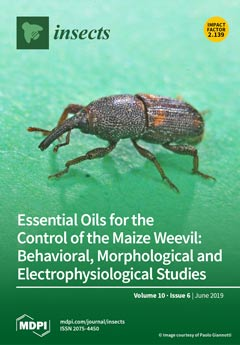
Cover Story: The sustainable control of insect pests in stored products has received increasing attention and essential oils (EOs) could represent an effective and environmentally safe control method. Aromatic plants from megadiverse countries could be a source of new effective repellents or insecticides to be considered in IPM strategies. In this study, we investigated the repellent effect of the EOs extracted from two Clinopodium (Lamiaceae) species typical of Ecuador Andean flora against the maize weevil Sitophilus zeamais. The EOs were chemically characterized, tested for insect EAG responses and, finally, used in behavioural bioassays. The antennal sensory structures of the maize weevil were also described in detail. The tests showed that the Clinopodium EOs are perceived by S. zeamais via antennal olfactory sensilla and showed a clear repellent activity towards the weevil. View this paper
  • Issues are regarded as officially published after their release is announced to the table of contents alert mailing list .
  • You may sign up for email alerts to receive table of contents of newly released issues.
  • PDF is the official format for papers published in both, html and pdf forms. To view the papers in pdf format, click on the "PDF Full-text" link, and use the free Adobe Reader to open them.

Articles (32)

  • Article
  • Open Access
46 Citations
4,997 Views
12 Pages

25 June 2019

Trichopria drosophilae is a pupal parasitoid that can develop in a large number of drosophilid host species including the invasive pest Drosophila suzukii, and is considered a biological control agent. We investigated the influence of the rearing hos...

  • Article
  • Open Access
12 Citations
4,691 Views
11 Pages

Effects of Host Plants Reared under Elevated CO2 Concentrations on the Foraging Behavior of Different Stages of Corn Leaf Aphids Rhopalosiphum maidis

  • Yu Chen,
  • Clément Martin,
  • Junior Corneille Fingu Mabola,
  • François Verheggen,
  • Zhenying Wang,
  • KangLai He and
  • Frederic Francis

23 June 2019

Climate change is a major environmental concern and is directly related to the increasing concentrations of greenhouse gases. The increase in concentrations of atmospheric carbon dioxide (CO2), not only affects plant growth and development, but also...

  • Article
  • Open Access
14 Citations
6,475 Views
7 Pages

22 June 2019

A previously unknown bark beetle species, Cryphalus eriobotryae sp. nov. Johnson, 2019 has emerged as a lethal pest of loquat (Eriobotrya japonica) in China. The description of new species has been provided. The new species is distinguished from the...

  • Article
  • Open Access
19 Citations
7,291 Views
14 Pages

22 June 2019

Habitat manipulation through the incorporation of non-crop plants such as trap crops (to lure pests away from the cash crop) and insectary plants (to provide resources for natural enemies) into agro-ecosystems is an ecological approach to pest manage...

  • Article
  • Open Access
50 Citations
6,519 Views
16 Pages

Synergistic Toxicity of Plant Essential Oils Combined with Pyrethroid Insecticides against Blow Flies and the House Fly

  • Suttida Suwannayod,
  • Kabkaew L. Sukontason,
  • Benjawan Pitasawat,
  • Anuluck Junkum,
  • Kwankamol Limsopatham,
  • Malcolm K. Jones,
  • Pradya Somboon,
  • Ratana Leksomboon,
  • Theeraphap Chareonviriyaphap and
  • Kom Sukontason
  • + 2 authors

21 June 2019

Blow flies (Diptera: Calliphoridae) and the house fly (Diptera: Muscidae) are filth flies of medical importance, and control of their population is needed. As insecticide applications have resulted in fly resistance, and the exploration of plant esse...

  • Review
  • Open Access
57 Citations
11,169 Views
20 Pages

21 June 2019

Small-scale farms are an important component of agricultural production even in developed economies, and have an acknowledged role in providing other biological and societal benefits, including the conservation of agricultural biodiversity and enhanc...

  • Article
  • Open Access
41 Citations
7,157 Views
15 Pages

Endophytic Beauveria bassiana in Foliar-Treated Citrus limon Plants Acting as a Growth Suppressor to Three Successive Generations of Diaphorina citri Kuwayama (Hemiptera: Liviidae)

  • Bamisope Steve Bamisile,
  • Chandra Kanta Dash,
  • Komivi Senyo Akutse,
  • Muhammad Qasim,
  • Luis Carlos Ramos Aguila,
  • Fangfei Wang,
  • Ravindran Keppanan and
  • Liande Wang

19 June 2019

Entomopathogenic fungi are commonly applied as inundative sprays to protect plants against insect pests. Their artificial establishment as fungal endophytes to provide other benefits to the host plants aside mere protection against the primary pests...

  • Article
  • Open Access
3 Citations
6,851 Views
12 Pages

Sticky Trap Design Considerations for Entrapping Bed Bugs

  • Benjamin A. Hottel,
  • Roberto M. Pereira,
  • Salvador A. Gezan and
  • Philip G. Koehler

19 June 2019

Little evidence has been presented on the usefulness of sticky traps for monitoring bed bugs, Cimex lectularius. We examined how the surface roughness around the adhesive of a sticky trap affects both bed bug behavior and adhesive entrapment. In the...

  • Article
  • Open Access
12 Citations
5,463 Views
11 Pages

Halyomorpha halys (Hemiptera: Pentatomidae) Genetic Diversity in North America and Europe

  • Despoina Ev. Kapantaidaki,
  • Vassiliki I. Evangelou,
  • William R. Morrison,
  • Tracy C. Leskey,
  • Jacques Brodeur and
  • Panagiotis Milonas

17 June 2019

The brown marmorated stink bug, Halyomorpha halys (Hemiptera: Pentatomidae), is an invasive species in North America and Europe that damages many different host plants. Substantial work has been conducted on the genetic diversity and invasion pathway...

  • Article
  • Open Access
20 Citations
6,531 Views
20 Pages

Chemosensory Gene Families in the Oligophagous Pear Pest Cacopsylla chinensis (Hemiptera: Psyllidae)

  • Ji-Wei Xu,
  • Xiu-Yun Zhu,
  • Qiu-Jie Chao,
  • Yong-Jie Zhang,
  • Yu-Xia Yang,
  • Ran-Ran Wang,
  • Yu Zhang,
  • Meng-Zhen Xie,
  • Ya-Ting Ge and
  • Lu Xu
  • + 4 authors

17 June 2019

Chemosensory systems play an important role in insect behavior, and some key associated genes have potential as novel targets for pest control. Cacopsylla chinensis is an oligophagous pest and has become one of the main pests of pear trees, but littl...

  • Review
  • Open Access
22 Citations
9,475 Views
23 Pages

Mosquitoes of Etiological Concern in Kenya and Possible Control Strategies

  • Samuel Karungu,
  • Evans Atoni,
  • Joseph Ogalo,
  • Caroline Mwaliko,
  • Bernard Agwanda,
  • Zhiming Yuan and
  • Xiaomin Hu

16 June 2019

Kenya is among the most affected tropical countries with pathogen transmitting Culicidae vectors. For decades, insect vectors have contributed to the emergence and distribution of viral and parasitic pathogens. Outbreaks and diseases have a great imp...

  • Review
  • Open Access
158 Citations
25,263 Views
26 Pages

Mayflies (Ephemeroptera) and Their Contributions to Ecosystem Services

  • Luke M. Jacobus,
  • Craig R. Macadam and
  • Michel Sartori

14 June 2019

This work is intended as a general and concise overview of Ephemeroptera biology, diversity, and services provided to humans and other parts of our global array of freshwater and terrestrial ecosystems. The Ephemeroptera, or mayflies, are a small but...

  • Article
  • Open Access
22 Citations
6,633 Views
23 Pages

Andean Flora as a Source of New Repellents against Insect Pests: Behavioral, Morphological and Electrophysiological Studies on Sitophilus zeamais (Coleoptera: Curculionidae)

  • Roberto Romani,
  • Stefano Bedini,
  • Gianandrea Salerno,
  • Roberta Ascrizzi,
  • Guido Flamini,
  • Maria Cristina Echeverria,
  • Priscilla Farina and
  • Barbara Conti

14 June 2019

Sitophilus zeamais (Motschulsky) is considered as one of the most destructive foodstuff pests. Due to their efficiency, low toxicity for mammalians and low environmental impact, plant-derived essential oils (EOs) are promising tools for pest control....

  • Article
  • Open Access
8 Citations
4,483 Views
11 Pages

14 June 2019

Numerous terrestrial arthropods are infected with the alphaproteobacterium Wolbachia. This endosymbiont is usually transmitted vertically from infected females to their offspring and can alter the reproduction of hosts through various manipulations,...

  • Article
  • Open Access
29 Citations
4,811 Views
13 Pages

13 June 2019

Megalurothrips usitatus (Bagnall) is one of the most harmful pests of leguminous plants. In order to expand our knowledge on the infection of M. usitatus by entomopathogenic fungi, two newly identified isolates of Akanthomyces attenuatus (Zare &...

  • Communication
  • Open Access
8 Citations
3,497 Views
12 Pages

13 June 2019

The Chinese citrus fly, Bactrocera minax, is a devastating pest of citrus, which enters the obligatory diapause in overwintering pupae to resist harsh environmental conditions. However, little is known about the molecular mechanisms underlying pupal...

  • Article
  • Open Access
10 Citations
4,305 Views
11 Pages

Occurrence and Distribution of Apolygus lucorum on Weed Hosts and Tea Plants in Tea Plantation Ecosystems

  • Yueyue Tian,
  • Hanyue Wang,
  • Jian Hou,
  • Lixia Zhang,
  • Zhengqun Zhang and
  • Xiaoming Cai

11 June 2019

The mirid bugs are one of the most important piercing–sucking insect pests in tea plantations, which severely reduce the quality and economic benefits of tea. In this study, the mirid bug species in the three tea-producing areas in Shandong Pro...

  • Article
  • Open Access
42 Citations
4,687 Views
13 Pages

RNAi-Mediated Knockdown of Tssk1 and Tektin1 Genes Impair Male Fertility in Bactrocera dorsalis

  • Summar Sohail,
  • Kaleem Tariq,
  • Weiwei Zheng,
  • Muhammad Waqar Ali,
  • Wei Peng,
  • Muhammad Fahim Raza and
  • Hongyu Zhang

10 June 2019

The genetic-based sterile insect technique (SIT) is an effective and environmentally safe strategy to diminish populations of agricultural and horticultural insect pests. Functional characterization of genes related to male fertility can enhance the...

  • Article
  • Open Access
51 Citations
5,717 Views
15 Pages

Effects of Endophytic Entomopathogenic Ascomycetes on the Life-History Traits of Aphis gossypii Glover and Its Interactions with Melon Plants

  • Natalia González-Mas,
  • Araceli Sánchez-Ortiz,
  • Pablo Valverde-García and
  • Enrique Quesada-Moraga

10 June 2019

Entomopathogenic fungi are sprayed commercially for aphid control in greenhouses. Recently, their ability to grow endophytically within plants was discovered, offering the opportunity for systemic biological control. Endophytic colonization of host p...

  • Article
  • Open Access
3 Citations
4,224 Views
18 Pages

10 June 2019

In this paper, the mature larva and pupa of Bagous claudicans are described and illustrated for the first time. Measurements of younger larval instars are also given. The biology of the species is discussed in association with larval morphology and f...

  • Article
  • Open Access
10 Citations
5,961 Views
10 Pages

Functional Morphology and Defensive Behavior in a Social Aphid

  • Junaid Ali Siddiqui,
  • Xuting Zou,
  • Qian Liu,
  • Hui Zhang,
  • Xiaolan Lin and
  • Xiaolei Huang

9 June 2019

Social aphids produce different morphs, which are genetically identical but morphologically different. Each morph performs a different duty in its community. Social aphids usually produce morphologically distinct soldiers to protect their colonies. T...

  • Article
  • Open Access
11 Citations
4,031 Views
11 Pages

Toxicity of Kadsura coccinea (Lem.) A. C. Sm. Essential Oil to the Bed Bug, Cimex lectularius L. (Hemiptera: Cimicidae)

  • Junaid U. Rehman,
  • Mei Wang,
  • Yupei Yang,
  • Yongbei Liu,
  • Bin Li,
  • Yan Qin,
  • Wei Wang,
  • Amar G. Chittiboyina and
  • Ikhlas A. Khan

7 June 2019

Kadsura coccinea (Lem.) A.C. Smith is an evergreen, woody climbing plant that is widely distributed throughout southwest mainland China. Extracts of this plant are used in traditional Chinese medicine (TCM) for the treatment of various diseases, like...

  • Review
  • Open Access
9 Citations
4,174 Views
10 Pages

5 June 2019

The invasive Mexican rice borer, Eoreuma loftini (Dyar), expanded its range from Mexico to South Texas in the early 1980s. By 2008 the pest had moved into sugarcane- and rice-growing areas of East Texas and Louisiana, and by 2012 it was reported on n...

  • Article
  • Open Access
10 Citations
4,639 Views
15 Pages

5 June 2019

Bradysia odoriphaga is a major pest that causes damage to chive production, and which has developed resistance to highly toxic chemical insecticides. Entomopathogenic nematodes (EPN) show a high potential for B. odoriphaga control. This study aimed t...

  • Article
  • Open Access
17 Citations
3,946 Views
12 Pages

4 June 2019

Seasonal weather systems that establish prevailing winds and seasonal rainfall on a large scale largely determine insect migration patterns, especially for micro-insects with completely windborne migration. Recent studies indicated that the summer mi...

  • Communication
  • Open Access
8 Citations
4,148 Views
11 Pages

4 June 2019

The horned passalus (Odontotaenius disjunctus) is one of the most extensively studied saproxylic beetles in the eastern United States. For several decades this species has been the subject of investigations into the behaviors associated with subsocia...

  • Communication
  • Open Access
13 Citations
5,428 Views
7 Pages

Discovery of Aphid Lethal Paralysis Virus in Vespa velutina and Apis cerana in China

  • Dahe Yang,
  • Hongxia Zhao,
  • Junming Shi,
  • Xiang Xu,
  • Yanyan Wu,
  • Rui Guo,
  • Dafu Chen,
  • Xinling Wang,
  • Shuai Deng and
  • Chunsheng Hou
  • + 2 authors

3 June 2019

Honey bees are essential to the functioning of terrestrial ecosystems. However, despite no single factor being blamed for losses of honey bee colonies in Europe and the USA, viruses have been considered as a major driver. Moreover, a virus vector can...

  • Article
  • Open Access
9 Citations
4,206 Views
9 Pages

The Compared Efficiency of the Traditional Method, Radiography without Contrast and Radiography with Contrast in the Determination of Infestation by Weevil (Sitophilus zeamais) in Maize Seeds

  • Maria Laene Moreira de Carvalho,
  • Eva Rezende Leite,
  • Geraldo Andrade Carvalho,
  • Fabiano França-Silva,
  • Dayliane Bernardes de Andrade and
  • Elizabeth Rosemeire Marques

1 June 2019

Technologies that increase safety and efficiency, while facilitating and streamlining the work of seed analysts, are increasingly required by the seed industry. X-ray image analysis is a technique that has been used in the analysis of grain and seeds...

  • Article
  • Open Access
6 Citations
5,000 Views
13 Pages

Unexpected Diversity of Wolbachia Associated with Bactrocera dorsalis (Diptera: Tephritidae) in Africa

  • Joseph Gichuhi,
  • Fathiya M. Khamis,
  • Johnnie Van den Berg,
  • Sunday Ekesi and
  • Jeremy K. Herren

31 May 2019

Bactrocera dorsalis (Hendel) is an important pest of fruit-bearing plants in many countries worldwide. In Africa, this pest has spread rapidly and has become widely established since the first invasion report in 2003. Wolbachia is a vertically transm...

  • Article
  • Open Access
19 Citations
4,030 Views
18 Pages

Inhibitory Effects of Plant Trypsin Inhibitors Msti-94 and Msti-16 on Therioaphis trifolii (Monell) (Homoptera: Aphididae) in Alfalfa

  • Hailong Zhao,
  • Hidayat Ullah,
  • Mark Richard McNeill,
  • Guilin Du,
  • Kun Hao,
  • Xiongbing Tu and
  • Zehua Zhang

30 May 2019

The spotted alfalfa aphid (Therioaphis trifolii (Monell)) is a known destructive pest that can significantly reduce alfalfa yields. Two differentially up-regulated alfalfa trypsin inhibitors ‘Msti-94’ and ‘Msti-16’ in transcri...

  • Article
  • Open Access
6 Citations
4,487 Views
14 Pages

29 May 2019

Effective pest management strategies for a targeted pest species must rely on accurate, reliable and reproducible estimates of population dynamics. Importance of such approaches is even more conspicuous when assessing pest’s potential to utiliz...

  • Article
  • Open Access
12 Citations
3,904 Views
11 Pages

The Prevalence of Bartonella Bacteria in Cattle Lice Collected from Three Provinces of Thailand

  • Chulaluk Promrangsee,
  • Pathamet Khositharattanakool,
  • Puckavadee Somwang,
  • Sakone Sunantaraporn,
  • Atchara Phumee,
  • Kanok Preativatanyou,
  • Apiwat Tawatsin,
  • Narisa Brownell and
  • Padet Siriyasatien

28 May 2019

Cattle lice are obligatory blood-sucking parasites, which is the cause of animal health problems worldwide. Recently, several studies have revealed that pathogenic bacteria could be found in cattle lice, and it can act as a potential vector for trans...

Get Alerted

Add your email address to receive forthcoming issues of this journal.

XFacebookLinkedIn
Insects - ISSN 2075-4450