


Abstract
Energy consumption in India is massive, and even the quantity used for household tasks is substantial. The majority of the requirement is satisfied by using fossil fuels, which are the traditional methods. Heating water is the most frequent home application. Accordingly, this article examines studies from the previous ten years. The information in this article demonstrates that using renewable energy is the greatest way to cut back on both the use of fossil fuels and carbon emissions while heating water for residential use. Solar, hydroelectric, wind, and biofuels are the most significant renewable sources for improving building efficiency that can be used for an extended period of time. The solar water heater is a common example of how solar energy is being used in homes more frequently. In order to identify key issues and solutions related to employing solar water heaters as an effective water heating application in both commercial and residential buildings, this article compiles research data from earlier studies (2012–2022). The literature survey was carried out using Scopus, a specialized database. Sixty-six dedicated research publications having search keywords plus recently published articles that matched the inclusion criteria were chosen for this review study. The study’s findings show that there is a greater inclination of researchers towards research and development in the field of domestic solar water heaters. The research publications that are being presented are all from the past 10 years (2012–2022) and stress the use of solar energy in increasing building efficiency. The study highlights how flat plate solar collectors with distilled water as the heat transfer fluid and a phase-changing substance as the thermal energy storage could potentially be enhanced. The thermal conductivity of paraffin wax and distilled water was improved by 75% of the researchers by using 0.05 to 0.5% concentrations of Al and Cu oxide nanoparticles, making it useful in solar water heaters. A total of 78% of researchers are interested in domestic water heating applications since they use a lot of energy in both urban and rural settings.
1. Introduction
Energy is used in some way by our daily activities. The main energy sources in the past were coal, wood, and animal manure. The biggest drawback of these sources is that they will eventually run out, which will make renewable energy sources even more crucial [1]. New energy types have been created to solve this problem. The most important long-term sustainable energy sources are solar energy, hydroelectric energy, wind energy, biofuels, and ocean wave energy. With the potential to be a viable renewable resource in the future, solar energy is a significant source of energy for both domestic and commercial applications. Due to its clean, abundant reserves, and pollution-free properties, solar energy has been addressing key interests as a type of renewable energy [2]. For engineering applications, solar energy provides a sizable reserve that may be gathered at a reasonable cost. Several countries rely on solar energy to meet their energy needs. The solar water heater is one of the most widely used household applications of solar energy (SWH).
The main issue with solar energy is that it is intermittent, and therefore unavailable during the night. As a result, thermal energy storage is required to store solar energy so that it can be used at night or when it is cloudy. One of the most intriguing ways to store solar thermal energy is through phase-changing materials (PCMs) [3]. Various PCMs, including organic and inorganic materials, eutectic mixes, and salt hydrates, are currently available for heat energy storage. The choice of PCM is influenced by thermal properties such as high latent heat, high heat capacity, and thermal conductivity in both solid and liquid phases [4,5]. Phase equilibrium, low vapor pressure, high sensitivity to volume change, and very high density are all desirable physical properties of PCMs [6]. According to previous research, PCMs have low thermal conductivity, undergo significant volume change, excellent cooling properties, and low heat-exchanging capabilities. Some of the inorganic PCMs, such as salt hydrates, show excellent thermal properties, but at the same time, these PCMs show super cooling and phase separation issues [7].
The use of nanometer-sized solid particles dispersed in common liquids is one method that has been developed to deal with these restrictions. Nanofluid (NF) is a term that refers to the suspension of particles ranging from one to one hundred nanometers in a typical base fluid. Choi and Eastman [8] were among the first researchers that utilized nanoparticles (NP) to enhance the thermal conductivity of fluids. In addition to exhibiting superior characteristics after suspension in a base liquid, NP also demonstrate greater stability compared to other millimeter- or micron-sized particles. The thermal conductivity of NF is substantially higher. Numerous studies have been conducted recently on a variety of NFs to enhance, experimentally and theoretically, the heat transmission in thermal engineering devices. In order to determine the thermophysical parameters of NFs, such as their density, viscosity, and specific heat, they have also used a number of production, characterization, and modeling techniques [9]. The improved thermophysical behavior of NF could present an excellent opportunity to intensify innovation in heat transfer, which can play a key role in HVAC application, power generation, microfabrication, thermal therapy for cancer treatment, and chemical and metallurgical sectors. Recent research on NF has focused on identifying methods to measure thermal conductivity [10]. Recently, Abouali, Ahmadi, and Kamyar looked at computer simulations and CFD-based model systems that used NFs and analyzed them [11,12]. Saidur et al. [13] noticed how NFs could be used in various areas, such as cooling electronics, heat exchangers, medical applications, fuel cells, and nuclear reactors. NF is also essential in SWH applications. We have examined the problems with using NF, such as how stable the nanoparticle dispersion is over time and how expensive it is.
In the literature, researchers have targeted finding the best way to use alternative energy sources to reduce the consumption of fossil fuels and CO2 emissions. As the price of fossils fuels-based energy is increasing day-by-day, renewable energy (solar) will be the energy of the present and the future. The amount of solar energy transferred to the earth in one hour is more than the entire world uses in a year [14]. Several changes were considered in order to find the best way to improve solar system efficiency while also making energy more stable and long-lasting. This paper examines the research that has been conducted on how NF can be used in SWH systems. According to the articles reviewed, SWH has a lot of potential for using solar energy, with a thermal energy storage (TES) system. Even after the sun goes down, the TES can keep the heat on [15,16]. Researchers can obtain a stable energy output from PCMs as TES for buildings applications. The low thermal conductivity of PCMs primarily influences how they absorb and emit heat. It is crucial for future studies because of the behavior and PCM impact relationship that was discovered [17]. In this way, tiny pieces of metal oxide, known as NPs, improve the thermal properties of PCMs. As a result, the majority of this review focuses on how NPs and NFs affect the efficiency of domestic SWH systems, as well as how they affect the economy and the environment when these systems are used.
The study’s main objectives can be divided into three categories: (a) to classify solar energy’s application-based driving force; (b) to study the techniques for boosting SWH with different designs of solar collectors; and (c) to study the application of PCM with different concentrations of NPs.
2. Methodology
A direct search of the literature is incorporated into the technique for article selection and country-wise distribution, as outlined in Figure 1.
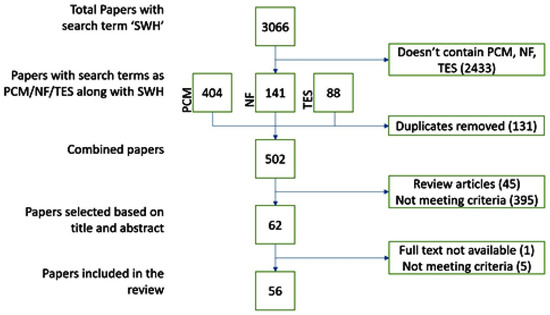
Figure 1.
Methodology adopted: flow diagram for article selection.
2.1. Search of the Literature
This study aims to present the most recent developments in thermal efficiency enhancement methodologies used to augment SWH and eliminate the obstacles that stand in the way of utilizing the SWH system in a variety of domestic and industrial applications by providing an overview of those developments. To compile the most recent research articles, the Scopus database was utilized. “Solar water heater”, “Phase changing materials”, “Thermal energy storage”, and “Nanofluid” were among the search terms that brought up a total of 3066 articles, conference papers, and review papers (Figure 1). All of the articles that were published in the journals with peer reviews were considered. The current analysis draws on a total of 56 different pieces of literature (Table 1). To familiarize the reader with the performance of SWH, nanocomposite PCMs were studied.

Table 1.
Search terms and combinations used.
The selection of papers was based on the following criteria: (a) the paper had to discuss the usage of PCMs as TES in SWH application; (b) the PCMs reported in the article had to be thermally enhanced with the application of NF. The following were among the factors for dismissal: (a) the study evaluated SWH without employing any TES technique; (b) the SWH application did not incorporate NF.
2.2. Data Extraction
According to the predetermined objectives, the information gathered from the research papers is organized into factors such as country and application. Table 2 was created to see if there was a pattern in the use of SWH across the country. It is worth noting that India has one of the highest rates of research in this field. Another categorization was performed in order to compile the various methods that are commonly used to evaluate thermal performance. When compared to existing strategies, these are just as effective at bringing about performance improvements.
Table 2.
Country-wise research trend of solar water heater from 2012–2022 and major research findings.
To consider the goal, the information gathered from the articles was further classified in Table 3, such as the specified design of the solar collector and the flow methodology used. The employment of various NPs concentrations with PCMs/distilled water was the subject of the next classification. This classification was also necessary to understand the role of PCMs in various solar collectors. Table 3 shows different NPs used for thermal conductivity improvement, i.e., CuO and Al2O3 are used in 38% of the previous literature research [7,8,9,12,13,14,15,16,17,19,21,22,25,26,27,35,37,38,39,42,43,44,48,50,52,53,54,55,57,58,59,60]. Authors have used other nanoparticles, such as graphene [10,20], CNT/MWCNT [11,24], and TiO2 [18,23], to improve heat transfer characteristics. From Table 3 it was concluded that 71–75% of researchers took 0.005–0.5%, and 25–29% took 1–5 percent of NPs by weight. Other NPs, such as SiO2, FeO2, ZnO, and expanded graphite, were also used by the researchers (Table 3).
Table 3.
Application of nanoparticles (with concentration) in solar water heating applications (2012–2022).
2.3. Obtained Results from the Reviewed Works
To find the relevant documents, the search terms “solar water heater”, “PCM”, and “Nanofluid” were directly entered into the Boolean formula. The majority of the papers discussed how PCM affects domestic SWH performance, but only a few looked at how NF can be used to improve SWH. The procedure extracted 503 documents, which were then re-filed based on the full text, yielding 56 papers, which are further extended up to 110+ articles. We will go over the information from these articles in greater detail in the following sections.
2.3.1. Distribution of Research Articles
When the article was distributed by country, India received the greatest share (36%), followed by China and Iran (nearly 11% each). The main suppliers were Egypt, the United States of America, Malaysia, and Hungary. China, Iran, and the United States of America all have more than a hundred days of sunshine per year [63]. In contrast, India has access to solar energy more than 300 days out of the year [64]. The majority of the articles discovered during the search process are from recent years. These data indicate that researchers see a bright future for solar energy harvesting.
2.3.2. Water Heating Applications by Utilizing Solar Energy
In this study, 78% of the articles were based on domestic SWH applications. In comparison, 11% were based on solar stills and other heat-exchanging devices. The deviation of 78% of articles towards domestic SWH applications gives hope of reducing a significant amount of carbon emission in water heating energy applications. A survey found that more than 80% of SWH applications are installed in residential buildings, and the rest (20%) belongs to public buildings and industries [65]. This survey shows that domestic SWH has more potential to harness this renewable energy source. The cost-effective appliances for solar water heating present an excellent view of solar energy utilization. However, low heat transfer rates and limited availability are still big hurdles in the path of SWH, which has drawn the attention of researchers [47].
2.3.3. Solar Collectors
These reviewed data point to the extensive adoption of flat plate collectors, accounting for 65% of all research articles. SWH systems that use evacuated tubes made of borosilicate glass with a special coating to absorb solar energy are called evacuated tube collector systems (ETC). Most flat plate collectors are used for low-temperature applications, while ETC is used for high-temperature applications. Nowadays, ETC is also very popular in domestic SWH. About 33% of the investigators have used ETC. An ETC has better thermal performance compared to a flat plate collector. Some of the earlier research reported that the cost of a NF-integrated heat collector is almost the same as a conventional heat collector [66,67,68,69,70]. In contrast, a NF-integrated solar collector is thermally more efficient than a conventional one. This becomes even more important considering the year-wise distribution of sunshine and the article percentages in those countries (Table 4).
Table 4.
Country-wise distribution of article share having maximum yearly sunshine hours.
2.3.4. Thermal Energy Storage
The reviewed articles found that 38% of researchers used paraffin wax as the TES. In comparison, only 4% of researchers used hydrates and eutectic mixtures. PCMs as heat accumulators work with the idea of absorbing and releasing thermal energy throughout the day during the charging and discharging process. Paraffin wax plays a vital role to achieve the desired objective in SWH application. The melting point of paraffin wax is 53 °C to 60 °C with latent heat storage of approx. 190 kJ/kg-K and thermal conductivity of 0.20 W/mK [71] (Table 5). PCMs change phases from solid to semi-liquid and then to liquid. The phase change process can also occur in the reverse direction when heat is removed from PCMs. When solar energy is available during the day, the paraffin wax absorbs heat and the temperature of the paraffin wax rises. The intensity of the sun’s radiation increases throughout the day, and the paraffin begins to change phase from solid to liquid (semi-solid) by absorbing more thermal energy, i.e., latent heat. As a result, the liquid-phase heat absorption process continues as sensible heating and behaves like a thermal reservoir [72,73]. About 52% of researchers used distilled water with NP as NF to improve domestic SWH and solar distillation. Between the temperature ranges of 40 °C to 52 °C, the PCM unit can store 5 times more energy than water. The appropriate amount of energy is delivered in a stable and consistent manner by the phase-change process. The sensible energy required to heat the PCM to 48 °C is only half that required to heat water. The choice of the fin pitch and the usage of expanded surfaces in the shape of aluminum fins resulted in an equivalent thermal conductivity of 23W/m-K. During sunshine, excess energy can be used in PCM thermal storage technology; this is called charging. The discharge process takes place when solar radiation is not accessible. Paraffin wax continuously loses heat to create a warming effect [74,75,76,77].
Table 5.
Comparison of thermal properties of paraffin wax found in the literature [72,73,74,75].
2.3.5. Nanoparticles-Embedded Nanofluid
Table 3 shows exhaustive applications of NPs to improve heat transfer characteristics. In the literature, authors used different NPs and evaluated how well they improve the thermal properties of base fluids. In contrast, in most research applications, CuO and Al2O3 are used alone (38%) or with other NFs (36%). About 71–75 percent of these researchers took 0.005–0.5 percent, and 25–29 percent took 1–5 percent of NPs’ weight. Other NPs, such as TiO2, SiO2, FeO2, ZnO, expanded graphite, and Carbon nanotube/multiwall carbon nanotube, were also used to speed up the rate at which the fluid transferred heat. As can be observed in Table 6, Al2O3, CuO, TiO2, and carbon nanotubes are very cheap nanoparticles with the best thermal conductivity, costing between INR 2,000 and 15,000 per 25 g. This is the reason why 73 percent of researchers used these NPs to improve the thermal properties of the SWH [78,79].
Table 6.
Thermal conductivity and cost comparison of NPs.
3. Discussion
Researchers are motivated to develop renewable energy-based water heating systems and to improve its efficiency. The efficiency of an SWH rises gradually from morning to noon, peaks at noon, and then progressively declines after midday as solar radiation drops. Higher productivity can be gained if the number of sunny days in a year is increased. In India, a higher amount of solar radiation in the summer months (May, June, and partial July), results in a higher fluid temperature, which can be highly beneficial for domestic SWH and solar still.
3.1. Effect of Collector
The efficiency of the collector determines how much energy is gathered from the radiation. The solar collector’s energy efficiency is determined by the amount of energy it receives and the amount of energy it transmits to the fluid. The solar energy collected was utilized to boost the thermal energy of the tank’s storage medium. In earlier research it was just water, but in later stages researchers have used PCM/nanocomposite PCM to improve the SWH thermal efficiency [80] (Table 5). The ability to maximize efficiency is a significant feature of the solar flat plate collector. One of the most important aspects of the collector is that it improves the heat transfer rate with the collecting area [81]. The evacuated tube is made up of double-layer borosilicate glass tubes that are thermally and chemically resistant. To ensure strong absorption of sunlight, the internal tube (absorber) is coated in a dark navy-blue tint. The entire mechanism is covered by the external glass tube. To obtain insulation, the air between the two layers of glass was vacuumed to create an evacuated space between the two tubes. This effect decreases the convection heat transfer loss [82,83,84].
3.2. Effect of PCM and Nanocomposite PCM
The thermal energy transfer characteristics of PCM and PCM nanocomposite can be assessed using a typical heating system to compare their melting (charging) and solidification (discharging) cycles. Melt mixing was used to prepare PCM-metal oxide nanocomposite. PCM-metal oxide nanocomposites have opened new research areas. In the first stage, PCM was heated on a hot plate to its phase transition temperature and then molten PCM was mixed extensively with the produced NPs for 20 min using a magnetic stirrer to create a stable PCM nanocomposite. Finally, a homogenous dispersion of PCM nanoparticle nanocomposite was obtained by ultrasonically treating the produced composite for 15 min [85]. By substituting NF for water, efficiency can be increased. These additions increased the PCM’s conductivity, increasing the quantity of solar energy transported from the absorber to the heat pipe through the PCM. The findings reveal that for the collector system with NF, the water temperature in the storage tank rises faster than for the system with only water working fluid. The maximum temperature is also higher than the pure water-based SWH system when NF is utilized as the working fluid in SWH [86,87].
Nano-enhanced PCM accumulates thermal energy in a shorter time in comparison to pure PCM. Due to their low cost, availability, limpness to the collector material and tank, low corrosiveness, easy dispersion in water, minimal scaling and fouling, and high thermal conductivity, Al2O3 and CuO-based NFs could be chosen as the best alternative as working fluids. In further research, it was concluded that TiO2 nanoparticles, due to their high surface area and less agglomeration in the composite, are suitable for maximum thermal conductivity. TiO2 also has a lower interfacial thermal resistance across the interface. Therefore, TiO2 aids in better heat transfer within the percolation network than SiO2, ZnO, and Fe2O3 metal oxide NPs [88,89].
3.3. Energy Movement through Nanoparticles
It was observed in the literature that solar panels with small NPs have a higher performance level in comparison to larger NP solar panels. This is due to the fact that NP-based NFs have higher thermal conductivity, resulting in a quick heat transfer, which contributes to the increased efficiency of the flat plate collectors [90,91,92]. Two different interpretations could be applied to this fact. On the one hand, when both the mass fraction and the number of particles are held constant, the number of small particles exceeds that of large particles. As a consequence of this, the small particles have a greater interface between the liquid and the particles than the large particles. As a result, there is a rapid and very effective exchange of heat. On the other hand, because of the tiny size effect caused by NPs, suspended NPs move in a random pattern. The micro-convection phenomenon occurs between particles and the liquid caused by the higher motion of the NPs. Due to micro-convection, there is an enhancement in the energy transfer process, which results in a thermal conductivity enhancement of NFs [93,94,95].
4. Conclusions
India is a country that produces solar energy. Currently, there are two major solar applications: electricity generation via photovoltaic cells and SWH. Solar energy is the most vital source of renewable energy that can be used for water heating applications in industry and residential buildings. Because of its low cost and high thermal efficiency, SWH is increasingly being used. However, many limitations have drawn the attention of researchers and have been thoroughly reviewed in this article. The critical points identified during the study are listed below:
- It was observed that in the past decade (2012–2022) researchers are more focused towards renewable energy-based technologies to improve building efficiency and reduce CO2 emissions. The most suitable example is SWH. Different methods and percentage improvements in thermal efficiency of SWH are evaluated in this article using the relevant articles available.
- Huge energy consumption was seen in domestic water heating applications in rural and urban areas attracting 78% of researchers toward domestic SWH.
- Most of the articles are based on flat plate solar collectors.
- Distilled water is the first choice of the researchers as most of the articles used it as the heat transfer fluid, and paraffin wax is extensively used as TES in domestic SWH.
- Cu and Al are the most popular nano particles due to their low cost and optimum thermal conductivity used in base fluids for improving thermal characteristics.
In the future, the study area can be extended to evaluate the use of advanced tools, such as ANN, fuzzy logic to analyze flow sensor application in buildings [96,97,98,99,100,101,102], advanced coating materials for photovoltaic applications and their thermal contact conductance analysis for rooftop solar plants and window paneling [103,104,105,106,107,108], and nano techniques for energy conversion and storage devices with a special emphasis on high performance piezoelectric nanogenerator for energy harvesting [109,110,111] in sustainable buildings.
Author Contributions
Conceptualization, P.K.K., N.K.S., A.K. and C.S.M.; methodology, P.K.K., N.K.S., A.K. and C.S.M.; validation, P.K.K. and N.K.S.; formal analysis, P.K.K., N.K.S., A.K. and C.S.M.; investigation, P.K.K., N.K.S., A.K. and C.S.M.; resources, P.K.K. and N.K.S.; data curation, P.K.K. and N.K.S.; writing—original draft preparation, P.K.K., N.K.S., A.K. and C.S.M.; writing—review and editing, P.K.K., N.K.S., A.K. and C.S.M.; visualization, P.K.K., N.K.S., A.K. and C.S.M.; supervision, P.K.K., N.K.S., A.K. and C.S.M.; project administration, P.K.K. and N.K.S. All authors have read and agreed to the published version of the manuscript.
Funding
This research received no external funding.
Institutional Review Board Statement
Not applicable.
Informed Consent Statement
Not applicable.
Data Availability Statement
Not applicable.
Conflicts of Interest
The authors declare that they have no conflict of interest.
References
- Mohamed, S.A.; Al-Sulaiman, F.A.; Ibrahim, N.I.; Zahir, H.; Al-Ahmed, A.; Saidur, R.; Yılbaş, B.S.; Sahin, A.Z. A review on current status and challenges of inorganic phase change materials for thermal energy storage systems. Renew. Sustain. Energy Rev. 2016, 70, 1072–1089. [Google Scholar] [CrossRef]
- Farid, M.M.; Khudhair, A.M.; Razack, S.A.K.; Al-Hallaj, S. A review on phase change energy storage: Materials and applications. Energy Convers. Manag. 2004, 45, 1597–1615. [Google Scholar] [CrossRef]
- Liu, M.; Saman, W.; Bruno, F. Review on storage materials and thermal performance enhancement techniques for high temperature phase change thermal storage systems. Renew. Sustain. Energy Rev. 2012, 16, 2118–2132. [Google Scholar] [CrossRef]
- Patel, A.; Namjoshi, S. Phase Change Material Based Solar Water Heater. Int. J. Eng. Sci. Invent. 2018, 5, 31–34. [Google Scholar]
- Shaisundaram, V.; Chandrasekaran, M.; Shanmugam, M.; Padmanabhan, S.; Muraliraja, R.; Karikalan, L. Investigation of Momordica charantia seed biodiesel with cerium oxide nanoparticle on CI engine. Int. J. Ambient. Energy 2019, 42, 1615–1619. [Google Scholar] [CrossRef]
- Muraliraja, R.; Sudagar, J.; Elansezhian, R.; Raviprakash, A.V.; Dhinakaran, R.; Shaisundaram, V.S.; Chandrasekaran, M. Estimation of Zwitterionic Surfactant Response in Electroless Composite Coating and Properties of Ni–P–CuO (Nano)Coating. Arab. J. Sci. Eng. 2018, 44, 821–828. [Google Scholar] [CrossRef]
- Mandal, S.K.; Kumar, S.; Singh, P.K.; Mishra, S.K.; Singh, D. Performance investigation of nanocomposite based solar water heater. Energy 2020, 198, 117295. [Google Scholar] [CrossRef]
- Ansu, A.K.; Sharma, R.K.; Hagos, F.Y.; Tripathi, D.; Tyagi, V.V. Improved thermal energy storage behavior of polyethylene glycol-based NEOPCM containing aluminum oxide nanoparticles for solar thermal applications. J. Therm. Anal. Calorim. 2020, 143, 1881–1892. [Google Scholar] [CrossRef]
- Hawwash, A.; Rahman, A.K.A.; Nada, S.; Ookawara, S. Numerical Investigation and Experimental Verification of Performance Enhancement of Flat Plate Solar Collector Using Nanofluids. Appl. Therm. Eng. 2017, 130, 363–374. [Google Scholar] [CrossRef]
- Ahmadi, A.; Ganji, D.D.; Jafarkazemi, F. Analysis of utilizing Graphene nanoplatelets to enhance thermal performance of flat plate solar collectors. Energy Convers. Manag. 2016, 126, 1–11. [Google Scholar] [CrossRef]
- Mahbubul, I.; Khan, M.M.A.; Ibrahim, N.I.; Ali, H.M.; Al-Sulaiman, F.A.; Saidur, R. Carbon nanotube nanofluid in enhancing the efficiency of evacuated tube solar collector. Renew. Energy 2018, 121, 36–44. [Google Scholar] [CrossRef]
- Munuswamy, D.B.; Madhavan, V.R.; Mohan, M. Comparison of the effects of Al2O3 and CuO nanoparticles on the performance of a solar flat-plate collector. J. Non-Equilib. Thermodyn. 2015, 40, 265–273. [Google Scholar] [CrossRef]
- Sadeghi, G.; Pisello, A.L.; Nazari, S.; Jowzi, M.; Shama, F. Empirical data-driven multi-layer perceptron and radial basis function techniques in predicting the performance of nanofluid-based modified tubular solar collectors. J. Clean. Prod. 2021, 295, 126409. [Google Scholar] [CrossRef]
- Sundar, L.S.; Singh, M.K.; Punnaiah, V.; Sousa, A.C. Experimental investigation of Al2O3/water nanofluids on the effectiveness of solar flat-plate collectors with and without twisted tape inserts. Renew. Energy 2017, 119, 820–833. [Google Scholar] [CrossRef]
- Sivakumar, P.; Raj, W.C.; Malathi, N.J.; Balamurugan, R. Experimental Investigation of Nano Particles Blended with Water on Solar Flat Plate Collector. Adv. Mater. Res. 2013, 768, 164–170. [Google Scholar] [CrossRef]
- He, Q.; Zeng, S.; Wang, S. Experimental investigation on the efficiency of flat-plate solar collectors with nanofluids. Appl. Therm. Eng. 2015, 88, 165–171. [Google Scholar] [CrossRef]
- El-Shafai, N.M.; Ji, R.; Abdelfatah, M.; Hamada, M.A.; Kandeal, A.; El-Mehasseb, I.M.; El-Shaer, A.; An, M.; Ramadan, M.S.; Sharshir, S.W.; et al. Investigation of a novel (GO@CuO.γ-Al2O3) hybrid nanocomposite for solar energy applications. J. Alloy. Compd. 2021, 856, 157463. [Google Scholar] [CrossRef]
- Ouyahia, S.-E.; Benkahla, Y.K.; Labsi, N. Numerical Study of the Hydrodynamic and Thermal Proprieties of Titanium Dioxide Nanofluids Trapped in a Triangular Geometry. Arab. J. Sci. Eng. 2016, 41, 1995–2009. [Google Scholar] [CrossRef]
- Sheikh, N.A.; Ali, F.; Khan, I.; Gohar, M.; Saqib, M. On the applications of nanofluids to enhance the performance of solar collectors: A comparative analysis of Atangana-Baleanu and Caputo-Fabrizio fractional models. Eur. Phys. J. Plus 2017, 132, 540. [Google Scholar] [CrossRef]
- Mahdi, M.M.; Jaddoa, A.A.; Kadhim, I.F.; Asmet, W. Outdoor testing of an evacuated tube closed two phase thermosyphon solar water heater charged with Nano-fluid. IOP Conf. Series Mater. Sci. Eng. 2020, 765, 12032. [Google Scholar] [CrossRef]
- Michael, J.J.; Iniyan, S. Performance analysis of a copper sheet laminated photovoltaic thermal collector using copper oxide—Water nanofluid. Sol. Energy 2015, 119, 439–451. [Google Scholar] [CrossRef]
- Rajput, N.S.; Shukla, D.D.; Rajput, D.; Sharm, S.K. Performance Analysis of Flat Plate Solar Collector using Al2O3/Distilled Water Nanofluid: An Experimental Investigation. Mater. Today Proc. 2019, 10, 52–59. [Google Scholar] [CrossRef]
- Kumar, R.R.; Suthahar, S.J.; Sakthivel, C.; Vijayan, V.; Yokeshwaran, R. Performance analysis of solar water heater by using TiO2 nanofluids. Mater. Today Proc. 2020, 21, 817–819. [Google Scholar] [CrossRef]
- Rajput, N.S.; Shukla, D.D.B.; Sharma, S.K.; Rajput, D. Thermal analysis of mwcnt/distilled water nanofluid on the effi-ciency of flat plate solar collector. Int. J. Mech. Eng. Technol. 2017, 8, 233–240. [Google Scholar]
- Darbari, B.; Rashidi, S. Thermal efficiency of flat plate thermosyphon solar water heater with nanofluids. J. Taiwan Inst. Chem. Eng. 2021, 128, 276–287. [Google Scholar] [CrossRef]
- Kabeel, A.; El-Said, E.M.; Abdulaziz, M. Thermal solar water heater with H2O-Al2O3 nano-fluid in forced convection: Experimental investigation. Int. J. Ambient Energy 2015, 38, 85–93. [Google Scholar] [CrossRef]
- Sundar, L.S.; Akanaw, T.T.; Singh, M.K.; Sousa, A.C.M. Thermosyphon solar water heating system with Cu/water nanofluid and wire coil configurations: Efficiency, energy, economic, environmental, and heat transfer study. Environ. Prog. Sustain. Energy 2021, 40, e13648. [Google Scholar] [CrossRef]
- Delfani, S.; Karami, M.; Akhavan-Behabadi, M.A. Performance characteristics of a residential-type direct absorption solar collector using MWCNT nanofluid. Renew. Energy 2016, 87, 754–764. [Google Scholar] [CrossRef]
- Owolabi, A.L.; Al-Kayiem, H.H.; Baheta, A.T. Performance investigation on a thermal energy storage integrated solar collector system using nanofluid. Int. J. Energy Res. 2017, 41, 650–657. [Google Scholar] [CrossRef]
- Ling, Z.; Liu, J.; Wang, Q.; Lin, W.; Fang, X.; Zhang, Z. MgCl2·6H2O-Mg(NO3)2·6H2O eutectic/SiO2 composite phase change material with improved thermal reliability and enhanced thermal conductivity. Sol. Energy Mater. Sol. Cells 2017, 172, 195–201. [Google Scholar] [CrossRef]
- Gupta, N.; Kumar, A.; Dhasmana, H.; Kumar, V.; Kumar, A.; Shukla, P.; Verma, A.; Nutan, G.V.; Dhawan, S.; Jain, V. Enhanced thermophysical properties of Metal oxide nanoparticles embedded magnesium nitrate hexahydrate based nanocomposite for thermal energy storage applications. J. Energy Storage 2020, 32, 101773. [Google Scholar] [CrossRef]
- Sobhansarbandi, S.; Martinez, P.M.; Papadimitratos, A.; Zakhidov, A.; Hassanipour, F. Evacuated tube solar collector with multifunctional absorber layers. Sol. Energy 2017, 146, 342–350. [Google Scholar] [CrossRef]
- Kumar, P.M.; Mylsamy, K. A comprehensive study on thermal storage characteristics of nano-CeO2 embedded phase change material and its influence on the performance of evacuated tube solar water heater. Renew. Energy 2020, 162, 662–676. [Google Scholar] [CrossRef]
- Shabtay, Y.L.; Black, J.R. Compact Hot Water Storage Systems Combining Copper Tube with High Conductivity Graphite and Phase Change Materials. Energy Procedia 2014, 48, 423–430. [Google Scholar] [CrossRef]
- Manirathnam, A.; Manikandan, M.D.; Prakash, R.H.; Kumar, B.K.; Amarnath, M.D. Experimental analysis on solar water heater integrated with Nano composite phase change material (SCi and CuO). Mater. Today: Proc. 2020, 37, 232–240. [Google Scholar] [CrossRef]
- Kumar, P.M.; Mylsamy, K. Experimental investigation of solar water heater integrated with a nanocomposite phase change material. J. Therm. Anal. Calorim. 2018, 136, 121–132. [Google Scholar] [CrossRef]
- Mirzaei, M. Experimental investigation of the assessment of Al2O3–H2O and CuO–H2O nanofluids in a solar water heating system. J. Energy Storage 2017, 14, 71–81. [Google Scholar] [CrossRef]
- Saw, C.L.; Al-Kayiem, H.H.; Owolabi, A.L. Experimental investigation on the effect of PCM and nano-enhanced PCM of integrated solar collector performance. In Proceedings of the Sustainable City 2022, Rome, Italy, 10–12 October 2022. [Google Scholar] [CrossRef]
- Vinet, L.; Zhedanov, A. A ‘missing’ family of classical orthogonal polynomials. J. Phys. A Math. Theor. 2011, 44, 85201. [Google Scholar] [CrossRef]
- Pasupathi, M.K.; Mylsamy, K.; Joseph, M.; Prakasam, S.; Karthick, A. Influence of Nano-Enhanced Phase Change Material (NEPCM) on the Performance of Solar Water Heater; Nova Science Publishers, Inc.: Hauppauge, NY, USA, 2021. [Google Scholar]
- Kumar, P.M.; Mylsamy, K.; Alagar, K.; Sudhakar, K. Investigations on an evacuated tube solar water heater using hybrid-nano based organic phase change material. Int. J. Green Energy 2020, 17, 872–883. [Google Scholar] [CrossRef]
- Mandal, S.K.; Singh, P.K.; Kumar, S.; Mishra, S.K. Parametric investigation of CuO-doped charged nanofluid in solar water heater. Int. J. Environ. Sci. Technol. 2020, 18, 2855–2864. [Google Scholar] [CrossRef]
- Al-Kayiem, H.H.; Lin, S.C. Performance evaluation of a solar water heater integrated with a PCM nanocomposite TES at various inclinations. Sol. Energy 2014, 109, 82–92. [Google Scholar] [CrossRef]
- Mandal, S.K.; Kumar, S.; Singh, P.K.; Mishra, S.K.; Bishwakarma, H.; Choudhry, N.P.; Nayak, R.K.; Das, A.K. Performance investigation of CuO-paraffin wax nanocomposite in solar water heater during night. Thermochim. Acta 2018, 671, 36–42. [Google Scholar] [CrossRef]
- Liu, L.; Chen, J.; Qu, Y.; Xu, T.; Wu, H.; Zhou, X.; Zhang, H. Preparation and thermal properties of low melting point alloy/expanded graphite composite phase change materials used in solar water storage system. Sol. Energy Mater. Sol. Cells 2019, 201, 110112. [Google Scholar] [CrossRef]
- Sobhansarbandi, S.; Martinez, P.M.; Papadimitratos, A.; Zakhidov, A.; Hassanipour, F. Solar Thermal Collector with Multifunctional Absorber Layers. In Proceedings of the ASME 2017 Power Conference Joint with ICOPE-17 collocated with the ASME 2017 11th International Conference on Energy Sustainability, the ASME 2017 15th International Conference on Fuel Cell Science, Engineering and Technology, and the ASME 2017 Nuclear Forum, Charlotte, NC, USA, 26–30 June 2017. [Google Scholar] [CrossRef]
- Alshukri, M.J.; Eidan, A.A.; Najim, S.I. The influence of integrated Micro-ZnO and Nano-CuO particles/paraffin wax as a thermal booster on the performance of heat pipe evacuated solar tube collector. J. Energy Storage 2021, 37, 102506. [Google Scholar] [CrossRef]
- Dhinakaran, R.; Muraliraja, R.; Elansezhian, R.; Baskar, S.; Satish, S.; Shaisundaram, V. Utilization of solar resource using phase change material assisted solar water heater and the influence of nano filler. Mater. Today Proc. 2020, 37, 1281–1285. [Google Scholar] [CrossRef]
- Li, C.; Zhang, B.; Xie, B.; Zhao, X.; Chen, J.; Chen, Z.; Long, Y. Stearic acid/expanded graphite as a composite phase change thermal energy storage material for tankless solar water heater. Sustain. Cities Soc. 2018, 44, 458–464. [Google Scholar] [CrossRef]
- Sahota, L.; Tiwari, G. Exergoeconomic and enviroeconomic analyses of hybrid double slope solar still loaded with nanofluids. Energy Convers. Manag. 2017, 148, 413–430. [Google Scholar] [CrossRef]
- Mahian, O.; Kianifar, A.; Heris, S.Z.; Wen, D.; Sahin, A.Z.; Wongwises, S. Nanofluids effects on the evaporation rate in a solar still equipped with a heat exchanger. Nano Energy 2017, 36, 134–155. [Google Scholar] [CrossRef]
- Rabbi, H.M.F.; Sahin, A.Z. Performance improvement of solar still by using hybrid nanofluids. J. Therm. Anal. Calorim. 2020, 143, 1345–1360. [Google Scholar] [CrossRef]
- Elsaid, E.; Kabeel, A.; Abdulaziz, M. Theoretical study on hybrid desalination system coupled with nano-fluid solar heater for arid states. Desalination 2016, 386, 84–98. [Google Scholar] [CrossRef]
- Dawood, M.M.K.; Nabil, T.; Kabeel, A.; Shehata, A.I.; Abdalla, A.M.; Elnaghi, B.E. Experimental study of productivity progress for a solar still integrated with parabolic trough collectors with a phase change material in the receiver evacuated tubes and in the still. J. Energy Storage 2020, 32, 102007. [Google Scholar] [CrossRef]
- Muraleedharan, M.; Singh, H.; Udayakumar, M.; Suresh, S. Modified active solar distillation system employing directly absorbing Therminol 55–Al2O3 nano heat transfer fluid and Fresnel lens concentrator. Desalination 2019, 457, 32–38. [Google Scholar] [CrossRef]
- Mishra, D.K.; Bhowmik, S.; Pandey, K.M. Experimental Investigations of Beeswax Based Composite Phase Change Material. In Recent Advances in Mechanical Engineering; Springer: Singapore, 2021; pp. 891–899. [Google Scholar] [CrossRef]
- Tlili, I.; Seyyedi, S.M.; Dogonchi, A.; Hashemi-Tilehnoee, M.; Ganji, D. Analysis of a single-phase natural circulation loop with hybrid-nanofluid. Int. Commun. Heat Mass Transf. 2020, 112, 104498. [Google Scholar] [CrossRef]
- Khoshvaght-Aliabadi, M.; Tatari, M.; Salami, M. Analysis on Al2O3/water nanofluid flow in a channel by inserting corrugated/perforated fins for solar heating heat exchangers. Renew. Energy 2018, 115, 1099–1108. [Google Scholar] [CrossRef]
- Chaurasia, S.R.; Sarviya, R. Experimental and numerical thermal performance analysis with exergy destruction on nanofluid flow in tube with double strip helical screw inserts. Proc. Inst. Mech. Eng. Part A J. Power Energy 2021, 235, 1661–1680. [Google Scholar] [CrossRef]
- Misale, M.; Devia, F.; Garibaldi, P. Experiments with Al2O3 nanofluid in a single-phase natural circulation mini-loop: Preliminary results. Appl. Therm. Eng. 2012, 40, 64–70. [Google Scholar] [CrossRef]
- Lin, W.; Ling, Z.; Zhang, Z.; Fang, X. Experimental and numerical investigation of sebacic acid/expanded graphite composite phase change material in a double-spiral coiled heat exchanger. J. Energy Storage 2020, 32, 101849. [Google Scholar] [CrossRef]
- Wu, J.; Feng, Y.; Liu, C.; Li, H. Heat transfer characteristics of an expanded graphite/paraffin PCM-heat exchanger used in an instantaneous heat pump water heater. Appl. Therm. Eng. 2018, 142, 644–655. [Google Scholar] [CrossRef]
- Available online: https://www.power-technology.com/features/featuresolar-power-india-lets-the-sunshine-in/ (accessed on 22 October 2022).
- Maithel, S. Solar Water Heaters in India: Market Assessment Studies and Surveys for Different Sectors; Greentech Knowledge Solutions: Delhi, India, 2010; Volume 110078. [Google Scholar]
- Rashidi, S.; Karimi, N.; Mahian, O.; Esfahani, J.A. A concise review on the role of nanoparticles upon the productivity of solar desalination systems. J. Therm. Anal. Calorim. 2018, 135, 1145–1159. [Google Scholar] [CrossRef]
- Available online: http://weather2travel.com/climate-guides/egypt/marsa-al-alam.php (accessed on 22 October 2022).
- Available online: https://en.wikipedia.org/wiki/National_Oceanic_and_Atmospheric_Administration (accessed on 22 October 2022).
- Available online: http://www.currentresults.com/Weather/India/annual-sunshine.php#a (accessed on 22 October 2022).
- Available online: https://en.wikipedia.org/wiki/China_Meteorological_Administration (accessed on 22 October 2022).
- Available online: http://www.chaharmahalmet.ir/iranarchive.asp (accessed on 22 October 2022).
- Ettouney, H.; Alatiqi, I.; Al-Sahali, M.; Al-Hajirie, K. Heat transfer enhancement in energy storage in spherical capsules filled with paraffin wax and metal beads. Energy Convers. Manag. 2006, 47, 211–228. [Google Scholar] [CrossRef]
- Alkilani, M.M.; Sopian, K.; Mat, S. Fabrication and Experimental Investigation of PCM Capsules Integrated in Solar Air Heater. Am. J. Environ. Sci. 2011, 7, 542–546. [Google Scholar] [CrossRef]
- Regin, A.F.; Solanki, S.; Saini, J. Latent heat thermal energy storage using cylindrical capsule: Numerical and experimental investigations. Renew. Energy 2006, 31, 2025–2041. [Google Scholar] [CrossRef]
- Agarwal, A.; Sarviya, R. Characterization of Commercial Grade Paraffin wax as Latent Heat Storage material for Solar dryers. Mater. Today Proc. 2017, 4, 779–789. [Google Scholar] [CrossRef]
- Liu, G.; Du, Z.; Xiao, T.; Guo, J.; Lu, L.; Yang, X.; Hooman, K. Design and assessments on a hybrid pin fin-metal foam structure towards enhancing melting heat transfer: An experimental study. Int. J. Therm. Sci. 2022, 182, 107809. [Google Scholar] [CrossRef]
- Obergfell, T.; Gölz, S.; Haussmann, T.; Gschwander, S.; Wagner, A. Influence of User Behaviour on the Functioning and Performance of Passive Phase-Change Material Systems after More Than a Decade of Operation. Buildings 2022, 12, 1797. [Google Scholar] [CrossRef]
- Thakkar, J.; Bowen, N.; Chang, A.C.; Horwath, P.; Sobkowicz, M.J.; Kośny, J. Optimization of Preparation Method, Nucleating Agent, and Stabilizers for Synthesizing Calcium Chloride Hexahydrate (CaCl2.6H2O) Phase Change Material. Buildings 2022, 12, 1762. [Google Scholar] [CrossRef]
- Singh, V.P.; Jain, S.; Karn, A.; Dwivedi, G.; Kumar, A.; Mishra, S.; Sharma, N.K.; Bajaj, M.; Zawbaa, H.M.; Kamel, S. Heat transfer and friction factor correlations development for double pass solar air heater artificially roughened with perforated multi-V ribs. Case Stud. Therm. Eng. 2022, 39, 102461. [Google Scholar] [CrossRef]
- Meena, C.S.; Kumar, A.; Roy, S.; Cannavale, A.; Ghosh, A. Review on Boiling Heat Transfer Enhancement Techniques. Energies 2022, 15, 5759. [Google Scholar] [CrossRef]
- Singh, V.P.; Jain, S.; Karn, A.; Kumar, A.; Dwivedi, G.; Meena, C.S.; Cozzolino, R. Mathematical Modeling of Efficiency Evaluation of Double-Pass Parallel Flow Solar Air Heater. Sustainability 2022, 14, 10535. [Google Scholar] [CrossRef]
- Meena, C.S.; Kumar, A.; Jain, S.; Rehman, A.U.; Mishra, S.; Sharma, N.K.; Bajaj, M.; Shafiq, M.; Eldin, E.T. Innovation in Green Building Sector for Sustainable Future. Energies 2022, 15, 6631. [Google Scholar] [CrossRef]
- Singh, V.P.; Jain, S.; Karn, A.; Kumar, A.; Dwivedi, G.; Meena, C.S.; Dutt, N.; Ghosh, A. Recent Developments and Advancements in Solar Air Heaters: A Detailed Review. Sustainability 2022, 14, 12149. [Google Scholar] [CrossRef]
- Dutt, N.; Binjola, A.; Hedau, A.J.; Kumar, A.; Singh, V.P.; Meena, C.S. Comparison of CFD Results of Smooth Air Duct with Experimental and Available Equations in Literature. Int. J. Energy Resour. Appl. 2022, 1, 40–47. [Google Scholar] [CrossRef]
- Singh, V.P.; Jain, S.; Kumar, A. Establishment of correlations for the thermo-hydraulic parameters due to perforation in a multi-V rib roughened single pass solar air heater. Exp. Heat Transf. 2022, 1–20. [Google Scholar] [CrossRef]
- Singh, V.P.; Jain, S.; Karn, A.; Dwivedi, G.; Alam, T.; Kumar, A. Experimental Assessment of Variation in Open Area Ratio on Thermohydraulic Performance of Parallel Flow Solar Air Heater. Arab. J. Sci. Eng. 2022; in press. [Google Scholar]
- Meena, C.S.; Prajapati, A.N.; Kumar, A.; Kumar, M. Utilization of Solar Energy for Water Heating Application to Improve Building Energy Efficiency: An Experimental Study. Buildings 2022, 12, 2166. [Google Scholar] [CrossRef]
- Meena, C.S.; Deep, A.; Das, A.K. Understanding of Interactions for Bubbles Generated at Neighboring Nucleation Sites. Heat Transf. Eng. 2017, 39, 885–900. [Google Scholar] [CrossRef]
- Meena, C.S.; Meena, S.; Bajpai, V. Correlation between Absorber Plate Thickness δ and Collector Efficiency Factor F’ of Solar Flat-Plate Collector. Appl. Mech. Mater. 2014, 592–594, 2341–2344. [Google Scholar] [CrossRef]
- Meena, S.; Meena, C.S.; Bajpai, V.K. Thermal Performance of Flat-Plate Collector: An Experimental Study. Int. J. Eng. Res. Appl. 2014, 1–4. [Google Scholar]
- Kumar, A.; Singh, P.; Kapoor, N.R.; Meena, C.S.; Jain, K.; Kulkarni, K.S.; Cozzolino, R. Ecological Footprint of Residential Buildings in Composite Climate of India—A Case Study. Sustainability 2021, 13, 11949. [Google Scholar] [CrossRef]
- Laleman, R.; Albrecht, J.; Dewulf, J. Life Cycle Analysis to estimate the environmental impact of residential photovoltaic systems in regions with a low solar irradiation. Renew. Sustain. Energy Rev. 2011, 15, 267–281. [Google Scholar] [CrossRef]
- Baharwani, V.; Meena, N.; Dubey, A.; Brighu, U.; Mathur, J. Life cycle analysis of solar PV system: A review. Int. J. Environ. Res. Dev. 2014, 4, 183–190. [Google Scholar]
- Raj, B.; Meena, C.; Agarwal, N.; Saini, L.; Khahro, S.H.; Subramaniam, U.; Ghosh, A. A Review on Numerical Approach to Achieve Building Energy Efficiency for Energy, Economy and Environment (3E) Benefit. Energies 2021, 14, 4487. [Google Scholar] [CrossRef]
- Wills, A.; Cruickshank, C.A.; Beausoleil-Morrison, I. Application of the ESP-r/TRNSYS Co-Simulator to Study Solar Heating with a Single-House Scale Seasonal Storage. Energy Procedia 2012, 30, 715–722. [Google Scholar] [CrossRef]
- Ali, E.S.; Harby, K.; Askalany, A.A.; Diab, M.R.; Alsaman, A.S. Weather effect on a solar powered hybrid adsorption desali-nation-cooling system: A case study of Egypt’s climate. Appl. Therm. Eng. 2017, 124, 663–672. [Google Scholar] [CrossRef]
- Patil, P.; Kumar, A.; Gori, Y. FEA design and analysis of flow sensor. Mater. Today Proc. 2021, 46, 10563–10568. [Google Scholar] [CrossRef]
- Saini, L.; Meena, C.S.; Raj, B.P.; Agarwal, N.; Kumar, A. Net Zero Energy Consumption building in India: An overview and initiative toward sustainable future. Int. J. Green Energy 2022, 19, 544–561. [Google Scholar] [CrossRef]
- Patil, P.P.; Kumar, A. Design and FEA Simulation of Omega Type Coriolis Mass Flow Sensor. Int. J. Control. Theory Appl. 2017, 9, 383–387. [Google Scholar]
- Patil, P.; Sharma, S.C.; Paliwal, V.; Kumar, A. ANN Modelling of Cu Type Omega Vibration Based Mass Flow Sensor. Procedia Technol. 2014, 14, 260–265. [Google Scholar] [CrossRef][Green Version]
- Patil, P.; Sharma, S.C.; Jaiswal, H.; Kumar, A. Modeling Influence of Tube Material on Vibration based EMMFS Using ANFIS. Procedia Mater. Sci. 2014, 6, 1097–1103. [Google Scholar] [CrossRef][Green Version]
- Paul, A.K.; Prasad, A.; Kumar, A. Review on Artificial Neural Network and its Application in the Field of Engineering. J. Mech. Eng. Prakash 2022, 1, 53–61. [Google Scholar] [CrossRef]
- Kurian, R.; Kulkarni, K.S.; Ramani, P.V.; Meena, C.S.; Kumar, A.; Cozzolino, R. Estimation of Carbon Footprint of Residential Building in Warm Humid Climate of India through BIM. Energies 2021, 14, 4237. [Google Scholar] [CrossRef]
- Bhoi, S.; Kumar, A.; Prasad, A.; Meena, C.S.; Sarkar, R.B.; Mahto, B.; Ghosh, A. Performance Evaluation of Different Coating Materials in Delamination for Micro-Milling Applications on High-Speed Steel Substrate. Micromachines 2022, 13, 1277. [Google Scholar] [CrossRef] [PubMed]
- Rana, S.; Kumar, A.; Gori, Y.; Patil, P. Design and Analysis of Thermal Contact Conductance. J. Crit. Rev. 2019, 6, 363–370. [Google Scholar]
- Rana, S.; Kumar, A. FEA Based Design and Thermal Contact Conductance Analysis of Steel and Al Rough Surfaces. Int. J. Appl. Eng. Res. 2019, 13, 12715–12724. [Google Scholar]
- Kumar, A.; Rana, S.; Gori, Y.; Sharma, N.K. Thermal Contact Conductance Prediction Using FEM-Based Computational Techniques. In Advanced Computational Methods in Mechanical and Materials Engineering; Kumar, A., Gori, Y., Dutt, N., Singla, Y.K., Maurya, A., Eds.; CRC Press: Boca Raton, FL, USA, 2022; Chapter 11; pp. 183–220. [Google Scholar] [CrossRef]
- Sharma, V.K.; Kumar, V.; Joshi, R.S.; Kumar, A. Effect of REOs on tribological behavior of aluminum hybrid composites using ANN. In Additive Manufacturing in Industry 4.0: Methods, Techniques, Modeling and Nano Aspects; Sharma, V.K., Kumar, A., Gupta, M., Kumar, V., Sharma, D.K., Sharma, S.K., Eds.; CRC Press: Boca Raton, FL, USA, 2022; Chapter 9; pp. 153–168. [Google Scholar] [CrossRef]
- Bansal, A.; Bhardwaj, H.K.; Sharma, V.K.; Kumar, A. Static and dynamic behavior analysis of Al-6063 alloy using modified Hopkinson bar. In Additive Manufacturing in Industry 4.0: Methods, Techniques, Modeling and Nano Aspects; Sharma, V.K., Kumar, A., Gupta, M., Kumar, V., Sharma, D.K., Sharma, S.K., Eds.; CRC Press: Boca Raton, FL, USA, 2022; Chapter 6; pp. 107–124. [Google Scholar] [CrossRef]
- Singh, S.; Kumar, A.; Behura, S.K.; Verma, K. Challenges and Opportunities in Nanomanufacturing. In Nanomanufacturing and Nanomaterials Design: Principles and Applications; Singh, S., Behura, S.K., Kumar, A., Verma, K., Eds.; CRC Press: Boca Raton, FL, USA, 2022; Chapter 2; pp. 17–30. [Google Scholar] [CrossRef]
- Srivastava, S.; Verma, D.; Thusoo, S.; Kumar, A.; Singh, V.P.; Kumar, R. Nanomanufacturing for Energy Conversion and Storage Devices. In Nanomanufacturing and Nanomaterials Design: Principles and Applications; Singh, S., Behura, S.K., Kumar, A., Verma, K., Eds.; CRC Press: Boca Raton, FL, USA, 2022; Chapter 10; pp. 165–173. [Google Scholar] [CrossRef]
- Singh, V.P.; Dwivedi, A.; Karn, A.; Kumar, A.; Singh, S.; Srivastava, S.; Srivastava, K. Nanomanufacturing and Design of High-Performance Piezoelectric Nanogenerator for Energy Harvesting. In Nanomanufacturing and Nanomaterials Design: Principles and Applications; Singh, S., Behura, S.K., Kumar, A., Verma, K., Eds.; CRC Press: Boca Raton, FL, USA, 2022; Chapter 15; pp. 241–242. [Google Scholar] [CrossRef]
Disclaimer/Publisher’s Note: The statements, opinions and data contained in all publications are solely those of the individual author(s) and contributor(s) and not of MDPI and/or the editor(s). MDPI and/or the editor(s) disclaim responsibility for any injury to people or property resulting from any ideas, methods, instructions or products referred to in the content. |
© 2022 by the authors. Licensee MDPI, Basel, Switzerland. This article is an open access article distributed under the terms and conditions of the Creative Commons Attribution (CC BY) license (https://creativecommons.org/licenses/by/4.0/).