


Abstract
Urban green spaces are vital for older people’s health. However, most studies have only focused on their relationship with single-dimensional health outcomes. This study introduced a theoretical model to explore how perceptions of green spaces influence older people’s multidimensional health, mediated by the use of these spaces. Using a literature review, interviews, and surveys, we developed and refined a measurement scale for older people’s perceptions of urban greenery. Using data from 513 seniors in Fuzhou’s urban parks, structural equation modeling was used to examine the relationships between their multidimensional health, usage, and perceptions of green spaces. The results showed that older people’s positive evaluations of green spaces, especially those with facilities, significantly increased their usage. This increased usage positively influences their physical, mental, and social health, with the most pronounced benefits for social health. The total impact of green space perception on multidimensional health was beneficial and significantly impacted social health, even though the direct impacts of quality perception on physical health and facility perception on social health were minimal. These findings enhance our understanding of the impact of green spaces on the health of older individuals and provide a theoretical basis for developing urban green spaces that maximize health advantages for older people.
1. Introduction
The worldwide population of older people exceeded 760 million in 2021 and is expected to more than double by 2050, indicating an unparalleled global aging trend [1]. China has the largest population of older people and one of the fastest aging rates in the world [2]. According to data from the seventh national census, the population of individuals in China who are 65 years old and over was 19.064 million, accounting for 13.5% of the total population. The population aged 60 and above is expected to reach 300 million in 2025 and close to 500 million by mid-century, accounting for 35% of China’s total population. This would lead to China being a super-aging country [3]. This demographic change has made the health of older people a primary focus of social concerns, highlighting the importance of developing conditions that improve their quality of life. Parks and green spaces have a crucial role in enhancing the quality of life and fostering the well-being of older individuals, as integral components of the urban environment [4]. When compared with other age groups, older people use urban green spaces for activities more frequently [5]. Therefore, exploring the relationship between older people’s perceptions, use, and health benefits from green spaces is essential.
In recent times, there has been an increase in research focusing on the beneficial impacts of the green spaces in parks on the physical and emotional well-being of older individuals. These benefits include enhancing their levels of physical activity, reducing psychological stress, and promoting social connection [6,7]. Green spaces can reduce stress by improving people’s quality of life and reducing their levels of depression and anxiety [8]. High-quality green spaces in a neighborhood are associated with higher physical activity levels and improved self-assessed health [9,10]. Furthermore, middle-aged and older people have a greater amount of leisure time, resulting in a greater desire for natural surroundings and a healthy lifestyle. As a result, they constitute a significant portion of the population that actively utilizes urban green areas [11]. This is motivated by relaxation, activity, and proximity to nature for leisure purposes [12]. The health and well-being of older individuals are strongly influenced by their perceptions and utilization patterns of park green areas. Their perceptions of green spaces, including factors such as how easily accessible they are, the quality of their facilities, and the level of environmental safety, substantially impact their willingness and frequency of using these areas. As a result, these perceptions directly affect the actual usage of green spaces. High-quality green space environments can encourage older adults to engage in outdoor activities more frequently [13]. The health benefits of green spaces include increased physical activity, stress reduction, and recreational and sporting activities [14]. The regular use of parks and green spaces by older adults is associated with lower stress levels, improved mood, and improved mental health.
Moreover, parks and green spaces provide an escape from the stresses of daily life and enhance psychological resilience [15]. Furthermore, older individuals use park green spaces that offer opportunities to participate in physical exercise and encourage social and community participation. Older persons who participate in green space activities demonstrate better social support and community involvement, which is crucial for their social well-being [16]. In addition, how older people perceive green spaces in parks and how these perceptions affect their health behaviors and psychological states [17] has received recent attention from scholars.
The majority of studies have examined the correlation between the green space environment, green space use (GSU), and one or two health dimensions separately, while only a limited number of studies have investigated the impact of green spaces on all three health dimensions simultaneously: mental, physical, and social health. The precise mechanisms underlying how older people’s perceptions and use of green spaces in parks impact their multidimensional health are not fully understood. Further studies are required to improve park green space design and attitudes to promote park usage and multidimensional health in older adults. As previous studies have paid less attention to the impact of urban green spaces on the three dimensions of the mental, physical, and social health of older people, we attempted to explore this aspect. This study aimed to investigate how park green areas are perceived and used by older people, as well as how these characteristics affect their overall health. Using a theoretical model with GSU as a mediator, this study sought to establish a connection between multidimensional health and older adults’ green space perceptions (GSPs). The objectives of this study were the following:
- O1.
- Explore an indicator system for measuring older people’s perceptions of green spaces.
- O2.
- Explore the relationships between older adults’ GSPs, GSU, and self-assessed multidimensional health.
The results of this study are expected to be used as a basis for developing age-friendly environments in urban parks, enhancing the health of older individuals, and improving the overall experience for the elderly population.
2. Theoretical Analysis and Hypotheses
2.1. Green Space Perception concerning Green Space Use
The existing research has demonstrated a strong link between residents’ perceptions of green spaces and their GSU behavior [18]. The perception of green spaces directly affects the frequency and duration of visits by older people to urban green spaces [17]. The attractiveness, pleasure, and safety of urban green spaces have been found to motivate people to use these spaces [19,20]. For instance, research has shown that older people’s perceptions of the safety and accessibility of urban green spaces influence their GSU frequency and self-rated health [21]. People who believe green spaces are safe places to hang out are more inclined to participate in outdoor activities and recreation there [22]. They might stop using the green area altogether or change how often they utilize it if they believe it is risky [23]. In addition, the quality and quantity of the facilities are also essential factors that affect older people’s willingness to visit a green space for different activities [24,25]. Older people are more likely to use green spaces frequently for physical exercise and leisure activities if they perceive the green space to be easy to reach and accessible [26,27]. The perceptions of older individuals about the qualitative characteristics of green spaces, such as aesthetics and maintenance condition, have a substantial impact on their propensity to utilize these areas. Thus, this directly influences their actual usage of green spaces. Therefore, well-maintained green areas can motivate elderly individuals to participate in more frequent outdoor activities [13].
Moreover, it is crucial to consider the emotional perception of green spaces, which refers to how older people perceive the opportunities for social connection in green areas. The development of favorable feelings towards green spaces can affect the amount of time elderly individuals spend in green areas. People perceive that green spaces are locations that encourage social relationships, and they are especially noteworthy for their ability to reduce feelings of isolation among older persons [28]. Furthermore, by comparing different parks, it was found that the various facilities provided in parks, such as running trails, fitness equipment, and basketball courts, increased park usage [29]. According to the findings of these studies, the views of older people on the quality of green spaces, their perceptions of the facilities, their perceptions of their experiences, and their perceptions of their emotions all directly influence the amount of time they spend in green spaces. Therefore, in light of these results, the current research offers the following hypothesis:
Hypothesis 1 (H1).
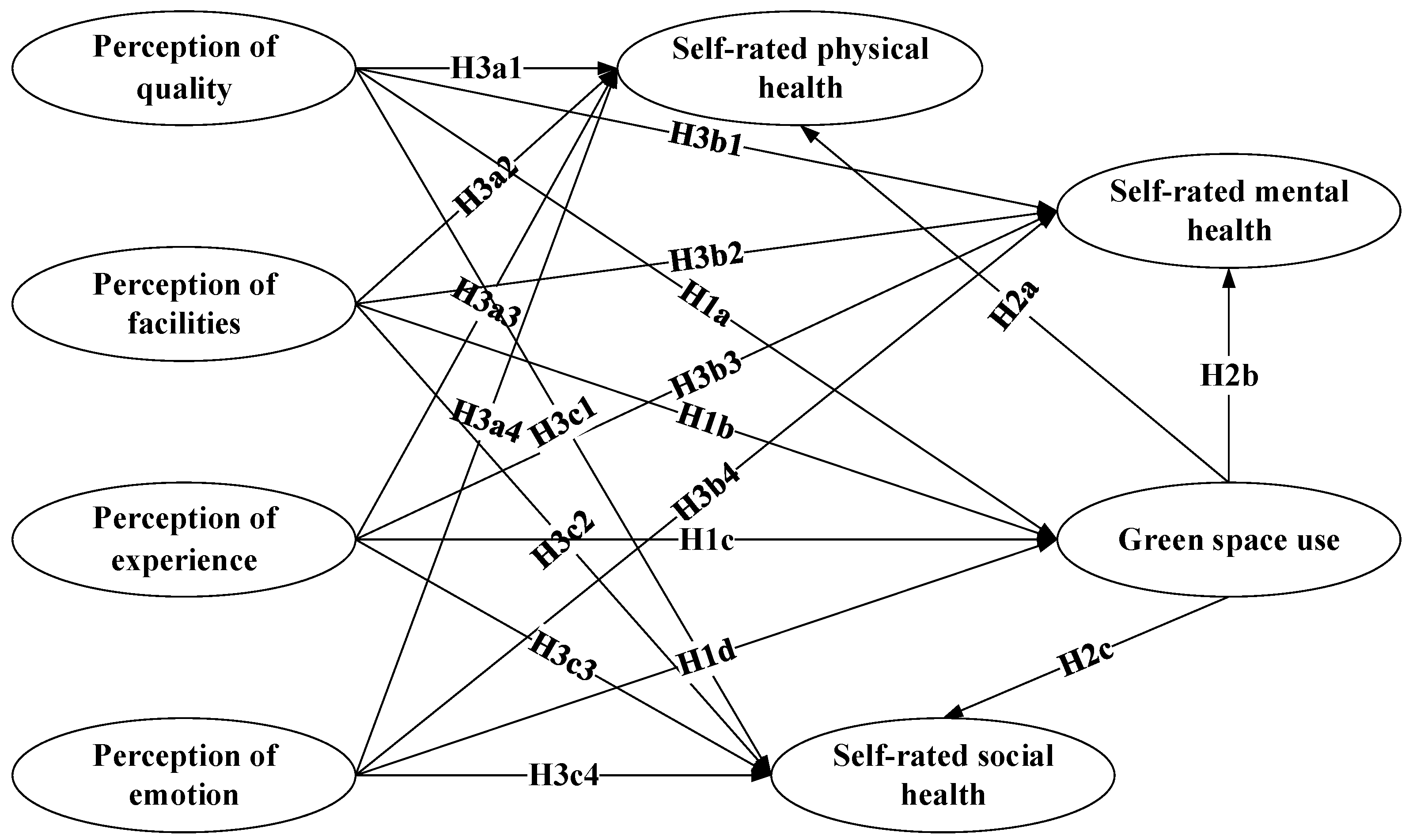
Older people’s GSPs have a significant positive impact on their GSU.
2.2. Green Space Use concerning Health
Green space use positively impacts the general health of older adults, with older adults with regular access to and use of green space having significantly better self-rated health status than those with less access to green spaces [30]. Studies have shown that exercise in green spaces improves the physiological health, such as lowering blood pressure and reducing the risk of chronic disease, of older people [31]. Moreover, older individuals demonstrate enhanced cardiovascular health indicators, such as reduced blood pressure and heart rate variability. These findings indicate that green spaces offer a favorable context for maintaining cardiovascular well-being [32]. Different types of green space activities can promote older people’s health in various ways. For instance, recreational activities, such as picnicking and reading [22], and light physical activities, such as walking, jogging, tai chi [33], and gardening [31], in green spaces can significantly reduce the risk of health problems, such as diabetes, obesity, cardiovascular disease, and other chronic diseases [34], and improve physical health.
Exposure to green spaces may significantly enhance older people’s mental health, including lowering their stress levels, improving their mood, and increasing well-being. This is particularly relevant when it comes to the impact that green space utilization has on mental health. The natural environment benefits the mental health and well-being of older people with disabilities [35]. Older people can significantly improve their mental health through the use of green spaces, reducing symptoms of depression and anxiety and increasing life satisfaction and well-being. Overall, older people with regular access to green spaces report reduced stress levels and better mood states [36]. Moreover, gardening activities in green spaces can provide physical and mental relaxation, promoting health and well-being [37].
Concerning social health, green spaces provide places for older people to socialize and interact, which can help reduce loneliness and social isolation [38]. Older people who participate in green space activities score higher in social support and community involvement, which is crucial for their social health [16]. Hence, urban green areas are essential for promoting health and well-being by offering opportunities for physical exercise and social engagement [4]. The findings of these studies indicate that older individuals primarily participate in activities such as walking, gardening, relaxing, jogging, tai chi, and socializing when utilizing green spaces. These activities have a notable influence on the health of older individuals, as they contribute to physical well-being, enhance mental health, reduce stress levels, and facilitate social interactions. Therefore, based on these findings, this study proposed the following hypothesis:
Hypothesis 2 (H2).
Older people’s GSU has a significant positive impact on their self-assessed physical health (PH), mental health (MH), and social health (SH).
2.3. Green Space Perception concerning Health
The perceptions of green spaces among older people, particularly their assessment and evaluation of their natural surroundings, directly and indirectly impact their health and overall well-being. Residents’ physical and emotional health is enhanced when their desires for green space environments are fulfilled [39]. People’s perceptions of green spaces can moderate the health benefits of urban green spaces [40]. Environmental factors and the quality of green spaces influence users’ perceptions of and preferences for green spaces, thus affecting their health [41]. Environmental perception is one of the most critical factors affecting the mental health of residents [42], and green space environments with high perceptual ratings are more likely to promote stress reduction and improved mental health than those with low perceptual ratings [43]. As a result, enhancing urban green space quality may be a valuable strategy for addressing chronic health issues [44], and individual perceptions about the quality of green space can substantially impact this [45]. Thus, based on these findings, this study proposed the following hypothesis:
Hypothesis 3 (H3).
Older people’s GSPs have a significant positive impact on their self-rated physical health, mental health, and social health.
Furthermore, GSP has an indirect impact on health. The utilization of green space by individuals frequently acts as an intermediary element in the correlation between GSP and health [40]. The nature of individuals’ activities when visiting green spaces plays a vital role in connecting urban green spaces with enhanced human health [46]. For example, people tend to have increased health when increasing the duration and intensity of their physical activity [47]. Older adults spend more time in parks compared to other age groups [48]. Thus, there is a stronger relationship between older people’s perceptions of green spaces and their use of green spaces [17], and their physical health, mental health, and social health benefits are enhanced when using green spaces for activities [30]. The correlation between physical exercise and mental health is more substantial than that between social engagement and mental health in older persons [49]. An Australian study found a considerable association between residents’ perceptions of communal green spaces and their self-rated mental health. This association was based on perceived environmental qualities, neighborhood satisfaction, and self-rated mental health [50]. In addition, the frequency of residents’ activities in green spaces [51], the duration and type of activities, and the behavioral characteristics of the activities [46] have also been shown to be influenced by the green space environment and their perceptual ratings of the environment, and these behavioral characteristics are associated with mental health [52]. Therefore, based on previous findings, this study proposed the following hypothesis:
Hypothesis 4 (H4).
GSU mediates older people’s GSPs’ influence on their self-assessed physical, mental, and social health.
3. Materials and Methods
3.1. Study Area
Fuzhou City is the capital of Fujian Province in China and is located in the lower reaches of the Min River, on the southeast coast. The problem of aging is becoming more prominent in Fuzhou. According to the seventh national census, about 16.76% of the population in Fuzhou is 60 years old and above, and 11.72% is 65 years old and above, which is 0.78% and 0.62% higher than the average level of the whole province of Fujian, respectively. Thus, there is an urgent need to address the health problems of older people. Furthermore, Fuzhou City has numerous urban green spaces and has earned the nickname “the city of a thousand gardens.” This study selected urban parks of various sizes, including West Lake Park, Zuohai Park, Minjiang Park, and Jinshan Park, as sample sites for the survey. These parks were selected based on their alignment with the study’s objectives, completion time, range, and their visitor flow (Figure 1).
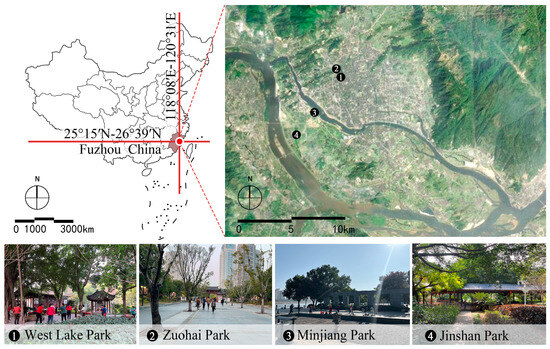
Figure 1.
Study area.
3.2. Data Collection
The survey was carried out on sunny days with comparable temperatures to reduce the impact of weather and temperature on the responses. It was directed at people 60 years of age and older who were taking leisure in four parks in Fuzhou City, and the participants provided their permission to participate. Based on random sampling and face-to-face interviews, the survey focused on perceptions of the urban park environment, activities, and health. Following structured interviews and a thematic analysis of the literature on park perception indicators, 20 indicators across four dimensions were identified. Moreover, a pre-questionnaire survey was also conducted. The team provided organizational training to the research team members. This study employs a paper-based methodology to address the possible challenges that elderly adults may face when reading surveys. A survey team member reads the questions and answers out loud one at a time, ensuring that respondents comprehend them fully and provide accurate responses, thus improving the efficiency of the questionnaire process. Once elderly respondents answered all the questions, their questionnaires were deemed valid, and they received a small thank you gift. The survey was conducted in West Lake Park and Zuohai Park from 4–6 January 2024, and it yielded 87 valid responses, leading to questionnaire adjustments for clarity. The primary survey, conducted from 8 January to 5 February 2024, collected a total of 550 questionnaires. Of these, 513 replies were considered valid, resulting in a response rate of 93.3%. The data included personal information, decisions about park impressions, participation in activities, and self-assessments of health. The respondents comprised older adults of various genders, age groups, and housing arrangements, assuring a certain degree of representativeness.
Table 1 shows that, among the survey participants, 270 (52.6%) were male and 243 (47.4%) were female. Most participants in the random sample were concentrated in the age ranges of 60–70 and 71–80, which can be attributed to their increased physical activity and regular excursions to urban parks and green areas. In addition, the survey included 66 individuals between the ages of 81 and 90, accounting for 13% of the participants. Furthermore, 7 participants were over the age of 90, making up 1.4% of the total. Regarding living arrangements, the largest group, comprising 231 respondents (45.0%), lived with a partner, which was followed by 129 (25.1%) in three-generation households, 124 (24.2%) living with their children, and 27 (5.3%) living alone.

Table 1.
Demographic information of the study sample.
3.3. Variable Description
This questionnaire, informed by in-depth interviews and prior research on older people’s perceptions of urban park green spaces, their usage, and health, assessed the older people’s GSP across four dimensions (quality, facilities, experience, and emotional connection), using 17 items. The ecological status, maintenance, richness, and attractiveness of the terrain were among the qualitative perceptions asked about. The suitability of the rest places, lighting, accessibility, recreational amenities, venue layout, and scale were the main areas of focus for their facility perceptions. The emotional perceptions examined security, familiarity, attachment, and belonging, while the experience perceptions addressed recreation, comfort, and accessibility. The dependent variable was self-assessed multidimensional health, which included self-assessed physical, mental, and social health based on existing studies’ scales. The self-assessed physical health scale was designed with five items from the Health Survey SF-12 Short Form [53], and mental health was developed with six items from the same source; the social health scale included social relationships, social support, social connections, and social interactions, with four question items [54,55]. A 7-point Likert scale was used to measure the items above. The indicators that were precisely measured were the “weekly length of visits to green space”, “weekly frequency of visits to green space,” and “weekly total green space activity”. GSU served as the mediating variable. The average activity metabolic equivalent was multiplied by the weekly activity hours of the older individuals to determine their total weekly activity in green spaces.
The questionnaire was used to determine the types of activities that older people conduct in green spaces, as shown in Table 2, which was based on a compilation of the physical activities of healthy adults in China [56]. The behavioral activities of elderly individuals in urban parks were observed and categorized. Metabolic equivalents were assigned to these activities to determine their average metabolic equivalents. The three indicators were classified into 7 levels to facilitate their study. In addition, the questionnaire included questions on the respondents’ basic personal information, their mode of residence, purpose in visiting the park, time of visiting the park, companions visiting the park, and mode of visiting the park, which were answered in a multiple-choice format.
Table 2.
Classification of everyday activities of older people in urban parks.
3.4. Study Analyses
A confirmatory factor analysis (CFA) and structural equation modeling (SEM) were conducted to examine our hypotheses. The CFA assessed the correlation between the two variables to determine whether the factors and latent variables within the proposed hypotheses were related. Following Fornell and Larcker’s suggestion [57], composite reliability (CR) and average variance extracted (AVE) were selected as indicators of a correlation. The CR value represents the internal consistency of the construct indicators, which was suggested to be greater than 0.6. The AVE value represents the latent variables’ explanatory power towards the measured variables. Hair et al. indicated that the AVE value should be greater than 0.25 [58]. Following the CFA results, SEM was used to investigate the association between GSP, GSU, and self-rated health in older people, as depicted in Figure 2. The model fit was then modified and tested for stability using AMOS23.0 (IBM Crop., Armonk, NY, USA). After constructing the model, we interpreted the results and verified their accuracy using SPSS26.0 statistical software (IBM Crop., Armonk, NY, USA) and AMOS23.0. This study’s goodness-of-fit values included the root mean square error of approximation (RMSEA), the comparative fit index (CFI), the parsimonious CFI (PCFI), the normed fit index (NFI), the Tucker–Lewis index (TLI), and the normed chi-square ratio (χ2/df). Finally, the impact of the intervening factors was examined using the path coefficient. The adjusted model’s indirect, total, and mediated effects were analyzed for statistical significance using bootstrapping.
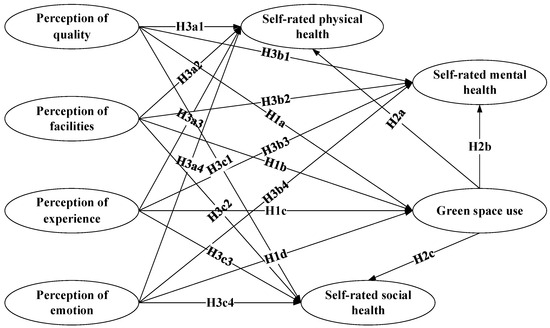
Figure 2.
Hypothetical model.
4. Results
4.1. Analysis of Differences
This study utilized Excel 2013 and SPSS to analyze its data. It examined the variations in the influence of green spaces on the health of older individuals of different ages, genders, and living styles. Furthermore, it examined the disparities in the perceptual ratings of various park environments, as presented in Table 3. The survey results indicate that, among the older adults interviewed, women generally rated their physical, psychological, and social health higher than men, which may be attributed to their higher life expectations, stronger health consciousness, and more proactive health behaviors. When comparing the health of older people by age group, those over 80 had the lowest physical, psychological, and social well-being levels. In contrast, those aged 71 to 80 had slightly higher levels. Their comparatively better physical health, greater social activity levels, and more adept psychological flexibility may contribute to this phenomenon.
Table 3.
Differences in the impact of green spaces on the health of the elderly.
Regarding living arrangements, older people living in three-generation households had the highest health indices across all categories due to strong family support and frequent social interactions; those living alone had the lowest health levels, owing primarily to social isolation and a lack of daily support. Elderly individuals living with a spouse or children showed no significant differences in these health metrics, generally maintaining higher levels. These findings highlight the considerable impact of family support and social interaction on the health of older adults.
Table 4 shows the differences in elderly respondents’ perceptions of green spaces in different parks. West Lake Park received the highest overall average score for green space quality, suggesting that its green space is highly regarded and appreciated by elderly visitors. This further contributes to its reputation as a nationally recognized 3A tourist attraction. Regarding facilities, Zuohai Park and Jinshan Park received the highest average scores.
Table 4.
Differences in elderly perceptions of various park green spaces.
According to the field surveys, these parks offer a wide variety of fitness facilities that are particularly suitable for elderly individuals’ use. Regarding experience and emotional perception, Jinshan Park scored the highest, likely because it serves as a community park primarily catering to residents with fewer visiting tourists, fostering stronger emotional connections and better green space experiences for older adults.
4.2. Reliability and Validity Analyses
An analysis of reliability and validity was performed on the data obtained from the questionnaire. The reliability of the survey results was tested using Cronbach’s alpha coefficient, as indicated in Table 5. The alpha coefficient for the total scale was 0.954, the alpha coefficients for each subscale were above 0.90, and all CR values were >0.8. This indicates that each latent variable’s observed variables were well designed and that the questionnaire was highly reliable. The validity tests of the questionnaire, using an exploratory factor analysis, revealed that the Kaiser–Meyer–Olkin (KMO) value for the total scale was 0.947, and those for each subscale were greater than 0.70. All the p-values from Bartlett’s sphericity tests were <0.01, and all the AVE values were >0.7, indicating high convergent validity. The reliability and validity test results showed that the questionnaire was suitable for factor analysis.
Table 5.
Confirmatory factor analysis.
4.3. Hypothesis Model Analysis
The model’s goodness-of-fit results were as follows: χ2/df = 1.124 < 5; GFI = 0.938 > 0.8; AGFI = 0.927 > 0.8; RMSEA = 0.016 < 0.05; NFI = 0.962 > 0.9; TLI = 0.995 > 0.9; IFI = 0.996 > 0.8; CFI = 0.996 > 0.9; PGFI = 0.797 > 0.5; and PNFI = 0.865 > 0.5. These values indicated that the theoretical model in this study fits the observed data well and can be subjected to path regression analysis.
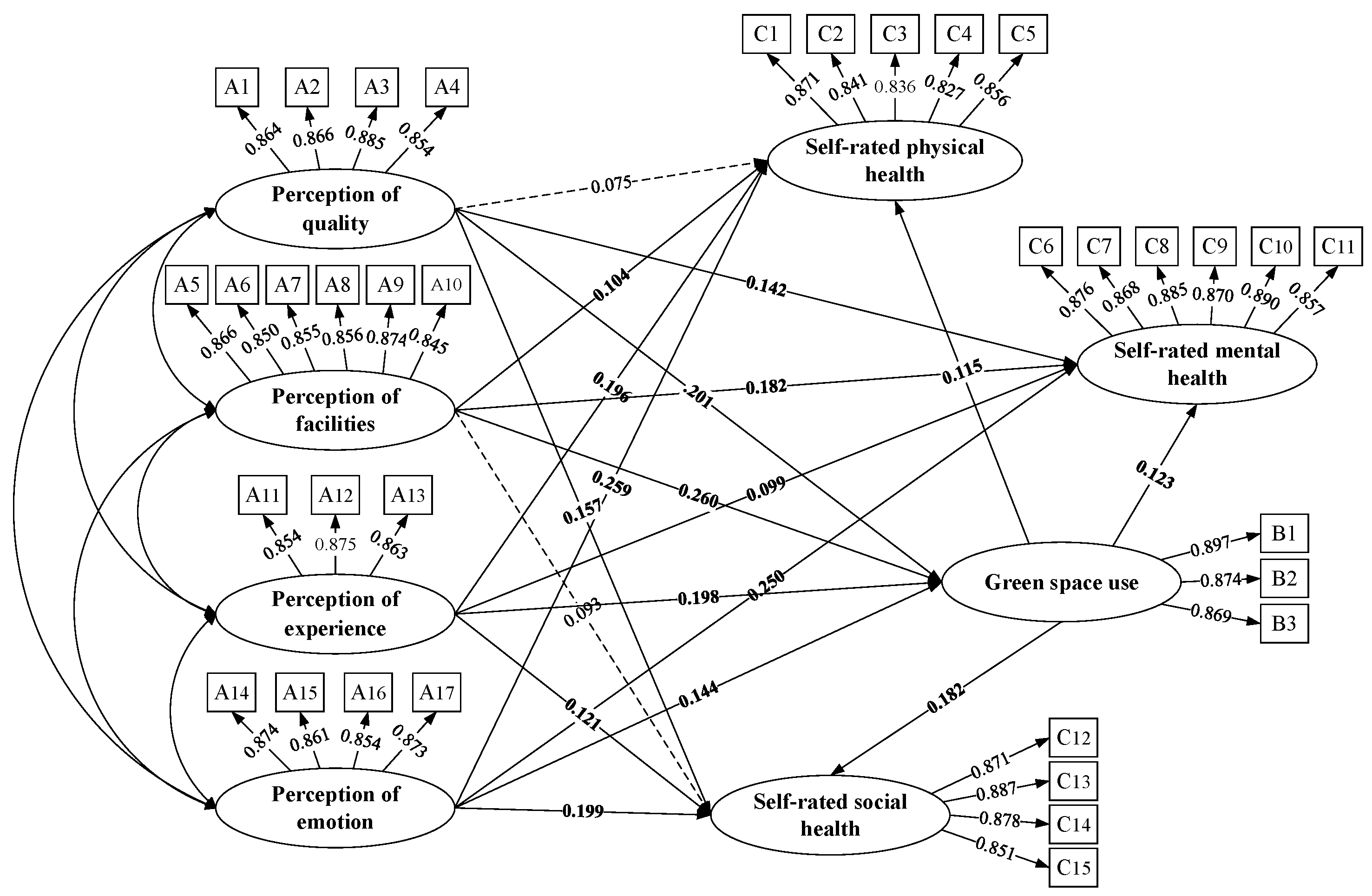
The SEM results are shown in Figure 3, where the relationship between the individual measurement variables and the degree of influence of each measured indicator is indicated by the magnitude of their standardized path coefficients. These CR values or p-values can be used to assess the validity of the regression paths in each measurement model. The path coefficient is significant when CR > 1.96 or p < 0.05.
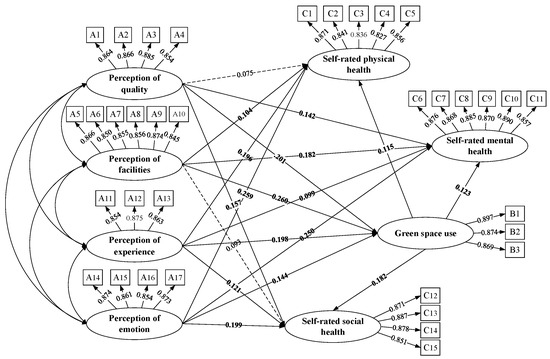
Figure 3.
Standard estimates of the structural equation model path analysis.
As shown in Table 6, the perception of the green space, including the perception of its quality (PQ), perception of its facilities (PF), perception of its experiences (PEX), and perception of emotions (PEM), exerted a significantly positive influence on GSU (p < 0.005). All hypotheses, H1a, H1b, H1c, and H1d, were confirmed. Out of all the factors, PF had the highest standardized path coefficient (0.260), suggesting that PF had the most substantial influence on place identity. It was followed by PQ, PEX, and PEM. GSU had a notably beneficial impact on physical health (PH), mental health (MH), and social health (SH) (p < 0.005). These illustrate the positive impact on physical, mental, and social health when older people use green spaces. Thus, H2a, H2b, and H2c were supported. Among the effects of perceived green spaces on physiological health, PF, PEX, and PEM significantly influenced physical health (p < 0.005). The PEM had the largest standardized path coefficient, indicating that PEM had the most significant impact on physical health, followed by PEX and PF. Furthermore, PQ had no significant effect on physical health (p = 0.152), and H3a2, H3a3, and H3a4 were supported. The four dimensions of GSP (PQ, PF, PEX, and PEM) had a significant positive effect on mental health (p < 0.005). As such, H3b1, H3b2, H3b3, and H3b4 were all supported. Their path coefficients were, in descending order, PEM (0.250) > PF (0.182) > PQ (0.142) > PEX (0.099). In terms of the effects of GSU on social health, PQ, PEX, and PEM had significant positive effects on physical health (p < 0.005). Their path coefficients were, in descending order, PEM (0.199) > PQ (0.157) > PEX (0.157). Furthermore, PF did not significantly impact social health statistically (p = 0.077). Thus, H3c1, H3c3, and H3c4 were supported. To summarize, how older individuals perceive green spaces can substantially impact their general subjective well-being and health. However, it is important to note that these perceptions may not always directly affect their physical health. On the other hand, GSU indirectly impacts the health of older individuals.
Table 6.
Tests for mediation effects.
Mediating effects were further analyzed to explore the pathways through which older people’s GSPs influence their GSU and multidimensional health. As shown in Table 7, the test of the mediation effects showed that, in H3a2, H3a3, and H3a4, GSU mediated the relationship between perception (PF, PEX, and PEM) and physical health, supporting H4a. Then, in H3b1, H3b2, H3b3, and H3b4, GSU mediated the relationship between perception (PQ, PF, PEX, and PEM) and mental health, supporting H4b. Furthermore, in H3c1, H3c3, and H3c4, GSU mediated the relationship between perception (PQ, PF, PEX, and PEM) and social health, supporting H4c.
Table 7.
Tests for intermediary effects.
5. Discussion
This study found a significant positive association between older adults’ perceptions of green spaces, including their quality, facilities, experiences, and emotions, and their use. This supported previous findings that linked green space utilization to improved physical, psychological, and social health among older people. Interestingly, the indirect effects of GSU were apparent, even though some of the direct impacts of GSP on health were minimal. This shows that green spaces’ qualities and features, as well as the experiences and emotional connections they produce, are vital in supporting older people’s multidimensional health.
5.1. Green Space Perception and Green Space Use by Older People
This study discovered that the GSU and perceptions of older persons impacted their multidimensional health. Furthermore, there was a strong positive association between older adults’ use of green space and their perceptions of the space’s quality, amenities, experiences, and emotions. This supports earlier research and emphasizes the value of GSP in encouraging older persons to engage in active outdoor activities [26,27]. When the standardized path coefficients of the four dimensions of the perceptions of green spaces were compared, facility perceptions played the most crucial role in promoting GSU. This reveals the pivotal role of good infrastructure, such as well-laid-out activity spaces, reasonable accessibility, and reasonable recreational and fitness facilities, in attracting older people to green spaces. On-site interviews revealed that age-appropriate amenities, such as benches, shade, and restrooms, significantly enhanced older adults’ use of green spaces, aligning with the findings that such facilities increase visitation frequency [15,26].
Moreover, when older adults perceive green spaces to be highly environmentally friendly and well-maintained, they are more likely to spend time using them [13]. This shows that the frequency and duration of GSU are often positively connected with assessments of the quality of green spaces. The way that a green space is used is also influenced by visitors’ perceptions and overall experience in the park, including their recreation and its accessibility. This is consistent with previous studies showing that older people’s perceptions of security and attachment to their surroundings were favorably correlated with their social, psychological, and physical health [59]. These findings provide evidence that GSP has a unifying impact on the GSU of older individuals. Therefore, to encourage older persons to utilize green spaces, it is advised that future park landscape design and green space management prioritize raising the quality of green spaces, upgrading facilities, enriching the overall experience of green spaces, and strengthening emotional connections.
5.2. Green Space Use and Multidimensional Health in Older Adults
The present investigation revealed an excellent correlation between GSU and older persons’ physical, mental, and social health, which aligns with previous research findings. Urban parks provide areas for social contact and physical movement, which is especially beneficial for vulnerable populations [60]. It was found that GSU has the greatest effect on social health, followed by mental health, and there was a positive correlation with physical health. Engaging in activities in green spaces has a substantial positive impact on social well-being. These activities provide opportunities for social interaction, which aligns with the research conducted by Whear et al. Their findings suggest that participating in group activities in green spaces helps establish new social connections and alleviates feelings of loneliness [61].
Furthermore, the calming environment of green spaces aids in mitigating stress, anxiety, and depression among older people, supporting existing studies [62,63]. Under lockdowns, a lack of access to these spaces intensified depression and anxiety symptoms, highlighting the mood-enhancing effects of natural landscapes [64]. Parks and urban green spaces provide a space for health-promoting behaviors, including physical activity [65] and social interaction [16], and older people’s activities in green spaces positively impact their physical, mental, and social health. Interviews with study participants indicated that the observed little immediate impact on their physical health may be because some participants started these activities recently. Encouraging older people to use green areas can improve their health.
5.3. Green Space Perception and Multidimensional Health in Older Adults
The GSPs of older people have shown some positive relationships with their physical, mental, and social well-being in this study, which agreed with previous studies [34,66]. Green spaces are vital natural environments facilitating physical activity, mental relaxation, and the emotional well-being of older people.
This study had an indirect effect; however, the direct relationship between quality perception and physiological health was not very strong. This finding, when combined with the interview results, might indicate that the physiological health of older individuals is not directly impacted by their perceptions of a green space’s quality. However, the use of green spaces can indirectly promote it. This research emphasizes the direct correlation between the experiences and emotions of older individuals regarding green spaces and their propensity to revisit these areas to enhance their health. This encompasses their perception of safety and the suitability of the leisure and fitness facilities.
Moreover, these findings underscore the mediating role of facilities, experiences, and emotional perceptions in the effect on older adults’ physical health and support the idea that positive perceptions of green spaces can increase outdoor activities. Regularly active older adults in green spaces exhibit better physical function and lower chronic disease rates [67]. The pathway by which GSPs influenced the emotional state and mental health of older individuals was as follows: quality perception, experience perception, emotion perception, and facility perception all had direct and indirect positive effects on the mental health of older individuals. This evidence substantiates the claim that green spaces have the potential to improve mental health and emotional well-being, as well as alleviate stress, anxiety, and depression; thus, this supports the notion that green spaces enhance life satisfaction [68]. Furthermore, while direct effects of facility perceptions on social health were not observed, indirect benefits, through increased GSU and social interaction, were noted, suggesting that the aesthetic and maintenance level of parks and a sense of belonging foster social engagement, which reduces loneliness and social isolation. Perceived quality, experience, and emotion all had favorable effects on the social health of older individuals. This study confirms that the perceived quality, knowledge, and emotion of green spaces mediate the physical health of older individuals. This is consistent with existing research showing that the aesthetics [69] and maintenance of urban green spaces [28] encourage older adults to socialize and participate in outdoor activities, thereby reducing loneliness and social isolation.
Notably, the path coefficients we obtained indicated that the direct effects of green space quality on physical, mental, and social health were the most significant among the many impacts of green space quality on multidimensional health. These findings indicate that it is crucial to prioritize efforts to improve older people’s emotional experiences of green spaces, such as their feelings of belonging, familiarity, connection, and security. This is crucial for enhancing their physical, mental, and social well-being.
5.4. Limitations of the Study
Although the findings of this study are consistent with the existing literature overall, there are some limitations. In terms of sample selection, this study used random sampling for the questionnaire survey, resulting in more than half of the respondents being between 60 and 70 years of age. Furthermore, various conditions may be connected to poor health in older adults. Not all of them have been covered in this study; only a few related to GSP and GSU activities have been discussed. Lastly, this study did not include objective measurements; instead, it used questionnaires to subjectively test participants’ self-reported GSP, GSU, and health conditions.
6. Conclusions
Designing and maintaining urban green spaces, particularly in places with a high rate of aging, requires an understanding of how older people view and use these spaces. This study investigated the factors impacting the GSPs, GSU, and self-reported multidimensional health of older persons in addition to developing indicators to assess their GSPs. This study presents a novel comparison of several pathways in a single model. The current model uniquely compares multiple pathways, identifying emotional perception as the most influential GSP factor on GSU and health. We found that, overall, GSP and GSU were positively correlated with better health outcomes. However, no significant links were observed between green space quality, physical health, facilities, and social health.
Furthermore, GSU notably enhances social health. These findings suggest that enhancing green space quality, facilities, and emotional experiences can significantly benefit older people’s health. To better serve the elderly, future urban park developments should improve facilities like benches, pathways, and pavilions to meet elderly needs and enhance convenience. Given the positive impact of green space usage on social health, spaces should be designed to encourage social interaction among older adults, and activities like health exercises and tai chi should be regularly organized. Moreover, implementing a feedback mechanism to collect continuous input from older users can enhance green spaces’ design and improve their health. Future research must consider and account for the confounding variable of elderly individuals’ overall health, including chronic diseases and physical limitations. In addition, using GPS trackers and electronic devices to document activities and assess physiological markers before and following trips to green spaces could improve our data-gathering techniques and deepen our comprehension of their health impacts.
Author Contributions
Data curation, Y.W. and W.Z.; Investigation, Y.W., H.Z. and Z.Y.; Methodology, Y.W., W.Z., H.Z. and Z.Y.; Writing—original draft, Y.W.; Writing—review and editing, Q.L. and S.L.; Supervision, Q.L.; Funding acquisition, Q.L. and S.L. All authors have read and agreed to the published version of the manuscript.
Funding
The authors gratefully acknowledge the financial support from The First Stage of Support for the First batch of Mass Entrepreneurship and Innovation Talents in Fujian Province under grant K8615001A, Fujian Provincial Department of Education under grant No. JAT220220, and Fujian Provincial Department of Science and Technology under grant 2023J05193.
Data Availability Statement
The data presented in this study are available on request from the corresponding author due to privacy.
Conflicts of Interest
Author Zhao Yan was employed by the company Fuzhou Minhou County Shangyi Education Technology Co., Ltd. The remaining authors declare that the research was conducted in the absence of any commercial or financial relationships that could be construed as a potential conflict of interest.
References
- UN Report Calls for Re-Thinking Social Protection as the World Ages|UN News [EB/OL]. (2023-01-12). Available online: https://news.un.org/en/story/2023/01/1132392 (accessed on 9 April 2024).
- Huang, B.; Huang, C.; Feng, Z.; Pearce, J.R.; Zhao, H.; Pan, Z.; Liu, Y. Association between residential greenness and general health among older adults in rural and urban areas in China—ScienceDirect. Urban For. Urban Green. 2020, 59, 126907. [Google Scholar] [CrossRef]
- Jiang, H.; Liu, Z. Community home elderly care services, multidimensional health and social participation of chronically ill elderly—Empirical analysis based on propensity score matching and multiple mediation analysis. Front. Public Health 2023, 11, 1121909. [Google Scholar] [CrossRef]
- Enssle, F.; Kabisch, N. Urban green spaces for the social interaction, health and well-being of older people—An integrated view of urban ecosystem services and socio-environmental justice. Environ. Sci. Policy 2020, 109, 36–44. [Google Scholar] [CrossRef]
- Egger, G.; Dixon, J. Beyond obesity and lifestyle: A review of 21st century chronic disease determinants. Biomed. Res. Int. 2014, 2014, 731685. [Google Scholar] [CrossRef] [PubMed]
- Kaplan, S. The restorative benefits of nature: Toward an integrative framework. J. Environ. Psychol. 1995, 15, 169–182. [Google Scholar] [CrossRef]
- Ali, M.d.J.; Rahaman, M.; Hossain, S.k.I. Urban green spaces for elderly human health: A planning model for healthy city living. Land Use Policy 2022, 114, 105970. [Google Scholar] [CrossRef]
- Zhou, R.; Zheng, Y.-J.; Yun, J.-Y.; Wang, H.-M. The Effects of Urban Green Space on Depressive Symptoms of Mid-Aged and Elderly Urban Residents in China: Evidence from the China Health and Retirement Longitudinal Study. Int. J. Environ. Res. Public Health 2022, 19, 717. [Google Scholar] [CrossRef] [PubMed]
- de Jong, K.; Albin, M.; Skärbäck, E.; Grahn, P.; Björk, J. Perceived green qualities were associated with neighborhood satisfaction, physical activity, and general health: Results from a cross-sectional study in suburban and rural Scania, southern Sweden. Health Place 2012, 18, 1374–1380. [Google Scholar] [CrossRef] [PubMed]
- Bjork, J.; Albin, M.; Grahn, P.; Jacobsson, H.; Ardo, J.; Wadbro, J.; Ostergren, P.-O.; Skarback, E. Recreational values of the natural environment in relation to neighbourhood satisfaction, physical activity, obesity and well-being. J. Epidemiol. Community Health 2008, 62, e2. [Google Scholar] [CrossRef]
- Ma, Y.; Brindley, P.; Lange, E. The Influence of Socio-Demographic Factors on Preference and Park Usage in Guangzhou, China. Land 2022, 11, 1219. [Google Scholar] [CrossRef]
- Park, K. Park and Neighborhood Attributes Associated with Park Use: An Observational Study Using Unmanned Aerial Vehicles; SAGE Publications: Los Angeles, CA, USA, 2020. [Google Scholar]
- Sugiyama, T.; Thompson, C.W. Older people’s health, outdoor activity and supportiveness of neighbourhood environments. Landsc. Urban Plan. 2007, 83, 168–175. [Google Scholar] [CrossRef]
- Sadeghian, M.M. The Health Benefits of Urban Green Spaces, a Literature Review; IJARIIE: New Delhi, India, 2018. [Google Scholar]
- Gong, Y.; Gallacher, J.; Palmer, S.; Fone, D. Neighbourhood green space, physical function and participation in physical activities among elderly men: The Caerphilly Prospective study. Int. J. Behav. Nutr. Phys. Act. 2014, 11, 40. [Google Scholar] [CrossRef] [PubMed]
- Maas, J.; Van Dillen, S.M.; Verheij, R.A.; Groenewegen, P.P. Social contacts as a possible mechanism behind the relation between green space and health. Health Place 2009, 15, 586–595. [Google Scholar] [CrossRef] [PubMed]
- Lau, K.K.L. Usage and perception of urban green space of older adults in the high-density city of Hong Kong. Urban For. Urban Green. 2021, 64, 127251. [Google Scholar] [CrossRef]
- Tan, Z.; Lau, K.K.L.; Roberts, A.C.; Chao, S.T.-Y.; Ng, E. Designing Urban Green Spaces for Older Adults in Asian Cities. Int. J. Environ. Res. Public Health 2019, 16, 4423. [Google Scholar] [CrossRef] [PubMed]
- Thompson, C.W.; Aspinall, P.; Bell, S.; Findlay, C. “It Gets You Away from Everyday Life”: Local Woodlands and Community Use—What Makes a Difference? Landsc. Res. 2005, 30, 109–146. [Google Scholar] [CrossRef]
- Bell, S.; Thompson, C.W.; Travlou, P. Contested views of freedom and control: Children, teenagers and urban fringe woodlands in Central Scotland. Urban For. Urban Green. 2003, 2, 87–100. [Google Scholar] [CrossRef]
- Finlay, J.; Franke, T.; McKay, H.; Sims-Gould, J. Therapeutic landscapes and well-being in later life: Impacts of blue and green spaces for older adults. Health Place 2015, 34, 97–106. [Google Scholar] [CrossRef] [PubMed]
- Thompson, C.W.; Roe, J.; Aspinall, P.; Mitchell, R.; Clow, A.; Miller, D. More green space is linked to less stress in deprived communities: Evidence from salivary cortisol patterns. Landsc. Urban Plan. 2012, 105, 221–229. [Google Scholar] [CrossRef]
- Jim, C.Y.; Shan, X. Socioeconomic effect on perception of urban green spaces in Guangzhou, China. Cities 2013, 31, 123–131. [Google Scholar] [CrossRef]
- Schipperijn, J.; Bentsen, P.; Troelsen, J.; Toftager, M.; Stigsdotter, U.K. Associations between physical activity and characteristics of urban green space. Urban For. Urban Green. 2013, 12, 109–116. [Google Scholar] [CrossRef]
- Miralles-Guasch, C.; Dopico, J.; Delclòs-Alió, X.; Knobel, P.; Marquet, O.; Maneja-Zaragoza, R.; Schipperijn, J.; Vich, G. Natural Landscape, Infrastructure, and Health: The Physical Activity Implications of Urban Green Space Composition among the Elderly. Int. J. Environ. Res. Public Health 2019, 16, 3986. [Google Scholar] [CrossRef] [PubMed]
- Coles, R.W.; Bussey, S.C. Urban forest landscapes in the UK—Progressing the social agenda. Landsc. Urban Plan. 2000, 52, 181–188. [Google Scholar] [CrossRef]
- Rodiek, S.D.; Fried, J.T. Access to the outdoors: Using photographic comparison to assess preferences of assisted living residents. Landsc. Urban Plan. 2005, 73, 184–199. [Google Scholar] [CrossRef]
- Kweon, B.S.; Sullivan, W.C.; Wiley, A.R. Green Common Spaces and the Social Integration of Inner-City Older Adults. Environ. Behav. 1998, 30, 832–858. [Google Scholar] [CrossRef]
- Cohen, D.A.; Marsh, T.; Williamson, S.; Derose, K.P.; Martinez, H.; Setodji, C.; McKenzie, T.L. Parks and physical activity: Why are some parks used more than others? Prev. Med. 2010, 50, S9–S12. [Google Scholar] [CrossRef] [PubMed]
- Mitchell, R.; Popham, F. Effect of exposure to natural environment on health inequalities: An observational population study. Lancet 2008, 372, 1655–1660. [Google Scholar] [CrossRef] [PubMed]
- Lee, I.M.; Paffenbarger, R.S., Jr. Associations of Light, Moderate, and Vigorous Intensity Physical Activity with Longevity: The Harvard Alumni Health Study. Am. J. Epidemiol. 2000, 151, 293–299. [Google Scholar] [CrossRef] [PubMed]
- Twohig-Bennett, C.; Jones, A. The health benefits of the great outdoors: A systematic review and meta-analysis of greenspace exposure and health outcomes. Environ. Res. 2018, 166, 628–637. [Google Scholar] [CrossRef]
- Roe, J.J.; Thompson, C.W.; Aspinall, P.A.; Brewer, M.J.; Duff, E.I.; Miller, D.; Mitchell, R.; Clow, A. Green Space and Stress: Evidence from Cortisol Measures in Deprived Urban Communities. Int. J. Environ. Res. Public Health 2013, 10, 4086–4103. [Google Scholar] [CrossRef]
- Gascon, M.; Triguero-Mas, M.; Martínez, D.; Dadvand, P.; Forns, J.; Plasència, A.; Nieuwenhuijsen, M.J. Mental Health Benefits of Long-Term Exposure to Residential Green and Blue Spaces: A Systematic Review. Int. J. Environ. Res. Public Health 2015, 12, 4354–4379. [Google Scholar] [CrossRef] [PubMed]
- Wood, C.J.; Pretty, J.; Griffin, M. A case–control study of the health and well-being benefits of allotment gardening. J. Public Health 2016, 38, e336–e344. [Google Scholar] [CrossRef] [PubMed]
- Beyer, K.M.M.; Kaltenbach, A.; Szabo, A.; Bogar, S.; Nieto, F.J.; Malecki, K.M. Exposure to Neighborhood Green Space and Mental Health: Evidence from the Survey of the Health of Wisconsin. Int. J. Environ. Res. Public Health 2014, 11, 3453. [Google Scholar] [CrossRef] [PubMed]
- Soga, M.; Gaston, K.J.; Yamaura, Y. Gardening is beneficial for health: A meta-analysis. Prev. Med. Rep. 2017, 5, 92–99. [Google Scholar] [CrossRef] [PubMed]
- Dadvand, P.; Bartoll, X.; Basagaña, X.; Dalmau-Bueno, A.; Martinez, D.; Ambros, A.; Cirach, M.; Triguero-Mas, M.; Gascon, M.; Borrell, C.; et al. Green spaces and General Health: Roles of mental health status, social support, and physical activity. Environ. Int. 2016, 91, 161–167. [Google Scholar] [CrossRef] [PubMed]
- Bagozzi, R.P. The Self-Regulation of Attitudes, Intentions, and Behavior. Soc. Psychol. Q. 1992, 55, 178–204. [Google Scholar] [CrossRef]
- Zhang, L.; Tan, P.Y.; Diehl, J.A. A conceptual framework for studying urban green spaces effects on health. J. Urban Ecol. 2017, 3, jux015. [Google Scholar] [CrossRef]
- Javadi, R.; Nasrollahi, N. Urban green space and health: The role of thermal comfort on the health benefits from the urban green space; a review study. Build. Environ. 2021, 202, 108039. [Google Scholar] [CrossRef]
- Dong, Y.; Li, Z.; Dong, W. Relationship Between Green Space Perception of Communities and Residents’ Stress Level: A Case Study of 12 Communities in Harbin. Landsc. Archit. 2020, 27, 88–93. (In Chinese) [Google Scholar]
- Hedblom, M.; Gunnarsson, B.; Iravani, B.; Knez, I.; Schaefer, M.; Thorsson, P.; Lundström, J.N. Reduction of physiological stress by urban green space in a multisensory virtual experiment. Sci. Rep. 2019, 9, 10113. [Google Scholar] [CrossRef]
- Liu, Y.; Zhao, B.; Cheng, Y.; Zhao, T.; Zhang, A.; Cheng, S.; Zhang, J. Does the quality of street greenspace matter? Examining the associations between multiple greenspace exposures and chronic health conditions of urban residents in a rapidly urbanizing Chinese city. Environ. Res. 2023, 222, 115344. [Google Scholar] [CrossRef]
- Wang, R.; Feng, Z.; Pearce, J.; Liu, Y.; Dong, G. Are greenspace quantity and quality associated with mental health through different mechanisms in Guangzhou, China: A comparison study using street view data. Environ. Pollut. 2021, 290, 117976. [Google Scholar] [CrossRef] [PubMed]
- Yessoufou, K.; Sithole, M.; Elansary, H.O. Effects of urban green spaces on human perceived health improvements: Provision of green spaces is not enough but how people use them matters. PLoS ONE 2020, 15, e0239314. [Google Scholar] [CrossRef]
- Huang, W.-Z.; Yang, B.-Y.; Yu, H.-Y.; Bloom, M.S.; Markevych, I.; Heinrich, J.; Knibbs, L.D.; Leskinen, A.; Dharmage, S.C.; Jalaludin, B.; et al. Association between community greenness and obesity in urban-dwelling Chinese adults. Sci. Total Environ. 2019, 702, 135040. [Google Scholar] [CrossRef]
- Esther, H.K.Y.; Winky, K.O.H.; Edwin, H.W.C. Elderly satisfaction with planning and design of public parks in high density old districts: An ordered logit model. Landsc. Urban Plan. 2017, 165, 39–53. [Google Scholar] [CrossRef]
- Lu, S.; Shu, P.; Wang, L. Paths and Effects of Residential Green Space’s Restorative Characteristics on Older Adults’ Mental Health Promotion. S. Archit. 2023, 11–19. (In Chinese) [Google Scholar] [CrossRef]
- Leslie, E.; Cerin, E. Are perceptions of the local environment related to neighbourhood satisfaction and mental health in adults? Prev. Med. 2008, 47, 273–278. [Google Scholar] [CrossRef]
- Akpinar, A. How is quality of urban green spaces associated with physical activity and health? Urban For. Urban Green. 2016, 16, 76–83. [Google Scholar] [CrossRef]
- Joseph, A.; Zimring, C.; Harris-Kojetin, L.; Kiefer, K. Presence and Visibility of Outdoor and Indoor Physical Activity Features and Participation in Physical Activity Among Older Adults in Retirement Communities. J. Hous. Elder. 2006, 19, 141–165. [Google Scholar] [CrossRef]
- Jenkinson, C.; Layte, R. Development and Testing of the UK SF-12. J. Health Serv. Res. Policy 1997, 2, 14–18. [Google Scholar] [CrossRef]
- Zhang, L.; Zhou, S.; Kwan, M.P. A comparative analysis of the impacts of objective versus subjective neighborhood environment on physical, mental, and social health. Health Place 2019, 59, 102170. [Google Scholar] [CrossRef] [PubMed]
- Huang, W.; Lin, G. The concept, benefit and influencing factors of Urban Green Space Social Health. Chin. Landsc. Archit. 2023, 77–82. (In Chinese) [Google Scholar] [CrossRef]
- Qiu, J.; Yang, J.; Lu, M.; Chen, Y. Compilation of Physical Activities of Healthy Chinese Adults: Reference Values for Energy Expenditure. Chin. J. Sports Med. 2022, 41, 335–349. (In Chinese) [Google Scholar] [CrossRef]
- Bagozzi, R.P. Evaluating Structural Equation Models with Unobservable Variables and Measurement Error: A Comment. J. Mark. Res. 1981, 18, 375–381. [Google Scholar] [CrossRef]
- Hair, J.F.; Black, W.C.; Babin, B.J.; Anderson, R.E. Multivariate Data Analysis: A Global Perspective; Pearson: Hong Kong, China, 2014. [Google Scholar]
- Lak, A.; Khodakarim, S.; Myint, P.K.; Baradaran, H.R. The influencing factors of elder-friendly public open spaces promoting older adults’ health in deprived urban neighborhoods: Partial Least Square Structural Equation Modeling approach. Front. Public Health 2023, 11, 1143289. [Google Scholar] [CrossRef]
- Kabisch, N.; Kraemer, R. Physical activity patterns in two differently characterized urban parks under conditions of summer heat. Environ. Sci. Policy 2020, 107, 56–65. [Google Scholar] [CrossRef]
- Whear, R.; Coon, J.T.; Bethel, A.; Abbott, R.; Stein, K.; Garside, R. What Is the Impact of Using Outdoor Spaces Such as Gardens on the Physical and Mental Well-Being of Those with Dementia? A Systematic Review of Quantitative and Qualitative Evidence. J. Am. Med. Dir. Assoc. 2014, 15, 697–705. [Google Scholar] [CrossRef] [PubMed]
- Huang, Y.; Yuan, X. Smellscape as a healing factor in institutional gardens to enhance health and well-being for older people with dementia: A scoping review. J. Clin. Nurs. 2024, 33, 454–468. [Google Scholar] [CrossRef] [PubMed]
- Collins, R.; Owen, S.; Opdebeeck, C.; Ledingham, K.; Connell, J.; Quinn, C.; Page, S.; Clare, L. Provision of Outdoor Nature-Based Activity for Older People with Cognitive Impairment: A Scoping Review from the ENLIVEN Project. Health Soc. Care Community 2023, 2023, e4574072. [Google Scholar] [CrossRef]
- Pouso, S.; Borja; Fleming, L.E.; Gómez-Baggethun, E.; White, M.P.; Uyarra, M.C. Contact with blue-green spaces during the COVID-19 pandemic lockdown beneficial for mental health. Sci. Total Environ. 2021, 756, 143984. [Google Scholar] [CrossRef]
- Sallis, J.F.; Cerin, E.; Conway, T.L.; Adams, M.A.; Frank, L.D.; Pratt, M.; Salvo, D.; Schipperijn, J.; Smith, G.; Cain, K.L.; et al. Physical activity in relation to urban environments in 14 cities worldwide: A cross-sectional study. Lancet 2016, 387, 2207–2217. [Google Scholar] [CrossRef] [PubMed]
- Shu, S.; Meng, L.; Piao, X.; Geng, X.; Tang, J. Effects of Audio–Visual Interaction on Physio-Psychological Recovery of Older Adults in Residential Public Space. Forests 2024, 15, 266. [Google Scholar] [CrossRef]
- White, M.P.; Wheeler, B.W.; Herbert, S.; Alcock, I.; Depledge, M.H. Coastal proximity and physical activity: Is the coast an under-appreciated public health resource? Prev. Med. Int. J. Devoted Pract. Theory 2014, 69, 135–140. [Google Scholar] [CrossRef] [PubMed]
- White, M.P.; Alcock, I.; Grellier, J.; Wheeler, B.W.; Hartig, T.; Warber, S.L.; Bone, A.; Depledge, M.H.; Fleming, L.E. Spending at least 120 min a week in nature is associated with good health and well-being. Sci. Rep. 2019, 9, 7730. [Google Scholar] [CrossRef]
- Coon, J.T.; Boddy, K.; Stein, K.; Whear, R.; Barton, J.; Depledge, M.H. Does participating in physical activity in outdoor natural environments have a greater effect on physical and mental well-being than physical activity indoors? A systematic review. Br. J. Soc. Med. 2011, 65 (Suppl. 2), A38. [Google Scholar]
Disclaimer/Publisher’s Note: The statements, opinions and data contained in all publications are solely those of the individual author(s) and contributor(s) and not of MDPI and/or the editor(s). MDPI and/or the editor(s) disclaim responsibility for any injury to people or property resulting from any ideas, methods, instructions or products referred to in the content. |
© 2024 by the authors. Licensee MDPI, Basel, Switzerland. This article is an open access article distributed under the terms and conditions of the Creative Commons Attribution (CC BY) license (https://creativecommons.org/licenses/by/4.0/).