Article

Influence of an Innovative Corrugated High-Strength Steel Profile on Soil–Steel Composite Bridges

by
Nerijus Bareikis
* and
Algirdas Juozapaitis
Department of Steel and Composite Structures, Faculty of Civil Engineering, Vilnius Gediminas Technical University, Saulėtekio al. 11, LT-10223 Vilnius, Lithuania
*
Author to whom correspondence should be addressed.
Buildings 2026, 16(7), 1414; https://doi.org/10.3390/buildings16071414
Submission received: 30 January 2026 / Revised: 23 March 2026 / Accepted: 25 March 2026 / Published: 2 April 2026
(This article belongs to the Section Building Structures)

Abstract

Composite soil–steel corrugated bridges, which are widely used in road, railway, and civil engineering, are recognized as durable, sustainable, and cost-effective structures. Due to their interactions with the surrounding soil, relatively thin corrugated steel plates are usually used in these bridges. Larger spans are associated with larger cross-sections, and deep corrugations with a 500 mm pitch and a 237 mm depth are already in use worldwide. However, the behavioral benefits of high-strength steel and additional strengthening elements for CSS structures have rarely been investigated with regard to local buckling in the straight regions of the corrugation. This study analyzed the influence of high-strength steel and innovative corrugated cross-sections strengthened with circular steel pipes on the utilization ratio of steel plates in composite soil–steel structures. Two-dimensional numerical models of three bridges with spans of 26 m, 17.5 m, and 12 m and surrounded by soil were developed to identify internal forces from permanent and temporary actions. Plate utilization was designed according to the Swedish, Canadian, and American methods, considering local buckling in the 500 × 237 mm and 381 × 140 mm corrugation profiles. It was found that the use of higher-strength steel material, as well as the introduction of steel pipes, significantly reduced the plate thickness of regular corrugations. The results show that the use of higher-strength steel reduced the cross-section area of regular and innovative corrugations by 30–40%. Moreover, the cross-section area of the innovative profile was 5% to 36% lower than that of the regular corrugation profile. Nevertheless, the results show that the local buckling approach proposed by the Swedish design method could be considered conservative and should be revised. In addition, the method of preventing local buckling by reducing the plastic moment capacity could be neglected when using thicker plates and lower steel grades.

1. Introduction

Corrugated soil–steel (CSS) composite structures applied in road, railway, and civil engineering are characterized by a light weight, a high load-bearing capacity, durability, cost-effectiveness, and sustainability [1,2,3,4,5,6]. The steel plates of these structures are usually relatively thin due to the mechanical properties of the corrugation and the interactions with the surrounding soil. Larger corrugation cross-sections enable thinner plates, wider spans, or a higher load-bearing capacity in CSS bridges. The use of deep corrugations with a 500 mm pitch and a 237 mm depth enabled the construction of the largest structure, with a span of 32.4 m [7]. High-strength steel and additional strengthening techniques provide benefits that could allow this limit to be increased; however, studies on their impacts are scarce.
In general, CSS structures and their responses to dead and live loads have been intensively monitored and investigated with the aim of understanding the limitations of existing design approaches [3]. Many numerical investigations have compared the results obtained with such approaches [8,9,10,11,12,13,14], and full-scale destructive tests have been performed to validate the data and improve applicable calculation methods [15,16,17,18,19,20]. Various strengthening techniques for CSS structures have been proposed and studied to achieve specific stiffness values and potentially better behavior in interactions with the surrounding soil [7,21,22,23,24,25].
Maleska and Beben [25] studied whether extra stiffening elements are needed in soil–steel bridge design. They modeled stiffening steel ribs filled with concrete and compared the numerical results with field measurements. Finite element internal forces were also compared with outcomes from relevant standards and design methods. Beben and Stryczek [23] presented a numerical analysis of a corrugated steel plate bridge with a reinforced concrete relieving slab under static loads. They studied the slab’s effect on shell deformations and compared the results with experimental tests. Displacements were reduced by 53–66% and stresses by 73–82%. Embaby et al. [7] examined the performance of lateral steel mesh reinforcement and circumferential steel stiffeners in the world’s largest CSS structure, with a 32.40 m span. A three-dimensional finite element model was validated against field measurements. The results showed that steel meshes reduced induced strain actions by up to 50% and that the circumferential steel stiffeners could keep crown vertical deformations below 0.5%. Embaby et al. [24] also examined the beveling slopes of structure ends. The results showed notable longitudinal bending moments in steel plates that were not supported by the full ring. However, it was found that the use of steel meshes around the CSS structure decreased circumferential axial stresses by up to 30%. Bareikis [22] examined how a rational layout of steel mesh affects the behavior of a large-span, deep corrugated steel structure. Finite element results showed that steel meshes can be effectively used to limit CSS structure deformations and internal forces. The study found that crown vertical displacement was reduced by 45% during the peaking stage. It also concluded that steel meshes can increase the structure’s load-bearing capacity. Chen et al. [26] and Sun et al. [27] studied local buckling effects of the straight region of the corrugation of CSS structures. Width-to-thickness ratios were proposed to prevent local buckling. Chen et al. [26] validated suggested limitations on pipe–arch-type structures. Sun et al. [27] provided strength design recommendations for deeply buried circular corrugated steel arches with various rise-to-span ratios, for both axial compression alone and combined axial compression and bending.
The use of a higher steel grade is associated with fatigue and local buckling issues in the design of conventional girder bridges and structures. Fatigue is not usually a decisive factor in the design of CSS structures because of the impact on soil cover and there being no welded parts. However, larger corrugation wave cross-section dimensions impact the resistance to local buckling in the straight region of the corrugation, especially when using higher steel grades. Regarding production technology and standard procedures of plate corrugation and rolling, it is almost impossible to stiffen corrugation using stiffeners. According to the results presented by Bareikis [28], increasing the plate thickness does not always provide a rational design either. Other strengthening techniques, for example, the application of hollow-section circular steel pipes, increase not only the load-bearing capacity of the structure but also the cross-section resistance to local buckling by reducing the buckling length of the straight region of the corrugation [21].
Local buckling is addressed in the Swedish design method (SDM) of corrugated soil–steel composite bridges [29]. Although it notes that commonly used systems employ relatively thick corrugated steel plates for which local buckling is not a concern, it still requires the corrugation to be examined for local buckling. In comparison, the CHBDC [30] and AASHTO [31] methods do not include any rules regarding local buckling prevention during the design of corrugated soil–steel composite systems. Considering this, an analysis was conducted to examine how the results are impacted by the local buckling relationship presented in the SDM [29]. It is important to understand the sensitivity of the results to the corrugation cross-section parameters, variables such as plate thickness, and the length of the straight region of the corrugation (tangent or buckling length).
In the current study, a numerical investigation was conducted on three low-profile, two-radius arches with spans of 26 m, 17.5 m, and 12 m and buried in soil. Their responses to temporary and permanent loads, as well as the impact of high-strength steel and two types of regular and innovative corrugation profiles reinforced by steel pipes, were analyzed. In addition, the slippage between the corrugated plates and circular pipes was evaluated, and the results are presented in this article. The corrugated steel plate utilization ratio was designed according to the Swedish [29], Canadian CHBDC [30], and American AASHTO [31] methods, and the results were compared. An analysis of the relationship between the plate utilization ratio and local buckling sensitivity was conducted according to the width-to-thickness ratio proposed by Sun et al. [27] and the Eurocode 3 Part 2 [32] standard.

2. Description of the Structure Dimensions

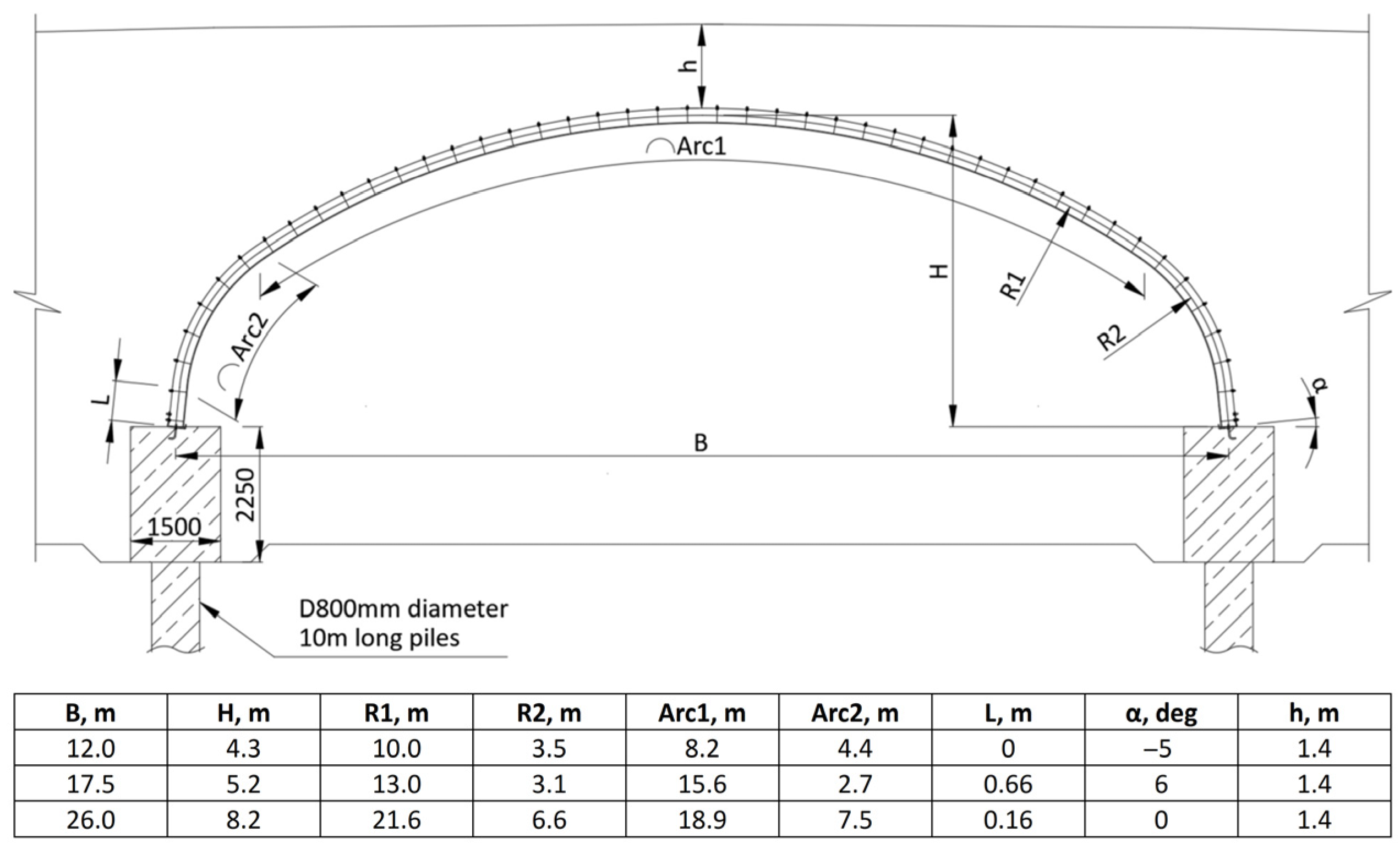
Three two-radius, low-profile arches were selected for this investigation, and their dimensions are presented in Figure 1. Such profiles are commonly used in practical engineering due to their rational performance and clearance box requirements as per national regulations. Each structure sat on 10 m long, 800 mm diameter reinforced concrete piles spaced 1.0 m apart. Solid pile heads that were 1.5 m wide and 2.25 m high were placed on top of the piles. Concrete of class C30/37 was used for the foundations to carry the vertical and horizontal loads transferred by the CSS structure. A soil cover of 1.40 m above the crown of the structure and live load model LM1 according to Eurocode 1 Part 2 [33] standard requirements were assumed in the analysis. Following standard installation rules for CSS structures, the backfill chosen comprised a sand–gravel mix with less than 5% fines, a unit weight of 21.50 kN/m3, and an effective friction angle of 33°. Detailed backfill envelope and soil parameters are presented in Section 3.
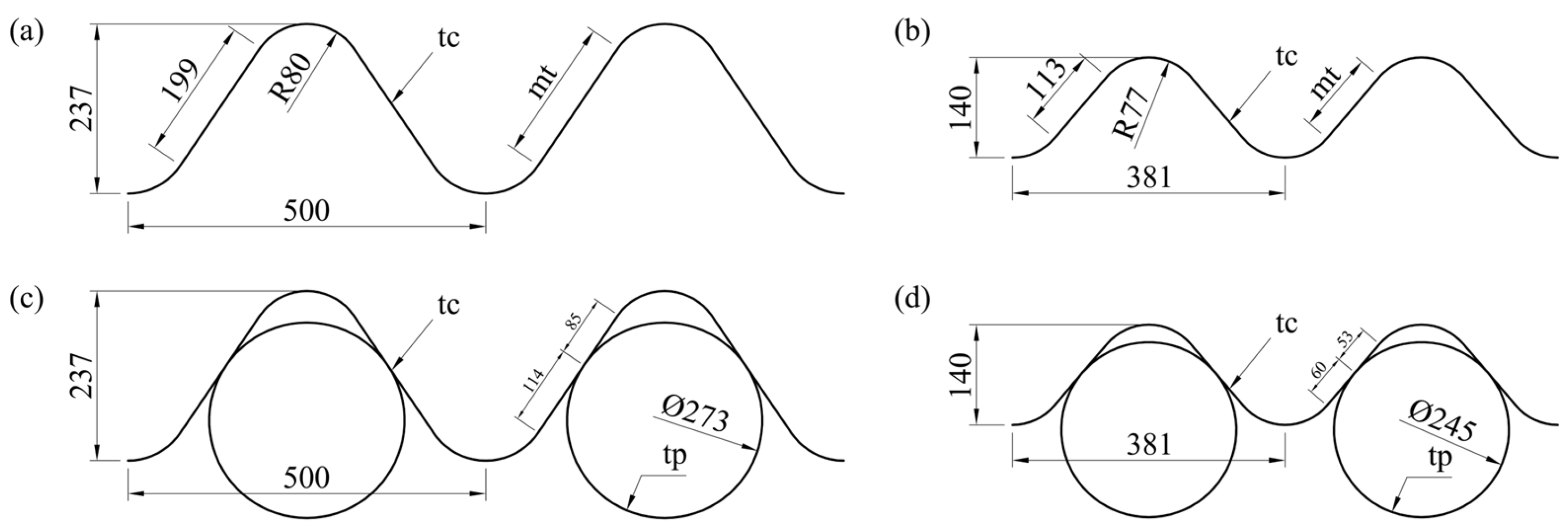
Two types of regular and innovative corrugation cross-section profiles were chosen to present comparative results, and their dimensions are presented in Figure 2. Although the length of the straight region of the corrugation mt somewhat depends on the plate thickness, only the axial tangent length behavior was studied. The diameter of the circular pipes for the innovative corrugations was selected considering the reduction in the buckling length of the straight region of the corrugation mt. It must be noted that, in this study, the corrugated plate and circular hollow-section steel pipe were assumed to have a fixed connection.

3. Numerical Models

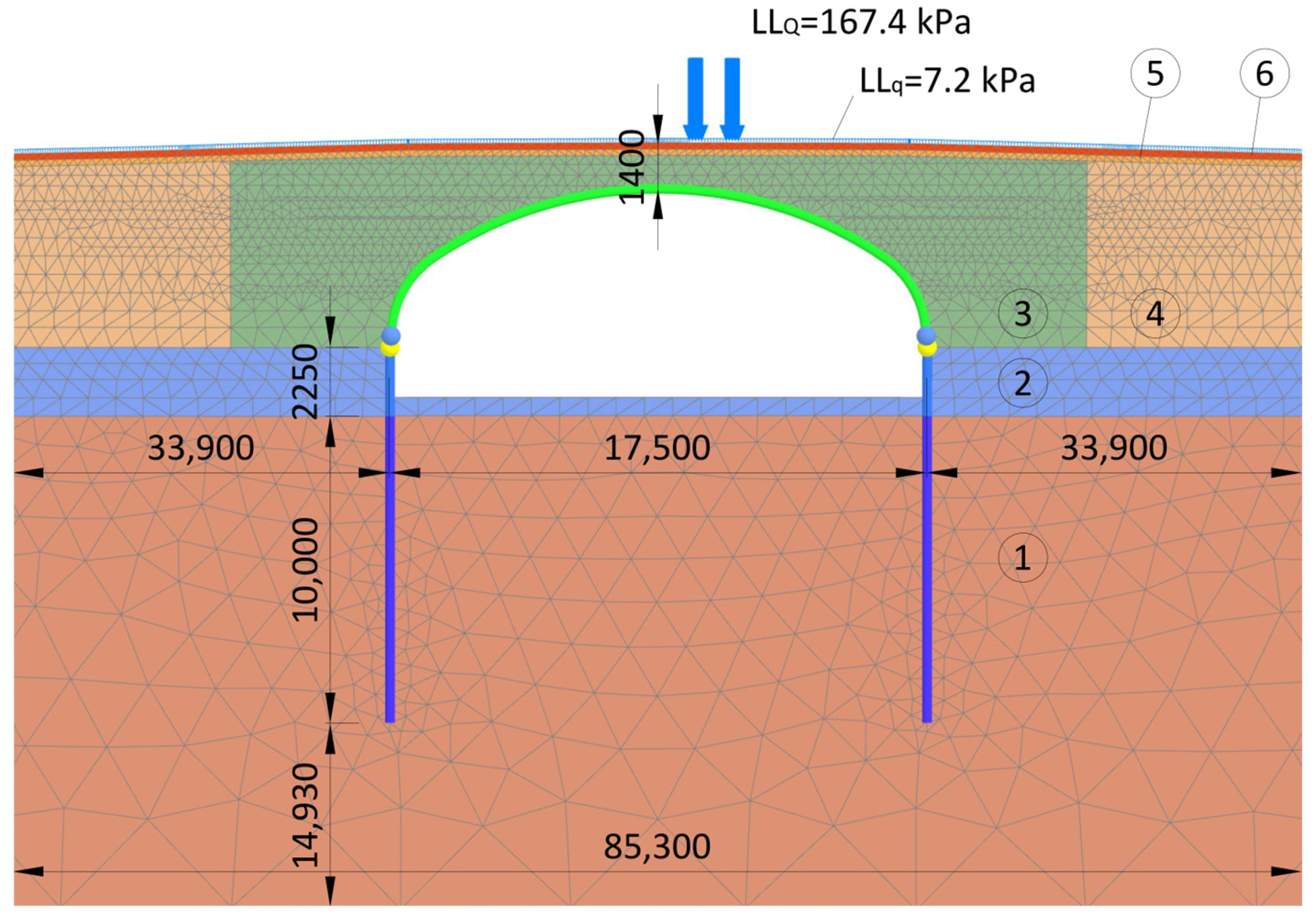
A nonlinear plane strain two-dimensional finite element model (FEM), as presented in Figure 3, was developed using Plaxis 2D Geotechnical Engineering Software [34]. It was necessary to identify the internal forces acting on the CSS structure because of soil–steel interactions. Moreover, according to the CHBDC [30] and AASHTO [31] regulations, a rigorous finite element (FE) analysis must be conducted when designing the deep and deeper cross-sections of corrugation profiles. It was believed that a three-dimensional analysis [7,35,36,37] would not significantly contribute to the study’s objective of comparing the steel material strength utilization results of the SDM [29], CHBDC [30], and AASHTO [31] design philosophies. However, assumptions were needed for the corrugated plate’s equivalent stiffness and the live load distribution in the transverse direction of the road due to the 2D plane strain idealization. Nevertheless, it was decided that the accuracy of internal forces was sufficient [14]; additionally, 2D models require less computational power. A three-dimensional analysis is planned for future research to verify the results [25].
The model boundary conditions extended horizontally to five times the CSS span and vertically to 1.5 times the pile length below the foundations. The corrugated steel arch and concrete foundation were modeled as plate elements. Individual soil regions of the model were set according to the data presented in Figure 3 and summarized in Table 1. Soil regions were modeled with 15-node triangular finite elements. The engineering backfill envelope (the soil region around the CSS structure) was assumed according to the requirements presented in the AASHTO [31] guidelines. The interface elements were set in contact with the soil and plate elements, with a resistance factor of 0.8 for non-cohesive soils [38]. Because of the 2D plane strain idealization, equivalent stiffness and unit weight values were assigned to all plate elements. Table 1 summarizes the material properties used in the FE model. However, it should be noted that, regardless of the importance of the soil geotechnical properties, this study did not analyze the influence of different soil characteristics on the behavior of soil–structure interactions. This study assumed constant soil properties according to national standard requirements and focused only on the strength of the steel material utilized. Despite the sensitivity of soil characteristics to buckling loads, it is believed that such a detailed investigation would go beyond the research objectives of this article.
The staged backfilling installation method was analyzed. The thickness of each backfill layer was set to 60 cm because thinner layers had no significant effect on the results. However, the influence of unsymmetrical loading was investigated by placing non-symmetrical soil cover at the sides of the CSS structure (only one layer difference).
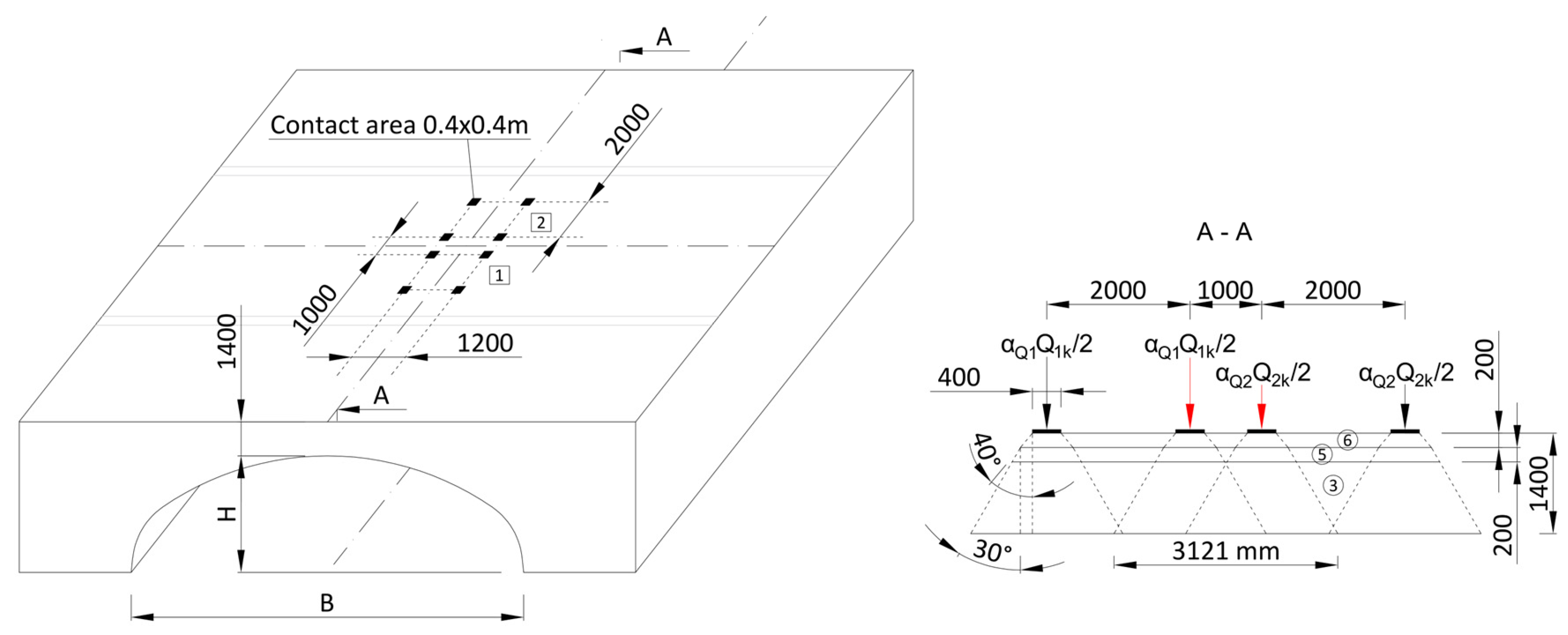
The tandem live load system LM1 (per Eurocode 1 Part 2 [33]) was positioned at various locations over the CSS structure. The aim of this approach was to simulate moving vehicles in the direction perpendicular to the axis of the structure and to induce the most unfavorable impact. The most critical position of the tandem system is when the interaction of the axial force and bending moment most reduces the structure’s load-bearing capacity. In each subsequent phase, the live load (LL) was shifted 1.2 m from the left boundary of the FE model toward the right. Figure 4 shows the LL located directly above the crown, while Figure 2 shows the tandem system’s most critical position.
Because a 2D plane strain idealization model is used, only two wheels were represented in the FE model (see Figure 3). The transverse live load distribution across the road was determined as per AASHTO [31], as the LL footprint was limited to a unit slice in that direction. The reduced surface load (RSL) method was applied to the 2D model, reducing the surface pressure by a reduction factor [39]. The reduction factor can be calculated using Equation (1) and in relation to Figure 4 following the ad hoc method described in the AASHTO [31] guidelines:
L L Q = r ( H ) P 0 = 2 W 0 S + W 0 + 2 t a n θ · H P 0 = α Q 1 · Q 1 k / 2 + α Q 2 · Q 2 k / 2 ( S + W 0 + 2 t a n θ · H ) · W 0 = 0.8 · 150 + 0.8 · 100 3.121 · 0.4 = 160.2   k P a
where L L Q is the effect of LM1 from the interaction of two wheels on a single axle (a minimal distance of 1.0 m between the first and second line wheels generates the highest pressure on the structure, so the remaining LL axles can be neglected; see red arrows in Figure 4 section A-A); r ( H ) is the surface pressure reduction factor according to the AASHTO [31] ad hoc method; P 0 is the actual service pressure on the footprint; W 0 is the width of the footprint, which is equal to 0.4 m; S is the distance between the wheels, which is 1.0 m; θ is the angle of the load distribution, which is assumed to be 40 ° for the asphalt layer and 30 ° for all other soil layers; H is the height of the soil cover, which is 1.40 m; α Q 1 and α Q 2 are the live load reduction factors, which are assumed to be 0.8; and Q 1 k and Q 2 k are the first and second lane axle loads, which are equal to 300 kN and 200 kN, respectively.
A total pressure of 167.4 kPa (including a uniformly distributed load of 7.2 kPa) under each wheel was simulated in the FE model (see Figure 2). Uniform pressure was also applied to the asphalt surface as per Eurocode 1 Part 2 [33]. Note that Plaxis 2D (Version 2023.1.0.136) Geotechnical Engineering Software [34] correctly modeled the increase in the footprint length along the road axis as the soil cover increased. The structural response to DL + LL was further examined in this study.

4. Results and Discussion

4.1. Corrugated Steel Plate Utilization

To investigate the results of the corrugated steel plate utilization ratio for regular and innovative corrugation profiles, the Swedish design method [29] was used, which is also adapted to Eurocode 3 Part 2 [32] standard requirements. Only the nature of buckling failure was investigated in this study; therefore, plate utilization ratios were calculated according to Equation (2). It is important to note that the local buckling provision addressed in the SDM [29] was not applied in this stage of calculations.
N E d χ y N R k γ M 1 + k y y M E d M R k γ M 1 1.0
where N E d and M E d are, respectively, the axial force and bending moment calculated numerically using the FEM; χ y is the reduction factor for flexural buckling, with χ y = N c r N u ; N c r is the buckling load of a buried structure (see Equation (3)); N u is the axial capacity of a fully plasticized cross-section, with N u = f y d A ; k y y is the coefficient of the interaction; N R k and M R k are the resistance to the axial force and bending moment, with N R k = f y A and M R k = f y W ; f y is the yield stress of the steel; A is the cross-section area; W is the plastic section modulus; and γ M 1 is the partial coefficient for the steel material.
According to Klöppel and Glock [40] and Abdel-Sayed [41], the general buckling load for a buried structure can be calculated according to Equation (3):
N c r = 3 ξ μ E s , d E I R t
where ξ and μ are the calculation parameters, E s , d is the design soil modulus, E I is the steel structure stiffness, and R t is the top radius of the soil–steel structure.
The cross-section parameters of the regular and innovative corrugation profiles were determined using SolidWorks (Version 34.1.1.0011) Corporation software [42]. The potential slippage between corrugated plates and circular pipes was evaluated by introducing reduction factors of the cross-section parameters accordingly: 0.5 for the moment of inertia and 0.75 for the plastic section modulus [43]. It is important to note that this overestimated modeling simplification was assumed to indicate the worst negative impact of slippage if such behavior existed. It was believed that the adopted reduction factors of the partially composite system may already be considered conservative; however, justification through parametric sensitivity analysis or experimental validation is planned for future research.
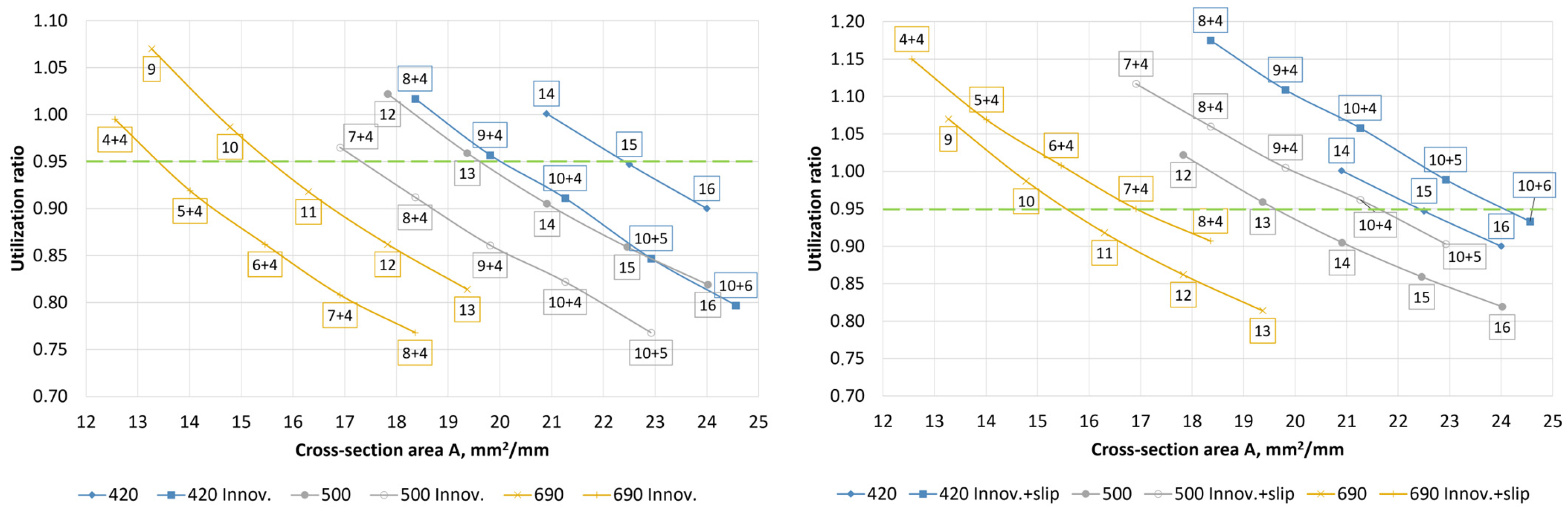
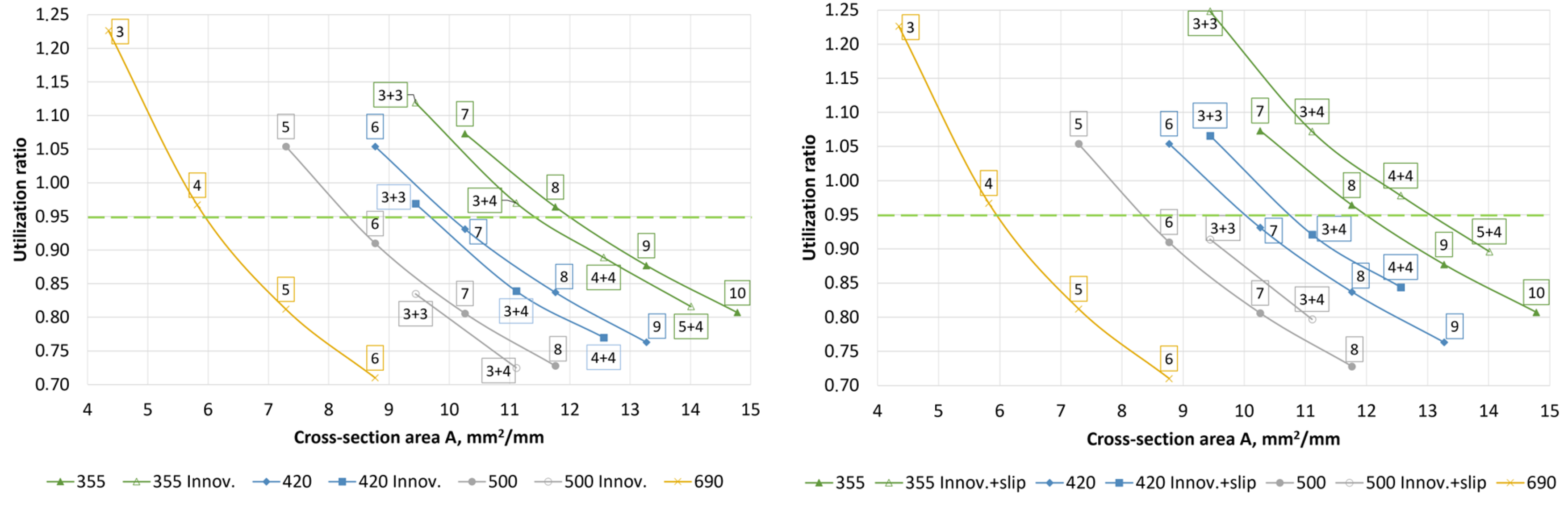
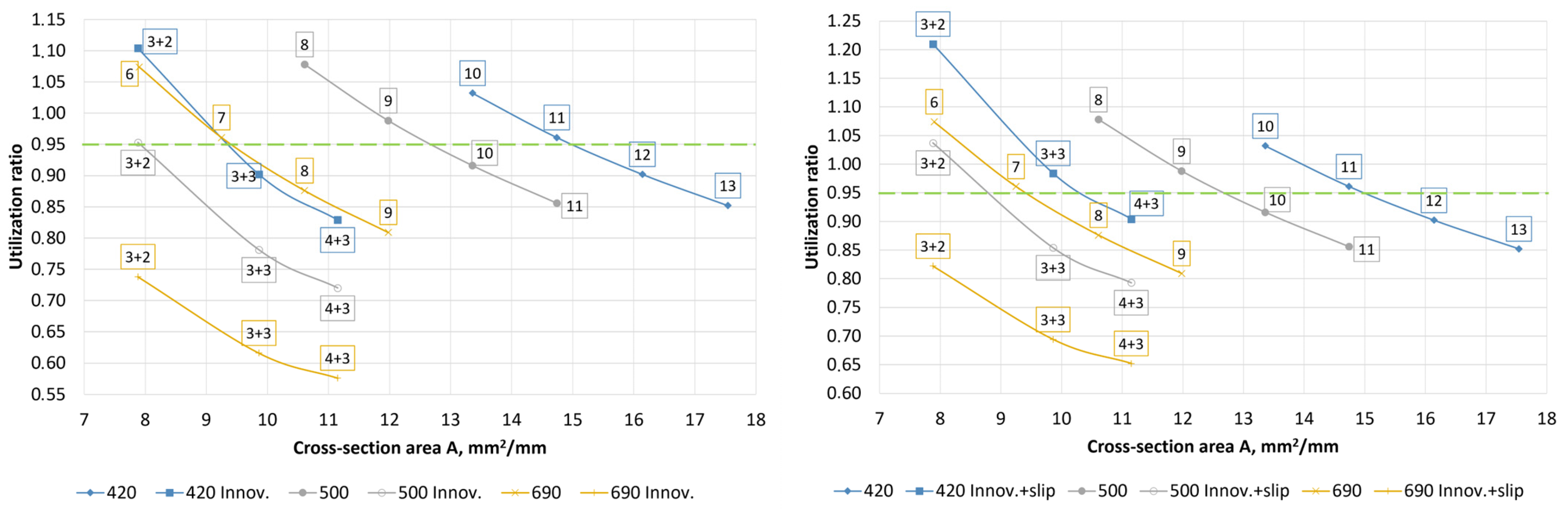
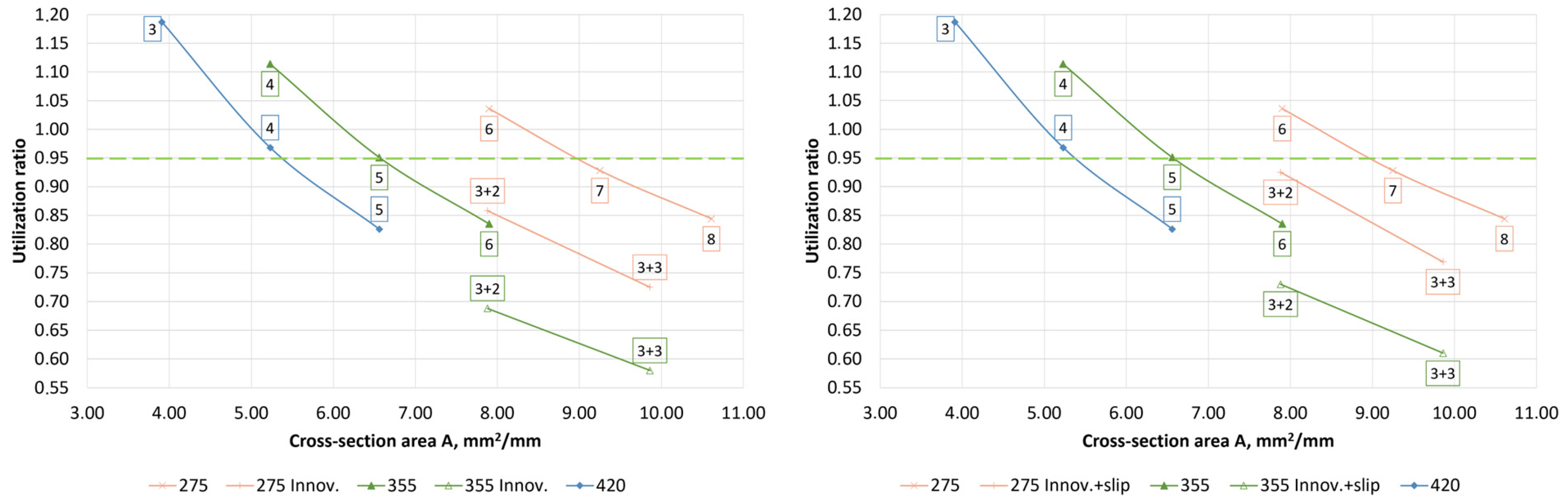
The results regarding the utilization ratio and cross-section area relationship are presented in Figure 5, Figure 6, Figure 7 and Figure 8. The results of the slippage between the corrugated plates and circular pipes are presented on the right sides of the figures. The regular and innovative corrugation profiles and different steel strengths are also included. The first number in the rectangles represents the corrugated plate thickness, and the second number represents the pipe wall thickness (for example, 7 + 4 mm). The corrugated plate and pipe wall thickness combinations were chosen by taking into account the nearby cross-section area values of the regular and innovative corrugation profiles.
The results in Figure 5, Figure 6, Figure 7 and Figure 8 indicate that the steel strength has a direct impact on the plate thickness utilization ratio—a higher yield stress allows for the use of thinner steel while maintaining the same strength, which can reduce the overall material usage and weight of the structure. The use of higher-strength steels can help to optimize resource efficiency. For example, Figure 5 shows that switching from 420 MPa steel to 690 MPa high-strength steel can reduce the cross-sectional area of both the regular and innovative corrugations by 31% at a utilization ratio of 0.95. Moreover, the results in Figure 5 show that the innovative corrugated profile strengthened with steel pipes also has a positive effect when potential slippage is not considered. As shown in Figure 5, the cross-section area of the innovative profile is about 12.9% lower than that of the regular profile with 690 MPa steel and a 0.95 utilization ratio. The same relationship can be observed for lower steel grades. However, if the cross-section parameters are reduced to account for the impact of potential slippage, the innovative profile loses its advantage. In such a case, the cross-section area of the innovative profile is about 6.7–10.7% larger at a utilization ratio of 0.95.
A similar relationship is presented in Figure 6 for a CSS structure with a smaller span of 17.5 m but the same corrugation profile of 500 × 237 mm. For example, by selecting 500 MPa steel instead of 355 MPa steel, the cross-section area can potentially be reduced by 30%. The application of the innovative profile is less beneficial for lower-span CSS structures because of the already high stiffness of the regular deeper corrugation profile. Nevertheless, as shown in Figure 6, the cross-section area of the innovative profile is about 5% smaller than that of the regular profile with 355 MPa steel. However, the cross-section area of the innovative profile is about 7–8.3% larger because of the effect of slippage.
The relationship between the utilization ratio and cross-section area of a steel structure with a 17.5 m span and deep corrugation of 381 × 140 mm is shown in Figure 7. In this case, when comparing conventional steel of 420 MPa and an HSS of 690 MPa, it was found that the use of the higher-strength steel can reduce the regular corrugation profile cross-section area by 37%. Meanwhile, the innovative profile has much greater potential than the larger-span and deeper corrugation structures shown in Figure 5 and Figure 6. The cross-section area of the innovative 381 × 140 mm profile is about 36% lower than that of the regular profile with 420 MPa steel. However, the benefits of using higher steel grades for innovative profiles are lost because the high-strength steel plate of the regular profile is already thin enough and already ensures the load-bearing capacity of the CSS structure. Additionally, slippage has a minor impact on the relationship, the results of which are presented on the right side of Figure 7.
According to the results presented in Figure 8, the relationship between the utilization ratio and cross-section area of the CSS structure with a 12 m span and corrugation dimensions of 381 × 140 mm is still affected when using higher grades of steel. The cross-section area decreases by 40% when using 420 MPa steel instead of 272 MPa steel. However, it must be noted that the use of HSS in a structure with such relatively small dimensions could lead to a much higher risk of local buckling in the straight region of the corrugation because of the use of thin corrugated steel plates. In addition, the impact of the innovative profile on reducing the cross-section area is minor, regardless of whether potential slippage between the corrugated plates and circular pipes is considered.

4.2. Local Buckling Impact

According to the Swedish design method [29] of corrugated soil–steel composite bridges, commonly used systems employ relatively thick corrugated steel plates, where local buckling does not represent a problem. However, it still requires the corrugation used to be examined with regard to local buckling by reducing the plastic moment capacity. The reduction coefficient can be calculated using Equation (4), and this calculation must be performed regardless of the cross-section parameters of the corrugation profile.
M u c r = ( 1.429 0.156 · l n ( ( m t / t ) · ( f y k / 227 ) 1 / 2 ) ) · M u
where m t is the corrugated profile’s tangent length, t is the corrugated plate thickness, and M u is the bending moment capacity.
It must be noted that the CHBDC [30] and AASHTO [31] methods do not include any rules regarding local buckling prevention during the design of corrugated soil–steel composite systems, thus giving rise to the following question: is the SDM [29] approach regarding the evaluation of local buckling too conservative? Considering this, an analysis was conducted to examine how the results are impacted by the local buckling relationship presented in the SDM [29]. In addition, the SDM [29] results were compared with flexural and axial strength designs, as well as global buckling failure checks, according to the methods presented in the AASHTO [31] and CHBDC [30] regulations. When following AASHTO [31] or CHBDC [30], the flexural and axial strength designs should be carried out according to Equation (5):
( T f R t ) 2 + | M u M n | 1.0
where T f and M u are, respectively, the factored thrust and moment calculated numerically using the FEM; R t is the factored thrust resistance, with R t = ϕ h F y A ; M n is the factored moment resistance, with M n = ϕ h M p ; ϕ h is the resistance factor; and M p is the plastic moment capacity of the section.
The global buckling failure check according to AASHTO [31] should be carried out as presented in Equation (6):
T f R b 1.0
where T f is the factored thrust calculated numerically using the FEM, and R b is the nominal axial force in the wall of the structure that causes general buckling, as shown in Equation (7):
R b = 1.2 φ b C n ( E p I p ) 1 3 ( φ s M s K b ) 2 3 R h
where φ b is the general buckling resistance factor; C n is the scalar calibration factor accounting for some nonlinear effects, equal to 0.55; E p is the steel material elasticity modulus; I p is the corrugated steel plate moment of inertia per unit length; φ s is the soil resistance factor; M s is the constrained modulus of embedment, with K b = ( 1 2 ν ) / ( 1 ν 2 ) ; ν is the soil Poisson’s ratio; R h is the correction factor for backfill geometry, with R h = 11.4 / ( 11 + S / H ) ; S is the span of the structure; and H is the height of the soil cover.
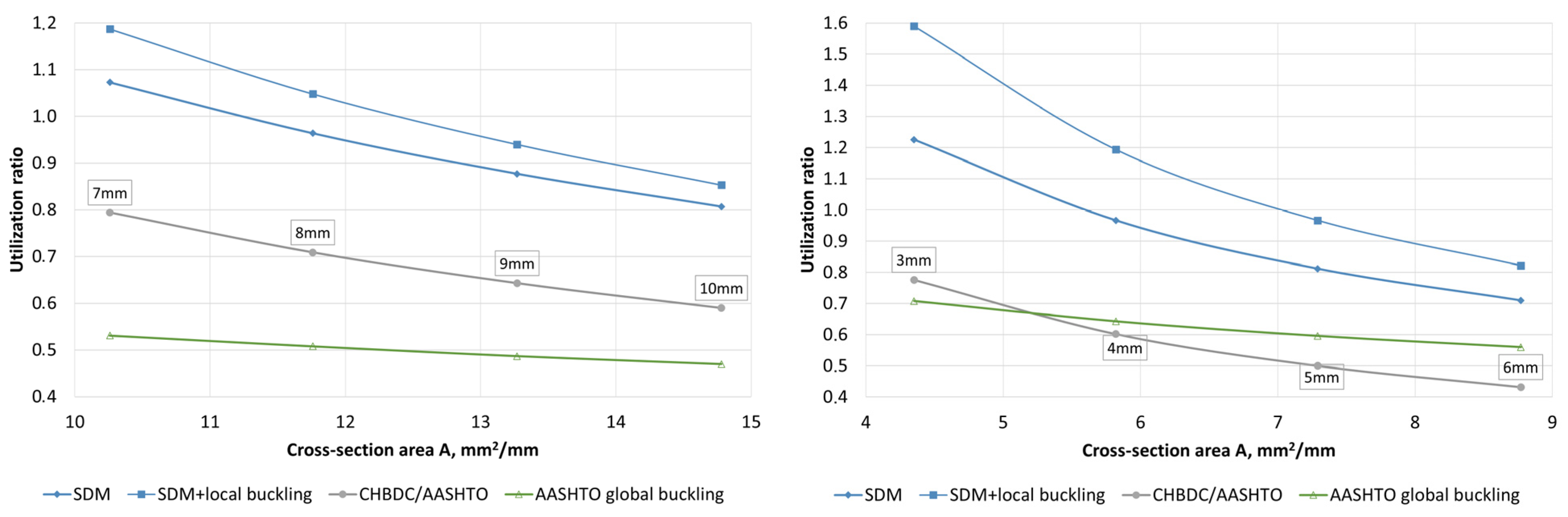
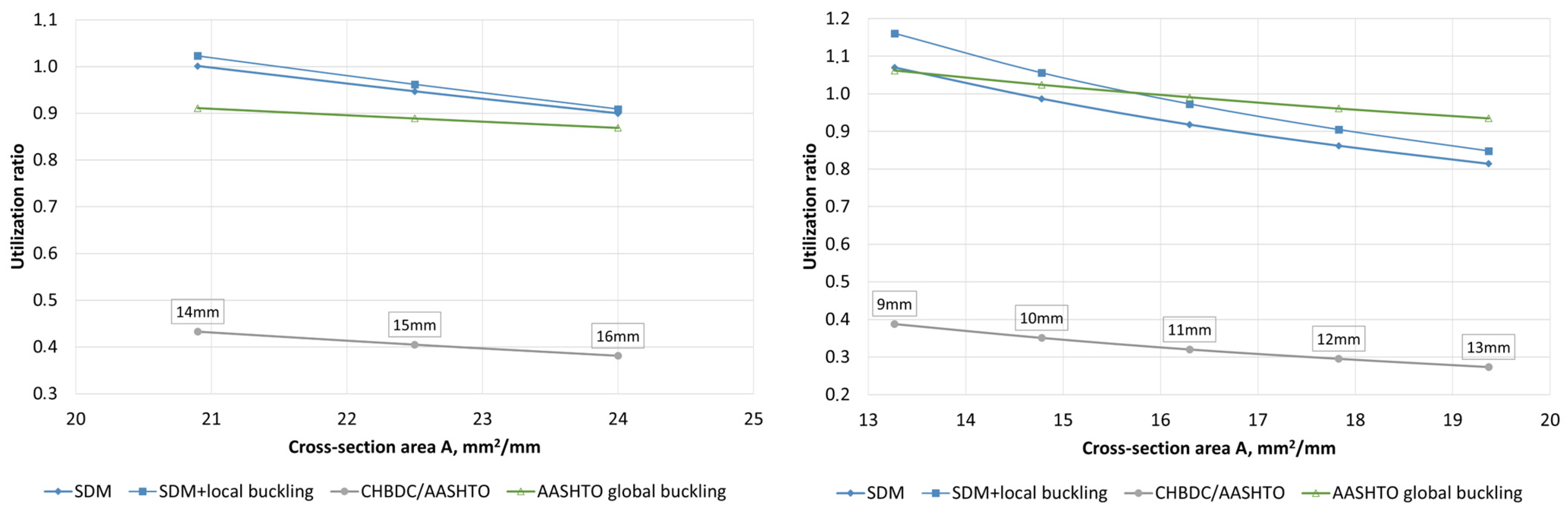
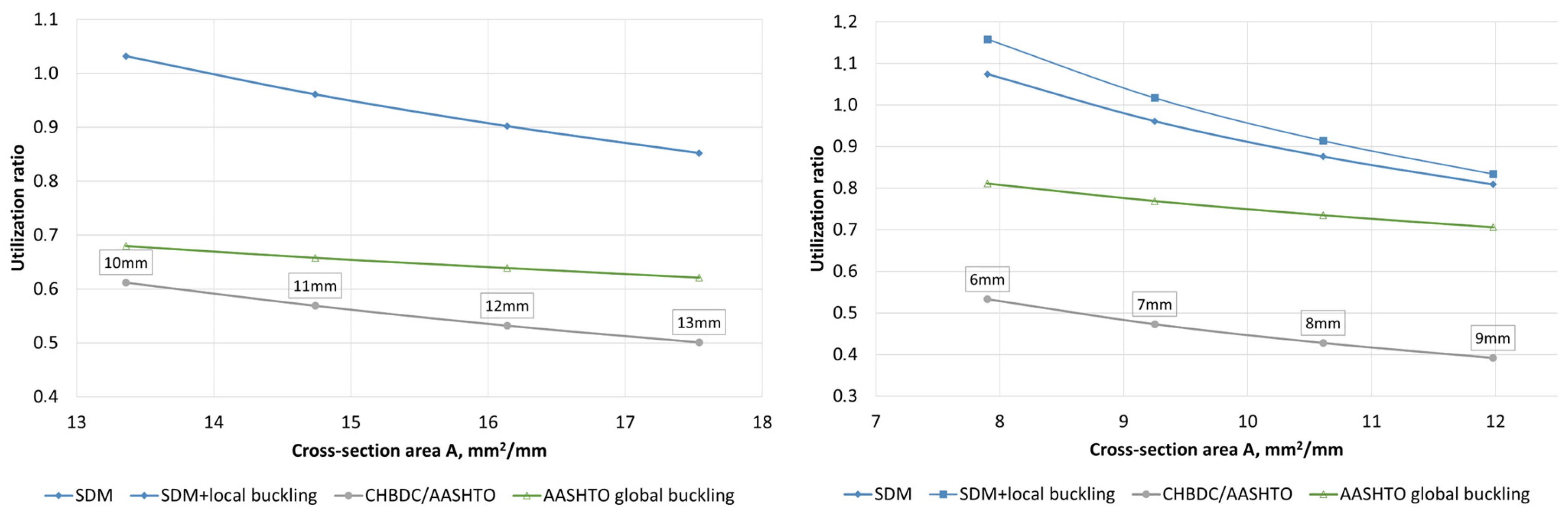
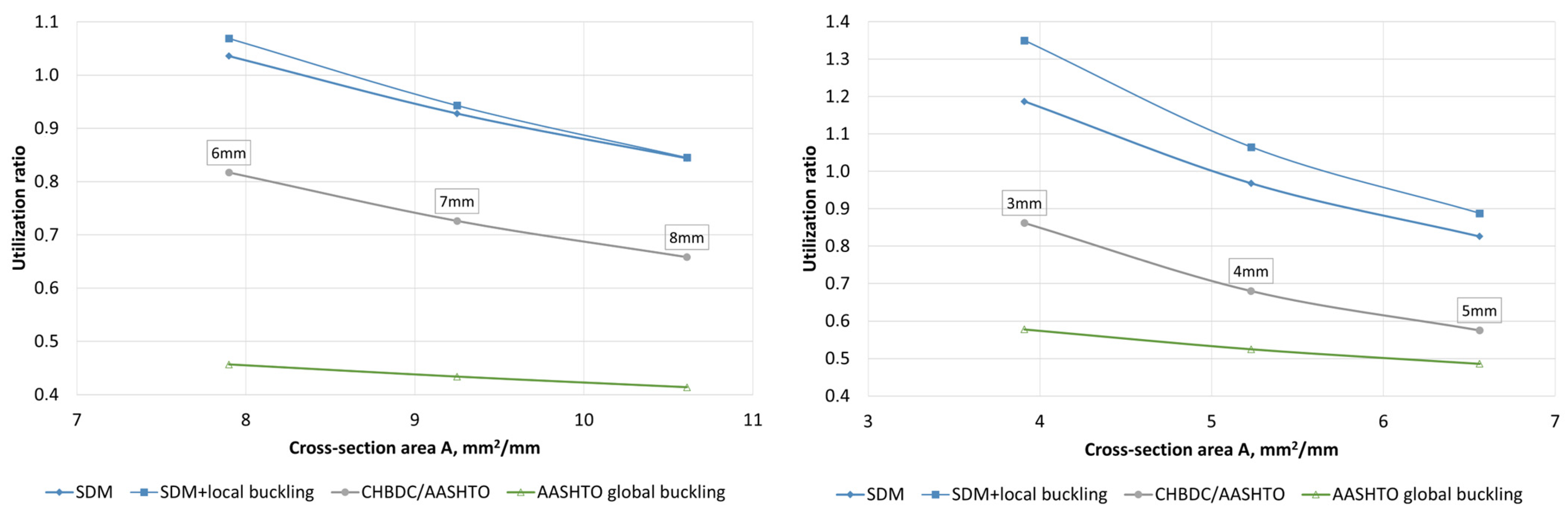
The results of the utilization ratio and cross-section area relationship obtained using the SDM [29], AASHTO method [31], and CHBDC [30] method are presented in Figure 9, Figure 10, Figure 11 and Figure 12, allowing for their comparison. Findings regarding the innovative corrugation profile are not presented, as investigations were only conducted for the regular corrugation profile and same plate thicknesses, which were closest to the utilization ratio of 1.0 according to the SDM [29] approach.
The relationship results for a CSS structure with a 26 m span and 500 × 237 mm corrugation profile when using steel with a strength of 420 MPa and 690 MPa are presented in Figure 9. It can be observed that the flexural and axial strength design according to AASHTO [31] or CHBDC [30] is less conservative than that according to the SDM [29] or AASHTO [31] global buckling approach. In this case, the utilization ratio is reduced by 67% for the plate with a 11 mm thickness. A reasonably higher impact of the local buckling reduction coefficient as per the SDM [29] is achieved when an HSS of 690 MPa is used. The utilization ratio for the 11 mm plate is 6% higher. Nevertheless, the results obtained in this case are in line with those obtained using the AASHTO [31] global buckling approach.
The results obtained for a CSS structure with a 17.5 m span and 500 × 237 mm corrugation profile are shown in Figure 10. The SDM [29] approach appears to be more demanding, and the need for a thicker corrugated plate is greater when the plastic moment capacity is reduced. In this case, the CHBDC [30] and AASHTO [31] results are less conservative and more uniform, especially for higher steel grades. The utilization ratio obtained when using the SDM [29] and considering local buckling is 18.5% higher than that obtained when the reduction factor because local buckling is not applied for 5 mm 690 MPa steel plates. However, the utilization ratio is 60% higher than that obtained using the AASHTO [31] global buckling failure check. Furthermore, it can be observed that the global buckling check is more sensitive to thinner plates and higher steel grades than the flexural and axial strength design.
Figure 11 shows the results of a CSS structure with a 17.5 m span and 381 × 140 mm corrugation profile with 420 MPa and 690 MPa steel strength, respectively. The flexural and axial strength designs according to CHBDC [30] or AASHTO [31] still clearly demonstrate much less conservative results. In this case, the corrugated plate utilization ratio is 46% higher than that observed in the SDM [29] and AASHTO [31] global buckling results for 420 MPa and 11 mm steel. However, because a relatively thick corrugated plate is needed, local buckling under the SDM [29] does not influence the results obtained with the 420 MPa steel. Nevertheless, the use of thinner plates and stronger steel increases the already high estimation obtained using the SDM [29], making the method even less preferable. However, the flexural and axial strength design obtained according to CHBDC [30] or AASHTO [31] is much less conservative than that obtained according to the other methods, especially when higher steel grades are used.
A comparison of the relationships between the utilization ratio and cross-section area of a CSS structure with a 12 m span and 381 × 140 mm corrugation profile with respect to 275 MPa and 420 MPa steel yield strength is shown in Figure 12. The design according to the SDM [29] remains the most conservative, while the AASHTO [31] global buckling failure check is less decisive for CSS structures with a smaller span. For example, 7 mm and a S275 steel plate is sufficient to ensure load-bearing capacity of the structure under a 94% plate utilization ratio according to the SDM [29], under 73% according to the CHBDC [30] flexural and axial strength design, and only under 43% according to the AASHTO [31] global buckling failure check.
Considering the presented results, it can be concluded that the SDM [29] is the most conservative method for the design of corrugated soil–steel structures presented in this study. Local buckling evaluation by reducing the plastic moment capacity seems to be even more conservative, making the method less preferable. However, it should be noted that the SDM [29] was designed for CSS structures with a relatively small span, and the impact of HSS was not considered in its most recent update, which was carried out in 2014. Considering this, additional local buckling sensitivity analyses were carried out according to the width-to-thickness ratio limit proposed by Sun et al. [27] and Eurocode 3 Part 2 [32] for sections in class 3 under axial compression.
Sun et al. [27] proposed a width-to-thickness ratio β for CSS structures to prevent local buckling. According to their investigation, β   =   s / 2 t     63 ε k , where s is the expansion length of a single repeating corrugation section, t is the corrugated steel plate thickness, and ε k   = 235 / f y . In contrast, Eurocode 3 Part 2 [32] for sections in class 3 proposes c / t     42 ε k , where c is the web length of the sections applicable for regular steel girder structures. Following these ratios, the results presented in this article were compared considering the impact of the minimal plate thickness and HSS on local buckling. A comparison of the results is presented in Table 2.
Despite the conservative results of the SDM method [29], in some cases, local buckling prevention assessment according to Sun et al. [27] or Eurocode 3 Part 2 [32] requires even thicker plates, as shown in Table 2 (the results marked in red color). However, the results of this study allow for the conclusion that the SDM [29] of preventing local buckling by reducing the plastic moment capacity should be revised, especially in cases using thicker and lower steel grades, when local buckling in principle can be neglected. The opposite situation is found for the CHBDC [30] and AASHTO [31] methods, which, in most cases, showed much less conservative results. This outcome indicates that local buckling prevention is important and cannot be ignored during the design of CSS structures. Moreover, the results indicate the need for more detailed analyses considering not only the strength utilized (safety limit state) but also serviceability aspects.

5. Summary and Conclusions

This study performed 2D numerical analyses of three low-profile, two-radius arches with spans of 26 m, 17.5 m, and 12 m embedded in soil to identify internal forces from permanent and temporary loads. An analysis of the steel plate utilization ratio was conducted according to the Swedish design method [29] with the aim of identifying the impacts and benefits of high-strength steel and two types of innovative deep and deeper corrugated cross-sections strengthened with circular steel pipes. Results considering slippage between the corrugated plates and circular pipes were also obtained. Afterward, an analysis of the steel plate utilization ratio was conducted according to the AASHTO [31] and CHBDC [30] design methods, and the results were compared to those obtained using the SDM [29] and its requirements for preventing local buckling by reducing the plastic moment capacity. Finally, the corrugated plate utilization results were compared with the width-to-thickness ratio proposed by Sun et al. [27] and with the c/t ratio presented in Eurocode 3 Part 2 [32]. According to the numerical analysis, the following conclusions can be drawn:
  • Higher-strength steel allows for thinner plates to be used in CSS structures while maintaining the same strength. HSS can help to optimize and reduce the overall material usage and weight of the structure. For example, as shown in Figure 5, Figure 6, Figure 7 and Figure 8, the transition from conventional steel to higher-strength steel enables the regular and innovative corrugation cross-section areas to be reduced by 30–40% with a utilization ratio of 95%.
  • The cross-section area of the innovative profile can be reduced by 5% to 36% in comparison to that of the regular corrugation profile. The innovative profile with 500 × 237 mm corrugation loses its advantage when the proposed slippage effect is considered, while the 381 × 140 mm corrugation profile reinforced by circular pipes achieves the same load-bearing capacity in less heavy CSS structures. However, the innovative cross-section has a minor impact on CSS structures with shorter spans.
  • Flexural and axial strength design according to the CHBDC [30] or AASHTO [31] regulations seems to be less conservative than that of other methods, especially when higher steel grades are used. However, it should be emphasized that differences arise from distinct design philosophies rather than methodological shortcomings. According to the results presented in Figure 9, Figure 10, Figure 11 and Figure 12, the utilization ratio can be up to 67% lower in contrast to that of the SDM [29]. However, the use of thinner plates and stronger steel increases the already high estimations obtained using the SDM [29], making the method less preferable. The AASHTO [31] global buckling failure check is less decisive for CSS structures with shorter spans.
  • In accordance with the results shown in Table 2, in specific cases, the corrugated plate is too thin even when considering the conservative SDM [29] and its local buckling approach. It is worth noting that conservatism is observed within a comparative code framework only. The results are even more surprising knowing that CHBDC [30] and AASHTO [31] propose less conservative design approaches, the results of which are presented in Figure 9, Figure 10, Figure 11 and Figure 12. Nevertheless, the results presented in Table 2 indicate that more detailed analyses are required and that local buckling should be prevented during the design of CSS structures. Such analyses of local buckling in the straight region of the corrugation, including laboratory tests, are already planned for future research.

Author Contributions

Conceptualization, N.B. and A.J.; methodology, N.B. and A.J.; software, N.B.; validation, N.B.; formal analysis, N.B.; investigation, N.B. and A.J.; resources, N.B. and A.J.; data curation, N.B.; writing—original draft, N.B.; writing—review and editing, N.B. and A.J.; visualization, N.B.; supervision, N.B. and A.J.; project administration, N.B.; funding acquisition, N.B. and A.J. All authors have read and agreed to the published version of the manuscript.

Funding

This research received no external funding.

Data Availability Statement

The original contributions presented in this study are included in the article. Further inquiries can be directed to the corresponding author.

Conflicts of Interest

The authors declare no conflicts of interest.

References

  1. Andersson, A.; Karoumi, R. A soil-steel bridge under high-speed railways. Arch. Inst. Inżynierii Lądowej 2017, 23, 45–52. [Google Scholar] [CrossRef]
  2. Gozzi, V.; Guante Henriquez, L. Integrating Sustainability Indicators in Conceptual Design of Footbridges: A Decision-Support Framework for Environmental, Economic, and Structural Performance. Sustainability 2025, 17, 4562. [Google Scholar] [CrossRef]
  3. Nakhostin, E.; Kenny, S.; Sivathayalan, S. Numerical performance assessment of buried corrugated metal culvert subject to service load conditions. Can. J. Civ. Eng. 2021, 48, 99–114. [Google Scholar] [CrossRef]
  4. Negrea, D.; Cazacu, C.E.; Conțiu, M. Innovative Solutions for the Rehabilitation of Bridges Using Flexible Galvanized Steel Structures: A Case Study. Sustainability 2023, 15, 6200. [Google Scholar] [CrossRef]
  5. Pettersson, L.; Flener, E.B.; Sundquist, H. Design of soil-steel composite bridges. Struct. Eng. Int. 2015, 25, 159–172. [Google Scholar] [CrossRef]
  6. Wang, T.; Tan, L.; Xie, S.; Ma, B. Development and applications of common utility tunnels in China. Tunn. Undergr. Space Technol. 2018, 76, 92–106. [Google Scholar] [CrossRef]
  7. Embaby, K.; Hesham El Naggar, M.; El Sharnouby, M. Performance of large-span arched soil–steel structures under soil loading. Thin-Walled Struct. 2022, 172, 108884. [Google Scholar] [CrossRef]
  8. Beben, D. Numerical analysis of a soil-steel bridge structure. Balt. J. Road Bridge Eng. 2009, 4, 13–21. [Google Scholar] [CrossRef]
  9. Beben, D. The role of backfill quality on corrugated steel plate culvert behaviour. Balt. J. Road Bridge Eng. 2017, 12, 1–11. [Google Scholar] [CrossRef]
  10. Kenny, S.; Sivathayalan, S. Examination of buried corrugated metal culvert failure mechanisms using finite elements methods. In Proceedings of the GeoOttawa 2017: Proceedings of 70th Canadian Geotechnical Conference 2017, Ottawa, ON, Canada, 1–4 October 2017. [Google Scholar]
  11. Wadi, A.; Pettersson, L.; Karoumi, R. Flexible culverts in sloping terrain: Numerical simulation of soil loading effects. Eng. Struct. 2015, 101, 111–124. [Google Scholar] [CrossRef]
  12. Wadi, A.; Pettersson, L.; Karoumi, R. Flexible culverts in sloping terrain: Numerical simulation of avalanche load effects. Cold Reg. Sci. Technol. 2016, 124, 95–109. [Google Scholar] [CrossRef]
  13. Wadi, A.; Pettersson, L.; Karoumi, R. FEM simulation of a full-scale loading-to-failure test of a corrugated steel culvert. Steel Compos. Struct. 2018, 27, 217–227. [Google Scholar] [CrossRef]
  14. Wadi, A.; Pettersson, L.; Karoumi, R. On predicting the ultimate capacity of a large-span soil-steel composite bridge. Int. J. Geosynth. Ground Eng. 2020, 6, 48. [Google Scholar] [CrossRef]
  15. Andersson, A.; Sundquist, H.; Karoumi, R. Full scale tests and structural evaluation of soil-steel flexible culverts for high-speed railways. Arch. Inst. Civ. Eng. 2012, 12, 43–53. [Google Scholar]
  16. Beben, D. Field Performance of Corrugated Steel Plate Road Culvert under Normal Live-Load Conditions. J. Perform. Constr. Facil. 2013, 27, 807–817. [Google Scholar] [CrossRef]
  17. Gogolik, S.; Kopras, M.; Szymczak-Graczyk, A.; Tschuschke, W. Experimental Evaluation of the Size and Distribution of Lateral Pressure on the Walls of the Excavation Support. J. Build. Eng. 2023, 73, 106831. [Google Scholar] [CrossRef]
  18. Kopras, M.; Buczkowski, W.; Szymczak-Graczyk, A.; Walczak, Z.; Gogolik, S. Experimental Validation of Deflections of Temporary Excavation Support Plates with the Use of 3D Modelling. Materials 2022, 15, 4856. [Google Scholar] [CrossRef]
  19. Pettersson, L. Full Scale Tests and Structural Evaluation of Soil Steel Flexible Culverts with Low Height of Cover; The Royal Institute of Technology: Stockholm, Sweden, 2007. [Google Scholar]
  20. Wysokowski, A. Full scale tests of various buried flexible structures under failure load. Sci. Rep. 2022, 12, 1328. [Google Scholar] [CrossRef]
  21. Bareikis, N. Parametric analysis of innovative corrugated profile of soil-steel composite bridge. Ce/Papers 2024, 7, 94–99. [Google Scholar] [CrossRef]
  22. Bareikis, N. Rational steel mesh layout influence on plate utilization of large span corrugated steel structure. Arch. Civ. Eng. 2024, 70, 561–578. [Google Scholar] [CrossRef]
  23. Beben, D.; Stryczek, A. Numerical analysis of corrugated steel plate bridge with reinforced concrete relieving slab. J. Civ. Eng. Manag. 2016, 22, 585–596. [Google Scholar] [CrossRef]
  24. Embaby, K.; Hesham El Naggar, M.; El Sharnouby, M. Investigation of bevel-ended large-span soil-steel structures. Eng. Struct. 2022, 267, 114658. [Google Scholar] [CrossRef]
  25. Maleska, T.; Beben, D. Numerical analysis of a soil-steel bridge during backfilling using various shell models. Eng. Struct. 2019, 196, 109358. [Google Scholar] [CrossRef]
  26. Chen, T.; Su, M.; Pan, C.; Zhang, L.; Wang, H. Local buckling of corrugated steel plates in buried structures. Thin-Walled Struct. 2019, 144, 106348. [Google Scholar] [CrossRef]
  27. Sun, H.J.; Guo, Y.L.; Wen, C.B.; Zuo, J.Q.; Zhao, Q.; Liu, Z.G. The strength design of deeply buried circular corrugated steel arches with considering only soil radial restraining. Thin-Walled Struct. 2023, 183, 110422. [Google Scholar] [CrossRef]
  28. Bareikis, N. High strength steel influence on sustainability of corrugated soil-steel composite bridge. IABSE Symp. 2025, 121, 807–814. [Google Scholar] [CrossRef]
  29. Pettersson, L.; Sundquist, H. Design of Soil Steel Composite Bridges (Report 112), 5th ed.; KTH Royal Institute of Technology: Stockholm, Sweden, 2014. [Google Scholar]
  30. CAN/CSA-S6-14; CHBDC (Canadian Highway Bridge Design Code). Canadian Standards Association: Mississauga, ON, USA, 2019.
  31. AASHTO (American Association of State Highway and Transportation Officials). AASHTO LRFD Bridge Design Specification, Customary U.S. Units, 8th ed.; AASHTO: Washington, DC, USA, 2017. [Google Scholar]
  32. EN 1993-2:2006; Eurocode 3: Design of Steel Structures—Part 2: Steel Bridges. The European Union: Brussels, Belgium, 2006.
  33. EN 1991-2:2003; Eurocode 1: Actions on Structures—Part 2: Traffic Loads on Bridges. The European Union: Brussels, Belgium, 2003.
  34. Plaxis 2D Geotechnical Engineering Software. Available online: https://www.bentley.com/software/plaxis-2d/ (accessed on 15 November 2023).
  35. Bagheri, M.; Ranjbar Malidarreh, N.; Ghaseminejad, V.; Asgari, A. Seismic Resilience Assessment of RC Superstructures on Long–Short Combined Piled Raft Foundations: 3D SSI Modeling with Pounding Effects. Structures 2025, 81, 110176. [Google Scholar] [CrossRef]
  36. Elshimi, T.M. Three-Dimensional Nonlinear Analysis of Deep-Corrugated Steel Culverts. Doctoral Dissertation, Queen’s University, Kingston, ON, Canada, 2011. [Google Scholar]
  37. Ezzeldin, I.; El Naggar, H. Three-dimensional finite element modeling of corrugated metal pipes. Transp. Geotech. 2021, 27, 100467. [Google Scholar] [CrossRef]
  38. Potyondy, J.G. Skin friction between various soils and construction materials. Geotechnique 1961, 11, 339–353. [Google Scholar] [CrossRef]
  39. Katona, M.G. Improved Methods for Simulating Live Loads for 2D Structural Analysis of Buried Culverts. In Proceedings of the Presentation at 2019 TRB Annual Meeting and Publication in TRR 2018, Washington, DC, USA, 13–17 January 2019. [Google Scholar]
  40. Klöppel, K.; Glock, D. Theoretische und Experimentelle Untersuchungen zu den Traglastproblemen Biegeweicher, in die Erde eingebetteter Rohre; Institut für Statik und Stahlbau: Darmstadt, Germany, 1970; Volume 10. [Google Scholar]
  41. Abdel-Sayed, G. Stability of Flexible Conduits embedded in Soil. Can. J. Civ. Eng. 1978, 3, 324–333. [Google Scholar] [CrossRef]
  42. SolidWorks Corporation. Available online: https://www.solidworks.com/domain/design-engineering (accessed on 1 April 2024).
  43. Machelski, C. Stiffness of Layered Shells in Soil-Steel Bridge Structures. Roads Bridges—Drog. I Mosty 2011, 10, 55–76. [Google Scholar]
Figure 1. Transverse section dimensions of the two-radius, low-profile arches investigated in this article.
Buildings 16 01414 g001
Figure 2. Cross-sections of corrugation profiles investigated in this study: (a) regular corrugation of 500 × 237 mm; (b) regular corrugation of 381 × 140 mm; (c) innovative corrugation of 500 × 237 mm reinforced by Ø273 mm steel pipes; (d) innovative corrugation of 381 × 140 mm reinforced by Ø245 mm steel pipes.
Buildings 16 01414 g002
Figure 3. Numerical 2D finite element model of a CSS structure with a span of 17.5 m (soil layer numbering corresponds to Table 1).
Buildings 16 01414 g003
Figure 4. Layout of LM1 tandem system above the crown of the low-profile, two-radius arch structures (soil layer numbering corresponds to that in Table 1).
Buildings 16 01414 g004
Figure 5. The relationship between the utilization ratio and cross-section area of a CSS structure with a 26 m span and 500 × 237 mm corrugation.
Buildings 16 01414 g005
Figure 6. The relationship between the utilization ratio and cross-section area for a CSS structure with a 17.5 m span and 500 × 237 mm corrugation.
Buildings 16 01414 g006
Figure 7. The relationship between utilization ratio and cross-section area of a CSS structure with a 17.5 m span and 381 × 140 mm corrugation.
Buildings 16 01414 g007
Figure 8. The relationship between the utilization ratio and cross-section area of a CSS structure with a 12 m span and 381 × 140 mm corrugation.
Buildings 16 01414 g008
Figure 9. The relationship between the utilization ratio and cross-section area of a CSS structure with a 26 m span and 500 × 237 mm corrugation profile when using 420 MPa and 690 MPa steel yield strength.
Buildings 16 01414 g009
Figure 10. The relationship between the utilization ratio and cross-section area for a CSS structure with a 17.5 m span and 500 × 237 mm corrugation profile with respect to 355 MPa and 690 MPa steel yield strength.
Buildings 16 01414 g010
Figure 11. The relationship between the utilization ratio and cross-section area of a CSS structure with a 17.5 m span and 381 × 140 mm corrugation profile with respect to 420 MPa and 690 MPa steel yield strength.
Buildings 16 01414 g011
Figure 12. The relationship between the utilization ratio and cross-section area of a CSS structure with a 12 m span and 381 × 140 mm corrugation profile with respect to 275 MPa and 420 MPa steel yield strength.
Buildings 16 01414 g012
Table 1. Summary of soil, concrete, and steel material properties assumed in the FE model.
No.IdentificationMaterial Model TypeUnit WeightElastic ModulusPoisson’s RatioCohesionFriction Angle
kN/m3MPakPaDegrees
1SubsoilMohr–Coulomb21.51200.20130
2Foundation backfillMohr–Coulomb21.2800.23129
3Engineering backfillMohr–Coulomb21.5350.20033
4EmbankmentMohr–Coulomb21.2300.23129
5Road subbaseMohr–Coulomb23.04000.23143
6AsphaltLinear elastic23.04000.40
7Foundation concreteElastic21.630,0000.20
8Corrugated steel shellElastic78.5210,0000.30
Table 2. Results of local buckling sensitivity analysis in relation to utilization ratio.
Structure Descriptiont, mmSDMSDM + Local Bucklings/2tc/t
B = 26 m,
500 × 237 mm (s = 722.4 mm, c = 199 mm), fy = 690 MPa
100.9871.056 36.1   <   63 ε k = 36.7 19.9   <   42 ε k = 24.5
B = 17.5 m, 500 × 237 mm (s = 722.4 mm, c = 199 mm), fy = 690 MPa50.8120.96772.2 > 63 ε k   =   36.7 39.8 > 42 ε k   =   24.5
B = 17.5 m, 381 × 140 mm (s = 492.2 mm, c = 113 mm), fy = 690 MPa70.9611.017 35.1   <   63 ε k = 36.7 16.1   <   42 ε k = 24.5
B = 12 m,
381 × 140 mm (s = 492.2 mm, c = 113 mm), fy = 420 MPa
50.8260.88849.2 > 63 ε k   =   47.1 22.6   <   42 ε k = 31.4
Disclaimer/Publisher’s Note: The statements, opinions and data contained in all publications are solely those of the individual author(s) and contributor(s) and not of MDPI and/or the editor(s). MDPI and/or the editor(s) disclaim responsibility for any injury to people or property resulting from any ideas, methods, instructions or products referred to in the content.