A Structural Equation Modelling Approach to Improving Progress Payment Systems Through Common Data Environment (CDE) Implementation

Abstract
1. Introduction
- To establish enabling factors to improve the implementation of a CDE.
- To evaluate the characteristics of a CDE in managing progress payment challenges.
- To identify the benefits of integrating a CDE in construction payment system.
- To develop a model for enhancing the management of payment systems through the implementation of a CDE.
1.1. Challenges Faced During CDE Implementation
1.2. Enabling Factors for Improving CDE Implementation
1.3. Characteristics of the Common Data Environment
1.3.1. Information Management
1.3.2. Communication
1.3.3. Collaboration
1.3.4. Transparency
1.3.5. Payment System
1.4. Managing Payment Systems Through a Common Data Environment
1.4.1. Gathering Data and Submitting for Payment Certificates
1.4.2. Authorization of Payment Data and Conclusion of Certificate Amounts
1.4.3. Submission of Invoice and Processing the Approved Payment
2. Materials and Methods
2.1. Systematic Literature Review
2.2. Questionnaire Survey
2.3. Structural Equation Modeling
3. Results
3.1. Distribution Characteristics of the Data
3.2. Identifiability of the Model
3.3. Fit Statistics on Measurement Models
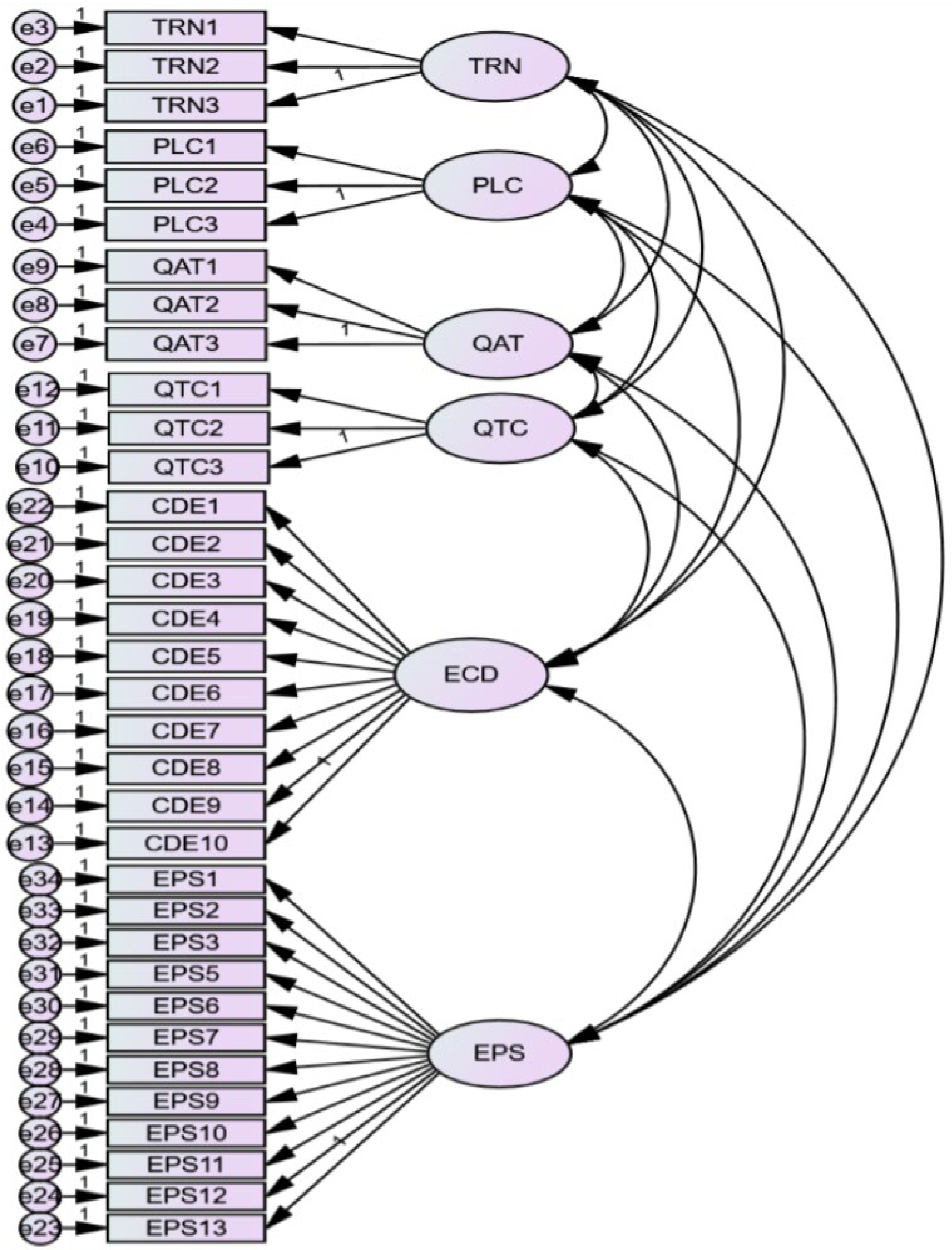
- Training is explained by grouped indicator variables TRN1 to 3;
- Policy is explained by indicator variables PLC1 to 3;
- Quality assurance team is explained by indicator variables QAT1 to 4;
- Quality technology is explained by indicator variables QTC1 to 3;
- Effective common data environment is explained by indicator variables CDE1 to 10;
- Effective efficient payment system is explained by indicator variables EPS1 to 13.
3.3.1. Model Goodness-of-Fit Statistics—RML
3.3.2. Statistical Significance of Parameter Estimates
3.3.3. Construct Validity of the Measurement Model
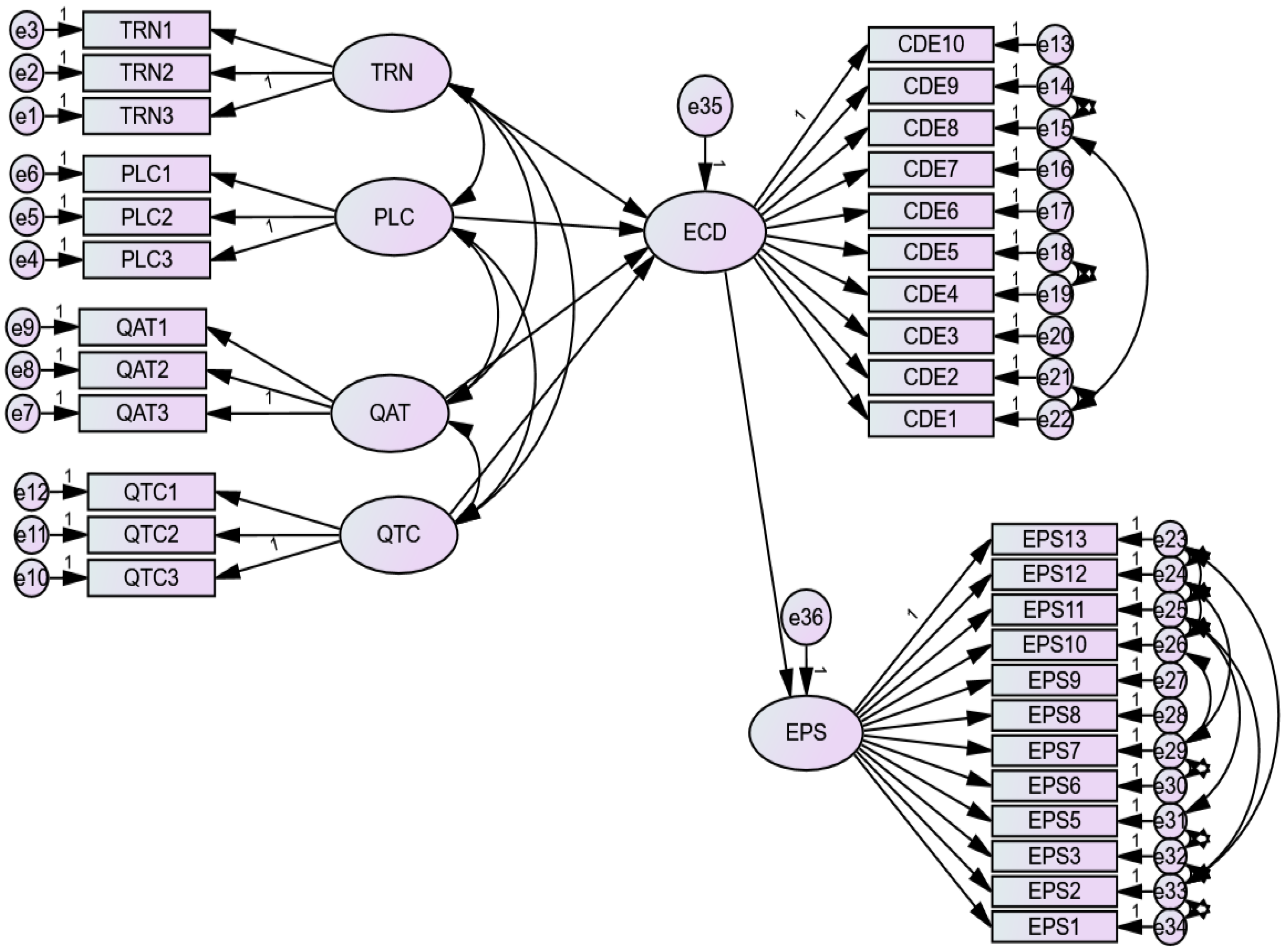
3.4. Model Hypotheses Testing
3.4.1. Testing the Direct Influence of Enabling Factors on Effective Common Data Environment
3.4.2. Testing the Direct Influence of Effective Common Data Environment on Effective Efficient Payment System
4. Discussion
4.1. The Influence of Training on Effective Common Data Environment (H1)
4.2. The Influence of Policy on Effective Common Data Environment (H2)
4.3. The Influence of Quality Assurance Team on Effective Common Data Environment (H3)
4.4. The Influence of Quality Technology on Effective Common Data Environment (H4)
4.5. The Influence of Effective Common Data Environment on Effective Efficient Payment System (H5)
4.6. The Effective Efficient Payment System
5. Conclusions
5.1. Practical Implication
5.2. Recommendations
5.2.1. Theoretical
5.2.2. Methodological
5.2.3. Practical
5.3. Limitations
5.4. Future Research
Author Contributions
Funding
Institutional Review Board Statement
Informed Consent Statement
Data Availability Statement
Acknowledgments
Conflicts of Interest
Abbreviations
| CDE | Common Data Environment |
| SEM | Structural Equation Modeling |
| AMOS | Analysis of Moment Structures |
| ADANCO | Advance Analysis of Composite Linear dichroism |
References
- Fombad, M.C. Accountability challenges in public-private partnerships from a South African perspective. Afr. J. Bus. Ethics 2013, 7, 11. [Google Scholar] [CrossRef]
- Effah Ameyaw, E.; Chan, A.P. Identifying public-private partnership (PPP) risks in managing water supply projects in Ghana. J. Facil. Manag. 2013, 11, 152–182. [Google Scholar] [CrossRef]
- Gcaba, M.G.; Yalezo, B. Factors constraining the planning and design process for public health construction projects in KwaZulu-Natal, South Africa. In Mbali Conference 2022 Proceedings; University of Zululand: Richards Bay, South Africa, 2022; p. 138. [Google Scholar]
- Jacobs, J.W. An Appraisal of Public Infrastructure Delivery in South Africa; University of Johannesburg: Johannesburg, South Africa, 2021. [Google Scholar]
- Chiswa, N. Unlocking Africa’s economic potential: The role of PPPs in fuelling infrastructure development and investment–South Africa’s perspective. Jindal Glob. Law Rev. 2024, 15, 157–185. [Google Scholar] [CrossRef]
- Carroll, L.C. Framework to Develop a Credible Final Accounts System for South African Construction Projects. Ph.D. Thesis, University of Pretoria, Pretoria, South Africa, 2024. [Google Scholar]
- Cumberlege, R.; Botha, B.; Bentley, M. Contractors’ Perceptions of Late Payments. J. Constr. Proj. Manag. Innov. 2019, 8, 2138–2145. [Google Scholar]
- Mahamid, I.; Bruland, A.; Dmaidi, N. Causes of delay in road construction projects. J. Manag. Eng. 2012, 28, 300–310. [Google Scholar] [CrossRef]
- Abdul-Rahman, H.; Kho, M.; Wang, C. Late payment and nonpayment encountered by contracting firms in a fast-developing economy. J. Prof. Issues Eng. Educ. Pract. 2014, 140, 04013013. [Google Scholar] [CrossRef]
- Bowen, P.A.; Edwards, P.J.; Cattell, K. Corruption in the South African construction industry: A thematic analysis of verbatim comments from survey participants. Constr. Manag. Econ. 2012, 30, 885–901. [Google Scholar] [CrossRef]
- Stewardson, A.; Edwards, D.J.; Asamoah, E.; Aigbavboa, C.O.; Lai, J.H.; El-Gohary, H. The late payment epidemic in UK construction. J. Financ. Manag. Prop. Constr. 2023, 28, 374–397. [Google Scholar] [CrossRef]
- Adaku, E.; Osei-Poku, V.; Ottou, J.A.; Yirenkyi-Fianko, A. Contractor payment delays: A systematic review of current trends and future directions. Constr. Innov. 2024, 24, 1205–1227. [Google Scholar] [CrossRef]
- Akinsiku, O.E.; Ajayi, O.M. Effects of delayed payment of contractors on construction project delivery in Nigeria. In Proceedings of the Construction, Building and Real Estate Research Conference of the Royal Institution of Chartered Surveyors, Toronto, ON, Canada, 20–22 September 2016. [Google Scholar]
- Peters, E.; Subar, K.; Martin, H. Late payment and nonpayment within the construction industry: Causes, effects, and solutions. J. Leg. Aff. Disput. Resolut. Eng. Constr. 2019, 11, 04519013. [Google Scholar] [CrossRef]
- Hasmori, M.F.; Ismail, I.; March Said, I. Issues of late and non-payment among contractors in Malaysia. In Proceedings of the 3rd International Conference on Business and Economic Research, Bandung, Indonesia, 12–13 March 2012. [Google Scholar]
- Wuni, I.Y.; Boafo, H.K.; Agyei-Kumi, S. Critical causes and effects of payment delays in the execution of public construction projects in Ghana: Fresh evidence from the brong-ahafo region. Dev. Ctry. Stud. 2017, 5, 12–24. [Google Scholar]
- Simeone, D.; Cursi, S.; Coraglia, U.; Fioravanti, A. Reasoning in Common Data Environments. Re-thinking CDEs to enhance collaboration in BIM processes. In Anthropologic-Architecture and Fabrication in the Cognitive Age; Education and Research in Computer Aided Architectural Design in Europe: Brussels, Belgium, 2020; Volume 2, pp. 499–506. [Google Scholar]
- Tao, X.; Das, M.; Liu, Y.; Cheng, J.C.P. Distributed common data environment using blockchain and Interplanetary File System for secure BIM-based collaborative design. Autom. Constr. 2021, 130, 103851. [Google Scholar] [CrossRef]
- Preidel, C.; Borrmann, A.; Oberender, C.; Tretheway, M. Seamless integration of common data environment access into BIM authoring applications: The BIM integration framework. In eWork and eBusiness in Architecture, Engineering and Construction: ECPPM 2016; CRC Press: Boca Raton, FL, USA, 2017; pp. 119–128. [Google Scholar]
- Matthei, J.; Klemt-Albert, K. Data driven planning and approval processes of public road construction projects. ce/Papers 2023, 6, 365–371. [Google Scholar] [CrossRef]
- Özkan, S.; Seyis, S. Identification of common data environment functions during construction phase of BIM-based projects. In Proceedings of the CIB W78-LDAC 2021, Luxembourg, 11–15 October 2021. [Google Scholar]
- Lu, Q.; Won, J.; Cheng, J.C.P. A financial decision making framework for construction projects based on 5D Building Information Modeling (BIM). Int. J. Proj. Manag. 2016, 34, 3–21. [Google Scholar] [CrossRef]
- Sacks, R.; Gurevich, U.; Shrestha, P. A review of building information modeling protocols, guides and standards for large construction clients. J. Inf. Technol. Constr. (ITcon) 2016, 21, 479–503. [Google Scholar]
- Sigalov, K.; Ye, X.; König, M.; Hagedorn, P.; Blum, F.; Severin, B.; Hettmer, M.; Hückinghaus, P.; Wölkerling, J.; Groß, D. Automated payment and contract management in the construction industry by integrating building information modeling and blockchain-based smart contracts. Appl. Sci. 2021, 11, 7653. [Google Scholar] [CrossRef]
- Nguyen, T.Q.; Lou, E.C.; Nguyen, B.N. A theoretical BIM-based framework for quantity take-off to facilitate progress payments: The case of high-rise building projects in Vietnam. Int. J. Build. Pathol. Adapt. 2024, 42, 704–728. [Google Scholar] [CrossRef]
- Sarkar, D.; Dhaneshwar, D.; Raval, P. Automation in monitoring of construction projects through BIM-IoT-Blockchain model. J. Inst. Eng. Ser. A 2023, 104, 317–333. [Google Scholar] [CrossRef]
- Jaskula, K.; Kifokeris, D.; Papadonikolaki, E.; Rovas, D. Common data environments in construction: State-of-the-art and challenges for practical implementation. Constr. Innov. 2024, 25, 5. [Google Scholar]
- Ahimbisibwe, A.; Cavana, R.Y.; Daellenbach, U. A contingency fit model of critical success factors for software development projects: A comparison of agile and traditional plan-based methodologies. J. Enterp. Inf. Manag. 2015, 28, 7–33. [Google Scholar] [CrossRef]
- Saeidi, P.; Saeidi, S.P.; Sofian, S.; Saeidi, S.P.; Nilashi, M.; Mardani, A. The impact of enterprise risk management on competitive advantage by moderating role of information technology. Comput. Stand. Interfaces 2019, 63, 67–82. [Google Scholar] [CrossRef]
- Poirier, E.A.; Soyez, M. Adoption and implementation of common data environments in the province of Quebec: Barriers, challenges, and trends. In Proceedings of the Canadian Society of Civil Engineering Annual Conference, Quebec, QC, Canada, 25–28 May 2022; Springer International Publishing: Cham, Switzerland, 2022; pp. 133–151. [Google Scholar]
- Kassem, M.; Kelly, G.; Dawood, N.; Serginson, M.; Lockley, S. BIM in facilities management applications: A case study of a large university complex. Built Environ. Proj. Asset Manag. 2015, 5, 261–277. [Google Scholar] [CrossRef]
- Migilinskas, D.; Popov, V.; Juocevicius, V.; Ustinovichius, L. The benefits, obstacles and problems of practical BIM implementation. Procedia Eng. 2013, 57, 767–774. [Google Scholar] [CrossRef]
- Dolla, T.; Venkatachalam, S.; Kumar Delhi, V.S. Institutional Shaping of Cde Implementation in Bim-Enabled Aec Projects. J. Inf. Technol. Constr. 2024, 29, 826. [Google Scholar] [CrossRef]
- Ng, C.W. Enhancing the Performance of the Adoption of Building Information Modelling (BIM) and Common Data Environment (CDE) Using Risk Management and Performance Contract Techniques; Hong Kong University of Science and Technology: Hong Kong, China, 2024. [Google Scholar]
- Sattineni, A.; Macdonald, J.A. 5D-BIM: A case study of an implementation strategy in the construction industy. In ISARC. Proceedings of the International Symposium on Automation and Robotics in Construction; IAARC Publications: Singapore, 2014; Volume 31, p. 1. [Google Scholar]
- Islam, J.; Hu, H. A review of literature on contingency theory in managerial accounting. Afr. J. Bus. Manag. 2012, 6, 5159–5164. [Google Scholar] [CrossRef]
- Loukis, E.; Soto-Acosta, P.; Pazalos, K. Using structural equation modelling for investigating the impact of e-business on ICT and non-ICT assets, processes and business performance. Oper. Res. 2013, 13, 89–111. [Google Scholar] [CrossRef]
- Shao, Z.; Feng, Y.; Hu, Q. Effectiveness of top management support in enterprise systems success: A contingency perspective of fit between leadership style and system life-cycle. Eur. J. Inf. Syst. 2016, 25, 131–153. [Google Scholar] [CrossRef]
- Lin, W.S.; Wang, C.H. Antecedences to continued intentions of adopting e-learning system in blended learning instruction: A contingency framework based on models of information system success and task-technology fit. Comput. Educ. 2012, 58, 88–99. [Google Scholar] [CrossRef]
- Lai, C.; Shum, M.; Tian, Y. Enhancing learners’ self-directed use of technology for language learning: The effectiveness of an online training platform. Comput. Assist. Lang. Learn. 2016, 29, 40–60. [Google Scholar] [CrossRef]
- Vitente, L.S.; Ong, A.K.S.; German, J.D. Assessment of adoption and acceptance of building information modeling for building construction among industries in Qatar. Buildings 2024, 14, 1433. [Google Scholar] [CrossRef]
- Fathima, F.; Jayasinghe, S.; Prasadika, J.; Wijerathna, S. Drivers of Actual Usage of Building Information Modelling Tools by Civil Engineering Professionals in Construction Industry of Sri Lanka. In Proceedings of the 2024 International Research Conference on Smart Computing and Systems Engineering (SCSE), Colombo, Sri Lanka, 4–5 April 2024; IEEE: New York, NY, USA; Volume 7, pp. 1–7. [Google Scholar]
- Kamau, J.W. Investigating the Influence of User Training on the Adoption of Desktop Open Source Software: A Case of Students in Selected Universities in Kenya. Afr. J. Empir. Res. 2025, 6, 361–369. [Google Scholar] [CrossRef]
- Vanderlinde, R.; Van Braak, J.; Dexter, S. ICT policy planning in a context of curriculum reform: Disentanglement of ICT policy domains and artifacts. Comput. Educ. 2012, 58, 1339–1350. [Google Scholar] [CrossRef]
- Qin, X.; Shi, Y.; Lyu, K.; Mo, Y. Using a TAM-TOE model to explore factors of Building Information Modelling (BIM) adoption in the construction industry. J. Civ. Eng. Manag. 2020, 26, 259–277. [Google Scholar] [CrossRef]
- Phiri, A.D.; Kanjo, C. Policy-Practice Contradiction: Case of Cloud Computing Adoption in the Malawi Health Sector. arXiv 2021, arXiv:2108.09956. [Google Scholar] [CrossRef]
- Xu, H.; Feng, J.; Li, S. Users-orientated evaluation of building information model in the Chinese construction industry. Autom. Constr. 2014, 39, 32–46. [Google Scholar] [CrossRef]
- Ebert, C.; Gallardo, G.; Hernantes, J.; Serrano, N. DevOps. IEEE Softw. 2016, 33, 94–100. [Google Scholar] [CrossRef]
- Lin, Y.C.; Hsu, Y.T.; Hu, H.T. BIM Model Management for BIM-Based Facility Management in Buildings. Adv. Civ. Eng. 2022, 2022, 1901201. [Google Scholar] [CrossRef]
- Batty, M.; Axhausen, K.W.; Giannotti, F.; Pozdnoukhov, A.; Bazzani, A.; Wachowicz, M.; Ouzounis, G.; Portugali, Y. Smart cities of the future. Eur. Phys. J. Spec. Top. 2012, 214, 481–518. [Google Scholar] [CrossRef]
- Wang, X.; Liu, L.; Liu, J.; Huang, X. Understanding the determinants of blockchain technology adoption in the construction industry. Buildings 2022, 12, 1709. [Google Scholar] [CrossRef]
- Ren, M. Why technology adoption succeeds or fails: An exploration from the perspective of intra-organizational legitimacy. J. Chin. Sociol. 2019, 6, 21. [Google Scholar] [CrossRef]
- Senthilvel, M.; Beetz, J. Conceptualizing decentralized information containers for common data environments using linked data. In Proceedings of the Conference CIB W78, Luxembourg, 11–15 October 2021; Luxembourg Institute of Science and Technology (LIST): Luxembourg, 2021; Volume 2021, pp. 11–15. [Google Scholar]
- Jaskula, K.; Papadonikolaki, E.; Rovas, D. Comparison of current common data environment tools in the construction industry. In Proceedings of the EC3 Conference 2023, Heraklion, Greece, 10–12 July 2023; European Council on Computing in Construction: Corfu, Greece, 2023; Volume 4. [Google Scholar]
- Akob, Z.; Zaidee, M.; Hipni, A.; Koka, R. Coordination and collaboration of information for pan borneo highway (Sarawak) via Common Data Environment (CDE). In IOP Conference Series: Materials Science and Engineering; IOP Publishing: Bristol, UK, 2019; Volume 512, p. 012001. [Google Scholar]
- Losev, K.Y. The common data environment features from the building life cycle perspective. In IOP Conference Series: Materials Science and Engineering; IOP Publishing: Bristol, UK, 2020; Volume 913, p. 042012. [Google Scholar]
- Lestari, S.A.; Purwanto, H.; Saputra, J. Application of common data environment (CDE) as a method of design review in construction project. Log. J. Ranc. Bangun Dan Teknol. 2022, 22, 103–109. [Google Scholar] [CrossRef]
- Vlasák, P.; Čerbák, B. BIM, structural analysis and communication using common data environment (CDE) in the field of water management. Int. Arch. Photogramm. Remote Sens. Spat. Inf. Sci. 2019, 42, 93–94. [Google Scholar] [CrossRef]
- Patacas, J.; Dawood, N.; Kassem, M. BIM for facilities management: A framework and a common data environment using open standards. Autom. Constr. 2020, 120, 103366. [Google Scholar] [CrossRef]
- Lin, Y.C. Use of BIM approach to enhance construction interface management: A case study. J. Civ. Eng. Manag. 2015, 21, 201–217. [Google Scholar] [CrossRef]
- Bucher, D.; Hall, D. Common Data Environment within the AEC Ecosystem: Moving collaborative platforms beyond the open versus closed dichotomy. In EG-ICE 2020 Proceedings: Workshop on Intelligent Computing in Engineering; Universitätsverlag der TU Berlin: Berlin, Germany, 2020; pp. 491–500. [Google Scholar]
- Lu, N.; Korman, T. Implementation of building information modeling (BIM) in modular construction: Benefits and challenges. In Construction Research Congress 2010: Innovation for Reshaping Construction Practice; ASCE: Reston, VA, USA, 2010; pp. 1136–1145. [Google Scholar]
- Abegaz, K. Investigating Security Measures in Common Data Environments: Insights from AEC Industry Case Studies. Master’s Thesis, Jönköping University, Jönköping. Sweden, 2024. [Google Scholar]
- Jaskula, K.; Perera, S.; Nanayakkarawasam, S.; Papadonikolaki, D.E.; Rovas, D. Blockchain-Based Common Data Environments: Prototype and Validation Through User Study. SSRN 4713471. 2024. Available online: http://dx.doi.org/10.2139/ssrn.4713471 (accessed on 22 August 2024). [CrossRef]
- Aibinu, A.A.; Papadonikolaki, E. A comparative case study of coordination mechanisms in Design and Build BIM-based projects in the Netherlands. In eWork and eBusiness in Architecture, Engineering and Construction: ECPPM 2016; CRC Press: Boca Raton, FL, USA, 2017; pp. 435–443. [Google Scholar]
- Ahmadisheykhsarmast, S.; Sonmez, R. A smart contract system for security of payment of construction contracts. Autom. Constr. 2020, 120, 103401. [Google Scholar] [CrossRef]
- Parn, E.A.; Edwards, D. Cyber threats confronting the digital built environment: Common data environment vulnerabilities and block chain deterrence. Eng. Constr. Archit. Manag. 2019, 26, 245–266. [Google Scholar] [CrossRef]
- Hamledari, H.; Fischer, M. Construction payment automation using blockchain-enabled smart contracts and robotic reality capture technologies. Autom. Constr. 2021, 132, 103926. [Google Scholar] [CrossRef]
- Elghaish, F.; Abrishami, S. A centralised cost management system: Exploiting EVM and ABC within IPD. Eng. Constr. Archit. Manag. 2021, 28, 549–569. [Google Scholar] [CrossRef]
- Ye, X.; Sigalov, K.; König, M. Integrating BIM-and cost-included information container with blockchain for construction automated payment using billing model and smart contracts. In Proceedings of the International Symposium on Automation and Robotics in Construction (ISARC), Kitakyushu, Japan, 27–28 October 2020; IAARC Publications: Singapore, 2020; Volume 37, pp. 1388–1395. [Google Scholar]
- Röck, M.; Passer, A.; Ramon, D.; Allacker, K. The coupling of BIM and LCA—Challenges identified through case study implementation. In Proceedings of the 6th International Symposium on Life-Cycle Civil Engineering: IALCCE 2018, Ghent, Belgium, 28–31 October 2018; Taylor & Francis Group: Abingdon, UK, 2019; pp. 841–846. [Google Scholar]
- Maritz, M.J.; Robertson, D.C. What are the legal remedies available to contractors and consultants to enforce payment? J. South Afr. Inst. Civ. Eng. 2012, 54, 27–35. [Google Scholar]
- Du Plessis, H.B. Building Contracts, a Means to Manage the Construction Process: A South African Perspective; University of the Free State: Bloemfontein, South Africa, 2017. [Google Scholar]
- Smyth, D. Contract management processes review. In Master of Engineering Management; University of Canterburry: Christchurch, New Zealand, 2019. [Google Scholar]
- Djokoto, V.K.T. Factors that Influence Late Payments in Government New Build Infrastructure Projects in Gauteng Province, South Africa; University of the Witwatersrand: Johannesburg, South Africa, 2017. [Google Scholar]
- Kiu, M.S.; Lai, K.W.; Chia, F.C.; Wong, P.F. Blockchain integration into electronic document management (EDM) system in construction common data environment. Smart Sustain. Built Environ. 2024, 13, 117–132. [Google Scholar] [CrossRef]
- Jaskula, K.; Kifokeris, D.; Papadonikolaki, E.; Rovas, D. Blockchain-Based Decentralized Common Data Environment: User Requirements and Conceptual Framework. J. Constr. Eng. Manag. 2025, 151, 04025112. [Google Scholar] [CrossRef]
- Taylor, M. Crossrail project: Building a virtual version of London’s Elizabeth line. Proc. Inst. Civ. Eng. Civ. Eng. 2017, 170, 56–63. [Google Scholar] [CrossRef]
- Ye, X.; Zeng, N.; Liu, Y.; König, M. Smart contract-enabled construction claim management in BIM and CDE-enhanced data environment. In Proceedings of the International Conference on Construction Logistics, Equipment, and Robotics, Munich, Germany, 9–11 October 2023; Springer: Cham, Switzerland, 2023; pp. 40–47. [Google Scholar]
- Qazimi, J.; Halili, F.; Rufati, E.; Xhaferi, G. Web-based Management System in Textual Format for Offers, Contract and Payment for Construction Company. JNSM J. Nat. Sci. Math. UT 2024, 9, 361–371. [Google Scholar] [CrossRef]
- Ye, X.; König, M. Framework for automated billing in the construction industry using BIM and smart contracts. In Proceedings of the International Conference on Computing in Civil and Building Engineering, São Paulo, Brazil, 18–20 August 2020; Springer: Cham, Switzerland, 2020; pp. 824–838. [Google Scholar]
- Rai, D.R. Progress payments in public procurement of construction works in Nepal. Int. J. Res. Anal. Rev. 2020, 7, 122–126. [Google Scholar]
- Radl, J.; Kaiser, J. Benefits of implementation of common data environment (CDE) into construction projects. In IOP Conference Series: Materials Science and Engineering; IOP Publishing: Bristol, UK, 2019; Volume 471, p. 022021. [Google Scholar]
- Gao, F.; Zhu, L.; Shen, M.; Sharif, K.; Wan, Z.; Ren, K. A blockchain-based privacy-preserving payment mechanism for vehicle-to-grid networks. IEEE Netw. 2018, 32, 184–192. [Google Scholar] [CrossRef]
- Luo, H.; Das, M.; Wang, J.; Cheng, J.C.P. Construction payment automation through smart contract-based blockchain framework. In Proceedings of the International Symposium on Automation and Robotics in Construction, ISARC, Banff, AB, Canada, 21–24 May 2019; IAARC Publications: Singapore, 2019; Volume 36, pp. 1254–1260. [Google Scholar]
- Bakhmat, N.; Kolosova, O.; Demchenko, O.; Ivashchenko, I.; Strelchuk, V. Application of international scientometric databases in the process of training competitive research and teaching staff: Opportunities of Web of Science (WoS), Scopus, Google Scholar. J. Theor. Appl. Inf. Technol. 2022, 100, 4914–4924. [Google Scholar]
- Snyder, H. Literature review as a research methodology: An overview and guidelines. J. Bus. Res. 2019, 104, 333–339. [Google Scholar] [CrossRef]
- Robinson, M.A. Using multi-item psychometric scales for research and practice in human resource management. Hum. Resour. Manag. 2018, 57, 739–750. [Google Scholar] [CrossRef]
- Chung, K.C.; Chen, C.H.; Tsai, H.H.; Chuang, Y.H. Social media privacy management strategies: A SEM analysis of user privacy behaviors. Comput. Commun. 2021, 174, 122–130. [Google Scholar] [CrossRef]
- Amhalhal, A.; Anchor, J.; Tipi, N.S.; Elgazzar, S. The impact of contingency fit on organisational performance: An empirical study. Int. J. Product. Perform. Manag. 2022, 71, 2214–2234. [Google Scholar] [CrossRef]
- Rehman, A.; Ullah, I.; Afridi, F.A.; Ullah, Z.; Zeeshan, M.; Hussain, A.; Rahman, H.U. Adoption of green banking practices and environmental performance in Pakistan: A demonstration of structural equation modelling. Environ. Dev. Sustain. 2021, 23, 13200–13220. [Google Scholar] [CrossRef]
- Ranatunga, R.V.S.P.K.; Priyanath, H.M.S.; Megama, R.G.N. Methods and rules-of-thumb in the determination of minimum sample size when applying structural equation modelling: A review. J. Soc. Sci. Res. 2020, 15, 102–109. [Google Scholar]
- Robinson, R.S. Purposive sampling. In Encyclopedia of Quality of Life and Well-Being Research; Springer International Publishing: Cham, Switzerland, 2024; pp. 5645–5647. [Google Scholar]
- Sathyanarayana, S.; Mohanasundaram, T.; Pushpa, B.V.; Harsha, H. Selecting the Right Sample Size: Methods and Considerations for Social Science Researchers. Int. J. Bus. Manag. Invent. 2024, 13, 152–167. [Google Scholar]
- Kline, R.B. Principles and Practice of Structural Equation Modelling, 4th ed.; Guilford Publications: Guildford, UK, 2016. [Google Scholar]
- Thakkar, J.J. Structural Equation Modelling Application for Research and Practice (with AMOS and R). In Studies in Systems, Decision and Control; Springer: Berlin/Heidelberg, Germany, 2020; Volume 285. [Google Scholar] [CrossRef]
- Kamaruddin, K.; Abeysekera, I. Structural equation modelling. In Studies in Managerial and Financial Accounting; Springer: Berlin/Heidelberg, Germany, 2013; pp. 93–123. [Google Scholar] [CrossRef]
- Raykov, T.; Tomer, A.; Nesselroade, J.R. Reporting structural equation modeling results in Psychology and Aging: Some proposed guidelines. Psychol. Aging 1991, 6, 499. [Google Scholar] [CrossRef]
- Asosega, K.A.; Iddrisu, W.A.; Tawiah, K.; Opoku, A.A.; Okyere, E. Comparing Bayesian and maximum likelihood methods in structural equation modelling of university student satisfaction: An empirical analysis. Educ. Res. Int. 2022, 2022, 3665669. [Google Scholar] [CrossRef]
- Lei, P.W.; Wu, Q. Introduction to structural equation modeling: Issues and practical considerations. Educ. Meas. Issues Pract. 2007, 26, 33–43. [Google Scholar] [CrossRef]
- Hair, J.F.; Black, W.C.; Babin, B.J.; Anderson, R.E.; Tatham, R.L. Multivariate Data Analysis, 8th ed.; Pearson University Press: Hoboken, NJ, USA, 2019. [Google Scholar]
- Wahid, K.A.; Numprasertchai, H.; Sudharatna, Y.; Laohavichien, T. Assessing perceived knowledge creation: The role of organizational knowledge and market environment. Int. J. Manag. Knowl. Learn. 2016, 5, 57–79. [Google Scholar]
- Maydeu-Olivares, A. Maximum likelihood estimation of structural equation models for continuous data: Standard errors and goodness of fit. Struct. Equ. Model. A Multidiscip. J. 2017, 24, 383–394. [Google Scholar] [CrossRef]
- Cavusoglu, N. LISREL growth model on direct and indirect effects using cross-country data. Econ. Model. 2012, 29, 2362–2370. [Google Scholar] [CrossRef]
- Arbuckle, J.L. IBM SPSS Amos 20 User’s Guide; Amos Development Corporation, SPSS Inc.: Chicago, IL, USA, 2011; pp. 226–229. [Google Scholar]
- Blanthorne, C.; Allison Jones-Farmer, L.; Dreike Almer, E. Why you should consider SEM: A guide to getting started. In Advances in Accounting Behavioral Research; Emerald Group Publishing Limited: Leeds, UK, 2006; pp. 179–207. [Google Scholar]
- Bollen, K.A.; Noble, M.D. Structural equation models and the quantification of behavior. Proc. Natl. Acad. Sci. USA 2011, 108, 15639–15646. [Google Scholar] [CrossRef] [PubMed]
- Teo, T.; Tsai, L.T.; Yang, C.C. Applying structural equation modeling (SEM) in educational research: An introduction. In Application of Structural Equation Modeling in Educational Research and Practice; SensePublishers: Rotterdam, The Netherlands, 2013; pp. 3–21. [Google Scholar]
- Goodboy, A.K.; Kline, R.B. Statistical and practical concerns with published communication research featuring structural equation modeling. Commun. Res. Rep. 2017, 34, 68–77. [Google Scholar] [CrossRef]
- Hair, J.F.; Black, W.C.; Babin, B.J.; Anderson, R.E.; Tatham, R.L. Multivariate Data Analysis, 6th ed.; Pearson University Press: Hoboken, NJ, USA, 2006. [Google Scholar]
- Schermelleh-Engel, K.; Moosbrugger, H.; Müller, H. Evaluating the fit of structural equation models: Tests of significance and descriptive goodness-of-fit measures. Methods Psychol. Res. Online 2003, 8, 23–74. [Google Scholar]
- Goyal, H.; Aleem, S. Confirmatory factor analysis (CFA) and psychometric validation of healthy lifestyle and personal control questionnaire (HLPCQ) in India. Indian J. Community Med. 2023, 48, 430–435. [Google Scholar] [CrossRef]
- Ejoke, U.P.; Du Plessis, E.D.; Dev, S.; Al Bustami, G.J.; Varghese, M. Confirmatory factor analysis of latent constructs for measuring social well-being in African migrant samples. Heliyon 2024, 10, e29479. [Google Scholar] [CrossRef] [PubMed]
- Raykov, T.; Widaman, K.F. Issues in applied structural equation modeling research. Struct. Equ. Model. A Multidiscip. J. 1995, 2, 289–318. [Google Scholar] [CrossRef]
- Byrne, B.M. Structural Equation Modeling with EQS: Basic Concepts, Applications, and Programming; Routledge: New York, NY, USA, 2013. [Google Scholar]
- Omar, M.K.; Abdul-Karim, S. Validity and reliability of the Malay version of the identification of functional ankle instability (IDFAI-M) questionnaire among Malaysian University Athletes. Malays. Orthop. J. 2021, 15, 32. [Google Scholar] [PubMed]
- Fornell, C.; Larcker, D.F. Evaluating structural equation models with unobservable variables and measurement error. J. Mark. Res. 1981, 18, 39–50. [Google Scholar] [CrossRef]
- Ringle, C.M.; Sarstedt, M.; Sinkovics, N.; Sinkovics, R.R. A perspective on using partial least squares structural equation modelling in data articles. Data Brief 2023, 48, 109074. [Google Scholar] [CrossRef]



| Group | Item | Percentage |
|---|---|---|
| Type of organisations | Client | 14.4 |
| Consulting firm | 57.7 | |
| Construction entity | 27.9 | |
| Roles of participants | Project manager-Client | 7.5 |
| Project manager-Consultant | 10.9 | |
| Principal agent | 1.5 | |
| Designer-Architect | 5.5 | |
| Designer-Civil/Structural | 14.4 | |
| Designer-MEP | 2.5 | |
| Site engineer-Civil/Structural | 8.0 | |
| Site engineer-MEP | 2.5 | |
| Quantity surveyor-Consultant | 14.4 | |
| Quantity surveyor-Contractor | 15.9 | |
| Contracts manager/Director-Contractor | 1.5 | |
| Construction manager | 4.0 | |
| Estimator-Contractor | 1.0 | |
| Site manager | 2.5 | |
| Health and safety agent | 0.5 | |
| Health and safety officer | 2.0 | |
| Others-Project administrators, Technologist, Surveyor | 5.5 | |
| Type of clients | Private Property Developer | 33.3 |
| Parastatal Organisation | 10.4 | |
| Public/Government | 36.8 | |
| Mining Organisation | 19.4 |
| Variable | Skewness | Kurtosis |
|---|---|---|
| TRN1 | −0.349 | −0.601 |
| TRN2 | −0.618 | −0.103 |
| TRN3 | −0.828 | 0.804 |
| PLC1 | −0.578 | −0.239 |
| PLC2 | −0.625 | 0.153 |
| PLC3 | −0.531 | −0.387 |
| QAT1 | −0.730 | 0.354 |
| QAT2 | −0.615 | 0.153 |
| QAT3 | −1.020 | 1.355 |
| QAT4 | −0.743 | 0.285 |
| QTC1 | −0.647 | 0.458 |
| QTC2 | −0.828 | 0.703 |
| QTC3 | −0.731 | 0.320 |
| CDE1 | −1.115 | 1.081 |
| CDE2 | −1.139 | 1.180 |
| CDE3 | −0.695 | 0.204 |
| CDE4 | −0.569 | 0.131 |
| CDE5 | −0.130 | −0.749 |
| CDE6 | −0.345 | −0.436 |
| CDE7 | −0.586 | −0.099 |
| CDE8 | −0.438 | −0.614 |
| CDE9 | −0.755 | −0.242 |
| CDE10 | −0.561 | −0.354 |
| EPS1 | −0.257 | −0.398 |
| EPS2 | −0.127 | −0.534 |
| EPS3 | −0.373 | −0.196 |
| EPS4 | −0.821 | 0.245 |
| EPS5 | −0.645 | −0.197 |
| EPS6 | −0.292 | −0.378 |
| EPS7 | −0.434 | −0.374 |
| EPS8 | −0.686 | 0.283 |
| EPS9 | −0.364 | −0.648 |
| EPS10 | −0.526 | −0.036 |
| EPS11 | −0.434 | −0.005 |
| EPS12 | −0.435 | −0.266 |
| EPS13 | −0.457 | −0.160 |
| Multivariate | 286 199 |
| TRN | PLC | QAT | QTC | ECDE | EEPS | |
|---|---|---|---|---|---|---|
| Training (TRN) | 1 | |||||
| Policy (PLC) | 0.791 | 1 | ||||
| Quality Assurance Team (QAT) | 0.746 | 0.852 | 1 | |||
| Quality Technology (QTC) | 0.690 | 0.734 | 0.797 | 1 | ||
| Effective Common Data Environment (ECD) | 0.536 | 0.483 | 0.543 | 0.597 | 1 | |
| Efficient Effective Payment System (EPS) | 0.314 | 0.432 | 0.575 | 0.687 | 0.490 | 1 |
| Cut-Off Value | Estimate | Comment | |
|---|---|---|---|
| S—Bx2 | 953.976 | ||
| Df | 0 ≥ Acceptable | 498 | Acceptable |
| CFI | 0.9 ≥ Acceptable 0.95 ≥ Good fit | 0.919 | Acceptable |
| IFI | 0.9 ≥ Acceptable 0.95 ≥ Good fit | 0.920 | Acceptable |
| SRMR | 0.08 ≤ Acceptable 0.05 ≤ Good fit | 0.061 | Acceptable |
| RMSEA | 0.08 ≤ Acceptable 0.05 ≤ Good fit | 0.068 | Acceptable |
| Latent Variable | Number of Indicators/Groups | Indicator Variable (Grouped) | Parameter Estimates | Z-Statistics | Composite Reliability | Dijkstra–Henseler’s Rho | AVE |
|---|---|---|---|---|---|---|---|
| Training | 3 | TRN1 | 0.909 | 45,450 | 0.937 | 0.944 | 0.641 |
| TRN2 | 0.940 | 47,000 | |||||
| TRN3 | 0.886 | 44,300 | |||||
| Policy | 3 | PLC1 | 0.838 | 27,933 | 0.905 | 0.942 | 0.650 |
| PLC2 | 0.904 | 45,200 | |||||
| PLC3 | 0.874 | 29,133 | |||||
| Quality Assurance Team | 3 | QAT1 | 0.870 | 43,500 | 0.920 | 0.960 | 0.551 |
| QAT2 | 0.948 | 67,714 | |||||
| QAT3 | 0.851 | 29,344 | |||||
| Quality Technology | 3 | QTC1 | 0.890 | 37,083 | 0.887 | 0.938 | 0.610 |
| QTC2 | 0.870 | 29,000 | |||||
| QTC3 | 0.780 | 20,000 | |||||
| Effective Common Data Environment | 10 | CDE1 | 0.683 | 14,532 | 0.902 | 0.909 | 0.488 |
| CDE2 | 0.730 | 15,869 | |||||
| CDE3 | 0.682 | 13,918 | |||||
| CDE4 | 0.666 | 12,109 | |||||
| CDE5 | 0.725 | 18,125 | |||||
| CDE6 | 0.706 | 15,012 | |||||
| CDE7 | 0.630 | 10,327 | |||||
| CDE8 | 0.740 | 17,209 | |||||
| CDE9 | 0.698 | 15,174 | |||||
| CDE10 | 0.648 | 11,172 | |||||
| Effective efficient payment system | 12 | EPS1 | 0.782 | 20,237 | 0.941 | 0.949 | 0.549 |
| EPS2 | 0.711 | 14,580 | |||||
| EPS3 | 0.773 | 16,041 | |||||
| EPS5 | 0.690 | 14,020 | |||||
| EPS6 | 0.734 | 15,122 | |||||
| EPS7 | 0.759 | 23,941 | |||||
| EPS8 | 0.799 | 22,243 | |||||
| EPS9 | 0.765 | 18,341 | |||||
| EPS10 | 0.747 | 14,800 | |||||
| EPS11 | 0.770 | 17,116 | |||||
| EPS12 | 0.774 | 15,872 | |||||
| EPS13 | 0.755 | 1400 |
| Construct | Training | Policy | Assurance | Technology | Common | Payment |
|---|---|---|---|---|---|---|
| Training | ||||||
| Policy | 0.847 | |||||
| Assurance | 0.779 | 0.900 | ||||
| Technology | 0.730 | 0.786 | 0.844 | |||
| Common | 0.570 | 0.516 | 0.575 | 0.648 | ||
| Payment | 0.311 | 0.444 | 0.587 | 0.719 | 0.513 |
| Label | Hypothesis Enabling Factors Have Direct Positive Impact on Effective Common Data Environment | Parameter Estimates | Z-Statistics | p-Value | Significant at 5% Level? |
|---|---|---|---|---|---|
| H1 | Training | 0.393 | 3.083 | 0.001 | Yes |
| H2 | Policy | 0.373 | 2.082 | 0 025 | Yes |
| H3 | Quality Assurance Team | 0.463 | 2.544 | 0 010 | Yes |
| H4 | Quality Technology | 0.472 | 3.799 | 0.0001 | Yes |
| Effective common data environment has a direct positive impact on efficient effective payment system | |||||
| H5 | ECD | 0.589 | 12.117 | 0.000 | Yes |
Disclaimer/Publisher’s Note: The statements, opinions and data contained in all publications are solely those of the individual author(s) and contributor(s) and not of MDPI and/or the editor(s). MDPI and/or the editor(s) disclaim responsibility for any injury to people or property resulting from any ideas, methods, instructions or products referred to in the content. |
© 2026 by the authors. Licensee MDPI, Basel, Switzerland. This article is an open access article distributed under the terms and conditions of the Creative Commons Attribution (CC BY) license.
Share and Cite
Malomane, R.; Musonda, I.; Monko, R.J. A Structural Equation Modelling Approach to Improving Progress Payment Systems Through Common Data Environment (CDE) Implementation. Buildings 2026, 16, 1415. https://doi.org/10.3390/buildings16071415
Malomane R, Musonda I, Monko RJ. A Structural Equation Modelling Approach to Improving Progress Payment Systems Through Common Data Environment (CDE) Implementation. Buildings. 2026; 16(7):1415. https://doi.org/10.3390/buildings16071415
Chicago/Turabian StyleMalomane, Reneiloe, Innocent Musonda, and Rehema Joseph Monko. 2026. "A Structural Equation Modelling Approach to Improving Progress Payment Systems Through Common Data Environment (CDE) Implementation" Buildings 16, no. 7: 1415. https://doi.org/10.3390/buildings16071415
APA StyleMalomane, R., Musonda, I., & Monko, R. J. (2026). A Structural Equation Modelling Approach to Improving Progress Payment Systems Through Common Data Environment (CDE) Implementation. Buildings, 16(7), 1415. https://doi.org/10.3390/buildings16071415