


There was an error in the original publication [1]. It was stated that two serum samples obtained from wild boars hunted in the municipality of Paraíso tested positive in the RFFIT, instead of one.
A correction has been made to the first paragraph of Section 3, as follows:
However, seven serum samples obtained from wild boars hunted in Monte Azul (four samples), Paraíso (one sample), Cajobi (one sample), and Colina (one sample).
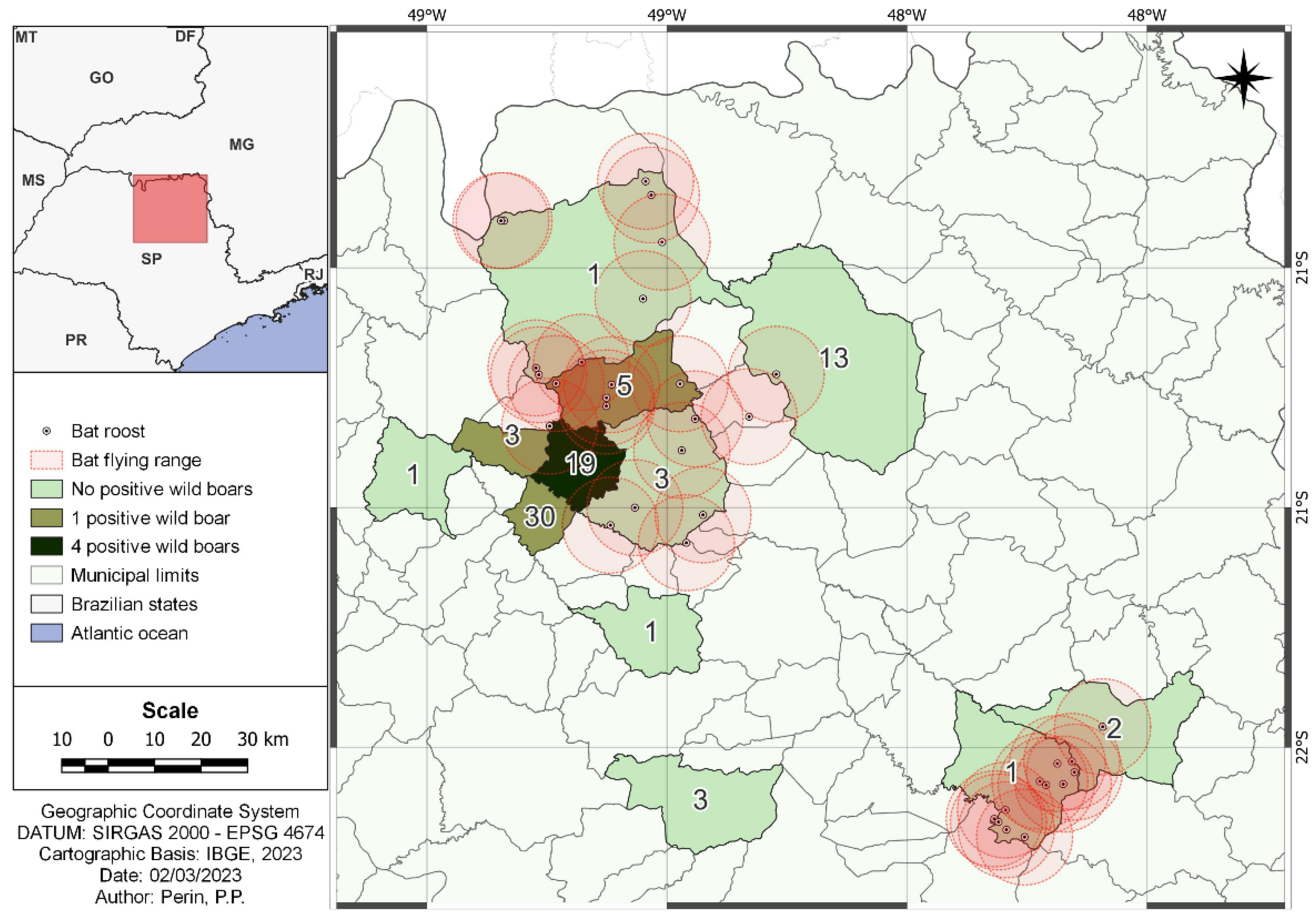
In the original publication [1], there was a mistake in Figure 2 as published. On the map, the municipality of Paraíso shows two positive samples instead of one. The corrected Figure 2 appears below.
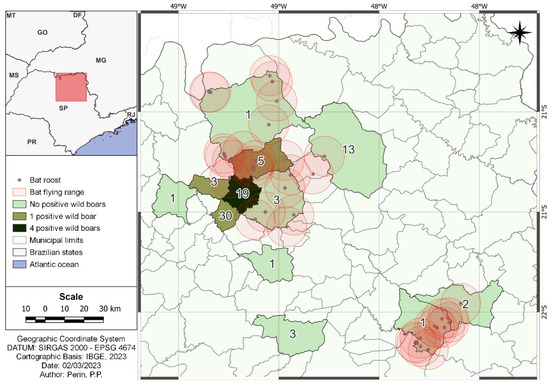
Figure 2.
Map highlighting the number of serum samples that tested positive in the RFFIT test, along with the location of bat roosts within a 10 km perimeter of their flying range. The numerical values within each city’s area represent the number of wild boars sampled at each location.
The authors state that the scientific conclusions are unaffected. This correction was approved by the Academic Editor. The original publication has also been updated.
Reference
- Perin, P.P.; Turmina, T.; Arias-Pacheco, C.A.; Gomes, J.S.; Andrade, L.d.O.; Zolla, N.d.O.; Mendonça, T.O.; Oliveira, W.J.; Fahl, W.d.O.; Scheffer, K.C.; et al. Rabies Virus-Neutralizing Antibodies in Free-Ranging Invasive Wild Boars (Sus scrofa) from Brazil. Pathogens 2024, 13, 303. [Google Scholar] [CrossRef] [PubMed]
Disclaimer/Publisher’s Note: The statements, opinions and data contained in all publications are solely those of the individual author(s) and contributor(s) and not of MDPI and/or the editor(s). MDPI and/or the editor(s) disclaim responsibility for any injury to people or property resulting from any ideas, methods, instructions or products referred to in the content. |
© 2024 by the authors. Licensee MDPI, Basel, Switzerland. This article is an open access article distributed under the terms and conditions of the Creative Commons Attribution (CC BY) license (https://creativecommons.org/licenses/by/4.0/).