


Simple Summary
Conflict between humans and Asian elephants is a major conservation issue. Here we discuss common tools used to manage human-elephant conflict (HEC) in Asia and the potential of animal-borne satellite-linked shock collars or Aversive Geofencing Devices (AGDs) for managing problem elephants. Most current HEC mitigation tools lack the ability to be modified to accommodate needs of elephants and therefore are sometimes unsuccessful. AGDs currently used to manage livestock movement can be adapted to mitigate HEC to overcome this problem. AGDs can constantly monitor animal movements and be programmed to deliver sound warnings followed by electric shock whenever animals attempt to move across virtual boundaries demarcated by managers. Elephants fitted with AGDs are expected to learn to avoid the electric shock by associating it with the warning sound and move away from specified areas. Based on the potential shown by studies conducted using AGDs on other wild species, we suggest that experiments should be conducted with captive elephants to determine the efficacy and welfare impact of AGDs on elephants. Further, assessing public opinion on using AGDs on elephants will also be important. If elephants can learn to avoid virtual boundaries set by AGDs, it could help to significantly reduce HEC incidents.
Abstract
Asian elephants are a principal cause of human-wildlife conflict. This results in the death/injury of elephants and humans and large-scale crop and property damage. Most current human-elephant conflict (HEC) mitigation tools lack the flexibility to accommodate the ecological needs of elephants and are ineffective at reducing HEC in the long-term. Here we review common HEC mitigation tools used in Asia and the potential of Aversive Geofencing Devices (AGDs) to manage problem elephants. AGDs can be configured to monitor animal movements in real-time and deliver auditory warnings followed by electric stimuli whenever animals attempt to move across user-specified virtual boundaries. Thus, AGDs are expected to condition elephants to avoid receiving shocks and keep them away from virtually fenced areas, while providing alternative routes that can be modified if required. Studies conducted using AGDs with other species provide an overview of their potential in conditioning wild animals. We recommend that the efficacy and welfare impact of AGDs be evaluated using captive elephants along with public perception of using AGDs on elephants as a means of addressing the inherent deficiencies of common HEC mitigation tools. If elephants could be successfully conditioned to avoid virtual fences, then AGDs could resolve many HEC incidents throughout Asia.
1. Introduction
Asian elephants Elephas maximus (Linnaeus 1758) once inhabited areas between the Euphrates and Tigris Rivers in west Asia to the Yangtze-Kiang River in China [1], but now inhabit a much smaller range within 13 countries: Bangladesh, Bhutan, Cambodia, China, India, Indonesia, Laos, Myanmar, Nepal, Sri Lanka, Thailand and Vietnam [2]. The total global population is estimated to be about 48,323 to 51,680 individuals, of which almost 75% of the population is found in India and Sri Lanka [3]. There is also a captive Asian elephant population of approximately 14,930 to 15,130 in range countries [3] and another ~1000 maintained in zoos outside range countries [4]. Asian elephants (hereafter elephants) are worshiped as a god in Hinduism and have an important role in Buddhism, two of the main religions in the region [5,6,7]. Ancient kings maintained thousands of elephants as work animals and warriors; they also traded and gifted them between countries [1,6,8,9,10]. In contemporary societies, captive elephants are commonly kept in temples and are used in ceremonial and religious rituals; they are also used in the logging and tourism industries [11,12,13]. Thus, elephants have played an important role in Asian cultural heritage since ancient times.
Despite the elephant conservation legislation imposed, various anthropogenic activities have continued to threaten the survival of elephants. Legal and illegal capture and illicit trade of elephants to supplement captive populations occur in several nations, which contributes to the decline of elephant numbers in the wild [14,15,16]. Hunting elephants for ivory, meat, hair, tail, bones and skin further poses a major threat [17,18,19]. Thus, elephants are listed in Appendix 1 of the Convention on the International Trade in Endangered Species (CITES), prohibiting international trade of elephants and elephant parts. Elephants are also listed as Endangered on the International Union for Conservation of Nature (IUCN) Red List of Threatened species [20] given elephant distribution has fragmented and declined considerably over the past few decades [21,22,23,24,25]. Many Asian countries with extant elephant populations also have high human population densities and developing economies [26]. These countries focus on large-scale and rapid industrial development and expansion projects which inevitably convert areas of wilderness to permanent human settlements, commercial zones and agricultural lands [27,28,29,30,31]. The resulting fragmented and heterogenous landscapes thus increases the frequency of interactions between humans and elephants [32,33], which is the root cause of human-elephant conflict (HEC).
Many elephant and human lives are lost as a consequence of HEC with highest numbers recorded in India and Sri Lanka, where an average of 124 elephants and 571 humans in India [34] and 263 elephants and 81 humans in Sri Lanka [35] are killed annually. HEC related elephant deaths result from gunshot injuries, poisoning, electrocution from illegal electric fences, accidents such as falling into agricultural wells or abandoned gem pits, and collision with trains [29,36,37]. Exposure to human disturbances increases stress levels of elephants which effects their reproductive success [38]. Many infant elephants are orphaned as a result of HEC as well [29]. Injury and death of humans often occur during chance encounters, particularly at night when humans confront and seek to deter crop-raiding elephants and those that damage houses to feed on stored grains [39,40], when people step out at dawn for toileting [41], enter forests to extract resources [42], or due to irresponsible behaviour [35]. Crop raiding is the main source of conflict between humans and elephants [6,43] as elephants raid many different cultivated crops such as rice, corn, millet, maize, sugar cane, vegetables, fruits and even coconut palms [40,44,45,46,47]. Affected people experience substantial economic losses and governments spend large sums of money in compensation payments for elephant impacts [48,49,50]. Apart from loss of lives, crops and property, there are also social and psychological effects which are often not accounted for when assessing HEC impacts [51,52]. Thus, mitigating HEC remains a key challenge for many of the elephant range countries.
Various tools and strategies are used to mitigate HEC and keep damage-causing elephants away from crops and other human-dominated areas [39,53]. The occurrence and frequency of HEC has increased despite mitigation efforts by governments and conservation organisations [35,54,55] due to various weaknesses in the HEC mitigation methods presently used. Current methods are mainly focussed on managing the symptoms of the conflict, but successful mitigation of HEC requires a greater focus on the root causes [56]. Elephants occupy large home ranges and travel long distances, depending on resource availability and reproductive status [32,57,58]. For example, elephants have larger home ranges in fragmented landscapes compared to non-fragmented habitats as elephants travel more in search of food and water due to their limited availability [32]. Further, during the musth period, male elephants cover much wider ranges in search of mates compared to the non-musth period [57]. Therefore, maintaining habitat connectivity is vital for HEC mitigation and elephant conservation [59]. For this, understanding and accommodating human and elephant behaviour to prevent HEC from occurring is extremely important [60]. Developing innovative tools and strategies that can reliably keep problem-causing elephants away from humans and crops, are dynamic and flexible enough to be modified according to elephant and human needs, and pose minimum welfare impacts to elephants are sorely needed.
Satellite-linked electric shock collars or Aversive Geofencing Devices (AGDs) can automatically deliver a warning sound followed by an electric shock as an animal reaches a virtual boundary, and have been successfully used in managing livestock movement [61,62,63]. The earliest reference of using AGDs on a wild species is for coyotes Canis latrans, in 1976 where three out of the four shock-collared animals learnt to avoid black domestic rabbits and prey on white rabbits after 3–5 shocks [64]. AGDs appear to have the potential as an HEC mitigation tool where wildlife authorities could fit them on identified “problem” elephants [65], and create and modify virtual fences based on human and elephants’ needs. If virtual fences can be created appropriately for high HEC areas and problem elephants can successfully learn to avoid them, then AGDs may become a very powerful HEC mitigation tool.
Here we briefly review the use of common approaches to manage conflict between humans and elephants across Asia, highlighting their function and drawbacks. We then discuss the potential use of AGDs as a means to address these drawbacks and sustainably mitigate HEC. We further describe important research needs that require addressing to advance the use of AGDs on elephants. Our aim is to highlight the similarities and differences between AGDs and other HEC mitigation tools and outline a pathway forward for the trial and development of AGDs on elephants.
2. HEC Mitigation Tools
A wide array of tools are used in Asia to mitigate HEC and several reviews have been published in the recent past on various aspects of HEC mitigation [56,59,60,66,67]. These have highlighted some progress, but have also highlighted a series of weaknesses in current approaches, which we discuss under five categories: (1) exclusion (2) removal of problem elephants, (3) early warning systems, (4) human centric methods and (5) habitat management, summarised in Table 1.

Table 1.
Summary of common human-elephant conflict (HEC) mitigation tools.
Exclusion of elephants from conflict areas or restricting elephants to protected areas aims to keep elephants away from humans and their interests and is ostensibly intended to avoid the need for the direct killing of elephants in accordance with cultural and societal expectations. Exclusion is often achieved by aversive conditioning where animals learn to associate a particular behaviour with an unpleasant stimuli, and hence cease or modify that behaviour [135,136,137]. A multitude of aversive stimuli are used against elephants which they learn to avoid by associating it with a warning stimulus (Table 2). However, large elephant populations live outside protected areas and boundaries created by humans do not always align with the ecological boundaries that elephants adhere to [22,118,138,139]. Thus, excluding animals from human habitats will not successfully mitigate HEC unless alternative routes and habitats are provided.
Table 2.
Aversive conditioning tools used in attempts to mitigate conflict between humans and Asian elephants.
As an alternative to excluding elephants from human habitats, identified problem elephants may be physically removed from a population by either killing or translocating them. Large-scale culling of elephants is no longer sanctioned in Asian elephant range countries [75], but massive culling and translocation operations conducted in Africa revealed long term social disruption in the remaining younger elephants who experienced the traumatic event [140]. One reason for large-scale culling of elephants in Africa is to manage large elephant populations that have exceeded carrying capacities [133] because it would otherwise cause irreversible damage to vegetation due to overutilisation by elephants, affecting the food availability for other species [141]. However, such vegetation transformation has not been observed by Asian elephants [6]. Removal of elephants may negatively affect the stability of the source population [78] and removed elephants may be replaced by other elephants which continue the conflict [18]. Translocation of elephants may be recommended as a last resort to save individuals or very small groups isolated from other elephant populations [78]. The removal of elephants by either killing or translocation also addresses only the symptom of HEC and is typically considered unfeasible and ethically unacceptable.
Various types of early warning systems are sometimes implemented to mitigate HEC, ranging from vigilance by farmers occupying traditional watchtowers to monitoring elephants using various remote sensing technologies (Table 1). The use of more modern and emerging technologies, are gaining a lot of interest and if financial and technological barriers can be overcome, they would immensely help in avoiding encounters with elephants [118]. However, early warning systems would still require humans to respond and chase the elephants away unless they are coupled with an aversive stimulus of some kind. A better tool would be an early warning system that would automate an effective aversive response without any human interaction with elephants.
Human centric methods are focused on encouraging human-elephant co-existence and developing tolerance towards elephants by providing financial relief or by educating stakeholders. The knowledge gap about HEC and the endangered status of elephants may intensify the conflict [142]. Even though financial relief has an immediate effect and addresses only the symptom of the problem, along with creating awareness, it helps to gain continuous support of stakeholders to mitigate HEC both in the short and the long term.
Habitat management through managing ecological corridors and enriching protected areas expects to reduce human-elephant interactions by reducing the need for elephants to venture into human-dominated habitats. Elephants are forest animals, but edge species, preferring habitats with intermediate disturbance rather than undisturbed forests [143,144,145,146]. Elephants are often attracted to landscapes disturbed by humans, thereby increasing the chances of HEC [31]. Alternatively, elephants may enter human-dominated landscapes simply because it is a connecting path leading to other resources such as water and mates [60]. Therefore, giving priority to proper land use planning and improving connectivity between elephant habitats [59] will be more effective to assist dispersal of elephants with minimum human encounters.
Overall, many of the current mitigation efforts either address the symptoms of HEC or are not dynamic or flexible enough to be modified as needs change, and therefore are successful only in the short term or are not sustainable [66]. Based on the functions and drawbacks highlighted above, the following can be suggested as ideal characteristics or objectives of tools that could successfully mitigate HEC:
- Prevents HEC incidents before they occur
- Keeps elephants in or out of designated areas
- Targets specific individuals or small family groups
- Does not require the death of the animal
- Produces minimal harm to elephants
- Does not harm or impede non-target species
- Does not require the construction of permanent or immovable structures
- Can be altered, moved, or removed as needed
- Is long-lasting or sustainable
- Is automated, or does not require substantial human input
- Is inexpensive or cost-effective
- Is culturally and socially acceptable
With current mitigation tools each having only some of these characteristics (Table 1), developing new and innovative tools remains a key priority for management and research. AGDs are one such potential tool and are essentially a combination of an exclusion method using aversive conditioning stimuli and an early warning system where people can be notified when elephants are nearby, addressing many of the above characteristics. AGDs have previously been suggested as a potential HEC mitigation method [108], but little progress has been made since that time.
3. Animal-Borne Aversive Geofencing Devices (AGDs): A Potential Tool for Reducing Conflict with Asian Elephants?
3.1. Use of AGDs on Domestic Animals
AGDs have been used on domestic pets (i.e., dogs) and livestock for many decades [147]. The first commercial AGD was patented in 1973 for dogs, where a hidden, signal-emitting wire placed around a predetermined boundary triggered the animal-borne collar to deliver an electric shock when the animal approached the wire [148]. In this way, dogs were contained in a residential backyard without the need for a visible fence. These dog training collars were modified and first used on livestock in 1987 when goats (Capra hircus) were also successfully contained in a designated area without a visible fence [149]. Since then, AGDs that are manually controlled or ones that use proximity based sensors have been used on other livestock species like cattle Bos taurus [150,151] and sheep Ovis aries [152,153] as well. Although generally considered effective, this approach still reflected the logistical limitations of a physical electric fence, including an inability to modify virtually fenced areas easily and establishing virtual fences in large landscapes.
Technical development of AGDs has evolved since then and modern AGDs are now able to deliver stimuli automatically in conjunction with real-time GPS tracking, user alerts, and data logging capabilities similar to most standard GPS tracking devices. They have proven to successfully restrict livestock movement to large and dynamic user-specific areas without proximity-based sensors [154], overcoming the limitations of earlier attempts. Farmers can now define a virtually fenced area, upload these boundaries onto an animal-borne device, deploy it on an animal, and then remotely monitor and control the movement of that animal in real-time. Animals attempting to cross a virtual boundary are first given an audible warning, which escalates if ignored, and then the ignored warnings are followed with an electric shock if the virtual fence is breached, shepherding the animal back to the safe zone if needed [62,63,155]. The locations of such virtual fences are temporally and spatially flexible, and therefore allow managers to change or alter the location of safe zones as needed. In other words, users can remotely move their animals from one location to another or allow/deny animal access to one location or another without being present. Experiments have shown that cattle and sheep learn to associate electric shock with the warning sound emitted by the collar after just a few attempts [153,156]. Key findings of some research conducted on virtual fencing with AGDs on livestock published from 2017–2022 (~last 5 years) are given in Appendix A (Table A1).
3.2. Use of AGDs on Wildlife
Even though responses of elephants to AGDs may vary from that of other animals, reviewing what is known from studies on other wild species may provide some insight into the potential and challenges that could be expected in conditioning elephants using AGDs. Scientific material published in the past 30 years (between 1993–2022) in the English language related to the use of AGDs on wild species were searched in Web of Science and Google Scholar using the following search string: (“shock collar*” OR “electric collar*” OR “training collar*” OR “electronic collar*” OR “e-collar*” OR “automated collar*” OR “virtual fencing collar*”) AND (“wildlife management” OR “wildlife conservation” OR “*wildlife conflict*” OR “predator management” OR “crop damage”). The initial search (last performed on 16th August 2022) resulted in 127 records. The titles and abstracts of each document was screened and eight empirical studies that involved direct experimentation with animal-borne electric shock collars on a wild species were extracted. References within articles were checked, and four articles missing from the initial list were added. The resulting list of articles (n = 12) are summarised in Table 3.
Table 3.
Summary of studies conducted with wild species using Aversive Geofencing Devices (AGDs).
According to the search results, research using AGDs has been conducted with five wild species: coyotes, grey wolves Canis lupus, dingoes Canis familiaris, island foxes Urocyon littoralis and black-tailed deer Odocoileus hemionus. The total number of wild animal studies conducted over the past 30 years are very few compared to the large number of studies available on livestock (see Appendix A). Even though most studies (n = 9) used an automatic shock delivery method, they all used proximity-based sensors, limiting the area of shock collars’ use. While three studies showed longer-term effectiveness of shock collars in conditioning animals after collars were deactivated [157,160,164], three other studies showed that animals returned to showing their undesirable behaviour sometime after the deactivation of shock collars [161,163,165]. Only two studies [163,165] used sound as a warning stimulus before delivering a shock, and both these studies showed that it is possible to condition animals to avoid shock using a sound warning. Effectiveness and battery life of shock collars may also be augmented by coupling a warning (lights or sound) before electric shock is delivered [163]. These studies also emphasized that use of AGDs is a better alternative than lethal control.
Many drawbacks and limitations were highlighted in these studies such as skin necrosis due to electrodes, irritation due to the collar belt material [157,159,166,167], improper fitting of collars or displacement of electrodes [161], limited battery life [157,161,162], the need for automatic activation of the collar [157], limited range of shock collar activation [159], inconsistency in shocking devices [161], and the need to reduce the weight of the shock unit [162]. Logistical difficulties of working with wild animals also affected the success of studies [168]. Further, extensive effort and high cost of collaring wild animals [159,163] could limit the number of animals that can be targeted using this approach. Variability in responses to stimuli by individual animals [168] that may also have occurred due to inconsistent shock delivery [161] was emphasized. These studies were also affected by low sample sizes and low number of trials, limiting the opportunity to test the devices properly or condition the animals [167], resulting in inconclusive outcomes. The sample size in most studies was less than 10 individuals with only a few exceptions [159,162]. Automatically activated AGDs that can be deployed over large heterogenous landscapes have not yet been tested with wild species. Investigating and overcoming these drawbacks will be essential before AGDs can be reliably implemented as an HEC mitigation tool.
3.3. AGDs as a Potential HEC Mitigation Tool
AGDs could help prevent HEC incidents before they arise if elephants learn to recognise the warning stimuli and predict the receipt of the electric shock and avoid it by moving away. This will minimise direct human interaction with elephants and prevent HEC incidents. AGDs may therefore be a good alternative when it is impractical to permanently erect electric fences in large areas [159] given their application does not require development of permanent structures, allowing wildlife managers to easily create, move, modify, and remove the virtual fences when needed. Elephants are highly intelligent and have superior cognitive abilities [169,170], making them ideal candidates for aversive conditioning with AGDs.
While the concept of testing AGDs on wild elephants to manage their movement may be attractive, elephants may not respond to the electric stimuli the same way livestock do and information available on other wild species may not be sufficient to foresee the potential of AGDs as an HEC mitigation tool. Virtual fences will also have to be established in much larger, heterogenous and complex landscapes than those that livestock are typically managed in. Figure 1 shows a conceptual illustration of how AGDs are expected to work to mitigate HEC. Conditioning elephants using AGDs is a complex process. Electric shocks are received by the elephant in the first few instances, and the probability of the unwanted behaviour (e.g., moving towards a village) is expected to decrease in the future as the animal learns to avoid the electric shock [171]. However, if the unwanted behaviour would be fully extinguished and whether elephants would move in the desired direction in the absence of a visual stimulus or a physical barrier is unknown. Unlike other wild species tested so far, an agitated elephant moving towards a village or agricultural land could create an unpredictable and potentially dangerous situation. AGDs should have a sense of directionality which is achieved by applying the stimuli only when animals move towards the exclusion zone rather than their location per se, so that they can learn the virtual fences accurately [156]. This will allow the animal to predict and control the receipt of the aversive stimuli while minimising the stress [172,173] and move in the desired direction. Planning, designing and monitoring virtual fences should also be done carefully. Baseline studies of land use and movement of both humans and elephants needs to be evaluated on a case-by-case basis [60] and all stake holders such as authorities, researchers and villagers should work together in planning and designing the location of virtual fences. These virtual fences should then be continuously monitored and evaluated and be modified as and when appropriate. Keeping elephants in or out of a designated area using AGDs would be possible by designing virtual fences in such a way that a safe ‘escape route’ is clear and available.
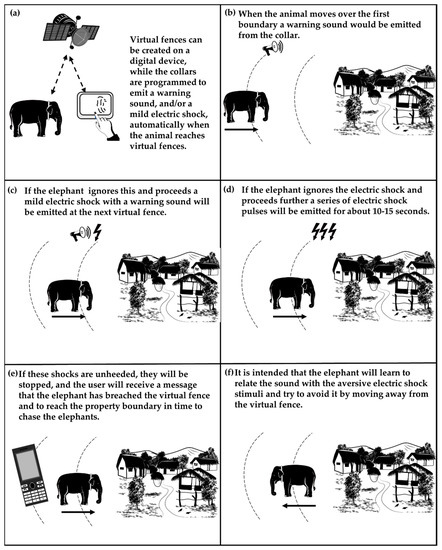
Figure 1.
Conceptual diagram of how Aversive Geofencing Devices (AGDs) are expected to work to manage movement of a wild elephant. (a) Virtual fences are drawn on a digital device. (b) Sound warning is delivered as the elephant fitted with an AGD approaches first virtual fence. (c) Elephant approaches second virtual fence and receives both sound and electric stimuli. (d) Elephant proceeds further and receives electric shock as pulses. (e) A warning message is sent to villagers’ mobile phones if the elephant ignores the electric shocks and proceeds further. (f) Elephant learns to turn away and avoid receiving electric shocks after few instances.
Fitting AGDs on wild elephants would also be a complex and costly process [119], so AGDs cannot be deployed on all elephants. Since most crop raiding elephants are lone males [43,174,175], installing AGDs on identified problem-causing lone elephants and matriarchs of herds would be more appropriate. Social facilitation could be expected to occur in group living, long lived animals like elephants where a matriarch collared with an AGD may lead the rest of the herd to avoid the electric shock associated with the virtual fence [147,176]. Learning to avoid virtual fences through social facilitation has been shown to occur in cattle and sheep with only a proportion of the animal group collared with AGDs [177,178]. The potential for wolves to learn through social facilitation was also shown where the rest of the pack members not wearing shock collars learnt to avoid a baited site [164]. Monitoring elephant movement and habitat use using GPS collars is conducted widely in Asian elephant range countries [17,31,179,180]. Given that AGDs also fulfil the same function of a GPS collar, fitting AGDs may be conducted at a similar scale as part of ongoing research that involves GPS collaring on selected elephants.
4. Progressing the Development of AGDs as a HEC Mitigation Tool
4.1. Developing and Testing the Efficacy of AGDs on Elephants
Elephants appear to be good candidates for the use of AGDs, but elephant’s large size, strength, speed, and potentially dangerous behaviour poses a risk in testing AGDs on elephants. Individual variability in their capacity for learning and response to the electrical stimuli might also be expected [63,152,153,168,181]. Furthermore, elephants have several different sensitive locations on the neck where electric probes may be more or less helpful in influencing animal movement or be avoided to prevent any harm to the elephant [182]. How individuals perceive the pain from the electric shock [183] and their temperament [184] may also vary. Hence, there is no guarantee that use of AGDs will be immediately successful for elephants. To determine the efficacy of AGDs on elephants, pilot studies should be conducted using captive elephants under controlled conditions [158,185,186]. Identifying the most suitable location on the neck to deliver the shock, and the safest appropriate strength of the shock, should be of primary research interest [153]. Field trials will then need to be conducted to understand the learning ability of elephants to associate the warning signals with the electric shock and avoid it. Negative reinforcement is often practiced by mahouts during training and handling of captive elephants in Asia [187,188,189]. However, safety of the mahout, relationship between mahouts and elephants and mahouts’ perception on testing AGDs on captive elephants should be considered during field trials. Exploration of the potential for captive elephants to learn through social facilitation would also be beneficial prior to testing of AGDs on wild elephants. Responses by captive elephants may not entirely represent wild elephant responses, but preliminary investigations with captive animals would still help resolve several uncertainties prior to work on wild elephants.
The longevity of AGDs must be considered given that frequent replacement of collars on wild elephants is not possible. GPS collars have limited battery life and are typically scheduled to collect GPS points every few hours [119]. However, AGDs will require real-time positioning of elephants and also generate sound and electric shock, thereby consuming a lot of battery capacity. Exploring options of harvesting energy using solar power, motion and body heat may be advantageous [147,190,191]. Maintaining uninterrupted communication between satellites and AGDs despite topographic barriers should be investigated [62], and the durability of the AGD is also an important factor requiring attention. In addition to being waterproof, the device may also have to be resistant to mud. AGDs should also be able to withstand strong movements such as head shaking or collar shaking using the trunk or rubbing of the collar against hard surfaces. Each of these issues need further exploration before AGDs will be ready for operational deployment on wild elephants.
4.2. AGDs and Elephant Welfare
AGDs typically expose animals to a high voltage electric shock with a very low amperage, delivered as pulses for a few milliseconds at a time [157,183], thereby minimising harm to the animal [192]. The strength of the shock from AGDs would also be much lower than what is received from electric fences [193]. Electricity will pass through and pain will be felt only between the contact points of the electrodes [194]. Further, when using AGDs the aversive stimulus is felt by the fewest number of possible animals and does not affect non-target individuals or species. Using devices that intentionally expose animals to pain naturally raise concerns about the ethical and welfare implications for the animal [158,195,196]. It might be expected that animals would show acute stress responses during early stages of learning, but after learning has occurred and animals know how to avoid the stimuli effectively, chronic stress levels should be no different from normal baseline levels [186,197]. Several studies have explored physiological stress levels using cortisol hormone and behavioural responses to understand the welfare of animals in relation to aversive conditioning [154,172,173,193,198,199,200]. If animals continue to show chronic stress responses and inability to learn, the experiment may need to be modified or discontinued with those animals [197]. Measuring cortisol hormone and behavioural time budgets are commonly used to assess stress levels of elephants [201,202,203]. Therefore, during preliminary studies, similar analysis should be done, as an indicator of welfare impacts associated with AGDs on elephants.
4.3. Public Acceptance for Using AGDs on Elephants
Obtaining acceptance of all stakeholders, local communities, line agencies, local administration and government is required to mainstream the use of AGDs. All approaches to managing HEC cause some sort of pain, distress, or disruption to elephants, but public acceptance of AGDs depends on how these welfare impacts compare to or are perceived to be compared to other HEC mitigation tools (Table 1). Use of electronic training collars on animals is not a common practice in Asian elephant range countries. Therefore, public reluctance to accept a novel technology may also be a challenge. In addition to the efficacy and welfare, successful adoption of new mitigation tools will be contingent on the probability of people to perceive it favourably, the capacity for the relevant stakeholders to implement or maintain it, and their ability to expand and adapt it on a wider scale [66]. Attitudes towards elephants may also affect the social acceptability of giving an electric shock to elephants using collars. This may vary significantly based on religious and cultural backgrounds and also depending on whether negative or positive interactions occur between humans and wild elephants [5,204]. Where negative perceptions are shown towards mitigation tools that have high efficacy, effort could be made to create awareness and change people’s attitudes towards such HEC mitigation tools. Hence, sociological surveys should be conducted to understand attitudes of various stakeholders at a preliminary stage to determine public opinion and acceptability of using AGDs on elephants in the future.
5. Conclusions
Elephants are endangered and play a significant role in the ecosystem and culture. Conflict between humans and elephants is one of the most important environmental issues in Asian elephant range countries. A variety of approaches are used to mitigate HEC, although most have not been very successful given they are not flexible or dynamic enough to be modified according to elephants’ behavioural and ecological needs. AGDs may overcome many of these issues, but require further development. AGDs may safely prevent elephant movement into human habitations and help humans and elephants coexist if elephants successfully learn to associate the non-aversive auditory stimulus with the aversive electric shock. Use of AGDs may be a more ethical choice than elephant removal. However, AGDs first require field-testing with captive elephants under controlled conditions to refine their design and optimise their efficacy and welfare impacts. Understanding public perceptions about AGDs is also important. AGDs will not be a ‘silver bullet’ for HEC, but they do overcome many of the limitations of current tools and may therefore become a powerful new management tool for reducing HEC in the future.
Author Contributions
Conceptualization, S.J.C.d.M. and B.L.A.; writing—original draft preparation, S.J.C.d.M.; writing—review and editing, S.S., R.K.d.M., A.D., D.K.W., T.M. and B.L.A.; supervision S.S., A.D., D.K.W., T.M. and B.L.A.; funding acquisition, S.S. All authors have read and agreed to the published version of the manuscript.
Funding
S.J.C.d.M was jointly supported by the University of Southern Queensland, Australia (International PhD fees scholarship) and the National Institute of Fundamental Studies, Kandy, Sri Lanka (in-kind support). The project was funded by the National Research Council, Sri Lanka, grant number 19-046, awarded to S.S.
Institutional Review Board Statement
Not applicable.
Informed Consent Statement
Not applicable.
Data Availability Statement
Not applicable.
Acknowledgments
Authors thank Deepthi Madumali for the digital illustrations used. Winifred Hathi and Francis Robinson provided useful advice on elephant behaviour and management. Authors also thank the anonymous reviewers for their constructive comments.
Conflicts of Interest
The authors declare no conflict of interest.
Appendix A
Table A1.
Key findings of some research conducted on virtual fencing with Aversive Geofencing Devices (AGDs) on livestock published between 2017–2022.
Table A1.
Key findings of some research conducted on virtual fencing with Aversive Geofencing Devices (AGDs) on livestock published between 2017–2022.
| Study | Country | Summary | |
|---|---|---|---|
| 1 | Aaser et al. (2022) [205] | Denmark | AGDs were successful in keeping the cattle within the virtual fences with no acute welfare impacts. However, there were individual variations between cows in their responses and were also influenced by stimuli received by other herd members. |
| 2 | Boyd et al. (2022) [62] | USA | This study focussed on excluding cattle from recently burned areas and AGDs were quite effective in limiting the use of burned areas by cattle. |
| 3 | Brunberg et al. (2017) [206] | Norway | The prototype device used was not very successful in keeping the sheep within the restricted zones and animal welfare may not be assured with this system. |
| 4 | Campbell et al. (2017) [154] | Australia | Cattle were able to associate the audio cue with the aversive stimuli from the AGDs and avoid moving virtual fences, thus animals did not associate the aversive stimuli with the location but responded to the audio cue from the collar. |
| 5 | Campbell et al. (2018) [155] | Australia | AGDs were able to successfully exclude most cattle from accessing a feed attractant but the rate of learning highly differed between individuals. |
| 6 | Campbell et al. (2019a) [207] | Australia | AGDs were successful in temporarily excluding a group of cattle from a riparian zone and animals re-entered the previously excluded area after fence deactivation. |
| 7 | Campbell et al. (2019b) [193] | Australia | AGDs were effective in containing cattle within a virtual fenced area without much impact on physiological stress levels or behavioural time budgets and showed no difference compared with those animals within a physical electric fence. |
| 8 | Campbell et al. (2020) [61] | Australia | AGDs were able to successfully exclude a group of cattle from an environmentally sensitive area across a period of 44 days, with the feed available in the protected zone doubled by the end of the experiment. |
| 9 | Campbell et al. (2021) [208] | Australia | Preliminary trials conducted on cattle and sheep demonstrated the potential to use AGDs for herding animals, however, further experimentation with updated versions of the device is required. |
| 10 | Colusso et al. (2020) [209] | Australia | Cows were trained to learn and respond to AGDs as individuals and in groups. When those trained in groups were tested individually, they were more likely to interact with virtual fences than those initially trained individually and then later tested in groups. This study demonstrated that those trained in groups relied on the responses of their conspecifics and for accurate learning of virtual fences, it is important that individual animals directly receive stimuli. |
| 11 | Colusso et al. (2021a) [210] | Australia | Experiments conducted with AGDs to evaluate the impact of feed restriction showed that the restriction of food may impact the exclusion of cows from a feed attractant, but later they quickly learnt to avoid receiving the electrical stimuli and stayed within the restricted zone. |
| 12 | Colusso et al. (2021b) [211] | Australia | AGDs were successful in excluding cows from fresh pasture even when they were only provided with post-grazing residuals. However, there were individual variations in the number of stimuli received by animals and time spent in the exclusion zone. |
| 13 | Kearton et al. (2019) [200] | Australia | Experiment was conducted to understand the stress responses of sheep to AGDs compared to other commonly encountered stimuli such as a barking dog and restraint procedures. Results showed that electric stimuli on sheep had no significant effect on physiological stress levels and showed aversive behavioural responses that were less aversive compared to commonly practiced restraining procedures. |
| 14 | Kearton et al. (2020) [172] | Australia | Predictability and controllability of the aversive stimuli from AGDs minimises both physiological and behavioural stress responses during aversive conditioning. |
| 15 | Kearton et al. (2022) [212] | Australia | Maternal demonstrators exposed to virtual fences with AGDs may contribute to the learning of virtual fences by lambs. However, this study protocol was limited by several aspects and therefore, further exploration of this is recommended. |
| 16 | Keshavarzi et al. (2020) [178] | Australia | This study showed that cattle learned to avoid virtual fences through social facilitation where animals stayed within a restricted zone based on the response of conspecifics. |
| 17 | Langworthy et al. (2021) [213] | Australia | Virtual fencing using AGDs were 99% successful in containing a herd of dairy cows within a restricted zone compared to the physical electric fences. |
| 18 | Lomax et al. (2019) [63] | Australia | AGDs were successful in keeping cows within a designated area 99% of the time, however learning rate of individual animals varied. |
| 19 | Marini et al. (2018a) [214] | Australia | Over a period of 3 days, after an average of 8 interactions, sheep learned to associate the auditory cue with the aversive stimuli. After the collar was removed, the sheep moved into the exclusion zone after 30 min. |
| 20 | Marini et al. (2018b) [153] | Australia | Mean of three trials were required for the sheep to learn to associate the auditory cue with the electrical stimuli. After that 52% of the sheep avoided receiving the electric shock after hearing the auditory signal. |
| 21 | Marini et al. (2019) [215] | Australia | The group of sheep that received both an auditory cue followed by electrical stimuli were able to predict the receipt of electrical stimuli and thus showed more favourable responses to the fence compared to the group that only received an electrical cue. Animal’s temperament showed no relationship on its learning ability. |
| 22 | Marini et al. (2020) [177] | Australia | The experiment with sheep showed that collaring 66% of a flock was enough to contain the entire flock within the exclusion zone indicating that sheep learn through social facilitation. However, collaring 33% of the flock did not prevent the flock from entering the exclusion zone. |
| 23 | Marini et al. (2022) [216] | Australia | Study showed that virtual fencing is as effective as electric fencing and virtual fenced sheep did not differ in their normal grazing behaviour. |
| 24 | McSweeney et al. (2020) [217] | Ireland | When visual boundaries were removed, cows made more boundary challenges. Also, cows grazed less in inclusion zone implying they were stressed. |
| 25 | Muminov et al. (2019) [218] | Korea | Goats responded positively to both electric shock and warning sounds. Also, the designed collar was effective at automatically classifying main behaviour categories. |
| 26 | Ranches et al. (2021) [219] | USA | Cows showed increased distressed behaviours when first fitted with the collars. However, they quickly adapted to the AGD. Cows also learned to avoid the exclusion zone when fitted with an AGD. Upon removing the AGD cows resumed normal behaviours. |
| 27 | Verdon et al. (2020) [181] | Australia | Study shows that cows that have had prior experience with electric fences learn the virtual fence techniques much faster. |
| 28 | Verdon and Rawnsley, (2020) [220] | Australia | Older heifers (22 months) learn to avoid the electrical stimuli quicker than younger animals (12 months). When the younger animals were re-trained at 22 months, they did not show a significant difference compared to the original 22-month animals. This showed that prior learning at a young age does not have an effect in avoiding the electrical stimuli later in life. |
| 29 | Verdon et al. (2021a) [221] | Australia | The study comprised of four groups of cattle grazing in adjacent paddocks, where two control groups were contained within physical electric fences and the other two with AGDs. AGDs successfully contained one group of animals, but the second group frequently encroached the exclusion zone. Study suggested that when animals have visual contact of other conspecifics in adjacent paddocks, the efficacy of AGDs can be reduced. |
| 30 | Verdon et al. (2021b) [222] | Australia | Milk production, live weight and standing and lying behaviour budgets did not differ between electric and virtual fence cattle groups. There was no significant welfare or behaviour effects immediately following implementation of AGDs (days 1–3). However, there was an increase in milk cortisol and changes in behavioural time budgets later (after day 4) with the virtual fence group. Therefore, a longer study period is required to determine the welfare impacts of AGDs on lactating dairy cattle |
References
- Olivier, R. Distribution and Status of the Asian Elephant. Oryx 1978, 14, 379–424. [Google Scholar] [CrossRef]
- Fernando, P.; Pastorini, J. Range-Wide Status of Asian Elephants. Gajah 2011, 35, 15–20. [Google Scholar]
- Menon, V.; Tiwari, S.K.R. Population Status of Asian Elephants Elephas maximus and Key Threats. Int. Zoo Yearb. 2019, 53, 17–30. [Google Scholar] [CrossRef]
- Sukumar, R. A Brief Review of the Status, Distribution and Biology of Wild Asian Elephants Elephas maximus. Int. Zoo Yearb. 2006, 40, 1–8. [Google Scholar] [CrossRef]
- Gogoi, M. Emotional Coping among Communities Affected by Wildlife-Caused Damage in North-East India: Opportunities for Building Tolerance and Improving Conservation Outcomes. Oryx 2018, 52, 214–219. [Google Scholar] [CrossRef]
- Sukumar, R. The Living Elephants: Evolutionary Ecology, Behavior and Conservation; Oxford University Press: New York, NY, USA, 2003; ISBN 0195107780. [Google Scholar]
- Köpke, S.; Withanachchi, S.S.; Pathiranage, R.; Withanachchi, C.R.; Gamage, D.U.; Nissanka, T.S.; Warapitiya, C.C.; Nissanka, B.M.; Ranasinghe, N.N.; Senarathna, C.D.; et al. Human–Elephant Conflict in Sri Lanka: A Critical Review of Causal Explanations. Sustainability 2021, 13, 8625. [Google Scholar] [CrossRef]
- Csuti, B. Elephants in Captivity. In Biology, Medicine, and Surgery of Elephants; Mikota, S., Fowler, M., Eds.; Blackwell Publishing: Oxford, UK, 2006; pp. 15–22. [Google Scholar]
- Locke, P. Explorations in Ethnoelephantology: Social, Historical, and Ecological Intersections between Asian Elephants and Humans. Environ. Soc. 2013, 4, 79–97. [Google Scholar] [CrossRef]
- McGaughey, C.A. The Elephant in Ancient and Modern Writings. Br. Vet. J. 1960, 116, 255–260. [Google Scholar] [CrossRef]
- Riddle, H.S.; Christopher, C. Captive Elephants—An Overview. J. Threat. Taxa 2011, 3, 1826–1836. [Google Scholar] [CrossRef]
- Maurer, G.; Gimenez, O.; Mulot, B.; Lescureux, N. Under Pressure: How Human-Wild-Captive Elephant Social-ecological System in Laos Is Teetering Due to Global Forces and Sociocultural Changes. People Nat. 2021, 3, 1047–1063. [Google Scholar] [CrossRef]
- Bansiddhi, P.; Brown, J.L.; Thitaram, C.; Punyapornwithaya, V.; Somgird, C.; Edwards, K.L.; Nganvongpanit, K. Changing Trends in Elephant Camp Management in Northern Thailand and Implications for Welfare. PeerJ 2018, 6, e5996. [Google Scholar] [CrossRef] [PubMed]
- Nijman, V. An Assessment of the Live Elephant Trade in Thailand; TRAFFIC International: Cambridge, UK, 2014. [Google Scholar]
- Prakash, T.G.S.L.; Indrajith, W.A.A.D.U.; Aththanayaka, A.M.C.P.; Karunarathna, S.; Botejue, M.; Nijman, V.; Henkanaththegedara, S. Illegal Capture and Internal Trade of Wild Asian Elephants (Elephas maximus) in Sri Lanka. Nat. Conserv. 2020, 42, 51–69. [Google Scholar] [CrossRef]
- Hankinson, E.; Nijman, V. Abdullah Asian Elephants: 15 Years of Research and Conservation. J. Phys. Conf. Ser. 2020, 1460, 012055. [Google Scholar] [CrossRef]
- Sampson, C.; McEvoy, J.; Oo, Z.M.; Chit, A.M.; Chan, A.N.; Tonkyn, D.; Soe, P.; Songer, M.; Williams, A.C.; Reisinger, K.; et al. New Elephant Crisis in Asia-Early Warning Signs from Myanmar. PLoS ONE 2018, 13, e0194113. [Google Scholar] [CrossRef]
- Perera, B.M.A.O. The Human-Elephant Conflict: A Review of Current Status and Mitigation Methods. Gajah 2009, 30, 41–52. [Google Scholar]
- Nijman, V.; Shepherd, C.R. Emergence of Mong La on the Myanmar–China Border as a Global Hub for the International Trade in Ivory and Elephant Parts. Biol. Conserv. 2014, 179, 17–22. [Google Scholar] [CrossRef]
- Williams, C.; Tiwari, S.K.R.; Goswami, V.R.; de Silva, S.; Kumar, A.; Baskaran, N.; Yoganand, K.; Menon, V. Elephas maximus; IUCN Red List of Threatened Species 2020: 2020; e.T7140A45818198. Available online: https://www.iucnredlist.org/species/7140/45818198 (accessed on 21 May 2021).
- Liu, P.; Wen, H.; Harich, F.K.; He, C.; Wang, L.; Guo, X.; Zhao, J.; Luo, A.; Yang, H.; Sun, X.; et al. Conflict between Conservation and Development: Cash Forest Encroachment in Asian Elephant Distributions. Sci. Rep. 2017, 7, 6404. [Google Scholar] [CrossRef]
- Fernando, P.; De Silva, M.K.C.R.; Jayasinghe, L.K.A.; Janaka, H.K.; Pastorini, J. First Country-Wide Survey of the Endangered Asian Elephant: Towards Better Conservation and Management in Sri Lanka. Oryx 2021, 55, 46–55. [Google Scholar] [CrossRef]
- Songer, M.; Aung, M.; Allendorf, T.D.; Calabrese, J.M.; Leimgruber, P. Drivers of Change in Myanmar’s Wild Elephant Distribution. Trop. Conserv. Sci. 2016, 9, 194008291667374. [Google Scholar] [CrossRef]
- Leimgruber, P.; Gagnon, J.B.; Wemmer, C.; Kelly, D.S.; Songer, M.A.; Selig, E.R. Fragmentation of Asia’s Remaining Wildlands: Implications for Asian Elephant Conservation. Anim. Conserv. 2003, 6, 347–359. [Google Scholar] [CrossRef]
- Luo, L.; Wang, X.; Guo, H.; Zhu, L.; Ma, Y.; Yang, R.; Wang, S.; Wang, G.; Wang, M.; Shao, J.; et al. Eighteen Years (2001–2018) of Forest Habitat Loss across the Asian Elephant’s Range and Its Drivers. Sci. Bull. 2022, 67, 1513–1516. [Google Scholar] [CrossRef]
- The World Bank Countries and Economies. Available online: https://data.worldbank.org/country (accessed on 14 September 2022).
- Fernando, P.; Prasad, T.; Janaka, H.K.; Ekanayaka, S.K.; Nishantha, H.G.; Pastorini, J. The Use of Radio-Tracking Data to Guide Development and Manage Elephants. Wildlanka 2015, 3, 12–19. [Google Scholar]
- Padalia, H.; Ghosh, S.; Reddy, C.S.; Nandy, S.; Singh, S.; Kumar, A.S. Assessment of Historical Forest Cover Loss and Fragmentation in Asian Elephant Ranges in India. Environ. Monit. Assess. 2019, 191, 802. [Google Scholar] [CrossRef]
- Othman, N.; Goossens, B.; Cheah, C.P.I.; Nathan, S.; Bumpus, R.; Ancrenaz, M. Shift of Paradigm Needed towards Improving Human–Elephant Coexistence in Monoculture Landscapes in Sabah. Int. Zoo Yearb. 2019, 53, 161–173. [Google Scholar] [CrossRef]
- Chen, Y.; Atzeni, L.; Gibson, L.; Sun, Y.; Yang, Z.; Shi, K.; Dudgeon, D. Urban Expansion and Infrastructure Development Reduce Habitat Suitability for Asian Elephants in Southwestern China. J. Wildl. Manag. 2022, 86, e22204. [Google Scholar] [CrossRef]
- Wadey, J.; Beyer, H.L.; Saaban, S.; Othman, N.; Leimgruber, P.; Campos-Arceiz, A. Why Did the Elephant Cross the Road? The Complex Response of Wild Elephants to a Major Road in Peninsular Malaysia. Biol. Conserv. 2018, 218, 91–98. [Google Scholar] [CrossRef]
- Alfred, R.; Ahmad, A.H.; Payne, J.; Williams, C.; Ambu, L.N.; How, P.M.; Goossens, B. Home Range and Ranging Behaviour of Bornean Elephant (Elephas maximus borneensis) Females. PLoS ONE 2012, 7, e31400. [Google Scholar] [CrossRef]
- Goswami, V.R.; Vasudev, D.; Oli, M.K. The Importance of Conflict-Induced Mortality for Conservation Planning in Areas of Human-Elephant Co-Occurrence. Biol. Conserv. 2014, 176, 191–198. [Google Scholar] [CrossRef]
- Ganesh, S. Human Elephant Conflict Kills 1713 People, 373 Pachyderms in 3 Years. Available online: https://www.thehindu.com/news/national/human-elephant-conflict-kills-1713-people-373-pachyderms-in-3-years/article26225515.ece (accessed on 11 May 2020).
- Prakash, T.G.S.L.; Wijeratne, A.W.; Fernando, P. Human-Elephant Conflict in Sri Lanka: Patterns and Extent. Gajah 2020, 51, 16–25. [Google Scholar]
- Asian Elephant Specialist Group. Asian Elephant Range States Meeting, Final Report; IUCN-SSC Asian Elephant Specialist Group: Jakarta, Indonesia, 2017. [Google Scholar]
- LaDue, C.A.; Eranda, I.; Jayasinghe, C.; Vandercone, R.P.G. Mortality Patterns of Asian Elephants in a Region of Human–Elephant Conflict. J. Wildl. Manag. 2021, 85, 794–802. [Google Scholar] [CrossRef]
- Tang, R.; Li, W.; Zhu, D.; Shang, X.; Guo, X.; Zhang, L. Raging Elephants: Effects of Human Disturbance on Physiological Stress and Reproductive Potential in Wild Asian Elephants. Conserv. Physiol. 2020, 8, coz106. [Google Scholar] [CrossRef] [PubMed]
- Fernando, P.; Kumar, M.A.; Williams, A.C.; Wikramanayake, E.; Aziz, T.; Singh, S.M. Review of Human-Elephant Conflict Mitigation Measures Practiced in South Asia; World Wide Fund for Nature: Gland, Switzerland, 2008. [Google Scholar]
- Neupane, D.; Johnson, R.L.; Risch, T.S. How Do Land-use Practices Affect Human—Elephant Conflict in Nepal? Wildl. Biol. 2017, 2017, 1–9. [Google Scholar] [CrossRef]
- Saha, S.K. Innovative Way of Human-Elephant Competition Mitigation. J. Threat. Taxa 2020, 12, 16494–16501. [Google Scholar] [CrossRef]
- Thant, Z.M.; May, R.; Røskaft, E. Pattern and Distribution of Human-Elephant Conflicts in Three Conflict-Prone Landscapes in Myanmar. Glob. Ecol. Conserv. 2021, 25, e01411. [Google Scholar] [CrossRef]
- Campos-Arceiz, A.; Takatsuki, S.; Ekanayaka, S.K.K.; Hasegawa, T. The Human-Elephant Conflict in Southeastern Sri Lanka: Type of Damage, Seasonal Patterns, and Sexual Differences in the Raiding Behavior of Elephants. Gajah 2009, 31, 5–14. [Google Scholar]
- Ekanayaka, S.; Campos-Arceiz, A.; Rupasinghe, M.; Pastorini, J.; Fernando, P. Patterns of Crop Raiding by Asian Elephants in a Human-Dominated Landscape in Southeastern Sri Lanka. Gajah 2011, 34, 20–25. [Google Scholar] [CrossRef]
- Nyhus, P.J.; Tilson, R.; Sumianto. Crop-Raiding Elephants and Conservation Implications at Way Kambas National Park, Sumatra, Indonesia. Oryx 2000, 34, 262–274. [Google Scholar] [CrossRef]
- Sukumar, R. Ecology of the Asian Elephant in Southern India. II. Feeding Habits and Crop Raiding Patterns. J. Trop. Ecol. 1990, 6, 33–53. [Google Scholar] [CrossRef]
- Webber, C.E.; Sereivathana, T.; Maltby, M.P.; Lee, P.C. Elephant Crop-Raiding and Human-Elephant Conflict in Cambodia: Crop Selection and Seasonal Timings of Raids. Oryx 2011, 45, 243–251. [Google Scholar] [CrossRef]
- Karanth, K.K.; Gupta, S.; Vanamamalai, A. Compensation Payments, Procedures and Policies towards Human-Wildlife Conflict Management: Insights from India. Biol. Conserv. 2018, 227, 383–389. [Google Scholar] [CrossRef]
- Chen, S.; Yi, Z.F.; Campos-Arceiz, A.; Chen, M.Y.; Webb, E.L. Developing a Spatially-Explicit, Sustainable and Risk-Based Insurance Scheme to Mitigate Human-Wildlife Conflict. Biol. Conserv. 2013, 168, 31–39. [Google Scholar] [CrossRef]
- Li, W.; Liu, P.; Guo, X.; Wang, L.; Wang, Q.; Yu, Y.; Dai, Y.; Li, L.; Zhang, L. Human-Elephant Conflict in Xishuangbanna Prefecture, China: Distribution, Diffusion, and Mitigation. Glob. Ecol. Conserv. 2018, 16, e00462. [Google Scholar] [CrossRef]
- Barua, M.; Bhagwat, S.A.; Jadhav, S. The Hidden Dimensions of Human-Wildlife Conflict: Health Impacts, Opportunity and Transaction Costs. Biol. Conserv. 2013, 157, 309–316. [Google Scholar] [CrossRef]
- Jadhav, S.; Barua, M. The Elephant Vanishes: Impact of Human–Elephant Conflict on People’s Wellbeing. Health. Place 2012, 18, 1356–1365. [Google Scholar] [CrossRef] [PubMed]
- Nelson, A.; Bidwell, P.; Sillero-Zubiri, C. A Review of Human-Elephant Conflict Management Strategies; Wildlife Conservation Research Unit, Oxford University: Oxford, UK, 2003. [Google Scholar]
- Chen, Y.; Marino, J.; Chen, Y.; Tao, Q.; Sullivan, C.D.; Shi, K.; Macdonald, D.W. Predicting Hotspots of Human-Elephant Conflict to Inform Mitigation Strategies in Xishuangbanna, Southwest China. PLoS ONE 2016, 11, e0162035. [Google Scholar] [CrossRef]
- Zhang, L.; Wang, N. An Initial Study on Habitat Conservation of Asian Elephant (Elephas maximus), with a Focus on Human Elephant Conflict in Simao, China. Biol. Conserv. 2003, 112, 453–459. [Google Scholar] [CrossRef]
- Shaffer, L.J.; Khadka, K.K.; Van Den Hoek, J.; Naithani, K.J. Human-Elephant Conflict: A Review of Current Management Strategies and Future Directions. Front. Ecol. Evol. 2019, 6, 235. [Google Scholar] [CrossRef]
- Fernando, P.; Wikramanayake, E.D.; Janaka, H.K.; Jayasinghe, L.K.A.; Gunawardena, M.; Kotagama, S.W.; Weerakoon, D.; Pastorini, J. Ranging Behavior of the Asian Elephant in Sri Lanka. Mamm. Biol. 2008, 73, 2–13. [Google Scholar] [CrossRef]
- Baskaran, N.; Balasubramaniam, M.; Swaminathan, S.; Desai, A.A. Home Range of Elephants in the Nilgiri Biosphere Reserve, South India. In A Week With Elephants; Daniel, J.C., Datye, H.S., Eds.; Bombay Natural History Society and Oxford University Press: Bombay/New Delhi, India, 1995; pp. 296–313. [Google Scholar]
- Goswami, V.R.; Vasudev, D. Triage of Conservation Needs: The Juxtaposition of Conflict Mitigation and Connectivity Considerations in Heterogeneous, Human-Dominated Landscapes. Front. Ecol. Evol. 2017, 4, 1–7. [Google Scholar] [CrossRef]
- Mumby, H.S.; Plotnik, J.M. Taking the Elephants’ Perspective: Remembering Elephant Behavior, Cognition and Ecology in Human-Elephant Conflict Mitigation. Front. Ecol. Evol. 2018, 6, 1–8. [Google Scholar] [CrossRef]
- Campbell, D.L.M.; Ouzman, J.; Mowat, D.; Lea, J.M.; Lee, C.; Llewellyn, R.S. Virtual Fencing Technology Excludes Beef Cattle from an Environmentally Sensitive Area. Animals 2020, 10, 1069. [Google Scholar] [CrossRef] [PubMed]
- Boyd, C.S.; O’Connor, R.; Ranches, J.; Bohnert, D.W.; Bates, J.D.; Johnson, D.D.; Davies, K.W.; Parker, T.; Doherty, K.E. Virtual Fencing Effectively Excludes Cattle from Burned Sagebrush Steppe. Rangel. Ecol. Manag. 2022, 81, 55–62. [Google Scholar] [CrossRef]
- Lomax, S.; Colusso, P.; Clark, C.E.F. Does Virtual Fencing Work for Grazing Dairy Cattle? Animals 2019, 9, 429. [Google Scholar] [CrossRef]
- Linhart, S.B.; Roberts, J.D.; Schumake, S.A.; Johnson, R. Avoidance of Prey by Captive Coyotes Punished with Electric Shock. In Proceedings of the 7th Vertebrate Pest Conference, Monterey, CA, USA, 9–11 March 1976; University of California: Davis, CA, USA, 1976; Volume 7, pp. 302–306. [Google Scholar]
- Hoare, R.E. Determinants of Human-Elephant Conflict in a Land-Use Mosaic. J. Appl. Ecol. 1999, 36, 689–700. [Google Scholar] [CrossRef]
- Denninger Snyder, K.; Rentsch, D. Rethinking Assessment of Success of Mitigation Strategies for Elephant-Induced Crop Damage. Conserv. Biol. 2020, 34, 829–842. [Google Scholar] [CrossRef]
- Montgomery, R.A.; Raupp, J.; Mukhwana, M.; Greenleaf, A.; Mudumba, T.; Muruthi, P. The Efficacy of Interventions to Protect Crops from Raiding Elephants. Ambio 2022, 51, 716–727. [Google Scholar] [CrossRef]
- Liefting, Y.; de Jong, J.F.; Prins, H.H.T. A New Type of Elephant Fence: Permeable for People and Game but Not for Elephant. Gajah 2018, 49, 11–19. [Google Scholar]
- Ponnusamy, V.; Chackrapani, P.; Lim, T.W.; Saaban, S.; Campos-Arceiz, A. Farmers’ Perceptions and Attitudes towards Government-Constructed Electric Fences in Peninsular Malaysia. Gajah 2016, 45, 4–11. [Google Scholar]
- Natarajan, L.; Kumar, A.; Qureshi, Q.; Desai, A.A.; Pandav, B. Evaluation of Wall-barriers to Manage Human Conflict with Asian Elephants in India. Wildl. Soc. Bull. 2021, 45, 215–220. [Google Scholar] [CrossRef]
- Sugiyo; Ardiantiono; Santo, A.; Marthy, W.; Amama, F. Evaluating the Intervention Methods to Reduce Human-Elephant Conflict around Way Kambas National Park. In Conserving Sumatran Wildlife Heritage for Sustainable Livelihood, Proceedings of the 3rd International Wildlife Symposium, Lampung, Indonesia, 18–20 October 2016; University of Lampung: Lampung, Indonesia, 2016; pp. 30–36. [Google Scholar]
- Pekor, A.; Miller, J.R.B.; Flyman, M.V.; Kasiki, S.; Kesch, M.K.; Miller, S.M.; Uiseb, K.; van der Merve, V.; Lindsey, P.A. Fencing Africa’s Protected Areas: Costs, Benefits, and Management Issues. Biol. Conserv. 2019, 229, 67–75. [Google Scholar] [CrossRef]
- Fernando, P.; Jayawardene, J.; Prasad, T.; Hendavitharana, W.; Pastorini, J. Current Status of Asian Elephants in Sri Lanka. Gajah 2011, 35, 93–103. [Google Scholar] [CrossRef]
- Wijesinghe, N. Path to Solve Human-Elephant Conflict. Available online: https://www.dailynews.lk/2019/01/16/features/174403/path-solve-human-elephant-conflict (accessed on 14 February 2022).
- Desai, A.A.; Riddle, H.S. Human-Elephant Conflict in Asia; U.S. Fish and Wildlife Service; Asian Elephant Support: Washington, DC, USA, 2015; p. 92. [Google Scholar]
- Gunaryadi, D.; Sugiyo; Hedges, S. Community-Based Human–Elephant Conflict Mitigation: The Value of an Evidence-Based Approach in Promoting the Uptake of Effective Methods. PLoS ONE 2017, 12, e0173742. [Google Scholar] [CrossRef] [PubMed]
- Hayward, M.W.; Kerley, G.I.H. Fencing for Conservation: Restriction of Evolutionary Potential or a Riposte to Threatening Processes? Biol. Conserv. 2009, 142, 1–13. [Google Scholar] [CrossRef]
- Saaban, S.; Yasak, M.N.; Gumal, M.; Oziar, A.; Cheong, F.; Shaari, Z.; Tyson, M.; Hedges, S. Viability and Management of the Asian Elephant (Elephas maximus) Population in the Endau Rompin Landscape, Peninsular Malaysia. PeerJ 2020, 8, e8209. [Google Scholar] [CrossRef]
- Smith, D.; King, R.; Allen, B.L. Impacts of Exclusion Fencing on Target and Non-target Fauna: A Global Review. Biol. Rev. 2020, 95, 1590–1606. [Google Scholar] [CrossRef]
- Osipova, L.; Okello, M.M.; Njumbi, S.J.; Ngene, S.; Western, D.; Hayward, M.W.; Balkenhol, N. Fencing Solves Human-Wildlife Conflict Locally but Shifts Problems Elsewhere: A Case Study Using Functional Connectivity Modelling of the African Elephant. J. Appl. Ecol. 2018, 55, 2673–2684. [Google Scholar] [CrossRef]
- Mehta, P.; Kulkarni, J.; Athale, U. There’s Many a Way to Keep the Elephant Away. A Review of Techniques for Preventing Crop Damage by Elephants; Wildlife Research and Conservation Society: Pune, India, 2020; p. 144. [Google Scholar]
- Wahed, M.A.; Ullah, M.R.; Haseeb, M.I. Human-Elephant Conflict Mitigation Measures: Lessons from Bangladesh; IUCN, International Union for Conservation of Nature, Bangladesh Country Office: Dhaka, Bangladesh, 2016; p. 30. [Google Scholar]
- Gross, E.M.; Drouet-Hoguet, N.; Subedi, N.; Gross, J. The Potential of Medicinal and Aromatic Plants (MAPs) to Reduce Crop Damages by Asian Elephants (Elephas maximus). Crop Prot. 2017, 100, 29–37. [Google Scholar] [CrossRef]
- Dharmarathne, C.; Fernando, C.; Weerasinghe, C.; Corea, R. Project Orange Elephant Is a Conflict Specific Holistic Approach to Mitigating Human-Elephant Conflict in Sri Lanka. Commun. Biol. 2020, 3, 43. [Google Scholar] [CrossRef]
- Ly, C.T.; Hung, V.; Anh, N.C.T.; Bao, H.D.; Quoc, P.D.P.; Khanh, H.T.; Van Minh, N.; Cam, N.T.H.; Cuong, C.D. A Pilot Study of Cultivating Non-Preferred Crops to Mitigate Human-Elephant Conflict in the Buffer Zone of Yok Don National Park, Vietnam. Gajah 2020, 51, 4–9. [Google Scholar]
- Fernando, C.; Corea, R. An Assessment of Beehive Fences in Deterring Crop Raiding Elephants: A Case Study from Wasgamuwa, Sri Lanka. In Proceedings of the Association for Tropical Biodiversity and Conservation Asia Pacific Conference 2019, Thulhiriya, Sri Lanka, 10–13 September 2019; p. 71. [Google Scholar]
- Water, A.; King, L.E.; Arkajak, R.; Arkajak, J.; Doormaal, N.; Ceccarelli, V.; Sluiter, L.; Doornwaard, S.M.; Praet, V.; Owen, D.; et al. Beehive Fences as a Sustainable Local Solution to Human-elephant Conflict in Thailand. Conserv. Sci. Pract. 2020, 2, e260. [Google Scholar] [CrossRef]
- Baishya, H.K.; Dey, S.; Sarmah, A.; Sharma, A.; Gogoi, S.; Aziz, T.; Ghose, D.; Williams, A.C. Use of Chilli Fences to Deter Asian Elephants—A Pilot Study. Gajah 2012, 36, 11–13. [Google Scholar]
- Davies, T.E.; Wilson, S.; Hazarika, N.; Chakrabarty, J.; Das, D.; Hodgson, D.J.; Zimmermann, A. Effectiveness of Intervention Methods against Crop-Raiding Elephants. Conserv. Lett. 2011, 4, 346–354. [Google Scholar] [CrossRef]
- Hedges, S.; Gunaryadi, D. Reducing Human–Elephant Conflict: Do Chillies Help Deter Elephants from Entering Crop Fields? Oryx 2010, 44, 139. [Google Scholar] [CrossRef]
- Thaufeek, U.L.; Padmalal, U.K.G.K.; Fernando, P. Land Use and Human-Elephant Conflict in the Sigiriya Sanctuary, Sri Lanka. Gajah 2014, 40, 26–30. [Google Scholar]
- Nath, N.K.; Lahkar, B.P.; Brahma, N.; Dey, S.; Das, J.P.; Sarma, P.K.; Talukdar, B.K. An Assessment of Human-Elephant Conflict in Manas National Park, Assam, India. J. Threat. Taxa 2009, 1, 309–316. [Google Scholar] [CrossRef]
- Thuppil, V.; Coss, R.G. Playback of Felid Growls Mitigates Crop-Raiding by Elephants Elephas maximus in Southern India. Oryx 2016, 50, 329–335. [Google Scholar] [CrossRef]
- Aziz, M.A.; Shamsuddoha, M.; Maniruddin, M.; Morshed, H.M.; Sarker, R.; Islam, M.A. Elephants, Border Fence and Human-Elephant Conflict in Northern Bangladesh: Implications for Bilateral Collaboration towards Elephant Conservation. Gajah 2016, 45, 12–19. [Google Scholar]
- de Silva, S.; Webber, C.E.; Weerathunga, U.S.; Pushpakumara, T.V.; Weerakoon, D.K.; Wittemyer, G. Demographic Variables for Wild Asian Elephants Using Longitudinal Observations. PLoS ONE 2013, 8, e82788. [Google Scholar] [CrossRef] [PubMed]
- Pradhan, N.M.B.; Williams, A.C.; Dhakal, M. Current Status of Asian Elephants in Nepal. Gajah 2011, 35, 87–92. [Google Scholar]
- Putri, A.; Al Azhari, M. Elephant Flying Squad, A Unique Approach to Reduce Human-Wildlife Conflict in Riau. Available online: https://jakartaglobe.id/news/elephant-flying-squad-unique-approach-to-reducing-human-wildlife-conflict-in-riau/ (accessed on 10 September 2022).
- Vijayakrishnan, S.; Kumar, M.A.; Umapathy, G.; Kumar, V.; Sinha, A. Physiological Stress Responses in Wild Asian Elephants Elephas maximus in a Human-Dominated Landscape in the Western Ghats, Southern India. Gen. Comp. Endocrinol. 2018, 266, 150–156. [Google Scholar] [CrossRef]
- Daim, M.S. Elephant Translocation- the Malaysian Approach. Gajah 1995, 14, 43–48. [Google Scholar]
- Fernando, P.; Leimgruber, P.; Prasad, T.; Pastorini, J. Problem-Elephant Translocation: Translocating the Problem and the Elephant? PLoS ONE 2012, 7, e50917. [Google Scholar] [CrossRef] [PubMed]
- Stüwe, M.; Abdul, J.B.; Nor, B.M.; Wemmer, C.M. Tracking the Movements of Translocated Elephants in Malaysia Using Satellite Telemetry. Oryx 1998, 32, 68–74. [Google Scholar] [CrossRef]
- Fernando, P. Managing Elephants in Sri Lanka: Where We Are and Where We Need to Be. Ceylon J. Sci. Biol. Sci. 2015, 44, 1–11. [Google Scholar] [CrossRef]
- Azmi, W.; Gunaryadi, D. Current Status of Asian Elephants in Indonesia. Gajah 2011, 35, 55–61. [Google Scholar]
- Leimgruber, P.; Oo, Z.; Aung, M.; Kelly, D.; Wemmer, C.; Senior, B.; Songer, M. Current Status of Asian Elephants in Myanmar. Gajah 2011, 35, 76–86. [Google Scholar]
- Saaban, S.; Othman, N.B.; Yasak, M.N.B.; Nor, B.M.; Ahmad, Z.; Campos-Arceiz, A. Current Status of Asian Elephants in Peninsular Malaysia. Gajah 2011, 35, 67–75. [Google Scholar]
- Pinter-Wollman, N. Spatial Behaviour of Translocated African Elephants (Loxodonta africana) in a Novel Environment: Using Behaviour to Inform Conservation Actions. Behaviour 2009, 146, 1171–1192. [Google Scholar] [CrossRef]
- Anthony, V. Horowpathana Elephant Holding Ground. Available online: https://www.themorning.lk/horowpathana-elephant-holding-ground/ (accessed on 10 January 2022).
- Fernando, P. Managing “Problem Elephants”. Loris 2011, 25, 32–36. [Google Scholar]
- Lahdenperä, M.; Mar, K.U.; Courtiol, A.; Lummaa, V. Differences in Age-Specific Mortality between Wild-Caught and Captive-Born Asian Elephants. Nat. Commun. 2018, 9, 3023. [Google Scholar] [CrossRef]
- Kuswanda, W.; Garsetiasih, R.; Gunawan, H.; Situmorang, R.O.P.; Hutapea, F.J.; Kwatrina, R.T.; Karlina, E.; Atmoko, T.; Zahrah, M.; Takandjandji, M.; et al. Can Humans and Elephants Coexist? A Review of the Conflict on Sumatra Island, Indonesia. Diversity 2022, 14, 420. [Google Scholar] [CrossRef]
- Slotow, R.; Blackmore, A.; Henley, M.; Trendler, K.; Garaï, M. Could Culling of Elephants Be Considered Inhumane and Illegal in South African Law? J. Int. Wildl. Law Policy 2021, 24, 181–206. [Google Scholar] [CrossRef]
- Chakraborty, S.; Paul, N. Efficacy of Different Human-Elephant Conflict Prevention and Mitigation Techniques Practiced in West Bengal, India. Not. Sci. Biol. 2021, 13, 11017. [Google Scholar] [CrossRef]
- Yadav, B.R. Human-Elephant Relationships and Conflicts in Eastern Nepal. In Endangered Elephants: Past, Present and Future; Jayawardene, J., Ed.; Elephant Conservation Trust: Colombo, Sri Lanka, 2004; pp. 90–92. [Google Scholar]
- Saif, O.; Kansky, R.; Palash, A.; Kidd, M.; Knight, A.T. Costs of Coexistence: Understanding the Drivers of Tolerance towards Asian Elephants Elephas maximus in Rural Bangladesh. Oryx 2020, 54, 603–611. [Google Scholar] [CrossRef]
- Venkataraman, A.B.; Saandeep, R.; Baskaran, N.; Roy, M.; Madhivanan, A.; Sukumar, R. Using Satellite Telemetry to Mitigate Elephant-Human Conflict: An Experiment in Northern West Bengal, India. Curr. Sci. 2005, 88, 1827–1831. [Google Scholar]
- Dabare, P.; Suduwella, C.; Sayakkara, A.; Sandaruwan, D.; Keppitiyagama, C.; De Zoysa, K.; Hewage, K.; Voigt, T. Listening to the Giants: Using Elephant Infra-Sound to Solve the Human-Elephant Conflict. In Proceedings of the 6th ACM Workshop on Real World Wireless Sensor Networks, Seoul, Koera, 1 November 2015; pp. 23–26. [Google Scholar]
- Sugumar, S.J.; Jayaparvathy, R. An Early Warning System for Elephant Intrusion along the Forest Border Areas. Curr. Sci. 2013, 104, 1515–1526. [Google Scholar]
- Chen, S.; Sun, G.-Z.; Wang, Y.; Huang, C.; Chen, Y.; Liu, P.; Deng, Y.; Cao, D.-F.; Zhang, M.-X.; Ong, S.; et al. A Multistakeholder Exercise to Identify Research and Conservation Priorities for Asian Elephants in China. Glob. Ecol. Conserv. 2021, 27, e01561. [Google Scholar] [CrossRef]
- Pastorini, J.; Prasad, T.; Leimgruber, P.; Isler, K.; Fernando, P. Elephant GPS Tracking Collars: Is There a Best? Gajah 2015, 43, 15–25. [Google Scholar]
- Karanth, K.K.; Gopalaswamy, A.M.; Prasad, P.K.; Dasgupta, S. Patterns of Human-Wildlife Conflicts and Compensation: Insights from Western Ghats Protected Areas. Biol. Conserv. 2013, 166, 175–185. [Google Scholar] [CrossRef]
- Bandara, R.; Tisdell, C. Asian Elephants as Agricultural Pests: Economics of Control and Compensation in Sri Lanka. Nat. Resour. J. 2002, 42, 491–520. [Google Scholar]
- Su, K.; Ren, J.; Yang, J.; Hou, Y.; Wen, Y. Human-Elephant Conflicts and Villagers’ Attitudes and Knowledge in the Xishuangbanna Nature Reserve, China. Int. J. Environ. Res. Public Health. 2020, 17, 8910. [Google Scholar] [CrossRef]
- Ogra, M.; Badola, R. Compensating Human-Wildlife Conflict in Protected Area Communities: Ground-Level Perspectives from Uttarakhand, India. Hum. Ecol. 2008, 36, 717–729. [Google Scholar] [CrossRef]
- Tisdell, C.; Zhu, X. Protected Areas, Agricultural Pests and Economic Damage: Conflicts with Elephants and Pests in Yunnan, China. Environmentalist 1998, 18, 109–118. [Google Scholar] [CrossRef]
- Abdullah, A.; Sayuti, A.; Hasanuddin, H.; Affan, M.; Wilson, G. People’s Perceptions of Elephant Conservation and the Human-Elephant Conflict in Aceh Jaya, Sumatra, Indonesia. Eur. J. Wildl. Res. 2019, 65, 69. [Google Scholar] [CrossRef]
- Jayewardene, J. Creating Awareness among School Children for Wild Elephant Conservation. Gajah 2011, 34, 41–45. [Google Scholar]
- Ancrenaz, M.; Dabek, L.; O’Neil, S. The Costs of Exclusion: Recognizing a Role for Local Communities in Biodiversity Conservation. PLoS Biol. 2007, 5, e289. [Google Scholar] [CrossRef]
- Dietsch, A.M.; Slagle, K.M.; Baruch-Mordo, S.; Breck, S.W.; Ciarniello, L.M. Education Is Not a Panacea for Reducing Human–Black Bear Conflicts. Ecol. Modell. 2018, 367, 10–12. [Google Scholar] [CrossRef]
- Menon, V.; Tiwari, S.K. Elephant Corridors of India: An Analysis. In Right of Passage: Elephant Corridors of India; Menon, V., Tiwari, S.K., Ramkumar, K., Kyarong, S., Ganguly, U., Sukumar, R., Eds.; Conservation Reference Series No. 3; Wildlife Trust of India: New Delhi, India, 2017. [Google Scholar]
- Bandara, T.W.M.T.W. Potentiality of Ecotourism in Enhancing Ethno-Zoological Values of Elephant Corridors for Mitigating Human-Elephant Conflict in Sri Lanka. Int. J. Sci. Res. Publ. 2020, 10, 9951. [Google Scholar] [CrossRef]
- Bakri, M.A.; Yusof, E.; Jawing, A.; Mohammad, N.; Rahim, M.R.A.; Ilias, R.; Salim, N.; Saaban, S.; Hussin, M.Z.; Kasim, M.R.M. The Presence of Wildlife Species at Artificial Pasture and Artificial Salt Lick Sites at Protected Areas in Peninsular Malaysia. J. Wildl. Natl. Park. 2019, 34, 1–8. [Google Scholar]
- Rishi, V. Wildlife Habitat Enrichment for Mitigating Human-Elephant Conflict by Biological Displacement of Lantana. Indian For. 2009, 135, 439–448. [Google Scholar]
- van Aarde, R.; Whyte, I.; Pimm, S. Culling and the Dynamics of the Kruger National Park African Elephant Population. Anim. Conserv. 1999, 2, 287–294. [Google Scholar] [CrossRef]
- Sukumar, R. The Asian Elephant: Ecology and Management; Cambridge University Press: New York, NY, USA, 1989. [Google Scholar]
- Greggor, A.L.; Clayton, N.S.; Phalan, B.; Thornton, A. Comparative Cognition for Conservationists. Trends Ecol. Evol. 2014, 29, 489–495. [Google Scholar] [CrossRef] [PubMed]
- Snijders, L.; Greggor, A.L.; Hilderink, F.; Doran, C. Effectiveness of Animal Conditioning Interventions in Reducing Human–Wildlife Conflict: A Systematic Map Protocol. Environ. Evid. 2019, 8, 10. [Google Scholar] [CrossRef]
- Appleby, R.; Smith, B.; Bernede, L.; Jones, D. Utilising Aversive Conditioning to Manage the Behaviour of K’gari (Fraser Island) Dingoes (Canis dingo). Pac. Conserv. Biol. 2017, 23, 335–358. [Google Scholar] [CrossRef]
- Fernando, P. Elephants in Sri Lanka: Past Present and Future. Loris 2000, 22, 38–44. [Google Scholar]
- Madhusudan, M.D.; Sharma, N.; Raghunath, R.; Baskaran, N.; Bipin, C.M.; Gubbi, S.; Johnsingh, A.J.T.; Kulkarni, J.; Kumara, H.N.; Mehta, P.; et al. Distribution, Relative Abundance, and Conservation Status of Asian Elephants in Karnataka, Southern India. Biol. Conserv. 2015, 187, 34–40. [Google Scholar] [CrossRef]
- Shannon, G.; Slotow, R.; Durant, S.M.; Sayialel, K.N.; Poole, J.; Moss, C.; McComb, K. Effects of Social Disruption in Elephants Persist Decades after Culling. Front. Zool. 2013, 10, 62. [Google Scholar] [CrossRef]
- Cumming, D.H.M.; Fenton, M.B.; Rautenbach, I.L.; Taylor, R.D.; Cumming, G.S.; Cumming, M.S.; Dunlop, J.M.; Ford, A.G.; Hovorka, M.D.; Johnston, D.S.; et al. Elephants, Woodlands and Biodiversity in Southern Africa. S. Afr. J. Sci. 1997, 93, 231–236. [Google Scholar]
- Ling, L.E.; Ariffin, M.; Manaf, L.A. A Qualitative Analysis of the Main Threats to Asian Elephant Conservation. Gajah 2016, 44, 16–22. [Google Scholar]
- Fernando, P.; Leimgruber, P. Asian Elephants and Seasonally Dry Forests. In The Ecology and Conservation of Seasonally Dry Forests in Asia; McShea, W.J., Davies, S.J., Phumpakphan, N., Pattanavibool, A., Eds.; Smithsonian Institution Scholary Press: Washington, DC, USA, 2011; pp. 151–163. [Google Scholar]
- Pastorini, J.; Janaka, H.K.; Nishantha, H.G.; Prasad, T.; Leimgruber, P.; Fernando, P. A Preliminary Study on the Impact of Changing Shifting Cultivation Practices on Dry Season Forage for Asian Elephants in Sri Lanka. Trop. Conserv. Sci. 2013, 6, 770–780. [Google Scholar] [CrossRef]
- Ranjeewa, A.D.G.; Pastorini, J.; Isler, K.; Weerakoon, D.K.; Kottage, H.D.; Fernando, P. Decreasing Reservoir Water Levels Improve Habitat Quality for Asian Elephants. Mamm. Biol. 2018, 88, 130–137. [Google Scholar] [CrossRef]
- Evans, L.J.; Asner, G.P.; Goossens, B. Protected Area Management Priorities Crucial for the Future of Bornean Elephants. Biol. Conserv. 2018, 221, 365–373. [Google Scholar] [CrossRef]
- Anderson, D.M. Virtual Fencing—Past, Present and Future. Rangel. J. 2007, 29, 65–78. [Google Scholar] [CrossRef]
- Peck, R.M. Method and Apparatus for Controlling an Animal. U.S. Patent 3753421, 21 October 1973. [Google Scholar]
- Fay, P.K.; McElligott, V.T.; Havstad, K.M. Containment of Free-Ranging Goats Using Pulsed-Radio-Wave-Activated Shock Collars. Appl. Anim. Behav. Sci. 1989, 23, 165–171. [Google Scholar] [CrossRef]
- Quigley, T.M.; Sanderson, H.R.; Tledemann, A.R.; Mclnnis, M.L. Livestock Control with Electrical and Audio Stimulation. Rangelands 1990, 12, 152–155. [Google Scholar]
- Bishop-Hurley, G.J.; Swain, D.L.; Anderson, D.M.; Sikka, P.; Crossman, C.; Corke, P. Virtual Fencing Applications: Implementing and Testing an Automated Cattle Control System. Comput. Electron. Agric. 2007, 56, 14–22. [Google Scholar] [CrossRef]
- Jouven, M.; Leroy, H.; Ickowicz, A.; Lapeyronie, P. Can Virtual Fences Be Used to Control Grazing Sheep? Rangel. J. 2012, 34, 111–123. [Google Scholar] [CrossRef]
- Marini, D.; Meuleman, M.; Belson, S.; Rodenburg, T.; Llewellyn, R.; Lee, C. Developing an Ethically Acceptable Virtual Fencing System for Sheep. Animals 2018, 8, 33. [Google Scholar] [CrossRef]
- Campbell, D.L.M.; Lea, J.; Farrer, W.; Haynes, S.; Lee, C. Tech-Savvy Beef Cattle? How Heifers Respond to Moving Virtual Fence Lines. Animals 2017, 7, 72. [Google Scholar] [CrossRef]
- Campbell, D.L.M.; Lea, J.M.; Haynes, S.J.; Farrer, W.J.; Leigh-Lancaster, C.J.; Lee, C. Virtual Fencing of Cattle Using an Automated Collar in a Feed Attractant Trial. Appl. Anim. Behav. Sci. 2018, 200, 71–77. [Google Scholar] [CrossRef]
- Lee, C.; Henshall, J.M.; Wark, T.J.; Crossman, C.C.; Reed, M.T.; Brewer, H.G.; Grady, J.O.; Fisher, A.D. Associative Learning by Cattle to Enable Effective and Ethical Virtual Fences. Appl. Anim. Behav. Sci. 2009, 119, 15–22. [Google Scholar] [CrossRef]
- Andelt, W.F.; Phillips, R.L.; Gruver, K.S.; Guthrie, J.W. Coyote Predation on Domestic Sheep Deterred with Electronic Dog-Training Collar. Wildl. Soc. Bull. 1999, 27, 12–18. [Google Scholar]
- Appleby, R. Dingo–Human Conflict: Attacks on Humans. In The Dingo Debate: Origins, Behaviour and Conservation; Smith, B., Ed.; CSIRO Publishing: Melbourne, Australia, 2015; pp. 131–158. [Google Scholar]
- Cooper, D.M.; Kershner, E.L.; Garcelon, D.K. The Use of Shock Collars to Prevent Island Fox (Urocyon littoralis) Predation on the Endangered San Clemente Loggerhead Shrike (Lanius ludovicianus mearnsi). In Proceedings of the Sixth California Islands Symposium, Ventura, CA, USA, 1–3 December 2003; Garcelon, D.K., Schwemm, C.A., Eds.; National Park Service Technical Publication CHIS-05-01. Institute for Wildlife Studies: Arcata, CA, USA, 2005; pp. 287–297. [Google Scholar]
- Gehring, T.M.; Hawley, J.E.; Davidson, S.J.; Rossler, S.T.; Cellar, A.C.; Schultz, R.N.; Wydeven, A.P.; VerCauteren, K.C. Are Viable Non-Lethal Management Tools Available for Reducing Wolf-Human Conflict? Preliminary Results from Field Experiments. In Proceedings of the 22nd Vertebrate Pest Conference, Berkeley, CA, USA, 6–9 March 2006; Timm, R.M., O’Brien, J.M., Eds.; University of California: Davis, CA, USA, 2006; Volume 22, pp. 2–6. [Google Scholar]
- Hawley, J.E.; Gehring, T.M.; Schultz, R.N.; Rossler, S.T.; Wydeven, A.P. Assessment of Shock Collars as Nonlethal Management for Wolves in Wisconsin. J. Wildl. Manag. 2009, 73, 518–525. [Google Scholar] [CrossRef]
- Hawley, J.E.; Rossler, S.T.; Gehring, T.M.; Schultz, R.N.; Callahan, P.A.; Clark, R.; Cade, J.; Wydeven, A.P. Developing a New Shock-Collar Design for Safe and Efficient Use on Wild Wolves. Wildl. Soc. Bull. 2013, 37, 416–422. [Google Scholar] [CrossRef]
- Nolte, D.L.; Vercauteren, K.C.; Perry, K.R.; Adams, S.E. Training Deer to Avoid Sites through Negative Reinforcement. In Proceedings of the 10th Wildlife Damage Management Conference, Hot Springs, AR, USA, 6–9 April 2003; Fagerstone, K.A., Witmer, G.W., Eds.; Wildlife Damage Management Working Group of the Wildlife Society: Fort Collins, CO, USA, 2003; pp. 95–104. [Google Scholar]
- Rossler, S.T.; Gehring, T.M.; Schultz, R.N.; Rossler, M.T.; Wydeven, A.P.; Hawley, J.E. Shock Collars as a Site-Aversive Conditioning Tool for Wolves. Wildl. Soc. Bull. 2012, 36, 176–184. [Google Scholar] [CrossRef]
- Schultz, R.N.; Jonas, K.W.; Skuldt, L.H.; Wydeven, A.P. Experimental Use of Dog-Training Shock Collars to Deter Depredation by Gray Wolves. Wildl. Soc. Bull. 2005, 33, 142–148. [Google Scholar] [CrossRef]
- Shivik, J.A.; Martin, D.J. Aversive and Disruptive Stimulus Applications for Managing Predation. In Proceedings of the 9th Wildlife Damage Management Conference, State College, PA, USA, 5–8 October 2000; Brittingham, M.C., Kays, J., McPeake, R., Eds.; Pennsylvania State University: State College, PA, USA, 2000; pp. 111–119. [Google Scholar]
- Shivik, J.A.; Asher, V.; Bradley, L.; Kunkel, K.; Phillips, M.; Breck, S.; Bangs, E. Electronic Aversive Conditioning for Managing Wolf Predation. In Proceedings of the 20th Vertebrate Pest Conference, Reno, NV, USA, 4–7 March 2002; Timm, R.M., Schmidt, R.H., Eds.; University of California: Davis, CA, USA, 2002; pp. 227–231. [Google Scholar]
- Shivik, J.A.; Treves, A.; Callahan, P. Nonlethal Techniques for Managing Predation: Primary and Secondary Repellents. Conserv. Biol. 2003, 17, 1531–1537. [Google Scholar] [CrossRef]
- Bates, L.A.; Poole, J.H.; Byrne, R.W. Elephant Cognition. Curr. Biol. 2008, 18, 544–546. [Google Scholar] [CrossRef]
- Hart, B.L.; Hart, L.A.; Pinter-Wollman, N. Large Brains and Cognition: Where Do Elephants Fit In? Neurosci. Biobehav. Rev. 2008, 32, 86–98. [Google Scholar] [CrossRef]
- McLeod, S.A. Skinner—Operant Conditioning. Available online: http://www.simplypsychology.org/operant-conditioning.html (accessed on 14 October 2022).
- Kearton, T.; Marini, D.; Cowley, F.; Belson, S.; Keshavarzi, H.; Mayes, B.; Lee, C. The Influence of Predictability and Controllability on Stress Responses to the Aversive Component of a Virtual Fence. Front. Vet. Sci. 2020, 7, 580523. [Google Scholar] [CrossRef]
- Schalke, E.; Stichnoth, J.; Ott, S.; Jones-Baade, R. Clinical Signs Caused by the Use of Electric Training Collars on Dogs in Everyday Life Situations. Appl. Anim. Behav. Sci. 2007, 105, 369–380. [Google Scholar] [CrossRef]
- Haturusinghe, H.S.; Weerakoon, D.K. Crop Raiding Behaviour of Elephants in the Northwestern Region of Sri Lanka. Gajah 2012, 36, 26–31. [Google Scholar]
- Sukumar, R.; Gadgil, M. Male-Female Differences in Foraging on Crops by Asian Elephants. Anim. Behav. 1988, 36, 1233–1235. [Google Scholar] [CrossRef]
- Jachowski, D.S.; Slotow, R.; Millspaugh, J.J. Good Virtual Fences Make Good Neighbors: Opportunities for Conservation. Anim. Conserv. 2014, 17, 187–196. [Google Scholar] [CrossRef]
- Marini, D.; Kearton, T.; Ouzman, J.; Llewellyn, R.; Belson, S.; Lee, C. Social Influence on the Effectiveness of Virtual Fencing in Sheep. PeerJ 2020, 8, e10066. [Google Scholar] [CrossRef] [PubMed]
- Keshavarzi, H.; Lee, C.; Lea, J.M.; Campbell, D.L.M. Virtual Fence Responses Are Socially Facilitated in Beef Cattle. Front. Vet. Sci. 2020, 7, 543158. [Google Scholar] [CrossRef] [PubMed]
- de la Torre, J.A.; Wong, E.P.; Lechner, A.M.; Zulaikha, N.; Zawawi, A.; Abdul-Patah, P.; Saaban, S.; Goossens, B.; Campos-Arceiz, A. There Will Be Conflict—Agricultural Landscapes Are Prime, Rather than Marginal, Habitats for Asian Elephants. Anim. Conserv. 2021, 24, 720–732. [Google Scholar] [CrossRef]
- Chan, A.N.; Wittemyer, G.; McEvoy, J.; Williams, A.C.; Cox, N.; Soe, P.; Grindley, M.; Shwe, N.M.; Chit, A.M.; Oo, Z.M.; et al. Landscape Characteristics Influence Ranging Behavior of Asian Elephants at the Human-Wildlands Interface in Myanmar. Mov. Ecol. 2022, 10, 6. [Google Scholar] [CrossRef]
- Verdon, M.; Lee, C.; Marini, D.; Rawnsley, R. Pre-Exposure to an Electrical Stimulus Primes Associative Pairing of Audio and Electrical Stimuli for Dairy Heifers in a Virtual Fencing Feed Attractant Trial. Animals 2020, 10, 217. [Google Scholar] [CrossRef]
- Deraniyagala, P.E.P. Some Extinct Elephants, Their Relatives, and the Two Living Species; Government Press: Colombo, Ceylon, 1955.
- Lines, J.A.; van Driel, K.; Cooper, J.J. Characteristics of Electronic Training Collars for Dogs. Vet. Rec. 2013, 172, 288. [Google Scholar] [CrossRef]
- Réale, D.; Reader, S.M.; Sol, D.; McDougall, P.T.; Dingemanse, N.J. Integrating Animal Temperament within Ecology and Evolution. Biol. Rev. 2007, 82, 291–318. [Google Scholar] [CrossRef] [PubMed]
- Jonkel, C. Grizzly/ Brown Bears. In The Handbook: Prevention and Control of Wildlife Damage; Hygnstrom, S.E., Timm, R.M., Larson, G.E., Eds.; University of Nebraska-Lincoln: Lincoln, Nebraska, 1994; pp. C17–C23. [Google Scholar]
- Lee, C.; Campbell, D.L.M. A Multi-Disciplinary Approach to Assess the Welfare Impacts of a New Virtual Fencing Technology. Front. Vet. Sci. 2021, 8, 637709. [Google Scholar] [CrossRef] [PubMed]
- Bansiddhi, P.; Brown, J.L.; Thitaram, C. Welfare Assessment and Activities of Captive Elephants in Thailand. Animals 2020, 10, 919. [Google Scholar] [CrossRef] [PubMed]
- Crawley, J.A.H.; Lahdenperä, M.; Seltmann, M.W.; Htut, W.; Aung, H.H.; Nyein, K.; Lummaa, V. Investigating Changes within the Handling System of the Largest Semi-Captive Population of Asian Elephants. PLoS ONE 2019, 14, e0209701. [Google Scholar] [CrossRef]
- Crawley, J.A.H.; Lahdenperä, M.; Min Oo, Z.; Htut, W.; Nandar, H.; Lummaa, V. Taming Age Mortality in Semi-Captive Asian Elephants. Sci. Rep. 2020, 10, 1889. [Google Scholar] [CrossRef] [PubMed]
- Nundrakwang, S.; Yingyong, P.; Isarakorn, D. Energy Harvesting for Self-Powered Systems. In Proceedings of the 2020 6th International Conference on Engineering, Applied Sciences and Technology (ICEAST), Chiang Mai, Thailand, 1–4 July 2020; pp. 1–4. [Google Scholar]
- Wang, Z.; Ruan, Z.; Ng, W.S.; Li, H.; Tang, Z.; Liu, Z.; Wang, Y.; Hu, H.; Zhi, C. Integrating a Triboelectric Nanogenerator and a Zinc-Ion Battery on a Designed Flexible 3D Spacer Fabric. Small Methods 2018, 2, 1800150. [Google Scholar] [CrossRef]
- Agrisellex Are Electric Fences a Serious Safety Risk to Humans? Available online: https://www.agrisellex.co.uk/blogs/blog/are-electric-fences-a-serious-safety-risk-to-humans (accessed on 24 April 2020).
- Campbell, D.L.M.; Lea, J.M.; Keshavarzi, H.; Lee, C. Virtual Fencing Is Comparable to Electric Tape Fencing for Cattle Behavior and Welfare. Front. Vet. Sci. 2019, 6, 445. [Google Scholar] [CrossRef]
- Whiting, T.L. Pain in Human and Non-Human Animals Caused by Electricity. Can. Vet. J. 2016, 57, 883–886. [Google Scholar]
- Smith, B.P.; Appleby, R.G. Promoting Human–Dingo Co-Existence in Australia: Moving towards More Innovative Methods of Protecting Livestock Rather than Killing Dingoes (Canis dingo). Wildl. Res. 2018, 45, 1–15. [Google Scholar] [CrossRef]
- Lee, C.; Fisher, A.D.; Reed, M.T.; Henshall, J.M. The Effect of Low Energy Electric Shock on Cortisol, β-Endorphin, Heart Rate and Behaviour of Cattle. Appl. Anim. Behav. Sci. 2008, 113, 32–42. [Google Scholar] [CrossRef]
- Lee, C.; Colditz, I.G.; Campbell, D.L.M. A Framework to Assess the Impact of New Animal Management Technologies on Welfare: A Case Study of Virtual Fencing. Front. Vet. Sci. 2018, 5, 187. [Google Scholar] [CrossRef] [PubMed]
- Christiansen, F.O.; Bakken, M.; Braastad, B.O. Behavioural Changes and Aversive Conditioning in Hunting Dogs by the Second-Year Confrontation with Domestic Sheep. Appl. Anim. Behav. Sci. 2001, 72, 131–143. [Google Scholar] [CrossRef]
- Steiss, J.E.; Schaffer, C.; Ahmad, H.A.; Voith, V.L. Evaluation of Plasma Cortisol Levels and Behavior in Dogs Wearing Bark Control Collars. Appl. Anim. Behav. Sci. 2007, 106, 96–106. [Google Scholar] [CrossRef]
- Kearton, T.; Marini, D.; Cowley, F.; Belson, S.; Lee, C. The Effect of Virtual Fencing Stimuli on Stress Responses and Behavior in Sheep. Animals 2019, 9, 30. [Google Scholar] [CrossRef]
- Pokharel, S.S.; Seshagiri, P.B.; Sukumar, R. Assessment of Season-Dependent Body Condition Scores in Relation to Faecal Glucocorticoid Metabolites in Free-Ranging Asian Elephants. Conserv. Physiol. 2017, 5, cox039. [Google Scholar] [CrossRef] [PubMed]
- de Mel, R.K.; Weerakoon, D.K.; Ratnasooriya, W.D. A Comparison of Stereotypic Behaviour in Asian Elephants at Three Different Institutions in Sri Lanka. Gajah 2013, 38, 25–29. [Google Scholar]
- Laws, N.; Ganswindt, A.; Heistermann, M.; Harris, M.; Harris, S.; Sherwin, C. A Case Study: Fecal Corticosteroid and Behavior as Indicators of Welfare during Relocation of an Asian Elephant. J. Appl. Anim. Welf. Sci. 2007, 10, 349–358. [Google Scholar] [CrossRef]
- Bandara, R.; Tisdell, C. The Net Benefit of Saving the Asian Elephant: A Policy and Contingent Valuation Study. Ecol. Econ. 2004, 48, 93–107. [Google Scholar] [CrossRef]
- Aaser, M.F.; Staahltoft, S.K.; Korsgaard, A.H.; Trige-Esbensen, A.; Alstrup, A.K.O.; Sonne, C.; Pertoldi, C.; Bruhn, D.; Frikke, J.; Linder, A.C. Is Virtual Fencing an Effective Way of Enclosing Cattle? Personality, Herd Behaviour and Welfare. Animals 2022, 12, 842. [Google Scholar] [CrossRef]
- Brunberg, E.I.; Bergslid, I.K.; Bøe, K.E.; Sørheim, K.M. The Ability of Ewes with Lambs to Learn a Virtual Fencing System. Animal 2017, 11, 2045–2050. [Google Scholar] [CrossRef]
- Campbell, D.L.M.; Haynes, S.J.; Lea, J.M.; Farrer, W.J.; Lee, C. Temporary Exclusion of Cattle from a Riparian Zone Using Virtual Fencing Technology. Animals 2019, 9, 5. [Google Scholar] [CrossRef] [PubMed]
- Campbell, D.L.M.; Marini, D.; Lea, J.M.; Keshavarzi, H.; Dyall, T.R.; Lee, C. The Application of Virtual Fencing Technology Effectively Herds Cattle and Sheep. Anim. Prod. Sci. 2021, 61, 1393–1402. [Google Scholar] [CrossRef]
- Colusso, P.I.; Clark, C.E.F.; Lomax, S. Should Dairy Cattle Be Trained to a Virtual Fence System as Individuals or in Groups? Animals 2020, 10, 1767. [Google Scholar] [CrossRef]
- Colusso, P.I.; Clark, C.E.F.; Green, A.C.; Lomax, S. The Effect of a Restricted Feed Ration on Dairy Cow Response to Containment from Feed Using a Virtual Fence. Front. Anim. Sci. 2021, 2, 710648. [Google Scholar] [CrossRef]
- Colusso, P.I.; Clark, C.E.F.; Ingram, L.J.; Thomson, P.C.; Lomax, S. Dairy Cattle Response to a Virtual Fence When Pasture on Offer Is Restricted to the Post-Grazing Residual. Front. Anim. Sci. 2021, 2, 791228. [Google Scholar] [CrossRef]
- Kearton, T.; Marini, D.; Lee, C.; Cowley, F.C. The Influence of Observing a Maternal Demonstrator on the Ability of Lambs to Learn a Virtual Fence. Anim. Prod. Sci. 2022, 62, 470–481. [Google Scholar] [CrossRef]
- Langworthy, A.D.; Verdon, M.; Freeman, M.J.; Corkrey, R.; Hills, J.L.; Rawnsley, R.P. Virtual Fencing Technology to Intensively Graze Lactating Dairy Cattle. I: Technology Efficacy and Pasture Utilization. J. Dairy Sci. 2021, 104, 7071–7083. [Google Scholar] [CrossRef] [PubMed]
- Marini, D.; Llewellyn, R.; Belson, S.; Lee, C. Controlling Within-Field Sheep Movement Using Virtual Fencing. Animals 2018, 8, 31. [Google Scholar] [CrossRef]
- Marini, D.; Cowley, F.; Belson, S.; Lee, C. The Importance of an Audio Cue Warning in Training Sheep to a Virtual Fence and Differences in Learning When Tested Individually or in Small Groups. Appl. Anim. Behav. Sci. 2019, 221, 104862. [Google Scholar] [CrossRef]
- Marini, D.; Cowley, F.; Belson, S.; Lee, C. Comparison of Virtually Fencing and Electrically Fencing Sheep for Pasture Management. Anim. Prod. Sci. 2022, 62, 1000–1005. [Google Scholar] [CrossRef]
- McSweeney, D.; O’Brien, B.; Coughlan, N.E.; Férard, A.; Ivanov, S.; Halton, P.; Umstatter, C. Virtual Fencing without Visual Cues: Design, Difficulties of Implementation, and Associated Dairy Cow Behaviour. Comput. Electron. Agric. 2020, 176, 105613. [Google Scholar] [CrossRef]
- Muminov, A.; Na, D.; Lee, C.W.; Kang, H.K.; Jeon, H.S. Monitoring and Controlling Behaviors of Livestock Using Virtual Fences. J. Theor. Appl. Inf. Technol. 2019, 97, 4909–4920. [Google Scholar]
- Ranches, J.; O′Connor, R.; Johnson, D.; Davies, K.; Bates, J.; Boyd, C.; Bohnert, D.W.; Parker, T. Effects of Virtual Fence Monitored by Global Positioning System on Beef Cattle Behavior. Transl. Anim. Sci. 2021, 5, S144–S148. [Google Scholar] [CrossRef]
- Verdon, M.; Rawnsley, R. The Effects of Dairy Heifer Age at Training on Rate of Learning and Retention of Learning in a Virtual Fencing Feed Attractant Trial. Front. Anim. Sci. 2020, 1, 618070. [Google Scholar] [CrossRef]
- Verdon, M.; Horton, B.; Rawnsley, R. A Case Study on the Use of Virtual Fencing to Intensively Graze Angus Heifers Using Moving Front and Back-Fences. Front. Anim. Sci. 2021, 2, 663963. [Google Scholar] [CrossRef]
- Verdon, M.; Langworthy, A.; Rawnsley, R. Virtual Fencing Technology to Intensively Graze Lactating Dairy Cattle. II: Effects on Cow Welfare and Behavior. J. Dairy Sci. 2021, 104, 7084–7094. [Google Scholar] [CrossRef]
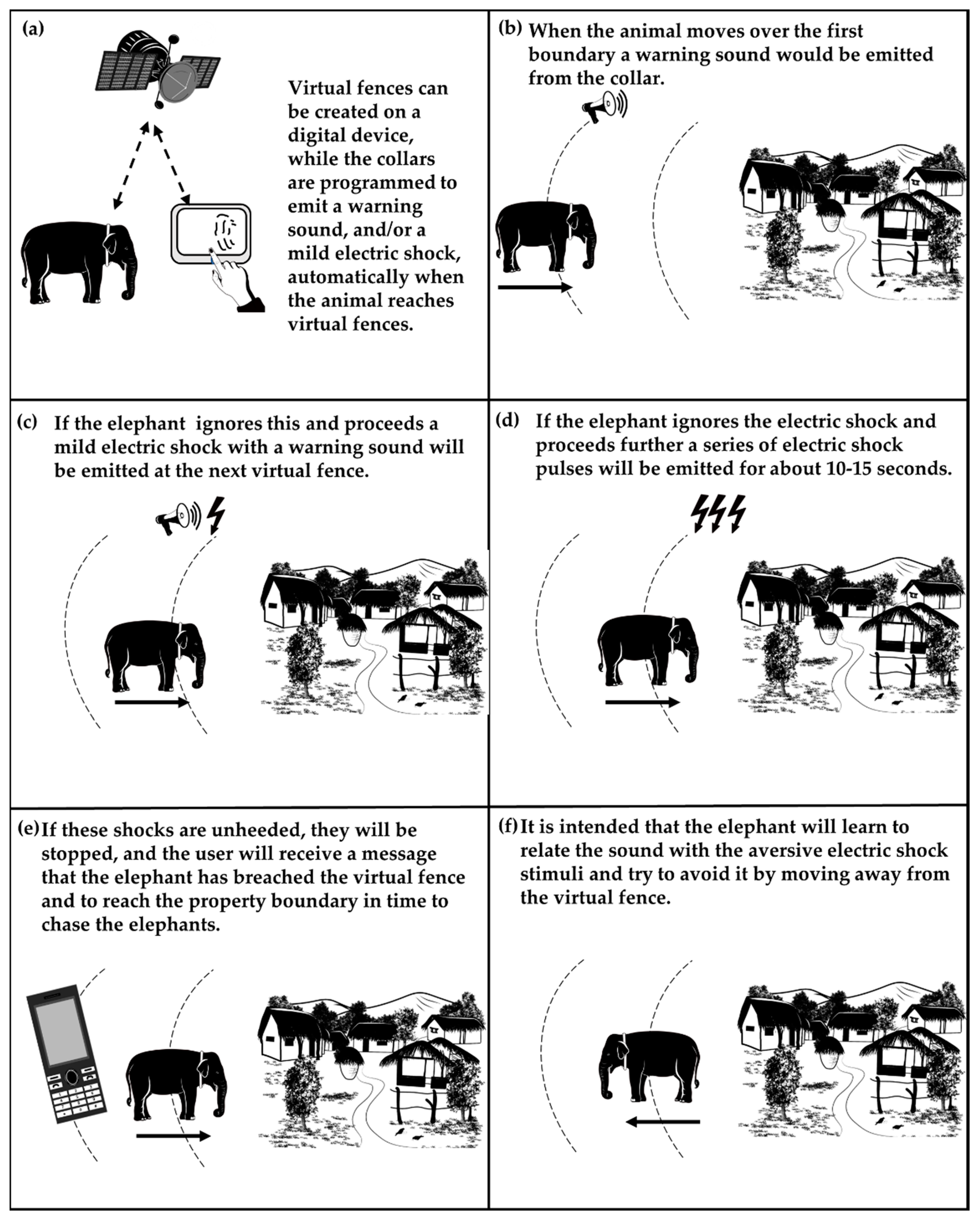
Publisher’s Note: MDPI stays neutral with regard to jurisdictional claims in published maps and institutional affiliations. |
© 2022 by the authors. Licensee MDPI, Basel, Switzerland. This article is an open access article distributed under the terms and conditions of the Creative Commons Attribution (CC BY) license (https://creativecommons.org/licenses/by/4.0/).