


Simple Summary
Citizen science offers an excellent opportunity to engage the public in scientific data collection, educational opportunities, and applied management. However, the practicalities of developing a citizen science program, from generating ideas to developing tools, implementing programming, and evaluating outcomes, are complex and challenging. To address challenges and provide a foundation for practitioners, scientists, and the public, the Government of Alberta developed a set of citizen science principles. Here, we use these principles as an evaluative framework to assess the outcomes of the GrizzTracker program, which was developed to help inform provincial species-at-risk recovery efforts. While the program experienced some successes, we identified challenges, including skepticism from the scientific community about the utility of citizen science and a lack of program leadership, staff capacity, and funding needs for long-term implementation. Reflecting on the principles, we provide policy recommendations that future citizen science programs can consider.
Abstract
Citizen science offers an excellent opportunity to engage the public in scientific data collection, educational opportunities, and applied management. However, the practicalities of developing and implementing citizen science programming are often more complex than considered. Some challenges to effective citizen science include scientists’ skepticism about the ability of public participants to rigorously collect quality data; a lack of clarity on or confidence in the utility of data; scientists’ hesitancy in engaging the public in projects; limited financial commitments; and challenges associated with the temporal and geographic scales of projects. To address these challenges, and provide a foundation upon which practitioners, scientists, and the public can credibly engage in citizen science, the Government of Alberta developed a set of citizen science principles. These principles offer a framework for planning, designing, implementing, and evaluating citizen science projects that extend beyond Alberta. Here, we present a case study using these principles to evaluate GrizzTracker, a citizen science program developed to help inform provincial species-at-risk recovery efforts. While we found that GrizzTracker applied each of the six principles in some way, including successful public engagement, strengthened relationships, and raising public awareness about northwest Alberta’s grizzly bears, we also identified a number of challenges. These included ongoing skepticism from the traditional scientific community about the utility of citizen science and governance challenges related to program leadership, staff capacity, and funding. By using the principles as a guideline, we provide policy recommendations for future citizen science efforts, including considerations for program design, implementation, and evaluation.
1. Introduction
Public participation in scientific research, also known as citizen science, has proliferated over the last two decades [1,2,3,4]. Increasingly, scholars and practitioners are recognizing the potential for citizen science to generate large-scale datasets at various spatiotemporal scales and support collaboration, relationships, and education among the public, scientists, policy-makers, and others [5,6].
Within conservation biology and environmental research, citizen science has contributed knowledge to a range of scientific, policy, and stewardship efforts. These include assessing vulnerable species [7], documenting migratory bird range shifts [8], recording urbanization effects on amphibians [9], monitoring lake water quality [10], reporting roadside animal carcasses to understand collision risks [11], integrating knowledge systems to understand freshwater mussel health [12], informing invasive marine species management [13], and reporting human–wildlife conflicts [14,15]. Through comprehensive design, including various social, political, and financial implementation supports, citizen science can both improve the public’s scientific literacy through co-learning and knowledge sharing [3,16,17] and enhance the relevancy and legitimacy of scientific research and applied management [3,18].
However, the scientific community remains reluctant to accept citizen science as a valid method of investigation, method of data generation, or approach to applied management [19,20,21,22,23]. There is a lack of understanding or appreciation by scientists of its value due, in part, to skepticism about the public’s ability to collect reliable data for applied decision-making [24,25,26]. Further, the amount of time and effort required for scientists to recruit, train, and retain volunteers [24,27,28] over the course of a research project is daunting, particularly if scientists are uncertain that they will achieve project outcomes [22,26,29]. Lastly, the rapid growth of citizen science presents a challenge, with diverse aims and applications contributing to a lack of cohesion in the field [30,31]. In this context, the lack of clear principles to guide the professional practice of citizen science adds to this hesitancy and skepticism.
To address these challenges, government and non-government agencies are developing policies and principles to clarify and guide the development, implementation, and evaluation of citizen science programming. This includes identifying appropriate roles for researchers, practitioners, and participants and appropriate applications of citizen science in conservation contexts [31,32,33]. However, there is little documentation available on how guiding principles are practically applied to citizen science programming and what effect this has on achieving outcomes [18,31]. Here, we present a practitioner’s perspective on how, and to what extent, a set of guiding principles are applied to a citizen science program in a conservation context. In the following sections, we: (1) describe the development of guiding principles for citizen science in Alberta, Canada; (2) evaluate how the principles were applied to a citizen science program developed to help inform species-at-risk recovery efforts; and (3) identify the potential for principles to guide the development, implementation, evaluation, and sustainability of future citizen science programs.
2. Citizen Science Principles of Good Practice
Recognizing the potential for citizen science to contribute to our knowledge of environmental change, the Government of Alberta’s Department of Environment and Parks (AEP), together with the non-profit research organization the Miistakis Institute, developed the Citizen Science Principles of Good Practice (hereafter Principles) [1] to guide the design and application of citizen science (Table 1). The AEP’s mandate is to support the conservation and protection of the environment, including fish and wildlife species, among other areas. The Miistakis Institute was engaged to support the AEP in the development of these Principles. The Principles were developed collaboratively with the citizen science community in Alberta. In doing so, the Principles capture the knowledge and lessons learned from citizen science researchers and practitioners across the province [34]. The Principles serve as a foundation and catalyst to elevate the practice of citizen science as a legitimate means to inform policy decisions and the application of environmental conservation for the AEP.

Table 1.
Six principles of good practice for citizen science [1].
We use the Principles post-hoc as an evaluative framework to understand the successes and challenges of the GrizzTracker program [14,35] and provide recommendations for future policy direction and citizen science programming.
3. Grizzly Bears and Citizen Science
Alberta grizzly bears (Ursus arctos) are a threatened species, with a provincial recovery plan implemented by the AEP identifying key strategies to address human-caused bear mortality and habitat loss [36]. In northwestern Alberta, an area designated Bear Management Area 1 (BMA 1; Figure 1) covers an area of approximately 40,000 km2 of the boreal forest. The area comprises extensive oil and gas developments, forestry operations, agricultural land (i.e., livestock and crops), recreational areas, and various smaller communities and rural farmsteads. A key component of recovery across this busy landscape is to engage the people living alongside bears to mitigate conflicts with them and secure habitat for future bear populations [37,38]. This includes supporting the scientific monitoring and reporting of bear observations and human interactions.
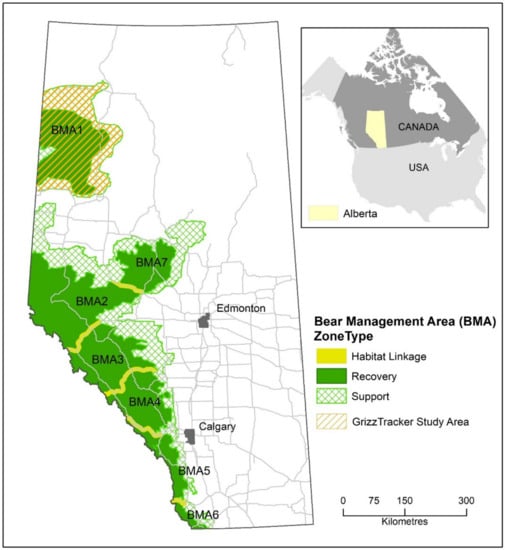
Figure 1.
Bear Management Areas (BMAs) of Alberta, with identification of BMA 1 where the GrizzTracker program was pilot tested [39].
Until recently, little was known about BMA 1’s population size and distribution [14]. However, people across BMA 1 would often report opportunistic grizzly bear sightings to government staff via phone calls, text messages, emails, or handwritten notes. These reports were often incomplete and lacked key details, including geo-referenced location, number of bears observed, bear activity, time of day, and observer effort. Recognizing the role that people can play in local bear management, AEP staff together with the Miistakis Institute worked with the Northwest Grizzly Bear Team to develop the citizen science program GrizzTracker (Figure 2) (see [14,35]).
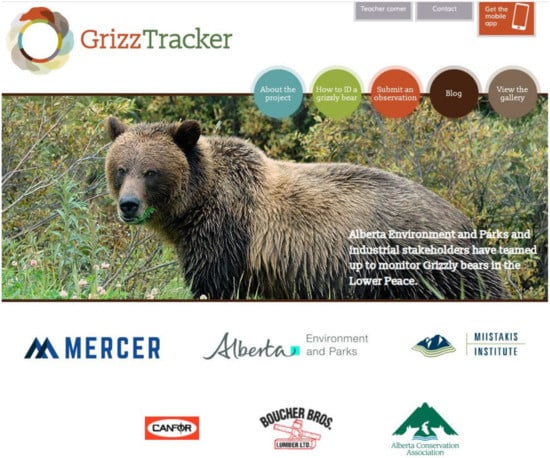
Figure 2.
GrizzTracker website landing page (grizztracker.ca, accessed on 20 December 2021).
In developing GrizzTracker, local AEP staff leading grizzly bear recovery efforts identified that not only would engaging citizens in grizzly bear science contribute much-needed data to support management, but also would also help raise awareness of the scientific methods used to study grizzly bears and show how data are used in policy decisions [40]. Further, AEP staff understood that engagement and collaboration with citizens would be an important opportunity to build open, trusting relationships and share information for the purpose of grizzly bear recovery [14,41].
Following a series of meetings amongst the Northwest Grizzly Bear Team, a unique smartphone application was developed that can record real-time grizzly bear observations on Android smartphones and iPhones using simple drop-down menus and photo uploads. The application also automatically collects anonymously geotagged locations (i.e., GPS-based points in 15-min intervals) of citizen scientists while the application is turned on and running in the background of the phone in order to measure observer effort in the field. The automatic collection of observer effort (i.e., the geographic and temporal distribution of observers across an area) is a novel feature of the smartphone application. These data are required for scientists to better understand where bears are being detected relative to where people are using the landscape, and in turn be useful in management decisions (i.e., not observing a bear in a certain area is just as important as observing a bear). Additionally, the program includes a website that provides educational materials on grizzly bear biology and ecology, scientific methods, land use management, and bear safety and conflict mitigation to help raise awareness and develop knowledge for citizen participants and broader public audiences.
4. Evaluative Framework: The Citizen Science Principles of Good Practice
To assess whether and how GrizzTracker followed the Principles, we reviewed Kelly et al.’s [18] citizen science evaluative framework and Kieslinger et al.’s [42] evaluation criteria to develop evaluative questions and indicators (Table 2) [14,43,44,45]. Then, using our expert judgment based on first-hand experiences and documentation during GrizzTracker’s development, we critically reviewed how the program performed using our criteria. Broadly, while we found that GrizzTracker applied each of the six principles in some way, including successful public engagement, strengthened relationships, and raising public awareness about northwest Alberta’s grizzly bears, we also identified a number of challenges. These included ongoing skepticism from the traditional scientific community about how useful citizen science data would be to grizzly bear recovery and persistent issues related to program leadership, staff capacity, and funding needs.
Table 2.
Evaluation framework and results.
5. Discussion
Given the rapid growth in the popularity of citizen science, a standard set of principles can help guide the development of citizen science programming, implementation, and evaluation for researchers, decision-makers, and practitioners [31]. We used the Citizen Science Principles of Good Practice as an evaluative framework to assess how the GrizzTracker program supports grizzly bear conservation. While GrizzTracker was found to broadly and conceptually adopt most of the principles, the practical application of specific principles varied.
5.1. Successes
We clearly outlined the purpose of data collection (Principle #2), which was to complement our understanding of grizzly bear movements across the landscape specific to where people were using that same landscape. In turn, this would help mitigate and reduce conflict as well as support habitat management. GrizzTracker data were not used for regulatory purposes (enforcement actions or access restrictions), and quality control and assurance methods were designed in relation to the data’s later utility (Principle #2). The smartphone application was specifically designed to enable participants to document grizzly bear observations and contribute to data quality control by documenting observer effort (Principle #2 and #5) [35]. The GrizzTracker application was developed using open-source technology and was promoted through our Northwest Grizzly Bear Team, through the networks of current participants, and via the website and social media. This demonstrated openness and transparency and promoted learning opportunities (Principle #3 and #5). As a result, the smartphone application has been shared and used by other road ecology conservation projects in Canada, e.g., [11]. Additionally, GrizzTracker provided a broad range of information and educational opportunities for participants and the public to learn about bear ecology, scientific methods, bear safety, and public policy (Principle #4 and #5). For citizen science to be successful, engagement and collaboration with multiple audiences, including intended citizen scientists, are key [46]. We also developed trust amongst the Northwest Grizzly Bear Team and citizen science participants—basing relationships on open communication and respect and sharing knowledge and expertise, supported by the program design (Principle #3 and #4). While this required numerous meetings, we ultimately developed a common understanding of the problem, needs, and process to achieve success [14]. Working together helped strengthen relationships and deepen confidence in the science team, while the team itself learned the benefits of taking a non-traditional approach to collecting data, as well as address cynicism towards citizen science. We also found that active engagement in meaningful citizen science encourages participants to recruit other citizen scientists from their social networks, thereby expanding data collection and educational opportunities (Principle #4 and #5) [40,45].
5.2. Challenges
GrizzTracker was only able to partially fulfill the Principles, including inconsistent use of the application by participants when observing bears and, importantly, when not observing bears, which reduced the effectiveness of collecting observer effort (Principles #2 and #4). We partly attribute this to how difficult grizzly bears are to see, leading to relatively rare observations, coupled with participants forgetting to turn on the application or not truly understanding the need to collect observer effort data for use in recovery planning and management. In hindsight, it may have been more beneficial for participants to record all wildlife sightings rather than just grizzly bears (i.e., broaden GrizzTracker to include other species) to encourage consistent use. We also did not allocate systematic roadway surveys to participants, given that many BMA 1 roads are used for industrial and forest harvest activities. Thus, it was not convenient nor feasible (in terms of, e.g., employee work hours and safety precautions) for the employees to travel elsewhere, and so the road network was not evenly surveyed. However, we do note that other citizen science projects report opportunistic road network observations without accounting for sampling effort [16,47].
We also found that a lack of sustainable program coordination, including staff dedicated to managing check-ins and outreach with participants, hindered our ability to effectively communicate updates (Principle #4 and #5). Steenweg et al. [35] found that GrizzTracker participants wanted more frequent updates related to their data submissions and how data was being used. The lack of financial resources to hire staff dedicated to the program, coupled with poor support from senior management for citizen science programming, contributed to communication breakdowns.
There were also limitations in recruiting a broad diversity of participants, including those from Indigenous communities and the agriculture sector (Principle #5). We note that while petroleum industry and forestry employees were keen to participate, this is likely reflective of their own company mandates and requirements to follow legislation and regulations linked to grizzly bear recovery and staff safety. However, we are not suggesting that Indigenous communities or agricultural landowners were uninterested in grizzly bears. Rather, despite our best efforts to engage these audiences (i.e., in face-to-face meetings explaining the project), they chose not to participate and thus represent a data gap. We strongly suggest that future programming accounts for targeting different audiences, which means considering the most appropriate engagement approaches, considering the complexity of values and preferences for how people want to engage in wildlife conservation and management, as well as taking the time to build open communication lines and strong relationships. We suggest that this could be more effective at developing relevant and meaningful citizen science approaches and tools tailored to the needs of the public and scientists (see, e.g., [37,38]).
That said, we do note that this limitation is particularly important to resolve amongst Indigenous communities. Indigenous peoples may be reluctant to engage in scientific activities given the history of colonialism and extractive research practices that have resulted in significant harms [48,49]. Certainly, citizen science initiatives must seek constructive ways to engage Indigenous communities “not just as actors carrying out information tasks or data collectors or as stakeholders defining research questions but, rather, as legitimate knowledge holders, respecting that their knowledge originates from different knowledge systems” [50] (p. 507). Further, we suggest that the lack of participation from certain groups in developing and using GrizzTracker reflects a hidden power dynamic. This suggests to us that reflection is required on engagement processes—who is inviting whom to the table, who shows up and why, and whose voices are heard [38]. Indeed, our evaluation suggests that it is naive to expect that ‘engagement’ in citizen science is as simple as an open invitation for people to participate.
Lastly, we found that the persistent hesitancy for some participants in using the GrizzTracker application was based on concerns of ensuring confidentiality and anonymity in their data submissions (Principle #5). This was despite our attempts to alleviate such concerns by clarifying who has data access and securing their privacy. In part, this may be an artefact of broader trust issues the public has in government or technology and the purposes for which their data will be used.
5.3. Recommendations
Our evaluation revealed that GrizzTracker was founded on a collaborative engagement process that attempted to account for diversity, inclusivity, and trust-building across participants as well as develop technically and technologically appropriate tools while considering the constraints of program sustainability. The GrizzTracker program is still operating and accessible to the public; however, there is currently no dedicated staff or funding to manage the program.
We suggest that, in order to ensure the success of GrizzTracker, clear policy direction be given. Assurances on data collection and quality, data ownership and sharing, and access to results at the local level require a legal and organizational framework [51,52,53]. Several guiding principles currently exist on different aspects of citizen science that may be useful to consider [34], in addition to the Principles we offer here.
There also needs to be investment in the coordination and leadership of citizen science programming at all levels, including addressing skepticism among scientists, developing meaningful engagement processes, and removing barriers to volunteer recruitment and engagement [54]. In particular, developing meaningful engagement processes that include open, two-way communication lines and feedback opportunities can help build more respectful and trusting relationships between citizen scientists, governments, and researchers [55]. Lastly, citizen science requires investment in program evaluation in order to ensure that challenges, lessons learned, and successes are recognized and recorded to improve future applications [42].
While we acknowledge that it is not easy to develop a citizen science program that balances the social, cultural, financial, and, in our case, conservation management needs, i.e., there is no ‘silver bullet’ to fix every problem [31], following clear principles like the Citizen Science Principles of Good Practice can help mitigate or avoid some challenges. Overall, we suggest that the value of citizen science must be more clearly articulated to scientists, organizations (whether government or otherwise), and public participants in order to help ensure that programs continue to be developed in ways that are sustainable, relevant, and supported. We hope that this will lead to the formal recognition of how beneficial community engagement in scientific data collection can be for conservation decisions and applied management.
6. Conclusions
Our paper described the development of the Citizen Science Principles of Good Practice for Alberta, Canada and our evaluation of a citizen science program called GrizzTracker. While GrizzTracker experienced much success relative to the program design and targeted engagement, our evaluation revealed some persistent challenges. Notably, we found a reluctance on the part of the scientific community to accept citizen science as well as skepticism from the public about participating in such a program. Both hindered the effectiveness of GrizzTracker. We also found that the amount of time and effort required to operate a program of this scale, including recruiting, training, and retaining volunteers, highlights the need for dedicated financial investment, staff, and decision-making leadership and targeted engagement of various audiences. Finally, we found that the lack of cohesion when designing, implementing, and evaluating the citizen science program reinforced the need for guidelines such as the Principles presented here. It is our hope that the Principles, evaluative framework, and lessons we learned will be useful in guiding future citizen science endeavors.
Author Contributions
C.H., K.T., T.S.L., J.K., and D.D. were all involved in the conceptualization, writing, and reviewing of this paper. All authors have read and agreed to the published version of the manuscript.
Funding
This research received no external funding; however, the original development and implementation of the GrizzTracker program, which made this evaluation possible, was supported by a Forest Resources Improvement Association of Alberta grant (FRIAA-FFI-16-007), an Alberta Conservation Association grant (030-00-90-280), annual funding from Mercer Peace River Pulp Ltd., and Government of Alberta contributions.
Acknowledgments
We would like to thank the Northwest Grizzly Bear Team for their contributions and collaboration. We would also like to thank Alberta Environment and Parks for their contribution that enabled us to complete the manuscript.
Conflicts of Interest
The authors declare no conflict of interest. The sponsors had no role in the design, execution, interpretation, or writing of this paper.
References
- Government of Alberta, Ministry of Environment and Parks. Citizen Science Principles of Good Practice; Government of Alberta: Edmonton, AB, Canada, 2020; p. 10. Available online: https://open.alberta.ca/publications/9781460146514 (accessed on 20 March 2022).
- Follett, R.; Strezov, V. An analysis of citizen science based research: Usage and publication patterns. PLoS ONE 2015, 10, e0143687. [Google Scholar] [CrossRef] [PubMed] [Green Version]
- Hecker, S.; Garbe, L.; Bonn, A. The European Citizen Science Landscape—A snapshot. In Citizen Science: Innovation in Open Science, Society and Policy; Hecker, S., Bonn, A., Haklay, M., Bowser, A., Makuch, Z., Vogel, J., Eds.; University College London (UCL) Press: London, UK, 2018; pp. 190–200. ISBN 9781787352353. [Google Scholar]
- Kullenberg, C.; Kasperowski, D. What is citizen science?—A scientometric meta-analysis. PLoS ONE 2016, 11, e0147152. [Google Scholar] [CrossRef] [PubMed] [Green Version]
- Bandy, J. A Word on Nomenclature. Available online: https://cft.vanderbilt.edu//cft/guides-sub-pages/a-word-on-nomenclature/ (accessed on 20 March 2022).
- Bonney, R.; Byrd, J.; Carmichael, J.T.; Cunningham, L.; Oremland, L.; Shirk, J.; Harten, A. Von. Sea change: Using citizen science to inform fisheries management. Bioscience 2021, 71, 519–530. [Google Scholar] [CrossRef]
- Westgate, M.J. Citizen science program shows urban areas have lower occurrence of frog species, but not accelerated declines. PLoS ONE 2015, 10, e0140973. [Google Scholar] [CrossRef] [PubMed] [Green Version]
- Wilson, S.; Anderson, E.M.; Wilson, A.; Bertram, D.F.; Arcese, P. Citizen science reveals an extensive shift in the winter distribution of migratory western grebes. PLoS ONE 2013, 8, 65408. [Google Scholar] [CrossRef] [Green Version]
- Lee, T.S.; Rondeau, K.; Schaufele, R.; Clevenger, A.P.; Duke, D. Developing a correction factor to apply to animal–Vehicle collision data for improved road mitigation measures. Wildl. Res. 2021, 48, 501–510. [Google Scholar] [CrossRef]
- Sinn, C.; Peter, B. LakeWatch: The Alberta Lake Management Society Volunter Lake Monitoring Program Summary Report 2021; The Alberta Lake Management Society (ALMS): Edmonton, AB, Canada, 2021; Available online: https://alms.ca/wp-content/uploads/2021/04/LakeWatch_Summary_2020_20210429.pdf (accessed on 20 March 2022).
- Lee, T.S.; Sulimov, S.; Sanderson, K. Pronghorn Xing: Improving Pronghorn Migration through Road Improvements; Mount Royal University: Calgary, AB, Canada, 2021; Available online: https://www.rockies.ca/files/reports/Pronghorn%20Xing_Final_Reporting_October%202021.pdf (accessed on 20 March 2022).
- Hopkins, D.; Joly, T.L.; Sykes, H.; Waniandy, A.; Grant, J.; Gallagher, L.; Hansen, L.; Wall, K.; Fortna, P.; Bailey, M. “Learning together”: Braiding indigenous and western knowledge systems to understand freshwater mussel health in the lower athabasca region of Alberta, Canada. J. Ethnobiol. 2019, 39, 315–336. [Google Scholar] [CrossRef]
- Delaney, D.G.; Sperling, C.D.; Adams, C.S.; Leung, B. Marine invasive species: Validation of citizen science and implications for national monitoring networks. Biol. Invasions 2008, 10, 117–128. [Google Scholar] [CrossRef]
- Hughes, C.; Steenweg, R.J.; Vander Vennen, L.M.; Melnycky, N.A.; Fullerton, L.; Witiw, J.T.; Morehouse, A. Working together for Grizzly Bears: A collaborative approach to estimate population abundance in Northwest Alberta, Canada. Front. Conserv. Sci. 2021, 2, 64. [Google Scholar] [CrossRef]
- Lee, T.; Quinn, M.; Duke, D. Citizen, science, highways, and wildlife: Using a web-based GIS to engage citizens in collecting wildlife information. Ecol. Soc. 2006, 11, 11. Available online: http://www.ecologyandsociety.org/vol11/iss1/art11/ (accessed on 20 March 2022). [CrossRef] [Green Version]
- Turrini, T.; Dörler, D.; Richter, A.; Heigl, F.; Bonn, A. The threefold potential of environmental citizen science—Generating knowledge, creating learning opportunities and enabling civic participation. Biol. Conserv. 2018, 225, 176–186. [Google Scholar] [CrossRef]
- Walker, D.W.; Smigaj, M.; Tani, M. The benefits and negative impacts of citizen science applications to water as experienced by participants and communities. WIREs Water 2020, 8, e1488. [Google Scholar] [CrossRef]
- Kelly, R.; Fleming, A.; Pecl, G.T.; von Gönner, J.; Bonn, A. Citizen science and marine conservation: A global review. Philos. Trans. R. Soc. B Biol. Sci. 2020, 375, 20190461. [Google Scholar] [CrossRef] [PubMed]
- Bonney, R.; Shirk, J.L.; Phillips, T.B.; Wiggins, A.; Ballard, H.L.; Miller-rushing, A.J.; Parrish, J.K. Next steps for citizen science. Science 2014, 343, 1436–1437. [Google Scholar] [CrossRef] [PubMed]
- Danielsen, F.; Enghoff, M.; Magnussen, E.; Mustonen, T.; Degteva, A.; Hansen, K.K.; Levermann, N.; Mathiesen, S.D.; Slettemark, Ø. Citizen science tools for engaging local stakeholders and promoting local and traditional knowledge in landscape stewardship. In The Science and Practice of Landscape Stewardship; Bieling, C., Plieninger, T., Eds.; Cambridge University Press: Cambridge, UK, 2017; pp. 80–98. [Google Scholar] [CrossRef] [Green Version]
- Hecker, S.; Wicke, N.; Haklay, M.; Bonn, A. How does policy conceptualise citizen science? A qualitative content analysis of international policy documents. Citiz. Sci. Theory Pract. 2019, 4, 32. [Google Scholar] [CrossRef] [Green Version]
- MacPhail, V.J.; Colla, S.R. Power of the People: A review of citizen science programs for conservation. Biol. Conserv. 2020, 249, 108739. [Google Scholar] [CrossRef]
- Riesch, H.; Potter, C. Citizen science as seen by scientists: Methodological, epistemological and ethical dimensions. Public Underst. Sci. 2013, 23, 107–120. [Google Scholar] [CrossRef]
- Burgess, H.K.; DeBey, L.B.; Froehlich, H.E.; Schmidt, N.; Theobald, E.J.; Ettinger, A.K.; HilleRisLambers, J.; Tewksbury, J.; Parrish, J.K. The science of citizen science: Exploring barriers to use as a primary research tool. Biol. Conserv. 2017, 208, 113–120. [Google Scholar] [CrossRef] [Green Version]
- Conrad, C.C.; Hilchey, K.G. A review of citizen science and community-based environmental monitoring: Issues and opportunities. Environ. Monit. Assess. 2011, 176, 273–291. [Google Scholar] [CrossRef]
- Lee, T.; Duke, D.; Haddock, R. Using Citizen Science to Advance Environmental Research and Monitoring in Alberta; Document prepared for Environmental Monitoring and Science Division, Alberta Environment and Parks; Miistakis Institute: Calgary, AB, Canada, 2016; (revised 2017); Available online: https://www.rockies.ca/files/reports/Revised_CitizenScienceReport_June%2023%202017.pdf (accessed on 20 March 2022).
- Land-Zandstra, A.; Agnello, G.; Gültekin, Y.S. Participants in Citizen Science. In The Science of Citizen Science; Vohland, K., Land-Zandstra, A., Ceccaroni, L., Lemmens, R., Perelló, J., Ponti, M., Samson, R., Wagenknecht, K., Eds.; Springer International Publishing: Cham, Switzerland, 2021; pp. 243–259. ISBN 978-3-030-58278-4. [Google Scholar]
- Silvertown, J.; Buesching, C.D.; Jacobson, S.K.; Rebelo, T. Citizen science and nature conservation. Key Top. Conserv. Biol. 2013, 2, 127–142. [Google Scholar] [CrossRef]
- Eicken, H.; Danielsen, F.; Sam, J.-M.; Fidel, M.; Johnson, N.; Poulsen, M.K.; Lee, O.A.; Spellman, A.V.; Iversen, L.; Pulsifer, P.; et al. Special section on community-based monitoring connecting top-down and bottom-up approaches in environmental observing. Bioscience 2021, 71, 467–483. [Google Scholar] [CrossRef] [PubMed]
- Eitzel, M.V.; Cappadonna, J.L.; Santos-Lang, C.; Duerr, R.E.; Virapongse, A.; West, S.E.; Kyba, C.C.M.; Bowser, A.; Cooper, C.B.; Sforzi, A.; et al. Citizen Science terminology matters: Exploring key terms. Citiz. Sci. Theory Pract. 2017, 2, 1. [Google Scholar] [CrossRef] [Green Version]
- Robinson, L.; Cawthray, J.L.; West, S.E.; Bonn, A.; Ansine, J. 10 Principles of citizen science. In Citizen Science: Innovation in Open Science, Society and Policy; Bonn, A., Hecker, S., Haklay, M., Bowser, A., Makuch, Z., Vogel, J., Eds.; University College London (UCL) Press: London, UK, 2018; pp. 27–40. ISBN 9781787352353. [Google Scholar]
- Holdren, J. Addressing Societal and Scientific Challenges through Citizen Science and Crowdsourcing [Memorandum]; Executive Office of the President, Office of Science and Technology Policy: Washington, DC, USA, 2015. Available online: https://obamawhitehouse.archives.gov/sites/default/files/microsites/ostp/holdren_citizen_science_memo_092915_0.pdf (accessed on 16 March 2022).
- Pocock, M.J.O.; Chapman, D.S.; Sheppard, L.J.; Roy, H.E. A Strategic Framework to Support the Implementation of Citizen Science for Environmental Monitoring; Final Report to SEPA; Centre for Ecology & Hydrology, Wallingford: Oxfordshire, UK, 2014; p. 65. Available online: http://nora.nerc.ac.uk/id/eprint/510645/ (accessed on 20 March 2022).
- García, F.S.; Pelacho, M.; Woods, T.; Fraisl, D.; See, L.; Haklay, M.(M.); Arias, R. Finding what you need: A guide to citizen science guidelines. In The Science of Citizen Science; Vohland, K., Land-Zandstra, A., Ceccaroni, L., Lemmens, R., Perelló, J., Ponti, M., Samson, R., Wagenknecht, K., Eds.; Springer International Publishing: Cham, Switzerland, 2021; pp. 419–437. ISBN 978-3-030-58278-4. [Google Scholar]
- Steenweg, R.J.; Lee, T.; Hughes, C. GrizzTracker: Using citizen science to advance grizzly bear conservation. Facets 2022. submitted for publication. [Google Scholar]
- Alberta Environment and Parks. Alberta Grizzly Bear (Ursus Arctos) Recovery Plan. Alberta Species at Risk Recovery Plan No. 37; Government of Alberta: Edmonton, AB, Canada, 2020; p. 30. [Google Scholar]
- Hughes, C.; Nielsen, S.E. ‘Bear are only the lightning rod’: Ongoing acrimony in Alberta’s Grizzly Bear recovery. Soc. Nat. Resour. 2019, 32, 34–52. [Google Scholar] [CrossRef]
- Hughes, C.; Yarmey, N.; Morehouse, A.; Nielsen, S. Problem perspectives and grizzly bears: A case study of alberta’s grizzly bear recovery policy. Front. Ecol. Evol. 2020, 38, 1–10. [Google Scholar] [CrossRef] [Green Version]
- Government of Alberta, Ministry of Environment and Parks. Alberta Grizzly Bear Recovery Plan; Government of Alberta, Ministry of Environment and Parks: Edmonton, AB, Canada, 2021; p. 83. Available online: https://open.alberta.ca/dataset/5bc2f11a-7360-48fe-a768-73127d24f039/resource/0f4abf49-9bdd-42a8-892f-a74f1a143770/download/aep-alberta-grizzly-bear-recovery-2020.pdf (accessed on 15 October 2021).
- Cosquer, A.; Raymond, R.; Prevot-Julliard, A.C. Observations of everyday biodiversity: A new perspective for conservation? Ecol. Soc. 2012, 17, 1–15. [Google Scholar] [CrossRef] [Green Version]
- Sullivan, B.L.; Aycrigg, J.L.; Barry, J.H.; Bonney, R.E.; Bruns, N.; Cooper, C.B.; Damoulas, T.; Dhondt, A.A.; Dietterich, T.; Farnsworth, A.; et al. The EBird enterprise: An integrated approach to development and application of citizen science. Biol. Conserv. 2014, 169, 31–40. [Google Scholar] [CrossRef]
- Kieslinger, B.; Schäfer, T.; Heigl, F.; Dörler, D.; Richter, A.; Bonn, A. Evaluating citizen science. In Citizen Science: Innovation in Open Science, Society and Policy; Bonn, A., Hecker, S., Haklay, M., Bowser, A., Makuch, Z., Vogel, J., Eds.; Univesity College London (UCL) Press: London UK, 2018; pp. 81–96. ISBN 9781787352353. [Google Scholar]
- Margoluis, R.; Stem, C.; Salafsky, N.; Brown, M. Using conceptual models as a planning and evaluation tool in conservation. Eval. Program Plann. 2009, 32, 138–147. [Google Scholar] [CrossRef]
- Morehouse, A.T.; Hughes, C.; Manners, N.; Bectell, J.; Bruder, T. Carnivores and communities: A case study of human-carnivore conflict mitigation in southwestern Alberta. Front. Ecol. Evol. 2020, 2, 1–15. [Google Scholar] [CrossRef] [Green Version]
- Sibanda, L.; van der Meer, E.; Johnson, P.J.; Hughes, C.; Dlodlo, B.; Parry, R.H.; Mathe, L.J.; Hunt, J.E.; Macdonald, D.W.; Loveridge, A.J. Evaluating the effects of a conservation intervention on rural farmers’ attitudes toward lions. Hum. Dimens. Wildl. 2021, 26, 445–460. [Google Scholar] [CrossRef]
- McKinley, D.C.; Miller-Rushing, A.J.; Ballard, H.L.; Bonney, R.; Brown, H.; Cook-Patton, S.C.; Evans, D.M.; French, R.A.; Parrish, J.K.; Phillips, T.B.; et al. Citizen science can improve conservation science, natural resource management, and environmental protection. Biol. Conserv. 2017, 208, 15–28. [Google Scholar] [CrossRef] [Green Version]
- Olson, D.D.; Bissonette, J.A.; Cramer, P.C.; Green, A.D.; Davis, S.T.; Jackson, P.J.; Coster, D.C. Monitoring wildlife-vehicle collisions in the information age: How smartphones can improve data collection. PLoS ONE 2014, 9, e98613. [Google Scholar] [CrossRef] [PubMed] [Green Version]
- Castleden, H.; Morgan, V.S.; Lamb, C. “I spent the first year drinking tea”: Exploring canadian university researchers’ perspectives on community-based participatory research involving indigenous peoples. Can. Geogr. Géographe Can. 2012, 56, 160–179. [Google Scholar] [CrossRef]
- Wong, C.; Ballegooyen, K.; Ignace, L.; Johnson, M.J. (Gùdia); Swanson, H. Towards reconciliation: 10 calls to action to natural scientists working in Canada. Facets 2020, 5, 769–783. [Google Scholar] [CrossRef]
- Tengö, M.; Austin, B.J.; Danielsen, F.; Fernández-Llamazares, Á. Creating synergies between citizen science and indigenous and local knowledge. Bioscience 2021, 71, 503–518. [Google Scholar] [CrossRef]
- Dickinson, J.L.; Zuckerberg, B.; Bonter, D.N. Citizen science as an ecological research tool: Challenges and benefits. Annu. Rev. Ecol. Evol. Syst. 2010, 41, 149–172. [Google Scholar] [CrossRef] [Green Version]
- Dickinson, J.L.; Shirk, J.; Bonter, D.; Bonney, R.; Crain, R.L.; Martin, J.; Phillips, T.; Purcell, K. The current state of citizen science as a tool for ecological research and public engagement. Front. Ecol. Environ. 2012, 10, 291–297. [Google Scholar] [CrossRef] [Green Version]
- Tulloch, A.I.T.T.; Possingham, H.P.; Joseph, L.N.; Szabo, J.; Martin, T.G. Realising the full potential of citizen science monitoring programs. Biol. Conserv. 2013, 165, 128–138. [Google Scholar] [CrossRef] [Green Version]
- Haklay, M. Citizen Science and Policy: A European Perspective by Muki Haklay; Woodrow Wilson International Center for Scholars: Washington, DC, USA, 2015; Available online: https://www.wilsoncenter.org/sites/default/files/media/documents/publication/Citizen_Science_Policy_European_Perspective_Haklay.pdf (accessed on 20 March 2022).
- Gilfedder, M.; Robinson, C.J.; Watson, J.E.M.; Campbell, T.G.; Sullivan, B.L.; Possingham, H.P. Brokering trust in citizen science. Soc. Nat. Resour. 2019, 32, 292–302. [Google Scholar] [CrossRef]
Publisher’s Note: MDPI stays neutral with regard to jurisdictional claims in published maps and institutional affiliations. |
© 2022 by the authors. Licensee MDPI, Basel, Switzerland. This article is an open access article distributed under the terms and conditions of the Creative Commons Attribution (CC BY) license (https://creativecommons.org/licenses/by/4.0/).