Skip Content
You are currently on the new version of our website. Access the old version .

Animals, Volume 8, Issue 1

2018 January - 15 articles

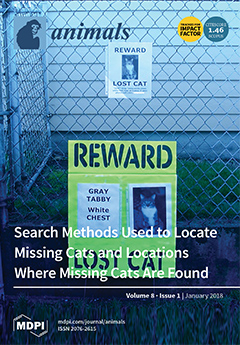
Cover Story: Every year, millions of pet cats go missing from their homes, and many are never found by their owners. Pet loss results in grief and lack of closure for the owner, and a drain on shelter and community resources. According to an article published in this journal, knowledge of the missing cat’s outside experience and use of effective search techniques can increase the owner’s chances of a successful recovery. “The most effective way to find a missing cat is to conduct a thorough physical search close to home within seven days” says Dr. Marcia Coradini, from the University of Queensland. “The majority of cats were found within 500 meters of their home, and very few were found in a shelter.” The data from this international study will be useful for animal care and welfare professionals when advising owners about lost cats, and for shelter policies involving unidentified cats. View this paper
  • Issues are regarded as officially published after their release is announced to the table of contents alert mailing list .
  • You may sign up for email alerts to receive table of contents of newly released issues.
  • PDF is the official format for papers published in both, html and pdf forms. To view the papers in pdf format, click on the "PDF Full-text" link, and use the free Adobe Reader to open them.

Articles (15)

  • Article
  • Open Access
88 Citations
31,537 Views
22 Pages

Speaking Up: Veterinary Ethical Responsibilities and Animal Welfare Issues in Everyday Practice

  • Elein Hernandez,
  • Anne Fawcett,
  • Emily Brouwer,
  • Jeff Rau and
  • Patricia V. Turner

22 January 2018

Although expectations for appropriate animal care are present in most developed countries, significant animal welfare challenges continue to be seen on a regular basis in all areas of veterinary practice. Veterinary ethics is a relatively new area of...

  • Article
  • Open Access
44 Citations
27,185 Views
15 Pages

18 January 2018

The use of trap-neuter-return (TNR) as a method of managing free-roaming cat populations has increased in the United States in recent decades. Historically, TNR has been conducted most often at a grassroots level, which has led to inconsistent data c...

  • Feature Paper
  • Article
  • Open Access
24 Citations
6,505 Views
13 Pages

Understanding Tail-Biting in Pigs through Social Network Analysis

  • Yuzhi Li,
  • Haifeng Zhang,
  • Lee J. Johnston and
  • Wayne Martin

15 January 2018

The objective of this study was to investigate the association between social structure and incidence of tail-biting in pigs. Pigs (n = 144, initial weight = 7.2 ± 1.57 kg, 4 weeks of age) were grouped based on their litter origin: littermates, non-l...

  • Article
  • Open Access
16 Citations
5,866 Views
11 Pages

Depopulation of Caged Layer Hens with a Compressed Air Foam System

  • Shailesh Gurung,
  • John Hoffman,
  • Kendre Stringfellow,
  • Daad Abi-Ghanem,
  • Dan Zhao,
  • David Caldwell,
  • Jason Lee,
  • Darrel Styles,
  • Luc Berghman and
  • Morgan Farnell
  • + 3 authors

11 January 2018

During the 2014–2015 US highly pathogenic avian influenza (HPAI) outbreak, 50.4 million commercial layers and turkeys were affected, resulting in economic losses of $3.3 billion. Rapid depopulation of infected poultry is vital to contain and eradicat...

  • Article
  • Open Access
81 Citations
9,295 Views
16 Pages

Predicting Lameness in Sheep Activity Using Tri-Axial Acceleration Signals

  • Jamie Barwick,
  • David Lamb,
  • Robin Dobos,
  • Derek Schneider,
  • Mitchell Welch and
  • Mark Trotter

11 January 2018

Lameness is a clinical symptom associated with a number of sheep diseases around the world, having adverse effects on weight gain, fertility, and lamb birth weight, and increasing the risk of secondary diseases. Current methods to identify lame anima...

  • Feature Paper
  • Article
  • Open Access
15 Citations
6,451 Views
15 Pages

On Farm Evaluation of a Novel Mechanical Cervical Dislocation Device for Poultry

  • Jessica E. Martin,
  • Victoria Sandilands,
  • Julian Sparrey,
  • Laurence Baker and
  • Dorothy E. F. McKeegan

10 January 2018

Urgent development of alternative on-farm killing methods for poultry is required following the number restrictions placed on the use of traditional manual cervical dislocation by European Legislation (EU 1099/2009). Alternatives must be proven to be...

  • Article
  • Open Access
32 Citations
5,243 Views
13 Pages

Using Longitudinal Assessment on Extensively Managed Ewes to Quantify Welfare Compromise and Risks

  • Carolina Munoz,
  • Angus Campbell,
  • Stuart Barber,
  • Paul Hemsworth and
  • Rebecca Doyle

8 January 2018

This study examined variation in the welfare of extensively managed ewes and potential welfare risks. A total of 100 Merino ewes (aged 2–4 years) were individually identified and examined at three key stages: pregnancy, lactation and weaning. Eight a...

  • Article
  • Open Access
16 Citations
6,374 Views
14 Pages

An Indication of Reliability of the Two-Level Approach of the AWIN Welfare Assessment Protocol for Horses

  • Irena Czycholl,
  • Kathrin Büttner,
  • Philipp Klingbeil and
  • Joachim Krieter

5 January 2018

To enhance feasibility, the Animal Welfare Indicators (AWIN) assessment protocol for horses consists of two levels: the first is a visual inspection of a sample of horses performed from a distance, the second a close-up inspection of all horses. The...

  • Article
  • Open Access
12 Citations
7,752 Views
13 Pages

Carbon Dioxide and Nitrogen Infused Compressed Air Foam for Depopulation of Caged Laying Hens

  • Shailesh Gurung,
  • Dima White,
  • Gregory Archer,
  • Darrel Styles,
  • Dan Zhao,
  • Yuhua Farnell,
  • James Byrd and
  • Morgan Farnell

3 January 2018

Depopulation of infected poultry flocks is a key strategy to control and contain reportable diseases. Water-based foam, carbon dioxide inhalation, and ventilation shutdown are depopulation methods available to the poultry industry. Unfortunately, the...

  • Article
  • Open Access
53 Citations
10,910 Views
16 Pages

Private Animal Welfare Standards—Opportunities and Risks

  • Frida Lundmark,
  • Charlotte Berg and
  • Helena Röcklinsberg

2 January 2018

The current shift moves the governance of animal welfare away from the government towards the private market and the consumers. We have studied the intentions, content, and on-farm inspection results from different sets of animal welfare legislation...

  • Article
  • Open Access
21 Citations
42,504 Views
20 Pages

Search Methods Used to Locate Missing Cats and Locations Where Missing Cats Are Found

  • Liyan Huang,
  • Marcia Coradini,
  • Jacquie Rand,
  • John Morton,
  • Kat Albrecht,
  • Brigid Wasson and
  • Danielle Robertson

2 January 2018

Missing pet cats are often not found by their owners, with many being euthanized at shelters. This study aimed to describe times that lost cats were missing for, search methods associated with their recovery, locations where found and distances trave...

  • Article
  • Open Access
14 Citations
8,518 Views
17 Pages

25 December 2017

Approximately 50% of cats admitted to Australian shelters are kittens, and 26% of dogs are puppies, and, particularly for cats, euthanasia rates are often high. Cats can be pregnant by 4 months of age, yet the traditional desexing age is 5–6 months,...

  • Article
  • Open Access
41 Citations
6,132 Views
16 Pages

Animal-Based Measures to Assess the Welfare of Extensively Managed Ewes

  • Carolina Munoz,
  • Angus Campbell,
  • Paul Hemsworth and
  • Rebecca Doyle

24 December 2017

The reliability and feasibility of 10 animal-based measures of ewe welfare were examined for use in extensive sheep production systems. Measures were: Body condition score (BCS), rumen fill, fleece cleanliness, fleece condition, skin lesions, tail le...

  • Article
  • Open Access
44 Citations
8,788 Views
11 Pages

Impact of Daily Grazing Time on Dairy Cow Welfare—Results of the Welfare Quality® Protocol

  • Kathrin Wagner,
  • Jan Brinkmann,
  • Solveig March,
  • Peter Hinterstoißer,
  • Sylvia Warnecke,
  • Maximilian Schüler and
  • Hans Marten Paulsen

22 December 2017

Grazing provides livestock better opportunities to act out their species-specific behavior compared to restrictive stable conditions. The aim of the present study was to examine the effects of daily grazing time on welfare of dairy cows in organic an...

Get Alerted

Add your email address to receive forthcoming issues of this journal.

XFacebookLinkedIn
Animals - ISSN 2076-2615