
Skip to Content
Applied SciencesApplied Sciences
  • Article
  • Open Access

14 October 2022

An Abstract Summarization Method Combining Global Topics

,
,
,
and
College of Computer Science and Engineering Chongqing, Chongqing University of Technology, Chongqing 400050, China
*
Author to whom correspondence should be addressed.
This article belongs to the Special Issue Multi-Modal Deep Learning and Its Applications

Abstract

Existing abstractive summarization methods only focus on the correlation between the original words and the summary words, ignoring the topics’ influence on the summaries. To this end, an abstract summarization method combining global topic information, ACGT, is proposed. A topic information extractor, based on Latent Dirichlet Allocation, is constructed to extract key topic information from the original text, and an attention module is built to fuse key topic information with the original text representation. The summary is then generated by combining a pointer generation network and coverage mechanism. With evaluation metrics of ROUGE-1, ROUGE-2, and ROUGE-L, the experimental results of ACGT in the English dataset CNN/Daily Mail are 0.96%, 2.44%, and 1.03% higher than the baseline model, respectively. In the Chinese dataset, LCSTS, ACGT shows a higher performance than the baseline method by 1.19%, 1.03%, and 0.85%, respectively. Our results demonstrate that the performance of summaries is significantly correlated with the number of topics that are introduced. Case studies show that the introduction of topic information can improve both the coverage of original text topics and the fluency of summaries.

1. Introduction

Automatic summarization [1] technology is a technique that uses computers to understand and analyze text in order to generate concise summaries covering topics of the original text. It is an important research direction in Natural Language Processing (NLP), and also a pre-task for many downstream applications, such as automated question and answer systems [2] and news headline generation [3].
Existing automatic summarization methods can be divided into two main categories: extractive and abstractive. Extractive methods constitute a summary by extracting important text units from the original text. The abstractive method is more similar to manual summarization methods. It restates the original text via techniques such as synonymous substitution and sentence abbreviation, thus resulting in summaries that mostly contain words or phrases other than the original text, and also with better fluency than summaries produced by extractive methods.
The Sequence to Sequence [4] (Seq2Seq) summary generation framework incorporating deep neural networks has been widely studied in recent years. Moreover, the Seq2Seq method with an attention mechanism [5] purposefully addresses the problem of gradient disappearance caused by excessively long sentences, thus improving the performance of generated summaries.
The performance of summary generation can also be affected by out-of-vocabulary (OOV) and redundant words. To this end, See et al. [6] proposed a pointer generator network. The method suggests copying words from the original text or generating new words from a fixed vocabulary, and uses a coverage mechanism to alleviate the word redundancy problem, thus improving the performance of summary generation.
In general, the Seq2Seq framework combined with an attention mechanism provides the basis for studies of automatic summaries. However, existing approaches consider summary generation as a translation process from the original text to the summary; moreover, most of the attention mechanism is built between characters of the original text and the summary characters, with less research from the perspective of the topics of the original text. In terms of evaluation metrics of automated summaries, ROUGE [7], which is widely used, is a recall-based evaluation metric. It evaluates the n-tuple contribution statistics of the generated summary and the reference summary, without evaluating the topic consistency between the summary and original text, which may result in topics of the summaries deviating from the original text despite high ROUGE scores.
We argue that the process of manually writing summaries is to read and understand the full text to find the words and phrases that are most relevant to the original topic, and then write a summary that matches the original topic. Therefore, we propose an Abstract Summarization method Combining Global Topics (ACGT) to improve the performance of the summary by constructing a global topic information extractor and an attention module that combines topic information. Our main achievements in this paper are as follows:
  • We propose a summary generation method incorporating global topic information, model the topic of the document, and update the document representation by fusing the topic information of the text with word embeddings through the information fusion module.
  • We propose the nTmG (n-TOPIC-m-GRAM) method to extract the key topic information in the original text. The essential method is used to avoid the noise caused by the introduction of the topic.
  • Empirical studies show that the proposed method demonstrates a more advanced performance than baseline methods. It also shows that the number of incorporated topics is tightly correlated with the performance of generating summaries, which provides empirical evidence for subsequent automatic summary studies combining topics.

3. Motivation

The purpose of the summary is to generate a short overview text that clarifies the important points of the article. The summary should cover the global topic information of the original text. The global topic information mentioned in this paper refers to the part of the document topics that have an important impact on summary generation. The relationship between global topic information and a summary is analyzed below.
In 2003, B lei et al. [22] proposed the LDA, which provides a method for discovering the underlying topics of documents. In recent years, LDA has been introduced into automatic summarization tasks by many researchers, and has achieved advanced results [28,29]. LDA is also the basis for our proposed ACGT model. We believe that for any document d, its word sequence is encoded as V, and the document topic distribution vector T of d generated by the LDA model reflects the global topic of d, and T can be integrated into V to obtain a fusion of global topic information V′, which is used in the decoder. Therefore, we need to focus on two issues, one is to avoid noise caused by the introduction of the topic, and the other is to improve the effectiveness of the topic’s introduction.
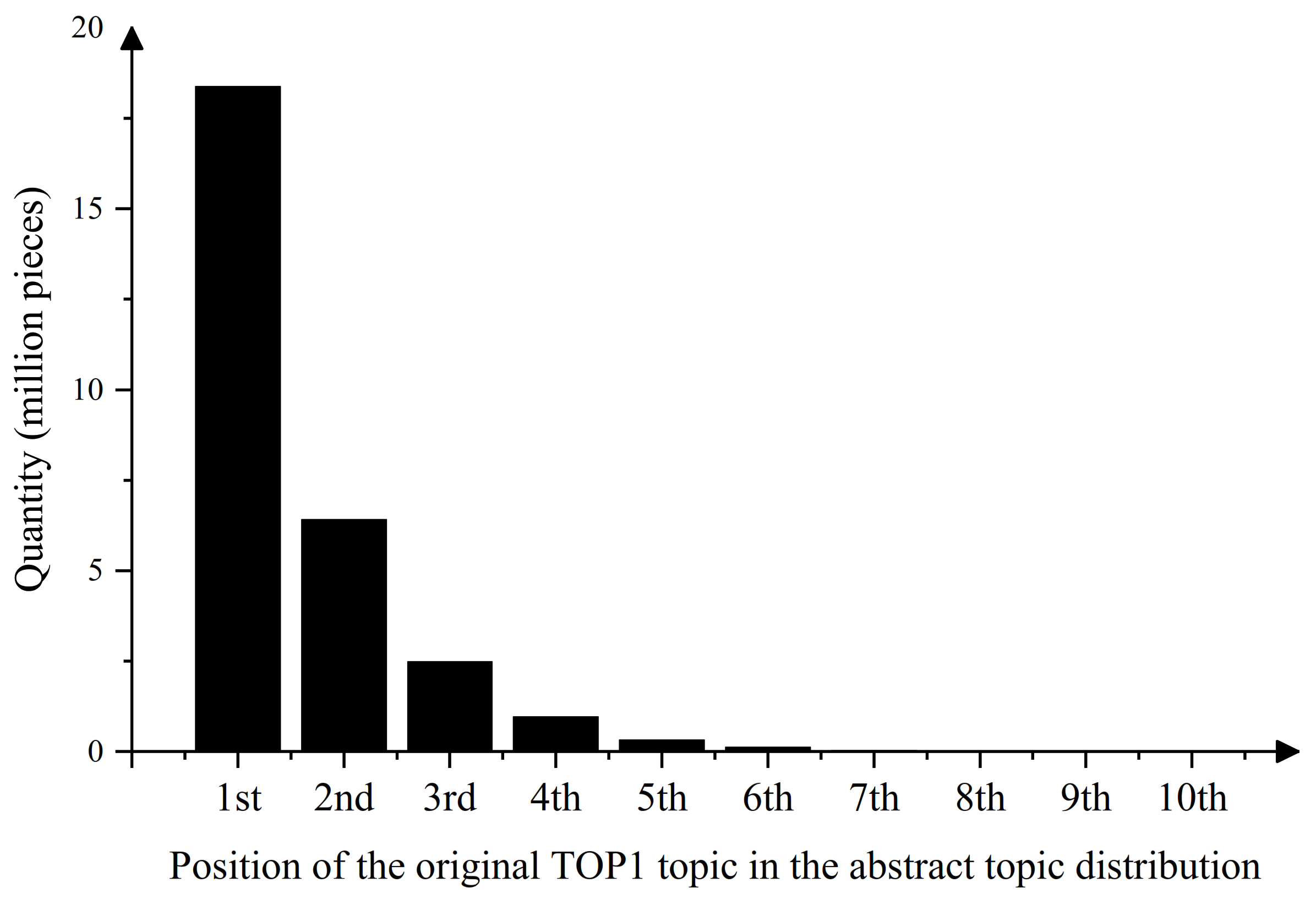
In this paper, we analyze more than 280,000 pieces of data in the CNN/Daily Mail dataset, and the topic relevance of the original text and summary is shown in Figure 1. It shows that there are 183,794 items of the TOP 1 topic in the original text that are also TOP 1 in the target summary, accounting for 63%. This suggests that the TOP 1 topic of the original text also appears in the summary with a high probability, which inspired us to propose a method to guide summary generation with the original text TOP N topics.
Figure 1. Distribution of original text TOP 1 topics in summary topics. The horizontal axis is the order of the original text TOP 1 topics in its summary topic, and the vertical axis is the number of the original text TOP 1 topics in summary topic distribution.
To avoid the noise caused by the introduction of topics, we propose the nTmG (n-TOPIC-m-GRAM) method, which chooses TOP m items with the highest probability from the n topics with the largest probability distribution in the original text. Then, to enhance the effectiveness of nTmG introduction, we fuse the mean vector of words with the original representation by an attention mechanism.

4. Approach

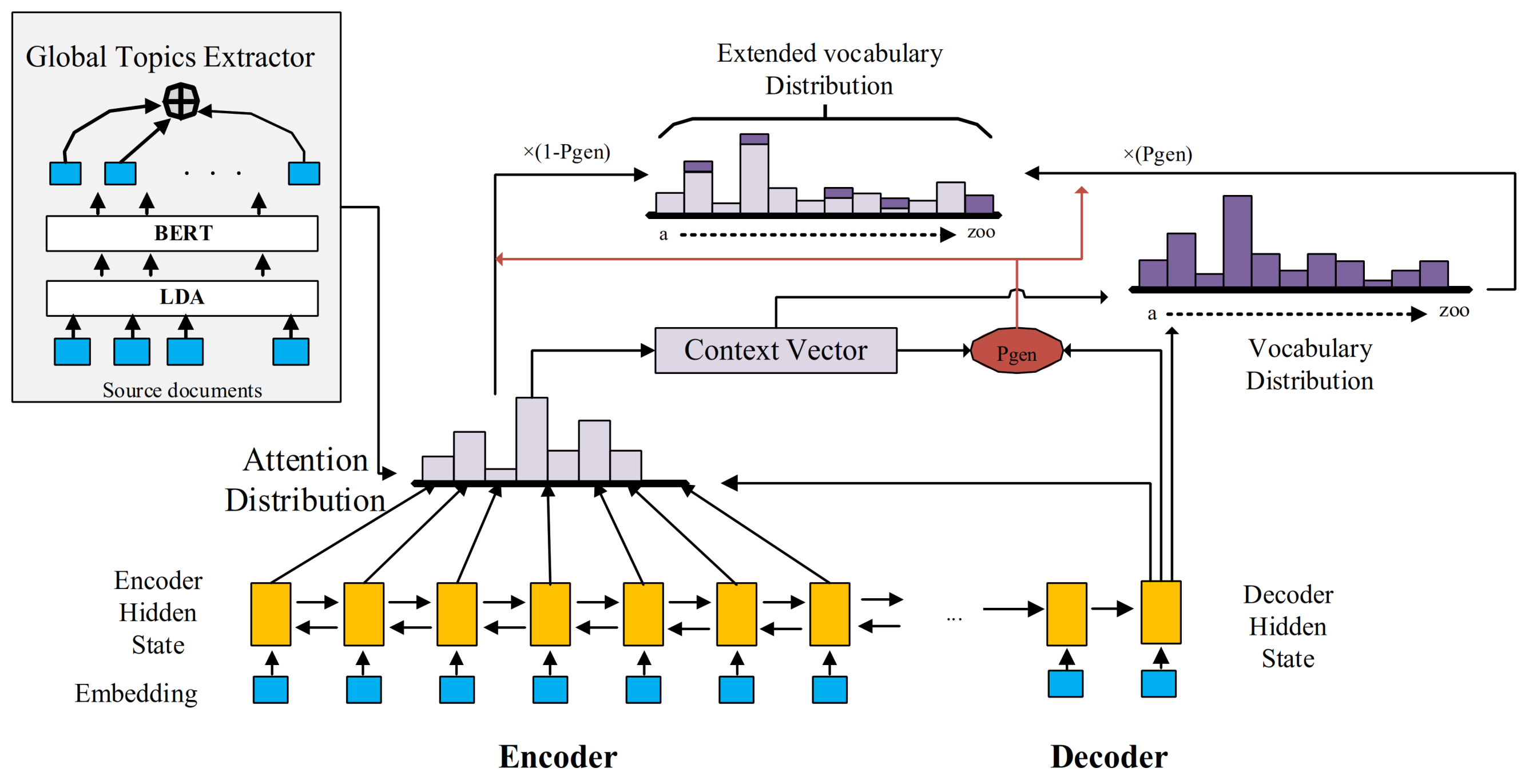
The ACGT summary generation model proposed in this paper is depicted in Figure 2. The encoder mainly includes the Global Topics Extractor and the Global Topics with combined Attention Module. It outputs the context vector containing the global topic information to the decoder, which is used to guide summary generation. The decoder uses the pointer network and coverage mechanism to solve the problem of OOV words and redundant words.
Figure 2. An abstract summarization method combining global topics.

4.1. Global Topics Extractor

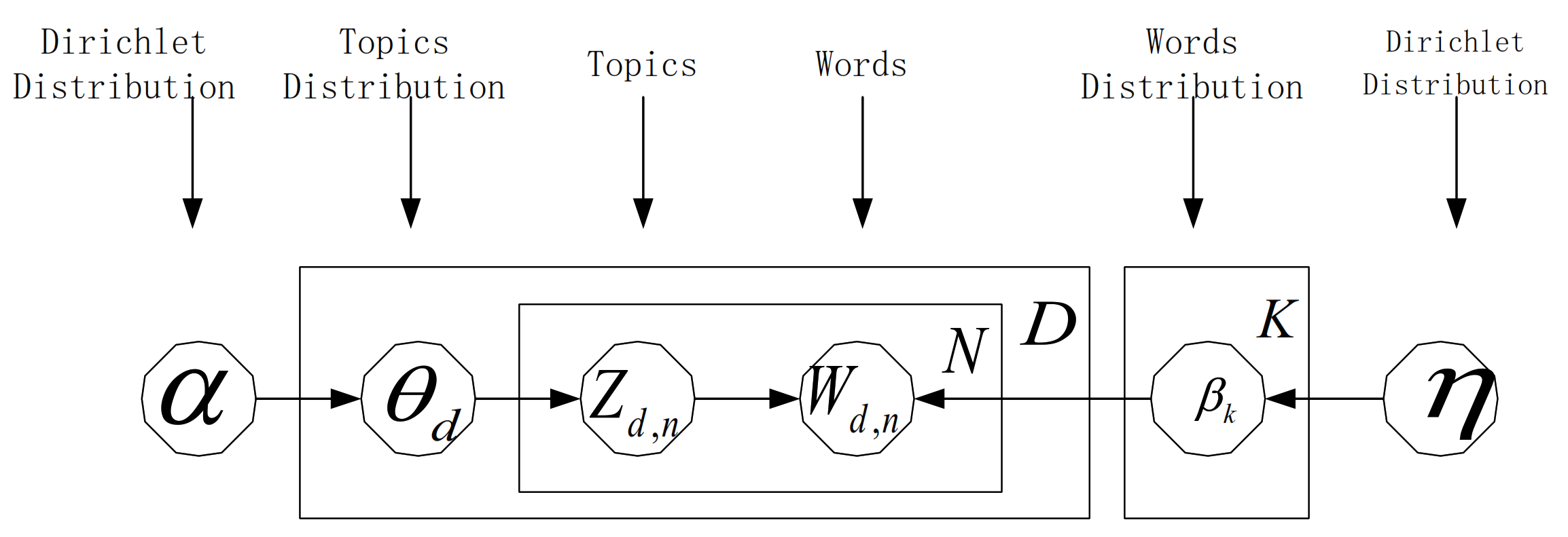
To extract the key topic information of the document, we construct a topic information extractor based on LDA. We use LDA combined with the nTmG method to extract the key topic words of the original text, and then re-encode the key topic information through the information fusion unit to obtain the global topic vector and then update attention. The probabilistic graphical model of LDA-generated documents is shown in Figure 3.
Figure 3. Probabilistic model diagram of LDA.
For the input document set D = d 1 , d 2 , d i , , d s , the latent variable K represents the number of topics implied in D, α represents the strong and weak relationship between the hidden topics in D, and η is the probability distribution of all implied topics; α and η both obey the Dirichlet distribution. When LDA generates a document, it selects the document according to the prior probability, determines the number of characteristic words of the document, samples the topic distribution of the document, selects the topic of the words in the document, and then samples the word distribution of the current topic, and finally samples the generated word. According to the LDA probability graph model, for the document d i D , the generation probability of the n-th word W d , n is calculated according to:
θ d = D i r i c h l e t ( α )
Z d , n = m u l t i ( θ d )
β k = D i r i c h l e t ( η )
where θ d is the topic distribution of the document d i , β k is the word distribution of the current topic, then θ d an are sampled from the Dirichlet distribution α and η , respectively. Z d , n , the topic of W d , n is sampled from the multinomial distribution of θ d .
In this paper, we use the Gibbs sampling algorithm to train the parameters of the topic distribution and word distribution β of the LDA model. First, determine the number of topics K, and randomly assign a topic number Z to each word in the corpus; Rescan the corpus, and update the topic number for each word with the Gibbs sampling formula, And repeat the aforementioned sampling steps until convergence. Finally, count the word topics in the corpus, get the topic distribution θ d n of the document, count the distribution of each topic word, and get the word distribution β k of the topic.
We use the LDA model to obtain the topic probability distribution of document set D and the word probability distribution under each topic. For the document d i D , we take the topic with the probability of TOP n, then choose the terms with the probability of TOP m under the topic of TOP n to form the key topic information word set T o p = t 11 , t 12 , , t 1 m , , t n m . Experimental demonstrated that BERT has achieved state-of-the-art performance in the summary task. We use the BERT pretraining model to obtain the embeddings representation of Top, and finally, take its mean vector G _ T as the key topic information vector of the document. These are calculated according to:
X = f B E R T ( T o p )
G _ T = 1 n m i = 1 n m X i
where f B E R T is the nonlinear equation of BERT and X = x 11 , x 12 , , x 1 m , , x n m is the vector set of key topic words encoded by BERT. In G _ T R ( b * l * d ) , b represents the model training batch, l represents the number of key topic words, and d represents the dimension of the last hidden layer of BERT.

4.2. Global Topics with Combined Attention Module

Based on the way the human brain processes information overload, Rush et al. [5] introduced an attention mechanism to improve the ability of neural networks to process information.
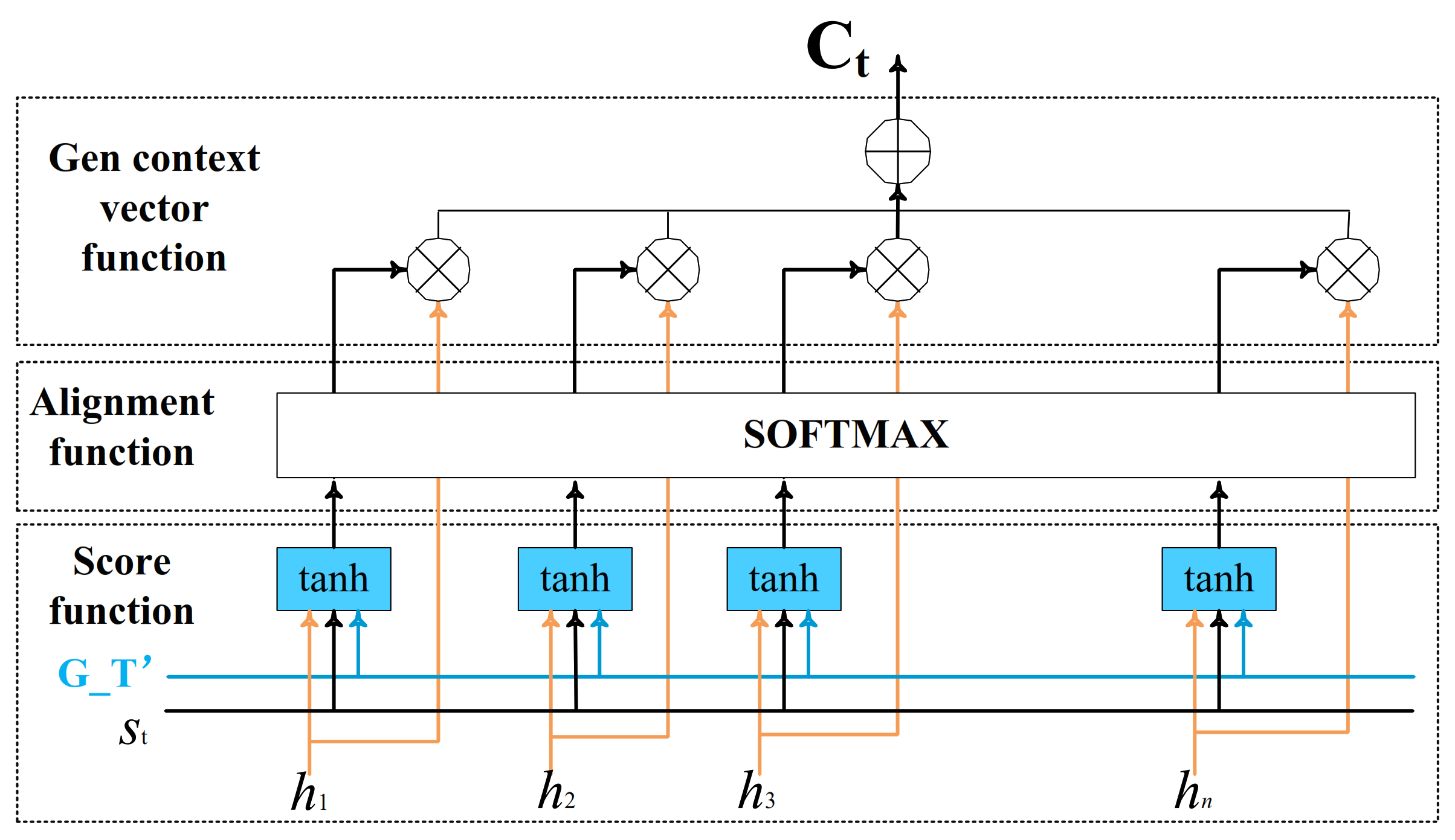
The essence of the attention mechanism is an addressing process. Its calculation can be divided into three steps. The first step is information input, the second step is to calculate the attention distribution α , and the third step is to calculate the weighted average of the input information according to the attention distribution α . However, traditional attention mechanisms generally pay attention to document information within a certain distance, while not paying attention to some important information. To this end, we propose an attention module that combines global topic information, and its structure is shown in Figure 4.
Figure 4. Global Topics with combined Attention Module.
We perform attention computation using Bahdanau attention [30], where the hidden layer state of the encoder and the key topic vector are jointly taken as the input of the attention module. First, linearity G _ T into the same dimension as the original word embedding to obtain the key topic information vector G _ T :
G _ T G _ T
where G _ T R ( b * l * d ) , in which b denotes the model training batch, l denotes the document length, and d denotes the hidden layer dimension of the word vector.
Next, the key topic information vector G _ T , the encoder hidden layer state h i , and the decoder hidden layer state s t pass through a linear layer and tanh activation function, and then the correlation weights are obtained. Finally, the Score function is calculated according to:
A t t ( h i , s t , G _ T ) = v T t a n h ( W h h i + W s s t + W g _ t G _ T + b a t t n )
The attention distribution α ^ is obtained by alignment function as follows:
α ^ = s o f t m a x ( A t t ( h i , s t , G _ T ) ) = exp ( A t t ( h i , s t , G _ T ) ) k = 1 T exp ( A t t ( h i , s t , G _ T ) )
where Att is additive attention using a single layer feedforward neural network, W h , W s , and W g _ t are learnable parameter matrices, and b a t t n is bias term.
We take the weighted summation of the attention distribution ( α ^ ) and the encoder hidden layer state of each word h = h 1 , h 2 , . h i . . h n , to obtain the context vector C t that fuses the key topic information to generate context vector functions as follows:
C t = t = 1 T α ^ h i

4.3. Pointer Network and Coverage Mechanism

For the sequence of target summary words R = [ r 1 , r 2 , , r t , r k ] , the decoder uses a single unidirectional LSTM to calculate the decoder’s hidden layer state s t :
y t = e w ( r t )
s t = LSTM ( s t 1 , y t 1 , C t )
where e w is the word embeddings representation, y t is the representation of the summary words r t at time step t, y t R m , m is the word embedding dimension, and s t is the decoder hidden layer state at time step t; in s t R n , n is the hidden layer state dimension.
For a given sequence, the conditional probability P w of the output of each word in the vocabulary is calculated according to:
P v o c a b = s o f t m a x ( V ( V [ s t ; C t ] + b ) + b )
P ( w ) = P v o c a b ( w )
where [;] denotes vector splicing, P v o c a b is the probability distribution of all words in the preset vocabulary, V and V are the learnable parameter matrix, and b and b are bias terms.

4.3.1. Pointer Network

The traditional Seq2Seq model cannot solve the problem of OOV words; therefore, See et al. [6] proposed the method of pointer generation network, which searches for the element with the largest weight of the current input sequence in each step of prediction, when the output sequence is completely derived from the input sequence, so it can adapt to the change of the length of the input sequence and solve the problem of OOV words.
We use a pointer network to solve the OOV words problem. At each decoder time step t, the pointer network calculates the generation probability P g e n 0 , 1 using the context vector C t , the decoder hidden layer state s t and the input y t at the decoder, which represents the probability of generating words from a fixed vocabulary, and helps the model in determining whether to generate words from the vocabulary or copy words from the input sequence of the original text. P g e n is calculated as shown:
P g e n = σ ( W c t C t + W s t s t + W y t y t + b p t r )
where W c t , W s t , and W y t are learnable parameter matrices, b p t r is the bias term, and σ is the sigmoid activation function.
For each document, P g e n weighted sums of the vocabulary distribution and the attention distribution are used to obtain an extended vocabulary on which the probability of generating word w is as follows:
P ( w ) = p g e n P v o c a b ( w ) + ( 1 p g e n ) i : w i = w α ^ i t
where P v o c a b is the probability of generating words on the predefined vocabulary. If w is a word outside the vocabulary, P v o c a b ( w ) is zero; if w does not appear in the original text, then i : w i = w α ^ i t is zero.

4.3.2. Coverage Mechanism

To alleviate the problem of generating repetition words, a coverage mechanism is introduced. The coverage vector, which is the sum of all attention distributions, is defined to record the coverage of words received from the attention mechanism up to the current time step. c t is calculated according to:
c t = t = 0 t 1 α ^ t
where α ^ t is the attention distribution at time step t.
To take into account the attention weights within a certain step size before the current time step, we introduce an additional input when calculating the attention distribution, changing Equation (7), as follows:
e i t = v T tanh ( W h h i + W s s t + W g _ t G _ T + W c c i t + b a t t n )
where W h , W s , W c , and W g _ t are learnable parameter matrices, and b a t t n is bias term.

4.4. Loss Function

During training, the loss at time step t uses the negative log likelihood of the target word w t , as follows:
l o s s t = log P ( w t )
The overall loss of the input sequence is:
l o s s = 1 T t = 0 T l o s s t
where T is the total length of the target summary.
Furthermore, an additional coverage loss is calculated in the coverage mechanism to penalize words with too much attention:
cov l o s s t = i min ( α ^ i t , c i t )
where cov l o s s t i α ^ i t = 1 Therefore, coverage loss is weighted by the hyperparameter λ is added to the loss function to obtain the final loss function is calculated according to:
l o s s t = log P ( w t ) + λ i cov l o s s t

5. Experiments

5.1. Dataset

Experiments are conducted on the English long paragraph dataset and Chinese short text dataset, respectively. The English dataset is CNN/Daily Mail (CNN/DM) [31], which contains 287,227 training data and 11,490 validation data. The basic statistics are shown in Table 1. The average length of the original text in the training set is 766, with a total of 29.74 sentences, and the average length of the target abstract is 53, with a total of 3.72 sentences, and the ratio of the length of the abstract to the original text is 1/14.45.
Table 1. Length statistics of CNN/DM.
The Chinese dataset is LCSTS (Large-scale Chinese Short Text Summarization dataset), which is contributed by Hu [32] based on the content published by authoritative certified users, such as China Daily on Weibo, with a scale of more than 2 million. The dataset consists of three parts, as shown in Table 2. Part I is the training set, and part II is randomly sampled from part I, with 1 to 5 manual scores added; 1 indicates the lowest correlation between the document and the abstract, and 5 indicates the highest. Part III is independent of the first two parts, and also has 1–5 manual scores. To make the comparison experiment fair, referring to the dataset used by the baseline model [32], this paper takes part I as the training set, and the data with more than 3 points of part III as the test set, for the experiment.
Table 2. Statistics of LCSTS.

5.2. Evaluation Metrics

We use the standard ROUGE-1, ROUGE-2, and ROUGE-L metrics [33] to measure summary qualities. The ROUGE-N is calculated according to:
R R O U G E N = S { R e f } N n g r a m S C o u n t m a t c h ( N n g r a m ) S { R e f } N n g r a m S C o u n t ( N n g r a m )
where n g r a m represents an n-gram, { R e f } represents the reference abstract, C o u n t m a t c h ( N n g r a m ) represents the number of n-grams that appear in the generated abstract and the reference abstract at the same time, and C o u n t ( N n g r a m ) indicates the number of n-grams appearing in the reference summary.
ROUGE-L is used to measure the readability of the generated summary, and its calculation is shown in the following equations:
R lcs = LCS ( X , Y ) m
P lcs = LCS ( X , Y ) n
R O U G E L = ( 1 + β 2 ) R l c s P l c s R l c s + β 2 P l c s
where L C S ( X , Y ) is the length of the longest common subsequence of X and Y, and m and n are the lengths of the reference abstract and the generated abstract. R l c s and P l c s represent the recall rate and precision rate, respectively. Since ROUGE cannot directly evaluate Chinese abstracts, when evaluating Chinese abstracts in this paper, Chinese characters are first converted into numbers before evaluation.

5.3. Experimental Setup

The experiments in this paper are conducted with the PyTorch deep learning framework on a graphics device, NVIDIA GeForce RTX 3090 TI. Training is performed using the ADAGRAD [34] optimizer, with a learning rate set to 0.15. For CNN/DM dataset, we follow the processing method of See et al., and use the non-anonymized version of the data. Word separation is performed using the Stanford University Toolkit core NLP pair, setting the original text length to 400, the summary length to 100 for training, and 120 for testing, and the preset vocabulary is set to 50 k. For LCSTS dataset, four types of characters are inserted into the document first, including <PAD> as a complementary character, <UNK> as an OOV words, <s> and </s> as sentence start and end identifiers. The vocabulary size is set to 40 k at (CHARACTER-BASED) and 50 k at (WORD-BASED) using the JIEBA word splitting tool. In the coverage mechanism, the weight of coverage loss is set to 1.
In our approach, we use a bidirectional LSTM on the encoder and a unidirectional LSTM on the decoder, with the hidden layer dimension being 256 in both. Additionally, our model has 128 dimensional word embeddings. The batch size is set to 16. We use beam search to get the summaries and the beam size is 4.

5.4. Experimental Results

We conducted four experiments, and the final experimental results were taken from the arithmetic mean of the four experiments, and the standard deviations of the four experimental results are presented in Table 3, Table 4 and Table 5.
Table 3. ROUGE score of each model on CNN/DM dataset.
Table 4. ROUGE score of each model on LCSTS dataset (word-based).
Table 5. ROUGE score of each model on LCSTS dataset (character-based).
We chose eight representative state-of-the-art baseline models for comparison, and the pointer generator network with coverage mechanism as our baseline.
Lead-3 [35]: A traditional simple extractive summary model, extracting the first three sentences of the article as the summary.
RNN [33]: RNN is used as the encoder and decoder, and the final hidden layer vector is used as the input of the decoder.
RNN context [32]: Using RNN as the encoder and decoder. The weighted summation of all hidden vectors on the encoding side is used to decode the summary.
ABS [5]: Generates the summary using an attention-mechanism-based encoder–decoder structure, such as RUSH.
Copy Net [15]: A hybrid mechanism is used to obtain information concerning the memory unit and encode the content and location of the text, mainly for solving OOV words.
PGEN [16]: A Seq2Seq + Attention structure with a pointer network that allows copying words from the original text or generating new words from a fixed vocabulary.
PGEN + Cov [6]: Combines a pointer network with an encoder–decoder based on the attention mechanism, and alleviates the problem of generating redundant words with a coverage mechanism.
Key information guide model [36]: Fusing key information of documents, including people, time, and place, in the form of keywords or key sentences, into the generation module using a multi-view attention approach to guide summary generation.
The comparison experiments show that the proposed ACGT outperforms all other baseline methods on both CNN/DM and LCSTS datasets. For CNN/DM dataset, ACGT yields gains of 0.96/2.44/1.03 of ROUGE-1/2/L scores compared to PGEN + Cov. On the LCSTS dataset (word-based), the ROUGE-1/2/L score of ACGT is improved by 1.19/1.03/0.85 compared to PGEN + Cov, and it also improved by 1.57/0.80/0.87 on the LCSTS dataset (character-based). It can be demonstrated that the summary generation method of combining topics proposed by ACGT is effective.

5.5. Ablation Experiment

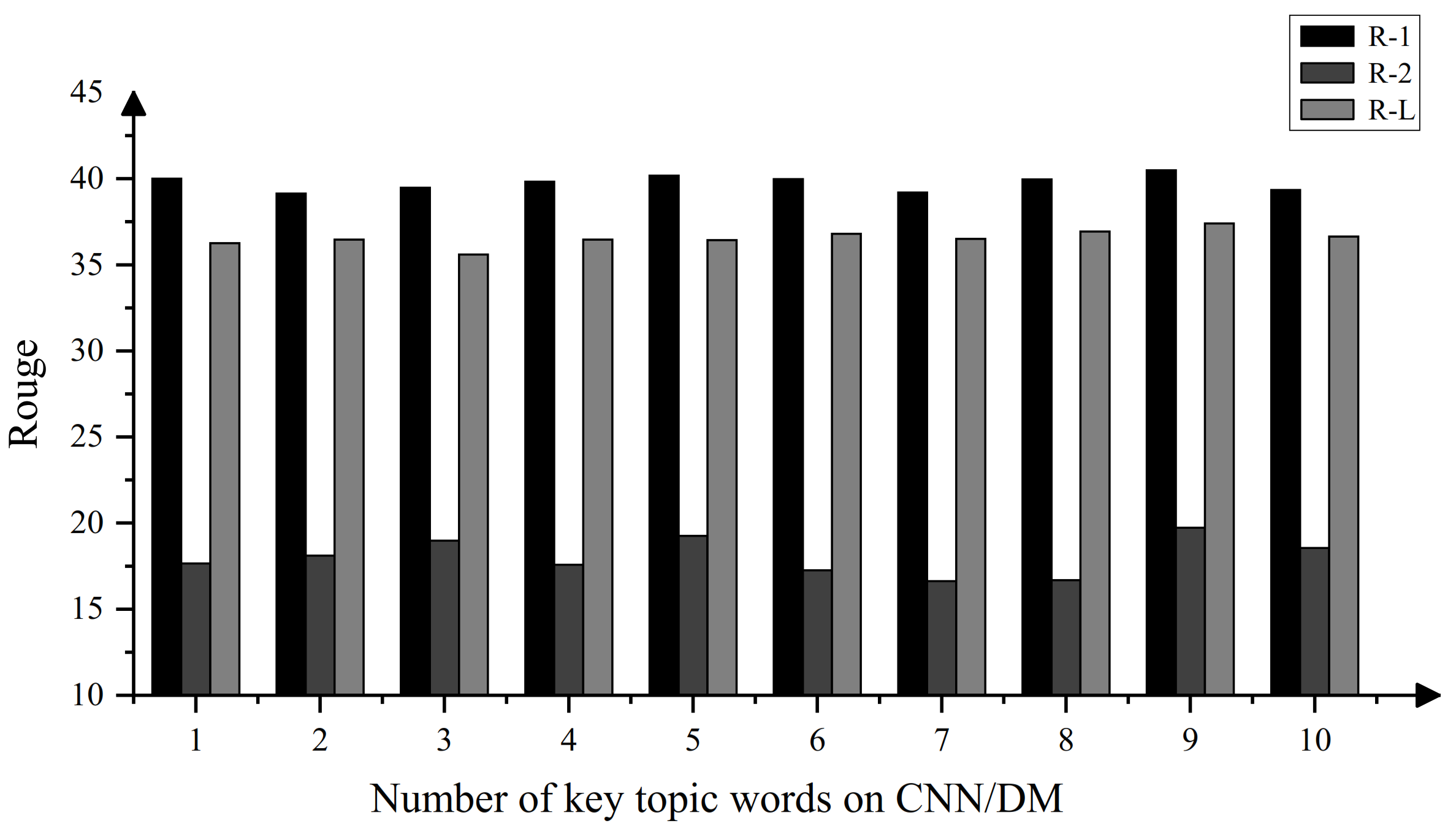
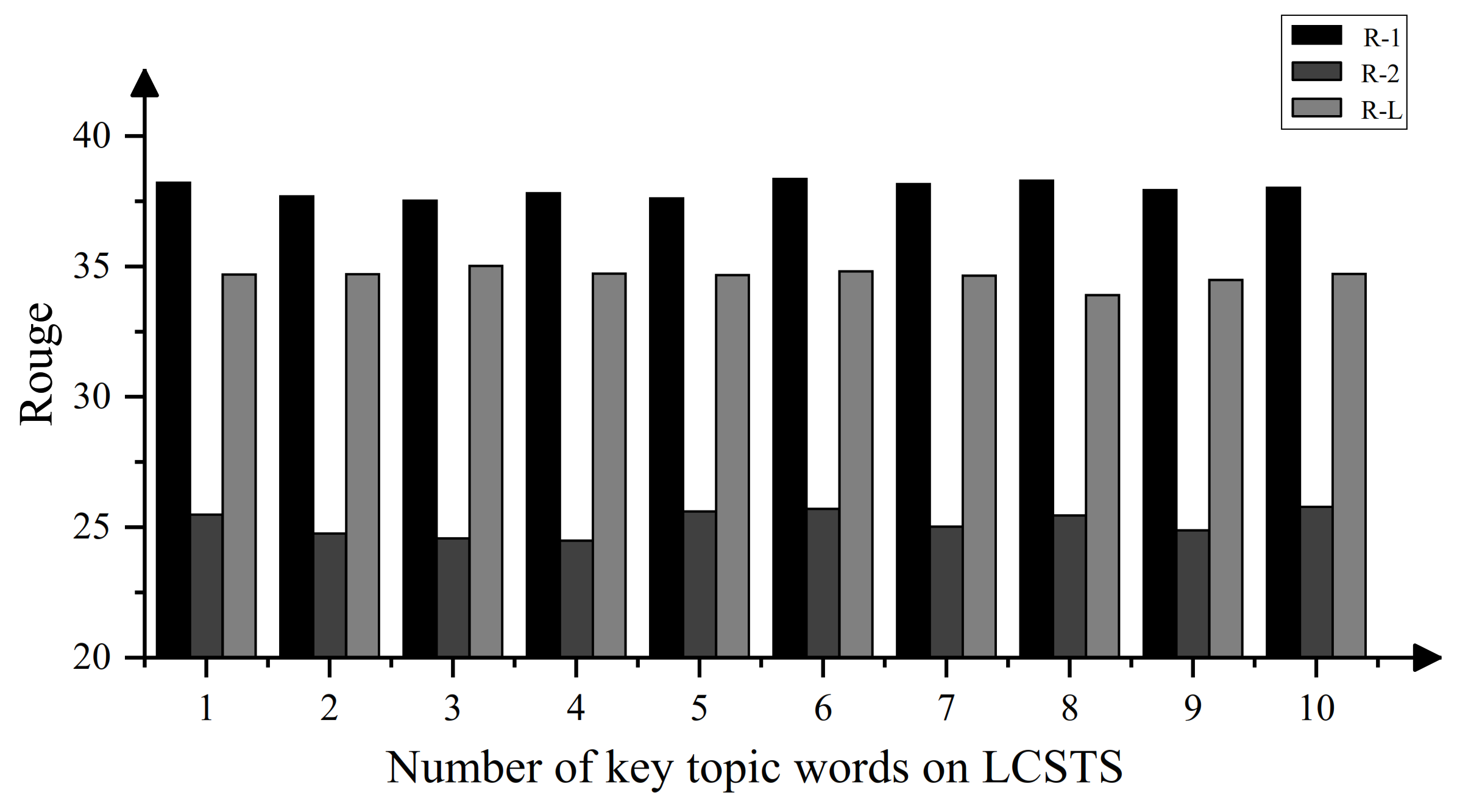
In the ablation experiment, to further illustrate the influence of the introduction of key topic words in ACGT on abstracts, this paper experimentally analyzes correlation between summaries quality and the number of topic terms. The number of terms extracted from each topic in the CNN/DM dataset and LCSTS dataset is 1–10, and the ROUGE values of ACGT generated abstracts are shown in Figure 5 and Figure 6.
Figure 5. Correlation between summaries quality and the number of topic terms in the CNN/DM dataset (number of topics is 43).
Figure 6. Correlation between summaries quality and the number of topic terms in the LCSTS dataset (number of topics is 18).
Overall, the number of key topic words has an impact on the quality of the abstract. ROUGE is slightly improved when key topic words are added to the model, and as the number of terms increases, the ROUGE value increases. Experiments show that the performance of both datasets remains stable with the change of the number of key topic words, indicating that ACGT is not sensitive to the number of key topic words.
We believe that although this paper fuses TOP m key topic words in Top n topics, the attention mechanism in our paper can sufficiently suppress the noise caused by the introduction of words, so that the summary performance remains stable with the change of the number of key topic words. For CNN/DM, the number of terms used in this experiment is nine. For the LCSTS dataset, six key themes were chosen.

6. Analysis and Discussion

6.1. Effect of Number of Topics

To illustrate the effect of introducing topic information into ACGT, we analyze the correlation between the number of topics and summary quality.
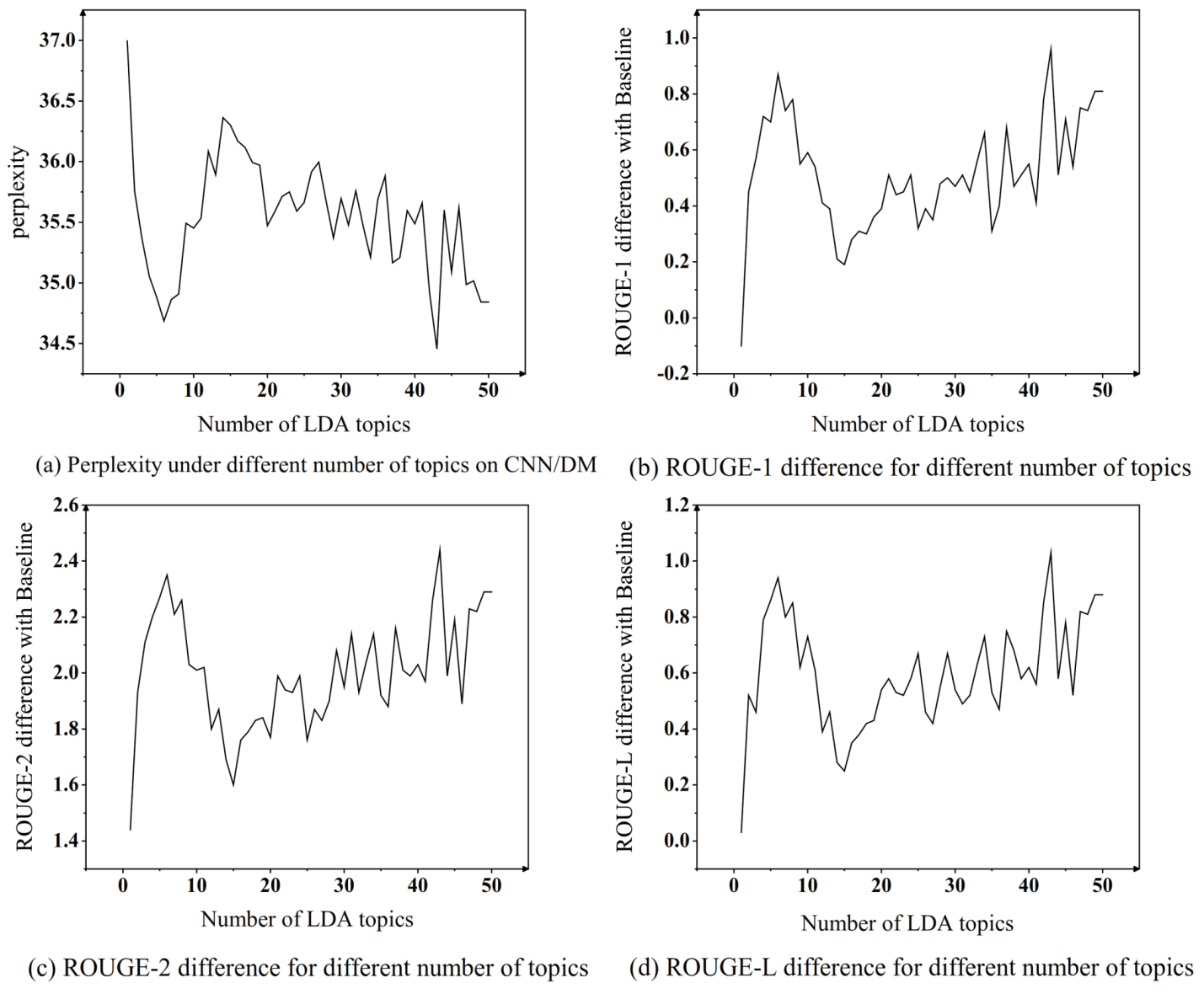
When training the LDA, the number of topics in the document set needs to be determined. B lei [23], the proposer of LDA, proposed perplexity as the metric; he suggested that a probability distribution model with low perplexity can predict the original text better. Thus, for CNN/DM dataset, we take the top 10 words with the highest probability for each topic as features and calculate the perplexity value of the LDA model for the number of topics between 1 and 50. The results are shown in Figure 7a. It shows that the average perplexity value of the model is lower when the number of topics is 40~45. Using PGEN + Cov as the baseline method, the ROUGE metrics of ACGT generating summaries when the number of topics is from 1 to 50 are shown in Figure 7b–d. We find that the difference between the ROUGE scores of the ACGT and the baseline method increases significantly as the perplexity value decreases. When the number of topics is 43, the perplexity value is the lowest, at which time the ROUGE difference is the largest, and the performance of ACGT to generate summaries is optimal.
Figure 7. Correlation of summary quality with the number of topics in CNN/DM dataset, where, figure (a) shows the variation of perplexity with the number of topics. In figure(bd) the vertical axis represents the ROUGE difference between ACGT and the baseline model [4].
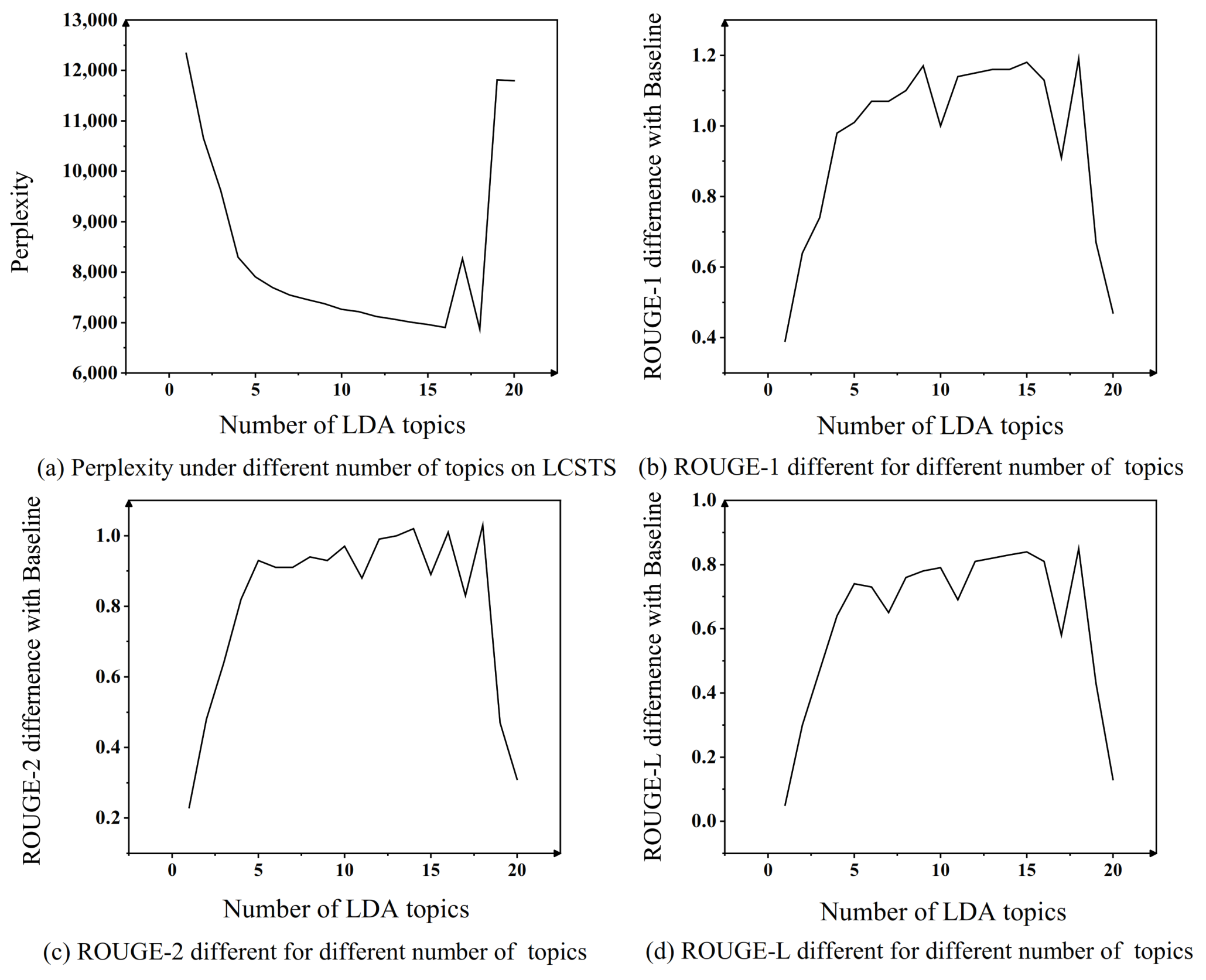
In the LCSTS dataset, the top 10 lexical items with the highest probability in each topic are also chosen as features, and the perplexity is calculated for the number of topics between 1 and 30, and the results are shown in Figure 8a. It shows that the model has the lowest average perplexity when the number of topics is 18 to 20, and overfitting occurs when the number of topics is greater than 20. When the number of topics ranges from 1 to 20, the ROUGE deference values of ACGT generating summaries compared with the baseline methods are shown in Figure 8b–d. It can be demonstrated that the perplexity and the ROUGE difference are negatively correlated. When the number of topics is 18, the ROUGE difference is the best and the performance of ACGT to generate summaries is optimal.
Figure 8. Correlation of summary quality with the number of topics in LCSTS dataset, where, figure (a) shows the variation of perplexity with the number of topics.In figure (bd), the vertical axis represents the ROUGE difference between ACGT and the baseline model [4].
The experiments show that the performance of the ACGT for generating summaries changes significantly with the number of topics introduced. When the perplexity of LDA decreases, the performance of ACGT generating summaries improves, indicating that the topic information extracted by LDA has a positive impact on the performance of summaries, and the ACGT is effective in incorporating topic information into summary generation. The number of topics used by CNN/DM is 43 and LCSTS is 18 in this experiment.

6.2. Case Studies

In this section, we present the performance of PGEN + Cov and ACGT using examples. The results are shown in Table 6 and Table 7, with the gray parts of the table indicating the topic information in each document.
Table 6. Example of summaries generated on CNN/DM dataset.
Table 7. Example of summaries generated on LCSTS dataset.
From Table 6 and Table 7, the summaries generated by PGEN + Cov tend to deviate from the topic of the text, while the summaries generated by ACGT are closer to the topic of standard summaries. Additionally, ACGT generates summaries with relatively complete sentences, and its fluency is better than that of the PGEN + Cov method. The case study shows that ACGT incorporates the global topic information of the text by the attention mechanism, which makes the generated abstracts focus on the topic of the original text more effectively and helps to improve the performance of the abstracts.

7. Conclusions

In the task of summary generation, the consistency between the summary and the topics of the original text is crucial. Existing summary generation methods based on the encoder–decoder structure mostly focus on the correlation between the original words and the summary words, while the application of the original topic information is inadequate. Therefore, an abstract summaries method combining global topic information, ACGT, is proposed. By constructing an LDA-based Global Topics Extractor and Global Topics with combined Attention Module, the key topic information of the original text is fused into the document representation for summary generation. Experiments show that ACGT achieves better ROUGE scores than that of baseline methods on both English CNN/DM and Chinese LCSTS datasets, and the performance of the generated summaries is significantly correlated with the number of topics introduced. The case studies show that ACGT generates summaries with better consistency with the original topics. In the next step, we aim to investigate the document from multiple viewpoints, and extract more key information for document information enhancement.

Author Contributions

Conceptualization, Z.D. and L.L.; methodology, Z.D.; software, Y.W.; validation, J.W. and Y.W.; formal analysis, W.Y.; investigation, J.W.; resources, W.Y.; data curation, W.Y.; writing—review and editing, Z.D.; visualization, Z.D.; supervision, Y.W.; project administration, L.L.; funding acquisition, W.Y. All authors have read and agreed to the published version of the manuscript.

Funding

The National Social Science Foundation of China “Research on the Emotional Semantic Transformation Mechanism of Online Public Opinion Field Based on Deep Learning” [2017CG29]; the Action Plan for High Quality Development of Postgraduate Education of Chongqing University of Technology [gzlcx20223199].

Institutional Review Board Statement

Not applicable.

Data Availability Statement

Conflicts of Interest

The authors declare no conflict of interest.

References

  1. Luhn, H.P. The automatic creation of literature abstracts. IBM J. Res. Dev. 1958, 2, 159–165. [Google Scholar] [CrossRef]
  2. Yuan, D.; Wang, L.; Wu, Q.; Meng, F.; Ngan, N.; Xu, L. Language Bias-Driven Self-Knowledge Distillation with Generalization Uncertainty for Reducing Language Bias in Visual Question Answering. Appl. Sci. 2022, 12, 7588. [Google Scholar] [CrossRef]
  3. Jwa, H.; Oh, D.; Park, K.; Kang, J.; Lim, H. Exbake: Automatic fake news detection model based on bidirectional encoder representations from transformers (bert). Appl. Sci. 2019, 9, 4062. [Google Scholar] [CrossRef]
  4. Sutskever, I.; Vinyals, O.; Le, Q.V. Sequence to sequence learning with neural networks. arXiv 2014, arXiv:1409.3215. [Google Scholar]
  5. Rush, A.M.; Chopra, S.; Weston, J. A neural attention model for abstractive sentence summarization. arXiv 2015, arXiv:1509.00685. [Google Scholar]
  6. See, A.; Liu, P.J.; Manning, C.D. Get to the Point: Summarization with Pointer-Generator Networks. arXiv 2017, arXiv:1704.04368. [Google Scholar]
  7. Lin, C.Y.; Hovy, E. Automatic evaluation of summaries using n-gram co-occurrence statistics. In Proceedings of the 2003 Human Language Technology Conference of the North American Chapter of the Association for Computational Linguistics, Edmonton, AB, Canada, 27 May–1 June 2003; pp. 150–157. [Google Scholar]
  8. Abdel-Salam, S.; Rafea, A. Performance Study on Extractive Text Summarization Using BERT Models. Information 2022, 13, 67. [Google Scholar] [CrossRef]
  9. Lamsiyah, S.; El Mahdaouy, A.; Espinasse, B.; El Alaoui Ouatik, S. An unsupervised method for extractive multi-document summarization based on centroid approach and sentence embeddings. Expert Syst. Appl. 2021, 167, 114152. [Google Scholar] [CrossRef]
  10. Rani, R.; Lobiyal, D.K. Document vector embedding based extractive text summarization system for Hindi and English text. Appl. Intell. 2022, 52, 9353–9372. [Google Scholar] [CrossRef]
  11. Nallapati, R.; Zhou, B.; dos Santos, C.N.; Gulcehre, C.; Xiang, B. Abstractive Text Summarization Using Sequence-to-Sequence RNNs and Beyond. arXiv 2022, arXiv:1602.06023. [Google Scholar]
  12. Gehrmann, S.; Deng, Y.; Rush, A.M. Bottom-up abstractive summarization. arXiv 2018, arXiv:1808.10792. [Google Scholar]
  13. Celikyilmaz, A.; Bosselut, A.; He, X.; Choi, Y. Deep communicating agents for abstractive summarization. arXiv 2018, arXiv:1803.10357. [Google Scholar]
  14. Gulcehre, C.; Ahn, S.; Nallapati, R.; Zhou, B.; Bengio, Y. Pointing the Unknown Words. arXiv 2022, arXiv:1603.08148. [Google Scholar]
  15. Gu, J.; Lu, Z.; Li, H.; Li, V.O.K. Incorporating Copying Mechanism in Sequence-to-Sequence Learning. arXiv 2016, arXiv:1603.06393. [Google Scholar]
  16. Vinyals, O.; Fortunato, M.; Jaitly, N. Pointer networks. Adv. Neural Inf. Process. Syst. 2015, 28. Available online: https://proceedings.neurips.cc/paper/2015/file/29921001f2f04bd3baee84a12e98098f-Paper.pdf (accessed on 15 August 2022).
  17. Ruan, Q.; Ostendorff, M.; Rehm, G. Histruct+: Improving extractive text summarization with hierarchical structure information. arXiv 2022, arXiv:2203.09629. [Google Scholar]
  18. Mao, Z.; Wu, C.H.; Ni, A.; Zhang, Y.; Zhang, R.; Yu, T.; Deb, B.; Zhu, C.; Awadallah, A.H.; Radev, D. Dyle: Dynamic latent extraction for abstractive long-input summarization. arXiv 2021, arXiv:2110.08168. [Google Scholar]
  19. Li, J.; Shang, J.; McAuley, J. UCTopic: Unsupervised Contrastive Learning for Phrase Representations and Topic Mining. arXiv 2022, arXiv:2202.13469. [Google Scholar]
  20. Bahrainian, S.A.; Feucht, S.; Eickhoff, C. NEWTS: A Corpus for News Topic-Focused Summarization. arXiv 2022, arXiv:2205.15661. [Google Scholar]
  21. Li, M.; Lin, X.X.; Chen, X.; Chang, J.; Zhang, Q.; Wang, F.; Wang, T.; Liu, Z.; Chu, W.; Zhao, D.; et al. Keywords and Instances: A Hierarchical Contrastive Learning Framework Unifying Hybrid Granularities for Text Generation. arXiv 2022, arXiv:2205.13346. [Google Scholar]
  22. Lei, D.M.B.; Ng, A.Y.; Jordan, M.I. Latent Dirichlet allocation. J. Mach. Learn. Res. 2003, 3, 993–1022. [Google Scholar]
  23. Wu, D.; Yuan, Z.; Li, X. Automatic Summarization Algorithm Based on the Combined Features of LDA. Computer Sci. Appl. 2013, 3, 145–148. [Google Scholar]
  24. Liu, N.; Lu, Y.; Tang, X.-J.; Li, M.-X. Multi-document automatic summarization algorithm based on important topics of LDA. J. Front. Comput. Sci. Technol. 2015, 9, 242–248. [Google Scholar]
  25. Yang, T.; Xie, Q.; Liu, Y.-J.; Liu, P.-F. Topic-aware long text automatic summarization algorithm. Comput. Eng. Appl. 2022, 34(Part A), 2651–2665. [Google Scholar]
  26. Guo, J.-F.; Fei, Y.-X.; Sun, W.-B.; Xie, P.-P.; Zhang, J. A PGN-GAN Text Summarization Model Fusion Topic. J. Chin. Comput. Syst. 2022, 1–7. [Google Scholar]
  27. Chou, Y.C.; Kuo, C.J.; Chen, T.T.; Horng, G.J.; Pai, M.Y.; Wu, M.E.; Lin, Y.C.; Huang, M.H.; Su, M.Y.; Chen, Y.C.; et al. Deep-learning-based defective bean inspection with GAN-structured automated labeled data augmentation in coffee industry. Appl. Sci. 2019, 9, 4166. [Google Scholar] [CrossRef]
  28. Onah, D.F.O.; Pang, E.L.L.; El-Haj, M. A Data-driven Latent Semantic Analysis for Automatic Text Summarization using LDA Topic Modelling. arXiv 2022, arXiv:2207.14687. [Google Scholar]
  29. Rani, R.; Lobiyal, D.K. An extractive text summarization approach using tagged-LDA based topic modeling. Multimed. Tools Appl. 2021, 80, 3275–3305. [Google Scholar] [CrossRef]
  30. Bahdanau, D.; Cho, K.; Bengio, Y. Neural machine translation by jointly learning to align and translate. arXiv 2014, arXiv:1409.0473. [Google Scholar]
  31. Hermann, K.M.; Kocisky, T.; Grefenstette, E.; Espeholt, L.; Kay, W.; Suleyman, M.; Blunsom, P. Teaching machines to read and comprehend. Adv. Neural Inf. Process. Syst. 2015, 28. [Google Scholar]
  32. Hu, B.; Chen, Q.; Zhu, F. Lcsts: A large scale chinese short text summarization dataset. arXiv 2015, arXiv:1506.05865. [Google Scholar]
  33. Lin, C.Y. Rouge: A Package for Automatic Evaluation of Summaries. Proceedings of the Workshop on Text Summarization of ACL, Barcelona, Spain, 25–26 July 2004; pp. 74–81. Available online: https://aclanthology.org/W04-1013.pdf (accessed on 15 August 2022).
  34. Duchi, J.; Hazan, E.; Singer, Y. Adaptive subgradient methods for online learning and stochastic optimization. J. Mach. Learn. Res. 2011, 12, 2121–2159. [Google Scholar]
  35. Wasson, M. Using Leading Text for News Summaries: Evaluation Results and Implications for Commercial Summarization Applications[C]//COLING 1998 Volume 2: The 17th International Conference on Computational Linguistics. 1998. Available online: https://aclanthology.org/C98-2217.pdf (accessed on 15 August 2022).
  36. Xu, W.; Li, C.; Lee, M.; Zhang, C. Multi-task learning for abstractive text summarization with key information guide network. EURASIP J. Adv. Signal Process. 2020, 2020, 16. [Google Scholar] [CrossRef]
Publisher’s Note: MDPI stays neutral with regard to jurisdictional claims in published maps and institutional affiliations.

Article Metrics

Citations

Article Access Statistics

Multiple requests from the same IP address are counted as one view.