
Abstract
The most effective use of numerous Combined Heat and Power Units (CHPUs) is a challenging issue that requires strong approaches to handle the Economic Dispatch (ED) with CHPUs. It aims at minimizing the fuel costs by managing the Power-Only Units (POUs), CHPUs, and Heat-Only Units (HOUs). The transmission losses are also integrated, which increases the non-convexity of the ED problem. This paper proposes a Modified Artificial Ecosystem Algorithm (MAEA) motivated by three energy transfer processes in an ecosystem: production, consumption, and decomposition. The MAEA incorporates a Fitness Distance Balance Model (FDBM) with the basic AEA to improve the quality of the solution in non-linear and multivariate optimization environments. The FDBM is a selection approach meant to find individuals which will provide the most to the searching pathways within a population as part of a reliable and productive approach. Consequently, the diversity and intensification processes are carried out in a balanced manner. The basic AEA and the proposed MAEA are performed, in a comparative manner considering the 7-unit and 48-unit test systems. According to numerical data, the proposed MAEA shows a robustness improvement of 97.31% and 96.63% for the 7-unit system and 46.03% and 60.57% for the 48-unit system, with and without the power losses, respectively. On the side of convergence, based on the average statistics, the proposed MAEA shows a considerable improvement of 47% and 43% of the total number of iterations for the 7-unit system and 13% and 20% of the total number of iterations for the 48-unit system, with and without the power losses, respectively. Thus, the suggested MAEA provides significant improvements in the robustness and convergence properties. The proposed MAEA also provides superior performance compared with different reported results, which indicates a promising solution methodology based on the proposed MAEA.
1. Introduction
1.1. Motivation
In numerous academic fields, meta-heuristics have steadily gained popularity for handling difficult optimization problems [1]. Traditional optimization procedures are undervalued due to concerns related to local optimal stagnation [2]. To overcome such issues, meta-heuristics optimization procedures are followed which involve the most effective and influential strategies for identifying optimal solutions. Because of the clear growth in manufacturing and residential needs, the world’s usage of electrical and thermal energy has recently become materialistic. In order to diminish the drawbacks of conventional facilities, energy planners have been instructed to include heat and power sources in addition to renewable energy sources. The reduction of pollution emissions that contribute to global warming has also received international attention [3]. One of the national energy policy initiatives by China is to focus on the development of efficient, secure, and sustainable energy sources with an ideal management system [4]. Economic load dispatch is a critical optimization problem in power systems that necessitates good generator coordination, control, and management [5]. Because of the imposed identical and uneven constraints, it exhibits non-linear performance. In response, it has been recognized as a difficult multi-modal optimizing problem to address [6]. Therefore, it is critical that a search is undertaken for efficient, robust, and highly convergent optimization solutions to the non-linear and complex ED optimization problem, which considers CHPUs.
1.2. Literature Survey
For this reason, a systematic learned PSO has been blended with a sequential quadratic programming technique and employed for ED optimization of the power system [6]. However, the primary objective task that was taken into consideration was the reduction of gasoline expenses. In [7], a multi-objective pigeon-inspired algorithm was used to solve the ED problem involving emissions minimization; however, in three scenarios explored, only 6-unit and 14-unit systems were considered in detail. The ED problem was solved using a dispersed fixed step-size optimizer in [8] while taking into account the cost function of the distributed energy resources. However, the traditional quadratic model was applied while excluding the actual effects of the valve point loadings.
In standard thermal power plants, a substantial amount of thermal energy is wasted and released into the environment via cooling towers, flue gas, or other methods. The efficiency of converting carbon fuels into electrical energy is therefore just 50% to 60%, despite the most efficient contemporary combined cycle plants. By gathering and using waste heat, CHPUs raise the energy conversion efficiency of these typical units from 50–60% to the order of 90% [9]. An essential issue for managing the operation of these units is the ED model combined with CHPUs [10]. Traditionally, an ED incorporating CHPUs manages the Power-Only Unit, CHP, and HOUs to save fuel expenditures. However, the production and use of energy are closely related to environmental concerns.
The integrated hybrid energy systems can meet a variety of energy demands with increasing productivity and efficiency. This lays the groundwork for creating a low-carbon, sustainable method of economic and social advancement. Additionally, during the past few decades, combined heat and power systems have been associated with energy savings and reduced environmental impact. Such systems have alerted the scientific community to further research and developments of renewable-based combined heat and power configurations in the domestic and commercial sectors, which served the objective [11,12]. By managing Power-Only Units, CHPs, and HOUs, the CHPEED challenge seeks to reduce fuel costs and emissions [13]. Moreover, in order to maintain the performance of the power, heat, and CHPUs, certain inequality limits must be satisfied. Additionally, the mutual dependence of the CHPUs must be maintained because it may have an impact on how the CHPEED problem is solved [14]. The challenging ED problem with CHPUs has been addressed using a wide variety of MAs. According to the primary objectives, the published research on the ED problem using CHPUs that has used metaheuristic methodologies to solve this problem can be split into two types. To achieve the lowest operating costs, the first category involves creating efficient optimization methods for systems incorporating thermal plants, CHPUs, and boilers. The investigation of all practically pertinent restrictions, such as transmission loss, valve-point impacts, and environmental difficulties with the heat and power supply of the ED issue with CHPUs, falls under the second category. Some of the most intriguing works in the first category include the following: as shown in [15], the ED problem with CHPUs was solved using the GSA by examining network system losses and the valve-point effect of POUs. To address the production cost reduction of the ED problem with the CHPU problem, specifically examining the valve-point effect of POUs, the CSA was employed in [16]. Both investigations looked at network losses and valve-point consequences. The environmental concerns, however, were not considered.
To solve the ED issue under varying CHPU operating conditions with minimal computational effort, [17] implements a DRL approach. Artificial neural networks have also been used to try to fix the ED issue using CHPUs [18]. Practical limitations including valve-point influence, transmission power loss, and environmental factors were not considered in [17,18]. Considering the transmission loss and valve-point impact, a heap optimizer was used in [19] on large-scale 84-unit and 96-unit systems. In addition, the optimal ED problem with the CHPU problem has been solved using a composite firefly and self-regulating PSO technique [20]. In addition, a differential evolution with migrating variables was performed to address the ED problem with the CHPU problem in [21], and the cuckoo optimization approach was combined with a penalty function to address the ED problem with the CHPU issue in [22]. The probability of the MPA [23] failing when prey is lost has been reduced, due to the partitioning of the iterations into three separate and continuous sections. In [24], the authors offer a MPHS for an ED problem involving CHPU optimization with 84 units, considering the effects of valve-point loading on thermal power plants. Together, the heap optimizer and the jellyfish optimizer were used to solve a 96-unit ED problem in the CHPU system while also considering the potential for unit outages (as studied in [25]). Most MAs, despite their impressive results, are highly sensitive to changes in user-defined parameters. Another drawback is that the MAs may not reliably converge to the global optimum. These worries have seized the interest of researchers, and they have begun developing hybrid versions as one of the valid metrics, as hybridization is a crucial part of high-performing algorithms.
Modifying and applying the AEA [26] in engineering contexts is straightforward and requires only minor adjustments. All ecosystems involve three forms of energy transfer (production, consumption, and breakdown), and AEA considers all three to obtain the optimal fitness score. Meanwhile, the consumption approach can help to strengthen the discovery, exploration, and exploitation of space. The production operation enables AEA to generate a new member at irregular intervals. Due to its robustness and powerful global searching capabilities, the AEA approach has been applied to a variety of real-world optimization engineering problems, such as distributed generation and capacitor allocation in power delivery networks [27], the minimization of regression test suites [28], the optimization of filter parameters [29], the optimization of demand-side management for hybridized energy sources [30], the representation of PV cells [31], and the identification of fuel-cell parameters [32].
1.3. Paper Contribution
This study introduces a novel improved MAEA, or Modified Artificial Ecosystem Algorithm, for solving the ED problem with CHPUs, both with and without power losses. One novel method for enhancing the solution quality in non-linear and multivariate optimization settings is to combine the AEA with the FDBM. A successful application of AEA combined with the FDBM technique for the power flow constrained by the transient stability level in power networks has been reported [33]. Therefore, the processes of diversification and intensification are carried out in harmony. The 7-unit and 48-unit test systems are used to conduct a comparative analysis of the standard AEA and the proposed MAEA. The results demonstrated that the proposed method was superior to the standard AEA in locating the global optimal solution. In early tests, the planned MAEA demonstrated impressive problem-solving abilities. This criterion suggests that the changes made to the design of this AEA throughout the decomposition stage were successful in producing results that were closer to the real-world behaviour of the algorithm being simulated. A few of the most important things that this research has added are:
- An FDBM is developed in collaboration with an AEA to create a unique MAEA with improved performance.
- The basic AEA and the proposed MAEA have been assessed in solving the ED problem including CHPUs with and without power losses.
- The proposed MAEA shows greater performance compared with several other reported algorithms in the literature.
- Furthermore, the suggested MAEA is stated to be more resilient and stable than the basic AEA.
1.4. Key Segments of the Paper
This paper is divided into five key segments. The first segment is the introduction section which describes the problem context, literature review, and the hypothesis based on the gap analysis of the previously published research. The second segment describes the modelling of the ED combining CHPUs in terms of the main objective function and the practical regarding constraints. The third segment describes the main structure of the basic AEA and the processes of the developed MAEA. The fourth segment compares the MAEA’s simulated outcomes considering two practical systems of the 7-unit and 48-unit test systems. The last segment provides a concluding note to this work.
2. ED Problem with CHPUs
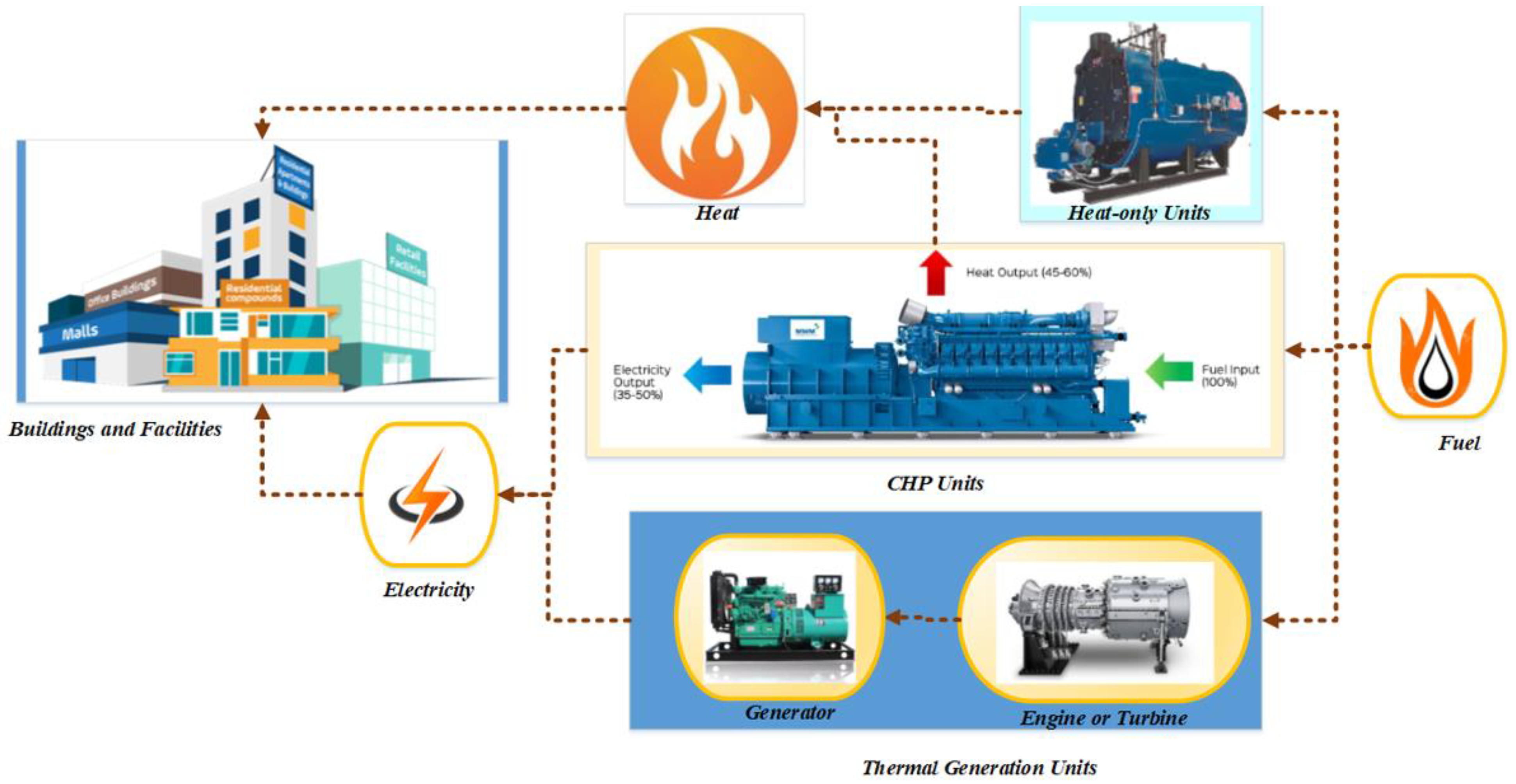
The key players in the ED in efforts to supply the electricity and heat loads in the facilities and buildings are depicted in Figure 1. The core purpose of the ED combining CHPUs would be to identify the economic potential rate for heat generated by HOUs, power generated by POUs, and both power and heat generated by CHPUs, such that fuel costs are maintained to a minimum while heat and power needs and restrictions are met [34]. Thus, the generation cost objective (F) may be stated as:
where
Figure 1.
Key players in the ED problem with CHPUs [35].
Furthermore, the inequality requirements of this problem should always be fulfilled in regard to the capacity of the POUs, HOUs, and CHPUs, as shown in Equations (5)–(8):
Furthermore, the equality requirements of this problem should always be satisfied in the perspective of heat and power balance, as addressed in Equations (9) and (10), and as described in the following:
The power loss represents an important phenomenon that occurs in power system networks due to the flow of the output power from the generation units to the customers. It is of great importance since it is usually modelled in a highly non-linear form that represents further complexity to the ED model incorporating CHPUs. Thus, the integration of transmission losses might result in additional non-convexity for the issue, which is described in Equation (11) as a proportion of the output power of the POUs, HOUs, and CHPUs:
where PLoss is the total losses; Bji is the coefficient element in the B-matrix that describes line losses correlating the units.
Accordingly, Equation (10) can be reformulated as follows:
3. Proposed MAEA for Solving the ED Problem with CHPUs
3.1. Artificial Ecosystem Algorithm
The AEA is influenced by three energy transfer processes inside an ecosystem: production, consumption, and decomposition. The production operation enables the AEA to construct a new solution represented at random, that may replace the prior member amongst the global optimum (YABest) and a randomized individual (YAR) created at irregular intervals in the solution space. The following is how the production operation may be quantified [26]:
wherever it corresponds to the present iteration; Tmax and PM represent the maximum number of repetitions and the size of the population, accordingly, whereas UB and LB represent the upper and lower limits, respectively. In addition, q1 and q represent a randomized value and a randomized vector inside the domain [0, 1].
In the consumption framework, Levy flying is incorporated, which can conveniently traverse the search area. It simulates the food quest of various species such as lions and cuckoos as a numerical operation. Levy flight is a randomized walk which may cover the search region successfully since the length of some stages is much longer in the long run, implying that it can achieve the global optimum. As a result, Levy flying is commonly used to increase the optimizing efficiency of metaheuristic algorithms [26]. However, there appear to be two drawbacks to such movement: intricacy and the necessity to adjust multiple settings. As a result, given the properties of Levy flight, a parameter-free randomized walk, termed consumption parameter (CP), is derived as shown in Equation (15).
wherein N(0,1) denotes a normal distribution with a mean of zero and a standard deviation of one. As a result, this consumption parameter could aid various sorts of consumers in implementing three consuming tactics. The first method is Herbivore, in which the consumer could only consume what the producer produces. This behaviour can be represented mathematically as described in the following:
The second technique is called Carnivore, in which the consumer could only devour a consumer having the highest degree of energy at irregular intervals. This behaviour could be represented mathematically as follows:
The third technique is called Omnivore, in which the consumer could devour both the consumer and the producer at random. This is how this behaviour may be demonstrated:
The individual position in a population could be upgraded in the decomposition, as shown in Equation (19). Therefore, to some extent, this approach exemplifies exploitation since it allows the subsequent place of every individual in the solution to be distributed around the global optimum of the best solution, which is stated as the decomposer. The following describes the decomposition behaviour:
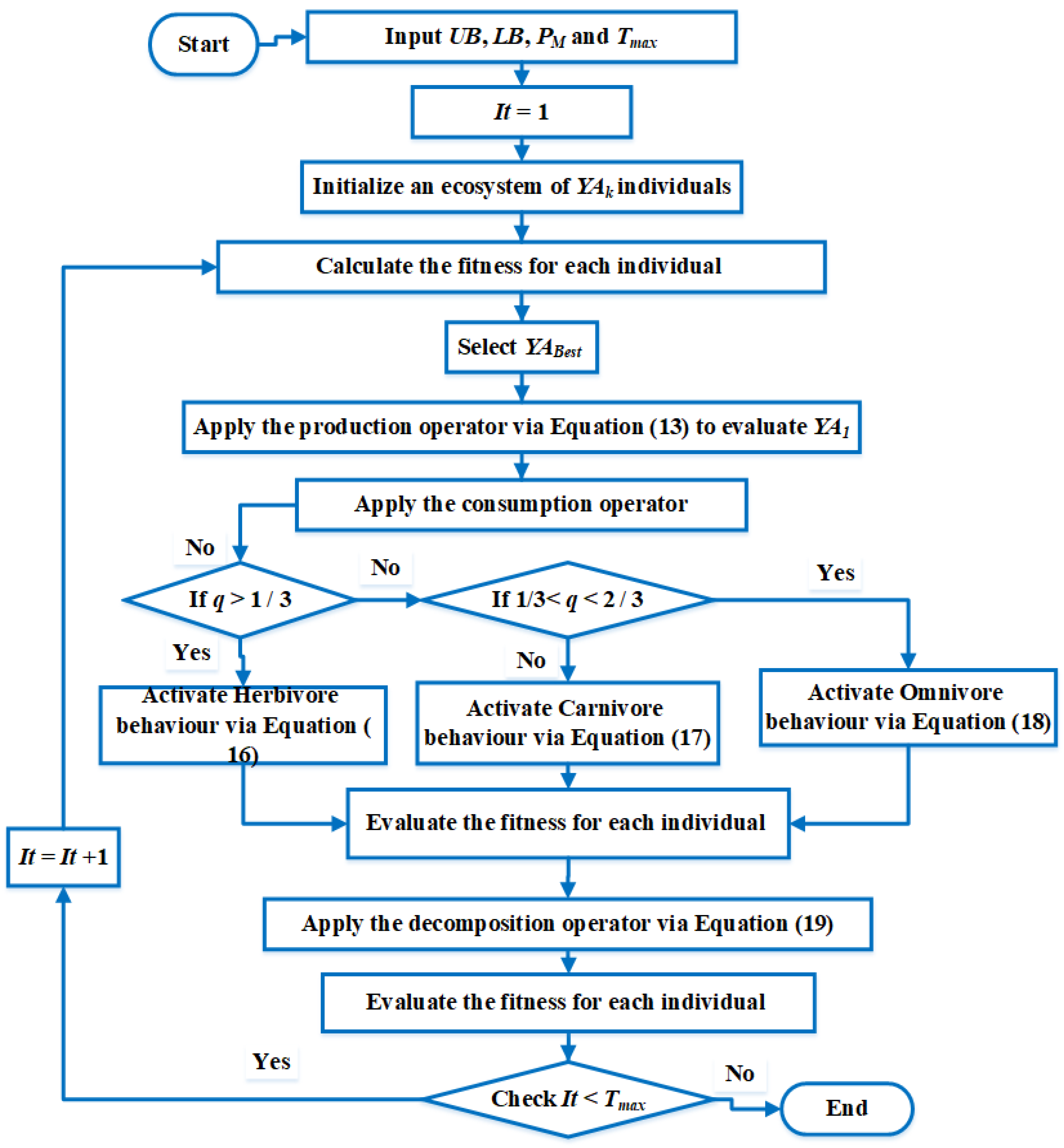
Based on the above illustrations, the main steps of the basic AEA can be depicted as in Figure 2.
Figure 2.
Main steps of AEA.
3.2. Proposed MAEA with FDBM
The purpose of developing the FDBM selecting approach is to discover participants who will make the greatest contribution to the search operations in a systematic and efficient way. Therefore, it is possible to ensure that the varying and strengthening actions are carried out in a balanced manner. The Euclidean distance metric could be employed to calculate the distance between the solutions and the preferred opportunity (YABest). Consequently, the distance (Dk) between each individual and the optimal choice is calculated as described in the following:
After that, the rating grade of each design choice is established. The rating grade is computed using the normalized fitness (NF) and normalized distance (ND). They may be assessed for every member (k) as follows:
Relying on this, the inclusion of normalized numerical quantities is designed to prevent these features from overpowering the target computation. As a result, each individual’s (k) grade (GR) may be calculated as follows:
Following the determination of all individuals’ grades, a roulette wheel selection process [36] is used to choose an alternative by including a high probability of getting a high grade (YAFDBM). As a result, the decomposition step stated in Equation (19) is improved by combining the FDBM:
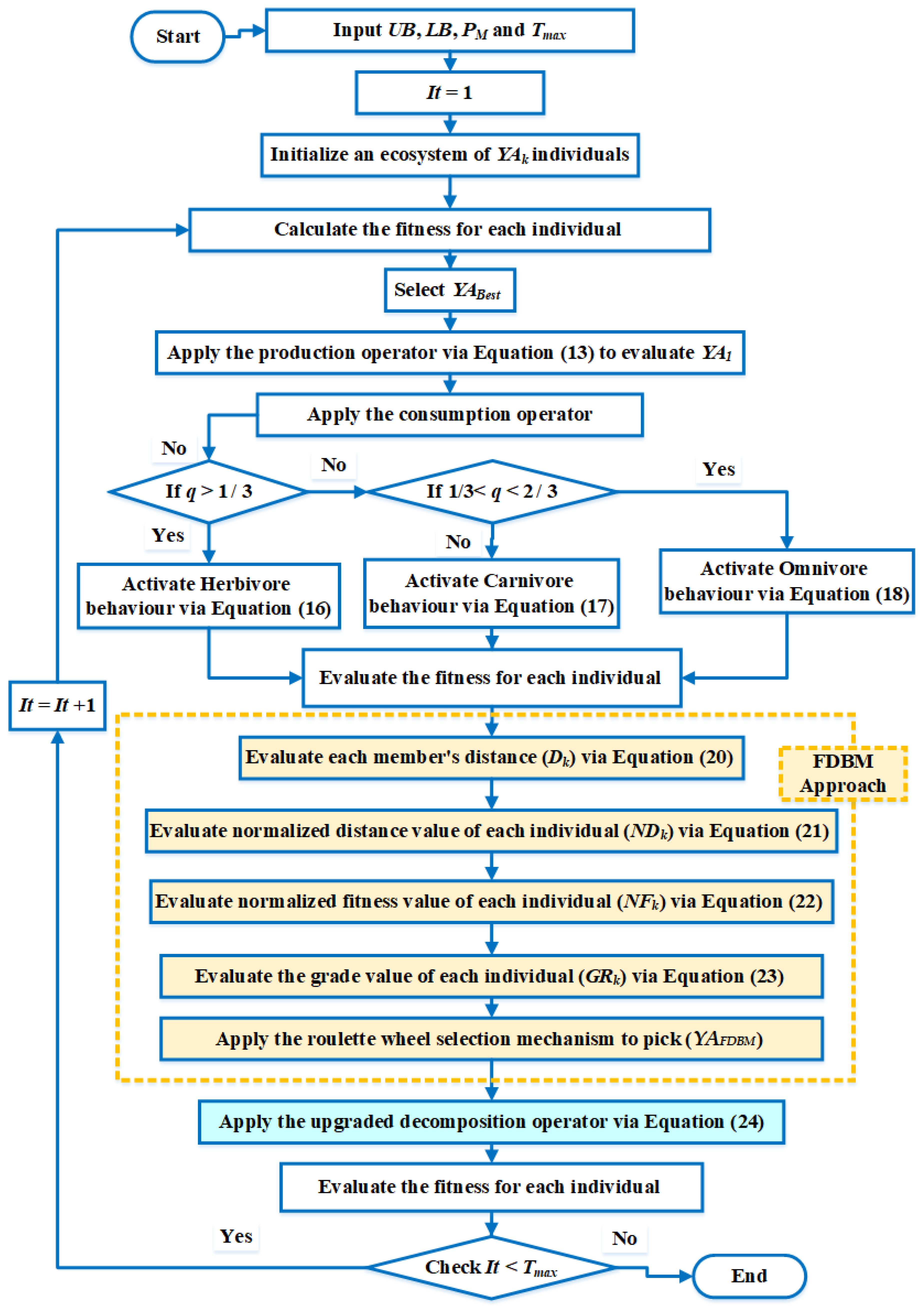
The MAEA process is depicted in Figure 3. It starts by randomly forming a population. The first seeking individuals adjust their locations according to Equation (13) with each repeat, but the subsequent participants have the same opportunity to alter their placements by selecting Herbivore according to Equation (16), Carnivore according to Equation (17), or Omnivore according to Equation (18). Adjustment may be allowable when a participant obtains a greater fitness trait. The FDBM is then triggered to select an alternative by including a high probability of receiving a good grade. To accomplish this, each member’s distance from the optimum choice is calculated as shown in Equation (20). The normalized objective functions and distance scores of the prospects are therefore assessed utilizing Equations (21) and (22), whereas the rating grades of the solutions are computed in the second step of the FDBM approach as shown in Equation (23). Equation (24) would then be used to change the placement of each component. Participants might be created at random in the seeking space whenever there is gap far from the upper or lower borders throughout the upgrade sequence. All changes are made continually until the AEA procedure is completed, by the inclusion of a termination criterion. Eventually, the best candidate is chosen.
Figure 3.
Main steps of the proposed MAEA.
4. Simulation Results
The acquired findings for the ED incorporating CHPUs were contrasted with the basic AEA to illustrate the effectiveness of the proposed MAEA. Both techniques are tested on two standard test systems. The two selected tested networks have different configurations and scalability called 7- and 48-unit systems. The first test system consists of two CHPUs, four POUs, and one HOU. As mentioned in [37], system data is stated as loss coefficients, fuel prices, and CHPU restrictions. For this system, the loading level of power and heat are 600 MW and 150 MWth. The second test system comprises 48-unit systems as mentioned in [38] which illustrates that 4700 MW and 2500 MWth are the load demand and heat demand, respectively, and it has 10 HOUs, 26 POUs, and 12 CHPUs. For the basic AEA and the proposed MAEA, the number of individuals is taken as 100 and the numbers of iterations are 300 and 3000, respectively, for the first and second system. MATLAB 2017b is used to execute the simulated implementations.
Based on the consideration of power losses, four cases are included in the study, which can be summarized as follows:
- Case 1: Minimization of the fuel costs without loss consideration for the 7-unit system.
- Case 2: Minimization of the fuel costs considering the power losses for the 7-unit system.
- Case 3: Minimization of the fuel costs without loss consideration for the 48-unit system.
- Case 4: Minimization of the fuel costs considering the power losses for the 48-unit system.
4.1. Implementation for Case 1
The suggested MAEA and basic AEA are employed to solve the ED with CHPUs in order to minimize fuel expenditures without accounting for losses. Table 1 depicts the optimal operating parameters of the POUs, CHPUs, and HOUs depending upon the suggested MAEA and the essential AEA in this instance. According to this data, the suggested MAEA achieves remarkable results by having the lowest fuel costs of 10,092.18 USD/h. To obtain these circumstances, the proposed MAEA sets the operational settings to 44.76, 98.56, 112.68, 209.82, 94.19, and 40 MW for the power outputs and 27.18, 74.99, and 47.82 MWth for the heat units. The basic AEA, on the other hand, attains fuel costs of 10,092.41 USD/h.
Table 1.
Optimal operational settings and related costs of the proposed MAEA and the basic AEA of Case 1.
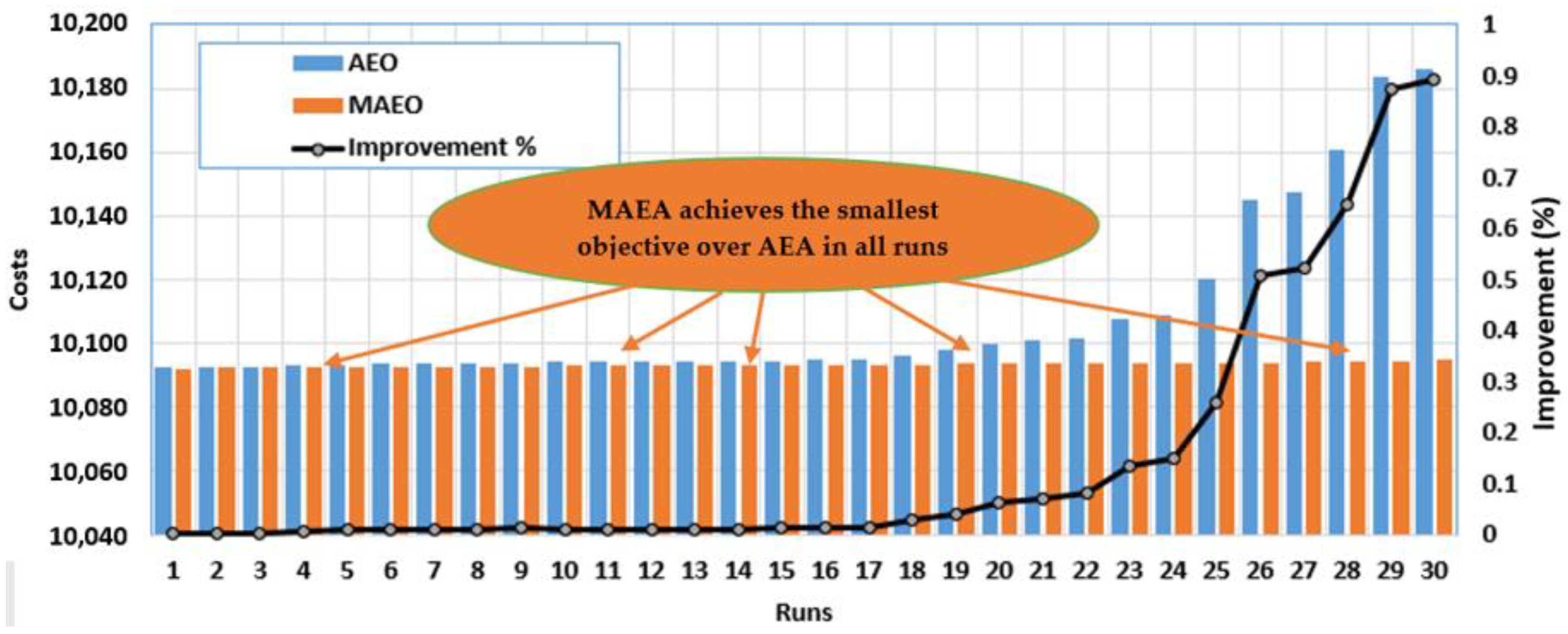
In addition, Figure 4 displays the obtained costs for all simulated runs of the proposed MAEA and the basic AEA of Case 1. As shown, the superior performance of the proposed MAEA is declared over the basic AEA in all simulated runs. The improvement percentage ranges from the very small value of 0.0023% to 0.89%.
Figure 4.
Obtained costs for all simulated runs of the proposed MAEA and the basic AEA of Case 1.
Based on that outcome in Figure 4, Table 2 records the robustness metrics of the proposed MAEA and the basic AEA of Case 1 in terms of the minimum, mean, maximum, and standard deviation. As shown, superior resilience performance related to the proposed MAEA is declared over the basic AEA. The proposed MAEA acquires the lowest minimum, mean, maximum, and standard deviation of 10,092.18, 10,093.32, 10,095.17, and 0.734646 USD/h, with improvements of 0.0023, 0.145, 0.892, and 97.31%, respectively.
Table 2.
Robustness metrics of the proposed MAEA and the basic AEA of Case 1.
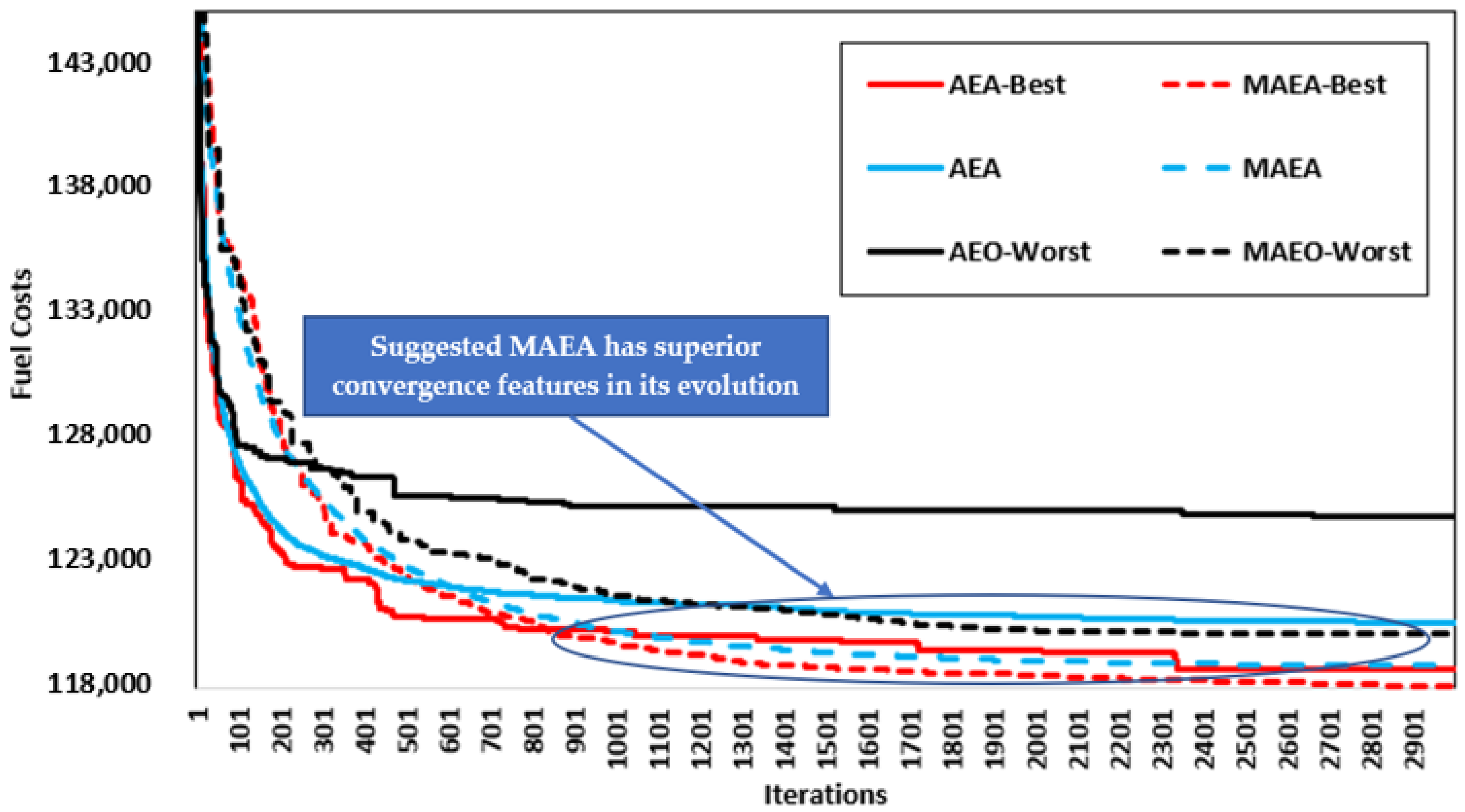
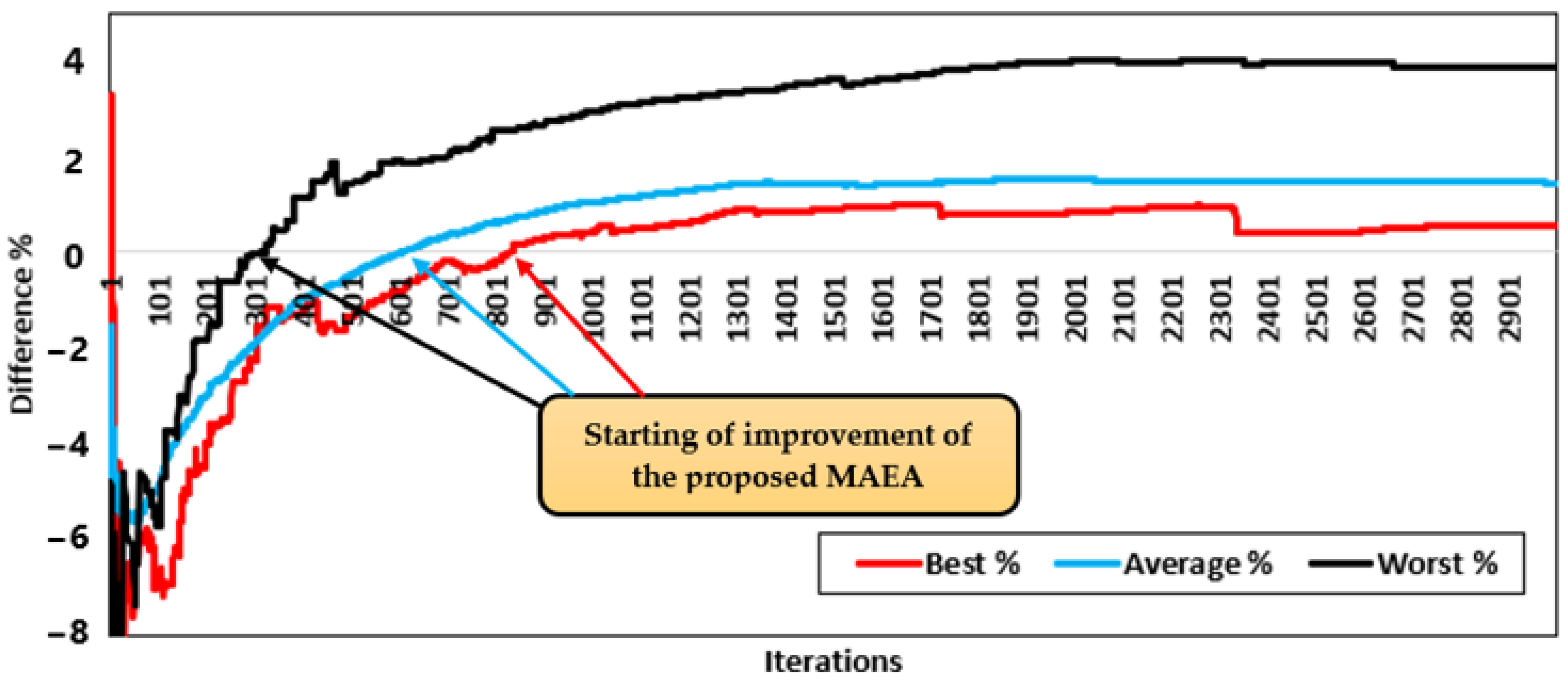
In addition, Figure 5 displays the convergence rates of the proposed MAEA and the basic AEA related to the best run, worst run, and the average of all simulated runs. As demonstrated, the suggested MAEA has superior convergence features in its evolution in terms of lowering fuel expenditures throughout the duration of iterations. Despite achieving lower fitness values in the first 130 iterations, the AEA remained in a local optimal zone, particularly for its best run. The difference between the best run, worst run, and the average of all runs of the MAEA and AEA of Case 1 is shown in Figure 6, confirming the considerable improvement of the proposed MAEA after about 47%, 7%, and 20% of the total number of iterations for the average, best, and worst situations.
Figure 5.
Convergence rates of the proposed MAEA and the basic AEA of Case 1.
Figure 6.
Percentage difference for the best and worst run and the average of all runs of the MAEA and AEA of Case 1.
4.2. Implementation for Case 2
The suggested MAEA and basic AEA are employed to solve the ED with CHPUs in order to minimize fuel expenditures, taking into consideration the power losses. Table 3 illustrates the optimal operating parameters of the POUs, CHPUs, and HOUs depending upon the suggested MAEA and the essential AEA in this instance. The suggested MAEA achieves remarkable results by having the lowest fuel costs of 10,095.02 USD/h. To obtain these circumstances, the proposed MAEA sets the operational settings to 45.17, 98.54, 112.69, 209.82, 94.6, and 40 MW for the power outputs and 24.73, 75, and 50.27 MWth for the heat units. The basic AEA, on the other hand, attains fuel costs of 10,092.18 USD/h.
Table 3.
Optimal operational settings and related costs of the proposed MAEA and the basic AEA of Case 2.
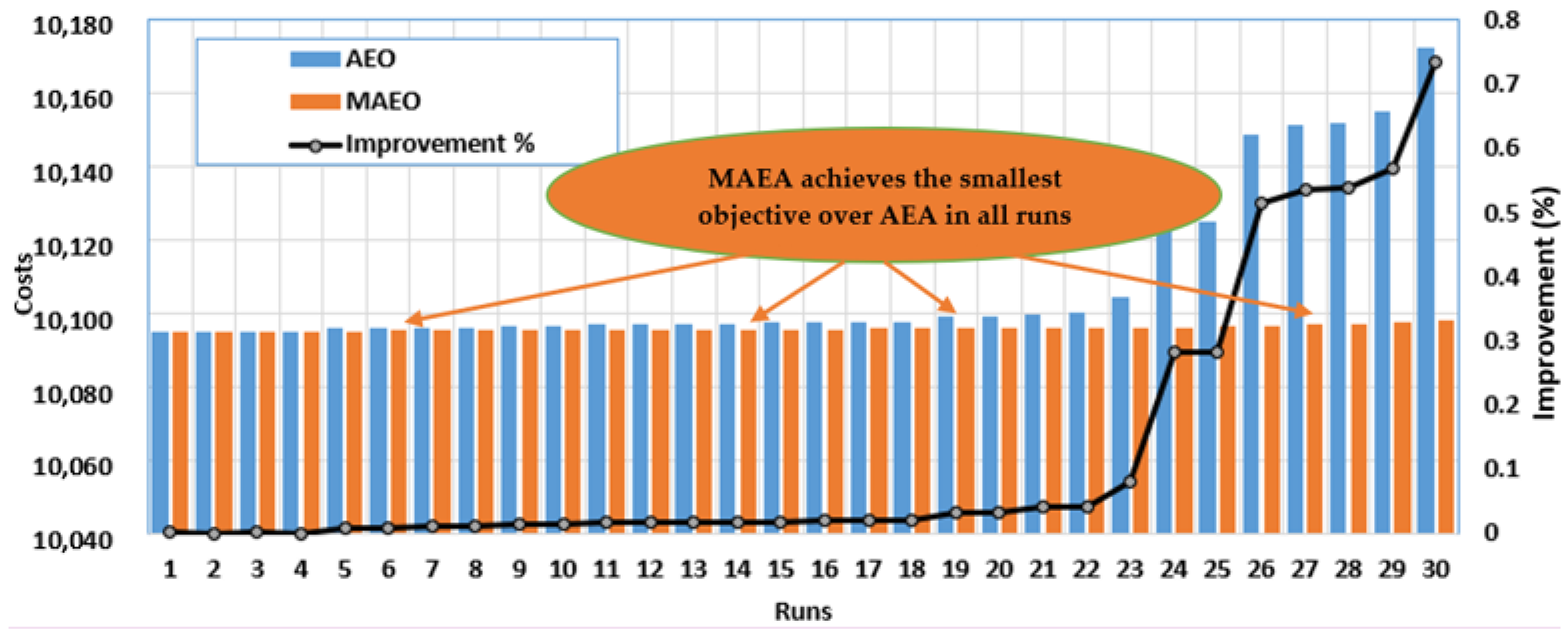
In addition, Figure 7 displays the obtained costs for all simulated runs of the proposed MAEA and the basic AEA of Case 2. As shown, the superior performance of the proposed MAEA is declared over the basic AEA in all simulated runs. The improvement percentage ranges from the very small value of 0.0009% to 0.73%.
Figure 7.
Obtained costs for all simulated runs of the proposed MAEA and the basic AEA of Case 2.
Based on the outcome in Figure 7, Table 4 records the robustness metrics of the proposed MAEA and the basic AEA of Case 2. As shown, superior resilience performance related to the proposed MAEA is declared over the basic AEA. The proposed MAEA acquires the lowest minimum, mean, maximum, and standard deviation of 10,092.18, 10,093.32, 10,095.17, and 0.734646 USD/h with improvements of 0.0009, 0.115, 0.73, and 96.63%, respectively.
Table 4.
Robustness metrics of the proposed MAEA and the basic AEA of Case 2.
In addition, comparisons are made with the results of powerful optimization algorithms used in solving ED problems in the literature. For this purpose, Table 5 displays the comparative assessment of the AEA and the proposed MAEA with reported algorithms of TVAC-PSO [38], IGA [39], ECSA [40], PSO [41], TVAC-PSO [41], LCA [42], CPSO [43], WVO [44], WVO-PSO [44], RCGA [45], BCO [45], and DE [43,46]. As shown, the suggested MAEA provides better-performing features compared with the others.
Table 5.
Comparative Results for Case 2 for the 7-Unit System.
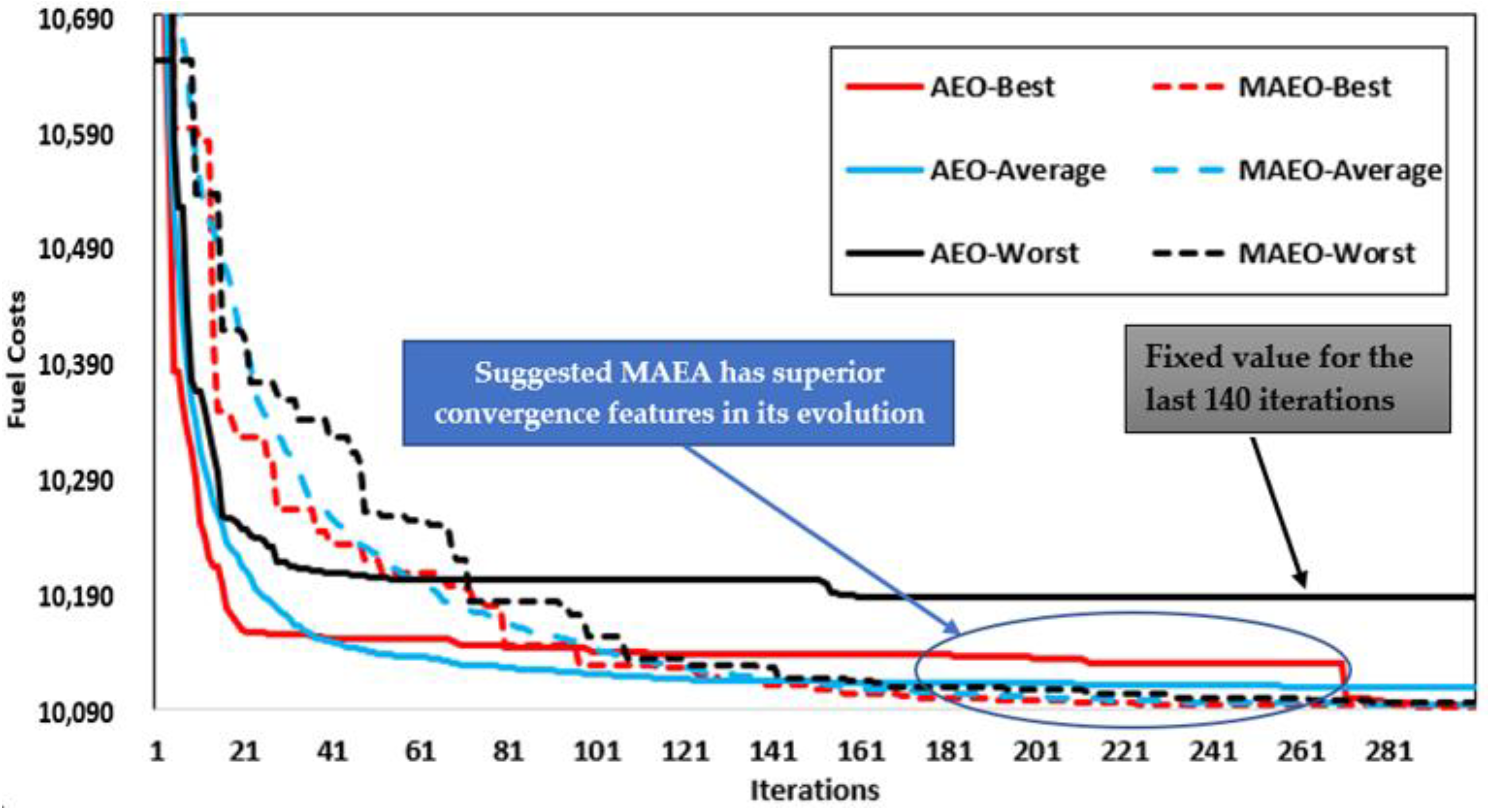
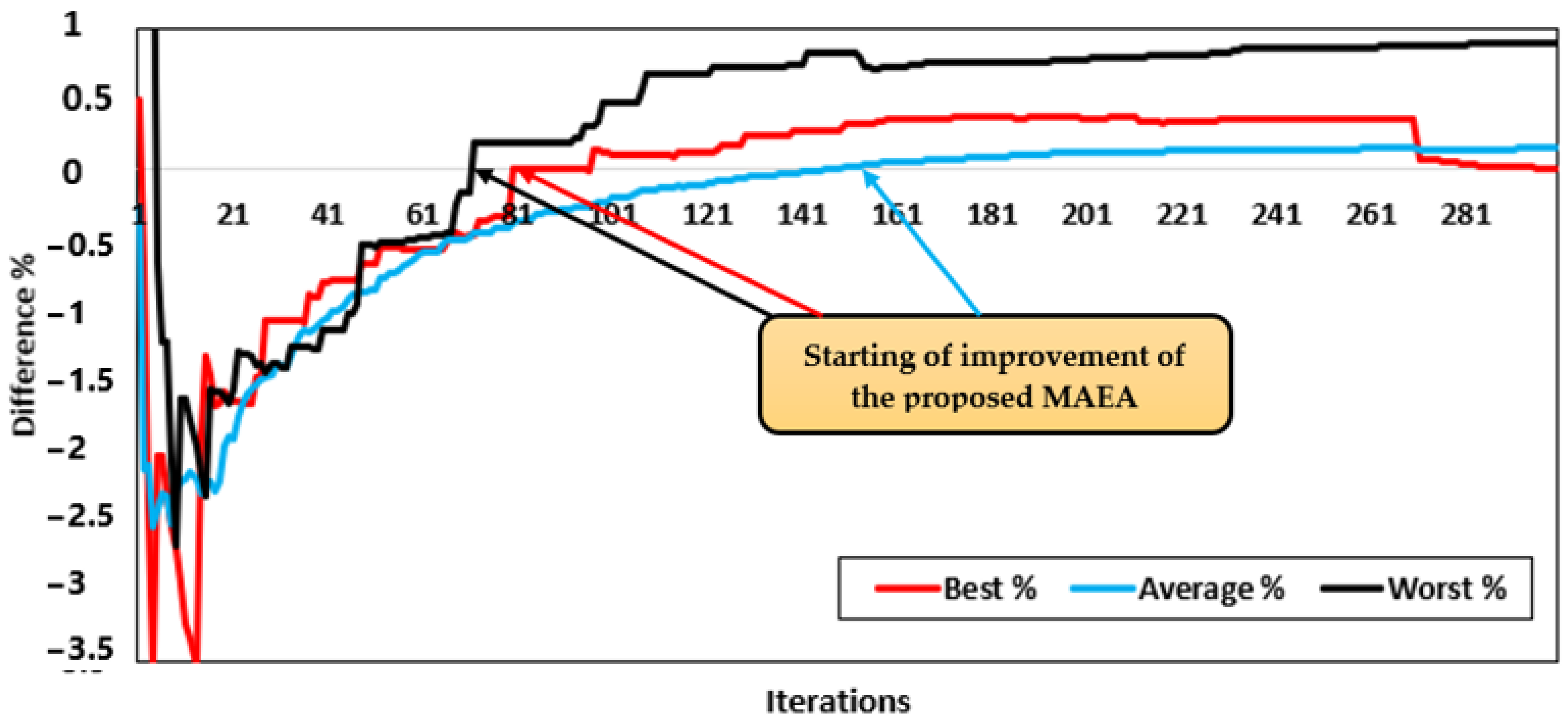
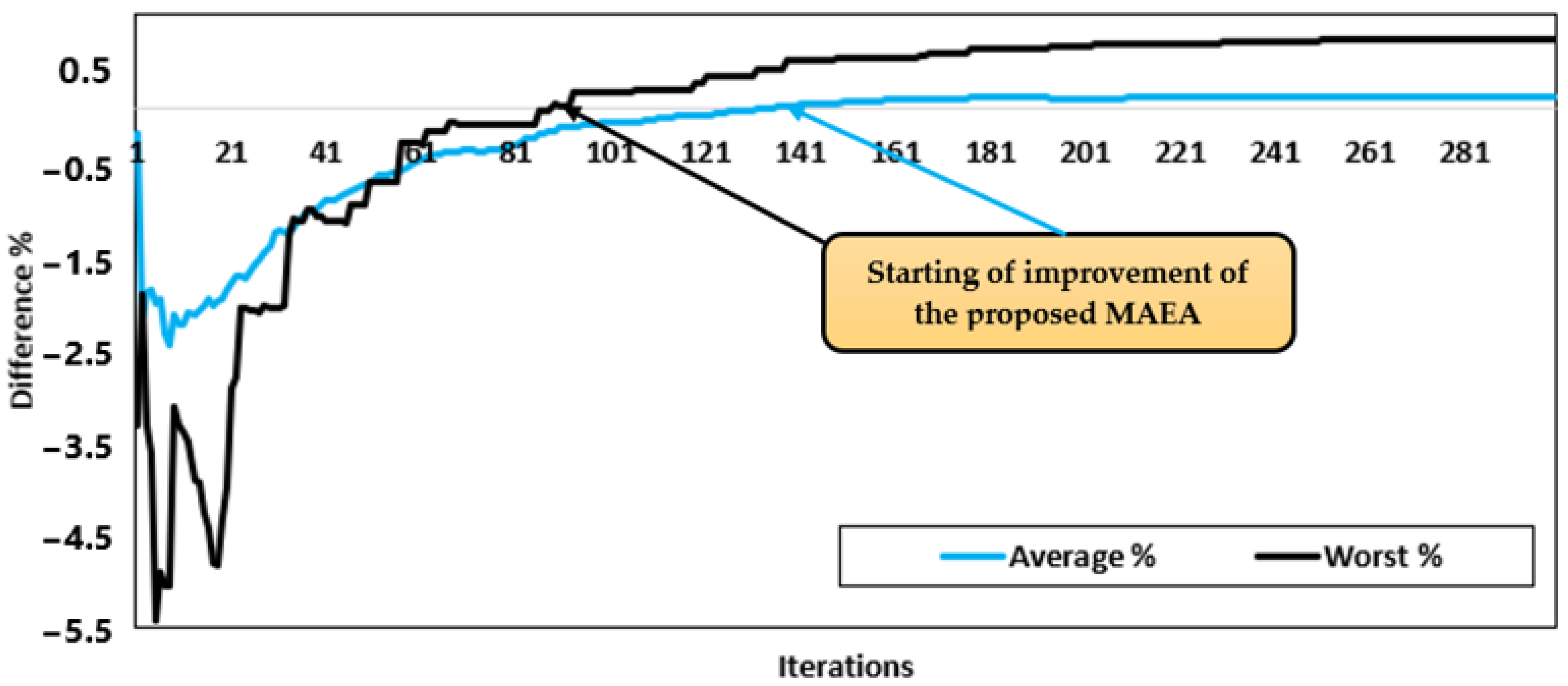
In addition, Figure 8 displays the convergence rates of the proposed MAEA and the basic AEA related to the best run, worst run, and the average of all simulated runs. As demonstrated, the suggested MAEA has superior convergence features in its evolution in terms of lowering fuel expenditures throughout the duration of iterations. Despite achieving lower fitness values in the first 140 iterations, the AEA remained in a local optimal zone, particularly for its best run. Focusing on the average and worst performance of the AEA and MAEA, the difference between the obtained convergence of the MAEA and AEA of Case 2 is shown in Figure 9, confirming the considerable improvement of the proposed MAEA after about 43% and 28% of the total number of iterations for the average and worst situations.
Figure 8.
Convergence rates of the proposed MAEA and the basic AEA of Case 2.
Figure 9.
Percentage difference for the worst run and the average of all runs of the MAEA and AEA of Case 2.
4.3. Implementation for Case 3
In this case, the 48-unit system is considered where the load demand and heat demand are 4700 MW and 2500 MWth, respectively. The suggested MAEA and basic AEA are employed to solve the ED with CHPUs to minimize the fuel cost without considering the losses. Table 6 depicts the optimal settings of the POUs, CHPUs, and HOUs. According to this data, the suggested MAEA achieves remarkable results by having the lowest fuel costs of 116,897.9 USD/h. The basic AEA, on the other hand, attains fuel costs of 118,881.4 USD/h.
Table 6.
Optimal operational settings and related costs of the proposed MAEA and the basic AEA of Case 3.
In addition, Figure 10 displays the obtained costs for all simulated runs of the proposed MAEA and the basic AEA of Case 3. As shown, the superior performance of the proposed MAEA is declared over the basic AEA in all simulated runs. The improvement percentage ranges from the very small value of 1.67% to 3.99%.
Figure 10.
Obtained costs for all simulated runs of the proposed MAEA and the basic AEA of Case 3.
Added to that, Table 7 records the corresponding robustness metrics of the proposed MAEA and the basic AEA of Case 3. The proposed MAEA greatly outperforms the basic AEA. The proposed MAEA acquires the lowest minimum, mean, maximum, and standard deviation of 116,897.89, 118,004.35, 119,424.03, and 597.05 USD/h with improvements of 1.69, 1.7, 4, and 46.03%, respectively.
Table 7.
Robustness metrics of the proposed MAEA and the basic AEA of Case 3.
In addition, comparisons are made with the results of powerful optimization algorithms used in solving ED problems in the literature. For this purpose, Table 8 displays the comparative assessment of the AEA and proposed MAEA with reported algorithms of CPSO [41], GSA [15], MRFO [47], TVAC-PSO [41], MVO [47], and SSA [47]. As shown, the suggested MAEA provides better-performing features compared with the others.
Table 8.
Comparative Results for Case 3 for the 48-Unit System.
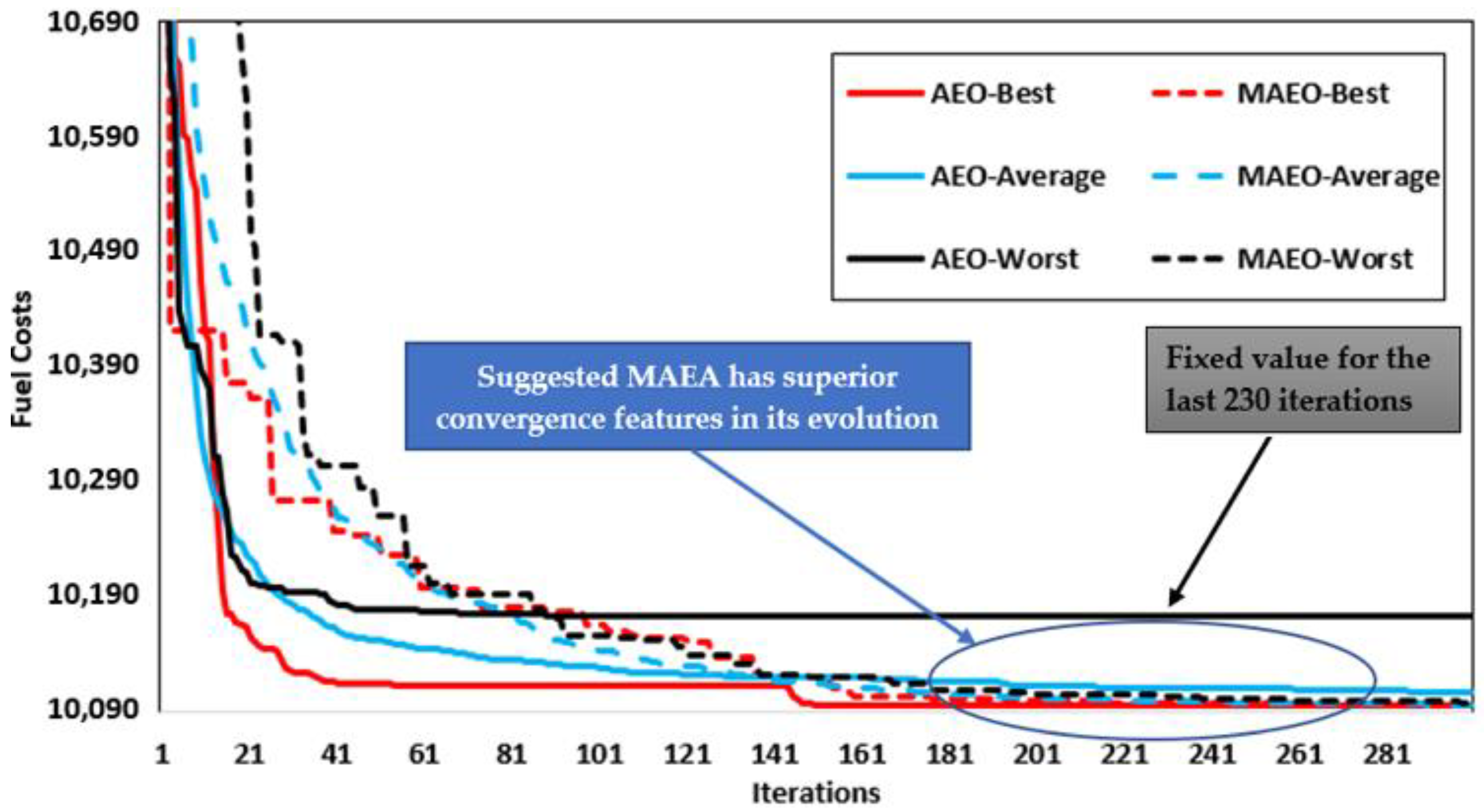
Figure 11 displays the convergence rates of the proposed MAEA and the basic AEA related to the best run, worst run, and the average of all simulated runs. The suggested MAEA has superior convergence features in its evolution in terms of lowering fuel expenditures throughout the duration of iterations. Despite achieving lower fitness values in the first 200 iterations, the AEA remained in a local optimal zone, particularly for its best run. The difference between the best run, worst run, and the average of all runs of the MAEA and AEA of Case 3 is shown in Figure 12, confirming the considerable improvement of the proposed MAEA after about 13%, 6.2%, and 4.5% of the total number of iterations for the average, best, and worst situations.
Figure 11.
Convergence rates of the proposed MAEA and the basic AEA of Case 3.
Figure 12.
Percentage difference for the best, worst run, and the average of all runs of the MAEA and AEA of Case 3.
4.4. Implementation for Case 4
The suggested MAEA and basic AEA are employed to solve the ED with CHPUs to minimise fuel expenditures, taking into consideration the power losses. Table 9 illustrates the optimal settings of the POUs, CHPUs, and HOUs. According to this data, the suggested MAEA achieves remarkable results by having the lowest fuel costs of 118,134.96 USD/h. The basic AEA, on the other hand, attains fuel costs of 118,793.85 USD/h.
Table 9.
Optimal operational settings and related costs of the proposed MAEA and the basic AEA of Case 4.
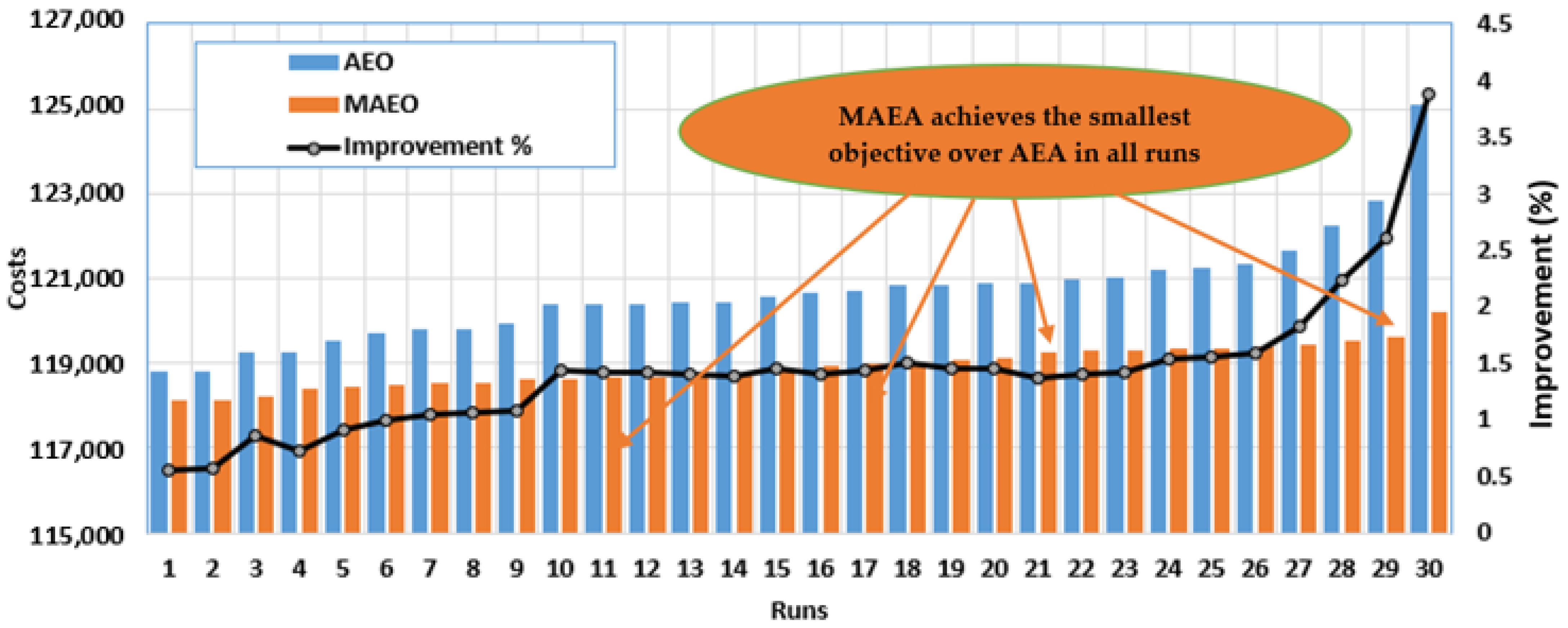
In addition, Figure 13 displays the obtained costs for all simulated runs of the proposed MAEA and the basic AEA of Case 4. As shown, the superior performance of the proposed MAEA is declared over the basic AEA in all simulated runs. The improvement percentage ranges from the very small value of 0.55% to 3.87%.
Figure 13.
Obtained costs for all simulated runs of the proposed MAEA and the basic AEA of Case 4.
In addition, Table 10 records the robustness metrics of the proposed MAEA and the basic AEA of Case 4. As shown, superior resilience performance related to the proposed MAEA is declared over the basic AEA. The proposed MAEA acquires the lowest minimum, mean, maximum, and standard deviation of 118,134.96, 118,925.83, 120,226.61, and 489.6 USD/h with improvements of 0.55, 1.44, 3.87, and 60.57%, respectively.
Table 10.
Robustness metrics of the proposed MAEA and the basic AEA of Case 4.
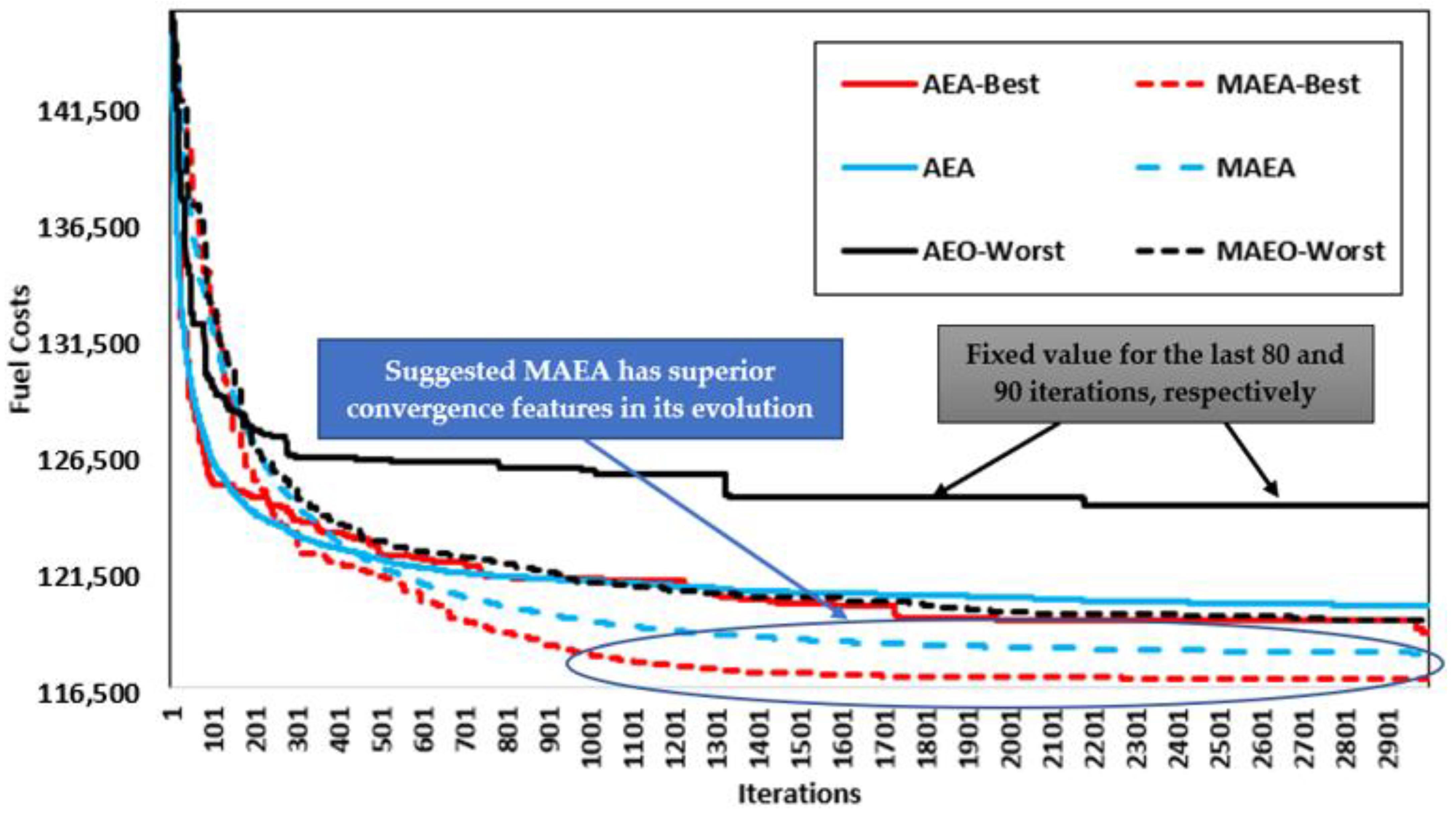
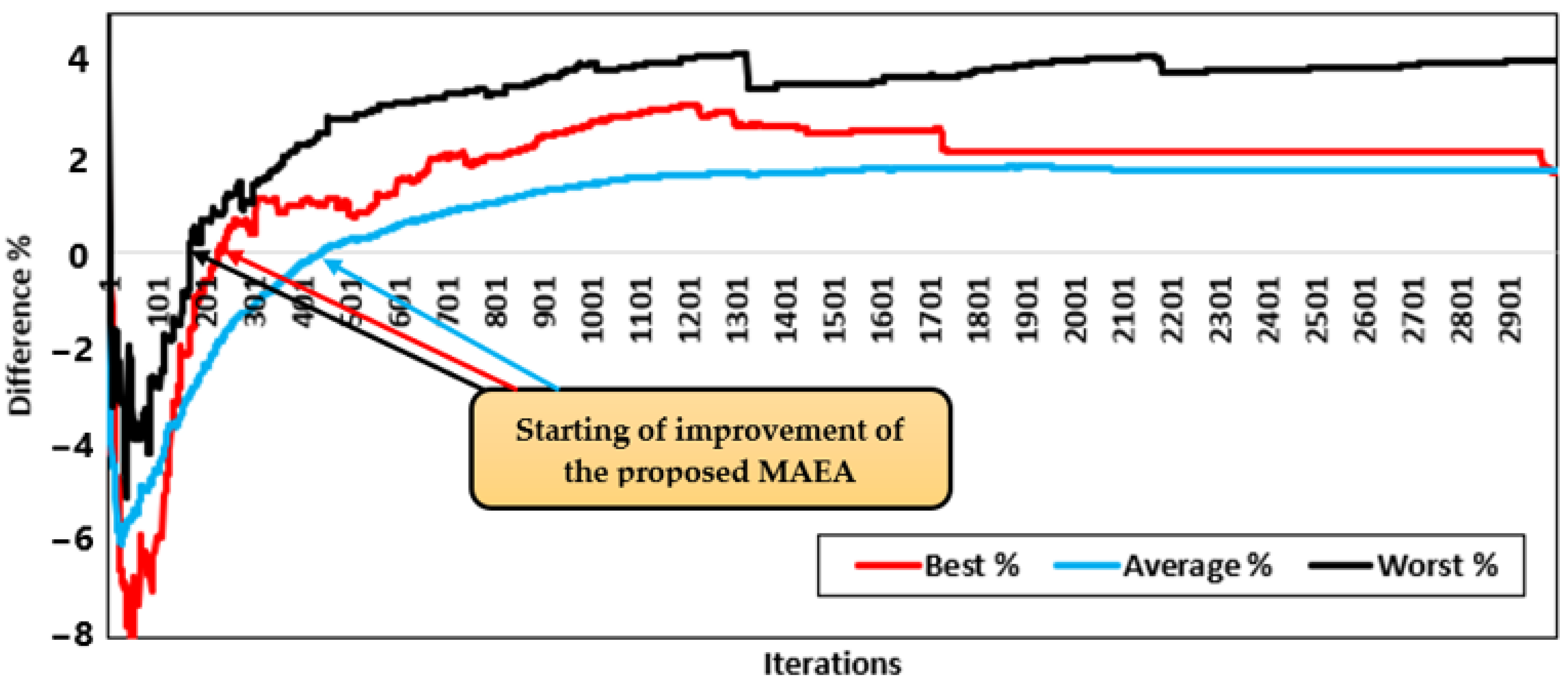
In addition, the convergence rates of the proposed MAEA and the basic AEA related to the best run, worst run, and the average of all simulated runs are displayed in Figure 14. The suggested MAEA has superior convergence features in its evolution in terms of lowering fuel expenditures throughout the duration of iterations. Despite achieving lower fitness values in the first 500 iterations, the AEA remained in a local optimal zone, particularly for its best run. The difference between the best run, worst run, and the average of all runs of the MAEA and AEA of Case 4 is shown in Figure 15, confirming the considerable improvement of the proposed MAEA after about 20%, 27%, and 10% of the total number of iterations for the average, best, and worst situations.
Figure 14.
Convergence rates of the proposed MAEA and the basic AEA of Case 4.
Figure 15.
Percentage difference for the worst run and the average of all runs of the MAEA and AEA of Case 4.
5. Conclusions
In this paper, a promising solution methodology based on a novel Modified Artificial Ecosystem Algorithm (MAEA) with superior performance and significant convergence has been proposed for solving the Economic Dispatch (ED) with Combined Heat and Power Units (CHPUs). The proposed MAEA combines the original AEA with a Fitness Distance Balance Model (FDBM) to increase solution quality in non-linear and multivariate optimization contexts. The FDBM was used as a method of selecting individuals which will contribute the most to the seeking paths within a community in a dependable and productive manner. As a result, the processes of diversification and intensification were carried out in a balanced manner. Both algorithms have been carried out in comparison using the 7-unit and 48-unit test systems. The suggested MAEA significantly outperforms the basic AEA with and without loss considerations. The suggested MAEA indicates superior resilience over the basic AEA by acquiring the lowest minimum, mean, maximum, and standard deviation. In addition, the suggested MAEA has superior convergence features in its evolution in terms of lowering fuel expenditures throughout the duration of iterations. As a further future study, applied methodology via the suggested MAEA is recommended for the optimal ED of cogeneration units considering the variability of electricity prices on the market which is a significant issue. Even though many CHPUs benefit from a tariff model with a fixed offtake price, it is recommended that the model is upgraded with external market signals in determining the optimal dispatch scenario.
Author Contributions
Conceptualization, A.M. and R.E.-S.; Methodology, R.E.-S., A.S. and A.G.; Software, A.S.; Validation, Z.M.S.E.; Formal analysis, A.M. and R.E.-S.; Investigation, R.E.-S.; Resources, A.S., A.G. and Z.M.S.E.; Data curation, A.M.; Writing—original draft, A.G.; Writing—review & editing, R.E.-S., A.S. and Z.M.S.E.; Project administration, A.G.; Funding acquisition, Z.M.S.E. All authors have read and agreed to the published version of the manuscript.
Funding
This research was funded by Deanship of Scientific Research at King Khalid University through the General Research Project under Grant number (RGP.1/223/43).
Institutional Review Board Statement
Not applicable.
Informed Consent Statement
Not applicable.
Data Availability Statement
Not applicable.
Acknowledgments
The authors extend their appreciation to the Deanship of Scientific Research at King Khalid University for funding this work through the General Research Project under Grant number (RGP.1/223/43).
Conflicts of Interest
The authors declare no conflict of interest.
Abbreviations
| AEA | Artificial ecosystem algorithm |
| BCO | Bee colony optimization |
| CHPUs | Combined heat and power units |
| CHPEED | Combined heat and power economic environmental dispatch |
| CSA | Cuckoo search algorithm |
| DE | Differential evolution |
| DRL | Deep reinforcement learning |
| ECSA | Effective cuckoo search algorithm |
| ED | Economic dispatch |
| FDBM | Fitness distance balance model |
| GSA | Gravitational search algorithm |
| HOU | Heat-only unit |
| IGA | Improved genetic algorithm |
| MAs | Metaheuristic algorithms |
| MAEA | Modified artificial ecosystem algorithm |
| MPA | Marine predator algorithm |
| MPHS | Multi-player harmony search |
| MRFO | Manta-ray foraging optimizer |
| MVO | Multi-verse optimizer |
| POU | Power-only unit |
| PSO | particle swarm optimization |
| PV | Photovoltaic |
| SSA | Salp swarm algorithm |
| TVAC-PSO | PSO with time varying acceleration coefficients |
| WVO | Weighted vertices optimization |
| NGU | Number of POUs |
| NHU | Number of HOUs |
| NCHPU | Number of CHPUs |
| Cm(Pgm) | Cost function for POUs |
| Cn(Hgn) | Cost function for HOUs |
| Ck(Pgk,Hgk) | Cost function for CHPUs |
| α1:α5 | Cost coefficients of POUs |
| φ1:φ3 | Cost coefficients of HOUs |
| β1:β6 | Cost coefficients of CHPUs |
| ‘min’ and ‘max’ | Lowest and highest bounds |
| PowerD | Total electric and heat demands |
| HeatD | Total electric and heat demands |
| PLoss | Total losses |
| Bji | Coefficient element in the B-matrix |
References
- Halim, A.H.; Ismail, I.; Das, S. Performance assessment of the metaheuristic optimization algorithms: An exhaustive review. Artif. Intell. Rev. 2021, 54, 3. [Google Scholar] [CrossRef]
- Kazda, K.; Li, X. A critical review of the modeling and optimization of combined heat and power dispatch. Processes 2020, 8, 441. [Google Scholar] [CrossRef]
- Sarhan, S.; Shaheen, A.; El-Sehiemy, R.; Gafar, M. A Multi-Objective Teaching-Learning Studying-Based Algorithm for Large-Scale Dispatching of Combined Electrical Power and Heat Energies. Mathematics 2022, 10, 2278. [Google Scholar] [CrossRef]
- Zhao, J.; Chen, L.; Wang, Y.; Liu, Q. A review of system modeling, assessment and operational optimization for integrated energy systems. Sci. China Inf. Sci. 2021, 64, 9. [Google Scholar] [CrossRef]
- Yu, W.; Li, C.; Yu, X.; Wen, G.; Lü, J. Economic power dispatch in smart grids: A framework for distributed optimization and consensus dynamics. Sci. China Inf. Sci. 2018, 61, 012204. [Google Scholar] [CrossRef]
- Wang, Y.; Li, B.; Yuan, B. Hybrid of comprehensive learning particle swarm optimization and SQP algorithm for large scale economic load dispatch optimization of power system. Sci. China Inf. Sci. 2010, 53, 8. [Google Scholar] [CrossRef]
- Yan, L.; Qu, B.; Zhu, Y.; Qiao, B.; Suganthan, P.N. Dynamic economic emission dispatch based on multi-objective pigeon-inspired optimization with double disturbance. Sci. China Inf. Sci. 2019, 62, 7. [Google Scholar] [CrossRef]
- Wang, K.; Fu, Z.; Xu, Q.; Chen, D.; Wang, L.; Yu, W. Distributed fixed step-size algorithm for dynamic economic dispatch with power flow limits. Sci. China Inf. Sci. 2021, 64, 112202. [Google Scholar] [CrossRef]
- Srivastava, A.; Das, D.K. A new Kho-Kho optimization Algorithm: An application to solve combined emission economic dispatch and combined heat and power economic dispatch problem. Eng. Appl. Artif. Intell. 2020, 94, 103763. [Google Scholar] [CrossRef]
- Ginidi, A.; Elsayed, A.; Shaheen, A.; Elattar, E.; El-Sehiemy, R. An Innovative Hybrid Heap-Based and Jellyfish Search Algorithm for Combined Heat and Power Economic Dispatch in Electrical Grids. Mathematics 2021, 9, 2053. [Google Scholar] [CrossRef]
- Bagherian, M.A.; Mehranzamir, K. A comprehensive review on renewable energy integration for combined heat and power production. Energy Convers. Manag. 2020, 224, 113454. [Google Scholar] [CrossRef]
- Al-Bahrani, L.; Seyedmahmoudian, M.; Horan, B.; Stojcevski, A. Solving the real power limitations in the dynamic economic dispatch of large-scale thermal power units under the effects of valve-point loading and ramp-rate limitations. Sustainability 2021, 13, 1274. [Google Scholar] [CrossRef]
- Li, L.; He, D.; Jin, J.; Yu, B.; Gao, X. Multi-objective load dispatch control of biomass heat and power cogeneration based on economic model predictive control. Energies 2021, 14, 762. [Google Scholar] [CrossRef]
- Jiang, Y.; Wan, C.; Botterud, A.; Song, Y.; Shahidehpour, M. Convex Relaxation of Combined Heat and Power Dispatch. IEEE Trans. Power Syst. 2021, 36, 2. [Google Scholar] [CrossRef]
- Beigvand, S.D.; Abdi, H.; la Scala, M. Combined heat and power economic dispatch problem using gravitational search algorithm. Electr. Power Syst. Res. 2016, 133, 160–172. [Google Scholar] [CrossRef]
- Mehdinejad, M.; Mohammadi-Ivatloo, B.; Dadashzadeh-Bonab, R. Energy production cost minimization in a combined heat and power generation systems using cuckoo optimization algorithm. Energy Effic. 2016, 10, 81–96. [Google Scholar] [CrossRef]
- Zhou, S.; Hu, Z.; Gu, W.; Jiang, M.; Chen, M.; Hong, Q.; Booth, C. Combined heat and power system intelligent economic dispatch: A deep reinforcement learning approach. Int. J. Electr. Power Energy Syst. 2020, 120, 106016. [Google Scholar] [CrossRef]
- Kim, M.J.; Kim, T.S.; Flores, R.J.; Brouwer, J. Neural-network-based optimization for economic dispatch of combined heat and power systems. Appl. Energy 2020, 265, 114785. [Google Scholar] [CrossRef]
- Ginidi, A.R.; Elsayed, A.M.; Shaheen, A.M.; Elattar, E.E.; El-Sehiemy, R.A. A Novel Heap based Optimizer for Scheduling of Large-scale Combined Heat and Power Economic Dispatch. IEEE Access 2021, 9, 83695–83708. [Google Scholar] [CrossRef]
- Ara, A.L.; Shahi, N.M.; Nasir, M. CHP Economic Dispatch Considering Prohibited Zones to Sustainable Energy Using Self-Regulating Particle Swarm Optimization Algorithm. Iran. J. Sci. Technol. Trans. Electr. Eng. 2020, 44, 1147–1164. [Google Scholar] [CrossRef]
- Zou, D.; Gong, D. Differential evolution based on migrating variables for the combined heat and power dynamic economic dispatch. Energy 2020, 238, 121664. [Google Scholar] [CrossRef]
- Mellal, M.A.; Williams, E.J. Cuckoo optimization algorithm with penalty function and binary approach for combined heat and power economic dispatch problem. Energy Rep. 2020, 6, 2720–2723. [Google Scholar] [CrossRef]
- Shaheen, A.M.; Elsayed, A.M.; Ginidi, A.R.; L-Sehiemy, R.A.E.; Alharthi, M.M.; Ghoneim, S.S.M. A novel improved marine predators algorithm for combined heat and power economic dispatch problem. Alex. Eng. J. 2022, 61, 1834–1851. [Google Scholar] [CrossRef]
- Nazari-Heris, M.; Mohammadi-Ivatloo, B.; Gharehpetian, G.B. A comprehensive review of heuristic optimization algorithms for optimal combined heat and power dispatch from economic and environmental perspectives. Renew. Sustain. Energy Rev. 2018, 81, 2128–2143. [Google Scholar] [CrossRef]
- Shaheen, A.M.; El-Sehiemy, R.A.; Elattar, E.; Ginidi, A.R. An Amalgamated Heap and Jellyfish Optimizer for economic dispatch in Combined heat and power systems including N-1 Unit outages. Energy 2022, 246, 123351. [Google Scholar] [CrossRef]
- Zhao, W.; Wang, L.; Zhang, Z. Artificial ecosystem-based optimization: A novel nature-inspired meta-heuristic algorithm. Neural Comput. Appl. 2020, 32, 9383–9425. [Google Scholar] [CrossRef]
- Shaheen, A.; Elsayed, A.; Ginidi, A.; El-Sehiemy, R.; Elattar, E. Reconfiguration of electrical distribution network-based DG and capacitors allocations using artificial ecosystem optimizer: Practical case study. Alex. Eng. J. 2022, 61, 6105–6118. [Google Scholar] [CrossRef]
- Verma, A.S.; Choudhary, A.; Tiwari, S. Regression test suite minimization using modified artificial ecosystem optimization algorithm. J. Inf. Technol. Manag. 2021, 13, 22–41. [Google Scholar] [CrossRef]
- Niu, Y.; Yan, X.; Wang, Y.; Niu, Y. Dynamic opposite learning enhanced artificial ecosystem optimizer for IIR system identification. J. Supercomput. 2022, 78, 11. [Google Scholar] [CrossRef]
- Omotoso, H.O.; Al-Shaalan, A.M.; Farh, H.M.H.; Al-Shamma, A.A. Techno-Economic Evaluation of Hybrid Energy Systems Using Artificial Ecosystem-Based Optimization with Demand Side Management. Electronics 2022, 11, 204. [Google Scholar] [CrossRef]
- Elkholy, M.M.; El-Hameed, M.A.; El-Fergany, A.A. Artificial ecosystem-based optimiser to electrically characterise PV generating systems under various operating conditions reinforced by experimental validations. IET Renew. Power Gener. 2021, 15, 3. [Google Scholar] [CrossRef]
- Rizk-Allah, R.M.; El-Fergany, A.A. Artificial ecosystem optimizer for parameters identification of proton exchange membrane fuel cells model. Int. J. Hydrog. Energy 2021, 46, 75. [Google Scholar] [CrossRef]
- Sonmez, Y.; Duman, S.; Kahraman, H.T.; Kati, M.; Aras, S.; Guvenc, U. Fitness-distance balance based artificial ecosystem optimisation to solve transient stability constrained optimal power flow problem. J. Exp. Theor. Artif. Intell. 2022, 1–40. [Google Scholar] [CrossRef]
- Shaheen, A.M.; Ginidi, A.R.; El-Sehiemy, R.A.; Elattar, E.E. Optimal economic power and heat dispatch in Cogeneration Systems including wind power. Energy 2021, 225, 120263. [Google Scholar] [CrossRef]
- El-Sehiemy, R.; Shaheen, A.; Ginidi, A.; Elhosseini, M. A Honey Badger Optimization for Minimizing the Pollutant Environmental Emissions-Based Economic Dispatch Model Integrating Combined Heat and Power Units. Energies 2022, 15, 7603. [Google Scholar] [CrossRef]
- El-Sehiemy, R.; Hamida, M.A.; Elattar, E.; Shaheen, A.; Ginidi, A. Nonlinear Dynamic Model for Parameter Estimation of Li-Ion Batteries Using Supply-Demand Algorithm. Energies 2022, 15, 4556. [Google Scholar] [CrossRef]
- Basu, M. Combined heat and power economic emission dispatch using nondominated sorting genetic algorithm-II. Int. J. Electr. Power Energy Syst. 2013, 53, 135–141. [Google Scholar] [CrossRef]
- Mohammadi-Ivatloo, B.; Moradi-Dalvand, M.; Rabiee, A. Combined heat and power economic dispatch problem solution using particle swarm optimization with time varying acceleration coefficients. Electr. Power Syst. Res. 2013, 95, 9–18. [Google Scholar] [CrossRef]
- Zou, D.; Li, S.; Kong, X.; Ouyang, H.; Li, Z. Solving the combined heat and power economic dispatch problems by an improved genetic algorithm and a new constraint handling strategy. Appl. Energy 2019, 237, 646–670. [Google Scholar] [CrossRef]
- Nguyen, T.T.; Nguyen, T.T.; Vo, D.N. An effective cuckoo search algorithm for large-scale combined heat and power economic dispatch problem. Neural Comput. Appl. 2017, 30, 3545–3564. [Google Scholar] [CrossRef]
- Shaabani, Y.a.; Seifi, A.R.; Kouhanjani, M.J. Stochastic multi-objective optimization of combined heat and power economic/emission dispatch. Energy 2017, 141, 1892–1904. [Google Scholar] [CrossRef]
- Shi, B.; Yan, L.X.; Wu, W. Multi-objective optimization for combined heat and power economic dispatch with power transmission loss and emission reduction. Energy 2013, 56, 135–143. [Google Scholar] [CrossRef]
- Roy, P.K.; Paul, C.; Sultana, S. Oppositional teaching learning based optimization approach for combined heat and power dispatch. Int. J. Electr. Power Energy Syst. 2014, 57, 392–403. [Google Scholar] [CrossRef]
- Dolatabadi, S.; El-Sehiemy, R.A.; Zadeh, S.G. Scheduling of combined heat and generation outputs in power systems using a new hybrid multi-objective optimization algorithm. Neural Comput. Appl. 2020, 32, 10741–10757. [Google Scholar] [CrossRef]
- Basu, M. Bee colony optimization for combined heat and power economic dispatch. Expert Syst. Appl. 2011, 38, 13527–13531. [Google Scholar] [CrossRef]
- Basu, M. Combined heat and power economic dispatch by using differential evolution. Electr. Power Compon. Syst. 2010, 38, 996–1004. [Google Scholar] [CrossRef]
- Shaheen, A.M.; Ginidi, A.R.; El-Sehiemy, R.A.; Ghoneim, S.S.M. Economic Power and Heat Dispatch in Cogeneration Energy Systems Using Manta Ray Foraging Optimizer. IEEE Access 2020, 8, 208281–208295. [Google Scholar] [CrossRef]
Publisher’s Note: MDPI stays neutral with regard to jurisdictional claims in published maps and institutional affiliations. |
© 2022 by the authors. Licensee MDPI, Basel, Switzerland. This article is an open access article distributed under the terms and conditions of the Creative Commons Attribution (CC BY) license (https://creativecommons.org/licenses/by/4.0/).