


Production Plant and Warehouse Automation with IoT and Industry 5.0

 , , ,
, , ,  ,
, 
Abstract
:1. Introduction
- Cyber-Physical Systems (CPS);
- Internet of Things (IoT);
- Internet of Services (IoS);
- Smart factories
1.1. Motivation for the Article
1.2. Industry 4.0
1.2.1. Evolution of the Internet to IIoT
1.2.2. Technologies for Communication and Security
1.2.3. IoT-Based Architecture in Industrial Automation
- Detection/sensors layer;
- Communications layer;
- Application layer.
1.2.4. Research Methodology and Selection Criteria
1.3. Supply Chain, IoT, and Big Data
1.4. Existing Survey Deficiencies
- How can digitalization and IoT improve the industrial sectors, mainly the supply chain management cycle?
- How does IoT implementation affect the internal and external cross-communication of the organizational stakeholders in content to the SC performance?
- How much impact does IoT’s implementation have on the performance of the supply chain of an organization as well as on its sustainability?
- How can various IoT devices impact the flexibility, traceability, quality, cost, and monitoring in SCM?
- Is IoT and modernization always beneficial, rather than a manual supply chain?
- What future enhancements can be applied to this sector that can simplify and improve workload and tracking in the future?
2. Introduction to IoT
2.1. Applications of IoT
2.1.1. IoT Application in the Business Area
2.1.2. IoT in Process Automation
2.1.3. IoT in Production Testing
2.1.4. IoT and the Supply Chain
2.1.5. Temperature Monitoring/Controlling System
2.1.6. IoT and the Control Systems
2.1.7. IoT and Energy Efficient Systems
2.1.8. IoT and the Intelligent/Smart Manufacturing System
2.2. Challenges of IoT
3. Literature Review
4. Observations and Derivations
4.1. Major Industrial Challenges
4.2. Key Findings
4.3. Implementation Analysis
4.4. Development of IIoT in the Future
5. Discussion
- Hardware, including actuators, sensors, modules, and other gadgets;
- A middleware for data storage and analytics purposes;
- Frontend presentation.
6. IoT Contribution in Performance Indication
6.1. RFID for Identification and Tracking
6.2. Logistics Indicators
6.3. Industry Regulations and Process Control
6.4. Production Turnover
6.5. Testing and Surveillance Advancement
6.6. Humanless Manufacturing and Control
6.7. Supply Chain and Production Management
7. Challenges on the Platform Shift
7.1. Challenges
7.2. Data Management
7.3. Monitoring and Sensing
7.4. Protocols
7.5. Interoperability
7.6. Standardization
7.7. Legal Aspects
8. Industrial Achievements of IIoT
8.1. Economic Impact
8.2. Social Impacts
8.3. Security
9. Future Scope Directions
9.1. Cyber Security and Data Analytics
9.2. Combination of Blockchain and IoT
9.3. Cyber-Physical Production Systems
10. Conclusions
Author Contributions
Funding
Institutional Review Board Statement
Informed Consent Statement
Data Availability Statement
Conflicts of Interest
References
- Zanella, A.; Bui, N.; Castellani, A.; Vangelista, L.; Zorzi, M. Internet of Things for Smart Cities. IEEE Internet Things J. 2014, 1, 22–32. [Google Scholar] [CrossRef]
- Xu, L.D.; He, W.; Li, S. Internet of Things in industries: A survey. IEEE Trans. Ind. Inform. 2014, 10, 2233–2243. [Google Scholar] [CrossRef]
- Khaleel, H.; Conzon, D.; Kasinathan, P.; Brizzi, P.; Pastrone, C.; Pramudianto, F.; Eisenhauer, M.; Cultrona, P.A.; Rusinà, F.; Lukáč, G.; et al. ‘Heterogeneous applications, tools and methodologies in the car manufacturing industry through an IoT approach’ 2015. IEEE Syst. J. 2017, 11, 1412–1423. [Google Scholar] [CrossRef]
- Badarinath, R.; Prabhu, V.V. Advances in IoT (IoT) in Manufacturing. In Advances in Production Management Systems. The Path to Intelligent, Collaborative and Sustainable Manufacturing; Springer: Cham, Switzerland, 2017; pp. 111–118. [Google Scholar] [CrossRef] [Green Version]
- Yang, C.; Shen, W.; Wang, X. Applications of IoT in manufacturing. In Proceedings of the 2016 IEEE 20th International Conference on Computer Supported Cooperative Work in Design (CSCWD), Nanchang, China, 4–6 May 2016; pp. 670–675. [Google Scholar]
- Pan, Y.; White, J.; Schmidt, D.; Elhabashy, A.; Sturm, L.; Camelio, J.; Williams, C. Taxonomies for Reasoning About Cyber-physical Attacks in IoT-based Manufacturing Systems. IJIMAI 2017, 4, 45–54. [Google Scholar] [CrossRef] [Green Version]
- Gomaa, N.N.; Youssef, K.Y.; Abouelatta, M. An IoT-based energy-efficient system for the industrial sector. In Proceedings of the 2019 15th International Computer Engineering Conference (ICENCO), Cairo, Egypt, 29–30 December 2019; 1109. [Google Scholar] [CrossRef]
- Lin, J.D.; Cheng, A.M.K.; Gercek, G. Partitioning Real-Time Tasks With Replications on Multiprocessor Embedded Systems. IEEE Embed. Syst. Lett. 2016, 8, 89–92. [Google Scholar] [CrossRef]
- Brusakova, I.A.; Borisov, A.D.; Gusko, G.R.; Nekrasov, D.Y.; Malenkova, K.E. Prospects for the development of IIoT technology in Russia. In Proceedings of the IEEE Conference of Russian Young Researchers in Electrical and Electronic Engineering (EIConRus), St. Petersburg/Moscow, Russia, 1–3 February 2017. [Google Scholar]
- Zhou, L.; Guo, H. Anomaly Detection Methods for IIoT Networks. In Proceedings of the IEEE International Conference on Service Operations and Logistics, and Informatics (SOLI), Singapore, 31 July–2 August 2018. [Google Scholar]
- Zhang, C.; Chen, Y. A Review of Research Relevant to the Emerging Industry Trends: Industry 4.0, IoT, Blockchain, and Business Analytics. J. Ind. Integr. Manag. 2020, 5, 165–180. [Google Scholar] [CrossRef]
- Aleksic, S. A Survey on Optical Technologies for IoT, Smart Industry, and Smart Infrastructures. J. Sens. Actuator Netw. 2019, 8, 47. [Google Scholar] [CrossRef] [Green Version]
- Karmakar, A.; Dey, N.; Baral, T.; Chowdhury, M.; Rehan, M. Industrial Internet of Things: A Review. In Proceedings of the 2019 International Conference on Opto-Electronics and Applied Optics (Optronix), Kolkata, India, 18–20 March 2019. [Google Scholar] [CrossRef]
- Maheswari, C.; Perinchery, A.A.B.; Priyanka, E.; Ambika, K.; Narmatha, S.; Prenitha, A.; Monisha, M. Review on Online Monitoring and Control in Industrial Automation–An IoT Perspective. IOP Conf. Ser. Mater. Sci. Eng. 2021, 1055, 012034. [Google Scholar] [CrossRef]
- Arsénio, A.; Serra, H.; Francisco, R.; Nabais, F.; Andrade, J.; Serrano, E. Internet of Intelligent Things: Bringing artificial in-telligence into things and communication networks. In Inter-Cooperative Collective Intelligence: Techniques and Applications; Springer: Berlin/Heidelberg, Germany, 2014; Volume 495, pp. 1–37. [Google Scholar]
- Goundar, S.; Bhardwaj, A.; Nur, S.S.; Kumar, S.S.; Harish, R. Industrial Internet of Things: Benefit, Applications, and Challenges. In Innovations in the Industrial Internet of Things (IIoT) and Smart Factory; IGI Global: Wellington, New Zealand, 2021; pp. 133–148. [Google Scholar] [CrossRef]
- Yadav, S.K.; Sharma, K. Industrial Automation: Overview of the IoT (IoT). Int. J. Sci. Eng. Res. 2017, 8, 75–81. [Google Scholar]
- Rao, P.; Saluia, P.; Sharma, N.; Mittal, A.; Sharma, S.V. Cloud computing for IoT & sensing-based applications. In Proceedings of the 2012 6th International Conference on Sensing Technologies (ICST), Kolkata, India, 18–21 December 2012; pp. 374–380. [Google Scholar]
- Mahmud, B. IoT (IoT) for Manufacturing Logistics on SAP ERP Applications. J. Telecommun. Electron. Comput. Eng. 2017, 9, 43–47. [Google Scholar]
- Lahti, J.P.; Helo, P.; Shamsuzzoha, A.; Phusavat, K. IoT in electricity supply chain: Review and evaluation. In Proceedings of the 2017 15th International Conference on ICT and Knowledge Engineering (ICT&KE), Bangkok, Thailand, 22–24 November 2017; pp. 1–6. [Google Scholar] [CrossRef]
- Salah, B. Real-Time Implementation of a Fully Automated Industrial System Based on IR 4.0 Concept. Actuators 2021, 10, 318. [Google Scholar] [CrossRef]
- Sciforce Article. Available online: https://medium.com/sciforce/how-to-recognize-industrial-internet-of-things-f27ccae1ac69 (accessed on 28 November 2021).
- González, I.; Calderón, A.J.; Figueiredo, J.; Sousa, J.M.C. A Literature Survey on Open Platform Communications (OPC) Applied to Advanced Industrial Environments. Electronics 2019, 8, 510. [Google Scholar] [CrossRef] [Green Version]
- Ungurean, I.; Gaitan, N.-C.; Gaitan, V.G. An IoT architecture for things from the industrial environment. In Proceedings of the 2014 10th International Conference on Communications (COMM), Bucharest, Romania, 29–31 May 2014; pp. 1–4. [Google Scholar]
- Rathee, G.; Balasaraswathi, M.; Chandran, K.P.; Gupta, S.D.; Boopathi, C.S. A secure IoT sensors communication in industry 4.0 using blockchain technology. J. Ambient. Intell. Humaniz. Comput. 2021, 12, 533–545. [Google Scholar] [CrossRef]
- Chen, W. Intelligent manufacturing production line data monitoring system for industrial internet of things. Comput. Commun. 2020, 151, 31–41. [Google Scholar] [CrossRef]
- Hussein, A.H. IoT (IoT): Research Challenges and Future Applications. Int. J. Adv. Comput. Sci. Appl. 2019, 10, 77–82. [Google Scholar] [CrossRef]
- Mondal, D. The internet of thing (IoT) and industrial automation: A future perspective. World J. Model. Simul. 2019, 15, 140–149. [Google Scholar]
- Mourtzis, D.; Vlachou, E.; Milas, N. Industrial Big Data as a result of IoT adoption in Manufacturing. Procedia CIRP 2016, 55, 290–295. [Google Scholar] [CrossRef] [Green Version]
- Routray, S.K.; Sharmila, K.P.; Javali, A.; Ghosh, A.D.; Sarangi, S. An Outlook of Narrowband IoT for Industry 4.0. In Proceedings of the 2020 Second International Conference on Inventive Research in Computing Applications (ICIRCA), Coimbatore, India, 15–17 July 2020; pp. 923–926. [Google Scholar]
- Aslam, F.; Aimin, W.; Li, M.; Ur Rehman, K. Innovation in the Era of IoT and Industry 5.0: Absolute Innovation Management (AIM) Framework. Information 2020, 11, 124. [Google Scholar] [CrossRef] [Green Version]
- Maga, C.; Jazdi, N. Concept of a domain repository for industrial automation. In Proceedings of the First International Workshop on Domain Engineering, Amsterdam, The Netherlands, 8–12 June 2009. [Google Scholar]
- Boyes, H.; Hallaq, B.; Cunningham, J.; Watson, T. The industrial IoT (IIoT): An analysis framework. Comput. Ind. 2018, 101, 1–12. [Google Scholar] [CrossRef]
- Sujay, L. Vailshery IoT (IoT)—Statistics & Facts; Statista Research Department: Hamburg, Germany, 2021. [Google Scholar]
- Ding, L.; Jiang, W.; Zhou, Y.; Zhou, C.; Liu, S. BIM-based task-level planning for robotic brick assembly through image-based 3D modeling. Adv. Eng. Inform. 2019, 43, 100993. [Google Scholar] [CrossRef]
- Alladi, T.; Chamola, V.; Parizi, R.M.; Choo, K.-K.R. Blockchain Applications for Industry 4.0 and Industrial IoT: A Review. IEEE Access 2019, 7, 176935–176951. [Google Scholar] [CrossRef]
- Chang, K.-H. Bluetooth: A viable solution for IoT? [Industry Perspectives]. IEEE Wirel. Commun. 2014, 21, 6–7. [Google Scholar] [CrossRef]
- Aich, S.; Chakraborty, S.; Sain, M.; Lee, H.-I.; Kim, H.-C. A Review on Benefits of IoT Integrated Blockchain based Supply Chain Management Implementations across Different Sectors with Case Study. In Proceedings of the 2019 21st International Conference on Advanced Communication Technology (ICACT), PyeongChang, Korea, 17–20 February 2019; pp. 138–141. [Google Scholar] [CrossRef]
- Wang, G.; Shi, Z.; Nixon, M.; Han, S. ChainS plitter: Towards Blockchain-Based Industrial IoT Architecture for Supporting Hierarchical Storage. In Proceedings of the 2019 IEEE International Conference on Blockchain (Blockchain), Atlanta, GA, USA, 14–17 July 2019; pp. 166–175. [Google Scholar]
- Bai, L.; Hu, M.; Liu, M.; Wang, J. BPIIoT: A Light-Weighted Blockchain-Based Platform for Industrial IoT. IEEE Access 2019, 7, 58381–58393. [Google Scholar] [CrossRef]
- Xu, Y.; Ren, J.; Wang, G.; Zhang, C.; Yang, J.; Zhang, Y. A Blockchain-Based Nonrepudiation Network Computing Service Scheme for Industrial IoT. IEEE Trans. Ind. Inform. 2019, 15, 3632–3641. [Google Scholar] [CrossRef]
- Wang, Q.; Zhu, X.; Ni, Y.; Gu, L.; Zhu, H. Blockchain for the IoT and industrial IoT: A review. Internet Things 2020, 10. [Google Scholar] [CrossRef]
- Kumar, A.S.; Iyer, E. An Industrial IoT in Engineering and Manufacturing Industries—Benefits and Challenges. Int. J. Mech. Prod. Eng. Res. Dev. 2019, 9, 151–160. [Google Scholar] [CrossRef]
- Hassan, M.U.; Rehmani, M.H.; Chen, J. Privacy preservation in blockchain-based IoT systems: Integration issues, prospects, challenges, and future research directions. Future Gener. Comput. Syst. 2019, 97, 512–529. [Google Scholar] [CrossRef]
- Breivold, H.P.; Jansen, A.; Sandström, K.; Crnkovic, I. Virtualize for architecture sustainability in industrial automation. In Proceedings of the 2013 IEEE 16th International Conference on Computational Science and Engineering, Sydney, NSW, Australia, 3–5 December 2013; pp. 409–415. [Google Scholar]
- Arvind, R.V.; Raj, R.R.; Raj, R.R.; Prakash, N.K. Industrial automation using wireless sensor networks. Indian J. Sci. Technol. 2016, 9, 1–8. [Google Scholar] [CrossRef]
- Breivold, H.P.; Sandström, K. Virtualize for test environment in industrial automation. In Proceedings of the 2014 IEEE Emerging Technology and Factory Automation (ETFA), Barcelona, Spain, 16–19 September 2014; pp. 1–8. [Google Scholar]
- Huang, J.; Kong, L.; Chen, G.; Wu, M.-Y.; Liu, X.; Zeng, P. Towards Secure Industrial IoT: Blockchain System With Credit-Based Consensus Mechanism. IEEE Trans. Ind. Inform. 2019, 15, 3680–3689. [Google Scholar] [CrossRef]
- Zhao, S.; Li, S.; Yao, Y. Blockchain-Enabled Industrial IoT Technology. IEEE Trans. Comput. Soc. Syst. 2019, 6, 1442–1453. [Google Scholar] [CrossRef]
- Santhosh, N.; Srinivasan, M.; Ragupathy, K. IoT (IoT) in smart manufacturing. IOP Conf. Ser. Mater. Sci. Eng. 2020, 76, 012025. [Google Scholar] [CrossRef]
- Cano, J.C.; Berrios, V.; Garcia, B.; Toh, C.K. Evolution of IoT: An Industry Perspective. IEEE Internet Things Mag. 2018, 1, 12–17. [Google Scholar] [CrossRef]
- Faul, A.; Jazdi, N.; Weyrich, M. Approach to interconnect existing industrial automation systems with the Industrial Internet. In Proceedings of the 2016 IEEE 21st International Conference on Emerging Technologies and Factory Automation (ETFA), Berlin, Germany, 6–9 September 2016; pp. 1–4. [Google Scholar]
- Okano, M.T. IoT and industry 4.0: The industrial new revolution. In Proceedings of the International Conference on Management and Information Systems, İstanbul, Turkey, 17–20 October 2017; Volume 25, p. 26. [Google Scholar]
- Teslya, N.; Ryabchikov, I. Blockchain-based platform architecture for industrial IoT. In Proceedings of the 2017 21st Conference of Open Innovations Association (FRUCT), Helsinki, Finland, 6–10 November 2017; pp. 321–329. [Google Scholar] [CrossRef]
- Minchala, L.I.; Peralta, J.; Mata-Quevedo, P.; Rojas, J. An Approach to Industrial Automation Based on Low-Cost Embedded Platforms and Open Software. Appl. Sci. 2020, 10, 4696. [Google Scholar] [CrossRef]
- Trunzer, E.; Calà, A.; Leitão, P.; Gepp, M.; Kinghorst, J.; Lüder, A.; Schauerte, H.; Reifferscheid, M.; Vogel-Heuser, B. System architectures for Industrie 4.0 applications. Prod. Eng. 2019, 13, 247–257. [Google Scholar] [CrossRef] [Green Version]
- Givehchi, O.; Landsdorf, K.; Simoens, P.; Colombo, A.W. Interoperability for Industrial Cyber-Physical Systems: An Approach for Legacy Systems. IEEE Trans. Ind. Inform. 2017, 13, 3370–3378. [Google Scholar] [CrossRef]
- Tawalbeh, L.; Muheidat, F.; Tawalbeh, M.; Quwaider, M. IoT Privacy and Security: Challenges and Solutions. Appl. Sci. 2020, 10, 4102. [Google Scholar] [CrossRef]
- Shenkoya, T.; Dae-Woo, C. Impact of IoT on social innovation in Japan. Asia Pac. J. Innov. Entrep. 2019, 13, 341–353. [Google Scholar] [CrossRef]
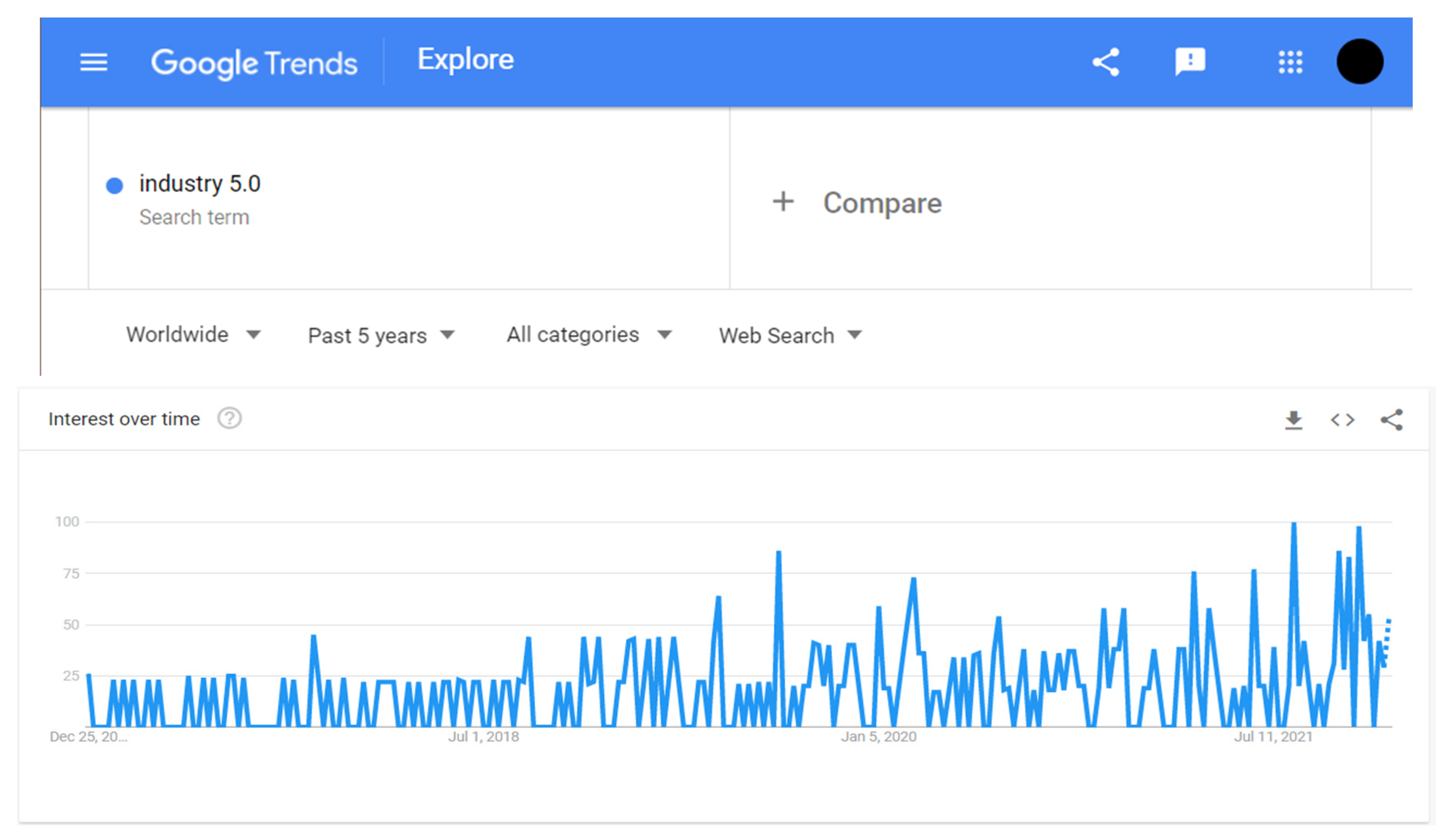
- Google Trends: Industry 5.0. Available online: https://trends.google.com/trends/explore?date=today%205-y&q=industry%205.0 (accessed on 28 November 2021).

| Keywords | Springer | IEEE Xplore | Science Direct | ACM |
|---|---|---|---|---|
| IoT in industry | 77 | 67 | 182 | 15 |
| Smart industry and IoT | 77 | 73 | 40 | 20 |
| Industrial automation and robots | 2 | 251 | 43 | 18 |
| Industrial 5.0 | 35 | 155 | 114 | 18 |
| Industrial 4.0 | 33 | 53 | 20 | 19 |
| Blockchain for IoT | 66 | 21 | 16 | 20 |
| Industrial automation using IoT | 34 | 29 | 106 | 10 |
| Paper Title | Technique/Proposed Methodology | The Issue Highlighted/Addressed | Proposed Architecture: Positive and Negative Points | Network Security Strong/Weak Also Named Security Schemes Applied | Technology | Material/ Devices Used |
|---|---|---|---|---|---|---|
| [35] | For large-scale industrial automation in Industry 4.0, narrowband IoT (NBIoT), a low power wide area (LPWA) technology, is proposed. | Industrial automation using IoT on a large scale consumes a large number of resources in terms of energy, bandwidth, and cost, which makes industrial automation a great issue. | No architecture is proposed. The paper highlights the benefits of using NBIoT in today’s large-scale industries. | In this paper, no such network security scheme is proposed or used. | Wi-Fi | IoT devices, sensors, actuators. |
| [36] | The absolute innovation management (AIM) framework is proposed in this paper, after reviewing the literature on the already proposed models and frameworks, to efficiently manage innovations with the emergence of IoT and Industry 5.0. | In the age of IoT and Industry 5.0, as well as the rapid advancements in information technology, innovation management and integration with business processes have become a major challenge. | The positive point of the AIM a framework is that it makes the innovation process more human-centered and also helps in making the process fast. The negative point is that the framework is just a proposal and needs further work and experimentation to make it implementable. | In this paper, no such network security scheme is proposed or used. | N/A | N/A |
| [37] | Develop an industrial automation system using reusable artifacts and the domain repository. | The complex automation functions and the technical process that uses real-time requirements. | This approach reuses work products, such as models of the technical processes and automation solutions. | No specified network security is used in this proposed concept. | N/A | Sensors, actuators, PLC, bus system. |
| [38] | IConnector offers system-dependent interfaces for industrial automation as well as universal interfaces for IoT. | The interconnection between the existing industrial automation systems with IoT, even if a different protocol of communication is used for industrial automation. | This method allows existing systems to handle internet technologies and thus participate in Industry 4.0. | Different communication protocols are used in this approach. | Various communication protocols. | I4.0 connector. |
| [39] | The technique of virtualization is used to visualize the industrial environment before implementing physical constraints, so that the cost, storage, and efforts can be reduced. | The high-cost requirements and risks associated with industrial testing and warehouse challenges in bulk testing and phenomenal quality assurance. | The proposed architecture is based upon the selection of tools and their impacts that provide a detailed platform to test and conduct QA on the industrial systems. The positive point is that the system is based upon conventional desktop tools and does not require heavy technical investments for deployment; however, the negative point is that the lack of sufficient technical knowledge and higher hardware-based operation may not be included under the scope of this architecture. | The virtualization architecture does not include specific network deployment. It only focuses on the automation of industrial test processes by any means that can help to reduce the risks and costs associated with physical testing. | Does not include any specific network recommendation to analyze the communication constraints. | Industry literature and case studies of system failures due to physical testing approaches. |
| [40] | The theoretical basis for the project’s analysis and construction was based on a survey on IoT and Industry 4.0. The quantitative analysis of the systematic review results provided an overview of the existing studies on IoT and Industry 4.0, as well as their significance. | The bibliographic research was carried out with two purposes: to gather knowledge about the concept of structured and unstructured data that compose the health area, and to find primary studies on the subject. | Does not include any specific network recommendation to analyze the architecture constraints. | Does not include any specific network recommendation to analyze the security constraints. | Does not include any specific network recommendation to analyze the communication constraints. | Web of Science and Semantics Scholar. |
| [41] | A secure wireless technique using wireless sensor networks. | This paper describes the implementation of one such WSN that can be used in industrial applications. | Does not include any specific network recommendation to analyze the architecture constraints. | Does not include any specific network recommendation to analyze the architecture constraints. | Wi-Fi and Bluetooth. | Sensors, IoT devices, actuators. |
| [42] | This study provides a detailed overview of virtualization in industrial automation for architecture sustainability. | This study highlights the issues faced in the different industries and recommends the solutions to automate industry techniques. | Does not include any specific network recommendation to analyze the architecture constraints. | Does not include any specific network recommendation to analyze the architecture constraints. | Wi-Fi | IoT devices, sensors, actuators. |
| [11] | The network’s security and quality of service (QoS) are being enhanced at the moment. | This study focuses on the industry’s inability to adapt to Industry 4.0, IoT, blockchain, and business analytics. | It does not propose any architecture to implement these technologies. | It does not include any recommendations to improve network security. | Wi-Fi | IoT devices, sensors, actuators. |
| [43] | This paper explores the various systems that can be developed by integrating IoT with blockchain to give rise to the fourth wave of IIoT, i.e., Industry 4.0. By utilizing the decentralized, distributed approach of blockchain, many systems can be made, including electric vehicle clouds and edge (EVCE), mobile commerce, trace food source, cloud storage, authentication and access management, big data, smart homes, and smart cities. This is because blockchain can record and sync the transactions and save information. | Security concerns of IIoT devices that inhibit the development of Industry 4.0 are scrutinized in this paper. | The discussion conducted by the authors is purely observational and theoretical; therefore, no architecture has been proposed to develop the mentioned applications. However, their research has emphasized how blockchain can advance all current systems in industry-based IoT. | The authors have highlighted blockchain to be the technology behind resolving network security issues for the mentioned IIoT systems. Anonymity, asymmetric encryption, and distributed control are the added benefits of using blockchain. However, some security issues persist, such as the culprits being able to form patterns from the publicly available information of the transactions and tracing roots of involved parties to dismantle the formed system. | Blockchain and a working Wi-Fi system are the main mediums of communication for all the applications. | The paper does not discuss the material/devices used to develop the systems. |
| [41] | The paper proposes a blockchain-based fair non-repudiation service provisioning scheme for IIoT scenarios, for which blockchain is used as an evidence recorder and service publisher. | There are several issues in the distrusted and distributed IIoT scenarios, due to malicious service providers or clients who can deny service provisions or usage for their interests. Traditional non-repudiation solutions are less effective in IIoT environments because of the demands of trusted third parties or unacceptable overheads. |
| Smart contracts. | Blockchain. | IoT clients and service providers. |
| [40] | This paper proposes the implementation of blockchain to support hierarchical storage for Industrial IoT architecture, and to provide immutable and verifiable services. |
|
| A blockchain connector is used to access control, manage permissions, verify and validate transactions. | Blockchain. | IoT storage, Data Engine, Gateway. |
| [44] | This paper proposes a technique to divide the architecture into two networks, namely the on-chain network and the off-chain network. The on-chain network will deal with the online transaction and digital signatures to ensure that the communication between our consumers and manufacturing resources is efficiently conducted and that smooth data transmission occurs. The off-chain network, on the other hand, will deal with the storage and load that checks correct code execution. In this way, network latency and load is made efficient. | Addresses the security, trust, and island connection problems in the process of Industrial IoT ecosystem construction, with blockchain techniques and smart contracts introduced into IoT. | Positive Points: 1. It uses mechanisms to enhance security; 2. It splits the network into the network to cater for blockchain issues, such as load and latency; 3. It resolves the trust problem between components with the help of a digital signature and access control mechanisms. | The network is highly secure as they have used secure multi-party computation and a secret sharing mechanism to guarantee data security and privacy. | Blockchain. | IoT Unit. |
| [43] | This paper proposes the implementation of blockchain to automate the conventional system used for the supply chain, so that data can be stored without possible errors and the thefts of goods. | The issues addressed in this paper are that the conventional systems do not usually offer the required amount of trust between the parties, they do not offer transparency of data, and they are usually prone to external attacks, such as theft and hiding information. | This paper only focuses on the benefits of automating the process in contrast to the conventional methods; hence, it does not possess explicit data regarding the said matter, except the strengths of the proposed technology. However, the data has greatly helped in setting the basis for carrying out the entire survey process. | Only provides a general overview and does not provide extensive research on how the said architecture is implemented. | Cryptographic keys, peer to peer communication. | Sensors were mainly used to keep track of the various products, to maintain the clean inventory records. |
| [45] | This paper proposes a mechanism that works on credit-based consensus for blockchain that enables the verified nodes to consume less power, whereas this makes it computationally difficult for the malicious nodes to penetrate the system while increasing the efficiency and throughput of the network. | The issue highlighted in this paper is that the chain structured blockchain-based systems cannot verify the continuous stream of data that is an integral part of the industrial sector; hence, the workflow of the system becomes slow and congestion starts occurring, resulting in the decreased performance of the network. | The positive point of the proposed architecture is that it greatly helps in enhancing the efficiency rate of the system and is extremely practical in various IIoT scenarios. The worst-case scenario is that it is still in its research phase; hence, it can only store a limited amount of data and is unable to have control over the quality of the sensory data. | The security of the network is extremely high as it is almost impossible to launch an attack on the network, because of the immense number of resources required to computationally solve complex mathematical problems to gain verification for carrying out illicit activities. | Raspberry Pi is used as the communication medium. | PC is used as the gateway, whereas Raspberry Pi Model 3B is used to serve the purpose of an IoT device. |
| [46] | This paper proposes to revolutionize IoT with the integration of blockchain and cryptocurrencies. It emphasizes the positive changes that will be seen when blockchain is used for data sharing throughout. It proposes a full node and lightweight node blockchain that enables IIoT architectures. | Many existing IIoT foundations depend on a centralized design, which is simpler for the board yet cannot effectively uphold the unchanging and unquestionable administrations among different gatherings. | The proposed architecture reduces redundancy, increases the security and privacy in data sharing, and makes the approach more efficient. | The network is highly secure, as data sharing through blockchain is safer than the conventional methods. | Blockchain. | IIoT service client, IIoT resource platform. |
| [47] | The lightweight blockchain platform for E-commerce transaction management, using the consensus mechanism called practical byzantine fault tolerance (PBFT) | The privacy and security concerns of IIoT devices that affect the development of Industry 4.0 are described to the point in this paper. | The industries of different sectors can benefit from the proposed architecture, a lot of examples of different sectors are given and reviewed in detail. | This 3-layered blockchain network is shown not only to be highly scalable and efficient but also to be secure against cyber-attacks. | Blockchain | PCs with sufficient computational powers are required. |
| [14] | The present study proposes several communication protocols and devices, the most effective of which are the LoRa protocol and ARM Cortex. | The study highlights the issue of the selection of the communication protocols and IoT devices in industries, and which technology is preferable for communication. | The architecture is based on the ARM Cortex and LoRa communication protocol. | The network security is strong. The LoRa protocol uses modern cryptography technology, which makes it very secure by design. | LoRa and Bluetooth protocols | ARM Cortex and Arduino. |
| [16] | This study focuses on the merits that Industrial IoT brings to the industries operating in different parts of the world, along with the challenges that arise due to IIoT. | This paper highlights the issues related to the lack of privacy in IIoT, and suggests a more thorough focus on the architecture of IIoT-based software to ensure that the interconnected devices are protected from any new attacks from communication channels. Additionally, the issues related to the lack of IIoT standards and cost for implementing IIoT are discussed. | Technology acceptance model to study the Fijian system—this model includes 8 major factors that show that the results of the test are: self-efficiency, risk cost, perceived usefulness and ease to use capability, actual use, compatibility, actual use, and behavioral intentions. | It analyzes the security of the present IIoT that, due to the lack of encryption techniques and absence of laws and regulation, can be attacked by unauthorized parties. This issue can be resolved if authors focus more on the encryption techniques for IIoT and the laws and regulation can control the unauthorized access. | Wi-Fi and Bluetooth | RFID tags, Wi-Fi, and sensors. |
| [17] | This study shows the overview of IoT in industrial automation, and discusses some of the advantages and disadvantages of automation and combined it with artificial intelligence to solve challenges. | Some challenges related to automation are highlighted. | Wireless communication and sensors, as well as RRFID-based architecture, are discussed, while it is further proposed to integrate IIoT with artificial intelligence to remove the disabilities present in commonly adopted architectures. | This paper shows the overview of IIoT that the network security of the present IIoT is not very good, but proposed that if AI is joined with IIoT so future security threats can be minimized, | Wireless sensor networks (WSNs). | RFIDs, CCTV, smart sensors. |
| [30] | The paper explains the usage of IoT in different domains, such as agriculture and industry, and also explains in detail all the research challenges that are faced in IoT. | The research challenges are highlighted, such as security, management of data, communication protocols, and interoperability. All these challenges are faced in IoT-based industrial solutions. | The paper proposes the fusion of blockchain and IoT, as blockchain is popular due to the security achieved by consensus algorithms. | for good network security, blockchain is used. The consensus algorithms used in blockchain will achieve the security of the network. | Wireless sensor networks (WSNs). | RFID tags, Wi-Fi, and sensors. |
| [28] | The paper explains the IoT-based architecture for industrial automation, and also explains the control systems used in industries that are based on IoT. it also explains the big data and cyber security view in IoT. | Some challenges are highlighted for security. | Proposed architecture: (IoT)-based architecture in industrial automation. | Good security, advanced network security, and monitoring tools, such as Generation Firewall (NGFW), IDS and IPS, Sandbox, anti-spam and antivirus, identity discovery, protocol analyzer, application control, and URL filtering. | Message queuing telemetry transport (MQTT), HTTP, and advanced message queuing protocol (AMQP). | IoT-based smart sensors; radio frequency identification (RFID) tag, remote input and output (I/O), and smart camera. |
| [7] | This article proposes an EMS based on the IoT (IoT) network that boosts the power quality for smart factories to establish an energy-efficient system. In addition, an architecture for improving the power quality in industries that follow ISO 50001 standards is suggested. | The electricity and fuel costs for industrial sectors has significantly increased in the past decade. Thus, factory owners needed to work on reducing the consumption of energy, by applying the factory energy management system. | Positive: architecture based on IoT will mitigate energy consumption and enhance the power quality of power electronic systems. This was verified through SIMULINK models, circumvents issues related to the reduction in power factors and the occurrence of harmonics. Negative: not applied to live-only in simulations, which means there are no unexpected situations. Can only figure out how well it works when applied to the actual world. | The paper does not mention any specific security safeguards. | M2M (machine-to-machine communications). | Simulink, MATLAB. |
| [21] | Presents an up-to-date review and evaluation of the IoT in the energy supply chain. | The traditional electricity supply chain is changing from uni-directional to bi-directional, but to further utilize the full efficacy, IoT would be needed to work with the existing smart grid and data analysis. IIoT challenges are faced. | No new architecture was proposed. Presents a review and evaluation of IoT in the electricity supply chain. IoT increases the utilization of smart grids, bi-directional electricity supply models. | The security of IIoT, in general, has a lot of room for improvement. No named security measures were mentioned. Thread (networking protocol) has some security measures in place. Utility companies have to keep in compliance with the privacy laws, such as the GDPR in Europe. | N/A | N/A |
| [46] | The purpose of this research is to examine the use of RFID (radio-frequency identification), IoT (IoT), and WSN (wireless sensor networks) in the industrial sector. | (1) Issues are related to the lack of a proper integration mechanism of RFID and WSN into the SOA (service-oriented architecture) in industrial applications. | (1) Proper analysis was performed and the proposed framework has a good presentation of data. | (1) HTTPS secured security moderate. | (1) Internet(ipv6), Wi-Fi, ZigBee, WiMAX, and 3G/4G mobile network. | (1) RFID, sensors, actuators, and WSN. |
| [4] | Service-oriented architecture (SOA)-based four-layer model. | This review paper addresses the IoT applications in manufacturing, sometimes referred to as the Industrial IoT IIoT. To that end, technologies related to the use of IoT in manufacturing to make it smart manufacturing. | SOA-based architecture aids in building effective IoT applications in manufacturing. whereas privacy, integrity, and technological barriers are major concerns. | This scheme has no official recognition of the security protocols, so it can endure the malfunction. | Cloud computing, WSNs, Bluetooth, and Wi-Fi. | Smart sensors. |
| [6] | Information technology system, IoT devices, and local shells. | Errors raise the production costs and offer quiet issues to emerge only under specific loads, posing a risk to safety and/or life. | Local shells and IoT devices are far best suited for these systems. | No such indication of security frameworks for this system; hence, the system can tolerate the fault | Information technology system | IoT devices and local shells. |
| [21] | It discusses the transfer of logistics on the internet and IoT, and enhances the operations by providing real-time updates while SAP works in parallel. | Improved the inventory management by using e-logistics to use real-time updated information through IoT with SAP, instead of updating it in the normalized system. | The architecture is only suited to those experts who have an understanding of both SAP and IoT. Through the real-time updating of the data stored in SAP, the costs can be reduced and the efficiency can be enhanced. | No specific security scheme is mentioned. The system is assumed to use the normal security associated with IoT so it can be moderate. | SAP enterprise software. | PC and IoT devices. |
| [22] | The benefits of IIoT and its challenges. | An overview of the latest advancements in the area of IoT-based manufacturing. | No architecture is proposed as it only discusses the benefits and challenges. | No specific security scheme is followed. The paper discusses various applications; hence, it is assumed that a mandatory level of security is maintained. | MODBUS, OPC, PROFIBUS, and MQTT. | IT system (ERP and CRM) with OT system (SCADA and MES). |
| Paper Title | Strengths | Weaknesses | Future Scope for Improvement |
|---|---|---|---|
| [35] | NBIoT is very industrially friendly because of its low energy and resource consumption, cost-effectiveness, compatibility with cellular technologies, and simple connectivity. It provides long-term support and a sustainable production process. | This technology only supports low data rates and that is why a large amount or volume of data cannot be sent in a shorter interval of time, which makes this technology less effective as, in larger industries, a vast amount of plant information has to be transferred. | With further work on NBIoT, authors can make it feasible for larger data volume by increasing its bandwidth while keeping it cost-effective. |
| [36] | The AIM framework presents the innovations in such a way that they become more understandable, simple, clear, and implementable. This framework merges all the members of an organization in the innovations process, which makes the process quicker, makes the innovation process part of a routine activity, and adds more value to the innovations. | This framework is just a proposal after performing a thorough review of the existing options. The authors need to properly examine it to find out its cons. This framework is not a solution, but gives way to efficient innovation management in the era of IoT and Industry 5.0. The authors need to perform more tests to make it more authentic. | This framework is just an idea, not a complete solution or destination for organizations. The authors can make software based on this framework, so that production firms can adopt it to manage innovations. |
| [37] | The reuse of work products, such as sensors, automation solutions, and auxiliary materials. | The artifacts, such as sensors, actuators, and PLCs, can be defective and not suitable for reuse. | Additional information of the domain repository and estimation using the case study can be planned. |
| [38] | Allows the existing systems to control the internet technologies that help to participate in Industry 4.0. | The research was limited to Industry 4.0. | The proposed concept can be helpful in the automation of industrial systems with minimum effort. |
| [39] | A good comparison of the software and hardware issues demonstrated alongside the benefits that can be achieved by the implementation of the virtual testing environment. | Does not include enough quantitative statistics to obtain the “extent” of success achieved during the test automation process. | Since all the industries have different work environments, it can be impossible to develop a single solution to assist in all the domains. However, the availability of common modules that can be customized and reused to optimize the process of deployment can be helpful to progress. |
| [40] | Based on the number of research papers produced, this graph depicts the industrialization trends and statistics. According to research, the industry themes 4.0 and IoT are relatively new, with only a few items addressing the two themes. | The article purely analyzes the flow of articles on the subject and does not have specific domain information on the matter. However, the research has helped in the selection of the papers for further studies. | With more papers developed in this domain and a greater number of architectures proposed, the research can then be modified to identify the architectures and propositions that are profitable, maintainable, reliable, and more secure among the developed systems. |
| [41] | The system is simple to set up and maintain. The WSN is unique in that it is a flexible, dependable, and low-cost system. | The network’s security and quality of service (QoS) are currently being improved. | The WSN clusters can be used for the automation of various industries with the possibility of easy modification or expansion in the future. |
| [42] | This study suggests the strong and experimental methods that can be used in industrial automation to reach architecture sustainability. | N/A | Overall, it is clear that virtualization is a mature technology, which offers significant benefits in overcoming some architecture sustainability challenges. |
| [11] | This study discusses the applications of state-of-the-art researches and presents the different researches on the four mentioned technologies with their purposes. It also promotes these four technologies and identifies the forces driving them. | This study is limited to IoT, Industry 4.0, blockchain, and business analytics. | Further scope for improvement is to address Industry 5.0, robotics, and explore them in the agriculture and health field as well. Artificial intelligence algorithms can also be included, which is also the most important field to change the future of the industry. |
| [43] | The authors have rightly addressed the different applications or possible applications of blockchain-based IIoT, to innovate our current systems that can save resources and increase efficiency. | The authors have centered their work around the possibilities of blockchain-based IIoT and the advantages it will provide to improve current systems. Hence, no weaknesses have been highlighted. | The limitations of the powerful integration of blockchain and IIoT comprises of a relatively poor performance, increased complexity, some security concerns, and a lack of testing platforms and criteria that can be overcome in future works. |
| [41] | The blockchain-based non-repudiation system offers significant performance with affordable additional overheads. | It assumes neither the client nor the service provider will perform any abnormal behaviors to damage their interests. | The authors intend to deploy our approach in a real network computing-enabled IIoT platform, for further practical evaluations. In addition, they would like to integrate more features, such as deposit and reputation mechanisms, to establish a more sophisticated and effective solution. |
| [40] |
| This work is the first of its kind to try to fix the storage issue on the chain level; hence, no weaknesses are mentioned yet. | As future work, the authors plan to work on the implementation of the proposed blockchain-based IoT architecture in more real IoT applications, and to thoroughly evaluate its other performances, such as latency and throughput. |
| [44] | 1. It reduces the network load and latency. 2. Secure multi-party computation proposed that guarantees data security and privacy. | This architecture has proposed solutions to the expected weakness, such as the intercommunication between the on-chain and off-chain networks. As of now, no new weaknesses are witnessed. | The paper describes two applications of the architecture BPIIoT. However, further research can be conducted to ensure the use of blockchain to meet the legislative standards for industrial applications. |
| [43] | Since blockchain-based IoT systems offer solutions to the problems addressed by providing transparency, decentralization, efficient data storage, and most importantly the data is being protected because of the immense security offered by such systems; hence, the inventory can be maintained with great ease. | Since this paper only focuses on the benefits of implementing blockchain-based systems in the industrial sector, no such weaknesses have been discussed so far. | The presented overview will help the academic researchers to practically implement the architecture to automate the entire workflow of the supply chain management. |
| [45] | The proposed architecture offers the increased throughput and efficiency of the system, while providing an immensely secure network that provides privacy and access control over the data that greatly improves the performance of the system. Moreover, the proposed architecture makes it extremely difficult for the malicious nodes to initiate the attack as it would be computationally expensive to carry out such attacks. | The weaknesses of the proposed architecture include the limitations in terms of storing great amounts of data, as well as the lack of control over the quality of data coming through the sensors. | In the future, the authors can carry out extensive research for establishing quality control over the sensory information in blockchain-based frameworks and a few strategies to store immense measures of information. |
| [46] | Blockchain-based IoT frameworks offer answers for the issues addressed, by giving straightforwardness, decentralization, effective information stockpiling, and, in particular, the information is being ensured on account of the high security presented by such frameworks; consequently, stock can be kept up effortlessly. | This paper discusses the limitations in research directed towards the use of blockchain-based systems and their effects on IIoT. | As blockchain and its changes settle in the thought process of industrial giants and implementation increases, more techniques with better outcomes will come to the platform. |
| [47] | In this paper, the different applications of blockchain-enabled IIoT have been addressed with emphasis. The discussions of the increase in implementation will lead to efficient, scalable, and secure working. | Since the implementation and research of blockchains are still in their infancy, the systems that rely on the blockchain cannot fully utilize the benefits of blockchain integrated systems and, hence, there are some limitations. | With an increase in research in blockchains and fully utilizing it, industries will soon be able to work on blockchain-based systems more comfortably. |
| [14] | A broader range of protocols and devices are compared and discussed. Their setups are thoroughly examined. | The research was limited to technical comparisons. There were no use cases available for the specific protocols and devices. | The researchers proposed the work of controlling and monitoring IoT devices and protocols remotely, and effectively in terms of cost. |
| [16] | This study depicts the observations about the acceptance of IIoT by the survey data of real industries, so that it can help in our further researches concerning what our industrial sector thinks about IIoT. | This study highlights the factors that are affecting the adaptation of IoT in the industrial sector, but do not discuss the possible solutions that can minimize these factors’ effects. | If authors can reduce the challenges and effects of factors affecting the adaptation of IIoT discussed in this paper, in the future, users will see the great industrial revolution in which IoT will have a greater contribution, as the authors discuss the contribution of IIoT in minimizing the wastage of energy resources, reduction in bills, well-organized maintenance can offer higher merits to the industrial sector. |
| [17] | The concept of automation is described more precisely with methods and types, and this paper also introduces the concept to integrate artificial intelligence in the IIoT. | It should further describe some ways to integrate the AI in IIoT so it would be more interesting. | Industrial automation with an artificial intelligence-based IoT system, so that the system will be capable to intelligently make decisions. |
| [30] | The paper briefly explains all the research challenges that are faced in IoT in a very simple and easy way. | The paper should also provide some ways to manage the challenges. | As blockchain algorithms consume a lot of energy, there is a need for energy-efficient devices to cope with this challenge. |
| [28] | The architecture for industrial automation and the technologies used for security in IoT applications are thoroughly explained in this paper. | It should further address some challenges for IoT. | As the processing of data and the management of data is computationally expensive, there is a need for adequate techniques to address this. |
| [7] | A proper architecture is proposed with strong research simulated for the real environment using Simulink and MATLAB, the quantitative measures presented. | Does not discuss the future improvements. Does not mention the challenges faced in implementing the IoT for the system. | The different architectures that improve the energy efficiency and performance of factories even further. |
| [21] | Mentions research questions, aims, scope, and background, and discusses all the required technology for implementing IIoT with protocols and describes what has already been applied in the field, challenges, future considerations. Surveys a solution in the sector (electricity supply chain). | Does not explore how to solve the issues associated with IoT (privacy, interoperability, and others). | Smart grids need to adjust the network balance based on situational awareness. In practice, protection relays and transformers and creating this information for downstream uses. IoT infrastructure enables remote controls and complex strategies utilizing future contracts and the virtualizations of power plants. Enabling charging for electric cars on a larger scale through IoT as the trend increases. |
| [46] | (1) The proposed techniques have many industrial applications with a good number of industrial benefits. The issues proposed have solutions, such as the use of proper layer architectures in the implementation | (1) No feasibility studies were proposed for the adaptation of these IoT-based techniques | (1) There are 3 main areas discussed, in which future improvements are possible. Firstly, using a lot of sensors can increase energy consumption so that energy-efficient IoT systems are needed. Secondly, the use of social media should be implemented to create a wide network. Lastly, AI should be implemented to create smart objects that can have good adaptability. |
| [4] | IoT technologies enable smart manufacturing using technologies, such as WSN, smart sensors, big data analytics, and cloud computing. | Opening up a large number of connected devices to the cloud provides an attacker with multiple points of entry. Sensor equipment is expensive, and data ownership is a legal concern. Manufacturing applications that demand real-time feedback control may be unable to withstand data transfer latency caused by IoT. | Emerging IoT applications in manufacturing present new research challenges, necessitating technical standards and solutions that can harness enormous streams of real-time data to enhance operations throughout the production life cycle. |
| [6] | A growing number of industrial firms are embracing the IoT to change their processes. For retrieving and altering the knowledge of inventory materials, information systems architecture has been widely employed in development, production methods, and condition monitoring. A more effective production reduction is achieved, thanks to the thorough integration between operating systems. RFID uses electromagnetic fields to transfer data. Wireless sensor networks are self-organized nodes that maintain the connectivity in data transfer. Cloud computing effectively manages the shared pool of computing resources. | Several of the attempts are examined using the manufacture hardware’s instruction set limits that are closely linked to the vehicle’s physical attributes and offer malware limits of assaults. | The next phase will be to create an analytical tool that will be used to simulate the existing Internet of Things production process. Additionally, investigate how to end data can be used to detect attacks and create an algorithm for detecting intrusions in cellular manufacturing techniques by digesting background. |
| [21] | IoT provided an improved operational environment and led to efficient decision making. | IoT in logistics application requires good communication and participation. Introverts cannot work very well in such a system. | IoT in transport and industry will contribute to an efficient logistics activity. |
| [22] | IoT enables resources to support remote management, facility management, auto supervision, and inventory management. | Power outages create connectivity issues and integration between operational, and information technology can cause data loss. | Involving decentralization and using more edge computing can reduce costs. |
Publisher’s Note: MDPI stays neutral with regard to jurisdictional claims in published maps and institutional affiliations. |
© 2022 by the authors. Licensee MDPI, Basel, Switzerland. This article is an open access article distributed under the terms and conditions of the Creative Commons Attribution (CC BY) license (https://creativecommons.org/licenses/by/4.0/).
Share and Cite
Fatima, Z.; Tanveer, M.H.; Waseemullah; Zardari, S.; Naz, L.F.; Khadim, H.; Ahmed, N.; Tahir, M. Production Plant and Warehouse Automation with IoT and Industry 5.0. Appl. Sci. 2022, 12, 2053. https://doi.org/10.3390/app12042053
Fatima Z, Tanveer MH, Waseemullah, Zardari S, Naz LF, Khadim H, Ahmed N, Tahir M. Production Plant and Warehouse Automation with IoT and Industry 5.0. Applied Sciences. 2022; 12(4):2053. https://doi.org/10.3390/app12042053
Chicago/Turabian StyleFatima, Zainab, Muhammad Hassan Tanveer, Waseemullah, Shehnila Zardari, Laviza Falak Naz, Hina Khadim, Noorah Ahmed, and Midha Tahir. 2022. "Production Plant and Warehouse Automation with IoT and Industry 5.0" Applied Sciences 12, no. 4: 2053. https://doi.org/10.3390/app12042053
APA StyleFatima, Z., Tanveer, M. H., Waseemullah, Zardari, S., Naz, L. F., Khadim, H., Ahmed, N., & Tahir, M. (2022). Production Plant and Warehouse Automation with IoT and Industry 5.0. Applied Sciences, 12(4), 2053. https://doi.org/10.3390/app12042053

