1. Introduction
Airport Stand Allocation Problem (ASAP), often referred to as the Airport Gate Assignment Problem (AGAP), represents a critical operational and planning challenge in modern airport management [
1,
2]. Efficient allocation of aircraft to compatible stands directly affects airport capacity, operational robustness, delay propagation, passenger experience, and overall economic performance [
3,
4,
5]. The problem is inherently complex due to its combinatorial nature and the need to simultaneously satisfy temporal, technical, and operational constraints, including aircraft size compatibility, turnaround times, and terminal-specific requirements [
6,
7].
ASAP/AGAP has been shown to be NP-hard, and extensive research has been devoted to its solution using mathematical programming, heuristics, metaheuristics, and, more recently, machine learning and reinforcement learning approaches [
1,
8,
9,
10,
11,
12]. Existing studies predominantly focus on optimizing stand or gate assignments for a given, fixed airport infrastructure, aiming to minimize objectives such as passenger walking distances, delays, or operational conflicts [
2,
3,
4,
13]. While these approaches provide valuable insights for operational decision-making, they typically assume that the underlying infrastructure configuration is predefined and immutable [
7,
14].
At the same time, global air traffic demand continues to grow, intensifying pressure on airport infrastructure. According to International Air Transport Association forecasts, global passenger numbers are expected to increase steadily over the next two decades, exacerbating the so-called “infrastructure capacity crunch,” where demand outpaces the ability of airports to expand runways, terminals, and apron systems [
15]. A growing number of airports operate under coordinated conditions, where stand and gate availability constitute a primary bottleneck limiting overall system performance [
16,
17]. In this context, strategic decisions regarding the composition and balance of stand categories become increasingly important [
13,
18].
Despite the extensive literature on ASAP/AGAP, comparatively limited attention has been paid to the strategic question of how different configurations of stand categories influence system-level performance under high traffic demand [
2,
13]. In particular, the impact of disproportional infrastructure composition—such as overinvestment in one stand category at the expense of others—has not been systematically quantified using simulation-based approaches [
19,
20]. This represents a relevant research gap, especially for early-stage infrastructure planning and capacity assessment, where rapid evaluation of alternative configurations is required prior to detailed operational optimization [
21].
This study addresses this gap by proposing a simulation-based framework for evaluating the performance of different airport stand configurations under heavy traffic conditions. Rather than solving the ASAP/AGAP in an optimization sense, the model intentionally employs a simplified first-come–first-served allocation logic to isolate the effects of infrastructure capacity composition on overall system performance [
22,
23]. A discrete-event simulation model implemented in MATLAB App Designer (version R2025a) is used to test fifteen infrastructure configurations with varying proportions of small, medium, and large stands [
24,
25]. System performance is evaluated using acceptance and rejection rates, including a detailed analysis of rejected aircraft by category.
The primary objective of this paper is to identify structural capacity effects and critical imbalances in stand configurations that significantly degrade airport performance. By focusing on infrastructure composition rather than allocation optimization, the proposed approach provides a transparent and computationally efficient screening tool that can support strategic planning, infrastructure design, and preliminary decision-making in airport capacity management [
13,
26]. The scientific innovation of this study resides in its perspective shift: rather than optimizing the assignment of aircraft to a given infrastructure, it evaluates the infrastructure itself as the object of analysis. This places the proposed framework at a different analytical level from all existing ASAP/AGAP research, making it the first study to systematically quantify how proportional stand category composition, independently of any allocation algorithm, determines the structural capacity limits of an airport apron system.
To position the proposed approach within the broader context of existing research, the following section reviews the main methodological streams in ASAP/AGAP literature, including optimization-based, stochastic, simulation-based, and data-driven approaches.
2. Literature Review
Research on the Airport Stand Allocation Problem (ASAP), also referred to as the Airport Gate Assignment Problem (AGAP), has traditionally been rooted in deterministic optimization [
4,
7]. Early systematic studies formulated the problem as an integer linear programming task aimed at maximizing stand utilization or minimizing passenger walking distances under fixed operational constraints [
4,
7]. Subsequent extensions introduced multi-objective formulations that account for conflicting interests of key stakeholders, including airlines, passengers, and airport operators [
2].
While these optimization-based approaches provide high-quality solutions for small and medium-sized instances, their practical applicability becomes increasingly limited as airport size and traffic volumes grow. The computational complexity of exact formulations rises rapidly with problem scale, restricting their use in large, highly congested airport environments [
13]. Moreover, most optimization models implicitly assume a fixed infrastructure configuration, thereby treating strategic decisions related to capacity sizing and stand composition as exogenous to the allocation problem itself [
7,
14].
In response to these limitations, research has progressively shifted toward heuristic and metaheuristic solution methods. Algorithms such as tabu search, genetic algorithms, and simulated annealing have demonstrated the ability to generate near-optimal solutions for large-scale ASAP/AGAP instances with acceptable trade-offs between solution quality and computational effort [
3,
21,
22]. Decomposition-based methods, particularly Branch-and-Price and Column Generation, represent a further methodological advance by explicitly exploiting problem structure to improve scalability [
6,
16]. However, despite their effectiveness, these approaches are often associated with high implementation complexity and strong data requirements, which constrain their suitability for early-stage infrastructure planning [
13].
Recognizing the inherent uncertainty of real-world airport operations, several studies have proposed stochastic and robust formulations of ASAP/AGAP. Stochastic models explicitly incorporate probabilistic distributions of arrival times and delays with the objective of minimizing expected operational costs [
23]. Robust optimization approaches, by contrast, seek solutions that maintain acceptable performance under adverse and unforeseen perturbations [
7,
26]. Although these models provide a more realistic representation of operational conditions, their application is frequently limited by data availability and increased computational demands [
13]. Consequently, they are seldom employed as tools for strategic evaluation of alternative infrastructure configurations.
Simulation-based approaches have emerged as an important complement to optimization models, particularly for analyzing system dynamics and validating decision strategies under varying conditions. Simulation frameworks enable the exploration of scenario-based behavior, sensitivity to parameter changes, and identification of infrastructure bottlenecks [
24,
25]. Hybrid approaches that combine simulation with optimization have given rise to experimental platforms often referred to as digital twins of airport systems [
27]. These frameworks facilitate integration of planning and operational decision layers but typically presuppose an adequately dimensioned infrastructure as an initial condition [
13].
More recent research has explored the application of artificial intelligence techniques, including machine learning and deep reinforcement learning, to support real-time stand allocation decisions. These approaches focus primarily on predictive modeling of operational parameters or adaptive allocation strategies learned through interaction with dynamic environments [
9,
10,
11,
12]. Despite their promise, practical deployment remains constrained by data requirements, limited interpretability, and the complexity of integration into existing airport management systems [
13].
Overall, synthesis of the existing literature indicates that the dominant stream of ASAP/AGAP research concentrates on optimizing stand allocation within a fixed infrastructure configuration [
2,
13]. Strategic decisions regarding the composition and proportionality of stand categories are generally treated as external inputs rather than as objects of systematic analysis [
7,
14]. The present study departs from this paradigm by shifting the focus to the infrastructure decision level. By employing a simulation-based approach, it enables a systematic assessment of how different stand configurations influence system-level performance under high demand, prior to the application of sophisticated operational optimization methods. In doing so, the study complements existing research and provides a practically oriented tool for strategic airport capacity planning [
21,
26]. The research gap addressed by this study can be positioned more precisely within the literature by noting the absence of quantitative, simulation-based studies on stand layout composition as an independent variable. While capacity planning methodologies have addressed runway and terminal dimensioning [
15], and while a small number of studies have examined stand availability from a scheduling perspective [
5,
18], none have systematically varied the proportional mix of stand size categories and quantified the resulting system-level performance effects under high traffic demand. This gap is particularly relevant for master-planning contexts where the fundamental stand category ratios must be decided before operational scheduling tools can be applied.
3. Materials and Methods
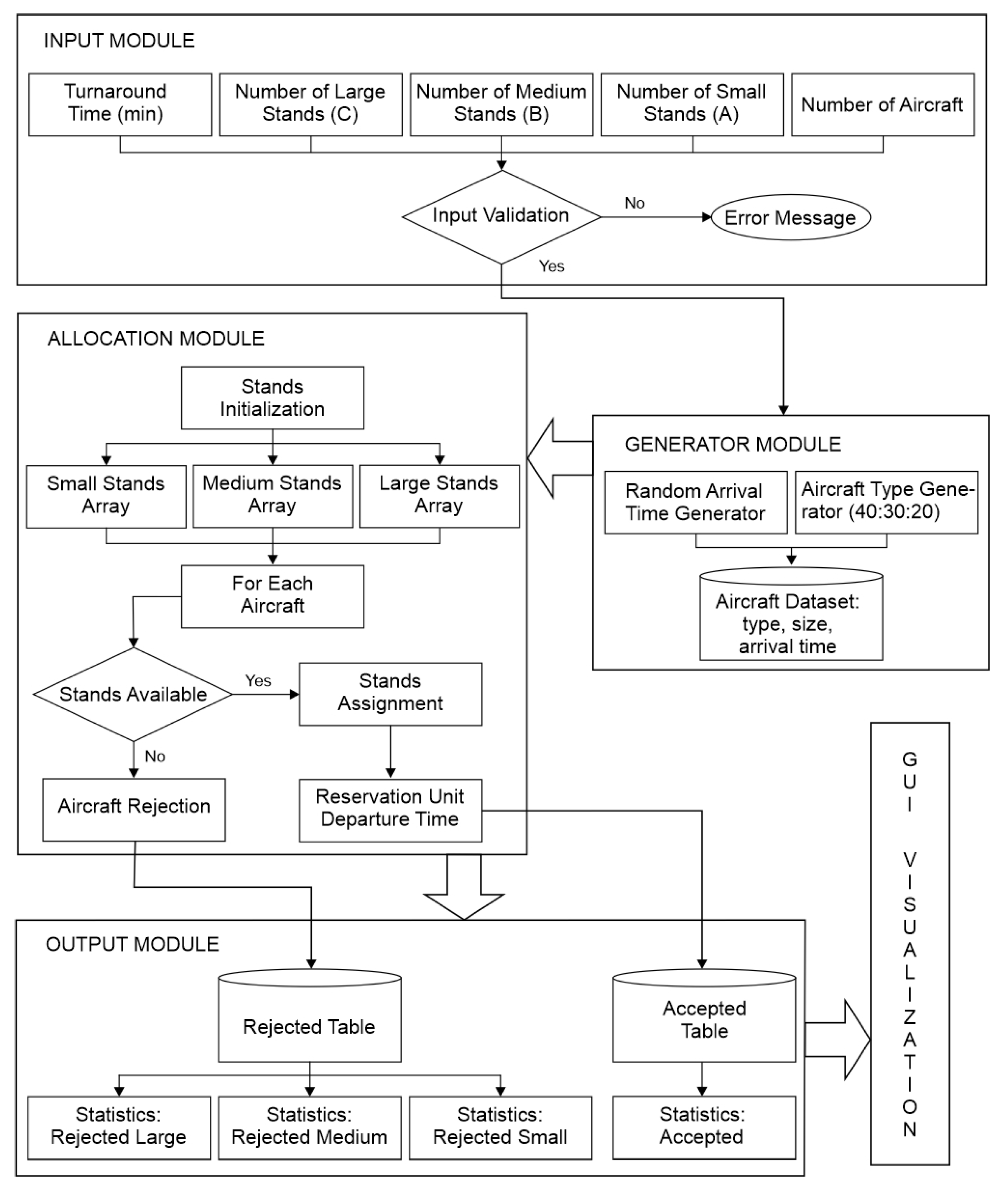
The objective of this study is to evaluate how different configurations of airport stand infrastructure influence system-level performance under high traffic demand. The methodological focus is therefore placed on strategic capacity assessment, rather than on operational optimization of stand assignments. To support this objective, a discrete-event simulation (DES) framework was adopted as the primary modelling approach. The simulation framework is composed of four main functional modules, including input generation, allocation logic, and output processing, as illustrated in
Figure 1.
DES is particularly well-suited for modelling airport apron operations, as it enables explicit representation of time-dependent processes, resource constraints, and queuing effects arising from limited infrastructure capacity. Unlike optimization-based approaches that aim to compute an optimal allocation for a given configuration, the proposed simulation framework is designed to observe emergent system behaviour resulting from interactions between traffic demand and infrastructure composition. The model represents airport operations over a fixed planning horizon of 24 h and simulates aircraft arrivals, stand occupancy, and release events. By systematically varying the number and proportional composition of stand categories across multiple scenarios, the framework enables comparative evaluation of alternative infrastructure configurations under controlled conditions.
To maintain transparency and interpretability, the airport system is represented using an abstracted infrastructure model that captures the essential capacity constraints relevant to stand allocation. This generic representation is intentional: the model is not calibrated to any specific real-world airport, enabling conclusions that are transferable across facilities of comparable size and traffic composition. Stands are aggregated into three categories based on aircraft wingspan compatibility, following ICAO Annex 14 classifications. For modeling purposes, stand categories defined in ICAO Annex 14 were aggregated into three representative groups, as summarized in
Table 1. This level of aggregation balances practical relevance with computational tractability. Aircraft arrivals are modeled as discrete entities characterized by arrival time, aircraft size category, and service duration. For baseline experiments, arrival times are generated using a uniform distribution over the 24-h horizon, representing a neutral demand profile without explicit peak structures. This assumption allows isolation of infrastructure-driven effects without confounding them with traffic wave dynamics.
Service time at stands is assumed to be constant across all aircraft types. Although this represents a simplification of real-world operations, it serves to decouple infrastructure effects from aircraft-specific handling variability. The implications of this assumption are explicitly addressed in
Section 5. The model intentionally excludes airline preferences, terminal affiliations, priority rules, and dynamic reallocation mechanisms. While these elements are relevant for operational decision-making, their inclusion would obscure the primary objective of the study, which is to identify structural capacity effects resulting from stand configuration choices.
Stand allocation follows a simple first-come–first-served (FCFS) logic. Each arriving aircraft is processed sequentially in chronological order of arrival and assigned to the first available compatible stand within its size category. If no suitable stand is available at the arrival time, the aircraft is rejected. The use of FCFS is a deliberate methodological choice rather than a limitation of the model. By avoiding priority rules, airline preferences, dynamic reallocation, or optimization-based decision-making, the allocation logic functions as a neutral control mechanism that minimizes algorithm-induced effects. This allows the analysis to focus explicitly on how infrastructure capacity composition alone influences system performance.
More sophisticated allocation strategies may partially compensate for capacity imbalances through reordering or anticipatory decisions; however, such mechanisms can obscure the identification of fundamental structural bottlenecks. In contrast, the FCFS logic exposes capacity shortages directly, as rejected aircraft can be unambiguously attributed to insufficient availability within the relevant stand category. From an experimental perspective, FCFS thus serves as a transparent and reproducible baseline policy, consistent with prior capacity-focused simulation studies. The use of FCFS as a neutral benchmark is consistent with established practice in airport capacity simulation [
25,
26], and represents the lower-performance bound against which more sophisticated allocation strategies can be evaluated in future work.
The simulation study follows a scenario-based approach aimed at systematically exploring the impact of stand configuration on airport performance under high traffic demand. A total of fifteen infrastructure configurations were defined, each representing a different distribution of small, medium, and large stands. While total stand capacity varies moderately across configurations, the primary simulation variable is the proportional composition of stand categories. Configurations were constructed to cover balanced configurations, dominance of a single stand category, critical shortages in individual categories, and configurations with increased or reduced overall capacity. Each infrastructure configuration was evaluated following a standardized experimental procedure consisting of preparation, repeated simulation runs, result aggregation, and averaging, as outlined in
Table 2. The fifteen configurations are systematically categorized as follows: (a) balanced reference configuration (S1: 15 small, 15 medium, 15 large stands); (b) single-category dominance configurations (S2–S7), in which one stand type represents the majority of total capacity; (c) single-category shortage configurations (S8–S10), in which one category is reduced to two stands while others remain at 15; and (d) overall capacity variation configurations (S11–S15), combining moderate asymmetry with increased or reduced total stand counts. This classification provides the structural basis for interpreting simulation results in
Section 4.
For all scenarios, a common set of traffic parameters was applied to ensure comparability of results. Each scenario simulates a 24-h operational period with a fixed number of arriving aircraft representing a high-demand environment. Aircraft types are generated probabilistically according to a predefined fleet mix, reflecting a heterogeneous traffic composition typical of large international airports. To account for stochastic variability, each scenario was simulated three times using different random seeds, and reported results represent arithmetic means across repetitions. Observed variability between runs remained low and did not affect relative scenario ranking, supporting the suitability of this repetition count for comparative capacity screening.
Model performance is evaluated using system-level indicators capturing both overall throughput and category-specific effects. The primary metric is the Acceptance Rate (AR), defined as the proportion of arriving aircraft successfully assigned to a compatible stand, complemented by the Rejection Rate (RR). Rejected aircraft are additionally disaggregated by size category to identify infrastructure-induced bottlenecks and to distinguish between globally constrained systems and configurations that systematically disadvantage specific aircraft types. All metrics are reported as percentages, and analysis focuses on relative differences between scenarios, rather than on absolute performance levels.
Model verification and validation were conducted to ensure logical consistency and alignment with the intended modeling objectives. Verification included manual testing with reduced datasets to confirm correct chronological processing of arrivals, enforcement of stand occupancy constraints, and accurate handling of rejection events. Validation was performed at a conceptual level, consistent with the strategic scope of the study. Generated aircraft size distributions were compared against the predefined fleet mix, and sensitivity tests with alternative service times confirmed that observed performance trends were primarily driven by infrastructure configuration rather than parameter artifacts. Validation against real airport operational data was not pursued, as the model is intended as a comparative screening tool; the implications of this choice are explicitly discussed in
Section 5.
4. Results
Simulation results for all fifteen infrastructure configurations are summarized in
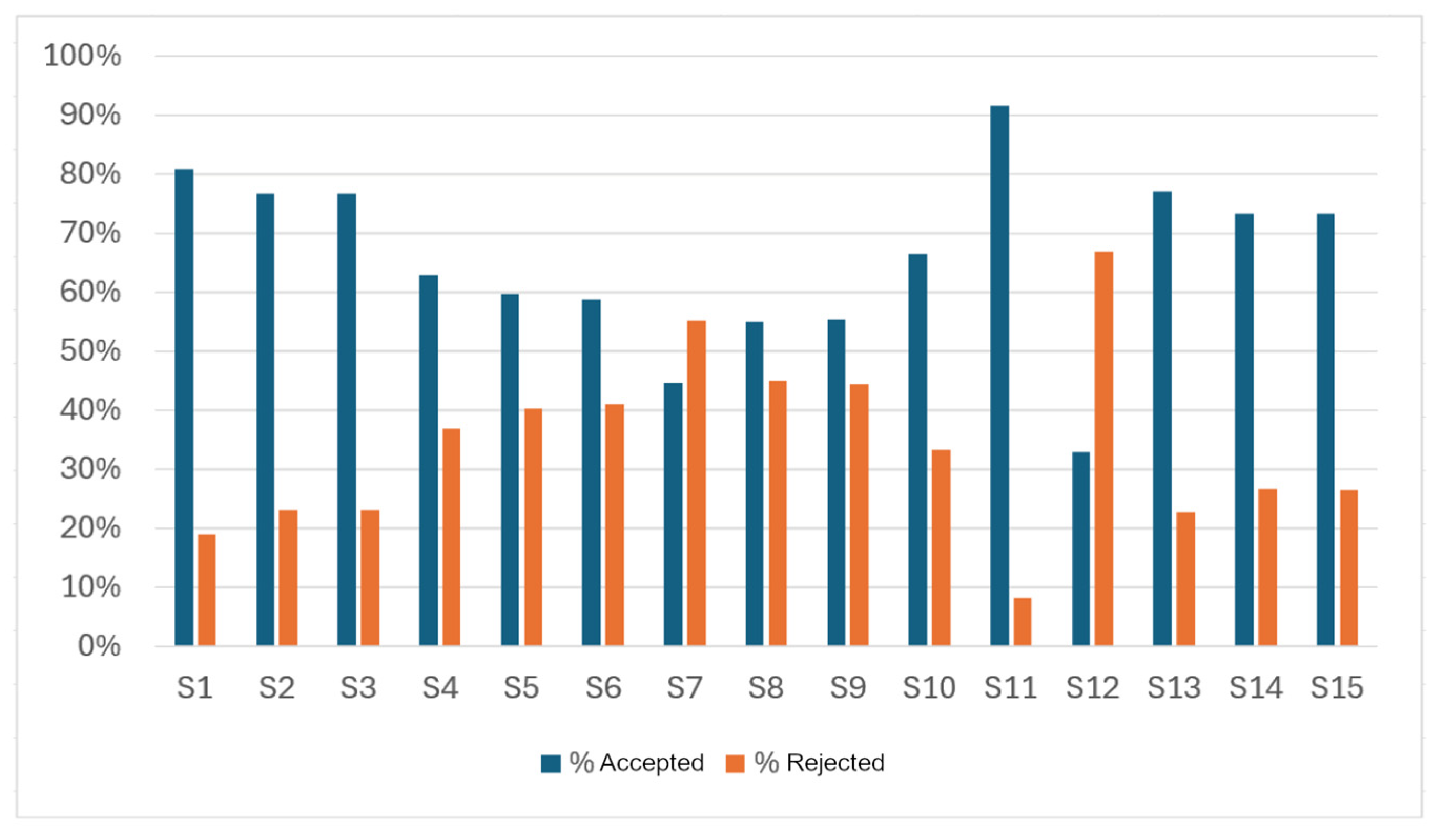
Table 3. Across scenarios, the Acceptance Rate (AR) ranges from 33% to 92%, indicating a pronounced sensitivity of system performance to stand configuration under identical traffic demand conditions. The relative ranking of scenarios remains stable across repeated simulation runs, suggesting that observed performance differences are driven primarily by infrastructure configuration rather than stochastic variability.
As illustrated in
Figure 2, balanced stand configurations consistently achieve higher acceptance rates than strongly asymmetric alternatives.
Balanced stand configurations consistently achieve higher acceptance rates than strongly asymmetric alternatives. The reference balanced scenario reaches an acceptance rate of approximately 81%, whereas scenarios dominated by a single stand category typically exhibit acceptance rates below 70%. The highest acceptance rate, reaching 92%, is observed in a configuration that combines increased total capacity with a balanced proportional distribution of stand categories. In contrast, scenarios with reduced overall capacity show a pronounced decline in performance. The lowest acceptance rate is recorded for the minimal-capacity configuration, in which less than one-third of arriving aircraft can be accommodated within the simulated planning horizon. Intermediate configurations characterized by moderate asymmetry cluster within acceptance rates between 70% and 80%, indicating partial resilience to imbalance provided that minimum capacity is maintained across all stand categories.
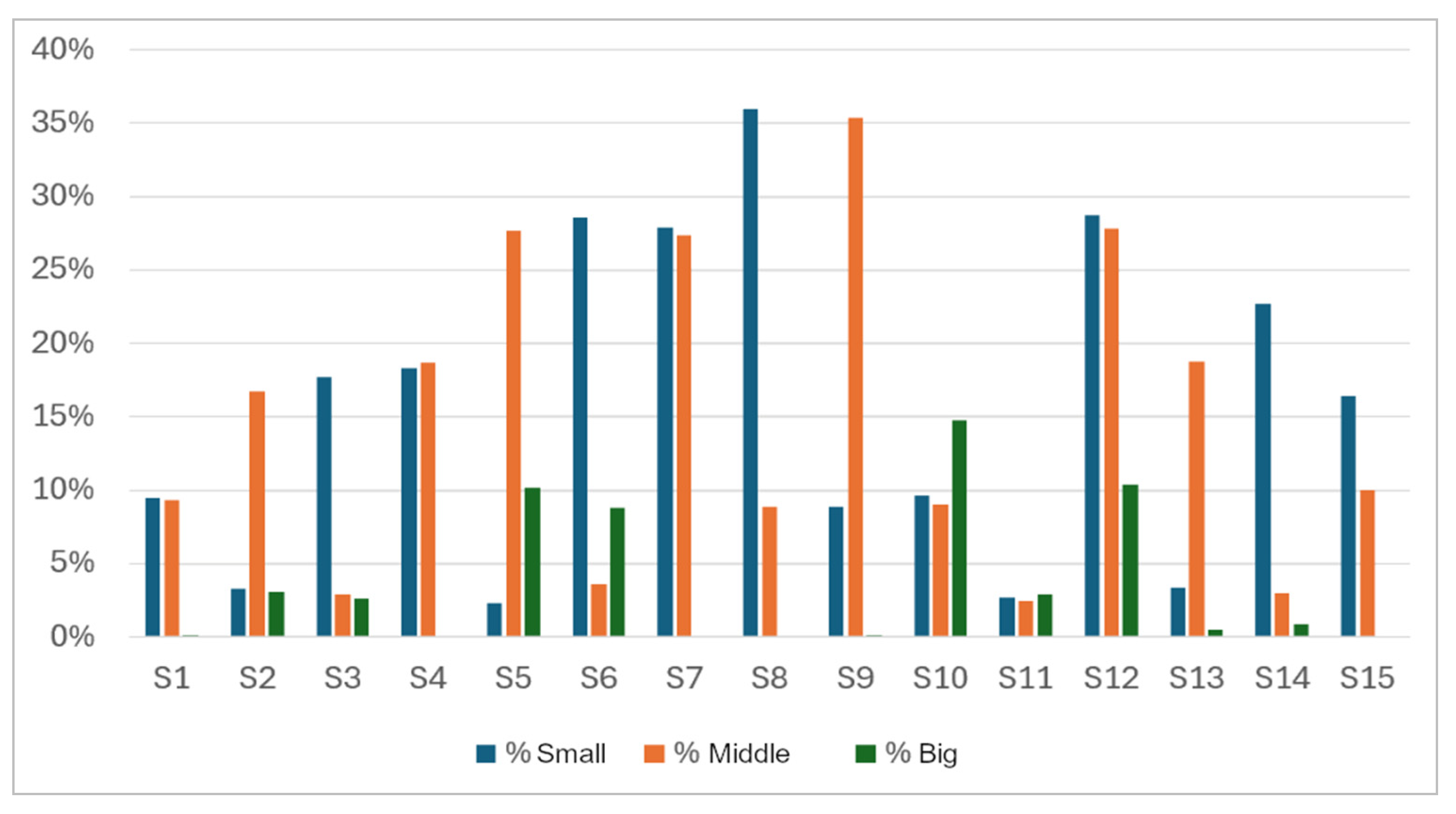
Disaggregation of rejected aircraft by size category reveals systematic patterns directly linked to infrastructure composition (see
Table 4).
Figure 3 further illustrates the concentration of rejections within the constrained stand category across configurations. In balanced configurations, rejection rates are relatively evenly distributed across aircraft categories, with no single category dominating the rejection profile. By contrast, scenarios featuring reduced capacity in one stand category exhibit highly concentrated rejection patterns. In these cases, the majority of rejected aircraft belong to the category corresponding to the constrained infrastructure type. For example, scenarios with minimal availability of small stands show rejection of small aircraft exceeding 35% of arrivals within that category, while rejection rates for other categories remain comparatively low. Analogous effects are observed in scenarios constrained in medium or large stand categories, where rejection rates for the affected aircraft type exceed 70% of arrivals in extreme cases. These results indicate that insufficient capacity in any single category can dominate system-level rejection behavior, irrespective of available capacity in other categories.
Comparison across scenarios further indicates the presence of structural threshold effects related to minimum category capacity. Configurations maintaining a minimum stand count in all categories achieve substantially higher acceptance rates than those falling below this threshold, even when total capacity levels are comparable. Once category capacity drops below a critical level, acceptance rates decline sharply and rejection rates increase disproportionately. These threshold effects are non-linear, as relatively moderate reductions in category capacity led to disproportionate performance degradation. Increasing total capacity without addressing category imbalance yields only limited improvements, whereas modest capacity increases applied uniformly across categories result in measurable gains in acceptance rates. Based on the fifteen simulated configurations, the critical capacity threshold can be quantitatively estimated for each stand category. For small stands, configurations with 5 units (S6, S12) yield overall acceptance rates of 59% and 33% respectively, while increasing to 8 units (S14) recovers performance to 73%; the threshold therefore lies in the range of 5–8 stands. For medium stands, the equivalent range is identified between 2 units (S9: 55%) and 5 units (S5: 60%), with recovery observed above 10 units (S2, S13: 77%); the threshold is estimated at 5–10 stands. For large stands, the most severe degradation is observed below 5 units: S7 (5 large stands, highly imbalanced) achieves only 45%, while S10 (2 large stands, others at 15) reaches 67% due to the supporting capacity from other categories; the threshold for large stand isolation effects is estimated below 5 units. The underlying mechanism driving these threshold effects is the interaction between aircraft fleet mix and the hard compatibility constraint: once a category becomes critically scarce, incoming aircraft of the matching size cannot be redistributed to other stand types, creating an irreducible rejection floor that accumulates proportionally to traffic demand in that category. This differs qualitatively from linear capacity shortfalls and explains the disproportionate performance degradation observed near the threshold.
5. Discussion
The results demonstrate that airport stand configuration exerts a pronounced influence on system-level performance under high traffic demand. Acceptance rates are shown to be sensitive not only to total infrastructure capacity but, more importantly, to the proportional distribution of stand categories. Balanced configurations consistently outperform asymmetric alternatives, even when the latter offer comparable or higher total capacity. This indicates that infrastructure-induced constraints emerge primarily at the category level rather than at the aggregate level. The system modelled represents a generic international airport apron comprising aircraft arrivals, stand occupancy, and departure events over a 24-h planning horizon. The primary bottlenecks identified by the simulation are stand-category-level capacity shortages: when the number of stands of any single size class falls below a critical threshold, the rejection rate for the corresponding aircraft category rises disproportionately. Specifically, reducing small stands to two units (S8) raises the small-aircraft rejection rate to 36%, reducing medium stands to two units (S9) raises the medium-aircraft rejection rate to 35%, and reducing large stands to two units (S10) raises the large-aircraft rejection rate to 15%—all relative to a balanced baseline of approximately 9–10% per category in S1.
Insufficient availability of any single stand category leads to concentrated rejection patterns that dominate overall system performance. Once a category becomes constrained, additional capacity in other categories cannot compensate for the resulting incompatibilities, highlighting the limited substitutability between stand types imposed by technical compatibility requirements. These findings reflect fundamental structural characteristics of airport infrastructure, where aircraft–stand compatibility constitutes a hard constraint that cannot be relaxed through redistribution of capacity alone. From a strategic perspective, this suggests that capacity expansion decisions should prioritize maintaining proportionality across stand categories rather than maximizing total stand count.
The analysis further reveals non-linear threshold effects associated with minimum category capacity. When capacity in a specific stand category falls below a critical level, acceptance rates decline sharply, and rejection rates increase disproportionately. These threshold effects are observed consistently across aircraft categories and are largely independent of capacity levels in other categories. Conversely, configurations that maintain a minimum level of capacity in all categories exhibit substantially higher robustness under high demand conditions. Modest uniform increases in capacity across categories yield greater performance improvements than selective reinforcement of individual categories, indicating that balanced capacity contributes not only to higher throughput but also to enhanced resilience.
Importantly, these structural effects emerge despite the use of a simplified allocation logic. The FCFS mechanism employed in the model enables clear attribution of observed performance differences to infrastructure configuration rather than to algorithmic decision-making. While more sophisticated allocation strategies may mitigate individual rejection events through prioritization or dynamic reallocation, they cannot eliminate the structural consequences of insufficient category capacity. The results should therefore be interpreted as manifestations of structural capacity phenomena rather than as operational optima. These findings suggest that airport capacity planning is most effectively conceived as a two-stage evaluation framework. In the first stage—structural feasibility screening—the infrastructure-level question is addressed: does the proposed stand category composition provide sufficient and balanced capacity to serve the anticipated traffic demand without inherent structural bottlenecks? The simulation-based approach presented in this study is designed precisely for this stage, operating prior to any specific allocation algorithm. In the second stage—operational optimization—the ASAP/AGAP toolbox (mathematical programming, heuristics, reinforcement learning) is applied to a structurally validated infrastructure to maximize allocation efficiency. This two-stage conception resolves the ambiguity between structural feasibility and operational performance: structural feasibility is a necessary precondition, while operational optimization is contingent upon it. Applying sophisticated allocation algorithms to a structurally imbalanced infrastructure—one that fails the first-stage screen—will yield only marginal improvements. The present study therefore provides the analytical foundation for the first stage, which existing ASAP/AGAP research has implicitly assumed rather than explicitly validated.
From a planning perspective, the proposed simulation framework provides a means to identify infrastructure configurations that are inherently prone to capacity collapse under high demand, independent of operational optimization. This implies that advanced allocation algorithms may offer limited benefits when applied to structurally imbalanced infrastructures. The presence of modest reserve capacity distributed across all stand categories appears to play a critical role in sustaining acceptable performance levels, acting as a structural buffer that enhances system robustness.
Several limitations of the present study should be acknowledged. The model relies on simplified assumptions regarding arrival distributions, service times, and allocation logic, which may underrepresent variability observed in real-world operations. Traffic wave effects, aircraft-specific handling times, and priority rules are not explicitly modeled. Future research could extend the framework by incorporating non-uniform arrival patterns, stochastic service durations, and adaptive allocation strategies, as well as by integrating optimization-based or learning-based decision layers. Nevertheless, the identified structural effects are expected to persist under more detailed modeling assumptions, as they arise from fundamental compatibility constraints inherent to airport stand infrastructure.
6. Conclusions
This study investigated the impact of airport stand infrastructure configuration on system-level performance under high traffic demand using a simulation-based screening framework. Rather than focusing on operational optimization of stand assignments, the analysis targeted the strategic infrastructure level, examining how the proportional composition of stand categories influences acceptance and rejection behavior.
The results indicate that balanced stand configurations consistently outperform asymmetric alternatives, even when total infrastructure capacity is comparable. Quantitatively, the highest-performing configuration (S11: 20 small, 20 medium, 10 large stands) achieved a system-wide acceptance rate of 92%, compared to 33% in the minimal-capacity configuration (S12: 5 stands per category). Reducing any single category to two stands (S8, S9) decreased the acceptance rate by 26–28 percentage points relative to the balanced reference configuration S1 (81%). Insufficient capacity in any single stand category leads to concentrated rejection patterns and sharp performance degradation, revealing non-linear threshold effects that cannot be offset by excess capacity in other categories. These findings demonstrate that proportionality across stand categories is a critical determinant of infrastructure robustness.
By employing simplified allocation logic, the proposed framework isolates structural capacity effects and enables transparent identification of infrastructure-induced bottlenecks. The results should therefore be interpreted as indicators of structural feasibility rather than operational optima. In this sense, the study complements existing ASAP/AGAP research by addressing a largely underexplored dimension of airport planning: the role of infrastructure composition as a prerequisite for effective operational optimization.
From a practical perspective, the presented approach provides a computationally efficient tool for early-stage infrastructure screening—that is, the pre-operational planning phase in which alternative stand layout concepts are evaluated before committing to detailed design or investment decisions. Quantitatively, the simulation results demonstrate that reducing any single stand category to a critically low count (e.g., two stands in S8 or S9) reduces system-wide acceptance by 26–28 percentage points relative to the balanced reference S1 (81% acceptance rate). The highest-performing configuration (S11: 20 small, 20 medium, 10 large stands) achieved 92% acceptance, confirming that balanced proportionality is a more effective design principle than total stand count maximization. These evidence-based findings provide actionable guidance for airport planners assessing stand layout alternatives at the pre-design stage.
Based on the simulation evidence, three practical design principles for airport preliminary planning can be derived. First, the proportionality principle: stand categories should be dimensioned in proportion to the expected fleet mix, as overinvestment in any single category does not compensate for shortfalls in others. Second, the minimum viable threshold principle: each stand category should maintain a minimum count above the empirically estimated critical threshold (approximately 5–8 units for small and medium stands, and 5 units for large stands in the configurations tested), below which system-level performance degrades disproportionately. Third, the uniform expansion principle: when capacity must be increased, adding stands uniformly across all categories yields greater performance improvements than selective expansion of individual categories. From a theoretical perspective, this study contributes to airport capacity management research by establishing the analytical foundation for a two-stage capacity planning framework, in which structural feasibility screening—the focus of this work—precedes and conditions operational allocation optimization. This positions infrastructure composition as a first-class research object in airport systems, distinct from and complementary to the allocation algorithm optimization that dominates existing ASAP/AGAP literature.
Future research may extend the framework by incorporating more realistic arrival patterns, variable service times, and adaptive allocation strategies, as well as by integrating optimization-based or learning-based decision layers. Nevertheless, the core findings indicate that structurally imbalanced infrastructure imposes fundamental constraints on achievable system performance, underscoring the importance of informed capacity planning in airport systems.