1. Introduction
As the global population grows, so does the demand for new buildings; however, the energy crisis of the last century has raised concerns about the rational use of energy, especially in buildings. Reducing household energy consumption is a fundamental European goal, and the construction sector is a significant contributor to energy use and pollution [
1]. Reports show that buildings were responsible for a substantial share of CO
2 emissions in 2016 [
2]. To address this issue, the construction sector has adopted solutions to reduce energy consumption, decarbonize, and minimise waste. Government policies, such as the European Directive, require near-zero-energy buildings (nZEBs) and set additional targets for zero-emission buildings by 2030. nZEBs buildings are characterised by their high energy efficiency and the use of renewable energy. They often incorporate passive building solutions and technologies such as photovoltaic panels and BESSs.
The Energy Performance of Buildings Directive (EPBD) [
3] was conceived assuming a permanent search for comfortable conditions in dwellings, and that space heating is the highest contributor to total energy needs. Cooling has a lower weight all across Europe than heating, even for southern Europe. Only Malta shows similar heating and cooling weights, considering actual consumption [
4]. This is because average temperatures in most of Europe are significantly lower than the comfort range defined in the regulations (18 °C in the actual Portuguese regulation [
5]; 20 °C in the previous, or in EN 15251 [
6], for instance). Therefore, it is expected that thermal regulations rely mostly on the minimization of winter losses, with the heating degree day (HDD) parameter holding a crucial role in the total energy needs.
In Portugal, there are approximately 3.6 million buildings and 6 million dwellings. More than 15% of these buildings need major renovations to meet current comfort and safety standards, and more than 30% require some form of intervention [
7,
8]. On the other hand, 71% of the total buildings were built before the first thermal regulation, from 1990, and many of them present hygrothermal pathologies [
9,
10]. This represents a huge opportunity to improve the thermal performance of housing stock, alongside new comfort requirements such as acoustics, seismic, and accessibility requirements.
Portugal introduced mandatory energy certification for buildings in 2009, following the implementation of DL 118/2013 [
11], which aligns with EU Directive 2010/31/EU [
12]. The number of EPCs issued has varied over the years, with a constant increase, and since 2014, more than 1.6 million energy performance certificates (EPCs) have been issued, according to the national Energy Certification System (SCE). Analysing the energy efficiency ratings of residential buildings (88% of the EPCs issued) certified between 2014 and 2020 reveals that most of the buildings fall into the C (22.1%) and D (23.3%) categories. Only 2.8% reached the highest rating, A+, while 8.4% were rated F, i.e., 89.3% were for existing buildings, and 59% of residential buildings still fall within C, D, and E ratings. Moreover, from these residential EPCs issued, around 80% are related to existing buildings and only 20% to new buildings [
13]. In summary, a considerable number of dwellings still fall into lower efficiency categories, underscoring the need for targeted energy improvement initiatives.
In Portugal, there is a clear connection between buildings with low energy efficiency ratings—classified as C, D, E, or F—and energy poverty. These buildings often suffer from poor insulation and outdated heating and cooling systems, resulting in higher energy bills to maintain basic comfort levels. Low-income households, frequently living in such buildings, struggle to afford their energy bills or to invest in necessary renovations. This situation worsens social vulnerability, impacting the health and well-being of residents, especially in colder or ageing regions of the interior [
14].
One of the first definitions for “energy poverty” was given by Boardman [
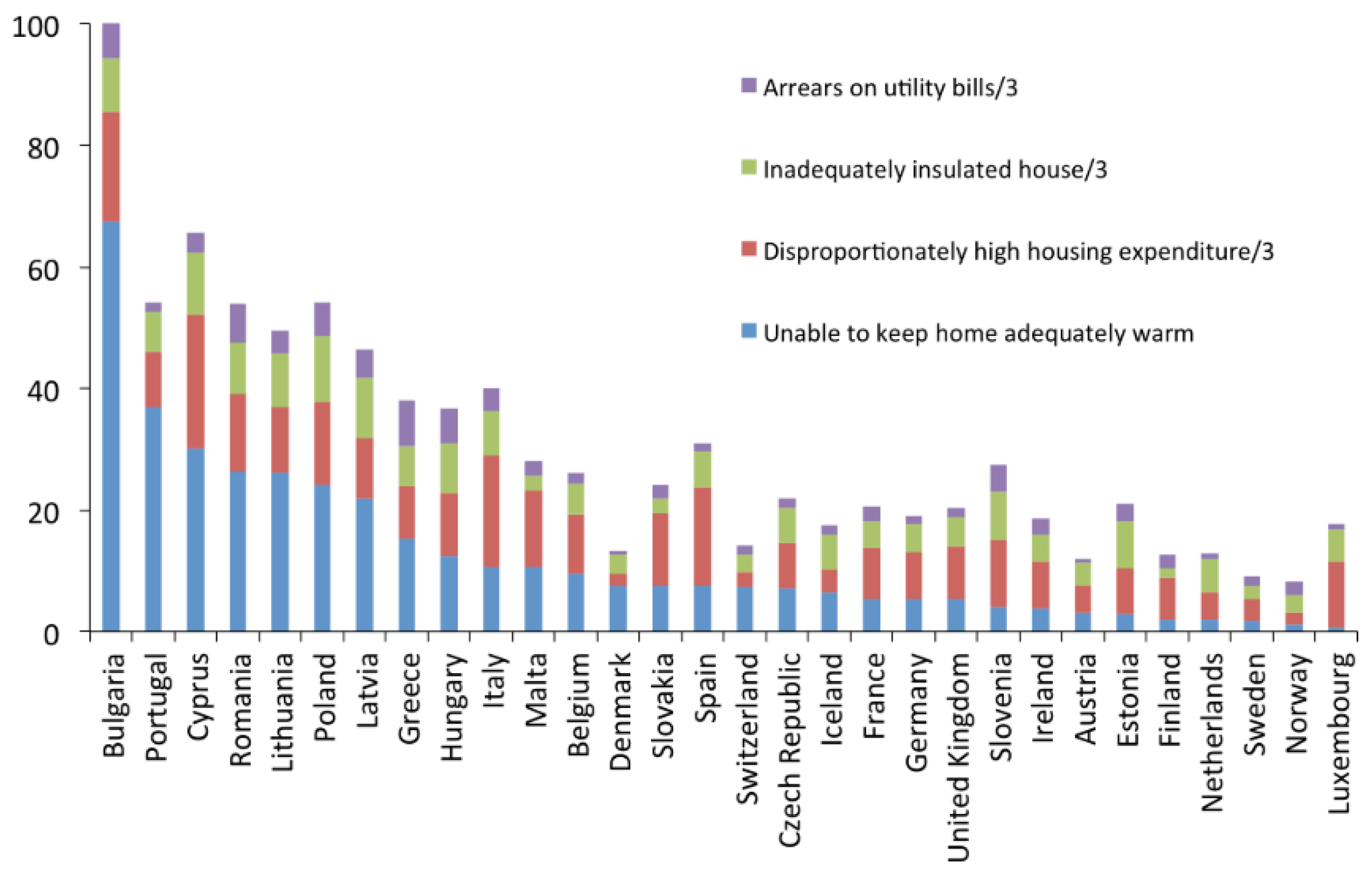
15]: “a situation where a household is unable to access a socially and materially necessitated level of energy services in the home”. This 1991 study showed that Portugal, like other southern and eastern countries, is one of the most vulnerable to the problem of energy poverty (see
Figure 1).
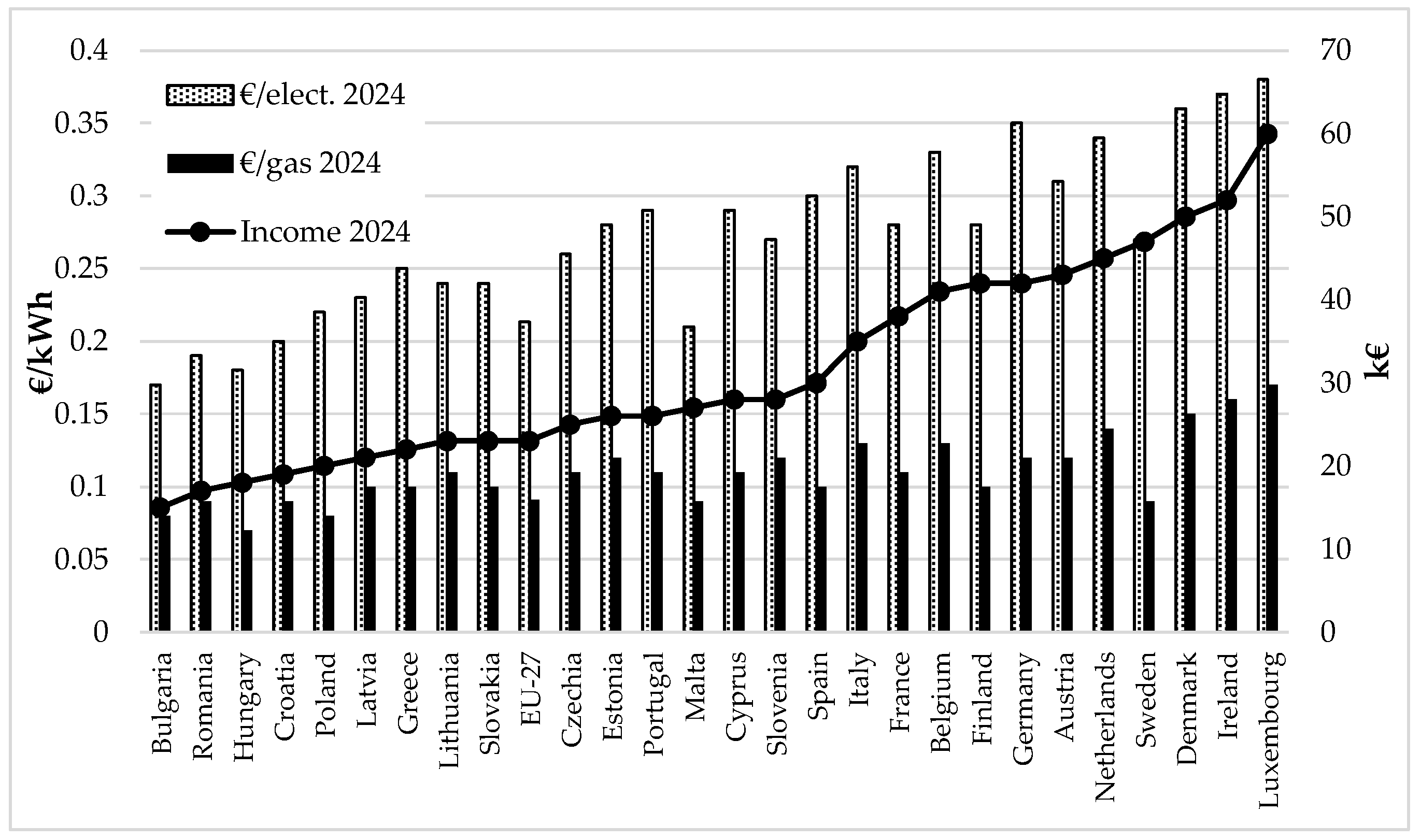
Comparing the data on income and energy prices between Portugal and the European averages directly, it is clear the uncomfortable position of Portugal, not only in income but also in energy (electricity and natural gas) prices per kWh.
Figure 2 shows the “median equivalised disposable income” (MDI) ranking, that is, the total income of a household, after tax and other deductions, that is available for spending or saving, divided by the number of household members converted into equalised adults, in 2024, for all EU-27 [
16]. In the same figure, the electricity and natural gas prices are presented for all countries. Observing Portugal, the uncomfortable position is clear. Portugal is one of the poorest countries in Europe and has some of the highest energy prices. The interaction between these factors can serve as a key indicator of heating behaviour patterns. While other Mediterranean countries show similar trends, they tend to be in a comparatively better position when both indicators, such as energy performance and the minimum discomfort index, are taken into account.
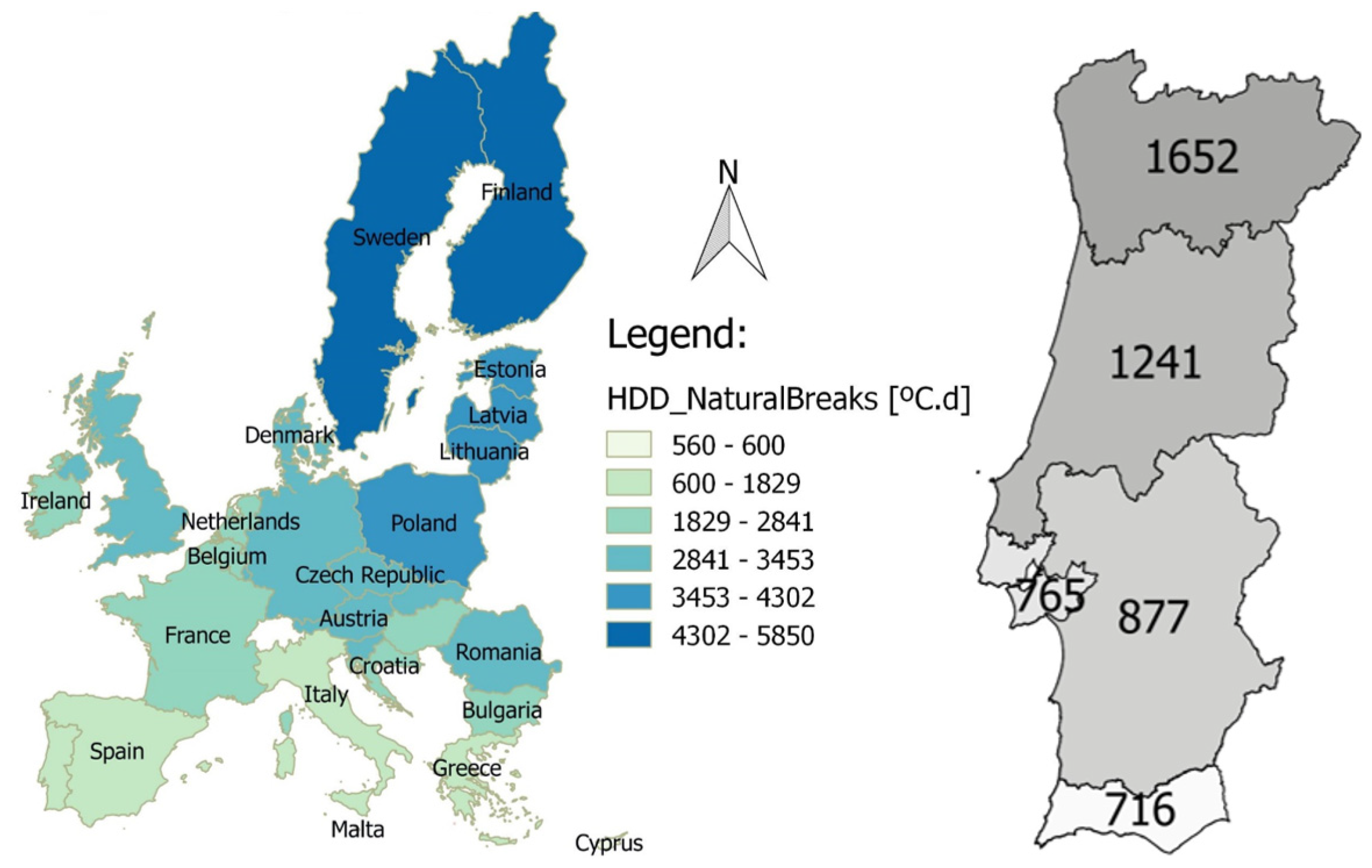
Perhaps more unexpectedly, when analysing only winter severity,
Figure 3 illustrates the spatial distribution of heating degree days (HDDs) across Europe and within Portugal’s five main regions. Portugal records an average of approximately 1166 HDDs—about 62% lower than the EU-27 average of 3076 [
17]. Notably, nearly half of the Portuguese territory registers fewer than 1000 HDDs. This pattern is consistent across Southern European countries, highlighting the comparatively milder winters in these regions when contrasted with Central Europe and Scandinavia.
Energy poverty becomes a vicious cycle: the poorer the energy performance of a home, the more energy is needed, the higher the costs, and the fewer the resources available to make improvements. Despite Portugal’s strong commitment to renewable energy, energy poverty remains a major issue, especially among low-income households. The main barrier is the high upfront cost of installing renewable technologies, such as photovoltaic panels or heat pumps, which many vulnerable families cannot afford, even with subsidies. Additionally, much of the housing stock is old, poorly insulated, or rented, making energy upgrades difficult to implement [
18].
Another obstacle is the lack of integration between social and energy policies. Current programmes often operate in isolation, and bureaucracy makes access to available support challenging for those most in need. Rural and interior regions are also underserved in terms of technical support and infrastructure. Several public programmes, such as the Efficiency Voucher and the Environmental Fund, could play a crucial role in reversing this trend if there were an integrated strategy through specific programmes that combine energy efficiency + renewable energy + energy poverty, promoting energy renovation as a tool for social justice [
19].
Recent research has increasingly explored the intersection between photovoltaic technologies and energy-poverty mitigation, offering valuable context for the present study. Wang et al. [
20] conducted a comprehensive review demonstrating the growing academic interest in solar photovoltaics as a tool for poverty alleviation, while Castro et al. [
21] expanded this perspective by analysing how PV projects contribute to multidimensional poverty reduction across different regions. Complementing these broader assessments, Jaeger-Waldau [
22] provided an updated overview of global PV deployment trends, highlighting technological and market developments that directly influence the feasibility of residential PV systems. In parallel, Horzela-Miś and Semrau [
23] examined the role of renewable energy and storage technologies in sustainable development, underscoring the importance of integrating PV generation with energy-storage solutions in the built environment. Together, these studies reinforce the relevance of evaluating PV and PV-storage configurations within the context of social housing and energy-poverty alleviation.
This energy transition requires the consideration of energy storage to mitigate the intermittency of solar energy. The photovoltaic (PV) market has grown significantly over the past decade, with 4 TW of capacity expected to be reached by 2030 [
24]. One of the main reasons for this growth can be attributed to the decrease in manufacturing costs that has occurred over the years [
25]. ESS have been shown to be capable of reducing household electricity costs [
26], and most of these are battery-based [
27,
28].
Through this work, a tool in Python (v3.14) [
29] was developed for the simulation and analysis of the performance of PV systems with and without a storage system, and it was applied in a case study of semi-detached households of a social neighbourhood in Porto. This provides insights into optimal setups given spatial and/or budget restrictions and helps uncover how viable these configurations are for grid independence. Parallel to this, it allows the comparison of the economic viability of these systems versus grid-only households.
Despite the growing body of research on photovoltaic technologies and their potential contribution to poverty alleviation, most existing studies remain focused on macro-level assessments, bibliometric analyses, or general trends in PV deployment. These works rarely address the specific challenges faced by low-income households living in social housing, nor do they integrate detailed building characteristics, local climatic conditions, and real consumption profiles into a unified optimisation framework. Furthermore, the literature provides limited case-based evaluations of PV and PV-storage systems tailored to vulnerable communities, particularly in Southern Europe. To address these gaps, the present study aims to develop and apply a detailed numerical model to assess the technical, economic, and environmental feasibility of photovoltaic and storage systems in Portuguese semi-detached social housing, with the overarching goal of identifying configurations capable of contributing effectively to energy-poverty mitigation.
In summary, there is strong potential for improvement. With better coordination, simplified financing mechanisms, and targeted investment in energy-efficient renovations, Portugal could harness renewables not only to decarbonize the grid but also to reduce inequality and protect the most vulnerable.
This work is structured as follows.
Section 2 presents the methodology, including the numerical model, building characterisation, climatic data, and the definition of the three scenarios under analysis.
Section 3 discusses the results obtained for each scenario, comparing their technical performance, economic feasibility, and environmental impact.
Section 4 summarises the main conclusions, highlights the implications for energy-poverty mitigation, and outlines recommendations for future research and policy development.
2. Materials and Methods
2.1. Numerical Model
The numerical model was developed using Python (v3.14) [
29] and comprises the following modules: weather data, photovoltaic production, residential load profile, energy balance, with or without battery storage, and a 20-year cost–benefit analysis.
A custom Python-based model was developed to ensure full flexibility in integrating hourly energy balances, battery degradation behaviour, cost–benefit calculations, and scenario-specific constraints such as roof area and social-housing consumption profiles. Existing commercial simulation tools do not always provide transparent access to internal modelling assumptions or the ability to modify individual components at the required level of detail, which is essential for research reproducibility. To ensure the adequacy of the model, verification procedures were performed: PV generation outputs were validated against PVGIS and PVWatts reference values for the same location and configuration; battery performance was compared with manufacturer specifications and benchmark degradation curves from the literature; and the residential load profile was cross-validated with the standardised BTN C profile provided by E-REDES. These steps confirm that the implemented models accurately represent the behaviour of the equipment and systems under study.
The modelling process starts by gathering meteorological information from a designated source to estimate the expected output of the PV system. This is followed by an energy balance that accounts for electricity generation, household consumption, and, when relevant, the contribution of stored energy. Based on the outcomes of this simulation, an economic assessment is then performed.
Its modular structure enables each component to be adapted to the requirements of different simulation scenarios. Although each module uses its own set of tools, the overall workflow relies on widely adopted resources for data handling and visualisation, which are described in the following sections [
30,
31,
32].
In this work, the Typical Meteorological Year (TMY) file was obtained using the PVGIS API [
33]. The simulations rely on a TMY, which represents long-term average climatic conditions for Porto. This approach is widely used in PV performance modelling; however, it does not explicitly account for interannual variability or long-term climate change trends. Although the Atlantic Ocean exerts a strong moderating influence on Northern Portugal, resulting in relatively small year-to-year fluctuations in solar irradiation, the cumulative impact of climatic changes over a 15–20-year system lifetime may influence long-term energy yields and economic performance.
For the PV array simulations, the Suntech STP550S-C72/Vmh module (Suntech, Eschborn, Germany) was selected, and its specifications under standard test conditions (STC) are summarised in
Table 1.
System losses were accounted for using the default PVWatts model assumptions, which estimate total system losses of ≈14% [
35]. Additionally, a degradation rate of 0.5%/year was included for multi-year simulations to reflect long-term performance declines. The annual PV degradation rate was set at 0.5%/year, consistent with values reported by [
36,
37] for modern monocrystalline silicon modules operating in temperate climates. Although some field studies have documented higher degradation rates, particularly in regions with high irradiance, elevated temperatures, or older module generations, the 0.5% value remains representative of contemporary module performance in coastal Portugal.
E-REDES also supplies standardised residential demand profiles based on extensive long-term monitoring of Portuguese households. The BTN C profile adopted in this study characterises typical low-consumption residential users and is built from a decade of quarter-hourly smart-meter records. Its normalisation follows the procedure established by the national regulatory authority and reflects the main features of electricity use in Portuguese homes, such as a pronounced evening peak around 20:00–21:00, increased consumption during winter months, and comparable demand patterns on both weekdays and weekends [
38].
An hourly energy balance was calculated using the energy produced, consumed, stored in the batteries, and exchanged with the grid. First, the total PV output is limited by the inverter’s maximum charging and discharging capacity. Then, the surplus PV electricity is calculated by subtracting the household demand from the generated PV electricity. When PV production is higher than consumption, the surplus is used to charge the batteries. If the batteries are fully charged, the remaining energy is exported to the grid. On the other hand, when PV production is not enough, the missing energy is supplied by the batteries. If this is still insufficient, the remaining electricity is imported from the grid.
The developed numerical model considers battery charging efficiency as well as its minimum and maximum storage limits; however, due to the intermittent nature of solar energy, it is recommended to incorporate a battery for homes in order to store excess energy generated during the day for use during periods of little or no sunlight. Electricity prices, driven by the increasing share of renewable energies, are progressively decreasing at midday, occasionally reaching zero or even negative values in the electricity markets of Mediterranean Europe [
39]. For simulation purposes, a lithium-ion battery based on the specifications of the Tesla Powerwall 2 (Tesla, NV, USA) [
40] was considered (see
Table 2).
Battery degradation is a complex and unavoidable phenomenon, influenced by several parameters such as chemical composition, ambient and operating temperature, cycling behaviour (charge/discharge patterns), secondary electrochemical reactions, and deterioration of electrodes and electrolytes [
41]. In this work, a simplified degradation model was considered, i.e., it only considered degradation due to cycling behaviour.
Thus, an efficient computational approach was implemented in which degradation is calculated based on the total cumulative discharged energy, as a way to calculate the equivalent number of complete cycles [
42]:
where
is the current state of health of the battery;
is the current number of cycles;
is the state of health of the battery at the end of life; and
is the number of cycles at the end of life. In the first iteration, it is assumed that the battery’s state of health (SoH) is 100% and
is 0.
It is important to note that the export of surplus PV electricity relies on the grid’s ability to provide voltage regulation, frequency stability, and reverse-power-flow management. Under the current Portuguese regulatory framework, prosumers do not directly pay for these ancillary services, as they are embedded in general grid access tariffs. However, future regulatory developments may introduce differentiated tariffs for prosumers, which could affect the long-term economic feasibility of PV-based energy-poverty mitigation strategies.
Finally, when a multiple-year simulation is performed, a cost–benefit analysis is carried out. A 20-year evaluation horizon was adopted for the cost–benefit analysis. This period corresponds to the typical operational lifetime and warranty of crystalline-silicon PV modules and is widely used in European residential renewable-energy assessments. Additionally, national and EU-level renovation and decarbonization strategies commonly employ a 20-year horizon when evaluating long-term economic and environmental impacts, making this timeframe consistent with established policy and technical practice.
The initial investment,
was determined by [
43,
44]:
where
is the photovoltaic system cost (
);
is the cost of the inverter;
is the cost of the storage system (
);
is the installation cost (
);
is the optional land cost;
includes other costs such as electrical components. The model also uses this calculation to determine the initial budget, which constrains the feasible configurations of PV modules and storage capacity. Each year, the following operational cost equation is used [
43,
44]:
where
is the yearly operational cost (
);
is the yearly maintenance cost;
is the cost of electricity imported from the grid (
);
is the yearly price of electricity sold to the grid (
).
Replacing the battery is typically recommended when its state of health (SOH) declines to approximately 70%, which generally corresponds to an operational lifespan of around 10 years.
The model compares two scenarios: a grid-only configuration and the designed system, which may include PV or PV and storage. The intersection of their cumulative cost curves determines the break-even point, and the values used in these calculations are detailed in
Table 3.
For the parameters in
Table 3 that lack direct bibliographic references, the adopted values were derived from market surveys and supplier quotations collected in the Porto metropolitan area. Installation costs for PV modules and batteries reflect typical prices charged by certified installers in Northern Portugal, consistent with values reported by national energy agencies and industry associations. The daily grid access tariff corresponds to the standard BTN C tariff published by the Portuguese energy regulator (ERSE) for low-voltage residential consumers. The maintenance cost of 10 €/kWpyr is aligned with average European values reported in recent PV operation and maintenance studies. The ‘other costs’ category (50 € per module) includes wiring, protection devices, and minor electrical components, based on typical bill-of-materials estimates for small residential PV systems.
2.2. Semi-Detached Household Characterisation
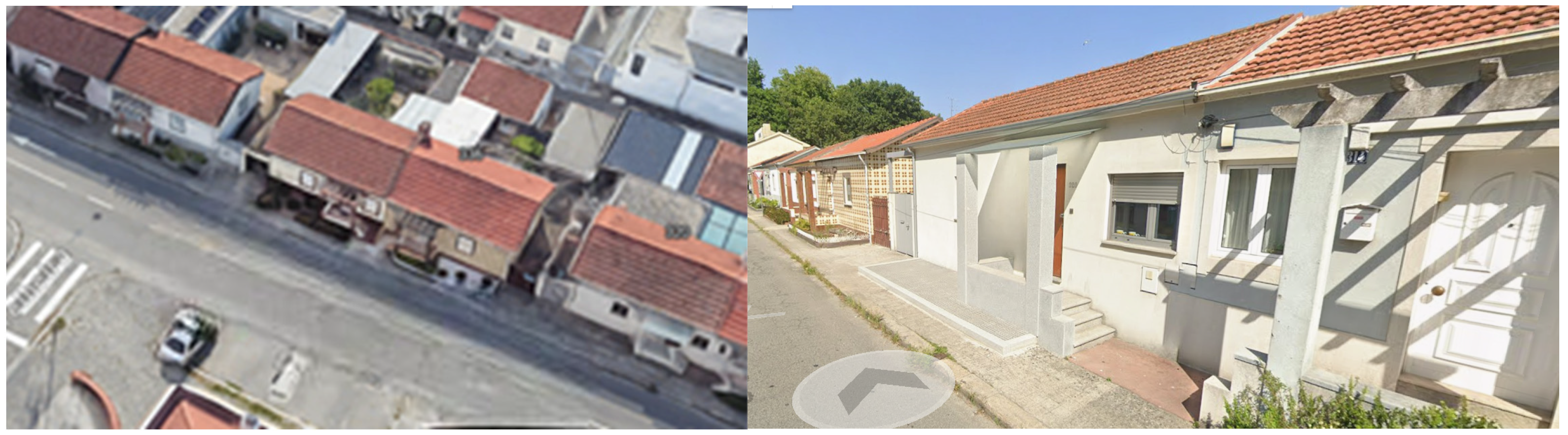
The case study is a semi-detached household located in a social-housing neighbourhood with several similar terraced houses, located in Porto, Portugal, built in the 1940s (see
Figure 4). All households are composed of one floor above, with a reinforced concrete frame structure and concrete slabs. Two types of flat configurations exist: T2, composed of two bedrooms, a living room, a kitchen, and a bathroom, and T3, composed of three bedrooms, a living room, a kitchen, and one or two bathrooms. The net floor area is approximately 60 m
2 for a 2-bedroom household and goes up to 75 m
2 for a T3, meeting the needs of different types of families. The buildings were rehabilitated in 2020, and the main constructive features are: (s) Exterior masonry cavity walls with a U = 1.1 W/m
2K; (b) roof (cold attic with 8 cm of mineral wool) with a U = 0.45 W/m
2K; (c) windows (aluminium frame, double glazing) with a U = 2.8 W/m
2K; (d) ventilation is done by scheduled by mechanical extraction in kitchens; (e) airtightness with an average ACH
50 = 6.9 h
−1; and (f) solar panels that allow the heating of sanitary hot water. Therefore, the most relevant characteristics are: (a) water heater capacity: 150 L; (b) power: 2000 W; and (c) an efficiency of 95%.
The households are naturally ventilated through outdoor air entering via open windows, infiltration through roller shutter boxes, and open balconies. Air extraction grilles are installed in the bathrooms. However, users often close these grilles, leading to frequently reported cases of inadequate ventilation [
51,
52]. No heating or cooling systems were installed, with rare exceptions in which electric portable heaters controlled by the occupants provide the heating.
To evaluate the impact of these upgrades (building passive rehabilitation), two key energy indicators, defined by Portuguese legislation (Decree-Law No. 118/2013, updated in 2021 [
11]), were applied:
Global heat loss coefficient (
C), which measures heat loss through the building envelope [
53]:
where
Ux is the thermal transmittance of opaque and glazed surfaces in W/m
2°C and
Ax is the respective surface area, in m
2.
- 2.
Gross energy demand for heating (
N), which estimates the energy required to maintain indoor comfort and is expressed by the following [
54]:
where
GD refers to heating degree days based on a 20 °C reference temperature.
As part of this pioneering intervention, the incorporation of solar thermal collectors (STC) significantly reduced the energy required for domestic hot water production throughout the year.
Portuguese public housing developments are built under a regulated cost framework designed to ensure affordability and accessibility. In the specific case of this study, a comprehensive renovation project was undertaken in 2017, and this intervention focused particularly on improvements that would yield measurable gains in energy efficiency, with associated costs directly tied to enhancing the buildings’ thermal and environmental performance.
Table 4 presents the estimated cost of the rehabilitation works associated with this intervention, which had energy efficiency-direct effects.
In summary, the costs associated with this social neighbourhood rehabilitation (composed by 15 semi-detached households) were approximately 213 m€, including façades with ETICS, insulated roofs, glazed areas (PVC + double glazing), regulating grids, and solar thermal collectors.
Table 5 presents the energy consumption of the two scenarios—pre- and post-rehabilitation—together with the corresponding domestic hot water production system (kWh/yr), the savings (€/yr), and the CO
2 (ton/yr) emissions calculation.
The results show that the building’s rehabilitation allows energy efficiency gains of 58.2% per year, which is equivalent to an annual improvement in energy cost of 9539 €/yr and 4 tons CO2/yr. Alongside aesthetic improvements, the retrofit succeeded in restoring dignity and identity to the neighbourhood by reducing the stigma associated with social housing.
2.3. Climates Analysed
To enhance the relevance of the numerical simulation analysis, a location representing the mildest climate conditions in Portugal, Porto, was included. Porto presents a heating degree day (HDD) value of 1589 °C [
55], and the climatic data was obtained using the PVGIS tool [
56].
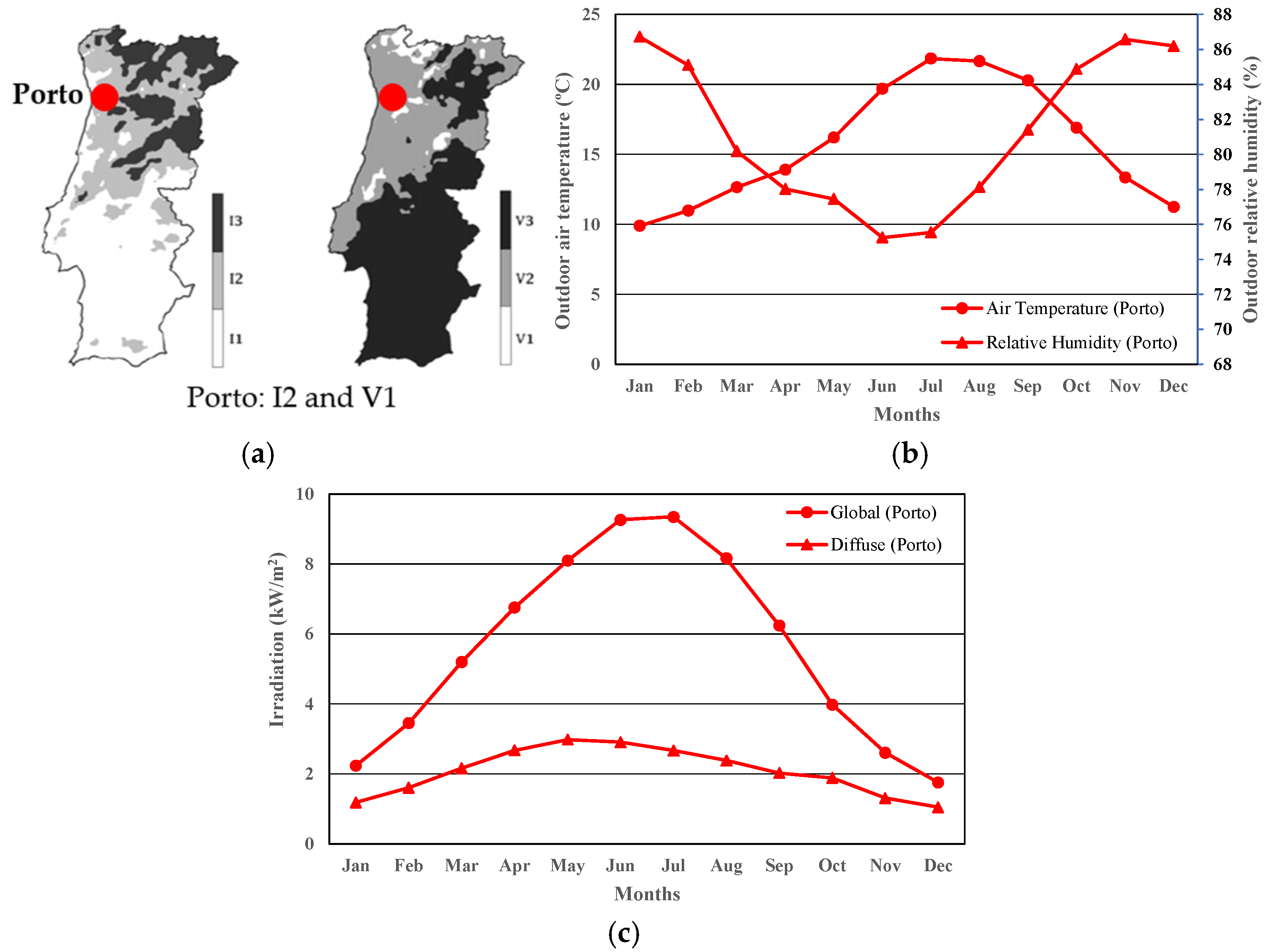
Figure 5 presents the average air temperature, relative humidity, solar irradiation, and the main climatic characteristics of Porto.
2.4. Scenarios Analysed
The main objective is to analyse which of the three proposed scenarios offers the most favourable cost–benefit profile, analysing its technical, economic, and environmental feasibility components. Based on available data [
57], the average electricity consumption per semi-detached household in Porto may vary depending on the type of housing and the number of inhabitants. According to Regulation 1010/2024 [
58], the maximum monthly electricity consumption limits for different types and sizes of households are for a T2, with 3–4 inhabitants, 3420 kWh/yr; and for a T3, with 5 inhabitants, 4280 kWh/yr, i.e., with an approximate monthly consumption of 70 kWh/person. These values represent maximum monthly limits established for energy sharing in renewable energy communities and may not reflect the actual consumption of each household. However, this information provides a useful reference for estimating consumption in social housing.
In this work, a semi-detached household (T2 with 3 inhabitants) for a range of PV and battery storage configurations was analysed, considering an annual electricity consumption of 3280 kWh, and a roof area of up to 50 m2 available for PV installation. The three distinct scenarios analysed are:
Scenario 1: The actual situation, i.e., a household designed with a solar domestic water heating system (reference).
Scenario 2: A project design with an optimised photovoltaic generation system, electric grid-connected and zero energy balance, i.e., to fulfil the entirety of the energy requirements over a year.
Scenario 3: A project design with an optimised photovoltaic generation and energy storage systems.
To ensure methodological consistency, the energy service boundary of each scenario is explicitly defined. Scenario 1 includes both electricity consumption and domestic hot water (DHW) production through the existing solar thermal system. Scenario 2 is conceived as an alternative configuration in which the solar thermal system is replaced by a photovoltaic system without storage; therefore, the DHW demand is incorporated into the electric load profile to maintain functional equivalence with Scenario 1. Scenario 3 extends Scenario 2 by adding battery storage. This clarification avoids comparing systems with different service scopes and ensures that all scenarios deliver the same set of household energy services.
3. Results and Discussion
3.1. Scenario 1 (Reference)
The orientation and tilt of the solar collectors were set based on the same parameters used for designing the photovoltaic energy system, i.e., oriented at an azimuth of 180° (full south orientation) with a slope of 35°, which corresponds to a total incident irradiation throughout the year of 1938.45 kWh/m2yr.
To simulate the solar fraction and perform the cost analysis, the selected flat solar collector was the Ariston KAIROS XP 2.5, a product that complies with EN 12975 [
59]. According to the technical specifications, the following relevant characteristics are: (a) collector area: 2.26 m
2; (b) mass flow rate: 0.020 kg/sm
2; (c) efficiency,
η: 0.808; and a loss coefficient,
FRUL: 3.131 W/m
2 °C. Regarding the electric heater chosen as a support system for the solar collectors and for supplying domestic hot water (DHW), it was the Ariston PRO R VTD. To calculate the solar fraction, it is necessary to know the capacity of the water heater, and the efficiency influences the cost analysis. The useful energy (kwh/d), i.e., the monthly energy demand for heating water, is given by [
60]
where
Vstor is the average daily consumption of reference water (l), ρ is the water specific mass (kg/L), c
p is the specific heat of water (4.187 kJ/kg°C),
Tstor is the water storage temperature (considered equal to 60 °C), and
Tenv is the annual average environmental temperature of the installation site (°C). The average daily water consumption reference,
Vstor, is 22 L/person [
61]. In this simulation, a household with 2 bedrooms, inhabited by 3 persons, was considered, i.e., 66 L/day of DHW required. Taking into account that the efficiency of the water heater (95%) and the water supply, in Porto, varies throughout the year between 9.5 °C and 20.2 °C, for an annual average of 15.1 °C (
Tenv), the amount of useful energy required producing domestic hot water (DWH), using Equation (6), is approximately 1240.8 kWh/yr (38% for DWH of the annual consumption, 3280 kWh/yr).
To simulate the monthly solar energy obtained by the solar collector proposed the F-Chart method [
62] was used. The following equation obtains the solar fraction for monthly analysis
where the parameter
X is related to the thermal losses from the solar collector and
Y to the energy absorbed by the collector, as presented by
where
Ac is the total area of the solar collector (m
2),
FRUL is the thermal loss coefficient of the collector (kW/m
2 °C),
Tref is the reference temperature, considered constant and equal to 60 °C, Δt is the month duration (h),
Cad is the specific desired storage capacity (L/m
2),
Cap is the specific storage capacity adopted by the F-Chart method, corresponding to 75 L/m
2,
is the result of multiplying the removal factor, glass transmissivity, and the ink collectors’ absorptivity by the average angle of incidence of direct radiation, and
HT is the daily global solar radiation on average monthly incident on the collector per unit area (kWh/m
2d). Finally, the parameter
X needs to be corrected,
Xc, due to the Portuguese context, which is different from the USA context, with regard to the need to heat water in homes. Duffie and Beckman [
62] proposed the following correction,
where
Tc is the temperature of usable water (considered 30 °C), and
Tgrid is the temperature at which water is admitted, values obtained by [
62] (°C). Finally, the monthly solar energy obtained by the solar collector is calculated by [
60,
62]
Thus, for a simple electric heating system for sanitary hot water, the annual expense, assuming an electricity price of 0.27 €/kWh, is 335 €/yr. Assuming the incorporation of a solar thermal collector with the same tank capacity, costing around 1200 € with an annual maintenance cost of 100 €, and simulating monthly solar energy, a value of 799.7 kWh/yr for Esolar is obtained. So, the payback period (in years) needed to recover an initial investment, considering an annual inflation of 2%, is approximately 10.4 years.
Finally, considering a CO
2 emission factor for electricity generation of 0.115 [
63], the reduction in CO
2 emissions amounts to 91.97 kg/yr.
3.2. Scenario 2 (Zero Energy Balance)
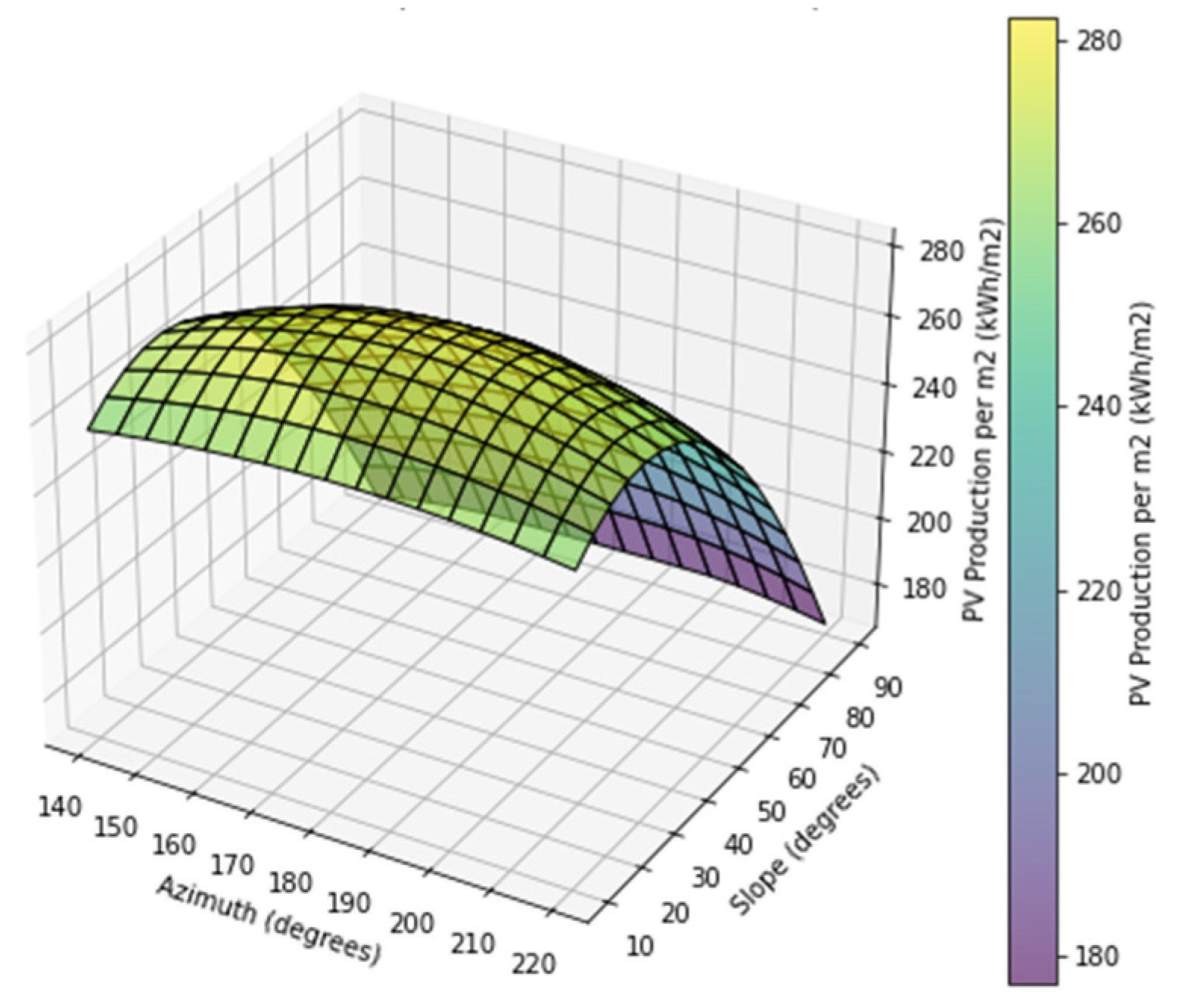
First, the photovoltaic (PV) performance under different slope and azimuth configurations was studied for Porto. For that, slopes from 10 degrees to 90 degrees and azimuths between 220 and 140 (where 180 is full-south orientation, with higher numbers indicating a westward direction) were applied to a single PV module (see
Table 1). The yearly PV production per square metre was studied and is shown in
Figure 6.
It is possible to observe that, for Porto, the optimal PV configuration with the highest energy production was oriented at 180° (full south) with a slope of 35°. These specifications were used for the subsequent simulations, which aimed to analyse the number of PV modules and the battery size, taking into account the objectives of scenarios 2 and 3.
The installation of photovoltaic modules is constrained by the geometry of the case-study dwellings. The maximum usable roof area facing south is approximately 50 m2, which defines the upper limit of the number of PV modules that can be installed. All simulations were performed assuming a south-facing roof with a tilt angle of 35°, matching the existing solar thermal collectors and representing the optimal configuration for Porto’s latitude. Alternative roof orientations, such as east–west, were not included in the main analysis because they would result in lower annual energy yield and require additional mounting structures to achieve the optimal tilt, thereby increasing capital costs. This geometric constraint is therefore incorporated into the modelling assumptions and defines the feasible design space for PV deployment in the analysed social-housing typology.
It is well known that increasing both the storage capacity and the number of PV modules leads to a higher degree of grid independence. A single PV module without energy storage can achieve a grid independence of 17% [
64] in typical housing. The relationship between grid independence and the number of PV modules follows a logarithmic trend, which indicates that, in the absence of storage, a significant portion of daytime energy consumption (approx. 50%) can be covered with less than 10 PV modules.
Based on the PVGIS TMY dataset for Porto, the equivalent full-load hours used in the simulations amount to approximately 1350–1450 kWh/kWp per year, depending on system losses and module orientation. This value is consistent with typical PV performance in coastal Northern Portugal and supports the annual generation results reported in Scenario 2.
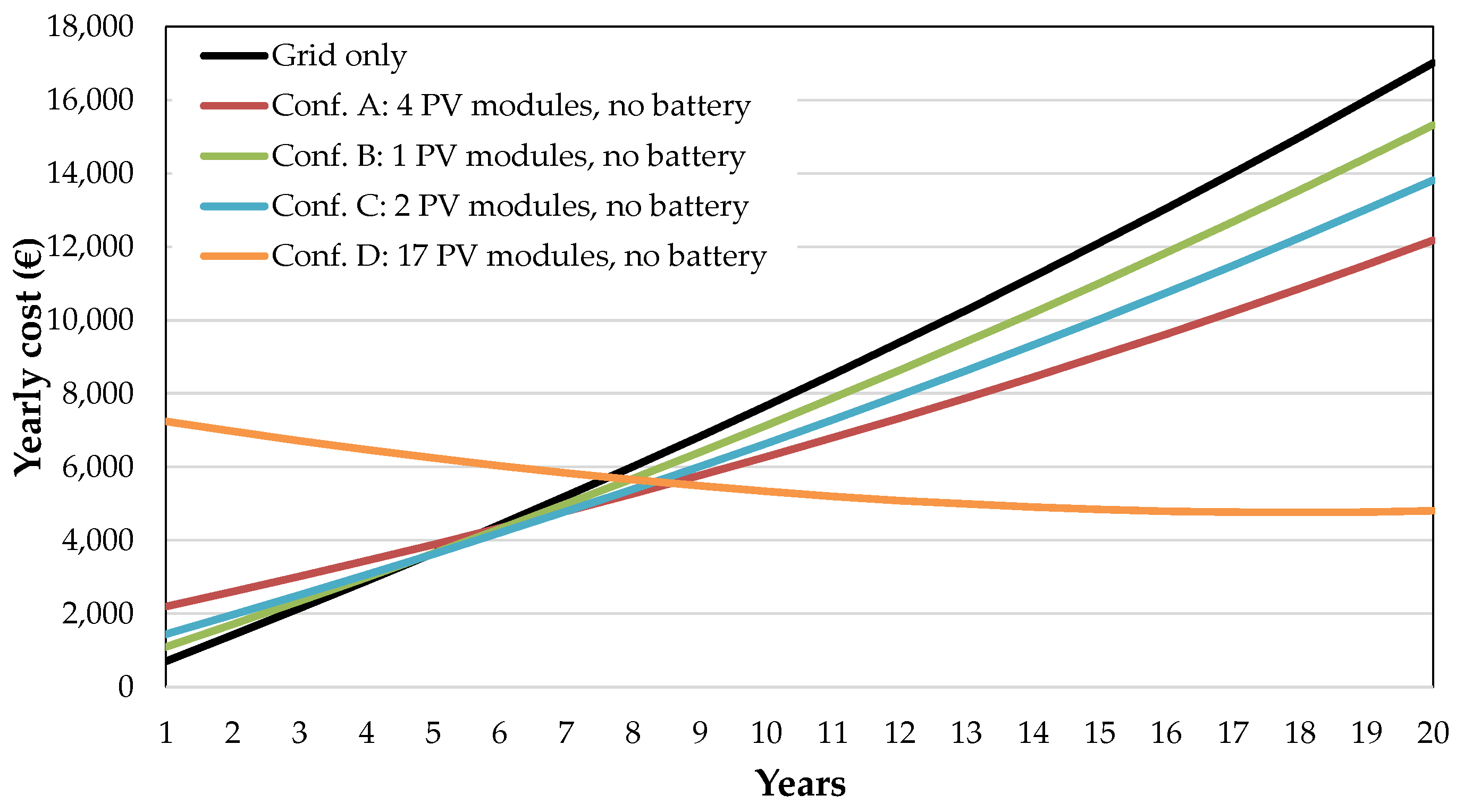
Scenario 2 (zero energy balance) considered a household without a storage system. Within these constraints, four photovoltaic configurations were analysed in detail. Configuration A, with four modules, produces 3315 kWh—closely matching the household’s annual electricity consumption of 3280 kWh, with a grid independence of 41.1%, a payback of 5.7 years, and a total of achieved savings during 20 years of 4834 € (see
Figure 7 and
Table 6).
However, for scenario 2, three other configurations were analysed. The four configurations (A–D) differ mainly in the number of photovoltaic modules installed, ranging from one to seventeen, allowing for a systematic assessment of how system size influences energy production, grid interaction, and economic viability.
The results demonstrate a strong correlation between the size of the photovoltaic array and annual energy production. Configuration B, consisting of a single module, generates 829 kWh in the first year, while configuration C doubles that production with two modules. At the upper end, configuration D, consisting of 17 modules, produces 14,088 kWh in the first year, more than quadrupling the household’s demand. This substantial overproduction results in significant exports to the grid, reaching 12,487 kWh annually.
Despite the high generation potential of larger systems, grid independence remains inherently limited in the absence of storage. Independence levels range from 24.7% (configuration B) to 48.8% (configuration D). Even the most oversized system, limited by available roof area, cannot exceed 50% independence because the time discrepancy between photovoltaic generation and domestic consumption forces a large portion of the energy produced to be exported instead of being self-consumed. This structural limitation underscores the importance of storage to increase self-consumption, but also highlights the economic efficiency of exclusively photovoltaic systems when the goal is to minimise costs rather than autonomy.
From an economic point of view, Scenario 2 shows strong performance in all configurations. Payback periods for configurations B, C, and A range from 4.8 to 5.7 years, reflecting the relatively low investment costs and the favourable balance between self-consumption and export revenues. Although configuration D requires a higher initial investment (€ 7530), it still achieves a reasonable payback period of 7.6 years and generates substantial long-term savings over 20 years.
Thus, configuration A stands out as the most economically balanced option, reaching €4834 in accumulated savings over 20 years. These results confirm that photovoltaic systems without storage can provide excellent economic returns, especially when sized to align with household consumption patterns.
3.3. Scenario 3 (PV and Storage)
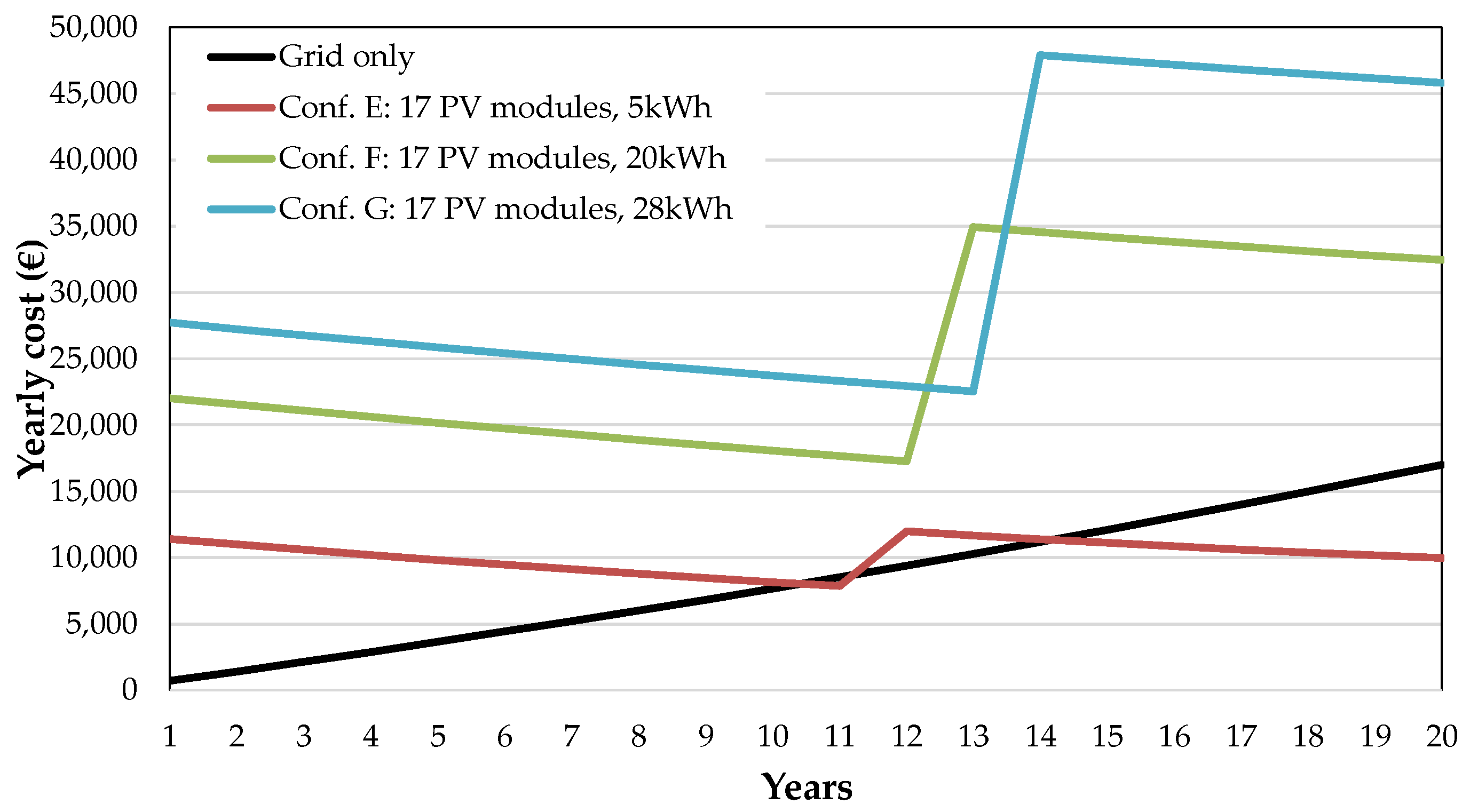
Scenario 3 evaluates the combined implementation of photovoltaic generation and battery storage, allowing for more efficient use of the energy produced and significantly increasing the degree of independence of the residence from the electrical grid. The simulations emphasise this relationship, demonstrating that increasing both storage capacity and the number of photovoltaic modules leads to a greater degree of grid independence. Three configurations (E–G) are analysed, all incorporating 17 photovoltaic modules, but differing in battery capacity: 5 kWh, 20 kWh, and 28 kWh (See
Figure 8 and
Table 7).
The introduction of storage fundamentally alters the system’s performance. Even the smallest battery (5 kWh, configuration E) raises grid independence to 86.1%, almost doubling the independence achieved by the same photovoltaic array without storage. Increasing the battery capacity to 20 kWh (configuration F) increases independence to 99.6%, while the largest battery (28 kWh, configuration G) allows for total autonomy, reaching 100% grid independence. These results clearly demonstrate that storage is the main factor in energy autonomy, allowing the residence to retain surplus energy that would otherwise be exported.
However, the economic implications of storage are considerably less favourable. Battery systems significantly increase the total cost of investment, and the need to replace the battery when it reaches 70% of its capacity further amplifies long-term expenses. Configuration E requires an initial investment of 11,841 €, plus 3555 € for replacement, while configurations F and G reach 22,506 € and 28,194 €, respectively, with proportionally higher replacement costs. Consequently, the economic performance of large battery systems is weak. Configuration E achieves a payback period of 10.4 years, substantially longer than any configuration in Scenario 2, while configurations F and G do not achieve payback within the 20-year analysis period, generating instead negative savings of −15,452 € and −28,800 €, respectively.
These results reinforce the idea that the number of photovoltaic modules has a more significant influence on the economic performance of the system than battery capacity. Although batteries substantially increase autonomy, they do not improve economic return; in fact, they significantly decrease it. Storage is therefore primarily justified in contexts where energy independence is a strategic, not economic, priority.
3.4. Comparison of the Different Scenarios Analysed
A comparative assessment of the three scenarios clearly illustrates the trade-offs between investment cost, energy production, environmental performance, and long-term economic return.
Table 8 summarises the key indicators: implementation cost, annual energy generation, annual CO
2 reduction, payback period, and 20-year accumulated savings, allowing a structured evaluation of the strengths and limitations of each configuration.
Scenario 1, which represents the baseline solution incorporating a solar thermal system for domestic hot water, exhibits the lowest implementation cost (1200 €). However, this economic advantage is offset by its limited technical performance, as it delivers the lowest annual energy generation (800 kWh) and the smallest CO2 reduction (92 kg/yr). The payback period of 10.4 years reflects the modest energy contribution of the system, resulting in comparatively low long-term savings (1120 € in the 20th year).
Scenario 2 presents a more favourable balance between cost and performance. With a moderate investment of 1810 €, the photovoltaic system without storage achieves a substantial increase in annual energy production (3315 kWh) and more than quadruples the CO2 reduction achieved in Scenario 1 (381 kg/yr). The payback period of 5.7 years is significantly shorter, making it the most economically attractive option. This is further confirmed by the highest accumulated savings among the three scenarios, reaching 4834 € by the 20th year. The combination of relatively low cost, strong energy output, and rapid return on investment positions Scenario 2 as the most efficient and cost-effective configuration for typical residential applications.
Scenario 3, which integrates photovoltaic generation with battery storage, delivers the highest technical and environmental performance. Its annual energy generation reaches 14,088 kWh, and its CO2 reduction (1620 kg/yr) far exceeds the values observed in the other scenarios. Nevertheless, these benefits come at a disproportionately high financial cost, with an implementation cost of 11,841 € and a payback period of 10.5 years, comparable to Scenario 1 despite vastly superior energy production. Although Scenario 3 achieves the greatest degree of energy autonomy and environmental impact, its economic performance is weakened by the high capital cost associated with battery storage. Even so, it still provides notable long-term savings (7046 € at the 20th year), though these savings are modest relative to the scale of the investment.
Overall, the comparison reveals a clear hierarchy among the three configurations. Photovoltaic systems without storage (Scenario 2) offer the most advantageous economic performance, combining moderate investment with high energy yield and rapid payback. Solar thermal systems (Scenario 1) provide the lowest upfront cost but deliver limited long-term benefits. Meanwhile, PV-battery systems (Scenario 3) maximise energy autonomy and environmental gains but at a significantly higher financial burden. This analysis underscores the importance of aligning system selection with the household’s priorities—whether economic optimisation, environmental impact, or energy independence.
Finally, the results also highlight important implications for energy-poverty mitigation. Although PV systems can substantially reduce annual electricity expenditure, the high upfront investment remains a major barrier for low-income households, who often lack access to financing mechanisms or the capacity to assume long-term debt. Ensuring that the benefits of renewable energy reach vulnerable groups requires targeted policy measures, such as dedicated subsidies for PV installations in social housing, simplified administrative procedures, and integrated renovation programmes that combine energy-efficiency upgrades with renewable-energy deployment. These actions would strengthen the social impact of PV adoption and reinforce its role in reducing energy poverty.
Despite these potential benefits, the economic burden associated with PV and PV-battery systems continues to pose a challenge for lower-income households. Well-designed incentives and supportive policies are therefore essential to reduce financial barriers and enable vulnerable populations to participate in the energy transition, ensuring that renewable-energy technologies do not exacerbate existing inequalities.
Additionally, the growing penetration of distributed renewable generation raises concerns about grid stability and cost allocation. The significant influx of energy into the distribution network can create operational challenges and increase system-wide costs. It is therefore essential to implement policies and tariff structures that ensure the grid remains reliable, financially sustainable, and capable of accommodating higher shares of decentralised generation.
3.5. Sensitivity Analysis
A sensitivity analysis was conducted for Scenarios 2 and 3 to evaluate how variations in key techno-economic parameters influence the performance of the proposed configurations, particularly regarding the payback period and degree of grid independence. Several input parameters, such as electricity tariffs, photovoltaic module prices, battery costs, and household load profiles, are subject to market volatility and behavioural uncertainty.
3.5.1. Influence of Electricity Price
Electricity price is consistently identified in the literature as the most influential factor affecting the economic viability of residential PV systems [
24]. The selected variation of +40%/−30% in electricity prices, relative to the baseline value of 0.27 €/kWh, reflects the high volatility observed in European retail markets during 2021–2022, where year-on-year increases above 30% were documented across multiple EU member states [
65].
Table 9 presents the results obtained.
The results showed that for an increase of +40%, the payback periods for Scenario 2 decrease by 0.8–1.8 years, and Scenario 3 becomes more competitive, while for a reduction of −30%, the payback periods increase by 8.8–4.0 years for all PV-based scenarios, and battery-based configurations become significantly less attractive. Grid independence remains unchanged, as it is a technical parameter.
To assess the influence of export remuneration, an additional sensitivity test was performed in which the electricity selling price was doubled from 0.06 €/kWh to 0.12 €/kWh. This value remains below the retail import tariff but represents a substantial improvement in prosumer compensation. The results showed that the payback periods decreased by up to 3.8 years, and that Configuration E approaches the payback periods observed for configurations with only PV. Grid independence remains unchanged, as expected.
These results are aligned with findings from European case studies showing that PV-battery systems only become economically favourable under high retail electricity prices or dynamic tariffs with strong peak-to-off-peak differentials [
66].
3.5.2. Influence of PV Module Cost
PV module prices have experienced a long-term downward trend, but short-term fluctuations remain common due to supply-chain constraints [
36]. The range of −30% to +20% (baseline module cost of 0.125 €/Wp) for PV module cost variation is consistent with recent global market behaviour, where long-term price declines have been punctuated by short-term supply-chain-driven increases of up to 20% [
43]. The results are presented in
Table 10.
The results showed that for an increase of 20%, the payback period increases by 0.2 years for the best scenarios (Conf. A and E), and for a reduction of 30%, the payback period of Conf. A decrease by 0.2 years and Conf. E decrease by 0.3 years. The total system cost decreases by 15–22%, depending on the configuration. These results are consistent with global analyses showing that PV module price reductions have diminishing marginal impacts on total system costs once storage is introduced [
27].
3.5.3. Influence of Battery Cost
Battery cost is the dominant economic driver in storage-based systems. The chosen interval of −30% to +10% (baseline value adopted is 711 €/kWh) for battery cost variation aligns with techno-economic projections showing sustained annual cost reductions of 10–20% and only occasional upward adjustments below 10% [
67].
The results showed that, with a reduction of 30%, Scenario 3 becomes more competitive, and Configuration E (5 kWh) approaches a payback of ~9.5 years. Larger batteries (20–28 kWh) remain economically prohibitive. And, with a 20% increase in battery cost, the payback period increases by 0.3 years. These findings mirror those of recent techno-economic studies [
66], which show that battery cost reductions are the single most important factor for making residential storage economically viable.
3.5.4. Influence of Load Profile Variability
Household consumption patterns are inherently uncertain and can vary due to occupancy, appliance use, and behavioural factors. To assess this variability, the baseline BTN-C profile was scaled by ±20%. The ±20% variation applied to the residential load profile is supported by empirical studies demonstrating that household electricity demand typically fluctuates between 10% and 25% due to behavioural and occupancy-related factors [
66].
Table 11 presents the results obtained.
The results showed that for an increase of 20%, the grid independence decreases by 0.5–5.6 percentage points across all scenarios, while for a 20% decrease, the grid independence increases by up to 5.4 percentage points. The payback periods increase by 0.3–0.6 years due to reduced self-consumption and decrease by 0.1–0.4 years due to increased self-consumption. It is possible to observe that for an increase of +20% in annual load, Scenario 2 becomes more economically favourable due to increased self-consumption, and Scenario 3 benefits from higher battery utilisation, but the economic performance remains dominated by storage cost. These results are consistent with empirical studies showing that load uncertainty is a major determinant of PV self-consumption and economic return [
68].
In summary, the sensitivity analysis confirms that PV-only systems offer the most stable and economically resilient solution for social-housing contexts, while PV-battery systems require substantial cost reductions to become competitive.
4. Conclusions
This work presents the development of a modular simulation model for PV and storage systems tailored to household applications. The model integrates weather data to estimate PV system power conversion through an hourly energy balance history between what is produced, consumed, exchanged with the grid, and stored in the batteries. It also supports multi-year performance assessments along with cost–benefit analyses. However, it should be noted that the optimal configuration identified in this study, PV without storage, derives from a single case study in Porto. Regional differences in solar resource availability, household load characteristics, and electricity tariff structures across Portugal may lead to different optimal solutions. Therefore, the conclusions should not be generalised without caution, and future work should extend the analysis to multiple climatic and socioeconomic contexts to capture regional variability.
The analysis of the three scenarios demonstrates that the ideal configuration depends on the family’s priorities: economy, environmental performance, or energy independence. The numerical results highlight this trade-off relationship, showing a trade-off between energy autonomy and economic performance, since configurations with moderate independence from the electricity grid produce the most economical results. Based on the results obtained within the context of this study, it can be concluded that:
- (a)
The scenario with only PV production and zero energy balance emerges as the most balanced and economically advantageous solution. With relatively low investment costs, short payback periods, and substantial long-term savings, exclusively photovoltaic systems sized to meet domestic consumption offer the best overall performance. They also provide significant environmental benefits without the financial burden associated with battery storage.
- (b)
A scenario with PV generation and energy storage, while technically superior in terms of autonomy and CO2 reduction, is hampered by the high cost of batteries and their replacement. Storage becomes economically viable only when energy independence is a primary objective, such as in remote locations or in contexts where the reliability of the electricity grid is low. For typical residential consumers connected to a stable grid, the economic penalty outweighs the benefits of autonomy.
In conclusion, the evidence gathered within the scope of this study supports that increasing photovoltaic capacity is the most effective strategy for improving environmental and economic performance, while increasing battery capacity primarily aims to improve autonomy at a disproportionately high cost. For the residence analysed, the most rational solution is a well-dimensioned photovoltaic system without storage, which offers the best balance between investment, savings, and sustainability.
Beyond the technical and economic findings, the results have important implications for energy-poverty mitigation in Portuguese social housing. Although PV systems, particularly those without storage, significantly reduce annual electricity expenditure, the high upfront investment remains a major barrier for low-income households. This highlights the need for targeted policy measures, including dedicated funding schemes for PV installations in social housing, simplified administrative procedures, and integrated renovation programmes that combine building-envelope improvements with renewable-energy deployment. Such mechanisms would ensure that the benefits of PV adoption are accessible to vulnerable groups and would enhance the social impact and policy relevance of the proposed solutions.