


Abstract
Face recognition is one research area that has benefited from the recent popularity of deep learning, namely the convolutional neural network (CNN) model. Nevertheless, the recognition performance is still compromised by the model’s dependency on the scale of input images and the limited number of feature maps in each layer of the network. To circumvent these issues, we propose PSI-CNN, a generic pyramid-based scale-invariant CNN architecture which additionally extracts untrained feature maps across multiple image resolutions, thereby allowing the network to learn scale-independent information and improving the recognition performance on low resolution images. Experimental results on the LFW dataset and our own CCTV database show PSI-CNN consistently outperforming the widely-adopted VGG face model in terms of face matching accuracy.
1. Introduction
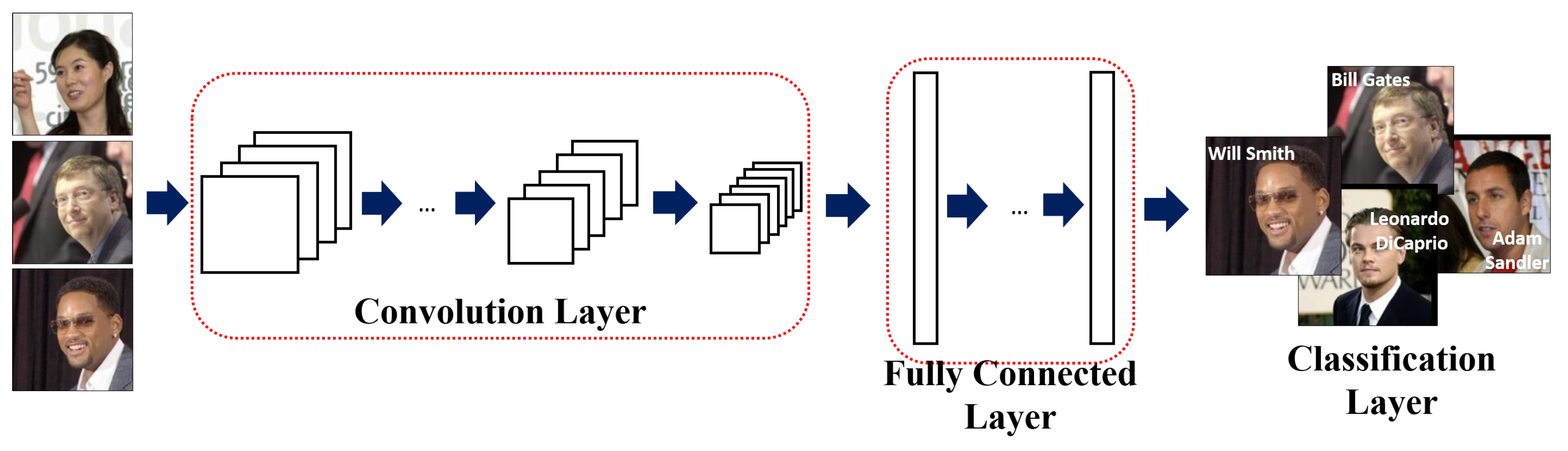
With the recent advancement in deep learning, a variety of models based on the convolutional neural network (CNN, see Figure 1) have been introduced in face recognition, most notably DeepFace [1], DeepID [2], FaceNet [3], and the VGG model [4]. These models apply convolution and pooling repeatedly to extract local and global features of input image. In order to enhance the classification ability, a set of fully connected layers are applied to feature maps from the final convolutional layer. In a typical CNN, n feature maps are extracted from the input image using n trained convolutional filters which are then transferred to the next layer. The size of the extracted feature maps is reduced through a pooling layer, and m feature maps (derived from m trained convolutional filters) are generated from the initially-obtained n feature maps through the current convolutional layer. Typically, the number of feature maps outputted by the shallower-side convolutional layers are limited by available memory and computational power, inevitably using only a subset of useful patterns for face recognition. This can also be interpreted as excluding some potentially useful patterns, which we define as untrained patterns in this paper, thereby yielding suboptimal matching performance. Devising a way to reintroduce these untrained patterns into the model is the main motivation of this work.
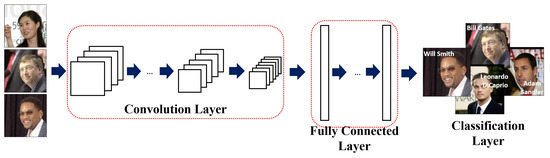
Figure 1.
An overview of a generic CNN architecture.
In surveillance applications, face recognition methods can be applied to identify a target person. Typically, images involved in these applications are acquired in an unconstrained environment with potentially large variations in pose, illumination, expression, resolution and image quality. Recent face recognition methods have achieved robustness to variations in pose, illumination, and expression, but issues caused by low image resolution and quality still persist, requiring an expensive data augmentation step to achieve advertised performance.
In this paper, we propose PSI-CNN, a pyramid-based scale-invariant convolutional neural network model, which utilizes additionally extracted untrained patterns to maintain high matching accuracy in unconstrained environments. Our contributions are as follows:
- We present a comprehensive review of the literature which builds foundation to this work.
- Our proposed PSI-CNN model utilizes additionally extracted feature maps from various image resolutions, achieving robustness to scale changes in input images, potentially enabling its application in unconstrained environments with variable z-distance values.
- We provide an extensive analysis of the recognition performance achieved by models employing the PSI-CNN architecture. This is achieved by not only utilizing a publicly available database but also creating our own dataset collected under unconstrained environmental conditions with variable facial-region size.
2. Related Work
With the growth of importance in security, biometrics encoding personal characteristics such as face, iris and fingerprints are widely used for person identification. Among them, face recognition is becoming more prevalent thanks to the recent deep learning-based methods steadily improving the identification accuracy.
Face recognition can be categorized into three groups: holistic-based, partial-based, and deep learning-based approaches. Holistic-based approaches utilize global facial characteristics as features for identification. Many traditional methods such as Eigenfaces [5] and Fisherfaces [6] (based on the linear discriminant analysis (LDA)), could be classified as holistic-based approaches.
Turk et al., introduced Eigenface [5], which is a face recognition method based on the principal component analysis (PCA). This method approximates an image as a vector of principal components by projecting into the subspace of eigenvectors, which are calculated from the covariance matrix of the training data. In this work, the eigenvectors represent the axes which can express the distribution of training data. By sorting and selecting eigenvectors according to their respective eigenvalues, one can reduce the dimension of input image without losing too much information. Belhumeur et al., proposed a Fisherface-based face recognition method, which has higher recognition accuracy than that of Eigenface [6]. The method is based on the LDA and projects given images into Fisher’s linear discriminant vectors, which best explain the inter-class and intra-class relationships. These two methods are the representative methods of the holistic-based approaches. Since holistic-based approaches compute a vectorized matrix from the training dataset, these methods are highly dependent to the characteristics of the training set used, and consequently they are sensitive to environmental conditions such as illumination, pose and expression. Therefore, holistic-based approaches require image normalization (e.g., through alignment of face region or normalization of illumination) in order to improve the matching accuracy.
Partial-based approaches were proposed to overcome the aforementioned weaknesses of the holistic-based approaches. These approaches divide face region into grids and extract local facial features. Well-known partial-based methods include the local binary patterns (LBP), scale-invariant feature transform (SIFT) and histogram of gradients (HOG).
Ahonen et al., proposed a face recognition method based on local binary patterns (LBP), which analyze the patterns of the facial region [7]. This LBP method generates binary patterns by comparing the value of the center pixel with that of its neighboring pixels in each local window. Assuming that the size of the local window is 3 × 3 (i.e., nine pixels), the LBP operator represents each pixel as 0 or 1 using a simple binary comparison. For instance, if a pixel value is greater than that of the center pixel, then LBP outputs 1, otherwise it outputs 0. Also, the LBP-based face recognition method transforms the extracted binary codes into uniform patterns. The uniform patterns consider the number of transitions from 0 to 1 and the length of 1. From that, it can describe the texture of facial skins which include edge and point information. Finally it represents these patterns as a histogram and recognizes user by calculating the distance between the enrolled features and the features from input image . The LBP-based method demonstrated then-high performance despite its relatively simple architecture. Direct extensions of this work include local ternary patterns (LTP) and three-patch LBP (TP-LBP) [8,9].
After the success of the LBP method, several partial-based approaches were proposed and utilized. In [10,11], the authors applied the SIFT and HOG algorithms respectively for partial feature-based face recognition. Both methods have the advantage of being able to robustly extract facial features in presence of local pose variations and illumination changes. Geng et al. introduced Volume-SIFT (VSIFT) and Partial-Descriptor-SIFT (PDSIFT), which are extended versions of the original SIFT descriptor [10]. The SIFT algorithm is commonly used for object detection and recognition as its descriptor is invariant to changes in scale and rotation. By applying SIFT to face recognition tasks, the authors were able to extract robust facial features and compare the matching performance against other methods based on holistic approaches. Deniz et al., applied HOG features for face recognition [11]; the authors detected facial landmarks from input image, around which they set small areas of patches and extracted a HOG descriptor from each patch. In this work, HOG features were extracted by applying patches of different sizes, and combining these varying features were shown to improve the recognition performance.
Chen et al. argued that high dimensionality leads to high performance, and demonstrated this by comparing the proposed high-dimensional LBP method against the original method and other then-state-of-the-art methods [12]. In this work, the authors initially detected 27 facial landmarks from input image and created one -sized patch per landmark centered on the corresponding landmark position. The designated patch region was divided into non-overlapping cells, and facial features were extracted from each divided cell by applying the LBP operator. In order to enhance scale invariance, the authors resized the input image over five steps and performed the above procedure repeatedly. From this, high-dimensional LBP features were generated by concatenating the extracted feature vector from each cell, leading to a feature space dimension of around 100 K. The authors applied PCA to reduce this dimension to a controllable size of 400. Experimental results showed that the high-dimensional LBP features outperformed the low-dimensional LBP and other state-of-the-art methods for the Labeled Faces in the Wild (LFW) dataset with unrestricted protocol [13]. Its matching accuracy is 93.18%, which was the-state-of-the art accuracy. (The matching accuracy of the prior best was about 90%).
Since the success of deep learning in many areas of computer vision, several deep learning-based methods have been proposed for face recognition. Overall, these methods attempt to extract feature vectors encompassing both holistic and partial characteristics. Taigman et al. proposed a deep learning framework for face recognition called “DeepFace”, which aligns input face image based on 3D face model and extracts the corresponding feature vector from a nine-layer CNN [1]. The model was trained by using approximately four million facial images acquired from around 4000 people. DeepFace adopts an end-to-end metric learning model called the Siamese network, which directly predicts whether the same person is observed in both of two input images. To enhance the recognition performance, the authors combined several deep learning-based method, including the previously-mentioned Siamese network. Subsequently, it achieved 97.37% of matching accuracy on the LFW dataset with unrestricted protocol, which is very close to human recognition accuracy ().
After the introduction of DeepFace, many other deep learning-based methods have been proposed. Sun et al.’s deep hidden identity features (DeepID) [2] detects five facial landmarks by using Sun et al.’s method [14] and aligns input face by considering the centers of eyes and mouth. From the aligned face image, the authors extracted feature vectors from 60 face patches, which are generated by considering 10 regions, three scales, and RGB or gray channels. They trained 60 convolutional networks (one per face patch) where each network outputs two 160-dimensional feature vectors. Thus, the total dimension of the concatenated feature vector is 19,200. Finally, a joint Bayesian method considering identity and intra-personal variation is applied to check if the same person is observed in both of two input images [15].
Schroff et al. proposed a face recognition system called “FaceNet”, which directly extracts a compact feature vector in the Euclidean space [3]. FaceNet generates a feature vector from input image through a deep convolutional network (e.g., the Zeiler & Fergus network [16] and the Inception network [17]) and embeds the feature vector into the Euclidean space by applying the triplet loss method. For training the network based on the triplet loss, the authors utilized three images as inputs, whereby two images are from the same identity and the other image is from a different person. They defined one of two images of the same identity as anchor, and called the other image of the same identity as positive and the image of a different identity as negative. Ideally, the Euclidean distance between the anchor and the positive () should be smaller than that between the anchor and the negative (). They minimized based on the equation , where is a margin variable to make larger gap between and . The authors used about 200 million images of eight million unique identities to train the network, achieving 99.63% recognition accuracy on the LFW dataset with unrestricted, labeled outside the data protocol.
Parkhi et al. collected a large-scale face dataset called VGG-Face, and proposed the VGG face model for face recognition [4]. The VGG-Face database contains about 2.6 millions images of 2622 celebrities with manual filtering. The network architecture comprises five convolution blocks and three fully connected layers connected in series. Each convolution block comprises of two or three convolutional layers with max pooling to reduce the size of the output feature map. This network was trained by using the VGG-Face database only, which is much smaller than the amount of training data used by [1,3]. They demonstrated the efficiency of their database and network architecture by achieving the recognition accuracy of over 97% on the LFW dataset with unrestricted protocol. Applying the triplet loss from [3] further improves the accuracy by 1.8%.
A more concise review of the literature and classifications of the aforementioned face recognition methods can be found in Table 1.

Table 1.
A summary of past and current face recognition methods.
3. Proposed Framework
In this section, we first describe the main intuition behind our PSI-CNN architecture. Conventional CNN models for face recognition comprise fewer number of filters in the shallower-side layers than those in the deeper-end convolutional layers. For example, the VGG face model only uses 64 filters in the first layer although the last convolutional layer utilizes 512 filters. The extracted feature map is passed onto the next convolution step. As mentioned in Section 2, utilizing the characteristics of local patterns can improve the recognition performance. However, since the sizes of input images are typically over , the number of convolutional filters in the shallower layers are limited by available memory and computation power. Consequently, some patterns are excluded from the network despite these local characteristics being potentially useful for further enhancing the recognition performance. Throughout this paper, we will refer to these excluded but potentially useful patterns as untrained patterns.
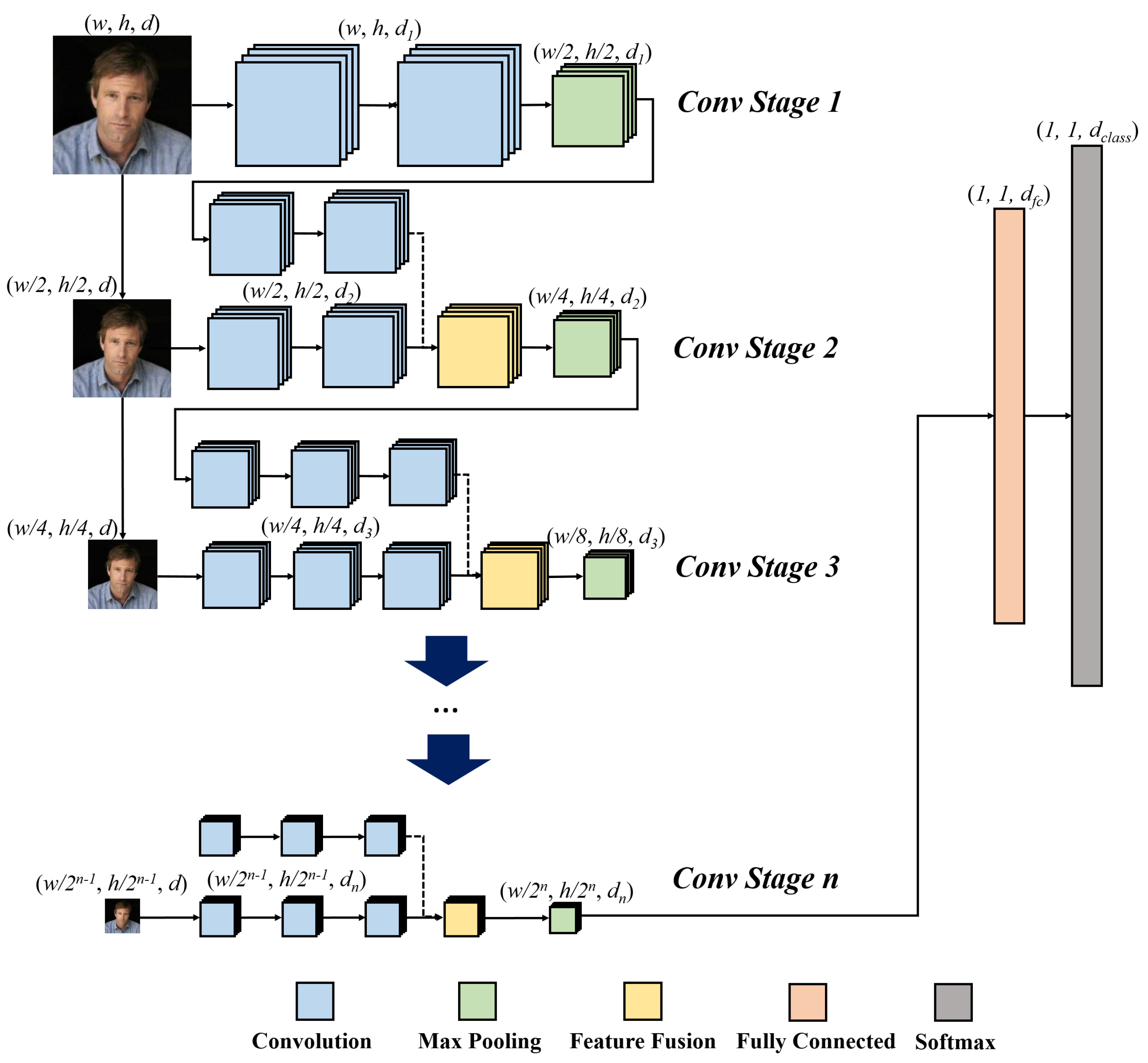
As shown in Figure 2, PSI-CNN works by additionally extracting the aforementioned untrained feature maps from a set of downsampled images (of the original input image) and fusing this information during the convolution stages. We will use the schematic diagram of the PSI-CNN architecture drawn in Figure 2 for further illustration of the model included in Section 3.1. (In this diagram, in Figure 2 refer to width, height, and number of feature maps respectively.)
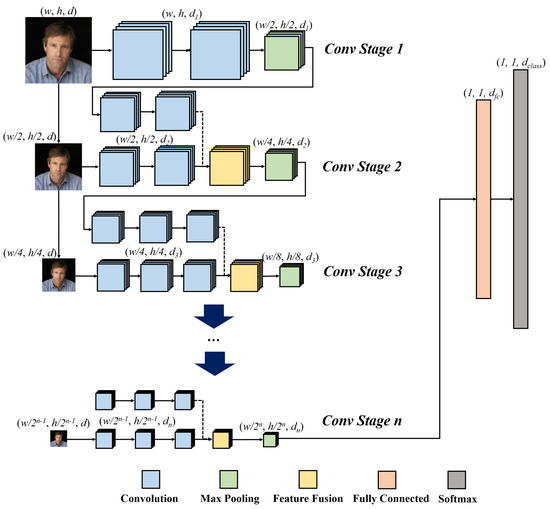
Figure 2.
An overview of our PSI-CNN architecture
3.1. PSI-CNN Model
PSI-CNN first passes input image through “Conv stage 1”, which comprises two ordinary convolutional layers followed by a standard pooling layer. Each convolutional layer extracts feature maps. Similar to the VGG face model, is set to 64 and each feature map has size of . After pooling, we yield 64 reduced feature maps of size .
Now, “Conv stage 2” is where the PSI-CNN model differs from other CNN-based approaches. The 64 feature maps generated from “Conv stage 1” are passed through two additional convolutional layers with 128 filters in “Conv stage 2”, generating feature maps in total. At the same time, the factor-of-two-downsampled input image is used to generate untrained feature maps of size . Thus, the total number of feature maps in “Conv stage 2” becomes 256 (=2 × 128).
If the above feature maps were to propagate directly to the next stage, the overall size of the network would increase, consequently increasing the computational cost. To circumvent this issue, we combine the feature maps resulted from “Conv stage 1” and the untrained feature maps from the downsampled image by adopting a feature-level fusion process, maintaining a constant number of feature maps. More specifically, each level of feature maps obtained by propagating through the network is paired with its same-level untrained counterpart (i.e., feature maps derived from image downsampling), and a combined feature map is generated by averaging each of these pairs. By adopting this fusion procedure, it is possible to utilize a conventional CNN architecture without modifying its foundational structure (e.g., number of feature maps and stride of convolution filters). The subsequent stages are extended in the same way as in “Conv stage 2”.
After each convolution step, we apply the rectified linear unit (ReLU), which is an efficient activation function that requires lower computation cost than other activations such as sigmoid or hyperbolic tangent and avoids the problem of vanishing gradients during back-propagation [18]. Given a scalar input x, the ReLU function simply outputs
After the last “Conv stage”, 512 feature maps of size are generated and converted to a 1024-dimensional vector by applying a fully connected layer. Finally, a softmax layer is added as a classifier. Note that this layer is only utilized at test time. The feature vector from the fully connected layer is used to calculate the similarity between two images to identify whether they are from the same person or not. To prevent over-fitting, we apply dropouts with 50% dropout probability to edges between the fully connected layer and the classifier.
More details on the PSI-CNN architecture can be found in Table 2. Note that the PSI-CNN framework is generic and may therefore be applied to other conventional convolutional networks without modifying its basis structure.
Table 2.
A detailed summary of the PSI-CNN structure.
4. Experimental Results and Discussions
We evaluated the recognition performance of our proposed PSI-CNN model on two datasets—Labeled Faces in the Wild (LFW) [13] and our custom dataset derived from CCTV cameras. For this purpose, we used a 12GB NVIDIA TITAN X graphics card. For comparisons, we use a modified version of the VGG face model as the baseline. This is because the original VGG model utilizes two fully connected layers with each outputting 4096-dimensional vectors, meaning that the model requires large amount of computation power and memory. To bypass this issue, we replaced the aforementioned fully connected layers by a single smaller (1024-dimensional) fully connected layer. From our preliminary empirical investigations, we were able to shrink the VGG model by almost 60% of its original size, whilst maintaining 98.4% average matching accuracy on the above datasets. This implies that using a fewer dimensional fully connected layer can be a computationally-efficient way of implementing a high-performance face recognition method.
4.1. Model Training
For the purpose of training, we used the CASIA WebFace database, which comprises approximately 500 K images of 10,575 different individuals collected from the Internet [19]. For the baseline model, we optimized the 1024-dimensional fully connected layer via fine-tuning using the CASIA WebFace database. After training the baseline model, we added “Conv stage 2”, which consists of two convolutional layers that extract features from the factor-of-two-downsampled input image. For the extended models, we set the learning rates for the existing layers and the newly added convolutional layers to 0.0001 and 0.001 respectively, encouraging more versatile movements of the newly added weights. The kernel size of each newly-trained convolutional filter was set to in order to maintain consistency with the reference VGG face model. All the model parameters were optimized using the stochastic gradient descent (SGD) method with the weight decay factor set to 0.0005. Further “Conv stages” are added and optimized consecutively in a similar manner.
4.2. Performance Comparison on the LFW Dataset
The LFW database comprises 13,233 images of 5749 individuals taken in various environments. It has become a de-facto evaluation benchmark dataset for face recognition. In this work, we evaluated the performance under the unrestricted, labeled outside data protocol, which aims to measure how many image pairs can be recognized correctly. It provides 6000 mixed pair of images, of which 3000 are genuine pairs and others are imposters. These groups of pairs are further segregated into 10 subsets. The matching performance is determined by the mean matching accuracy and the standard deviation of accuracies based on 10 cross validations. These are defined in (2) and (3) respectively, where denotes the recognition rate of each test set. In this work, we computed the measurement of similarity between each image pair based on their Euclidean distance.
In order to extract feature vectors from input images, each image was resized to , and total of 10 patches of size were set on the original image and the flipped image (i.e., five patches per image). On each image, one patch was placed at the center of each image and the other four were located near the image corners. We extracted feature vectors from these patches and averaged them to generated the final feature vector.
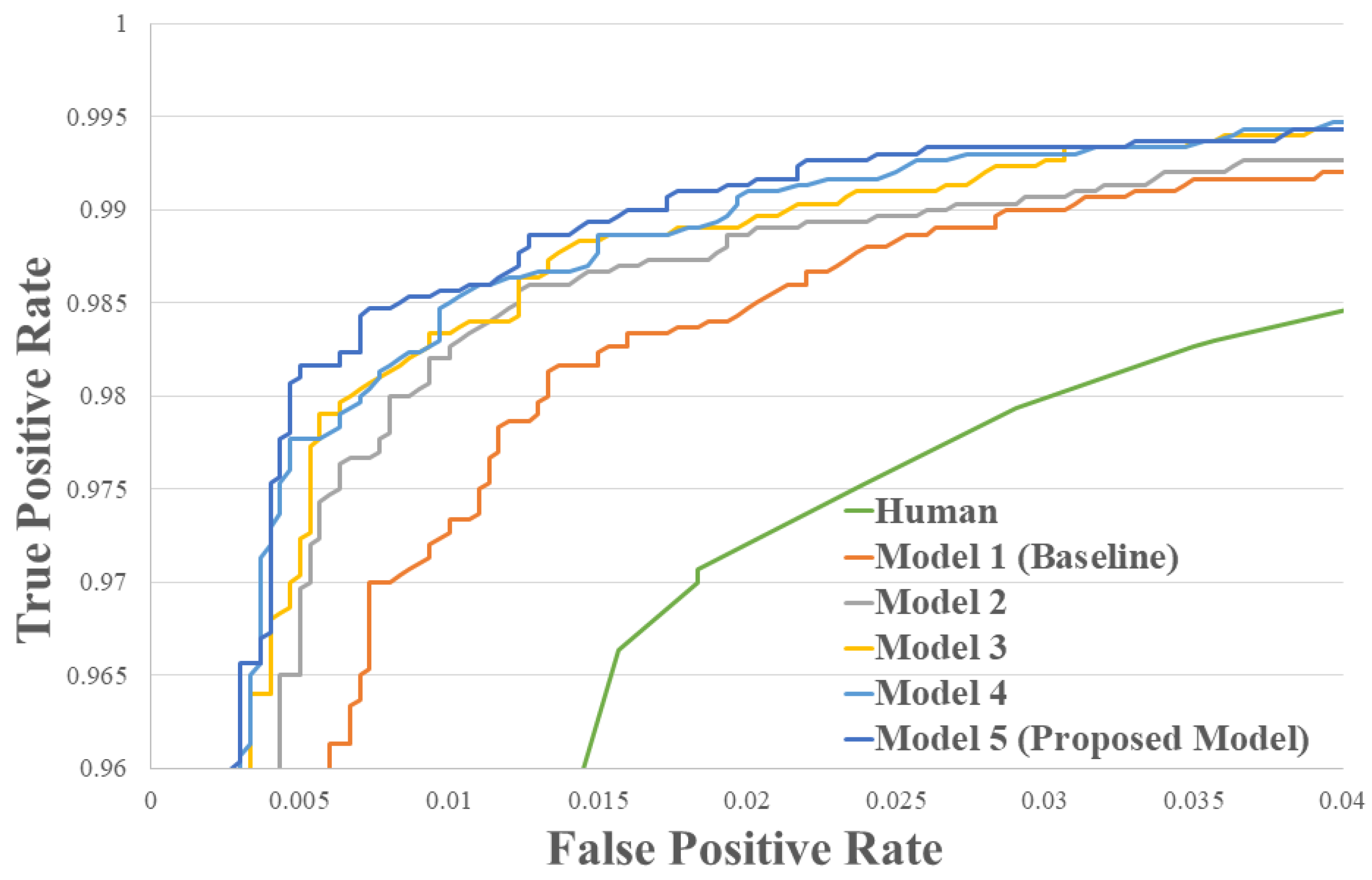
For the first experiment, we compared the matching accuracy of each “Conv stage”-extended model against the baseline. As shown in Figure 3 and Table 3, the performance is incrementally enhanced by adding more convolutional stages. The proposed model with five convolutional stages showed matching accuracy of 98.87%. Note that this score is achieved just by adopting the PSI-CNN architecture and without incorporating additional learning framework such as triplet loss.
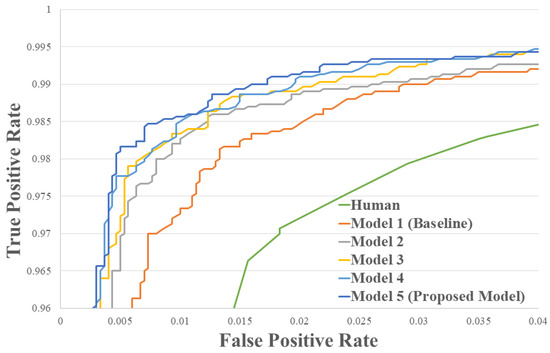
Figure 3.
The ROC curve of different models on the LFW dataset
Table 3.
Means and standard deviations of matching accuracies on the LFW dataset.
The experimental results demonstrate the effectiveness of untrained patterns in improving the matching accuracy for face recognition.
4.3. Performance Comparison on Our CCTV Dataset
In the second experiment, we compared the performance of the baseline model and PSI-CNN using our dataset generated from CCTVs. This dataset has around 1,500 images of 10 individuals, comprising both high-quality images of frontal faces and low-resolution CCTV images for each person. The number of genuine and imposter pairs are 2380 and 21,420 respectively. This CCTV dataset was only used for the testing phase to demonstrate PSI-CNN’s robustness towards variations in image resolutions and qualities. For performance comparisons, we used the equal error rate (EER), which defines the error rate at which the false acceptance rate (FAR) and the false rejection rate (FRR) are equal. FAR and FRR are calculated using (4) and (5) respectively. In these equations, true positive (TP) and false negative (TN) refer to cases whereby the model identifies a true match as positive and negative respectively, and vice versa for true negative (TN) and false positive(FP).
As shown in Table 4, the EER of the proposed model is 15.27%, which is 33% smaller than the EER of the baseline model.
Table 4.
A performance comparison between the baseline and PSI-CNN models on own CCTV dataset.
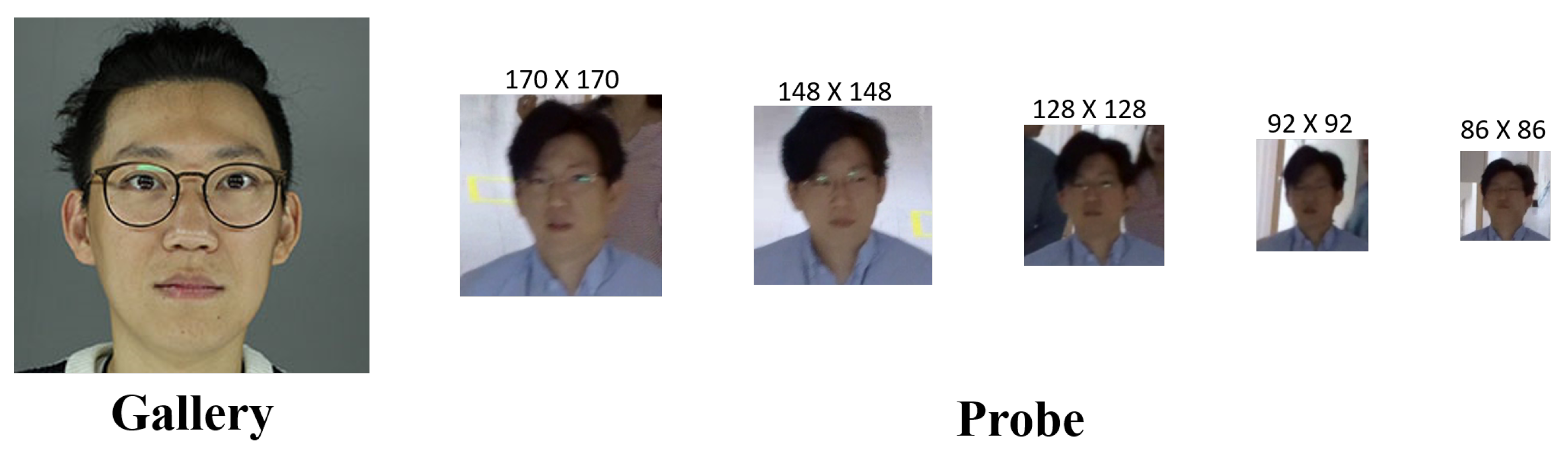
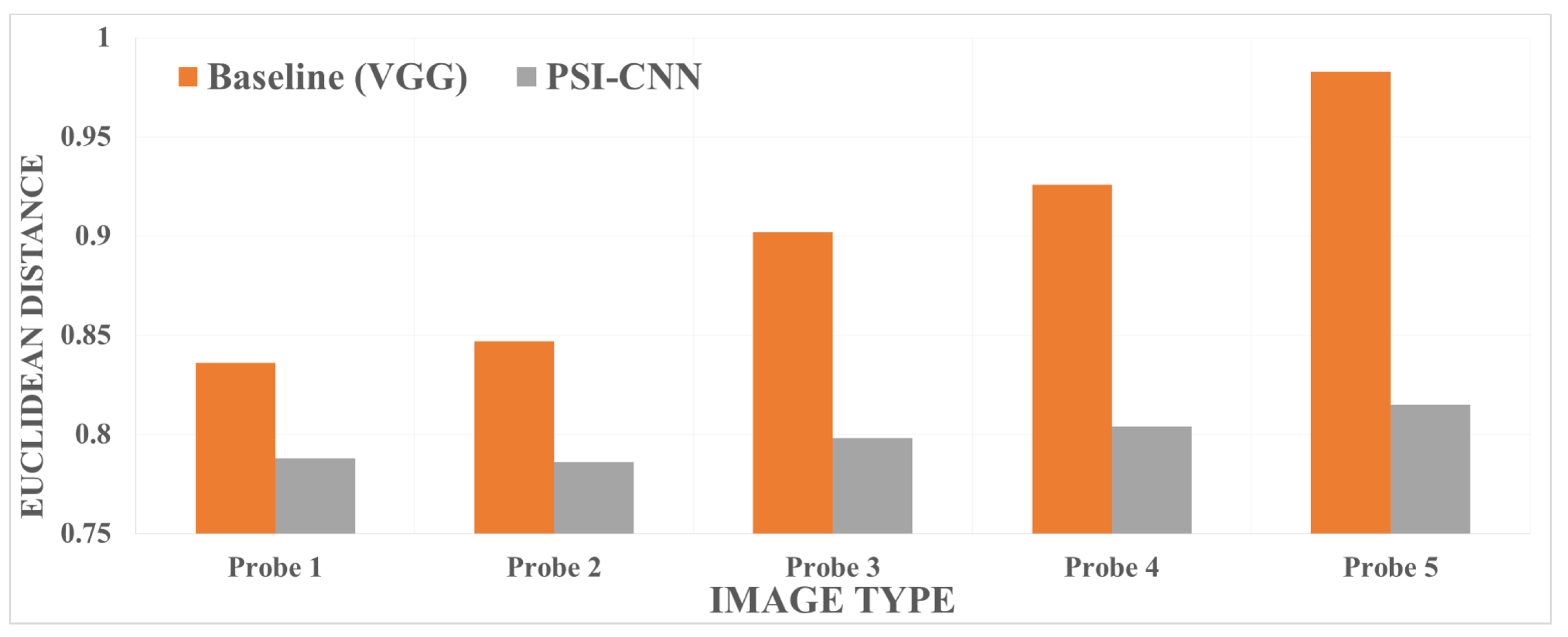
Additionally, we sampled and classified some CCTV images into groups (Probe 1 to probe 5) according to their facial region size (see Figure 4 for a comprehensive example). In each group of these sampled images, we compared the average matching distance achieved by the baseline and PSI-CNN models. As shown in Figure 5, the proposed model achieves small error distance between the reference frontal image and low-resolution CCTV images even when the resolution of the query image is significantly reduced. This demonstrates PSI-CNN’s robustness to unfavorable changes in image resolution and quality.
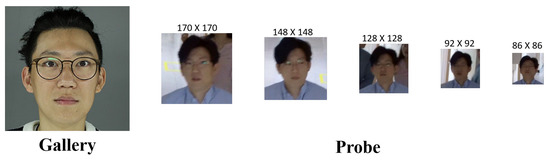
Figure 4.
Some exemplary images in our CCTV dataset.
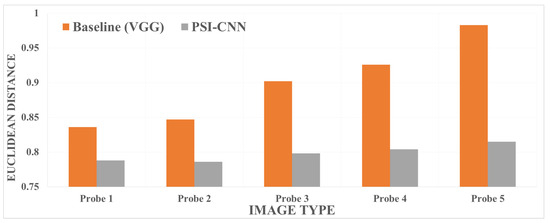
Figure 5.
A performance comparison of face recognition models for different image resolutions based on the Euclidean distance.
4.4. Limitations
PSI-CNN was designed to utilize untrained patterns with the aim to resolve the weaknesses of the current face recognition methods, which are sensitive to the resolution and quality of the input image. However, this network still does not overcome problems arising from extreme pose variations and occlusions largely due to lack of facial information. Developing a face recognition method robust to facial occlusions (e.g., due to hair or accessories) and extreme pose variations is left for future work.
5. Conclusions
In this paper, we proposed PSI-CNN, a pyramid-based scale-invariant network for face recognition. The proposed model additionally extracts untrained feature maps from downsampled input image and fuses them with original feature maps, thereby encouraging the network to learn potentially useful scale-independent information. Experimental results shows PSI-CNN outperforming the baseline derived from the VGG face model in terms of matching accuracy. Furthermore, PSI-CNN was able to maintain stable performance when tested on low-resolution images acquired from CCTV cameras. These results demonstrate PSI-CNN’s robustness to changes in image resolution and quality. Extending the proposed generic PSI-CNN architecture to solve other image-based problems would also yield an interesting direction for future research.
Author Contributions
G.P.N. and I.-J.K. designed PSI-CNN architecture, H.C. and J.C. refined databases and helped the experiments. All of the authors wrote and revised the paper.
Acknowledgments
This work was supported by the ICT R&D program of MSIT/IITP. [2017-0-00097, Construction of Intelligence Information Industry Infrastructure] and [2017-0-00162, Development of Human-care Robot Technology for Aging Society]. We thank Je Hyeong Hong at the Korea Institute of Science and Technology for revising the paper.
Conflicts of Interest
The authors declare no conflict of interest.
References
- Taigman, Y.; Yang, M.; Ranzato, M.; Wolf, L. DeepFace: Closing the Gap to Human-Level Performance in Face Verification. In Proceedings of the IEEE Conference on Computer Vision and Pattern Recognition, Columbus, OH, USA, 23–28 June 2014; pp. 1701–1708. [Google Scholar]
- Sun, Y.; Wang, X.; Tang, X. Deep Learning Face Representation from Predicting 10,000 Classes. In Proceedings of the IEEE Conference on Computer Vision and Pattern Recognition, Columbus, OH, USA, 23–28 June 2014; pp. 1891–1898. [Google Scholar]
- Schroff, F.; Kalenichenko, D.; Philbin, J. FaceNet: A Unified Embedding for Face Recognition and Clustering. In Proceedings of the IEEE Conference on Computer Vision and Pattern Recognition, Boston, MA, USA, 7–12 June 2015; pp. 815–823. [Google Scholar]
- Parkhi, O.M.; Vedaldi, A.; Zisserman, A. Deep Face Recognition. In Proceedings of the British Machine Vision Conference, Swansea, UK, 7–10 September 2015. [Google Scholar]
- Turk, M.; Pentland, A. Eigenfaces for Recognition. J. Cognit. Neurosci. 1991, 3, 71–86. [Google Scholar] [CrossRef] [PubMed]
- Belhumeur, P.N.; Hespanha, J.P.; Kriegman, D.J. Eigenfaces vs. Fisherfaces: Recognition using Class Specific Linear Projection. IEEE Trans. Pattern Anal. Mach. Intell. 1997, 19, 711–720. [Google Scholar] [CrossRef]
- Ahonen, T.; Hadid, A.; Pietikainen, M. Face Description with Local Binary Patterns: Application to Face Recognition. IEEE Trans. Pattern Anal. Mach. Intell. 2006, 28, 2037–2041. [Google Scholar] [CrossRef] [PubMed]
- Tan, X.; Triggs, B. Enhanced Local Texture Feature Sets for Face Recognition under Difficult Lighting Conditions. IEEE Trans. Image Process. 2010, 19, 1635–1650. [Google Scholar] [PubMed]
- Wolf, L.; Hassner, T.; Taigman, Y. Effective Unconstrained Face Recognition by Combining Multiple Descriptors And Learned Background Statistics. IEEE Trans. Pattern Anal. Mach. Intell. 2011, 33, 1978–1990. [Google Scholar] [CrossRef] [PubMed]
- Geng, C.; Jiang, X. Face Recognition Using SIFT Features. In Proceedings of the IEEE International Conference on Image Processing (ICIP), Cairo, Egypt, 7–10 November 2009. [Google Scholar]
- Deniz, O.; Bueno, G.; Salido, J.; De la Torre, F. Face Recognition Using Histograms of Oriented Gradients. Pattern Reocgnit. Lett. 2011, 32, 1598–1603. [Google Scholar] [CrossRef]
- Chen, D.; Cao, X.; Wen, F.; Sun, J. Blessing of Dimensionality: High-dimensional Feature and Its Efficient Compression for Face Verification. In Proceedings of the IEEE Conference on Computer Vision and Pattern Recognition, Portland, OR, USA, 23–28 June 2013; pp. 3026–3032. [Google Scholar]
- Huang, G.B.; Mattar, M.; Berg, T.; Learned-Miller, E. Labeled Faces in the Wild: A Database for Studying Face Recognition in Unconstrained Environments. In Proceedings of the Workshop on Faces in ’Real-Life’ Images: Detection, Alignment, and Recognition, Marseille, France, 17–20 October 2008; pp. 7–49. [Google Scholar]
- Sun, Y.; Wang, X.; Tang, X. Deep Convolutional Network Cascade for Facial Point Detection. In Proceedings of the IEEE Conference on Computer Vision and Pattern Recognition, Portland, OR, USA, 23–28 June 2013; pp. 3476–3483. [Google Scholar]
- Chen, D.; Cao, X.; Wang, L.; Wen, F.; Sun, J. Bayesian Face Revisited: A Joint Formulation. In Proceedings of the 12th European Conference on Computer Vision, Florence, Italy, 7–13 October 2012; pp. 566–579. [Google Scholar]
- Zeiler, M.D.; Fergus, R. Visualizing and Understanding Convolutional Networks. In Proceedings of the 13th European Conference on Computer Vision, Zurich, Switzerland, 6–12 September 2014; pp. 818–833. [Google Scholar]
- Szegedy, C.; Liu, W.; Jia, Y.; Sermanet, P.; Reed, S.; Anguelov, D.; Erhan, D.; Vanhoucke, V.; Rabinovich, A. Going Deeper with Convolutions. In Proceedings of the IEEE Conference on Computer Vision and Pattern Recognition, Boston, MA, USA, 7–12 June 2015; pp. 1–9. [Google Scholar]
- Glorot, X.; Bordes, A.; Bengio, Y. Deep sparse rectifier networks. In Proceedings of the Fourteenth International Conference on Artificial Intelligence and Statistics, Ft. Lauderdale, FL, USA, 11–13 April 2011; pp. 315–323. [Google Scholar]
- Yi, D.; Lei, Z.; Liao, S.; Li, S.Z. Learning Face Representation from Scratch. arXiv, 2014; arXiv:1411.7923. [Google Scholar]
© 2018 by the authors. Licensee MDPI, Basel, Switzerland. This article is an open access article distributed under the terms and conditions of the Creative Commons Attribution (CC BY) license (http://creativecommons.org/licenses/by/4.0/).