


Skip Content
You are currently on the new version of our website. Access the old version .

Vaccines, Volume 7, Issue 2

2019 June - 23 articles

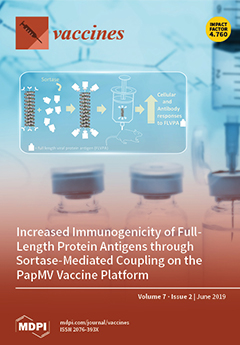
Cover Story: A novel rod-shaped nanoparticle, made of the coat protein of papaya mosaic virus (PapMV) self-assembled around an ssRNA, was used as a vaccine platform. The PapMV nanoparticle is a strong inducer of the toll like receptor 7/8. Consequently, the attachment of an antigen to the nanoparticle enhances its immunogenicity. Using a bacterial transpeptidase (sortase A), two different full-length viral protein antigens (FLVPAs), the simian immunodeficiency virus (SIV) GAG and the influenza A nucleoprotein (NP), were covalently attached to each extremity of PapMV nanoparticles. The resulting coupled nanoparticles showed a significant increase of the cellular and humoral immune responses to the FLVPAs. This approach allows rapidly developing a vaccine formulation with large viral protein antigens that contain several protective B and T cell epitopes. View this paper
  • Issues are regarded as officially published after their release is announced to the table of contents alert mailing list .
  • You may sign up for email alerts to receive table of contents of newly released issues.
  • PDF is the official format for papers published in both, html and pdf forms. To view the papers in pdf format, click on the "PDF Full-text" link, and use the free Adobe Reader to open them.

Articles (23)

  • Review
  • Open Access
148 Citations
13,421 Views
20 Pages

Subunit Vaccine Approaches for African Swine Fever Virus

  • Natasha N. Gaudreault and
  • Juergen A. Richt

African swine fever virus (ASFV) is the cause of a highly fatal disease in swine, for which there is no available vaccine. The disease is highly contagious and poses a serious threat to the swine industry worldwide. Since its introduction to the Cauc...

  • Article
  • Open Access
19 Citations
5,172 Views
16 Pages

A Chimeric Zika Virus between Viral Strains MR766 and BeH819015 Highlights a Role for E-glycan Loop in Antibody-mediated Virus Neutralization

  • Etienne Frumence,
  • Wildriss Viranaicken,
  • Sandra Bos,
  • Maria-Teresa Alvarez-Martinez,
  • Marjolaine Roche,
  • Jacques-Damien Arnaud,
  • Gilles Gadea and
  • Philippe Desprès

Zika virus (ZIKV) is an emerging mosquito-borne flavivirus which is of major public health concern. ZIKV infection is recognized as the cause of congenital Zika disease and other neurological defects, with no specific prophylactic or therapeutic trea...

  • Review
  • Open Access
13 Citations
9,573 Views
20 Pages

Current and Novel Approaches in Influenza Management

  • Erasmus Kotey,
  • Deimante Lukosaityte,
  • Osbourne Quaye,
  • William Ampofo,
  • Gordon Awandare and
  • Munir Iqbal

Influenza is a disease that poses a significant health burden worldwide. Vaccination is the best way to prevent influenza virus infections. However, conventional vaccines are only effective for a short period of time due to the propensity of influenz...

  • Article
  • Open Access
18 Citations
6,340 Views
20 Pages

Subunit vaccines have advantages of good safety, minimal reactogenicity, and high specificity. However, subunit vaccines also show a crucial disadvantage of poor immunogenicity and, therefore, are often formulated with an adjuvant carrier to form a v...

  • Article
  • Open Access
5,890 Views
17 Pages

An Influenza Virus Hemagglutinin-Based Vaccine Platform Enables the Generation of Epitope Specific Human Cytomegalovirus Antibodies

  • Mohammad Amin Behzadi,
  • Kathryn R. Stein,
  • Maria Carolina Bermúdez-González,
  • Viviana Simon,
  • Raffael Nachbagauer and
  • Domenico Tortorella

Human cytomegalovirus (CMV) is a highly prevalent pathogen with ~60%–90% seropositivity in adults. CMV can contribute to organ rejection in transplant recipients and is a major cause of birth defects in newborns. Currently, there are no approve...

  • Review
  • Open Access
12 Citations
5,390 Views
12 Pages

DNA vaccines are stable, safe, and cost effective to produce and relatively quick and easy to manufacture. However, to date, DNA vaccines have shown relatively poor immunogenicity in humans despite promising preclinical results. Consequently, a numbe...

  • Brief Report
  • Open Access
18 Citations
4,275 Views
9 Pages

Increased Immunogenicity of Full-Length Protein Antigens through Sortase-Mediated Coupling on the PapMV Vaccine Platform

  • Marie-Ève Laliberté-Gagné,
  • Marilène Bolduc,
  • Ariane Thérien,
  • Caroline Garneau,
  • Philippe Casault,
  • Pierre Savard,
  • Jérome Estaquier and
  • Denis Leclerc

Background: Flexuous rod-shape nanoparticles—made of the coat protein of papaya mosaic virus (PapMV)—provide a promising vaccine platform for the presentation of viral antigens to immune cells. The PapMV nanoparticles can be combined with...

  • Article
  • Open Access
28 Citations
4,238 Views
12 Pages

Childhood Immunization in Ethiopia: Accuracy of Maternal Recall Compared to Vaccination Cards

  • Julia M. Porth,
  • Abram L. Wagner,
  • Yemesrach A. Tefera and
  • Matthew L. Boulton

Health surveys conducted in low- and middle-income countries typically estimate childhood vaccination status based on written vaccination cards, maternal recall (when cards are not available), or a combination of both. This analysis aimed to assess t...

  • Article
  • Open Access
47 Citations
6,342 Views
13 Pages

Type of RNA Packed in VLPs Impacts IgG Class Switching—Implications for an Influenza Vaccine Design

  • Ariane C. Gomes,
  • E. S. Roesti,
  • Aadil El-Turabi and
  • Martin F. Bachmann

Nucleic acid packed within virus-like particles (VLPs) is shown to shape the immune response and to induce stronger B cell responses in different immunisation models. Here, using a VLP displaying the highly conserved extracellular domain of the M2 pr...

  • Review
  • Open Access
15 Citations
8,710 Views
23 Pages

The traditional design of effective vaccines for rapidly-evolving pathogens, such as influenza A virus, has failed to provide broad spectrum and long-lasting protection. With low cost whole genome sequencing technology and powerful computing capabili...

  • Article
  • Open Access
50 Citations
8,134 Views
13 Pages

Bacterial Outer Membrane Vesicles (OMVs)-Based Dual Vaccine for Influenza A H1N1 Virus and MERS-CoV

  • Mahmoud M. Shehata,
  • Ahmed Mostafa,
  • Lisa Teubner,
  • Sara H. Mahmoud,
  • Ahmed Kandeil,
  • Rabeh Elshesheny,
  • Thamer A. Boubak,
  • Renate Frantz,
  • Luigi La Pietra and
  • Mobarak Abu Mraheil
  • + 5 authors

Vaccination is the most functional medical intervention to prophylactically control severe diseases caused by human-to-human or animal-to-human transmissible viral pathogens. Annually, seasonal influenza epidemics attack human populations leading to...

  • Article
  • Open Access
15 Citations
5,562 Views
16 Pages

Infectious diseases are linked to 15%–20% of cancers worldwide. Among them, Epstein–Barr virus (EBV) is an oncogenic herpesvirus that chronically infects over 90% of the adult population, with over 200,000 cases of cancer and 150,000 canc...

  • Article
  • Open Access
8 Citations
5,261 Views
13 Pages

Activation of the immune system using antigen targeting to the dendritic cell receptor DEC205 presents great potential in the field of vaccination. The objective of this work was to evaluate the immunogenicity and protectiveness of a recombinant mous...

  • Article
  • Open Access
18 Citations
5,675 Views
22 Pages

Identification of novel molecular adjuvants which can boost and enhance vaccine-mediated immunity and provide dose-sparing potential against complex infectious diseases and for immunotherapy in cancer is likely to play a critical role in the next gen...

  • Article
  • Open Access
15 Citations
6,096 Views
19 Pages

A HER2-Displaying Virus-Like Particle Vaccine Protects from Challenge with Mammary Carcinoma Cells in a Mouse Model

  • Lisa Nika,
  • Sara Cuadrado-Castano,
  • Guha Asthagiri Arunkumar,
  • Clemens Grünwald-Gruber,
  • Meagan McMahon,
  • Krisztina Koczka,
  • Adolfo García-Sastre,
  • Florian Krammer and
  • Reingard Grabherr

Human epidermal growth factor receptor-2 (HER2) is upregulated in 20% to 30% of breast cancers and is a marker of a poor outcome. Due to the development of resistance to passive immunotherapy with Trastuzumab, active anti-HER2 vaccination strategies...

  • Article
  • Open Access
27 Citations
8,838 Views
12 Pages

Safety and Immunogenicity of a Novel Recombinant Simian Adenovirus ChAdOx2 as a Vectored Vaccine

  • Pedro M. Folegatti,
  • Duncan Bellamy,
  • Rachel Roberts,
  • Jonathan Powlson,
  • Nick J. Edwards,
  • Catherine F. Mair,
  • Georgina Bowyer,
  • Ian Poulton,
  • Celia H. Mitton and
  • Sarah C. Gilbert
  • + 6 authors

Adenovirus vectored vaccines are a highly effective strategy to induce cellular immune responses which are particularly effective against intracellular pathogens. Recombinant simian adenovirus vectors were developed to circumvent the limitations impo...

  • Article
  • Open Access
32 Citations
31,352 Views
13 Pages

Combating Vaccine Hesitancy with Vaccine-Preventable Disease Familiarization: An Interview and Curriculum Intervention for College Students

  • Deborah K. Johnson,
  • Emily J. Mello,
  • Trent D. Walker,
  • Spencer J. Hood,
  • Jamie L. Jensen and
  • Brian D. Poole

In 2019, the World Health Organization (WHO) listed vaccine hesitancy in its top ten threats to global health. Vaccine hesitancy is a “delay in acceptance or refusal to vaccinate despite availability of vaccination services”. Urban areas...

  • Review
  • Open Access
12 Citations
5,890 Views
14 Pages

Cytolytic Perforin as an Adjuvant to Enhance the Immunogenicity of DNA Vaccines

  • Ashish C. Shrestha,
  • Danushka K. Wijesundara,
  • Makutiro G. Masavuli,
  • Zelalem A. Mekonnen,
  • Eric J. Gowans and
  • Branka Grubor-Bauk

DNA vaccines present one of the most cost-effective platforms to develop global vaccines, which have been tested for nearly three decades in preclinical and clinical settings with some success in the clinic. However, one of the major challenges for t...

  • Review
  • Open Access
374 Citations
83,305 Views
20 Pages

This review provides a comparison of the theoretical issues and experimental findings for plasmid DNA and mRNA vaccine technologies. While both have been under development since the 1990s, in recent years, significant excitement has turned to mRNA de...

  • Article
  • Open Access
8 Citations
4,546 Views
11 Pages

New Promising Targets for Synthetic Omptin-Based Peptide Vaccine against Gram-Negative Pathogens

  • Valentina A. Feodorova,
  • Anna M. Lyapina,
  • Sergey S. Zaitsev,
  • Maria A. Khizhnyakova,
  • Lidiya V. Sayapina,
  • Onega V. Ulianova,
  • Sergey S. Ulyanov and
  • Vladimir L. Motin

Omptins represent a family of proteases commonly found in various Gram-negative pathogens. These proteins play an important role in host–pathogen interaction and have been recognized as key virulence factors, highlighting the possibility of dev...

  • Meeting Report
  • Open Access
1 Citations
5,415 Views
11 Pages

20th International Conference on Emerging Infectious Diseases in the Pacific Rim Organized by the United States-Japan Cooperative Medical Sciences Program (USJCMSP)

  • USJCMSP AIDS, ARI, Cancer, Hepatitis, Immunology and Viral Diseases Panels,
  • K. Gayle Bernabe,
  • Kristina T. Lu,
  • F. Gray Handley,
  • Diane E. Griffin,
  • Ichiro Kurane,
  • Aikichi Iwamoto,
  • George F. Gao and
  • Florian Krammer

The 20th International Conference on Emerging Infectious Diseases in the Pacific Rim to3ok place in Shenzhen, China on January 8–9, 2018 followed by meetings of the acquired immunodeficiency syndrome (AIDS)/immunology, acute respiratory infecti...

  • Article
  • Open Access
65 Citations
7,755 Views
15 Pages

In silico Designed Ebola Virus T-Cell Multi-Epitope DNA Vaccine Constructions Are Immunogenic in Mice

  • Sergei I. Bazhan,
  • Denis V. Antonets,
  • Larisa I. Karpenko,
  • Svetlana F. Oreshkova,
  • Olga N. Kaplina,
  • Ekaterina V. Starostina,
  • Sergei G. Dudko,
  • Sofia A. Fedotova and
  • Alexander A. Ilyichev

Background: The lack of effective vaccines against Ebola virus initiates a search for new approaches to overcoming this problem. The aim of the study was to design artificial polyepitope T-cell immunogens—candidate DNA vaccines against Ebola vi...

Get Alerted

Add your email address to receive forthcoming issues of this journal.

XFacebookLinkedIn
Vaccines - ISSN 2076-393X