


Abstract
Objectives: The Naples Prognostic Score (NPS) integrates inflammatory and nutritional markers. We evaluated its association with short-term outcomes after intravenous thrombolysis (IVT) for acute ischemic stroke (AIS). Methods: This single-center retrospective study included 211 patients treated with IVT alone. The NPS was dichotomized as low (0–2) or high (3–4), and the primary outcome was poor 90-day functional outcome (scores of 3–6 on the modified Rankin Scale [mRS]). Logistic regression models were adjusted for demographics, comorbidities, and National Institutes of Health Stroke Scale (NIHSS) score at admission (Model 1), as well as for pre-stroke mRS score (Model 2). Results: Patients with a high NPS (n = 77, 36.5%) were older and had worse pre-stroke functional status, but their admission NIHSS scores were similar; furthermore, poor 90-day outcome occurred in 51.9% of patients with a high NPS versus 31.3% of those with a low NPS (p = 0.003). A high NPS was independently associated with poor outcome in Model 1 (odds ratio [OR] 2.10; 95% confidence interval [CI] 1.12–3.93) but not in Model 2 (OR 1.47; 95% CI 0.74–2.95). The NPS was not associated with 90-day mortality, early neurological improvement, or intracranial hemorrhage and did not improve the discrimination of a clinical model (area under the curve values of 0.795 vs. 0.797). Conclusions: A high NPS identifies patients at risk of poor outcome after IVT independently of stroke severity; however, this association was attenuated after adjustment for pre-stroke functional status, and the incremental prognostic value of the NPS appears limited.
1. Introduction
Acute ischemic stroke (AIS) is a leading cause of mortality and long-term disability worldwide, and intravenous thrombolysis (IVT) is a Class I, Level A-recommended treatment for eligible patients [1]. Nevertheless, functional outcomes after IVT vary considerably, and simple tools that help identify patients at risk of poor recovery remain of clinical interest. Inflammatory responses play a central role in the pathophysiology of AIS and are associated with disease progression and prognosis [2], and impaired nutritional status is likewise associated with poor outcomes after stroke [3]. The Naples Prognostic Score (NPS) reflects systemic inflammatory and nutritional status by incorporating the neutrophil-to-lymphocyte ratio (NLR), lymphocyte-to-monocyte ratio (LMR), total cholesterol (TC), and serum albumin levels [4]. Although previous studies have demonstrated an association between the NPS and prognosis in patients with cancer [5,6] and cardiovascular diseases [7,8,9], evidence in AIS remains limited and derives mainly from patients undergoing endovascular treatment [10]. Moreover, because inflammatory and nutritional markers are also influenced by age, comorbidities, and pre-stroke frailty, it is unclear whether the NPS provides prognostic information beyond established clinical predictors. In this study, we evaluated the association between the NPS and short-term outcomes in patients with AIS treated with IVT and examined whether this association was independent of stroke severity and pre-stroke functional status.
2. Methods
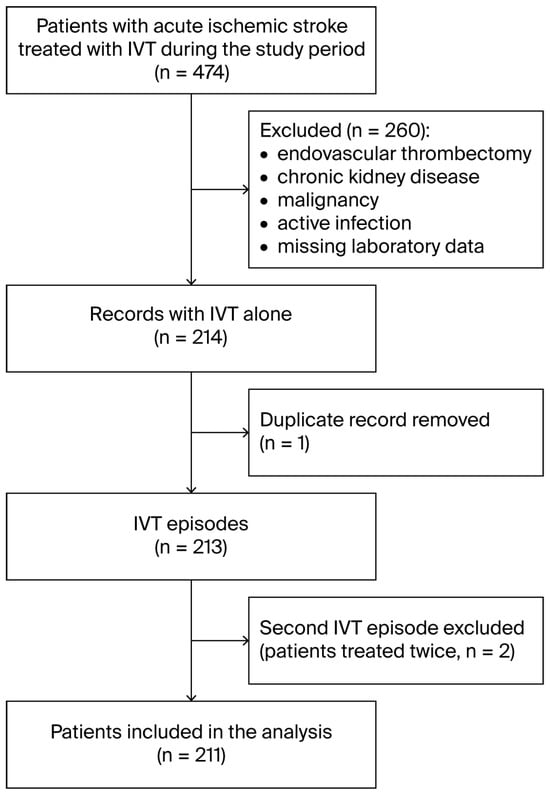
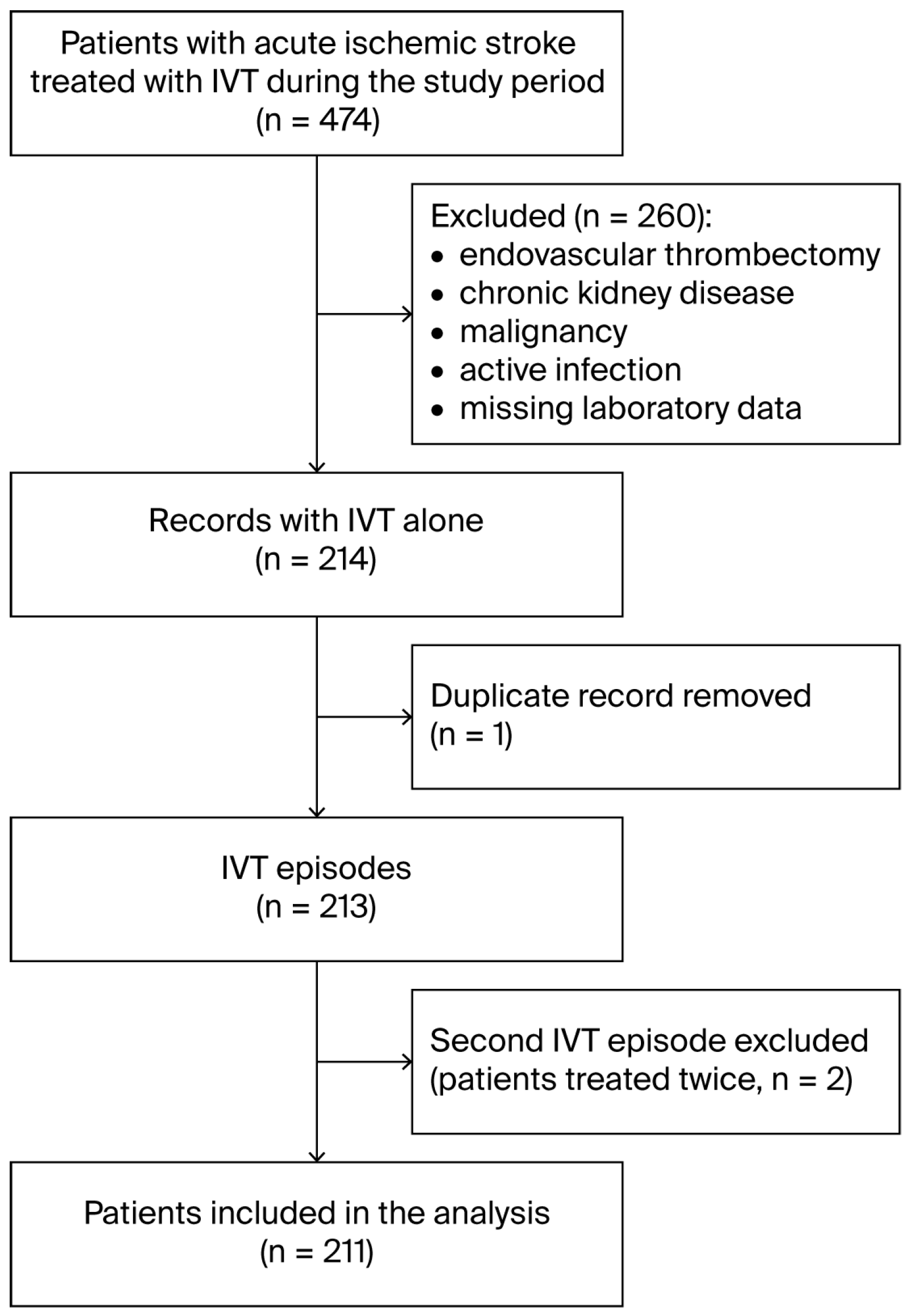
This single-center retrospective cohort study included patients with AIS who received IVT at the University of Health Sciences, Fatih Sultan Mehmet Training and Research Hospital (Istanbul, Türkiye), between January 2018 and January 2020. Treatment eligibility was determined according to the current American Heart Association/American Stroke Association guidelines [1]. Patients were eligible if they were aged ≥18 years, had undergone non-contrast computed tomography (CT) on admission, and had a National Institutes of Health Stroke Scale (NIHSS) score of ≥1. During the study period, 474 patients received IVT and their vessel statuses were assessed using CT angiography. To obtain a homogeneous population treated with IVT alone, patients who underwent endovascular thrombectomy (EVT) were excluded; patients with large vessel occlusion who did not undergo EVT (e.g., because of age, clinical ineligibility, lack of consent, or a perceived high procedural risk) and were treated with IVT alone were included. Patients with missing laboratory data were excluded, as well as those with chronic kidney disease, malignancy, or active infection, because these conditions may independently affect inflammatory and nutritional markers. After these exclusions (n = 260), 214 records remained. After removal of one duplicate record and retention of the first episode only for two patients who received IVT on two separate occasions, 211 patients were included in the analysis (Figure 1).
Figure 1.
Flow diagram of patient selection. EVT, endovascular thrombectomy; IVT, intravenous thrombolysis.
Demographic characteristics, vascular risk factors, pre-stroke functional status (pre-stroke modified Rankin Scale [mRS] score), onset-to-needle time, and laboratory data were obtained from electronic medical records. Complete blood counts and serum albumin were measured in the first blood sample upon admission to the emergency department before IVT was administered; thus, the interval from symptom onset to sampling was shorter than the onset-to-needle time. TC was measured in the first blood sample obtained after hospital admission. Hyperlipidemia was defined as a prior diagnosis with ongoing statin therapy, while stroke etiology was classified according to the Trial of Org 10172 in Acute Stroke Treatment (TOAST) criteria [11]. Stroke severity was assessed using the NIHSS upon admission and at 24 h. Alteplase was administered at a dose of 0.9 mg/kg (maximum 90 mg), with 10% given as an intravenous bolus and the remainder infused over 60 min. Follow-up CT was routinely performed at 24 h or earlier in cases of clinical deterioration.
The primary outcome was poor functional outcome at 90 days, defined as mRS scores of 3–6 [12]. Secondary outcomes were poor functional outcome at discharge (mRS 3–6), death within 90 days, early neurological improvement, any intracranial hemorrhage (ICH), and parenchymal hematoma. Early neurological improvement was defined as a relative reduction in the NIHSS score of ≥46% at 24 h, calculated as (admission NIHSS − 24 h NIHSS)/admission NIHSS × 100, as previously described in patients treated with IVT [13]. Admission and 24 h NIHSS scores were documented in the medical records of all patients, and early neurological improvement was determined for all 211 patients during data collection; however, the individual 24 h NIHSS scores were not transferred to the research dataset. ICH was assessed during follow-up imaging and classified according to the European Cooperative Acute Stroke Study (ECASS) criteria as hemorrhagic infarction type 1 (HI1) or 2 (HI2) or parenchymal hematoma type 1 (PH1) or type 2 (PH2) [14]. Symptomatic ICH requires that clinical deterioration be attributed to the hemorrhage at the time it occurs, which could not be reliably determined retrospectively; therefore, ICH refers to any radiological hemorrhage, and parenchymal hematoma (PH1/PH2) was analyzed separately.
Functional status at discharge was recorded by the treating neurologist, and functional outcome at 90 days was obtained from routine outpatient follow-up visits and hospital records; patients were not contacted for the purposes of this study. For patients who were transferred to a tertiary intensive care unit or did not attend neurological follow-up, vital and functional status at 90 days were verified using hospital records and the national electronic health record system (e-Nabız). Ninety-day outcome data were available for all included patients, and deaths within 90 days were confirmed, although the exact date of death was not available for all patients. The study was conducted in accordance with the Declaration of Helsinki and was approved by the Ethics Committee for Non-Interventional Clinical Research of Istanbul Medipol University (decision no. 773, 19 June 2025; reference no. E-10840098-202.3.02-4340). All patients had provided written consent at hospital admission for the use of their medical records; because of the retrospective design, the requirement for study-specific informed consent was waived.
The NPS was calculated as described by Galizia et al. [4]; the NLR as the absolute neutrophil count divided by the absolute lymphocyte count, and the LMR as the absolute lymphocyte count divided by the absolute monocyte count. One point was assigned for each of the following criteria: NLR > 2.96, LMR ≤ 4.44, TC ≤ 180 mg/dL, and serum albumin < 4.0 g/dL. The total NPS ranged from 0 to 4. In line with the original description, in which patients with scores of 3–4 formed the highest-risk group [4], scores of 0–2 were classified as low NPS and 3–4 as high NPS. The NPS was additionally analyzed as an ordinal score (0–4) and according to the original three groups (0, 1–2, and 3–4).
Statistical Analysis
Continuous variables are presented as mean ± standard deviation or median (minimum–maximum), as appropriate, with normality assessed using the Shapiro–Wilk test; groups were then compared using Student’s t-test or the Mann–Whitney U test. Categorical variables are presented as frequencies and percentages, with groups compared using the chi-square test or Fisher’s exact test. Logistic regression was used to evaluate the association between a high NPS and each outcome. Two adjustment sets were used: Model 1 included age, sex, hypertension (HT), diabetes mellitus (DM), coronary artery disease (CAD), and admission NIHSS score; Model 2 additionally included pre-stroke mRS score. For the primary outcome (82 events), standard maximum likelihood estimation was used; for secondary outcomes, which had fewer events, Firth’s penalized likelihood logistic regression was used to reduce small-sample bias [15]. The NPS was also analyzed per point and according to the original three groups. Covariates were selected a priori on the basis of clinical relevance rather than by stepwise procedures; multicollinearity was assessed using variance inflation factors. Since all variables included in the models were complete for the 211 patients analyzed, no imputation was required. Sensitivity analyses were additionally adjusted for onset-to-needle time, cardioembolic etiology, or hyperlipidemia and included all 213 IVT episodes. The results are reported as odds ratios (ORs) with 95% confidence intervals (CIs). Discrimination was assessed using receiver operating characteristic (ROC) curve analysis, with the NPS entered as an ordinal score (0–4). For albumin, TC, and LMR, lower values indicated higher risk, but for the NLR, it was higher values. Areas under the curve (AUCs) were compared using the DeLong method, and AUC values < 0.70 indicated poor discrimination [16]. The incremental value of the NPS was assessed by comparing a clinical model (age, admission NIHSS score, and pre-stroke mRS score) with and without the NPS, using the DeLong test and a bootstrap 95% CI for the difference in AUC (1000 resamples). Calibration was assessed using the Hosmer–Lemeshow test, and internal validation was performed using 500 bootstrap resamples to obtain optimism-corrected AUCs and calibration slopes. Confidence intervals for sensitivity, specificity, and predictive values were calculated using the Wilson method. Statistical analyses were performed using IBM SPSS Statistics version 20.0 (IBM Corp., Armonk, NY, USA) and Python 3 (NumPy 2.5, SciPy 1.18, and scikit-learn 1.9), with a two-sided p-value < 0.05 considered statistically significant. All analyses were performed using the corrected and verified patient-level dataset, and all values reported in the text, tables, figures, and were generated from this dataset and cross-checked for consistency before submission.
3. Results
Of the 474 patients treated with IVT during the study period, 211 were included in the analysis (Figure 1). The mean age was 72.1 ± 13.2 years, and 98 patients (46.4%) were female. HT was the most prevalent comorbidity (65.4%), with a median admission NIHSS score of 8 (range, 1–22) and a median onset-to-needle time of 175 min (range, 45–270). According to the TOAST classification, 22 patients (10.4%) had large-artery atherosclerosis, 91 (43.1%) had cardioembolism, and 98 (46.4%) had undetermined etiology. ICH occurred in 35 patients (16.6%), with HI1 in 11, HI2 in 4, PH1 in 13, and PH2 in 7 patients. Early neurological improvement, which was assessed in all 211 patients, was observed in 116 (55.0%). At 90 days, the median mRS score was 2 (range, 0–6); 82 patients (38.9%) had a poor functional outcome, and 28 (13.3%) had died, including 5 (2.4%) who died during hospitalization. The median NLR was 2.68 (interquartile range, 1.59–4.04; range, 0.38–19.00). The individual NPS criteria were met by 97 patients (46.0%) for NLR > 2.96, 126 (59.7%) for LMR ≤ 4.44, 94 (44.5%) for TC ≤ 180 mg/dL, and 95 (45.0%) for albumin < 4.0 g/dL. The NPS was 0 in 31, 1 in 51, 2 in 52, 3 in 51, and 4 in 26 patients; thus, 77 patients (36.5%) had a high NPS.
Patients with a high NPS were older than those with a low NPS (76.6 ± 11.6 vs. 69.5 ± 13.4 years; p < 0.001) and more frequently had a pre-stroke mRS score ≥ 2 (37.7% vs. 17.2%; p < 0.001), whereas sex, vascular risk factors, and admission NIHSS scores did not differ significantly between the groups (Table 1). Cardioembolic etiology was more frequent (58.4% vs. 34.3%) and onset-to-needle time was longer (median 200 vs. 162.5 min; p = 0.049) in the high-NPS group.
Table 1.
Baseline characteristics and outcomes according to the NPS.
As expected from the score components, serum albumin and TC levels were lower, the NLR was higher, and the LMR was lower in the high-NPS group (all p < 0.001). The length of hospital stays, and the rate of early neurological improvement did not differ between the groups. Patients with a high NPS had higher mRS scores at discharge and at 90 days, and fewer achieved a good functional outcome at 90 days (48.1% vs. 68.7%; p = 0.003). In-hospital death occurred in 4 (5.2%) versus 1 (0.7%) patients (p = 0.061), and death within 90 days in 14 (18.2%) versus 14 (10.4%) patients (p = 0.111).
Data are presented as mean ± standard deviation (SD), median (minimum–maximum), or n (%). CAD, coronary artery disease; DM, diabetes mellitus; HT, hypertension; ICH, intracranial hemorrhage; LMR, lymphocyte-to-monocyte ratio; mRS, modified Rankin Scale; NIHSS, National Institutes of Health Stroke Scale; NLR, neutrophil-to-lymphocyte ratio; NPS, Naples Prognostic Score; TC, total cholesterol; TOAST, Trial of Org 10172 in Acute Stroke Treatment.
In univariable analysis, a high NPS was associated with poor 90-day functional outcome (OR 2.37; 95% CI 1.33–4.22; p = 0.003), as were age, admission NIHSS score, and pre-stroke mRS score (Table 2). After adjustment for age, sex, HT, DM, CAD, and admission NIHSS score (Model 1), a high NPS remained independently associated with poor 90-day outcome (OR 2.10; 95% CI 1.12–3.93; p = 0.020). However, after additional adjustment for pre-stroke mRS score (Model 2), the association was attenuated and was no longer statistically significant (OR 1.47; 95% CI 0.74–2.95; p = 0.274), whereas admission NIHSS score (OR 1.17 per point) and pre-stroke mRS score (OR 2.67 per point) remained strong independent predictors. Similar results were obtained when the NPS was analyzed as a continuous variable (Model 1: OR 1.38 per point, 95% CI 1.07–1.79; Model 2: OR 1.24 per point, 95% CI 0.94–1.65) and according to the original three NPS groups (NPS 3–4 vs. 0: Model 1, OR 2.40, 95% CI 0.89–6.48; Model 2, OR 1.77, 95% CI 0.60–5.24). Variance inflation factors were all <1.6.
Table 2.
Logistic regression analysis for poor functional outcome at 90 days (mRS 3–6).
Regarding secondary outcomes, a high NPS was associated with poor functional outcome at discharge in Model 1 (OR 1.87; 95% CI 1.02–3.44) but not in Model 2 (OR 1.34; 95% CI 0.69–2.60). A high NPS was not significantly associated with death within 90 days, early neurological improvement, any ICH, or parenchymal hematoma in any model (Table 3). For any ICH, a high NPS had a sensitivity of 42.9% (95% CI 28.0–59.1), specificity of 64.8% (57.5–71.4), positive predictive value of 19.5% (12.2–29.7), and negative predictive value of 85.1% (78.1–90.1). The results were consistent in sensitivity analyses that were additionally adjusted for onset-to-needle time, cardioembolic etiology, or hyperlipidemia; used Firth’s penalized likelihood for the primary outcome; or included all 213 IVT episodes.
Table 3.
Association between a high NPS and secondary outcomes.
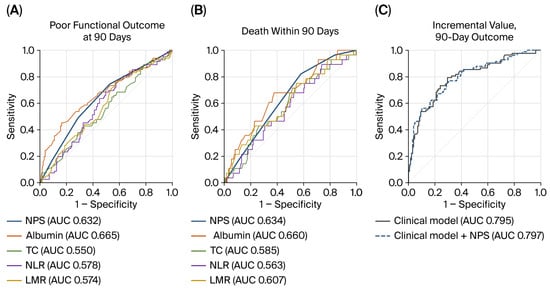
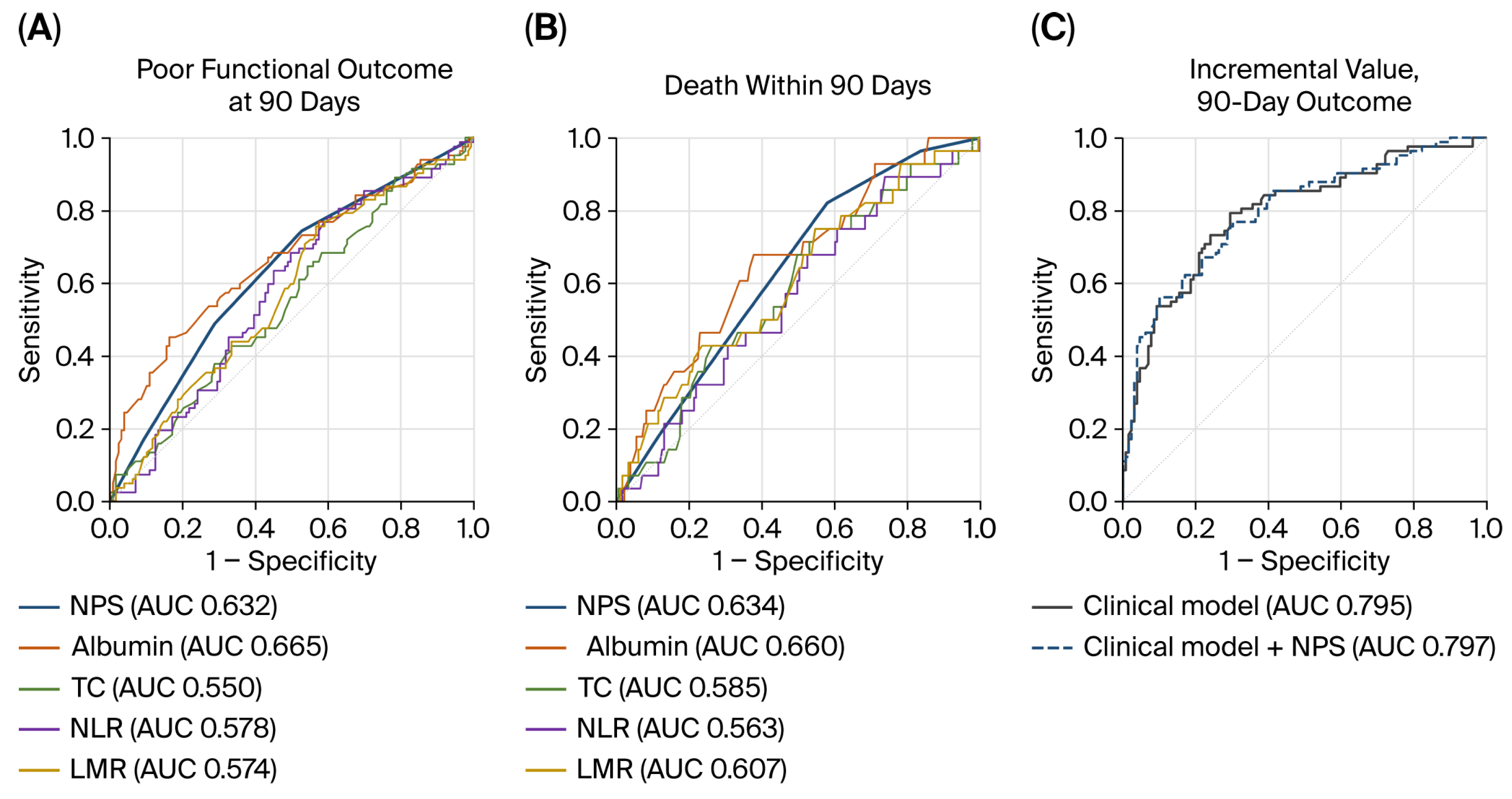
In ROC analysis, the discriminative ability of the NPS was poor for both poor 90-day outcome (AUC 0.632; 95% CI 0.557–0.707) and 90-day mortality (AUC 0.634; 95% CI 0.536–0.731), and the NPS did not outperform its individual components; serum albumin alone yielded numerically higher AUCs (0.665 and 0.660, respectively) (Table 4; Figure 2). Adding the NPS to a clinical model comprising age, admission NIHSS score, and pre-stroke mRS score did not improve discrimination for poor 90-day outcome (AUC 0.795 vs. 0.797; difference 0.002; bootstrap 95% CI −0.007 to 0.028; p = 0.863) or for 90-day mortality (AUC 0.837 vs. 0.847; difference 0.010; 95% CI −0.003 to 0.043; p = 0.395). Both models were well calibrated (Hosmer–Lemeshow p > 0.50). After internal validation, the optimism-corrected AUC for poor 90-day outcome was 0.786 for the clinical model and 0.782 after the addition of the NPS, with calibration slopes of 0.96 and 0.93, respectively. ORs refer to a high versus low NPS and were estimated using Firth’s penalized likelihood logistic regression. Model 1: adjusted for age, sex, HT, DM, CAD, and admission NIHSS score. Model 2: Model 1 plus pre-stroke mRS score. The primary outcome is shown in Table 2. Abbreviations are the same as in Table 1 and Table 2. The NPS was entered as an ordinal score (0–4). * p-values from the DeLong test versus the NPS for individual markers, and versus the clinical model for the clinical model + NPS. For albumin, TC, and LMR, lower values indicated higher risk. AUC, area under the curve; the other abbreviations are the same as those in Table 1.
Table 4.
Discrimination of the NPS, its components, and a clinical model with and without the NPS.
Figure 2.
ROC curves of the NPS and its components and the incremental value of the NPS. (A) ROC curves of the NPS, serum albumin, TC, NLR, and LMR for poor functional outcome at 90 days (mRS 3–6). (B) ROC curves of the same markers for death within 90 days. (C) ROC curves of a clinical model including age, admission NIHSS score, and pre-stroke mRS score, with and without the NPS, for poor functional outcome at 90 days. For albumin, TC, and LMR, lower values indicated higher risk. AUC, area under the curve; LMR, lymphocyte-to-monocyte ratio; NIHSS, National Institutes of Health Stroke Scale; NLR, neutrophil-to-lymphocyte ratio; NPS, Naples Prognostic Score; ROC, receiver operating characteristic; TC, total cholesterol.
4. Discussion
In this cohort of patients with AIS treated with IVT, a high NPS was associated with poor functional outcome at 90 days independent of age, comorbidities, and stroke severity. However, this association was substantially attenuated and no longer significant after adjustment for pre-stroke functional status. Moreover, the NPS was not associated with mortality, early neurological improvement, or ICH, and it did not improve the discrimination of a simple clinical model. These findings suggest that the NPS may, at least in part, reflect pre-stroke vulnerability and provides little independent prognostic information beyond established clinical predictors.
Inflammation plays a central role in atherosclerosis and ischemic brain injury [17,18], and the migration of immune cells and the release of cytokines influence neuronal injury and recovery after AIS [19]. Accordingly, inflammatory markers such as the NLR and LMR have been associated with outcomes after reperfusion therapy [2,20,21], and indicators of nutritional status have been associated with mortality and functional impairment after stroke [3]. The NPS combines these domains into a single score and has shown prognostic value in malignancies [5,6], cardiovascular diseases [7,8,9], and AIS treated with endovascular therapy [10]. Other composite indices reflecting different pathophysiological domains have also been investigated in AIS; for example, the Endothelial Activation and Stress Index (EASIX), a marker of endothelial injury, has been studied in relation to functional outcomes and mortality after AIS [22]. Such indices may capture complementary aspects of vulnerability that are not reflected by inflammatory and nutritional status alone.
A key finding of our study concerns the role of pre-stroke functional status. Patients with a high NPS were older and more often dependent before the stroke, but their admission NIHSS scores were comparable to those of patients with a low NPS. Low serum albumin and cholesterol levels and an altered leukocyte profile are common in older adults with frailty and chronic disease. Thus, the NPS may act as a laboratory marker of pre-stroke vulnerability, which is itself a strong determinant of post-stroke disability. This interpretation is consistent with the attenuation of the association after adjustment for pre-stroke mRS score, whereas the association persisted after adjustment for stroke severity. However, statistical adjustment in an observational study cannot establish a causal mechanism; the attenuation may also reflect common determinants of nutritional–inflammatory status and pre-stroke disability, residual confounding, or limited statistical power. From a practical standpoint, the NPS might serve as an objective indicator of vulnerability when reliable information on pre-stroke function is unavailable, for example, in patients with aphasia or decreased consciousness; however, this hypothesis requires prospective evaluation.
In contrast to a previous study of patients undergoing endovascular treatment, in which the NPS was associated with in-hospital mortality [10], we found no significant association between the NPS and mortality. This discrepancy may be explained by differences in stroke severity and treatment, as patients who underwent EVT were excluded from our cohort, and by the small number of deaths in our study, which limited statistical power; the point estimates were directionally consistent but imprecise. Similarly, although systemic inflammation has been implicated in post-thrombolysis complications such as hemorrhagic transformation and early neurological deterioration [23], the NPS was not associated with any ICH or parenchymal hematoma in our cohort, and its sensitivity for ICH was low. Therefore, the NPS should not be used to estimate bleeding risk after IVT.
Low TC contributes to a higher NPS, and lower cholesterol levels have been associated with poorer outcomes after reperfusion therapy [24]. Because statin therapy may lower cholesterol independently of nutritional status, we carried out a sensitivity analysis adjusting for hyperlipidemia treated with statins, which did not change the results. Other concurrent medications and acute systemic conditions, such as stress-related leukocytosis, may also influence the components of the NPS; patients with active infection were excluded to limit this effect.
Discrimination analyses further support a cautious interpretation. The AUC values of the NPS were below the conventional threshold of 0.70 [16]; the NPS did not outperform its individual components; and adding the NPS to a clinical model including age, admission NIHSS score, and pre-stroke mRS score did not improve discrimination. Therefore, our data does not support the use of the NPS as a stand-alone prognostic tool in patients treated with IVT.
This study has several limitations. First, its retrospective, single-center design and relatively small sample size may limit generalizability and statistical power, particularly for mortality and hemorrhagic outcomes, which had few events. Because patients who underwent EVT were excluded, our findings apply to patients treated with IVT alone; in addition, the numbers of patients excluded for each reason and the vessel occlusion statuses of the included patients were not available for analysis. Second, individual 24 h NIHSS scores were not included in the research dataset, and symptomatic ICH could not be reliably ascertained retrospectively; therefore, analyses of hemorrhagic complications were restricted to radiological ICH. Third, deaths within 90 days were confirmed through hospital and national records, but exact dates of death were not available for all patients, precluding time-to-event analysis. Fourth, only baseline laboratory values were evaluated, and serial changes in inflammatory and nutritional markers were not assessed; moreover, TC was measured in the first in-hospital blood sample rather than before IVT. Fifth, recanalization status after IVT, infarct volume, and collateral status were not assessed; therefore, residual confounding cannot be excluded. Finally, no external validation cohort was available, and our findings should be confirmed in larger prospective multicenter studies.
5. Conclusions
In patients with AIS treated with IVT, a high NPS was associated with poor 90-day functional outcome independently of stroke severity, but this association was attenuated and was no longer significant after adjustment for pre-stroke functional status. The NPS was not associated with mortality or ICH and did not improve the discrimination of established clinical predictors. Although the NPS is a simple and inexpensive marker that may reflect pre-stroke vulnerability, its incremental prognostic value after IVT appears limited.
Author Contributions
Conceptualization, I.K.A.,L.R. and N.S.G.K.; methodology, I.K.A. and L.R.; software, I.K.A. and N.S.G.K.; validation, I.K.A., L.R., N.S.G.K. and E.G., formal analysis, I.K.A. and N.S.G.K.; investigation, I.K.A., L.R. and N.S.G.K.; resources, I.K.A. and N.S.G.K.data curation, I.K.A.; N.S.G.K.; writing—original draft preparation, I.K.A.; writing—review and editing, I.K.A., L.R. and E.G.; visualization, L.R. and E.G.; supervision, L.R. and E.G.; project administration, I.K.A. and E.G.; funding acquisition, I.K.A. All authors have read and agreed to the published version of the manuscript.
Funding
This research received no external funding, and the APC was funded by IKA.
Institutional Review Board Statement
The study was conducted in accordance with the Declaration of Helsinki and was approved by the Ethics Committee for Non-Interventional Clinical Research of Istanbul Medipol University (decision no. 773, 19 June 2025; reference no. E-10840098-202.3.02-4340).
Informed Consent Statement
All patients had provided written consent at hospital admission for the use of their medical records; because of the retrospective design, the requirement for study-specific informed consent was waived.
Data Availability Statement
No new data were created or analyzed in this study. Data sharing is not applicable to this article.
Acknowledgments
During the preparation of this manuscript the authors used [Claude, https://claude.com/] for the purposes of [to correct spelling errors and to make it suitable for the Journal]. The authors have reviewed and edited the output and take full responsibility for the content of this publication.
Conflicts of Interest
The authors declare no conflicts of interest.
References
- Powers, W.J.; Rabinstein, A.A.; Ackerson, T.; Adeoye, O.M.; Bambakidis, N.C.; Becker, K.; Biller, J.; Brown, M.; Demaerschalk, B.M.; Hoh, B.; et al. Guidelines for the Early Management of Patients with Acute Ischemic Stroke: 2019 Update to the 2018 Guidelines for the Early Management of Acute Ischemic Stroke: A Guideline for Healthcare Professionals from the American Heart Association/American Stroke Association. Stroke 2019, 50, e344–e418. [Google Scholar] [CrossRef] [Scilit] [PubMed]
- Kömürcü, H.F.; Gözke, E.; Doğan Ak, P.; Kalyoncu Aslan, I.; Salt, I.; Özgenç Bi Er, Ç.İ. Changes in neutrophil, lymphocyte, platelet ratios and their relationship with NIHSS after rtPA and/or thrombectomy in ischemic stroke. J. Stroke Cerebrovasc. Dis. 2020, 29, 105004. [Google Scholar] [CrossRef] [Scilit] [PubMed]
- Di Vincenzo, O.; D’Elia, L.; Ballarin, G.; Pasanisi, F.; Scalfi, L. Controlling Nutritional Status (CONUT) score and the risk of mortality or impaired physical function in stroke patients: A systematic review and meta-analysis. Nutr. Metab. Cardiovasc. Dis. 2023, 33, 1501–1510. [Google Scholar] [CrossRef] [Scilit] [PubMed]
- Galizia, G.; Lieto, E.; Auricchio, A.; Cardella, F.; Mabilia, A.; Podzemny, V.; Castellano, P.; Orditura, M.; Napolitano, V. Naples Prognostic Score, Based on Nutritional and Inflammatory Status, is an Independent Predictor of Long-term Outcome in Patients Undergoing Surgery for Colorectal Cancer. Dis. Colon Rectum 2017, 60, 1273–1284. [Google Scholar] [CrossRef] [Scilit] [PubMed]
- Li, S.; Wang, H.; Yang, Z.; Zhao, L.; Lv, W.; Du, H.; Che, G.; Liu, L. Naples Prognostic Score as a novel prognostic prediction tool in video-assisted thoracoscopic surgery for early-stage lung cancer: A propensity score matching study. Surg. Endosc. 2021, 35, 3679–3697. [Google Scholar] [CrossRef] [Scilit] [PubMed]
- Li, Q.; Cong, R.; Wang, Y.; Kong, F.; Ma, J.; Wu, Q.; Ma, X. Naples prognostic score is an independent prognostic factor in patients with operable endometrial cancer: Results from a retrospective cohort study. Gynecol. Oncol. 2021, 160, 91–98. [Google Scholar] [CrossRef] [Scilit] [PubMed]
- Süygün, H.; Yalçınkaya Öner, D.; Karakulak, U.N. The Value of the Naples Prognostic Score and the Systemic Immune-Inflammation Index in Predicting Ischemia on Myocardial Perfusion Scintigraphy. Diagnostics 2025, 15, 1372. [Google Scholar] [CrossRef] [Scilit] [PubMed]
- Erdogan, A.; Genc, O.; Ozkan, E.; Goksu, M.M.; Ibisoglu, E.; Bilen, M.N.; Guler, A.; Karagoz, A. Impact of Naples Prognostic Score at Admission on In-Hospital and Follow-Up Outcomes Among Patients with ST-Segment Elevation Myocardial Infarction. Angiology 2023, 74, 970–980. [Google Scholar] [CrossRef] [Scilit] [PubMed]
- Unkun, T.; Fidan, S.; Derebey, S.T.; Şengör, B.G.; Aytürk, M.; Sarı, M.; Efe, S.Ç.; Alıcı, G.; Özkan, B.; Karagöz, A. The Value of Naples Prognostic Score in Predicting Ischemia on Myocardial Perfusion Scintigraphy. Koşuyolu Heart J. 2024, 27, 63–69. [Google Scholar] [CrossRef] [Scilit]
- Uysal, O.K.; Ozdogru, D.; Yildirim, A.; Ozturk, I.; Tras, G.; Arlier, Z. The Prognostic Value of a Naples Score in Determining in-Hospital Mortality in Patients with Acute Ischemic Stroke Undergoing Endovascular Treatment. J. Clin. Med. 2024, 13, 6434. [Google Scholar] [CrossRef] [Scilit] [PubMed]
- Adams, H.P., Jr.; Bendixen, B.H.; Kappelle, L.J.; Biller, J.; Love, B.B.; Gordon, D.L.; Marsh, E.E., 3rd. Classification of subtype of acute ischemic stroke. Definitions for use in a multicenter clinical trial. TOAST. Trial of Org 10172 in Acute Stroke Treatment. Stroke 1993, 24, 35–41. [Google Scholar] [CrossRef] [Scilit] [PubMed]
- Sulter, G.; Steen, C.; De Keyser, J. Use of the Barthel index and modified Rankin scale in acute stroke trials. Stroke 1999, 30, 1538–1541. [Google Scholar] [CrossRef] [Scilit] [PubMed]
- Zhang, X.; Liang, R.; Zhou, J.; Li, Y.; Wang, Y.; Zeng, J.; Chen, X.; Shen, L.; Zhang, Z. Analysis of influencing factors of early neurological improvement after intravenous rt-PA thrombolysis in acute anterior circulation ischemic stroke. Front. Neurol. 2022, 13, 1037663. [Google Scholar] [CrossRef] [Scilit] [PubMed]
- Fiorelli, M.; Bastianello, S.; von Kummer, R.; del Zoppo, G.J.; Larrue, V.; Lesaffre, E.; Ringleb, A.P.; Lorenzano, S.; Manelfe, C.; Bozzao, L. Hemorrhagic transformation within 36 hours of a cerebral infarct: Relationships with early clinical deterioration and 3-month outcome in the European Cooperative Acute Stroke Study I (ECASS I) cohort. Stroke 1999, 30, 2280–2284. [Google Scholar] [PubMed]
- Firth, D. Bias reduction of maximum likelihood estimates. Biometrika 1993, 80, 27–38. [Google Scholar] [CrossRef] [Scilit]
- Hosmer, D.W.; Lemeshow, S.; Sturdivant, R.X. Applied Logistic Regression, 3rd ed.; John Wiley & Sons: Hoboken, NJ, USA, 2013. [Google Scholar]
- Chen, L.; Deng, H.; Cui, H.; Fang, J.; Zuo, Z.; Deng, J.; Li, Y.; Wang, X.; Zhao, L. Inflammatory responses and inflammation-associated diseases in organs. Oncotarget 2017, 9, 7204–7218. [Google Scholar] [CrossRef] [Scilit] [PubMed]
- Kim, J.Y.; Park, J.; Chang, J.Y.; Kim, S.-H.; Lee, J.E. Inflammation after Ischemic Stroke: The Role of Leukocytes and Glial Cells. Exp. Neurobiol. 2016, 25, 241–251. [Google Scholar] [CrossRef] [Scilit] [PubMed]
- Berchtold, D.; Priller, J.; Meisel, C.; Meisel, A. Interaction of microglia with infiltrating immune cells in the different phases of stroke. Brain Pathol. 2020, 30, 1208–1218. [Google Scholar] [CrossRef] [Scilit] [PubMed]
- Lux, D.; Alakbarzade, V.; Bridge, L.; Clark, C.N.; Clarke, B.; Zhang, L.; Khan, U.; Pereira, A.C. The association of neutrophil-lymphocyte ratio and lymphocyte-monocyte ratio with 3-month clinical outcome after mechanical thrombectomy following stroke. J. Neuroinflamm. 2020, 17, 60. [Google Scholar] [CrossRef] [Scilit] [PubMed]
- Zhu, F.; Ji, Y.; Song, J.-H.; Huang, G.-X.; Zhang, Y.-F. Correlations between NLR, NHR, and clinicopathological characteristics, and prognosis of acute ischemic stroke. Medicine 2023, 102, e33957. [Google Scholar] [CrossRef] [Scilit] [PubMed]
- Makris, M.; Ztriva, E.; Gavriilaki, E.; Patriarcheas, V.; Gougoula, V.; Giannakakis, M.; Tselepis, A.; Ntaios, G.; Savopoulos, C.; Kaiafa, G. Prognostic Role of the Endothelial Activation and Stress Index (EASIX) in Functional Outcomes and Mortality After Acute Ischemic Stroke: A Retrospective Pilot Cohort Study. J. Cardiovasc. Dev. Dis. 2026, 13, 66. [Google Scholar] [CrossRef] [Scilit] [PubMed]
- Luo, B.; Yuan, M.; Kuang, W.; Wang, Y.; Chen, L.; Zhang, Y.; Chen, G. A novel nomogram predicting early neurological deterioration after intravenous thrombolysis for acute ischemic stroke. Heliyon 2024, 10, e23341. [Google Scholar] [CrossRef] [Scilit] [PubMed]
- Ha, S.H.; Ryu, J.-C.; Bae, J.-H.; Koo, S.; Kwon, B.; Song, Y.; Lee, D.H.; Chang, J.Y.; Kang, D.-W.; Kwon, S.U.; et al. High serum total cholesterol associated with good outcome in endovascular thrombectomy for acute large artery occlusion. Neurol. Sci. 2022, 43, 5985–5991. [Google Scholar] [CrossRef] [Scilit] [PubMed]

Disclaimer/Publisher’s Note: The statements, opinions and data contained in all publications are solely those of the individual author(s) and contributor(s) and not of MDPI and/or the editor(s). MDPI and/or the editor(s) disclaim responsibility for any injury to people or property resulting from any ideas, methods, instructions or products referred to in the content. |
© 2026 by the authors. Licensee MDPI, Basel, Switzerland. This article is an open access article distributed under the terms and conditions of the Creative Commons Attribution (CC BY) license.