


Abstract
This article centers around the Anavatapta Lake. In East Asian pictorialization of worldview, Maps of Mt. Sumeru, which depict the mountain at the core of the world, are often paired with Maps of India, in which the Anavatapta Lake occupies a significant place. When the concept of the Anavatapta Lake was transmitted from India to China and Japan, it was understood through the lens of local cultures and ideologies, and the lake was envisioned as a site spatially connected to various places in China and Japan. As a result, the idea of the Indian lake located at the center of the human world helped China and Japan formulate their statuses and positions within the religious and geopolitical discourse of Buddhist cosmology. Through investigations of both pictorial and textual sources, this article explores the significance and place that the Anavatapta Lake occupied in East Asian religion and literature.
1. Introduction
In Buddhist cosmology, a large lake called the Anavatapta Lake (Ch. anouda 阿耨池, anoudada 阿耨達池; Jp. munecchi 無熱池) lies at the center of the continent Jambudvīpa, the southern of the Four Continents surrounding Mt. Sumeru. This cosmology was transmitted from India to East Asia along with Buddhism. The Anavatapta Lake occupies an important place in this cosmology because it is the source of all water and therefore crucial to all life. The lake is the sacred abode of a water deity dragon, Nāga, and rivers run from the lake in all the cardinal directions―to China in the east, to India in the south, to nomadic lands in the north, and to the Middle East and Europe in the west―bringing water to everywhere in Jambudvīpa. The significance of the lake derives from this myth, that the water from the lake nourishes all creatures in the world.
In the process of dissemination of Buddhist cosmology, the concept of the Anavatapta Lake was understood through the lens of local cultures and ideologies, and the lake was envisioned as a site spatially connected to various places in China and Japan. Premodern people in East Asia had access to a vast amount of sources that mention the Anavatapta Lake. This article examines such sources―a travel journal, Buddhist sutras, narratives, and visual images that describe and pictorialize the lake―and discusses how the imaginary lake was perceived in China and Japan while blending with local cultures and ideologies.
3. The Anavatapta Lake in the Picture of the Buddhist Cosmology in the Harvard Art Museums
The Buddhist cosmology that Xuanzang’s Xiyuji describes is represented in a handscroll called the Picture of Buddhist Cosmology (Nihon[koku narabi ni] Shumi Shoten[koku] zu 日本須弥諸天図) in the collection of the Harvard Art Museums (hereafter “the Harvard scroll”). Based on its colophon, this scroll can be dated to 1402 and attributed to Ryūyū 隆宥 (dates unknown) and Ryūi 隆意 (1338–1418), both of whom were Buddhist monks of the temple Daigoji in Kyoto, showing the production of the scroll at the temple.3 The handscroll contains a map of Japan in the style called “Gyōki map” (a style that is said to have been originated by the monk Gyōki), a “Map of India”, a “Diagram of the Anavatapta Lake”, a “Diagram of Mt. Sumeru”, and a “Map of Heaven”.
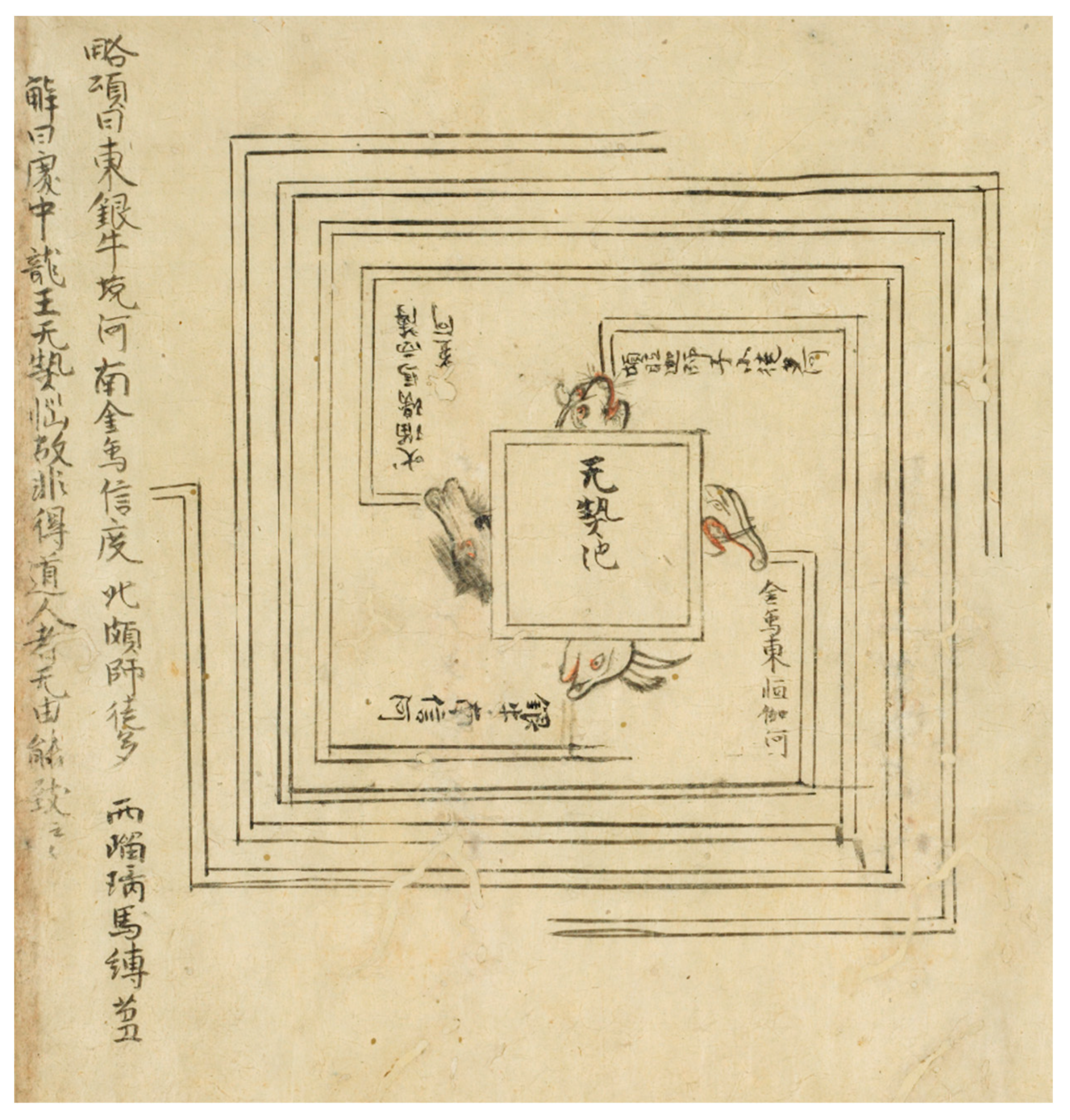
The Map of India in the scroll portrays the Anavatapta Lake in a similar manner to its description in Xiyuji, as if pictorializing it. India is represented as a continent in the shape of rounded trapezoid, surrounded by the neighboring countries such as China and Korea.4 The map does not depict Japan, even on the periphery. The Anavatapta Lake, which is enclosed by a double square, is drawn in the center of the northern part of India. Subsequent to the Map of India is the Diagram of the Anavatapta Lake, which shows the lake in close-up at its center (Figure 1).
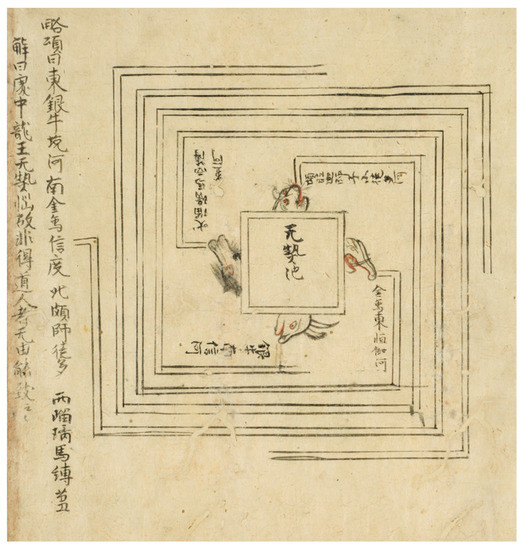
Figure 1.
A diagram of the Anavatapta Lake from the Harvard scroll. Section from Buddhist Cosmology (Nihon koku narabini Shumi shoten zu) with text copied by Monk Ryūi; Harvard Art Museums/Arthur M. Sackler Museum, Gift of the Hofer Collection of the Printed and Graphic; ©President and Fellows of Harvard College; Accession Number: 1973.66; Image Numbers: DDC101828.
The heads of the Crystal Lion (north), the Golden Elephant (east), the Silver Ox (south), and the Lapis Lazuli Horse (west) are placed on the four sides of the lake, and a river flows out of the mouth of each animal, drawing a square spiral counter-clockwise. The placement of these animals in the Diagram of the Anavatapta Lake does not correspond exactly to their description in Xiyuji: the diagram and Xiyuji agree on the placement of the Horse (west) and the Lion (north), but the Elephant (east in the diagram) and the Ox (south) are swapped.
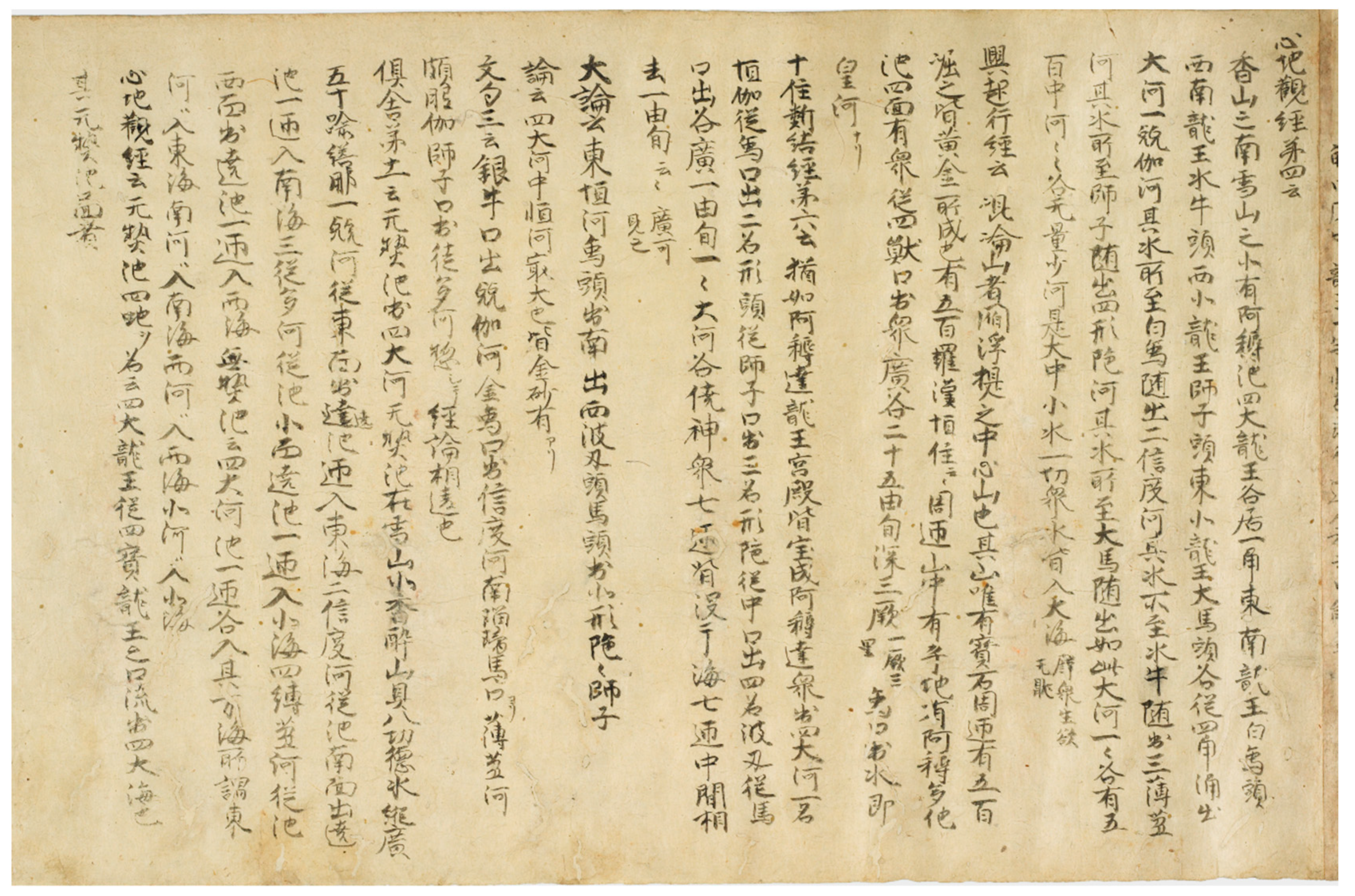
The Diagram of Anavatapta Lake is followed by various passages. The first passage, seen in Figure 1, reads as follows:
This passage places the four animals in the same directions as in Xiyuji. The last part, “no one who has not mastered the dharma can reach it”, is seen in the fascicle 11 of Jushelun 倶舎論 (Jp. Kusharon). Other passages, which also mention the Anavatapta Lake and the four animals, cite various other Buddhist texts: (Dachengbensheng) Xindiguan jing (大乗本生)心地観經 (Jp. Daijō honjō shinjikan gyō), (Foshuo) Xingqixing jing (佛說)興起行經 (Jp. Bussetsukōkigyō kyō),6 Shizhu duanjie jing 十住断結經 (Jp. Jūjū danketsu kyō)7, Dazhidulun 大智度論 (Jp. Daichidoron), Fahua wenju 法華文句 (Jp. Hokke mongu), and Jushelun (Figure 2). They exhibit some variations regarding the geography surrounding the Anavatapta Lake, however.The abridged verse says: the Silver Ox to the east, the Ganges; the Golden Elephant to the south, the Indus; the Crystal Lion to the north, the Sītā; and the Lapis Lazuli Horse to the west, the Oxus. The commentary says: since the Anavatapta Lake is the adobe of a Nāga king, no one who has not mastered the [Buddhist] way can reach it.5
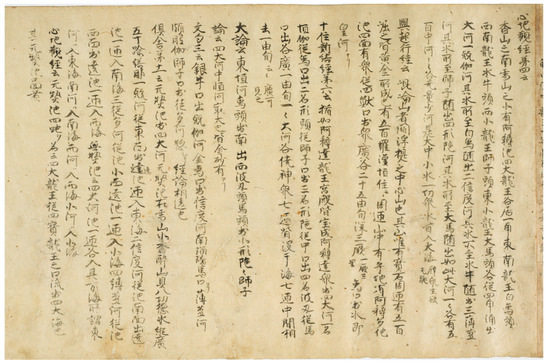
Figure 2.
Passages on the Anavatapta Lake in the Harvard scroll. Section from a Buddhist Cosmology (Nihon koku narabini Shumi shoten zu) with text copied by Monk Ryūi; Harvard Art Museums/Arthur M. Sackler Museum, Gift of the Hofer Collection of the Printed and Graphic; ©President and Fellows of Harvard College; Accession Number: 1973.66; Image Numbers: DDC101827.
For instance, the excerpt from Xindiguan jing states that four Nāga (dragon or mythical serpent) kings reside in the Anavatapta Lake; that the Ganges flows from the mouth of the Nāga king on the southeast of the lake, who has the head of the White Elephant; that the Indus flows from the mouth of the Nāga king on the southwest with the head of the Water Buffalo; that the Sītā flows from the mouth of the Nāga king on the northwest with the head of the Lion; and that the Oxus flows from the mouth of the Nāga king on the northeast with the head of the Horse. It is distinctive of this description that the Nāga kings are placed in the intercardinal directions. It is worth noting that Xindiguan jing contains several lines that use the Anavatapta Lake as a metaphor of the superiority of “bodhisattva monks” to the laity, by comparing the laity’s limitless desire to the ocean that is never satisfied with the water flowing out from the Anavatapta Lake.8 The excerpt summarizes these lines with a note that “It is like a sentient being’s desire having no satisfaction.”
On the other hand, the passage based on (Foshuo) Xingqixing jing identifies Mt. Anavatapta, which is at the center of Jambudvīpa, with Mt. Kunlun 崑崙山 of China, and states that the river flowing from the mouth of the Elephant on the Anavatapta Lake is the Yellow River.9 (Foshuo) Xingqixing jing was translated by a Buddhist scholar of Sogdian descent, Kang Mengxiang 康孟詳 (in the late second century), in Luoyang, the capital city of the Eastern Han near the Yellow River. The identification of Mt. Anavatapta with Mt. Kunlun is particularly noteworthy in the localization of the concept of the Anavatapta Lake in China.
As we have just observed, different passages show significant discrepancy with respect the geography surrounding the Anavatapta Lake, for instance regarding the directions of the four animals and the four rivers. Indeed, one of the passages states that “sutras disagree” regarding the animals and rivers.
Among the Buddhist texts cited in the Harvard scroll, Dazhidulun describes the Anavatapta Lake in the closest manner to the depiction in the Diagram of the Anavatapta Lake in the Harvard scroll, as these two sources assign the same directions to the four animals.10 (The short passage in the scroll based on Dazhidulun lacks the mention of the Ox on the south, however.) Since the accounts of the geography of the lake vary significantly across Buddhist texts, the Diagram of the Anavatapta Lake pictorializes only a part of the accounts, and this pictorialization is relativized by the passages citing different accounts. In addition, as we have seen, the Harvard scroll gives additional accounts, such as that only the bodhisattva monks can reach the Anavatapta Lake or that the water from the Elephant is the source of the Yellow River in China, the latter of which illustrates a way in which the imaginary geography of the Anavatapta Lake was connected to the real geography.
Although the Harvard scroll was produced by Japanese monks in Japan, the Buddhist texts and visual representations of the Anavatapta Lake in the scroll were probably influenced more by Chinese culture than by the Japanese one―for the scroll quotes passages from Buddhist sutras and commentaries that were either translated from Sanskrit and/or Pali into Chinese or written by Chinese scholars and commentators. In this sense, Japanese monks perceived the idea of the Anavatapta Lake through the mediation of the Chinese interpretation.
In this section, I have reviewed the images of and commentaries on the Anavatapta Lake in the Harvard Scroll. The next section will examine the way in which the Anavatapta Lake appears in Buddhist sutras, Japanese literature, and visual cultures.
7. The Anavatapta Lake in the Garden in the Illustrated Biography of Xuanzang
Lastly, I examine a fourteenth-century Japanese picture scroll called the Illustrated Biography of Xuanzang (Genjō sanzō-e 玄奘三蔵絵), which is closely related to Xuanzang’s Xiyuji.48 Somewhat surprisingly, the Anavatapta Lake appears in a depiction of a garden in this scroll.
The style of gardening in East Asia has been influenced by the worldview of Mt. Sumeru. For instance, in ancient Japan, in the seventh century, emperors had stone monuments in the shape of Mt. Sumeru constructed in their courtyards49. Indeed, one of these stone monuments was unearthed in Asuka, and scholars believe that it was originally a stone fountain set up at the center of a garden pond.50 Though the relationship between this pond and the Anavatapta Lake is uncertain, evidence suggests that there were gardens in which lakes or ponds imitated the Anavatapta Lake.
In China, Xu Gaozeng zhuan 続高僧伝 (The Continued Biographies of Eminent Monks), which was compiled by Dao Xuan 道宣 (596–667) during the Tang dynasty, includes a short biography of Chāde 叉徳 (d. 638), a monk from Mt. Liang 梁山 in Yong Province 雍州. It recounts that Chāde constructed a lake imitating the Anavatapta Lake to the south of Mt. Jiuzong 九峻山, and made a stone basin beside the lake, for the benefit of sentient beings. There were probably more cases of this kind, although there has been no pictorial source found in China that shows the Anavatapta Lake in gardens; neither has archaeological evidence been investigated on the construction of imitated Anavatapta Lakes.
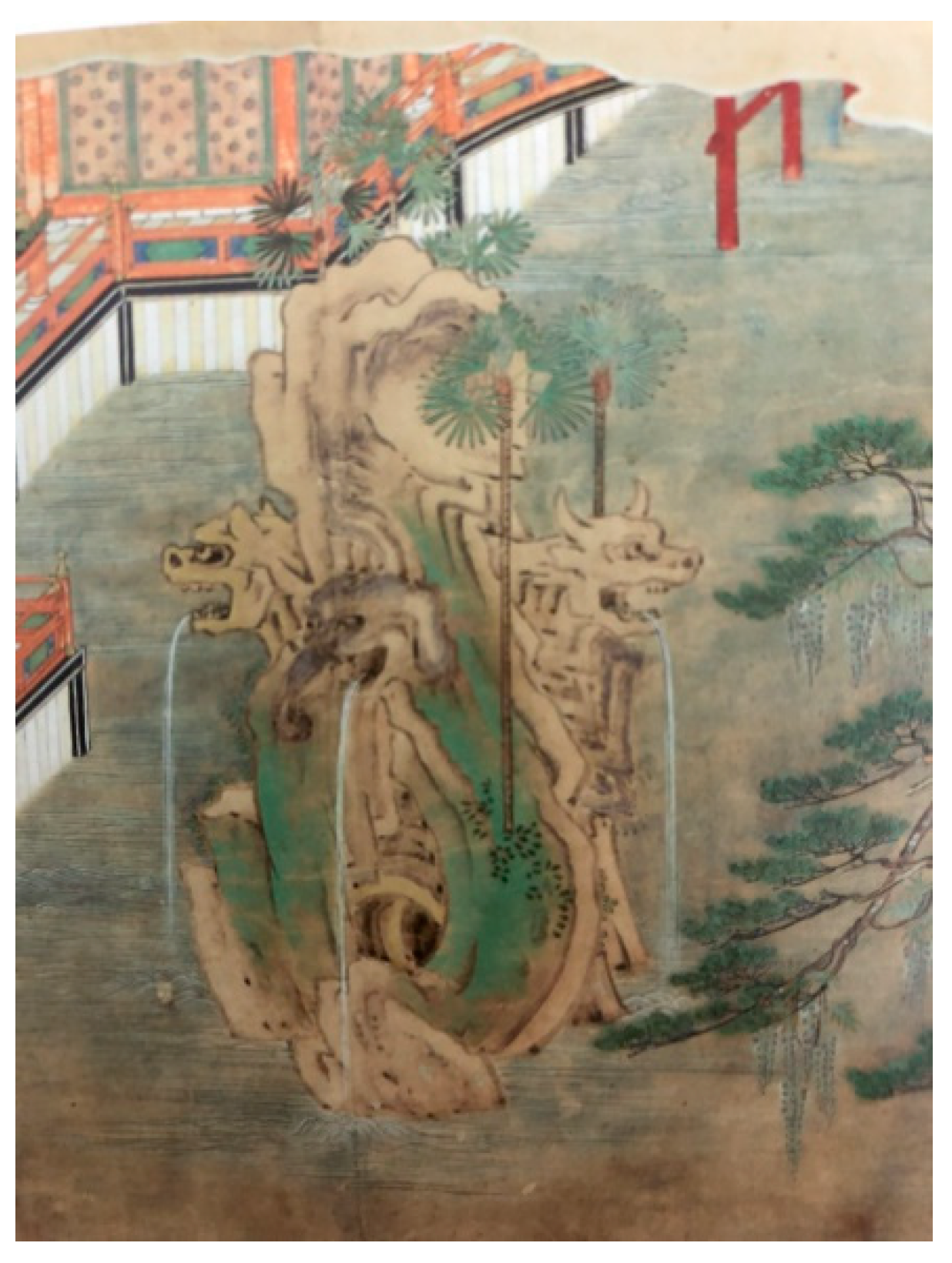
By contrast, in Japan, there is a depiction of a garden placing an imitated Anavatapta Lake―namely, in the Illustrated Life of Xuanzang. This picture scroll was produced by the prominent court painter Takashina no Takakane 高階隆兼 (active in the early fourteenth century). In the second section of the sixth fascicle of the scroll, there is a scene where Xuanzang receives offerings from King Bālāditya at Nālandā Monastery in India and stays in the living quarters of Dharamapāla Bodhisattva. In front of the living quarters a fountain in a pond is depicted―although it has not been pointed out, this pond is clearly modeled on the Anavatapta Lake (Figure 3).51
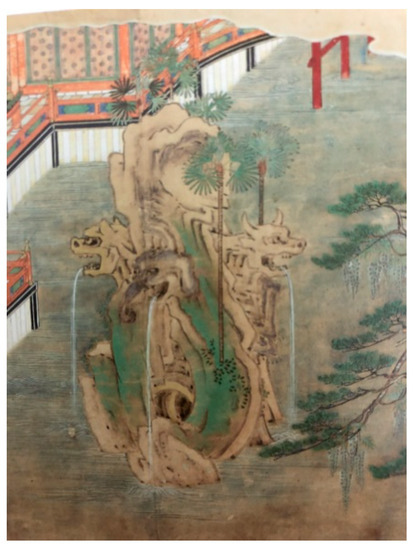
Figure 3.
A garden fountain modeled on the Anavatapta Lake, from the Illustrated Life of Xuanzang. (Nara Kokuritsu Hakubutsukan 2011), p. 91.
A text accompanying the illustration of this scene explains the origin of the name of the monastery. The direct source of this text is Da Tang Da Ci’ensi Sanzang fashi zhuan 大唐大慈恩寺三蔵法師伝 (Biography of the Tripiṭaka Master of the Great Ci’en Monastery of the Great Tang Dynasty), which relates the monastery to a pond as follows:
Though this passage does not mention the Anavatapta Lake, it refers to a pond where a dragon lived. Perhaps because of the dragon inhabiting in the pond, the Illustrated Life of Xuanzang associates the pond with the Anavatapta Lake and portrays the pond with a fountain of the four animals in the four cardinal directions.Nālandā Monastery means the monastery of Insatiability in Almsgiving. It was said by old tradition that to the south of the monastery there had been a pond in a mango grove in which lived a dragon named Nālanda. As the monastery was built beside the pond, it was named so. It was also said that when the Tathāgata was practicing the Bodhisattva path in one of his former lives, he was a great king and founded his capital at this place. As he had pity on the poor and the lonely, he often gave alms to them; and in memory of his beneficence the people called the place Insatiability in Almsgiving.52
The Illustrated Life of Xuanzang also depicts a strangely shaped rock in the center of the pond. The rock is partially covered with moss, and windmill palm trees grow around its top. Around half-way up to the top, three animal heads are attached: an elephant on the front, a water buffalo on the right, and a lion on the left. Water is flowing out of the mouth of each animal. The opposite side, although invisible, must have a horse’s head. This representation of the four animals and water flowing from their mouth is exactly the same as that in the descriptions of the Anavatapta Lake in the Xiyuji and the Harvard scroll. Although the directions of the animals vary across different texts, the majority of texts have an elephant on the south; it is therefore likely that the Illustrated Life of Xuanzang depicts this scene from the south.
To the best of my knowledge, however, there are no other pictorial sources that show the Anavatapta Lake in a garden. Nevertheless, the absence of a fountain in a garden in the accompanied text in the Illustrated Life of Xuanzang suggests that the artist used a preceding pictorial source as a model for his depiction of the pond. Since gardens with the imitated Anavatapta Lake were actually built as attested in the aforementioned Xu Gaozeng zhuan, it is possible that there are remains of such gardens―this demands more of both pictorial and archaeological research.
8. Conclusions
This article’s search for the Anavatapta Lake started with Xuanzang’s Xiyuji and ended with the Illustrated Life of Xuanzang. We have examined various references to the lake from Xiyuji to the Harvard scroll, to Buddhist sutras, to works of medieval literature such as Konjaku monogatari shū and Taiheiki, and to the Illustrated Life of Xuanzang. All of these sources have made it clearer how significant a place the lake occupied in the cosmology of Indian origin. It was a landmark deeply connected to the world of Mt. Sumeru, which was located at the center of the Asian worldview. While Mt. Sumeru provided a more imaginary and massive worldview, the Anavatapta Lake constituted a space at which imaginary and real geographies intersected with each other, as the lake was thought to, for instance, connect to the Yellow River in China.
In the process of transmission of Buddhism from India to East Asian counties, the idea of the Anavatapta Lake carried layers of meanings beyond its initial role as a sacred water source located in India. Buddhist cosmology placed India at the center of the world and at the top of the hierarchy of sacredness. The adoption of this cosmology in China or in Japan therefore caused tensions with their ideologies that placed China at the center of the world or that regarded Japan as a divinely protected sacred country. Against the backdrop of these tensions, the Anavatapta Lake played a crucial role in adapting and adopting Buddhist cosmology in China and Japan. In the localization of the concept of the lake, the sacred source of all water in the world became intricately associated, and sometimes believed to even be spatially connected, with places of cultural, religious, and ideological significance in China and Japan, such as China’s Yellow River or Japan’s Shinsen’en pond. These conceptual and spatial connections helped the reconciliation of the India-centered cosmology and the local ideologies in China and Japan, and reformulated political and cultural visions in East Asia.
Funding
This research was funded by the Beijing Social Science Foundation, grant number 14WYC058. I would like to extend my heartfelt gratitude to the Foundation for its generous support of my research project entitled “the Study of Collection of Tales of Times Now Past in East Asian Comparative Literature (Konjaku monogatari shū no Higashi Ajia hikaku kenkyū)”.
Acknowledgments
I thank the Harvard Art Museums for generous permission to use the images from their collection. I also thank Naoko Gunji for editing this article and translating it from Japanese to English, as well as for her feedback on the manuscript. I would furthermore like to express my gratitude to the anonymous referees for insightful comments and suggestions.
Conflicts of Interest
The author declares no conflict of interest.
Abbreviations
| T | SAT Daizōkyō Text Database (SAT大正新脩大蔵経テキストデータベース). 2018 version. Tokyo: University of Tokyo. http://21dzk.l.u-tokyo.ac.jp/SAT/. |
References
Primary Sources
(Foshuo) Xingqixing jing (佛說)興起行經. T. Available online: http://21dzk.l.u-tokyo.ac.jp/SAT2018/master30.php (accessed on 15 November 2018).Da Piluzhena chengfo jing shu 大毘盧遮那成佛經疏. T. Available online: http://21dzk.l.u-tokyo.ac.jp/SAT2018/master30.php (accessed on 20 April 2019).Daban niepan jing 大般涅槃經. T. Available online: http://21dzk.l.u-tokyo.ac.jp/SAT2018/master30.php (accessed on 20 April 2019).Dabaoji jing 大宝積經. T. Available online: http://21dzk.l.u-tokyo.ac.jp/SAT2018/master30.php (accessed on 20 April 2019).Dafang guangfo huayan jing 大方広佛華厳經. T. Available online: http://21dzk.l.u-tokyo.ac.jp/SAT2018/master30.php (accessed on 3 May 2019).Dasheng baoyun jing 大乘宝雲經. T. Available online: http://21dzk.l.u-tokyo.ac.jp/SAT2018/master30.php (accessed on 3 December 2018).Dazhidulun 大智度論. T. Available online: http://21dzk.l.u-tokyo.ac.jp/SAT2018/master30.php (accessed on 5 November 2018).Foshuo chang ahan jing 佛說長阿含經. T. Available online: http://21dzk.l.u-tokyo.ac.jp/SAT2018/master30.php (accessed on 5 November 2018).Foshuo huashou jing 佛說華手經. T. Available online: http://21dzk.l.u-tokyo.ac.jp/SAT2018/master30.php (accessed on 5 November 2018).Foshuo zhufa yongwang jing 佛說諸法勇王經. T. Available online: http://21dzk.l.u-tokyo.ac.jp/SAT2018/master30.php (accessed on 7 January 2018).Fozutongji 佛祖統紀. T. Available online: http://21dzk.l.u-tokyo.ac.jp/SAT2018/master30.php (accessed on 8 November 2018).Heike monogatari 平家物語. Shinpen Nihon koten bungaku zenshū 新編日本古典文学全集 45–46. Tokyo: Shōgakukan, 1994.Konjaku monogatari shū 今昔物語集. Vols. 1–3. Shin Nihon koten bungaku taikei 新日本古典文学大系 33–35. Tokyo: Iwanami Shoten, 1993–1997.Miaofa lianhua jing 妙法蓮華經. T. Available online: http://21dzk.l.u-tokyo.ac.jp/SAT2018/master30.php (accessed on 8 November 2018).Nihon shoki 日本書紀. Nihon koten bungaku taikei 日本古典文学大系 68. Tokyo: Iwanami Shoten, 1965.Ruyi baozhu zhuanlun mimi xianshen chengfo jinlun zhouwang jing 如意宝珠転輪秘密現身成佛金輪呪王經. T. Available online: http://21dzk.l.u-tokyo.ac.jp/SAT2018/master30.php (accessed on 5 November 2018).Sanpō-e, Chūkōsen 三宝絵, 注好選. Shin nihon koten bungaku taikei 新日本古典文学大系 31. Tokyo: Iwanami Shoten, 1997.Shengman baoku 勝鬘宝窟. T. Available online: http://21dzk.l.u-tokyo.ac.jp/SAT2018/master30.php (accessed on 1 December 2018).Shisonglu 十誦律. T. Available online: http://21dzk.l.u-tokyo.ac.jp/SAT2018/master30.php (accessed on 5 November 2018).Shizhu jing 十住經. T. Available online: http://21dzk.l.u-tokyo.ac.jp/SAT2018/master30.php (accessed on 5 November 2018).Taiheiki 太平記, vols. 1–3. Nihon koten bungaku taikei 日本古典文学大系 34. Tokyo: Iwanami Shoten, 1960.Xindiguan jing 心地觀經. T. Available online: http://21dzk.l.u-tokyo.ac.jp/SAT2018/master30.php (accessed on 5 November 2018).Zhichan bingmi yaozhu 治禅病祕要法. T. Available online: http://21dzk.l.u-tokyo.ac.jp/SAT2018/master30.php (accessed on 5 November 2018).Zuisheng wen pusa shizhu chugou duanjie jing 最勝問菩薩十住除垢断結經. T. Available online: http://21dzk.l.u-tokyo.ac.jp/SAT2018/master30.php (accessed on 5 November 2018).Secondary Sources
- Araki, Hiroshi 荒木浩. 2015. Shohyō: Koten ronkō–Nihon to iu shiza 書評:古典論考―日本という視座. Kokubungaku kenkyū 国文学研究 176: 55–66. [Google Scholar]
- Yoshiko Kurata Dykstra, trans. 1998, The Konjaku Tales Japanese Section (I): From a Medieval Japanese Collection. Osaka: Kansai Gaidai University Publication.
- Yoshiko Dykstra, trans. 2014, Buddhist Tales of India, China, and Japan: India Section. Honolulu: Kanji Press.
- Gao, Yang 高陽. 2010. Shumisen to tenjō sekai: Haabaado daigaku shozō Nihon shumi shoten zu to Chūgoku no Hokkai anryū zu o megutte 須弥山と天上世界―ハーバード大学所蔵『日本須弥諸天図』と中国の『法界安立図』をめぐって. In Kanbun bunka ken no setsuwa sekai 漢文文化圏の説話世界. Edited by Komine Kazuaki 小峯和明. Tokyo: Chikurinsha, pp. 259–82. [Google Scholar]
- Gao, Yang 高陽. 2012. Higashi Ajia no shumisen zu: Tonkō-bon to Haabaado-bon o chūshin ni 東アジアの須弥山図―敦煌本とハーバード本を中心に. In Higashi Ajia no Konjaku monogatari shū: Honyaku, hensei, yogen 東アジアの今昔物語集―翻訳・変成・予言. Edited by Komine Kazuaki 小峯和明. Tokyo: Bensei Shuppan, pp. 263–84. [Google Scholar]
- Gao, Yang 高陽. 2017. Tenjiku shinwa no ikusa o megutte–Taishakuten to ashura no tatakai o chūshinni 天竺神話のいくさをめぐって―帝釈天と阿修羅の戦いを中心に. In Nihon bungaku no tenbō o hiraku 日本文学の展望を拓く, vol. 3. Shūkyō bungei no gensetsu to kankyō 宗教文芸の言説と環境. Edited by Komine Kazuaki 小峯和明 and Hara Katsuaki 原克昭. Tokyo: Kasama Shoin, pp. 21–36. [Google Scholar]
- Gasho Translation Committee, trans. 1999. The Writings of Nichiren Daishōnin . Writings of Nichiren Daishōnin. Available online: https://www.nichirenlibrary.org/en/wnd-1/Content/32 (accessed on 15 November 2018).
- Komatsu, Shigemi 小松茂美, ed. 1975. Ban dainagon ekotoba 伴大納言絵詞. Nihon emaki taisei 日本絵巻大成 2. Tokyo: Chūō Kōronsha. [Google Scholar]
- Komine, Kazuaki 小峯和明. 2011. Shumisen sekai no gensetsu to zuzō o meguru 須弥山世界の言説と図像をめぐる. In Ajia shinjidai no minami Ajia ni okeru nihon zō: Indo, SAARC shokoku ni okeru Nihon kenkyū no genjō to hitsuyōsei アジア新時代の南アジアにおける日本像 インド・SAARC諸国における日本研究の現状と必要性. Edited by International Research Center for Japanese Studies. Kyoto: International Research Center for Japanese Studies, pp. 45–55. [Google Scholar]
- Komine, Kazuaki 小峯和明, and Fujisawa Shūhei 藤沢周平, eds. 1991. Konjaku monogatari shū, Uji shūi monogatari. 今昔物語集・宇治遺物語. Shinchō koten bungaku arubamu 新潮古典文学アルバム. Tokyo: Shinchōsha, vol. 9. [Google Scholar]
- Rongxi Li, trans. 1995, A Biography of the Tripiṭaka Master of the Great Ci’en Monastery of the Great Tang Dynasty. Berkeley: Numata Center for Buddhist Translation and Research.
- Rongxi Li, trans. 1996, The Great Tang Dynasty Record of the Western Regions. Berkeley: Numata Center for Buddhist Translation and Research.
- Lü, Jianfu 呂建福. 2005. Fojiao shijieguan dui Zhonguo gudai dili zhongxin guanniande yingxiang 仏教世界観対中国古代地理中心観念的影響. Shanxi shifan daxue xuebao, Zhexue shehui, Kexueban 陜西師範大学学報・哲学社会・科学 4: 75–82. [Google Scholar]
- Lü, Jianfu. 2015. The Influence of Buddhist Cosmology on the Idea of the Geographical Center in Pre-Modern China. In Buddhism. Edited by Yulie Lou. Leiden: Koninklijke Brill NV, pp. 255–87. [Google Scholar]
- Maeda, Masaaki 前田雅之. 2014. Koten ronkō–Nihon to iu shiza 古典論考―日本という視座. Tokyo: Shintensha. [Google Scholar]
- Helen Craig McCullough, trans. 1988, The Tale of the Heike. Stanford: Stanford University Press.
- Helen Craig McCullough, trans. 2004, The Taiheiki: A Chronicle of Medieval Japan. Rutland: Tuttle.
- Murai, Shōsuke 村井章介. 2014. Nihon no jigazō 日本の自画像. In Iwanami koza nihon no shisō 岩波講座日本の思想. vol. 3: Uchi to soto: Taigaikan to jikozō no keisei 内と外・対外観と自己像の形成. Edited by Karube Tadashi 苅部直. Tokyo: Iwanami Shoten, pp. 45–83. [Google Scholar]
- Sencho Murano, trans. 2000, Kaimokushō or Liberation from Blindness. Berkeley: Numata Center for Buddhist Translation and Research.
- Nara Kokuritsu Hakubutsukan 奈良国立博物館, ed. 2011. Tenjiku e: Sanzō hōshi 3 man kiro no tabi 天竺へ 三蔵法師3万キロの旅. Exhibition catalogue. Nara: Nara Kokuritsu Hakubutsukan. [Google Scholar]
- Takahashi, Shūei 高橋秀栄. 1994. Heian Kamakura bukkyō yō bunshū, ge 平安鎌倉仏教要文集 下. Komazawa daigaku bukkyō gakubu kenkyū kiyō 駒澤大学仏教学部研究紀要 52: 257–85. [Google Scholar]
- Paul Varley, trans. 1980, A Chronicle of Gods and Sovereigns: Jinnō Shōtōki of Kitabatake Chikafusa. New York: Columbia University Press.
- Wang, Zhongmin 王重民, Qingshu Wang 王庆菽, Xiang Da 向达, Yiliang Zhou 周一良, Gong Qi 启功, and Yigong Zeng 曾毅公, eds. 1984. Dunhuang bianwen ji 敦煌変文集. Beijing: Renmin Wenxue Chubanshe. [Google Scholar]
- Yakushiji 薬師寺. 2015. Genjō sanzō to Yakushiji 玄奘三蔵と薬師寺. Nara: Hossōshū Daihonzan Yakushiji. [Google Scholar]
| 1 | The preface also covers the first-hand observation of the sites Xuanzang visited and the second-hand information he collected during his journey to Central Asia and India, and describes these places in relation to the Buddhist worldview. For previous scholarship on Mt. Sumeru, see (Komine 2011, pp. 45–55; Gao 2010, pp. 259–82; Gao 2012, pp. 263–84). |
| 2 | (Li 1996, p. 18). For the Fragrant Mountain (kōzan 香山), see (Maeda 2014, pp. 237–80; Araki 2015, p. 58). |
| 3 | The Harvard scroll was first introduced by Komine in his co-edited book, (Komine and Fujisawa 1991, pp. 2–25); also see (Komine 2011, pp. 49–52) in which Komine discusses the scroll in detail. Gao further investigated the scroll in comparison with a three-volume Ming publication entitled Fajie anli tu法界安立図 (Dharma Realm Diagrams; printed in 1584) and Sangai kuji no zu 三界九地之図 (Depiction of Three Realms and Nine Levels; ninth or tenth century) that was discovered in Dunhuang. (Gao 2010, pp. 259–82; Gao 2012, pp. 263–84). For the discussion of Gyōki map in the Harvard scroll, see (Murai 2014, pp. 45–83). |
| 4 | For instance, the earliest extant Map of India (dated to 1364) in the collection of Hōryūji and the Edo-period map titled Nansenbushū bankoku shōkanozu (1710) show a similar map. For these maps, see (Yakushiji 2015, pp. 37–39). |
| 5 | It is not clear what is the source of this abridged verse and the commentary. It is likely, however, that they are derived from a commentary of the Treasury of Abhidharma. |
| 6 | (Foshuo) Xingqixing jing (佛說)興起行經, T197, vol. 4, p. 163, c, l3.18. |
| 7 | Shizhu duanjie jing is also known as Zuisheng wen pusa shizhu chugou duanjie jing 最勝問菩薩十住除垢断結經, T309, vol. 10, p. 1011, a, 8.20. |
| 8 | An explanatory note to the final passage reads “is comparable to not to disgust against sentient being’s desire.” The description of the Anavatapta Lake in Xindiguan jing can be found in T159, vol. 3, p. 307, c, l.5. |
| 9 | There is a variation between the excerpt and the original text: while the inscription in the Harvard scroll says that the Sītā River measures three li, the original text says it measures seven li. See (Foshuo) Xingqixing jing, T197, vol. 4, p. 163, c, l3.18. |
| 10 | Dazhidulun, T1509, vol. 25, p. 114, a, 15.25. |
| 11 | Dafang guangfo huayan jing 大方広佛華厳經, T279, vol. 10, p. 208, c, l2.16. |
| 12 | Fozutongji 佛祖統紀, fascicle 32, T2035, vol. 49, p. 314, a, 2.8. |
| 13 | Da Piluzhena chengfo jing shu 大毘盧遮那成佛經疏, fascicle 15, T1796, vol. 39, p. 734, a, 22.25. |
| 14 | For instance, see the preface to Miaofa lianhua jing 妙法蓮華經, T1718, vol. 34, p. 24, c, l8.20. |
| 15 | Foshuo chang ahan jing 佛說長阿含經, T1, vol. 1, p. 116, c, 05.18. |
| 16 | For instance, see Shengman baoku 勝鬘宝窟, fascicle middle, T1744, vol. 37, p. 43, a, 27.29. |
| 17 | Shisonglu 十誦律, fascicle 2, T1435, vol. 23, p. 346, a, 9.28. |
| 18 | (Wang et al. 1984, p. 146). |
| 19 | Ruyi baozhu zhuanlun mimi xianshen chengfo jinlun zhouwang jing 如意宝珠転輪秘密現身成佛金輪呪王經, fascicle 1, T961, vol. 19, p. 331, c, 6.8. |
| 20 | Dafang guangfo huayan jing 大方広佛華厳經, fascicle 27, T279, vol. 10, p. 222, b, l6.29; Shizhu jing 十住經, T286, vol. 10, p. 531, b, 26.28. |
| 21 | Dabaoji jing 大宝積經, fascicle 119, T310, vol. 11, p. 575, a, 8.10. |
| 22 | Foshuo huashou jing 佛說華手經, fascicle 7, T657, vol. 16, p. 182, c, 29.a05. |
| 23 | Foshuo zhufa yongwang jing 佛說諸法勇王經, T822, vol. 17, p. 848, b, 22.28. |
| 24 | Daban niepan jing 大般涅槃經, fascicle 23, T375, vol. 12, p. 755, c, 9.12. |
| 25 | Zhichan bingmi yaozhu 治禅病祕要法, fascicle 1, T620, vol. 15, p. 335, b, 3.18. |
| 26 | Dasheng baoyun jing 大乘宝雲經, fascicle 1, T659, vol. 16, p. 241, c, l0.11. |
| 27 | (Lü 2005, pp. 75–82; also see Lü 2015, p. 267). |
| 28 | (Lü 2005, p. 77; 2015, p. 267). As we have seen, a similar interpretation is also stated in the Harvard scroll. |
| 29 | In the Qing period (1644–1912), firsthand surveys of the river systems of the Yellow River led to the identification of Mt. Anavatapta (or Mt. Kunlun) with Mt. Kailash 岡底斯山, an actual mountain in Tibet. (Lü 2005, p. 77; 2015, pp. 268–70). |
| 30 | (Lü 2005, p. 78; 2015, p. 39). |
| 31 | (Wang et al. 1984, p. 112). |
| 32 | The same episode is compiled in a collection of didactic tales Chūkōsen 注好選 in the twelfth century. Sanpō-e, Chūkōsen 1997, p. 367. |
| 33 | (Dykstra 2014, p. 149); also see Konjaku monogatari shū 1999, p. 221. |
| 34 | In Kitano tsuya monogatari, the Buddhist monk Raii of Hino visits Kitano Shrine, and listens to a dialogue between a hermit, a courtier, and a Buddhist monk all night long. These dialogists narrate Indian, Chinese, and Japanese tales, with which they castigate the sovereign’s rulership in Japan in the middle of the civil war between the Northern and Southern Courts. |
| 35 | Konjaku monogatari shū 1999, p. 170; see also (Dykstra 2014, pp. 115–20). |
| 36 | (Varley 1980, p. 54). |
| 37 | Originally the collection was housed in the archives in the complex of the Buddhist temple Shōmyōji in Yokohama. For Gumonji kuketsu, see (Takahashi 1994, p. 275). |
| 38 | Gumonji kuketsu goes on to say that the monk Huiguo 恵果 (746–806), who transmitted esoteric Buddhist tradition to Kūkai at Qinglong Monastery in Chang’an in 805, has moved to Mt. Murō, and that whenever a Shingon master visits Mt. Murō, Huiguo welcomes him, whereas if an inexperienced practitioner visits there, he will be slaughtered by poisonous snakes and other creatures. (Takahashi 1994, p. 275). |
| 39 | Although the Dragon King Zennyo appears in Baoxidi chengfo tuoluo ni jing 宝悉地成佛陀羅尼經 translated by Amoghavajra (705–774), it appears more frequently in Japanese sources more frequently. We can assume that the name Zennyo was more familiar to Japanese people through a wide reception of the setsuwa literature. |
| 40 | See “Matter of the Garden of Divine Waters”, in (McCullough 2004, p. 374); Taiheiki 1960, pp. 420–24. Also see Konjaku monogatari shū 1993, p. 359; “How Master Kōbō Practiced the Cult of Shōukyō and Caused a Downpour”, in (Dykstra 1998, pp. 248–49). |
| 41 | (McCullough 1988, p. 227); also see Heike monogatari 1994, pp. 25–28. |
| 42 | The image of the Kunming Lake seems to have permeated among Japanese people. For instance, in the Illustrated Scroll of the Story of the Courtier Ban (Ban dainagon ekotoba), the lake is depicted on a free-standing panel behind a courtier in formal attire in the scene where the chancellor Fujiwara no Yoshifusa (804–872) makes a direct appeal to Emperor Seiwa (850–881; r. 858–876) that the minister of the left, Minamoto no Makoto, is innocent of having set fire to the Ōten-mon gate. Ban dainagon ekotoba (Komatsu 1975, pp. 28–29). |
| 43 | Taiheiki 1960, pp. 144–146. |
| 44 | (Gasho Translation Committee 1999, p. 302). |
| 45 | (Dykstra 2014, pp. 67–68). |
| 46 | (Gao 2017, pp. 21–36). |
| 47 | Saddharmapuṇḍarīka-sutra is a Sanskrit name of the Lotus Sutra. Translation is from (Murano 2000, p. 81). |
| 48 | For the Illustrated Biography of Xuanzang, see (Nara Kokuritsu Hakubutsukan 2011, p. 91). |
| 49 | Nihon shoki 1965, pp. 198, 330, 336, 343. |
| 50 | It is now preserved in the Asuka Historical Museum, along with a reconstructed model. |
| 51 | (Nara Kokuritsu Hakubutsukan 2011, p. 91). |
| 52 | (Li 1995, p. 93). The scroll text that accompanies the illustration in the Illustrated Life of Xuanzang is almost identical. In addition, a similar account is recorded in “the Country of Magadha” of the ninth fascicle of Xuanzang’s Record of the Western Regions. (Li 1996, p. 281). |
© 2020 by the author. Licensee MDPI, Basel, Switzerland. This article is an open access article distributed under the terms and conditions of the Creative Commons Attribution (CC BY) license (http://creativecommons.org/licenses/by/4.0/).