


Abstract
Religion and public policy are interconnected across a variety of issues. One aspect where this linkage has been understudied is religion and Indigenous sacred sites protection. This article aims to address this gap by analyzing how Indigenous women’s activism advances this cause. The focus is on how Indigenous Peoples, specifically women, use grassroots activism to provoke change on public policy in the context of the protection of Indigenous sacred sites. Two case studies are used to illustrate this concept: the American “Women of Standing Rock” and the Canadian “Idle No More” grassroots social movements. My analysis draws from interpretative methods. Interpretative research revolves around the concept of individuals as active producers of meaning. The women-led grassroots social movements at issue highlight a fundamental lack of awareness of the historical and current struggles of Indigenous Peoples, both in the US and Canada. Modern technologies and social media provide democratic means for grassroots social movements to be heard and empowered. The growing movement by Indigenous women to assert their rights, and their quest for self-determination in land use and sacred sites protection create a positive discourse that advances Indigenous women’s position in crossing the obstacles onto “institutional places of privilege,” hence influencing public policy.
1. Introduction
Religion and public policy are linked across a variety of issues. One area where this linkage has been understudied is religion and Indigenous sacred sites protection. This article addresses this gap by exploring ways Indigenous women’s activism can help advance this cause. This work focuses on how Indigenous Peoples, and specifically women, use grassroots activism to provoke change on public policy in the context of the protection of Indigenous sacred sites. I use two case studies to illustrate this concept: the American “Women of Standing Rock” and the Canadian “Idle No More” grassroots social movements.
Religion and its related practices are crucial characteristics of Indigenous Peoples. In fact, in many tribes, the word religion does not even exist. For Indigenous Peoples, spirituality is not compartmentalized—it refers to their whole person, to their identity (Parke-Sutherland 2018). This trait influences the way that Indigenous communities respond to the non-Indigenous world. Tension can arise when the social and religious values of Indigenous Peoples conflict with the values of mainstream society. The Gasquet-Orleans (G-O) road controversy (1967–1990), a landmark case for Indigenous sacred sites protection, provides an example of this point.
The G-O road controversy involved an Indigenous sacred site in Northern California that encompasses approximately 13,500 acres of the Six Rivers National Forest. It is an area that bears much spiritual significance for Native Americans. In the 1970s, Native Peoples lost control of the site as the US Forest Service began plans to build a paved road to encourage logging and timber activity. The construction of the road and its consequences would have been “potentially destructive of the very core of Northwest [Indian] religious beliefs and practices” (Lyng V. Northwest Indian Cemetery Protective Association 1988). Native Americans claimed that any artificial interference with nature in this area prevented their free exercise of religion as guaranteed by the First Amendment of the US Constitution (Emenhieser and Taylor 2005, pp. 701–2). Indigenous practices and values collided with non-Indigenous ones and caused a three-decade-long controversy. Two lower courts found that a Forest Service plan to build the G-O logging road was a violation of Native American religious freedom because of its impact on an large sacred site, but those rulings were later overturned by the Supreme Court (Lyng V. Northwest Indian Cemetery Protective Association 1988). The G-O road case illustrates where tensions between the Federal Government and Indigenous groups arise, and it also highlights the difficulties in finding a fair middle ground. This is especially true because Indigenous Peoples are still struggling to have a voice in the policy-making arena.
In light of the discussion above, how can Indigenous Peoples balance conflicting interests and develop a shared understanding with both the majority population and with the Federal Government? Specifically, how can Indigenous women influence public policy to protect Indigenous land and sacred sites effectively––hence promoting an environmentally sustainable development? There are undoubtedly many possible answers to these questions.
One venue where Indigenous women are experiencing a significant impact in advancing their cause is through social movements. In the wake of women’s social movements around the globe, Indigenous women are gaining a strong voice of their own. Recently, the United Nations affirmed that Indigenous women are “key actors in achieving the 2030 Agenda” (UN Women 2018). This article intends to be a journey through the major milestones that brought Indigenous women to this important role as catalysts within key public policy discussions like that of sacred sites protection––starting from the 1995 Fourth World Conference on Women. The Conference gave a new platform to Indigenous women across the globe to raise their voice––particularly through the Commission on the Status of Women (“CSW”).
There are still significant challenges that Indigenous Peoples—and Indigenous women in particular—face every day. These challenges include gender equality and the empowerment of women (Parke-Sutherland 2018). Here, I reflect on possible ways to overcome them, adopting an international and comparative approach. The focus of this analysis is Indigenous Peoples in the US. I also comparatively refer to Canada through an analysis of social movements based in the two countries at issue. The rationale behind my case study selection is a diversity in the legal approach to the treatment of Indigenous Peoples, but a similar common law framework and a federal type of government. This common ground sets an even operative ground for comparison.
I pursue my analysis focusing on environmentally sustainable development and Indigenous women’s activism. Specifically, I look into the Women of Standing Rock and Idle No More grassroots social movements. The underlying political issues I am concerned with are the building of the Dakota Access Pipeline (“DAPL”) and Indigenous sovereignty in the context of sacred sites protection. What makes the DAPL a political issue is that its building had a profound environmental impact on Native American communities living in the area along the course of the DAPL and on their sacred land and sites. Such impact generated Indigenous movements that opposed the building of the DAPL and that called for policy reform for increased Indigenous Peoples’ participation in decision-making processes on matters that would directly impact them (Mengden IV 2017). While the Dakota Access Pipeline does not directly impact Canada, in 2016, a Canadian-based company called Enbridge Energy Partners, L.P. (EEP), announced that they would acquire a 27.6 percent interest in the Bakken Pipeline System. Further, three Canadian banks, RBC, Scotiabank, and TD Securities, are amongst 17 financial institutions that have either financial dealings with the pipeline or with companies that have a stake in the pipeline project (Mahboob and Hahn 2016).
Indigenous Peoples are characterized by a strong relationship with their ancestral lands. In many instances, Indigenous women experience loss of their territory, limited access to natural resources, and face a number of dysfunctions in their tribal societies (i.e., abuse, impoverishment, lack of education). Literature suggests that such structural dysfunctions lead back to colonization, which caused a breakdown of traditional Indigenous societies and a loss of identity (Taiaiake 2009; Blaser 2009). These inequalities make Indigenous women vulnerable and dependent (UN Women 2018). Indigenous women have a special connection with the land and their territory in that they are most often responsible for their children and upbringing. Therefore, their voice is crucial in the international arena, and is one that has mobilized masses and given a new shape to the international debate on Indigenous environmental sustainability and sacred sites protection. I argue that the political engagement of Indigenous women is crucial to bring the needs of Indigenous Peoples to the table in the international arena. I also argue that increasing Indigenous women’s capabilities fosters a sense of identity that counteracts the historical identity loss, the traditional Indigenous societies’ breakdown, and promotes development in Indigenous communities. Therefore, I advocate for social movements to play a pivotal role in facilitating participation and in advancing sustainable development for Indigenous women.
2. Research Question and Design
This article is about how Indigenous women can contribute to fostering sustainable environmental development and sacred sites protection through social movements. How effective have women-led Indigenous grassroots social movements been in advancing the position of Indigenous women? More specifically, what role do Indigenous women play as social movement leaders? How are they portrayed as such?
I aim to shed light on how empowering grassroots social movements leads to influencing public policy in the realm of Indigenous movements at the intersection between religion, law, and public policy. The significance of my questions lies in understanding where such action can be improved or steered in a new direction in the framework of the international, US, and Canadian legal framework. Indigenous women have played an increasingly crucial role in advancing Indigenous Peoples’ rights; for example, when fighting the use of Native American mascots in US professional sports (McLean et al. 2017). I am now analyzing how leadership and action can extend to other areas and have a lasting impact on the current public policy debate.
Methodology and Theoretical Framework
My analysis draws from an interpretative methods approach. I chose this method because my analysis revolves around visual materials and discourse. Interpretative methods are based on the concept of individuals as active producers of meanings, which are, therefore, constructed (Berger and Luckmann 1966; Creswell and Creswell 2018). Interpretative research consists of analyzing such meaning-making practices and how they produce observable outcomes. Although still in a minority position in the field of political science, interpretative methods have sparked increased interest in recent years (Yanow and Schwartz-Shea 2012).1
Specifically, I focus on understanding how discourse through news outlets and scholarly literature, along with the imagery accompanied to it, influenced the advancement of Indigenous women’s environmental sustainability cause. I used two images to complement my interpretative analysis. I chose a photo of the WSD movement provided by Bethany Yellowtail, which appeared in a 2018 article by Temryss MacLean Lane. I also chose a photo by Maggie Lemere, which appeared on the National Geographic blog covering the WSR Movement in December 2016. Both photos are representative of the WSR and depict Indigenous women in action, at the forefront of the peaceful protest. As for the discourse, I mainly drew from social media and YouTube material, specifically that coming from the Indigenous women leaders of the movements like LaDonna Brave Bull Allard. I paid close attention to the symbolism revolving around both images and discourse. In this work, I am not doing a quantitative analysis because data are hard to come by with it. I collected my data through the use of primary sources. I also used secondary sources, news, and images. In the Indigenous field of research, there is a sheer lack of scholarship at the intersection of law and political science. Therefore, I hope to contribute to filling this gap building from an interdisciplinary use of the literature available.
3. Empowering Grassroots Social Movements to Influence Public Policy: A Constructivist Approach
My theoretical framework rests upon a constructivist approach. According to the epistemology of constructivism, human beings are not passive receivers of knowledge; they interact with it and link it to the already available information, therefore being active construers of reality (Frey 2018).2 I also utilize an intersectional approach. The latter rests on the premise that “multiple interacting systems of oppression” contribute to a situation of disadvantage for a specific group of peoples (Tormos 2017). Collins and Chepp (2013) define intersectionality as:
An assemblage of ideas and practices that maintain that gender, race, class, sexuality, age, ethnicity, ability, and similar phenomena cannot be analytically understood in isolation from one another; instead, these constructs signal an intersecting constellation of power relationships that produce unequal material realities and distinctive social experiences for individuals and groups positioned within them.(Collins and Chepp 2013, p. 58)
In a well-known metaphor, Kimberlé Crenshaw depicted intersectionality as a basement stacked with disadvantaged people—the lower positioned persons had most elements of disadvantage, and the ones closer to the ceiling the least (Crenshaw 1989). Above the basement ceiling are those individuals who are not disadvantaged. According to Crenshaw, when a hatch is created through the floor, only those right below it can pass through it. This metaphor exemplifies how the more elements of disadvantage are present (i.e., lower-class background, being a woman, belonging to a minority), the harder it is to have a voice, and break through the glass ceiling (Crenshaw 1989).
I rest upon the literature of Martha Nussbaum and Amrita Basu to argue that Indigenous women-led strategies and agency influence public policy and challenge the federal control of environmental governance and sacred sites protection (Maleta 2018). Specifically, Nussbaum and Basu’s work helped me frame the relationship between feminist theories and Women’s activism. Nussbaum’s work analyzes feminism and international development in the context of the capability approach theoretical framework (Nussbaum 2000). The underlying assumption is that the unequal setting where women and men operate, both political and social, prevents them from fully developing their human capabilities (Nussbaum 2000). The author argues that international politics and the economy should take into account the gender disparity between men and women, in order to put women in the position to develop their full potential and have a voice of their own (Nussbaum 2000). Nussbaum classifies capabilities into ten different categories that together contribute to foster peoples’ human dignity—political participation, economic transactions engagement, liberty of conscience, control over one’s environment, and literacy are some of the capabilities that are particularly relevant for this article (Nussbaum 2000). According to Nussbaum’s outcome-oriented approach, states play a critical role in making the realization of such capabilities possible, this way fostering human rights. Nussbaum adopts a universalistic approach, where her theory applies across countries and cultures (Nussbaum 2000).
Shreya Atrey reflects on the effectiveness of women’s movements. She critiques Nussbaum’s approach affirming that it is not sufficiently intersectional (Atrey 2018). According to Atrey, the effectiveness of women’s movements, and ultimately progress, take place when women with more than one intersectional disadvantage (those at the bottom of the basement) can improve their situation. Atrey’s transformative approach offers some important cues of reflections on Nussbaum’s theoretical framework (Atrey 2018).
In her critique of Nussbaum, Basu explores the relationship between theory and practice, and how the clean-cut capabilities approach has to face a “messy” reality—especially when social movements come into play (Basu 2010). It investigates how to go from universal to particular, and from international down to the local level (Basu 2010). Basu refers to Nussbaum’s work in highlighting the power of Indigenous women’s grassroots social movements to influence public policy (Basu 2010). She also reports the concern that institutionalization of women’s social movements might weaken their radicalism—and ultimately, their action (Basu 2010). This is because grassroots social movements capture the essence of community-based identities and, therefore, the deeper needs of groups like the Indigenous ones to foster changes in public policy (Basu 2010).
4. Indigenous Women’s Activism in the International Legal Framework
Understanding the legal framework is fundamental to contextualize the type of environment where grassroots social movements operate to influence public policy. Referring back to Crenshaw’s basement metaphor, international law provides a “hatch” for Indigenous women to break through the basement. It does so through the Convention on the Elimination of All Forms of Discrimination against Women (CEDAW) and the United Nations Declaration on the Rights of Indigenous Peoples (UNDRIP). CEDAW supported the international women’s movements by providing common goals, a shared language, and a shared set of demands—all with (limited but important) legal implications (Nussbaum 2016). One such demand is to require the participation of women on equal terms with men, as women’s contribution is crucial for the development of a country, of the world, and to promote global peace (CEDAW 1981). According to Nussbaum’s practical approach, it is the role that these legal documents play in political and social movements that determines the effectiveness of international human rights law (Nussbaum 2016).
Article 5 of UNDRIP affirms the right of Indigenous Peoples to conserve and reinforce their own “political, legal, economic, social, and cultural institutions while retaining their right to participate fully […] in the political, economic, social, and cultural life of the State” (UN General Assembly 2007). This concept is reiterated in Articles 18 and 19, which underscore the importance of Indigenous Peoples prior and informed consent in matters which would affect their rights like the protection of sacred sites and sustainable development. (UN General Assembly 2007). It is noteworthy that UNDRIP was written with particular attention to the rights of Indigenous women (UN General Assembly 2007). Article 7(c) of CEDAW explicitly recognizes women’s right to “participate in non-governmental organizations and associations concerned with the public and political life of the country” (CEDAW 1981). Further, Article 8 affirms that “States Parties shall take all appropriate measures to ensure to women, on equal terms with men and without any discrimination, the opportunity to represent their Governments at the international level and to participate in the work of international organizations” (CEDAW 1981). Although the US has only signed CEDAW and has yet to ratify it, the Convention is considered “soft law” in that it holds a significant persuasive authority (Baldez 2012; Rosenblum 2011).
One of the leading promoters of Indigenous women’s empowerment and gender equality at an intergovernmental level is the Commission on the Status of Women (CSW). CSW was founded through a Council Resolution in 1946, and it operates within the framework of the Economic and Social Council (ECOSOC). In March 2019, the Commission underscored the importance of women’s access to the media and information technologies for their advancement and their empowerment (CSW 2019). It also reiterated the importance of policies that strengthen Indigenous women’s leadership in decision-making in sustainable development (UN Women 2018). Such leadership can be fostered through capacity-building programs that center on Indigenous women’s agency, organization and political involvement in the realm of sustainable development (UN Women 2018).
4.1. The Domestic Legal Framework in the United States
Indigenous spirituality and rights to land and natural resources are deeply interconnected. A total of 6.7 million people in the US––equating to about 2% of the total population––identify as Native American or Alaska Native, either alone or in combination with another ethnic identity. About 2.9 million individuals, amounting to 0.9% of the US population, identify as American Indian or Alaska Native alone (US Census Bureau 2017). At a domestic level, Native Americans in the US are considered “domestic dependent nations” (US Supreme Court 1831). This is a unique status. The idea refers to the European concept of the feudatory states, where small nations would attach themselves to larger nations for self-preservation purposes (US Supreme Court 1831). Such an alliance between the US Federal Government and Native Americans and the territory did not represent a surrender of sovereignty; instead, it was considered an exercise of sovereignty, aimed to receive protection from the United States (Duthu 2008). Therefore, according to this peculiar status, Native Americans have (semi) sovereign recognition from the US Federal Government and treaty-making power. They are also recognized in the American constitutional system. Through Art. I par.8 cl.3, also known as Commerce Clause, Congress is authorized “to regulate commerce with foreign nations, and among the several states, and with the Indian tribes.” (US Constitution 1787). With the clause, Native American presence as a third, separate entity is officially recognized along with their unique status.
Through this clause, Congress could begin formal relations with Indian tribes—having acknowledged them as distinct entities (Goldberg et al. 2010). In light of their legal status, and treaty-making power, the passage and extraction of fossil fuel like that occurring in the DAPL violates Federal Indian Law, and the 1851 and 1868 Fort Laramie Treaty. Specifically, the American Indian Religious Freedom Act (“AIRFA”), recognizes the right of Native Americans to worship according to tribal religious traditions, and to “exercise their traditional religions by ensuring access to sites, use and possession of sacred objects, and the freedom to worship through ceremonials and traditional rites” 42 USC. § (AIRFA 1996) (2011). The Fort Laramie Treaty establishes Native American’s sovereignty over the lands affected by the pipeline. It also affirms their right to the use of resources on such lands, as the Black Hills of Dakota are sacred to the Sioux Indians. (US Government 1868). A related question that arises in light of the US Federal Indian Law is whether Native Americans can claim a right or legally demand a share in the revenues from oil extracted from or transported over their land. The answer varies. If the tribe relinquished its rights through a valid treaty, and if the US Government paid just compensation for the land, then Native claims are often limited to land use according to their hunting, fishing, gathering rights, or other rights to exercise religious and spiritual practices pursuant to AIRFA (Standing Rock Sioux Tribe v. US Army Corps of Engineers 2017).
4.2. The Domestic Legal Framework in Canada: A Comparison
In the Canadian legal system, too, the federal legal framework of Indigenous Peoples has an impact on their use of resources and spiritual practices. As of the 2016 national census, there were 1,673,785 Indigenous peoples in Canada, accounting for 4.9 percent of the total population (Statistics Canada 2017). With the Indian Act of 1876, the Canadian Federal Government dismantled the traditional system of Aboriginal Peoples, which de facto imposed the Federal Government extensive control on Indigenous matters through the establishment of the Department of Indian Affairs (Government of Canada 1876, chp. 18.2). The rise of Indigenous movements in the 1970s, with their revival in the 2000s, led to the Constitutional acknowledgment of the right to self-government of Indigenous peoples in Canada, through the Constitution Act of 1982. Notably, the latter recognized “existing Aboriginal and treaty rights” (Government of Canada 1982, sct. 35)
Today, Aboriginal People in Canada do not hold a unique status of “Domestic Dependent Nations,” as is the case in the US (US Supreme Court 1831). Instead, individual communities have achieved differing levels of self-government through Comprehensive Land Claims—modern day treaties between Indigenous Peoples and the Canadian Federal Government (Henderson 2018). According to such land claims, Aboriginal Peoples in Canada have a right to traditional use and occupancy of their land. Further, these claims gave rise to various forms of acknowledgment of Canadian Indigenous Peoples’ claims (i.e., settlements, local governments, hunting and fishing rights, sacred sites protection).
5. The ‘Women of Standing Rock’ and the ‘Idle No More’ Grassroots Social Movements
The Women of Standing Rock (WSR) movement arose in the United States within the context of the Dakota Access Pipeline social movement—DAPL. Women, following the example of Lakota historian and activist LaDonna Brave Bull Allard, rose as protectors of the waters and the environment as an inherent aspect of Native American traditions and culture (Johnson 2017). Water, in particular, represents the essence of Indigenous communities’ social, cultural, economic, and spiritual practices (Lane 2018; Parke-Sutherland 2018). “Tribes consider the waters to be “sacred” and “central to [their] practice of religion” (Standing Rock Sioux Tribe v. US Army Corps of Engineers 2017). This is why water became a symbol of survival and refusal in the Women of Standing Rock movement (Lane 2018). The movement was born to oppose the building of the Dakota Access Pipeline (DAPL), a USD 3.7 billion US project that cuts through North Dakota Native lands to carry the equivalent of 470.000 oil barrels per day across the Country, undermining tribal water supply and posing a significant environmental risk due to possible leaks of the pipeline on sacred native land (Daiss 2016; Yan 2016; BBC News 2017). For proximity, the Missouri River is particularly endangered in that DAPL is required to excavate under the river, and in its immediate surroundings (Lane 2018; Parke-Sutherland 2018).
The Idle No More (INM) social movement first rose to prominence in Canada as a social media call to action by four native women in the region of Saskatchewan—home of 70 Indigenous First Nations (Government of Canada 2020; The Globe and Mail 2018). It has grown into an international grassroots social movement that brings forth similar claims to those of the DAPL social movement—that is, fostering Indigenous sovereignty, and protecting the environment and Indigenous sacred land (Johnson 2017; Nicolescu 2018). Both movements are described as “peaceful resistance” (Lane 2018). Both movements are also women-led, and with their action, they created what was defined as a real “national stir” (Nicolescu 2018). INM experienced its peak in 2013 when it gained significant media attention due to a protest at the Canadian Parliament, where INM advocated to deal with the Canadian Government on environmental-related issues with a Nation-to-Nation type of approach (Nicolescu 2018). The four native women who founded the movement are Sylvia McAdam, Jess Gordon, Nina Wilson, and Sheelah McLean (Nicolescu 2018).
5.1. Indigenous Women’s Activism and Discourse
This section focuses on the discourse revolving around Native American land rights and the role of women in advancing them through the media, mainly social media. Live social media activity became a powerful tool to support and amplify the action of the Women of Standing Rock (Lane 2018; Barnett 2019). The Lakota expression “Mní Wičhóni”—water is life—became central in the discourse surrounding the Women of Standing Rock social movement (Lane 2018). LaDonna Brave Bull Allard, one of the WSR founders, underscored the importance of water for Indigenous Peoples from the inception of the movement. She started advocating against the construction of the DAPL streaming the message “For us the most important thing in our lives is water, we cannot live without water, water is the essence of life—without water, nothing lives. […] If this proposed pipeline will go right across my land it will destroy my water, it will destroy everything that’s beautiful here. […] I am asking everybody to stand with us, to say that water is important and to come stand with us […] pray for us, and if you can: help us” (Bravebull Allard 2016).
The reference to the “Black Snake” also became central in the WSR discourse. An ancient Lakota prophecy narrates that one day a black snake will crawl on Native land, destroying sacred sites and contaminating the water, before devastating the Earth itself (Pauls 2016). For the Indigenous women (and people) at Standing Rock the “Black Snake” is the DAPL; a snake black like the oil the pipeline carries, potentially poisonous and deadly like an oil spill on sacred land and waters would be. Brave Bull Allard later added “We must stand together, and we must kill the Black Snake [the DAPL]” (Pauls 2016).
LaDonna’s message went viral, and its strength was attributed to its clarity and incisiveness. It became a prayer for the water, to prevent the Black Snake to crawl onto Native lands (Pauls 2016). The power of her message also comes from the juxtaposition of life and death. The death of her husband and son, whose graves were about to be removed by the DAPL bulldozers, the threat brought about by the “Black Snake,” and the celebration of life and global peace promoted by the movement (Lane 2018; Barnett 2019). “Water as life-blood” chants Lisa Greyshield—another Woman of Standing Rock activist. Again, the juxtaposition of life and death is ever-present in the WSR discourse (Pauls 2016). The WSR call for action, conjoined with the operation of social media through hashtags like #waterislife #womenofstandingrock, #standwithstandingrock, and #NoDAPL, had the domino effect of mobilizing the masses and to speaking to those who for years felt unheard (Lane 2018).
5.2. Indigenous Women’s Activism and Images
Images are a powerful tool for the depiction of reality. For this reason, I decided to include two figures from the Women of Standing Rock stand-off that I consider iconic. One embodies the power, determination, and strength of these Indigenous women standing up for themselves. In particular, the representations of Indigenous women at the stand-off at Standing Rock to oppose the Dakota Access Pipeline portray Indigenous women at the frontline to protect their access to water and their land (Figure 1 and Figure 2). The women’s expressions are determined and fierce, as those of who have waited long enough to have a voice of their own (Figure 1 and Figure 2).
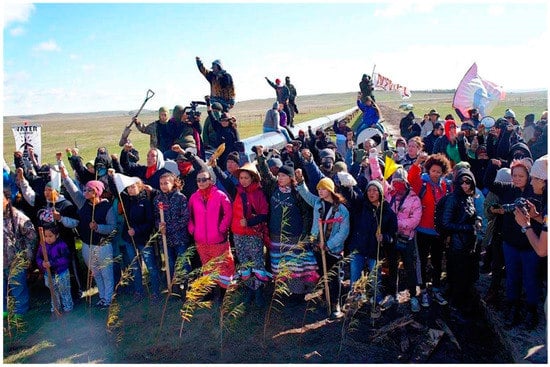
Figure 1.
Women at the Dakota Access Pipeline (Photo by Bethany Yellowtail in Lane 2018).
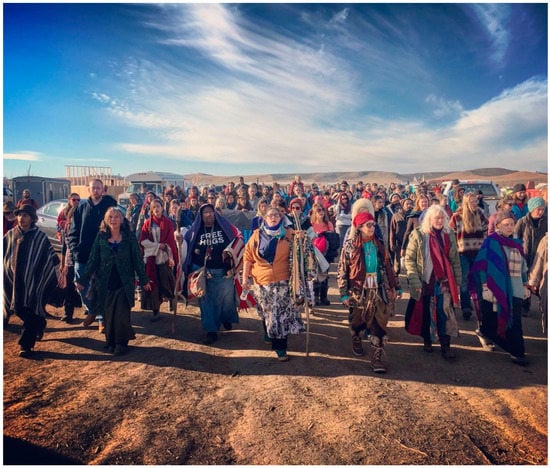
Figure 2.
Women of Standing Rock Marching (Lemere 2016).
In Figure 1, the Indigenous women are standing right in front of an extension of the pipeline, with their fists up in a peaceful sign of opposition. They stand in front of newly planted willow trees, symbols of hope and life. It appears that the willows were planted right at the end of the segment of the pipeline, as an act of defiance, and as a reiteration of the juxtaposition of life and death that has recurrently arisen in the discourse surrounding the matter. Further, the power of trees is invoked as one that can stop the construction of, and ultimately break, the pipeline. In Figure 2, Indigenous women are fiercely marching, physically blocking the path of the Pipeline to assert their rights and protect the sacred site. Several women display traditional indigenous garments and accessories, proudly showing tokens of their identity, which had been repressed for too long. The Indigenous woman at the center of the picture appears to be leading the crowd, her stare looking ahead, defiant. She appears confident that Indigenous women can be leaders, too. The presence of children in both Figure 1 and Figure 2 is a striking reminder of the future generations, and of the future life that will face the consequences of the present human actions.
5.3. Implications
The implications of this work are multi-fold. First of all, the woman-led grassroots social movements at issue highlight a fundamental lack of awareness towards the historical and current struggles of Indigenous Peoples, both in the US and in Canada. This is also embodied in my personal experience as a law student. None of the American law schools I attended had Federal Indian Law as a required course, although this body of law is at the essence of the American legal system and the Tribes’ unique status is even recognized in the US Constitution (art. 1, sct 8). The course offerings are scarce in most law schools as well, and the vast majority of future policymakers, attorneys, and leaders graduate without knowing of the Federal Indian legal Framework. As Nancy Wadsworth highlighted in her work, there is a sheer lack of teaching in Indigenous politics and history in the realm of political science (Wadsworth 2014). It comes as no surprise that leaders are not equipped to understand the position of Indigenous Peoples, and why it is crucial to empower grassroots social movements to bring the informed perspective of Indigenous stakeholders to the table, so to influence the current public policy debate.
The discussion above also calls for a holistic approach where Indigenous Peoples—and Indigenous women—are informed and active participants of the policies that so closely affect them, under UNDRIP and CEDAW (Tomaselli 2017). Modern technologies and social media provide democratic means for these grassroots social movements to be heard and empowered (Johnson 2017). The recent election to Congress of the first-ever Native American women in history, Deb Halaand and Sharice Davids, both supporters of, and supported by grassroots social movements, is a positive sign of a wind of change (Davids 2020; Deisen 2019). There are, therefore, grounds to attribute such an historic milestone and its timing to the powerful actions of social movements like the Women of Standing Rock and Idle No More. The movements highlighted the importance of having the voice of Indigenous women represented in the US Congress. Their legacy is unprecedented. “For the first time, a young girl living at Laguna Pueblo could say, ‘I could grow up to be President.’ That has not been possible because they never saw anybody that looked like them” (Jones 2018).
6. Conclusions
In February 2017, the Trump administration granted the final permit to finish the DAPL, and by June of the same year, it was in full operation (Proctor 2017; BBC News 2017). The legal battle continues, but the legacy that the social movement brought for Indigenous women is unprecedented. LaDonna Brave Bull Allard was one of the leading founders of the Standing Rock movement, and of the first protest encampment in the path of the pipeline, the Sacred Stone Camp. In 2017, she was recognized for her pivotal role at Standing Rock with the Conservation Colorado “Rebel with a Cause” award—followed by many others such as the William Sloane Coffin, Jr. Peacemaker Award (Proctor 2017). “The movement has become the largest intertribal alliance on the American continent in centuries, and possibly ever, with over 200 tribal nations represented” (Friendly 2017).
On the one hand, The Women of Standing Rock and the Idle No More movements highlighted how there are many situations where Indigenous Peoples have significantly reduced capabilities, and opportunities, to live in accordance with their traditional and spiritual values because of resource appropriation, inadequate resource protection, or resource exploitation (Bockstael and Berkes 2017). On the other hand, the movements also highlighted that Indigenous women today, more than ever, can influence public policies that foster and protect their land and their religious identity. Therefore, the WSD and IDM grassroots social movements also proved that the Nussbaum and Basu paradigm—promoting agency and Indigenous women’s capabilities—do produce outcomes, especially when they take the form of social movements. The growing movement by Indigenous women to assert their rights, and to move to self-determination in sustainable environmental and spiritual practices and development, creates a positive discourse that advances Indigenous women’s position in crossing the obstacles onto “institutional places of privilege” (Lane 2018; Bockstael and Berkes 2017). This became evident through the impact that the INM movement had globally, and how it influenced the WSR movement’s development a few years later (Nicolescu 2018). INM and WSR became political movements with such power to generate an “obligation to hear” and involve the tribes in environmental projects that affect them, their territory, and their traditional and spiritual practices (Nicolescu 2018).
The Women of Standing Rock and the Idle No More grassroots social movements played a role in advancing Indigenous women’s political participation and are examples of democratic politics, where Indigenous Peoples and Indigenous women in particular became fundamental leaders to advocate for Indigenous Peoples’ land and religious rights. They opened a “hatch” through Crenshaw’s basement, giving new authority and a new voice to Indigenous Peoples and Indigenous women in North America.
Funding
This research received no external funding.
Conflicts of Interest
The author declares no conflict of interest.
References
- AIRFA. 1996. American Indian Religious Freedom Act (AIRFA), 42 USCA sct. [Google Scholar]
- Atrey, Shreya. 2018. Women’s human rights: From progress to transformation, an intersectional response to Martha Nussbaum. Human Rights Quarterly 40: 859–904. [Google Scholar] [CrossRef]
- Baldez, Lisa. 2012. What impact Would CEDAW have in the US? Paper presented at APSA 2012 Annual Meeting, New Orleans, LA, USA, August 30–September 2. [Google Scholar]
- Barnett, Tracy L. 2019. Esperanza Project, Women of Standing Rock: LaDonna Brave Bull Allard. Available online: https://www.esperanzaproject.com/2019/environment/women-of-standing-rock-ladonna-brave-bull-allard/ (accessed on 9 July 2020).
- Basu, Amrita. 2010. Who Secures Women’s capabilities in Martha Nussbaum’s quest for social justice. Columbia Journal of Gender and Law 19: 201. [Google Scholar]
- BBC News. 2017. Dakota Pipeline: What's behind the controversy? Available online: https://www.bbc.com/news/world-us-canada-37863955 (accessed on 30 April 2020).
- Berger, Peter L., and Thomas Luckmann. 1966. The Social Construction of Reality: A Treatise in the Sociology of Knowledge. Anchor Books. [Google Scholar]
- Blaser, Mario. 2009. Indigenous peoples, civil society, and the environment: The struggle for sustainability. In Decolonizing Indigenous Rights, 2009th ed. Edited by Adolfo De Olivera. New York: Routledge Taylor and Francis Group, p. 190. [Google Scholar]
- Bockstael, Erika, and Fikret Berkes. 2017. Using the capability approach to analyze contemporary environmental governance challenges in coastal Brazil. International Journal of the Commons 11: 799–822. [Google Scholar] [CrossRef]
- Bravebull Allard, LaDonna. 2016. Ladonna Bravebull Allard speaks eloquently on the reasons for the Dakota Access Pipeline protest and the help that her people and all people need to stop the potential pollution of their water. Available online: https://www.youtube.com/watch?v=Z7FVRprI6co&t=8s (accessed on 30 April 2020).
- CEDAW. 1981. Convention on the Elimination of All Forms of Discrimination against Women. New York: United Nations. [Google Scholar]
- Collins, Patricia H., and Valerie Chepp. 2013. Intersectionality, 57–87. In Oxford Handbook of Gender and Politics. Edited by Georgina Waylen, Karen Celis, Johanna Kantola and S. Laurel Weldon. New York: Oxford University Press. [Google Scholar]
- Crenshaw, Kimberlè. 1989. Demarginalizing the intersection of race and sex: A black feminist critique of antidiscrimination doctrine, feminist theory and antiracist politics. The University of Chicago Legal Forum 1989: 139. [Google Scholar]
- Creswell, W. John, and J. David Creswell. 2018. Research Design: Qualitative, Quantitative, and Mixed Methods Approaches. Los Angeles: Sage publications. [Google Scholar]
- CSW. 2019. Commission on the status of women agreed conclusions of 2013, 2016, and 2017. Available online: https://www.unwomen.org/en/csw/outcomes (accessed on 19 July 2020).
- Daiss, Tim. 2016. Oil Pipeline Battle Intensifies: ‘If It Spills It Kills’. New York: Forbes. [Google Scholar]
- Davids, Sharice. 2020. End Citizens United Backs Sharice Davids for Congress. Available online: https://www.shariceforcongress.com/end_citizens_united_backs_sharice_davids_for_congress (accessed on 29 June 2020).
- Deisen, Madeleine. 2019. Politicians Encourage Young People to Become Activists. Available online: https://www.shariceforcongress.com/end_citizens_united_backs_sharice_davids_for_congress (accessed on 12 June 2020).
- Duthu, Bruce Nathan. 2008. American Indians and the Law. New York: Penguin books. [Google Scholar]
- Emenhieser, JeDon A., and Bron Taylor. 2005. Encyclopedia of Religion and Nature. London and New York: Continuum, pp. 701–2. [Google Scholar]
- Frey, B. Bruce. 2018. Constructivist approach. In The SAGE Encyclopedia of Educational Research, Measurement, and Evaluation. New York: Sage Publications. [Google Scholar]
- Friendly, Joe. 2017. Peacemaker award: LaDonna Brave Bull Allard. Available online: https://www.youtube.com/watch?v=AvWIpnjyHEg (accessed on 13 March 2020).
- Goldberg, Carole E., Rebecca Tsosie, Kevin K. Washburn, and Elizabeth Washburn Rodke. 2010. American Indian Law: Native Nations and the Federal System: Cases and Materials. New Providence: LexisNexis. [Google Scholar]
- Governmsent of Canada. 1876. An Act to amend and consolidate the laws respecting Indians, Statutes of Canada 1876, chp. 18. [Google Scholar]
- Government of Canada. 1982. The Constitution Act, 1982, being Schedule B to the Canada Act 1982 (UK), c 11. [Google Scholar]
- Government of Canada. 2020. First Nations Map of Saskatchewan. Available online: https://www.aadncaandc.gc.ca/eng/1100100020616/1100100020653 (accessed on 13 March 2020).
- Henderson, William B. 2018. Indigenous self-government in canada. Available online: https://www.thecanadianencyclopedia.ca/en/article/aboriginal-self-government (accessed on 19 July 2020).
- Johnson, Hayley. 2017. #NoDAPL: Social media, empowerment, and civic participation at standing rock. Library Trends 66: 155–75. [Google Scholar]
- Jones, Rachel. 2018. Deb Haaland: “Why Not Me? Why Not now?”. Available online: https://www.nationalgeographic.com/culture/2018/11/debra-haaland-first-native-american-congresswoman-new-mexico-midterm-election/ (accessed on 30 April 2020).
- Lane, Temryss MacLean. 2018. The frontline of refusal: Indigenous women warriors of standing rock. International Journal of Qualitative Studies in Education 31: 197–214. [Google Scholar] [CrossRef]
- Lemere, Maggie. 2016. The Powerful Voices of Women at Standing Rock. National Geographic. Available online: https://blog.nationalgeographic.org/2016/12/16/the-powerful-voices-of-women-at-standing-rock/ (accessed on 9 July 2020).
- Lyng V. Northwest Indian Cemetery Protective Association. 1988. 485 US 439, referring to Cultural Resources of the Chimney Rock Section, Gasquet-Orleans Road, Six Rivers National Forest (Theodoratus D.J., Chartkoff J.L., Chartkoff K.K.). [Google Scholar]
- Mahboob, Tahiat, Phil Hahn, and CTV News. 2016. Dakota Access Pipeline Explained: What You Need to Know. Available online: https://www.ctvnews.ca/world/dakota-access-pipeline-explained-what-you-need-to-know-1.3143020 (accessed on 19 July 2020).
- Maleta, Yulia. 2018. Australian women’s anti-nuclear leadership: The framing of peace and social change. Journal of International Women’s Studies 19: 70. [Google Scholar]
- McLean, Sheelah, Alex Wilson, and Erica Lee. 2017. The whiteness of redmen: Indigenous mascots, social media and an antiracist intervention. Australasian Journal of Information Systems 21. [Google Scholar] [CrossRef]
- Mengden IV, Walter H. 2017. Indigenous People, Human Rights, and Consultation: The Dakota Access Pipeline, 41 Am. Indian L. Rev. Available online: https://digitalcommons.law.ou.edu/ailr/vol41/iss2/8 (accessed on 9 July 2020).
- Nicolescu, Ionut. 2018. Cases of equality: Idle no more and the protests at standing rock. Canadian Journal of Urban Research 27: 1–13. [Google Scholar]
- Nussbaum, Martha. 2000. Introduction: Feminism and International Development. In Women and Human Development: The Capabilities Approach. The Seeley Lectures. Cambridge: Cambridge University Press, pp. 1–33. [Google Scholar] [CrossRef]
- Nussbaum, Martha. 2016. Women’s progress and women’s human rights. Human Rights Quarterly 38: 519. [Google Scholar] [CrossRef]
- Parke-Sutherland, T. 2018. Ecofeminist activism and the greening of native America. American Studies in Scandinavia 50: 123–49. [Google Scholar] [CrossRef]
- Pauls, Karen. 2016. ‘We Must Kill the Black Snake’: Prophecy and Prayer Motivate Standing Rock Movement. Toronto: CBC News. [Google Scholar]
- Proctor, Cathy. 2017. ‘Water is life’: Activist Recounts Dakota Access Pipeline Battle. Denver Business Journal. Available online: https://www.bizjournals.com/denver/news/2017/05/30/water-is-life-activist-recounts-dakota-access.html (accessed on 22 July 2020).
- Rosenblum, Darren. 2011. Unsex CEDAW, or what’s wrong with women’s right. Columbia Journal of Gender and Law 20: 98. [Google Scholar]
- Standing Rock Sioux Tribe v. US Army Corps of Engineers. 2017. 255 F. Supp. 3d 101 (D.D.C. 2017). [Google Scholar]
- Statistics Canada. 2017. Aboriginal peoples in Canada: Key results from the 2016 Census. Available online: https://www150.statcan.gc.ca/n1/daily-quotidien/171025/dq171025a-eng.htm (accessed on 19 July 2020).
- Taiaiake, Alfr. 2009. Peace, Power, Righteousness: An Indigenous Manifesto. Oxford: Oxford University Press. [Google Scholar]
- The Globe and Mail. 2018. The spiritual side of Idle No More. Available online: https://www.theglobeandmail.com/opinion/the-spiritual-side-of-idle-no-more/article8765756/ (accessed on 19 July 2020).
- Tomaselli, Alexandra. 2017. The right to political participation of Indigenous peoples: A holistic approach. International Journal on Minority and Group Rights 24: 390. [Google Scholar] [CrossRef]
- Tormos, F. 2017. Intersectional solidarity. Politics, Groups, and Identities 5: 707–20. [Google Scholar] [CrossRef]
- UN General Assembly. 2007. The United Nations Declaration on the Rights of Indigenous Peoples. New York: United Nations. [Google Scholar]
- UN Women. 2018. “Indigenous Women: Key Actors in Achieving the 2030 Agenda” (Implementing SDG 5). Available online: https://www.un.org/development/desa/indigenouspeoples/wp-content/uploads/sites/19/2018/03/CSW62-CN-March-15.pdf (accessed on 19 July 2020).
- US Census Bureau. 2017. American Indian and Alaska Native Heritage Month: November 2017. Available online: https://www.census.gov/newsroom/facts-for-features/2017/aian-month.html (accessed on 29 June 2020).
- US Constitution. 1787. Art. 1, §8, cl. 3. [Google Scholar]
- US Government. 1868. Treaty with the Sioux-Brule, Oglala, Miniconjou, Yanktonai, Hunkpapa, Blackfeet, Cuthead, Two Kettle, San Arcs, and Santee-and Arapaho; General Records of the United States Government.
- US Supreme Court. 1831. Cherokee Nation v. Georgia, 30 US 1, 8 L. Ed. 25. [Google Scholar]
- Wadsworth, Nancy D. 2014. Unsettling lessons: Teaching Indigenous politics and settler colonialism in political science. PS: Political Science & Politics 47: 692–97. [Google Scholar]
- Yan, Holly. 2016. Dakota access pipeline: What’s at stake? CNN. October 28. Available online: https://edition.cnn.com/2016/09/07/us/dakota-access-pipeline-visual-guide/index.html (accessed on 19 July 2020).
- Yanow, Dvora, and Peregrine Schwartz-Shea, eds. 2006. Interpretation and Method: Empirical Research Methods and the Interpretative Turn. New York: Routledge. [Google Scholar]
- Yanow, Dvora, and Peregrine Schwartz-Shea. 2012. Interpretative Research Design: Concepts and Processes. New York: Routledge. [Google Scholar]
| 1 | To learn more about interpretative methods, see (Yanow and Schwartz-Shea 2006, 2012). |
| 2 | To learn more about constructivism, see (Frey 2018). |
© 2020 by the author. Licensee MDPI, Basel, Switzerland. This article is an open access article distributed under the terms and conditions of the Creative Commons Attribution (CC BY) license (http://creativecommons.org/licenses/by/4.0/).