


Abstract
GPT (Generative Pre-trained Transformer) represents advanced language models that have significantly reshaped the academic writing landscape. These sophisticated language models offer invaluable support throughout all phases of research work, facilitating idea generation, enhancing drafting processes, and overcoming challenges like writer’s block. Their capabilities extend beyond conventional applications, contributing to critical analysis, data augmentation, and research design, thereby elevating the efficiency and quality of scholarly endeavors. Strategically narrowing its focus, this review explores alternative dimensions of GPT and LLM applications, specifically data augmentation and the generation of synthetic data for research. Employing a meticulous examination of 412 scholarly works, it distills a selection of 77 contributions addressing three critical research questions: (1) GPT on Generating Research data, (2) GPT on Data Analysis, and (3) GPT on Research Design. The systematic literature review adeptly highlights the central focus on data augmentation, encapsulating 48 pertinent scholarly contributions, and extends to the proactive role of GPT in critical analysis of research data and shaping research design. Pioneering a comprehensive classification framework for “GPT’s use on Research Data”, the study classifies existing literature into six categories and 14 sub-categories, providing profound insights into the multifaceted applications of GPT in research data. This study meticulously compares 54 pieces of literature, evaluating research domains, methodologies, and advantages and disadvantages, providing scholars with profound insights crucial for the seamless integration of GPT across diverse phases of their scholarly pursuits.
1. Introduction
The advent of advanced language models, particularly those exemplified by GPT (Generative Pre-trained Transformer) and LLMs (Large Language Models), such as GPT-3, has profoundly influenced the landscape of academic writing. These technologies have demonstrated considerable utility in the realm of scholarly endeavors, providing valuable support in idea generation, drafting processes, and surmounting challenges associated with writer’s block [1,2,3]. However, a comprehensive understanding of their implications in the academic context necessitates an acknowledgment of the nuanced interplay between their benefits and limitations, as evidenced by scholarly investigations [4,5]. The scholarly discourse on GPT and LLMs reveals a dichotomy wherein their application in academic writing is accompanied by notable advantages and inherent challenges [1,2,3]. Noteworthy studies delve into the intricate dynamics of human–machine interaction, emphasizing the imperative of judiciously integrating AI tools into the fabric of writing practices [4]. Furthermore, recent contributions extend the conversation to encompass copywriting, elucidating the multifaceted impact of AI on diverse professional roles and creative processes [5]. Thus, while these technologies offer promising prospects for enhancing research writing, their conscientious and responsible utilization becomes paramount.
The primary challenges identified in recent scholarship pertaining to the utilization of GPT and LLMs in research writing converge on concerns related to accuracy, potential biases, and ethical considerations [6]. Addressing these challenges requires a concerted effort to establish ethical guidelines and norms, ensuring the judicious use of LLMs in research endeavors [6]. The academic discourse underscores the significance of upholding scientific rigor and transparency, particularly in light of the potential biases embedded in LLM outputs [3,4,5]. Papers in [7,8,9] collectively suggest that while LLMs offer innovative tools for research writing, their use must be accompanied by careful consideration of ethical standards, methodological rigor, and the mitigation of biases. As highlighted in [7,8,9], one of the darning issues of using GPT or LLM-based technology in authoring academic publications involves the use of AI-based paraphrasing to hide potential plagiarism in scientific publications.
Notwithstanding the concerns associated with the authoring aspect of research, the review at hand strategically narrows its focus to explore alternative dimensions of GPT and LLM applications in scholarly pursuits. Specifically, the examination focuses on data augmentation, where GPT and LLMs play a pivotal role in enhancing research data, generating features, and synthesizing data [10,11,12]. As shown in Figure 1, with GPT’s advanced language understanding capabilities, features can be extracted from plain text information. It should be noted that previously, feature extraction from plain texts involved various natural language processing techniques like entity recognition, sentiment analysis, classification, and others, as shown in [13,14,15,16,17,18]. With the introduction of GPT and associated technologies, a simple prompt can extract various features from plain text (Figure 1). Moreover, as depicted in Figure 1. Semantically similar content could be added by GPT being part of the data augmentation process, improving the diversity and robustness of the data. Furthermore, rows of data could be synthetically generated by GPT, facilitating the training of the machine learning process during times of data scarcity or confidentiality (shown in Figure 1).
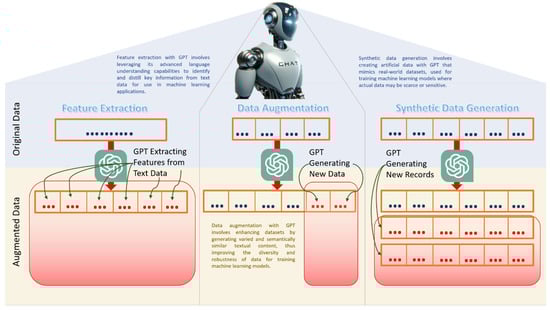
Figure 1.
Conceptual diagram of how GPT performs feature extraction, data augmentation, and synthetic data generation.
In the recent literature landscape, various reviews have emerged concerning the adoption of GPT in research [19,20,21]. However, a critical research gap persists, as none of these reviews comprehensively explores GPT’s substantial capacity and capability in the realms of generating, processing, and analyzing research data. To address this significant void, this literature review meticulously scrutinizes 412 scholarly works, employing rigorous exclusion criteria to distill a curated selection of 77 research contributions. These selected studies specifically address three pivotal research questions, delineated as follows:
- RQ1: How can GPT and associated technology assist in generating and processing Research Data
- RQ2: How can GPT and associated technology assist in analyzing Research Data
- RQ3: How can GPT and associated technology assist in Research Design and problem solving
In Figure 2, the systematic literature review adeptly highlights the central focus on data augmentation with GPT, encapsulating 45 highly pertinent scholarly contributions. Beyond this primary focus, the study delves into the proactive role of GPT in facilitating critical analysis of research data [22,23,24,25] and shaping research design [26,27,28]. Significantly advancing the scholarly discourse, this study pioneers the development of a comprehensive classification framework for “GPT’s use of research data”, marking a seminal contribution. By critically scrutinizing existing research works on data augmentation, the review uniquely establishes a classification system encompassing six overarching categories and 14 sub-categories, providing a systematic and insightful perspective on the multifaceted applications of GPT in research data. Furthermore, the judicious placement of all 45 seminal works within these meticulously defined sub-categories serves as a sagacious validation of the intellectual rigor and innovation inherent in this classification framework, thereby substantiating its rationale and scholarly significance. Ultimately, the meticulous comparative analysis of 54 extant literary works, rigorously evaluating research domains, methodological approaches, and attendant advantages and disadvantages, provides profound insights to scientists and researchers contemplating the seamless integration of GPT across diverse phases of their scholarly endeavors.
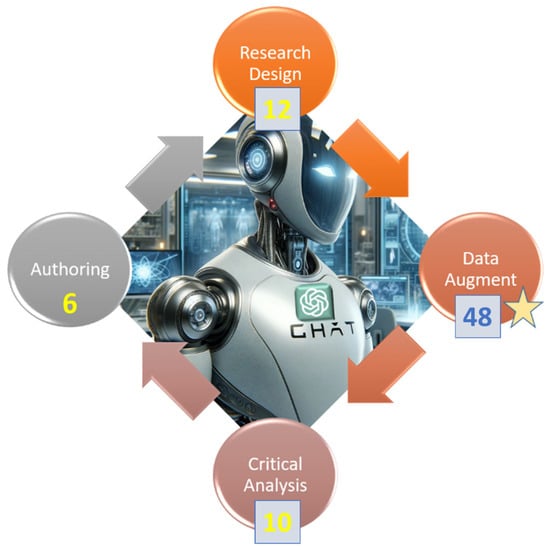
Figure 2.
Use GPT and associated LLM in all phases of research. 48 scholarly works on data augmentation (Starred denoting the main focus of this review), 12 existing publications on critical analysis (i.e., research data analysis), and 10 papers on research design.
2. Research Methods
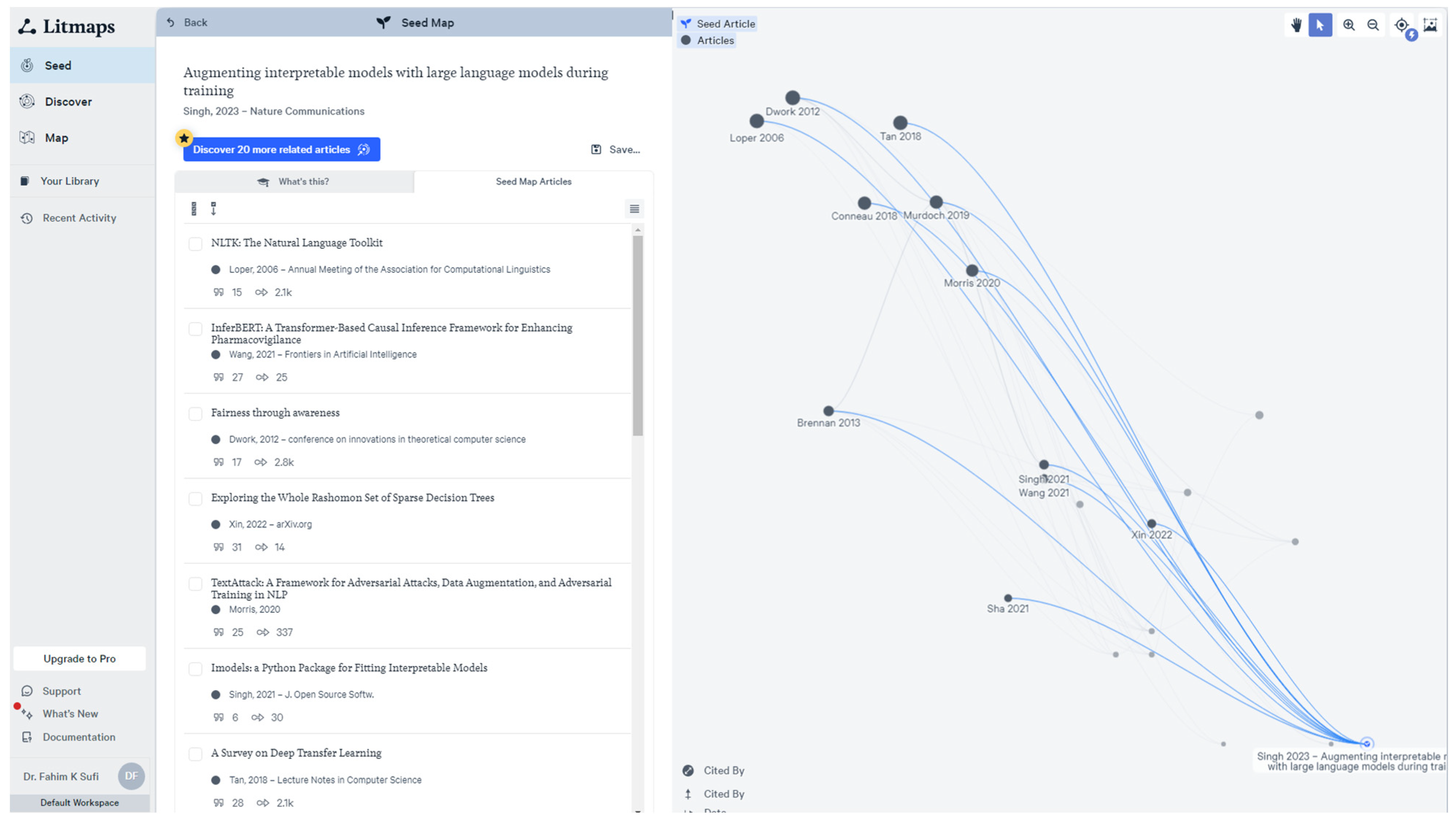
This systematic literature review rigorously investigates the application of GPT, LLM, and related technologies across various research phases following the PRISMA method, an acronym for Preferred Reporting Items for Systematic Reviews and Meta-Analyses. PRISMA represents a meticulously structured approach for conducting and reporting systematic literature reviews and meta-analyses within the realm of academic research. The PRISMA method encompasses key components such as the identification, screening, eligibility assessment, and inclusion of pertinent studies, as well as the extraction and synthesis of data from the selected literature. This systematic approach is underpinned by a commitment to reducing bias and enhancing the reproducibility of the review process. Employing a meticulously devised strategy, as depicted in Figure 3, we formulated a comprehensive set of search keywords. These keywords were then utilized across multiple databases, including IEEE Xplore, Scopus, ACM Library, Web of Science, and PubMed, leading to the initial identification using their supported advanced queries. As seen from Figure A1, Figure A2, Figure A3, Figure A4 and Figure A5 in Appendix A, the actual implementation of advanced queries varies from platform to platform. However, all these advanced queries implemented the conceptual query design represented in Figure 3. Additionally, we explored other sources like Litmaps [29], yielding nine supplementary resources. Innovative visualization tools like Litmaps showed related research in our domain of interest, thereby highlighting papers that might have been missed from mainstream databases. Figure A6 of Appendix A shows how Litmaps identified 20 possible citations that might be within the domain of interest. After identification of possible records from IEEE Xplore, Scopus, ACM Library, Web of Science, and PubMed, duplicated records were identified and removed. From the records without duplicates, the screening process was performed in two stages. In the first stage, screening was performed by careful inspection of the titles and abstracts. If the title and abstract of a record contained the keywords but focused on a completely different area of research, then that record was excluded. For example, the records shown in Figure A1 (i.e., GPT as virtual assistant in medical surgery), Figure A2 (i.e., comparison of ChatGPT, GPT, and DALL-E2), and Figure A4 (i.e., research in nanomaterials and nanotechnology) of Appendix A were excluded because these studies did not focus on “GPT in Research”. In stage 2 of screening, full-text articles were downloaded, inspected, and critically reviewed for eligibility. From reading the full text, if the article had an insignificant focus on the research questions set out in RQ1, RQ2, and RQ2, the article was excluded. Finally, 77 articles relevant to the research questions were included in this study.
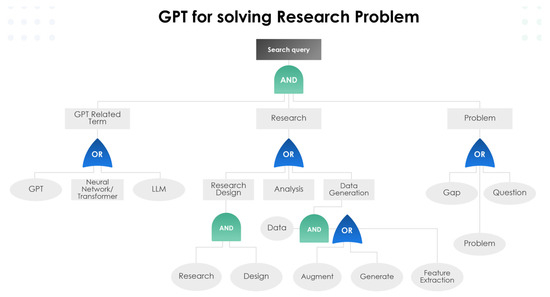
Figure 3.
Search keyword used for obtaining relevant existing academic works on “GPT, LLM, and associated technologies in different phases of research”.
It should be noted that the extensive set of criteria represented in Table 1 is a modified version of an earlier work on systematic literature review [30]. Figure 4 presents a schematic diagram elucidating this systematic review process. Our analysis reveals that 48 of these papers directly address GPT/LLM applications in research data phases, while another 22 contribute insights on their utilization in research analysis and design.

Table 1.
Inclusion and Exclusion criteria for both peer-reviewed and grey literature.
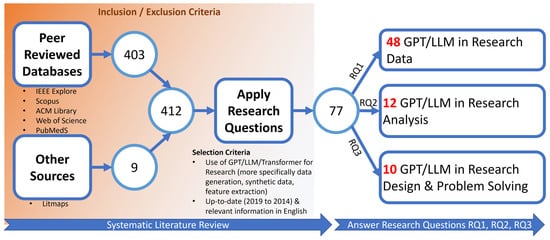
Figure 4.
Schematic Diagram of the systematic literature review (i.e., use of GPT, LLM, and associated technologies on different phases of research).
Significantly, a subset of 6+ papers [3,4,5,6,7,8,9] underscore major concerns associated with GPT-based technologies in research authorship, citing issues such as hallucinations, biases, ethical dilemmas, and the potential for AI-assisted plagiarism concealment. Consequently, this review conscientiously excludes GPT-based research authoring from its primary focus areas.
3. Existing Research on GPT’s Use in Research Data
As shown in Figure 2 and Figure 4, the major focus of this review study is on the use of GPT in research data. As a result of the systematic literature review process, 48 existing pieces of literature were found to be highly relevant to “GPT on Research Data”. This section would summarize these papers.
GPT and other large language models (LLMs) provide versatile tools for various data-related tasks. They excel at generating coherent, contextually relevant textual data, making them ideal for content creation across diverse fields. LLMs can synthesize realistic synthetic data, which is especially valuable in domains with privacy concerns or data scarcity. In data augmentation, these models enhance existing datasets by adding new, synthesized samples, thereby improving the robustness of machine learning models. Furthermore, LLMs are capable of extracting and generating features from complex datasets, aiding in more efficient and insightful data analysis. The adaptability of these models to different data types and their ability to tailor their output make them powerful tools in data science and AI development.
The study in [31] presents the GReaT (Generation of Realistic Tabular data) approach, which uses transformer-based large language models (LLMs) for the generation of synthetic tabular data. This method addresses challenges in tabular data generation by leveraging the generative capabilities of LLMs. [32] discusses a method that combines GPT technology with blockchain technology for secure and decentralized data generation. This approach can be beneficial in scenarios where data privacy and security are paramount. [26] explores the use of GPT for augmenting existing datasets. It demonstrates how GPT can be used to expand datasets by generating new, realistic samples, which can be particularly useful in fields where data is scarce or expensive to obtain. A study in [33] presents a novel application of GPT for feature extraction from unstructured data. It showcases how GPT models can be fine-tuned to identify and extract relevant features from complex datasets, enhancing data analysis and machine learning tasks. Ref. [34] details an early version of a GPT-based system for data anonymization, highlighting its potential to protect sensitive information in datasets while retaining its utility for analysis. Research in [35] focuses on using GPT for generating synthetic datasets for training machine learning models. This is especially useful in domains where real-world data is limited or sensitive. The work in [36] investigates the potential of Foundation Models (FMs), like GPT-3, in handling classical data tasks such as data cleaning and integration. It explores the applicability of these models to various data tasks, demonstrating that large FMs can adapt to these tasks with minimal or no task-specific fine-tuning, achieving state-of-the-art performance in certain cases. The study in [37] discusses advanced techniques for text data augmentation, focusing on improving the diversity and quality of the generated text data. It emphasizes methods that can generate nuanced and contextually appropriate data, enhancing the performance of machine learning models, particularly in natural language processing tasks. Ref. [38] explores the use of GPT-based models for feature extraction and generation, showcasing their effectiveness in identifying and creating relevant features from complex datasets, which is critical for enhancing data analysis and predictive modeling.
The work in [39] introduces LAMBADA, a novel method for text data augmentation. It leverages language models for synthesizing labeled data to improve text classification tasks, particularly in scenarios with limited labeled data. Ref. [40] focuses on the augmentation of medical datasets using transformer-based text generation models. It particularly addresses the challenge of data scarcity in the medical domain by generating synthetic clinical notes, which are then evaluated for their utility in downstream NLP tasks like unplanned readmission prediction and phenotype classification. A study in [41] presents a method called PREDATOR for text data augmentation, which improves the quality of textual datasets through the synthesis of new, high-quality text samples. This method is particularly useful for text classification tasks and demonstrates a significant improvement in model performance. Work in [42] presents a novel approach for enhancing hate speech detection on social networks. It combines DeBERTa models with back-translation and GPT-3 augmentation techniques during both training and testing. This method significantly improves hate speech detection across various datasets and metrics, demonstrating robust and accurate results. The work in [43] presents DHQDA, a novel method for data augmentation in Named Entity Recognition (NER). It uses GPT and a small-scale neural network for prompt-based data generation, producing diverse and high-quality augmented data. This approach enhances NER performance across different languages and datasets, particularly in low-resource scenarios. The study in [44] introduces the I-WAS method, a data-augmentation approach using GPT-2 for simile detection. It focuses on generating diverse simile sentences through iterative word replacement and sentence completion, significantly enhancing simile detection capabilities in natural language processing. Ref. [45] explores generation-based data augmentation for offensive language detection, focusing on its effectiveness and potential bias introduction. It critically analyzes the feasibility and impact of generative data augmentation in various setups, particularly addressing the balance between model performance improvement and the risk of bias amplification. Ref. [46] explores the use of GPT-2 in generating synthetic biological signals, specifically EEG and EMG, to improve classification in biomedical applications. It demonstrates that models trained on synthetic data generated by GPT-2 can achieve high accuracy in classifying real biological signals, thus addressing data scarcity issues in biomedical research. The work in the [47] document describes a study on fine-grained claim detection in financial documents. The research team from Chaoyang University of Technology uses MacBERT and RoBERTa with BiLSTM and AWD-LSTM classifiers, coupled with data resampling and GPT-2 augmentation, to address data imbalance. They demonstrate that data augmentation significantly improves prediction accuracy in financial text analysis, particularly in the Chinese Analyst’s Report section. Ref. [48] discusses the role of ChatGPT in data science, emphasizing its potential in automating workflows, data cleaning, preprocessing, model training, and result interpretation. It highlights the advantages of ChatGPT’s architecture, its ability to generate synthetic data, and addresses limitations and concerns such as bias and plagiarism.
Research work in [49] details an approach for automating the extraction and classification of technical requirements from complex systems’ specifications. It utilizes data augmentation methods, particularly GPT-J, to generate a diverse dataset, thereby enhancing the training of AI models for better classification accuracy and efficiency in requirements engineering. Ref. [50] investigates data augmentation for hate speech classification using a single class-conditioned GPT-2 language model. It focuses on the multi-class classification of hate, abuse, and normal speech and examines how the quality and quantity of generated data impact classifier performance. The study demonstrates significant improvements in macro-averaged F1 scores on hate speech corpora using the augmented data. The study in [51] explores the use of GPT models for generating synthetic data to enhance machine learning applications. It emphasizes the creation of diverse and representative synthetic data to improve machine learning model robustness. The paper in [52] focuses on augmenting existing datasets using GPT models. The method involves generating additional data that complements the original dataset, thereby enhancing the richness and diversity of data available for machine learning training.
The research in [12] examines the generation of synthetic educational data using GPT models, specifically for physics education. It involves creating responses to physics concept tests, aiming to produce diverse and realistic student-like responses for educational research and assessment design. The reference in [53] discusses the revolutionary role of artificial intelligence (AI), particularly large language models (LLMs) like GPT-4, in generating original scientific research, including hypothesis formulation, experimental design, data generation, and manuscript preparation. The study showcases GPT-4’s ability to create a novel pharmaceutics manuscript on 3D printed tablets using pharmaceutical 3D printing and selective laser sintering technologies. GPT-4 managed to generate a research hypothesis, experimental protocol, photo-realistic images of 3D printed tablets, believable analytical data, and a publication-ready manuscript in less than an hour. Ref. [54] focuses on the application of GPT models to augment existing datasets in the field of healthcare. It presents a method for generating synthetic clinical notes in Electronic Health Records (EHRs) to predict patient outcomes, addressing challenges in healthcare data such as privacy concerns and data scarcity. The paper in [11] deals with textual data augmentation in the context of patient outcome prediction. The study introduces a novel method for generating artificial clinical notes in EHRs using GPT-2, aimed at improving patient outcome prediction, especially the 30-day readmission rate. It employs a teacher–student framework for noise control in the generated data. The study in [55] focuses on leveraging large language models (LLMs) like GPT-3 for generating synthetic data to address data scarcity in biomedical research. It discusses various strategies and applications of LLMs in synthesizing realistic and diverse datasets, highlighting their potential for enhancing research and decision-making in the biomedical field. Ref. [56] discusses the use of GPT models for enhancing data quality in the context of social science research. It focuses on generating synthetic responses to survey questionnaires, aiming to address issues of data scarcity and respondent bias.
The seminal work in [57] explores the use of GPT-3 for creating synthetic data for conversational AI applications. It evaluates the effectiveness of synthetic data in training classifiers by comparing it with real user data and analyzing semantic similarities and differences. The paper in [58] presents a system developed for SemEval-2023 Task 3, focusing on detecting genres and persuasion techniques in multilingual texts. The system combines machine translation and text generation for data augmentation. Specifically, genre detection is enhanced using synthetic texts created with GPT-3, while persuasion technique detection relies on text translation augmentation using DeepL. The approach demonstrates effectiveness by achieving top-ten rankings across all languages in genre detection, and notable ranks in persuasion technique detection. The paper outlines the system architecture utilizing DeepL and GPT-3 for data augmentation, experimental setup, and results, highlighting the strengths and limitations of the methods used. Ref. [59] explores using GPT-3 for generating synthetic responses in psychological surveys. It focuses on enhancing the diversity of responses to understand a broader range of human behaviors and emotions. The study in [60] investigates the use of GPT-3 in augmenting data for climate change research. It generates synthetic data, representing various climate scenarios, to aid in predictive modeling and analysis.
The research in [61] leverages GPT-3.5 for augmenting Dutch multi-label datasets in vaccine hesitancy monitoring. The paper discusses how synthetic tweets are generated and used to improve classification performance, especially for underrepresented classes. Romero-Sandoval et al. [62] investigate using GPT-3 for text simplification in Spanish financial texts, demonstrating effective data augmentation to improve classifier performance. Rebboud et al. [63] explore GPT-3’s ability to generate synthetic data for event relation classification, enhancing system accuracy with prompt-based, manually validated synthetic sentences. Quteineh et al. [64] present a method combining GPT-2 with Monte Carlo Tree Search for textual data augmentation, significantly boosting classifier performance in active learning with small datasets. Suhaeni et al. [65] explore using GPT-3 for generating synthetic reviews to address class imbalances in sentiment analysis, specifically for Coursera course reviews. It shows how synthetic data can enhance the balance and quality of training datasets, leading to improved sentiment classification model performance. Singh et al. [66] introduce a method to augment interpretable models using large language models (LLMs). The approach, focusing on transparency and efficiency, shows that LLMs can significantly enhance the performance of linear models and decision trees in text classification tasks. Sawai et al. discuss using GPT-2 for sentence augmentation in neural machine translation. The approach aims to improve translation accuracy and robustness, especially for languages with different linguistic structures. The method demonstrated significant improvements in translation quality across various language pairs.
The paper in [10] focuses on using GPT-2 to generate complement sentences for aspect term extraction (ATE) in sentiment analysis. The study introduces a multi-step training procedure that optimizes complement sentences to augment ATE datasets, addressing the challenge of data scarcity. This method significantly improves the performance of ATE models. A study in [67] explores data augmentation for text classification using transformer models like BERT and GPT-2. It presents four variants of augmentation, including masking words with BERT and sentence expansion with GPT-2, demonstrating their effectiveness in improving the performance of text classification models. Another recent work by Veyseh et al. focuses on enhancing open-domain event detection using GPT-2-generated synthetic data [68]. The study introduces a novel teacher–student architecture to address the noise in synthetic data and improve model performance for event detection. The experiments demonstrate significant improvements in accuracy, showcasing the effectiveness of this approach. Waisberg et al. discuss the potential of ChatGPT (GPT-3) in medicine [69]. The study highlights ChatGPT’s ability to perform medical tasks like writing discharge summaries, generating images from descriptions, and triaging conditions [69]. It emphasizes the model’s capacity for democratizing AI in medicine, allowing clinicians to develop AI techniques. The paper also addresses ethical concerns and the need for compliance with healthcare regulations [69].
The paper “Investigating Paraphrasing-Based Data Augmentation for Task-Oriented Dialogue Systems” by Liane Vogel and Lucie Flek explores data augmentation in task-oriented dialogue systems using paraphrasing techniques with GPT-2 and Conditional Variational Autoencoder (CVAE) models [70]. The study demonstrates how these models can effectively generate paraphrased template phrases, significantly reducing the need for manually annotated training data while maintaining or even improving the performance of a natural language understanding (NLU) system [70]. Shuohua Zhou and Yanping Zhang focus on improving medical question-answering systems [71]. It employs a combination of BERT, GPT-2, and T5-Small models, leveraging GPT-2 for question augmentation and T5-Small for topic extraction [71]. The approach demonstrates enhanced prediction accuracy, showcasing the model’s potential in medical question-answering and generation tasks.
4. A New Classification Scheme: GPT on Research Data
The previous section summarized 48 existing research works on the use of GPT in generating research data. This section demonstrates the extensive classification framework developed to group these 48 existing literary works on the use of GPT for data augmentation, natural language processing-based feature extraction, machine learning model-based data cleaning, transformation, performance improvement, etc. As seen in Figure 5, research data enhancement using GPT could be grouped into six categories. Each of these six categories hosts two or more sub-categories. In this section, all these categories and sub-categories will be described. Most importantly, all 48 existing works of literature would be classified into one or more of these categories (as shown in Table 2, Table 3, Table 4, Table 5, Table 6 and Table 7).
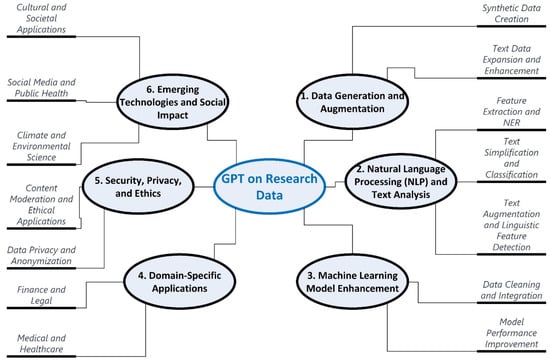
Figure 5.
A comprehensive classification framework for “GPT’s use of research data”.
4.1. Data Generation and Augmentation
- Synthetic Data Creation: Focuses on using GPT models to generate artificial data that mimics real-world data, useful in scenarios where data privacy is crucial or actual data is limited. Literature in [31,35,51,52,56,57] could be attributed to this sub-category.
- Text Data Expansion and Enhancement: This involves leveraging GPT to create new textual content and enhance existing datasets, thereby improving machine learning models’ performance and addressing data scarcity [12,26,37,39,41,48,53,54,65].
4.2. Natural Language Processing (NLP) and Text Analysis
- Feature Extraction and NER: This encompasses the use of GPT for identifying salient features within unstructured data and enhancing named entity recognition (NER) capabilities [33,38,43]. As shown in Figure 6, prior to the era of GPT, various NLP techniques like entity recognition, sentiment analysis, and category classifications were used for extracting features from textual data like social media posts, as shown in [13,14,15,16,17,18]. Then these extracted features were used by machine learning techniques for obtaining insights and analytics. However, with the advent of GPT, features could be extracted with a simple GPT prompt like “Categorize these data into the following categories (1) animals, (2) plants, and (3) equipment,” as shown in Figure 5.
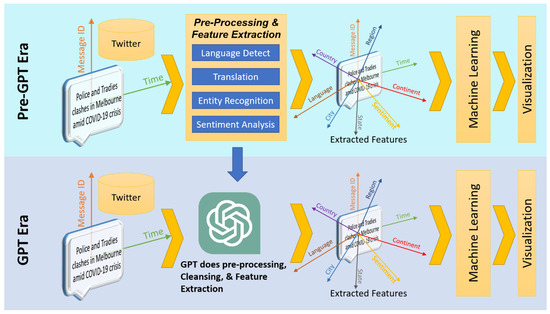 Figure 6. A comparative schematic of feature extraction process with NLP and GPT.
 - Text Simplification and Classification: Covers the application of GPT in simplifying complex texts for better understanding and classification, particularly in specialized fields like finance [10,62,64,67].
- Text Augmentation and Linguistic Feature Detection: This refers to the use of GPT for generating text that aids in the detection and analysis of specific linguistic features, such as similes or event relations. Works in [44,63] (Event Relation Classification) [53] are categorized within this bucket.
Table 2.
Categorizing existing literature into the “Data Generation and Augmentation” category.
Table 2.
Categorizing existing literature into the “Data Generation and Augmentation” category.
| Reference | Area of Research | Method Used | Advantages | Disadvantages |
|---|---|---|---|---|
| [31] | Realistic Tabular Data Generation | Textual Encoding and LLMs for Tabular Data | Versatile, less preprocessing, authentic synthesis | May require large models for complexity |
| [26] | Data Augmentation | GPT for expanding datasets | Generates new, realistic samples | May not capture specific domain nuances |
| [35] | Synthetic Data Generation for ML | GPT for synthetic dataset creation | Useful in limited/sensitive data scenarios | Potential biases in generated data |
| [37] | Text Data Augmentation | Advanced text augmentation techniques | Improves data diversity and quality | May require significant computational resources |
| [39] | Text Data Augmentation | LAMBADA for text data synthesis | Effective for improving text classification with limited data | May not generalize across all data types |
| [41] | Text Data Augmentation | PREDATOR for text synthesis | Enhances text dataset quality, useful for classification tasks | Specific focus on text data, may not generalize to other data types |
| [48] | Data Science Automation | ChatGPT for automating data science workflows | Streamlines data science tasks, generates synthetic data | Bias, plagiarism concerns |
| [12] | Educational Research, Physics Education | Generating synthetic responses for physics | Produces realistic student-like responses | Limited to specific educational contexts |
| [52] | Data Augmentation, Machine Learning | Augmenting datasets with GPT-generated data | Increases dataset richness; aids model training | Risk of introducing biases in synthetic data |
| [51] | Machine Learning, Synthetic Data Generation | Generating diverse synthetic data using GPT models | Enhances model robustness; improves data diversity | May not capture nuanced real-world scenarios |
| [54] | Healthcare, EHR Data Augmentation | Generating synthetic clinical notes using GPT models | Addresses healthcare data scarcity and privacy | Specific to healthcare data, may lack versatility |
| [56] | Social Science Research | Generating synthetic survey responses with GPT models | Addresses data scarcity and respondent bias | May not fully capture human variability |
| [58] | Multilingual Text Analysis | Genre and persuasion techniques detection using GPT-3 and DeepL | Effective in multilingual context; top rankings achieved | Limited by translation accuracy and text generation capabilities |
| [57] | Conversational AI | Synthetic data creation for AI using GPT-3 | Useful for AI training; analyzes data similarities | Less effective than real user data |
| [65] | Sentiment Analysis with Class Imbalance | GPT-3 for generating synthetic reviews | Balances training data, improves model accuracy | |
| [53] | Text Augmentation and Linguistic Feature Detection generating comprehensive research documents | GPT-4 for scientific research generation | Accelerates medical research, demonstrates multidisciplinary AI capabilities | Inaccuracies in literature, experimental data challenges |
Table 3.
Categorizing existing literature into the “NLP and Text Analysis” category.
Table 3.
Categorizing existing literature into the “NLP and Text Analysis” category.
| Reference | Area of Research | Method Used | Advantages | Disadvantages |
|---|---|---|---|---|
| [33] | Feature Extraction from Unstructured Data | GPT for feature identification | Efficient in complex datasets | Requires fine-tuning for specific tasks |
| [38] | Feature Generation and Extraction | GPT-based models for feature extraction | Effective in complex datasets | Requires model tuning for specific tasks |
| [43] | Named Entity Recognition (NER) | DHQDA using GPT for NER data augmentation | Enhances NER performance, effective in multiple languages | May require complex model training and fine-tuning |
| [44] | Simile Detection in NLP | I-WAS with GPT-2 for simile sentence generation | Enhances simile detection with diverse sentences | May require iterative adjustments and fine-tuning |
| [62] | Text Simplification in Spanish Financial Texts | GPT-3 for data augmentation | Effective augmentation for small datasets, improved classifier performance | Not specified |
| [63] | Event Relation Classification | Prompt-based GPT-3 data generation, manual validation | Realistic and relevant synthetic sentence generation, improved system performance | Manual validation process required |
| [64] | Text Classification with Active Learning on Small Datasets | GPT-2 with MCTS and entropy optimization | Significant performance increase in classifiers, efficient for small datasets | Potential for generation of less relevant or noisy data in outputs |
| [10] | Aspect Term Extraction in Sentiment Analysis | GPT-2 for generating complement sentences | Improves ATE model performance, addresses data scarcity | Complexity in optimizing sentence generation |
| [67] | Text Classification | Data augmentation with transformers | Enhances text classification model performance | Depends on the transformer model’s limitations |
| [53] | Text Augmentation and Linguistic Feature Detection by generating comprehensive research documents | GPT-4 for scientific research generation | Accelerates medical research, demonstrates multidisciplinary AI capabilities | Inaccuracies in literature, experimental data challenges |
4.3. Machine Learning Model Enhancement
- Data Cleaning and Integration: Demonstrates how GPT could be used for data cleansing, transformation, and integration activities, as demonstrated in [36].
- Model Performance Improvement: Details how GPT and other language models are integrated during the model fitting process to enhance the performance of machine learning models, particularly those requiring interpretability [53,66,68,72].
Table 4.
Categorizing existing literature into the “Machine Learning Model Enhancement” category.
Table 4.
Categorizing existing literature into the “Machine Learning Model Enhancement” category.
| Reference | Area of Research | Method Used | Advantages | Disadvantages |
|---|---|---|---|---|
| [36] | Data Cleaning and Integration | Foundation Models (e.g., GPT-3) | Adaptable to various data tasks with minimal fine-tuning, state-of-the-art performance in some cases | May require task-specific adaptations, complexity in handling domain-specific data |
| [66] | Enhancing Interpretable Models with LLMs | Aug-imodels using LLMs during model fitting | Improves interpretable models while maintaining transparency and efficiency | Requires careful integration of LLMs |
| [72] | Neural Machine Translation Enhancement | GPT-2 for sentence data generation | Improves translation accuracy and robustness | Time-intensive sentence generation process |
| [68] | Open-Domain Event Detection | GPT-2 generated synthetic data, teacher–student architecture | Significant accuracy improvements in event detection | Complex architecture and noise management |
| [53] | LLMs in generating coherent and contextually relevant scientific text | GPT-4 for scientific research generation | Accelerates medical research, demonstrates multidisciplinary AI capabilities | Inaccuracies in literature, experimental data challenges |
4.4. Domain-Specific Applications
- Medical and Healthcare: Describes the use of GPT models for generating and augmenting data in the medical field, such as patient records, to improve healthcare outcomes and NLP tasks. Research works in [11,40,53,54,55,69,71,73] could be directly attributed to this sub-category.
- Finance and Legal: Discusses the application of GPT in financial and legal document analysis, aiming to improve prediction accuracy and automate document-related processes [46,47].
Table 5.
Categorizing existing literature into the “Domain-Specific Applications” category.
Table 5.
Categorizing existing literature into the “Domain-Specific Applications” category.
| Reference | Area of Research | Method Used | Advantages | Disadvantages |
|---|---|---|---|---|
| [40] | Medical Dataset Augmentation | Transformer-based text generation for clinical notes | Addresses data scarcity in medical domain, useful for NLP tasks | Quality of synthetic notes may vary |
| [46] | Biomedical Signal Classification | GPT-2 for generating synthetic EEG and EMG signals | Addresses data scarcity in biomedical research, high classification accuracy | Potential challenges in generating realistic biosignals |
| [47] | Financial Document Analysis | MacBERT, RoBERTa, BiLSTM, AWD-LSTM, GPT-2 Augmentation | Improves prediction accuracy in financial texts | Complexity in combining multiple approaches |
| [54] | Healthcare, EHR Data Augmentation | Generating synthetic clinical notes using GPT models | Addresses healthcare data scarcity and privacy | Specific to healthcare data, may lack versatility |
| [11] | Healthcare, Patient Outcome Prediction | Textual data augmentation using GPT-2 for EHRs | Improves prediction of patient outcomes | Focused on healthcare context only |
| [55] | Biomedical Research | Synthetic data generation using large language models | Enhances biomedical research with diverse data | May face challenges in data realism and accuracy |
| [69] | AI in Medicine with ChatGPT | ChatGPT for medical tasks | Democratizes AI in medicine, versatile in medical tasks | Ethical concerns, regulatory compliance |
| [71] | Medical Question Answering | BERT, GPT-2, T5-Small for question augmentation | Enhanced prediction accuracy in medical QA | Complexity in managing multiple models |
| [74] | Medical and Healthcare Message Generation | AI-generated health messages using Bloom for message generation | Efficient generation of health awareness messages, potential for wide application in health communication | Dependence on the quality and biases of the underlying AI model |
| [53] | Medical and Healthcare, demonstrating the use of AI in accelerating research in this domain | GPT-4 for scientific research generation | Accelerates medical research, demonstrates multidisciplinary AI capabilities | Inaccuracies in literature, experimental data challenges |
4.5. Security, Privacy, and Ethics
- Data Privacy and Anonymization: Addresses the use of GPT to anonymize sensitive data, striking a balance between maintaining data utility and protecting privacy [32,34].
- Content Moderation and Ethical Applications: This involves using GPT for ethical applications, such as detecting hate speech and extracting technical requirements, ensuring content moderation, and adhering to ethical standards. Research works in [42,45,49,50] (Technical Requirements Extraction) directly fall into this sub-category.
Table 6.
Categorizing existing literature into the “Security, Privacy, and Ethics” category.
Table 6.
Categorizing existing literature into the “Security, Privacy, and Ethics” category.
| Reference | Area of Research | Method Used | Advantages | Disadvantages |
|---|---|---|---|---|
| [32] | Secure and Decentralized Data Gen. | GPT with Blockchain | Enhances data privacy and security | Complexity in implementation |
| [34] | Data Anonymization | GPT for anonymizing data | Protects sensitive information | Balancing data utility and anonymity is challenging |
| [42] | Hate Speech Detection | DeBERTa with back-translation and GPT-3 | Significantly improves hate speech detection accuracy | Complexity in integrating multiple techniques |
| [45] | Offensive Language Detection | Generative data augmentation | Potentially improves model performance | Risk of amplifying biases |
| [49] | Technical Requirements Extraction | GPT-J for data augmentation in requirements engineering | Enhances classification accuracy and efficiency | Requires careful data preparation |
| [50] | Hate Speech Classification | Data augmentation with GPT-2 | Improves classification performance in hate speech detection | Requires careful tuning to avoid bias in generated data |
Table 7.
Categorizing existing literature into the “Emerging Technologies and Social Impact” category.
Table 7.
Categorizing existing literature into the “Emerging Technologies and Social Impact” category.
| Reference | Area of Research | Method Used | Advantages | Disadvantages |
|---|---|---|---|---|
| [56] | Social Science Research | Generating synthetic survey responses with GPT models | Addresses data scarcity and respondent bias | May not fully capture human variability |
| [60] | Climate Change Research | Generating synthetic climate reports and datasets with GPT-3 | Broader understanding of climate impacts | Risk of misrepresentation and overfitting |
| [59] | Music Recommendation Systems | Synthetic user review and metadata generation with GPT-3 | Improved recommendation accuracy and diversity | Authenticity and bias concerns in synthetic data |
| [61] | Vaccine Hesitancy Monitoring | Generating anti-vaccination tweets in Dutch with GPT-3.5 | Improved classification of underrepresented classes | Decreased precision for common classes; generalization concerns |
| [70] | Task-Oriented Dialogue Systems | Paraphrasing with GPT-2 and CVAE | Reduces need for manual data, maintains/improves NLU system performance | |
| [58] | Multilingual Text Analysis | Genre and persuasion techniques detection using GPT-3 and DeepL | Effective in multilingual context; top rankings achieved | Limited by translation accuracy and text generation capabilities |
4.6. Emerging Technologies and Social Impact
- Climate and Environmental Science: Explores the use of GPT in generating reports and datasets to broaden our understanding of climate impacts and inform environmental policies [60].
- Social Media and Public Health: Covers the generation of content like anti-vaccination tweets to monitor public health trends and sentiment, aiming for better-informed public health strategies [61].
- Cultural and Societal Applications: This includes the generation of synthetic user reviews and metadata for music recommendation systems, and the enhancement of multilingual text analysis for cultural and societal research [58,59,70].
5. Research Analysis
GPT-based technologies allow modern researchers to analyze their data with the help of prompts. A researcher can use GPT, LLM, and associated technologies for data analysis and critical research by leveraging their ability to perform complex textual analysis and pattern recognition in large datasets, aiding in tasks like detecting nuanced patterns in financial texts [23,24,75,76]. These models also excel at solving intricate problems, such as those in discrete mathematics, showing significant improvements in advanced versions like GPT-4. Furthermore, they provide innovative methodologies for analyzing statistical data, offering insights and predictions with higher efficiency compared to traditional methods. For example, the paper in [23] presents a novel system for generating data visualizations directly from natural language queries using LLMs like ChatGPT and GPT-3. The system, named Chat2VIS (as demonstrated in Figure 7), demonstrates efficient and accurate end-to-end solutions for visualizing data based on user queries. It addresses the challenge of interpreting natural language in data visualization and utilizes advanced LLMs to convert free-form natural language into appropriate visualization code. The study includes case studies and comparisons of GPT-3, Codex, and ChatGPT performances in generating visualizations from various types of queries, highlighting their potential in rendering visualizations from natural language, even when queries are ambiguous or poorly specified. The study in [24] explores the application of GPT-3 for statistical data analysis. It proposes a method for analyzing large datasets using GPT-3 to predict insights from calculated statistics. The research addresses the limitations of existing methods and compares traditional statistical analysis with machine learning approaches using GPT-3. It includes experiments on different datasets like e-commerce sales, heart attacks, and telecom churn rates, assessing GPT-3’s performance in providing insights and its accuracy compared to traditional methods. The study also discusses the pros and cons of using GPT-3 in research, focusing on performance, accuracy, and reliability.
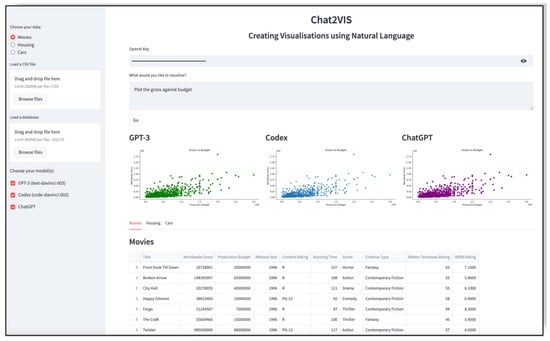
Figure 7.
Chat2VIS analyzes data and shows results in visualization with a GPT prompt like “plot the gross against budget” [23].
The study in [75] examines the application of generative large language models (GLLMs) like ChatGPT and GPT-4 in accounting research. It emphasizes GLLMs’ ability to perform complex textual analysis tasks, including those previously achievable only through human coding. The paper discusses the practicalities of using GLLMs in research, focusing on model selection, prompt engineering, construct validity, and addressing bias, replicability, and data privacy concerns. A case study is included to demonstrate GLLMs’ capabilities, specifically in detecting non-answers in earnings conference calls, a task challenging for traditional automation.
The study in [76] focuses on the application of GPT models in data analysis, specifically in the context of discrete mathematics education. The study compares the performance of GPT-3.5 and GPT-4 in solving Proof Blocks problems, highlighting the significant improvement of GPT-4 over its predecessor. This comparison demonstrates the evolving ability of LLMs to handle complex academic and educational tasks, marking a notable advancement in the application of these models for intricate problem-solving and analysis in mathematics.
6. Research Design
GPT and LLMs can significantly assist researchers in research design for solving critical problems in various ways, as shown in [28,75,77,78,79,80]. They facilitate solving complex problems by providing insights into abstract reasoning tasks, enhancing the ability to conceptualize and tackle intricate issues. LLMs excel in deep textual analysis and detecting nuanced patterns, making them invaluable for research involving large volumes of text.
GPT models, especially the latest versions, show promise in solving advanced mathematical problems, aiding in disciplines that require rigorous analytical skills. They offer new methodologies for conducting research, particularly in fields where traditional approaches are limited or inefficient.
In essence, GPT and LLMs open new avenues for addressing critical research challenges, offering tools that combine deep learning, language understanding, and problem-solving capabilities as summarized in Table 8.
Table 8.
Review of existing literature in GPT-based research design.
7. Results and Discussion
In accordance with the research questions delineated in Section 2, a sophisticated query mechanism was introduced in Figure 3. The implementation of this query method varies across databases used to obtain literature, as each database adheres to its own prescribed formulation for queries. This study utilized popular databases supporting advanced queries, including Scopus, IEEE Xplore, PubMed, Web of Science, and the ACM Digital Library, to compile a comprehensive list of literature. Table 9 details the advanced query applied to each database, along with the number of records retrieved on 30 January 2024, when these advanced queries were executed.
Table 9.
Variation in advanced queries against each of the databases.
Notably, certain databases like Google Scholar were excluded due to the limitations of their advanced query mechanism. As elucidated in [81], Google Scholar lacks advanced search capabilities, the ability to download data, and faces challenges related to quality control and clear indexing guidelines. Consequently, Google Scholar is recommended for use as a supplementary source rather than a primary source for writing systematic literature reviews [82]. As shown in Table 9, the number of records retrieved from Scopus, IEEE Xplore, PubMed, Web of Science, and the ACM Library was 99, 119, 47, 306, and 102, respectively. Conversely, the use of the same advanced query in Google Scholar yielded over 30,000 results, underscoring the challenges associated with quality control and indexing guidelines within Google Scholar, as noted in [81,82].
In addition to utilizing the prominent databases outlined in Table 9, an advanced citation visualization tool, Litmaps, was employed to identify additional relevant studies [29]. The incorporation of LitMaps in the context of a systematic literature review is indispensable, given its pivotal role in augmenting the efficiency and efficacy of the review process. LitMaps functions as a sophisticated analytical tool facilitating the systematic organization, categorization, and visualization of an extensive corpus of scholarly literature, encompassing both citing and cited articles. As depicted in Figure 8, Litmaps identified nine studies not present in Scopus, IEEE Xplore, PubMed, Web of Science, or the ACM Digital Library.
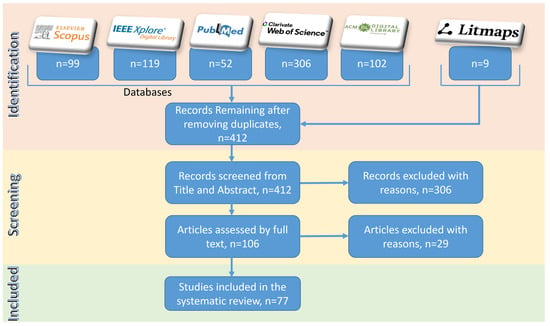
Figure 8.
PRISMA Flow Diagram on the systematic literature review of “GPT for research”.
The PRISMA flow diagram in Figure 8 illustrates the identification process, where 412 studies were initially identified after the deduplication of 275 studies. Following a screening process based on title and abstracts, 306 records were excluded due to their lack of relevance to the theme of “using GPT in performing research”, despite the inclusion of keywords like GPT or research in the abstract or title. These studies were found to belong to entirely different areas, with some using the term “research” merely to denote future research endeavors or directions. Following the initial screening, full texts were obtained for 106 studies. Subsequently, a detailed analysis led to the exclusion of 29 full-text articles as they did not address the original research questions regarding GPT’s role in generating and processing research data, analyzing research data, or contributing to research design and problem-solving. Ultimately, 77 studies were included in the systematic literature review. While a few of these studies did not directly answer the original research questions, they provided valuable insights into the limitations, issues, and challenges associated with the adoption of GPT technologies in research activities.
This study conducted a thorough examination of over 77 peer-reviewed papers within the domain of “GPT in Research.” Given the recent and trending nature of the GPT topic, a majority of the relevant papers span the past four years. Consequently, a significant 65% of the scrutinized papers were published in the years 2023 and 2024. The distribution includes 2 papers in 2024, 48 papers in 2023, 18 in 2022, 7 in 2021, and 4 in 2020, as illustrated in Figure 9.
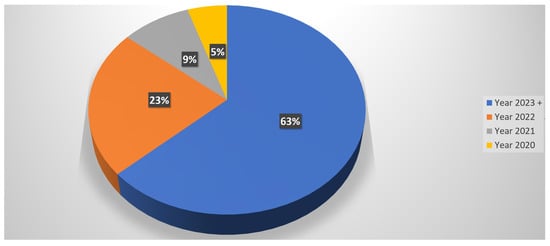
Figure 9.
Timeline analysis of existing literature on the use of GPT in research.
To ensure the rigor and reliability of this systematic literature review, the following measures were meticulously implemented:
- Adherence to Established Guidelines: The review methodologically aligned with established guidelines and recommendations from seminal academic works, particularly the study in [82]. The work in [82], categorized Scopus, PubMed, Web of Science, ACM Digital Library, etc. as “Principal Sources”. Hence, we exclusively used these databases.
- Exclusion of Unreliable Sources: A stringent criterion was applied to exclude sources lacking in quality control and those without clear indexing guidelines to maintain the overall reliability of the review. Existing scholarly work in [81,82] identified Google Scholar as one of the sources that lacks clear indexing guidelines. Hence, Google Scholar was not used as a source.
- Utilization of Advanced Visualization Tools: Advanced visualization tools, exemplified by Litmaps, played a pivotal role in assessing the alignment of identified studies with the predetermined domain of interest [29]. Litmaps facilitated a comprehensive evaluation, highlighting potential gaps and identifying relatively highly cited studies crucial for inclusion in the review process. Figure 8 illustrates the outcomes of utilizing Litmaps, showcasing the identification of nine significantly cited studies, thereby enhancing the comprehensiveness of the systematic literature review.
- Strategic Citation Analysis: In addition to advanced visualization tools, a strategic citation analysis was conducted to ascertain the prominence and impact of selected studies within the scholarly landscape. High-quality studies with a substantial number of citations were accorded due attention, contributing to the refinement and validation of the literature survey (using Litmaps).
8. Conclusions
Existing reviews on GPT [19,20,21] did not address how GPT could be useful for researchers in generating or augmenting research-related data and analyzing it. To mitigate this gap, this methodically crafted literature offers a strategic focus on data augmentation, backed by a meticulous examination of 412 scholarly works. In conclusion, the practical contributions of this comprehensive literature review are paramount in guiding researchers towards the judicious integration of GPT and associated technologies in their scholarly pursuits. By meticulously distilling 77 selected research contributions and developing a rigorous classification framework for “GPT’s use on research data”, this study provides a nuanced understanding of the multifaceted applications of GPT in data augmentation, critical analysis, and research design. Researchers can leverage the findings to inform their approach to generating and processing research data, analyzing complex datasets, and enhancing research design and problem-solving. Moreover, the systematic comparison of 54 extant literary works, evaluating diverse research domains, methodological approaches, and associated advantages and disadvantages, offers a practical roadmap for scientists seeking to seamlessly integrate GPT across various phases of their academic endeavors, thereby fostering innovation and efficiency in scholarly pursuits.
The deployment of GPT in research is not immune to inherent limitations, notably encompassing the issues of ethics [6], biases [7], hallucinations [83] and sycophantic behavior [73]. GPT, while proficient at generating human-like text, is susceptible to generating content that may be speculative or diverge from factual accuracy, leading to hallucinations within the generated information [83]. Furthermore, the model may exhibit sycophantic tendencies, showcasing an inclination to excessively praise or flatter, potentially compromising the objectivity and reliability of the generated output [73]. The manifestation of hallucinations and sycophantic behavior raises concerns about the model’s capacity to maintain a rigorous and unbiased approach in generating content for research purposes, necessitating careful scrutiny and consideration of these limitations in the utilization of GPT within the academic realm.
Future studies could explore refining GPT through advanced training techniques to minimize bias, and hallucinations and enhance content accuracy. Additionally, research focusing on developing tailored algorithms to mitigate sycophantic behavior in GPT-generated content may contribute to more objective and reliable outputs for academic applications.
Funding
This research received no external funding.
Institutional Review Board Statement
Not applicable.
Informed Consent Statement
Not applicable.
Data Availability Statement
No dataset was generated in this research.
Acknowledgments
Special appreciation is reserved for the COEUS Institute, Maine, US (https://coeus.institute/ accessed on 27 January 2024), where the author serves as the Chief Technology Officer, for fostering an environment conducive to research excellence. The Institute’s commitment to advancing knowledge in AI and pattern discovery has significantly enriched the author’s endeavors in conducting this systematic review.
Conflicts of Interest
The authors declare no conflict of interest.
Abbreviations
| GPT | Generative Pre-trained Transformer |
| LLM | Large Language Models |
| ML | Machine Learning |
| NER | Named Entity Recognition |
| NLP | Natural Language Processing |
| EHR | Electronic Health Records |
| GReaT | Generation of Realistic Tabular data |
Appendix A
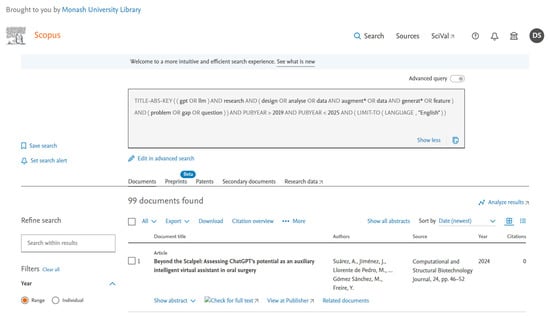
Figure A1.
Database search from Scopus using Scopus-specific advanced query. From Scopus, 99 documents were returned, including the duplicates. After removing the duplicates, records were screened. For example, the first record, “Beyond the Scalpel: Assessing ChatGPT’s Potential as an Auxiliary Intelligent Virtual Assistant in Oral Surgery” is not relevant to the focus of this study, “i.e., GPT in Research/GPT in Data Augmentation/GPT in Data Generation/GPT in Solving Research Problem”.
Figure A1.
Database search from Scopus using Scopus-specific advanced query. From Scopus, 99 documents were returned, including the duplicates. After removing the duplicates, records were screened. For example, the first record, “Beyond the Scalpel: Assessing ChatGPT’s Potential as an Auxiliary Intelligent Virtual Assistant in Oral Surgery” is not relevant to the focus of this study, “i.e., GPT in Research/GPT in Data Augmentation/GPT in Data Generation/GPT in Solving Research Problem”.
Figure A2.
Database search from IEEE Xplore using IEEE Xplore-specific advanced queries. A total of 119 documents were returned, including duplicates. After removing the duplicates, records were screened. For example, the first record was included, and the second record was screened out as this paper does not address “GPT in research”.
Figure A2.
Database search from IEEE Xplore using IEEE Xplore-specific advanced queries. A total of 119 documents were returned, including duplicates. After removing the duplicates, records were screened. For example, the first record was included, and the second record was screened out as this paper does not address “GPT in research”.
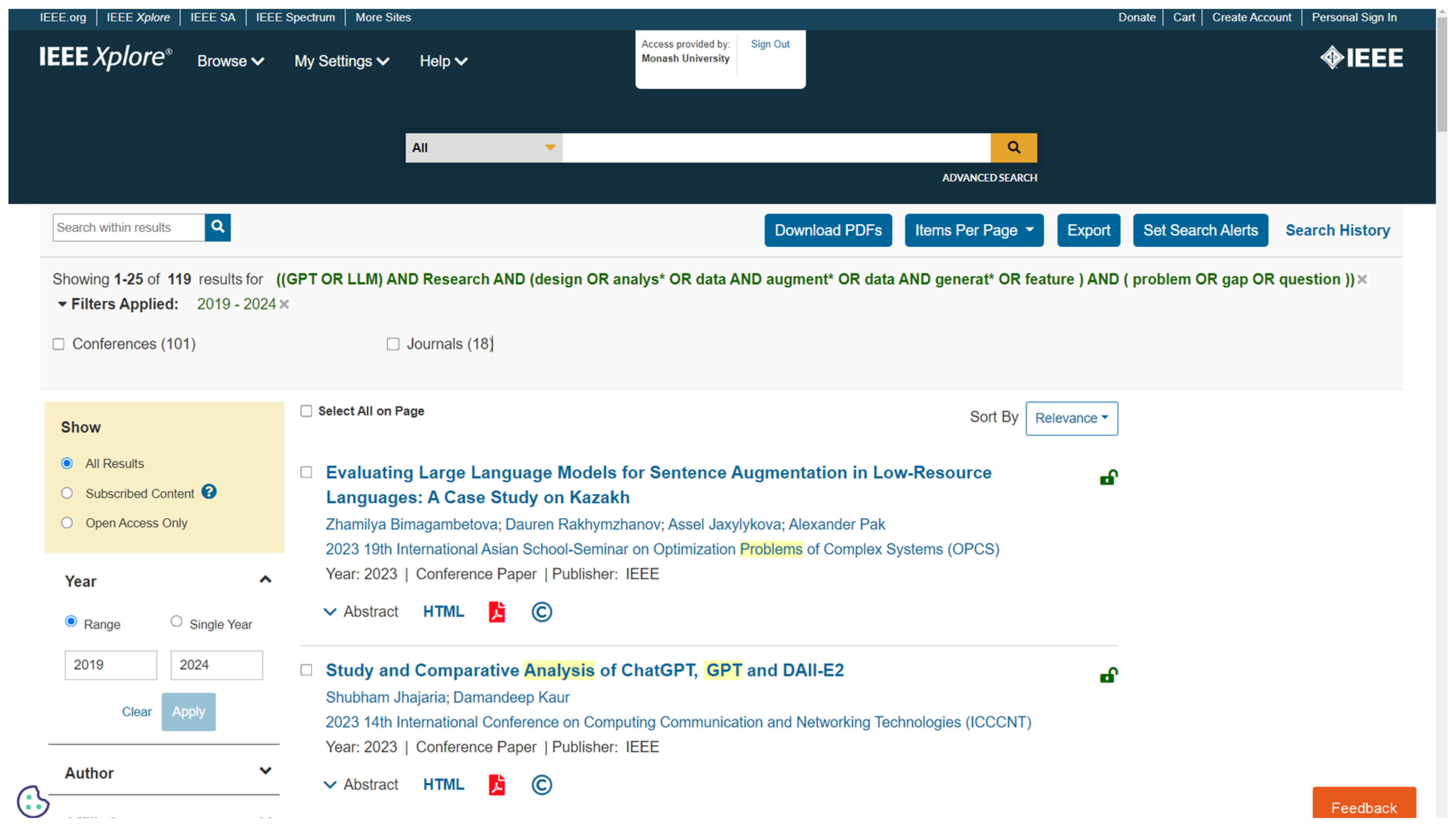
Figure A3.
Database search from PubMed using a PubMed-specific advanced query. From PubMed, 47 documents were returned, including the duplicates.
Figure A3.
Database search from PubMed using a PubMed-specific advanced query. From PubMed, 47 documents were returned, including the duplicates.
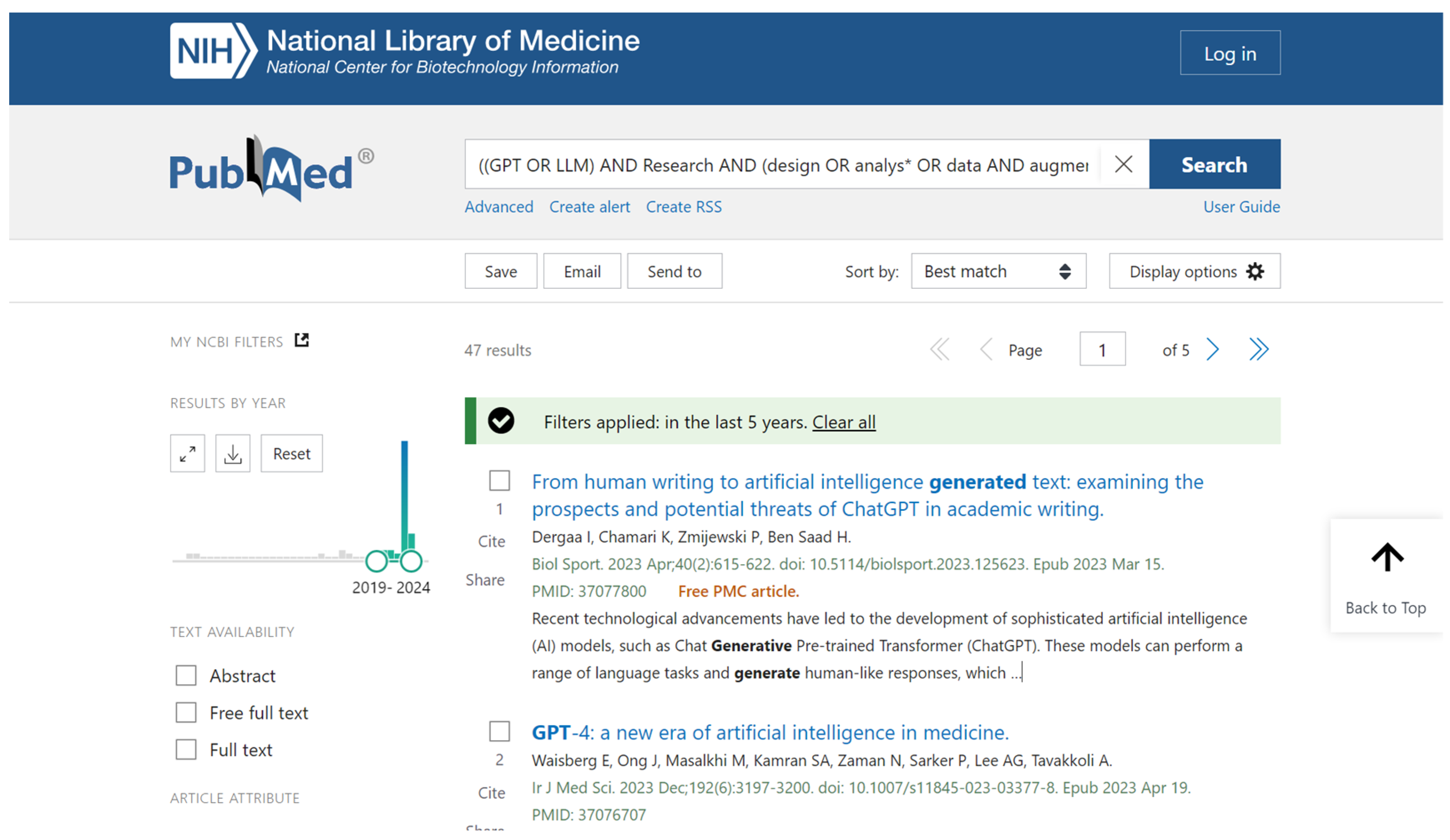
Figure A4.
Database Search from Web of Science using their supported advanced query. From Web of Science, 306 documents were returned, including duplicates. After removing the duplicates, the records were screened. For example, the first records were screened out as this paper was focused on nanotechnology and nanomaterials.
Figure A4.
Database Search from Web of Science using their supported advanced query. From Web of Science, 306 documents were returned, including duplicates. After removing the duplicates, the records were screened. For example, the first records were screened out as this paper was focused on nanotechnology and nanomaterials.
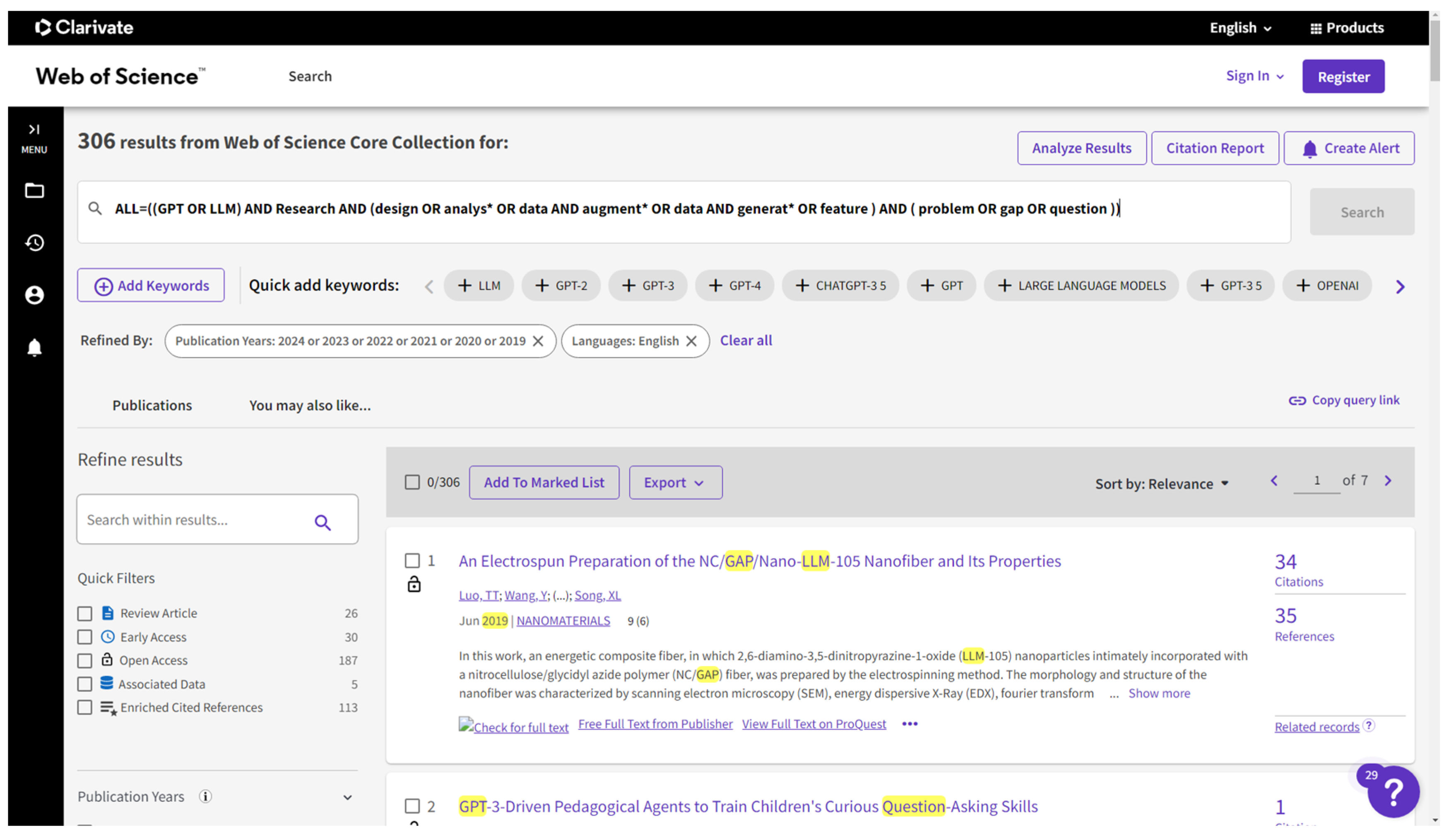
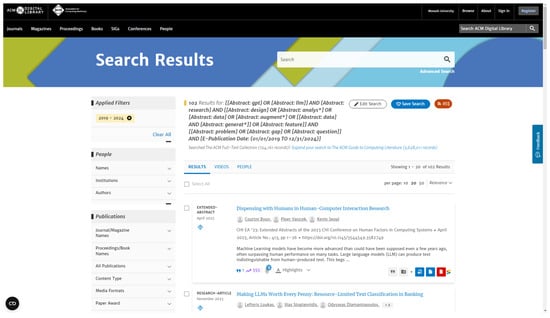
Figure A5.
Database search from the ACM Digital Library using their supported advanced query. From the ACM Digital Library, 102 documents were returned, including duplicates.
Figure A5.
Database search from the ACM Digital Library using their supported advanced query. From the ACM Digital Library, 102 documents were returned, including duplicates.

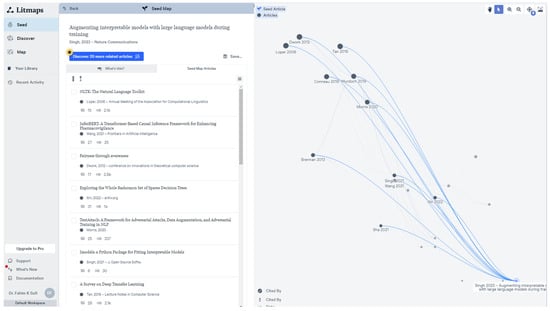
Figure A6.
Litmaps suggest 20 possibly relevant articles by visually analyzing the citation maps of [66].
Figure A6.
Litmaps suggest 20 possibly relevant articles by visually analyzing the citation maps of [66].
References
- Adiguzel, T.; Kaya, M.H.; Cansu, F.K. Revolutionizing education with AI: Exploring the transformative potential of ChatGPT. Contemp. Educ. Technol. 2023, 15, ep429. [Google Scholar] [CrossRef]
- Zhang, M.; Li, J. A commentary of GPT-3 in MIT Technology Review 2021. Fundam. Res. 2021, 1, 831–833. [Google Scholar] [CrossRef]
- Katar, O.; Özkan, D.; Yildirim, Ö.; Acharya, U.R. Evaluation of GPT-3 AI Language Model in Research Paper Writing. Turk. J. Sci. Technol. 2023, 18, 311–318. [Google Scholar] [CrossRef]
- Shibani, A.; Rajalakshmi, R.; Mattins, F.; Selvaraj, S.; Knight, S. Visual Representation of Co-Authorship with GPT-3: Studying Human-Machine Interaction for Effective Writing. In Proceedings of the 16th International Conference on Educational Data Mining, Bengaluru, India, 11–14 July 2023. [Google Scholar] [CrossRef]
- Iorga, D. Journal of Comparative Research in Anthropology and Sociology Let Me Write That for You: Prospects Concerning the Impact of GPT-3 on the Copywriting Workforce. 2022. Available online: http://compaso.eu (accessed on 5 February 2024).
- Watkins, R. Guidance for researchers and peer-reviewers on the ethical use of Large Language Models (LLMs) in scientific research workflows. AI Ethics 2023. [Google Scholar] [CrossRef]
- Casal, J.E.; Kessler, M. Can linguists distinguish between ChatGPT/AI and human writing?: A study of research ethics and academic publishing. Res. Methods Appl. Linguist. 2023, 2, 100068. [Google Scholar] [CrossRef]
- Meyer, J.G.; Urbanowicz, R.J.; Martin, P.C.; O’Connor, K.; Li, R.; Peng, P.C.; Bright, T.J.; Tatonetti, N.; Won, K.J.; Gonzalez-Hernandez, G.; et al. ChatGPT and large language models in academia: Opportunities and challenges. BioData Min. 2023, 16, 20. [Google Scholar] [CrossRef] [PubMed]
- Hosseini, M.; Resnik, D.B.; Holmes, K. The ethics of disclosing the use of artificial intelligence tools in writing scholarly manuscripts. Res. Ethics 2023, 19, 449–465. [Google Scholar] [CrossRef]
- Pouran, A.; Veyseh, B.; Dernoncourt, F.; Min, B.; Nguyen, T.H. Generating Complement Data for Aspect Term Extraction with GPT-2. In Proceedings of the Third Workshop on Deep Learning for Low-Resource Natural Language Processing, Seattle, WA, USA, 14–15 July 2022. [Google Scholar]
- Lu, Q.; Dou, D.; Nguyen, T.H. Textual Data Augmentation for Patient Outcomes Prediction. In Proceedings of the 2021 IEEE International Conference on Bioinformatics and Biomedicine, BIBM 2021, Houston, TX, USA, 9–12 December 2021; pp. 2817–2821. [Google Scholar] [CrossRef]
- Kieser, F.; Wulff, P.; Kuhn, J.; Küchemann, S. Educational data augmentation in physics education research using ChatGPT. Phys. Rev. Phys. Educ. Res. 2023, 19, 020150. [Google Scholar] [CrossRef]
- Sufi, F.K.; Alsulami, M.; Gutub, A. Automating Global Threat-Maps Generation via Advancements of News Sensors and AI. Arab. J. Sci. Eng. 2023, 48, 2455–2472. [Google Scholar] [CrossRef]
- Sufi, F. Social Media Analytics on Russia–Ukraine Cyber War with Natural Language Processing: Perspectives and Challenges. Information 2023, 14, 485. [Google Scholar] [CrossRef]
- Sufi, F.K.; Razzak, I.; Khalil, I. Tracking Anti-Vax Social Movement Using AI-Based Social Media Monitoring. IEEE Trans. Technol. Soc. 2022, 3, 290–299. [Google Scholar] [CrossRef]
- Sufi, F.K.; Khalil, I. Automated Disaster Monitoring from Social Media Posts Using AI-Based Location Intelligence and Sentiment Analysis. IEEE Trans. Comput. Soc. Syst. 2022. [Google Scholar] [CrossRef]
- Sufi, F.K. AI-SocialDisaster: An AI-based software for identifying and analyzing natural disasters from social media. Softw. Impacts 2022, 13, 100319. [Google Scholar] [CrossRef]
- Sufi, F. A decision support system for extracting artificial intelligence-driven insights from live twitter feeds on natural disasters. Decis. Anal. J. 2022, 5, 100130. [Google Scholar] [CrossRef]
- Mahuli, S.A.; Rai, A.; Mahuli, A.V.; Kumar, A. Application ChatGPT in conducting systematic reviews and meta-analyses. Br. Dent. J. 2023, 235, 90–92. [Google Scholar] [CrossRef] [PubMed]
- Sallam, M. ChatGPT Utility in Healthcare Education, Research, and Practice: Systematic Review on the Promising Perspectives and Valid Concerns. Healthcare 2023, 11, 887. [Google Scholar] [CrossRef] [PubMed]
- Yenduri, G.; Ramalingam, M.; Chemmalar Selvi, G.; Supriya, Y.; Srivastava, G.; Maddikunta, P.K.; Deepti Raj, G.; Jhaveri, R.H.; Prabadevi, B.; Wang, W. Generative Pre-trained Transformer: A Comprehensive Review on Enabling Technologies, Potential Applications, Emerging Challenges, and Future Directions. arxiv 2023, arXiv:2305.10435. [Google Scholar] [CrossRef]
- Espejel, J.L.; Ettifouri, E.H.; Alassan, M.S.Y.; Chouham, E.M.; Dahhane, W. GPT-3.5, GPT-4, or BARD? Evaluating LLMs reasoning ability in zero-shot setting and performance boosting through prompts. Nat. Lang. Process. J. 2023, 5, 100032. [Google Scholar] [CrossRef]
- Maddigan, P.; Susnjak, T. Chat2VIS: Generating Data Visualizations via Natural Language Using ChatGPT, Codex and GPT-3 Large Language Models. IEEE Access 2023, 11, 45181–45193. [Google Scholar] [CrossRef]
- Sharma, A.; Devalia, D.; Almeida, W.; Patil, H.; Mishra, A. Statistical Data Analysis using GPT3: An Overview. In Proceedings of the 2022 IEEE Bombay Section Signature Conference (IBSSC), Mumbai, India, 8–10 December 2022. [Google Scholar]
- Del, M.; Fishel, M. True Detective: A Deep Abductive Reasoning Benchmark Undoable for GPT-3 and Challenging for GPT-4. arxiv 2023, arXiv:2212.10114. [Google Scholar] [CrossRef]
- Jansen, B.J.; Jung, S.; Salminen, J. Employing large language models in survey research. Nat. Lang. Process. J. 2023, 4, 100020. [Google Scholar] [CrossRef]
- Ai, M.R.; Quantum, M.A. The Impact of Large Language Models on Scientific Discovery: A Preliminary Study Using GPT-4. arXiv 2023, arXiv:2311.07361. [Google Scholar]
- Dong, Q.; Dong, L.; Xu, K.; Zhou, G.; Hao, Y.; Sui, Z.; Wei, F. Large Language Model for Science: A Study on P vs. NP. arXiv 2023, arXiv:2309.05689. [Google Scholar]
- Kaur, A.; Gulati, S.; Sharma, R.; Sinhababu, A.; Chakravarty, R. Visual citation navigation of open education resources using Litmaps. Libr. Hi Tech. News 2022, 39, 7–11. [Google Scholar] [CrossRef]
- Sufi, F. Algorithms in Low-Code-No-Code for Research Applications: A Practical Review. Algorithms 2023, 16, 108. [Google Scholar] [CrossRef]
- Borisov, V.; Seßler, K.; Leemann, T.; Pawelczyk, M.; Kasneci, G. Language Models are Realistic Tabular Data Generators. arXiv 2022, arXiv:2210.06280. [Google Scholar]
- Nakamoto, R.; Flanagan, B.; Yamauchi, T.; Dai, Y.; Takami, K.; Ogata, H. Enhancing Automated Scoring of Math Self-Explanation Quality Using LLM-Generated Datasets: A Semi-Supervised Approach. Computers 2023, 12, 217. [Google Scholar] [CrossRef]
- Joon, J.; Chung, Y.; Kamar, E.; Amershi, S. Increasing Diversity While Maintaining Accuracy: Text Data Generation with Large Language Models and Human Interventions. arxiv 2023, arXiv:2306.04140. [Google Scholar] [CrossRef]
- Borisov, V.; Leemann, T.; Sessler, K.; Haug, J.; Pawelczyk, M.; Kasneci, G. Deep Neural Networks and Tabular Data: A Survey. IEEE Trans. Neural Netw. Learn. Syst. 2022. [Google Scholar] [CrossRef] [PubMed]
- Acharya, A.; Singh, B.; Onoe, N. LLM Based Generation of Item-Description for Recommendation System. In Proceedings of the 17th ACM Conference on Recommender Systems, RecSys 2023, Singapore, 18–22 September 2023; pp. 1204–1207. [Google Scholar] [CrossRef]
- Narayan, A.; Chami, I.; Orr, L.; Arora, S.; Ré, C. Can Foundation Models Wrangle Your Data? arXiv 2022, arXiv:2205.09911. [Google Scholar] [CrossRef]
- Bayer, M.; Kaufhold, M.A.; Buchhold, B.; Keller, M.; Dallmeyer, J.; Reuter, C. Data augmentation in natural language processing: A novel text generation approach for long and short text classifiers. Int. J. Mach. Learn. Cybern. 2023, 14, 135–150. [Google Scholar] [CrossRef]
- Balaji, S.; Magar, R.; Jadhav, Y.; Farimani, A.B. GPT-MolBERTa: GPT Molecular Features Language Model for molecular property prediction. arXiv 2023, arXiv:2310.03030. [Google Scholar]
- Anaby-Tavor, A.; Carmeli, B.; Goldbraich, E.; Kantor, A.; Kour, G.; Shlomov, S.; Tepper, N.; Zwerdling, N. Do Not Have Enough Data? Deep Learning to the Rescue! arxiv 2019, arXiv:1911.03118. [Google Scholar] [CrossRef]
- Amin-Nejad, A.; Ive, J.; Velupillai, S. Exploring Transformer Text Generation for Medical Dataset Augmentation. In Proceedings of the Twelfth Language Resources and Evaluation Conference, Marseille, France, 19 May 2020; pp. 4699–4708. Available online: https://aclanthology.org/2020.lrec-1.578 (accessed on 5 February 2024).
- Queiroz Abonizio, H.; Barbon Junior, S. Pre-trained Data Augmentation for Text Classification. In Lecture Notes in Computer Science (Including Subseries Lecture Notes in Artificial Intelligence and Lecture Notes in Bioinformatics); Springer Science and Business Media Deutschland GmbH: Cham, Switzerland, 2020; pp. 551–565. [Google Scholar] [CrossRef]
- Cohen, S.; Presil, D.; Katz, O.; Arbili, O.; Messica, S.; Rokach, L. Enhancing social network hate detection using back translation and GPT-3 augmentations during training and test-time. Inf. Fusion 2023, 99, 101887. [Google Scholar] [CrossRef]
- Chen, H.; Zhang, W.; Cheng, L.; Ye, H. Diverse and High-Quality Data Augmentation Using GPT for Named Entity Recognition. In Communications in Computer and Information Science; Springer Science and Business Media Deutschland GmbH: Singapore, 2023; pp. 272–283. [Google Scholar] [CrossRef]
- Chang, Y.; Zhang, R.; Pu, J. I-WAS: A Data Augmentation Method with GPT-2 for Simile Detection. In Lecture Notes in Computer Science (Including Subseries Lecture Notes in Artificial Intelligence and Lecture Notes in Bioinformatics); Springer Science and Business Media Deutschland GmbH: Cham, Switzerland, 2023; pp. 265–279. [Google Scholar] [CrossRef]
- Casula, C.; Tonelli, S.; Kessler, F.B. Generation-Based Data Augmentation for Offensive Language Detection: Is It Worth It? In Proceedings of the 17th Conference of the European Chapter of the Association for Computational Linguistics, Dubrovnik, Croatia, 2–6 May 2023; pp. 3359–3377. Available online: https://aclanthology.org/2023.eacl-main.244 (accessed on 5 February 2024).
- Bird, J.J.; Pritchard, M.; Fratini, A.; Ekart, A.; Faria, D.R. Synthetic Biological Signals Machine-Generated by GPT-2 Improve the Classification of EEG and EMG through Data Augmentation. IEEE Robot. Autom. Lett. 2021, 6, 3498–3504. [Google Scholar] [CrossRef]
- Hong, X.-S.; Wu, S.-H.; Tian, M.; Jiang, J. CYUT at the NTCIR-16 FinNum-3 Task: Data Resampling and Data Augmentation by Generation. In Proceedings of the 16th NTCIR Conference on Evaluation of Information Access Technologies, Tokyo Japan, 14–17 June 2022; pp. 95–102. Available online: http://research.nii.ac.jp/ntcir/workshop/OnlineProceedings16/pdf/ntcir/03-NTCIR16-FINNUM-HongX.pdf (accessed on 5 February 2024).
- Hassani, H.; Silva, E.S. The Role of ChatGPT in Data Science: How AI-Assisted Conversational Interfaces Are Revolutionizing the Field. Big Data Cogn. Comput. 2023, 7, 62. [Google Scholar] [CrossRef]
- Grasler, I.; Preus, D.; Brandt, L.; Mohr, M. Efficient Extraction of Technical Requirements Applying Data Augmentation. In Proceedings of the ISSE 2022—2022 8th IEEE International Symposium on Systems Engineering, Vienna, Austria, 24–26 October 2022. [Google Scholar] [CrossRef]
- D’Sa, A.G.; Illina, I.; Fohr, D.; Klakow, D.; Ruiter, D. Exploring Conditional Language Model Based Data Augmentation Approaches for Hate Speech Classification. In Lecture Notes in Computer Science (Including Subseries Lecture Notes in Artificial Intelligence and Lecture Notes in Bioinformatics); Springer Science and Business Media Deutschland GmbH: Cham, Switzerland, 2021; pp. 135–146. [Google Scholar] [CrossRef]
- Hu, Y.; Mai, G.; Cundy, C.; Choi, K.; Lao, N.; Liu, W.; Lakhanpal, G.; Zhou, R.Z.; Joseph, K. Geo-knowledge-guided GPT models improve the extraction of location descriptions from disaster-related social media messages. Int. J. Geogr. Inf. Sci. 2023, 37, 2289–2318. [Google Scholar] [CrossRef]
- Khatri, S.; Iqbal, M.; Ubakanma, G.; Van Der Vliet-Firth, S. SkillBot: Towards Data Augmentation using Transformer language model and linguistic evaluation. In Proceedings of the 2022 International Conference on Human-Centered Cognitive Systems, HCCS 2022, Shanghai, China, 17–18 December 2022. [Google Scholar] [CrossRef]
- Elbadawi, M.; Li, H.; Basit, A.W.; Gaisford, S. The role of artificial intelligence in generating original scientific research. Int. J. Pharm. 2024, 652, 123741. [Google Scholar] [CrossRef] [PubMed]
- Maharana, A.; Bansal, M. GRADA: Graph Generative Data Augmentation for Commonsense Reasoning. In Proceedings of the 29th International Conference on Computational Linguistics, Gyeongju, Republic of Korea, 12–17 October 2022. [Google Scholar]
- Hämäläinen, P.; Tavast, M.; Kunnari, A. Evaluating Large Language Models in Generating Synthetic HCI Research Data: A Case Study. In Proceedings of the 2023 CHI Conference on Human Factors in Computing Systems, Hamburg, Germany, 23–28 April 2023; ACM: New York, NY, USA, 2023; pp. 1–19. [Google Scholar] [CrossRef]
- Maimaiti, M.; Liu, Y.; Luan, H.; Sun, M. Data augmentation for low-resource languages NMT guided by constrained sampling. Int. J. Intell. Syst. 2022, 37, 30–51. [Google Scholar] [CrossRef]
- Meyer, S.; Elsweiler, D.; Ludwig, B.; Fernandez-Pichel, M.; Losada, D.E. Do We Still Need Human Assessors’ Prompt-Based GPT-3 User Simulation in Conversational AI. In ACM International Conference Proceeding Series; Association for Computing Machinery: New York, NY, USA, 2022. [Google Scholar] [CrossRef]
- Modzelewski, A.; Sosnowski, W.; Wilczynska, M.; Wierzbicki, A. DSHacker at SemEval-2023 Task 3: Genres and Persuasion Techniques Detection with Multilingual Data Augmentation through Machine Translation and Text Generation. In Proceedings of the 17th International Workshop on Semantic Evaluation (SemEval-2023), Toronto, Canada, 15 July 2023; pp. 1582–1591. Available online: https://aclanthology.org/2023.semeval-1.218 (accessed on 5 February 2024).
- Nouri, N. Data Augmentation with Dual Training for Offensive Span Detection. In Proceedings of the 2022 Conference of the North American Chapter of the Association for Computational Linguistics: Human Language Technologies, Seattle, WA, USA, 10–15 July 2022. [Google Scholar]
- Pellicer, L.F.A.O.; Ferreira, T.M.; Costa, A.H.R. Data augmentation techniques in natural language processing. Appl. Soft Comput. 2023, 132, 109803. [Google Scholar] [CrossRef]
- Van Nooten, J.; Daelemans, W. Improving Dutch Vaccine Hesitancy Monitoring via Multi-Label Data Augmentation with GPT-3.5. In Proceedings of the 13th Workshop on Computational Approaches to Subjectivity, Sentiment, & Social Media Analysis, Toronto, Canada, July 2023; pp. 251–270. Available online: https://aclanthology.org/2023.wassa-1.23 (accessed on 5 February 2024).
- Romero-Sandoval, M.; Calderón-Ramírez, S.; Solís, M. Using GPT-3 as a Text Data Augmentator for a Complex Text Detector. In Proceedings of the 2023 IEEE 5th International Conference on BioInspired Processing (BIP), San Carlos, Alajuela, Costa Rica, 28–30 November 2023; pp. 1–6. [Google Scholar] [CrossRef]
- Rebboud, Y.; Lisena, P.; Troncy, R. Prompt-based Data Augmentation for Semantically-Precise Event Relation Classification. In Proceedings of the SEMMES 2023, Semantic Methods for Events and Stories, Heraklion, Greece, 23–28 May 2023; Available online: https://www.eurecom.fr/publication/7298 (accessed on 5 February 2024).
- Quteineh, H.; Samothrakis, S.; Sutcliffe, R. Textual Data Augmentation for Efficient Active Learning on Tiny Datasets. In Proceedings of the 2020 Conference on Empirical Methods in Natural Language Processing (EMNLP), Online, 19–20 November 2020; pp. 7400–7410. Available online: https://aclanthology.org/2020.emnlp-main.600 (accessed on 5 February 2024).
- Suhaeni, C.; Yong, H.S. Mitigating Class Imbalance in Sentiment Analysis through GPT-3-Generated Synthetic Sentences. Appl. Sci. 2023, 13, 9766. [Google Scholar] [CrossRef]
- CSingh; Askari, A.; Caruana, R.; Gao, J. Augmenting interpretable models with large language models during training. Nat. Commun. 2023, 14, 7913. [Google Scholar] [CrossRef]
- Veyseh, A.P.B.; Van Nguyen, M.; Min, B.; Nguyen, T.H. Augmenting Open-Domain Event Detection with Synthetic Data from GPT-2. In Lecture Notes in Computer Science (Including Subseries Lecture Notes in Artificial Intelligence and Lecture Notes in Bioinformatics); Springer Science and Business Media Deutschland GmbH: Cham, Switzerland, 2021; pp. 644–660. [Google Scholar] [CrossRef]
- Tapia-Téllez, J.M.; Escalante, H.J. Data Augmentation with Transformers for Text Classification. In Lecture Notes in Computer Science (Including Subseries Lecture Notes in Artificial Intelligence and Lecture Notes in Bioinformatics); Springer Science and Business Media Deutschland GmbH: Cham, Switzerland, 2020; pp. 247–259. [Google Scholar] [CrossRef]
- Zhou, S.; Zhang, Y. DATLMedQA: A data augmentation and transfer learning based solution for medical question answering. Appl. Sci. 2021, 11, 1251. [Google Scholar] [CrossRef]
- Waisberg, E.; Ong, J.; Kamran, S.A.; Masalkhi, M.; Zaman, N.; Sarker, P.; Lee, A.G.; Tavakkoli, A. Bridging artificial intelligence in medicine with generative pre-trained transformer (GPT) technology. J. Med. Artif. Intell. 2023, 6. [Google Scholar] [CrossRef]
- Vogel, L.; Flek, L. Investigating Paraphrasing-Based Data Augmentation for Task-Oriented Dialogue Systems. In Lecture Notes in Computer Science (Including Subseries Lecture Notes in Artificial Intelligence and Lecture Notes in Bioinformatics); Springer Science and Business Media Deutschland GmbH: Cham, Switzerland, 2022; pp. 476–488. [Google Scholar] [CrossRef]
- Sawai, R.; Paik, I.; Kuwana, A. Sentence augmentation for language translation using gpt-2. Electronics 2021, 10, 3082. [Google Scholar] [CrossRef]
- Ranaldi, L.; Pucci, G. When Large Language Models contradict humans? Large Language Models’ Sycophantic Behaviour. arXiv 2023, arXiv:2311.09410. [Google Scholar]
- Lim, S.; Schmälzle, R. Artificial intelligence for health message generation: An empirical study using a large language model (LLM) and prompt engineering. Front. Commun. 2023, 8, 1129082. [Google Scholar] [CrossRef]
- de Kok, T. Generative LLMs and Textual Analysis in Accounting: (Chat)GPT as Research Assistant? SSRN 2023. [Google Scholar] [CrossRef]
- Lengerich, B.J.; Bordt, S.; Nori, H.; Nunnally, M.E.; Aphinyanaphongs, Y.; Kellis, M.; Caruana, R. LLMs Understand Glass-Box Models, Discover Surprises, and Suggest Repairs. arXiv 2023, arXiv:2308.01157. [Google Scholar]
- Arora, D.; Singh, H.G. Have LLMs Advanced Enough? A Challenging Problem Solving Benchmark for Large Language Models Mausam IIT Delhi. arxiv 2023, arXiv:2305.15074. [Google Scholar] [CrossRef]
- Xu, Y.; Li, W.; Vaezipoor, P.; Sanner, S.; Khalil, E.B. LLMs and the Abstraction and Reasoning Corpus: Successes, Failures, and the Importance of Object-based Representations. arXiv 2023, arXiv:2305.18354. [Google Scholar]
- Orrù, G.; Piarulli, A.; Conversano, C.; Gemignani, A. Human-like problem-solving abilities in large language models using ChatGPT. Front. Artif. Intell. 2023, 6, 1199350. [Google Scholar] [CrossRef] [PubMed]
- Poulsen, S.; Sarsa, S.; Prather, J.; Leinonen, J.; Becker, B.A.; Hellas, A.; Denny, P.; Reeves, B.N. Solving Proof Block Problems Using Large Language Models. In Proceedings of the SIGCSE 2024, Portland, OR, USA, 20–23 March 2024; Volume 7. [Google Scholar]
- Halevi, G.; Moed, H.; Bar-Ilan, J. Suitability of Google Scholar as a source of scientific information and as a source of data for scientific evaluation—Review of the Literature. J. Informetr. 2017, 11, 823–834. [Google Scholar] [CrossRef]
- Gusenbauer, M.; Haddaway, N.R. Which academic search systems are suitable for systematic reviews or meta-analyses? Evaluating retrieval qualities of Google Scholar, PubMed, and 26 other resources. Res. Synth. Methods 2020, 11, 181–217. [Google Scholar] [CrossRef] [PubMed]
- Ji, Z.; Lee, N.; Frieske, R.; Yu, T.; Su, D.; Xu, Y.; Ishii, E.; Bang, Y.J.; Madotto, A.; Fung, P. Survey of Hallucination in Natural Language Generation. ACM Comput. Surv. 2023, 55, 1–38. [Google Scholar] [CrossRef]
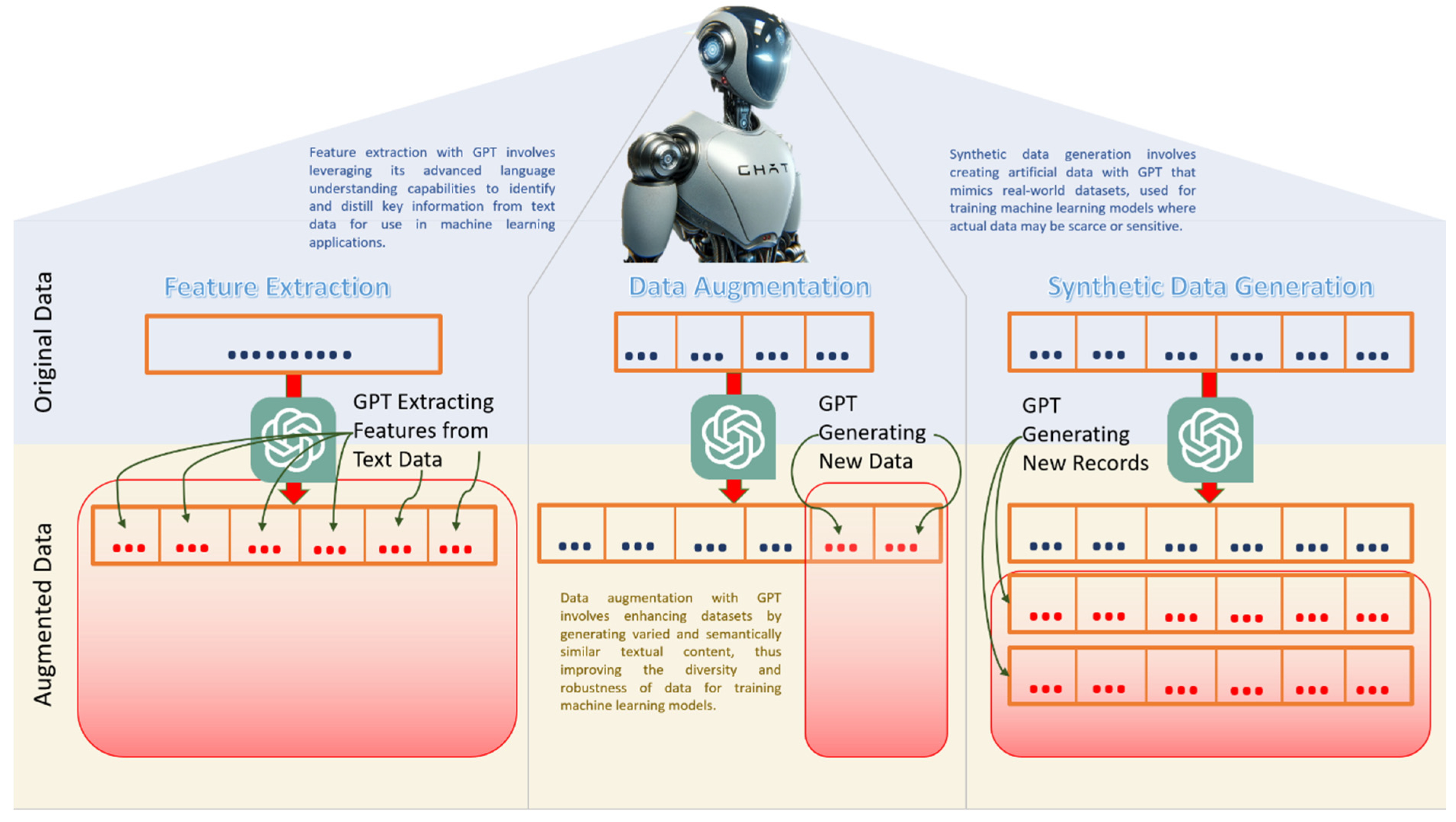
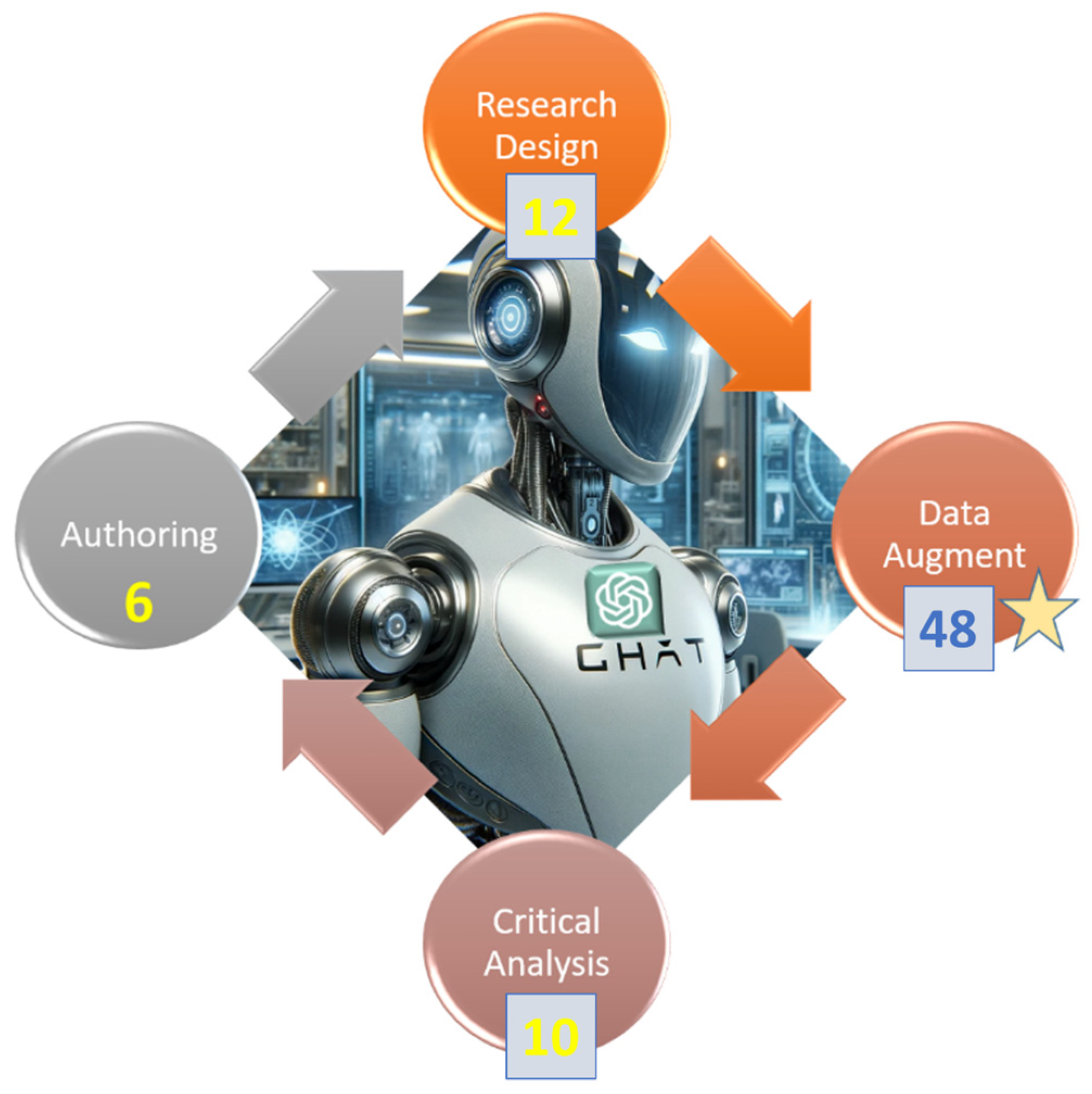
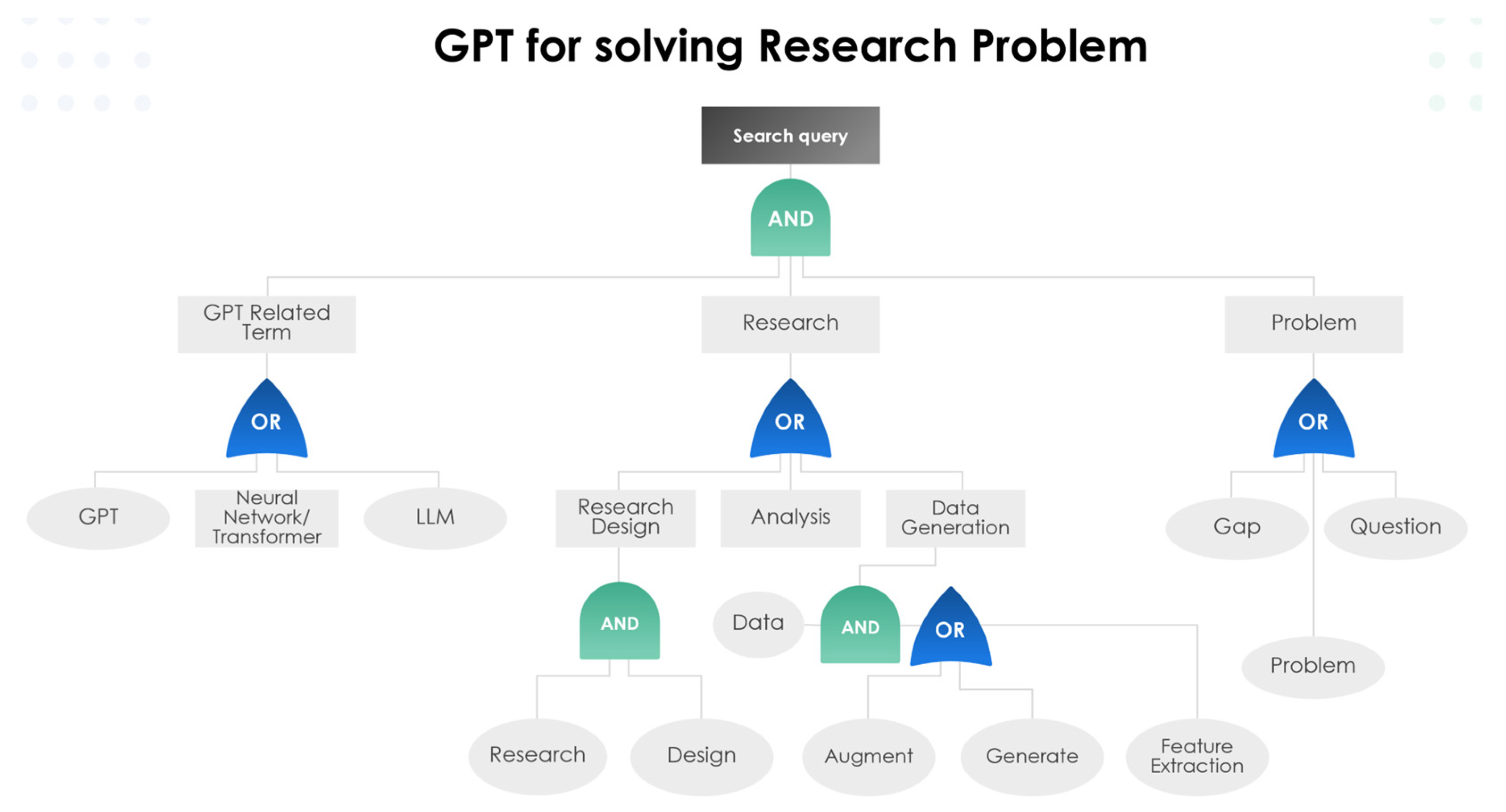
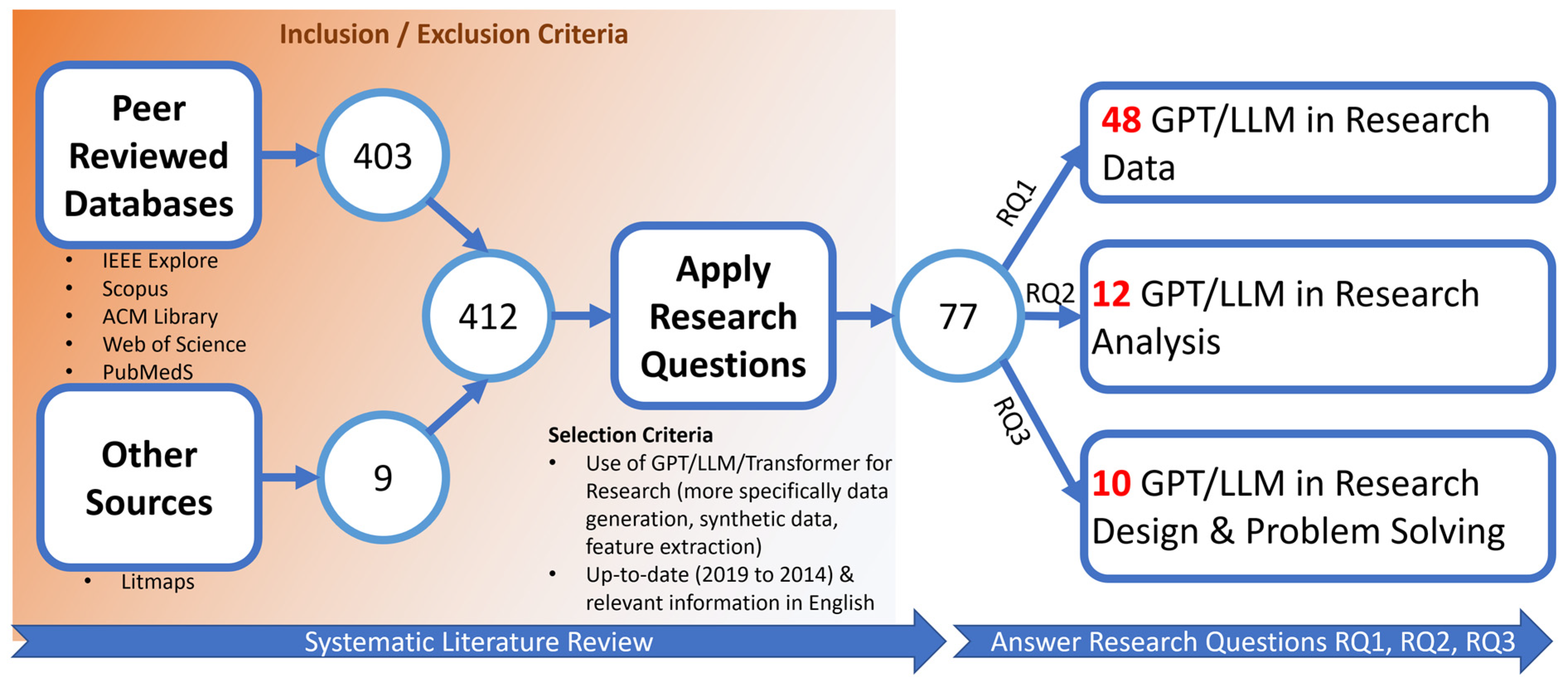
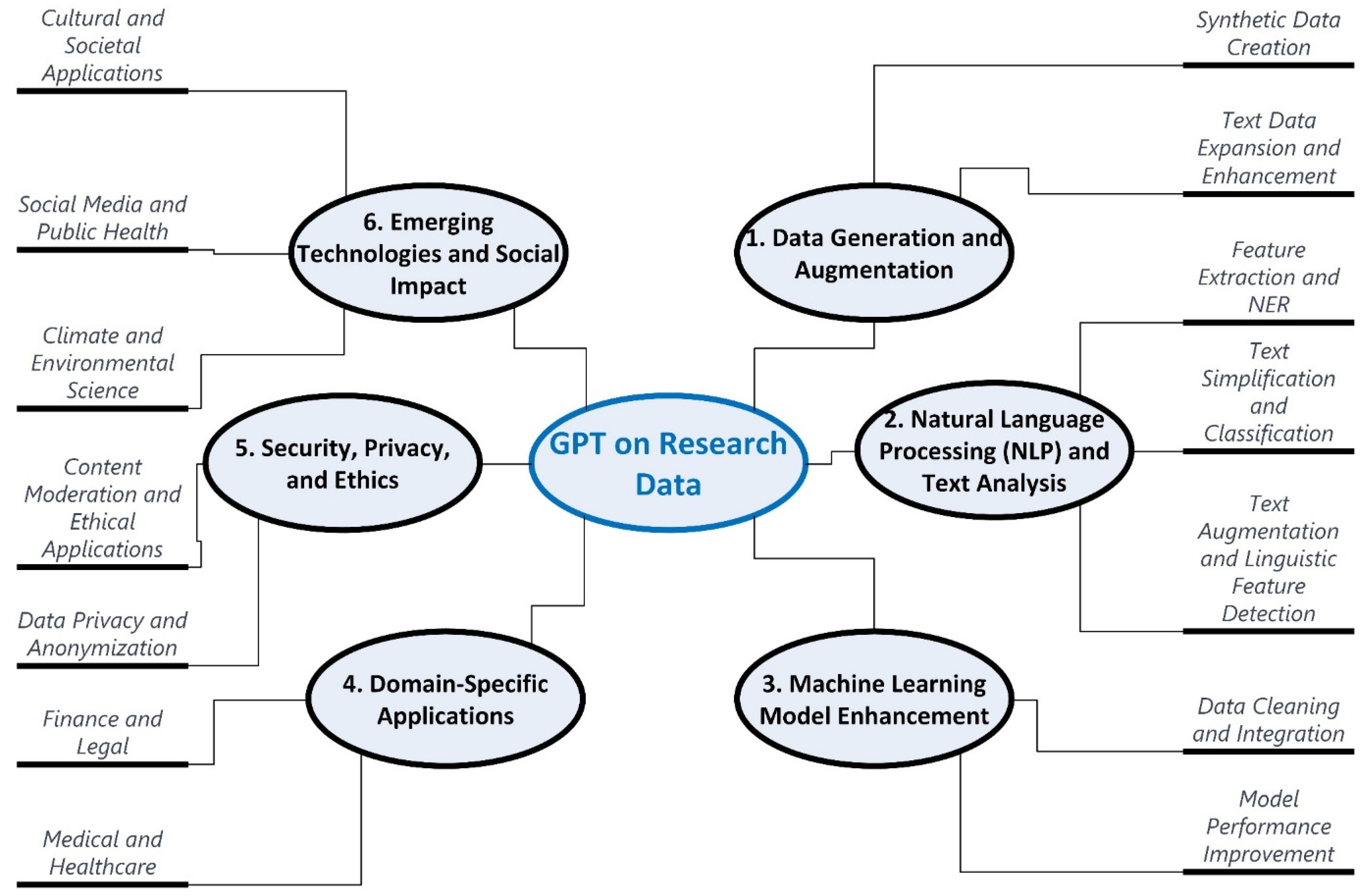
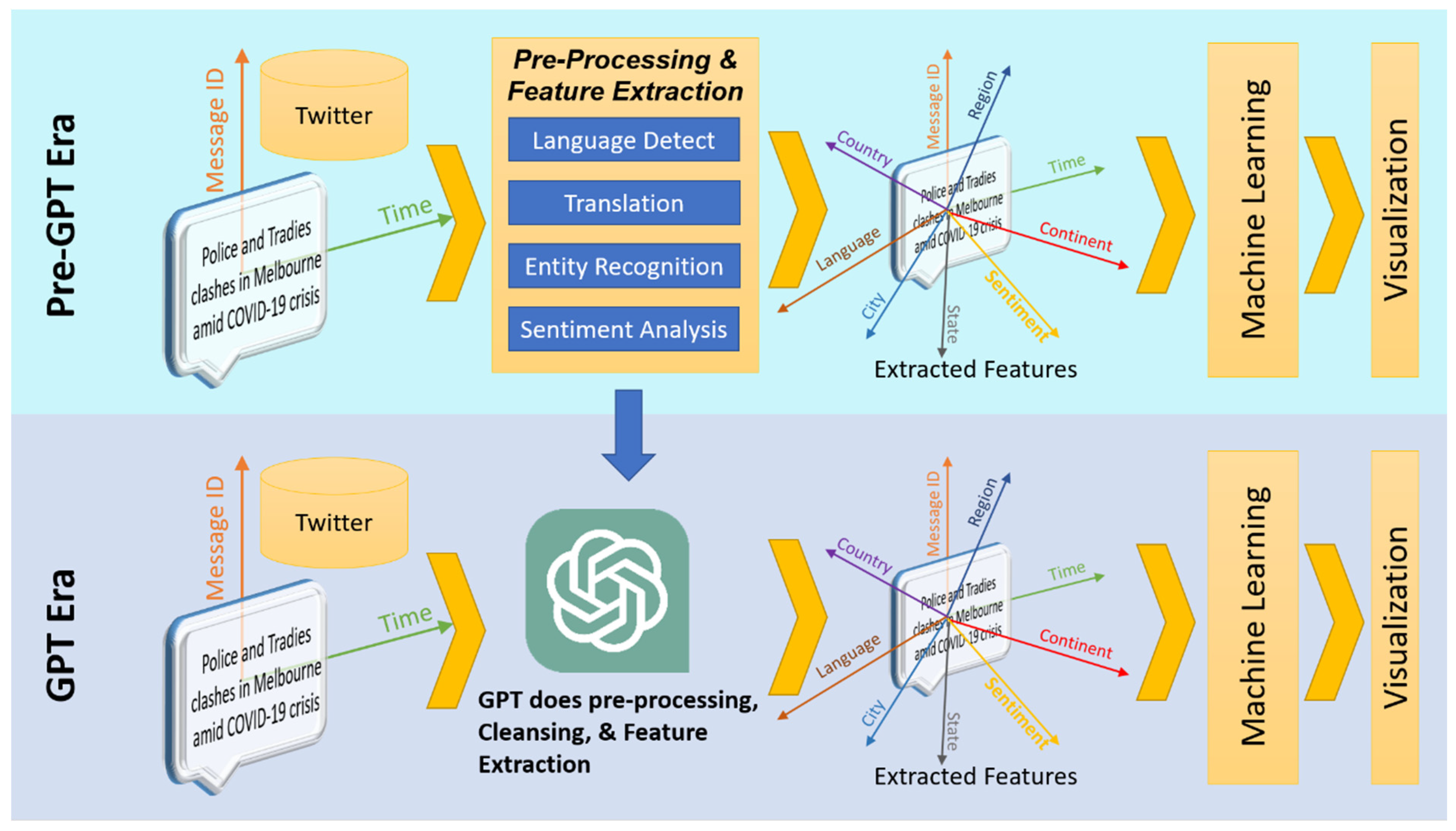
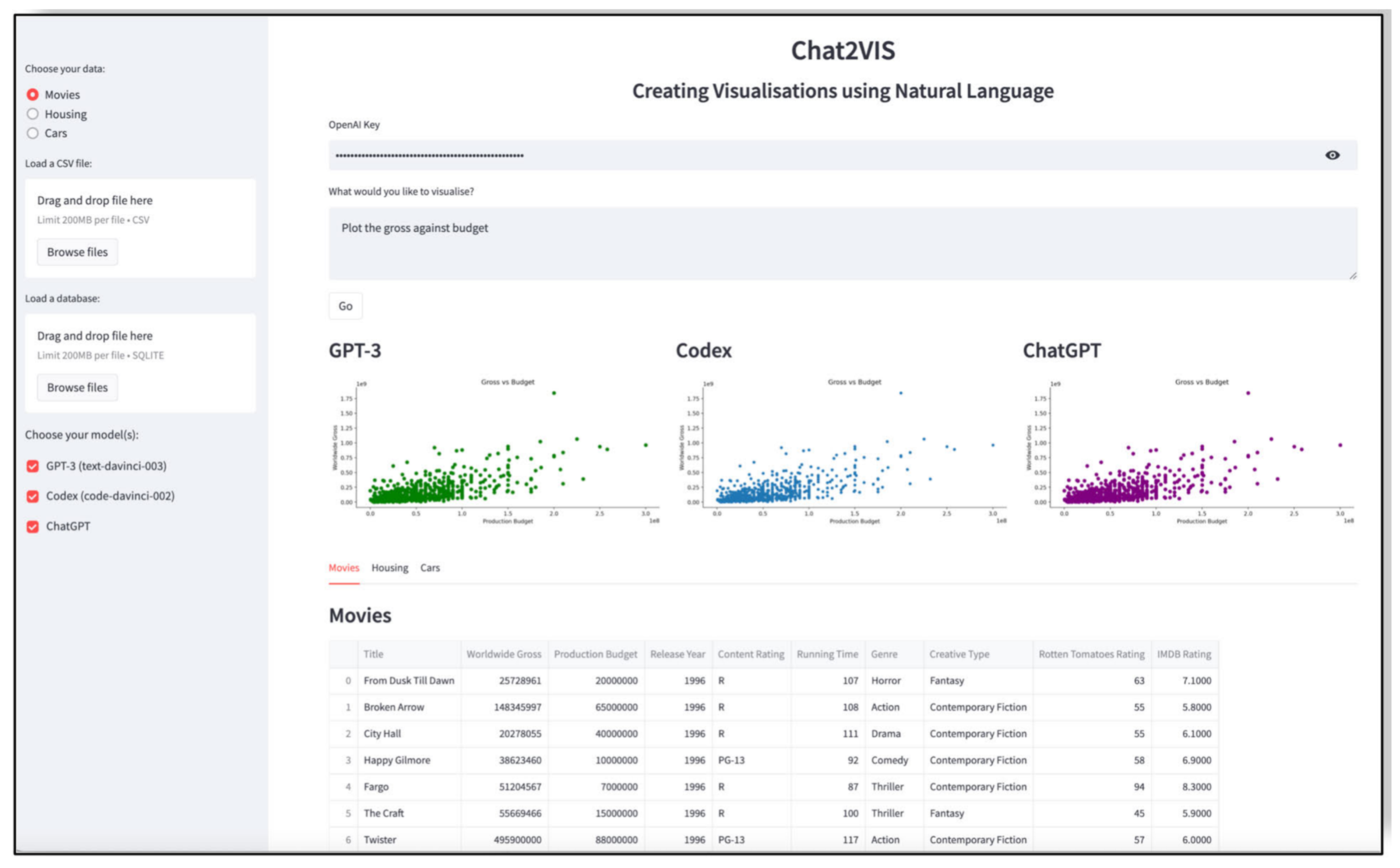
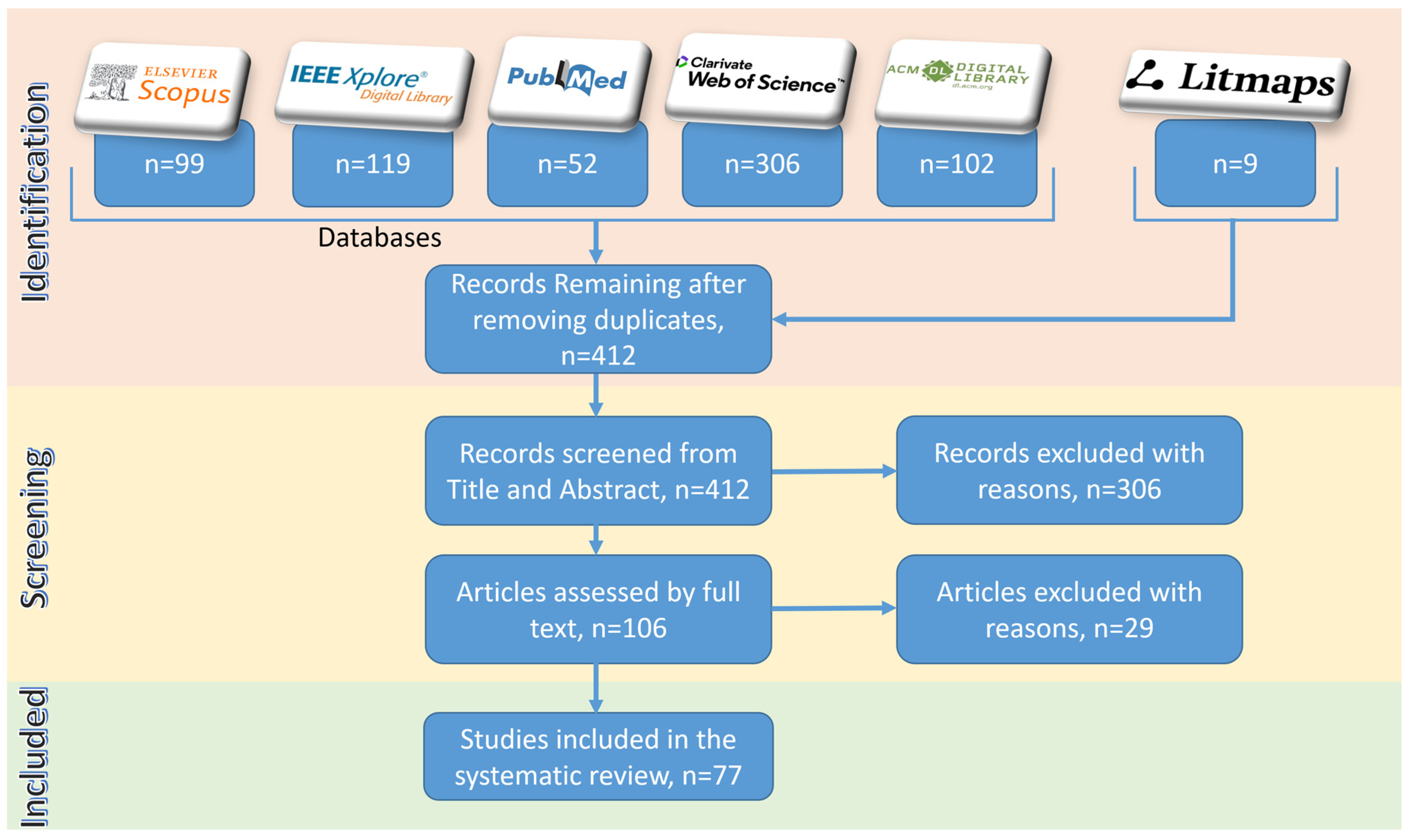
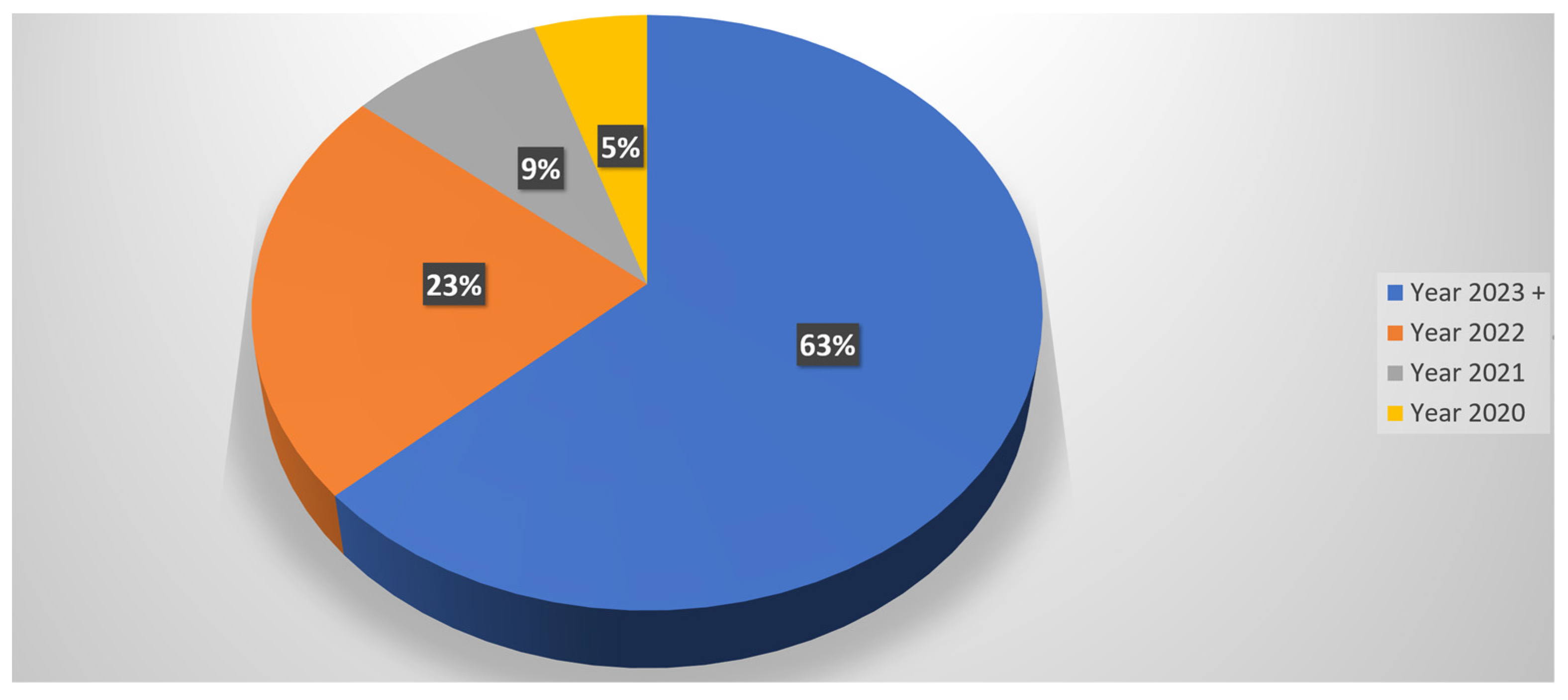
Disclaimer/Publisher’s Note: The statements, opinions and data contained in all publications are solely those of the individual author(s) and contributor(s) and not of MDPI and/or the editor(s). MDPI and/or the editor(s) disclaim responsibility for any injury to people or property resulting from any ideas, methods, instructions or products referred to in the content. |
© 2024 by the author. Licensee MDPI, Basel, Switzerland. This article is an open access article distributed under the terms and conditions of the Creative Commons Attribution (CC BY) license (https://creativecommons.org/licenses/by/4.0/).