


Abstract
In this study, we investigated the abilities of nitrogen and sulfur heterocyclic carbenes of benzotriazole, 2-mercaptobenzothiazole, 8-hydroxyquinoline, and 3-amino-1,2,4-triazole-5-thiol regarding adsorption on an Al-Mg-Si alloy toward corrosion inhibition of the surface. Al-Si(14), Al-Si(19), and Al-Si(21) in the Al-Mg-Si alloy surface with the highest fluctuation in the shielding tensors of the “NMR” spectrum generated by intra-atomic interaction directed us to the most influence in the neighbor atoms generated by interatomic reactions of N → Al, O → Al, and S → Al through the coating and adsorbing process of Langmuir adsorption. The values of various thermodynamic properties and dipole moments of benzotriazole, 2-mercaptobenzothiazole, 8-hydroxyquinoline, and 3-amino-1,2,4-triazole-5-thiol adsorbed on the Al-Mg-Si increased by enhancing the molecular weight of these compounds as well as the charge distribution between organic compounds (electron donor) and the alloy surface (electron acceptor). Finally, this research can build up our knowledge of the electronic structure, relative stability, and surface bonding of various metal alloy surfaces, metal-doped alloy nanosheets, and other dependent mechanisms such as heterogeneous catalysis, friction lubrication, and biological systems.
1. Introduction
Among the various methods that minimize corrosion of metal surfaces, its inhibition by organic molecules is one of the most applicable methods because of its stability and low cost [1,2,3,4,5,6,7,8,9,10,11,12]. The existence of multiple bonds with π-electrons in these inhibitors help extensively in the formation of inactive blocks on metal surface and alloys, thereby closing the active sites of corrosion [13,14,15,16,17,18,19,20,21,22].
Based on some research, benzotriazole, 2-mercaptobenzothiazole, 8-hydroxyquinoline, and 3-amino-1,2,4-triazole-5-thiol are organic cyclic inhibitors for metal, semi-metal, or non-metal surfaces and their alloys by preventing undesirable surface reactions. It is obvious that a passive layer containing a complex between the surface and these inhibitors is generated when the surface is immersed in a solution consisting of benzotriazole, 2-mercaptobenzothiazole, 8-hydroxyquinoline, and 3-amino-1,2,4-triazole-5-thiol. The passive layer is insoluble in aqueous and many organic solutions. There is a positive connection between the thickness of the passive layer and the efficiency of preventing corrosion [23,24,25,26].
In the present work, we investigated adding some alloying elements of magnesium and silicon to an aluminum surface to form A-Mg-Si complex that was coated with organic compounds of benzotriazole, 2-mercaptobenzothiazole, 8-hydroxyquinoline, and 3-amino-1,2,4-triazole-5-thiol as the corrosion inhibitors of Al-Mg-Si alloy surface.
2. Theory, Materials, and Method
2.1. Heterocycle Inhibiting Agents
Recently, some researchers investigated how organic compounds can be employed as corrosion inhibitors for Al and its alloys because they consist of several heteroatoms (nitrogen, sulfur, oxygen, and phosphorus) that act as active adsorption centers. In this paper, we discuss the use of organic compounds of benzotriazole, 2-mercaptobenzothiazole, 8-hydroxyquinoline, and 3-amino-1,2,4-triazole-5-thiol as the corrosion inhibitors of an Al-Mg-Si alloy surface [27,28].
In this work, it was attributed to the inhibiting influence of the benzotriazole, 2-mercaptobenzothiazole, 8-hydroxyquinoline, and 3-amino-1,2,4-triazole-5-thiol on the adsorption of a stable complex on the aluminum alloy of the Al-Mg-Si surface.
2.2. Langmuir Adsorption Theory
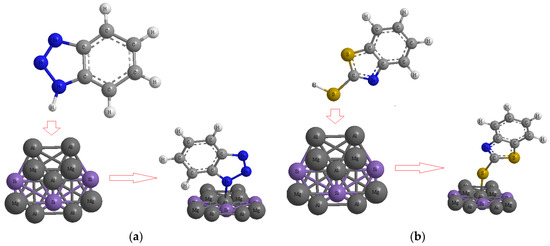
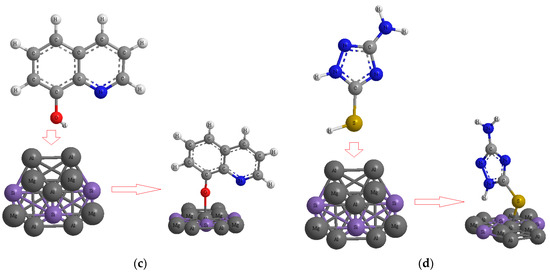
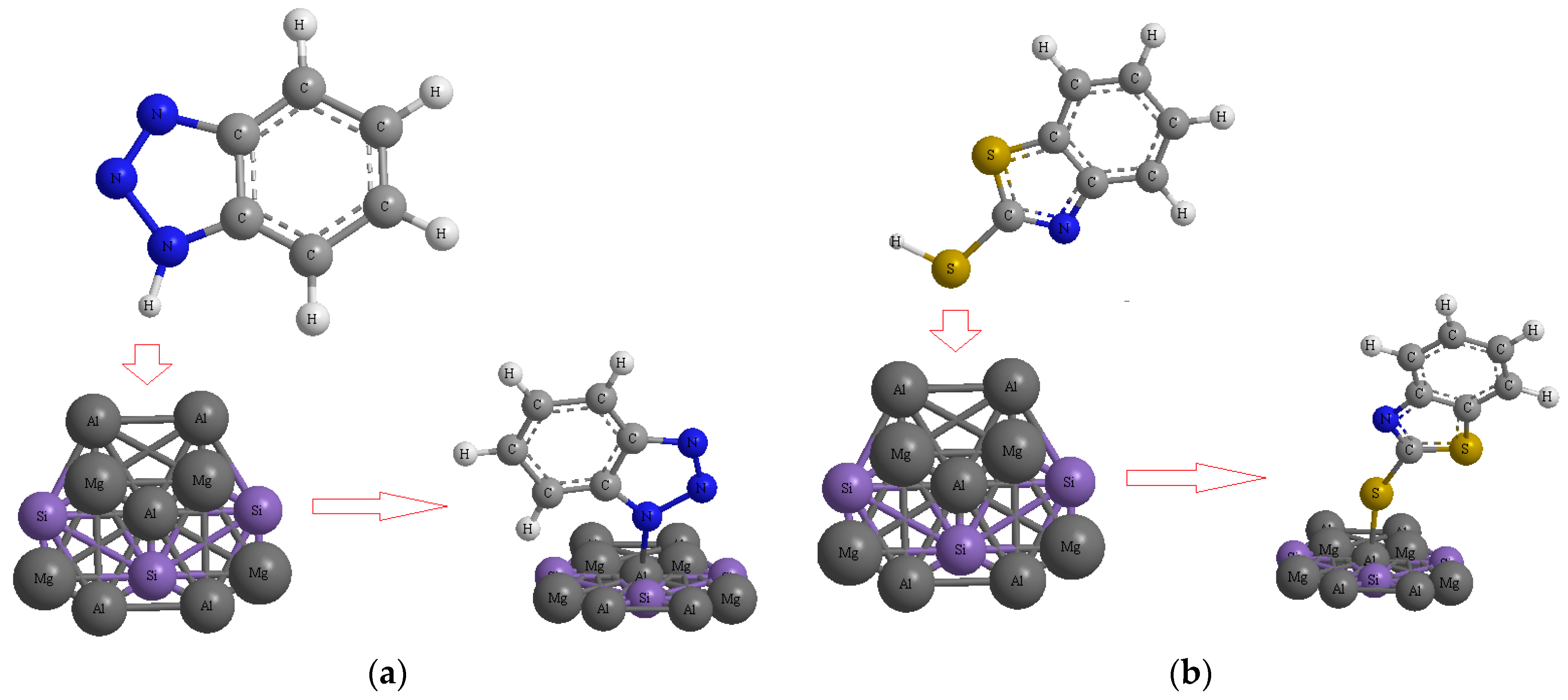
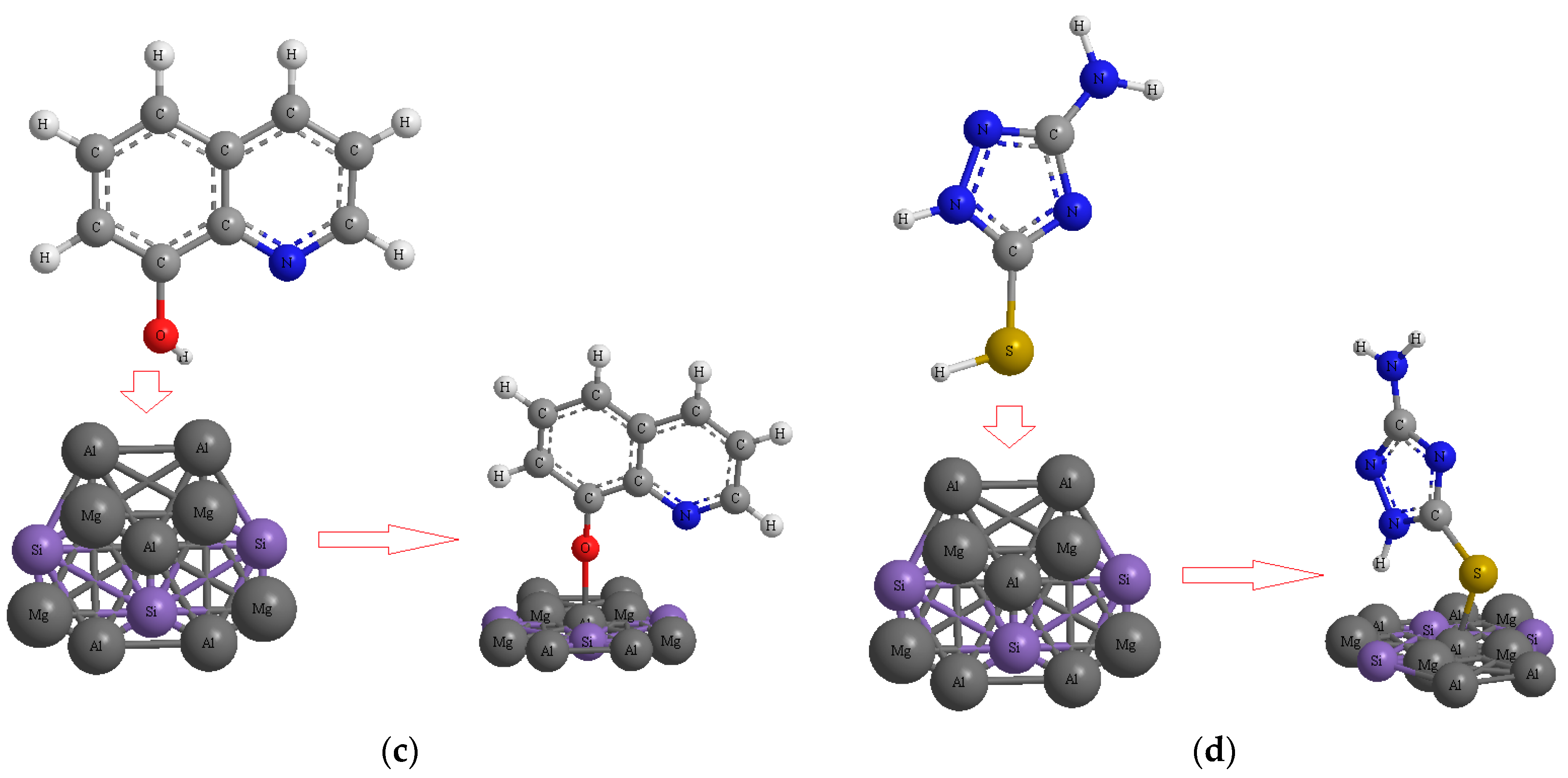
The adsorption of benzotriazole, 2-mercaptobenzothiazole, 8-hydroxyquinoline, and 3-amino-1,2,4-triazole-5-thiol as corrosion inhibitors on the aluminum alloy surface of Al-Mg-Si in NaCl solution was performed [29,30,31] (Scheme 1).
Scheme 1.
Mechanism of Langmuir adsorption of the organic corrosion inhibitors of (a) benzotriazole, (b) 2-mercaptobenzothiazole, (c) 8-hydroxyquinoline, and (d) 3-amino-1,2,4-triazole-5-thiol on an Al-Mg-Si alloy surface.
2.3. Conceptual “ONOIM”
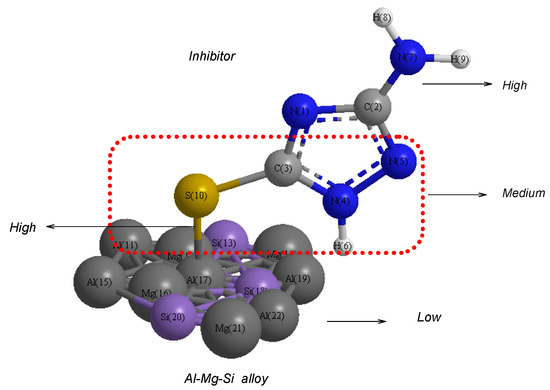
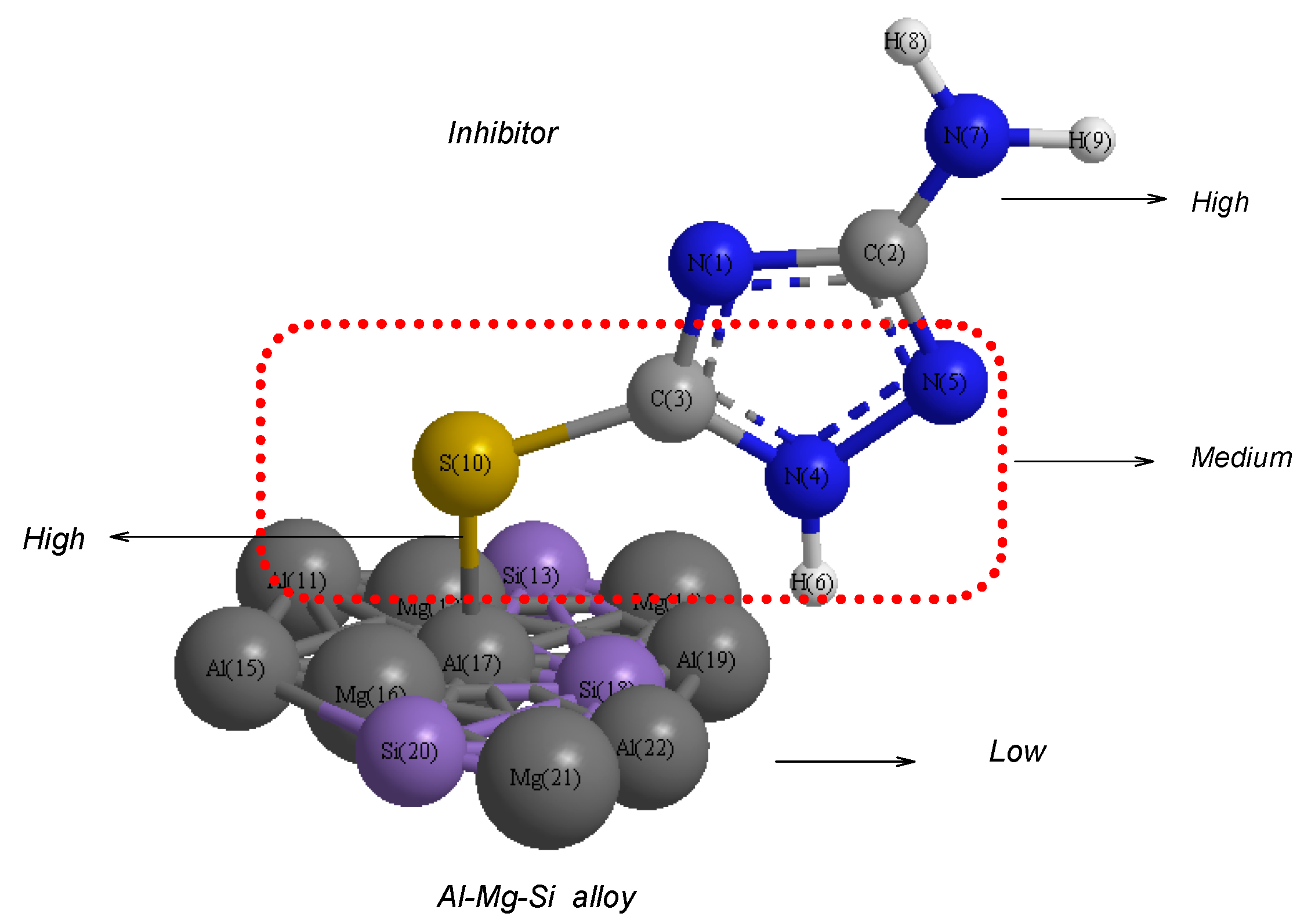
The three-layered pattern was applied for effective barriers of benzotriazole, 2-mercaptobenzothiazole, 8-hydroxyquinoline, and 3-amino-1,2,4-triazole-5-thiol adsorbing on an Al-Mg-Si alloy surface (Scheme 2) [32,33].
Scheme 2.
The “ONIOM” layer of adsorption mechanism of N-heterocyclic carbene on an Al-Mg-Si alloy surface based on optimized coordination.
We found that the surface binding site preferences of the N-atom of benzotriazole, O-atom of 8-hydroxyquinoline, and S-atom of both 2-mercaptobenzothiazole and 3-amino-1,2,4-triazole-5-thiol on the adsorption site were largely affected by the presence of neighboring atoms (Scheme 2).
The average composition and crystal lattice parameters of Al-Mg-Si with a needle shape were considered based on Miller indices (including a = 6.75, b = 4.05, and c = 7.94 Å) [34,35,36].
The resulting observations showed that the Al-Mg-Si alloy surface calculated with the obtained structure properties was in good agreement with those metal alloys from other experimental computations [37,38,39,40,41,42].
2.4. DFT Calculations
The Al-Mg-Si alloy surface was built with a rigid system and a “Z-Matrix” format, for which a blank line was placed and after that, the following information has been illustrated. The rigid “PES” was performed with the “CAM-B3LYP” functional [43,44,45,46,47,48,49] while employing the “6-31+ G (d,p)/EPRIII/LANL2DZ” basis sets [50] for benzotriazole, 8-hydroxyquinoline, 2-mercaptobenzothiazole, and 3-amino-1,2,4-triazole-5-thiol adsorbing onto the Al-Mg-Si alloy surface using the “Gaussian 16” program package [35]. For the Al alloy surface, the small energy difference between the formations of adsorbate → Al-Mg-Si alloy complex could direct us to a somewhat coated surface for preventing the corrosion.
3. Results and Discussion
Many inhibitors reduce or prohibit the corrosion of aluminum via either cathode or anodic reactions. Usage of chromates (which extinguish the anodic reactions with coatings as the inhibitions for aluminum sheets) has been reduced because of toxicity. Other compounds such as phosphates, silicates, nitrates, nitrites, benzoates, and N-heterocyclic structures can influence the cathodic reactions in an aqueous environment.
In this study, the susceptibility of organic inhibitors (benzotriazole, 2-mercaptobenzothiazole, 8-hydroxyquinoline, and 3-amino-1,2,4-triazole-5-thiol), the characteristics of the aluminum alloy surface (Al-Mg-Si), and the adsorption conditions were considerable.
3.1. Infrared Spectroscopy Analysis
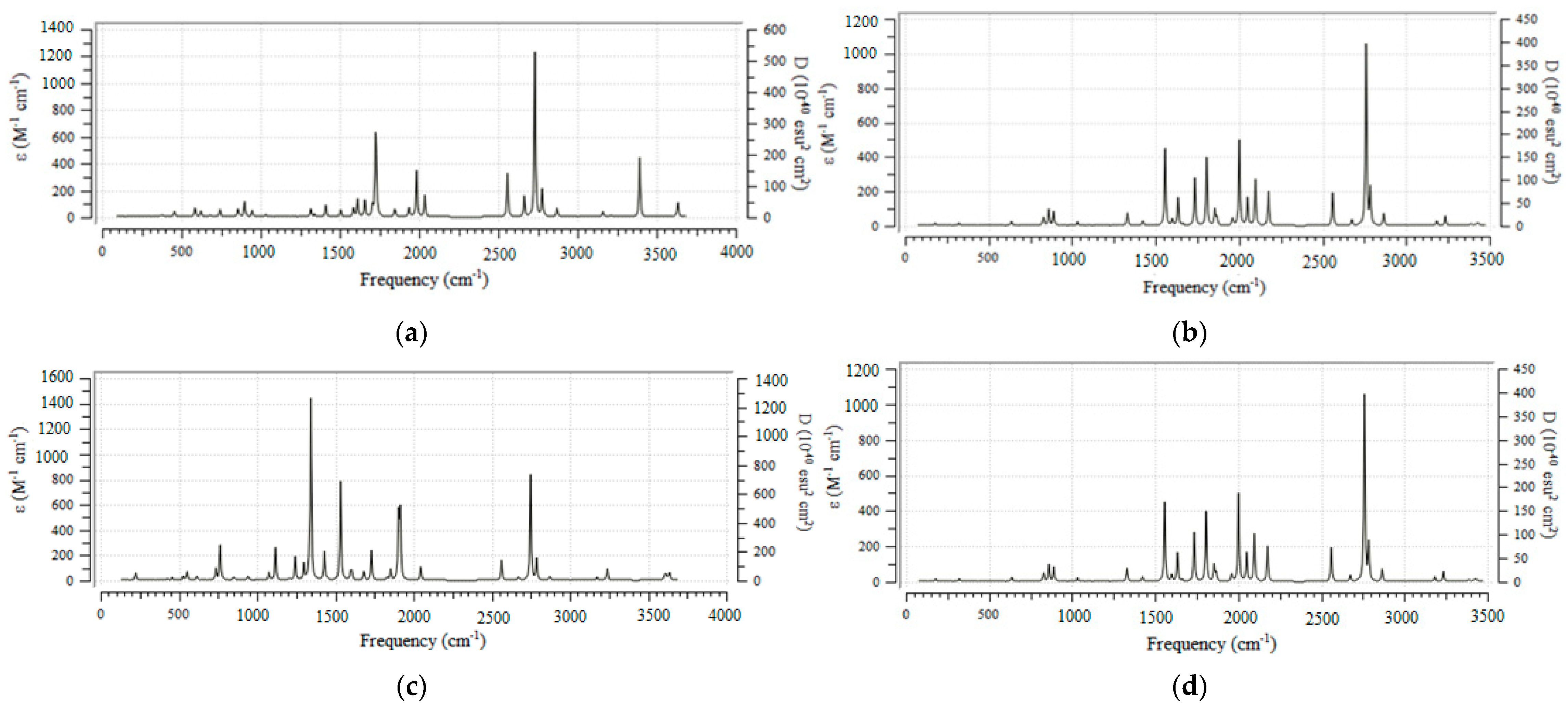
The infrared specifications around 1500–3500 cm−1 for benzotriazole → Al-Mg-Si, 2-mercaptobenzothiazole → Al-Mg-Si, 8-hydroxyquinoline → Al-Mg-Si, and 3-amino-1,2,4-triazole-5-thiol → Al-Mg-Si with the strongest peak at approximately 2700–2750 cm−1 are reported in Figure 1a–d.
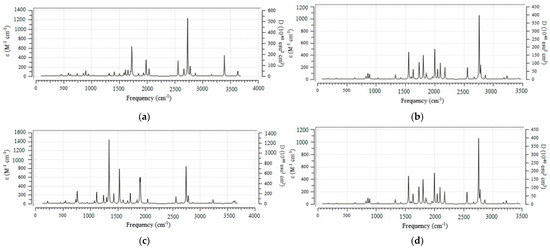
Figure 1.
Infrared specifications for (a) benzotriazole → Al-Mg-Si, (b) 2-mercaptobenzothiazole → Al-Mg-Si, (c) 8-hydroxyquinoline → Al-Mg-Si, and (d) 3-amino-1,2,4-triazole-5-thiol → Al-Mg-Si using the “CAM-B3LYP” method with “6-31+ G (d,p)/EPRIII/LANL2DZ” basis sets. ε (M−1cm−1 or Lmol−1cm−1) is the absorbance unit and D (10−4 esu2 cm2) is the dipole strength via the esu or electrostatic unit, which is a unit of charge in the cgs (centimeter-gram-second) system.
The vibrational calculations were done for an aluminum alloy of Al-Mg-Si interacting with four organic inhibitors including benzotriazole, 2-mercaptobenzothiazole, 8-hydroxyquinoline, and 3-amino-1,2,4-triazole-5-thiol adsorbed onto this alloy surface, which produced the complexes of benzotriazole → Al-Mg-Si, 2-mercaptobenzothiazole → Al-Mg-Si, 8-hydroxyquinoline → Al-Mg-Si, and 3-amino-1,2,4-triazole-5-thiol → Al-Mg-Si (Table 1).

Table 1.
Thermochemical traits for benzotriazole, 2-mercaptobenzothiazole, 8-hydroxyquinoline, and 3-amino-1,2,4-triazole-5-thiol as corrosion inhibitors on the aluminum alloy surface of Al-Mg-Si in NaCl solution at 300 K.
Table 1 shows physical and thermodynamic properties containing the dipole moment, thermal energy (∆E°), thermal enthalpy (∆H°), Gibbs free energy (∆G°), and entropy (S°). The values of various thermodynamic properties and dipole moments of benzotriazole, 2-mercaptobenzothiazole, 8-hydroxyquinoline, and 3-amino-1,2,4-triazole-5-thiol adsorbed on the Al-Mg-Si were enhanced by increasing the molecular weight of these compounds and the charge distribution between organic compounds (electron donor) and the surface (electron acceptor) (Table 1) [51].
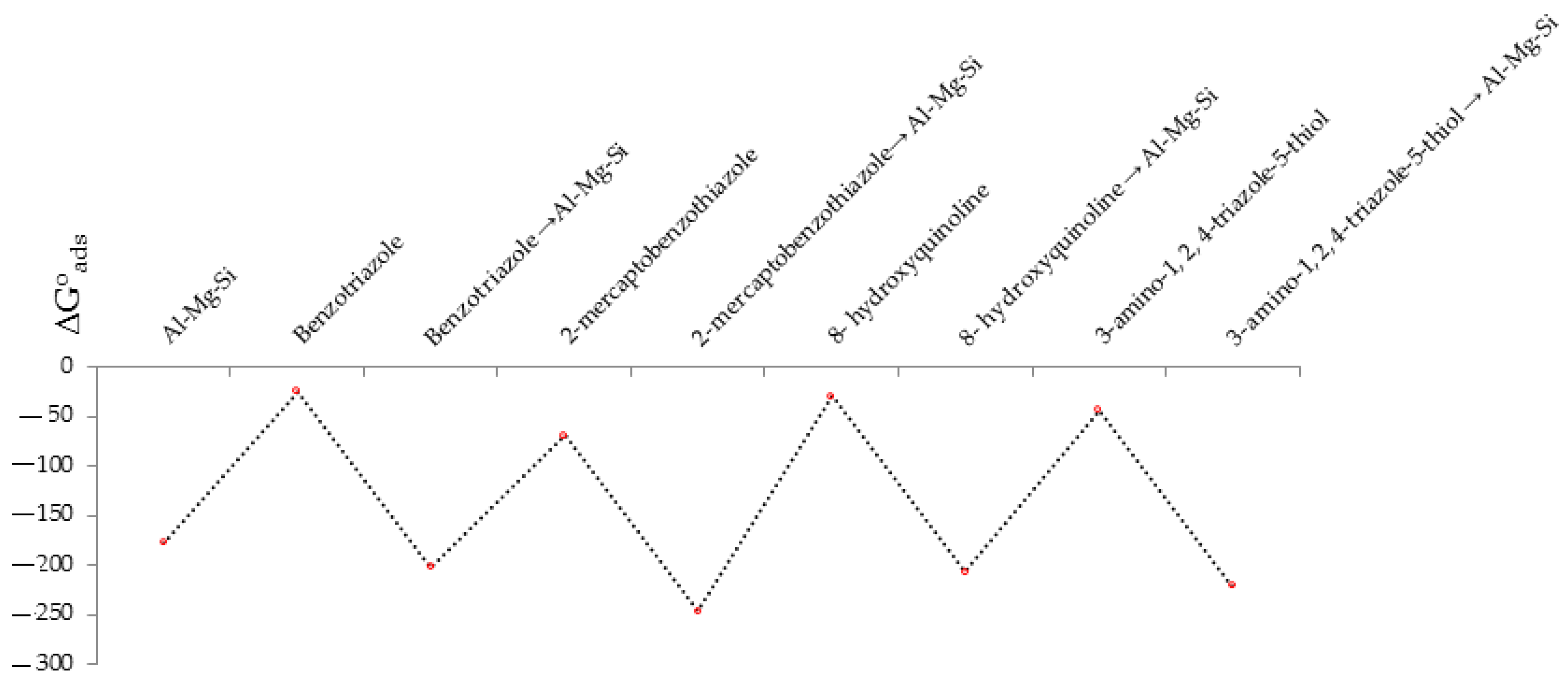
As shown in Figure 2, may depend on the interactions between the inhibiting agents and the Al alloy surfaces. In fact, a comparison to was in good accordance with the calculated results and the validity of the picked isotherm for the adsorption procdure of benzotriazole → Al-Mg-Si, 2-mercaptobenzothiazole → Al-Mg-Si, 8-hydroxyquinoline → Al-Mg-Si, and 3-amino-1,2,4-triazole-5-thiol → Al-Mg-Si (Figure 2).
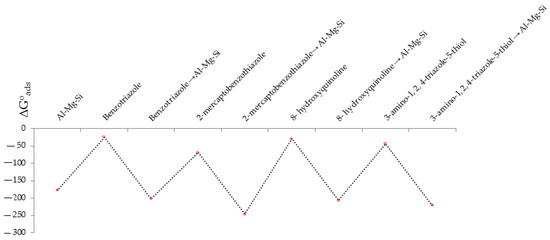
Figure 2.
Gibbs free energy of benzotriazole, 2-mercaptobenzothiazole, 8-hydroxyquinoline, and 3-amino-1,2,4-triazole-5-thiol as corrosion inhibitors on the Al-Mg-Si alloy surface in NaCl solution at 300 K.
On the basis of data in Table 1, we predicted that the adsorption of the inhibitor on the Al-Mg-Si alloy surface might be physical and chemical in nature. As shown in Figure 2, all the computed amounts were very close, which exhibited the agreement of the evaluated data by all methods and the validity of the computations; this also represented the maximum fluctuation for benzotriazole → Al-Mg-Si, 2-mercaptobenzothiazole → Al-Mg-Si, 8-hydroxyquinoline → Al-Mg-Si, and 3-amino-1,2,4-triazole-5-thiol → Al-Mg-Si (Figure 2).
3.2. “NMR” Spectroscopy & “NBO” Analysis
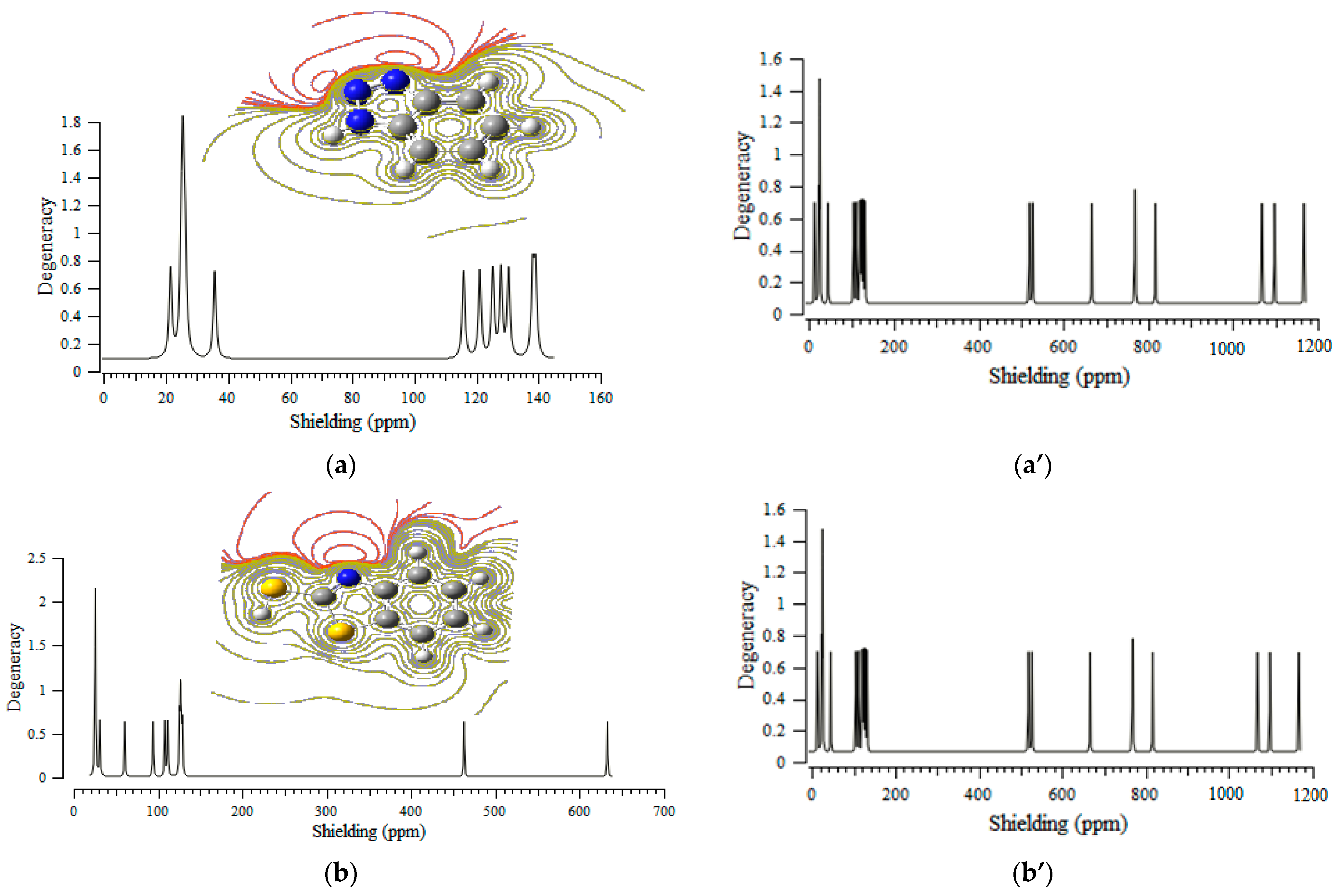
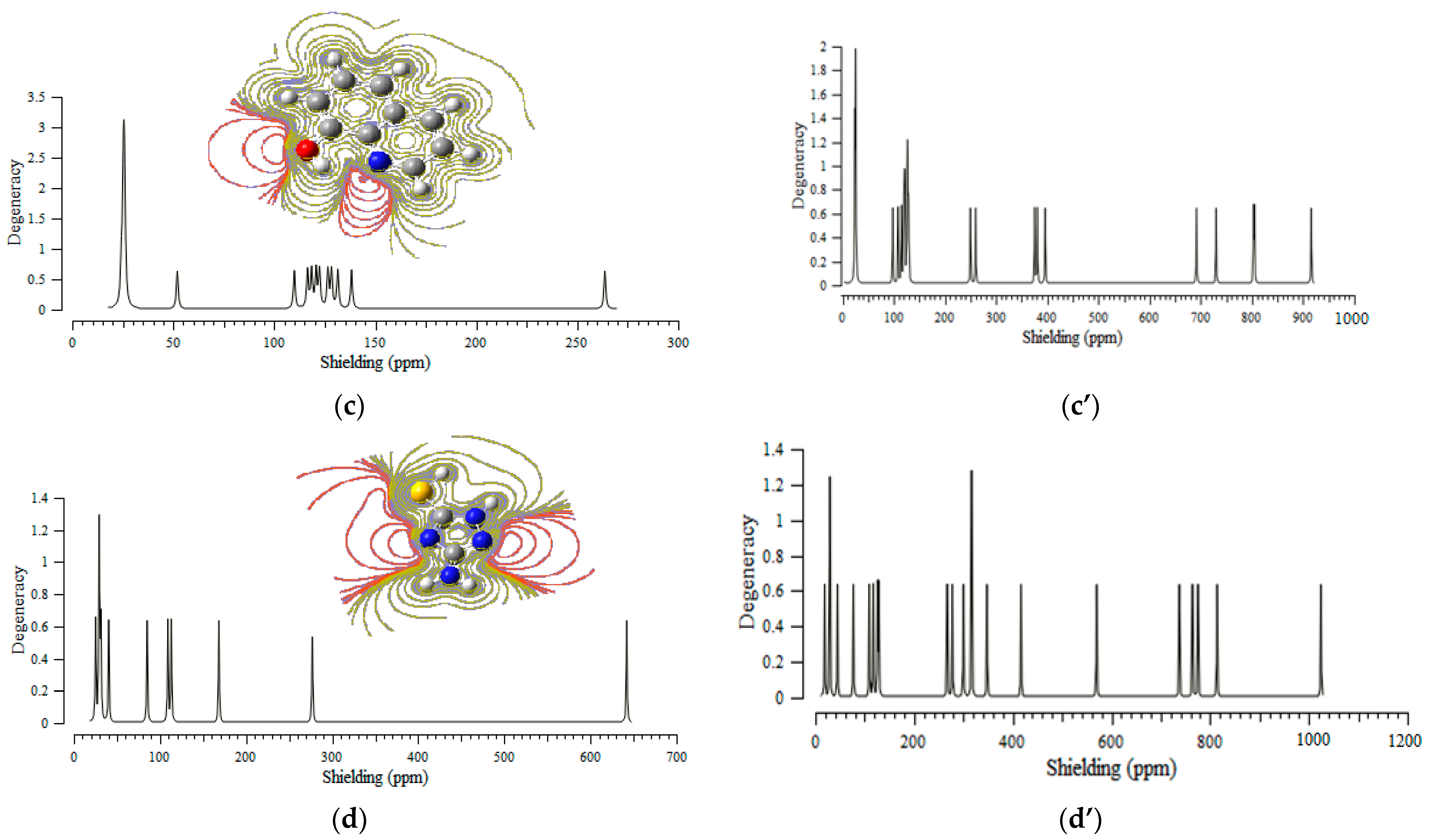
The heterocyclic organic inhibitors of benzotriazole, 2-mercaptobenzothiazole, 8-hydroxyquinoline, and 3-amino-1,2,4-triazole-5-thiol showed an approximately identical behavior (20–200 ppm) for various atoms in the active sites of these compounds through the “NMR” properties and electrostatic potential “ESP” surface (Figure 3a–d,a’–d’). The strongest peak was seen at almost 20 ppm for these components. The weakest peaks appeared at 120–140 ppm for all four heterocyclic carbenes, which consisted of benzotriazole, 2-mercaptobenzothiazole, 8-hydroxyquinoline, and 3-amino-1,2,4-triazole-5-thiol (Figure 3a–d).
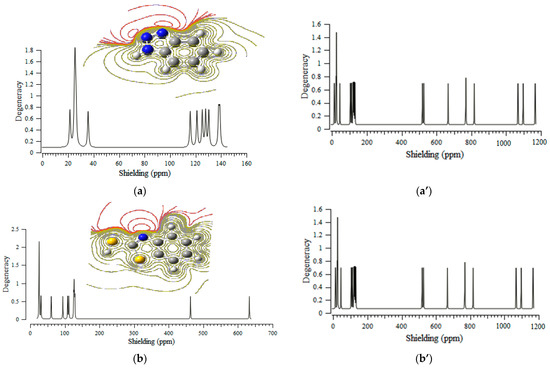
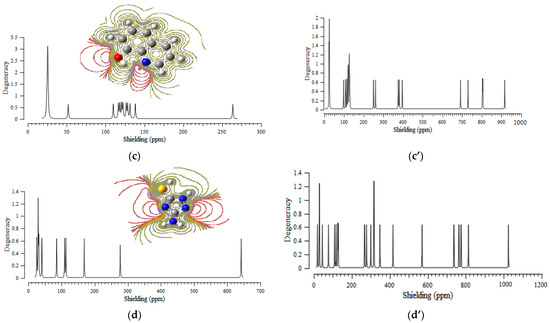
Figure 3.
Chemical shift of “NMR” spectroscopy for (a) benzotriazole, (a’) benzotriazole → Al-Mg-Si, (b) 2-mercaptobenzothiazole, (b’) 2-mercaptobenzothiazole → Al-Mg-Si, (c) 8-hydroxyquinoline, (c’) 8-hydroxyquinoline → Al-Mg-Si, (d) 3-amino-1,2,4-triazole-5-thiol, and (d’) 3-amino-1,2,4-triazole-5-thiol → Al-Mg-Si indicating the active nitrogen, oxygen, and sulfur atoms in heterocyclic compounds approaching the nanosurface.
Langmuir adsorbing of benzotriazole → Al-Mg-Si, 2-mercaptobenzothiazole → Al-Mg-Si, 8-hydroxyquinoline → Al-Mg-Si, and 3-amino-1,2,4-triazole-5-thiol → Al-Mg-Si showed band wavelengths between 10 ppm and 1000 ppm, and the sharpest peaks were at about 10 ppm for these compounds (Figure 3a’–d’).
Then, the atomic charge and “NMR” data of the isotropic (σiso) and anisotropic shielding tensor (σaniso) for benzotriazole → Al-Mg-Si, 2-mercaptobenzothiazole → Al-Mg-Si, 8-hydroxyquinoline → Al-Mg-Si, and 3-amino-1,2,4-triazole-5-thiol → Al-Mg-Si were calculated using Gaussian 16 revision C.01 software [35]; the results are reported in Table 2 [52,53,54].
Table 2.
Atomic charge (Q) and NMR properties of some atoms of benzotriazole, 2-mercaptobenzothiazole, 8-hydroxyquinoline, and 3-amino-1,2,4-triazole-5-thiol in ppm adsorbed onto the Al-Mg-Si alloy surface.
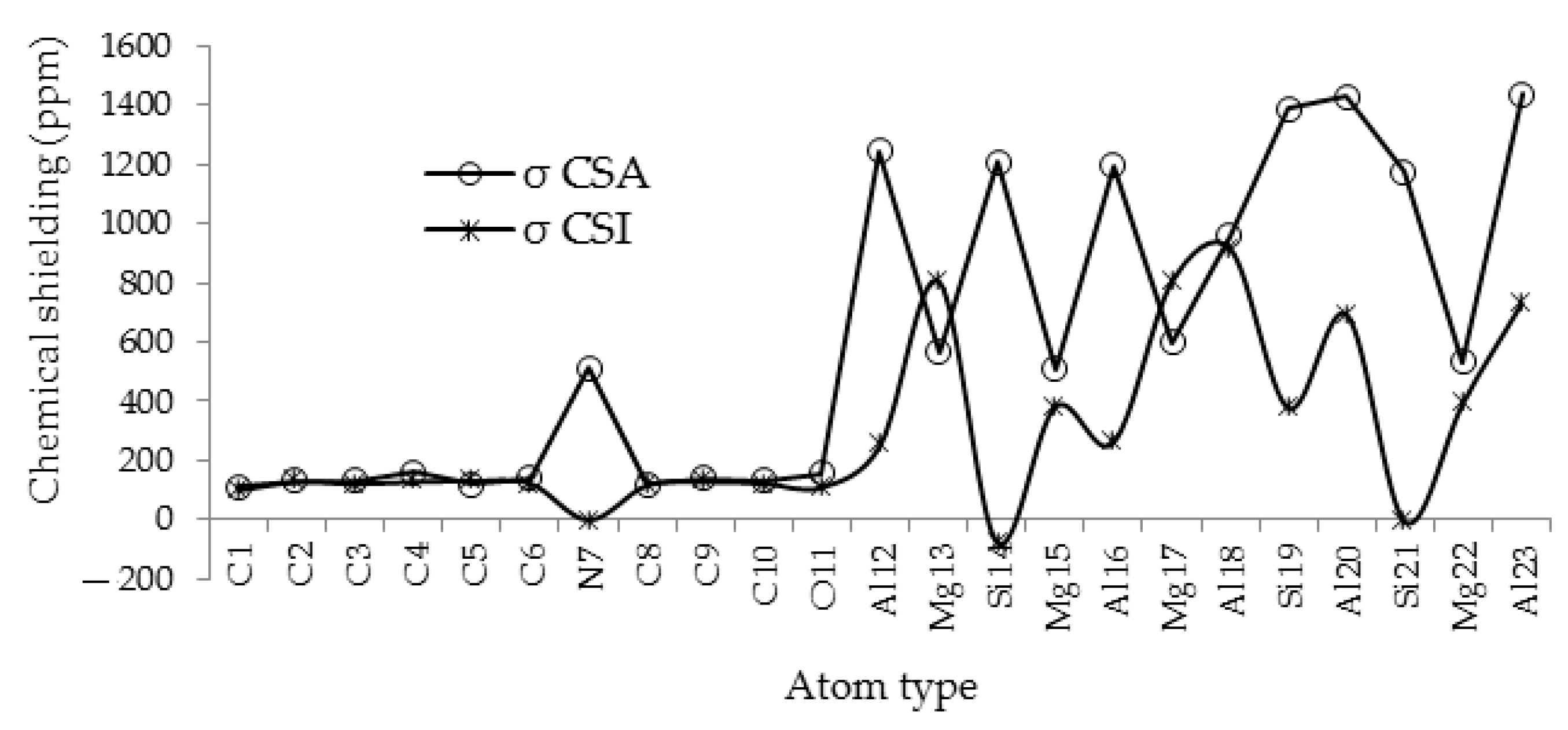
In addition, the NaCl solution influenced the electromagnetic traits of carbon, nitrogen, oxygen, sulfur, aluminum, magnesium, and silicon in benzotriazole → Al-Mg-Si, 2-mercaptobenzothiazole → Al-Mg-Si, 8-hydroxyquinoline → Al-Mg-Si, and 3-amino-1,2,4-triazole-5-thiol → Al-Mg-Si. Figure 4 indicates the isotropic (σCSI) and anisotropic (σCSA) chemical shielding tensors of some effective atoms on the adsorption sites of benzotriazole → Al-Mg-Si, 2-mercaptobenzothiazole → Al-Mg-Si, 8-hydroxyquinoline → Al-Mg-Si, and 3-amino-1,2,4-triazole-5-thiol → Al-Mg-Si (Table 2 and Figure 4).
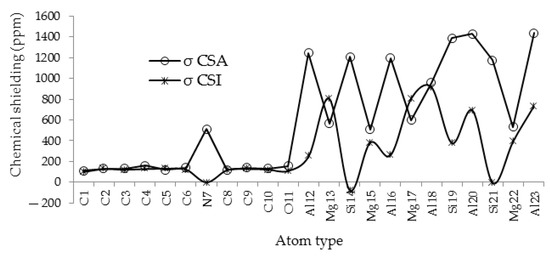
Figure 4.
Isotropic (σiso) and anisotropic (σaniso) shielding tensors through intra-atomic interactions with magnesium and silicon atoms on the alloy surface of Al-Mg-Si and interatomic interaction with organic inhibitors on the adsorption site of «N → Al, O → Al, S → Al».
Interatomic interactions, which are related positions of one, two, three, etc. atoms at a time, are written as a series expansion of functional parameters with interatomic potential [54].
Intra-atomic interactions consisted of Al-Al, Al-Mg, Al-Si, Mg-Mg, Mg-Si, and Si-Si; interatomic interactions were N → Al-Mg-Si, O → Al-Mg-Si, and S → Al-Mg-Si based on the of CAM-B3LYP/6-31+G(d,p)/EPR-III/LANL2DZ quantum mechanics calculations using the Gaussian 16 revision C.01 program (Figure 4).
In Figure 4, it can be observed that Al-Si(14), Al-Si(19), and Al-Si(21) directed us to the most influence in the neighbor atoms generated by interatomic reactions of N →Al, O → Al, and S → Al on the Al-Mg-Si alloy surface. Furthermore, the natural bond orbital (NBO) analysis of benzotriazole, 2-mercaptobenzothiazole, 8-hydroxyquinoline, and 3-amino-1,2,4-triazole-5-thiol adsorbed on the Al-Mg-Si surface is reported in Table 3.
Table 3.
NBO analysis of some atoms on the adsorption site for benzotriazole, 2-mercaptobenzothiazole, 8-hydroxyquinoline, and 3-amino-1,2,4-triazole-5-thiol bonded to the Al-Mg-Si alloy surface.
In Table 3, the benzotriazole, 2-mercaptobenzothiazole, 8-hydroxyquinoline, and 3-amino-1,2,4-triazole-5-thiol adsorbed on the Al-Mg-Si indicate the electron donor atoms bonded to the aluminum atom as the electron acceptor on the alloy surface at the active site area. The bond orbitals of S7—Al14 in 3-amino-1,2,4-triazole-5-thiol → Al-Mg-Si, S10—Al17 in 2-mercaptobenzothiazole → Al-Mg-Si, O11—Al18 in 8-hydroxyquinoline → Al-Mg-Si, and N7—Al16 in Benzotriazole → Al-Mg-Si showed the maximum occupancy.
3.3. Nuclear Quadrupole Resonance (“NQR”)
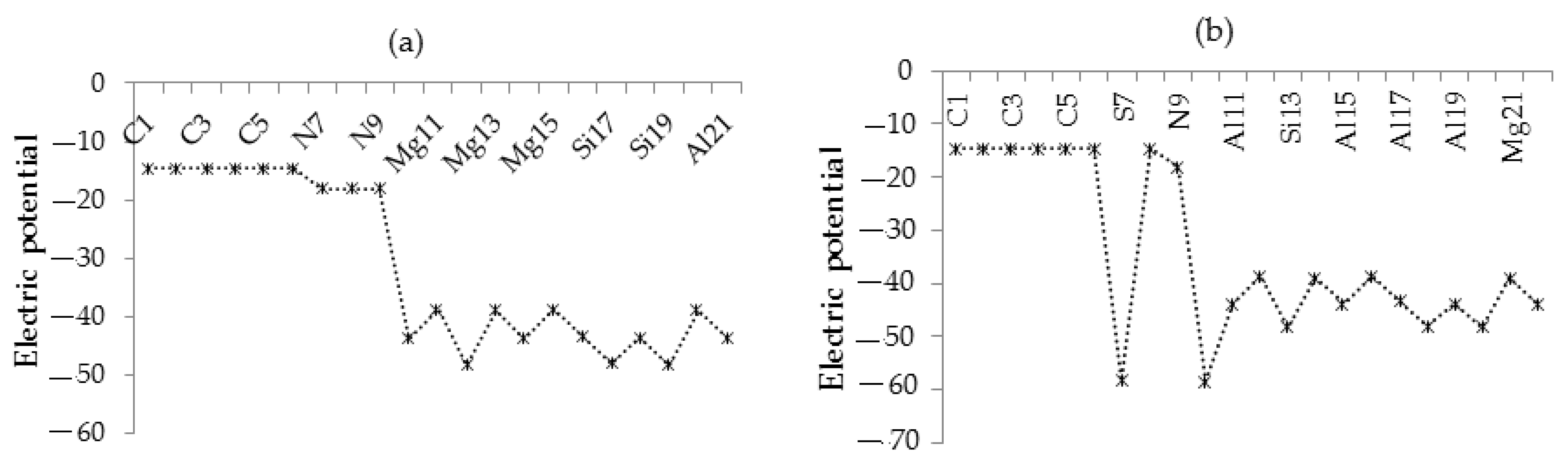
The nuclear quadrupole resonance (NQR) frequency for benzotriazole → Al-Mg-Si, 2-mercaptobenzothiazole → Al-Mg-Si, 8-hydroxyquinoline → Al-Mg-Si, and 3-amino-1,2,4-triazole-5-thiol → Al-Mg-Si was measured (Table 4). There was an electric quadrupole moment that was accompanied by non-spherical nuclear charge distributions. So, the nuclear charge distribution deviated from that of a sphere as the oblate or prolate form of the nucleus [55,56,57,58]. In this research work, the electric potential was measured for benzotriazole, 2-mercaptobenzothiazole, 8-hydroxyquinoline, and 3-amino-1,2,4-triazole-5-thiol diffusing onto an Al-Mg-Si alloy surface (Table 4).
Table 4.
Electric potential for elements of benzotriazole, 2-mercaptobenzothiazole, 8-hydroxyquinoline, and 3-amino-1,2,4-triazole-5-thiol adsorbed on the Al-Mg-Si alloy surface according to a “CAM-B3LYP/EPR-III,6-31+G(d,p)” calculation extracted from the “NQR” method.
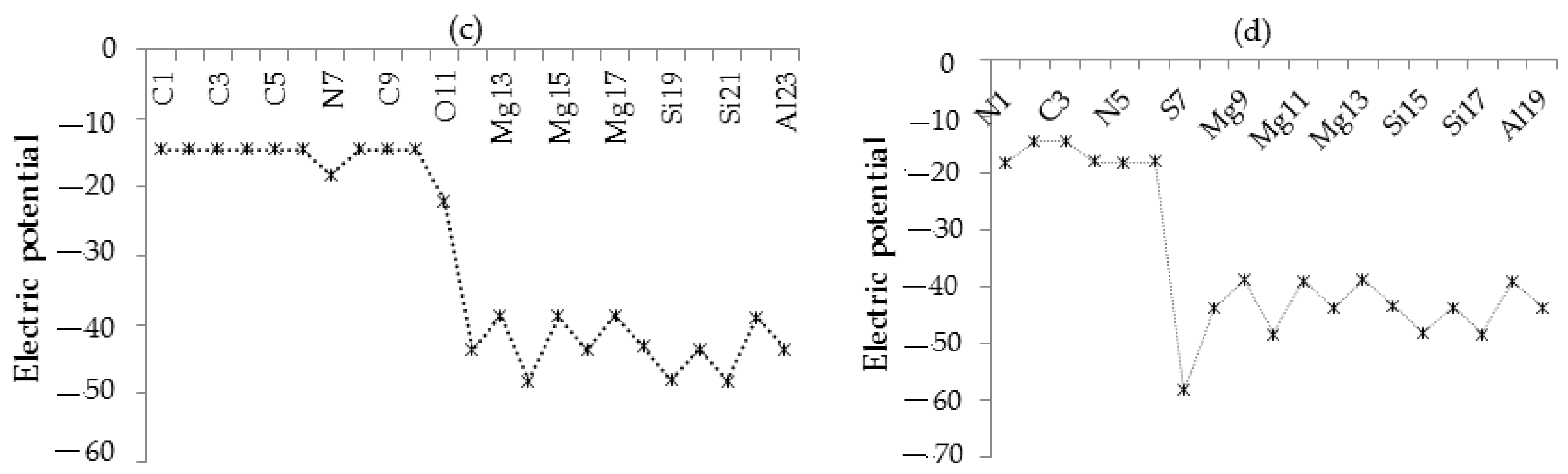
In addition, Figure 5a–d show the electric potential for elements of benzotriazole, 2-mercaptobenzothiazole, 8-hydroxyquinoline, and 3-amino-1,2,4-triazole-5-thiol that were adsorbed onto the Al-Mg-Si alloy.
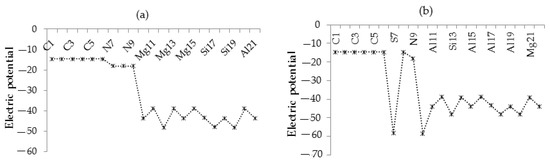
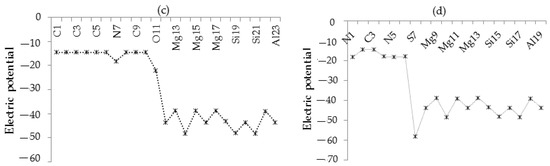
Figure 5.
Electric potential for (a) benzotriazole, (b) 2-mercaptobenzothiazole, (c) 8-hydroxyquinoline, and (d) 3-amino-1,2,4-triazole-5-thiol adsorbed onto the Al-Mg-Si alloy.
Figure 5 shows the electric potential for carbon, nitrogen, oxygen, sulfur, aluminum, magnesium, and silicon in benzotriazole → Al-Mg-Si, 2-mercaptobenzothiazole → Al-Mg-Si, 8-hydroxyquinoline → Al-Mg-Si, and 3-amino-1,2,4-triazole-5-thiol → Al-Mg-Si.
3.4. Charge Density Analysis
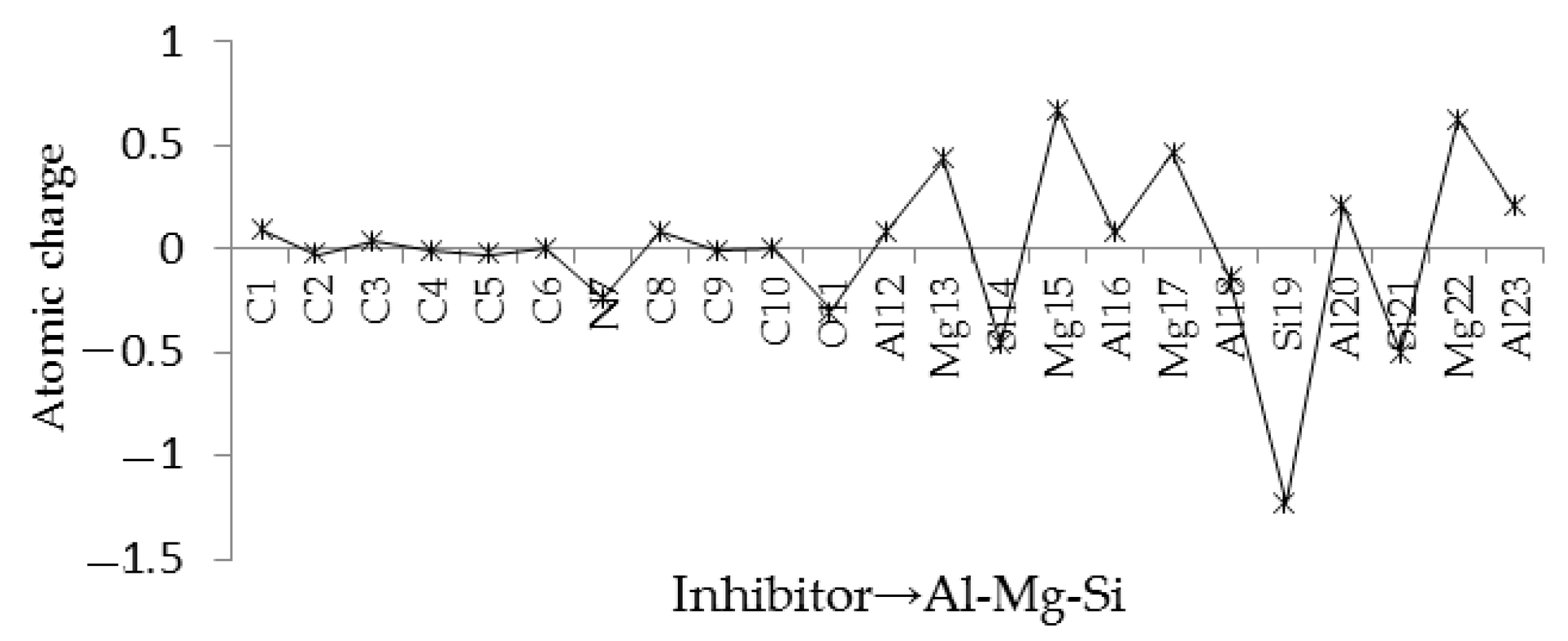
By observing the intra/interatomic interactions between the organic inhibitor of benzotriazole, 2-mercaptobenzothiazole, 8-hydroxyquinoline, and 3-amino-1,2,4-triazole-5-thiol with the Al-Mg-Si alloy surface and the consequent formation of adsorbed surfaces of benzotriazole → Al-Mg-Si, 2-mercaptobenzothiazole→ Al-Mg-Si, 8-hydroxyquinoline → Al-Mg-Si, and 3-amino-1,2,4-triazole-5-thiol → Al-Mg-Si (Table 2), the charge density difference (“CDD”) for these structures at the adsorption site was estimated and plotted as shown in Figure 6.
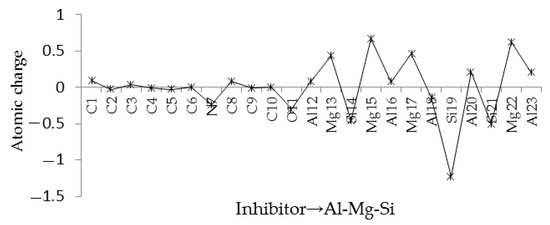
Figure 6.
Calculated electronic charge for aluminum atoms through intra-atomic interactions with magnesium and silicon on the alloy surface of Al-Mg-Si and through interatomic interactions with organic inhibitors on the adsorption site of «N → Al, O → Al, S → Al».
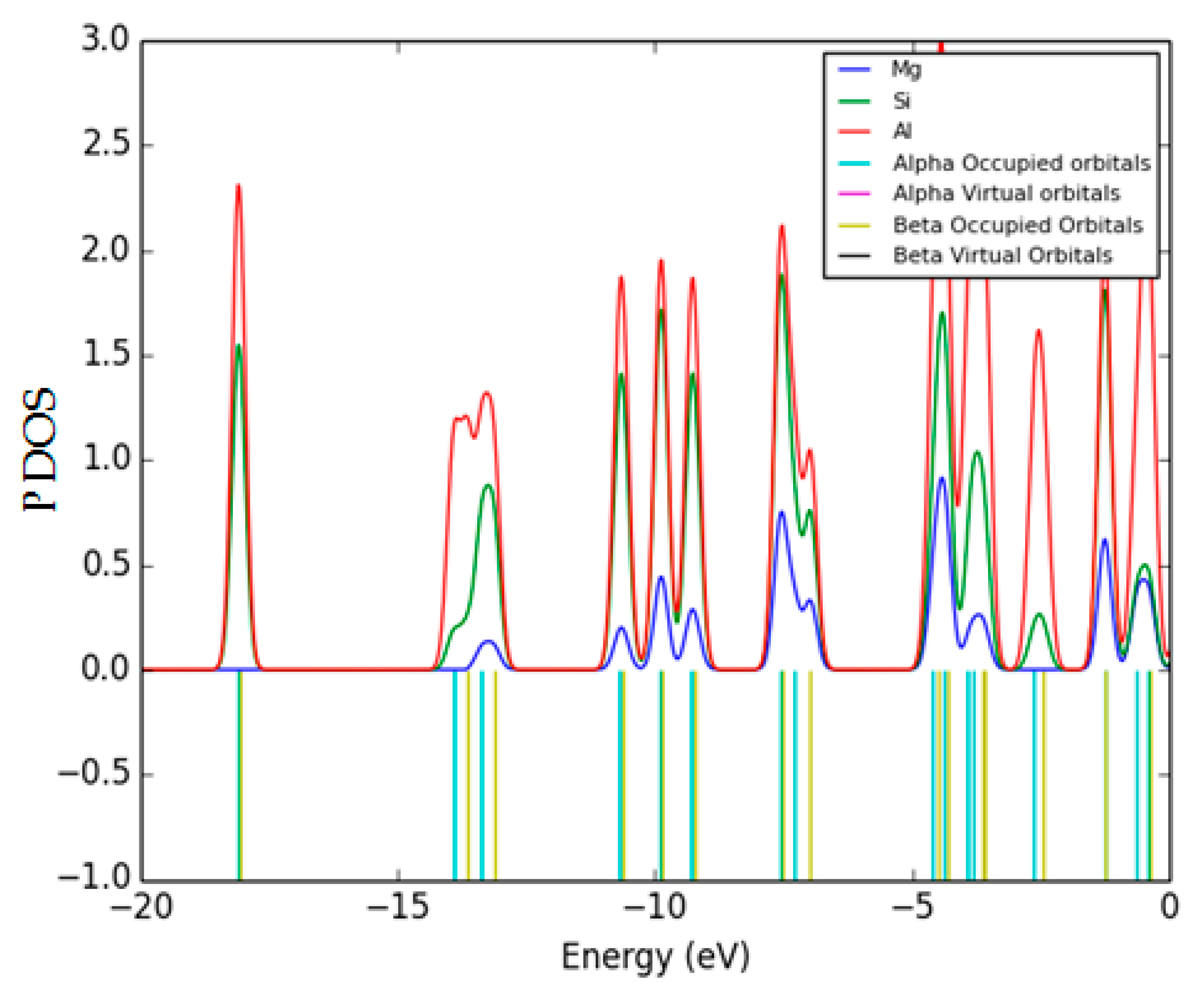
Furthermore, the presence of covalent bonds in this alloy exhibited the identical energy value and outlook of the “PDOS” for the p orbitals of aluminum and silicon (Figure 7).
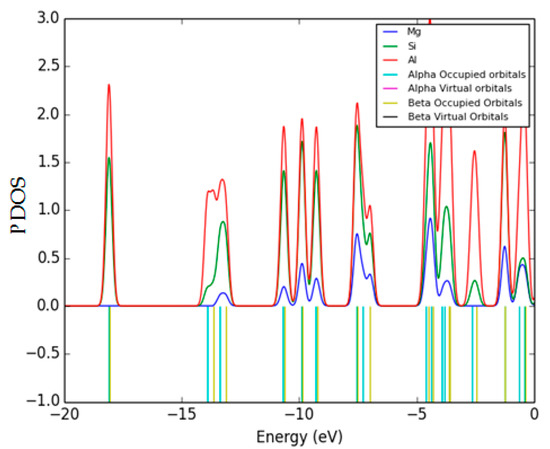
Figure 7.
PDOS of Al-Mg-Si alloy surface with Fermi level = 0.
Furthermore, the Al-Mg-Si alloy surface showed an atomic charge (coulomb) of −1.200 before adsorption of heterocyclic carbenes and −1.41, −1.136, −1.230, and −0.407 after adsorption of benzotriazole, 2-mercaptobenzothiazole, 8-hydroxyquinoline, and 3-amino-1,2,4-triazole-5-thiol, respectively. Therefore, the charge densities for benzotriazole, 2-mercaptobenzothiazole, 8-hydroxyquinoline, and 3-amino-1,2,4-triazole-5-thiol on the Al-Mg-Si alloy surface were alternatively: ∆Q3-amino-1,2,4-triazole-5-thiol → Al-Mg-Si = 0.793 > ∆Q2-mercaptobenzothiazole → Al-Mg-Si = 0.064 > ∆Q8-hydroxyquinoline → Al-Mg-Si = −0.03 > ∆Qbenzotriazole → Al-Mg-Si = −0.21. The data explain the charge penetration through adsorption of benzotriazole on the Al-Mg-Si alloy surface.
3.5. Potential Energy of Interatomic Interactions
When binding occurred, we could observe the potential with both an attractive and a repulsive component [59]. Therefore, the optimized potential energies of the interatomic interaction for benzotriazole → Al-Mg-Si, 2-mercaptobenzothiazole → Al-Mg-Si, 8-hydroxyquinoline → Al-Mg-Si, and 3-amino-1,2,4-triazole-5-thiol → Al-Mg-Si were measured (Table 5).
Table 5.
Potential energy (kcal/mol) for benzotriazole, oxygen atom in 8-hydroxyquinoline, and sulfur atom in both 2-mercaptobenzothiazole and 3-amino-1,2,4-triazole-5-thiol with aluminum on the Al-Mg-Si nanosurface.
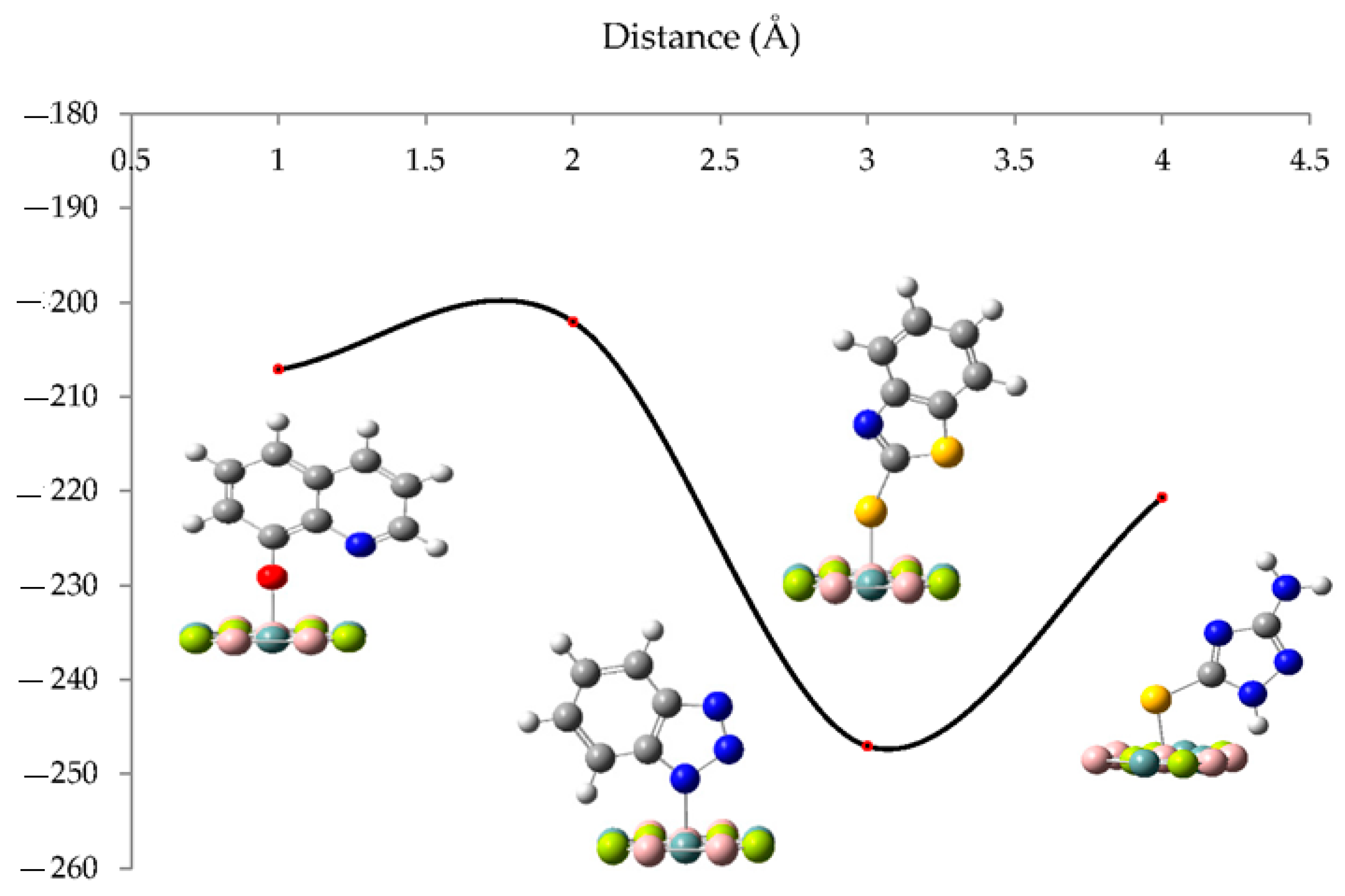
Then, the distance between the nitrogen atom in benzotriazole, oxygen atom in 8-hydroxyquinoline, and sulfur atom in both 2-mercaptobenzothiazole and 3-amino-1,2,4-triazole-5-thiol with aluminum on the Al-Mg-Si nanosurface was evaluated (Table 5 and Figure 8).
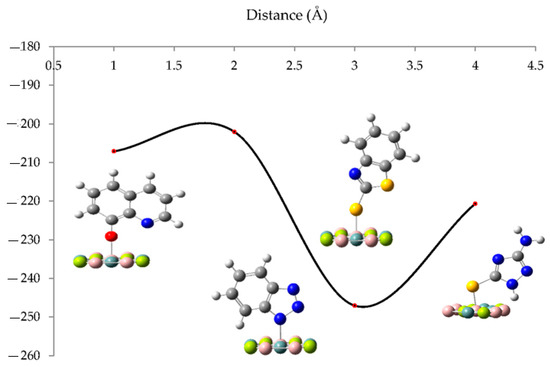
Figure 8.
Potential energy (kcal/mol) for benzotriazole, oxygen atom in 8-hydroxyquinoline, and sulfur atom in both 2-mercaptobenzothiazole and 3-amino-1,2,4-triazole-5-thiol with aluminum on the Al-Mg-Si nanosurface.
Based on Figure 8, we assumed that for benzotriazole → Al-Mg-Si, 2-mercaptobenzothiazole → Al-Mg-Si, 8-hydroxyquinoline → Al-Mg-Si, and 3-amino-1,2,4-triazole-5-thiol → Al-Mg-Si, the Lennard-Jones potential as an intermolecular pair potential can be described [60,61].
3.6. “HOMO”, “LUMO”, and “UV-vis” Analysis
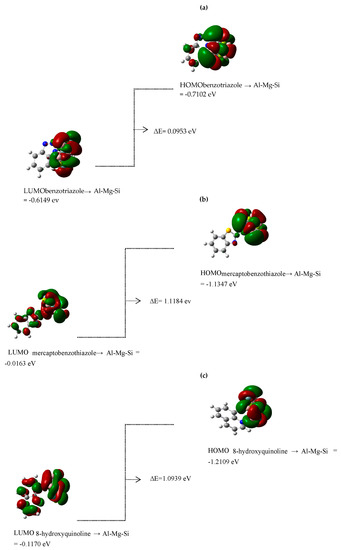
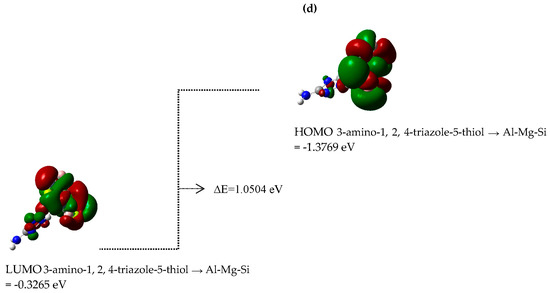
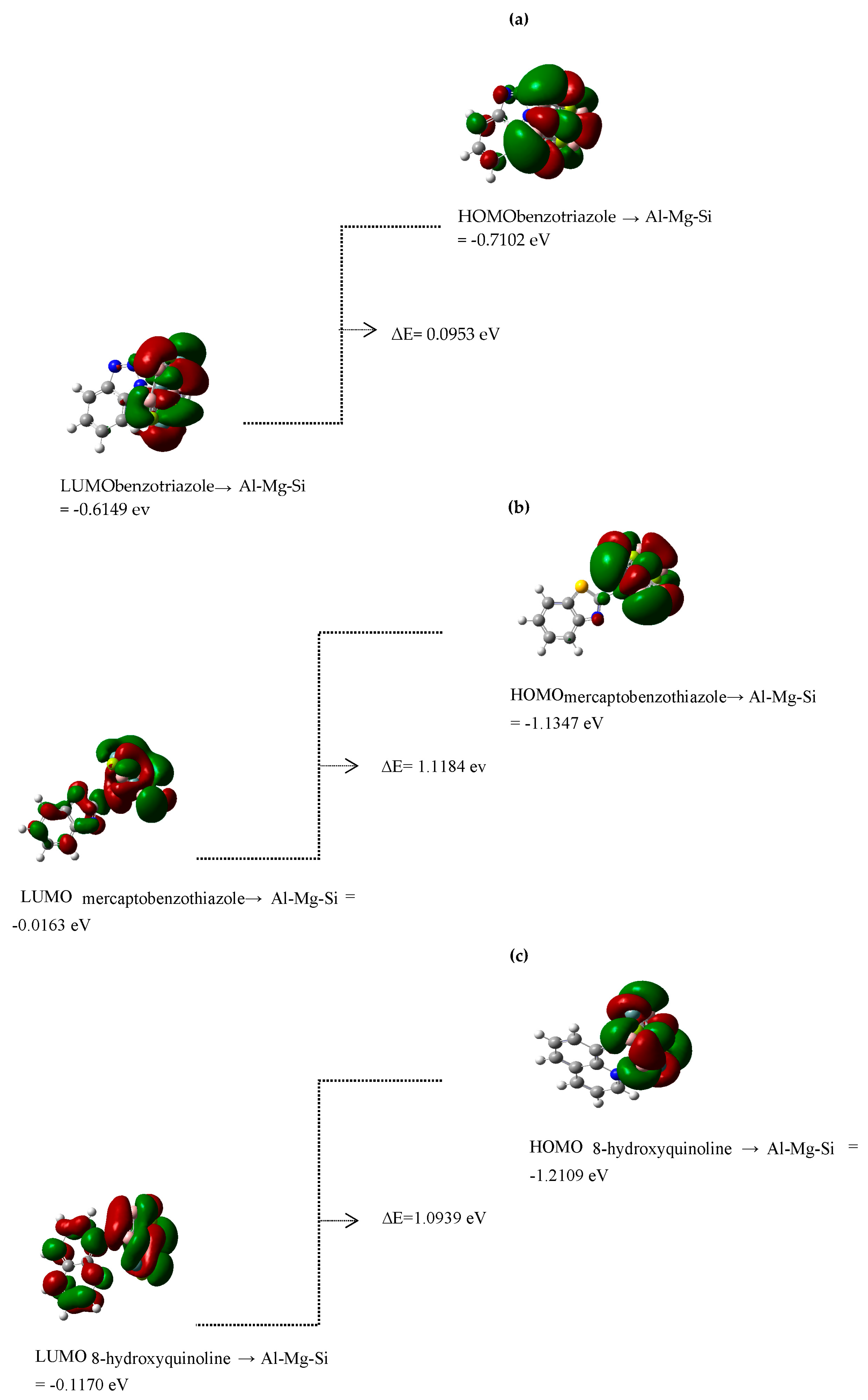
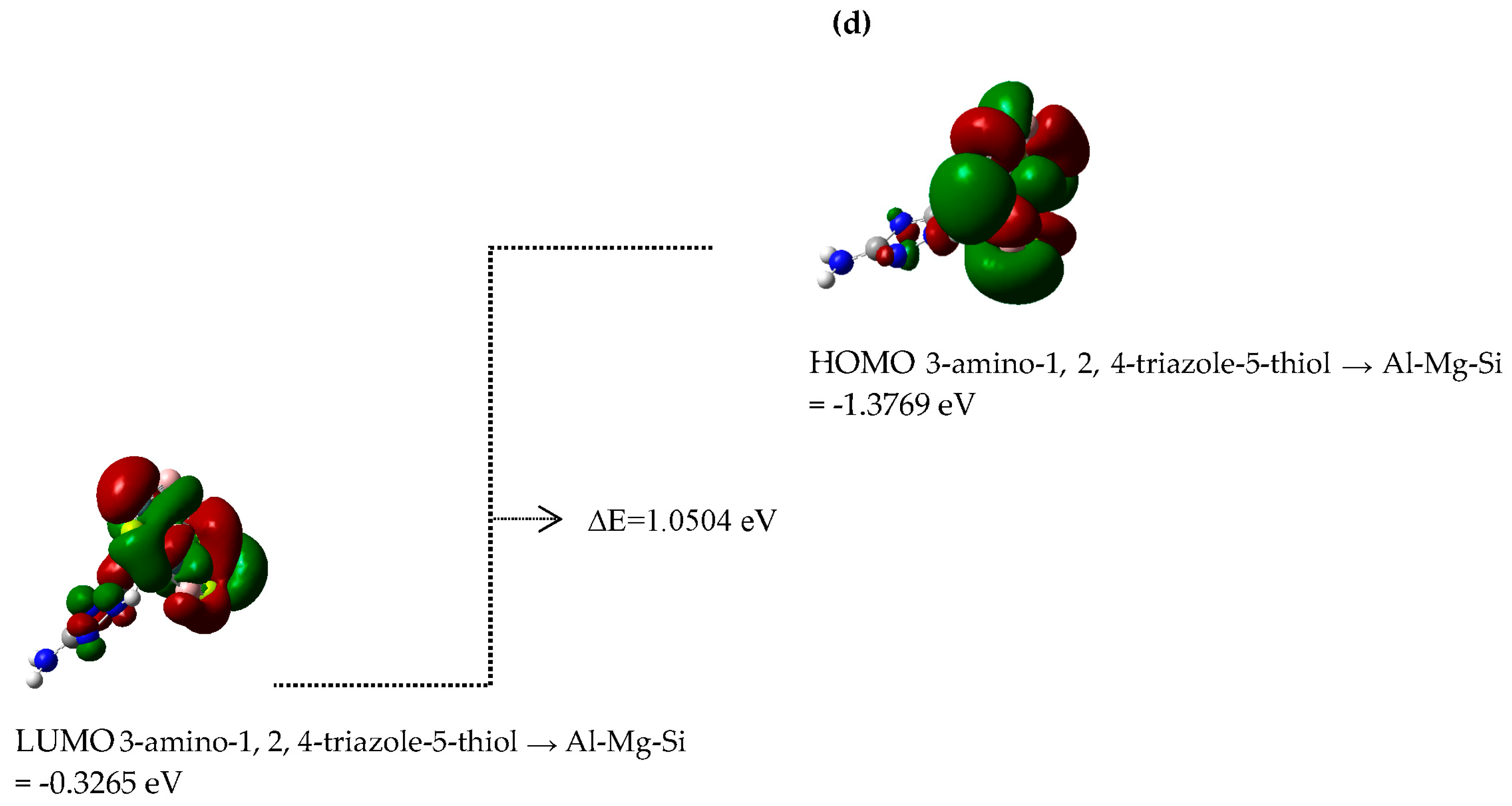
Ionization causes the highest occupied molecular orbital (“HOMO”) energy, and the electron affinity produces the lowest unoccupied molecular orbital (“LUMO”) energy, which were calculated and reported for benzotriazole → Al-Mg-Si, 2-mercaptobenzothiazole → Al-Mg-Si, 8-hydroxyquinoline → Al-Mg-Si, and 3-amino-1,2,4-triazole-5-thiol → Al-Mg-Si (Scheme 3). The “HOMO” (au), “LUMO” (au), and band energy gap “∆E = E LUMO- EHOMO” (ev) present a pictorial explanation of the frontier molecular orbitals and their respective positive and negative zones, which were important factors in identifying the molecular characteristics of effective compounds in these organic inhibitors (Scheme 3).
Scheme 3.
The HOMO, LUMO, and band energy gap (ev) for three organic inhibitors for (a) benzotriazole → Al-Mg-Si, (b) 2-mercaptobenzothiazole, (c) 8-hydroxyquinoline, and (d) 3-amino-1,2,4-triazole-5-thiol → Al-Mg-Si.
In fact, the compositions with a half-filled “HOMO-LUMO” band were not only metallic but could also turn to semiconducting, in which a molecular material is known to enter the zero-resistance state encountered for Al-Mg-Si toward adsorption of organic heterocyclic carbenes. The chemical reactivity of Al-Mg-Si was conducted by its low “HOMO–LUMO” gap, making it an appropriate electron acceptor. The energy gap between “HOMO” and “LUMO” distinguished the attributes of molecular electrical transport [62]. Based on the “Franck–Condon” principle, the maximum absorption peak (max) depends on a UV–visible spectrum of vertical excitation [63,64,65,66,67].
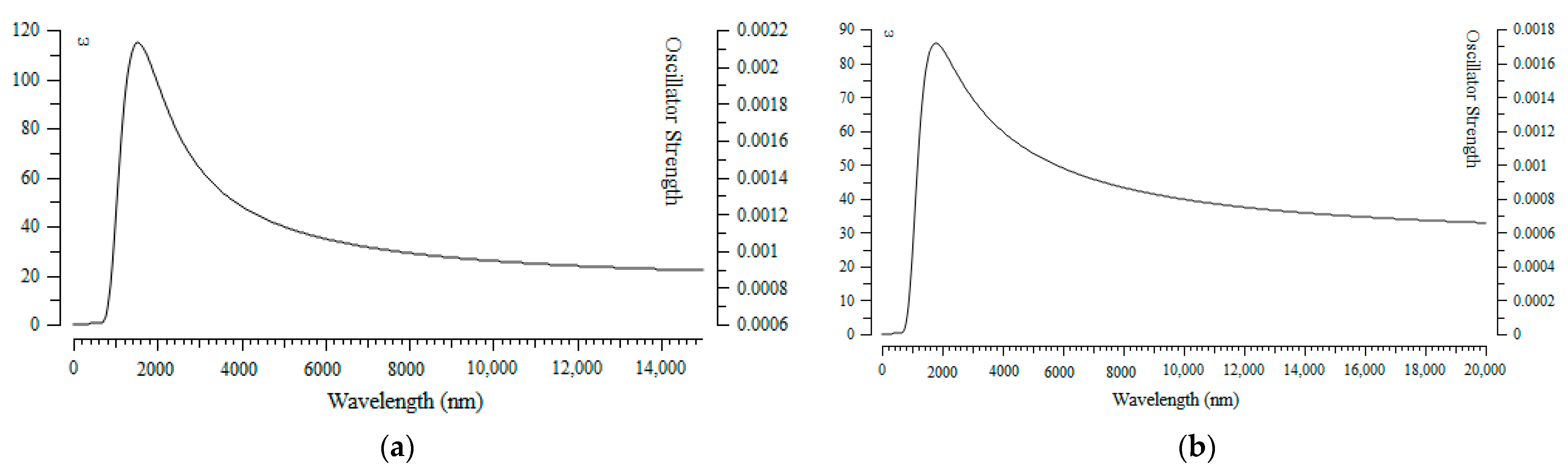
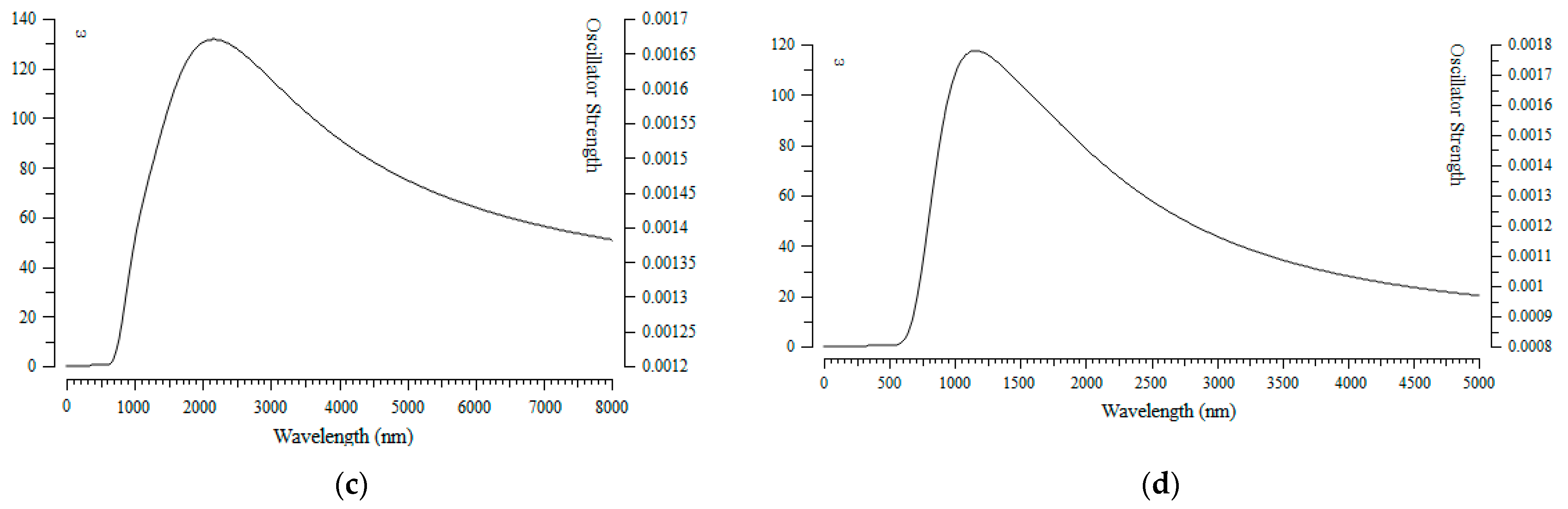
Finally, “TD-DFT/6-31+G (2d,p)/EPR-III/LANL2DZ” computation which has been a computational QM modelling methodology for studying the electronic structure of many-body systems [49,68,69,70,71,72], was done to identify the low-lying excited states of benzotriazole, 8-hydroxyquinoline, 2-mercaptobenzothiazole, and 3-amino-1,2,4-triazole-5-thiol adsorbing on the Al-Mg-Si alloy surface. The data contained the vertical excitation energies, oscillator strengths, and wavelengths, which are shown in Figure 9a–d.
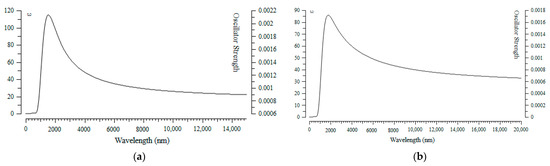
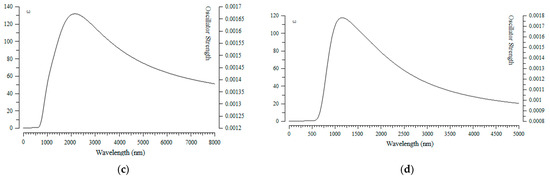
Figure 9.
“UV-vis” spectra for (a) benzotriazole → Al-Mg-Si, (b) 2-mercaptobenzothiazole, (c) 8-hydroxyquinoline, and (d) 3-amino-1,2,4-triazole-5-thiol → Al-Mg-Si.
As a matter of fact, based on the calculated values of the “UV-vis” spectra for benzotriazole, 2-mercaptobenzothiazole, 8-hydroxyquinoline, and 3-amino-1,2,4-triazole-5-thiol adsorbing onto the Al-Mg-Si alloy surface, there were maximum adsorption bands in the range of 1000–3000 nm wavelengths for these organic heterocyclic inhibitors of the joint metal alloy; these showed a sharp peak with an approximately 2000 nm wavelength (Figure 9a–d).
4. Conclusions
In this work, the adsorption and diffusion of benzotriazole, 2-mercaptobenzothiazole, 8-hydroxyquinoline, and 3-amino-1,2,4-triazole-5-thiol adsorbed onto an Al-Mg-Si alloy surface were studied based on the “Langmuir” theory using the “ONIOM” method with “high”, “medium”, and “low” levels of “EPR-III/6-31+G (d,p)/LANL2DZ” as well as semi-empirical and “MM2” basis sets using the program package “Gaussian 16” revision C.01.
In this research, the effectiveness of the (N- and S-) heterocycles as the Al alloy coating was investigated through the electromagnetic traits, a thermodynamic analysis, and characteristics of the environmental situation, which resulted in the complexes of benzotriazole → Al-Mg-Si, 2-mercaptobenzothiazole → Al-Mg-Si, 8-hydroxyquinoline → Al-Mg-Si, and 3-amino-1,2,4-triazole-5-thiol → Al-Mg-Si.
A special investigation of the mechanism of local minima in the adsorption potential energy insight denoted that the intact benzotriazole, 2-mercaptobenzothiazole, 8-hydroxyquinoline, and 3-amino-1,2,4-triazole-5-thiol were adsorbed with the aromatic ring parallel to the Al-Mg-Si alloy surface. In the favorite path, these (N- and S-) heterocycles remained parallel to the surface while running small single rotational steps with a “C–C” double-bond hinged top of a single Al element.
Author Contributions
F.M.: Conceptualization and idea, Methodology, Software, Validation, Formal analysis, Investigation, Data curation, Writing—original draft preparation, visualization, Supervision, Project administration. M.M.: Methodology, Software, Formal analysis, Investigation, Data curation, Writing—review and editing, Visualization, Resources. All authors have read and agreed to the published version of the manuscript.
Funding
This research received no external funding.
Data Availability Statement
Not applicable.
Acknowledgments
In successfully completing this paper and its research, the authors are grateful to Kastamonu University for its support through the library, the laboratory, and scientific websites.
Conflicts of Interest
The authors declare no conflict of interest.
References
- Lasagni, F.; Lasagni, A.; Marks, E.; Holzapfel, C.; Mücklich, F.; Degischer, H. Three-dimensional characterization of ‘as-cast’ and solution-treated AlSi12(Sr) alloys by high-resolution FIB tomography. Acta Mater. 2007, 55, 3875–3882. [Google Scholar] [CrossRef]
- Mollaamin, F.; Monajjemi, M. Molecular modelling framework of metal-organic clusters for conserving surfaces: Langmuir sorption through the TD-DFT/ONIOM approach. Mol. Simul. 2023, 49, 365–376. [Google Scholar] [CrossRef]
- Requena, G.; Garcés, G.; Rodríguez, M.; Pirling, T.; Cloetens, P. 3D architecture and load partition in eutectic Al-Si alloys. Adv. Eng. Mater. 2009, 11, 1007–1014. [Google Scholar] [CrossRef]
- Mollaamin, F.; Monajjemi, M. In Silico-DFT Investigation of Nanocluster Alloys of Al-(Mg, Ge, Sn) Coated by Nitrogen Heterocyclic Carbenes as Corrosion Inhibitors. J. Clust. Sci. 2023, 1–18. [Google Scholar] [CrossRef]
- Asghar, Z.; Requena, G.; Kubel, F. The role of Ni and Fe aluminides on the elevated temperature strength of an AlSi12 alloy. Mater. Sci. Eng. A 2010, 527, 5691–5698. [Google Scholar] [CrossRef]
- Mollaamin, F.; Shahriari, S.; Monajjemi, M.; Khalaj, Z. Nanocluster of Aluminum Lattice via Organic Inhibitors Coating: A Study of Freundlich Adsorption. J. Clust. Sci. 2023, 34, 1547–1562. [Google Scholar] [CrossRef]
- Stadler, F.; Antrekowitsch, H.; Fragner, W.; Kaufmann, H.; Uggowitzer, P. Effect of main alloying elements on strength of Al–Si foundry alloys at elevated temperatures. Int. J. Cast Met. Res. 2012, 25, 215–224. [Google Scholar] [CrossRef]
- Boughoues, Y.; Benamira, M.; Messaadia, L.; Ribouh, N. Adsorption and corrosion inhibition performance of some environmental friendly organic inhibitors for mild steel in HCl solution via experimental and theoretical study. Colloids Surf. A Physicochem. Eng. Asp. 2020, 593, 124610. [Google Scholar] [CrossRef]
- Mollaamin, F.; Monajjemi, M. Harmonic Linear Combination and Normal Mode Analysis of Semiconductor Nanotubes Vibrations. J. Comput. Theor. Nanosci. 2015, 12, 1030–1039. [Google Scholar] [CrossRef]
- Monajjemi, M.; Noei, M.; Mollaamin, F. Design of fMet-tRNA and Calculation of its Bonding Properties by Quantum Mechanics. Nucleosides Nucleotides Nucleic Acids 2010, 29, 676–683. [Google Scholar] [CrossRef]
- Guimarães, T.A.; da Cunha, J.N.; de Oliveira, G.A.; da Silva, T.U.; de Oliveira, S.M.; de Araújo, J.R.; Machado, S.d.P.; D’Elia, E.; Rezende, M.J. Nitrogenated derivatives of furfural as green corrosion inhibitors for mild steel in HCl solution. J. Mater. Res. Technol. 2020, 9, 7104–7122. [Google Scholar] [CrossRef]
- Monajjemi, M.; Mahdavian, L.; Mollaamin, F. Characterization of nanocrystalline silicon germanium film and nanotube in adsorption gas by Monte Carlo and Langevin dynamic simulation. Bull. Chem. Soc. Ethiop. 2008, 22, 277–286. [Google Scholar] [CrossRef]
- Mobin, M.; Aslam, R. Experimental and theoretical study on corrosion inhibition performance of environmentally benign nonionic surfactants for mild steel in 3.5% NaCl solution. Process Saf. Environ. Prot. 2018, 114, 279–295. [Google Scholar] [CrossRef]
- Singh, A.; Lin, Y.; Quraishi, M.A.; Olasunkanmi, L.O.; Fayemi, O.E.; Sasikumar, Y.; Ramaganthan, B.; Bahadur, I.; Obot, I.B.; Adekunle, A.S.; et al. Porphyrins as corrosion inhibitors for N80 steel in 3.5% NaCl solution: Electrochemical, quantum chemical, QSAR and Monte Carlo simulations studies. Molecules 2015, 20, 15122–15146. [Google Scholar] [CrossRef]
- Ali, S.A.; Mazumder, M.A.J.; Nazal, M.K.; Al-Muallem, H.A. Assembly of succinic acid and isoxazolidine motifs in a single entity to mitigate CO2 corrosion of mild steel in saline media. Arab. J. Chem. 2020, 13, 242–257. [Google Scholar] [CrossRef]
- Amar, H.; Benzakour, J.; Derja, A.; Villemin, D.; Moreau, B. A corrosion inhibition study of iron by phosphonic acids in sodium chloride solution. J. Electroanal. Chem. 2003, 558, 131–139. [Google Scholar] [CrossRef]
- Monajjemi, M.; Khaleghian, M.; Tadayonpour, N.; Mollaamin, F. The effect of different solvents and temperatures on stability of single-walled carbon nanotube: A QM/MD study. Int. J. Nanosci. 2010, 9, 517–529. [Google Scholar] [CrossRef]
- Mollaamin, F.; Noei, M.; Monajjemi, M.; Rasoolzadeh, R. Nano theoretical studies of fMET-tRNA structuren in protein synthesis of prokaryotes and its comparison with the structure of fALA-tRNA. Afr. J. Microbiol. Res. 2011, 5, 2667–2674. [Google Scholar] [CrossRef]
- Yang, D.; Zhang, M.; Zheng, J.; Castaneda, H. Corrosion inhibition of mild steel by an imidazolium ionic liquid compound: The effect of pH and surface pre-corrosion. RSC Adv. 2015, 5, 95160–95170. [Google Scholar] [CrossRef]
- Mollaamin, F.; Monajjemi, M. Tailoring and functionalizing the graphitic-like GaN and GaP nanostructures as selective sen-sors for NO, NO2, and NH3 adsorbing: A DFT study. J. Mol. Model. 2023, 29, 170. [Google Scholar] [CrossRef]
- Mollaamin, F.; Monajjemi, M. Transition metal (X = Mn, Fe, Co, Ni, Cu, Zn)-doped graphene as gas sensor for CO2 and NO2 detection: A molecular modeling framework by DFT perspective. J. Mol. Model. 2023, 29, 119. [Google Scholar] [CrossRef] [PubMed]
- Mollaamin, F.; Monajjemi, M. Doping of Graphene Nanostructure with Iron, Nickel and Zinc as Selective Detector for the Toxic Gas Removal: A Density Functional Theory Study. C 2023, 9, 20. [Google Scholar] [CrossRef]
- Amberchan, G.; Lopez, I.; Ehlke, B.; Barnett, J.; Bao, N.Y.; Allen, A.L.; Singaram, B.; Oliver, S.R. Aluminum Nanoparticles from a Ga–Al Composite for Water Splitting and Hydrogen Generation. ACS Appl. Nano Mater. 2022, 5, 2636–2643. [Google Scholar] [CrossRef]
- Mollaamin, F.; Monajjemi, M. Tribocorrosion Framework of (Iron, Nickel, Zinc)-Doped Graphene Nanosheet: New Sights into Sulfur Dioxide and Hydrogen Sulfide Removal Using DFT/TD-DFT Methods. J. Bio-Tribo-Corros. 2023, 9, 47. [Google Scholar] [CrossRef]
- Monajjemi, M.; Farahani, N.; Mollaamin, F. Thermodynamic study of solvent effects on nanostructures: Phosphatidylserine and phosphatidylinositol membranes. Phys. Chem. Liq. 2012, 50, 161–172. [Google Scholar] [CrossRef]
- Mollaamin, F.; Ilkhani, A.; Sakhaei, N.; Bonsakhteh, B.; Faridchehr, A.; Tohidi, S.; Monajjemi, M. Thermodynamic and solvent effect on dynamic structures of nano bilayer-cell membrane: Hydrogen bonding study. J. Comput. Theor. Nanosci. 2015, 12, 3148–3154. [Google Scholar] [CrossRef]
- Xhanari, K.; Finšgar, M. Organic corrosion inhibitors for aluminum and its alloys in acid solutions: A review. RSC Adv. 2016, 6, 62833–62857. [Google Scholar] [CrossRef]
- Mollaamin, F.; Monajjemi, M. Graphene Embedded with Transition Metals for Capturing Carbon Dioxide: Gas Detection Study Using QM Methods. Clean Technol. 2023, 5, 20. [Google Scholar] [CrossRef]
- Mashuga, M.E.; Olasunkanmi, L.O.; Ebenso, E.E. Experimental and theoretical investigation of the inhibitory effect of new pyridazine derivatives for the corrosion of mild steel in 1M HCl. J. Mol. Struct. 2017, 1136, 127–139. [Google Scholar] [CrossRef]
- Shahriari, S.; Soofi, N.S.; Farzi, F.; Attarikhasraghi, N.; Khosravi, S.; BabaeiTuskiee, B.; Esmkhani, R.; Monajjemi, M. Interaction of Nano-Boron Nitride/Graphene Sheets with Anode Lithium Ion Battery. J. Comput. Theor. Nanosci. 2016, 13, 3070–3082. [Google Scholar] [CrossRef]
- Monajjemi, M.; Baie, M.T.; Mollaamin, F. Interaction between threonine and cadmium cation in [Cd(Thr)] (n = 1–3) complexes: Density functional calculations. Russ. Chem. Bull. 2010, 59, 886–889. [Google Scholar] [CrossRef]
- Svensson, M.; Humbel, S.; Froese, R.D.J.; Matsubara, T.; Sieber, S.; Morokuma, K. ONIOM: A Multilayered Integrated MO + MM Method for Geometry Optimizations and Single Point Energy Predictions. A Test for Diels−Alder Reactions and Pt(P(t-Bu)3)2 + H2 Oxidative Addition. J. Phys. Chem. 1996, 100, 19357–19363. [Google Scholar] [CrossRef]
- Brandt, F.; Jacob, C.R. Systematic QM Region Construction in QM/MM Calculations Based on Uncertainty Quantification. J. Chem. Theory Comput. 2022, 18, 2584–2596. [Google Scholar] [CrossRef]
- Dennington, R.; Keith, T.A.; Millam, J.M. GaussView, Version 6; Semichem Inc.: Shawnee Mission, KS, USA, 2016. [Google Scholar]
- Frisch, M.J.; Trucks, G.W.; Schlegel, H.B.; Scuseria, G.E.; Robb, M.A.; Cheeseman, J.R.; Scalmani, G.; Barone, V.; Petersson, G.A.; Nakatsuji, H.; et al. Gaussian 16, Revision C.01; Gaussian, Inc.: Wallingford, CT, USA, 2016. [Google Scholar]
- Andersen, S.J.; Marioara, C.D.; Vissers, R.; Frøseth, A.; Zandbergen, H.W. The structural relation between precipitates in AlMgSi alloys, the Al-matrix and diamond silicon, with emphasis on the trigonal phase U1- MgAl2Si2. Mater. Sci. Eng. A 2007, 444, 157–169. [Google Scholar] [CrossRef]
- Bilić, A.; Reimers, J.R.; Hush, N.S. Adsorption of Pyridine on the Gold(111) Surface: Implications for “Alligator Clips” for Molecular Wires. J. Phys. Chem. B 2002, 106, 6740–6747. [Google Scholar] [CrossRef]
- Malone, W.; Kara, A. A coverage dependent study of the adsorption of pyridine on the (111) coinage metal surfaces. Surf. Sci. 2020, 693, 121525. [Google Scholar] [CrossRef]
- Monajjemi, M.; Mollaamin, F.; Gholami, M.R.; Yoosbashizadeh, H.; Sadrnezhad, S.K.; Passdar, H. Quantum Chemical Parameters of Some Organic Corrosion Inhibitors, Pyridine, 2-Picoline 4-Picoline and 2, 4- Lutidine, Adsorption at Aluminum Surface in Hydrocholoric and Nitric Acids and Comparison Between Two Acidic Media. Main Group Met. Chem. 2003, 26, 349–362. [Google Scholar] [CrossRef]
- Dumont, E.; De Bleye, C.; Haouchine, M.; Coïc, L.; Sacré, P.-Y.; Hubert, P.; Ziemons, E. Effect of the functionalisation agent on the surface-enhanced Raman scattering (SERS) spectrum: Case study of pyridine derivatives. Spectrochim. Acta Part A Mol. Biomol. Spectrosc. 2020, 233, 118180. [Google Scholar] [CrossRef]
- Mollenhauer, D.; Gaston, N.; Voloshina, E.; Paulus, B. Interaction of Pyridine Derivatives with a Gold (111) Surface as a Model for Adsorption to Large Nanoparticles. J. Phys. Chem. C 2013, 117, 4470–4479. [Google Scholar] [CrossRef]
- Isvoranu, C.; Wang, B.; Ataman, E.; Schulte, K.; Knudsen, J.; Andersen, J.N.; Bocquet, M.-L.; Joachim Schnadt, J. Pyridine Adsorption on Single-Layer Iron Phthalocyanine on Au(111). J. Phys. Chem. C 2011, 115, 20201–20208. [Google Scholar] [CrossRef]
- Becke, A.D. Density-functional thermochemistry. III. The role of exact exchange. J. Chem. Phys. 1993, 98, 5648–5652. [Google Scholar] [CrossRef]
- Lee, C.; Yang, W.; Parr, R.G. Development of the Colle–Salvetti correlation-energy formula into a functional of the electron density. Phys. Rev. B 1988, 37, 785–789. [Google Scholar] [CrossRef] [PubMed]
- Kim, K.; Jordan, K.D. Comparison of Density Functional and MP2 Calculations on the Water Monomer and Dimer. J. Phys. Chem. 1994, 98, 10089–10094. [Google Scholar] [CrossRef]
- Stephens, P.J.; Devlin, F.J.; Chabalowski, C.F.; Frisch, M.J. Ab Initio Calculation of Vibrational Absorption and Circular Dichroism Spectra Using Density Functional Force Fields. J. Phys. Chem. 1994, 98, 11623–11627. [Google Scholar] [CrossRef]
- Cramer, C.J. Essentials of Computational Chemistry: Theories and Models, 2nd ed.; Wiley: New York, NY, USA, 2004; Available online: wiley.com (accessed on 24 June 2021).
- Monajjemi, M.; Falahati, M.; Mollaamin, F. Computational investigation on alcohol nanosensors in combination with carbon nanotube: A Monte Carlo and ab initio simulation. Ionics 2013, 19, 155–164. [Google Scholar] [CrossRef]
- Shahriari, S.; Mollaamin, F.; Monajjemi, M. Increasing the Performance of {[(1 − x − y)LiCo0.3Cu0.7] (Al and Mg doped)]O2}, xLi2MnO3, yLiCoO2 Composites as Cathode Material in Lithium-Ion Battery: Synthesis and Characterization. Micromachines 2023, 14, 241. [Google Scholar] [CrossRef]
- Ghalandari, B.; Monajjemi, M.; Mollaamin, F. Theoretical Investigation of Carbon Nanotube Binding to DNA in View of Drug Delivery. J. Comput. Theor. Nanosci. 2011, 8, 1212–1219. [Google Scholar] [CrossRef]
- Mollaamin, F.; Monajjemi, M.; Salemi, S.; Baei, M.T. A Dielectric Effect on Normal Mode Analysis and Symmetry of BNNT Nanotube. Fuller. Nanotub. Carbon Nanostruct. 2011, 19, 182–196. [Google Scholar] [CrossRef]
- Bakhshi, K.; Mollaamin, F.; Monajjemi, M. Exchange and correlation effect of hydrogen chemisorption on nano V(100) surface: A DFT study by generalized gradient approximation (GGA). J. Comput. Theor. Nanosci. 2011, 8, 763–768. [Google Scholar] [CrossRef]
- Tahan, A.; Mollaamin, F.; Monajjemi, M. Thermochemistry and NBO analysis of peptide bond: Investigation of basis sets and binding energy. Russ. J. Phys. Chem. A 2009, 83, 587–597. [Google Scholar] [CrossRef]
- Monajjemi, M.; Khaleghian, M.; Mollaamin, F. Theoretical study of the intermolecular potential energy and second virial coefficient in the mixtures of CH4 and Kr gases: A comparison with experimental data. Mol. Simul. 2010, 36, 865–870. [Google Scholar] [CrossRef]
- Smith, J.A.S. Nuclear Quadrupole Resonance Spectroscopy. J. Chem. Educ. 1971, 48, 39–41. [Google Scholar] [CrossRef]
- Mollaamin, F.; Shahriari, S.; Monajjemi, M. Induced Metals on BN–Nanotube by DFT/EPR Methods. Russ. J. Phys. Chem. A 2021, 95 (Suppl. S2), S331–S337. [Google Scholar] [CrossRef]
- Mollaamin, F.; Monajjemi, M. Corrosion Inhibiting by Some Organic Heterocyclic Inhibitors Through Langmuir Adsorption Mechanism on the Al-X (X = Mg/Ga/Si) Alloy Surface: A Study of Quantum Three-Layer Method of CAM-DFT/ONIOM. J. Bio Tribo Corros. 2023, 9, 33. [Google Scholar] [CrossRef]
- Young, H.A.; Freedman, R.D. Sears and Zemansky’s University Physics with Modern Physics, 13th ed.; Addison-Wesley: Boston, MA, USA, 2012; p. 754. [Google Scholar]
- Monajjemi, M.; Khosravi, M.; Honarparvar, B.; Mollaamin, F. Substituent and solvent effects on the structural bioactivity and anticancer characteristic of catechin as a bioactive constituent of green tea. Int. J. Quantum Chem. 2011, 111, 2771–2777. [Google Scholar] [CrossRef]
- Heinz, H.; Vaia, R.A.; Farmer, B.L.; Naik, R.R. Accurate Simulation of Surfaces and Interfaces of Face-Centered Cubic Metals Using 12-6 and 9-6 Lennard-Jones Potentials. J. Phys. Chem. C 2008, 112, 17281–17290. [Google Scholar] [CrossRef]
- Mahdavian, L.; Monajjemi, M. Alcohol sensors based on SWNT as chemical sensors: Monte Carlo and Langevin dynamics simulation. Microelectron. J. 2010, 41, 142–149. [Google Scholar] [CrossRef]
- Aihara, J. Reduced HOMO−LUMO Gap as an Index of Kinetic Stability for Polycyclic Aromatic Hydrocarbons. J. Phys. Chem. A 1999, 103, 7487–7495. [Google Scholar] [CrossRef]
- Silverstein, R.M.; Bassler, G.C.; Morrill, T.C. Spectrometric Identification of Organic Compounds, 5th ed.; John Wiley & Sons, Inc.: New York, NY, USA, 1981. [Google Scholar]
- Zadeh, M.A.A.; Lari, H.; Kharghanian, L.; Balali, E.; Khadivi, R.; Yahyaei, H.; Mollaamin, F.; Monajjemi, M. Density functional theory study and anti-cancer properties of shyshaq plant: In view point of nano biotechnology. J. Comput. Theor. Nanosci. 2015, 12, 4358–4367. [Google Scholar] [CrossRef]
- Khalili Hadad, B.; Mollaamin, F.; Monajjemi, M. Biophysical chemistry of macrocycles for drug delivery: A theoretical study. Russ. Chem. Bull. 2011, 60, 238–241. [Google Scholar] [CrossRef]
- Monajjemi, M.; Lee, V.S.; Khaleghian, M.; Honarparvar, B.; Mollaamin, F. Theoretical Description of Electromagnetic Nonbonded Interactions of Radical, Cationic, and Anionic NH2BHNBHNH2 Inside of the B18N18 Nanoring. J. Phys. Chem. C 2010, 114, 15315–15330. [Google Scholar] [CrossRef]
- Ahmadi, R.; Pishghadam, S.; Mollaamine, F.Z.; Monfared, M.R. Comparing the Effects of Ginger and Glibenclamide on Dihydroxybenzoic Metabolites Produced in Stz-Induced Diabetic Rats. Int. J. Endocrinol. Metab. 2013, 11, e10266. [Google Scholar] [CrossRef] [PubMed]
- Mollaamin, F.; Monajjemi, M. DFT outlook of solvent effect on function of nano bioorganic drugs. Phys. Chem. Liq. 2012, 50, 596–604. [Google Scholar] [CrossRef]
- Khaleghian, M.; Zahmatkesh, M.; Mollaamin, F.; Monajjemi, M. Investigation of Solvent Effects on Armchair Single-Walled Carbon Nanotubes: A QM/MD Study. Fuller. Nanotub. Carbon Nanostruct. 2011, 19, 251–261. [Google Scholar] [CrossRef]
- Lee, V.S.; Nimmanpipug, P.; Mollaamin, F.; Kungwan, N.; Thanasanvorakun, S.; Monajjemi, M. Investigation of single wall carbon nanotubes electrical properties and normal mode analysis: Dielectric effects. Russ. J. Phys. Chem. A 2009, 83, 2288–2296. [Google Scholar] [CrossRef]
- Monajjemi, M.; Ghiasi, R.; Ketabi, S.; Passdar, H.; Mollaamin, F. A Theoretical Study of Metal-Stabilised Rare Tautomers Stability: N4 Metalated Cytosine (M = Be2+, Mg2+, Ca2+, Sr2+ and Ba2+) in Gas Phase and Different Solvents. J. Chem. Res. 2004, 2004, 11–18. [Google Scholar] [CrossRef]
- Mollaamin, F.; Varmaghani, Z.; Monajjemi, M. Dielectric effect on thermodynamic properties in vinblastine by DFT/Onsager modelling. Phys. Chem. Liq. 2011, 49, 318–336. [Google Scholar] [CrossRef]
Disclaimer/Publisher’s Note: The statements, opinions and data contained in all publications are solely those of the individual author(s) and contributor(s) and not of MDPI and/or the editor(s). MDPI and/or the editor(s) disclaim responsibility for any injury to people or property resulting from any ideas, methods, instructions or products referred to in the content. |
© 2023 by the authors. Licensee MDPI, Basel, Switzerland. This article is an open access article distributed under the terms and conditions of the Creative Commons Attribution (CC BY) license (https://creativecommons.org/licenses/by/4.0/).