


Abstract
We have studied the ultrafast saturation behavior of a high-density well-aligned single-walled carbon nanotubes saturable absorber (HDWA-SWCNT SA), obtained by a high-pressure and high-temperature treatment of commercially available single-wall carbon nanotubes (SWCNTs) and related it to femtosecond erbium-doped fiber laser performance. We have observed the polarization dependence of a nonlinear optical saturation, along with a low saturation energy level of <1 fJ, limited to the detector threshold used, and the ultrafast response time of <250 fs, while the modulation depth was approximately 12%. We have obtained the generation of ultrashort stretched pulses with a low mode-locking launching threshold of ~100 mW and an average output power of 12.5 mW in an erbium-doped ring laser with the hybrid mode-locking of a VDVA-SWNT SA in combination with the effects of nonlinear polarization evolution. Dechirped pulses with a duration of 180 fs were generated, with a repetition rate of about 42.22 MHz. The average output power standard deviation was about 0.06% RMS during 3 h of measurement.
1. Introduction
Potential implementations of nanoscale carbon forms in nonlinear optics are among the most urgent problems currently facing modern materials science and quantum-physical instrumentation development [1]. For example, one of the most important elements of a femtosecond mode-locked (ML) fiber laser is a saturable absorber based on nanomaterials—single-walled carbon nanotubes (SWCNTs). In 2003, this type of saturable absorber was used in mode-locked lasers for the first time [2]. At present, the effective generation of ultrashort pulses (USPs) has been implemented using various ML techniques [3]. Based on semiconductor materials, there are various types of saturable absorbers, such as SESAM [4], topological insulators [5], black phosphorus-based saturable absorbers (SA) and their analogs [6], bismuthene SA [7], ReSe2 [8], MoS2 [9], SnS2 [10]. SAs and other 2D van der Waals materials [11,12] have ultrafast saturable absorption at the infrared spectral region. Among these materials, a special place is occupied by reliable and popular saturable absorbers based on various carbon nanostructures, such as single-wall carbon nanotubes, graphene, and graphene oxide [13,14,15]. In addition to the cost advantages, SWCNTs-SAs significantly improve the noise characteristics of lasers and have an ultrafast relaxation time [16,17,18]. Moreover, SWCNTs can be easily introduced as a doping element into polymer films, with high optical quality in the near-infrared spectral region, ensuring the use of this saturable absorber as a mode-locker in the all-fiber resonator setup and providing an advantage for laser tuning [19,20,21]. It should be noted that SWCNTs can operate in a wide spectral range (up to 500 nm or more) due to the presence of dispersion in the nanotube diameters and their chirality during the manufacturing process [13,19,20,22,23,24]. Even with the well-established production technology of the SWCNTs themselves, there is an issue regarding controlling the response time of the SWCNTs-SA during the film manufacturing process, which is critical for ML. In particular, it is known that the response time of SWCNTs is determined by the complex intratubular interaction (the excited state energy is transmitted to metal tubes and then quenched) [16]; hence, the response time depends on the SWCNTs’ production technology [25]. Moreover, an increase in SWCNTs concentration in the polymer films does not lead to an improvement in modulation depth, but rather leads to an increase in unsaturated losses [26,27]. Furthermore, the SWCNTs orientations are randomly distributed, which makes it impossible to control the polarization dependence of the SA. Immediately after fabrication, traditional carbon nanotubes are a disordered structure of filaments intertwined with each other. Such a disordered structure significantly affects the entire range of the optical characteristics of SA, which, in turn, makes it difficult to obtain well-reproducible generation modes in USP lasers. [28]. On the other hand, the presence of a polarization dependence in a saturable absorber would make it possible to reduce the variability of generation regimes during laser assembly. It would also make it possible to more efficiently single out the low-intensity direction of the polarization ellipse in the fiber lasers, which would simplify the self-starting of the mode locking process.
In previous works, it has been shown that these problems can be solved by ordering the structure of carbon nanotubes [29,30]. To date, several research groups have developed techniques for synthesizing ordered carbon nanotubes using a surface modification of the substrates, hydrophobic films, a liquid–air interface, and catalysts [31,32,33,34], as well as growing crystals with vacancies in the form of SWCNTs [30] and the use of a plasma-enhanced chemical vapor deposition technique [35]. However, even given the great progress in the study of nanostructures, the production of such materials, with the required parameters and in large quantities, is a difficult task. In the present work, the ultrafast nonlinear optical properties of a saturable absorber obtained by the high-pressure and high-temperature treatment of commercially available SWCNTs were investigated. It should be noted that the method described in this work is much simpler and cheaper than other methods of obtaining ordered carbon nanostructures. In addition, treatment with high pressure and high temperature allows for the obtaining of multilayer ordered carbon structures of large density and in relatively large quantities. We have shown that there is a significant impact on the ultrafast optical properties of SA due to the well-aligned and high-density structure of the newly developed SWCNTs, which is related to the characteristics of the ML laser.
2. Production and Nonlinear Optical Properties of an HDWA-SWCNTs SA
The investigation of the transformation processes of single- and multi-walled carbon nanotubes and C60-pipodes, under conditions of hydrostatic and non-hydrostatic compression, have revealed the existence of the orientational ordering effect in the cases of distinct non-hydrostatic compression [36,37,38]. The orienting effect is associated with the presence of inhomogeneous tensile stresses that arise in high-pressure apparatuses. Particularly, the clear ordering effect of non-hydrostatic compression on the nanotubes bundles has been seen in the case of SWCNTs.
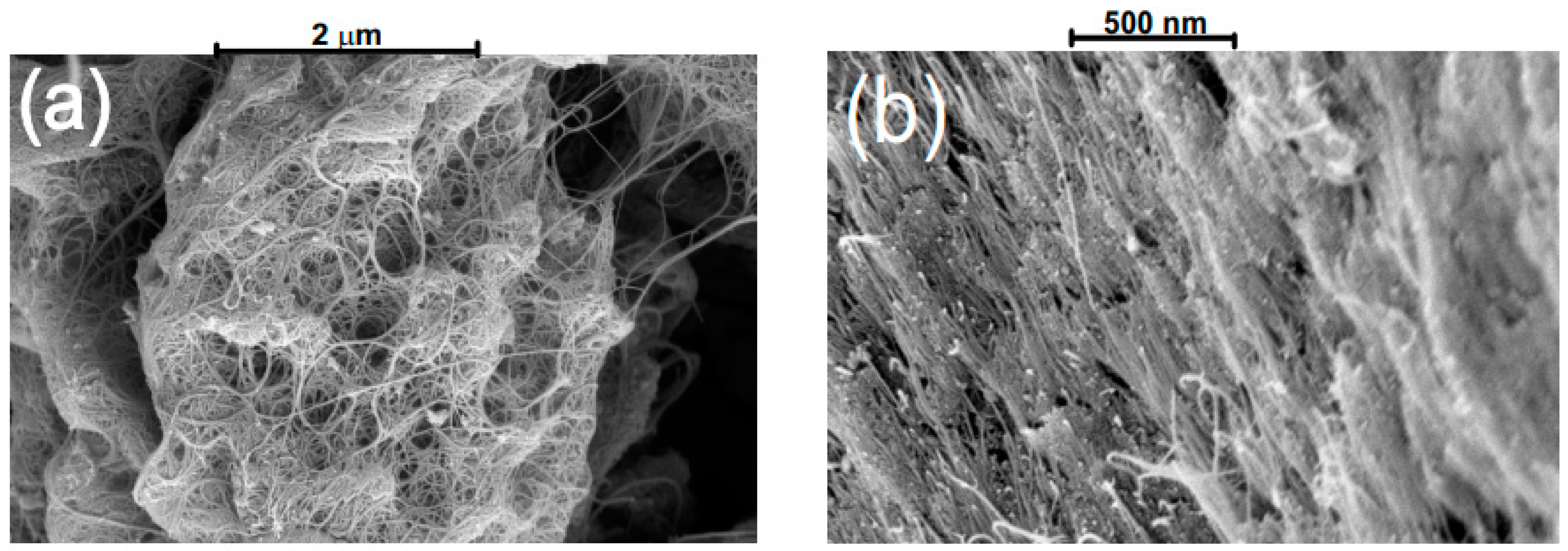
High-density, well-aligned single-walled carbon nanotubes (HDWA-SWCNT) were obtained using a high pressure of 8 GPa and a high temperature of 400 °C applied to commercially available SWCNTs (HiPco™ Single-Walled Carbon Nanotubes, Atom Optoelectronics, Los Angeles, CA, USA). As can be seen in Figure 1, HDWA-SWCNTs have a pronounced orientation compared to their initial state. After pressure and temperature treatment, HDWA-SWCNTs were mixed with an aliphatic epoxy resin, which possesses optical transparency in the infrared region of the spectrum. Films with a thickness of 1 µm were obtained by cutting a polymerized mixture of epoxy resin with HDWA-SWCNTs. Later, these films were installed in a module with a saturable absorber, including nanotubes (SAINT module) formed by two FC/APC connectors, for further study.
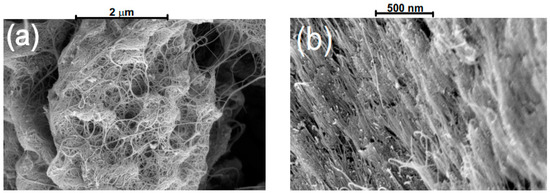
Figure 1.
SEM images of (a) the initial SWCNTs, and (b) after high-pressure high-temperature treatment.
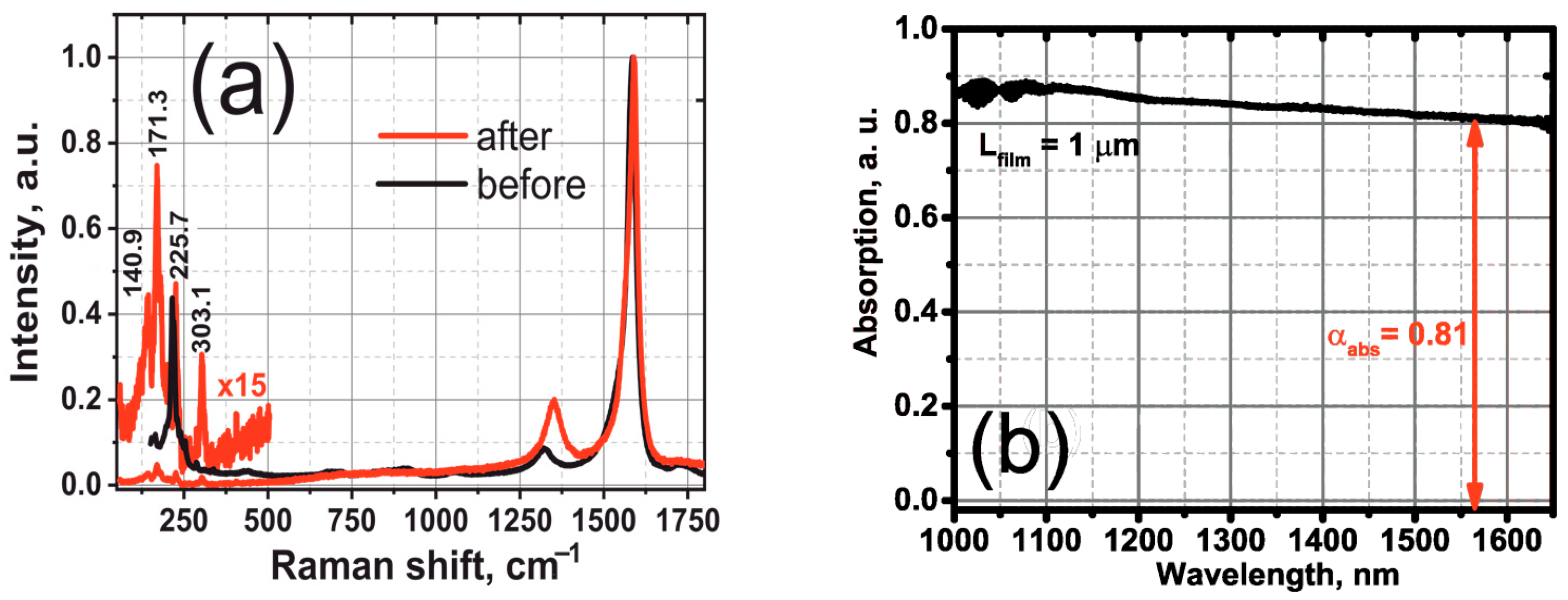
Figure 2a shows Raman spectrums of initial SWCNTs and HDWA-SWCNTs obtained with an unpolarized pump at a wavelength of 641.4 nm. The Raman spectrums clearly show the presence of SWCNTs after the treatment due to the strong Raman mode at 1590.2 cm−1 [19,39]. On the other hand, the high pressure and temperature treatment, which should introduce nanotubes defects, resulted in significant increase at the 1324.9 cm−1 band [40]. HDWA-SWCNTs remained after treatment, with a diameter ≈ 1 nm (corresponding to the 225.7 cm−1 breathing mode of Raman spectra) [39], suitable for the the promotion of the successful mode-locking process. Figure 2b shows a small signal absorption spectrum of 1 µm thickness of a thin film. Note that SWCNTs absorb more than l0 ≈ 80% of the halogen lamp optical power in a wide spectral region of 1000–1650 nm.
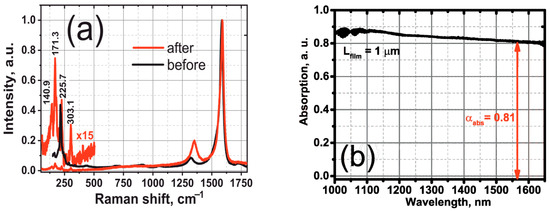
Figure 2.
(a) Raman spectra of the initial SWCNTs and HDWA-SWCNTs; (b) a small signal absorption spectrum of HDWA-SWCNTs thin film.
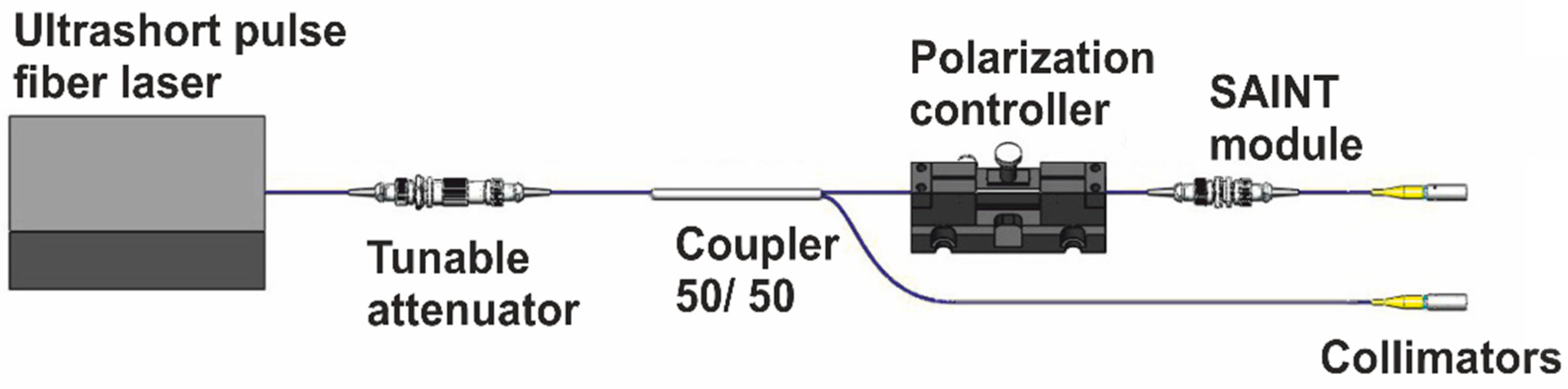
Figure 3 shows the experimental setup on which the ultrafast saturation measurement was performed. For measurements, we used homemade ML erbium-doped fiber lasers with a pulse duration of 180 fs and 300 fs and a pulse repetition rate of 42.2 MHz and 11.1 MHz, respectively [41,42]. The laser radiation was directed to the splitter, where it was divided into two optical channels at a ratio of 50/50, preliminarily passing through a tunable attenuator. The radiation in one port of the splitter was sent directly to the radiation receiver, and a polarization controller in the SAINT module with the HDWA-SWCNTs under study were installed on the second port.
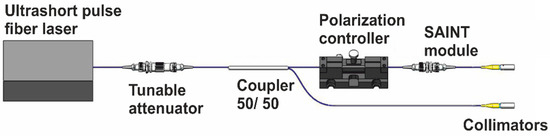
Figure 3.
Setup for experimental measurement of a HDWA-SWCNT thin film optical loss.
To satisfy the condition of a slowly saturating absorber, we sought to use the shortest probing pulses possible. Therefore, the duration of the laser pulse must be much shorter than the recovery time of the SA. Due to this assumption, the optical loss in the SA, depending on the energy of the input pulse Ep, can be expressed as [43]:
Here, lns represents non-saturable losses, ΔT shows the modulation depth of the losses (transmission), and Esat shows the energy saturation that accounts for a saturation behavior in the case of a slow saturable absorber.
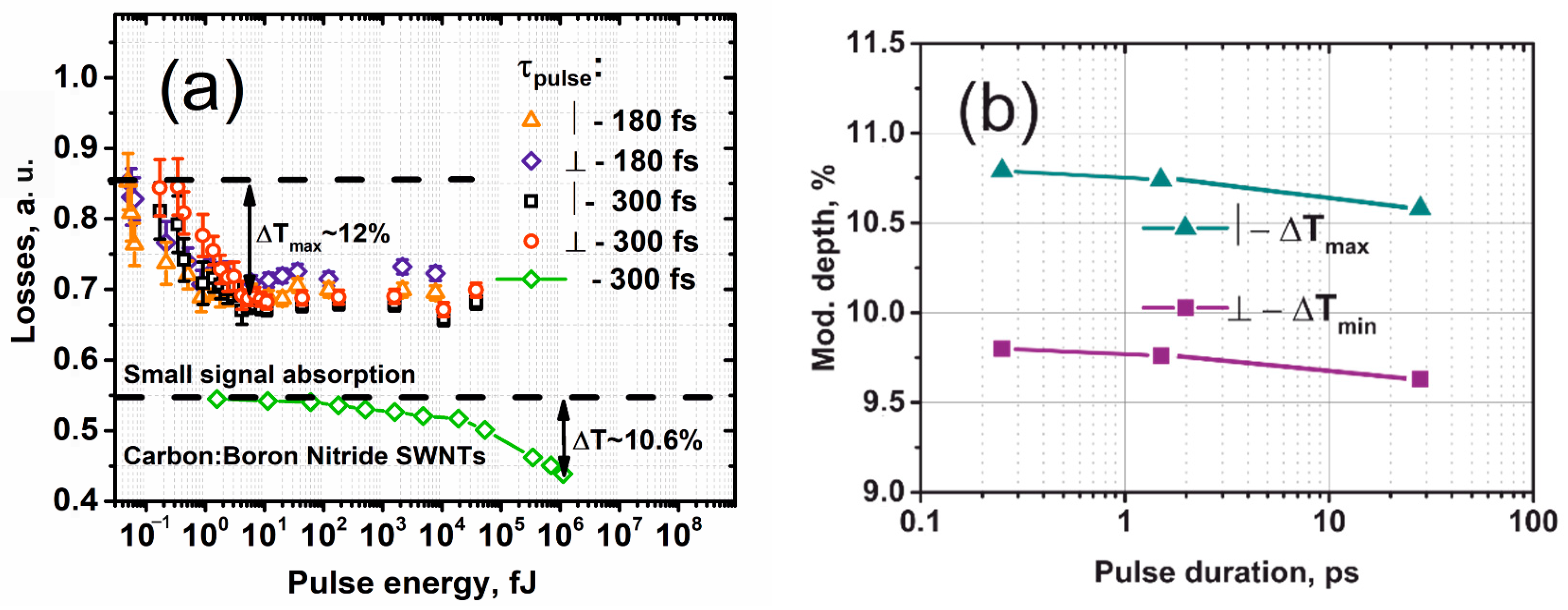
Figure 4a shows the measured loss function of an HDWA-SWCNT thin film absorber compared to a similar absorber based on boron nitride doped carbon nanotubes using either 180 or 300 fs full width half maximum (FWHM) pulses. We observed a polarization dependence (up to a 3% difference in optical losses for 2 orthogonal polarizations) of optical saturation, which is direct evidence of the ordered structure of HDWA-SWCNT, as well as a low level of saturation energy Esat of <1 fJ, limited to the detector threshold used, while the maximal modulation depth was ΔT ≈ 12%. Note that the power meter’s minimal detecting optical power was ≈300 pW (model MTP 6000, IIT BSIIR, Minsk, Belarus). We have also varied the ultrashort pulse durations (see Figure 4b) in the wide range of 0.25–28 ps (at the FWHM pulse intensity level) by controlling the length of the output fiber SMF-28 using a homemade ultrashort pulse fiber laser [41]. Moreover, carbon nanotubes, doped with boron nitride, serve as an ideal platform for creating laser saturated absorbers, as well as a short response time, from a high modulation depth [28,42,44]. However, compared to C:BNNT, high-density SWCNTs films have the advantage of a much lower level of saturation energy and higher resistance to radiation damage. It is also worth noting that during the experiments, we observed a dependence of the modulation depth on the duration of the irradiating pulses, which proves a shorter response time (tresp) for HDWA-SWCNTs compared to boron nitride-doped nanotubes. It should be mentioned that the observed response time of HDWA-SWCNTs shows good agreement with the ultrafast carrier dynamic measurements in SWCNTs obtained by the pump–probe method [45].
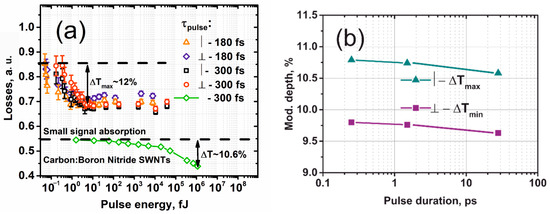
Figure 4.
(a) Dependence of nonlinear optical losses of HDWA-SWCNTs and carbon nanotubes doped with boron and nitrogen using a homemade 300-fs USP source; (b) modulation depth ΔT of HDWA-SWCNTs vs. pulse width.
Table 1 shows significant changes in the key nonlinear optical characteristics of conventional SWCNTs [28] and C:BNNT compared to HDWA-SWCNTs. HDWA-SWCNTs benefit from an ultrashort relaxation time τresp < 250 fs, which is one of the best results in the class of the SWCNTs SA [46]. This obstacle, on one hand, provides reliable ML launching. On other hand, the low-saturation-energy level of HDWA-SWCNTs SA dramatically impacts ML laser performance, i.e., as an inefficient ultrashort pulse filter, it may ruin the ML operation [47]. In this way, the application of the HDWA-SWCNTs as an SA requires an additional mechanism of ML support in the laser resonator, such as the hybrid ML mechanism [3]. It should be noted that the low saturation energy level in the wavelength range of 1.3 to 1.7 μm, combined with a response time of about 250 fs and a wide absorption spectrum, makes these nanotubes attractive for use as an ultrafast and sensitive photodetector [48,49,50].

Table 1.
SWCNTs thin films parameters, along with the corresponding ML laser parameters.
3. Mode-Locking by the HDWA-SWCNTs SA
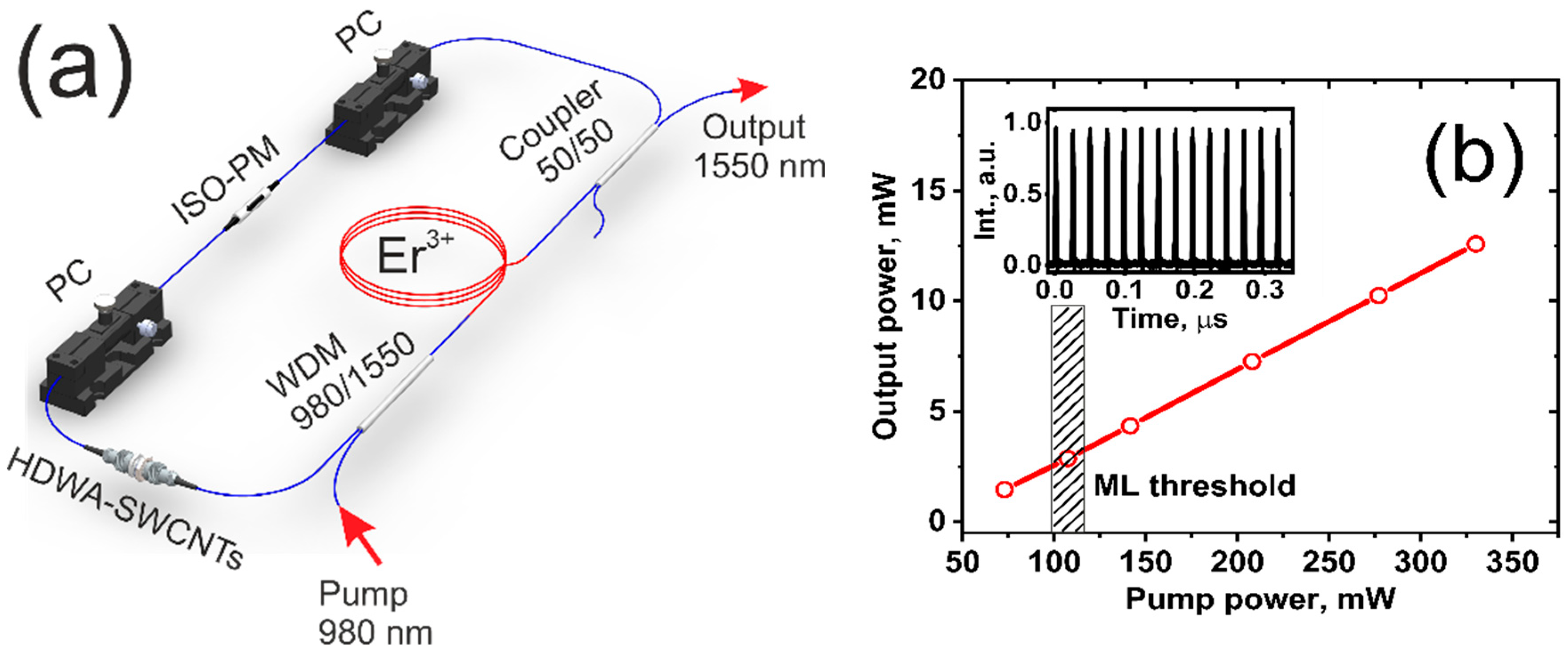
Figure 5a shows the experimental setup of a femtosecond hybrid ML all-fiber laser. The HDWA-SWCNTs film was inserted into the SAINT module, formed by two FC/APC connectors as a slow passive SA. A fast mode-locking mechanism based on nonlinear polarization evolution (NPE) was provided by a commercially available isolator-polarizer (ISO-PM). The ISO-PM is used for two purposes. First, it blocks the back propagation of radiation in the resonator. Second, it weakens the orthogonal polarization in the ellipse, causing the radiation to be linearly polarized. In the process of pulse propagation, it is assumed that the state of the laser resonator changes nonlinearly under the action of phase and cross modulations, which arise due to the nonlinearity of the fibers, creating a phase shift between the orthogonally polarized components. This leads to a rotation of the polarization ellipse, but not to a change in its shape. Thus, upon multiple passages through the ISO-PM, the low-intensity polarization component is so weakened that this allows the mode-locking process to be triggered. Two polarization controllers (PCs) were used to adjust the mode-locking regimes. The resonator consists of two types of optical fibers, including erbium-doped fiber with positive group velocity dispersion (GVD) at 1550 nm and SMF-28 (manufactured by Corning Corp., Glendale, AZ, USA) with a negative GVD at 1550 nm. It should be noted that the length of the erbium-doped fiber is a 1.34 m, with a small signal core absorption of ~43 dB/m at the 980 nm pump wavelength and a dispersion parameter (D) of ~−30.7 ps/(nm·km) at 1550 nm, but the length of the SMF-28 (manufactured by Corning Corp.) is 3.6 m. The pump source for the erbium-doped fiber is used as a pigtailed single-mode laser diode at 980 nm. A 50/50 coupler is used for the output of laser radiation from the cavity.
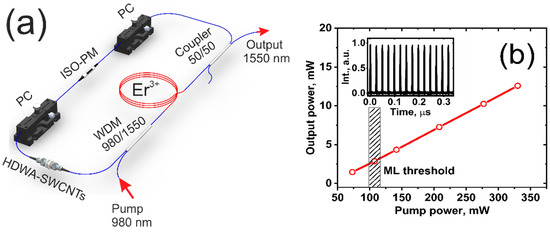
Figure 5.
(a) Experimental setup of the hybrid ML fiber laser. (b) Output power vs. pump power and output pulse trace.
We have realized a stable, single-pulse, self-starting USP generation through both PCs adjustments. The inset of Figure 5b shows the output pulse trace for the investigated USP generation (using the Infinium MSO9254A oscilloscope, Keysight Technologies, Santa Rosa, CA, USA) at a repetition rate of 42.2 MHz, corresponding to a total cavity length of ~4.93 m.
The ML threshold (see Figure 5b) was observed at an average pump power of ~104 mW. Moreover, we have not observed any pulse breakage by increasing the pump power up to 330 mW. It is worth noting that regarding such a low ML threshold, compared with NPE-based only, ML [41] is attributable to the applied hybrid ML technique in which the slow SA, represented by HDWA-SWCNTs SA, reliably triggers ML at a low pump power, while the pulse shortening is caused by the NPE effect [51]. It should be noted that the ML laser threshold corresponds well with the results of the PML (presented in Table 1) obtained by the ML technique based only on SWCNTs SAs for the significant value of unsaturated losses lns. This fact proves that the observed USP is generated mainly by the action of the HDWA-SWCNTs SA.
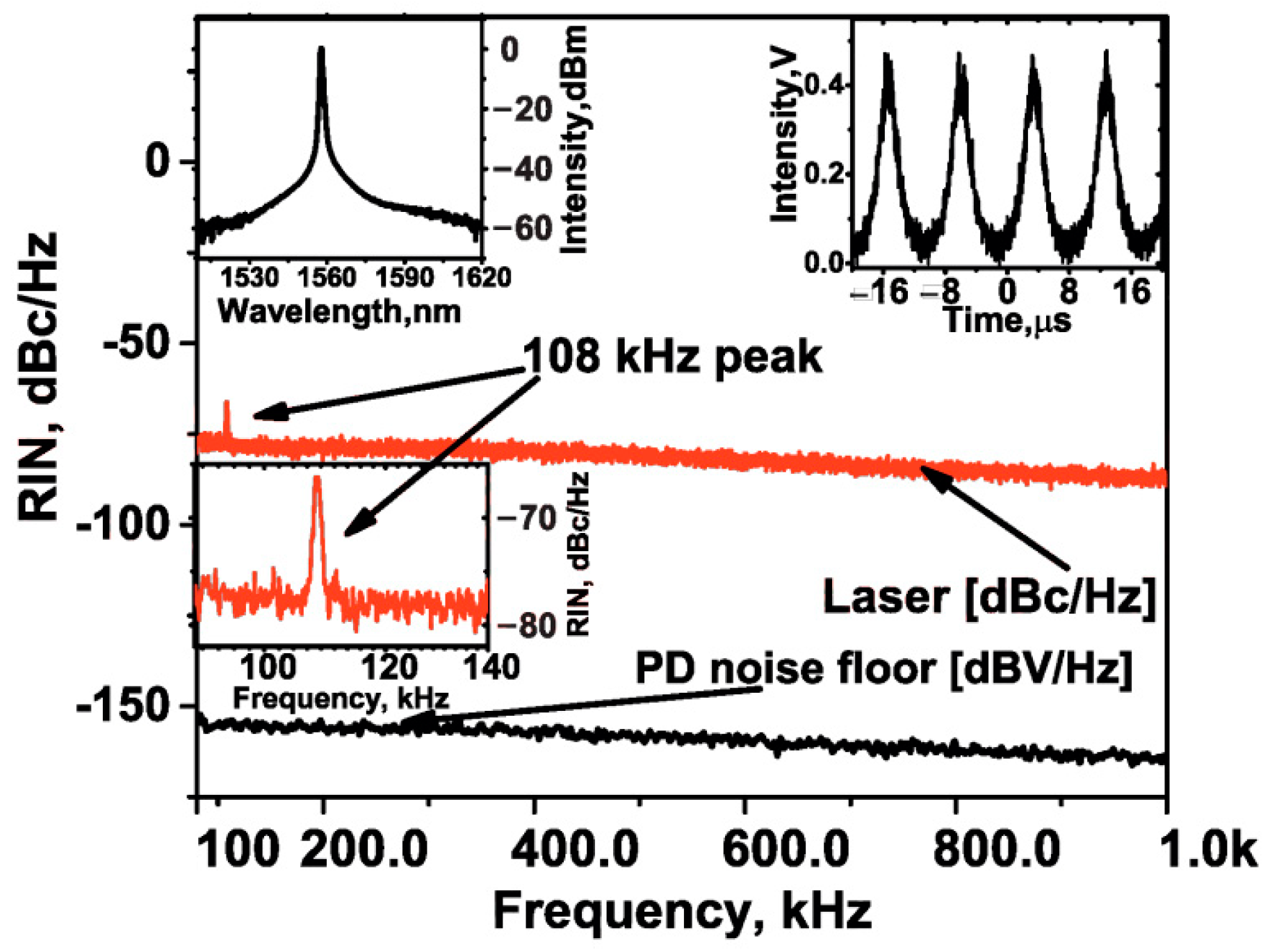
As experimental confirmation of the statement that the key component providing the mode-locking launching is the SA based on the HDWA-SWCNTs, we present the measured data from the implemented Q-switching operation mode (also obtained by PCs adjustment), which naturally coexists in the laser resonator along with the ML operation, ensured by the slow relaxation time of the SWCNTs [52]. As can be seen from the inset to Figure 6, the spectral width of the output spectrum is about 4 nm (at FWHM). In this case, the pulse repetition rate estimated through a typical pulse train corresponded to 108 kHz, which is confirmed by the measured RF spectrum in the range from 80 kHz to 1 MHz.
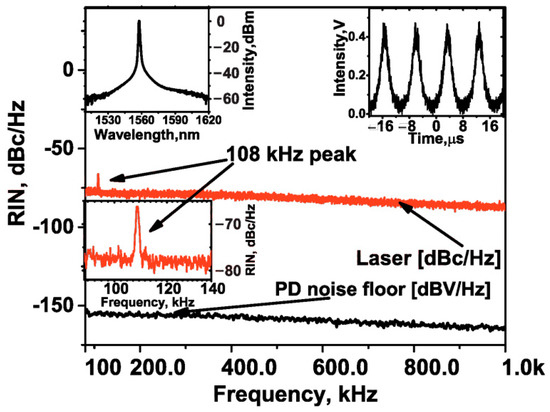
Figure 6.
RIN of the Q-switching operation mode and photodetector (PD) + ESA noise floor. Inset: optical spectrum and output pulse trace.
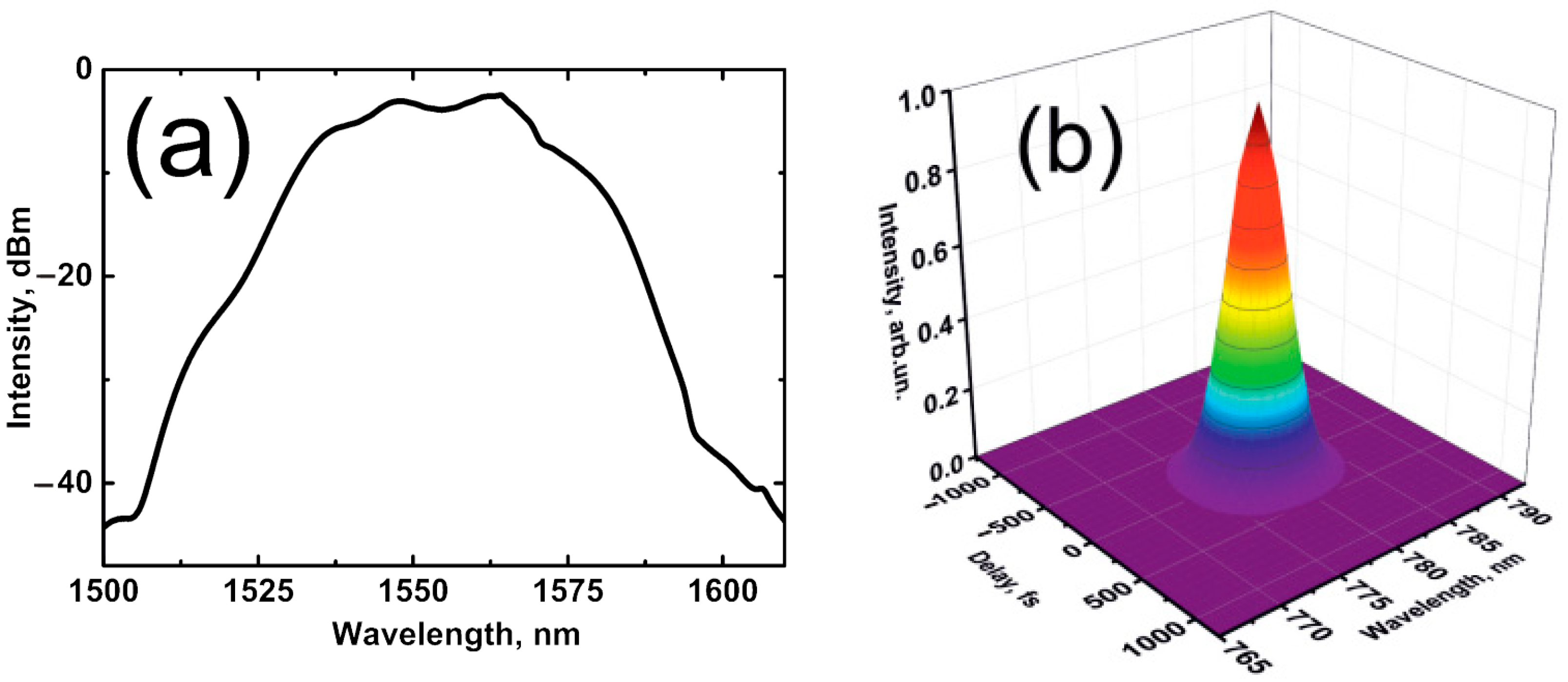
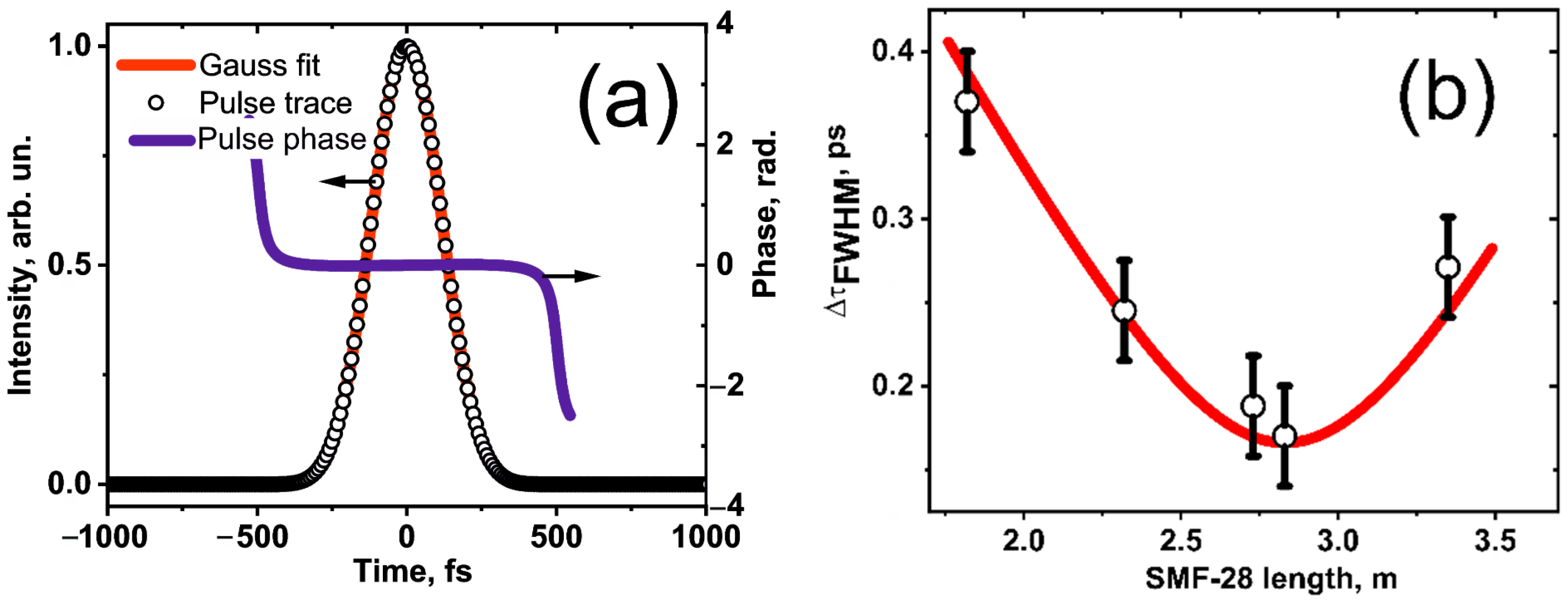
Figure 7a shows the pulse spectra obtained for the USP regime at a maximum average output power of ~12.5 mW. The Gaussian-type spectrum has an FWHM of ~30 nm. Figure 8a shows the corresponding intensity autocorrelation traces and its Gaussian fitting, along with the pulse phase of the dechirped USP obtained at the laser output with a 2.75 m-long SMF-28 fiber from the coupler to an intensity autocorrelator (obtained from Swamp Optics LLC, GRENOUILLE Model 15-40-USB, Atlanta, GA, USA). Note that the Gaussian spectrum and pulse shape are inherent in stretched-pulse generation [53]. An estimation of pulse widths gives a value of 180 fs at FWHM. The calculated time-bandwidth product (TBP) for the Gaussian pulses is TBP ~0.67 (the typical TBP value for Gaussian pulses is ~0.441). Thus, the obtained Gaussian pulse is close to its bandwidth limit.
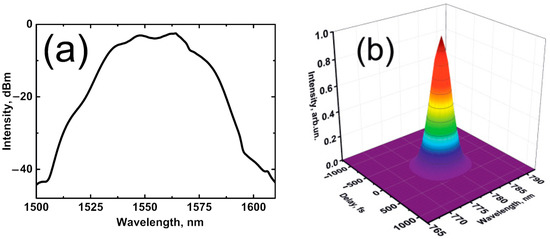
Figure 7.
(a) Optical spectrum and (b) SHG FROG trace of the pulse profile.
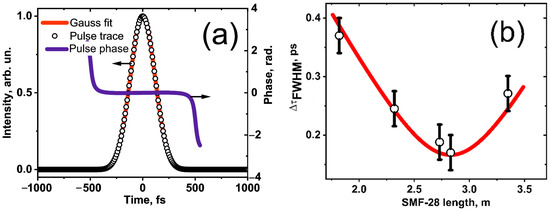
Figure 8.
(a) Autocorrelation trace of USP and Gaussian fitting, along with the pulse phase. (b) Pulse width vs. length of output SMF-28 fiber.
Figure 8b shows a pulse-width evolution at the laser output. In the experiment, a dependence was obtained that is quite accurately consistent with the function responsible for the Gaussian pulse evolution , with the dispersion length (LD) of (48.0 ± 1.0) cm, where τmin is the minimum pulse duration, L is the length of the current output fiber, and L0 is the length of fiber when τmin. At the output, the SMF length LSMF ~2.75 m exhibited the minimum pulse duration position in the laser cavity for conservative dynamics of the Gaussian pulse evolution [54]. Therefore, the compression of pulses at the laser output is mainly governed by fiber dispersion. Moreover, the symmetrical shape of a second harmonic generation (SHG) FROG trace of the USP (Figure 7b) and the pulse-phase value close to zero (see Figure 8a) confirms the generation of the dechirped bandwidth-limited USP.
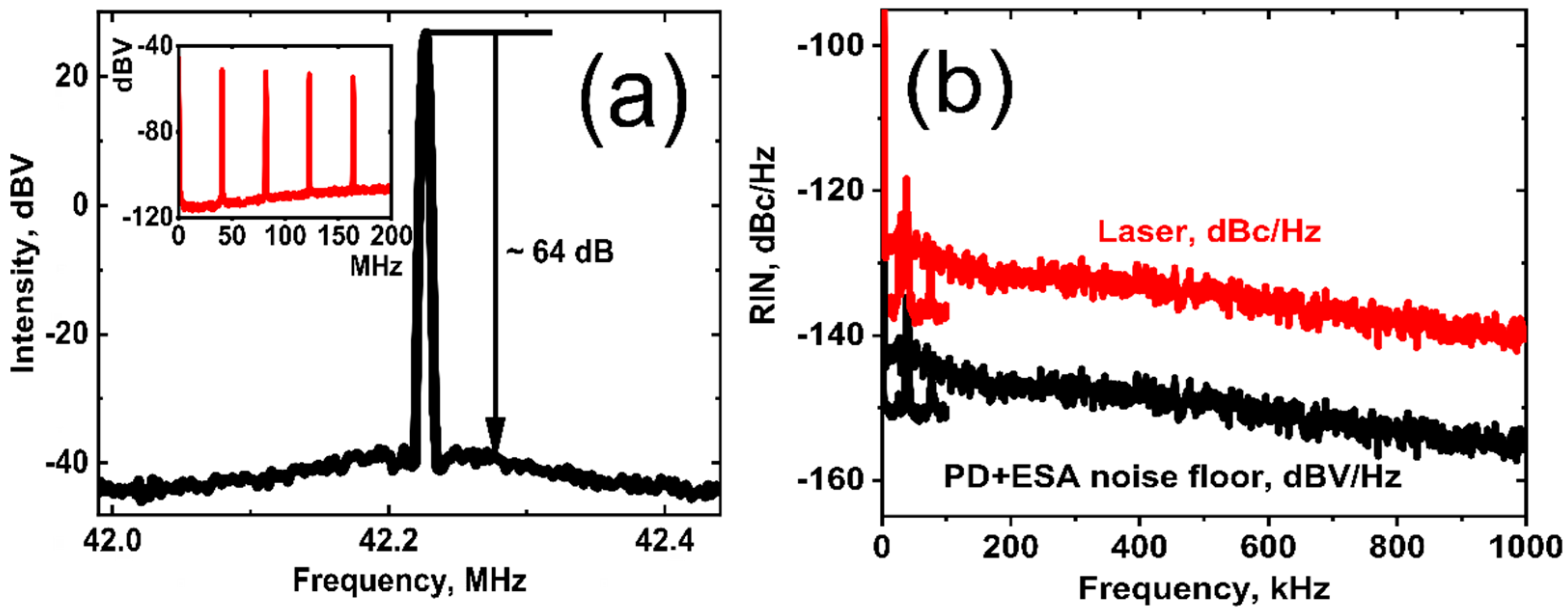
To characterize the short-term stability of the obtained USP generation, we measured the radio-frequency (RF) spectrum at the fundamental oscillation frequency of 42.2 MHz, depicted in Figure 9a (using a FEMTO 200 MHZ HCA-S-200M InGaAs photoreceiver and the ESA FSL 3 model.03; Rohde & Schwarz GmbH & Co. KG, Munich, Germany), with a signal-to-noise ratio (SNR) ~64 dB (with the ESA resolution of 300 Hz). The inset of Figure 9a shows the RF spectrum in the frequency range of 30 kHz–200 MHz (3-kHz resolution bandwidth). The high SNR ratio at the fundamental frequency and the absence of any Q-switch sidebands in the RF spectrum prove the pulse-to-pulse stability of the ML regime.
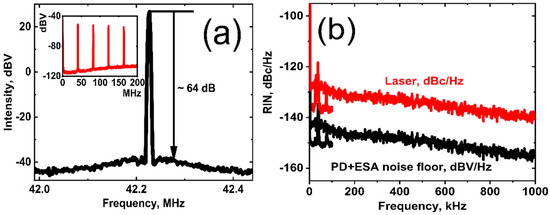
Figure 9.
(a) The radio-frequency spectrum of the pulse train at the fundamental repetition frequency and in the range 30 kHz–200 MHz (inset). (b) RIN of the USP fiber laser and photodetector (PD) + ESA noise floor.
Moreover, we have measured the relative intensity noise (RIN) of the fiber laser with the maximum value of <−135.4 dBc/Hz, as shown in Figure 9b, in the range 30 Hz–100 kHz (with 250 Hz resolution using ESA SR770FFT, manufactured by Stanford Research Systems) and in the range 30 kHz–1000 kHz (with 300 Hz resolution using ESA manufactured by Rohde & Schwarz). As a result, we have obtained an RIN value for the ultrashort pulse fiber laser, mode-locked by HDWA-SWCNTs SA in a coaction with an NPE effect, that is comparable to that obtained previously by low-energy stable femtosecond optical combs [55].
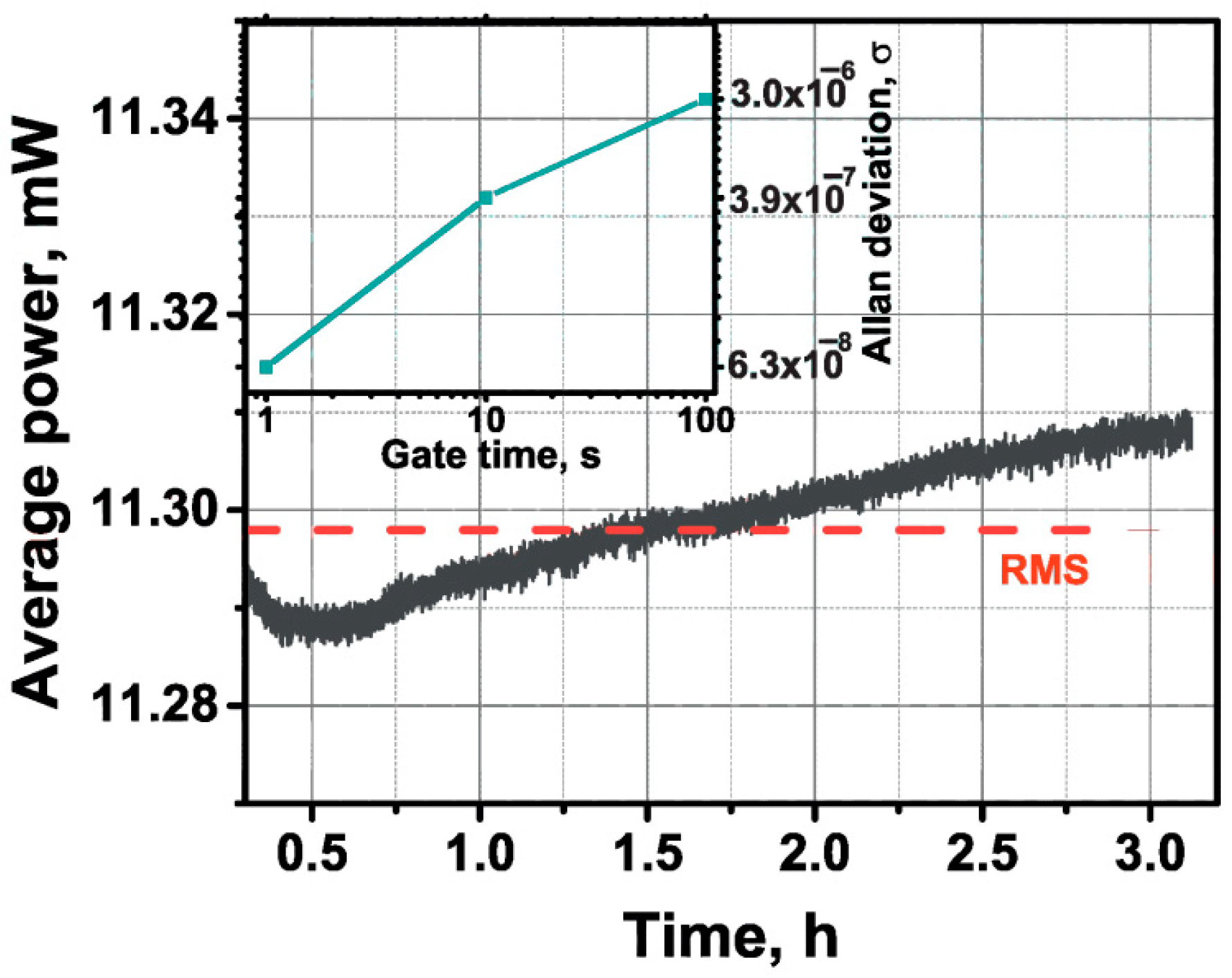
At last, to understand the long-term stability of the obtained ML generation regime, we measured the output average power stability at the nearly maximum available output average optical power of ~11.3 mW and the Allan deviation of the repetition rate (for 5 Hz data using the 53132A manufactured by Agilent Inc) of the free-running fiber laser. Figure 10 shows the stability of the average optical output power with a standard deviation of ~0.06% RMS over a time of 3 h (measured by a PM200 power meter with an InGaAs S145C detector manufactured by Thorlabs Inc., Bergkirchen, Germany). As can be seen from the inset in Figure 10, the developed laser also has a relatively low pulse repetition rate deviation, with a value of 6.3 × 10⁻⁸ for an interval of 1 s, which is only determined by the temperature drift during the average time interval of 1 × 10² s and environmental action. It should be noted that during the experiment, which lasted for several hours, we did not observe any pulse breakage or instability in the laser operation.
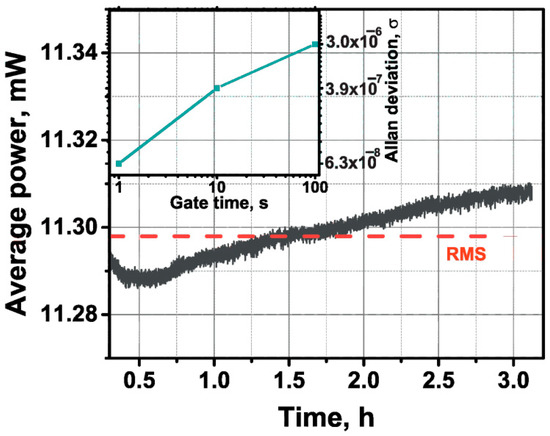
Figure 10.
Average output of optical power during the measurement. Inset: Allan deviation of the repetition rate in a 1 × 10² s time interval.
4. Conclusions
We have carefully investigated the optical properties of an ultrafast saturable absorber based on highly oriented high-density single-walled carbon nanotubes and related it to the obtained output characteristics of an erbium-doped femtosecond all-fiber laser. We have observed polarization dependence of a nonlinear optical saturation, proving the aligned structure of the SWCNTs, along with an ultra-low saturation energy level (Esat < 1 fJ limited to the threshold of the detector used) compared to conventional SWCNTs, while the modulation depth was ≈12%. Moreover, the observed ultrafast saturation behavior, with a response time of <250 fs, ensured a robust mode-locking launching in a hybrid erbium-doped ML fiber laser, with an ultra-low threshold at about 100 mW. We have demonstrated the generation of stable dechirped 180 fs stretched pulses at a central wavelength of 1555 nm with the 12.5 mW average output power corresponding to the <1.3 kW maximum peak power and <0.3 nJ maximum pulse energy, with an RIN value < −135.4 dBc/Hz (30 Hz–1000 kHz), at a 42.2 MHz repetition rate, with an SNR ratio ≈ 64 dB (with the resolution of ~300 Hz) in the erbium-doped ring laser hybrid mode-locked by HDWA-SWCNTs SA in co-action with a nonlinear polarization evolution effect. In this case, the Allan deviation of the repetition rate does not exceed ~3 × 10⁻⁶ at an average time of ~100 s, and the standard deviation of the average output power does not exceed ~0.06% RMS for 3 h of measurements. It should be noted that the low intensity noise in a fiber laser with a cavity length of more than 5 m was achieved by using a natural saturable absorber based on nanotubes in the laser. At the same time, the NEP effectively reduced the pulse duration by operating in the mode of a fast saturable absorber.
In summary, newly-developed HDWA-SWCNTs thin film SA demonstrates a low saturation energy level at 1.5 µm, along with an ultrafast response time and a wide absorption spectrum. The unique nonlinear optical properties of HDWA-SWCNTs make this nanomaterial attractive for future ultrafast photonics, starting from ultrashort pulse generation, for applications such as single-photon sensors and emitters.
Author Contributions
Conceptualization, S.G.S., D.A.D., L.K.D. and V.E.K.; methodology, V.N.K., V.N.A. and V.A.D.; software: I.O.O. and I.S.K.; validation: D.A.D. and V.A.D.; formal analysis: I.O.O. and I.S.K.; investigation: I.O.O. and I.S.K.; data curation: I.O.O. and I.S.K.; writing—original draft preparation: S.G.S., I.O.O., D.A.D., V.A.D., L.K.D. and V.E.K.; writing—review and editing: S.G.S., I.O.O., L.K.D. and V.E.K.; visualization: I.O.O.; supervision, S.G.S.; project administration, S.G.S. All authors have read and agreed to the published version of the manuscript.
Funding
This research was funded by Bauman Moscow State Technical University.
Institutional Review Board Statement
Not applicable.
Informed Consent Statement
Not applicable.
Data Availability Statement
Not applicable.
Conflicts of Interest
The authors declare no conflict of interest. The funders had no role in the design of the study; in the collection, analyses, or interpretation of data; in the writing of the manuscript, or in the decision to publish the results.
References
- Yamashita, S. Nonlinear optics in carbon nanotube, graphene, and related 2d materials. APL Photonics 2019, 4, 034301. [Google Scholar] [CrossRef]
- Set, S.Y.; Yaguchi, H.; Tanaka, Y.; Jablonski, M.; Sakakibara, Y.; Rozhin, A.; Tokumoto, M.; Kataura, H.; Achiba, Y.; Kikuchi, K. Mode-locked fiber lasers based on a saturable absorber incorporating carbon nanotubes. In Proceedings of the OFC 2003 Optical Fiber Communications Conference, Atlanta, GA, USA, 28 March 2003; pp. PD44–P1. [Google Scholar]
- Fermann, M.; Hartl, I. Ultrafast fiber laser technology. Sel. Top. Quantum Electron. IEEE J. 2009, 15, 191–206. [Google Scholar] [CrossRef]
- Saltarelli, F.; Graumann, I.J.; Lang, L.; Bauer, D.; Phillips, C.R.; Keller, U. Power scaling of ultrafast oscillators: 350-w average-power sub-picosecond thin-disk laser. Opt. Express 2019, 27, 31465–31474. [Google Scholar] [CrossRef] [PubMed]
- Zhao, C.; Zhang, H.; Qi, X.; Chen, Y.; Wang, Z.; Wen, S.; Tang, D. Ultra-short pulse generation by a topological insulator based saturable absorber. Appl. Phys. Lett. 2012, 101, 211106. [Google Scholar] [CrossRef]
- Li, Y.Y.; Gao, B.; Han, Y.; Chen, B.K.; Huo, J.Y. Optoelectronic characteristics and application of black phosphorus and its analogs. Front. Phys. 2021, 16, 43301. [Google Scholar] [CrossRef]
- Guo, B.; Wang, S.-H.; Wu, Z.-X.; Wang, Z.-X.; Wang, D.-H.; Huang, H.; Zhang, F.; Ge, Y.-Q.; Zhang, H. Sub-200 fs soliton mode-locked fiber laser based on bismuthene saturable absorber. Opt. Express 2018, 26, 22750–22760. [Google Scholar] [CrossRef] [PubMed]
- He, J.; Zhang, L.; He, D.; Wang, Y.; He, Z.; Zhao, H. Ultrafast transient absorption measurements of photocarrier dynamics in monolayer and bulk rese2. Opt. Express 2018, 26, 21501–21509. [Google Scholar] [CrossRef]
- Ahmed, M.H.M.; Latiff, A.A.; Arof, H.; Harun, S.W. Mode-locking pulse generation with mos2 pva saturable absorber in both anomalous and ultra-long normal dispersion regimes. Appl. Opt. 2016, 55, 4247–4252. [Google Scholar] [CrossRef]
- Niu, K.; Sun, R.; Chen, Q.; Man, B.; Zhang, H. Passively mode-locked er-doped fiber laser based on sns2 nanosheets as a saturable absorber. Photon. Res. 2018, 6, 72–76. [Google Scholar] [CrossRef]
- Zhang, Y.; Song, Z.Y.; Qiao, D.; Li, X.; Guang, Z.; Li, S.; Zhou, L.; Chen, X. 2D van der Waals materials for ultrafast pulsed fiber lasers: Review and prospect. Nanotechnology 2022, 33, 082003. [Google Scholar] [CrossRef]
- Wang, J.; Wang, X.; Lei, J.; Ma, M.; Wang, C.; Ge, Y.; Wei, Z. Recent advances in mode-locked fiber lasers based on two-dimensional materials. Nanophotonics 2020, 9, 2315–2340. [Google Scholar] [CrossRef]
- Hussain, S.A. Comparison of Graphene and Carbon Nanotube Saturable Absorbers for Wavelength and Pulse Duration Tunability. Sci. Rep. 2019, 9, 17282. [Google Scholar] [CrossRef] [PubMed]
- Cheng, C.-H.; Lin, G.-R. Carbon Nanomaterials Based Saturable Absorbers for Ultrafast Passive Mode-Locking of Fiber Lasers. Curr. Nanosci. 2020, 16, 441–457. [Google Scholar] [CrossRef]
- Steinberg, D.; Gerosa, R.M.; Pellicer, F.N.; Zapata, J.D.; Domingues, S.H.; de Souza, E.A.T.; Saito, L.A.M. Graphene oxide and reduced graphene oxide as saturable absorbers onto d-shaped fibers for sub 200-fs edfl mode-locking. Opt. Mater. Express 2018, 8, 144–156. [Google Scholar] [CrossRef]
- Lauret, J.S.; Voisin, C.; Cassabois, G.; Delalande, C.; Roussignol, P.; Jost, O.; Capes, L. Ultrafast carrier dynamics in single-wall carbon nanotubes. Phys. Rev. Lett. 2003, 90, 057404. [Google Scholar] [CrossRef] [PubMed]
- Wu, K.; Li, X.; Wang, Y.; Wang, Q.; Shum, P.; Chen, J. Towards low timing phase noise operation in fiber lasers mode locked by graphene oxide and carbon nanotubes at 15 μm. Opt. Express 2015, 23, 501. [Google Scholar] [CrossRef] [PubMed]
- Li, X.; Wu, K.; Sun, Z.; Meng, B.; Wang, Y.; Wang, Y.; Yu, X.; Yu, X.; Zhang, Y.; Shum, P.P.; et al. Single-wall carbon nanotubes and graphene oxide-based saturable absorbers for low phase noise mode-locked fiber lasers. Sci. Rep. 2016, 6, 25266. [Google Scholar] [CrossRef]
- Chernov, A.I.; Obraztsova, E.D.; Lobach, A.S. Optical properties of polymer films with embedded single-wall carbon nanotubes. Phys. Status Solidi (B) 2007, 244, 4231–4235. [Google Scholar] [CrossRef]
- Solodyankin, M.; Lobach, A.; Chernov, A.; Tausenev, A.; Konov, V.; Dianov, E. Mode-locked 1.93 m thulium fiber laser with a carbon nanotube absorber. Opt. Lett. 2008, 33, 1336–1338. [Google Scholar] [CrossRef]
- Gerosa, R.; Steinberg, D.; Rosa, H.; Barros, C.; de Matos, C.; Souza, E. Cnt film fabrication for mode-locked er-doped fiber lasers: The droplet method. IEEE Photonics Technol. Lett. 2013, 25, 1007–1010. [Google Scholar] [CrossRef]
- Hasan, T.; Sun, Z.; Tan, P.H.; Popa, D.; Flahaut, E.; Kelleher, E.; Bonaccorso, F.; Wang, F.; Jiang, Z.; Torrisi, F.; et al. Double-wall carbon nanotubes for wide-band, ultrafast pulse generation. ACS Nano 2014, 8, 4836–4847. [Google Scholar] [CrossRef]
- Liu, X.; Han, D.; Sun, Z.; Zeng, C.; Lu, H.; Mao, D.; Cui, Y.; Wang, F. Corrigendum: Versatile multi-wavelength ultrafast fiber laser mode-locked by carbon nanotubes. Sci. Rep. 2013, 3, 2718. [Google Scholar] [CrossRef] [PubMed]
- Liu, X.; Cui, Y. Flexible pulse-controlled fiber laser. Sci. Rep. 2015, 5, 9399. [Google Scholar] [CrossRef] [PubMed]
- Obraztsova, E.A.; Lüer, L.; Obraztsova, E.D.; Chernov, A.I.; Brida, D.; Polli, D.; Lanzani, G. Effect of environment on ultrafast photoexcitation kinetics in single-wall carbon nanotubes. Phys. Status Solidi (B) 2010, 247, 2831–2834. [Google Scholar] [CrossRef]
- Chiu, J.-C.; Chang, C.-M.; Hsieh, B.-Z.; Lin, S.-C.; Yeh, C.-Y.; Lin, G.-R.; Lee, C.-K.; Lin, J.-J.; Cheng, W.-H. Pulse shortening mode-locked fiber laser by thickness and concentration product of carbon nanotube based saturable absorber. Opt. Express 2011, 19, 4036–4041. [Google Scholar] [CrossRef] [PubMed]
- Szabó, Á.; Varallyay, Z. Numerical study on the saturable absorber parameter selection in an erbium fiber ring oscillator. IEEE Photonics Technol. Lett. 2012, 24, 122–124. [Google Scholar] [CrossRef]
- Krylov, A.A.; Sazonkin, S.G.; Arutyunyan, N.R.; Grebenyukov, V.V.; Pozharov, A.S.; Dvoretskiy, D.A.; Obraztsova, E.D.; Dianov, E.M. Performance peculiarities of carbon-nanotube-based thin-film saturable absorbers for erbium fiber laser mode-locking. J. Opt. Soc. Am. B 2016, 33, 134–142. [Google Scholar] [CrossRef]
- Song, Y.-W.; Yamashita, S.; Einarsson, E.; Maruyama, S. All-fiber pulsed lasers passively mode locked by transferable vertically aligned carbon nanotube film. Opt. Lett. 2007, 32, 1399–1401. [Google Scholar] [CrossRef]
- Xu, X.; Zhai, J.; Chen, Y.; Zhu, H.; Li, L.; Ruan, S.; Tang, Z. Well-aligned single-walled carbon nanotubes for optical pulse generation and laser operation states manipulation. Carbon 2015, 95, 84–90. [Google Scholar] [CrossRef]
- Li, X.; Zhang, L.; Wang, X.; Shimoyama, I.; Sun, X.; Seo, W.-S.; Dai, H. Langmuir-blodgett assembly of densely aligned single-walled carbon nanotubes from bulk materials. J. Am. Chem. Soc. 2007, 129, 4890–4891. [Google Scholar] [CrossRef] [PubMed]
- Cao, Q.; Han, S.-J.; Tulevski, G.; Zhu, Y.; Lu, D.; Haensch, W. Arrays of single-walled carbon nanotubes with full surface coverage for high-performance electronics. Nat. Nanotechnol. 2013, 8, 180–186. [Google Scholar] [CrossRef] [PubMed]
- Park, H.; Afzali, A.; Han, S.-J.; Tulevski, G.; Franklin, A.; Tersoff, J.; Hannon, J.; Haensch, W. High-density integration of carbon nanotubes via chemical self-assembly. Nat. Nanotechnol. 2012, 7, 787–791. [Google Scholar] [CrossRef] [PubMed]
- Hu, Y.; Kang, L.; Zhao, Q.; Zhong, H.; Zhang, S.; Yang, L.; Wang, Z.; Lin, J.; Li, Q.; Zhang, Z.; et al. Growth of high-density horizontally aligned swnt arrays using trojan catalysts. Nat. Commun. 2015, 6, 6099. [Google Scholar] [CrossRef] [PubMed]
- Hiramatsu, M.; Hori, M. Fabrication of carbon nanowalls using novel plasma processing. Jpn. J. Appl. Phys. 2006, 45, 5522–5527. [Google Scholar] [CrossRef]
- Rols, S.; Papoular, R.J.; Davydov, V.A.; Rakhmanina, A.V.; Autret, C.; Agafonov, V. Study of c60 peapods after a high-pressure–high-temperature treatment. Fuller. Nanotub. Carbon Nanostruct. 2010, 18, 412–416. [Google Scholar] [CrossRef]
- Khabashesku, V.N.; Gu, Z.; Brinson, B.; Zimmerman, J.L.; Margrave, J.L.; Davydov, V.A.; Kashevarova, L.S.; Rakhmanina, A.V. Polymerization of Single-Wall Carbon Nanotubes Under High Pressures and High Temperatures. Phys. Chem B 2002, 106, 11155–11162. [Google Scholar] [CrossRef]
- Bousige, C.; Rols, S.; Ollivier, J.; Schober, H.; Fouquet, P.; Simeoni, G.G.; Agafonov, V.; Davydov, V.; Niimi, Y.; Suenaga, K.; et al. From a one-dimensional crystal to a one-dimensional liquid: A comprehensive dynamical study of c60 peapods. Phys. Rev. B 2013, 87, 195438. [Google Scholar] [CrossRef]
- Journet, C.; Maser, W.K.; Bernier, P.; Loiseau, A.; de la Chapelle, M.L.; Lefrant, S.; Deniard, P.; Lee, R.; Fischer, J.E. Large-scale production of single-walled carbon nanotubes by the electric-arc technique. Nature 1997, 388, 756–758. [Google Scholar] [CrossRef]
- Arutyunyan, N.; Arenal, R.; Obraztsova, E.; Stephan, O.; Loiseau, A.; Pozharov, A.; Grebenyukov, V. Incorporation of boron and nitrogen in carbon nanomaterials and its influence on their structure and opto-electronical properties. Carbon 2012, 50, 791–799. [Google Scholar] [CrossRef]
- Dvoretskiy, D.A.; Sazonkin, S.G.; Orekhov, I.O.; Kudelin, I.S.; Pnev, A.B.; Karasik, V.E.; Krylov, A.A.; Denisov, L.K. High-energy ultrashort-pulse all-fiber erbium-doped ring laser with improved free-running performance. J. Opt. Soc. Am. B 2018, 35, 2010–2014. [Google Scholar] [CrossRef]
- Dvoretskiy, D.A.; Sazonkin, S.G.; Negin, M.A.; Shelestov, D.A.; Pnev, A.B.; Karasik, V.E.; Denisov, L.K.; Krylov, A.A.; Davydov, V.A.; Obraztsova, E.D. Comb peculiarities of dispersion-managed solitons in a hybrid mode-locked all-fiber ring laser. IEEE Photonics Technol. Lett. 2017, 29, 1588–1591. [Google Scholar] [CrossRef]
- Paschotta, R.; Keller, U. Passive mode locking with slow saturable absorbers. Appl. Phys. B 2001, 73, 653–662. [Google Scholar] [CrossRef]
- Zhang, Z.; Sun, X.; Yuan, P.; Yokokawa, S.; Zheng, Y.; Jiang, H.; Jin, L.; Anisimov, A.S.; Kauppinen, E.I.; Xiang, R.; et al. SWCNT@BNNT With 1D Van Der Waals Heterostructure with a High Optical Damage Threshold for Laser Mode-Locking. J. Light. Technol. 2021, 39, 5875–5883. [Google Scholar] [CrossRef]
- Vivien, L.; Riehl, D.; Anglaret, E.; Hache, F. Pump-probe experiments at 1064 nm in singlewall carbon nanotube suspensions. IEEE J. Quantum Electron. 2000, 36, 680–686. [Google Scholar] [CrossRef]
- Lau, K.Y.; Liu, X.; Qiu, J. A Comparison for Saturable Absorbers: Carbon Nanotube Versus Graphene. Adv. Photonics Res. 2022, 3, 2200023. [Google Scholar] [CrossRef]
- Liu, S.; Chen, Y.; Huang, L.; Cao, T.; Qin, X.; Ning, H.; Yan, J.; Hu, K.; Guo, Z.; Peng, J. Optimal conditions for self-starting of soliton mode-locked fiber lasers with a saturable absorber. Opt. Lett. 2021, 46, 2376–2379. [Google Scholar] [CrossRef] [PubMed]
- Blagov, E.V.; Pavlov, A.A.; Dudin, A.A.; Orlov, A.P.; Kitsuk, E.P.; Shaman, Y.; Gerasimenko, A.Y.; Ichkitidze, L.P.; Polohin, A.A. The radiation detector with sensitive elements on the base of array of multi-walled carbon nanotubes. In Advanced Materials; Parinov, I.A., Chang, S.-H., Topolov, V.Y., Eds.; Springer International Publishing: Cham, Switzerland, 2016; pp. 581–590. [Google Scholar]
- Wang, X.; Nanot, S.; He, X.; Young, C.C.; Tsentalovich, D.E.; Behabtu, N.; Pasquali, M.; Kono, J. Flexible photodetector based on carbon nanotube fibers. In CLEO: Science and Innovations; Optica Publishing Group: Washington, DC, USA, 2013; pp. 1–2. [Google Scholar]
- Pavlov, A.; Kitsyuk, E.; Ryazanov, R.; Timoshenkov, V.; Adamov, Y. Photodetector based on carbon nanotubes. In Carbon Nanotubes, Graphene, and Emerging 2D Materials for Electronic and Photonic Devices VIII; Razeghi, M., Ghazinejad, M., Bayram, C., Yu, J.S., Lee, Y.H., Eds.; International Society for Optics and Photonics (SPIE): Bellingham, WA, USA, 2015; Volume 9552, pp. 63–68. [Google Scholar]
- Krylov, A.A.; Sazonkin, S.G.; Lazarev, V.A.; Dvoretskiy, D.A.; Leonov, S.O.; Pnev, A.B.; Karasik, V.E.; Grebenyukov, V.V.; Pozharov, A.S.; Obraztsova, E.D.; et al. Ultra-short pulse generation in the hybridly mode-locked erbium-doped all-fiber ring laser with a distributed polarizer. Laser Phys. Lett. 2015, 12, 065001. [Google Scholar] [CrossRef]
- Chu, H.; Li, Y.; Wang, C.; Zhang, H.; Li, D. Recent investigations on nonlinear absorption properties of carbon nanotubes. Nanophotonics 2020, 9, 761–781. [Google Scholar] [CrossRef]
- Tamura, K.; Ippen, E.P.; Haus, H.A.; Nelson, L.E. 77-fs pulse generation from a stretched-pulse mode-locked all-fiber ring laser. Opt. Lett. 1993, 18, 1080–1082. [Google Scholar] [CrossRef]
- Tamura, K.; Nelson, L.E.; Haus, H.A.; Ippen, E.P. Soliton versus nonsoliton operation of fiber ring lasers. Appl. Phys. Lett. 1994, 64, 149–151. [Google Scholar] [CrossRef]
- Kim, J.; Song, Y. Ultralow-noise mode-locked fiber lasers and frequency combs: Principles, status, and applications. Adv. Opt. Photon. 2016, 8, 465–540. [Google Scholar] [CrossRef]
Publisher’s Note: MDPI stays neutral with regard to jurisdictional claims in published maps and institutional affiliations. |
© 2022 by the authors. Licensee MDPI, Basel, Switzerland. This article is an open access article distributed under the terms and conditions of the Creative Commons Attribution (CC BY) license (https://creativecommons.org/licenses/by/4.0/).