


In the original publication [1], due to the conversion of units in the calculation process, some of the values were incorrectly presented. Also, due to the calibration of the sensitivity discrepancy by a different method, a different optical absorption coefficient occurred. The authors have decided to make corrections to the numerical and unit errors previously made in the published paper [1] and add more textual content to bring the subject closer to readers and provide an adequate interpretation of the experimental phenomena and data in the original publication.
The word “Ultra-” has been deleted from the title of the published paper, and the title “High-Sensitivity and -Stability Thin-Film Heat Flux Sensor Based on Transverse Thermoelectric Effect” remains as corrected.
The value “230 μV/(kW/m2)” has been changed to 23 μV/(kW/m2) in the fourth sentence of the Abstract [1]. Also, the word “ultra-” has been deleted from the phrase “Ultra-high sensitivity”, and “High sensitivity” remains as corrected in the fourth sentence of the Abstract.
There was an error in Table 1. Reference [8] has been changed from “Zhang, W.; Zeng, M.; Xiao, L. Numerical study for the effects of ablation and pyrolysis on the hypersonic reentry flow. J. Natl. Univ. Def. Technol. 2014, 36, 41–48.” to “Chen, X.; Tao, B.; Zhao, R.; Yang, K.; Li, Z.; Xie, T.; Zhong, Y.; Zhang, T.; Xia, Y. The atomic layer thermopile heat flux sensor based on the inclined epitaxial YBa2Cu3O7-δ films. Mater. Lett. 2023, 330, 133336.” [2], as this reference makes a better connection with the data. The “Sensitivity” data from the reference previously cited in the table is therefore incorrect and has been changed from 127 to 17.54. The sensitivity value in “This Work” has been changed from “230” to “23”. The resistance value for reference [8] has been changed from “291” to “-”. The corrected text and numerical values in Table 1 appear below.

Table 1.
Comparison of the sensitivity and uncertainty of our designed sensor with other similar sensors.
The value “230 μV/(kW/m2)” has been changed to 23 μV/(kW/m2) in the fourth sentence of the first paragraph in Section 3.4. Calibration of the Devices.
An additional textual explanation has been added as a continuation of the second paragraph of Section 3.5. Steady-State Heat Flux Calibration Facility. The following text has been added:
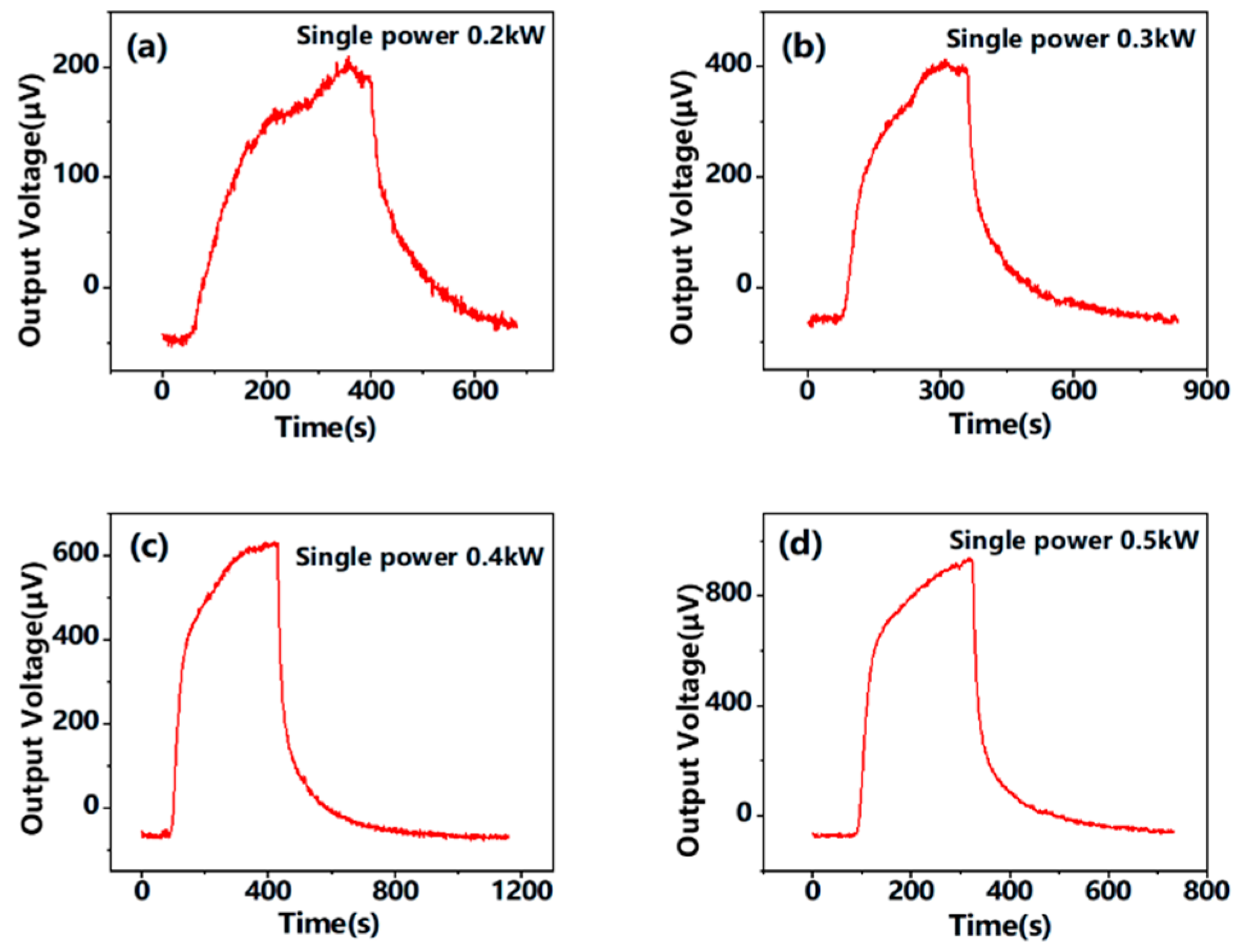
“In addition, it is observed in Figure 6 that when the thermal power is removed, the output signal of the sensor does not disappear immediately, but gradually returns to its pre-use state over time. The reasons for this phenomenon are when the power is applied to the quartz lamp for a long time, the quartz lamp and the environment will be heated. When the power supply is turned off, there is still heat transferred from the quartz lamp or the environment to the heat flux sensor through convection. Therefore, the heat flow sensor still has an output signal. In addition, the heat flux sensor is also heated, and when the heat source is removed, the heat is cooled by water through conduction inside the sensor, and finally returns to the thermal equilibrium state before use.”
The value “230 μV/(kW/m2)” has been changed to 23 μV/(kW/m2) in the second sentence of the first paragraph in Section 4. Conclusions. Also, the word “ultra” has been deleted from the phrase “ultra-high-sensitivity”, and the phrase “which is significantly better than the similar index” has also been removed from the second sentence of the first paragraph in Section 4. Conclusions.
The units of the ordinate of the figures in the original draft are also used in “μV”, in the same unit as the unit of sensitivity. Corrected Figure 4, Figure 6, Figure 7, Figure 8 and Figure 9 are shown below:
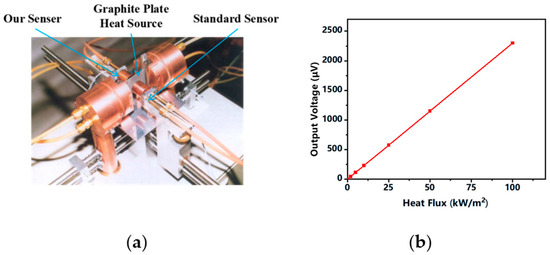
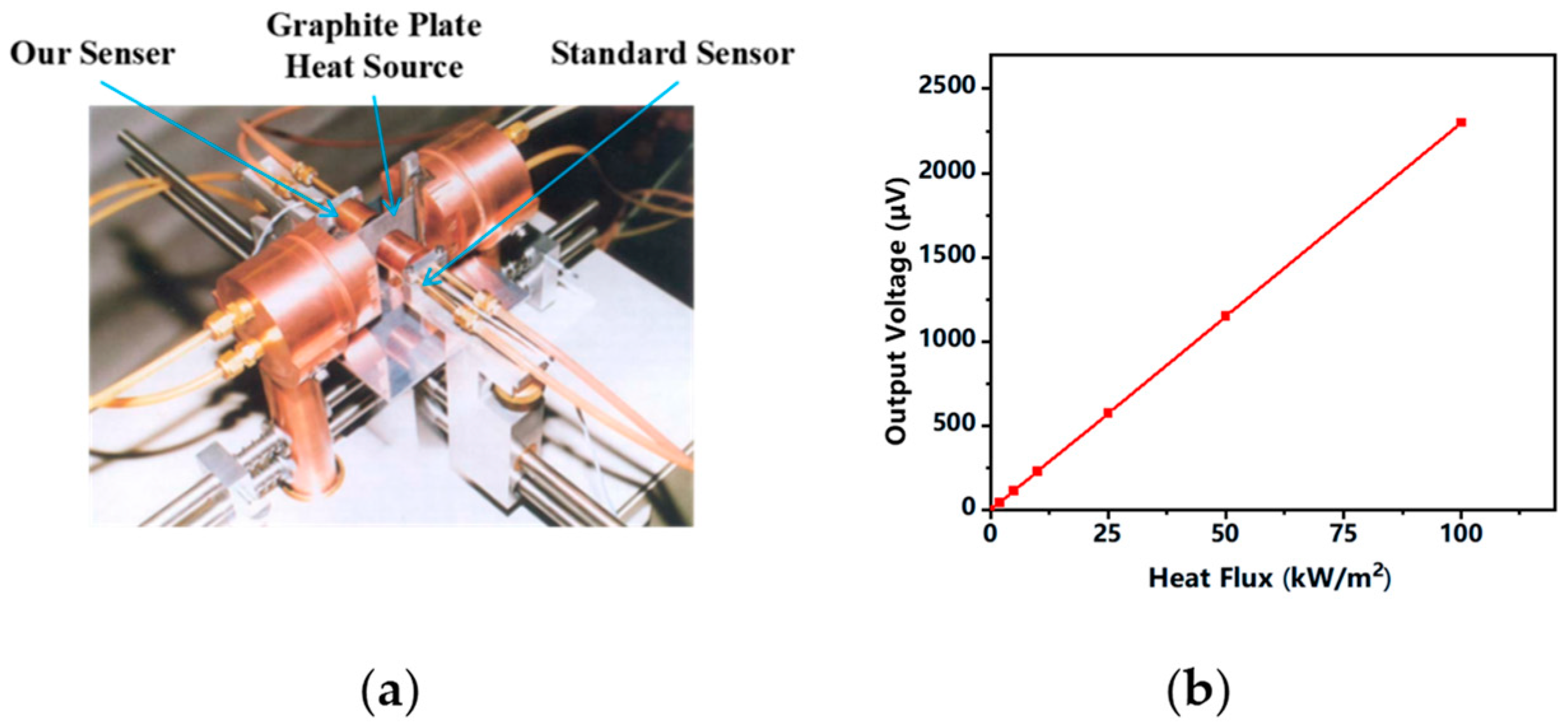
Figure 4.
(a) is a schematic diagram of the device calibration test system by graphite flat plate heating method, and (b) is the calibration curve of the device in the range of 0~100 kW/m2.
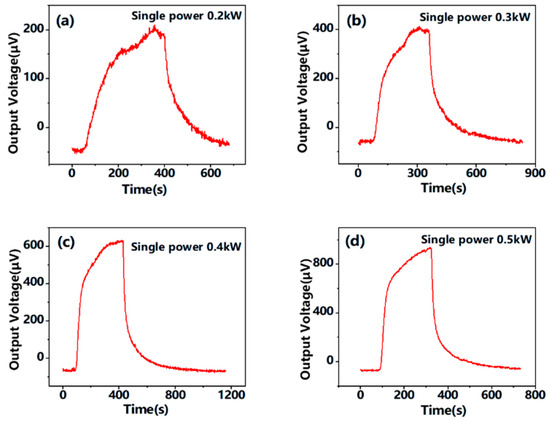
Figure 6.
(a–d) show the V-T variation curve of the output of the heat flow sensor when the power of a single quartz lamp array is 0.2 kW, 0.3 kW, 0.4 kW and 0.5 kW, respectively.
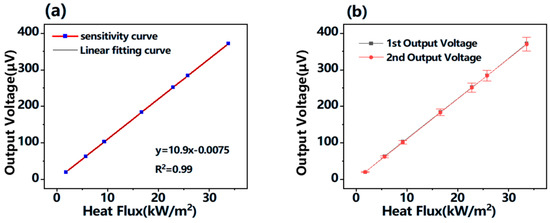
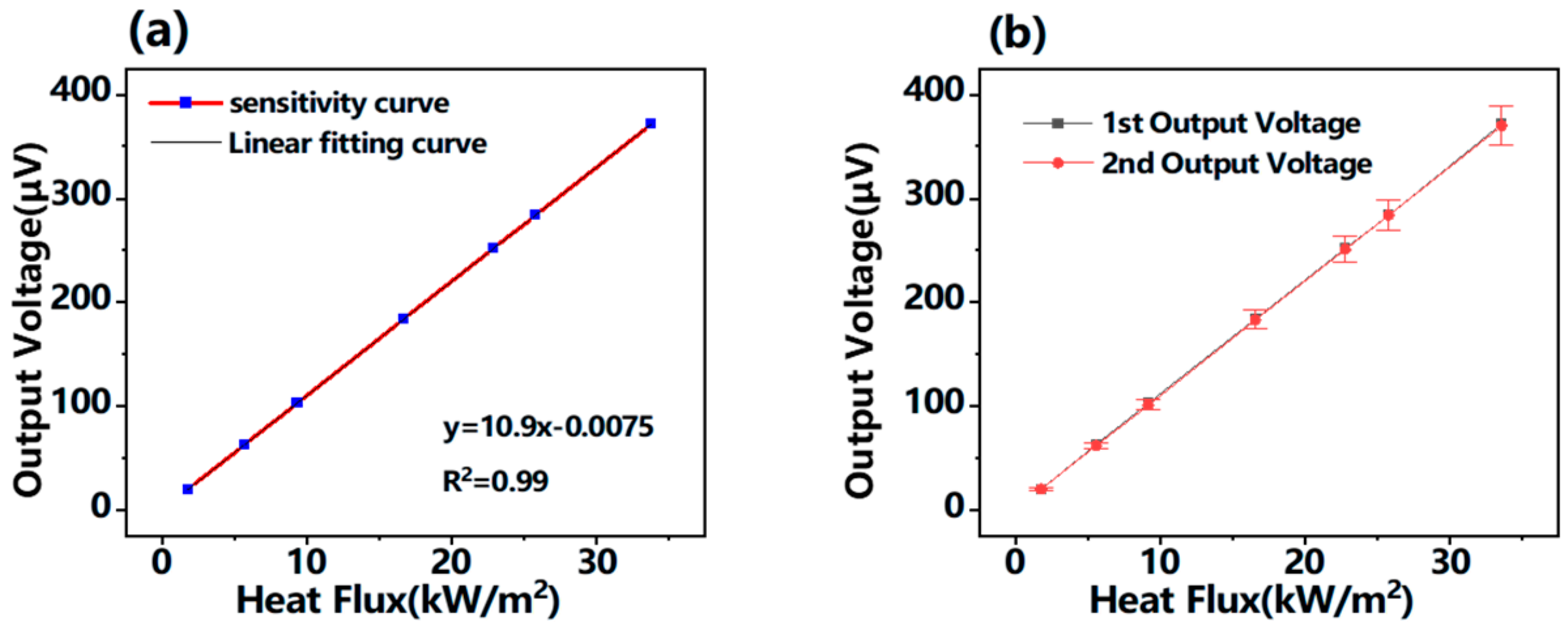
Figure 7.
(a) The output V-q curve of the heat flow sensor, (b) the repeated characteristic curve of the heat flow sensor.
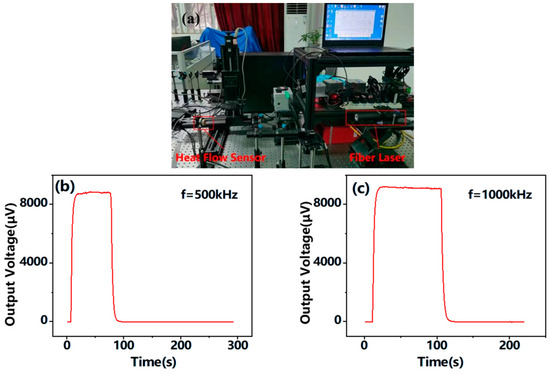
Figure 8.
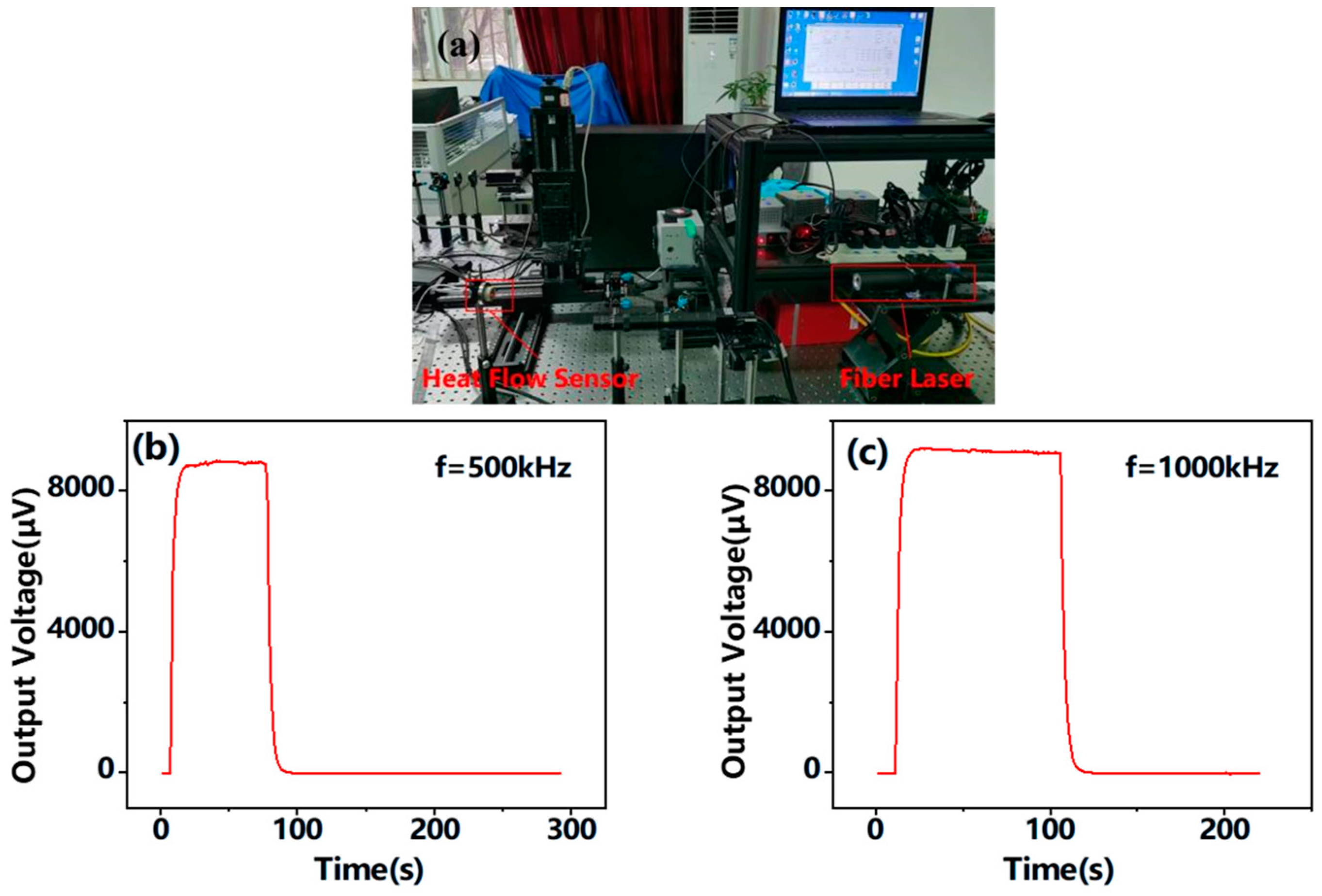
(a) The schematic diagram of the laser transient heat flow calibration facility, (b) the V-T dynamic curve under the irradiation of the laser frequency of 500 kHz, (c) the V-T dynamic curve under the irradiation of the sample laser frequency of 1000 kHz.
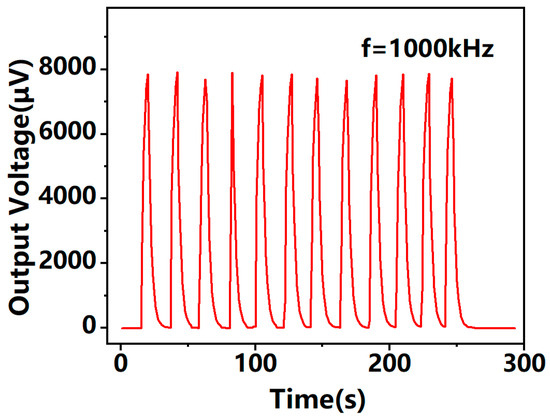
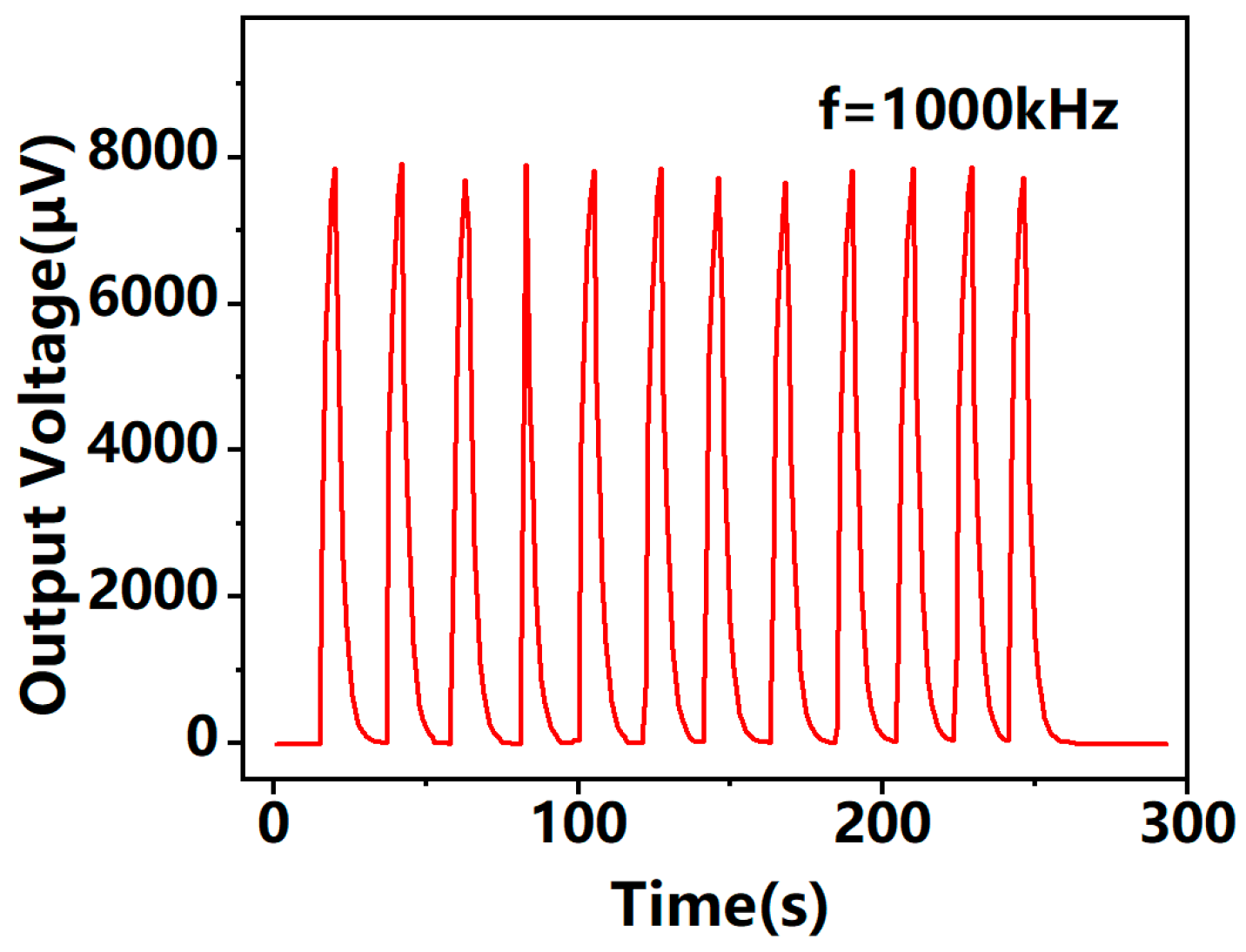
Figure 9.
Repetition response curve of the component under 1000 kHz laser frequency irradiation.
The authors state that the scientific conclusions are unaffected. This correction was approved by the Editor-in-Chief of Coatings. The original publication has also been updated.
References
- Chen, H.; Wang, Y.; Yi, Z.; Dai, B.; Tang, B.; Xu, X.; Yi, Y. High-Sensitivity and -Stability Thin-Film Heat Flux Sensor Based on Transverse Thermoelectric Effect. Coatings 2023, 13, 1610. [Google Scholar] [CrossRef]
- Chen, X.; Tao, B.; Zhao, R.; Yang, K.; Li, Z.; Xie, T.; Zhong, Y.; Zhang, T.; Xia, Y. The atomic layer thermopile heat flux sensor based on the inclined epitaxial YBa2Cu3O7-δ films. Mater. Lett. 2023, 330, 133336. [Google Scholar] [CrossRef]
Disclaimer/Publisher’s Note: The statements, opinions and data contained in all publications are solely those of the individual author(s) and contributor(s) and not of MDPI and/or the editor(s). MDPI and/or the editor(s) disclaim responsibility for any injury to people or property resulting from any ideas, methods, instructions or products referred to in the content. |
© 2024 by the authors. Licensee MDPI, Basel, Switzerland. This article is an open access article distributed under the terms and conditions of the Creative Commons Attribution (CC BY) license (https://creativecommons.org/licenses/by/4.0/).