


Abstract
Spacetime wormholes are evidently an essential component of the construction of a time machine. Within the context of general relativity, such objects require, for their formation, exotic matter—matter that violates at least one of the standard energy conditions. Here, we explore the possibility that higher-curvature gravity theories might permit the construction of a wormhole without any matter at all. In particular, we consider the simplest form of a generalized quasi topological theory in four spacetime dimensions, known as Einsteinian Cubic Gravity. This theory has a number of promising features that make it an interesting phenomenological competitor to general relativity, including having non-hairy generalizations of the Schwarzschild black hole and linearized equations of second order around maximally symmetric backgrounds. By matching series solutions near the horizon and at large distances, we find evidence that strong asymptotically AdS wormhole solutions can be constructed, with strong curvature effects ensuring that the wormhole throat can exist.
1. Introduction
It has long been known that if spacetime is to have closed timelike curves in some local regions [1], then wormholes are an essential part of this construction [2,3]. However, a key characteristic of such objects is that they require exotic matter that does not respect the energy conditions. Despite the challenges presented in constructing wormholes [4], the search nevertheless continues in the hopes of evading the constraints imposed by quantum physics in Einsteinian geometries [5].
Much effort has gone into exploring modified gravity to this end [6,7,8,9,10,11,12,13,14]. The higher-curvature Lovelock theories [15,16] have been of particular interest [17,18,19,20,21,22,23,24] since the field equations are of second order in the metric components. However, non-trivial solutions exist only in spacetime dimensions . Curiously, quasi-topological gravities [25,26,27,28,29,30] could also be considered for wormhole solutions, but none have been obtained to date. However, such objects would also exist only in dimensions.
Both Lovelock and quasi-topological theories have been shown to be particular cases of a more general class called Generalized Quasi-Topological gravity (GQTG) [31,32,33,34,35]. These theories are characterized by second-order linearized equations around maximally symmetric backgrounds and admit single-function () non-hairy generalizations of the Schwarzschild black hole. These theories are ghost-free on constant-curvature backgrounds, but, on a generic background, will have ghosts. However, such ghosts cannot escape to infinity in spacetimes that are asymptotically of constant curvature. The effects of the additional degrees of freedom in GQTGs have not been fully explored, but it is known that they significantly modify the thermodynamics of black holes for small masses [34] and, in the cubic and quartic cases, exhibit an number of interesting features [34,36,37,38,39,40,41]. A comprehensive list of their properties has been given [35,42]. A key advantage of GQTGs is that they have non-trivial field equations (and solutions) in dimensions.
In this paper, we carry out the first investigations of wormhole solutions in Generalized Quasi-Topological gravity. For specificity, we shall consider the simplest GQTG, a theory known as Einsteinian Cubic Gravity (ECG) [31,43], whose action is of the form
with , and being coupling constants, and three densities that are cubic in the Riemann curvature, given by
For a general static spherically symmetric ansatz (GSSS)
the densities and do not contribute in a linearly independent way to the field equations. Both of these terms become trivial when the metric function is a constant. This situation is the one generally considered in ECG and clearly does not admit a vacuum wormhole. Note that, regardless of the values that the higher-curvature couplings take, the Einstein–AdS limit of the theory at large distances is preserved (albeit with a modified cosmological constant), since the contributions from the cubic terms fall off much more rapidly than the contributions from the Einstein–Hilbert part of the action if AdS asymptotic behaviour is imposed as a requirement.
We therefore consider the GSSS ansatz with . We find that this situation is possible if the spacetime has a spherical deficit/surfeit angle in the asymptotic large-r region. We shall specifically consider solutions whose metric functions have the asymptotic form
where l is the AdS length scale and parametrizes the deficit/surfeit angle.
We find that Einsteinian Cubic Gravity—and, by implication, higher-order GQTGs—admits wormhole solutions that are purely gravitational without any exotic matter. The solutions that we obtain are asymptotically anti-de Sitter, with a spherical deficit angle resembling that of a global monopole. Unlike other solutions with radial symmetry, these solutions have non-zero values for the coupling parameter . We find that including provides a sufficiently large number of parameters to match the series solutions for the two metric functions over a broad range of radii at which the matching takes place.
2. The Non-Linear ODE System
For the ansatz (5), we find that the two independent field equations are
and
where, without loss of generality, we can set in (1), since its inclusion simply reproduces the preceding equations but with .
If is constant, then these equations become linearly dependent, and a wormhole solution is not possible since there will be a single metric function whose largest root corresponds to the horizon of a black hole.
We can see this by considering the series expansions
in the asymptotically distant region at large r, where asymptotically flat solutions have . Inserting these into the field Equations (7) and (8) yields
in the limit , where
and
and all -dependent terms vanish.
From these formulae, we observe several aspects. First, a power-series solution in implies only a single independent function , which is the hallmark of GQTGs. Second, for asymptotically flat solutions , which in turn implies , we also have , and so the asymptotically flat solution can be immediately obtained from (11) by setting . However, note that the converse is not true: even if , it is possible to have asymptotically de Sitter solutions with provided that .
We seek solutions that have the asymptotic form (6), where is not constant so as to obtain wormhole solutions. The presence of the wormhole needs to be manifest at large-r in a way that differs from that of a spherically symmetric star or black hole. To this end, we consider the ansatz
where the quantity parameterizes a spherical deficit/surfeit angle produced by the wormhole. The effect is analogous to that produced by a global monopole [44,45]. Far from the wormhole, all light rays are deflected by the same angle regardless of their impact parameter.
Inserting the ansatz (14) into the field equations yields
from both equations to leading order. This equation is satisfied by choosing either or . However, it is straightforward to show that the next order forces regardless of the value of . However, if this latter quantity is non-zero, then it is straightforward to show that there is no deficit angle, and all coefficients must vanish as per the discussion above.
We now see that the condition from (13) allows for N to be a non-constant function, opening up the possibility of obtaining a wormhole solution. We pursue this in the next section.
3. Series Solutions
Anticipating the asymptotic behaviour (14), we rewrite the general static spherically symmetric (GSSS) ansatz (5) in the form
using the coordinate transformation
where the metric functions and , defined on , are
with a positive constant.
For wormhole solutions [1], these continuous functions must be everywhere positive in the interior of the domain, with n vanishing and g having a finite positive value at , which locates the position of the wormhole throat. Under this map, is compactified to . With this new ansatz, the boundary condition (6) is equivalent to
as x approaches 1. The effect of is analogous to that produced by a global monopole [44,45], which deflects light rays by the same angle regardless of their impact parameter.
The advantage of the ansatz (18) is clear—it compactifies the domain so that numerical and semi-analytic solutions become more easily attainable. We now employ this ansatz to obtain series solutions for the functions n and g. The field equations for and are given in Appendix A.
3.1. Large-r Solution
To obtain solutions asymptotic to (20), we substitute the formal series
into the equations and solve them order by order in . Note that we have set due to the discussion following condition (15). The lowest two orders yield two constraints and . The first of these simply defines in terms of the other parameters. Solutions with a vanishing deficit satisfy the second constraint but force or, in other words, . The only alternative non-trivial solution occurs when , yielding
where
and and are replaced by expressions in terms of L via the two constraints and (24).
The parameters , and are the only free variables in this solution; we also have . Furthermore is an independent coupling parameter. It can happen in a non-linear system that fewer constants of integration appear in a solution than the differential order of the equations. Due to the non-linearity, a spontaneous singularity could appear, which means that the radii of convergence for g and n depend on the initial conditions, namely the values of these parameters. We do not expect vanishing radii of convergence for all values of the parameters, since the series with converges to the AdS solution with a deficit.
3.2. Near-Throat Solution
There is likewise a near-throat solution for . Local solutions near compatible with (22) and (23) are necessarily Taylor series. In this case, the desired boundary conditions at the throat require the ansatz to be
which yields two series whose coefficients are fully determined by , and . We obtain
Higher-order terms are very lengthy and cumbersome to write; we present some of them in Appendix B.
Note that in both series solutions (near and near ), the independent parameters and always appear as and . Consequently, we can set and regard and as independent parameters without loss of generality.
4. Matching the Solutions
As a consequence of the uniqueness of Taylor series, we expect that the Taylor expansions of (22) and (23) at can be matched with (26) and (27) as long as a wormhole solution (analytic on ) exists for some values of . We achieve this matching by minimizing the quantity
where is the matching point, as a function of the parameters , where . By matching the second derivatives, we ensure that there are no discontinuities in the Riemann curvature.
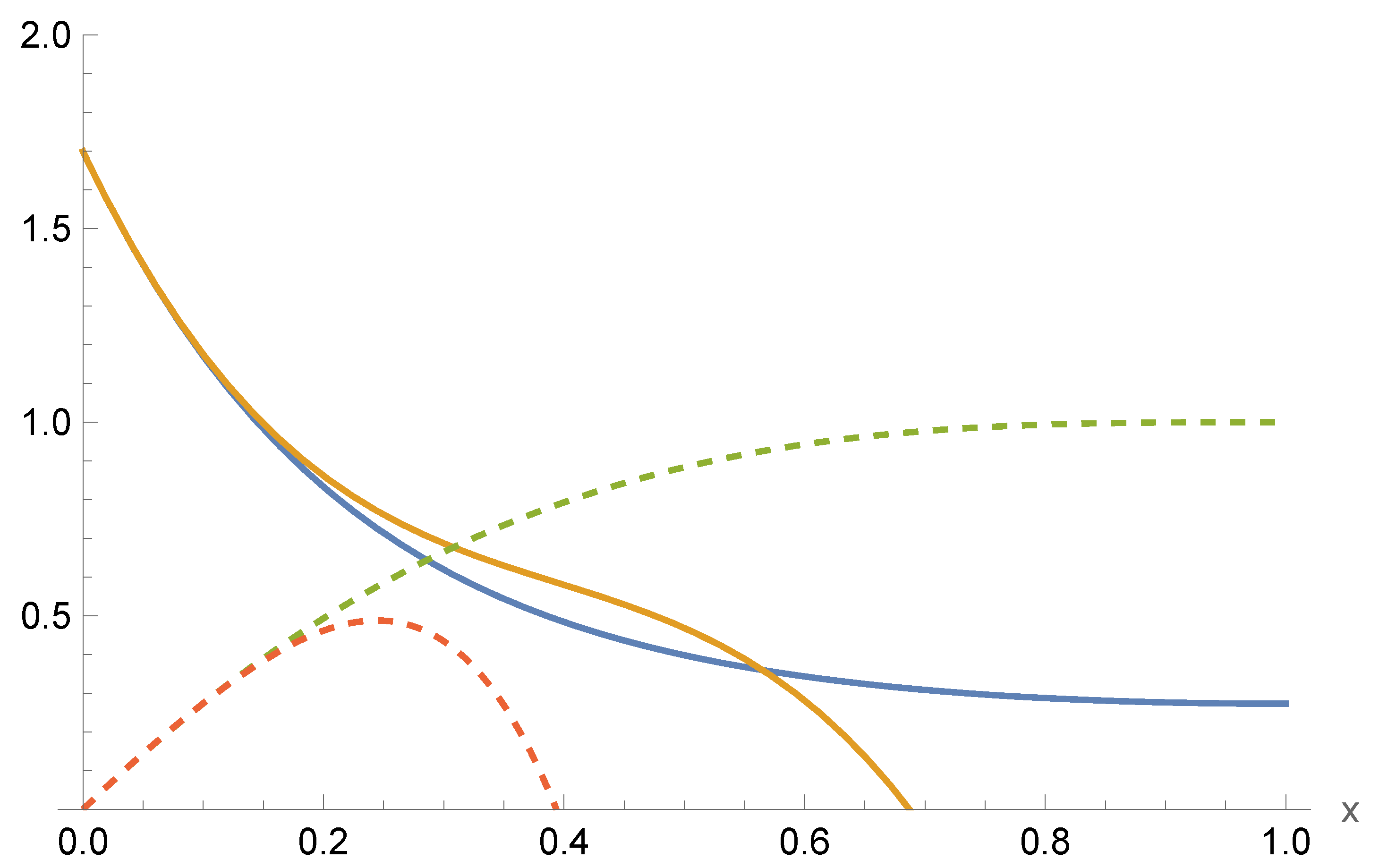
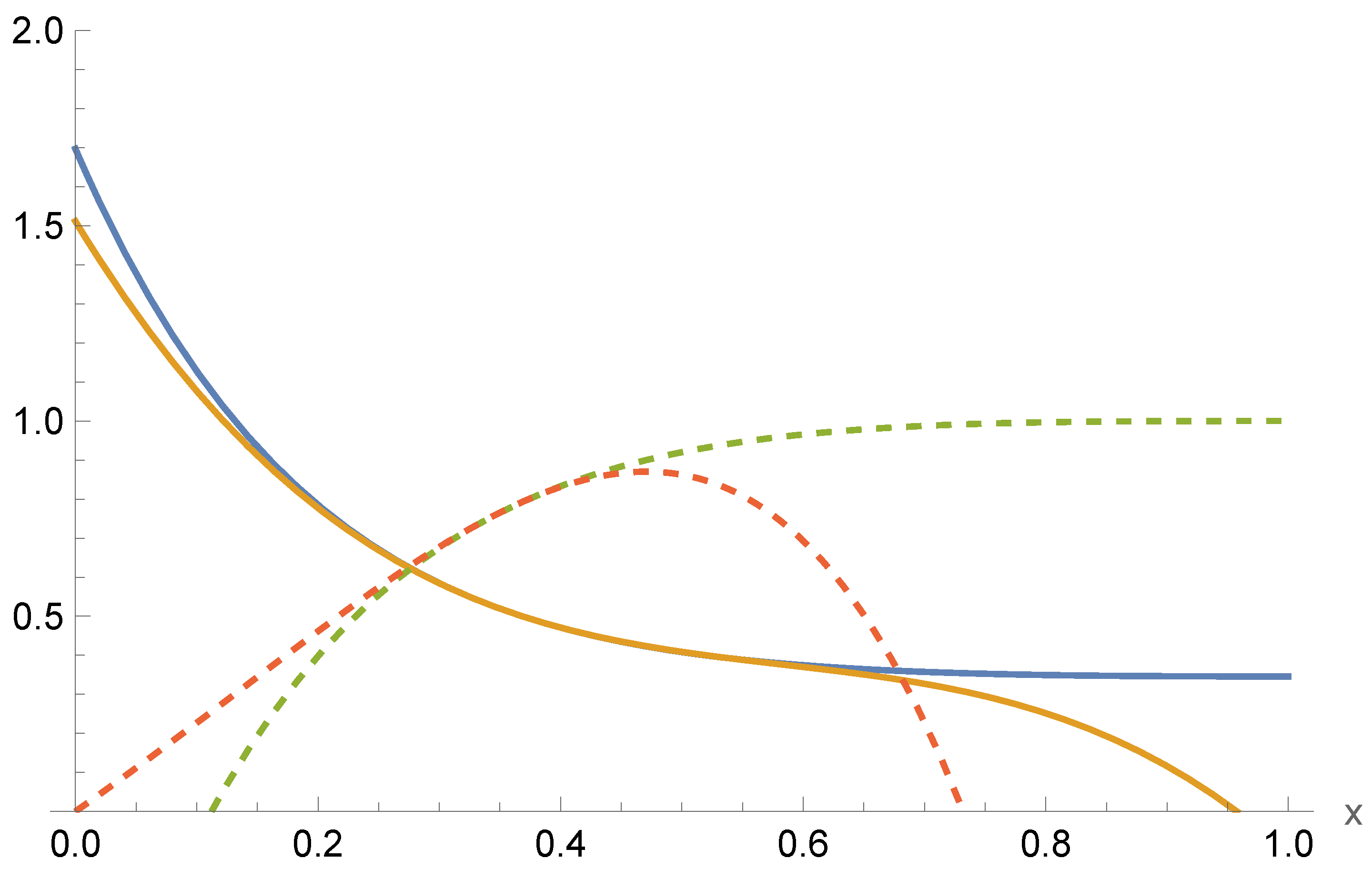
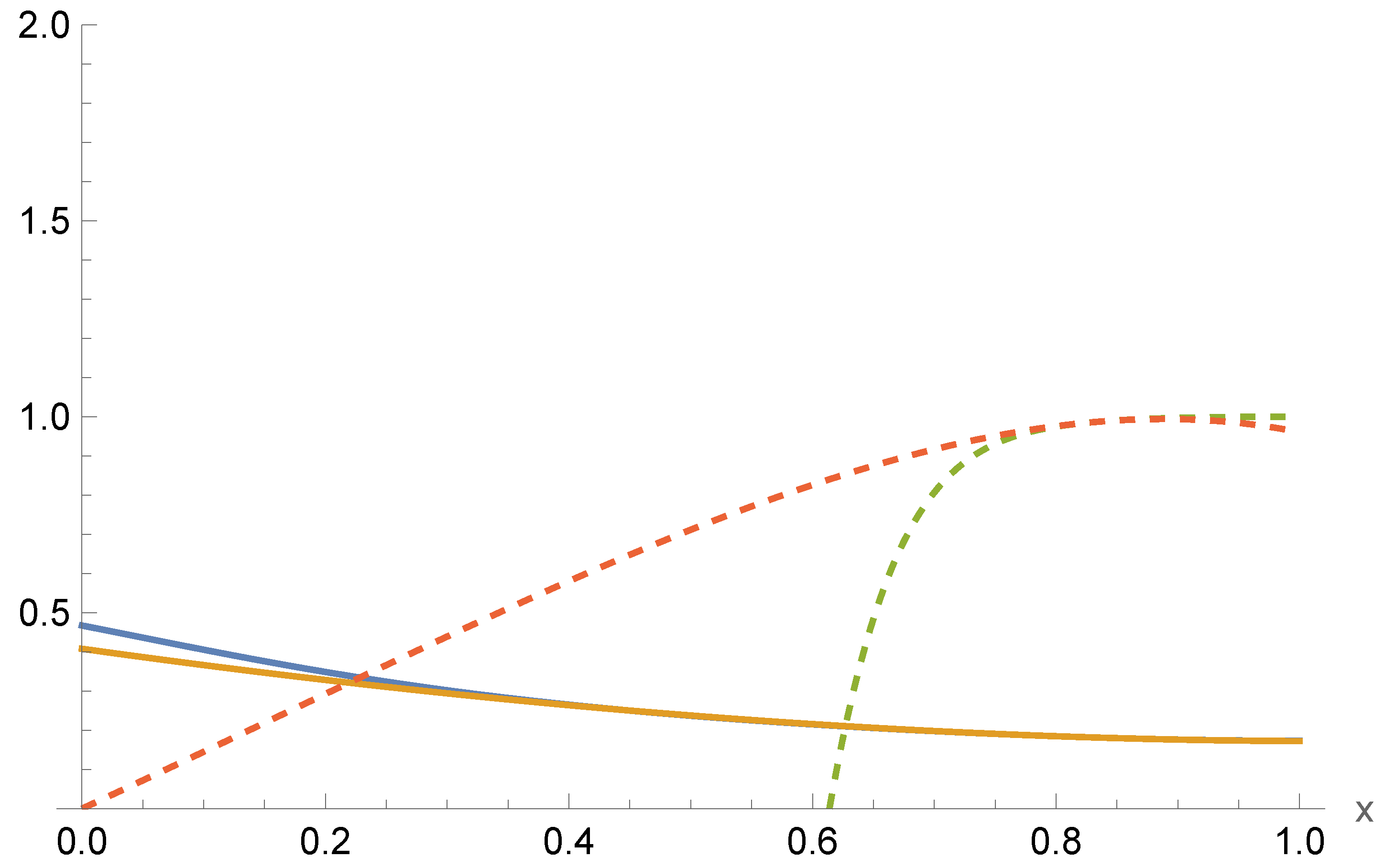
The presence of the coupling parameter , irrelevant for asymptotically AdS solutions (with ), has a profound effect insofar as it yields a sufficient amount of freedom in the parameter space to minimize to high precision. The precision of our matching is accurate to one part in at worst. Note from (24) that each solution appears for a specific choice of . We have found a broad range of wormhole solutions using this method. These are illustrated in Figure 1, Figure 2 and Figure 3 and, respectively, correspond to matching for small , mid-range , and large .
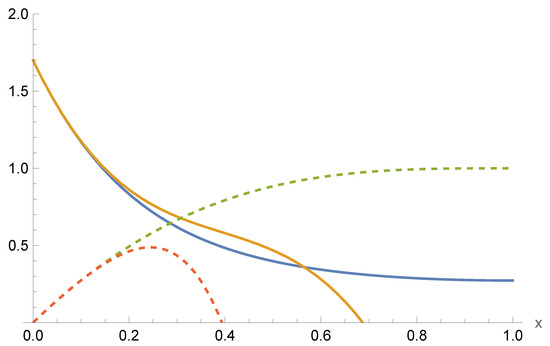
Figure 1.
Plots of the series solutions for both large-r [(solid blue, dashed green)] and near-throat [(solid orange, dashed red)]. The solutions smoothly match with at for the parameters .
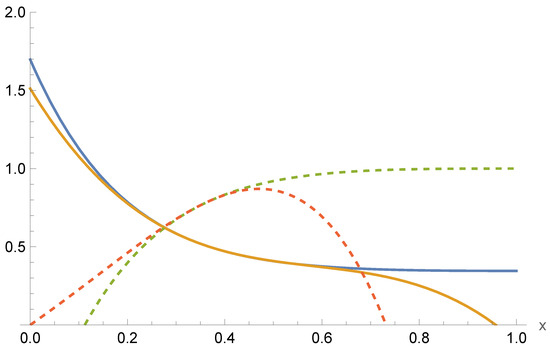
Figure 2.
Plots of the series solutions for both large-r [(solid blue, dashed green)] and near-throat [(solid orange, dashed red)]. The solutions smoothly match with at for the parameters .
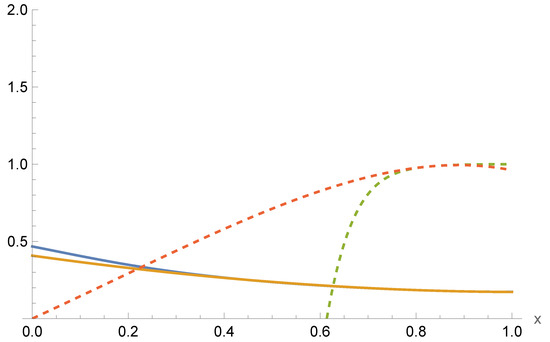
Figure 3.
Plots of the series solutions for both large-r [(solid blue, dashed green] and near-throat [(solid orange, dashed red]. The solutions smoothly match with at for the parameters .
5. Conclusions
We have shown that Einsteinian Cubic Gravity contains wormhole solutions that are purely gravitational. Unlike wormholes obtained in generic higher-curvature gravity theories, our solutions are in -dimensions and require no exotic matter in their construction.
In contrast to previous solutions obtained in the theory, our wormhole solutions require three special characteristics. One is that their asymptotic behaviour is that of AdS spacetime with a global monopole deficit. The second is that the the coupling parameter is related to the effective cosmological constant via (24). The third is that the coupling parameter . Our wormhole solutions have no horizons or singularities and so are traversable in principle. Imposing more stringent traversability requirements (such as requiring that the gravity at the throat not exceed Earth’s gravity) will reduce the range of allowed solutions; we have not imposed this constraint on the solutions that we have obtained.
Although our series-matching approach has yielded candidate gravitational wormholes, a full wormhole solution to the field Equations (A1) and (A2) remains to be obtained. This can be done numerically, but it presents a computational challenge. A solution in terms of Tchebyshev polyonomials requires many coefficients to obtain high accuracy. We were not able to achieve this using the computational resources available. While it is straightforward to apply the shooting method to an ODE system, here, we have a double shooting problem, which is considerably more challenging. The solution will necessarily depend on tuning the constants of integration appearing in the local series expansions of the metric functions near such that the integrated solution from satisfies the boundary condition at the other end (or vice versa, beginning at ). We did attempt such solutions but found that we typically encountered at least one spontaneous singularity for g between and . Some of these cases might be indicative of a new class of black holes, which merit further investigation.
Author Contributions
Conceptualization, R.B.M.; methodology, R.B.M., M.L. and J.Y.; software, M.L. and J.Y.; formal analysis, M.L., J.Y. and R.B.M.; writing—original draft preparation, R.B.M.; writing—review and editing, R.B.M., M.L. and J.Y.; supervision, R.B.M.; project administration, R.B.M.; funding acquisition, R.B.M. All authors have read and agreed to the published version of the manuscript.
Funding
This work was supported in part by the Natural Science and Engineering Research Council of Canada. Mengqi Lu was also supported by the China Scholarship Council.
Data Availability Statement
Files used to generate the various graphs presented in this paper are available on request.
Acknowledgments
We would like to thank Niayesh Afshordi, Jianhui Qiu, and Robie Hennigar for the helpful discussions.
Conflicts of Interest
The authors declare no conflicts of interest.
Abbreviations
The following abbreviations are used in this manuscript:
| dS | de Sitter |
| AdS | Anti-de Sitter |
| ECG | Einsteinian Cubic Gravity |
| GR | General Relativity |
| GQTG | Generalized Quasitopological Gravity |
| GSSS | General Static Spherically Symmetric |
| ODE | Ordinary Differential Equation |
Appendix A. On-Shell Field Equations
Appendix B. Higher-Order Terms of Near-Throat Solutions
Here, we present the first few coefficients of the near-throat solutions (26) and (27) beyond linear order; note that the present and appear in the main text.
The coefficients and require about 5 and 10 pages, respectively, to present, so we omit them here.
References
- Morris, M.S.; Thorne, K.S.; Yurtsever, U. Wormholes, Time Machines, and the Weak Energy Condition. Phys. Rev. Lett. 1988, 61, 1446–1449. [Google Scholar] [CrossRef] [PubMed]
- Morris, M.S.; Thorne, K.S. Wormholes in space-time and their use for interstellar travel: A tool for teaching general relativity. Am. J. Phys. 1988, 56, 395–412. [Google Scholar] [CrossRef]
- Visser, M. Lorentzian Wormholes: From Einstein to Hawking; American Institute of Physics: Woodbury, NY, USA, 1995. [Google Scholar]
- Visser, M. From wormhole to time machine: Comments on Hawking’s chronology protection conjecture. Phys. Rev. D 1993, 47, 554–565. [Google Scholar] [CrossRef] [PubMed]
- Ford, L.H.; Roman, T.A. Quantum field theory constrains traversable wormhole geometries. Phys. Rev. D 1996, 53, 5496–5507. [Google Scholar] [CrossRef] [PubMed]
- Harko, T.; Lobo, F.S.N.; Mak, M.K.; Sushkov, S.V. Modified-gravity wormholes without exotic matter. Phys. Rev. D 2013, 87, 067504. [Google Scholar] [CrossRef]
- Nandi, K.K.; Islam, A.; Evans, J. Brans wormholes. Phys. Rev. D 1997, 55, 2497–2500. [Google Scholar] [CrossRef]
- Yue, X.; Gao, S. Stability of Brans-Dicke thin shell wormholes. Phys. Lett. A 2011, 375, 2193–2200. [Google Scholar] [CrossRef][Green Version]
- Lobo, F.S.N.; Oliveira, M.A. General class of vacuum Brans-Dicke wormholes. Phys. Rev. D 2010, 81, 067501. [Google Scholar] [CrossRef]
- Sushkov, S.V.; Kozyrev, S.M. Composite vacuum Brans-Dicke wormholes. Phys. Rev. D 2011, 84, 124026. [Google Scholar] [CrossRef]
- Lobo, F.S.N.; Oliveira, M.A. Wormhole geometries in f(R) modified theories of gravity. Phys. Rev. D 2009, 80, 104012. [Google Scholar] [CrossRef]
- Garcia, N.M.; Lobo, F.S.N. Wormhole geometries supported by a nonminimal curvature-matter coupling. Phys. Rev. D 2010, 82, 104018. [Google Scholar] [CrossRef]
- Montelongo Garcia, N.; Lobo, F.S.N. Nonminimal curvature-matter coupled wormholes with matter satisfying the null energy condition. Class. Quant. Grav. 2011, 28, 085018. [Google Scholar] [CrossRef]
- Anabalon, A.; Oliva, J.; Quijada, C. Fully resonant scalars on asymptotically AdS wormholes. Phys. Rev. D 2019, 99, 104022. [Google Scholar] [CrossRef]
- Lovelock, D. Divergence-free tensorial concomitants. Aequationes Math. 1970, 4, 127–138. [Google Scholar] [CrossRef]
- Lovelock, D. The Einstein tensor and its generalizations. J. Math. Phys. 1971, 12, 498–501. [Google Scholar] [CrossRef]
- Bhawal, B.; Kar, S. Lorentzian wormholes in Einstein-Gauss-Bonnet theory. Phys. Rev. D 1992, 46, 2464–2468. [Google Scholar] [CrossRef] [PubMed]
- Wang, W.; Li, X.Y. Wormhole solution in D-dimensional Einstein and Lovelock theories. Il Nuovo Cimento B 1996, 111, 1101–1110. [Google Scholar] [CrossRef]
- Shang, Y.W.; Xu, J.J. Wormhole solution in Lovelock gravity theory. Chin. Phys. Lett. 1999, 16, 85–87. [Google Scholar] [CrossRef]
- Maeda, H.; Nozawa, M. Static and symmetric wormholes respecting energy conditions in Einstein-Gauss-Bonnet gravity. Phys. Rev. D 2008, 78, 024005. [Google Scholar] [CrossRef]
- Dehghani, M.H.; Dayyani, Z. Lorentzian wormholes in Lovelock gravity. Phys. Rev. D 2009, 79, 064010. [Google Scholar] [CrossRef]
- Mehdizadeh, M.R.; Lobo, F.S.N. Novel third-order Lovelock wormhole solutions. Phys. Rev. D 2016, 93, 124014. [Google Scholar] [CrossRef]
- Mehdizadeh, M.R.; Riazi, N. Cosmological wormholes in Lovelock gravity. Phys. Rev. D 2012, 85, 124022. [Google Scholar] [CrossRef]
- Mehdizadeh, M.R.; Kord Zangeneh, M.; Lobo, F.S.N. Einstein-Gauss-Bonnet traversable wormholes satisfying the weak energy condition. Phys. Rev. D 2015, 91, 084004. [Google Scholar] [CrossRef]
- Oliva, J.; Ray, S. A new cubic theory of gravity in five dimensions: Black hole, Birkhoff’s theorem and C-function. Class. Quant. Grav. 2010, 27, 225002. [Google Scholar] [CrossRef]
- Myers, R.C.; Robinson, B. Black Holes in Quasi-topological Gravity. JHEP 2010, 08, 067. [Google Scholar] [CrossRef]
- Oliva, J.; Ray, S. Birkhoff’s Theorem in Higher Derivative Theories of Gravity. Class. Quant. Grav. 2011, 28, 175007. [Google Scholar] [CrossRef]
- Oliva, J.; Ray, S. Birkhoff’s Theorem in Higher Derivative Theories of Gravity II. Phys. Rev. D 2012, 86, 084014. [Google Scholar] [CrossRef]
- Dehghani, M.H.; Bazrafshan, A.; Mann, R.B.; Mehdizadeh, M.R.; Ghanaatian, M.; Vahidinia, M.H. Black Holes in Quartic Quasitopological Gravity. Phys. Rev. D 2012, 85, 104009. [Google Scholar] [CrossRef]
- Cisterna, A.; Guajardo, L.; Hassaine, M.; Oliva, J. Quintic quasi-topological gravity. JHEP 2017, 4, 66. [Google Scholar] [CrossRef]
- Hennigar, R.A.; Kubizňák, D.; Mann, R.B. Generalized quasitopological gravity. Phys. Rev. D 2017, 95, 104042. [Google Scholar] [CrossRef]
- Bueno, P.; Cano, P.A. On black holes in higher-derivative gravities. Class. Quant. Grav. 2017, 34, 175008. [Google Scholar] [CrossRef]
- Ahmed, J.; Hennigar, R.A.; Mann, R.B.; Mir, M. Quintessential Quartic Quasi-topological Quartet. JHEP 2017, 5, 134. [Google Scholar] [CrossRef]
- Bueno, P.; Cano, P.A. Universal black hole stability in four dimensions. Phys. Rev. D 2017, 96, 024034. [Google Scholar] [CrossRef]
- Bueno, P.; Cano, P.A.; Hennigar, R.A. (Generalized) quasi-topological gravities at all orders. Class. Quant. Grav. 2020, 37, 015002. [Google Scholar] [CrossRef]
- Hennigar, R.A. Criticality for charged black branes. JHEP 2017, 9, 82. [Google Scholar] [CrossRef]
- Mir, M.; Mann, R.B. On generalized quasi-topological cubic-quartic gravity: Thermodynamics and holography. JHEP 2019, 7, 12. [Google Scholar] [CrossRef]
- Mir, M.; Hennigar, R.A.; Ahmed, J.; Mann, R.B. Black hole chemistry and holography in generalized quasi-topological gravity. JHEP 2019, 8, 068. [Google Scholar] [CrossRef]
- Li, Y.Z.; Liu, H.S.; Lu, H. Quasi-Topological Ricci Polynomial Gravities. JHEP 2018, 2, 166. [Google Scholar] [CrossRef]
- Li, Y.Z.; Lu, H.; Wu, J.B. Causality and a-theorem Constraints on Ricci Polynomial and Riemann Cubic Gravities. Phys. Rev. D 2018, 97, 024023. [Google Scholar] [CrossRef]
- Li, Y.Z.; Lu, H.; Mai, Z.F. Universal Structure of Covariant Holographic Two-Point Functions In Massless Higher-Order Gravities. JHEP 2018, 10, 063. [Google Scholar] [CrossRef]
- Bueno, P.; Cano, P.A.; Moreno, J.; Murcia, A. All higher-curvature gravities as Generalized quasi-topological gravities. JHEP 2019, 11, 062. [Google Scholar] [CrossRef]
- Bueno, P.; Cano, P.A. Einsteinian cubic gravity. Phys. Rev. D 2016, 94, 104005. [Google Scholar] [CrossRef]
- Barriola, M.; Vilenkin, A. Gravitational Field of a Global Monopole. Phys. Rev. Lett. 1989, 63, 341. [Google Scholar] [CrossRef]
- Shi, X.; Li, X.z. The Gravitational field of a global monopole. Class. Quant. Grav. 1991, 8, 761–767. [Google Scholar] [CrossRef]
Disclaimer/Publisher’s Note: The statements, opinions and data contained in all publications are solely those of the individual author(s) and contributor(s) and not of MDPI and/or the editor(s). MDPI and/or the editor(s) disclaim responsibility for any injury to people or property resulting from any ideas, methods, instructions or products referred to in the content. |
© 2024 by the authors. Licensee MDPI, Basel, Switzerland. This article is an open access article distributed under the terms and conditions of the Creative Commons Attribution (CC BY) license (https://creativecommons.org/licenses/by/4.0/).