


Abstract
We study the homogeneous but anisotropic Bianchi type-V cosmological model with time-dependent gravitational and cosmological “constants”. Exact solutions of the Einstein field equations (EFEs) are presented in terms of adjustable parameters of quantum field theory in a spatially curved and expanding background. It has been found that the general solution of the average scale factor a as a function of time involved the hypergeometric function. Two cosmological models are obtained from the general solution of the hypergeometric function and the Emden–Fowler equation. The analysis of the models shows that, for a particular choice of parameters in our first model, the cosmological “constant” decreases whereas the Newtonian gravitational “constant” increases with time, and for another choice of parameters, the opposite behaviour is observed. The models become isotropic at late times for all parameter choices of the first model. In the second model of the general solution, both the cosmological and gravitational “constants” decrease while the model becomes more anisotropic over time. The exact dynamical and kinematical quantities have been calculated analytically for each model.
PACS:
04.50.Kd; 04.80.-y; 06.20.Jr; 95.30.Ft; 98.80.Es; 98.80.-k
1. Introduction
The Bianchi models are described as classes of non-standard cosmological models that are in principle spatially homogeneous but anisotropic. Alternatively, they can be considered as a generalization of the well-known standard Friedman–Lemaître–Robertson–Walker (FLRW) models of cosmology. Originally, these models date back to the work of Bianchi [1,2], who classified them according to their construction of homogeneous surfaces in space-time. These surfaces are constructed by the action of a three-dimensional group of isometrics upon the space-like 3−surfaces [3]. From the cosmological point of view, these models are of great interest because they provide a way of studying the anisotropy at an early period of our universe’s expansion history [4].
One of the most puzzling and unsolved problems in physics today is the Cosmological Constant Problem [5] in the Einstein field equations (EFEs). In cosmology, it is regarded as a matter field with negative pressure (or as a vacuum energy density) that drives the accelerated expansion of the universe. The calculations of quantum field theory predict the value of vacuum to be of the order of s, whereas the cosmological constant value is of the order of s; hence, a new thought is required to explain or resolve this puzzle. The idea of considering the cosmological models as varying vacuum energy density has extensively been adapted by several authors [6,7,8,9,10,11,12,13,14,15,16,17,18,19,20,21,22]. Chen [23] considered proportional to , and a generalized form , which depends on adjustable parameters and of the quantum field on a curved and expanding background, the Hubble parameter H and the average scale factor of the universe a was also introduced [24].
Since the Newtonian constant G is a coupling “constant” between the geometry of spacetime and energy in the general theory of relativity (GR), and the universe is evolving with time, it is natural to assume that G varies with time. This consideration was first introduced by Dirac [25]. Based on this idea, there have been many attempts to modify the theory of GR, but, unfortunately, one of these efforts has yet to be universally accepted or studied extensively. Recently, there has been an increasing interest in studying modifications of GR with variable cosmological and Newtonian “constants” [26,27,28,29,30,31,32,33]. Apart from these investigations that include the variation in both G and within the limit of GR, there are also studies on cosmological models with viscous fluids in the presence of G and [17,34,35].
Many authors have studied the solutions of EFEs for homogeneous and anisotropic Bianchi type models [27,36,37,38,39,40,41,42,43,44,45,46]. For instance, Dwivedi [47] has solved the EFEs for a Bianchi Type-V model with variable cosmological and Newtonian “constants“ for a stiff perfect fluid. In his solution, the physical and kinematical parameters have been fully described, and he has found that the model has a singularity point, and all the physical parameters decrease as time increases, with the model isotropizing at late times. In addition to that, the universe described by such a model expands at a constant rate (i.e., the deceleration parameter equals zero). On the other hand, Yadav [48] has solved the same problem and generated two types of solution for the average scale factor, namely power-law type and exponential-type solutions. He found that the “cosmological constant” decreases with time and it reaches a small positive value at late and early times, respectively, results supported by supernova Type Ia observations. It is now well established from a variety of studies [47] that all the previous solutions are for special cases where the values of and are chosen from the beginning of the solution process, and no previous study has investigated the general case.
The main aim of this paper is to find the general solution of the EFEs for Bianchi type-V models for a stiff perfect fluid with variable and G without making any constraints on the value of and in the term, and to describe the behavior of the physical and kinematical parameters of the models. The remaining part of the paper is structured as follows: Section 2 is dedicated for a short description of the Bianchi type-V model and their general mathematical solutions for the EFEs. In Section 3, we present our models for restricted values of either or , and considering the other parameter as free. Finally, we conclude our results in Section 4.
We follow the Misner–Wheeler–Thorne notation where , Latin letters for the metric and geometric units with .
2. Bianchi Type-V Cosmology
We consider the spatially homogeneous and anisotropic Bianchi type-V space-time that is represented by the following line-element:
where and are the components of the fundamental metric tensor. We assume that the cosmic matter is a perfect fluid that is represented by the following energy-momentum tensor:
where is matter density, is the normalized fluid four-velocity, which is a time-like quantity such that , and p is the fluid’s isotropic pressure. and p are related through the barotropic equation of state
where w is the equation-of-state (EoS) parameter. The EFEs with time-dependent and G are given by
where and are the Ricci and metric tensors, respectively, and R is the Ricci scalar. Substituting Equations (1) and (2) into Equation (4), we get the field equations
with the dot over a letter representing differentiation with respect to time. The covariant divegence of the left hand side of Equation (4) produces
while the conservation of the usual energy-momentum tensor (i.e., ) yields
Substituting Equation (11) into (10), we get
This equation shows how and G evolve with time. It also shows that the two “constants” form a coupled system and, therefore, do not evolve independently of each other. The average scale factor for Bianchi-V models is defined to be
and the generalized Hubble parameter H is defined as in [47]
where and are directional Hubble’s parameters along x, y and z directions, respectively. The deceleration parameter q follows the usual definition:
The volume expansion parameter , the average anisotropy parameter , and shear modules are defined as in [47]
where the term represents the shear tensor. For this model, its scalar quantity comes out to be
where K is a positive constant that is related to the anisotropy of the model. Having introduced these quantities, we can re-express the field Equations (5)–(8) and (11) in terms of a, H, q and as
so that, when subtracting Equation (21) from Equation (22), we eliminate the term, obtaining
We see that this equation cannot be integrated as it is because of the unknown functions A, G, and the parameter w. Now, integrating Equation (9) and absorbing the integration constant into A or B, gives
and substituting it into Equation (13), we see that the average scale factor reads
Subtracting Equation (6) from (7) gives
which is equivalent to
and, multiplying this equation by , we obtain
Both sides of this equation are a factorization of a product rule of the following
Eliminating from both sides and integrating with respect to t yields
and dividing throughout by yields
where is a constant of integration. Recalling that , we finally get a first-order coupled differential equation of A and B as follows:
Similarly, the subtraction of (6) from (8), and (7) from (8), respectively, gives
where and are constants of integration. Again integrating the above set of Equations (32)–(33), we get
These equations can be combined to give
where and k are constant values that depend on the undetermined constants and , see [49] for more details. It is clear that Equations (25), (38) and (39) are totally dependent on the value of a, which is yet to be determined. To complete the solution process, we substitute Equation (25) into Equation (23) so that
Now, following [24] for the parametrization of , we assume
Setting for a stiff cosmological fluid and substituting Equation (41) into Equation (40) produces
which can also be re-arranged as
This is the generalized Friedman equation of Bianchi type-V models. The first term represents force per unit mass times distance or work of a system that is equivalent to a potential energy, the second term is a kinetic energy and is a kind of mass, and the last term is the total energy of the system.
As we have mentioned that and are adjustable constants of quantum field theory in an expanding curved background, the challenging problem here is to solve Equation (43) for general values of and without making any constraints from the beginning as some authors did [47,48]. It is obvious that, for , Equation (43) is a nonlinear second-order differential equation, which is not easy to solve unless we transform it into a set of first-order equations. Before we move to the general solution, however, we remark that, for the special cases of , the model has a scale factor solution that grows linearly with cosmic time, i.e.,
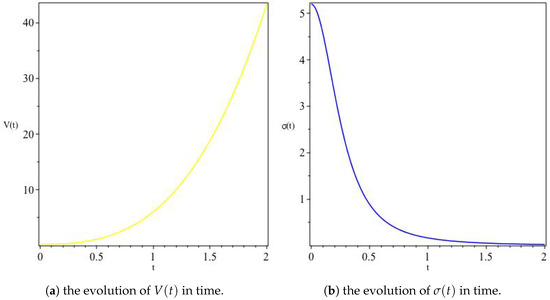
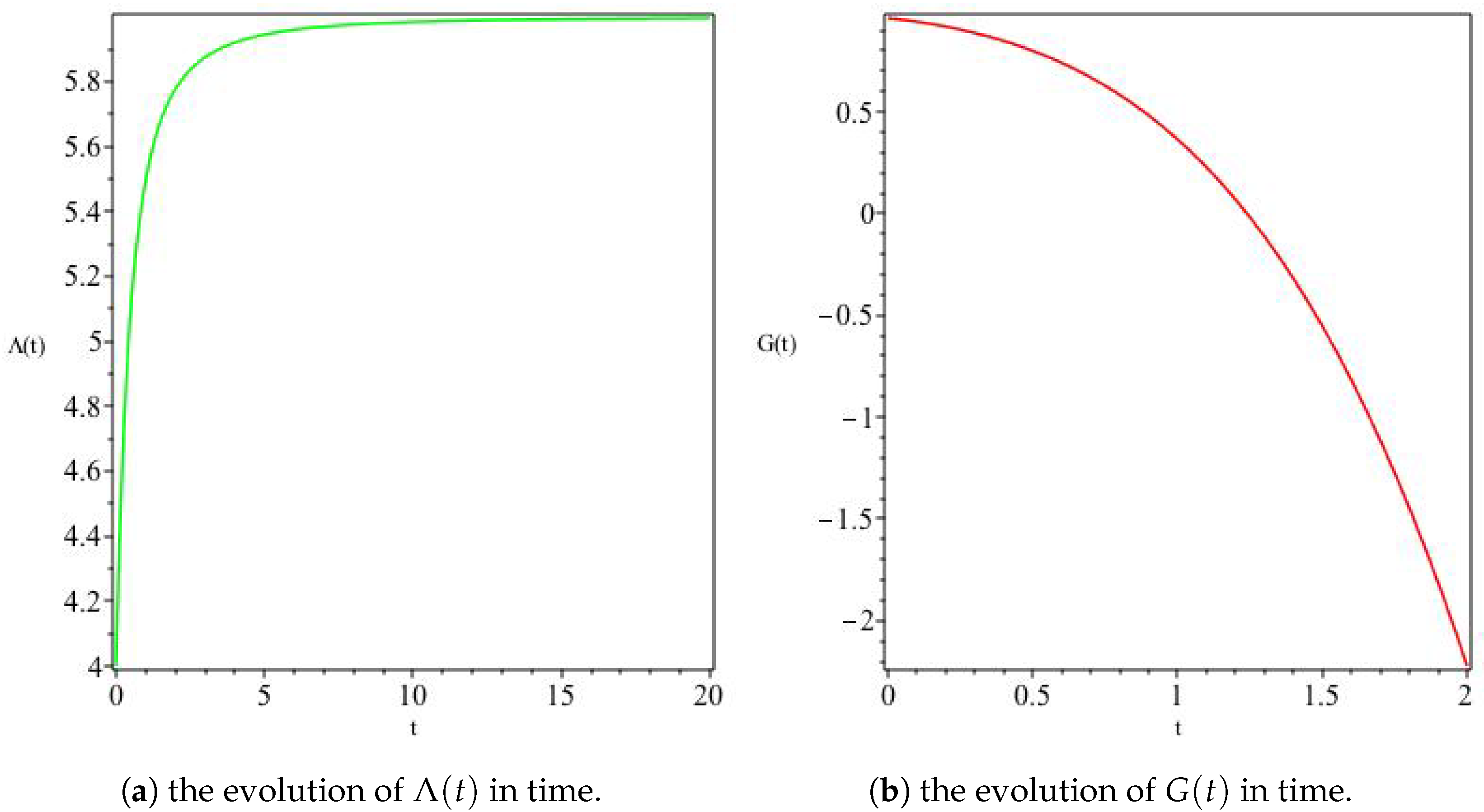
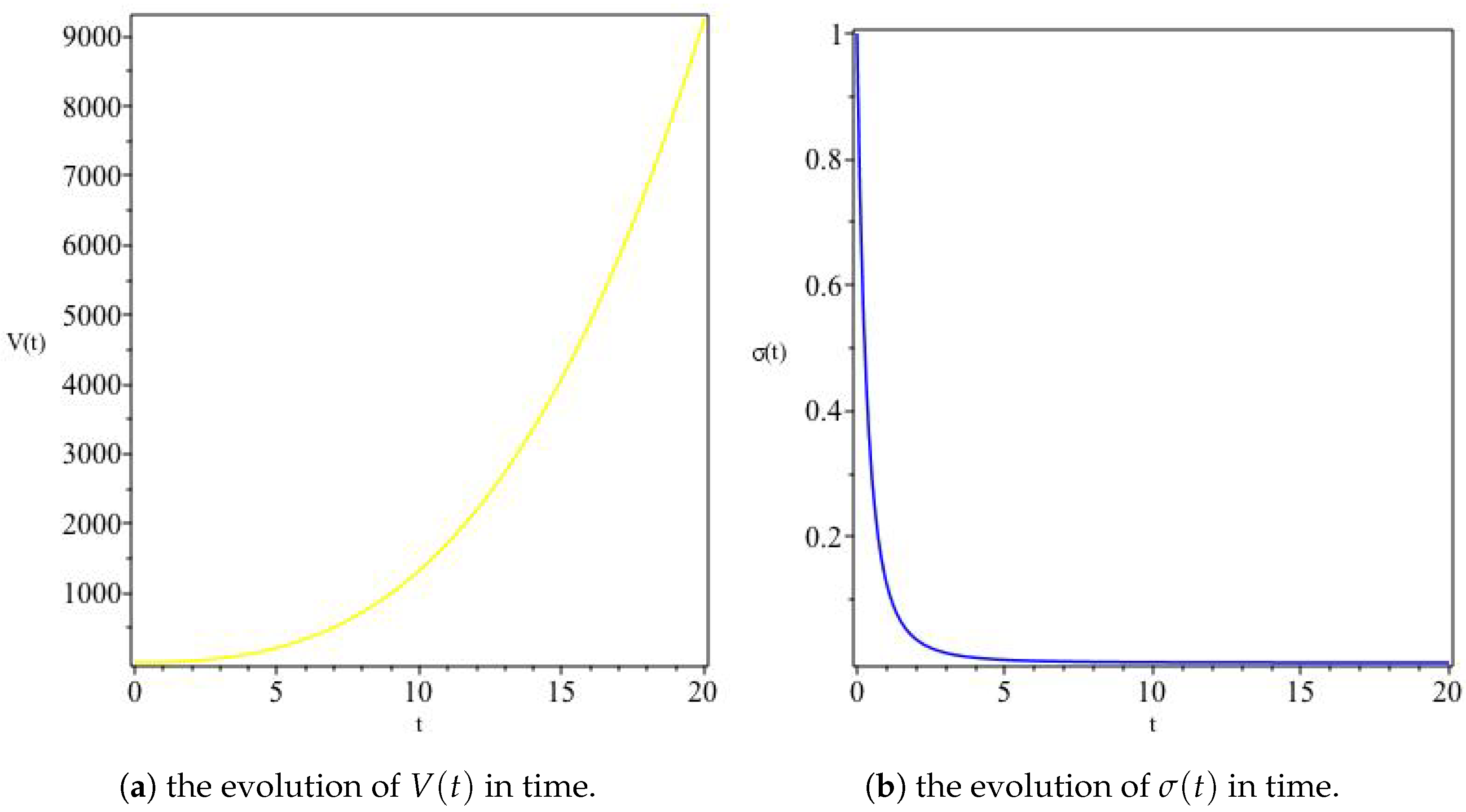
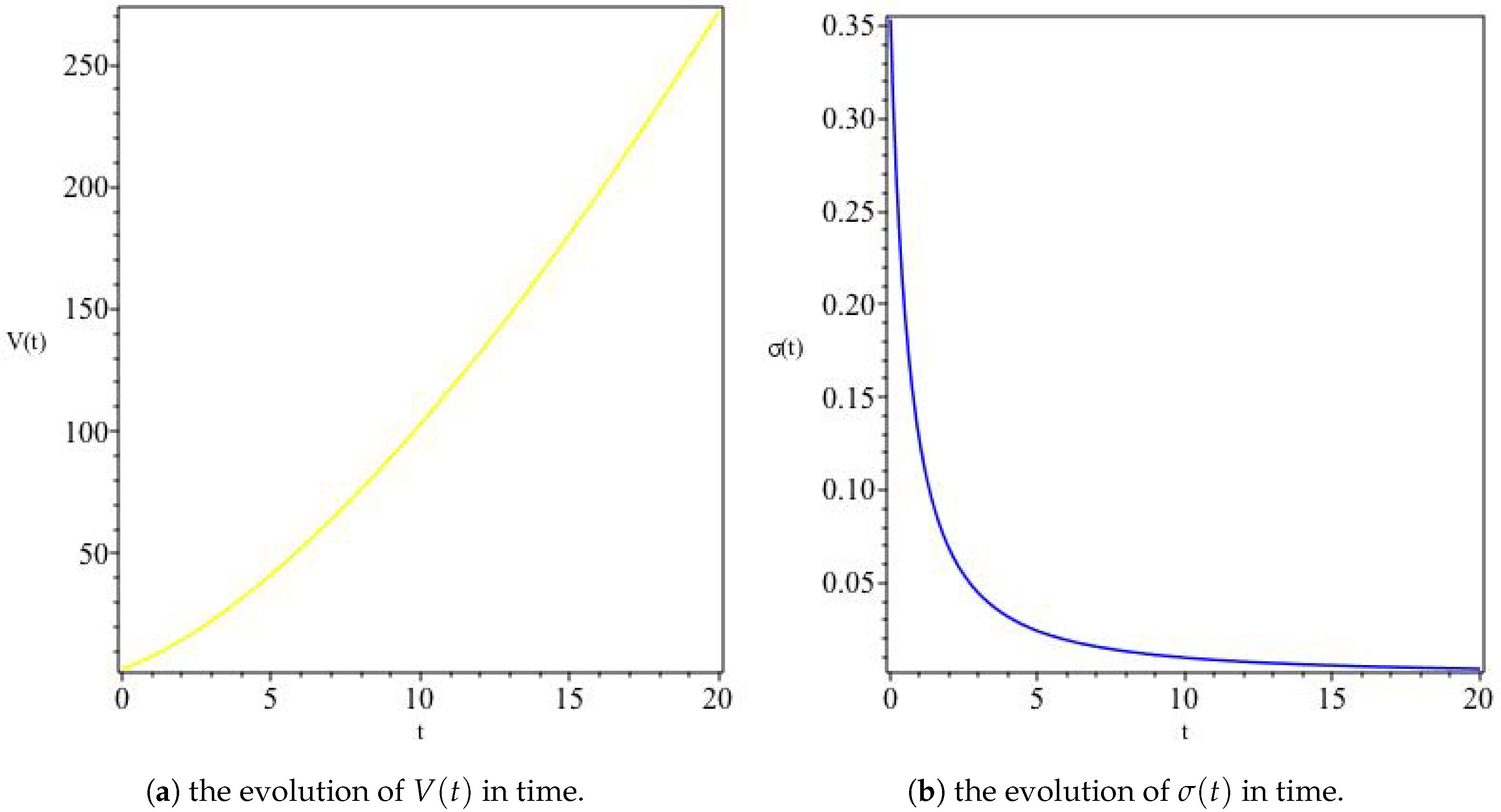
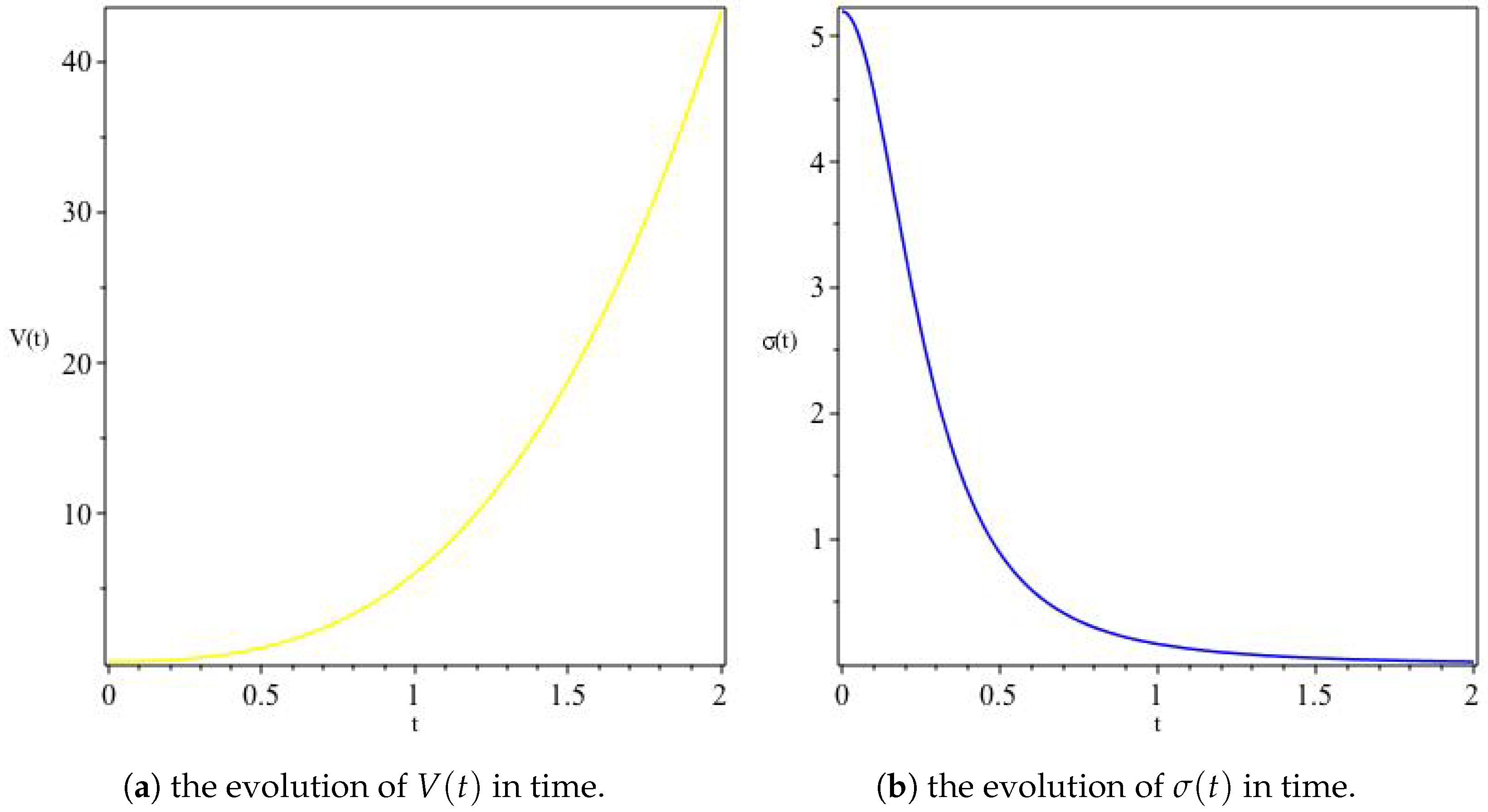
where and are integration constants. This solution has a constant expansion and an initially increasing that asymptotes to a constant value at late times, as well as a decreasing G, as can be seen in Figure 1. Moreover, we can see from Figure 2 that the model describes an expanding universe with an overall increasing volume and asymptotically approaches isotropy at late times.
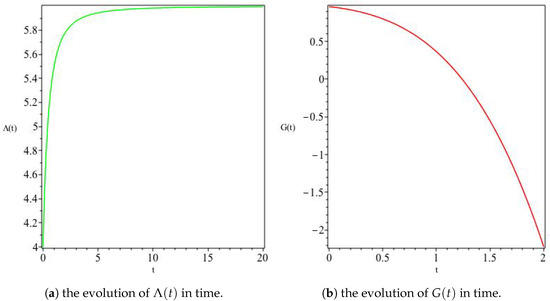
Figure 1.
The variation of and G for , In (a), we see that an initially increasing asymptotically reaches a constant value at late times, whereas (b) shows an initially positive G decreases with time, attaining negative values at alate times.
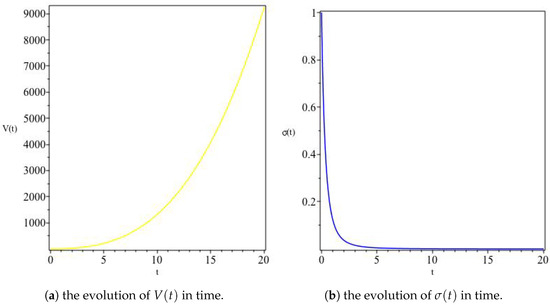
Figure 2.
The variation of V and for , In (a), we see a monotonically increasing volume due to the expanding scale factor, whereas (b) shows an initially anisotropic universe rapidly isotropizing at alate times.
On the other hand, for and , the model provides a solution of the form
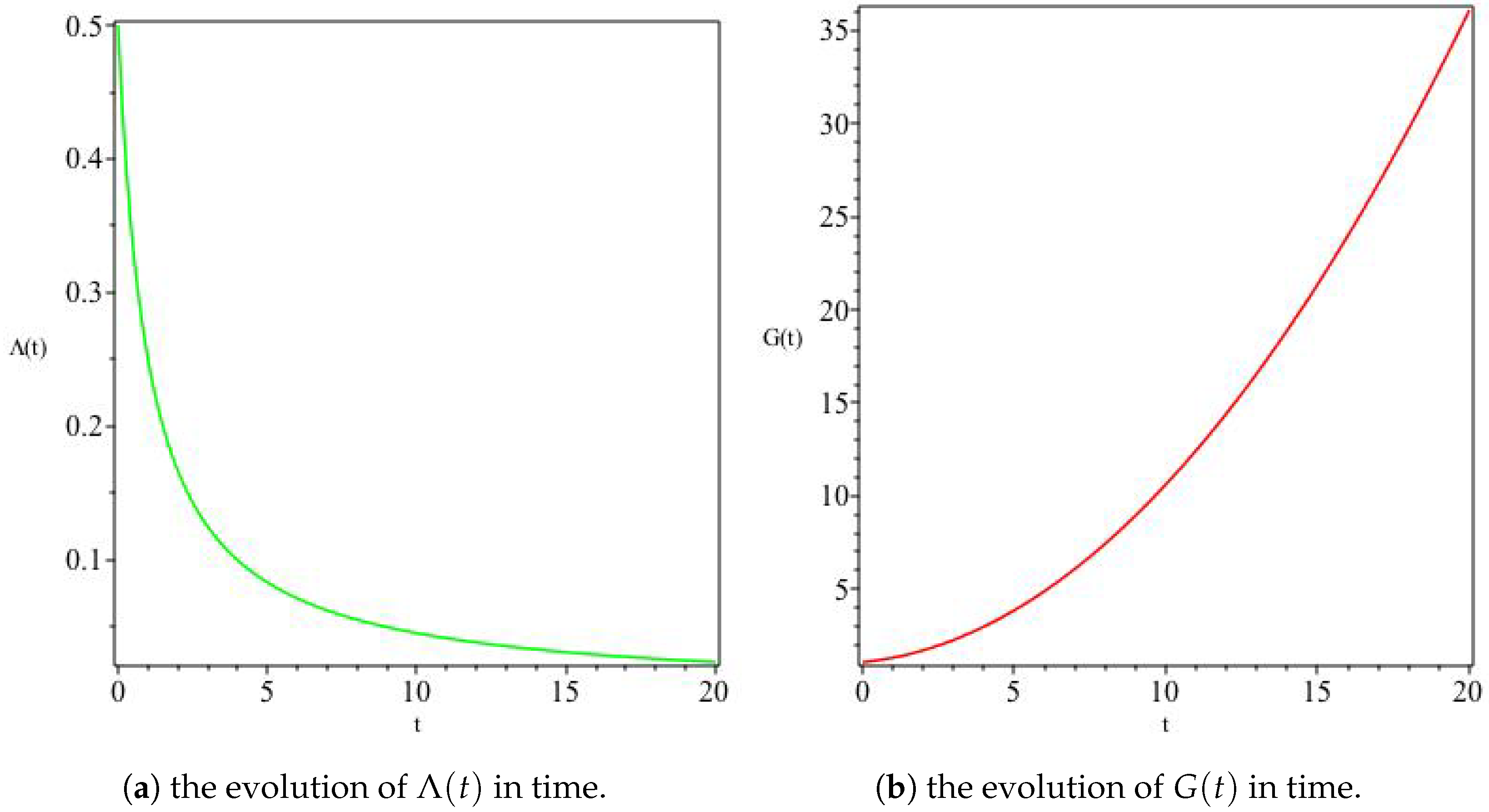
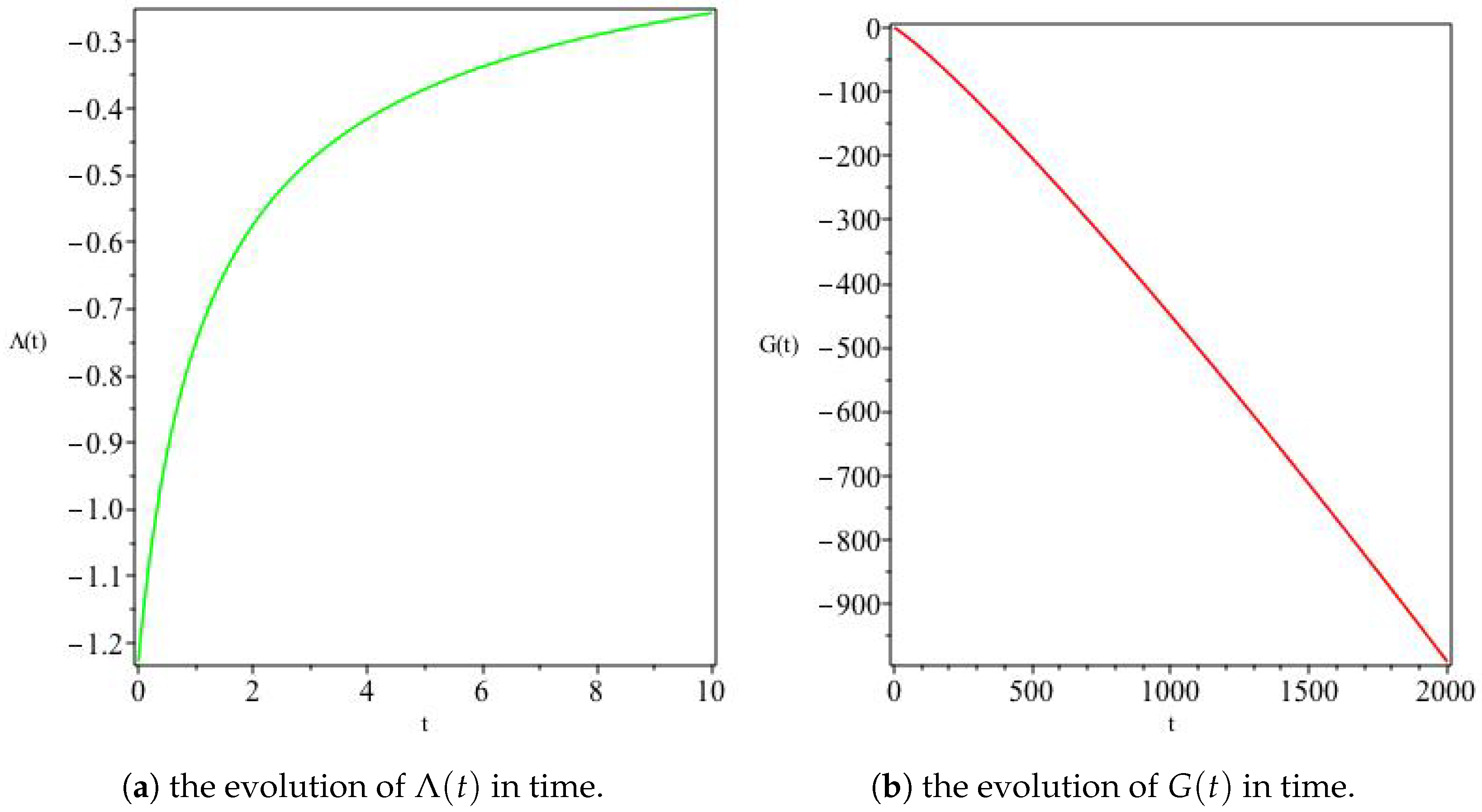
for integration constants and . Unsurprisingly, this solution reduces to the linear expansion solution above when we fix . We clearly notice that the behaviours of and G depend on the choice of . For example, while fixing results in Figure 3, a different behaviour is observed when , as shown in Figure 4 where asymptotically attains a constant value. It is worthwhile noticing, however, that the general behaviour of V and remains the same as shown in Figure 5 (infinitely increasing and asymptotically vanishing at time infinity, respectively).
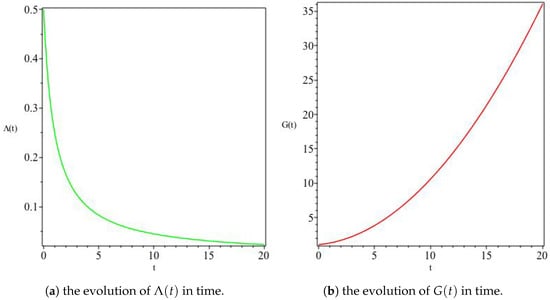
Figure 3.
The variation of and G for , For this model, we see a monotonically decreasing in Panel (a), whereas Panel (b) shows an increasing G with time.
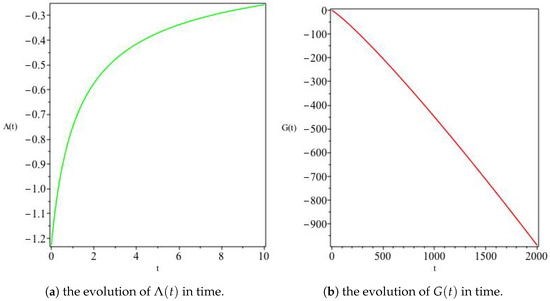
Figure 4.
The variation of and G for , . Here the opposite behaviour to Figure 3 is observed, namely an increasing and a decreasing G for the choice of model parameters made.
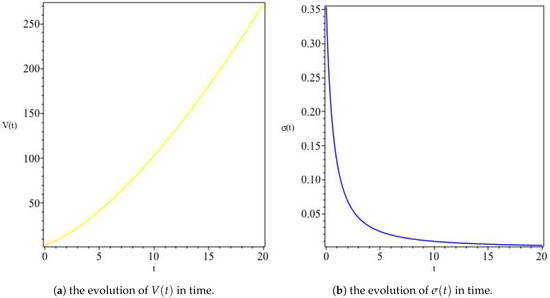
Figure 5.
The variation of V and for , The panel (a) depicts a monotonically increasing volume of the the universe (as would be expected due to the cosmological expansion) whereas the panel (b) depicts a universe isotropizing at late times.
Now, let us introduce an intermediate variable P such that
and use this in Equation (43) to obtain
Separating the variables, we can rewrite this as
and integrating both sides gives
where is an integration constant. Substituting the value of P from (46) and taking the anti-logarithm for both sides gives
Integrating Equation (50), we can see that
which can be rewritten as
where and , and is the hypergeometric function. It is obvious that Equation (52) is a general form of the solution, and cannot be simplified into an analytical expression for a as an explicit function of time unless we have to make some gauge choices on the values of and .
Our approach is different from the other previous works of some authors, where they firstly fixed the value of and in the term, then solved the generalized Friedmann equation, but we do not assume a priori the value or functional dependence of these constants or any other parameters in our models.
3. Some Specific Models of the General Solution
In this section, we will present our cosmological models that emerge from the choice of suitable values of and .
3.1. Model I:
In this model, we choose such that Equation (52) gives a power solution of a as
Having known the value of a in this model, then the kinematical and dynamical parameters , and , the Newtonian gravitational “constant” G, and the metric variables are calculated as
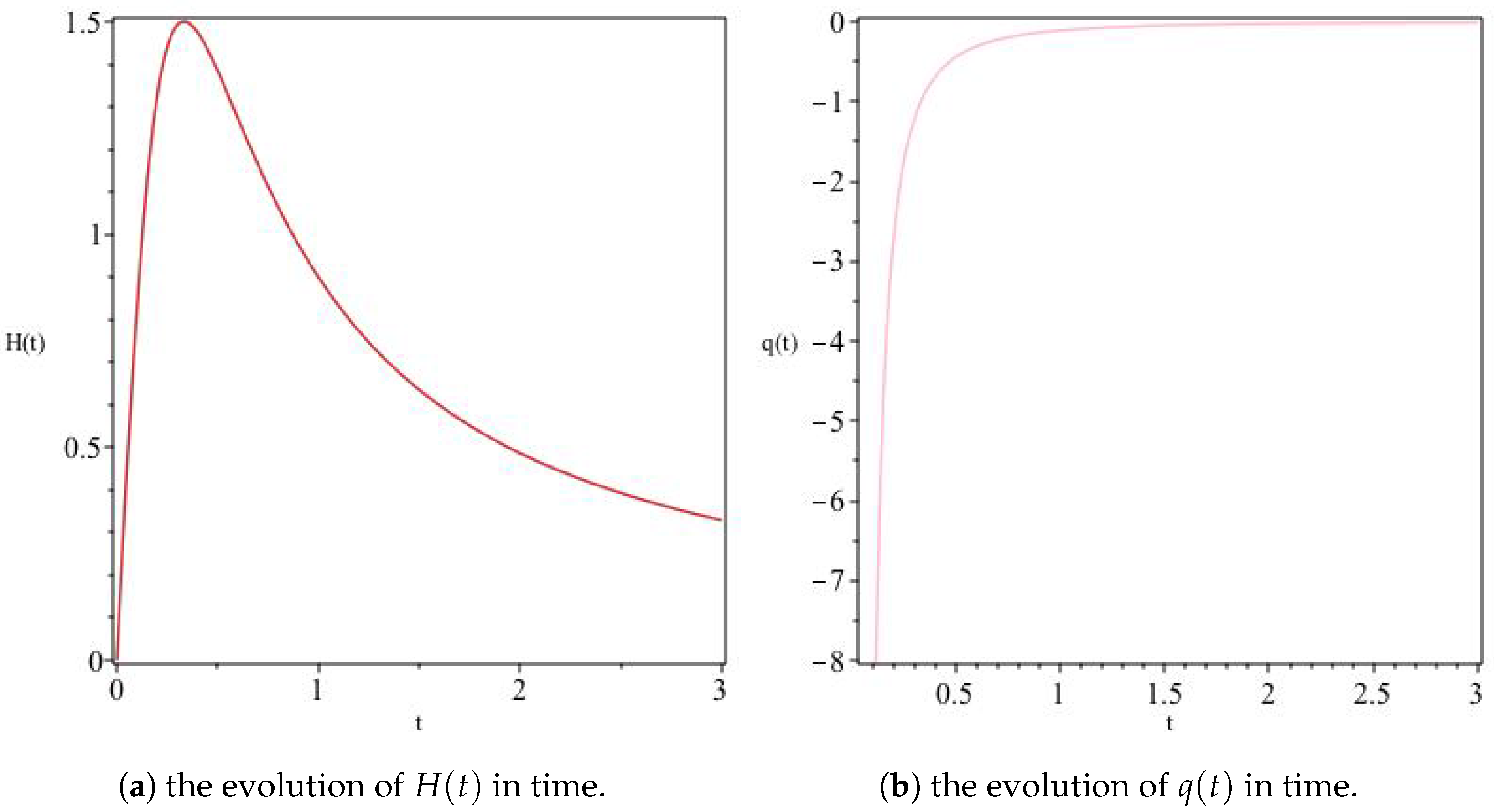
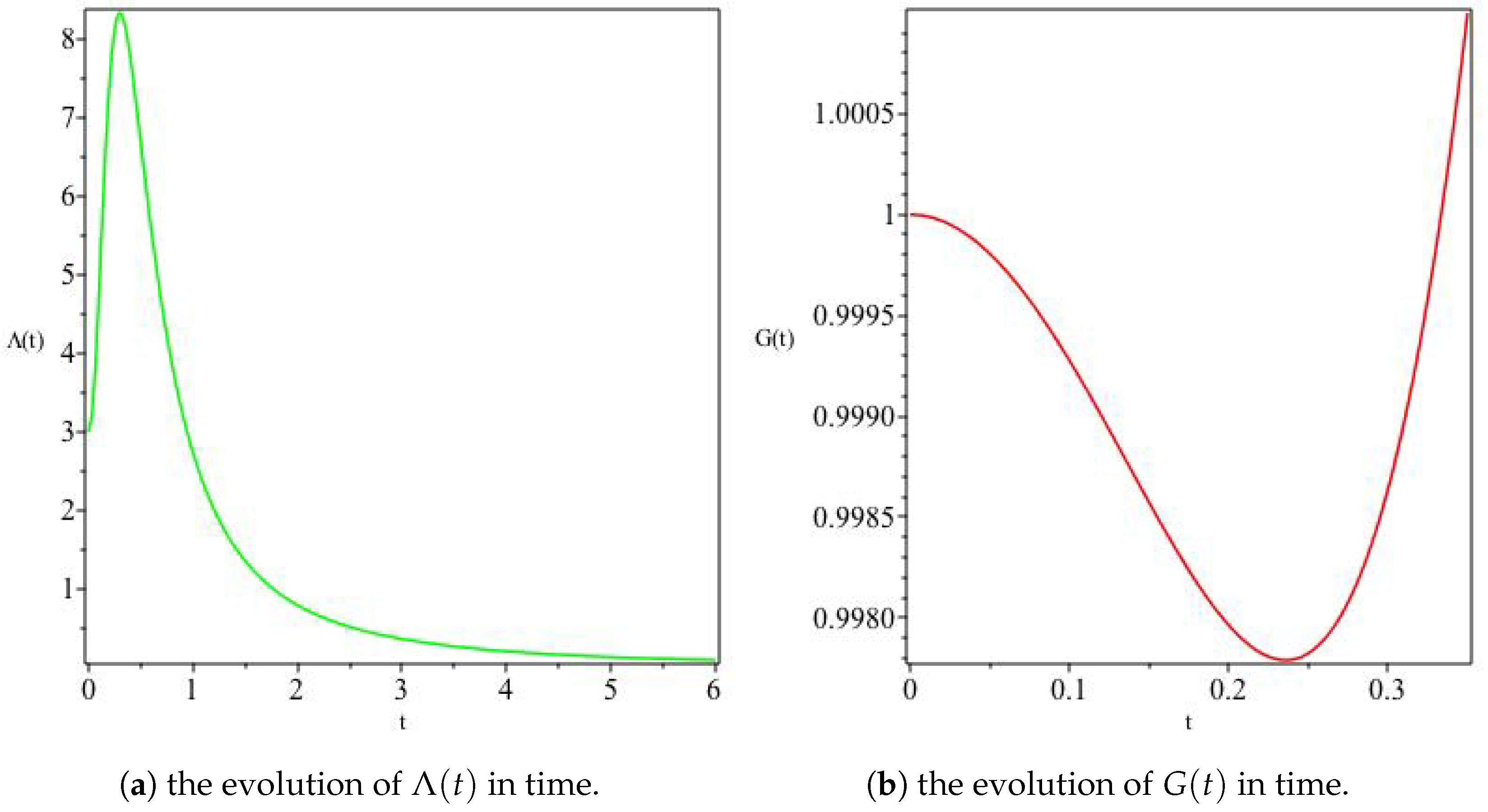
where and are constants of integration. This model has an initial point of singularity at and . Furthermore, although early-time behaviour, shown in Figure 6, Figure 7, Figure 8 and Figure 9, differs slightly for different choices of and , it can be shown that, as , , the magnitude of q and all decrease with time, whereas G, the volume V and and the metric variables and C are increasing functions of time. It is worth mentioning here that although the numerical values of and q decrease asymptotically towards constant values, whether the model describes an accelerated or decelerated expansion solely depends on the sign of . For example, a positive choice of describes an early accelerated expansion that eventually slows down to an asymptotically constant expansion expansion, whereas a negative describes an early decelerated expansion that eventually asymptotes to a constant expansion at late times. In addition, as , thus indicating that the model approaches isotropy for large values of t, as observed in [47] as well.
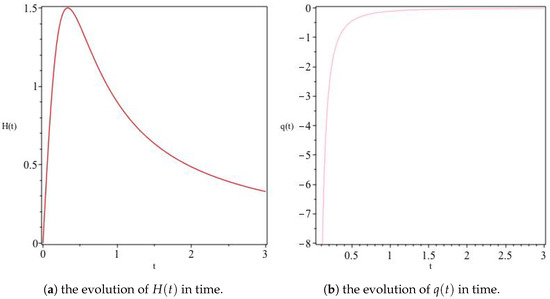
Figure 6.
The variation of H and q for Model I. For the model with and all normalized to unity, we get an initially accelerated expanding solution reaching a finite maximum value and eventually contracting asymptotically towards a vanishing q as depicted by the left and right panels above.
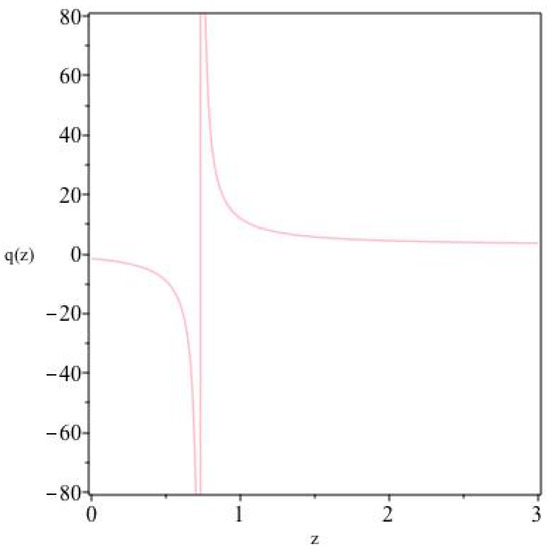
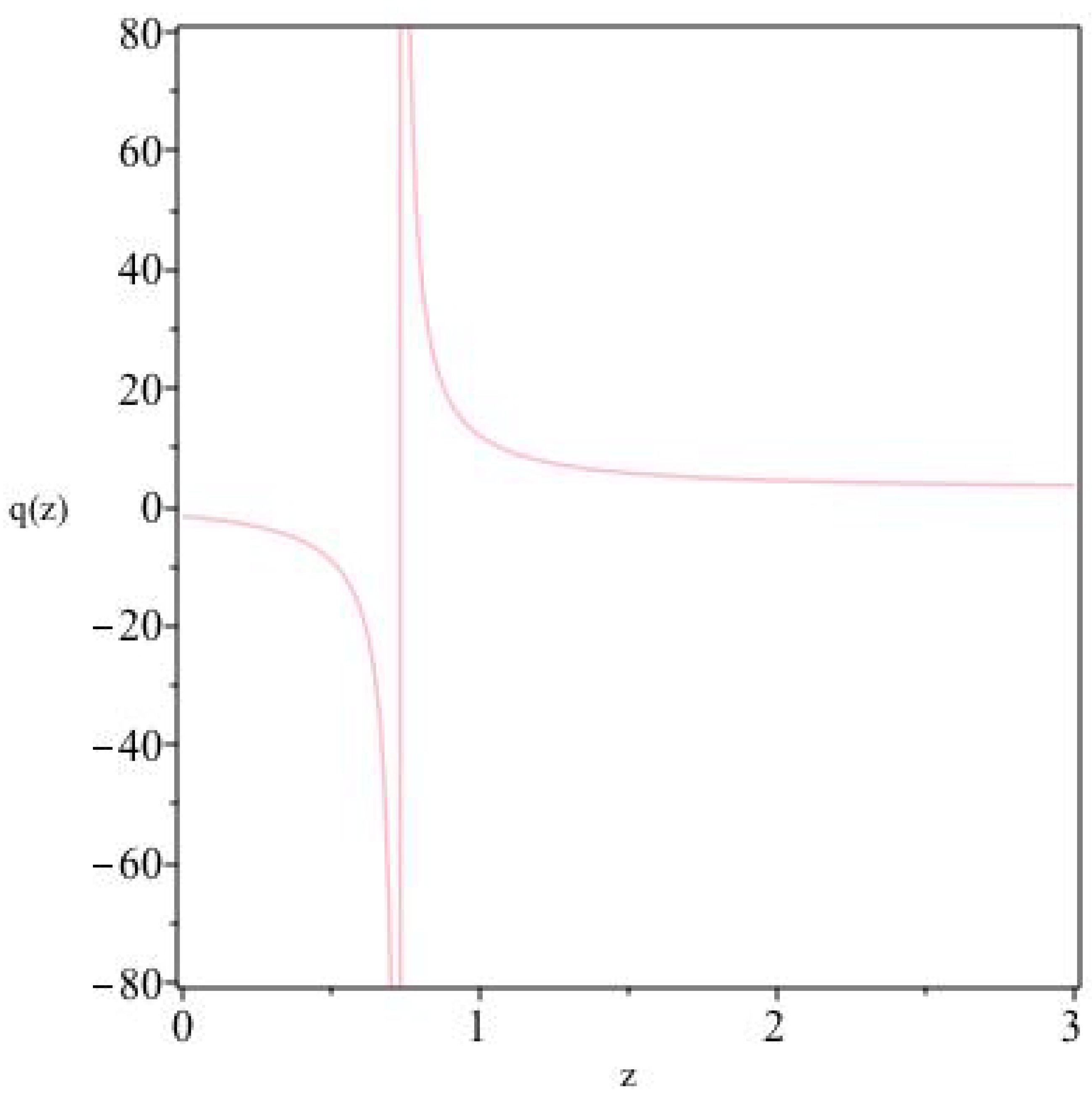
Figure 7.
The deceleration parameter in terms of redshift for .
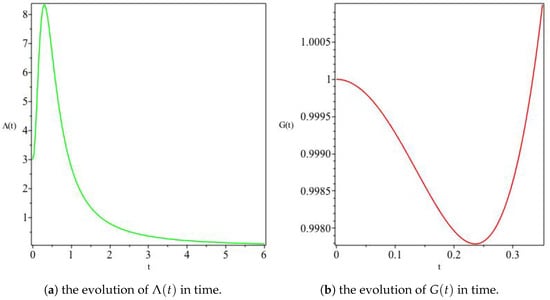
Figure 8.
The variation of and G for Model I. Panel (a) shows an initially positive increasing towards a finite maxumumm value and eventually vanishingly decreasing. Panel (b) shows figure drawn so as to zoom in the decreasing behaviour of G for small t, increasing for large t.
In redshift space, we can show that the deceleration parameter for the model can be given by
where . In Figure 7, we show in redshift space the transition from an early deceleration epoch (at large redshifts) to late-time acceleration (at small redshifts).
Here, a mathematical singularity occurs at the value of z for which , and hence the singular point can be shifted either way by choosing appropriate values of and .
3.2. Model II: The Emden–Fowler Approach
This model naturally arises when comparing the nonlinear Equation (50) to the first integral of the Emden–Fowler equation [50]
which, for , is given by
where and s are constants. This equation has a particular solution of the form
Thus, comparing Equations (65) and (50), we find that and , and a reads
Although this is a particular solution, this still is a direct and exact generalization result of all work that has been done on Bianchi-V cosmological models with varying and G. Having known the values of a, the dynamical and kinematical parameters of the model can be computed as follows. Using Equation (67), the Hubble parameter is
Integrating Equation (11) gives an expression for the density as
Using Equation (68) in Equation (19), the expansion scalar is
and, from Equations (67) and (16), the shear scalar reads
From Equation (67), we can compute and and substitute them into Equation (15) to compute the constant deceleration parameter as
Thus, this model can have (deceleration) if , (acceleration) if and (constant expansion) if .
The direct substitution of a in Equation (41) gives
and differentiating Equation (73) with respect to t gives
We use this result together with Equation (69) to compute the Newtonian “constant" as
and, from Equations (25), (38) and (39), the metric variables can be computed as
where and are constants of integration whose actual values can be chosen using appropriate initial conditions.
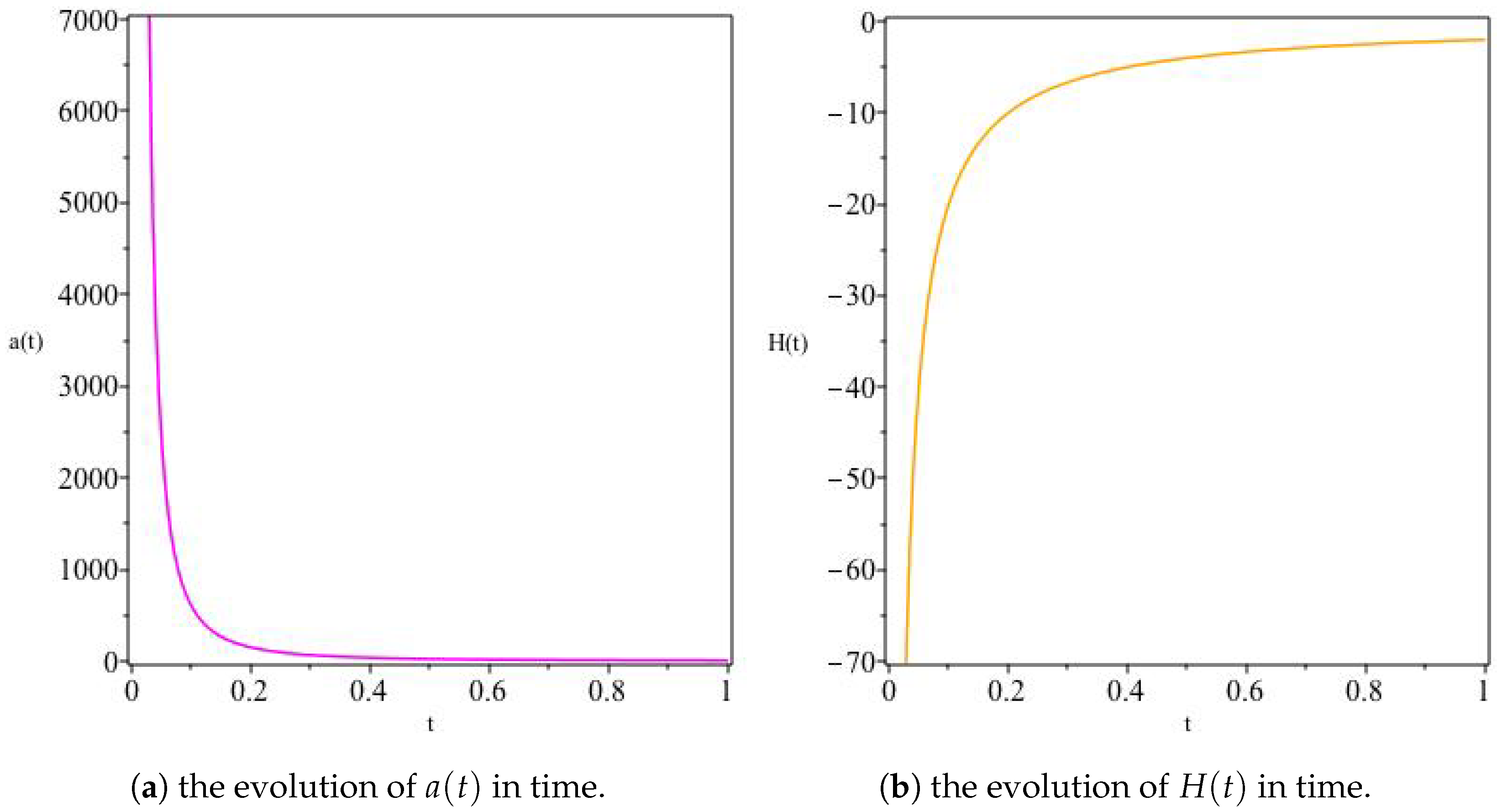
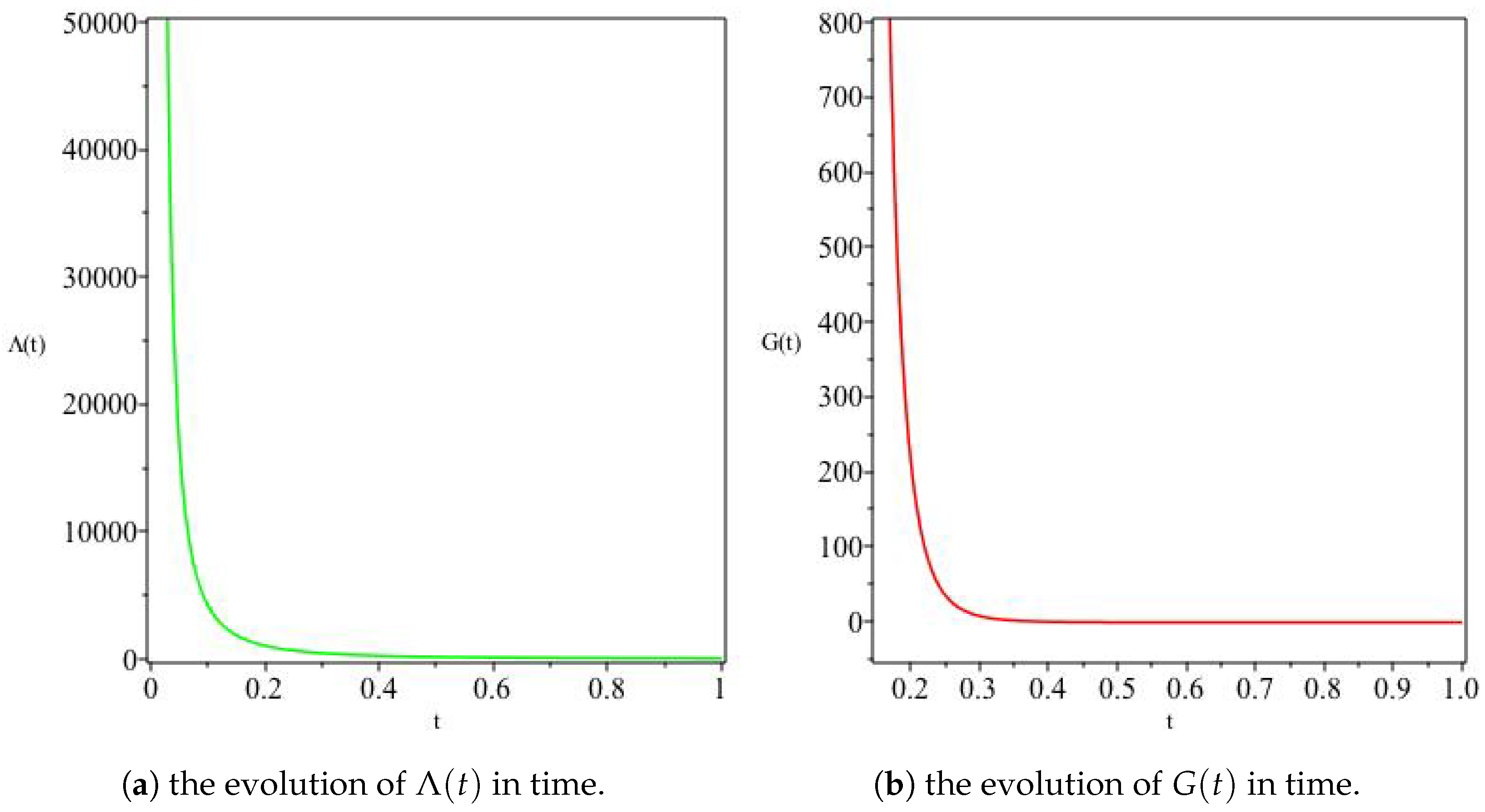
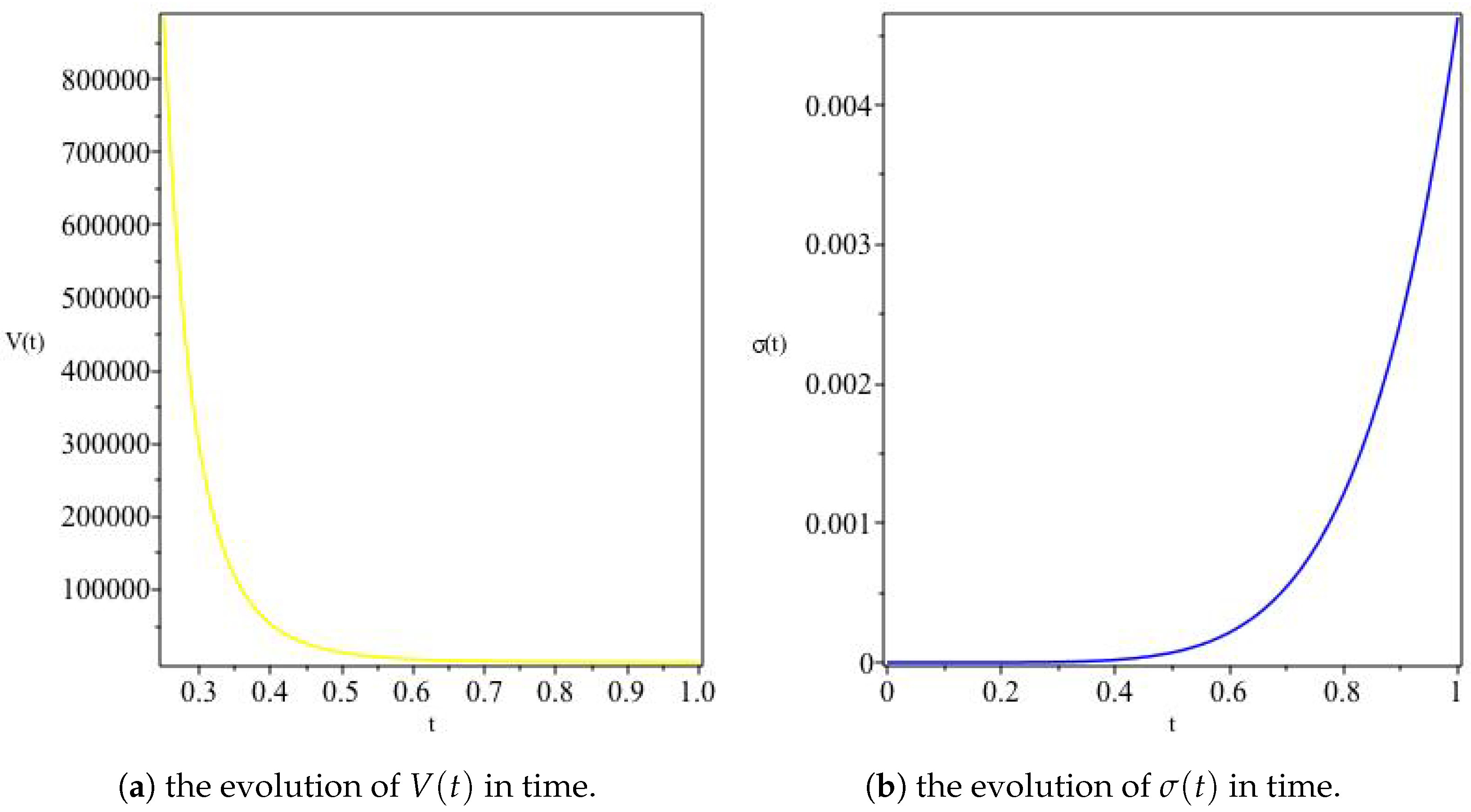
The above results show that the model has a point of initial singularity or a Big Bang at . This result improves on the result obtained in [47], where the singularity occurs at a negative point in time. As Figure 10, Figure 11 and Figure 12 depict, this model represents a contracting universe solution where V and both and G simultaneously decrease, while H, , and all increase as time increases, with H asymptotically approaching zero from below. It is worth mentioning here that the model produces a constant deceleration of the expansion for acceptable values of . In this model, as the expansion rate of the universe slows down as time increases, with the expansion eventually stopping, the ratio of as , thus predicting that the universe in this model becomes anisotropic at late times. These anisotropic predictions contradict the results reported by Dwivedi and Tiwari [47]. Moreover, as , the metric components A, B and C approach zero rapidly, and the average scale factor a tends to zero, which, with an even more rapidly increasing energy density, potentially results in a Big Crunch.
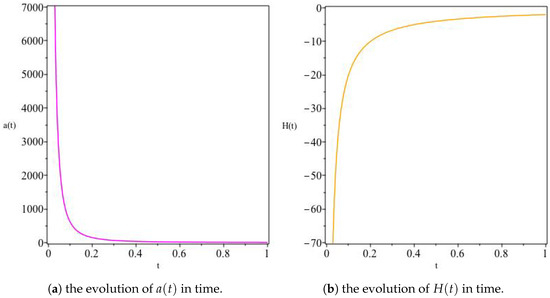
Figure 10.
The variation of a and H for Model II. This model depicts a contracting universe (Panel (a)) for a particular set of parameters (, for example). Panel (b) shows that contraction occurs at a decreasing rate, asymptotically leading to a universe with vanishingly small constant size at late times.
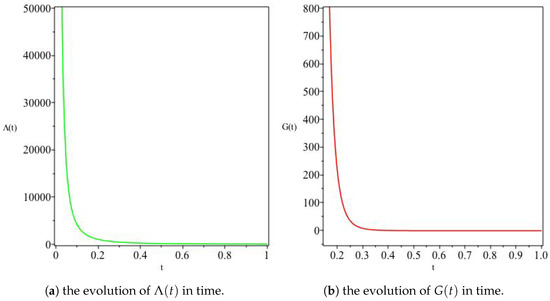
Figure 11.
The variation of and G for Model II. Here both and G decrease in time, the former faster than the later.
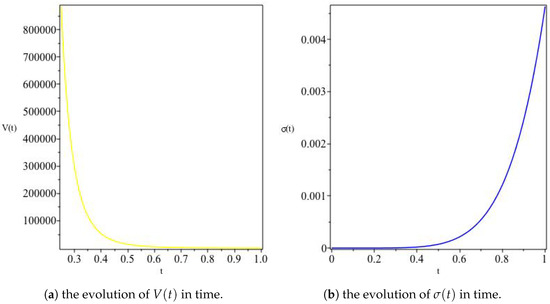
Figure 12.
The variation of V and for Model II. Since the model has a contracting solution, we see that the overall volume of the universe decreases as expected, with increasing anisotropy at late times.
4. Conclusions
The main objective of this paper was to find general exact solutions for Bianchi Type-V cosmological models for a stiff perfect fluid with time-varying cosmological and gravitational “constants”. In practice, this is a generalization process of previous works without prior choice of the quantum field theoretically adjustable parameters and that define the cosmological constant as .
In our solution process, we have followed two steps: (i) the EFEs were derived and reduced to a coupled system of differential equations, plus arbitrary constants of integration. This provides a way to integrate for the values of A, B, C, , and G, but it is not a complete solution because of the unknown value of a; (ii) The EFEs have been transformed to a nonlinear second-order DE in a, whose solution has been obtained using the hypergeometric function. Throughout the solution steps, we did not assume a priori the values of and , unlike previous works in the literature. We have therefore tried to solve the system in a more general setting. We have shown that the hypergeometric function is controlled by the value of and makes it very difficult to have a closed form for a as an explicit function of t.
Finally, two cosmological models are obtained with a choice of suitably fixed values of and through the transformation of the generalized Friedman equation into a special case of the Emden–Fowler equation. The dynamical and kinematical parameters of each model are exactly computed and clearly discussed. It has been shown that, while one of these models results in a universe that asymptotically isotropizes at late times, the other becomes increasingly anisotropic.
As more precise data become available, it will, in principle, be possible to constrain the integration constants that we chose arbitrarily in this study to get a better picture of this class of cosmological models. We leave this particular task to a future consideration.
Author Contributions
All authors contributed equally to this work.
Funding
This work is supported in part by the National Research Foundation of South Africa (Grant Numbers 109257 and 112131).
Acknowledgments
A.A. acknowledges the hospitality of the Department of Physics, University of Khartoum, where, upon visiting, collaboration on this project was initiated.
Conflicts of Interest
The authors declare no conflict of interest.
References
- Bianchi, L. Memorie di Matematica e di Fisica della Societa Italiana delle Scienze, serie III. Tomo XI, 267 (1898). Gen. Rel. Gravit. 2001, 33, 2171–2253. [Google Scholar]
- Bianchi, L. Lezioni sulla teoria dei gruppi continui finiti di trasformazioni (Italian version); University of Michigan Library: Ann Arbor, MI, USA, 1916. [Google Scholar]
- Ellis, G.F.R. The Bianchi models: Then and now. Gen. Relativ. Gravit. 2006, 38, 1003–1015. [Google Scholar] [CrossRef]
- Coles, P.F.; Luechin, F. The Origin and the Evolution of the Cosmic Strucre; John Wiley & Sons: Hoboken, NJ, USA, 2002. [Google Scholar]
- Weinberg, S. The cosmological constant problem. Rev. Mod. Phys. 1989, 61, 1–23. [Google Scholar] [CrossRef]
- Vishwakarma, R.G. A model of the universe with decaying vacuum energy. Pramana J. Phys. 1996, 47, 41–55. [Google Scholar]
- Vishwakarma, R.G. Dissipative cosmology with decaying vacuum energy. Indian J. Phys. B 1996, 70B, 75–80. [Google Scholar]
- Vishwakarma, R.G. LRS Bianchi type-I models with a time-dependent cosmological constant. Phys. Rev. D 1999, 60, 063507. [Google Scholar] [CrossRef]
- Vishwakarma, R.G. A study of angular size-redshift relation for models in which Λ decays as the energy density. Class. Quantum Gravit. 2000, 17, 3833. [Google Scholar] [CrossRef]
- Vishwakarma, R.G. Consequences on variable Λ-models from distant type Ia supernovae and compact radio sources. Class. Quantum Gravit. 2001, 18, 11–59. [Google Scholar] [CrossRef]
- Vishwakarma, R.G. A model to explain varying Λ, G and σ2 simultaneously. Gen. Relativ. Gravit. 2005, 37, 1305–1311. [Google Scholar] [CrossRef]
- Berman, M.S.; Som, M.M. Brans-Dicke models with time-dependent cosmological term. Int. J. Theor. Phys. 1990, 29, 1411–1414. [Google Scholar] [CrossRef]
- Berman, M.S.; Som, M.M.; Gomide, F.M. Brans-Dicke static universes. Gen. Rel. Gravity 1989, 21, 287–292. [Google Scholar] [CrossRef]
- Berman, M.S. Static universe in a modified Brans-Dicke cosmology. Int. J. Theor. Phys. 1990, 29, 567–570. [Google Scholar] [CrossRef]
- Berman, M.S. Cosmological Models with Variable Gravitational and Cosmological Constants. Gen. Relativ. Gravit. 1991, 23, 465–469. [Google Scholar] [CrossRef]
- Berman, M.S. Cosmological Models with Variable Cosmological Term. Phys. Rev. D 1991, 43, 1075–1078. [Google Scholar] [CrossRef]
- Arbab, A.I. Cosmological Models with Variable Cosmological and Gravitational Constants and Bulk Viscous Models. Gen. Relativ. Gravit. 1997, 29, 61–74. [Google Scholar] [CrossRef]
- Mishra, R.; Chawla, C.; Pradhan, A. A new class of accelerating cosmological models with variable G & Λ in Sáez and Ballester theory of gravitation. Rom. J. Phys. 2014, 59, 12–25. [Google Scholar]
- Pradhan, A.; Jaiswal, R.; Khare, R.K. Cosmological Consequences with Time Dependent Λ-Term in Bianchi Type-I Space-Time-Revisited. ARPN J. Sci. Technol. 2013, 3, 908–914. [Google Scholar]
- Pradhan, A.; Singh, A.K.; Chouhan, D.S. Accelerating Bianchi Type-V Cosmology with Perfect Fluid and Heat Flow in Saez-Ballester Theory. Int. J. Theor. Phys. 2013, 52, 266–278. [Google Scholar] [CrossRef]
- Chawla, C.; Mishra, R.K.; Pradhan, A. String cosmological models from early deceleration to current acceleration phase with varying G and Λ. Eur. Phys. J. Plus. 2012, 127, 127–137. [Google Scholar] [CrossRef]
- Pradhan, A.; Amirhashchi, H. Accelerating Dark Energy Models in Bianchi Type-V Spacetime. Mod. Phys. Lett. A 2011, 26, 2261–2275. [Google Scholar] [CrossRef]
- Chen, W.; Wu, Y.S. Implications of a cosmological constant varying as R−2. Phy. Rev. D 1990, 41, 695–698. [Google Scholar] [CrossRef]
- Carvalho, J.C.; Lima, J.A.S.; Waga, I. Cosmological consequences of a time-dependent Λ term. Phys. Rev. D 1992, 46, 2404–2407. [Google Scholar] [CrossRef]
- Dirac, P.A.M. The Cosmological Constants. Nature 1937, 139, 323. [Google Scholar] [CrossRef]
- Abdel-Rahman, A.M. A Critical Density Cosmological Model with Varying Gravitational and Cosmological Constants. Gen. Rel. Gravit. 1990, 22, 655–663. [Google Scholar] [CrossRef]
- Pradhan, A.; Yadav, A.K.; Yadav, L. Generation of Bianchi type V cosmological models with varying Λ-term. Czech. J. Phys. 2005, 55, 503–518. [Google Scholar] [CrossRef]
- Kalligas, D.; Wesson, P.; Everitt, C.W.F. Flat FRW models with variable G and Λ General. Gen. Rel. Gravit. 1992, 24, 351–357. [Google Scholar] [CrossRef]
- Vishwakarma, R.G. Some FRW models with variable G and Λ. Class Quantum Gravit. 1997, 14, 945–953. [Google Scholar]
- Singh, J.P.; Tiwari, R.K. Variable G & Λ in FRW model. Int. J. Mod. Phys. D 2007, 16, 745–754. [Google Scholar]
- Borges, H.A.; Carneiro, S. Friedmann cosmology with decaying vacuum density. Gen. Relativ. Gravit. 2005, 37, 1385–1394. [Google Scholar] [CrossRef]
- Singh, J.P.; Tiwari, R.K. Perfect fluid Bianchi Type-I cosmological models with time varying G and Λ. Pramana J. Phys. 2008, 70, 565–574. [Google Scholar] [CrossRef]
- Singh, C.P.; Ram, S.; Zeyauddin, M. Bianchi type-V perfect fluid space-time models in general relativity. Astrophys. Space Sci. 2008, 315, 181–189. [Google Scholar] [CrossRef]
- Baghel, P.S.; Singh, J.P. Bianchi Type-V universe with bulk Viscous matter and time varying gravitational and cosmological constant. Res. Astronomy Astrophys. 2012, 12, 1457–1466. [Google Scholar] [CrossRef]
- Arbab, A.I. Bianchi Type I Viscous Universe with Variable G and Λ. Gen. Relativ. Gravit. 1998, 30, 1401–1405. [Google Scholar] [CrossRef]
- Pradhan, A.; Yadav, L.; Yadav, A.K. Viscous Fluid Cosmological Models in LRS Bianchi Type V Universe with Varying Λ Czechoslov. J. Phys. 2004, 54, 487–498. [Google Scholar]
- Pradhan, A.; Kumar, A. LRS Bianchi I Cosmological Universe Models with Varying Cosmological Term Λ. Int. J. Mod. Phys. D 2001, 10, 291–298. [Google Scholar] [CrossRef]
- Pradhan, A.; Ostarod, S. Universe with Time Dependent Deceleration Parameter and Λ Term in General Relativity. Astrophys. Space Sci. 2006, 306, 11–16. [Google Scholar] [CrossRef]
- Hajj-Boutros, J. On hypersurface-homogeneous space-times. J. Math. Phys. 1985, 26, 2297–2301. [Google Scholar] [CrossRef]
- Hajj-Boutros, J. New cosmological models. Class. Quantum Gravit. 1986, 3, 311–316. [Google Scholar] [CrossRef]
- Ram, S. Generation of LRS Bianchi type I universes filled with perfect fluids. Gen. Relativ. Gravit. 1989, 21, 697–704. [Google Scholar] [CrossRef]
- Ram, S. Bianchi type V perfect fluid space-times. Int. J. Theor. Phys. 1990, 29, 901–906. [Google Scholar] [CrossRef]
- Camci, U.; Yavuz, I.; Baysal, H.; Tahran, I.; Yilmaz, I. Generation of Bianchi Type V Universes Filled with A Perfect Fluid. Astrophys. Space Sci. 2001, 275, 391–400. [Google Scholar] [CrossRef]
- Mazumder, A. Solutions of LRS Bianchi I space-time filled with a perfect fluid. Gen. Relativ. Gravit. 1994, 26, 307–310. [Google Scholar] [CrossRef]
- Tiwari, R.K. Bianchi type-I cosmological models with time dependent G and Λ. Astrophys. Space Sci. 2008, 318, 243–247. [Google Scholar] [CrossRef]
- Tiwari, R.K. Some Robertson-Walker models with time dependent G and Λ. Astrophys. Space Sci. 2009, 321, 147–150. [Google Scholar] [CrossRef]
- Dwivedi, U.K. Bianchi Type-V Models with Decaying Cosmological Term Λ. Int. J. Phys. Math. Sci. 2012, 2, 568–573. [Google Scholar]
- Yadav, A.K. Bianchi Type V Matter Filled Universe with Varying Lambda Term in General Relativity. Electron. J. Theor. Phys. 2013, 10, 169–182. [Google Scholar]
- Singh, C.P.; Kumar, S. Bianchi-I Space-time with Variable Gravitational and Cosmological “Constants”. Int. J. Theor. Phys. 2009, 48, 2401–2411. [Google Scholar] [CrossRef]
- Polyanin, A.D.; Zaitsev, V.F. Handbook of Exact Solutions for Ordinary Differential Equations; CRC Press: New York, NY, USA, 1995. [Google Scholar]
© 2018 by the authors. Licensee MDPI, Basel, Switzerland. This article is an open access article distributed under the terms and conditions of the Creative Commons Attribution (CC BY) license (http://creativecommons.org/licenses/by/4.0/).