


Abstract
In this paper, the generalized helical hypersurfaces with a time-like axis in Minkowski spacetime are considered. The first and the second fundamental form matrices, the Gauss map, and the shape operator matrix of are calculated. Moreover, the curvatures of the generalized helical hypersurface are obtained by using the Cayley–Hamilton theorem. The umbilical conditions for the curvatures of are given. Finally, the Laplace–Beltrami operator of the generalized helical hypersurface with a time-like axis is presented in .
1. Introduction
Differential geometry has a very important place in mathematics, engineering, physics, and astrophysics. In differential geometry, the theory of hyper-surfaces has been worked on by many mathematicians (especially geometers), engineers, physicists, astrophysicists, etc., for hundreds of years.
For instance, Obata [1] revealed certain conditions for a Riemannian manifold to be isometric with a sphere; Takahashi [2] proved that a connected Euclidean submanifold is of the one-type, iff it is either minimal in or minimal in some hypersphere of ; Chern, do Carmo, and Kobayashi [3] gave the minimal submanifolds of a sphere with a second fundamental form of constant length; Cheng and Yau [4] considered the hypersurfaces with constant scalar curvature; Lawson [5] gave the minimal submanifolds and indicated the general definition of the Laplace–Beltrami operator.
Chen [6,7,8,9] studied the submanifolds of the finite-type whose immersion is into (or ) by using a finite number of eigenfunctions of their Laplacian. Some results of the two-type spherical closed submanifolds were given by [7,10,11]; Garay [12] researched the extension of Takahashi’s theorem in . Chen and Piccinni [13] focused on the submanifolds with the finite-type Gauss map in .
In Euclidean three-space , when looking at ruled (helicoidal or helical) and rotational characters, it is seen that those are related by Bour’s theorem [14]. Regarding helical surfaces in Euclidean three-space, do Carmo and Dajczer [15] proved that, by using a result of Bour [14], there exists a two-parameter family of helical surfaces isometric to a given helical surface. Takahashi [2] proved the minimal surfaces and spheres are the only surfaces satisfying the condition ; Ferrandez, Garay, and Lucas [16] gave that the surfaces satisfying , are either minimal or an open piece of a sphere or of a right circular cylinder; Choi and Kim [17] studied the minimal helicoid in terms of the pointwise one-type Gauss map of the first kind; Garay [18] classified a certain class of finite-type surfaces of revolution; Dillen, Pas, and Verstraelen [19] focused on the only surfaces satisfying and being the minimal surfaces, the spheres, and the circular cylinders; Stamatakis and Zoubi [20] obtained the surfaces of revolution satisfying ; Senoussi and Bekkar [21] introduced helical surfaces , which are of the finite-type with respect to the fundamental forms , and i.e., their position vector field satisfies the condition where ; Kim, Kim, and Kim [22] gave the Cheng–Yau operator and the Gauss map of the surfaces of revolution.
In Minkowski three-space , Beneki, Kaimakamis, and Papantoniou [23] studied helical surfaces with a space-like, time-like, and light-like axis in three-dimensional Minkowski space. Güler and Turgut Vanlı [24] worked the Bour’s theorem; Güler [25] studied helical surfaces with a light-like profile curve using Bour’s theorem in Minkowski geometry. Mira and Pastor [26] investigated helical maximal surfaces in Lorentz–Minkowski three-space. Kim and Yoon [27,28,29] worked with ruled and rotation surfaces in pseudo-Euclidean space. See also [2,24,30,31].
In Euclidean four-space , Moore [32,33] worked on general rotational surfaces; Hasanis and Vlachos [34] considered hypersurfaces with a harmonic mean curvature vector field; Cheng and Wan [35] gave the complete hypersurfaces with CMC; Arslan et al. [36] worked with the Vranceanu surface with the pointwise one-type Gauss map; Arslan et al. [37] studied generalized rotational surfaces; Magid, Scharlach, and Vrancken [38] introduced the affine umbilical surfaces in four-space. Scharlach [39] studied the affine geometry of surfaces and hypersurfaces in four-space. Arslan, Deszcz, and Yaprak [40] considered the Weyl pseudosymmetric hypersurfaces. Arslan, Bulca, and Milousheva [41] worked on meridian surfaces in four-space with the pointwise one-type Gauss map. Yoon [42] studied rotation surfaces with the finite-type Gauss map in four-space. Güler, Magid, and Yaylı [43] introduced helical hypersurfaces; Güler, Hacısalihoğlu, and Kim [44] studied the Gauss map and the third Laplace–Beltrami operator of rotational hypersurface; Güler [45] found the rotational hypersurfaces satisfying , where He [46] also introduced the fundamental form and the curvature formulas of the hypersphere.
In Minkowski four-space , Ganchev and Milousheva [47] indicated the analogue of the surfaces of [32,33]; Arvanitoyeorgos, Kaimakamais, and Magid [48] studied when the mean curvature vector field of satisfies the equation ( being a constant); then, has CMC; Arslan and Milousheva [49] considered meridian surfaces of the elliptic- or hyperbolic-type with the pointwise one-type Gauss map; Güler [50] gave helical hypersurfaces; recently, Iliadis [51] considered the fuzzy algebraic modelling of spatiotemporal time series paradoxes in cosmic-scale kinematics; Leuenberger [52] introduced the emergence of Minkowski spacetime by simple deterministic graph rewriting.
In this paper, the generalized helical hypersurfaces with a time-like axis in Minkowski four-space are introduced. Some basic concepts of four-dimensional Minkowski geometry are given in Section 2. The i-th curvature formulas depend on the coefficients of the fundamental forms and in Minkowski four-space, which are obtained in Section 3. In Section 4, the definition of the generalized helical hypersurface having a time-like axis in is indicated. The umbilic points of these kinds of hypersurfaces are described in Section 5. The generalized helical hypersurfaces with a time-like axis satisfying in are given in Section 6. Finally, a summary of the paper is presented in the last section.
2. Preliminaries
In this section, some of the basic facts and definitions are given, then the notations used in this paper are described.
Let denote the semi-Euclidean m-space with the semi-Euclidean metric tensor given by where is an element of constantlength (or Lorentz metric) and are the pseudo-Euclidean coordinates of type . Consider an m-dimensional semi-Riemannian submanifold M of the space . The Levi-Civita connections [53] of the manifold and its submanifold M of are denoted by respectively. Denoting the vector field tangent (respectively, normal) to M, the letters (respectively, ) are used.
The Gauss and Weingarten formulas are given, respectively, by
where h, D, and A are the second fundamental form, the normal connection, and the shape operator of M, respectively.
For each , the shape operator is a symmetric endomorphism of the tangent space at . The shape operator and the second fundamental form are related by
The Gauss and Codazzi equations are given, respectively, by
where are the curvature tensors associated with connections ∇ and D, respectively, and is defined by
2.1. Hypersurfaces of Minkowski Space
Now, let M be an oriented hypersurface in Minkowski space , its shape operator (i.e., the Weingarten map), and x its position vector. Consider a local orthonormal frame field consisting of the principal directions of M corresponding to the principal curvature for . Let the dual basis of this frame field be . Then, the first Cartan structural equation is
where denotes the connection forms corresponding to the chosen frame field. Denote the Levi-Civita connection of M of by ∇. Then, from the Codazzi equation, the following holds:
for distinct .
Put , where is the j-th elementary symmetric function given by
The following notation is used
By the definition, and . The function is called the k-th mean curvature of M. Note that functions and are called the mean curvature and Gauss–Kronecker curvature of M, respectively. In particular, M is said to be j-minimal if on M. See also [54,55].
In finding the i-th curvature formulas , where the following characteristic polynomial eq. of is used:
where denotes the identity matrix of order Then, the curvature formulas are given by . That is, (by definition),
The k-th fundamental form of M is defined by Therefore,
In particular, one can obtain the classical result of surface theory for See [55] for the details.
For a Minkowskian submanifold x: , the immersion is said to be the finite-type, if x can be expressed as a finite sum of the eigenfunctions of the Laplacian of i.e., x=, where is a constant map, non-constant maps, and , . If are different, M is called k-type. See [7] for the Euclidean details.
2.2. Rotational Hypersurfaces
The definition of the rotational hypersurfaces in Riemannian space forms can be found in [56].
A rotational hypersurface generated by a curve around an axis that does not meet is obtained by taking the orbit of under those semi-orthogonal transformations of that leaves pointwise fixed.
Throughout the paper, a vector and its transpose will be considered identical. Consider the case , and let be the curve parametrized by where are the differentiable functions. If is the -axis, then a semi-orthogonal transformation of that leaves pointwise fixed has the form
where , and Therefore, the parametrization of the rotational hypersurface generated by a curve around an axis is given by
Definition 1.
Let be an immersion from to , where the Lorentzian inner product is given by
and the triple Lorentzian vector product is defined by
with the vectors .
Definition 2.
Hypersurface depends on three parameters in Minkowski four-space:
the first and the second fundamental form being symmetric matrices, respectively (i.e., and , respectively): where Here,
is the unit normal (i.e., the Gauss map) of .
3. -th Curvatures
Product matrices · give the matrix of the shape operator of hypersurface in Minkowski four-space. See [43,44] for the details.
Therefore, the shape operator matrix of the hypersurface is given by
where
and
For computing the i-th curvature formulas , where the characteristic polynomial eq. , i.e., , is used. Then, (by definition), See [46] for the details.
Therefore, the following i-th curvature formulas depend on the coefficients of the fundamental forms and in Minkowski four-space.
Theorem 1.
Any hypersurface in has the following curvature formulas, (by definition),
Proof.
The proof is the same as the Euclidean case. □
See [46] for the details of the Euclidean four-space. A hypersurface in is i-minimal, when identically on .
4. Generalized Helical Hypersurfaces Having Time-like Axis
In this section, the definition of the generalized helical hypersurface with a time-like axis in is given. Let be a curve in a plane and ℓ be a straight line in in .
A rotational hypersurface in is defined as a hypersurface rotating a curve around a line ℓ (called the profile curve and the axis, respectively). Suppose that when a profile curve rotates around the axis ℓ, it simultaneously displaces parallel lines orthogonal to the axis ℓ, so that the speed of displacement is proportional to the speed of rotation. Then, the resulting hypersurface is called the generalized helical hypersurface having axis ℓ and pitches .
Supposing that ℓ is the line spanned by the time-like vector , the semi-orthogonal matrix fixing the above vector is defined by where The matrix can be found by solving the following equations, simultaneously, , where diag When the axis of rotation is ℓ, there is a Minkowskian transformation by which the axis ℓ is transformed to the -axis of . The parametrization of the profile curve is given by where is a differentiable function for all . Therefore, the generalized helical hypersurface spanned by the time-like vector with pitches is as follows in where If the generalized helical surface with a time-like axis as in three-dimensional Minkowski space is obtained. When , the surface is just a generalized rotational hypersurface with a time-like axis.
Hence, the generalized helical hypersurface with a time-like axis is given by
where and
See Figure 1 for the projection of the hypersurface into the three-space.
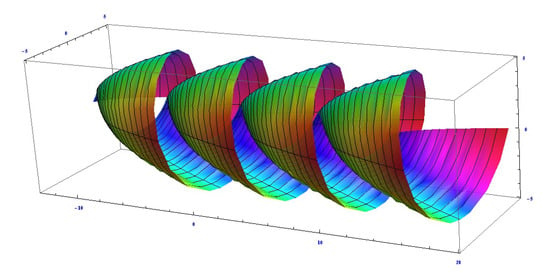
Figure 1.
Helical surface having a time-like axis.
Using the first derivatives of (14) with respect to , the first fundamental form matrix is presented as
Here, Then,
where
Definition 3.
For any curve or hypersurface in Minkowski four-space, the following holds:
- i.
- When (respectively, , the curve γ (respectively, the hypersurface ) is called space-like;
- ii.
- When (respectively, , the curve γ (respectively, the hypersurface ) is called time-like;
- iii.
- When (respectively, , the curve γ (respectively, the hypersurface ) is called light-like (or null).
Here,
Corollary 1.
When the profile curve of the generalized helical hypersurface having time-like axis (14) is the unit speed curve, then i.e., it is a space-like curve. Hence, the following holds:
Corollary 2.
While then and then, the hypersurface is space-like.
Corollary 3.
When then and then, the hypersurface is time-like.
Corollary 4.
When the hypersurface having time-like axis (14) is the light-like hypersurface (i.e., then it has the following:
The Gauss map of the hypersurface (14) is described by
Using the second derivatives of (14) with respect to the second fundamental form matrix is derived as
where and Then,
Hence, by using (10), the shape operator matrix of (14) has the following components:
Finally, the curvatures of the generalized helical hypersurface with time-like axis are given by the following.
Theorem 2.
In , the generalized helical hypersurface having time-like axis (14) has the following curvatures, respectively, by definition,
where
Proof.
By using the Cayley–Hamilton theorem, the characteristic polynomial eq. of for the generalized helical hypersurface with time-like axis the following coefficients (in the theorem) of the eq. are obtained:
□
Corollary 5.
When the curvatures are given by
Corollary 6.
If , the curvatures are described by
Corollary 7.
While the curvatures are found by
Corollary 8.
When then , i.e., the generalized helical hypersurface having time-like axis (14) is the i-minimal rotational hypersurface.
Finally, the following holds:
Theorem 3.
Let , be a generating curve of the generalized helical hypersurface having a time-like axis given by (14) immersed in . Then, the curvatures at the point are functions of the same variable u, i.e., , . Moreover, given constants and a function , the family of curves is defined.
5. The Umbilical Hypersurfaces in Minkowski Four-Space
Before defining the umbilical hypersurface in Minkowski four-space, it can be seen that the curvatures and the principal curvatures of any hypersurface are related as follows:
Then, the following holds:
Corollary 9.
The following are equivalent:
Corollary 10.
The following are equivalent:
Corollary 11.
Combining Corollary 9 with Corollary 10, the following holds:
Therefore, the following is given:
Definition 4.
The hypersurface immersed in a is called the umbilical if all its points are umbilical, i.e., or, equivalently, with .
Remark 1.
The only umbilical hypersurfaces are (open) hyperplanes and hyperspheres in .
An umbilical point is an important geometric attribute, closely related to the lines of curvature. It is a singularity of a line of curvature: a line of curvature will end at such points. This may partly be because there is an effective criterion for a smooth hypersurface defined by a formula, for both parametric or implicit hypersurfaces:
Lemma 1.
A point is an umbilical point on the hypersurface in Minkowski four-space if and only if , at this point.
Hence, the following comes out:
Problem 1.
Solve the following system of differential equations for the generalized helical hypersurface with time-like axis (14):
The solutions of the problem will give the umbilic points of the hypersurface .
6. Generalized Helical Hypersurface Having Time-like Axis Satisfying in
In this section, the first Laplace–Beltrami operator (i.e., that depends on the first fundamental form) of a smooth function in is given. Then, the Laplace–Beltrami operator is calculated by using the generalized helical hypersurface (14).
Definition 5.
The Laplace–Beltrami operator of a smooth function of class depends on the first fundamental form is defined by
where and
Hence, the inverse matrix of the first fundamental form matrix of any hypersurface having three parameters in Minkowski four-space is given by
where
With the help of the above matrix, the inverse matrix of (15) is obtained by
where .
By using (17) with the above matrix of (14), the following holds.
Theorem 4.
The first Laplace–Beltrami operator of the generalized helical hypersurface (14) is given by
where is the mean curvature and is the Gauss map of .
Proof.
By directly computing (17) on , is found. □
Theorem 5.
Let : ⟶ be an immersion given by (14).
, where is the matrix of order four if and only if has , i.e., it has zero mean curvature.
Proof.
Considering the following comes out:
where is the matrix, Differentiating the above ODEs twice with respect to the following holds:
Considering (18) the following appears:
Taking into account that the functions sin and cos are linear independent of all the components of the matrix are 0. Since then . This means is a one-minimal generalized helical hypersurface having a time-like axis. □
7. Summary
In this work, the definition of the generalized helical hypersurface having a time-like axis in four-dimensional Minkowski spacetime is given. The related differential geometric objects such as the fundamental form matrices, the Gauss map, the shape operator matrix, the curvatures, etc., of these kinds of hypersurfaces were calculated. The curvature formulas depend on the coefficients of the first and the second fundamental forms. The umbilical conditions of that kind of hypersurface were also indicated. The Laplace–Beltrami operator of the generalized helical hypersurfaces having a time-like axis was given. Thanks to three-dimensional projections, visual graphics were added to this work.
Time-like worldlines in general relativity correspond to physical, causal trajectories of mass particles. Therefore, we hope that this paper can be used for real-world applications in the near future.
Funding
This research received no external funding.
Institutional Review Board Statement
Not applicable.
Informed Consent Statement
Not applicable.
Data Availability Statement
Not applicable.
Conflicts of Interest
The author declares no conflict of interest.
References
- Obata, M. Certain conditions for a Riemannian manifold to be isometric with a sphere. J. Math. Soc. Jpn. 1962, 14, 333–340. [Google Scholar] [CrossRef]
- Takahashi, T. Minimal immersions of Riemannian manifolds. J. Math. Soc. Jpn. 1966, 18, 380–385. [Google Scholar] [CrossRef]
- Chern, S.S.; Do Carmo, M.P.; Kobayashi, S. Minimal Submanifolds of a Sphere with Second Fundamental Form of Constant Length, Functional Analysis and Related Fields; Springer: Berlin/Heidelberg, Germany, 1970. [Google Scholar]
- Cheng, S.Y.; Yau, S.T. Hypersurfaces with constant scalar curvature. Math. Ann. 1977, 225, 195–204. [Google Scholar] [CrossRef]
- Lawson, H.B. Lectures on Minimal Submanifolds, 2nd ed.; Mathematics Lecture Series 9; Publish or Perish, Inc.: Wilmington, DE, USA, 1980. [Google Scholar]
- Chen, B.Y. On submanifolds of finite type. Soochow J. Math. 1983, 9, 65–81. [Google Scholar]
- Chen, B.Y. Total Mean Curvature and Submanifolds of Finite Type; World Scientific: Singapore, 1984. [Google Scholar]
- Chen, B.Y. Finite Type Submanifolds and Generalizations; University of Rome: Rome, Italy, 1985. [Google Scholar]
- Chen, B.Y. Finite type submanifolds in pseudo-Euclidean spaces and applications. Kodai Math. J. 1985, 8, 358–374. [Google Scholar] [CrossRef]
- Barros, M.; Chen, B.Y. Stationary 2-type surfaces in a hypersphere. J. Math. Soc. Jpn. 1987, 39, 627–648. [Google Scholar] [CrossRef]
- Barros, M.; Garay, O.J. 2-type surfaces in S3. Geom. Dedicata 1987, 24, 329–336. [Google Scholar] [CrossRef]
- Garay, O.J. An extension of Takahashi’s theorem. Geom. Dedicata 1990, 34, 105–112. [Google Scholar] [CrossRef]
- Chen, B.Y.; Piccinni, P. Submanifolds with finite type Gauss map. Bull. Aust. Math. Soc. 1987, 35, 161–186. [Google Scholar] [CrossRef]
- Bour, E. Theorie de la deformation des surfaces. J. Ecole Imp. Polytech. 1862, 22, 1–148. [Google Scholar]
- Do Carmo, M.P.; Dajczer, M. Helicoidal surfaces with constant mean curvature. Tohoku Math. J. 1982, 34, 351–367. [Google Scholar] [CrossRef]
- Ferrandez, A.; Garay, O.J.; Lucas, P. On a certain class of conformally at Euclidean hypersurfaces. In Global Analysis and Global Differential Geometry; Springer: Berlin/Heidelberg, Germany, 1990; pp. 48–54. [Google Scholar]
- Choi, M.; Kim, Y.H. Characterization of the helicoid as ruled surfaces with pointwise 1-type Gauss map. Bull. Korean Math. Soc. 2001, 38, 753–761. [Google Scholar]
- Garay, O.J. On a certain class of finite type surfaces of revolution. Kodai Math. J. 1988, 11, 25–31. [Google Scholar] [CrossRef]
- Dillen, F.; Pas, J.; Verstraelen, L. On surfaces of finite type in Euclidean 3-space. Kodai Math. J. 1990, 13, 10–21. [Google Scholar] [CrossRef]
- Stamatakis, S.; Zoubi, H. Surfaces of revolution satisfying ΔIIIx=Ax. J. Geom. Graph. 2010, 14, 181–186. [Google Scholar]
- Senoussi, B.; Bekkar, M. Helicoidal surfaces with ΔJr=Ar in 3-dimensional Euclidean space. Stud. Univ. Babeş-Bolyai Math. 2015, 60, 437–448. [Google Scholar]
- Kim, D.S.; Kim, J.R.; Kim, Y.H. Cheng–Yau operator and Gauss map of surfaces of revolution. Bull. Malays. Math. Sci. Soc. 2016, 39, 1319–1327. [Google Scholar] [CrossRef]
- Beneki, C.C.; Kaimakamis, G.; Papantoniou, B.J. Helicoidal surfaces in three-dimensional Minkowski space. J. Math. Anal. Appl. 2002, 275, 586–614. [Google Scholar] [CrossRef]
- Güler, E.; Turgut Vanlı, A. Bour’s theorem in Minkowski 3-space. J. Math. Kyoto Univ. 2006, 46, 47–63. [Google Scholar] [CrossRef]
- Güler, E. Bour’s theorem and lightlike profile curve. Yokohama Math. J. 2007, 54, 55–77. [Google Scholar]
- Mira, P.; Pastor, J.A. Helicoidal maximal surfaces in Lorentz-Minkowski space. Monatsh. Math. 2003, 140, 315–334. [Google Scholar] [CrossRef]
- Kim, Y.H.; Yoon, D.W. Classification of ruled surfaces in Minkowski 3-spaces. J. Geom. Phys. 2004, 49, 89–100. [Google Scholar] [CrossRef]
- Kim, Y.H.; Yoon, D.W. Classifications of rotation surfaces in pseudo-Euclidean space. J. Korean Math. Soc. 2004, 41, 379–396. [Google Scholar] [CrossRef]
- Kim, Y.H.; Yoon, D.W. On the Gauss map of ruled surfaces in Minkowski space. Rocky Mountain J. Math. 2005, 35, 1555–1581. [Google Scholar] [CrossRef]
- Ji, F.; Kim, Y.H. Mean curvatures and Gauss maps of a pair of isometric helicoidal and rotation surfaces in Minkowski 3-space. J. Math. Anal. Appl. 2010, 368, 623–635. [Google Scholar] [CrossRef]
- Ji, F.; Kim, Y.H. Isometries between minimal helicoidal surfaces and rotation surfaces in Minkowski space. Appl. Math. Comput. 2013, 220, 1–11. [Google Scholar] [CrossRef]
- Moore, C. Surfaces of rotation in a space of four dimensions. Ann. Math. 1919, 21, 81–93. [Google Scholar] [CrossRef]
- Moore, C. Rotation surfaces of constant curvature in space of four dimensions. Bull. Am. Math. Soc. 1920, 26, 454–460. [Google Scholar] [CrossRef]
- Hasanis, T.; Vlachos, T. Hypersurfaces in E4 with harmonic mean curvature vector field. Math. Nachr. 1995, 172, 145–169. [Google Scholar] [CrossRef]
- Cheng, Q.M.; Wan, Q.R. Complete hypersurfaces of R4 with constant mean curvature. Monatsh. Math. 1994, 118, 171–204. [Google Scholar] [CrossRef]
- Arslan, K.; Bayram, B.K.; Bulca, B.; Kim, Y.H.; Murathan, C.; Öztürk, G. Vranceanu surface in E4 with pointwise 1-type Gauss map. Indian J. Pure Appl. Math. 2011, 42, 41–51. [Google Scholar] [CrossRef]
- Arslan, K.; Bayram, B.K.; Bulca, B.; Öztürk, G. Generalized rotation surfaces in E4. Results Math. 2012, 61, 315–327. [Google Scholar] [CrossRef]
- Magid, M.; Scharlach, C.; Vrancken, L. Affine umbilical surfaces in R4. Manuscripta Math. 1995, 88, 275–289. [Google Scholar] [CrossRef]
- Scharlach, C. Affine Geometry of Surfaces and Hypersurfaces in R4. In Symposium on the Differential Geometry of Submanifolds; Dillen, F., Simon, U., Vrancken, L.O., Eds.; Un. Valenciennes: Valenciennes, France, 2007; Volume 124, pp. 251–256.R4. [Google Scholar]
- Arslan, K.; Deszcz, R.; Yaprak, Ş. On Weyl pseudosymmetric hypersurfaces. Colloq. Math. 1997, 72, 353–361. [Google Scholar] [CrossRef]
- Arslan, K.; Bulca, B.; Milousheva, V. Meridian surfaces in E4 with pointwise 1-type Gauss map. Bull. Korean Math. Soc. 2014, 51, 911–922. [Google Scholar] [CrossRef]
- Yoon, D.W. Rotation surfaces with finite type Gauss map in E4. Indian J. Pure Appl. Math. 2001, 32, 1803–1808. [Google Scholar]
- Güler, E.; Magid, M.; Yaylı, Y. Laplace–Beltrami operator of a helicoidal hypersurface in four-space. J. Geom. Symmetry Phys. 2016, 41, 77–95. [Google Scholar] [CrossRef] [Green Version]
- Güler, E.; Hacısalihoğlu, H.H.; Kim, Y.H. The Gauss map and the third Laplace–Beltrami operator of the rotational hypersurface in 4-space. Symmetry 2018, 10, 398. [Google Scholar] [CrossRef]
- Güler, E. Rotational hypersurfaces satisfying ΔIR=AR in the four-dimensional Euclidean space. J. Polytech. 2021, 24, 517–520. [Google Scholar]
- Güler, E. Fundamental form IV and curvature formulas of the hypersphere. Malaya J. Mat. 2020, 8, 2008–2011. [Google Scholar] [CrossRef]
- Ganchev, G.; Milousheva, V. General rotational surfaces in the 4-dimensional Minkowski space. Turk. J. Math. 2014, 38, 883–895. [Google Scholar] [CrossRef]
- Arvanitoyeorgos, A.; Kaimakamis, G.; Magid, M. Lorentz hypersurfaces in satisfying ΔH=αH. Illinois J. Math. 2009, 53, 581–590. [Google Scholar] [CrossRef]
- Arslan, K.; Milousheva, V. Meridian surfaces of elliptic or hyperbolic type with pointwise 1-type Gauss map in Minkowski 4-space. Taiwan. J. Math. 2016, 20, 311–332. [Google Scholar] [CrossRef]
- Güler, E. Helical hypersurfaces in Minkowski geometry . Symmetry 2020, 12, 1206. [Google Scholar] [CrossRef]
- Iliadis, L. Fuzzy algebraic modelling of spatiotemporal timeseries’ paradoxes in cosmic scale kinematics. Mathematics 2022, 10, 622. [Google Scholar] [CrossRef]
- Leuenberger, G. Emergence of Minkowski spacetime by simple deterministic graph rewriting. Universe 2022, 8, 149. [Google Scholar] [CrossRef]
- Levi-Civita, T. Famiglie di superficie isoparametriche nellordinario spacio euclideo. Rend. Acad. Lincei 1937, 26, 355–362. [Google Scholar]
- Alias, L.J.; Gürbüz, N. An extension of Takashi theorem for the linearized operators of the highest order mean curvatures. Geom. Dedicata 2006, 121, 113–127. [Google Scholar] [CrossRef]
- Kühnel, W. Differential Geometry, Curves-Surfaces-Manifolds, 3rd ed.; Translated from the 2013 German ed.; AMS: Providence, RI, USA, 2015. [Google Scholar]
- Do Carmo, M.P.; Dajczer, M. Rotation hypersurfaces in spaces of constant curvature. Trans. Am. Math. Soc. 1983, 277, 685–709. [Google Scholar] [CrossRef] [Green Version]
Publisher’s Note: MDPI stays neutral with regard to jurisdictional claims in published maps and institutional affiliations. |
© 2022 by the author. Licensee MDPI, Basel, Switzerland. This article is an open access article distributed under the terms and conditions of the Creative Commons Attribution (CC BY) license (https://creativecommons.org/licenses/by/4.0/).