Article

Characterization and Agromorphological Variation in 27 Accessions of Chenopodium quinoa Within the Arid Coastal Zone of Peru

by
Lady E. Checmapocco-Conza
1,
Fredy L. Huamani-Aymara
1,
Alberto Anculle-Arena
1,
José L. Bustamante-Muñoz
1,
Eric N. Jellen
2 and
Mayela Elizabeth Mayta-Anco
1,*
1
Facultad de Agronomía, Universidad Nacional de San Agustín de Arequipa, Arequipa 04001, Peru
2
Department of Plant and Wildlife Sciences, College of Life Sciences, Brigham Young University, Provo, UT 84602, USA
*
Author to whom correspondence should be addressed.
Plants 2026, 15(8), 1147; https://doi.org/10.3390/plants15081147
Submission received: 13 February 2026 / Revised: 23 March 2026 / Accepted: 3 April 2026 / Published: 8 April 2026

Abstract

Quinoa is an Andean crop with wide genetic variability, including the capacity to adapt to various environmental conditions, which is essential for improving its yield and quality. The present work sought to characterize and agromorphologically evaluate 27 accessions of quinoa and the commercial cultivar ‘Salcedo INIA’ (SAL) for 28 qualitative and 25 quantitative variables. The results show that, on average, maturity occurred at 120 days after sowing (DAS), with a range of 105 DAS (ACC 50) to 132 DAS (ACC 35, ACC 37, ACC 43 and SAL). Grain diameter varied between 2.39 and 1.92 mm, with ACC 29 and the SAL control having the largest seed. The percentage of saponin varied between 0.210 and 0.089%, with ACC 43 having the lowest percentage. The severity of mildew infection varied between 17.22% and 1.22%, with ACC 50 being the most resistant genotype. Grain yield ranged from 5.60 (ACC 33) to 2.44 (ACC 42) t ha−1. Genotypes ACC 29 and ACC 50 had the highest selection index (SI) values, at 1.10 and 1.01, respectively, being notable for their earliness, short stature, low saponin content, and seed productivity.

1. Introduction

Quinoa (Chenopodium quinoa Willd.) is an annual forb and seed crop that was domesticated for its robustness in the Andean regions of Peru and Bolivia [1], mainly in the Altiplano, where the inhabitants practice a unique form of agriculture [2]. Quinoa belongs to the Class Magnoliopsida and the Family Amaranthaceae (or Chenopodiaceae-Amaranthaceae) [3]. Quinoa stands out for its elevated vitamin, protein, essential amino acid, fiber, lipid, and mineral nutrient contents [4]. These attributes make it an important crop for alleviating hunger and promoting food security [5], and its consumption is consequently spreading throughout the world [6]. Quinoa is consumed for breakfast, lunch and dinner as a whole grain or is processed in different products [7]. Additionally, certain medicinal properties are attributed to it within its center of domestication in the Andean region [8].
The plant is able to tolerate extreme environmental conditions (salinity, cold, intense solar radiation, and drought) [9]. Its remarkable agronomic adaptation to adverse climatic conditions makes it suitable for production in regions susceptible to the effects of climate change [10]. However, that does not make the plant immune to various pests or pathogens. Downy mildew, caused by Peronospora variabilis Gaum, is considered the main disease in quinoa [11] and it can cause yield losses of up to 90% [12]. Diseases of secondary importance include chupadera (Rhizoctonia sp., Fusarium sp., Phyum sp., Scleroum rolfsii), brown rot (Phoma exigua var. fov) and leaf blotch (Ascochyta hyalospora) [13].
With the passage of time, the various quinoa strains have been exposed to the extreme environment, generating a large number of genotypes adapted to different local conditions, thus amplifying quinoa’s genetic diversity [14]. It is important to identify the agronomic characteristics that have been shaped by these edapho-climactic conditions [15]. The understanding of genetic variability plays an essential role in the genetic improvement of plant species [16].
Diverse research efforts have demonstrated the wide genetic diversity of quinoa [17], including those performed by [18] while studying agronomic and morphological characteristics in 10 genotypes from diverse regions. They observed ample genetic variability for panicle color and diameter. Similarly, ref. [19] investigated harvest and postharvest variables in 12 red quinoa lines (Chenopodium quinoa Willd.) selected for their mildew resistance (Peronospora variabilis), and found that the quantitative variables were significantly different among lines. They determined that taller plants were more highly developed, had higher quality grain, and had a higher percentage of medium-sized grain, with highly significant differences for processing characteristics and higher seed quality. Another group of researchers [14] carried out a morphological characterization of 19 quinoa varieties using 27 morphological descriptors and measured the highest coefficients of variation for quantitative characters. In addition, others [20] have evaluated selection indices based on yield components and morphological descriptors, identifying four accessions as potential progenitors for quinoa breeding programs in Colombia.
As much of the genetic diversity in cultivated quinoa exists within relatively unimproved, heterogeneous landrace accessions, phenotypic characterization of this diversity is a challenging but essential prerequisite when these genetic materials are to provide the foundation for a modern breeding program—in this case, for a low- and intermediate-elevation program breeding quinoa varieties for the hyper-arid Peruvian coastal desert at the National University of San Agustín—Arequipa. Andean quinoa producers and breeders are familiar with apparent transposon-mediated variegation in varieties such as ‘Sayaña’, with whole-genome sequencing having confirmed that transposons comprise over 55% of the genome in a single plant sequenced from the Andean ‘Real’ landrace [21]. It is therefore reasonable to assume that a significant proportion of the phenotypic variability and instability for which Andean quinoa landraces are notorious, and which can complicate line purification from these materials, is due to quinoa’s dynamic genome.
Within this paradigm, the objective of the current research work was to characterize the phenology and morphology, agronomic traits, grain quality characteristics, and selection index of 27 quinoa accessions, the end goal being to provide information on potential adaptation to the irrigated desert production area of Majes, on the Peruvian coast.

2. Results

2.1. Quantitative Phenological Variables

The results shown in Table 1 reveal that emergence was between 5 and 7 DAS for the accessions evaluated (CV = 13.60%). In the formation of the flower bud (DFBF), accessions ranged from 30 to 37 DAS (CV = 5.73%). Days at onset of flowering (DSF) averaged 53 DAS (CV = 5.62%), with accessions ranging from 42 DAS (ACC 50) to 57 DAS (ACC 43). Values for the 50% flowering stage (D50F) averaged 56 DAS (CV = 5.35%), with accessions varying from 45 DAS (ACC 50) to the control (SAL) at 62 DAS. For days to flowering termination (DEF), the range was from 51 DAS for ACC 50 to the SAL control at 70 DAS (CV = 6.10%). For days to the milky grain (DMS) stage, an average of 79 DAS was obtained, with ACC 50 achieving it at 67 DAS. For days to the pasty grain (DDS) stage, the average was 92 DAS, with ACC 29 having the shortest time of 86 DAS and the control SAL reaching DDS at 103 DAS. For number of days to 50% physiological maturity (D50PM), ACC 50 achieved the shortest time at 95 DAS, while ACC 43 and ACC 47 matured the latest at 121 DAS.

2.2. Emergence (EP)

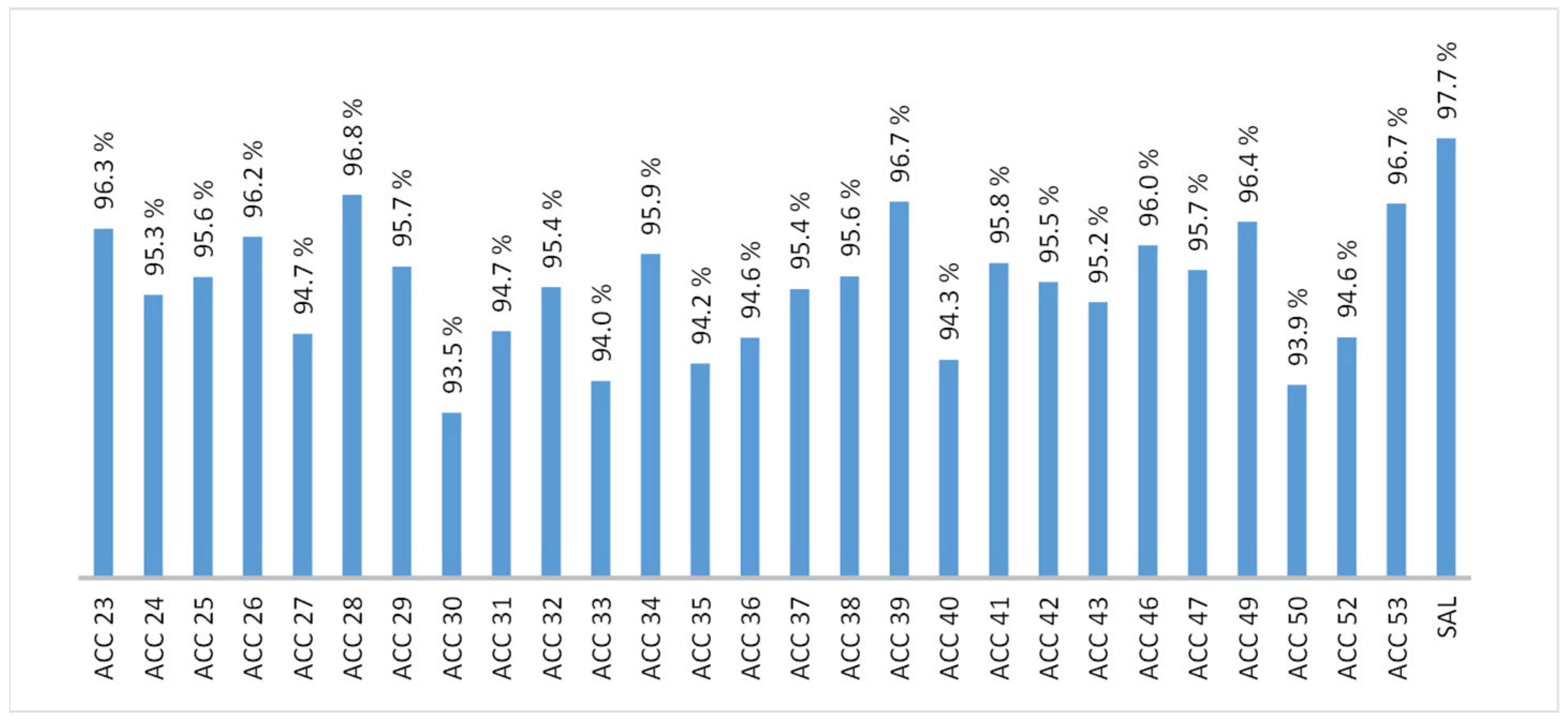
The emergence percentages of the 27 accessions and commercial control (SAL) are presented in detail in Figure 1. The average emergence value was 94.23%, with values ranging from 93.50% (ACC 30) to 97.65% (SAL). The emergence percentage could be measured by evaluating an area of 1 m2 randomly selected from within the middle of a plot [22].

2.3. Quantitative Morphological Variables

Quantitative morphological variables are presented in Table 2. For plant height (PH) at physiological maturity, we observed that ACC 43 (231.1 cm) stood out for its tall stature, statistically similar to that measured for SAL (231.1 cm), while the shortest genotype was ACC 50 (145.5 cm). For the main stem diameter (MSD) the thickest genotype was ACC 53 (13.49 mm), which was statistically similar to the check SAL (13.59 mm), while those with the thinnest stems were the statistically similar ACC 50 (10.65 mm) and ACC 47 (10.62 mm). For petiole length (PEL), the longest was ACC 38 (6.09 cm) and the shortest was ACC 41 (4.50 cm). Similarly, for leaf length (MLL), the genotype with the greatest value was ACC 38 (8.32 cm), while ACC 50 (5.76 cm) obtained the lowest value. For leaf width (MLW), ACC 52 had the greatest value (8.23 cm) and ACC 50 had the narrowest leaves (5.57 cm). For panicle length (PL), ACC 24 had the longest panicles (81.9 cm), while the check SAL had the shortest (38.9 cm), the average being 69.32 cm for the 28 strains evaluated. With respect to panicle diameter (PW), ACC 28 had the widest ones (18.77 cm) and ACC 50 had the thinnest (6.80 cm). For mildew infection (DS), ACC 43 had the most severe infection (17.22%) while ACC 50 was the most resistant to the fungus (1.22%). Line ACC 36 had the greatest specific leaf area (SLA, 923 cm2 g−1) while ACC 37 had the lowest (599 cm2 g−1). In addition, line ACC 53 had the highest number of leaf serrations (NTB, 35) while ACC 50 had the least (18).

2.4. Quantitative Grain Variables

Quantitative grain yield variables are shown in Table 3. With respect to grain diameter (GW), the check variety SAL (2.39 mm) and ACC 29 (2.29 mm) had significantly larger seeds than the other lines, whereas ACC 42 had the smallest seeds (1.92 mm). For seed thickness (GT), on the other hand, ACC 50 was the thickest (1.23 mm) and ACC 27 had the thinnest seed (0.93 mm). In continuation, the check variety SAL reached 3.96 g per thousand seed (G1000W), which was statistically superior to the other accessions. For hectoliter weight (GHW), ACC 31 was the heaviest (0.72 g cm−3). For saponin percentage (SC), ACC 25 produced the most saponin (0.210%) while ACC 43 had the least (0.08%). Accession ACC 50’s harvest index (HI) value of 33.07% was highest of all lines. In terms of seed yield (SY) ACC 33 was the highest yielding at 5.6 t ha−1 while ACC 42 had the lowest yield at 2.44 t ha−1.

2.5. Qualitative Morphological Variables

Qualitative morphological variables are presented in Table 4. With respect to growth habit (GH), all of the lines were non-branching, while for stem form (MSS) all of the accessions were cylindrical. For axil pigmentation (PPA), 79% were non-pigmented, while 21% of the lines were pigmented. With respect to stem striping (PRS), all of the accessions displayed this character. None of the lines displayed panicle branches (PB). For leaf shape (LS), all had triangular leaves. Similarly, all of the lines had indentations on the leaf margins (LM). None of the lines exhibited male sterility (MS). In terms of degree of dehiscence (DD), 75% of the accessions had normal dehiscence, 14% were strongly dehiscent, and 11% were slightly dehiscent. For panicle density (PD), 57% of the lines were lax, 36% intermediate, and 7% were compact. For panicle shape (PS), 71% were intermediate, 21% glomerulate, and 7% amaranthiform. With respect to perigonium pattern (PAP), 86% of the lines were semi-open and 14% closed. For insect susceptibility (PSY), 71% were lightly damaged, 25% moderately damaged, and 4% showed no insect damage. For pericarp appearance (PA), 93% of the lines were ashen and 7% granular. For episperm appearance (EA), 96% were opaque and 4% had vitreous episperm. For grain shape (GS), 54% were cylindrical, 42% elliptical, and 4% were lenticular. All of the lines displayed presence of saponin (SP). For saponin effusion (ES), 93% of the lines were medium, 4% produced minimal saponin, and the remaining 4% were rated as heavy saponin producers.
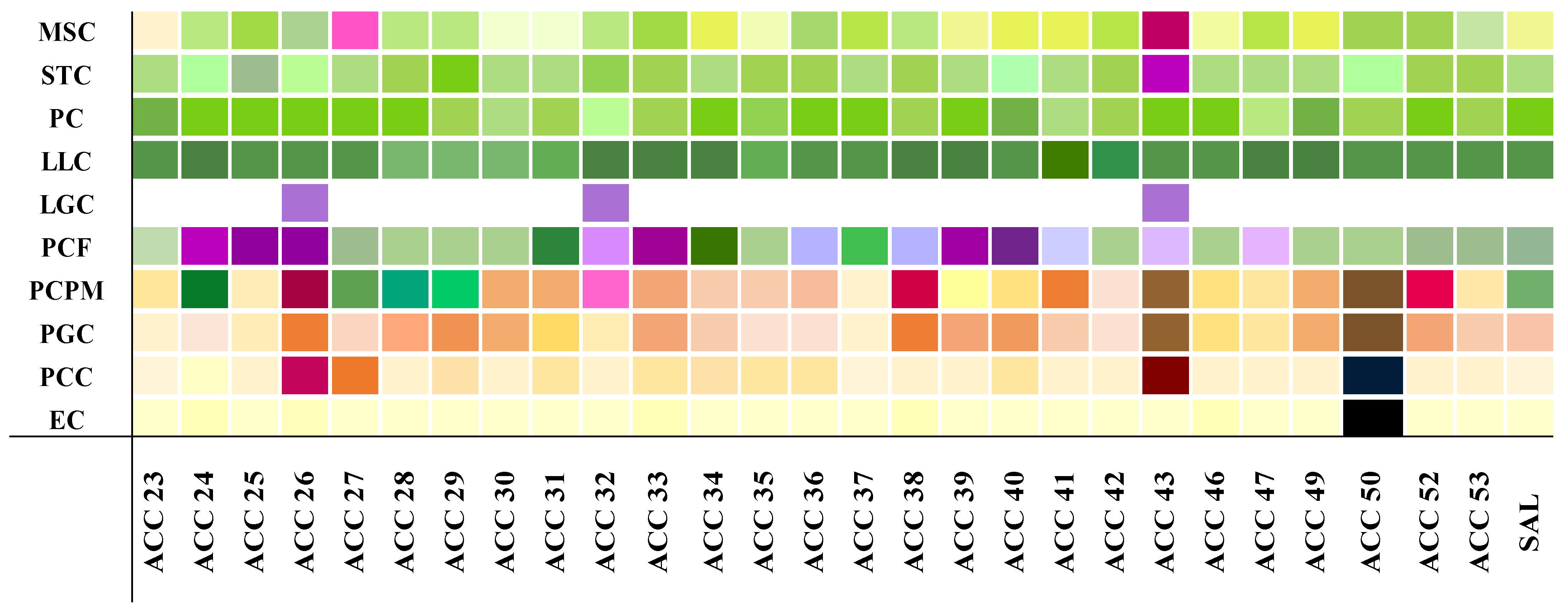
Plant color frequency analysis results are presented in Figure 2. Five accessions (18%) had intense yellow-green main stems (MSC), while four (14%) were brilliant yellow-green. For stem striae color (STC), 43% (12 accessions) were light yellow-green and 29% (8 accessions) were deep yellow-green. With respect to petiole color (PC), 46% (13 accessions) were intense yellow-green. Similarly, the laminar leaf color (LLC) of 46% (13 accessions) were medium olive green. Meanwhile, for leaf grain or epidermal bladder color (LGC) 89% (25 accessions) were colorless and 11% (3 accessions) were purple. With respect to panicle color at flowering (PCF), 29% (8 accessions) were predominantly medium yellow-green. At physiological maturity (PCPM), panicle color expression became highly variable, with three accessions (11%) appearing medium yellow-orange. For perigonium color (PGC), color was again highly variable, with 14% (4 accessions) being pale yellow and 11% (3 accessions) being medium orange-yellow. The pericarp color (PCC) in 12 accessions was mainly pale yellow (43%). The predominant episperm color (EC) was whitish-yellow at 79% (22 accessions).

2.6. Correlation Matrix

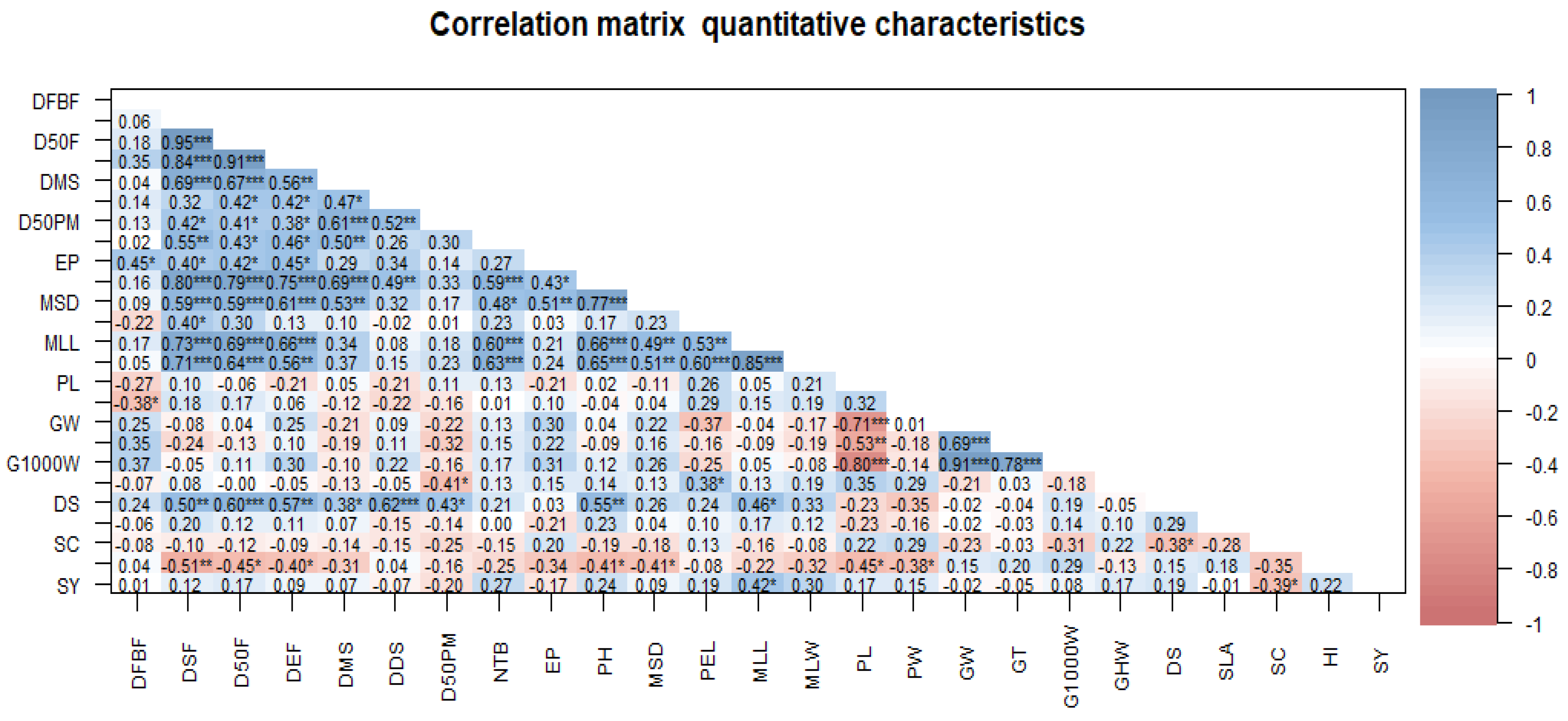
Spearman correlation coefficients are presented in Figure 3. Elevated correlation values were observed between discrete phenological stages such as D50F and DSF (r = 0.95), D50F and DEF (r = 0.91), DEF and DSF (r = 0.84); between morphological variables MLW and MLL (r = 0.85) and MSD and PH (r = 0.77); and between grain variables G1000W and GW (r = 0.91), G1000W and GT (r = 0.78), and between SY and MLL (0.42). Negative correlations were also observed, between G1000W and PL (r = −0.80), GW and PL (r = −0.78), and SY and SC (r = −0.39).

2.7. Analysis of Principal Components

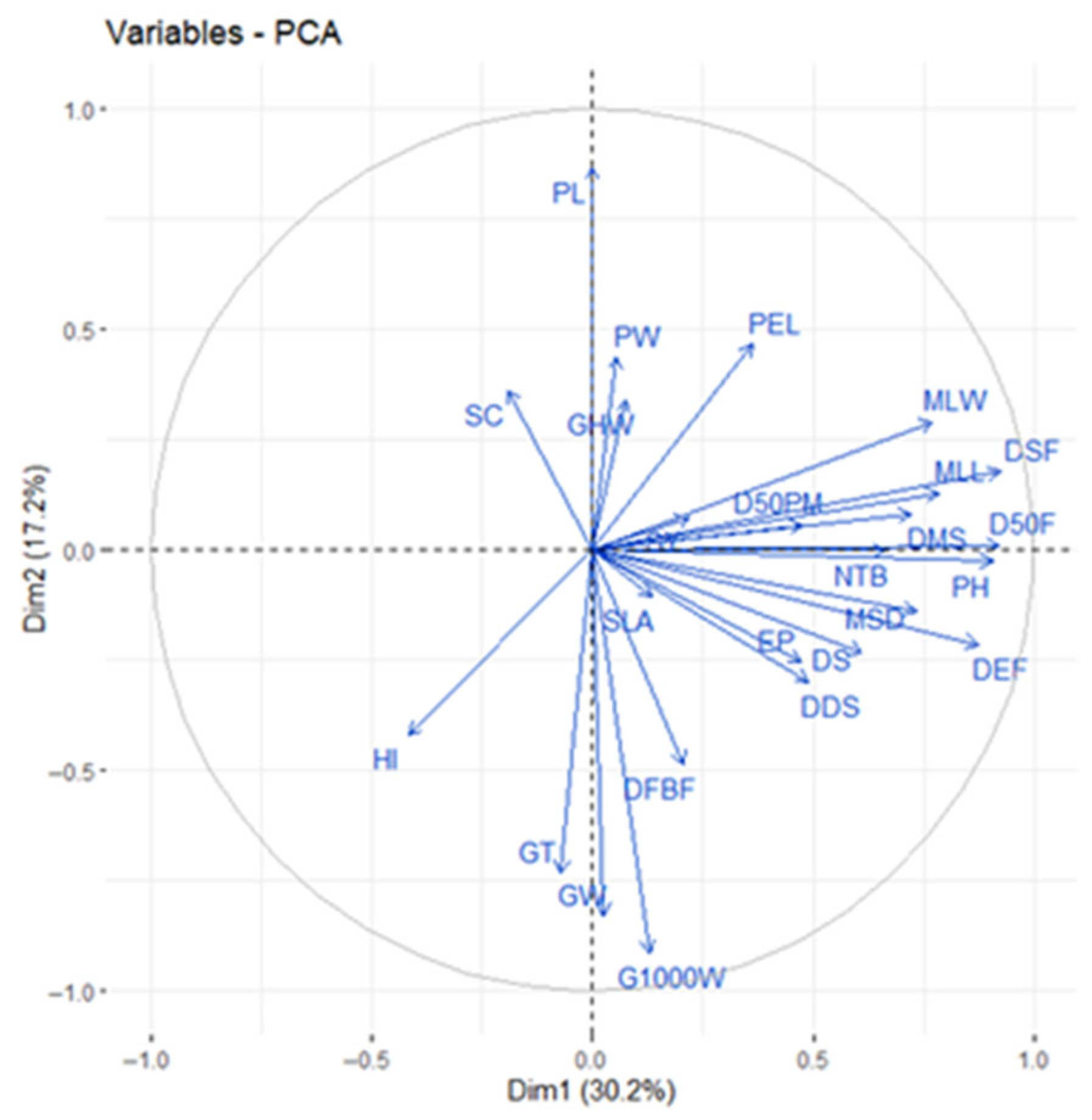
The analysis of principal components is presented in Figure 4. The two principal components explained 47.4% of the total variance. Variables having the greatest contribution to the first principal component (PC1) were D50F, PH, DEF, DSF, MLL, DMS, DS and MLW. For PC2, variables PL, PW, HI, DFBF, GT, GW and G1000W were most significant.
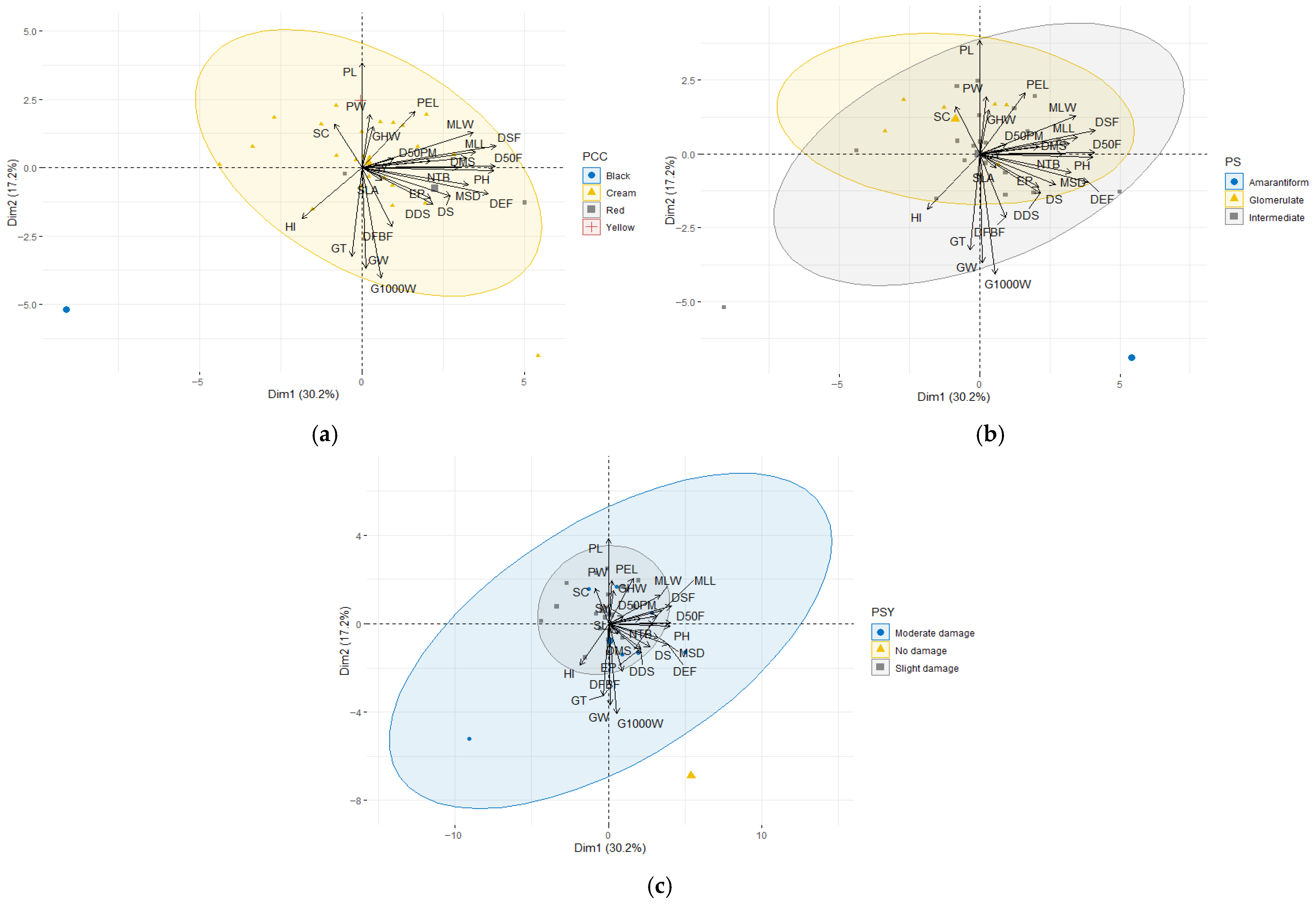
Results of principal component analyses (PCAs) for qualitative morphological traits are presented in Figure 5. We observed modest discrimination among groups for grain color (Figure 5a), with an overwhelming number of lines having cream-colored seeds (Figure 2). Similarly, panicle morphology demonstrated only modest discrimination in the PCA biplot, with variables SC, PW, PL and GHW being associated with glomerulate panicles (Figure 5b). However, no discrimination was observed among groups for pest tolerance levels, as most genotypes were moderately pest-tolerant and a smaller group displayed slight pest damage and a general association with variables SC, PW, PEL, GHW and SY (Figure 5c).

2.8. Cluster Analysis

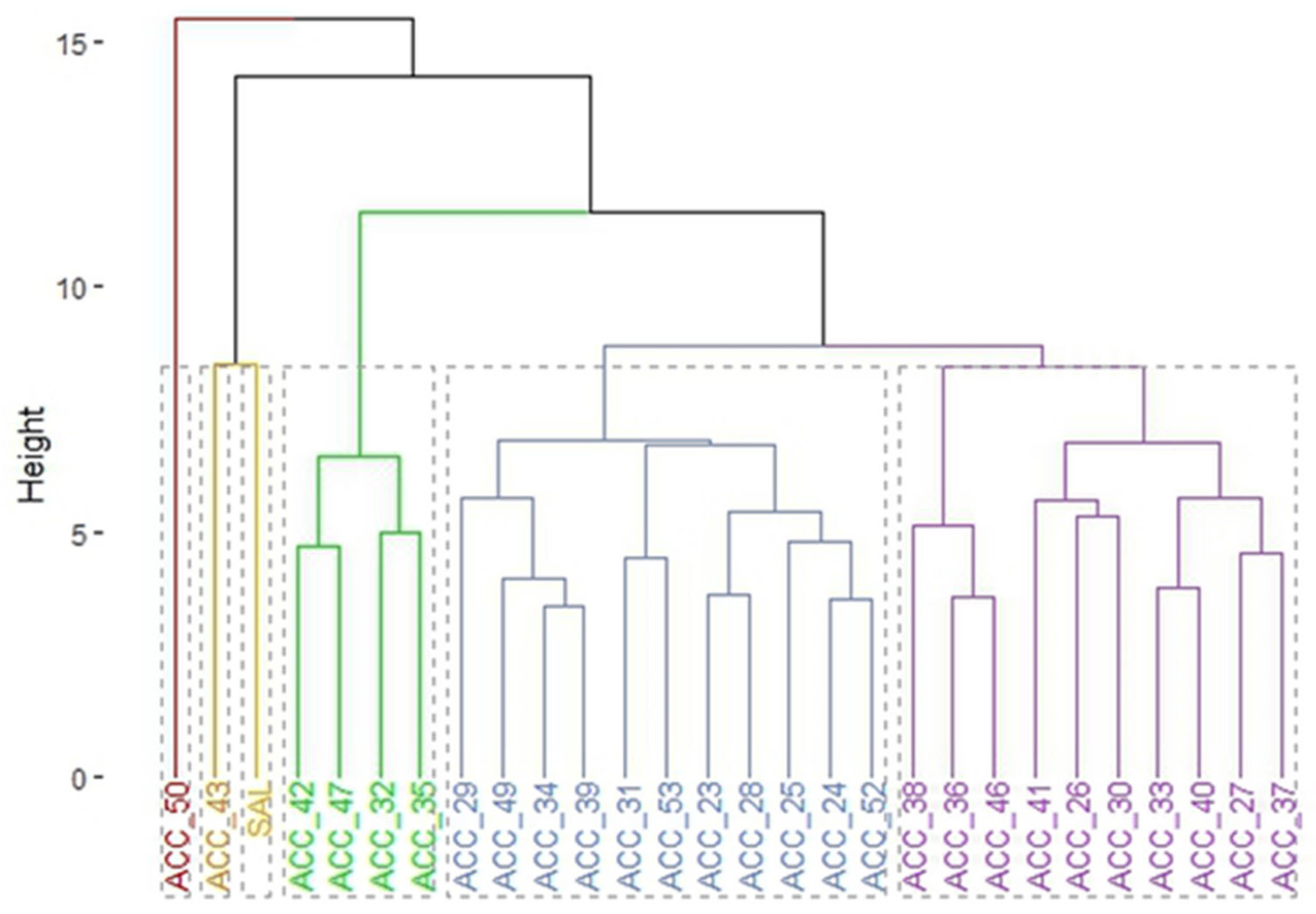
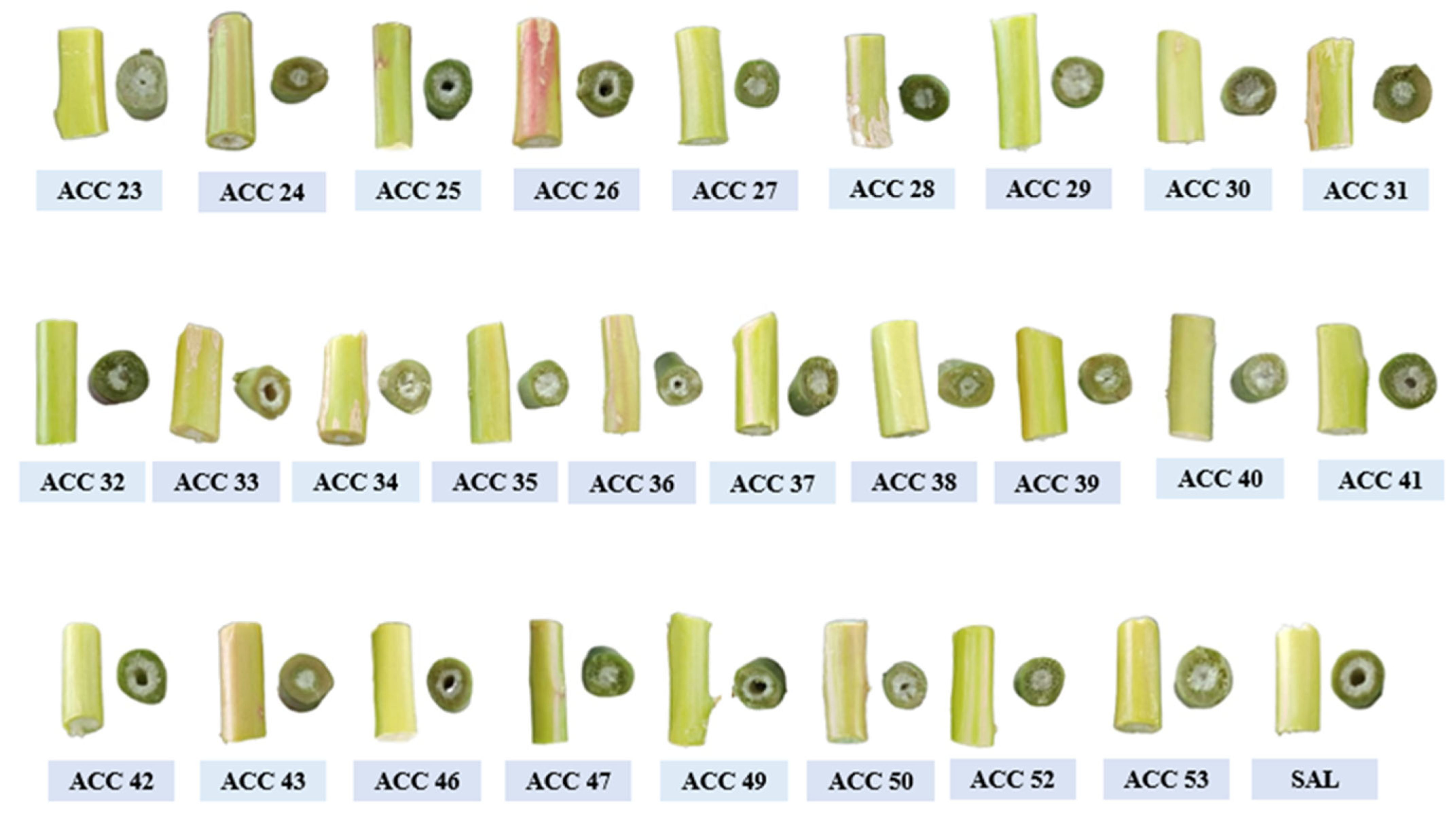
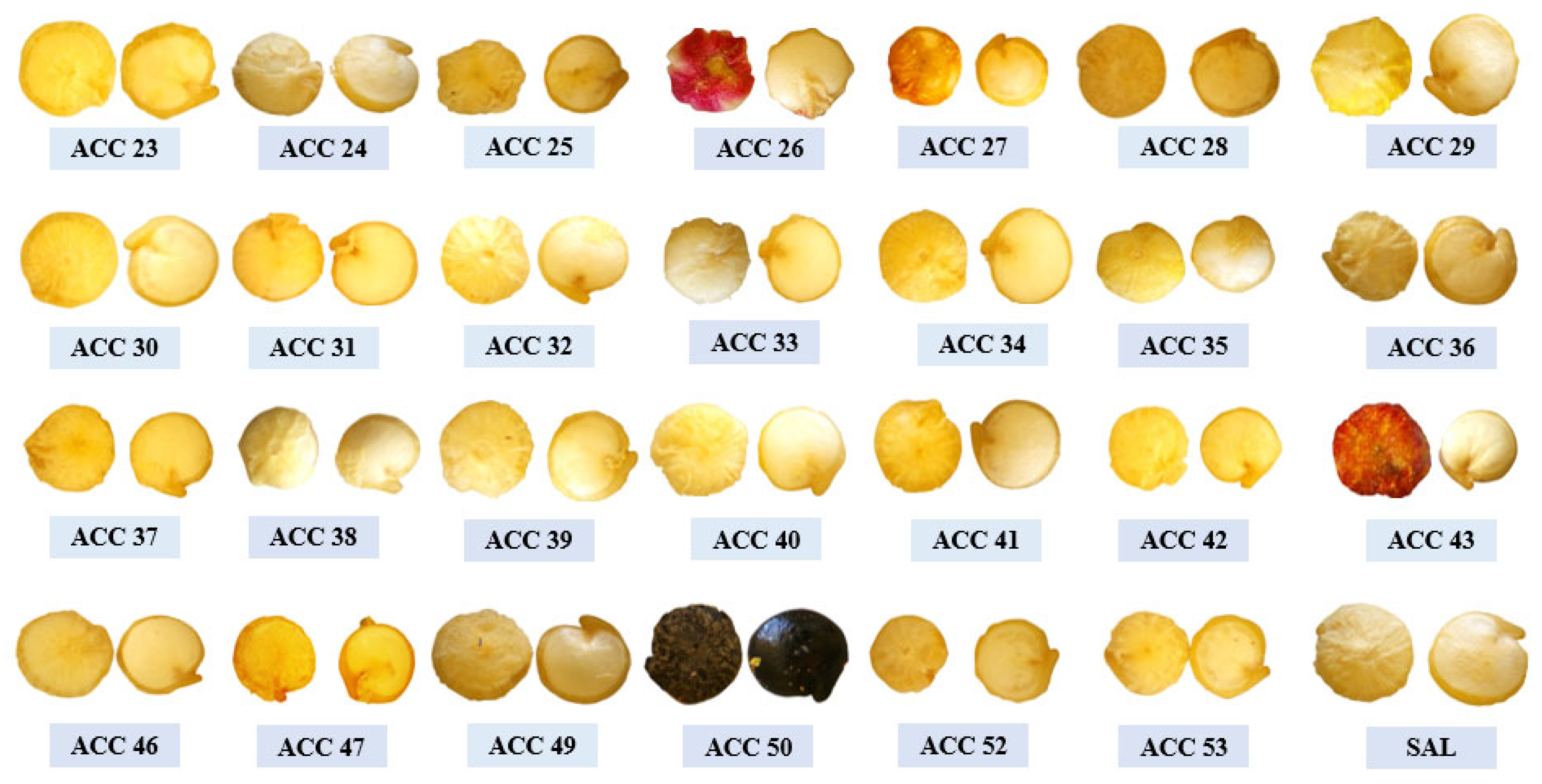
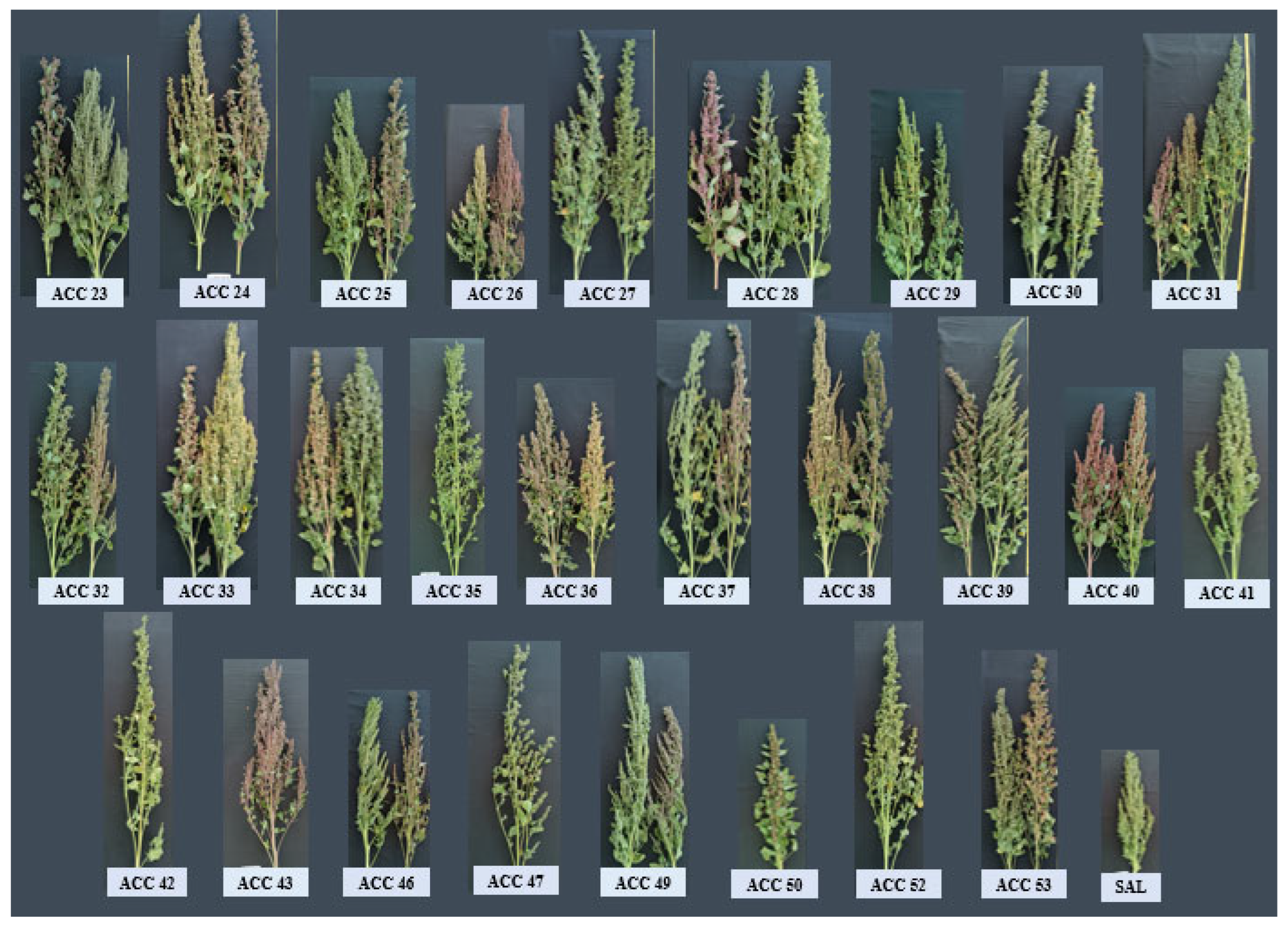
In the cluster analysis (Figure 6), six major groups were identified that shared similarities for many of the variables discussed above. Their phenotypic characteristics are shown photographically for stems (Figure 7), seeds (Figure 8), and panicles (Figure 9).
The first group (a) consisted of ACC 50. This line stands out for its earliness, having reached 50% physiological maturity by 42 DAS and for reaching complete maturity at 105 days (Table 1). Other salient characteristics of this accession/group are the following: shorter plant stature at 145.5 cm; narrower stem diameter of 10.65 mm; shorter leaf length at 5.76 cm; narrower leaves of 5.57 cm; shorter panicles of 50 cm; a narrower panicle diameter averaging 6.80 cm; reduced severity of mildew infection (1.22%); thicker grain (1.23 mm); and a higher harvest index (33.07%).
The second group (b) was composed of ACC 43 (Figure 6). Accession 43 was notable for its delayed maturation, requiring generally longer times to floral bud formation (57 DAS), to pasty grain stage (110 DAS), and to final physiological maturity (132 DAS, Table 1). Other important characteristics of this group included taller plant height at 231.1 cm, longer petioles at 5.97 cm, more severe mildew infestation (17.22%), and a harvest index of 28.77%.
The third group (c) consisted of the varietal check SAL. This variety was notable for its relatively high number of days until floral bud formation (37 DAS), to 50% physiological maturity (62 DAS), and for its long total growth cycle (132 days, Table 1). Additionally, SAL had the tallest plants (average 231.1 cm), the greatest average stem diameter (13.59 mm), and the largest (2.39 mm), thickest (1.18 mm), and heaviest seeds, as measured by thousand-seed (3.96 g) and hectoliter weights (0.62 g cm−3).
The fourth group (d) included four accessions: ACC 42, ACC 47, ACC 32 and ACC 35 (Figure 6). This group is characterized by reaching 50% physiological maturity between 48 and 52 DAS and with a 112-to-132-day requirement before reaching complete physiological maturity (Table 1). Stem diameter for this group varied from 10.62 to 12.15 mm, petiole length from 4.97 to 5.64 cm, maximum leaf lengths from 6.30 to 7.13 cm, average leaf widths from 6.27 to 7.36 cm, seed diameters from 1.92 to 2.09 mm, thousand-grain weights from 2.07 to 2.69 g, and hectoliter seed weight varied from 0.64 to 0.69 g cm−3 (Table 3). For this group, saponin percentage ranged from 0.123% to 0.180% and harvest index from 24.12% to 28.71%. In summary, these accessions were of medium height, had lower grain yields, were earlier, and they had smaller grains.
The fifth group (e) encompassed 11 accessions: ACC 29, ACC 49, ACC 34, ACC 39, ACC 31, ACC 53, ACC 23, ACC 28, ACC 25, ACC 24 and ACC 52 (Figure 6). This group required 51 to 56 days until initiation of the floral bud and 112 to 126 days until final physiological maturity (Table 1). Plant height in this group varied from 185.5 to 213.2 cm, stem diameters ranged from 11.83 to 13.49 mm, panicles were from 5.03 to 6.05 cm long, maximum leaf lengths ranged from 6.89 to 7.98 cm, maximum leaf widths from 6.89 to 7.98 cm, and hectoliter grain weight varied from 0.64 to 0.72 g cm−3. In terms of mildew susceptibility, these strains were highly variable (Table 2), with the most resistant lines being ACC 28 (1.56% severity) and ACC 23 (1.69% severity). Overall, this group consisted of average-height lines with intermediate yields, intermediate maturity, intermediate seed yields, and intermediate grain size.
The sixth group (f) of lines in the cluster analysis in Figure 6 was made up of the following ten accessions: ACC 38, ACC 36, ACC 46, ACC 41, ACC 26, ACC 30, ACC 33, ACC 40, ACC 27 and ACC 37. These lines flowered from 53 to 56 DAS and required 112 to 126 days to reach final physiological maturity. Their plant heights ranged from 187.1 to 215.5 cm, with the principal stem diameters measuring 11.26 to 12.75 mm. Petiole lengths in this group were from 4.50 to 6.09 cm, maximum leaf lengths from 6.99 to 8.32 cm, leaf widths from 6.39 to 8.13 cm, and panicle lengths ranged from 57.9 to 81.1 cm. For panicle diameters, the group varied between 9.47 and 12.80 cm. Seed characteristics were as follows: diameters ranged from 1.95 to 2.19 mm, widths from 0.93 to 1.08 mm, and the hectoliter weights varied from 0.62 to 0.71 g cm−3. In summary, this group was taller, had higher seed yields, was earlier maturing, and had smaller seeds.

2.9. Selection Indices

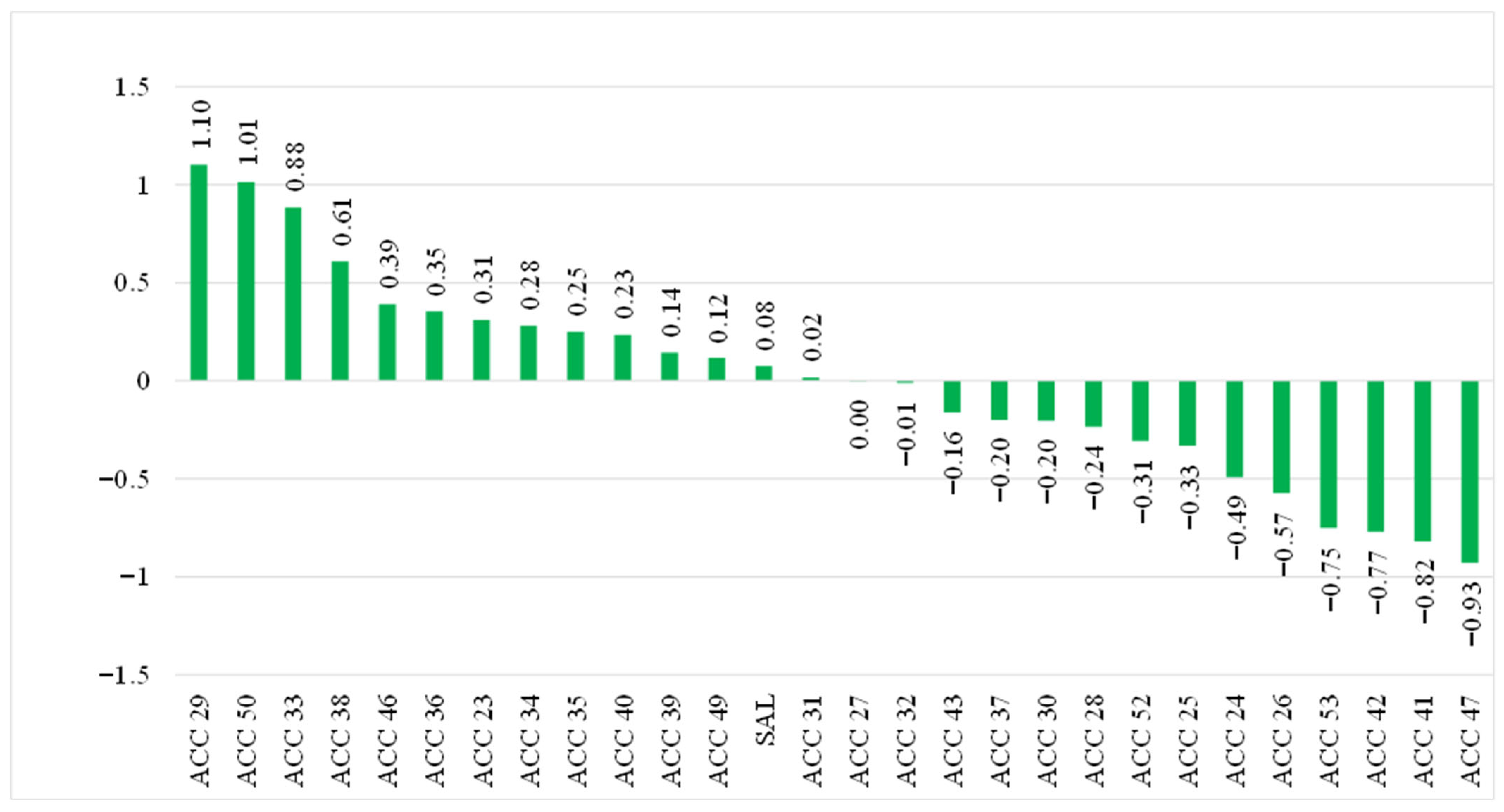
Selection index values for the 27 accessions and the SAL check (Figure 10) ranged from between 1.10 to −0.93. Significant values are considered to be those equal to or greater than 0.60. Consequently, the four most attractive accessions (Figure 10) had plant heights of 145.5 to 222.1 cm, with an average of 188.3 cm. Their thousand-grain weights varied from 2.48 to 3.19 g, with an average of 2.93 g, and seed yields ranged from 3.20 to 5.60 t ha−1. The saponin contents varied between 0.101% and 0.117%, with an average value of 0.110%. In contrast, the five lines having the lowest SI values (−0.57 to −0.93) averaged 195.2 cm in height, with average thousand-seed weights of 2.41 g, average yields of 25.8 g plant−1, and saponin contents averaging 0.16% (Figure 10). Interestingly, varietal check SAL had only an average SI value of 0.08, being surpassed by 12 of the test accessions.

3. Discussion

The phenological quantitative variables of quinoa that were evaluated included plant emergence, which varied from 94 to 98% for the 27 accessions and was noted to be strongly affected by temperature [23]. Flower bud formation averaged 31 DAS, earlier than values observed by other authors but with similar genotypic variability [24]. Anthesis or flowering initiation occurred on average at 53 DAS, while previous studies reported the onset of anthesis at 100 DAS [25]. In our study, lines averaged 56 DAS until 50% of flowering, whereas others [26] had measured 84 DAS for the earliest and 94 DAS for the latest lines. For number of days from flowering to the pasty grain stage, our average was 92 days, while others have reported shorter periods [27], with 61 days in early varieties and 83 days in late varieties. We observed an average of 108 days from anthesis to 50% of physiological maturity, contrary to what was reported by [26], who obtained higher values. It is worth noting that others [28] had observed earlier maturation with average daily temperatures of 24 °C, which are similar to those in our experiment. When evaluating seedling emergence (EP), our values were very close to those of [29], who achieved 100% as a percentage of emergence for Colombian ecotypes. Of course, all phenological characteristics can be heavily influenced by the environment where the crop is grown and not solely by intrinsic genetics of the quinoa lines.
For the quantitative morphological variables in our quinoa trial, we noted an average plant height of 199 cm, which differs from values reported by others [30], who have reported a range of heights from 133.1 to 175.1 cm. Stem diameters in our study averaged 12.2 mm, which in another study had been reported to decrease by up to 17% under water-deficit conditions [31]. Panicle lengths in our study averaged 69 cm; this trait is known to be a function of the processes of growth and differentiation within the apical meristem [32]. For our 27 accessions, we identified a variability of 72%, indicative of differential genetic resistance/susceptibility among these lines, and contrasts with the results of others [33]. The average number of leaf margin indentations for our study was 26, whereas ref. [34] observed lower leaf teeth numbers in their study.
With respect to our quantitative seed measurements for quinoa, grain diameter across the 28 lines averaged 2.11 mm, which was higher than the report of [35]. Our average grain thickness was 1.07 mm, similar to what was recorded by [26], varying from 0.9 to 1 mm. For thousand-seed weight the average in our experiment was 2.72 g, results which are similar to those indicated by [36], with an average of 2.59 g, and within the range reported by [37], with values from 1 to 3 g, but which are lower than those of [38], who observed a range from 3.37 to 3.46 g. Our average hectoliter weight value was 0.67 kg L−1, which was close to the value of 0.73 kg L−1 from [39]. Saponin percentage in the 28 lines averaged 0.14%, which is higher than the 0.11% threshold for differentiating sweet from bitter lines [40], and only six of our 27 genotypes would be considered sweet. Our average harvest index was 26%, close to the value obtained by [41]. Our lines yielded an average of 3.7 t ha−1 of grain, a figure similar in magnitude to that recorded in trials in the Cochabamba Valley [26], where quinoa yielded 3.4–6.34 t ha−1. As with others [42] these data indicate that yield components are affected by various phenotypic characteristics, among them plant height, petiole length, leaf shape and size, etc. In addition, humidity can have significant effects on yield [43].
For qualitative morphological variables, all 27 lines exhibited a simple growth pattern, though there is evidence that this growth habit can vary when the soil is saline [44]. All our lines had cylindrical stems, as was also reported by [25] but not by [45], who observed 66% of lines with angular and 34% cylindrical stems. With respect to branching, none of our lines were highly branched, unlike ref. [46] who reported branched accessions in the lower and middle thirds of the stems. As had been reported by [45], all of our lines had triangular leaves. For panicle density, 57% were lax, 36% intermediate, and 7% compact, and these coincided with the observations of [45]. For panicle shape, 71% were of intermediate form, 21% glomerulate, and 7% were amaranthiform, in keeping with the results of [47], who reported intermediate (77%), glomerulate (15%), and amaranthiform (8%) panicles. However, in other studies, like [25], 76% amaranthiform and 24% glomerulate panicles are recorded, while ref. [45] reported 16% glomerulate, 38% intermediate, and 47% amaranthiform panicles in their studied genotypes. A majority of our lines had opaque seeds, in keeping with ref. [46] who reported 100% of their lines as being opaque. In terms of seed shape, 54% were cylindrical, 42% elliptical, and 4% were lenticular, which differed from [25], whose quinoas all had cylindrical seeds. All of our lines contained saponin as was previously noted by [25].
For color of the main stem, 18% of our lines were deep yellow-green and 14% were bright yellow-green; meanwhile, others [45] had reported green as the predominant stem color in in 31% of their genotypes. Striae color along the stem was mainly light yellow-green or strong yellow-green, results conforming with those of [25], who reported 76% of striae were green; however, others [48] have observed pink stem striae at maturity. For petiole color, 46% of our accessions were strong yellow-green, whereas ref. [46] had reported 81% of genotypes as having green petioles. For leaf blade color, 46% were medium olive green, as reported also by [49] but different from [50]. For glandular leaf trichome appearance, 89% were transparent while 11% were purple; others [45] reported 16% as being violet. For panicle color at flowering, 29% were medium yellow-green, a similar result to that obtained by [51], with green to violet panicles. Episperm color in 22 of our lines was whitish-yellow (cream), whereas ref. [52] had noted a range of distinct episperm colors, including translucent, white, cream, and including darker colors like black, gray, purple, and red, among others. This variation for episperm color implies that a wide range of genetic variability for seed pigmentation exists in quinoa [53].
We observed a strong positive correlation of 0.77 between main stem diameter and plant height. These results are concordant with [54], who obtained a moderately positive correlation (r = 0.56) between these two traits.
For the PCA, the first component encompassed 30.2% of the variability, explained primarily by the variables D50F, PH, DEF, DSF, MLL, DMS, DS, and MLW, whose vectors projected toward the positive pole of the axis and which comprise lines that were taller, with greater vegetative biomass, later maturity, and higher disease susceptibility. The second component of the PCA accounted for 17.2% of the variability, associated primarily with PL and PW, complementing the contributions of HI, DFBF, GT, GW, and G1000W. The extreme positive axis grouped lines have large panicles, while the negative axis contained lines showing higher productivity. Others [55] have reported the two principal components as explaining 51.1% of the total variation, with the first axis explaining 35.0% along a gradient of vegetative vigor and higher biomass, while the second accounted for 16.1% and projected a gradient for productivity and disease severity. These results contrast with those of [56], who observed that days to 50% flowering, seed yield per plant, and panicle length were the main contributing variables to PC1.
Our cluster analysis identified six main groups. The study of [57] had observed only three groups of clustered lines, whose groupings were highly influenced by panicle and seed characteristics along with plant height. Similarly, ref. [58] had identified three groups based on similar characteristics. However, ref. [59] had reported four groups dominated by genotypes from Peru and the Bolivian Altiplano (G1); the Bolivian Altiplano alone (G2); the USDA collection made by Ballón (and considered to be derived from crosses between Andean highland and coastal Chilean accessions, G3); and some accessions of Ballón along with some coastal Chilean lines (G4), with this last group being the most distinct genetically. Differences in these clustered groupings in the cited studies were most likely due to genetic differences of the source germplasm evaluated, along with different environmental conditions and other factors.
The selection indices of the 27 accessions and varietal check Salcedo-INIA varied between 1.10 and −0.93, with four accessions having the highest SI values (ACC 29, ACC 50, ACC33, and ACC 38) due to their combination of high yields, short statures, larger seeds, earliness, and lower saponin contents. In contrast, another study [59] treated the yield variables along with the number of panicles as positive SI contributors, but early maturation as a negative factor, in their study of 30 quinoa varieties.

4. Materials and Methods

4.1. Study Site

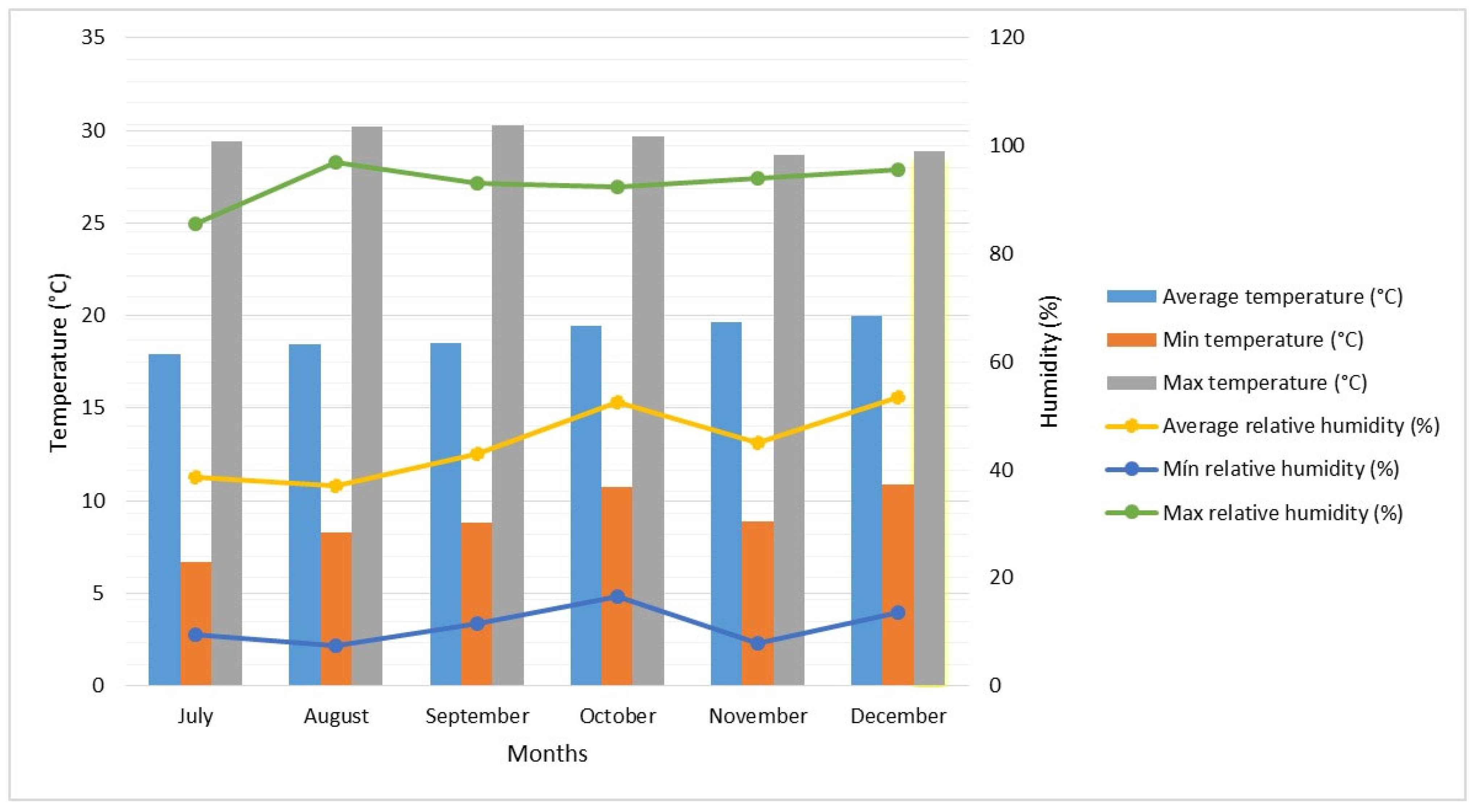
The research trial was performed at the Center for Research, Teaching, and Agricultural Production “CIEPA-MAJES” of the National University of San Agustín of Arequipa, section B1 Specialized Zone; located in the Majes District, Caylloma Province, Arequipa Region, Peru, at 1431 m above sea level and 16°19′35″ south latitude and 72°13′01″ west longitude. The project was conducted under the specific agro-climatic conditions of this location (Table 5; Figure 11).
Water and soil analyses were performed in June, 2023 in the laboratory LABSAF-Arequipa, Santa Rita de Siguas. The soil was a sandy loam, with a moderately alkaline pH 7.7, non-saline electrical conductivity of 39.7 mS m−1, a low organic matter content of 1.1%, high in available phosphate at 12.1 mg kg−1, high in available potassium at 0.79 Cmol kg−1, a high calcium level of 10.42 Cmol kg−1, intermediate magnesium content of 2.05 Cmol kg−1, and with a modest cation exchange capacity of 14.28 meq 100 g−1. The irrigation water had a pH of 8, which is considered normal, along with a moderate electrical conductivity of 0.702 dS m−1, and moderately hard at 25.03 mg L−1.
Source: Automated meteorological station Pampa de Majes [60] and the meteorological station of Autodema at plot E3–67 [61].

4.2. Plant Material

The 27 selected experimental materials derived from native accessions were obtained from the Project Germplasm Bank of the National University of San Agustin of Arequipa (UNSA), using the commercial variety ‘Salcedo INIA’ (SAL) as a check (Table 6).

4.3. Variables Evaluated

Evaluations were done for 28 qualitative and 25 quantitative variables (Table 7) from 15 randomly selected plants, within the two central rows of each accession.

4.4. Agro-Morphological Characterization

Data on each of the quantitative and qualitative variables were scored and recorded based on quinoa descriptors for the crop published by [62]. Similarly, for the phenological stages were recorded the following: days to formation of the floral bud (DFBF); days to the start of flowering/anthesis (DSF); days to 50% flowering (D50F); days to the end of flowering (DEF); days to the milky grain stage (DMS); days to the pasty grain stage (DDS); days to 50% physiological maturity (D50PM); and, for each stage, days were counted from sowing. To determine hectoliter weight (GHW), a 10 mL precision test tube with an interior diameter of 12.18 mm was used for collected seed in a volume of 1 cm3, after which the sample was weighed on an analytical balance.
Colors of the main stem (MSC), striae (STC), petioles (PC), leaf blades (LLC), leaf granular trichomes (LGC), flowering panicles (PCF), plants at physiological maturity (PCPMs), perigonium (PGC), pericarp (PCC), and episperm (EC) were measured utilizing the Royal Horticultural Society color Chart, sixth edition (London, UK, 2015), with each color being numerically coded.

4.5. Evaluation of the Specific Leaf Area

The specific leaf area (SLA) was determined using the formula proposed by [63], for which 15 leaves from the middle third of the plant were collected, one from each plant sampled at 84 days post-sowing, which were later placed on a white surface and photographed from a height of 0.4 m. With the help of an IPAC, the photos were analyzed using Compu Eye, Leaf and Symptom Area (Doki, El Cairo, Egypt) in units of cm2 [64], after which the leaves were dried in a vacuum oven and then weighed on an analytical balance. The SLA was then calculated using the following formula:
S L A = L A / D W
where SLA = specific leaf area (cm2/g), LA = leaf area (cm2), and DW = dry weight (g).

4.6. Evaluation of Saponin Effusion (ES) and Saponin Content (SC)

Saponin effusion (ES) is the volume of foam measured using a modification of the protocol of [40]. Some 0.50 ± 0.02 g of whole seeds were measured out, after which they were crushed in a porcelain mortar to obtain flour. The quinoa flour was then placed in a test tube (15 cm tall × 13.77 mm interior diameter) to which was then added 5 mL of distilled water, the tube was then capped and agitated vigorously for 30 s, and then set aside to settle for 5 min. Afterwards the foam height was measured in cm. The data were then entered into the following equation to calculate saponin content (SC):
%   s a p o n i n   =   ( 0.441   ×   h ) +   0.001 m   ×   10
where h = foam height (cm) and m = sample weight (g).

4.7. Grain Yield (SY)

Yield per hectare was calculated based on weight of grain from 15 plants of the central row for each accession, taking into account the area occupied by each plant (0.09 m2). The data were then entered into the following formula [65]:
Y i e l d   ( t   h a 1 )   =   ( G r a i n   y i e l d   ( kg ) A r e a   ( m 2 ) ) × 10

4.8. Mildew Severity (DS)

We evaluated mildew (Peronospora variabilis) severity according to the procedure described by [66], where a random leaf from each third of a plant was selected and the average percentage of damage on three leaves was calculated as the final value for infection severity per plant. This evaluation was done two weeks after sowing, in the absence of any fungicide application.

4.9. Pest Susceptibility (PSY)

For this evaluation we utilized the pest infection level scale according to Ponce and Badillo (2006), cited as [67], and this was performed two weeks after sowing, prior to any insecticide application.

4.10. Selection Index (SI)

The agromorphological characterization of the quinoa accessions would facilitate selection of genetic materials suitable for breeding and production in areas with unique environmental conditions [20]. Variables relating to yield, earliness, presence/absence of saponins, and other agronomic management variables (for example, plant height) were the most important for establishing a selection index (SI) based on linear equations proposed by [68]:
S I   =   y i e l d   ( 0.30 )   p l a n t   h e i g h t   ( 0.15 ) +   1000   s e e d   w e i g h t   ( 0.15 )   d a y s   t o   50 %   o f   p h y s i o l o g i c a l   m a t u r i t y   ( 0.20 )   p r e s e n c e   o f   s a p o n i n   ( 0.20 )
where yield (t ha−1), height (cm) and saponin (%)

4.11. Agronomic Management of the Study

Each experimental unit consisted of a 5 × 3.6 m plot containing four rows that were 0.9 m wide, for a total area of 18 m2 per genotype.
Sowing was performed on 23 July 2023, at 0.01 m deep, at a density of 11 kg ha−1, with 20 g of seed per accession and 5 g per row. At 27 days after sowing (DAS), plots were thinned, leaving 4 to 5 plants per hill for a final density of approximately 555,000 plants ha−1. Each accession was separated by a row of hybrid maize, sown 30 days prior to the quinoa planting. Irrigation was performed using a DREAM v4. 109.1203 automated drip system controlled by the console software Talgil DREAM (version 4.0.6.8832) and the application SPOT (version 4.0.2136) for Android (Talgil Computing and Control Ltd. Naaman Center, Haifa—Acco Road, Israel). The water volume applied during crop development was 7785.4 m3 ha−1.
Fertilizers were applied at 301, 118, 360, 50, and 40 units per hectare of nitrogen, phosphorus, potassium, calcium, and magnesium, respectively and were based on the recommendations of the National Institute of Agrarian Innovation (INIA) of Peru with research done within the zone.
Phytosanitary control was performed using a manual hydraulic sprayer with an open cone head, taking into account rotation recommendations of action sites of the Action Committee Against Insect Resistance (IRAC) and the Action Committee Against Fungicide Resistance (FRAC). Prior to sowing, the quinoa seeds were impregnated with the fungicide Homai® (Thiophanatemethyl + Thiram; Nippon Soda Co., Ltd., Tokyo, Japan), for preventative control of the rot fungus Rhizoctonia solani, at a dose of 0.01 g per 20 g of seeds. To control Delia platura, Orthene® (Acephato; AMVAC Chemical Corporation, Newport Beach, CA, USA) was applied at 500 g ha−1. To prevent mildew (Peronospora variabilis), the fungicide Legasus® (Metiram + Pyraclostrobin; BASF SE, Ludwigshafen, Germany) was applied at 27 DAS at the rate of 100 g per 20 L in a backpack sprayer; Helios® (Propineb + Cymoxanil; Point Agro China Ltd., Wan Chai, China)) at 33 DAS at a dose of 100 g 20 L−1 of water; Acrobat® (Dimethomorph + Mancozeb; BASF SE, Ludwigshafen, Alemania) at 44 DAS at a rate of 100 g 20 L−1 of water; and Curtine® (Mancozeb + Cymoxanil; Zhejiang Well-Done Chemical Co., Ltd., Hangzhou, China) at 65 DAS at the rate of 50 g 20 L−1 of water.
Accessions were harvested manually, independently for each one and when the plants had reached physiological maturity. Cut panicles were allowed to dry in the sun, after which they were threshed and the seeds measured.

4.12. Data Analysis

To compare the qualitative variables, the mode was calculated and frequency analysis was performed, while for the quantitative data the medians ( x ¯ ), standard deviations (σ), and coefficients of variation (CVs) were calculated. Additionally, the quantitative variables were subjected to analyses of variance (ANOVA) and Duncan tests to compare the accessions (p ≤ 0.05), using R software version 4.4.1 and version 2024-06-14 ucrt of RStudio (Posit PBC, Boston, MA, USA). The packages used within this program included agricolae [69]; corrplot [70] was used to determine the correlation matrix; factoMineR [71] and factoextra [72] for the principal component analyses (PCA). Similarly, for the cluster dendrogram based on quantitative variables, the elbow method was used to determine the optimum number of groups using the factoextra package.

5. Conclusions

This study performed morphological and agronomic characterizations of 27 quinoa accessions within the hyper-arid Peruvian coastal region, so as to determine the capacity of these lines to respond or acclimatize to an adverse production environment in which they were neither originally domesticated nor selected through their hundreds of years of existence.
In terms of morphological characteristics, these lines matured at an average of 120 DAS, ranging from very early accessions like ACC 50 at 105 DAS and late ones like ACC 35, ACC 37, ACC 43, and SAL that matured by 132 DAS. We also identified lines with outstanding characteristics like ACC 29 and ACC 50, which stood out for their earliness, short stature, low saponin content, and superior productivity in comparison with the commercial check variety ‘Salcedo INIA’. On the other hand, all of the accessions performed similarly in their simple growth habit, cylindrical stems, triangular and toothed leaves, presence of striae, lack of male sterility, lack of branching, and presence of saponin. For the remaining characteristics the accessions displayed variability.
Based on analyses of the selection indices, we observed that ACC 29 and ACC 50 were superior to all the other tested lines and the Salcedo-INIA check, having SI values of 1.10 and 1.01, respectively.
Although this agro-morphological characterization was carried out in a single location, the results provide an essential catalog of the diversity present and identify those landrace accessions among the 27 that are most suitable for further line purification within the irrigated desert environment at Majes, Arequipa, Peru. By combining these most promising landrace selections together with internationally available germplasm of Chilean (coastal) origin and the extremely diverse lines being selected out of interspecific cross populations (quinoa X North American pitseed goosefoot, C. berlandieri), a highly diverse foundation is being laid for low-elevation quinoa breeding at the UNSA–Arequipa [36]. To supplement these findings and determine their adaptive attributes for other environments, these landrace accessions should be tested at different altitudes and latitudes.


Author Contributions

Conceptualization, M.E.M.-A., L.E.C.-C., F.L.H.-A. and A.A.-A.; methodology, M.E.M.-A., L.E.C.-C., A.A.-A., F.L.H.-A. and E.N.J.; software, L.E.C.-C. and F.L.H.-A.; validation, L.E.C.-C., F.L.H.-A., A.A.-A. and M.E.M.-A.; formal analysis, L.E.C.-C., F.L.H.-A., A.A.-A. and M.E.M.-A.; investigation, L.E.C.-C., F.L.H.-A., J.L.B.-M. and E.N.J.; resources, L.E.C.-C., F.L.H.-A. and M.E.M.-A.; data curation, L.E.C.-C. and F.L.H.-A.; writing—original draft preparation, L.E.C.-C., F.L.H.-A., A.A.-A. and M.E.M.-A.; writing—review and editing, L.E.C.-C., F.L.H.-A., M.E.M.-A. and E.N.J.; visualization, L.E.C.-C., F.L.H.-A., M.E.M.-A., J.L.B.-M. and E.N.J.; supervision, M.E.M.-A. and J.L.B.-M.; project administration, M.E.M.-A. and J.L.B.-M.; funding acquisition, M.E.M.-A. All authors have read and agreed to the published version of the manuscript.

Funding

This research was financed under the project “Comportamiento Agronomico de Accesiones de Chenopodium sp. para su cultivo sustentable en suelos áridos de la Región Arequipa”, contract IBA-IB-36-2020-UNSA.

Data Availability Statement

The data presented in this study are available by request to the corresponding author.

Acknowledgments

We are grateful to Henry Gustavo Polanco Cornejo, and to Héctor Medina Dávila, the Agronomy Faculty of the National University of San Agustín of Arequipa, for granting field space to perform the experiments within the Center for Research, Teaching, and Agricultural Production. We also offer thanks to Raymundo O. Gutiérrez Rosales for the technical advice and knowledge transmitted, to all those directly or indirectly involved in the research, and to Irma Astete for her help in compiling the data.

Conflicts of Interest

The authors declare no conflicts of interest.

References

  1. Soria, P.K. Perú Como Primer Exportador de Quinua a Nivel Mundial. Quipukamayoc 2017, 25, 75–83. [Google Scholar] [CrossRef]
  2. Sucasaca, R.L. Caracterización agronómica y morfológica de las accesiones de quinua (Chenopodium quinoa Willd) obtenidas ancestralmente vía descriptor bioversity international. Rev. Investig. 2023, 12, 1–14. [Google Scholar] [CrossRef]
  3. Organización de Las Naciones Unidas Para La Alimentación y La Agricultura: Biodiversidad de La Quinua|Plataforma de Información de La Quinua|Organización de Las Naciones Unidas Para La Alimentación y La Agricultura. Available online: https://www.fao.org/in-action/quinoa-platform/quinua/biodiversidad-de-la-quinua/es/ (accessed on 12 March 2026).
  4. Liu, P.; Hu, Y.; Wang, M.; Kang, L. Nutrient Weight against Sarcopenia: Regulation of the IGF-1/PI3K/Akt/FOXO Pathway in Quinoa Metabolites. Curr. Opin. Pharmacol. 2021, 61, 136–141. [Google Scholar] [CrossRef]
  5. Quinua: Una Planta con Mucho Potencial|USDA. Available online: https://www.usda.gov/about-usda/news/blog/quinoa-plant-lot-potential (accessed on 12 March 2026).
  6. Ain, Q.T.; Siddique, K.; Bawazeer, S.; Ali, I.; Mazhar, M.; Rasool, R.; Mubeen, B.; Ullah, F.; Unar, A.; Jafar, T.H. Adaptive Mechanisms in Quinoa for Coping in Stressful Environments: An Update. PeerJ 2023, 11, e14832. [Google Scholar] [CrossRef]
  7. Flores Mamani, E.; Rodriguez-Huamani, R.E.; Arce-Ortiz, N.V.; García-Tejada, G.F.; Flores Mamani, E.; Rodriguez-Huamani, R.E.; Arce-Ortiz, N.V.; García-Tejada, G.F. Cultura y Comportamiento Del Consumidor de Quinua Como Producto Orgánico. Idesia Arica 2022, 40, 133–142. [Google Scholar] [CrossRef]
  8. Valiente, C.L. Quinoa, Quinua, Quínoa, Kínua…. Espores. 2016. Available online: https://espores.org/es/es-plantas/quinoa-quinua-quinoa-kinua/ (accessed on 12 March 2026).
  9. Hernández-Ledesma, B. Quinoa (Chenopodium quinoa Willd.) as Source of Bioactive Compounds: A Review. Bioact. Compd. Health Dis. 2019, 2, 27. [Google Scholar] [CrossRef]
  10. Cui, H.; Yao, Q.; Xing, B.; Zhou, B.; Shah, S.S.; Qin, P. The Performance of Agronomic and Quality Traits of Quinoa under Different Altitudes in Northwest of China. Agronomy 2024, 14, 1194. [Google Scholar] [CrossRef]
  11. Colque-Little, C.; Abondano, M.C.; Lund, O.S.; Amby, D.B.; Piepho, H.-P.; Andreasen, C.; Schmöckel, S.; Schmid, K. Genetic Variation for Tolerance to the Downy Mildew Pathogen Peronospora Variabilis in Genetic Resources of Quinoa (Chenopodium quinoa). BMC Plant Biol. 2021, 21, 41. [Google Scholar] [CrossRef]
  12. Ttacca, B.L.; Coari, P.P.M.; Iturregui, L.A.P. Microorganismos eficaces y Trichoderma sp. en el biocontrol de mildiu (Peronospora variabilis) en cultivo de quinua. Acta Agronómica 2021, 70, 380–385. [Google Scholar]
  13. Valdivia Gongora, P. Cultivo de Quinua Organica En El Distrito de Andaray y Zonas Altoandinas de La Region de Arequipa 2020. Available online: https://www.agroarequipa.gob.pe/images/boletines/biblioteca/Folleto%20Quinua%202020_compressed.pdf (accessed on 15 March 2026).
  14. Morillo Coronado, A.C.; Manjarres Hernández, E.H.; Morillo Coronado, Y.; Morillo Coronado, A.C.; Manjarres Hernández, E.H.; Morillo Coronado, Y. Evaluación morfoagronómica de 19 materiales de Chenopodium quinoa en el Departamento de Boyacá. Biotecnol. Sect. Agropecu. Agroindustrial 2020, 18, 84–96. [Google Scholar] [CrossRef]
  15. Estrada-Zúniga, R.; Apaza-Mamani, V.; Pérez-Ávila, A.; Altamirano-Pérez, A.; Neyra-Valdez, E. Comportamiento agronómico de 81 genotipos de quinua (Chenopodium quinoa Willd) en el Perú. Ecosistemas Recur. Agropecu. 2022, 9, 1. [Google Scholar] [CrossRef]
  16. Bedoya-Perales, N.S.; Pumi, G.; Mujica, A.; Talamini, E.; Domingos Padula, A. Quinoa Expansion in Peru and Its Implications for Land Use Management. Sustainability 2018, 10, 532. [Google Scholar] [CrossRef]
  17. García-Godos, P.; Cueva-Castillo, J.M. Variabilidad Genética de 29 Accesiones de Quinua (Chenopodium quinoa Willd) Peruana Mediante Marcadores AFLP y Análisis Multivariante. Sci. Agropecu. 2021, 12, 57–64. [Google Scholar] [CrossRef]
  18. Alanoca, C.; Machaca, E. Caracterización agromorfológica de 10 accesiones y variedades de quinua (Chenopodium quinoa Willd.) en condiciones del Valle Alto de Cochabamba. Rev. Investig. Agropecu. For. Boliv. 2015, 1, 21–29. [Google Scholar]
  19. Calle Sillo, L.; Vargas Mena, A.; Bonifacio Flores, A.; del Castillo Gutiérrez, C. Evaluación de características comerciales en Quinua roja (Chenopodium quinoa Willd.) en K’iphak’iphani, provincia Ingavi-La Paz. Rev. Investig. Innovación Agropecu. Recur. Nat. 2016, 3, 207–213. [Google Scholar]
  20. Manjarres-Hernández, E.H.; Arias-Moreno, D.M.; Morillo-Coronado, A.C.; Ojeda-Pérez, Z.Z.; Cárdenas-Chaparro, A. Phenotypic Characterization of Quinoa (Chenopodium quinoa Willd.) for the Selection of Promising Materials for Breeding Programs. Plants 2021, 10, 1339. [Google Scholar] [CrossRef]
  21. Zou, C.; Chen, A.; Xiao, L.; Muller, H.M.; Ache, P.; Haberer, G.; Zhang, M.; Jia, W.; Deng, P.; Huang, R.; et al. A High-Quality Genome Assembly of Quinoa Provides Insights into the Molecular Basis of Salt Bladder-Based Salinity Tolerance and the Exceptional Nutritional Value. Cell Res. 2017, 27, 1327–1340. [Google Scholar] [CrossRef]
  22. Stanschewski, C.S.; Rey, E.; Fiene, G.; Craine, E.B.; Wellman, G.; Melino, V.J.; S. R. Patiranage, D.; Johansen, K.; Schmöckel, S.M.; Bertero, D.; et al. Quinoa Phenotyping Methodologies: An International Consensus. Plants 2021, 10, 1759. [Google Scholar] [CrossRef]
  23. Bois, J.F.; Winkel, T.; Lhomme, J.P.; Raffaillac, J.P.; Rocheteau, A. Response of Some Andean Cultivars of Quinoa (Chenopodium quinoa Willd.) to Temperature: Effects on Germination, Phenology, Growth and Freezing. Eur. J. Agron. 2006, 25, 299–308. [Google Scholar] [CrossRef]
  24. Apaza Calcina, J.D. Caracterización y Variabilidad de Progenies S3 Autofecundadas, Procedentes de Cruzas Simples Genéticamente Distantes y Cercanas, en Seis Cultivares de Quinua (Chenopodium quinoa willd). Master’s Thesis, Universidad Nacional de San Agustín de Arequipa, Arequipa, Peru, 2014. [Google Scholar]
  25. Castro-Albán, H.A.; Castro-Gómez, R.d.P.; Alvarado-Capó, Y.; Castro-Albán, H.A.; Castro-Gómez, R.d.P.; Alvarado-Capó, Y. Variabilidad morfoagronómica de quinua (Chenopodium quinoa Willd.) nativa tipo Chimborazo en Ecuador. Agron. Mesoam. 2023, 34, 53229. [Google Scholar] [CrossRef]
  26. Gabriel, J.; Luna, N.; Vargas, A.; Magne, J.; Angulo, A.; La Torre, J.; Bonifacio, A. Quinua de valle (Chenopodium quinoa Willd.): Fuente valiosa de resistencia genética al mildiu (Peronospora farinosa Willd.). J. Selva Andin. Res. Soc. 2012, 3, 27–44. [Google Scholar] [CrossRef]
  27. Valverde-Ramos, M.G.; Espitia-Rangel, E.; Miranda-Colín, S.; Benítez-Riquelme, I. Evaluation of Quinoa Germplasm in Environments of the Central High-Valley Lands of Mexico. Agrociencia 2022, 34, 5. [Google Scholar] [CrossRef]
  28. Uquillas, C.M.; Calderón, K.Z.; Alava, J.P.; Zamora, D.V.; Montufar, G.V.; Fernández-García, N.; Olmos, E. Evaluación agronómica de genotipos de quinua (Chenopodium quinoa Willd.) en condiciones agroclimáticas en la zona de Mocache. Cienc. Tecnol. 2019, 12, 19–30. [Google Scholar] [CrossRef]
  29. Montes-Rojas, C.; Burbano-Catuche, G.A.; Muñoz-Certuche, E.F.; Calderón-Yonda, Y.; Burbano-Catuche, G.A.; Muñoz-Certuche, E.F.; Calderón-Yonda, Y. Descripción del ciclo fenológico de cuatro ecotipos de (Chenopodium quinoa Willd.), en Purace—Cauca, Colombia. Biotecnol. Sect. Agropecu. Agroindustrial 2018, 16, 26–37. Available online: https://dialnet.unirioja.es/servlet/articulo?codigo=6829352 (accessed on 10 January 2025).
  30. Ali, S.; Chattha, M.U.; Hassan, M.U.; Khan, I.; Chattha, M.B.; Iqbal, B.; Rehman, M.; Nawaz, M.; Amin, M.Z. Growth, Biomass Production, and Yield Potential of Quinoa (Chenopodium quinoa Willd.) as Affected by Planting Techniques Under Irrigated Conditions. Int. J. Plant Prod. 2020, 14, 427–441. [Google Scholar] [CrossRef]
  31. Nguyen, L.V.; Bertero, D.; Hoang, D.T.; Long, N.V. Variation in Quinoa Roots Growth Responses to Drought Stresses. J. Agron. Crop Sci. 2022, 208, 830–840. [Google Scholar] [CrossRef]
  32. García-Parra, M.; García-Molano, J.; Deaquiz-Oyola, Y.; García-Parra, M.; García-Molano, J.; Deaquiz-Oyola, Y. Physiological Performance of Quinoa (Chenopodium quinoa Willd.) under Agricultural Climatic Conditions in Boyaca, Colombia. Agron. Colomb. 2019, 37, 144–152. [Google Scholar] [CrossRef]
  33. Urdanegui, P.; Pérez-Ávila, Á.; Estrada-Zúñiga, R.; Neyra, E.; Mujica, Á.; Corredor, F.-A. Yield and agromorphological evaluation of quinoa genotypes (Chenopodium quinoa Willd.) in Huancayo, Peru. Agroindustrial Sci. 2021, 11, 63–71. [Google Scholar] [CrossRef]
  34. Vergara, R.D.O.; Martins, A.B.N.; Soares, V.N.; Carvalho, I.R.; Barbosa, M.H.; Conte, G.G.; GAdotti, G.I.; Ludke, R.; Villela, F.A. Agronomic and Morphological Characteristics of Quinoa Grown in the Southern Region of Rio Grande Do Sul State. Rev. Bras. Eng. Sustentabilidade 2020, 8, 18. [Google Scholar] [CrossRef]
  35. Infante, R.H.; Albesiano, S.; Arrieta, V.L.; Gómez, V.N. Morphological Characterization of Varieties of Chenopodium quinoa Cultivated in the Department of Boyacá, Colombia. Rev. UDCA Actual. Divulg. Científica 2018, 21, 329–339. [Google Scholar] [CrossRef]
  36. Ramos-Tarifa, E.G.; Anculle-Arenas, A.; Bustamante-Muñoz, J.L.; Jellen, E.N.; Mayta-Anco, M.E. Agro-Morphological Characterization of 14 Quinoa (Chenopodium quinoa Willd.) × Pitseed Goosefoot (C. berlandieri Moq.) Interspecific Hybrid-Derived Lines in an Arid Zone. Agronomy 2026, 16, 82. [Google Scholar] [CrossRef]
  37. Naneli, I.; Tanrikulu, A.; Dokuyucu, T. Response of the Quinoa Genotypes to Different Locations by Grain Yield and Yield Components. Int. J. Agric. Innov. Res. 2017, 6, 447–451. [Google Scholar]
  38. Altuner, F. The Impact of Different Sowing-Times of the Quinoa (Chenopodium quinoa Willd.) and Its Varieties on the Yield and Yield Components in Turkey-Mardin Ecology Condition. Appl. Ecol. Environ. Res. 2019, 17, 10105–10117. [Google Scholar] [CrossRef]
  39. Mamani, E.R.; Bonifacio, A.; Taboada, G.C.; Angulo, F.R. Determinación de La Pureza y Calidad de Grano de Quinua (Chenopodium quinoa Willd.) Dulce y Amarga de Variedades Comerciales, En Viacha—La Paz. Cibum Sci. 2022, 1, 7–15. [Google Scholar] [CrossRef]
  40. Koziol, M.J. Afrosimetric Estimation of Threshold Saponin Concentration for Bitterness in Quinoa (Chenopodium quinoa Willd). J. Sci. Food Agric. 1991, 54, 211–219. [Google Scholar] [CrossRef]
  41. Ramírez, C.V.; Guerrero, G.R.; Piedras, J.J.G. Respuesta Morfoagronómica y Calidad En Proteína de Tres Accesiones de Quinua (Chenopodium quinoa Willd.) En La Sabana Norte de Bogotá. Rev. UDCA Actual. Divulg. Científica 2016, 19, 325–332. [Google Scholar] [CrossRef]
  42. Vergara, R.; Carvalho, I.R.; Gadotti, G.I.; Soares, V.N.; Szareski, V.J.; Pedó, T.; Aumonde, T.Z.; Villela, F.A. Canonical Correlation and Agronomic Performance of Quinoa (Chenopodium quinoa Willd). Rev. Bras. Agropecuária Sustentável 2021, 11, 252–258. [Google Scholar] [CrossRef]
  43. Azhar, M.F. Morphological Features of Different Accessions of Chenopodium quinoa. Pure Appl. Biol. 2018, 7, 374–383. [Google Scholar] [CrossRef]
  44. Miranda, R.; Caballero, A.; Cadena, F.; Bosque, H. Salinidad y El Cultivo de La Quinua—Una Breve Revisión Bibliográfica. Apthapi 2016, 3, 87–92. [Google Scholar]
  45. EL-Harty, E.H.; Ghazy, A.; Alateeq, T.K.; Al-Faifi, S.A.; Khan, M.A.; Afzal, M.; Alghamdi, S.S.; Migdadi, H.M. Morphological and Molecular Characterization of Quinoa Genotypes. Agriculture 2021, 11, 286. [Google Scholar] [CrossRef]
  46. Estrada Zúniga, R.; Bobadilla, L.G.; Neyra Valdez, E.; Manotupa Tupa, M.B.; Álvarez Caceres, A.; Céspedes Florez, E. Evaluación Morfoagronómica de 100 Accesiones de Quinua (Chenopodium quinoa Willd.) Por Su Respuesta a Mildiu (Peronospora variabilis Gäum), Rendimiento y Contenido de Saponina En Cusco, Perú. Av. Investig. Agropecu. 2022, 26, 47–61. [Google Scholar] [CrossRef]
  47. Craine, E.B.; Davies, A.; Packer, D.; Miller, N.D.; Schmöckel, S.M.; Spalding, E.P.; Tester, M.; Murphy, K.M. A Comprehensive Characterization of Agronomic and End-Use Quality Phenotypes across a Quinoa World Core Collection. Front. Plant Sci. 2023, 14, 1101547. [Google Scholar] [CrossRef] [PubMed]
  48. Sarwar, A.; Khatun, M.; Fakir, M. Quinoa—A Functional Food Crop: Morphological Descriptors. J. Bangladesh Agric. Univ. 2023, 21, 12–22. [Google Scholar] [CrossRef]
  49. Delgado, H.; Tapia, C.; Manjarres-Hernández, E.H.; Borja, E.; Naranjo, E.; Martín, J.P. Phenotypic Diversity of Quinoa Landraces Cultivated in the Ecuadorian Andean Region: In Situ Conservation and Detection of Promising Accessions for Breeding Programs. Agriculture 2024, 14, 336. [Google Scholar] [CrossRef]
  50. Madrid, D.; Salgado, E.; Verdugo, G.; Olguín, P.; Bilalis, D.; Fuentes, F. Morphological Traits Defining Breeding Criteria for Coastal Quinoa in Chile. Not. Bot. Horti Agrobot. Cluj-Napoca 2018, 46, 190–196. [Google Scholar] [CrossRef]
  51. Morillo, A.; Manjarres, E.H.; Lorena, W.; Morillo, Y. Intrapopulation Phenotypic Variation in Piartal (Chenopodium quinoa Willd.) from the Department of Boyac, Colombia. Afr. J. Agric. Res. 2020, 16, 1195–1203. [Google Scholar] [CrossRef]
  52. Antezana Febres, E.M. Respuesta de quinua (Chenopodium quinoa) al estrés de sequía y calor bajo condiciones de La Molina. Bachelor’s Thesis, Universidad Nacional Agraria La Molina, La Molina, Peru, 2019. [Google Scholar]
  53. Shen, Z.-J.; Xu, S.-X.; Huang, Q.-Y.; Li, Z.-Y.; Xu, Y.-D.; Lin, C.-S.; Huang, Y.-J. TMT Proteomics Analysis of a Pseudocereal Crop, Quinoa (Chenopodium quinoa Willd.), during Seed Maturation. Front. Plant Sci. 2022, 13, 975073. [Google Scholar] [CrossRef]
  54. Galecio-Julca, M.; Neira-Ojeda, M.; Chanduvi-García, R.; Peña-Castillo, R.; Álvarez-Bernaola, L.A.; Granda-Wong, C.; Lindo-Seminario, D.; Saavedra-Alberca, E.; Javier-Alva, J.; Morales-Pizarro, A.; et al. Efecto de la eficacia de los microorganismos nativos y la composta en tres pisos altitudinales en el cultivo de quinua (Chenopodium quinoa) variedad INIA 415-Pasankalla. Terra Latinoam. 2023, 41, e1622. [Google Scholar] [CrossRef]
  55. Baldera-Chapoñan, V.-H.; De la Cruz, G.; Oliva-Cruz, S.; Lozano-Isla, F. Agromorphological Characterization of Quinoa (Chenopodium quinoa Willd.) Under Andean–Amazonian Region of Peru. Plants 2025, 14, 3689. [Google Scholar] [CrossRef] [PubMed]
  56. Bhardwaj, R.; Yadav, R.; Vishwakarma, H.; Sharma, K.; Chandora, R.; Rana, J.C.; Riar, A. Agro-Morphological and Nutritional Assessment of Chenopod and Quinoa Germplasm—Highly Adaptable Potential Crops. Food Sci. Nutr. 2023, 11, 5446–5459. [Google Scholar] [CrossRef]
  57. Coronado, A.C.M.; Hernández, E.H.M.; Coronado, Y.M. Phenotypic Diversity of Agromorphological Characteristics of Quinoa (Chenopodium quinoa Willd.) Germplasm in Colombia. Sci. Agric. 2021, 79, e20210017. [Google Scholar] [CrossRef]
  58. Silva-García, D.; Rodríguez-Maldonado, E.; Román-Ramos, A. Caracterización agronómica de materiales extraterritoriales de quinua (Chenopodium quinoa Willd.) en la provincia Bolívar. Rev. Agrotecnológica Amaz. 2024, 4, e748. [Google Scholar] [CrossRef]
  59. Hafeez, M.B.; Iqbal, S.; Li, Y.; Saddiq, M.S.; Basra, S.M.A.; Zhang, H.; Zahra, N.; Akram, M.Z.; Bertero, D.; Curti, R.N. Assessment of Phenotypic Diversity in the USDA Collection of Quinoa Links Genotypic Adaptation to Germplasm Origin. Plants 2022, 11, 738. [Google Scholar] [CrossRef] [PubMed]
  60. SENAMHI Datos Hidrometeorológicos a Nivel Nacional, Pampa de Majes. Available online: https://www.senamhi.gob.pe/?p=estaciones (accessed on 18 September 2024).
  61. AUTODEMA Datos de Estaciones Meteorológicas, Autoridad Autónoma de Majes. Available online: https://www.autodema.gob.pe/ (accessed on 18 September 2024).
  62. Bioversity International; FAO; PROINPA; INIAF; FIDA. Descriptores Para Quinua (Chenopodium quinoa Willd.) y Sus Parientes Silvestres. 2013. Available online: https://cgspace.cgiar.org/server/api/core/bitstreams/0de7c382-30cd-4263-8a70-b5933bb83bb0/content (accessed on 5 January 2026).
  63. Jonckheere, I.; Fleck, S.; Nackaerts, K.; Muys, B.; Coppin, P.; Weiss, M.; Baret, F. Methods for Leaf Area Index Determination Part I: Theories, Techniques and Instruments. Agric. For. Meteorol. 2004, 121, 19–35. [Google Scholar] [CrossRef]
  64. Bakr, E.M. A New Software for Measuring Leaf Area, and Area Damaged by Tetranychus Urticae Koch. J. Appl. Entomol. 2005, 129, 173–175. [Google Scholar] [CrossRef]
  65. Mabrouka, O.; Smail, M.; Mohammed Tahar, H.; Chenchouni, H. Yield, Growth Development and Grain Characteristics of Seven Quinoa (Chenopodium quinoa Willd.) Genotypes Grown in Open-Field Production Systems under Hot-Arid Climatic Conditions. Sci. Rep. 2023, 13, 1991. [Google Scholar] [CrossRef]
  66. Danielsen, S.; Ames, T. El Mildiu (Peronospora farinosa) de La Quinua (Chenopodium quinoa) En La Zona Andina: Manual Practico Para El Estudio de La Enfermedad y El Patogeno. 2000. Available online: https://www.semanticscholar.org/paper/El-mildiu-(Peronospora-farinosa)-de-la-quinua-en-la-Danielsen-Ames/3050ba3c9f0bdea963cade41fae4500ff1a6e34c#related-papers (accessed on 4 November 2024).
  67. Mullo Guaminga, A.D. Respuesta del Cultivo de Quinua (Chenopodium quinoa Will) a Tres Tipos de Abonos Orgánicos, Con Tres Niveles de Aplicación, Bajo el Sistema de Labranza Mínima, en la Comunidad Chacabamba Quishuar, Provincia de Chimborazo, Escuela Superior Politécnica de Chimborazo. Bachelor’s Thesis, Escuela Superior Politécnica de Chimborazo, Riobamba, Ecuador, 2011. [Google Scholar]
  68. Delgado, A.I.; Palacios, J.H.; Betancourt, C. Evaluación de 16 genotipos de quinua dulce (Chenopodium quinoa Willd.) en el municipio de Iles, Nariño (Colombia). Agron. Colomb. 2009, 27, 159–167. [Google Scholar]
  69. Mendiburu, F. Agricolae: Statistical Procedures for Agricultural Research. 2023. Available online: https://www.scienceopen.com/document?vid=9fe7f3b9-2a4a-42af-bce3-febb887caf48 (accessed on 14 October 2024).
  70. Wei, T.; Simko, V.; Levy, M.; Xie, Y.; Jin, Y.; Zemla, J.; Freidank, M.; Cai, J.; Protivinsky, T. Corrplot: Visualization of a Correlation Matrix. 2024. Available online: https://taiyun.r-universe.dev/corrplot (accessed on 14 October 2024).
  71. Husson, F.; Josse, J.; Le, S.; Mazet, J. FactoMineR: Multivariate Exploratory Data Analysis and Data Mining. 2024. Available online: https://cran.r-project.org/web/packages/FactoMineR/index.html (accessed on 14 October 2024).
  72. Kassambara, A.; Mundt, F. Factoextra: Extract and Visualize the Results of Multivariate Data Analyses. 2020. Available online: https://cran.r-project.org/web/packages/factoextra/index.html (accessed on 14 October 2024).
Figure 1. Emergence values for the 27 accessions and commercial check (SAL).
Plants 15 01147 g001
Figure 2. Polynomial plant color variables for the 27 accessions and one commercial variety based on the Royal Horticultural Society Color Chart Guide, Sixth Edition (2015; reprint 2019). Explanations: MSC = main stem color; STC = striae color; PC = petiole color; LLC = leaf lamina color; LGC = leaf granule color; PCF = panicle color at flowering; PCPM = panicle color at physiological maturity; PGC = perigonium color; PCC = pericarp color; EC = episperm color.
Plants 15 01147 g002
Figure 3. Matrix of correlation coefficients between quantitative variables for the 27 accessions and commercial variety SAL. Significance levels: * p < 0.05, ** p < 0.01, *** p < 0.001.
Plants 15 01147 g003
Figure 4. Analysis of principal components (PCA) between quantitative variables for the 27 accessions and commercial variety SAL.
Plants 15 01147 g004
Figure 5. Principal component analyses (PCAs) for (a) grain color, (b) panicle shape, and (c) disease susceptibility.
Plants 15 01147 g005
Figure 6. Dendrogram for the 27 accessions and one commercial variety, SAL. There are six discernable groups as depicted using the elbow method.
Plants 15 01147 g006
Figure 7. Main stem shape for the 27 accessions and commercial variety check, SAL.
Plants 15 01147 g007
Figure 8. Image of the grain with pericarp (left) and without pericarp (right), for the 27 accessions and commercial variety check SAL. Seeds have been uniformly scaled.
Plants 15 01147 g008
Figure 9. Observed phenotypic diversity in panicles of the twenty-eight quinoa lines at physiological maturity. Panicle photographs are set to a uniform size scale.
Plants 15 01147 g009
Figure 10. Selection Index (S.I.) for the 27 accessions and commercial check SAL.
Plants 15 01147 g010
Figure 11. Data from the Pampa de Majes Automatic Meteorological Station in Majes, Arequipa, Peru.
Plants 15 01147 g011
Table 1. Vegetative period in days for the evaluated accessions.
Phenological Stages (DAS)AccessionsVariability
232425262728293031323334353637383940414243464749505253SAL x ¯ σCV (%)
Emergence556565677666757667555575566560.7913.60%
Floral bud formation30303030303030303030303330303033333030333033333332333037311.795.73%
Start of flowering54525253535651545448535248555554545454525756525342535456532.975.62%
50% flowering56555655555854565652565552585856565656546059545545565562562.975.35%
End of flowering59596358596357626155596154626161626163566564596251615970603.686.10%
Milk stage80757782797974828174818081778179818181798277787567768486793.754.75%
Doughy grain9188908991938691899889979187988791919190110899292878898103925.355.81%
50% physiological maturity10310710111411711297119106102105105111101109103112102105105121101121105951091101181087.026.52%
End of physiological maturity1121121121261261141121261261121191191321121321191191191261261321191261191051191191321207.406.14%
Table 2. Morphological quantitative characters in 27 quinoa accessions and varietal check SAL. Arithmetic mean ± standard deviation. Explanations: PH = plant height (cm) at physiological maturity; MSD = main stem diameter (mm); PEL = petiole length (mm); MLL = mean leaf length (cm); MLW = mean leaf width (cm); PL = panicle length (cm); PW = panicle width (cm); DS = mildew disease severity (%); SLA = specific leaf area (cm2 g−1); NTB = number of leaf blade teeth.
LinePHMSDPELMLLMLWPLPWDSSLANTB
ACC 23200.4 ± 12.7 efg12.37 ± 1.59 abcde5.69 ± 0.65 abc6.89 ± 0.62 ijkl7.49 ± 0.88 bcdefghi70.7 ± 8.1 cdef16.87 ± 2.10 b1.69 ± 2.15 fgh839 ± 113 abc26 ± 5.9 efg
ACC 24199.9 ± 24.5 efg11.83 ± 2.40 cdef5.45 ± 0.91 abcde7.37 ± 0.71 efghi7.63 ± 0.63 abcdefgh81.9 ± 9.3 a16.27 ± 2.46 b2.31 ± 3.76 defgh687 ± 135 defgh26 ± 5.6 efg
ACC 25185.5 ± 14.8 ijk12.71 ± 1.99 abcd6.05 ± 0.84 a7.07 ± 0.61 ghij7.01 ± 0.85 hijk65.3 ± 5.1 fghi15.53 ± 2.64 bc4.53 ± 4.66 defgh661 ± 93 efg22 ± 6.2 hij
ACC 26187.1 ± 10.7 hijk12.07 ± 1.43 cde5.99 ± 0.61 a7.29 ± 0.83 efghi7.32 ± 0.91 defghij59.1 ± 6.2 ij10.73 ± 1.67 fghij2.04 ± 3.15 efgh817 ± 139 abc25 ± 6.1 fgh
ACC 27195.5 ± 15.5 fghi12.36 ± 2.41 abcde5.55 ± 0.66 abcd7.43 ± 0.74 defghi7.68 ± 0.60 abcdef76.8 ± 7.7 abc11.80 ± 2.14 defgh3.98 ± 5.00 defgh721 ± 97 cdefg24 ± 6.1 fghi
ACC 28194.2 ± 14.9 ghij12.66 ± 1.21 abcd5.83 ± 0.53 a7.64 ± 0.63 cdefg7.73 ± 0.63 abcdef69.5 ± 8.7 cdefg18.77 ± 1.84 a1.56 ± 1.81 gh671 ± 134 efg28 ± 6.1 def
ACC 29193.5 ± 17.3 ghij12.88 ± 1.57 abcd5.52 ± 0.75 abcd7.16 ± 0.78 fghij7.03 ± 0.81 ghijk62.5 ± 10.4 ghij12.07 ± 1.03 defgh2.53 ± 4.20 defgh664 ± 95 efg24 ± 5.9 fgh
ACC 30198.9 ± 14.4 efgh11.78 ± 1.33 cdef5.11 ± 0.54 bcdef6.99 ± 0.66 hijk6.39 ± 0.66 l69.3 ± 8.2 cdefg12.27 ± 1.83 defgh6.89 ± 8.11 cdef879 ± 161 ab28 ± 5.0 def
ACC 31199.3 ± 13.2 efgh12.89 ± 2.04 abcd5.99 ± 0.91 a7.81 ± 0.85 abcde8.01 ± 1.09 ab75.2 ± 7.4 abcd11.27 ± 1.44 efgh3.51 ± 3.78 defgh679 ± 116 efg32 ± 5.2 abc
ACC 32179.7 ± 19.1 k10.76 ± 1.21 f4.97 ± 0.72 def6.45 ± 0.45 klm6.27 ± 0.46 l66.6 ± 7.5 efgh14.73 ± 2.66 c2.47 ± 2.11 defgh648 ± 153 efg20 ± 5.7 jk
ACC 33192.0 ± 14.1 ghij11.26 ± 1.20 ef5.48 ± 0.71 abcd7.55 ± 0.65 defgh7.85 ± 0.51 abcde78.7 ± 11.3 ab11.87 ± 1.77 defgh5.93 ± 7.80 cdefgh805 ± 176 abcd31 ± 5.6 abcd
ACC 34200.5 ± 15.2 efg12.11 ± 1.27 cde5.67 ± 1.00 abc7.07 ± 0.80 ghij7.15 ± 0.81 fghijk71.0 ± 12.0 cdef11.07 ± 1.87 fghi4.82 ± 7.01 defgh696 ± 82 defg28 ± 5.4 cdef
ACC 35186.9 ± 15.8 hijk12.15 ± 1.98 cde5.14 ± 0.70 bcde6.38 ± 0.91 lm6.34 ± 0.92 l73.8 ± 6.2 bcde10.67 ± 2.09 fghij3.89 ± 3.65 defgh635 ± 151 fg20 ± 5.6 ijk
ACC 36202.1 ± 12.2 defg11.69 ± 1.40 def5.82 ± 0.60 a7.31 ± 0.66 efghi7.91 ± 0.60 abcd61.5 ± 6.9 hij12.33 ± 1.59 def6.29 ± 6.56 cdefgh923 ± 119 a22 ± 5.1 ghij
ACC 37204.3 ± 13.0 cdefg12.07 ± 1.46 cde5.99 ± 0.63 a7.18 ± 0.59 fghij7.28 ± 0.61 defghij78.7 ± 11.3 ab11.67 ± 2.66 defgh7.09 ± 10.20 bcde599 ± 108 g22 ± 5.0 ghij
ACC 38222.1 ± 16.3 ab12.75 ± 1.09 abcd6.09 ± 0.84 a8.32 ± 0.77 a8.13 ± 0.57 ab81.1 ± 7.9 ab12.80 ± 2.21 de6.67 ± 8.67 cdefg888 ± 233 a25 ± 5.2 fgh
ACC 39208.5 ± 9.9 cde12.23 ± 1.05 bcde5.03 ± 0.76 cdef7.25 ± 0.52 efghij6.99 ± 0.60 ijk80.0 ± 10.0 ab11.20 ± 1.26 efgh2.27 ± 2.94 efgh610 ± 129 g32 ± 5.2 ab
ACC 40207.5 ± 14.2 cdef12.10 ± 1.55 cde5.55 ± 1.12 abcd8.15 ± 0.73 abc7.81 ± 0.77 abcde59.1 ± 7.2 ij10.47 ± 2.00 hijk4.38 ± 6.11 defgh751 ± 143 cdef30 ± 5.0 bcde
ACC 41215.5 ± 13.3 bc12.74 ± 1.25 abcd4.50 ± 0.54 f6.68 ± 0.69 jklm6.81 ± 0.51 jkl70.5 ± 4.3 cdef9.47 ± 2.88 ijkl2.20 ± 2.52 efgh837 ± 178 abc22 ± 4.7 ghij
ACC 42182.3 ± 14.7 jk11.70 ± 1.00 def5.45 ± 0.75 abcde6.30 ± 0.56 m6.58 ± 0.53 kl80.9 ± 9.9 ab9.07 ± 2.09 kl2.53 ± 2.84 defgh758 ± 152 bcdef19 ± 4.5 jk
ACC 43231.1 ± 15.2 a13.08 ± 1.26 abc5.97 ± 0.81 a7.80 ± 0.74 abcde8.13 ± 0.89 ab67.7 ± 6.7 defgh8.80 ± 1.15 l17.22 ± 10.80 a822 ± 190 abc30 ± 4.7 bcde
ACC 46209.1 ± 16.1 cde12.19 ± 1.19 bcde5.76 ± 0.70 ab8.26 ± 0.90 ab7.24 ± 0.75 efghij57.9 ± 14.3 j10.60 ± 1.72 ghijk11.64 ± 7.86 b913 ± 120 a24 ± 4.9 fgh
ACC 47177.8 ± 13.5 k10.62 ± 0.98 f5.64 ± 1.14 abc7.13 ± 0.76 fghij7.36 ± 0.81 cdefghij73.5 ± 17.8 bcde8.60 ± 1.30 l7.56 ± 8.57 bcd640 ± 154 efg24 ± 4.9 fgh
ACC 49203.9 ± 16.4 cdefg12.63 ± 1.83 abcd5.45 ± 0.82 abcde7.73 ± 0.97 bcdef8.10 ± 1.12 ab70.7 ± 6.7 cdef10.87 ± 1.77 fghi3.20 ± 4.32 defgh657 ± 98 efg32 ± 4.8 ab
ACC 50145.5 ± 9.4 l10.65 ± 0.72 f4.91 ± 0.78 def5.76 ± 0.55 n5.57 ± 0.50 m50.0 ± 5.6 k6.80 ± 0.77 m1.22 ± 1.19 h821 ± 112 abc18 ± 4.2 k
ACC 52200.1 ± 18.4 efg12.33 ± 1.12 abcde5.83 ± 0.76 a7.98 ± 0.44 abcd8.23 ± 0.78 a80.3 ± 8.1 ab13.27 ± 2.94 d4.09 ± 4.72 defgh762 ± 225 bcde24 ± 4.2 fgh
ACC 53213.2 ± 14.0 bcd13.49 ± 1.86 ab5.88 ± 0.61 a7.40 ± 0.55 defghi7.97 ± 0.80 abc70.0 ± 10.2 cdef9.20 ± 1.01 jkl5.91 ± 6.62 cdefgh839 ± 130 abc35 ± 4.2 a
SAL231.1 ± 10.9 a13.59 ± 1.35 a4.82 ± 0.70 ef7.71 ± 0.79 bcdef7.65 ± 0.86 abcdefg38.9 ± 5.9 l8.47 ± 1.06 l10.69 ± 6.86 bc715 ± 161 cdefg27 ± 4.2 def
x ¯ 198.8412.205.547.297.3569.3211.704.97747.7325.74
σ17.150.750.420.610.6710.092.743.5697.364.37
CV9%6%8%8%9%15%23%72%13%17%
Values followed by the same letter were not significantly different, based on the Duncan Test (p ≤ 0.05).
Table 3. Quantitative yield characters in the 27 quinoa accessions and cultivar check SAL. Arithmetic mean ± standard deviation. Explanations: GW = grain diameter (mm); GT = grain thickness (mm); G1000W = thousand-seed weight (g); GHW = grain hectoliter weight (g cm−3); SC = saponin percentage (%); HI = harvest index (%); SY = seed yield (t ha−1).
LineGWGTG1000WGHWSCHISY
ACC 232.21 ± 0.07 de1.05 ± 0.06 ijk2.85 ± 0.28 ef0.69 ± 0.04 bcd0.133 ± 0.046 defghi26.53 ± 1.59 bcdef4.21 ± 0.97 bcdefg
ACC 242.13 ± 0.11 fghi1.03 ± 0.05 kl2.57 ± 0.35 fghi0.68 ± 0.03 cdef0.178 ± 0.066 bc21.90 ± 2.85 hi3.49 ± 1.26 cdefghi
ACC 252.13 ± 0.07 fghi1.13 ± 0.04 c2.77 ± 0.32 efg0.67 ± 0.02 defghij0.210 ± 0.057 a24.58 ± 1.69 fg3.54 ± 0.73 cdefghi
ACC 262.06 ± 0.07 jkl1.08 ± 0.05 defghi2.84 ± 0.22 ef0.62 ± 0.05 n0.165 ± 0.046 bcd27.59 ± 2.37 bcde3.02 ± 1.05 fghi
ACC 271.96 ± 0.09 nop0.93 ± 0.06 n2.10 ± 0.40 jkl0.64 ± 0.03 ijklmn0.097 ± 0.022 jk26.15 ± 1.74 def4.40 ± 1.92 abcdef
ACC 282.18 ± 0.06 efg1.09 ± 0.04 cdefgh2.75 ± 0.30 efg0.68 ± 0.04 cdefg0.130 ± 0.057 defghij23.12 ± 2.72 ghi3.37 ± 1.02 defghi
ACC 292.29 ± 0.07 bc1.10 ± 0.05 cde3.19 ± 0.32 c0.66 ± 0.04 fghijkl0.101 ± 0.031 ijk24.37 ± 2.50 fg4.77 ± 1.58 abc
ACC 302.19 ± 0.06 efg1.06 ± 0.06 ghijk2.90 ± 0.33 de0.62 ± 0.04 mn0.108 ± 0.019 ghijk24.00 ± 1.85 fghi3.53 ± 1.01 cdefghi
ACC 312.07 ± 0.06 ijkl1.10 ± 0.05 cdefg2.57 ± 0.43 fghi0.72 ± 0.03 a0.136 ± 0.031 defgh25.02 ± 3.04 fg3.97 ± 1.25 cdefgh
ACC 322.09 ± 0.11 ijk1.06 ± 0.05 hijk2.69 ± 0.55 efgh0.68 ± 0.04 cdef0.180 ± 0.059 b27.59 ± 2.81 bcde3.86 ± 1.03 cdefgh
ACC 331.99 ± 0.08 mno1.08 ± 0.05 defghi2.58 ± 0.44 fghi0.65 ± 0.03 hijkl0.114 ± 0.033 fghijk26.40 ± 3.57 bcdef5.60 ± 2.23 a
ACC 342.10 ± 0.09 hij1.11 ± 0.05 cde2.84 ± 0.36 ef0.70 ± 0.02 abc0.164 ± 0.039 bcd25.76 ± 2.86 ef4.87 ± 2.05 abc
ACC 352.02 ± 0.10 lmn1.00 ± 0.04 lm2.35 ± 0.38 ijk0.64 ± 0.04 lmn0.123 ± 0.019 efghij28.71 ± 1.88 bc4.65 ± 2.78 abcd
ACC 362.13 ± 0.06 ghi1.03 ± 0.03 kL2.84 ± 0.32 ef0.68 ± 0.04 cdefgh0.138 ± 0.033 defg26.30 ± 2.24 cdef4.31 ± 1.61 abcdefg
ACC 372.03 ± 0.07 klm1.05 ± 0.04 hijk2.36 ± 0.42 ij0.65 ± 0.03 hijklm0.148 ± 0.038 bcdef23.12 ± 4.51 ghi4.16 ± 2.01 cdefg
ACC 381.95 ± 0.08 op1.04 ± 0.03 ijk2.49 ± 0.31 ghi0.71 ± 0.04 ab0.117 ± 0.023 fghijk26.42 ± 2.87 bcdef5.52 ± 2.00 ab
ACC 392.19 ± 0.04 ef1.12 ± 0.03 cd2.79 ± 0.28 ef0.67 ± 0.03 defghi0.140 ± 0.038 defg24.90 ± 2.81 fg4.80 ± 1.55 abc
ACC 402.16 ± 0.09 efgh1.06 ± 0.07 fghijk2.69 ± 0.35 efgh0.64 ± 0.02 klmn0.144 ± 0.046 cdef28.56 ± 4.00 bcd4.45 ± 2.02 abcde
ACC 412.09 ± 0.05 ijk1.03 ± 0.03 jkl2.37 ± 0.17 ij0.65 ± 0.05 ghijkl0.159 ± 0.038 bcd21.66 ± 1.90 i2.67 ± 0.87 hi
ACC 421.92 ± 0.10 p1.04 ± 0.05 ijk2.09 ± 0.52 kl0.69 ± 0.03 bcde0.164 ± 0.034 bcd24.12 ± 2.87 fgh2.44 ± 1.33 i
ACC 432.10 ± 0.06 hij1.07 ± 0.03 efghij2.93 ± 0.42 cde0.67 ± 0.03 defghijk0.089 ± 0.025 k28.77 ± 2.05 b4.11 ± 1.42 cdefg
ACC 462.17 ± 0.05 efg1.06 ± 0.06 ghijk2.97 ± 0.47 cde0.69 ± 0.03 bcd0.135 ± 0.040 defghi26.89 ± 1.81 fg4.38 ± 2.22 abcdef
ACC 471.95 ± 0.08 op0.98 ± 0.05 m2.07 ± 0.21 l0.64 ± 0.05 ijklmn0.156 ± 0.040 bcde26.37 ± 2.24 bcdef2.99 ± 1.41 ghi
ACC 492.26 ± 0.06 cd1.10 ± 0.06 cdef3.14 ± 0.24 cd0.64 ± 0.03 jklmn0.155 ± 0.072 bcde25.24 ± 3.10 efg4.05 ± 1.31 cdefg
ACC 502.33 ± 0.05 b1.23 ± 0.03 a3.48 ± 0.23 b0.66 ± 0.04 efghijkl0.108 ± 0.017 ghijk33.07 ± 0.96 a3.20 ± 0.74 efghi
ACC 522.04 ± 0.06 jklm1.08 ± 0.05 defghi2.43 ± 0.27 hi0.65 ± 0.03 hijkl0.157 ± 0.027 bcde22.90 ± 2.29 ghi3.88 ± 1.51 cdefgh
ACC 532.06 ± 0.06 jkl1.09 ± 0.03 cdefgh2.67 ± 0.27 efgh0.70 ± 0.03 abcd0.155 ± 0.039 bcde22.87 ± 2.06 ghi3.20 ± 1.07 efghi
SAL2.39 ± 0.13 a1.18 ± 0.03 b3.96 ± 0.34 a0.62 ± 0.03 n0.103 ± 0.015 hijk25.33 ± 1.55 efg3.77 ± 1.16 cdefghi
x ¯ 2.111.072.720.670.1425.653.71
σ0.120.060.410.030.032.450.26
CV6%5%15%4%21%10%7%
Values followed by the same letter were not significantly different, based on the Duncan Test (p ≤ 0.05).
Table 4. Qualitative morphological and grain variables for the 27 quinoa accessions and varietal check SAL. Explanations: PPA = axil pigmentation (+ = present, − = absent); DD = degree of dehiscence (+++ = strong, ++ = regular, + = slight); PD = panicle density; PS = panicle shape; PAP = perigonium appearance; PSY = insect damage; PA = pericarp appearance; EA = episperm appearance; GS = grain shape; ES = saponin effusion.
LinePPADDPDPSPAPPSYPAEAGSES
ACC 23++++LaxIntermediateSemi-openSlightAshenOpaqueCylindricalIntermediate
ACC 24+++LaxIntermediateSemi-openSlightAshenOpaqueCylindricalIntermediate
ACC 25++++LaxIntermediateSemi-openSlightAshenOpaqueEllipsoidIntermediate
ACC 26+++LaxIntermediateSemi-openSlightAshenOpaqueEllipsoidHigh
ACC 27++IntermediateIntermediateSemi-openSlightGrainyOpaqueCylindricalIntermediate
ACC 28+++IntermediateIntermediateClosedSlightGrainyOpaqueCylindricalIntermediate
ACC 29++IntermediateIntermediateSemi-openSlightAshenOpaqueEllipsoidIntermediate
ACC 30+++IntermediateIntermediateSemi-openSlightAshenOpaqueCylindricalIntermediate
ACC 31++CompactIntermediateSemi-openSlightAshenOpaqueCylindricalIntermediate
ACC 32++LaxIntermediateSemi-openSlightAshenOpaqueCylindricalIntermediate
ACC 33++IntermediateIntermediateSemi-openSlightAshenOpaqueCylindricalIntermediate
ACC 34++LaxIntermediateSemi-openSlightAshenOpaqueCylindricalIntermediate
ACC 35++IntermediateIntermediateSemi-openSlightAshenOpaqueCylindricalIntermediate
ACC 36+LaxGlomerulateSemi-openSlightAshenOpaqueEllipsoidIntermediate
ACC 37+IntermediateIntermediateSemi-openSlightAshenOpaqueLenticularIntermediate
ACC 38+++IntermediateIntermediateSemi-openSlightAshenOpaqueEllipsoidLow
ACC 39+++LaxIntermediateSemi-openSlightAshenVitreousEllipsoidIntermediate
ACC 40++LaxIntermediateSemi-openSlightAshenOpaqueCylindricalIntermediate
ACC 41++LaxGlomerulateSemi-openSlightAshenOpaqueEllipsoidIntermediate
ACC 42+++CompactAmarathiformSemi-openSlightAshenOpaqueEllipsoidIntermediate
ACC 43++LaxIntermediateClosedModerateAshenOpaqueCylindricalIntermediate
ACC 46+++LaxIntermediateClosedModerateAshenOpaqueEllipsoidIntermediate
ACC 47++LaxGlomerulateSemi-openModerateAshenOpaqueCylindricalIntermediate
ACC 49++LaxGlomerulateSemi-openModerateAshenOpaqueEllipsoidIntermediate
ACC 50++LaxGlomerulateClosedModerateAshenOpaqueEllipsoidIntermediate
ACC 52+++IntermediateGlomerulateSemi-openModerateAshenOpaqueCylindricalIntermediate
ACC 53++LaxIntermediateSemi-openModerateAshenOpaqueCylindricalIntermediate
SAL+IntermediateAmaranthiformSemi-openNoneAshenOpaqueEllipsoidIntermediate
Table 5. Meteorological data for Majes District during the 2023 study period.
JulyAugustSeptemberOctoberNovemberDecember
Average temperature (°C)17.9418.4418.4919.4519.6319.96
Min temperature (°C)6.708.308.8010.758.8510.85
Max temperature (°C)29.4030.2030.2529.6528.7028.90
Average relative humidity (%)38.6937.0043.0952.5545.1353.53
Min relative humidity (%)9.507.5011.5016.508.0013.50
Max relative humidity (%)85.5097.0093.0092.5094.0095.50
Table 6. Description of the experimental lines.
LineCODE GB UNSA 1
SALSalcedo INIA
ACC 23UNSA-CH-1900023
ACC 24UNSA-CH-1900024
ACC 25UNSA-CH-1900025
ACC 26UNSA-CH-1900026
ACC 27UNSA-CH-1900027
ACC 28UNSA-CH-1900028
ACC 29UNSA-CH-1900029
ACC 30UNSA-CH-1900030
ACC 31UNSA-CH-1900031
ACC 32UNSA-CH-1900032
ACC 33UNSA-CH-1900033
ACC 34UNSA-CH-1900034
ACC 35UNSA-CH-1900035
ACC 36UNSA-CH-1900036
ACC 37UNSA-CH-1900037
ACC 38UNSA-CH-1900038
ACC 39UNSA-CH-1900039
ACC 40UNSA-CH-1900040
ACC 41UNSA-CH-1900041
ACC 42UNSA-CH-1900042
ACC 43UNSA-CH-1900043
ACC 46UNSA-CH-1900046
ACC 47UNSA-CH-1900047
ACC 49UNSA-CH-1900049
ACC 50UNSA-CH-1900050
ACC 52UNSA-CH-1900052
ACC 53UNSA-CH-1900053
1 CODE GB UNSA: Code assigned by the Project Germplasm Bank of the National University of San Agustin of Arequipa (UNSA).
Table 7. Qualitative and quantitative variables utilized for characterizing the 28 quinoa lines.
QuantitativeQualitative
CodeVariableCodeVariable
1DFBFNumber of days to floral bud formation (DAS)1GHGrowth habit
2DSFNumber of days to start of flowering (DAS)2MSSMain stem shape
3D50FNumber of days to 50% flowering (DAS)3PPAPresence of pigmented axils
4DEFNumber of days to end of flowering (DAS)4PRSPresence of striae
5DMSNumber of days to milk stage (DAS)5PBPresence of branching
6DDSNumber of days to doughy grain (DAS)6LSLeaf shape
7D50PMNumber of days to 50% physiological maturity (DAS)7LMLeaf margin
8EPEmergency8MSMale sterility
9PHPlant height (cm)9DDDehiscence degree
10MSDMain stem diameter (mm)10PDPanicle density
11PELPetiole length (cm)11PSPanicle shape
12MLLMaximum leaf length (cm)12PAPPerigonium appearance
13MLWMaximum leaf width (cm)13PSYPest susceptibility
14PLPanicle length (cm)14PAPericarp aspect
15PWPanicle width (cm)15EAEpisperm appearance
16DSMildew severity16GSGrain shape
17SLASpecific leaf area (cm2 g−1)17SPSaponin presence
18NTBNumber of teeth on leaf blade18ESEffusion of saponin
19GWGrain width (mm)19MSCMain stem color
20GTGrain thickness (mm)20STCStriae color
21G100W1000-grain weight (g)21PCPetiole color
22GHWGrain hectoliter weight (g cm−3)22LLCLeaf lamina color
23SCSaponin content (%)23LGCLeaf granules color
24HIHarvest index24PCFPanicle color at flowering
25SYGrain yield (t ha−1)25PCPMPanicle color at physiological maturity
26PGCPerigonium color
27PCCPericarp color
28ECEpisperm color
DAS = days after sowing.
Disclaimer/Publisher’s Note: The statements, opinions and data contained in all publications are solely those of the individual author(s) and contributor(s) and not of MDPI and/or the editor(s). MDPI and/or the editor(s) disclaim responsibility for any injury to people or property resulting from any ideas, methods, instructions or products referred to in the content.