


Abstract
The growth seen in the number of addictive behaviours related to substance and drug use among adolescents has become one of society’s major problems. Several research studies have tried to find answers to this problem, highlighting the potential of physical activity as a prevention method for substance abuse. The aims of this study were (1) to conduct a systematic review analysing the effects of physical activity, exercise or sports-based interventions on substance use among young people and adolescents and (2) to describe and analyse these interventions. To this end, the guidelines of the PRISMA Declaration were followed, and six databases were searched: PubMed, Web of Science (WOS), PsycINFO, ERIC, SPORTDiscus, and SCOPUS. After screening and meeting the proposed eligibility criteria, a total of 10 articles were included. The results provided scientific evidence of the benefits of physical activity in preventing and reducing substance use, most significantly in interventions based on yoga and structured physical activity.
1. Introduction
There is currently an increasing number of young people and adolescents showing addictive behaviours related to substance and drug use. Specific data on the increase in substance abuse have been introduced.
In this regard, between 2010 and 2019, the total number of people in the world who used drugs increased by 22 percent (Arteaga-Zambrano & Mendoza-Alcívar, 2022), which has become one of the main problems in society (Tai et al., 2021). This leads to biological, genetic, and social deterioration (Parfilova & Velieva, 2016), thus becoming a threat to the health and well-being of the population as a whole (Hovhannisyan et al., 2020).
Due to the increase in adolescent substance use and its consequences, several research studies have attempted to find answers to the problem (Brook et al., 2015). Some studies show that there are various risk and protective factors, which, interacting with each other, favour or decrease the desire to consume these substances (Larsen & Wiers, 2016). Some of the factors that could be involved in this interaction could be those related to the individual’s genetics and development (Van der Zwaluw & Engels, 2009), certain transitional periods in the person’s life (Moore & Werch, 2007), various circumstances pertaining to their immediate context (Larsen & Wiers, 2016), and their affiliation with groups at risk of exclusion (Brook et al., 2015).
The consequences of early substance use, such as tobacco, alcohol, and other drug abuse in young people and adolescents (Odgers et al., 2008), due to their susceptibility and the severe effects of these addictive substances on their developing brains (Brellenthin & Lee, 2018), are, to a greater extent, at the level of executive dysfunction (Oscar-Berman et al., 2014). In addition, Welford et al. (2022) indicate that continued heavy use is associated with various mood disorders, related problems in an educational context (Lewis et al., 2022), or antisocial behaviour, even leading to cases of verbal and physical violence in the person (Lieberman, 2000). In this regard, Kuypers et al. (2016) state that a large proportion of substance use disorders are considered chronic, and the main strategy used to minimise the impact of these disorders is to prevent them as soon as possible (Ceccarini et al., 2014).
In this way, it is crucial to implement interventions that include components of physical activity due to the benefits of physical activity in strengthening regulatory processes in the individual (Weinberg & Gould, 1996), avoiding the desire for harmful reward-seeking behaviours, such as substance abuse (Georgakouli et al., 2017). This is supported by Zschucke et al. (2012), as they indicate that dealing with problems associated with substance abuse involves behavioural modifications that are deeply rooted in the person’s lifestyle. In this sense, it could be stated that a complementary technique to modify this lifestyle, with the aim of achieving the cessation or prevention of tobacco, alcohol, and/or other drug use in the individual, could be based on the introduction of physical activity, exercise, or sports in the individual’s daily routine (Godínez & Gómez, 2012).
Therefore, due to the characteristics of physical activity and its role in combatting this problem, a recent initiative has emerged with the aim of determining whether any physical exercise is useful in preventing and treating substance use disorders in individuals (Horrell et al., 2020). One of the motives for this reasoning is that while a person is engaged in any behaviour that promotes a healthy state, in this case physical exercise, they cannot simultaneously engage in other behaviours that are detrimental to their health, such as substance use (Ward et al., 2003). On the other hand, the development of key psychological aspects that physical activity produces, such as self-esteem, control of impulsivity, and emotional well-being, could be considered a key aspect in preventing and reducing physical activity (Craft & Perna, 2004). Finally, from a neurobiological point of view, the performance of any sports practice excites reward pathways in the brain, similar to the pathways that are activated when consuming various substances (O’Brien et al., 2011), modulating the serotonergic and dopaminergic system and thus trying to mitigate the desire to consume in the subject (L. Zhang & Yuan, 2019).
Taking into account the benefits that physical activity can bring in reducing and preventing drug use habits (Horrell et al., 2020), it is worth highlighting the considerable role of schools and sports clubs, which carry out structured, supervised, and organised pro-social activities, with the aim of providing protection for this group against risky behaviours that may arise at this stage of life (Lee & Lowe, 2015). However, despite existing evidence on the use of physical activity, exercise, or sports as a treatment for substance use disorders (Lane & DeCamp, 2017), the same is not true for prevention (L. Zhang & Yuan, 2019). Studies in this area have generated some controversy. Aaron et al. (1995) showed a reduction in smoking among girls, but at the same time, an increase in heavy drinking among boys. Along the same lines, Modric et al. (2011) found an increase in alcohol consumption among girls, while levels of tobacco, alcohol, and cannabis decreased among boys. In contrast, Hayes and Tevis (1977) found positive relationships between physical activity and a reduction in the use of various drugs by their study participants.
Some systematic reviews have focused on prevention programmes in sports settings, on the association between participation in physical sports activity and substance use, or on the benefits of physical activity in substance use disorders (Kingsland et al., 2016; Gür & Can, 2020; Mewton et al., 2018; Z. Zhang & Liu, 2022). In this regard, the review carried out by Thompson et al. (2020) focused on the analysis of interventions aimed at the prevention, reduction, and treatment of substance use, although it analysed studies that looked at interventions that did not include programmed physical activity, exercise, or sports. For this reason, to our knowledge, no reviews have been conducted that focus on the effects of implementing programmes that use physical activity, physical exercise, or sports to prevent substance use among young people and adolescents.
The questions that guided the review were the following: Which variables (tobacco, alcohol, cannabis, and/or other drugs) have been most studied when implementing interventions to prevent their use through physical activity, exercise, or sports? Does physical activity, exercise, or sport favour the prevention of substance use among young people and adolescents? In this sense, the objectives of this research were (1) to conduct a systematic review analysing the effects of interventions based on physical activity, exercise, or sports on substance use among young people and adolescents and (2) to describe and analyse these interventions.
2. Materials and Methods
In the present study, we conducted a systematic review of those investigations in which interventions based on the practice of physical activity, physical exercise, or sports (both programmes exclusively focused on the physical component as well as multiple interventions with other components in addition to this) were implemented with the aim of preventing substance use in young people and adolescents. In the preparation of it, the guidelines offered by the PRISMA (Preferred Reporting Items for Systematic Reviews and Meta-Analyses) statement (Page et al., 2021), as well as its guidance on systematic reviews with or without meta-analyses (Moher et al., 2015), were used as a reference. The review methods were established prior to the start of the present study, and the review was registered in the International Prospective Register of Systematic Reviews (PROSPERO) under the identification number CRD42023417556 “https://www.crd.york.ac.uk/PROSPERO/view/CRD42023417556 (accessed on 26 April 2023)”.
2.1. Eligibility Criteria
The articles were included according to the following inclusion criteria: (a) research articles published in international journals; (b) studies that carried out the implementation of programmes that included the practice of physical activity, physical exercise, or sports based on the prevention of substance use, in addition to the analysis of their effect; (c) interventions applied exclusively to young people and/or adolescents; (d) studies written in Spanish, English, or Portuguese; (e) studies with the inclusion of pre-test and post-test measures; (f) articles available in full text; (g) research that was an intervention, experimental study, quasi-experimental study, or randomised controlled trial; and (h) studies that met the quality criteria based on “Standard Quality Assessment Criteria for Evaluating Primary Research Papers from a Variety of Fields” (Kmet et al., 2004).
In terms of exclusion criteria, the following were proposed: (a) studies based on systematic or literature reviews (e.g., Thompson et al., 2020); (b) manuscripts understood as opinion articles, theses, conference proceedings, books, or book chapters; (c) interventions that did not address substance use prevention and were not delivered to people outside the youth or adolescent stage (e.g., Fagan et al., 2021); and finally, (d) reports not available in full text.
Some articles were also incorporated through an exhaustive analysis of the references provided by the reports included to be described in this review, as well as through the search of databases for articles related to the manuscripts included in them.
2.2. Source of Information and Search Strategies
The search was carried out between the months of December 2024 and January 2025 in six databases: PubMed, Web of Science (WOS), PsycINFO, ERIC, SPORTDiscus full text, and SCOPUS. The next search phrase was formulated and adjusted according to the specific syntax and requirements of each database. (“Addiction Prevention”) AND (“Drugs” OR “Alcohol” OR “Cannabis” OR “Marijua-na” OR “Tobacco” OR “Substance Use” OR “Legal Drugs” OR “Illegal Drugs” OR “Narcot-ics”) AND (“Physical Activity” OR “Exercise” OR “Sports”) AND (“Children” OR “Youths” OR “Adolescents”) AND (“Intervention” OR “Experimental” OR “Quasi-experimental” OR “Randomised Controlled Trial”).
2.3. Study Selection and Data Extraction Process
After developing the search for the different studies in each database, with the filters applied, a total of 579 papers were obtained. After examining the titles and abstracts of each one and excluding the studies that were not compatible with the eligibility criteria proposed in this research, 10 publications were eventually selected and included in this systematic review. In order to reduce selection bias, data extraction was performed by two investigators individually. In the case of discrepancies, these were resolved by consulting the third investigator.
2.4. Quality Assessment
Once the articles were selected to be analysed in the review, they were subjected to a quality assessment using the “Standard Quality Assessment Criteria for Evaluating Primary Research Papers from a Variety of Fields” (Kmet et al., 2004) tool for quantitative studies. Each report was exposed to a total of 14 items, which related to the research design, the characteristics of the sample, the methodology used, the data analysis, and the way in which the results and conclusions of the study were presented. These items were scored in relation to the degree of satisfaction or dissatisfaction with them within each investigation: 2 (satisfactory), 1 (partially satisfactory), 0 (unsatisfactory), and NA (not applicable). The final score was obtained with the following formula [(“satisfactory numbers” × 2) + (“partially satisfactory numbers” × 1)/28 − (“not applicable numbers” × 2)]. The scores obtained were expressed as percentages, ranging from 0 to 100%. Two researchers assessed the quality of the studies on a case-by-case basis, seeking as much objectivity as possible. Where discrepancies were found, they were resolved by the third researcher included in the research.
3. Results
3.1. Selection of Studies
Figure 1 shows a flowchart summarising the most important results of the search carried out. After searching for the different studies in each database, with the filters applied, we obtained an initial 579 documents from (1) PubMed (n = 213); (2) Web of Science (n = 10); (3) PsycINFO (n = 81); (4) ERIC (n = 3); (5) SPORTDiscus full text (n = 267); and (6) SCOPUS (n = 5) for examination. These reports were then subjected to a screening and analysis based on reading the titles and abstracts in order to select research papers in accordance with the subject matter presented. After this first screening, a total of 572 documents were excluded for the following reasons: (1) duplicates (n = 30); (2) they were systematic reviews or meta-analyses (n = 21); (3) they did not correspond to the topic (n = 476); (4) they did not implement interventions that involved physical activity, physical exercise, or sport (n = 3); (5) Pre- and post-test measures were not given (n = 3); (6) the sample was not composed of young people or adolescents (n = 1); (7) they were not articles (n = 37); and (8) it was not written in Spanish, English, or Portuguese (n = 1). In this way, a total of seven articles from the different databases were included. On the other hand, 12 more studies were identified via other methods (after examining the references of the included articles and searching for related articles in the databases analysed), as follows: reports extracted through reference lists (n = 5) and (2) studies selected by searching for articles related to previously selected documents in the databases (n = 7). Of these 12 studies, after analysing the title and abstract and the screening process, 3 articles were included in the study. Finally, a total of 10 publications were included in the review, in which interventions that were carried out through programmes based on the practice of physical activity, physical exercise, or sport were implemented with the aim of preventing the use of tobacco, alcohol, and/or drugs in young people and adolescents.
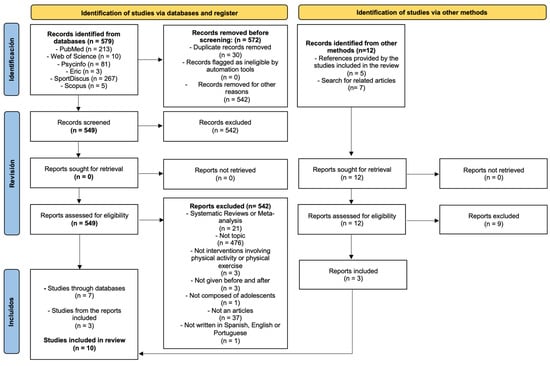
Figure 1.
Flowchart of the systematic review process according to the PRISMA protocol declarations.
3.2. Quality of Studies
The quality scores of the articles were expressed as percentages, ranging from 0 to 100% and ranging from 0.65 to 0.92 (see Table 1). Inter-rater agreement was calculated using the intra-class correlation coefficient, yielding a score of 0.905 (p < 0.001), indicating superb agreement (Koo & Li, 2016). After implementing the inter-rater agreement, a moderate cut-off point was agreed upon for their selection, including studies with scores of no less than 65% (>0.65). The overall scores ranged from 0.65 to 0.92 (first observer) and from 0.65 to 0.83 (second observer).

Table 1.
Assessment of the quality of studies.
3.3. Characteristics of the Studies
Below are the main characteristics extracted from the 10 studies included in the review (Table 1), alongside data related to the country where each intervention was conducted, the study design and duration, participant characteristics (gender, age, contextual data, etc.), the variables measured, and the instruments used in the study (Table 2). On the other hand, Table 3 shows the data related to the objective and hypothesis of the study, the programme followed in the intervention, and the main results, conclusions, and limitations of each study.
Table 2.
Characteristics of the study and participants, variables assessed, and assessment instruments.
Table 3.
Aim, intervention programme, main results, conclusions, and limitations of the research.
4. Discussion
The aim of this research was twofold: (1) to conduct a systematic review analysing the effects of interventions based on physical activity, exercise, or sports on substance use among young people and adolescents and (2) to describe and analyse these interventions.
Regarding the country where each intervention was implemented, most studies were conducted in the United States (7/10), with the exception of research implemented in Spain (Espada et al., 2014), India (Sidhu et al., 2016), and the Netherlands (Schijven et al., 2020). These data are in agreement with research by Thompson et al. (2020), who, after conducting a systematic review addressing aspects related to the prevention, reduction, and treatment of alcohol and other drug use through physical activity, found that all studies linked to the preventive aspect were carried out in the United States.
In relation to the context of the intervention and the characteristics of the study participants, most of the research (7/10) was implemented in schools belonging to the secondary education stage, while the studies conducted by Collingwood et al. (1991, 2000) combined several contexts (secondary school, community centre, and health centre). It is worth noting the intervention carried out by Schijven et al. (2020), which was developed in a specialised treatment centre for people with mild intellectual disabilities and borderline intellectual functioning. All the research involved young people and adolescents, aged between 12 and 21 years old, who admitted to being users of tobacco, alcohol, cannabis, and/or other drugs prior to the intervention.
In terms of data related to economic and cultural profiles, 2/10 investigations were directed exclusively at students with lower-middle socio-economic and socio-demographic levels (Collingwood et al., 1991, 2000), as opposed to the only study, by Butzer et al. (2017), that involved individuals with a combination of these levels (upper-middle, middle, and lower-middle). On the other hand, 4/10 studies had a sample whose participants had criminal and behavioural problems (Collingwood et al., 1991, 2000; Fishbein et al., 2015; Schijven et al., 2020), while 5/10 reports did not report information on socio-economic and behavioural status in this respect.
In relation to the instruments used in the different interventions, the use of questionnaires and scales based on the assessment of the intention to use/use of substances (tobacco, alcohol, cannabis, and/or other drugs) occurred in all the studies, with the Peirs Harris Children’s Self-Concept Scale (Peirs & Harris, 1969), the General Well-Being Scale (Fazio, 1977) and the Youth Risk Behavior Survey (YRBS) (Brener et al., 1995) being most commonly used to measure these variables. On the other hand, in addition to the use of instruments to measure substance use among the participants in the included sample, other instruments were implemented within the same study to assess several variables. These included (1) physical fitness being measured with the Fitnessgram Test (Cooper Institute for Aerobics Research, 1987), one of the instruments that can be used for this purpose; (2) mental health being assessed through the Perceived Stress Scale (PSS) (Cohen et al., 1983) to measure the level of stress or the Brunel Mood Scale (Terry et al., 2003) to assess the state of mind of individuals; (3) behavioural conduct being assessed through the UPPS-P Impulsive Behavior Scale (Lynam et al., 2006); or (4) emotional self-regulation being evaluated through the Scales of Self-Regulation (Wills & Ainette, 2010). It is worth mentioning that seven investigations, in full or in part, used ad hoc instruments to measure various variables in their interventions.
The results extracted from the different research studies showed that the implementation of programmes based on physical activity, physical exercise, or sports in young people and adolescents led to improvements in the prevention and even cessation of the consumption of various substances. In this regard, the study by Schijven et al. (2020) is notable, who, after conducting their intervention with Dutch adolescents, found a decrease in the frequency of alcohol, cannabis, and/or other drug use in those participants belonging to the experimental group. In the same vein, Mathews et al. (2007), in addition to obtaining reductions in the use of these substances, found reductions in tobacco use, although with greater significance for females. These data are supported by the study by Dever et al. (2012), who, after examining the relationships between substance use in secondary school students and exercise, as well as participation in school sports, found a lower level of tobacco, alcohol, and cannabis use, which was more significant in girls with higher levels of physical exercise and sports participation.
On the other hand, in the research conducted by Butzer et al. (2017), in addition to obtaining a decrease in the levels of consumption of tobacco, alcohol, cannabis, and/or other drugs in those participants belonging to the experimental group, after a total of 32 sessions based on yoga exercises, improvements in emotional self-control were established. Consistent with these results are the research findings of Bowen et al. (2006) and Fishbein et al. (2015). In contrast, the research by Werch et al. (2005) shows a small increase in the levels of tobacco use in both the experimental and control groups.
More favourable results are provided in the studies carried out by Sekulic et al. (2012) and Niedermeier et al. (2018), who found a higher level of alcohol prevention in participants with higher levels of physical activity, with a more significant impact on the female gender. These data are in line with those of Goldberg et al. (2000) and Collingwood et al. (1991, 2000), who reported reductions related to the use of tobacco, alcohol, cannabis, and/or other drugs.
On their part, Sun et al. (2007) and Espada et al. (2014) found significant results in reducing use intention as well as tobacco use, which is consistent with the results of Veliz et al. (2015). Wichstrom and Wichstrom (2009) found that participation in sports in adolescence, as well as participation in team sports in particular, can reduce later increases in tobacco and/or cannabis use, both in later adolescence and adulthood. These data are in agreement with those reported in the research by Sidhu et al. (2016), who obtained a 100% smoking cessation rate in both the control and experimental groups, highlighting quite significant prevention effects through physical exercise.
On the other hand, it seems that both the number of weekly sessions given in the intervention and the duration of each session may influence the significant improvement in the results obtained. In this sense, Collingwood et al. (2000) carried out three weekly sessions of between 90 and 180 min, and this intervention, with the highest number of sessions and longest duration of sessions, obtained slightly more significant improvements. On the other hand, in the study carried out by Melnyk et al. (2013), one session per week of 20 min each was carried out, establishing itself as the research with the lowest number of weekly sessions, as well as having the shortest duration of sessions. Finally, it is worth mentioning that 3/10 reports included in this study did not have a source of funding for their research, or at least did not provide information on this aspect, while the rest of the interventions (Collingwood et al., 1991, 2000; Melnyk et al., 2013; Espada et al., 2014; Sidhu et al., 2016; Butzer et al., 2017; Schijven et al., 2020) were funded by an institution for their implementation.
However, the results obtained in this systematic review should be treated with caution, as it has some limitations that should be taken into consideration. First is the complexity of evaluating the data obtained from the different variables measured in each intervention, as well as specifying these variables, which allude to the concept of “substance”, encompassing a multitude of terms corresponding to different drugs and narcotics. Another limitation relates to the differences in effectiveness based on gender and substance type, as well as to the lack of long-term follow-up.
In addition, there is a limited geographical reach, as most of the research included in this review was conducted in the United States, which may raise some doubts about the generalisability of the results to young people and adolescents in other countries. Another limitation to point out is the lack, in some of the studies included in this research, of several interesting data, such as the age of the participants (Collingwood et al., 1991, 2000; Schijven et al., 2020), as well as the mean age (and its standard deviation) of the subjects included (Collingwood et al., 1991, 2000; Goldberg et al., 2000; Fishbein et al., 2015), causing some loss of robustness with respect to the extracted findings. All this makes it very difficult to analyse and compare the different research papers.
Finally, although there was a certain level of homogeneity in the design of the research, as well as in the sample and the context in which each of the studies was carried out, the heterogeneity in the instruments used and the intervention programmes implemented means that, to a certain extent, the findings of this review should be treated with caution.
In this sense, future lines of research could be directed towards the analysis of different types of intervention formats and contexts, carrying out various combinations of interventions in order to assess the multiple positive outcomes on the health behaviours of young people and adolescents through different types of physical activity, exercise, or sports. In addition, future studies could aim to improve those evaluation processes that require follow-up data to clarify the long-term impact of the effects of physical activity on addictive behaviours, as well as to determine which type of physical activity, exercise, or sports further favours the prevention of substance use.
5. Conclusions
This work sought to conduct a systematic review of studies in which substance use prevention interventions in youth and adolescents based on physical activity, physical exercise, or sports were implemented, with the aim of answering the following research questions: Which variables (tobacco, alcohol, cannabis and/or other drugs) have been most studied when implementing such interventions? Does physical activity, exercise, or sport favour the prevention of substance use among young people and adolescents? With regard to the first question, it is possible to indicate a majority predisposition towards the study of the variable referring to tobacco use, followed by those variables referring to alcohol use and cannabis, while those referring to the use of other drugs are given to a lesser extent. On the other hand, regarding the second question, the results of the included studies reveal that interventions based on the practice of yoga, physical activity, and exercise produce significant improvements in terms of intention and reduction in substance use among the participants that took part in the intervention. Moreover, it should be noted that these improvements occur with a higher level of significance for a higher number of weekly sessions and a longer duration of sessions.
Thus, this study suggests that active treatment can have strong potential to reduce substance use. However, these findings should be taken with caution due to the limitations presented in the study.
Practical Implications
The practical applications of the systematic review relate to, on the one hand, raising awareness among researchers and academics regarding the need to conduct more research on the effects of physical activity, exercise, or sport on preventing and reducing substance use and abuse in adolescents. In addition, the findings of this review could be used to instruct and train educators and trainers involved in the prevention of/education about substance use among youth and adolescents on the importance of implementing interventions and programmes that consider the systematic and deliberate practice of physical activity, exercise, or sport as an essential focus. In this sense, the considerations found through this research could motivate educational and social institutions to adopt measures that favour the implementation of programmes that contemplate the practice of physical activity and sport as a means of preventing and reducing the consumption of addictive substances among adolescents.
Author Contributions
Conceptualization: M.T.A.R. and F.J.G.-F.-G.; methodology: M.T.A.R. and J.Á.M.C.; formal analysis: J.Á.M.C. and M.R.M.; investigation: M.T.A.R. and F.J.G.-F.-G.; data curation: J.Á.M.C. and M.R.M.; writing—original draft preparation: M.T.A.R. and J.Á.M.C.; writing—review and editing: F.J.G.-F.-G. and M.R.M.; supervision: M.T.A.R. and F.J.G.-F.-G. All authors have read and agreed to the published version of the manuscript.
Funding
This research received no external funding.
Institutional Review Board Statement
Not applicable.
Informed Consent Statement
Not applicable.
Data Availability Statement
The original contributions presented in this study are included in the article. Further inquiries can be directed to the corresponding author.
Conflicts of Interest
The authors declare no conflicts of interest.
References
- Aaron, D. J., Dearwater, S. R., Anderson, R., Olsen, T., Kriska, A. M., & Laporte, R. E. (1995). Physical activity and the initiation of highrisk health behaviors in adolescents. Medicine and Science in Sports and Exercise, 27(12), 1639–1645. [Google Scholar] [CrossRef] [PubMed]
- Arteaga-Zambrano, V. M., & Mendoza-Alcívar, W. R. (2022). El Consumo de Sustancias Psicoactivas en Adolescentes de San Alejo durante la Pandemia por COVID-19. Polo del Conocimiento. Revista Científico-Profesional, 7(3), 1360–1381. [Google Scholar]
- Beete, L. (1994). About steroids. Channing. [Google Scholar]
- Bowen, S., Witkiewitz, K., Dillworth, T. M., Chawla, N., Simpson, T. L., Ostafin, B. D., Larimer, M. E., Blume, A. W., Parks, G. A., & Marlatt, A. (2006). Mindfulness meditation and substance use in an incarcerated population. Psychology of Addictive Behaviors, 20(3), 343–347. [Google Scholar] [CrossRef]
- Brellenthin, A. G., & Lee, D.-C. (2018). Physical activity and the development of substance use disorders: Current knowledge and future directions. Progress in Preventive Medicine, 3(3), e0018. [Google Scholar] [CrossRef]
- Brener, N. D., Collins, J. L., Kann, L., Warren, C. W., & Williams, B. I. (1995). Reliability of the Youth Risk Behavior Survey Questionnaire. American Journal of Epidemiology, 141(6), 575–580. [Google Scholar] [CrossRef] [PubMed]
- Brook, J., Rifenbark, G. G., Boulton, A., Little, T. D., & McDonald, T. P. (2015). Risk and protective factors for drug use among youth living in foster care. Child and Adolescent Social Work Journal, 32(2), 155–165. [Google Scholar] [CrossRef]
- Butzer, B., LoRusso, A., Shin, S. H., & Khalsa, S. B. S. (2017). Evaluation of yoga for preventing adolescent substance use risk factors in a middle school setting: A preliminary group-randomized controlled trial. Journal of Youth and Adolescence, 46, 603–632. [Google Scholar] [CrossRef]
- Ceccarini, J., Hompes, T., Verhaeghen, A., Casteels, C., Peuskens, H., Bormans, G., Claes, S., & Laere, K. V. (2014). Changes in cerebral CB1 receptor availability after acute and chronic alcohol abuse and monitored abstinence. The Journal of Neuroscience, 34(8), 2822–2831. [Google Scholar] [CrossRef]
- Cohen, S., Kamarck, T., & Mermelstein, R. (1983). A global measure of perceived stress. Journal of Health and Social Behavior, 24, 385–396. [Google Scholar] [CrossRef]
- Collingwood, T. R., Reynolds, R., Kohl, H. W., Smith, W., & Sloan, S. (1991). Physical fitness effects on substance abuse risk factors and use patterns. Journal of Drug Education, 21(1), 73–84. [Google Scholar] [CrossRef] [PubMed]
- Collingwood, T. R., Sunderlin, J., Reynolds, R., & Kohl, H. W. (2000). Physical training as a substance abuse prevention intervention for youth. Journal of Drug Education, 30(4), 435–451. [Google Scholar] [CrossRef] [PubMed]
- Cooper Institute for Aerobics Research. (1987). Fitnessgram test administration manual. Institute for Aerobics Research. [Google Scholar]
- Craft, L. L., & Perna, F. M. (2004). The benefits of exercise for the clinically depressed. The Primary Care Companion to the Journal of Clinical Psychiatry, 6(3), 104–111. [Google Scholar] [CrossRef] [PubMed]
- Dever, B. V., Schulenberg, J. E., Dworkin, J. B., O’Malley, P. M., Kloska, D. D., & Bachman, J. G. (2012). Predicting risk-taking with and without substance use: The effects of parental monitoring, school bonding and sports participation. Prevention Science, 13, 605–615. [Google Scholar] [CrossRef] [PubMed]
- Espada, J. P., Gonzálvez, M. T., Guillén-Riquelme, A., Sun, P., & Sussman, S. (2014). Immediate effects of Project-EX in Spain: A classroom-based smoking prevention and cessation intervention program. Journal of Drug Education: Substance Abuse Research and Prevention, 44(1–2), 3–18. [Google Scholar] [CrossRef]
- Fagan, M. J., Glowacki, K., & Faulkner, G. (2021). “You get that craving and you go for a half-hour run”: Exploring the acceptability of exercise as an adjunct treatment for substance use disorder. Mental Health and Physical Activity, 21, 100424. [Google Scholar] [CrossRef]
- Fazio, A. F. (1977). A concurrent validation study of the NCHS general well being scale vital and health statistics. National Center for Health Statistics. [Google Scholar] [CrossRef]
- Fishbein, D., Miller, S., Herman-Stahl, M., Williams, J., Lavery, B., Markovitz, L., Kluckman, M., Mosoriak, G., & Johnson, M. (2015). Behavioral and psychophysiological effects of a yoga intervention on high-risk adolescents: A randomized control trial. Journal of Child and Family Studies, 25, 518–529. [Google Scholar] [CrossRef]
- Georgakouli, K., Manthou, E., Georgoulias, P., Ziaka, A., Fatouros, I. G., Mastorakus, G., Koutedakis, Y., Theodorakis, Y., & Jamurtas, A. Z. (2017). Exercise training reduces alcohol consumption but does not affect HPA-axis activity in heavy drinkers. Physiology and Behavior, 179, 276–283. [Google Scholar] [CrossRef]
- Godínez, J. A., & Gómez, G. B. (2012). Family, school and sports (FEDE), three areas in the lives of students in the state of Jalisco, Mexico: Analysis of the use of leisure time and the use or abuse of drugs. Salud y Drogas, 12(2), 193–226. [Google Scholar] [CrossRef][Green Version]
- Goldberg, L., MacKinnon, D. P., Elliot, D. L., Moe, E. L., Clarke, G., & Cheong, J. W. (2000). The adolescents training and learning to avoid steroids program. Archives of Pediatrics and Adolescent Medicine, 154(4), 332–338. [Google Scholar] [CrossRef]
- Gür, F., & Can, G. (2020). Is exercise a useful intervention in the treatment of alcohol use disorder? Systematic review and meta-analysis. American Journal of Health Promotion, 34(5), 520–537. [Google Scholar] [CrossRef]
- Hayes, R. W., & Tevis, B. W. (1977). A comparison of attitudes and behavior of high school athletes and non-athletes with respect to alcohol use and abuse. Journal of Alcohol and Drug Education, 23(1), 20–28. [Google Scholar]
- Horrell, J., Thompson, T. P., Taylor, A. H., Neale, J., Husk, K., Wanner, A., Creanor, S., Wei, Y., Kandiyali, R., Sinclair, J., Nasser, M., & Wallace, G. (2020). Qualitative systematic review of the acceptability, feasibility, barriers, facilitators and perceived utility of using physical activity in the reduction of and abstinence from alcohol and other drug use. Mental Health and Physical Activity, 19, 100355. [Google Scholar] [CrossRef]
- Hovhannisyan, K., Rasmussen, M., Adami, J., Wikström, M., & Tonnesen, H. (2020). Evaluation of very integrated program: Health promotion for patients with alcohol and drug addiction: A randomized trial. Alcoholism: Clinical and Experimental Research, 44(7), 1456–1467. [Google Scholar] [CrossRef] [PubMed]
- Kingsland, M., Wiggers, J. H., Vashum, K., Hodder, R. K., & Wolfenden, L. (2016). Interventions in sports settings to reduce risky alcohol consumption and alcohol-related harm: A systematic review. Systematic Reviews, 5, 12. [Google Scholar] [CrossRef] [PubMed]
- Kmet, L. M., Cook, L. S., & Lee, R. C. (2004). Standard quality assessment criteria for evaluating primary research papers from a variety of fields. Alberta Heritage Foundation for Medical Research. [Google Scholar] [CrossRef]
- Koo, T. K., & Li, M. Y. (2016). A guideline of selecting and reporting intraclass correlation coefficients for reliability research. Journal of Chiropratic Medicine, 15(2), 155–163. [Google Scholar] [CrossRef]
- Kuypers, K. P. C., Theunissen, E. L., Van Wel, J. H. P., De Sousa, E. B., Linssen, A., Sambeth, A., Schultz, B. G., & Ramaekers, J. G. (2016). Verbal memory impairment in polydrug ecstasy users: A clinical perspective. PLoS ONE, 11(2), e0149438. [Google Scholar] [CrossRef]
- Lane, D. C., & DeCamp, W. (2017). Sports will keep’em out of trouble: A comparative analysis of substance use among adolescents and young adults. Journal of Sport and Health Research, 9(1), 41–52. [Google Scholar]
- Larsen, H., & Wiers, R. W. (2016). Risk factors for adolescent drinking: An introduction. Alcoholism: Clinical and Experimental Research, 40(4), 653–656. [Google Scholar] [CrossRef]
- Lee, K. T. H., & Lowe, D. (2015). Out-of-school time and adolescent substance use. Journal of Adolescent Health, 57(5), 523–529. [Google Scholar] [CrossRef]
- Lewis, M. A., Litt, D. M., Fairlie, A. M., Kilmer, J. R., Kannard, E., Resendiz, R., & Walker, T. (2022). Investigating why and how young adults use protective behavioral strategies for alcohol and marijuana use: Protocol for developing a randomized controlled trial. JMIR Research Protocols, 11(4), e37106. [Google Scholar] [CrossRef] [PubMed]
- Lieberman, D. Z. (2000). Children of alcoholic: An update. Current Opinion in Pediatrics, 12(4), 336–340. [Google Scholar] [CrossRef] [PubMed]
- Lynam, D. R., Smith, G. T., Whiteside, S. P., & Cyders, M. A. (2006). The UPPS-P: Assessing five personality pathways to impulsive behavior. Purdue University. [Google Scholar]
- Mathews, A. E., Werch, C., Michniewicz, M., & Bian, H. (2007). An impact evaluation of two versions of a brief intervention targeting alcohol use and physical activity among adolescents. Journal of Drug Education, 37(4), 401–416. [Google Scholar] [CrossRef] [PubMed]
- Melnyk, B. M., Jacobson, D., Kelly, S., Belyea, M., Shaibi, G., Small, L., O’Haver, J., & Marsiglia, F. F. (2013). Promoting healthy lifestyles in high school adolescents: A randomized controlled trial. American Journal of Preventive Medicine, 45(4), 407–415. [Google Scholar] [CrossRef]
- Mewton, L., Visontay, R., Chapman, C., Mewton, N., Slade, T., Kay-Lambkin, F., & Teesson, M. (2018). Universal prevention of alcohol and drug use: An overview of reviews in an Australian context. Drug and Alcohol Review, 37(1), 435–469. [Google Scholar] [CrossRef]
- Miller, S., Herman-Stahl, M., Fishbein, D., Lavery, B., Johnson, M., & Markovits, L. (2014). Use of formative research to develop a yoga curriculum for high-risk youth: Implementation considerations. Advances in School Mental Health Promotion, 7(3), 171–183. [Google Scholar] [CrossRef]
- Modric, T., Zenic, N., & Sekulic, D. (2011). Substance use and misuse among 17 to 18 year-old croatian adolescents: Correlation with scholastic variables and sport factors. Substance Use and Misuse, 46(10), 1328–1334. [Google Scholar] [CrossRef]
- Moher, D., Shamseer, L., Clarke, M., Ghersi, D., Liberati, A., Petticrew, M., Shekelles, P., Stewart, L. A., & PRISMA Group. (2015). Preferred reporting ítems for systematic review and meta-analysis protocols (PRISMA-P) 2015 statement. Systematic Reviews, 4(1), 1–9. [Google Scholar] [CrossRef]
- Moore, M. J., & Werch, C. (2007). Results of a two-year longitudinal study of beverage-specific alcohol use among adolescents. Journal of Drug Education, 37(2), 107–122. [Google Scholar] [CrossRef]
- Niedermeier, M., Frühauf, A., Koop-Wilfling, P., Rumpold, G., & Koop, M. (2018). Alcohol consumption and physical activity in austrian college students: A cross-sectional study. Substance Use and Misuse, 53(10), 1581–1590. [Google Scholar] [CrossRef]
- O’Brien, C. P., Gastfriend, D. R., Forman, R. F., Schweizer, E., & Pettinati, H. M. (2011). Long-term opioid blockade and hedonic response: Preliminary data from two open-label extension studies with extended-release naltrexone. American of Journal Psychiatry, 20(2), 106–112. [Google Scholar] [CrossRef] [PubMed]
- Odgers, C. L., Caspi, A., Nagin, D. S., Piquero, A. R., Slutske, W. S., Milne, B. J., Dickson, N., Poulton, R., & Moffitt, T. E. (2008). Is it important to prevent early exposure to drugs and alcohol among adolescents? Psychological Science, 19(10), 1037–1044. [Google Scholar] [CrossRef]
- Oscar-Berman, M., Valmas, M., Sawyer, K., Ruiz, S., Luhar, R., & Gravitz, Z. R. (2014). Profiles of impaired, spared and recovered neuropsychologic processes in alcoholism. Handbook of Clinical Neurology, 125, 183–210. [Google Scholar] [CrossRef] [PubMed]
- Page, M. J., McKenzie, J. E., Bossuyt, P. M., Boutron, I., Hoffmann, T. C., Mulrow, C. D., Shamseer, L., Tetzlaff, J. M., Akl, E. A., Brennan, S. E., Chou, R., Glanville, J., Grimshaw, J. M., Hróbjartsson, A., Lalu, M. M., Li, T., Loder, E. W., Mayo-Wilson, E., McDonald, S., … McGuinness, L. A. (2021). The PRISMA 2020 statement: An updated guideline for reporting systematic reviews. International Journal of Surgery, 372, n71. [Google Scholar] [CrossRef]
- Parfilova, G. G., & Velieva, S. V. (2016). Preventive work with teenagers who are prone to addiction, in terms of educational space. International Journal of Environmental and Science Education, 11(8), 1901–1912. [Google Scholar] [CrossRef]
- Peirs, E., & Harris, D. (1969). Children’s self concept scale. Counselor Recordings and Tests. [Google Scholar]
- Schijven, E. P., Hulsmans, D. H. G., Van Der Nagel, J. E. L., Lammers, J., Otten, R., & Poelen, E. A. P. (2020). The effectiveness of an indicated prevention programme for substance use in individuals with mild intellectual disabilities and borderline intellectual functioning: Results of a quasi-experimental study. Addiction, 116(2), 373–381. [Google Scholar] [CrossRef]
- Sekulic, D., Ostojic, M., Ostojic, Z., Hajdarevic, B., & Osotojic, L. (2012). Substance abuse prevalence and its relation to scholastic achievement and sport factors: An analysis among adolescents of the Herzegovina-Neretva Canton in Bosnia and Herzegovina. BMC Public Health, 12(274), 274. [Google Scholar] [CrossRef]
- Sidhu, A. K., Sussman, S., Tewari, A., Bassi, S., & Arora, M. (2016). Project-EX-India: A classroom-based tobacco use prevention and cessation intervention program. Addictive Behaviors, 53, 53–57. [Google Scholar] [CrossRef]
- Sun, P., Miyano, J., Ann, L., Dent, C., & Sussman, S. (2007). Short-term effects of Project-EX-4: A classroom-based smoking prevention and cessation intervention program. Addictive Behaviors, 32(2), 342–350. [Google Scholar] [CrossRef]
- Sussman, S., Dent, C. W., & Lichtman, K. L. (2001). Project-EX: Outcomes of a teen smoking cessation program. Addictive Behaviors, 26(3), 425–438. [Google Scholar] [CrossRef]
- Tai, H., Swartz, M. D., Marsden, D., & Perry, C. L. (2021). The future of substance abuse now: Relationships among adolescent use of vaping devices, marijuana and synthetic cannabinoids. Substance Use and Misuse, 56(2), 192–204. [Google Scholar] [CrossRef] [PubMed]
- Terry, P. C., Lane, A. M., & Fogarty, G. J. (2003). Construct validity of the Profile of Mood States-Adolescentes (POMS-A) for use with adults. Psychology of Sport and Exercise, 4(2), 125–139. [Google Scholar] [CrossRef]
- Thompson, T. P., Horrell, J., Taylor, A. H., Wanner, A., Husk, K., Wei, Y., Creanor, S., Kandiyali, R., Neale, J., Sinclair, J., Nasser, M., & Wallace, G. (2020). Physical activity and the prevention, reduction and treatment of alcohol and other drug use across the lifespan (The PHASE review): A systematic review. Mental Health and Physical Activity, 19, 100360. [Google Scholar] [CrossRef] [PubMed]
- Van der Zwaluw, C., & Engels, R. C. M. E. (2009). Gene-environment interactions and alcohol use and dependence: Current status and future challenges. Addiction, 104(6), 907–914. [Google Scholar] [CrossRef] [PubMed]
- Veliz, P. T., Boyd, C. J., & McCabe, S. E. (2015). Competitive sport involvement and substance use among adolescents: A nationwide study. Substance Use and Misuse, 50(2), 156–165. [Google Scholar] [CrossRef]
- Ward, K. D., Weg, M. W., & Klesges, R. C. (2003). Characteristics of highly physically active smokers in a population of young adult military recruits. Addictive Behaviors, 28(8), 1405–1418. [Google Scholar] [CrossRef]
- Weinberg, R., & Gould, D. (1996). Fundamentos de psicología del deporte y el ejercicio físico. Ariel. [Google Scholar]
- Welford, P., Gunillasdotter, V., Andréasson, S., & Hallgren, M. (2022). Effects of physical activity on symptoms of depression and anxiety in adults with alcohol use disorder (FitForChange): Secondary outcomes of a randomised controlled trial. Drug and Alcohol Dependence, 239, 109601. [Google Scholar] [CrossRef]
- Werch, C., Moore, M. J., DiClemente, C. C., Bledose, R., & Jobli, E. (2005). A multihealth behavior intervention integrating physical activity and substance use prevention for adolescents. Prevention Science, 6(3), 213–226. [Google Scholar] [CrossRef]
- Wichstrom, T., & Wichstrom, L. (2009). Does sports participation during adolescence prevent later alcohol, tobacco and cannabis use? Addiction, 104(1), 138–149. [Google Scholar] [CrossRef]
- Wills, T. A., & Ainette, M. G. (2010). Temperament, self-control and adolescent substance use. In L. M. Scheier (Ed.), Handbook of drug use etiology: Theory, methods and empirical findings (pp. 127–146). American Psychological Association. [Google Scholar] [CrossRef]
- Zhang, L., & Yuan, T. F. (2019). Exercise and substance abuse. International Review of Neurobiology, 147, 269–280. [Google Scholar] [CrossRef]
- Zhang, Z., & Liu, X. (2022). A systematic review of exercise intervention program for people with substance use disorder. Frontiers in Psychiatry, 13, 817927. [Google Scholar] [CrossRef] [PubMed]
- Zschucke, E., Heinz, A., & Ströhle, A. (2012). Exercise and physical activity in the therapy of substance use disorders. The Scientific World Journal, 2012, 901741. [Google Scholar] [CrossRef] [PubMed]
Disclaimer/Publisher’s Note: The statements, opinions and data contained in all publications are solely those of the individual author(s) and contributor(s) and not of MDPI and/or the editor(s). MDPI and/or the editor(s) disclaim responsibility for any injury to people or property resulting from any ideas, methods, instructions or products referred to in the content. |
© 2025 by the authors. Licensee MDPI, Basel, Switzerland. This article is an open access article distributed under the terms and conditions of the Creative Commons Attribution (CC BY) license (https://creativecommons.org/licenses/by/4.0/).