


Abstract
In this article, a Riga plate is exhibited with an electric magnetization actuator consisting of permanent magnets and electrodes assembled alternatively. This exhibition produces electromagnetic hydrodynamic phenomena over a fluid flow. A new study model is formed with the Sutterby nanofluid flow through the Riga plate, which is crucial to the structure of several industrial and entering advancements, including thermal nuclear reactors, flow metres and nuclear reactor design. This article addresses the entropy analysis of Sutterby nanofluid flow over the Riga plate. The Cattaneo–Christov heat and mass flux were used to examine the behaviour of heat and mass relaxation time. The bioconvective motile microorganisms and nanoparticles are taken into consideration. The system of equations for the current flow problems is converted from a highly non-linear partial system to an ordinary system through an appropriate transformation. The effect of the obtained variables on velocity, temperature, concentration and motile microorganism distributions are elaborated through the plots in detail. Further, the velocity distribution is enhanced for a greater Deborah number value and it is reduced for a higher Reynolds number for the two cases of pseudoplastic and dilatant flows. Microorganism distribution decreases with the increased magnitude of Peclet number, Bioconvection Lewis number and microorganism concentration difference number. Two types of graphical outputs are presented for the Sutterby fluid parameter (β = −2.5, β = 2.5). Finally, the validation of the present model is achieved with the previously available literature.
MSC:
76D05; 35Q79; 76A05
1. Introduction
The rate of heat transport characteristics has received increasing attention from various scientists owing to its tremendous industrial features, for example, in mechanical, optical, electrical and cooling instruments. The rate of heat transport increment is very crucial in depositing energy. Therefore, researchers have focused on the investigation of a new type of fluid that is a mixture of nanoparticles with a size of 100 nm and larger thermophysical properties than ordinary fluids, known as nanoliquids. A nanoliquid is a colloidal suspension of the nanoparticle’s thermal behaviour in the ordinary fluid. The first attempt was conducted by Choi et al. [1] in 1995. They showed the thermal conductivity of nanoliquids by adding nanosized particles. Later, Buongiorno [2] used this understanding of nanofluid to achieve a mathematical form by adding Brownian and Thermophoretic terms. A mixed convection nanofluid flow with different geometries was presented by Hussain et al. [3,4]. Haq et al. [5] studied the second law analysis on a cross nanofluid. The MHD mixed convective flow of CNTs/Al2O3 nanofluid in water past a heated flexible plate with injection/suction and radiation was studied by Prabakaran et al. [6]. Mankiw et al. [7] analysed the MHD time-dependent flow of nanofluid with variable properties due to an inclined stretching sheet under thermal radiation. Shahid [8] studied the effect of an upper convective Maxwell fluid over a permeable surface near the stagnation point. Rafique et al. [9] addressed the stratified micropolar nanofluid flow past the Riga surface. The unsteady viscous flow of the nanofluid flow over the Riga plate using a rotating system was investigated by Parvine et al. [10]. Abbas et al. [11] studied entropy production over the Riga plate with the suction case. Mohamed et al. [12] using a non-homogeneous dynamic model, which is physically more accurate in describing nanofluids than homogeneous ones. They numerically examined the free convective flow in a cubical cavity filled with a copper–water nanofluid. Aziz et al. [13] discussed the characteristics of nanoparticles with Lorentz and Coriolis forces. More developments of nanofluids are in [14,15,16,17].
Different fluid forms, such as polymer melts, colloidal suspensions and organic chain mixes, are used in a wide range of industrial and production processes. The rheological behaviour of these fluids cannot be described well by the Naiver–Stokes equation. Therefore, several nonlinear fluid models have been proposed to represent the rheological characteristics of complicated fluids. One of the non-Newtonian fluid models is used to examine the key characteristics of pseudoplastic and dilatant fluids, which is known as Sutterby fluid model. Numerous experts have studied the flow of the Sutterby liquid extensively. Waqas et al. [18] inspected the Sutterby nanofluid flow using two rotating disks. Yahya et al. [19] investigated Williamson Sutterby nanoparticles under the Cattaneo–Christov heat flux. The effect of MHD on Sutterby nanoparticles due to porous movable sheets was discovered by Fayydh et al. [20]. Gowda et al. [21] examined the Cattaneo–Christof theory of heat diffusion in a Sutterby nanofluid. The thermal aspect of Sutterby nanofluid containing the microorganisms due the stretched cylinder was examined by Aldabesh et al. [22]. Hayat et al. [23] investigated the Sutterby fluid with thermal radiation due to a rotating disk. Fujii et al. [24] addressed a Sutterby fluid with natural convection flow due to a vertical plate. Darcy surface with MHD flow of Sutterby fluid was reported by Bilal et al. [25]. The bioconvection flow of a Sutterby nanofluid due to a rotating disk is described by Khan et al. [26]. Sohail et al. [27] designed the free convection flow of a Sutterby fluid with Cattaneo–Christov theory. The heat generation/absorption in the thermally stratified flow of a Sutterby fluid through a linearly stretched plate is analysed by Saif et al. [28]. Usman et al. [29] investigated the two-dimensional stagnant flow of a Sutterby nanofluid across a stretching wedge with porous media. Ali et al. [30] discussed the heat and mass transportation of a Sutterby nanofluid due to a horizontally stretching surface with bioconvection of microorganisms. The influence of homogeneous–heterogeneous reaction on Sutterby fluid flow through a disk with Cattaneo–Christov heat flux was studied by Khan et al. [31].
In the modern period, research on bioconvection exists due to the upwards motion of microorganisms, whose microorganisms are denser than water. The upward surface of the fluid develops thickness due to the collection of the microorganisms. Because of this, the upper surface becomes disturbed and microorganisms are fall down, which develops the bioconvection. Bioconvection phenomena have been continuously researched due to their applications in the clinical area, manufacturing process and biofuel production. Bioconvection can be organised in the motion of direction with enormous microorganism species. In this way, gyrotactic microorganisms are among those whose swimming directional is based on viscous and gravitational force. Kuznetsov et al. [32,33] reported the investigation of bioconvection in a mixed suspension of nanoparticles with gyrotactic microorganisms. Kotha et al. [34] examined the MHD flow of nanofluids with motile gyrotactic microorganisms over a vertical plate. Siddiq et al. [35] analysed numerically, through the bvp4c method, the bioconvection of micropolar nanofluid flow through a stretchable disk. Ali et al. [36] studied the effect of bioconvection and Cattaneo–Christov heat flux effects of a micropolar-type nanofluid past a vertical stretching sheet. Azam et al. [37] investigated the effect of bioconvection flow for a Sutterby nanoliquid with nonlinear radiation. Khashi’ie et al. [38] studied a hybrid nanofluid having bioconvection with gyrotactic microorganisms. Azam [39] explored the time-dependent flow of the chemically reactive Sutterby nanofluid and the influence of gyrotactic microorganisms. Hayat et al. [40] operated the bioconvection flow of nanomaterial subject to the melting effect. They addressed thermal nonlinear radiation and Joule heating for heat distribution characteristics. Reddy et al. [41] analysed the time-dependent flow of a cross nanofluid comprising the gyrostatic microorganisms due to slip velocity. Sarkar et al. [42] defined a Sutterby nanofluid flow having motile gyrotactic microorganisms over the Riga plate. Syed et al. [43] described the biocovective phenomena of a Prandtl hybrid nanofluid over a stretched surface.
The current investigation aims to express the Sutterby nanofluid flow over a Riga plate with Cattaneo–Christov double diffusion and gyrotactic microorganisms. Chemical reactions and heat source-sink are considered. The main intention of this work is the inclusive analysis of this flow problem. The governing systems are designed as a coupled partial system. The flow problems are altered into the nonlinear ordinary system by applying suitable transformations. Further, the solution of ordinary differential equations is computed via the homotopy analysis method (HAM). The novel outcomes of the current work are obtained through different parameters and explained in detail with graphs and tables.
2. Description of the Physical Model
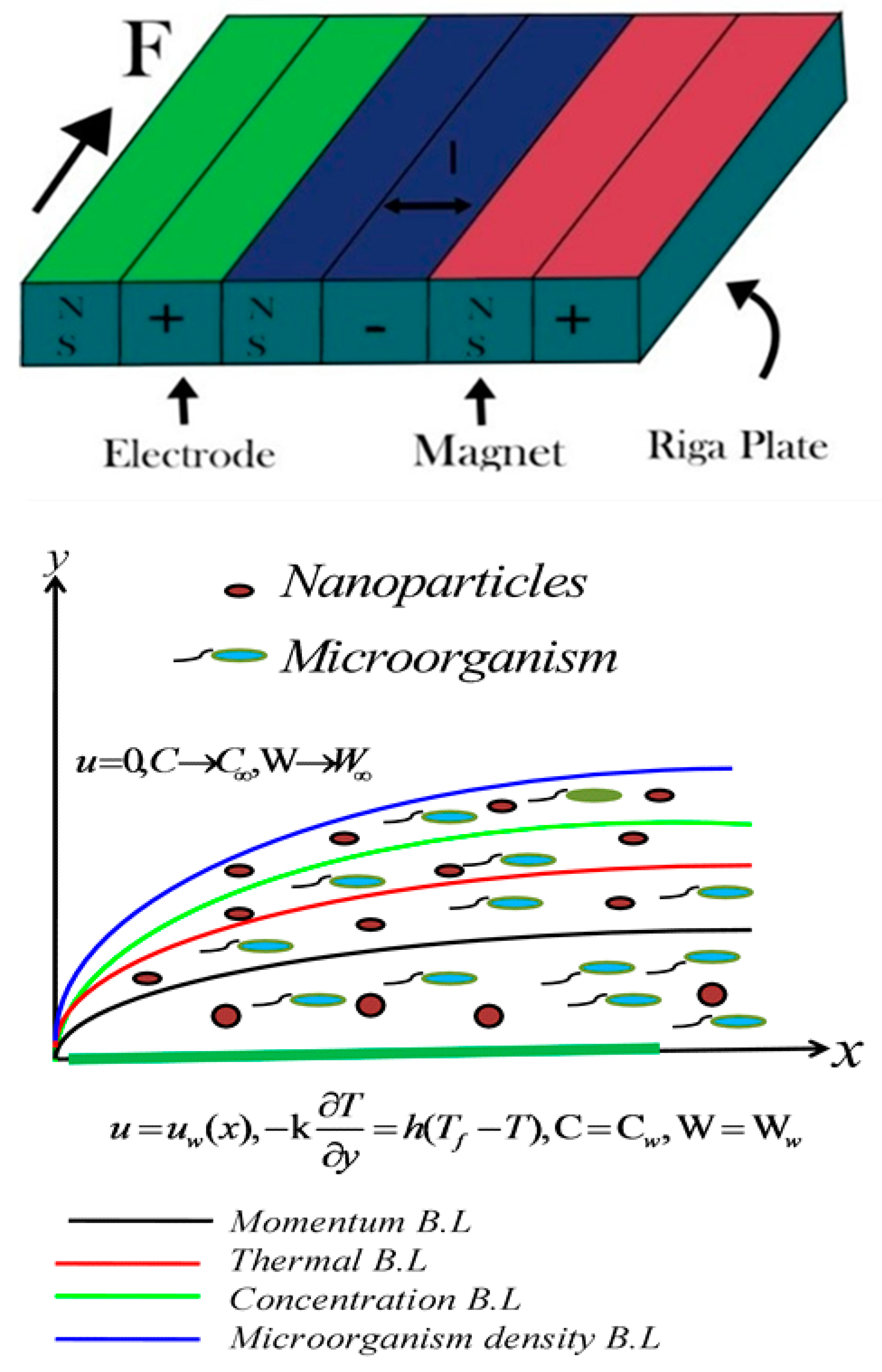
Consider the incompressible and steady flow of a Sutterby nanofluid over the Riga plate containing gyrotactic microorganisms. Cattaneo–Christov with heat and mass flux were also incorporated into the temperature and concentration equation. The -axis is considered along with the sheet and the -axis is taken perpendicular to the sheet. Moreover, the velocity of the sheet is taken as . The temperature of the surface, the concentration of the surface and the microorganism of the surface are represented by , and, respectively. Furthermore, it was assumed that the fluid contains gyrotactic bacteria. The fluids’ microorganisms gravitate towards the light. Gyrotactic phenomena, or movement against gravity, are made possible by the “bottom heavy” bulk microorganism, which orients their bodies. The existence of microorganisms is advantageous for the suspension of the nanoparticles. The motion of microorganisms is taken, irrespective of that of the nanoparticles, to ensure the stability of convection. The flow of a double-diffusive fluid across a Riga plate containing gyrotactic microorganisms has not been investigated, and this study aims to fill that gap with the simplification of unsteady boundary layer approximation expressions provided in [22]. Figure 1 describes the physical model of the present problem.
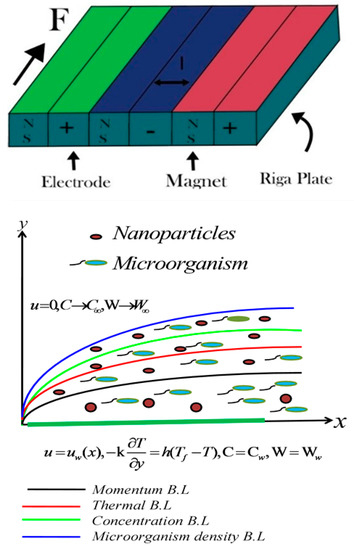
Figure 1.
Physical configuration of the flow problem.
Fluid Model
The Cauchy stress tensor for the Sutterby fluid [44] is defined as
where the Sutterby viscosity model is represented as
where , are the power law index, zero share rate viscosity and time material constant.
Introducing Equation (2) into Equation (1), then we have
The governing equations are illustrated in the following form [21]:
where u and v are velocity components in the x and y directions. represents the kinematic viscosity of the fluid, represents the density of the fluid, represents the thermal diffusivity, is the concentration, represent Brownian diffusion and thermophoretic diffusion (respectively), denotes volumetric expansion, represents microorganism coefficient, and and are the fluid relaxation time.
In the above equations, the terms and are stated as
The relevant boundary conditions are assumed to be:
where can be expanded as follows:
Replacing Equation (12) into Equation (13),
Introducing the variables [14]
Using Equation (15), Equations (4)–(6) become
The corresponding boundary conditions are
where is the modified Hartmann number; is the Reynolds number; is the Deborah number; is the radiation parameter; is the Prandtl number; is the Brownian motion parameter; is the thermophoresis parameter; is the Schmidt number; is the Biot number; is the Peclet number; is the bioconvection Lewis number; and is the chemical reaction.
The thermofluidic quantities of engineering interest in this study are skin friction, , heat transfer rate, , mass transfer rate, , and motile density, .
where is the surface shear stress, is the surface heat flux, is the surface mass flux and is the motile density, which are presented by the following expressions:
The dimensionless form of the above parameters is expressed as
where is the local Reynolds number.
3. Entropy Generation Analysis
The entropy generation with a Sutterby nanofluid is communicated as [37]:
The significance of the entropy production can be written as
Using Equation (15), the rate of entropy Equation (24) can be converted as:
The Bejan number is defined as the ratio over the entropy generation with heat transport, , and the total entropy production, , and it can be written as:
4. Homotopy Expression
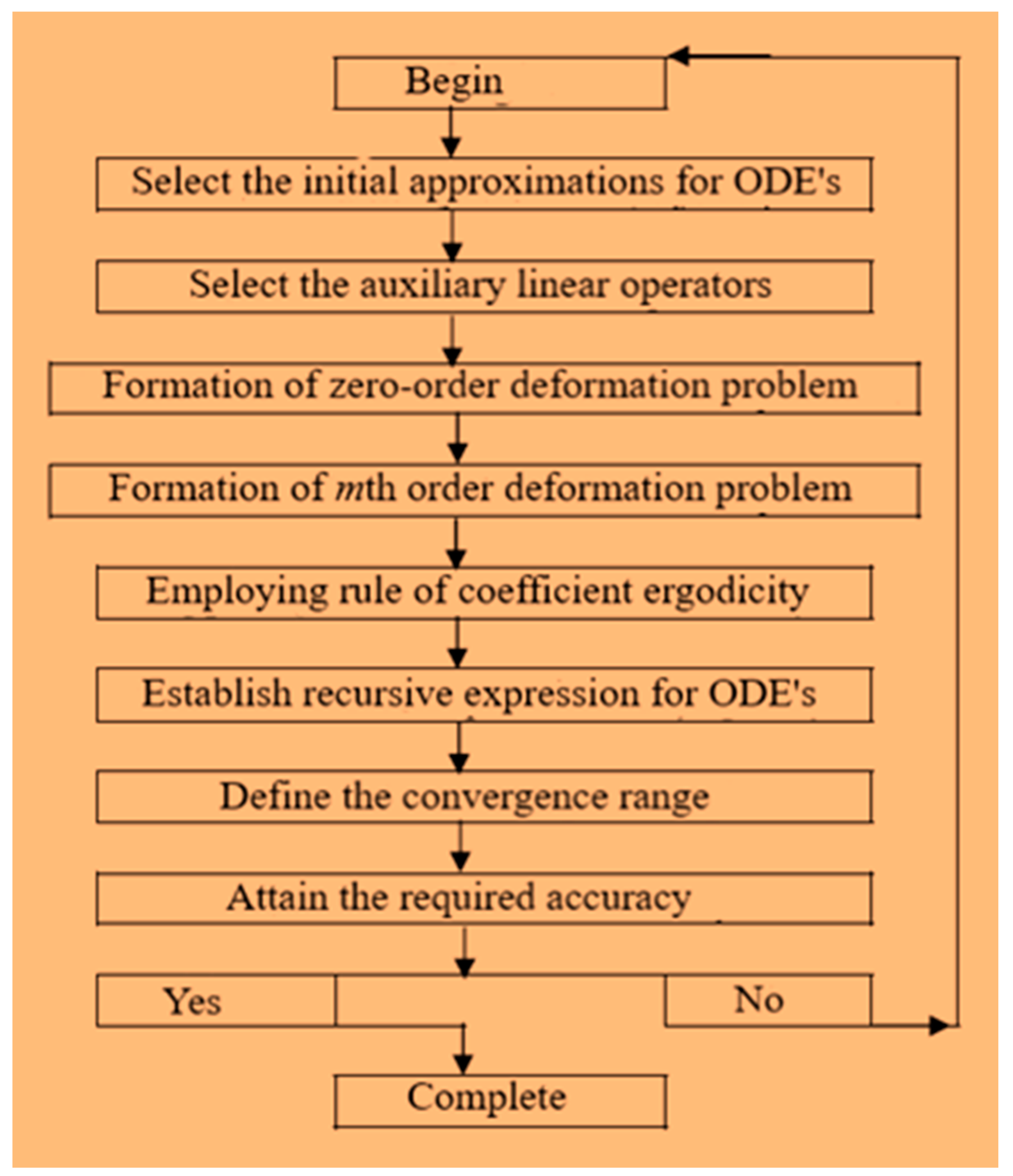
Nonlinearity issues are solved using a variety of numerical approaches. The HAM [45,46,47,48,49,50,51,52] technique, which is the most successful semi-analytically approach and applied to utilize these greatly nonlinear equations. These variables are used to calculate the approximation rate of this solution. The flow map of HAM process is given in Chart 1. Furthermore, the user can select the starting assumptions for the solutions. The higher order non-linear ODE Equations (16)–(20) are solved through this HAM technique.
with the property
in which are the constants.
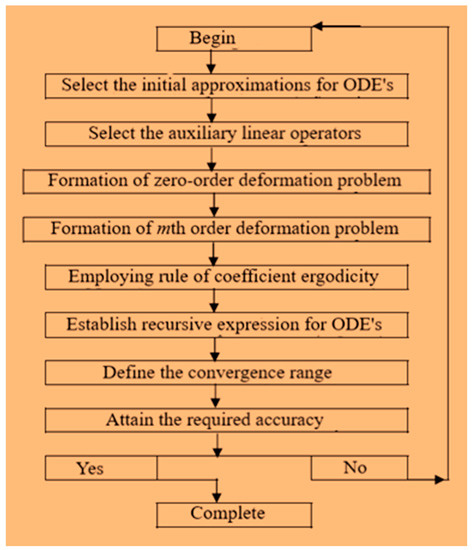
Chart 1.
Flow chart of HAM expression.
- Zeroth order formulation
For and , the results are achieved:
- mth order formulation
The th order deformation can be presented in the following forms:
Boundary conditions are:
where
The general solutions are
where are the special solutions.
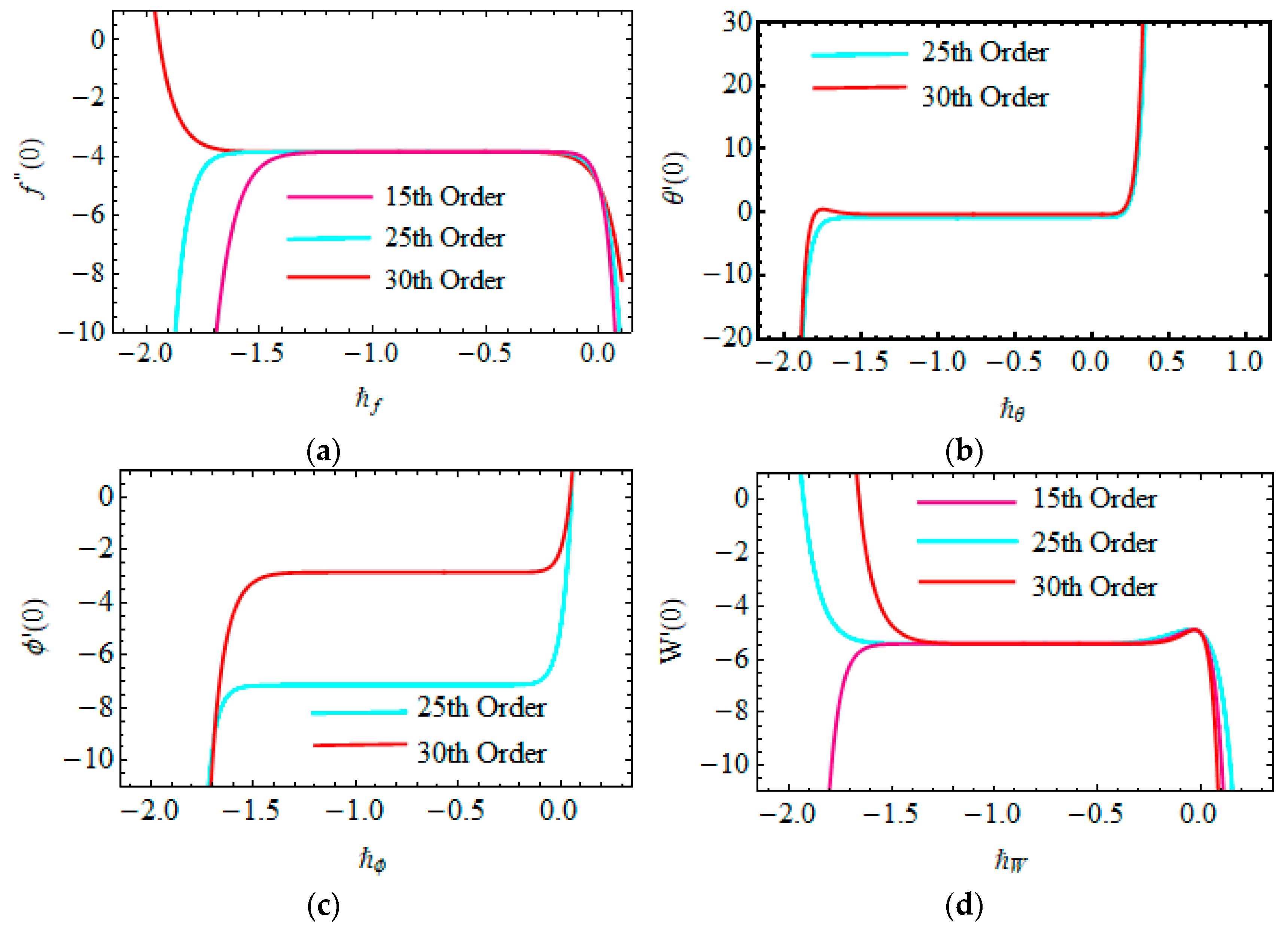
Convergence of Homotopy Solutions
The parameters are the converging control of the desired series solution. For the function f″(0), θ′(0), ϕ′(0), W′(0) seek the permissible values to obtain the 25th and 30th order. Figure 1, Figure 2, Figure 3 and Figure 4 specify that the range of The series converges in the entire region of when . The order of approximation for HAM is denoted in Table 1.
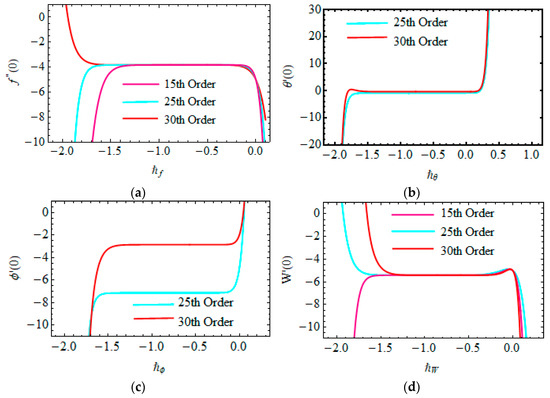
Figure 2.
Plots of (a) —curve of , (b) —curve of , (c) —curve of and (d) —curve of .
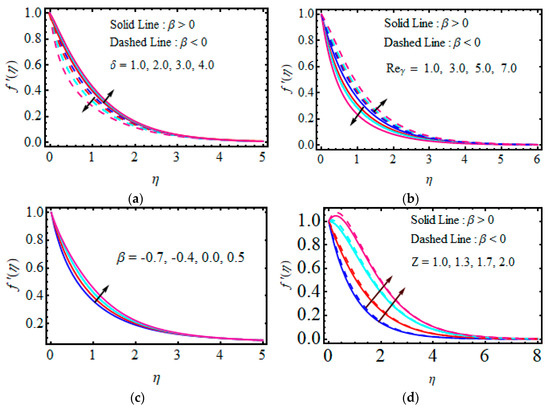
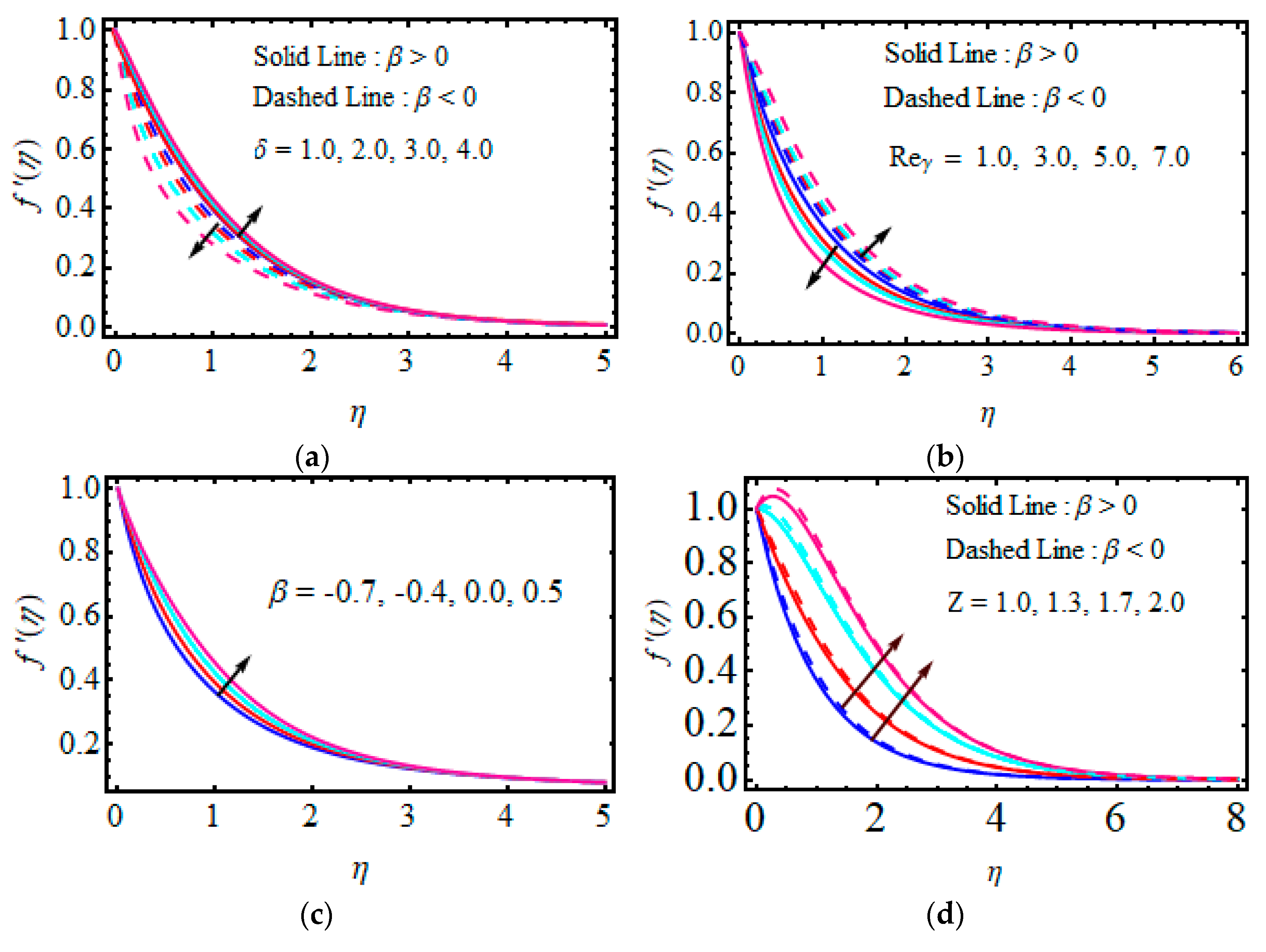
Figure 3.
(a–d). The impact of the : (a), (b) , (c) and (d) Z.
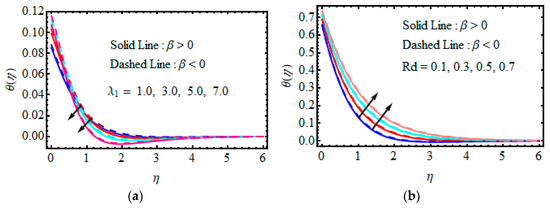
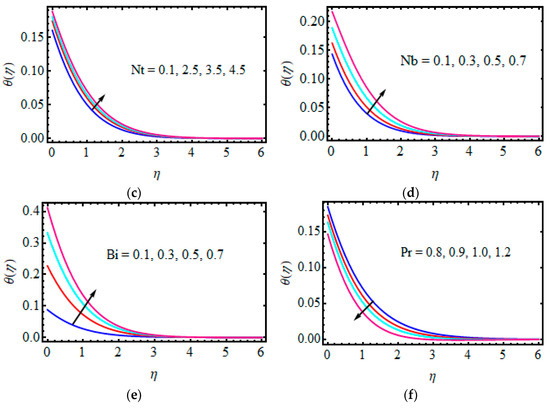
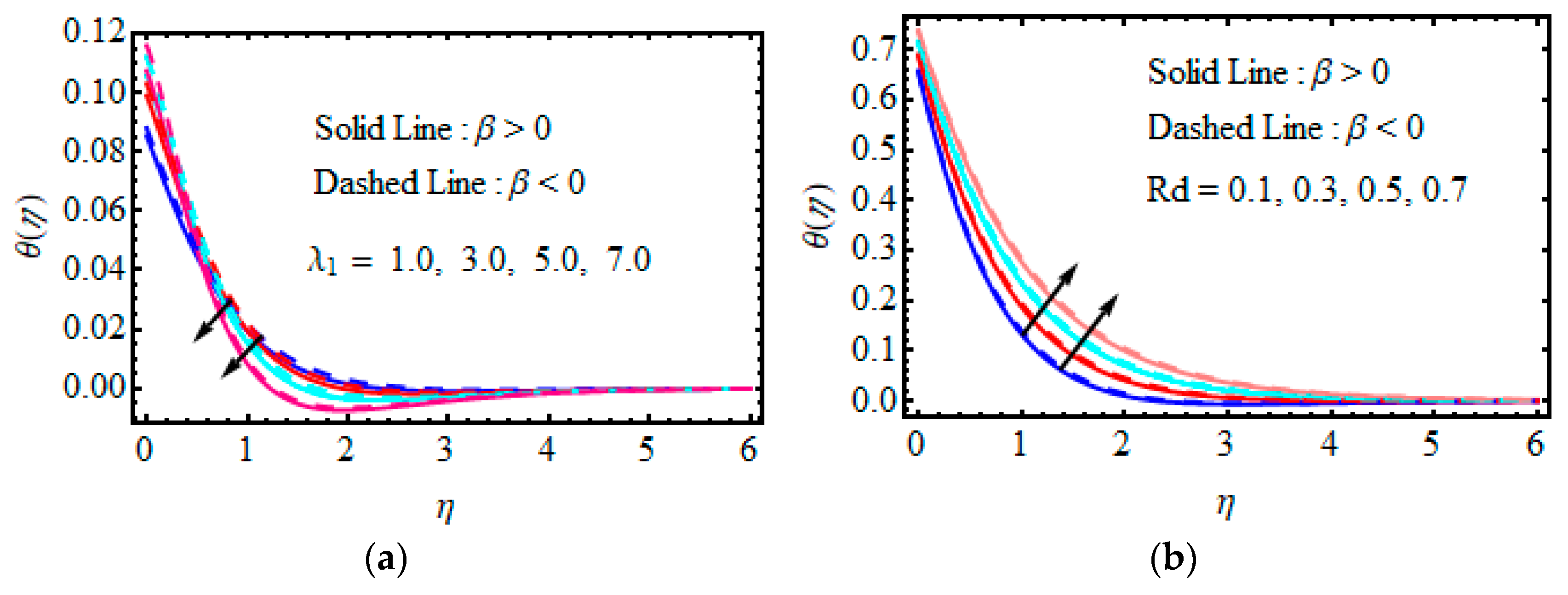
Figure 4.
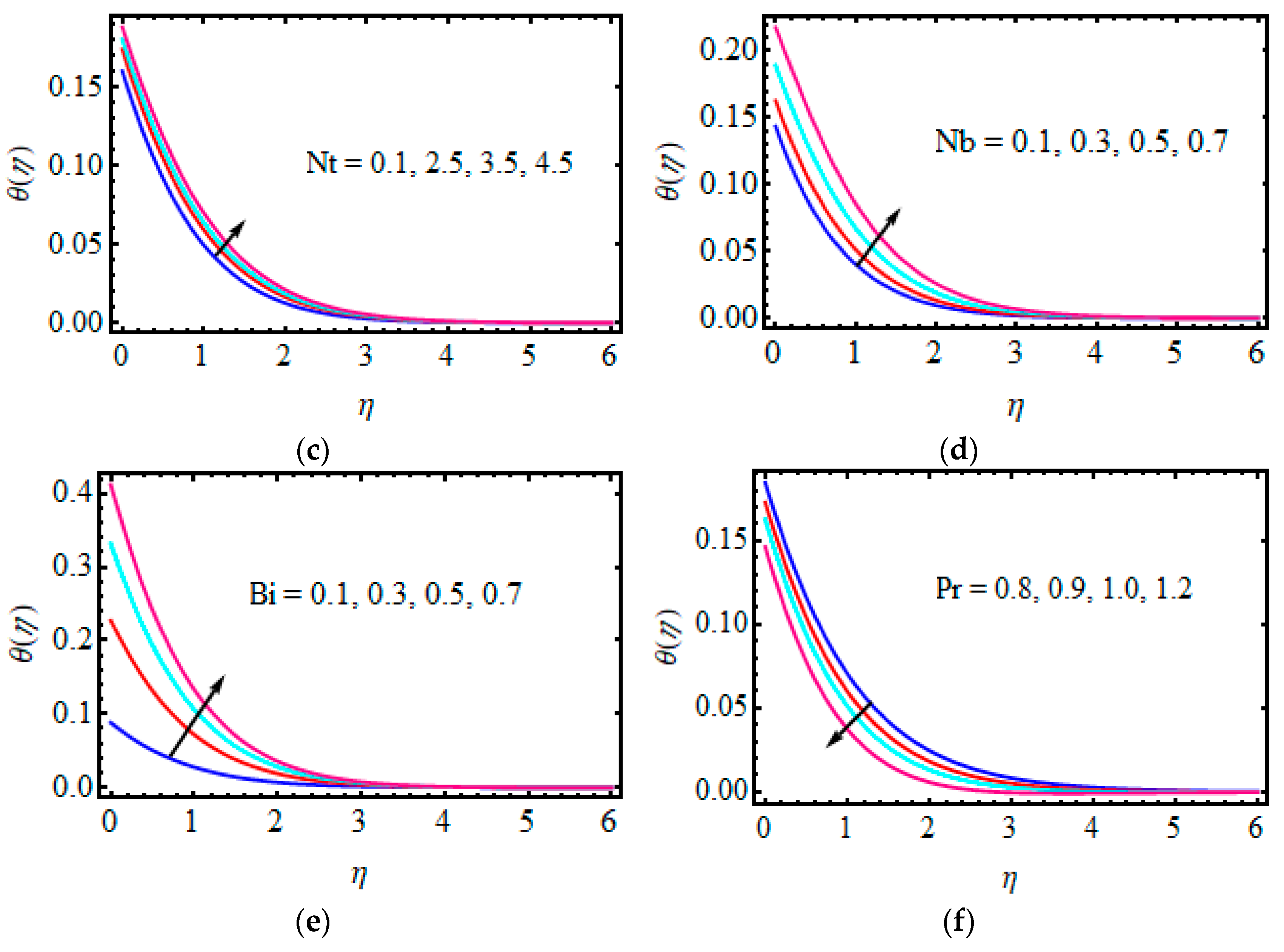
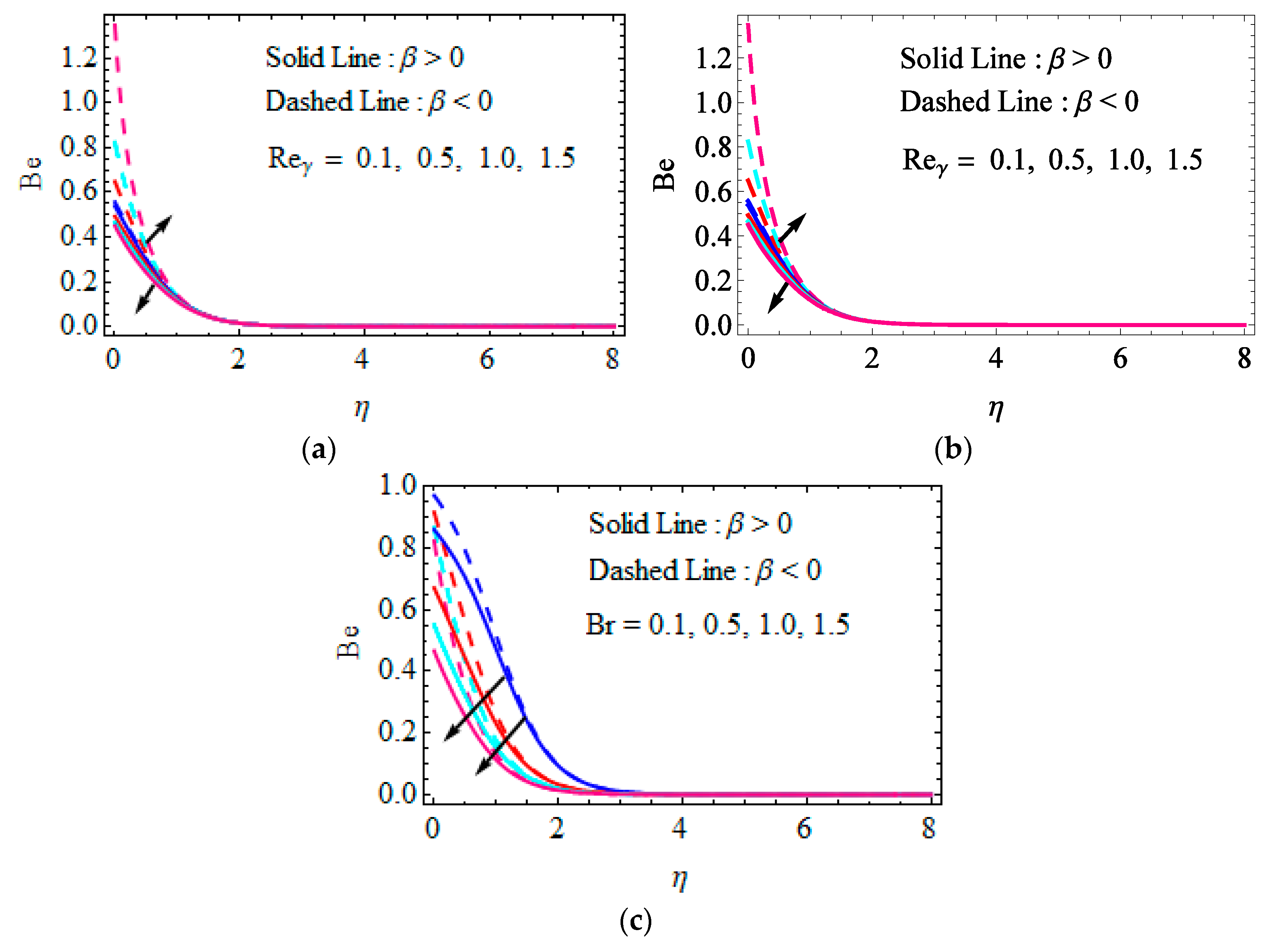
(a–f). The impact of the numerous variables of (a) , (b) , (c) (d) (e) and (f) .

Table 1.
Convergence solution of HAM.
5. Results and Discussion
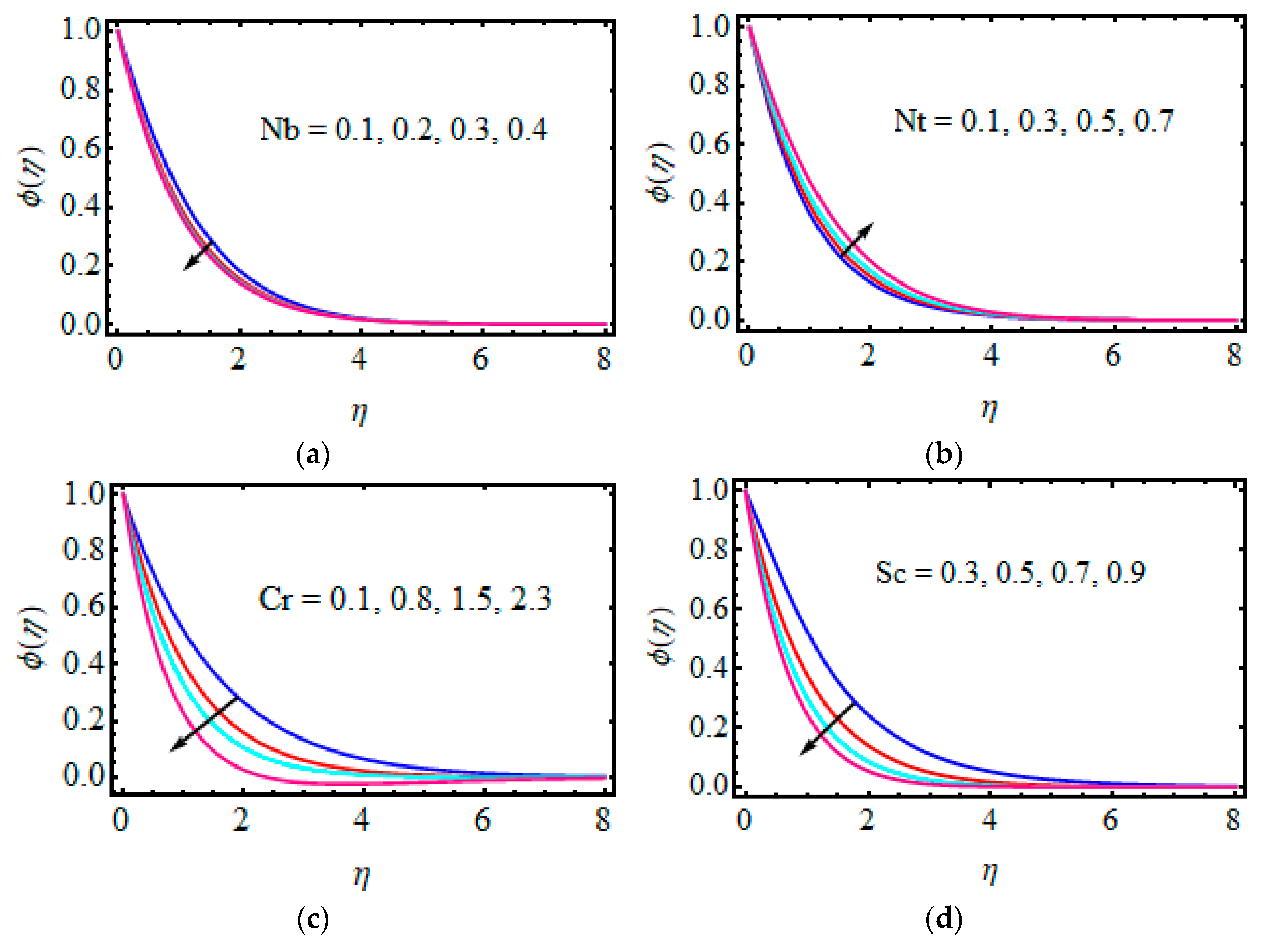
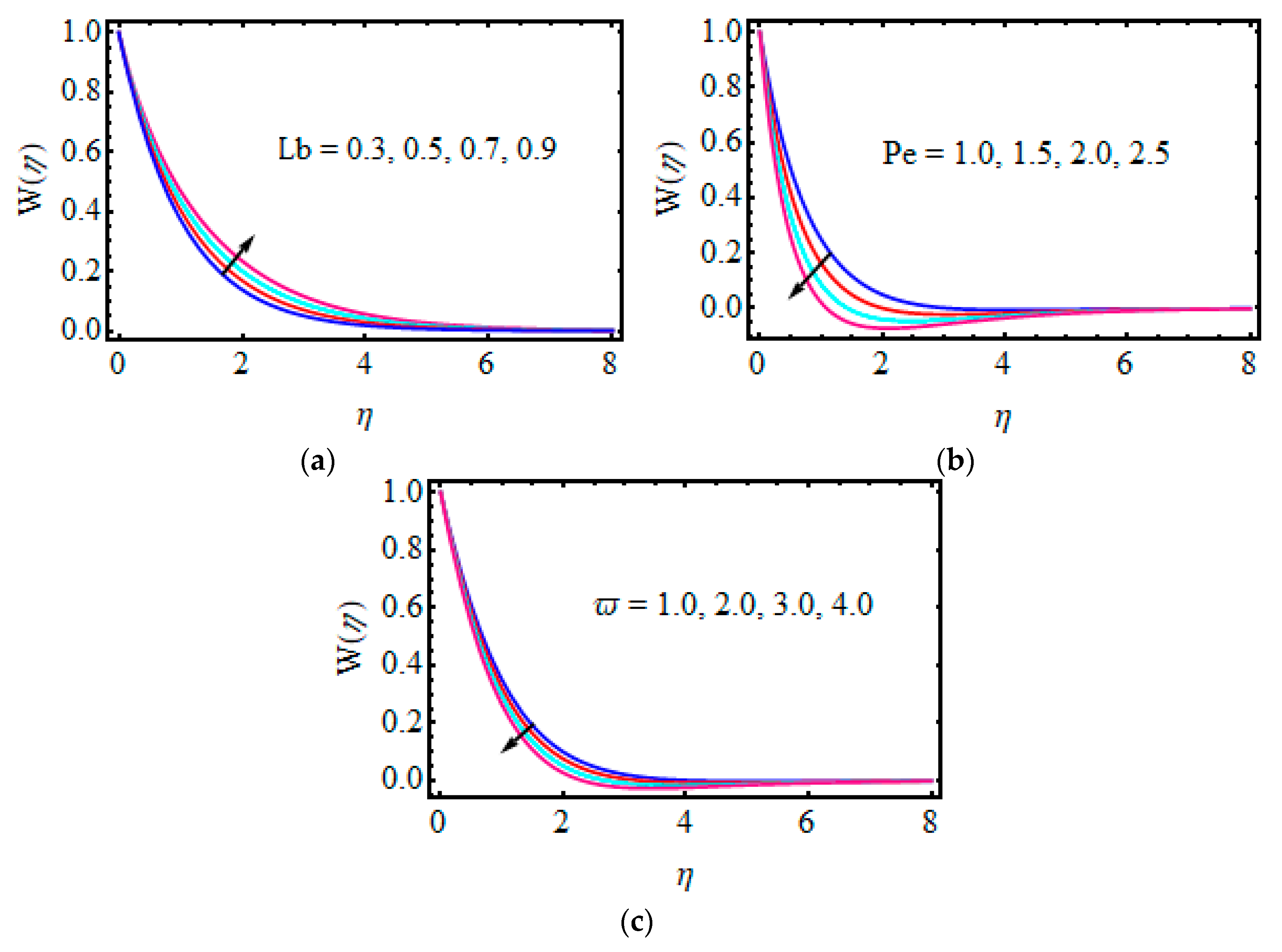
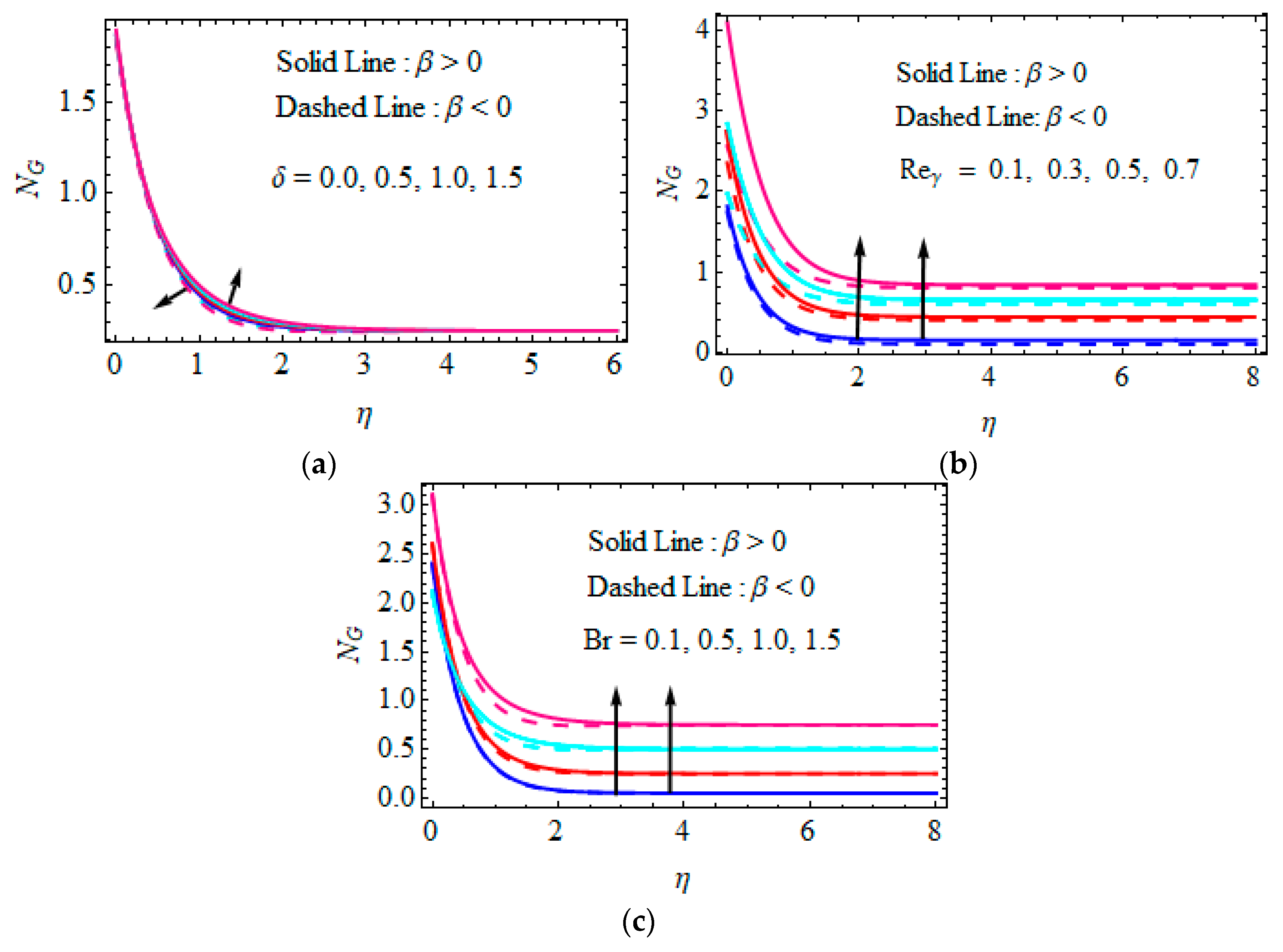
The system of Equations (16)–(19) subject to the boundary condition (20) was addressed through the homotopy analysis method (HAM). To discuss the performance of the physical significance against the velocity field , temperature distribution , concentration field , motile microorganism profile , entropy production , Bejan number , as well as skin friction, Nusselt number, Sherwood number and motile density microorganism were delineated, as seen in Figure 3, Figure 4, Figure 5, Figure 6, Figure 7, Figure 8 and Figure 9. Table 2 verifies in accordance with Wang [52], Gorla and Sidawi [53], and Khan and Pop [54], with the limiting case and found a good agreement.
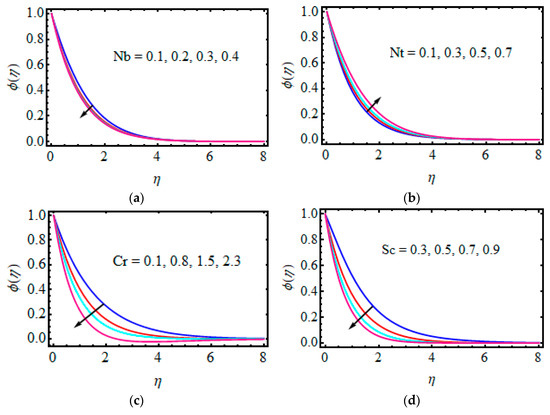
Figure 5.
(a–d) The impact of the numerous variables of (a), (b) , (c) and (d) .
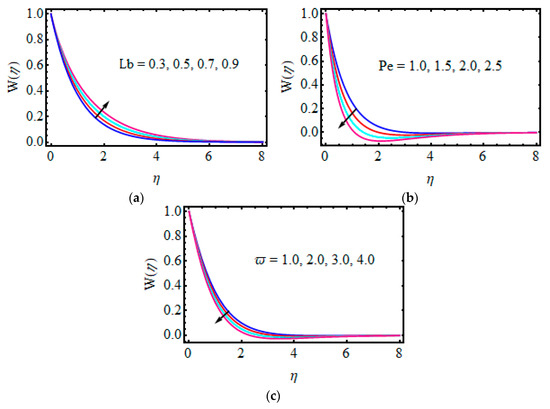
Figure 6.
(a–c) The impact of the numerous variables of : (a) , (b) and (c) .
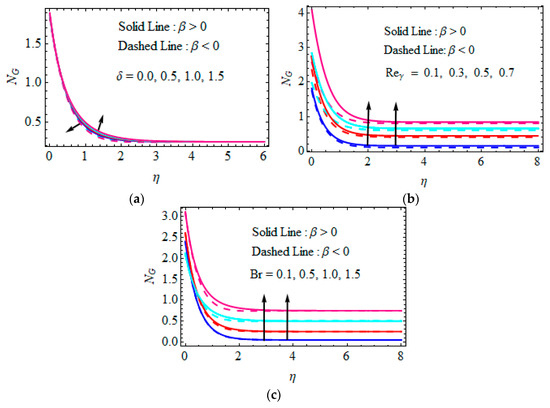
Figure 7.
(a–c) The impact of the numerous variables of : (a) , (b) and (c) .
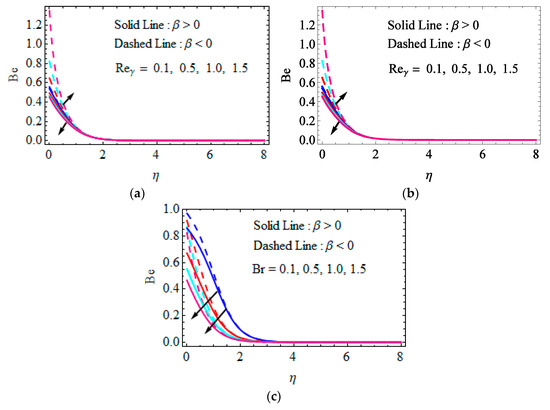
Figure 8.
(a–c) The impact of the numerous variables of (a), (b) and (c) .
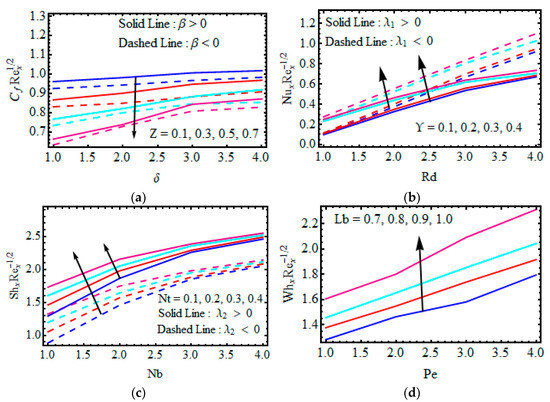
Figure 9.
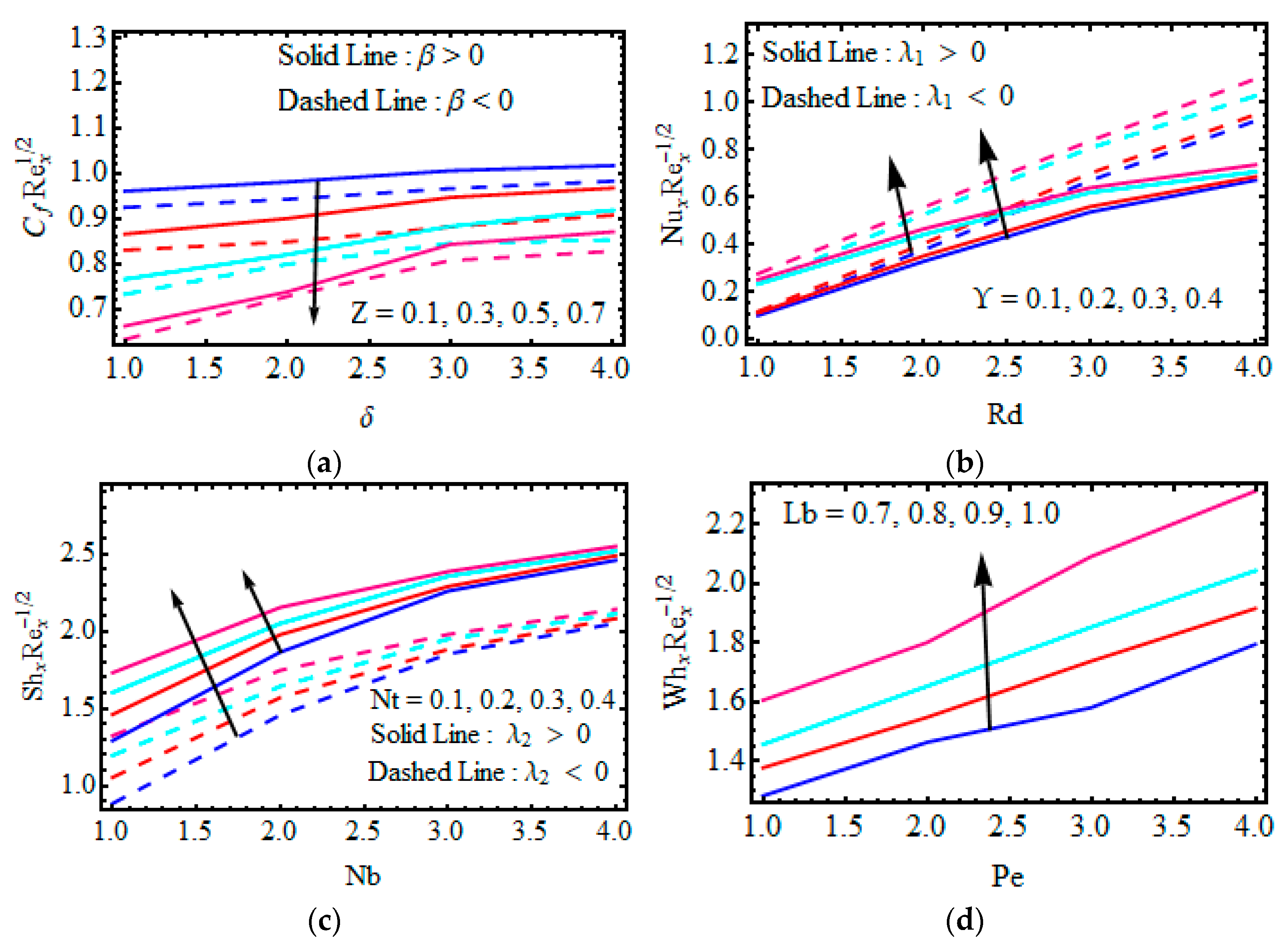
(a–d) Variation in the numerous variables of (a) , (b) , (c) and (d) .
Table 2.
Comparison of the obtained values of the Nusselt number with those of Wang [52], Gorla and Sidawi [53], and Khan and Pop 45 [54], when .
5.1. Velocity Profile
The effects of different numerous parameters over the velocity distribution are discussed in Figure 3a–d. Figure 3a shows that the velocity of the fluid diminishes with the superior values of Deborah number , for the case of , and the velocity field is enhanced for the rising value of Deborah number , for the case of . Figure 3b shows that the velocity field is reduced for higher Reynolds number values, in the case of ; a higher tends to diminish the viscous force and the fluidity decreases for the pseudoplastic fluid. For shear thicking fluid, the velocity field enhances as increases, for the case. Figure 3c shows that the effect of the augmentation in the power law index parameter causes that the velocity profile rises for shear thickening fluid. Figure 3d demonstrates the significance of the Hartmann number on the velocity field, for the two cases of and . It was revealed that the strength of changes and the velocity of the fluid escalates in both cases. Physically, an increment in corresponds to enhancing the external electric field that constructs the wall-parallel Lorentz force. Therefore, increases.
5.2. Temperature Profile
Figure 4a–f plot the consequences of temperature against different values of the involved parameters over the temperature field. The thermal relaxation time parameter impacts on are demonstrated in Figure 4a. It can be noted that the thermal relaxation parameter tends to decrease the temperature profile for both the dilatants and pseudoplastic cases. Figure 4b reveals the inclination of for specific values of the thermal radiation parameter, for and . The temperature of the fluid increases due to the enlargement in the radiation parameter in both cases. Figure 4c reports the variation of thermophoresis over temperature. This is due to the nanoparticles move from the hotter surface to the colder surface. Figure 4d demonstrates the influence of the Brownian motion parameter on the temperature profile. This is due to Brownian motion, which is the erratic movement of the particles suspended in the fluid. The random collision of particles suspended in the fluid increases the temperature of the fluid, which further contributes to the anticipated improvement in the temperature profile θ(η). Figure 4e depicts the impact of the Biot number . From the figure, it can be seen that the temperature field is boosted by enhancing the value of . Actually, the Biot number means the ratio of convection proportion of conducting the inner side of the boundary at the surface. Figure 4f displays variations of the Prandtl number against . The temperature is maintained in light of a higher .
5.3. Nanoparticle Concentration Profile
The outcomes of the different leading parameters are presented in Figure 5a–d. Figure 5a shows the characteristics of on . The concentration distribution depletes with a rising . Brownian motion’s relationship with the Brownian diffusion coefficient, which causes the concentration field to decrease, is the cause of this phenomenon. The influence of the thermophoresis variable on is rendered in Figure 5b. An augmentation in leads to a reduction in concentration. One can notice, from that graph, the upsurge in Nt improves the mass transfer. The chemical reaction influences the profile of concentration, as seen in Figure 5c. The enhanced values result in a fluid particle break near the surface, which reduces the concentration and the corresponding boundary layer thickness. The Schmidt number effect against the concentration profile is displayed in Figure 5d. Clearly, a depreciation in concentration is noted for the greater , due to the reduction in mass diffusion.
5.4. Microorganism Profile
The effect of different influential variables on the microorganism’s field is shown in Figure 6a–c. Variations in motile microorganisms against the biocovection Lewis number for various values are seen in Figure 6a. Therefore, the greater values of reduces the microorganism field. Actually, has an opposite trend with thermal diffusivity as an escalation in decreases the thermal diffusivity in regards to a decline in motile density. From Figure 6b, it can be seen that the higher Peclet number in the microorganism field produces a reduction in . It has a direct relation with cell swimming speed; therefore, the climbing improves the cell speed of micro-best stumbling microorganism diffusivity. As a result, declines with the rising values of . Figure 6c examines the characteristics of the opposite . It can be seen that the motile density shrinks for the larger . In fact, improving the values of escalates the concentration of microorganisms in ambient concentration. Finally, declines.
5.5. Entropy Generation Profile
Figure 7a–c examine the performance of numerous variable parameters and entropy production . Figure 7a sketched the effect of Deborah number over . This shows the enhancement in entropy production close to the wall for dilatant and deduction close to the wall for pseudoplastic fluid . Increasing the influence in the Reynolds number entropy generation is studied for dilatant and pseudoplastic fluid fluids plots in Figure 7b. The disparity in against is plotted in Figure 7c. Entropy generation increases with increasing value in both cases. Subsequently, attributes the proportion of free heat through viscous heating with the molecular condition. Therefore, heat is created in the system for increased values of as well as disorder increasing in the system, which explains the upsurges in the entropy of the system.
5.6. Bejan Number Profile
The performance is opposite to the variations in the variables and ; the plots are shown in Figure 8a–c. Figure 8a,b show the behaviour of the physical parameters of the Deborah and Reynolds numbers on the Bejan number. It examined that the Bejan number declines with the larger values of Deborah and Reynolds numbers for shear thickening and increases for both numbers for the shear-thinning fluid. Furthermore, Figure 8c shows that the influence of the Bejan number Be reduces with the growing values of .
5.7. Physical Entitles
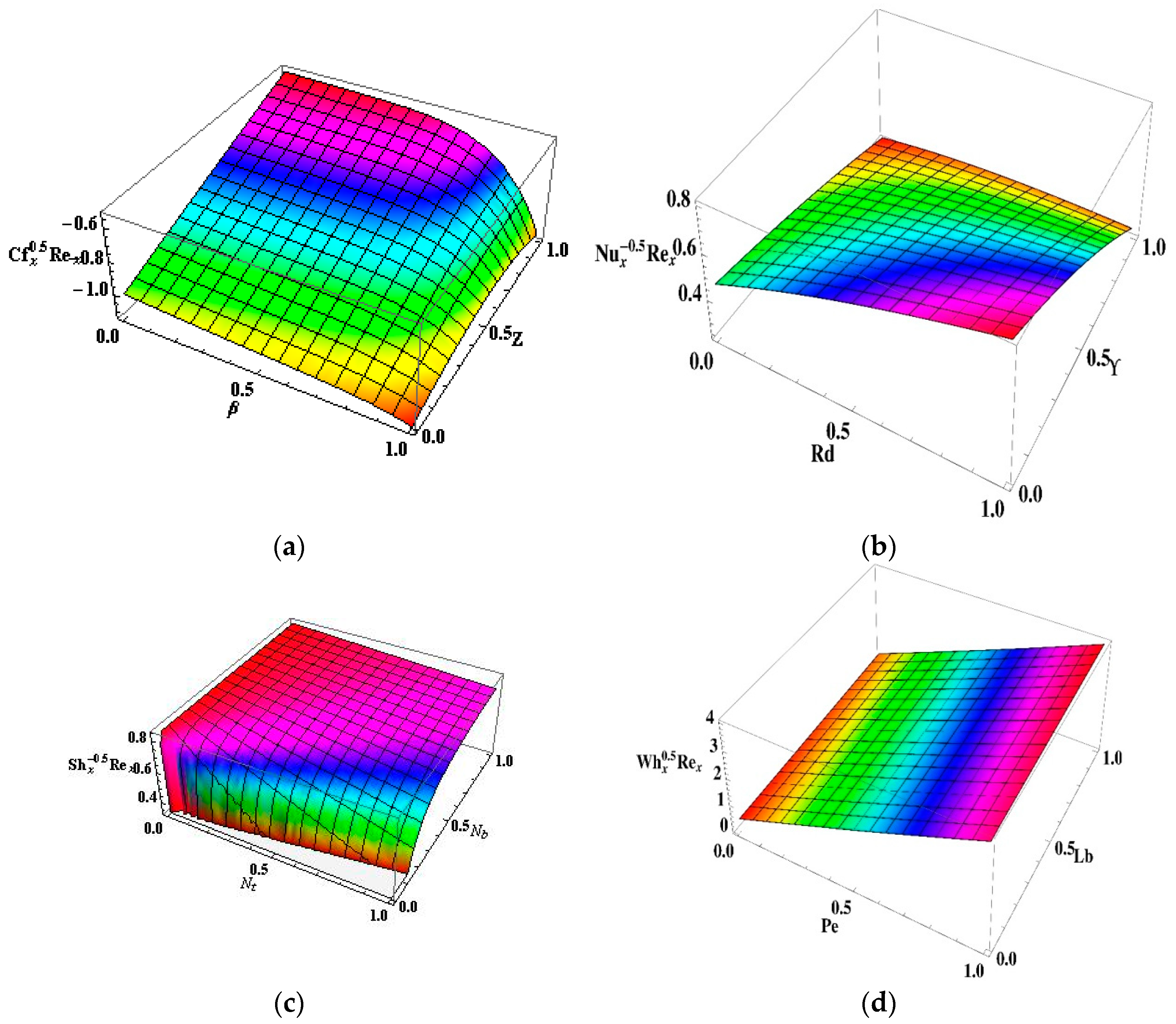
Figure 9a reports that the skin friction coefficient is deformed in both cases for the larger values of the parameters and for . The influence of the non-Newtonian nanofluid parameter on the Nusselt number against the thermal radiation is highlighted in Figure 9b. The heat transport gradient increases when rising the and . The significance of and on the Sherwood number is shown in Figure 9c. It is determined that there is amplification in the Sherwood number for raised values of fluid parameters. Figure 9d elucidates the substantial rescaled density number of motile microorganisms. The rescaled density number of motile microorganisms is voluminous for higher variations of and . Figure 10a–d shows the 3D representation of skin friction, Nusselt number, Sherwood number and motile density, respectively.
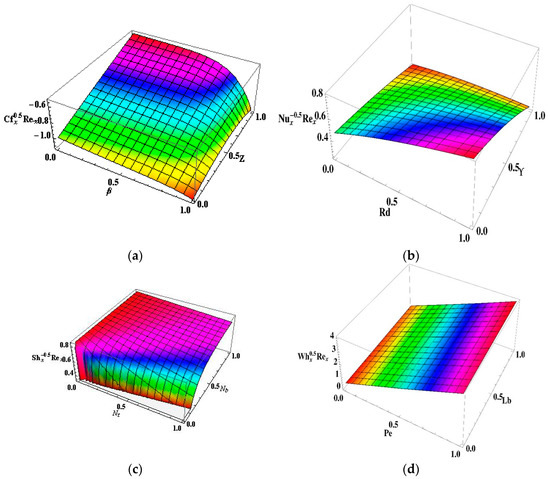
Figure 10.
(a–d) Three-dimensional graphs; (a) Skin friction for and ; (b) Nusselt number for and (c) Sherwood number for and ; and (d) motile density for and .
5.8. Stream Line and Isotherm Line
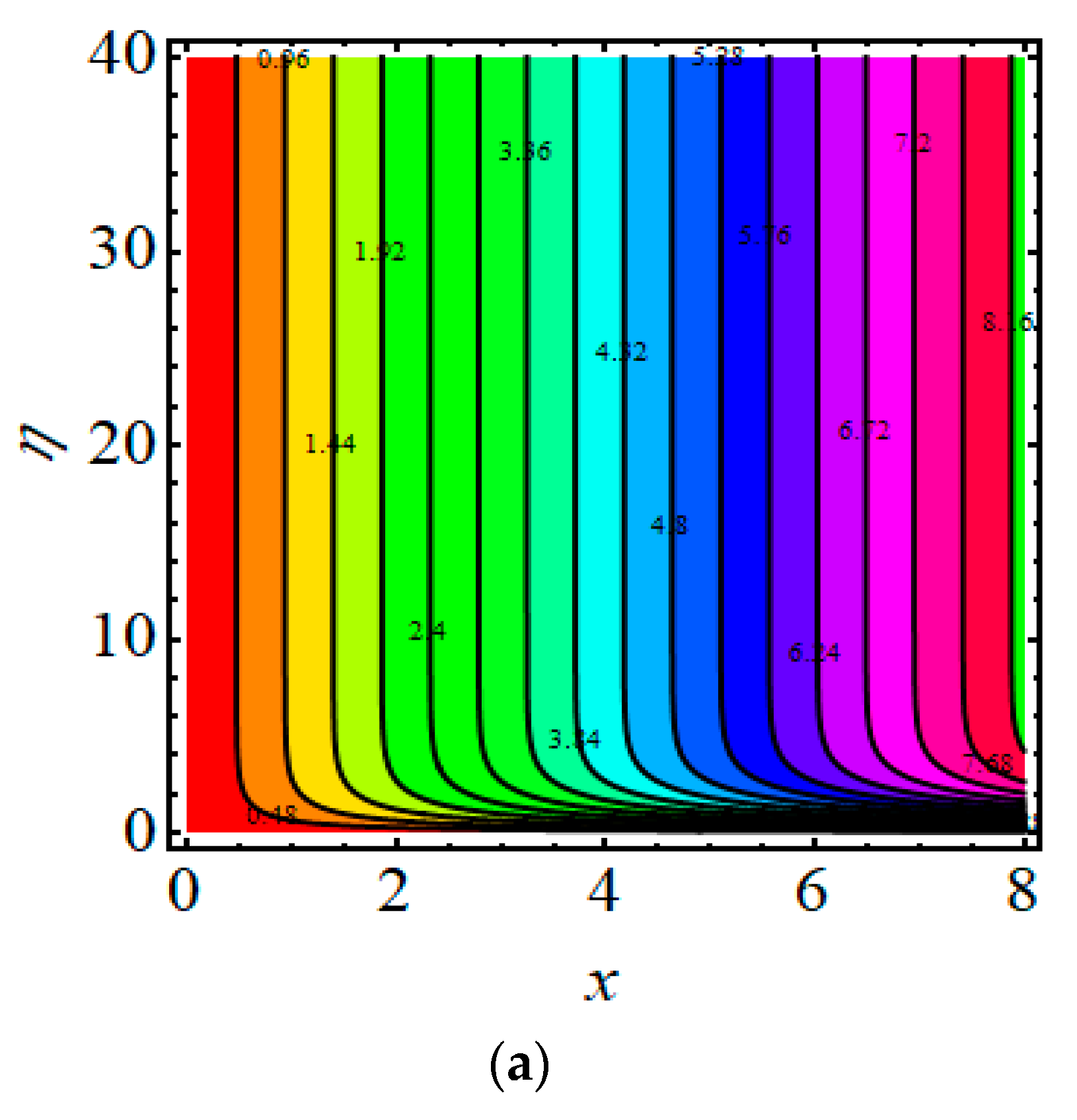
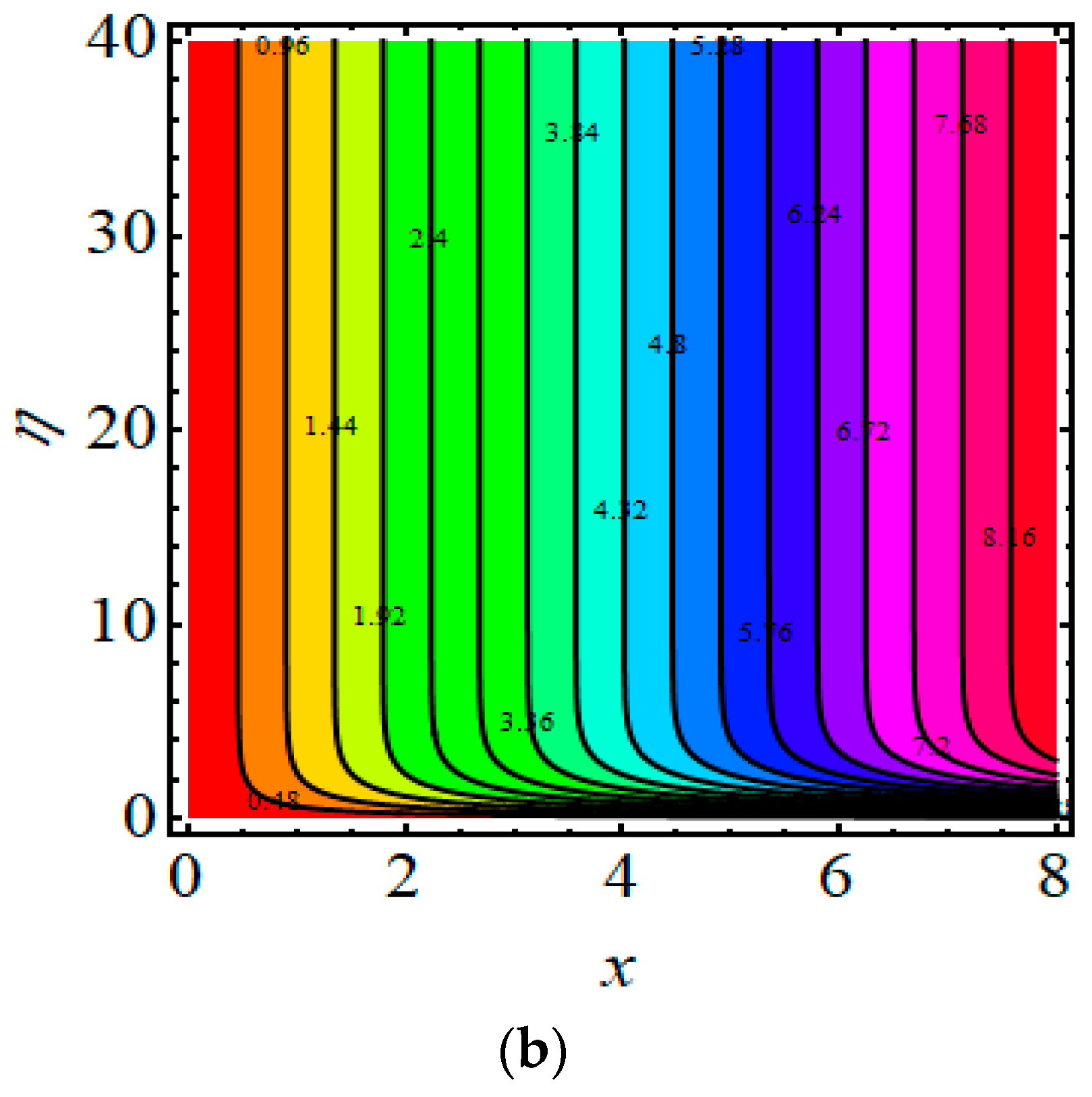
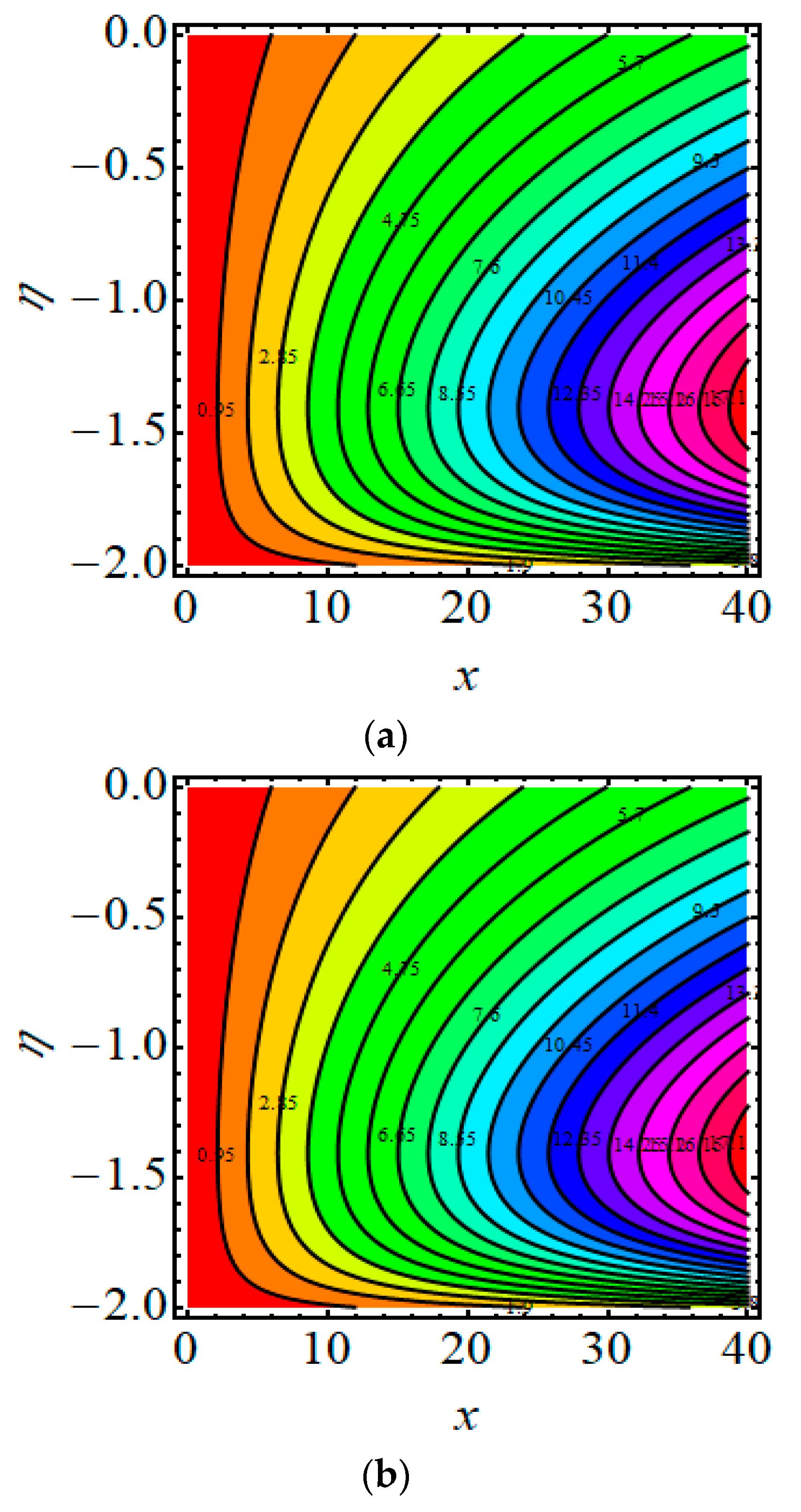
Figure 11b shows the behaviour of the stream function for the current flow. The patterns depict that the streamlines are more obscured and split into two sections, pseudo-plastic and dilatant ; the shape is modest and fills the flow field. Figure 12a,b show the behaviour of the isotherm line for the present flow for both the cases.
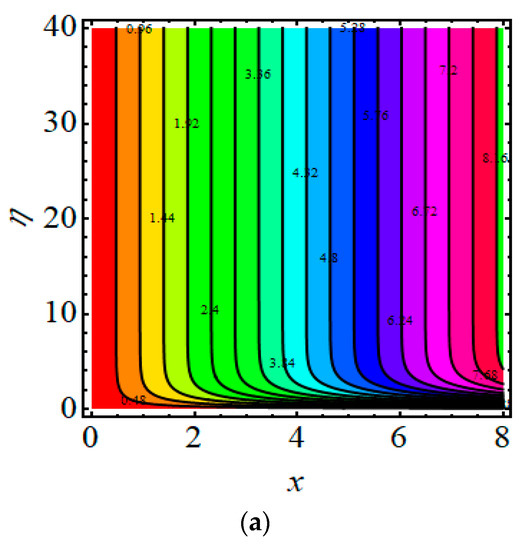
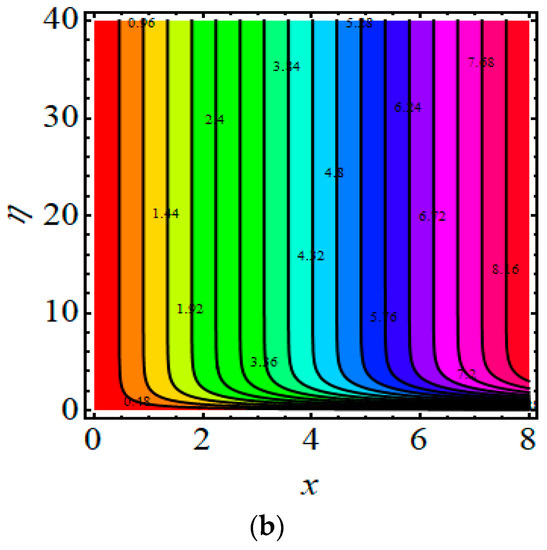
Figure 11.
(a,b) Streamline for (a) and (b) .
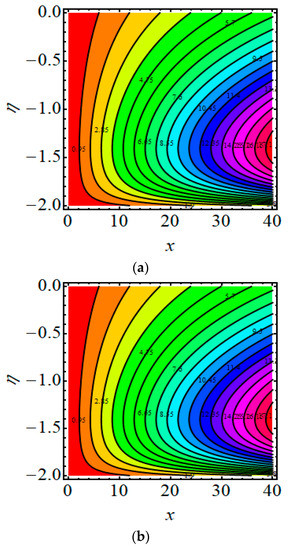
Figure 12.
(a,b) Isotherm lines (a) and (b) .
6. Major Outcomes
This investigation examined a Sutterby nanofluid with Cattaneo–Christov double diffusion theory over a Riga plate. Additionally, the bioconvection of the motile microorganisms and the chemical reaction was included. To obtain a non-linear system of ordinary differential problems, appropriate transformations were used. The non-linear systems were computed through the HAM technique. The main findings of the present study were as follows:
- The Deborah and Reynolds numbers produce the opposite behaviour in the flow field for the different cases of and .
- The velocity shows the continuous improvement with increasing the Hartman number in both dilatant and pseudoplastic fluid cases.
- A larger chemical reaction reveals a decrement in the concentration, while the thermophoresis parameter lead to the expansion in concentration.
- The microorganism field deteriorated for the higher values of and microorganism difference parameter.
- The entropy generation number presented an increasing magnitude for large valuesof the Reynolds and Brinkman numbers, for the cases of pseudoplastic and dilatants fluid. Large values of entropy generation number appear in the area of the sheet due to the high viscous effects.
- Enhancing the value of the Deborah and Reynolds numbers results in the decrease in the Bejan profile in the case of the dilatant fluid, while the opposite effect is observed in the case of shear thinning.
Author Contributions
Conceptualization: M.F. and S.I.A.; Data curation: A.Z.; Formal analysis: M.F. and A.Z.; Investigation: F.A., K.L., A.Z. and S.I.A.; Methodology: K.L. and C.A.R.; Resources: M.F. and F.A.; Software: M.F. and K.L.; Supervision: S.I.A.; Validation: F.A. and S.I.A.; Visualization: C.A.R.; Writing—original draft: F.A., K.L. and M.F.; Writing—review and editing: C.A.R. and S.I.A. All authors have read and agreed to the published version of the manuscript.
Funding
This research received no external funding.
Data Availability Statement
Not applicable.
Acknowledgments
Sara I. Abdelsalam expresses her deep gratitude to Fundación Mujeres por África for supporting this work through the fellowship awarded to her in 2020.
Conflicts of Interest
The authors declare no conflict of interest.
Nomenclature
| Stretching rate | |
| Similarity function for velocity | |
| Ambient temperature | |
| Fluid temperature | |
| Microorganism concentration | |
| Dimensionless temperature | |
| Ambient concentration | |
| Power index number | |
| Deborah number | |
| Local Reynolds number | |
| Modified Hartmann number | |
| Thermal radiation | |
| Heat source/sink parameter | |
| Chemical reaction | |
| Thermal relaxation parameter | |
| Concentration relaxation parameter | |
| Thermophoresis parameter | |
| Brownian motion parameter | |
| Biot number | |
| Prandtl number | |
| Schmidt number | |
| Peclet number | |
| Lewis number | |
| Microorganism concentration difference parameter | |
| Fluid density | |
| Dynamic viscosity | |
| Ambient condition | |
| Skin friction coefficient | |
| Nusselt number | |
| Sherwood number | |
| Microorganism density number | |
| Ratio of the effective heat capacity | |
| Brinkman number | |
| Local volumetric entropy generation rate | |
| Entropy number | |
| Bejan number |
References
- Choi, S.U.; Eastman, J.A. Enhancing thermal conductivity of fluids with nanoparticles. in development and applications of non-Newtonian flow. ASME 1995, 66, 99–105. [Google Scholar]
- Buongiorno, J. Convective transport in nanofluids. J. Heat Transf. 2006, 128, 240–250. [Google Scholar] [CrossRef]
- Hussain, S.; Ahmad, S.; Mehmod, K.; Sagheer, M. Effects of inclintion angle on mixed convetive nanofluid flow in a double lid-driven cavity with discrete heat sources. Int. J. Heat Mass Transf. 2017, 106, 847–860. [Google Scholar] [CrossRef]
- Hussain, S.; Ahmed, S.E.; Saleem, F. Impact of periodic magnetic field on entropy generation and mixed convection. J. Thermophys. Heat Transf. 2018, 32, 999–1012. [Google Scholar] [CrossRef]
- Haq, F.; Saleem, M.; Rahman, M.U. Investigation of natural bio-convective flow of cross nanofluid containing gyrotactic microorganisems subject to activation energy and magnetic field. Phys. Scr. 2020, 95, 105219. [Google Scholar] [CrossRef]
- Prabakaran, R.; Eswaramoorthi, S.; Loganathan, K.; Sarris, I.E. Investigation on Thermally Radiative Mixed Convective Flow of Carbon Nanotubes/Al2O3 Nanofluid in Water Past a Stretching Plate with Joule Heating and Viscous Dissipation. Micromachines 2022, 13, 1424. [Google Scholar] [CrossRef]
- Mjankwi, M.A.; Masanja, V.G.; Mureithi, E.W.; James, M.N. Unsteady MHD flow of nanofluid with variable properties over a stretching sheet in the presence of thermal radiation and chemical reaction. Int. J. Math. Math. Sci. 2019, 2019, 7392459. [Google Scholar]
- Shahid, A. The effectiveness of mass transfer in the MHD upper-convected Maxwell fluid flow on a stretched porous sheet near stagnation point: A numerical invstigation. Inventions 2020, 5, 64. [Google Scholar] [CrossRef]
- Rafique, K.; Alotaibi, H.; Ibrar, N.; Khan, I. Stratified flow of micropolar nanofluid over riga plate: Numerical analysis. Energies 2022, 15, 316. [Google Scholar]
- Parvine, M.; Alam, M.M. Nanofluid flow along the riga plate with electromagnetic field in a rotating system. AIP Conf. Proc. 2019, 2121, 070003. [Google Scholar] [CrossRef]
- Abbas, T.; Ayub, M.; Bhatti, M.M.; Rashidi, M.M.; Ali, M.E.S. Entropy generation on nanofluidflow through a horizental riga plate. Entropy 2016, 18, 223. [Google Scholar] [CrossRef]
- Sannad, M.; Hussein, A.K.; Abidi, A.; Homod, R.Z.; Biswal, U.; Ali, B.; Kolsi, L.; Younis, O. Numeical study of MHD natural convection inside a cubical cavity loaded with copper-water nanofluid by using a non-homogeneous dynamic mathematical model. Mathematics 2022, 10, 2072. [Google Scholar] [CrossRef]
- Awan, A.U.; Ahammad, N.A.; Majeed, S.; Gamaoun, F.; Ali, B. Significance of hybrid nanoparticles, Lorentz and Coriolis forces on the dynamics of water-based flow. Int. Commun. Heat Mass Transf. 2022, 135, 106084. [Google Scholar] [CrossRef]
- Elanchezhian, E.; Nirmalkumar, R.; Balamurugan, M.; Mohana, K.; Prabu, K.M.; Viloria, A. Heat and mass transmission of an Oldroyd-B nanofluid flow through a stratified medium with swimming of motile gyrotactic microorganisms and nanoparticles. J. Therm. Anal. Calorim. 2020, 141, 2613–2623. [Google Scholar] [CrossRef]
- Loganathan, K.; Mohana, K.; Mohanraj, M.; Sakthivel, P.; Rajan, S. Impact of third-grade nanofluid flow across a convective surface in the presence of inclined Lorentz force: An approach to entropy optimization. J. Therm. Anal. Calorim. 2020, 144, 1935–1947. [Google Scholar] [CrossRef]
- Ahmad, S.; Khan, M.I.; Hayat, T.; Khan, M.I.; Alsaedi, A. Entropy genertion optimization and unsteady squeezing flow of viscous fluid with five different shapes of nanoparticles. Colloids Surf. A Physicochem. Eng. Asp. 2018, 554, 197–210. [Google Scholar] [CrossRef]
- Loganathan, K.; Rajan, S. An entropy approach of Williamson nanofluid flow with Joule heating and zero nanoparticle mass flux. J. Therm. Anal. Calorim. 2020, 141, 2599–2612. [Google Scholar] [CrossRef]
- Waqas, H.; Farooq, U.; Muhammad, T.; Hussain, S.; Khan, I. Thermal effect on bioconvection flow of Sutterby fluid between two rotating diskswith motiole microorganisems. Case Stud. Therm. Eng. 2021, 26, 101136. [Google Scholar] [CrossRef]
- Yahya, A.U.; Salamat, N.; Habib, D.; Ali, B.; Hussain, S.; Abdal, S. Implication of Bio-convection and Cattaneo-Christov heat flux on Williamson Sutterby nanofluid transportation caused by a stretching surface with convective boundary. Chin. J. Phys. 2021, 73, 706–718. [Google Scholar] [CrossRef]
- Fayyadh, M.M.; Naganthran, K.; Basir, M.F.M.; Hashim, I.; Roslan, R. Raiative MHD Sutterby Nanofluid Flow Past a Moving Sheet: Scaling Group Analysis. Mathemtics 2020, 8, 1430. [Google Scholar]
- Gowda, R.J.P.; Kumar, R.N.; Rauf, A.; Prasannakumara, B.C.; Shehzad, S.A. Magnetized flow of sutterby nanofluid through cattneo-christov theory of heat diffusion and stefan blowing condition. Appl. Nanosci. 2021. [Google Scholar] [CrossRef]
- Aldabesh, A.; Haredy, A.; Al-Khaled, K.; Khan, S.U.; Tlili, I. Darcy resistance flow of Sutterby nanofluid with microorganisms with applications of nano-biofuel cells. Sci. Rep. 2022, 12, 7514. [Google Scholar] [CrossRef] [PubMed]
- Hayat, T.; Masood, F.; Qayyum, S.; Alsaedi, A. Sutterby fluid flow subject to homogeneous-heterogeneous reactions and nonlinear radiation. Phys. A Stat. Mech. Appl. 2019, 2019, 123439. [Google Scholar] [CrossRef]
- Fujii, T.; Miyatake, O.; Fujii, M.; Tanaka, H.; Murakami, K. Natural convective heat transfer from a vertical isothermal surface to a non- Newtonian Sutterby fluid. Int. J. Heat Mass Transf. 1973, 16, 2177–2187. [Google Scholar]
- Bilal, S.; Sohail, M.; Naz, R.; Malik, M.Y. Dynamical and optimal procedure to analyse the exhibition of physical attribute imparted by Sutterby magneto nano fluid in Darcy medium yield by axially stretched cylindr. Can. J. Phys. 2019, 98, 1–10. [Google Scholar] [CrossRef]
- Khan, M.I.; Waqas, H.; Farooq, U.; Khan, S.U.; Chu, Y.M.; Kadry, S. Assessment of bioconvection in magentized Sutterby nanofluid configured by a rotating disk: A numerical approach. Mod. Phys. Lett. B 2021, 35, 2150202. [Google Scholar] [CrossRef]
- Sohail, M.; Naz, R. Modified heat and mass transmission models in the magnetohydrodynamic flow of Sutterby fluid flow in stretching cylinder. Phys. A Stat. Mech. Appl. 2020, 549, 124088. [Google Scholar] [CrossRef]
- Saif-ur-Rehman; Mir, N.A.; Alqarni, M.S.; Farooq, M.; Malik, M.Y. Analysis of heat generation/absorption in thermally stratified Sutterby fluid flow with Cattaneo-Christov theory. Microsyst. Technol. 2019, 25, 3365–3373. [Google Scholar] [CrossRef]
- Usman; Lin, P.; Ghaffari, A. Heat and mass transfer in a steady flow of Sutterby nanofluid over the surface of a stretching wedge. Phys. Scr. 2021, 96, 065003. [Google Scholar] [CrossRef]
- Ali, F.; Loganathan, K.; Prabu, E.; Eswaramoorthi, S.; Faizan, M.; Zaib, A.; Chaudhary, D.K. Entropy Minimization on Sutterby Nanofluid past a Stretching Surface with Swimming of Gyrotactic Microorganisms and Nanoparticles. Math. Probl. Eng. 2021, 5759671. [Google Scholar] [CrossRef]
- Khan, M.I.; Qayyum, S.; Hayat, T. Stratified flow of Sutterby fluid homogeneous-heterogeneous reaction and Cattaneo-Christov heat flux. Int. J. Numer. Methods Heat Fluid Flow 2019, 29, 2977–2992. [Google Scholar] [CrossRef]
- Kuznestov, A.V.; Nield, D.A. Natural convective boundary layer flow of a nanofluid past a verticle plate. Int. Therm. Sci. 2010, 49, 243–247. [Google Scholar]
- Kuznetsov, A.V. The onset of nanofluid bioconvection in a suspension containing both nanoparticles and gyrotactic microorganisems. Int. Commun. Heat Mass Transf. 2010, 37, 1421–1425. [Google Scholar] [CrossRef]
- Kotha, G.; Kolipaula, V.R.; Rao, M.V.S.; Penki, S.; Chamkha, A.J. Internal heat generation on bioconvection of an MHD nanofluid flow due to gyrotactic microorganisms. Eur. Phys. J. Plus 2020, 135, 135–600. [Google Scholar] [CrossRef]
- Siddiq, M.K.; Ashraf, M. Bioconvection of micropolar nanofluid with modified cattaneo-christov theories. Adv. Mech. Eng. 2020, 12, 1687814020925217. [Google Scholar] [CrossRef]
- Bagh, A.; Sajjad, H.; Yufeng, N.; Liaqat, A.; Ul, H.S. Finite element simulation of bioconvection and cattaneo-Christov effects on micropolar based nanofluid flow over a vertically stretching sheet. Chin. J. Phys. 2020, 68, 654–670. [Google Scholar]
- Azam, M.; Mahbood, F.; Khan, M. Bioconvection and activation energy dynamisms on radiative sutterby melting nanomaterial with gyrotactic microorganism. Case Stud. Therm. Eng. 2022, 30, 101749. [Google Scholar]
- Khashi’ie, N.S.; Arifin, N.M.; Pop, I.; Nazar, R. Dual solutions of bioconvection hybrid nanofluid flow due to gyrotactic microorganisms towards a vertical plate. Chin. J. Phys. 2021, 72, 461–474. [Google Scholar] [CrossRef]
- Azam, M. Bioconvection and nonlinear thermal extrusion in development of chemically reactive Sutterbynano-material due to gyrotactic microorganisms. Int. Commun. Heat Mass Transf. 2022, 130, 105820. [Google Scholar] [CrossRef]
- Hayat, T.; Inayatullah, A.; Alsaedi, A. Development of bioconvection flow of nano-material with melting effects. Chaos Solitons Fractals 2021, 148, 111015. [Google Scholar] [CrossRef]
- Reddy, C.S.; Ali, F.; Ahmed, M.F.A.F. Aspect on unsteady for MHD flow of cross nanofluid having gyrotactic motile microorganism due to convectively heated sheet. Int. J. Ambient Energy 2021. [Google Scholar] [CrossRef]
- Sarkar, S.; Kumar, T.; Ali, A.; Das, S. Themo-bioconvection of gyrotactic microorganisms in a polymer solution near a perforated Riga plate immersed in a DF medium involving heat radiation, and Arrhenius kinetics. Chem. Phys. Lett. 2022, 797, 139557. [Google Scholar] [CrossRef]
- Ali, F.; Zaib, A. Unsteady flow of an Eyring-Powell nanofluid near stagnation point past a convectively heated stretching sheet. Arab J. Basic Appl. Sci. 2019, 26, 215–224. [Google Scholar] [CrossRef]
- Rana, S.; Nawaz, M. Investigation of enhancement of heat transfer in Sutterby nanofluid using Koo-Kleinstreuer and Li (KKL) correlations and Cattaneo-Christov heat flux model. Phys. Scr. 2019, 94, 115213. [Google Scholar] [CrossRef]
- Mehmood, A.; Ali, A.; Shah, T. Heat transfer analysis of unsteady boundary layer flow by homotopy analysis method. Commun. Nonlinear Sci. Numer. Simul. 2008, 13, 902–912. [Google Scholar] [CrossRef]
- Karthik, T.S.; Loganathan, K.; Shankar, A.N.; Carmichael, M.J.; Mohan, A.; Kaabar, M.K.; Kayikci, S. Zero and nonzero mass flux effects of bioconvective viscoelastic nanofluid over a 3D Riga surface with the swimming of gyrotactic microorganisms. Adv. Math. Phys. 2021, 2021, 9914134. [Google Scholar] [CrossRef]
- Saeed, A.; Kumam, P.; Nasir, S.; Gul, T.; Kumam, W. Non-linear convective flow of the thin film nanofluid over an inclined stretching surface. Sci. Rep. 2021, 11, 18410. [Google Scholar] [CrossRef]
- Loganathan, K.; Sivasankaran, S.; Bhuvaneswari, M.; Rajan, S. Second-order slip, cross-diffusion and chemical reaction effects on magneto-convection of Oldroyd-B liquid using Cattaneo-Christov heat flux with convective heating. J. Therm. Anal. Calorim. 2019, 136, 401–409. [Google Scholar] [CrossRef]
- Eswaramoorthi, S.; Loganathan, K.; Jain, R.; Gyeltshen, S. Darcy-Forchheimer 3D Flow of Glycerin-Based Carbon Nanotubes on a Riga Plate with Nonlinear Thermal Radiation and Cattaneo-Christov Heat Flux. J. Nanomater. 2022, 2022, 5286921. [Google Scholar] [CrossRef]
- Gul, T.; Rehman, M.; Anwar, S.; Khan, I.; Khan, A.; Nasir, S.; Bariq, A. Magnetohydrodynamic impact on Carreau thin film couple stress nanofluid flow over an unsteady stretching sheet. Math. Probl. Eng. 2021, 2021, 8003805. [Google Scholar] [CrossRef]
- Loganathan, K.; Alessa, N.; Kayikci, S. Heat Transfer Analysis of 3-D Viscoelastic Nanofluid Flow Over a Convectively Heated Porous Riga Plate with Cattaneo-Christov Double Flux. Front. Phys. 2021, 9, 641645. [Google Scholar] [CrossRef]
- Wang, C.Y. Free Convection on a Vertical Stretching Surface. Z. Angew. Math. Mech. 1989, 69, 418–420. [Google Scholar] [CrossRef]
- Gorla, R.S.R.; Sidawi, I. Free convection on a vertical stretching surface with suction and blowing. Appl. Sci. Res. 1994, 52, 247–257. [Google Scholar] [CrossRef]
- Khan, W.A.; Pop, I. Boundary-layer flow of a nanofluid past a stretching sheet. Int. J. Heat Mass Transf. 2010, 53, 2477–2483. [Google Scholar] [CrossRef]
Publisher’s Note: MDPI stays neutral with regard to jurisdictional claims in published maps and institutional affiliations. |
© 2022 by the authors. Licensee MDPI, Basel, Switzerland. This article is an open access article distributed under the terms and conditions of the Creative Commons Attribution (CC BY) license (https://creativecommons.org/licenses/by/4.0/).