


Abstract
In this paper, we establish the existence and stability results for the -Hilfer fractional integro-differential equations under instantaneous impulse with non-local multi-point fractional integral boundary conditions. We achieve the formulation of the solution to the -Hilfer fractional differential equation with constant coefficients in term of the Mittag–Leffler kernel. The uniqueness result is proved by applying Banach’s fixed point theory with the Mittag–Leffler properties, and the existence result is derived by using a fixed point theorem due to O’Regan. Furthermore, Ulam–Hyers stability and Ulam–Hyers–Rassias stability results are demonstrated via the non-linear functional analysis method. In addition, numerical examples are designed to demonstrate the application of the main results.
Keywords:
(ρ,ϕ)-Hilfer fractional derivative; impulsive conditions; integral multi-point boundary conditions; fixed point theorems; Ulam–Hyers stability MSC:
26A33; 33E12; 34A37; 34B10; 34D20
1. Introduction
Fractional calculus () is discussed as the fractional integral operator () and fractional derivative operator (), which have a long and illustrious history. is popularly used to analyze phenomena in the branch of mathematical analysis, which is noticed to be of outstanding assistance in modifying complex real-world problems in many fields, such as physical sciences [1], financial economics [2], dynamics of particles, fields and media [3], bio-engineering [4], Zika [5], HIV [6], COVID-19 [7], ecology [8], continuum mechanics [9], Navier–Stokes problem [10], social media addiction [11], and references cited therein. For more theoretical details on this topic, see: [12,13,14,15,16]. A variety of types of s are regularly settled in the sense of s. Various types of s with different kernel terms, such as Riemann–Liouville (), Caputo, Hadamard, Katugampola, Hilfer, and others, are shown in the literature survey on .
Recently, in 2018, the concept of with respect to another function was developed by Sousa and Oliveira [17], which is known as the -Hilfer . Some existence and stability results of the solutions for fractional differential equations (s) were created in the context of -Hilfer [18,19,20,21,22] and the references therein. After that, in 2021, Kucche and Mali [23] introduced and demonstrated some properties of the ()-Hilfer . They applied Banach’s type to analyzed the uniqueness result for the non-linear s under ()-Hilfer :
where is the ()-Hilfer of order and type with , and , . It is worth noting the ()-Hilfer , which can be generalized as various known s (see more details in Remark 2).
The physical and social sciences are explained by applying impulsive differential equations with integer order and fractional order. They are also applicable to dynamical systems, such as evolutionary processes, which show instantaneous state changes at some points. The qualitative theory of impulsive s, such as existence theory and stability results, has been widely employed in engineering and applied sciences throughout the last several decades (see [24,25,26]). Many researchers will attempt to operate in the area of impulsive s with impulses and have presented essential and interesting results through the years that have contributed greatly to the mathematical analysis of s with impulses effect. In 2009, Benchohra and Slimani [27] studied a variety of conditions for the existence of the solutions for the impulsive Caputo-type with initial condition by using Banach’s, Leray–Schauder’s, and Schaefer’s fixed point theorems. Later, the impulsive s in [27] have been extended and studied for their existence results in Banach spaces by Benchohra and Seba [28]. In 2012, Wang et al. [29] investigated the piecewise continuous solutions to the problem in [27,28]. The existence, uniqueness, and Ulam’s stability results of solutions for the impulsive boundary value problems (s) are obtained by using a fixed point theorem via generalized Gronwall inequalities. In 2014, Wang and Lin [30] investigated the existence of solutions to impulsive Caputo s under anti-periodic boundary conditions via constant coefficients. The formula of solutions to the problem in [30] was constructed in the sense of Mittag–Leffler kernels. At the same time, the Lipschitz and non-linear growth conditions were used to establish the existence results of solutions to the problem in [30]. In 2017, Zuo et al. [31] established the existence and uniqueness results for impulsive anti-periodic s through fractional integro-differential equation () with constant coefficient based on Banach’s and Krasnoselskii’s types. In 2020, Kucche et al. [32] developed the existence results of solutions for the non-linear -Hilfer impulsive with initial condition:
where is the -Hilfer of order and type , is the -- of order . In addition, they extended the problem (2) to the non-local -Hilfer . In 2022, based on Banach’s and Schauder’s types, Salim et al. [33] proved the existence and uniqueness of solutions for the non-linear implicit -generalized -Hilfer -s via retardation and anticipation:
where and are the -generalized -Hilfer of order , and type , and the -generalized -Hilfer of order , respectively, and for . Note that several works have been published using concentrated and important tools in mathematical analysis. We suggest modern works on impulsive s on existence, uniqueness, and Ulam’s stability and the reference given therein [34,35,36,37,38,39,40,41,42,43,44,45,46].
To motivate the enrichment of novel literature for interested researchers, in this paper, we establish qualitative results of the solutions for the following non-linear impulsive -Hilfer s with non-local multi-point fractional integral boundary conditions (-s) as:
where denotes the -Hilfer of order and type on , , , , , , , , , is the - of order , , , where , , , , , , , , , and . For the sake of use, the problem (4) can be called the impulsive -Hilfer --s.
The remaining sections of this work are structured as follows: in Section 2, some concepts of the ()-Hilfer fractional operators related to our discussion are defined along with some essential lemmas are proved. Additionally, the solution of the linear variant of the ()-Hilfer fractional Cauchy problem (11) is derived in the form of the generalized Mittag–Leffler kernel. After that, an equivalent integral equation to the impulsive -Hilfer --s (4). The essential lemma is very important to transform the proposed problem (4) into a fixed-point problem. In Section 3, presenting the first main results of the problem (4), the uniqueness result is proved by Banach’s type and the existence result is studied by a fixed point theorem due to O’Regan. In addition, a variety of Ulam’s stability results for problem (4) are investigated in Section 4. Finally, Section 5 shows illustrative examples to verify the main results.
2. Preliminaries
This section introduces fundamental concepts and constructs several properties of the -Hilfer fractional calculus relevant to our results.
2.1. The -Hilfer Fractional Calculus and Its Properties
Definition 1
([47]). Let and an increasing function via for . The -- of a function f of order is defined by
where is the ρ-Gamma function which is introduced by Diaz and Pariguan [48],
Some other useful properties of (5) are well known as follows:
Definition 2
([23]). Let , , , for , α, , and . The -Hilfer of a function f of order α and type β is given by
where and .
Remark 1.
The ()-Hilfer can be rewritten in the sense of the ()-- as follows:
where
and with .
Remark 2.
It is noticed that:
- ()
- If we take in (7), then we have the ()-- defined in [23], while if with , then we obtain the ρ-- defined in [49].
- ()
- If we take in (7), then we have the ()-Caputo defined in [23], while if we take with , then we obtain the ρ-Caputo defined in [23].
- ()
- If we take in (7), then we have the ρ-Hilfer–Katugampola , that is:
- ()
- If we take in (7), then we have the ρ-Hilfer–Hadamard , that is:
Some important basic properties, which are used throughout this paper, are as follows:
Lemma 1
([23]). Let α, and , such that . Then, we have
- (i)
- .
- (ii)
- .
- (iii)
- .
Lemma 2
([33]). If , , , where and , then
where and .
Next, we provide the Mittag–Leffler functions and that will be employed throughout in this paper.
Lemma 3
([51,52]). Take , . Hence, and are non-negative functions, and for each , , , with
For the sake of easy for calculation in this paper, we define the symbols:
Lemma 4.
Proof.
By applying Definition 1 and Lemma 3 we have
By using (ii) of Lemma 1, we have
which provides the desired (9). □
Lemma 5.
Proof.
By applying Definition 1 and Lemma 3 we have
By using Lemma 4, the equality (10) is obtained. □
2.2. The Linear -Hilfer Fractional Cauchy Problem
Consider the linear variant of the -Hilfer fractional Cauchy problem with constant coefficient as follows:
where denotes the -Hilfer of order and type , denotes the -- of order , , , and . By applying the Picard’s successive approximation technique, we derive to construct an explicit solution to the problem (11) in form of the Mittag–Leffler kernel.
Lemma 6.
Let , , , , and . Then, the explicit solution of the problem (11) is provided by
Proof.
Assume u is a solution of the problem (11). By applying Lemma 2, The corresponding an integral equation of the problem (11) can be represented as
The method of successive approximation is applied to develop an explicit form for the solution in our results. Define
For , by using Definition 1, we obtain
From (i) of Lemma 1, we have
By the same process, for , one has
For , we obtain that
Taking with changing the summation index in the last expression, , we obtain
By using the property (6), we obtain
Applying Lemma 3, we find that the explicit solution (12). □
2.3. An Auxiliary Lemma
Let us denote the weighted space
where . Next, we provide the weighted space of piecewise continuous functions as follows:
Observe that is a Banach space equipped with
For the easy to prove, we set the symbol that will be used throughout this paper.
Lemma 7.
Assume that , , , , , with , , , , , , , and . Then, the following impulsive -Hilfer --s:
is corresponding to the following integral equation, ,
Proof.
Let be a solution of the impulsive -Hilfer --s (4). We consider the following several cases.
For , we obtain
Taking the operator into the above equation with Lemmas 4 and 5, which implies that
In particular, for , it follows that
For , we obtain
By using the impulsive condition, that is , we obtain
Taking into the above equation with Lemmas 4 and 5, one has
In particular, for , we have
For with , we obtain
Repeating the previous procedure, for , , it follows form
From the non-local condition, , we obtain
and
3. Existence Results
By Lemma 7, we define an operator as
where . It should be noted that has fixed points if and only if the impulsive -Hilfer --s (4) has solutions.
We define the notations of constants that will be used throughout this paper.
3.1. Uniqueness Result via Banach’s Fixed Point Theorem
Lemma 8
(Banach’s fixed point theorem [53]). Assume that is a non-empty closed subset of where is a Banach. Then, any contraction mapping from into itself has a unique fixed point.
Theorem 1.
Let and for . Suppose that
- ()
- There exist constants , , so thatfor all and , , , .
- ()
- There exists a constant so that
Proof.
Transformation the problem (4) into a fixed point problem, , where is define by (21). We know that the fixed points of are solutions to the problem (4). We separate the procedure into two steps.
Step 1: We show that .
Let and . Define with the radius
Obviously, the set is a bounded, closed, and convex subset of .
For every , we obtain
Since,
By applying ()–(), we have the following inequalities
Hence, which implies that .
Step 2: We show that is a contraction.
For each u, and for any , we obtain that
By using ()–(), we have
3.2. Existence Result via O’Regan’s Fixed Point Theorem
Lemma 9
(O’Regan’s fixed point theorem [54]). Let be an open set in a closed, convex set of a Banach space , with and representing the closure and boundary of , respectively. Moreover, it is assumed that and is such that is bounded and that , where is continuous and completely continuous and is non-linear contraction, that is, there exists a non-negative non-decreasing function , such that for , and for all u, . Then, either () has a fixed point ; or () there exist a point and , such that .
Theorem 2.
Let and , . Suppose that
- ()
- There exists such that for all , .
- ()
- There exist a continuous non-decreasing function and , , , such thatfor any .
- ()
- There exist a continuous non-decreasing function and , such thatfor any u, , satisfying where is defined by (23).
- ()
Then, the impulsive -Hilfer --s (4) has at least one solution.
Proof.
Let satisfying
From Theorem 1, we can prove that is continuous. By using (), we show that is bounded. For any , we obtain
which implies that .
Next, we will show that maps bounded set into equicontinuous set of . Let , , for with and . Then, we obtain
It is easy to see that the above result is independent of variable , which implies that as . Since, maps bounded set into equicontinuous set of . Thus, by the Arzelá-Ascoli theorem, we get that is completely continuous.
Next, we will show that is a non-linear contraction. Define a continuous non-decreasing function by , for all . Clearly, satisfies and by applying , we obtain for all . For every u, , we have
By setting , note that and for all . So,
which yields that is non-linear contraction.
Next, we will show that is bounded. By using (), for any , we obtain
This yields that is bounded with the boundedness of the set .
Finally, we will show that () of Theorem 2 does not true. On the contrary, assume that () holds. Then, there exists and for every so that . Hence, we have and
which yields that
Then, we have
which contradicts the condition (). Hence, and fulfill all the conditions of Lemma 9. Therefore, the impulsive -Hilfer --s (4) has at least one solution. □
4. Stability Results
First of all, we give the following inequalities for analyzing Ulam’s stability of the impulsive -Hilfer --s (4). Let be a non-decreasing function, , , , such that for , , the following inequalities are fulfilled:
Definition 3.
Definition 4.
Definition 5.
Definition 6.
Remark 3.
It is easy to see that: (i) Definition 3⇒ Definition 4, () Definition 5⇒ Definition 6, and () Definition 5 with ⇒ Definition 3.
Remark 4.
is a solution of (37) if there is and , , (which depends on z), such that
- (i)
- , , ,
- (ii)
- , ,
- (iii)
- .
Remark 5.
is a solution of (38) if there is and , , (which depends on z), such that
- (i)
- , , ,
- (ii)
- , ,
- (iii)
- .
Remark 6.
is a solution of (39) if there is and , , (which depends on z), such that
- (i)
- , , ,
- (ii)
- , ,
- (iii)
- .
4.1. Ulam–Hyers Stability Results
We construct the proof of the following lemma, which gives a base for obtaining a solution to the impulsive -Hilfer --s (4).
Theorem 3.
Let , , , , , with for . Assume that and (). Suppose that ()–() hold. Then, the impulsive -Hilfer --s (4) is stable if
Proof.
Suppose that is a solution of the problem (37). From Lemma (15) with Remark 4 ()–(), we obtain
then the solution of (44) can be rewritten as
By applying Lemma 3 with , for any , we obtain that
Thanks to (i) of Remark 4 with ()–(), we obtain the following result
which implies that
Then , where
Therefore, the impulsive -Hilfer --s (4) is stable in . □
Corollary 1.
Under conditions in Theorem 3, if so that , then we have the impulsive -Hilfer --s (4) becomes stable.
4.2. Ulam–Hyers–Rassias Stability Results
To analyze stability results, we will need the following condition as follows:
- ()
- There exists a non-decreasing function and there is , for each , such that the following inequality
Theorem 4.
Let and , (). If (), (), (), and
are fulfilled. Then the impulsive -Hilfer --s (4) is stable with respect to ().
Proof.
Let be any solution of (39) and be the solution of the problem (4). By the same process in Theorem 3, we have
Thanks to (i) of Remark 6 with (), (), and (), we have the following result
which implies that
Then , with
Hence, the impulsive -Hilfer --s (4) is stable with respect to in . □
Corollary 2.
Under conditions in Theorem 4, if so that , then we have the impulsive -Hilfer --s (4) becomes stable.
5. Numerical Examples
This section provides some illustrative examples of the exactness and applicability of our main results.
Example 1.

Consider the following impulsive -Hilfer --s of the form:
Form the problem (49), we obtain that , , , , , , , , , , , , , , , , , , and . From the given all data, we can find that , , and . The following functions will be considered for theoretical confirmation:
. Consider the functions
For , , , , and , we can find that
The assumption – are satisfied with , , and . Hence,
Since, all the conditions of Theorem 1 are fulfilled. Then, the impulsive -Hilfer --s (49) has a unique solution on . Moreover, by Theorem 3, we also find that
Then, the impulsive -Hilfer --s (49) is stable on . Taking via , then, by Corollary 1, the following impulsive -Hilfer --s (49) is stable on . Taking with , we obtain
From (), we obtain
Then,
Hence, by all conditions in Theorem 4, the following impulsive -Hilfer --s (49) is stable on . Moreover, if with , then, by Corollary 2, the impulsive -Hilfer --s (49) is stable with respect to .
. Consider the functions
For u, v, , , and , we can find that
The assumption – are satisfied with , , , , and . Hence, , , and
Since, all the problem (49) has at least one solution on .
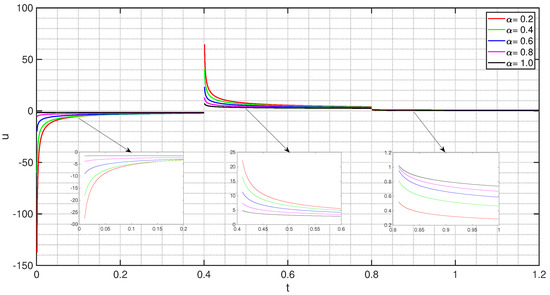
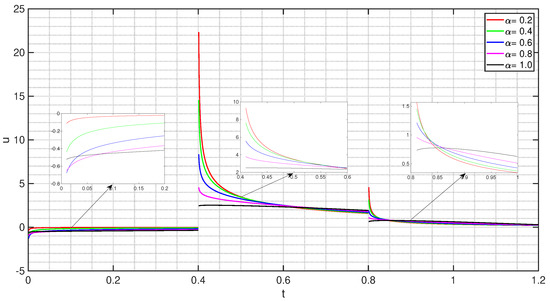
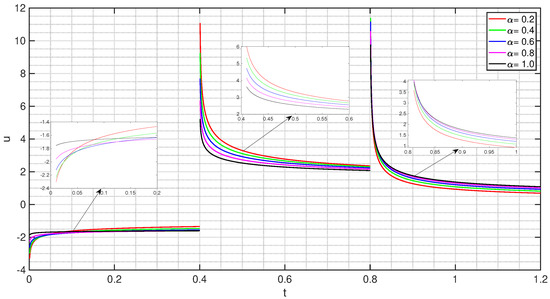
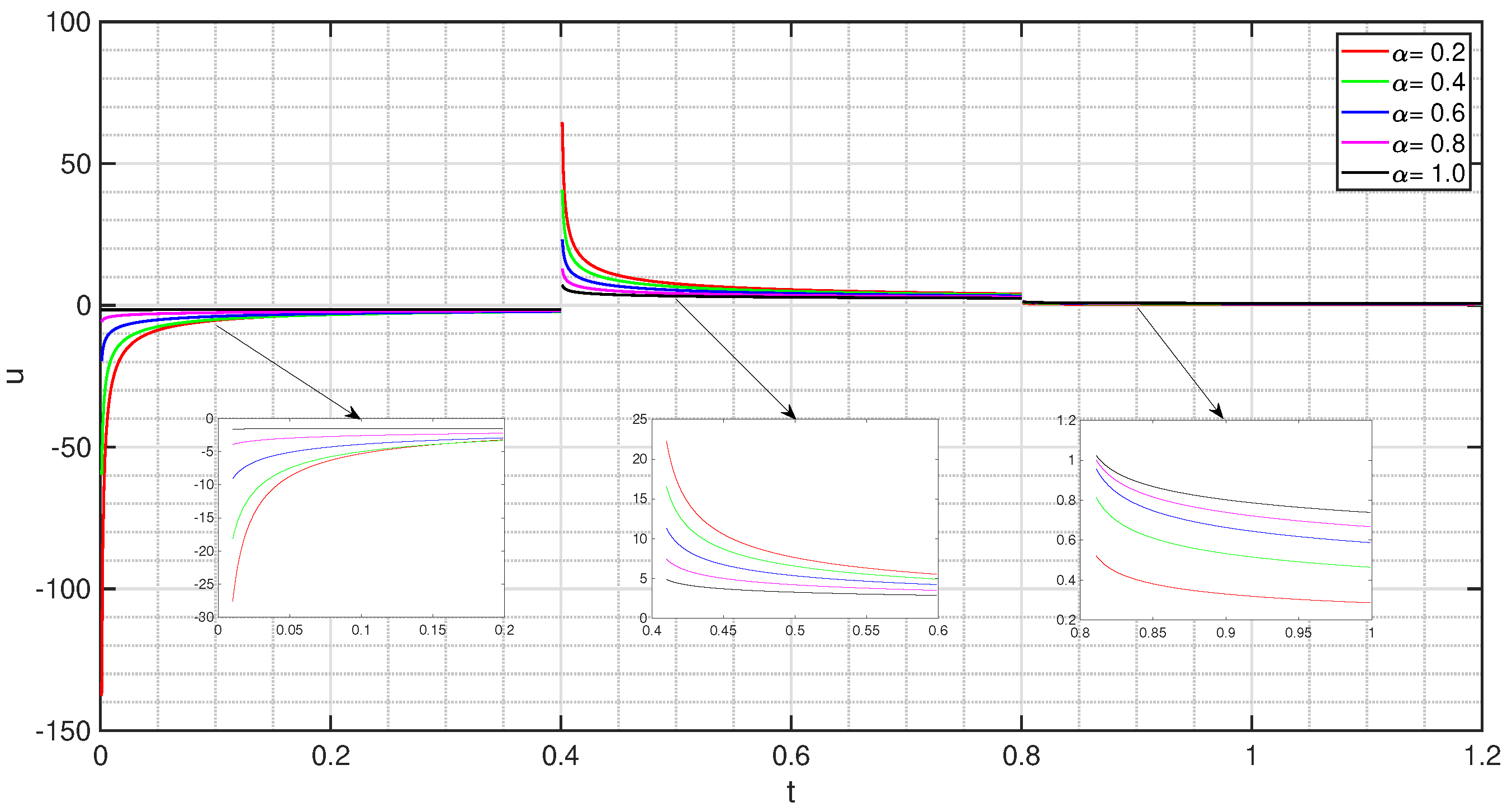
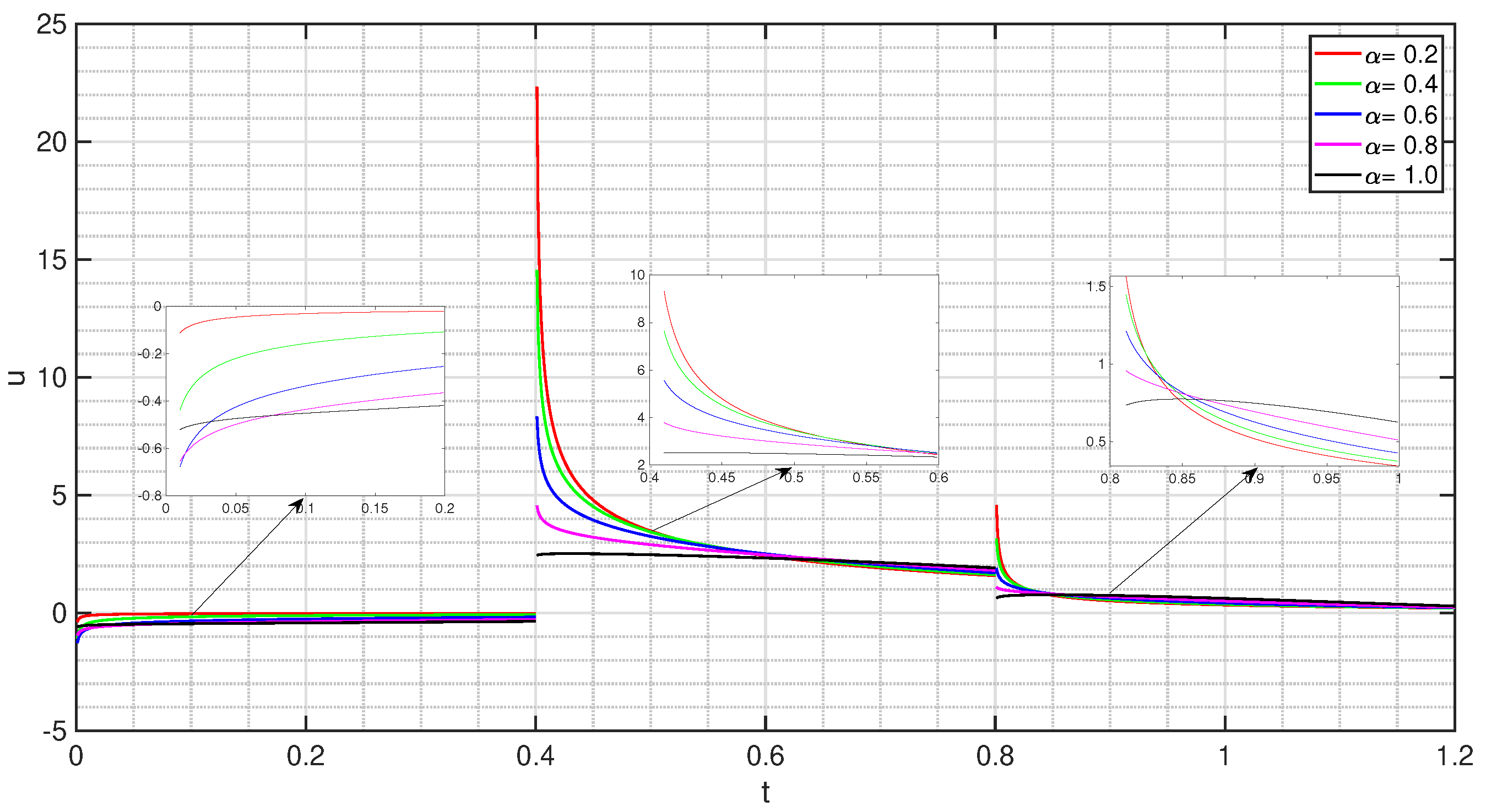
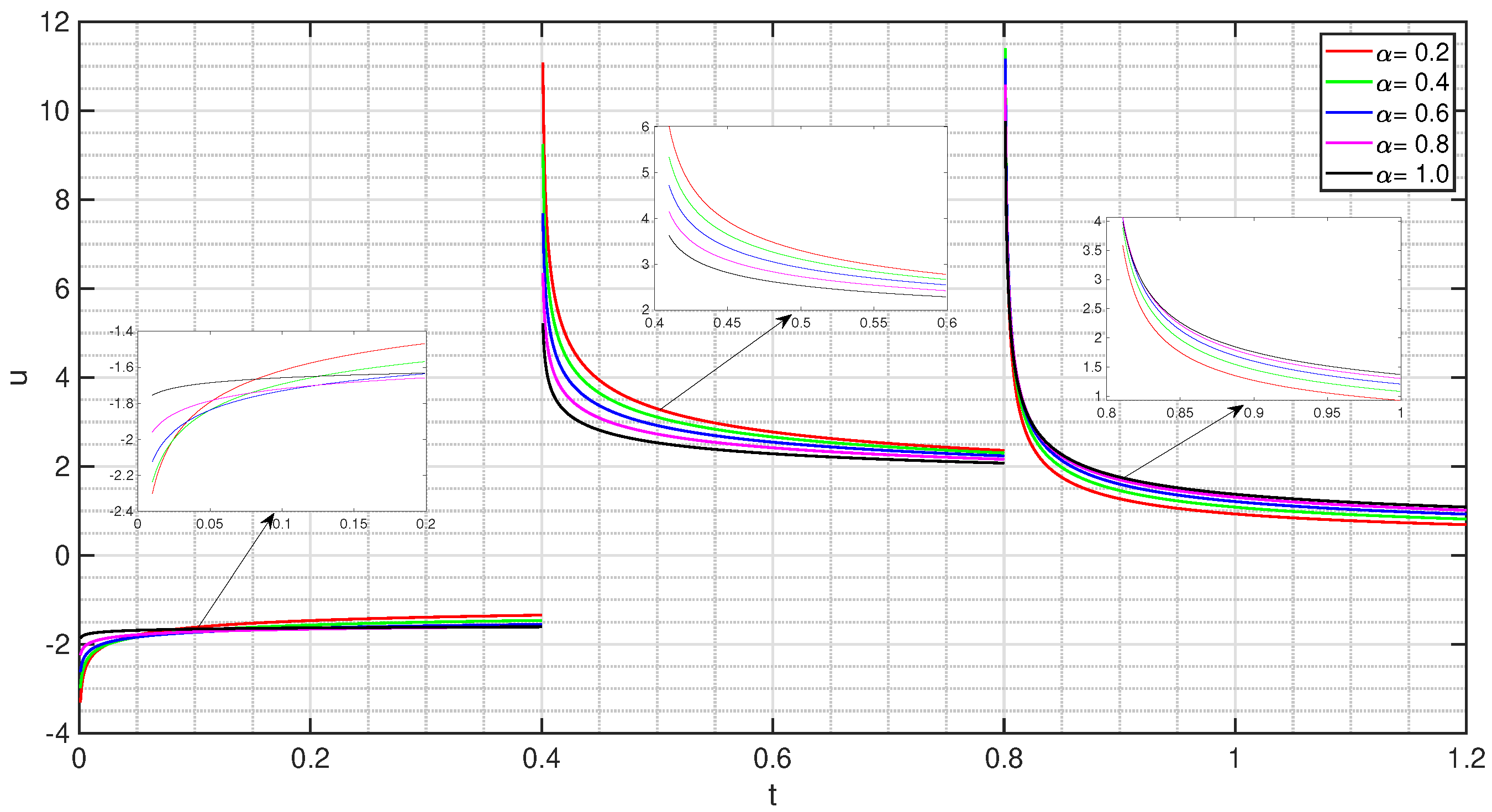
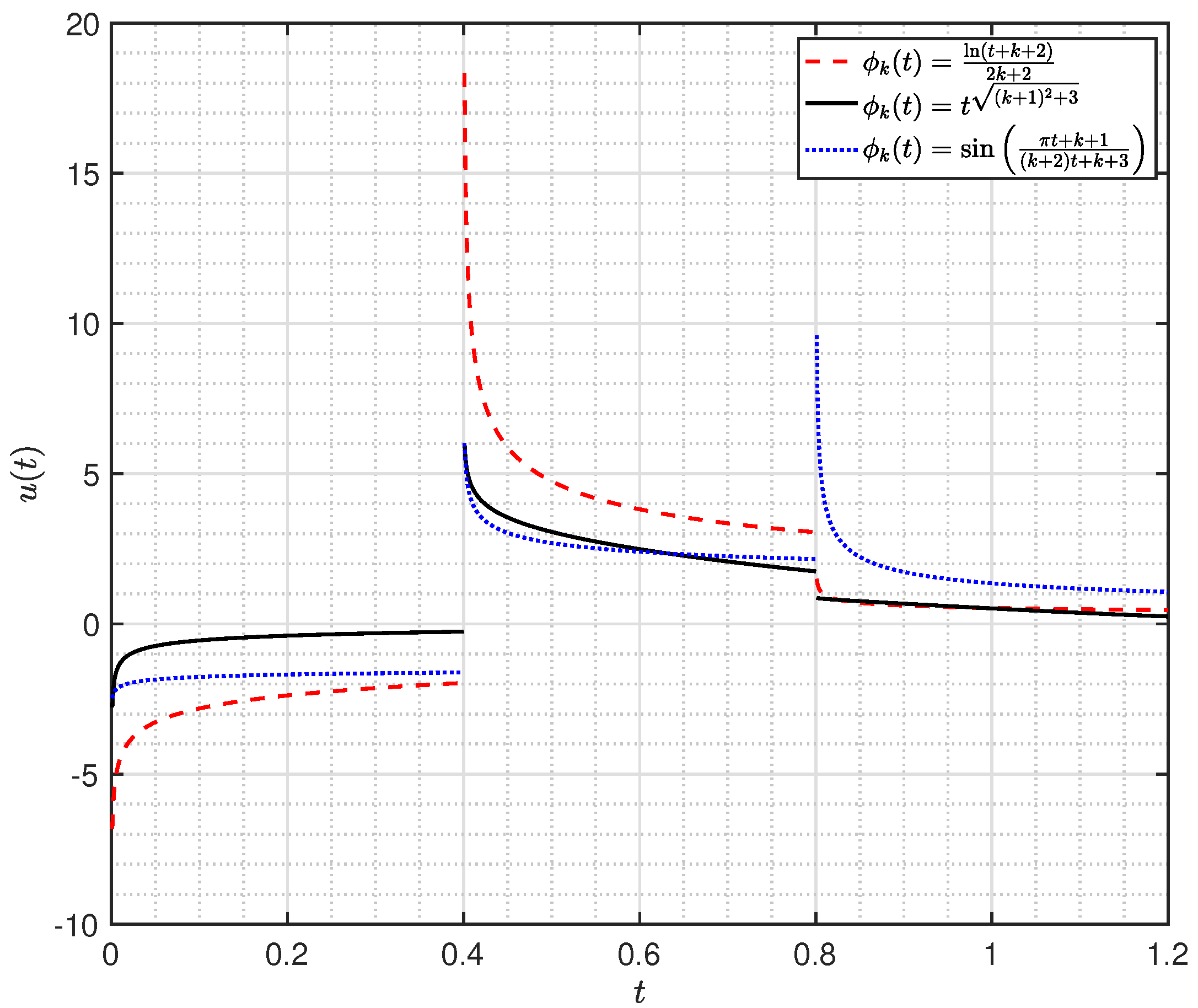
. Consider the functions and . By using (14), (22), (23), (24), the numerical values of Ξ, , , for , as shown in Table 1. From Lemma 7, we obtain the implicit solutions of the problem (49), as shown in Figure 1, via fixed values of , , and with vary for . By using (14), (22), (23), (24), the numerical values of Ξ, , , for , , as shown in Table 2. From Lemma 7, we obtain the implicit solutions of the problem (49) as shown in Figure 2 via fixed values of , , and with vary for . Later, by using (14), (22), (23), (24), the numerical values of Ξ, , , for , , as shown in Table 3. From Lemma 7, we obtain the implicit solutions of the problem (49) as shown in Figure 3 via fixed values of , , and with vary for . In addition, we will show the implicit solutions of the problem (49) as shown in Figure 4 for each values of , , , are given as in Table 4.
Table 1.
Numerical values of and , , for when , , and for .
Figure 1.
The implicit solutions of Example (49) via when , , and for .
Table 2.
Numerical values of and , , for when , , and for .
Figure 2.
The implicit solutions of Example (49) via when , , and for .
Table 3.
Numerical values of and , , for when , , and for .
Figure 3.
The implicit solutions of Example (49) via when , , and for .
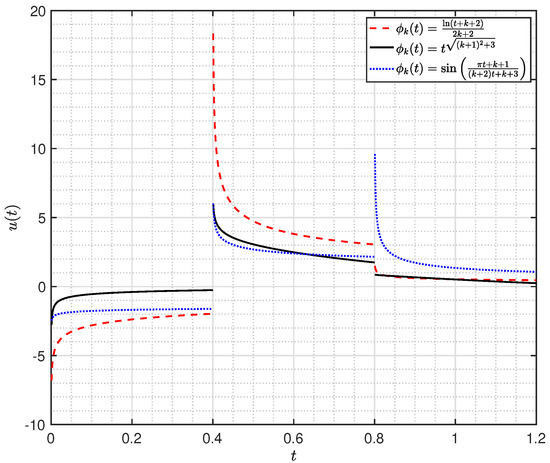
Table 4.
The values of , , , , and .
6. Conclusions
In this paper, we studied the impulsive -Hilfer s with a constant coefficient involving -s. Firstly, we created some essential properties to apply to our main results. The formula of the solution to the linear ()-Hilfer fractional Cauchy problem was constructed in the form of the Mittag–Leffler kernel. The non-linear impulsive -Hilfer fractional Cauchy was converted into a fixed-point problem via an auxiliary lemma regarding a linear variant of the problem. The uniqueness result was investigated by Banach’s fixed point theorem, while the existence result was proved by a fixed point theorem due to O’Regan. In addition, by applying non-linear functional analysis methods and qualitative theory, a variety of stability, stability, and their generalization are also examined. To confirm all the achieved theoretical results, numerical examples were given to present the application of our main results in the recent past. Apart from that, our main results are not only novel in the context of the impulsive problem at hand, but they also show some new special situations by adjusting the parameters involved. They have enriched the qualitative theory literature on non-linear impulsive ()-Hilfer s of order in equipped with -s. In future work areas, we recommend working on the qualitative theory literature on non-linear fractional integro-differential equations/inclusions involving a special function, such as the linear Cauchy-type problem with variable coefficients, stability, or the algorithms to solve the ()-Hilfer fractional differential equations in mathematical software.
Author Contributions
Conceptualization, M.K., R.P., W.S., J.A., C.T. and J.K.; methodology, M.K., R.P. and W.S.; software, M.K., W.S. and C.T.; validation, M.K. and W.S.; formal analysis, M.K., W.S., J.A., C.T. and J.K.; investigation, M.K. and W.S.; resources, M.K. and W.S.; data curation, M.K. and W.S.; writing—original draft preparation, M.K., R.P., W.S., J.A., C.T. and J.K.; writing—review and editing, M.K., R.P., W.S., J.A., C.T. and J.K.; visualization, M.K. and W.S.; supervision, W.S. and J.A.; project administration, W.S.; funding acquisition, M.K. All authors have read and agreed to the published version of the manuscript.
Funding
This research received no external funding.
Data Availability Statement
Not applicable.
Acknowledgments
M. Kaewsuwan, R. Phuwapathanapun, and W. Sudsutad would like to thank you for financially supporting this paper through Ramkhamhaeng University. J. Alzabut is thankful to Prince Sultan University and OSTİM Technical University for their endless support. J. Kongson and C. Thaiprayoon would like to extend their appreciation to Burapha University.
Conflicts of Interest
The authors declare no conflict of interest.
Abbreviations
The following abbreviations are used in this manuscript:
| Fractional calculus | |
| Riemann–Liouville | |
| Non-local multi-point | |
| Boundary value problem | |
| Fractional integral operator | |
| Fractional derivative operator | |
| Fractional differential equation | |
| Fractional integral boundary condition | |
| Fractional integro-differential equation |
References
- Hilfer, R. Applications of Fractional Calculus in Physics; World Scientific: Singapore, 2000. [Google Scholar]
- Fallahgoul, H.A.; Focardi, S.M.; Fabozzi, F.J. Fractional Calculus and Fractional Processes with Applications to Financial Economics; Theory and Application; Elsevier/Academic Press: London, UK, 2017. [Google Scholar]
- Tarasov, V.E. Fractional Dynamics: Application of Fractional Calculus to Dynamics of Particles, Fields and Media; Springer & HEP: Berlin, Germany, 2011. [Google Scholar]
- Magin, R.L. Fractional Calculus in Bioengineering; Begell House Publishers: Danbury, CT, USA, 2006. [Google Scholar]
- Thaiprayoon, C.; Kongson, J.; Sudsutad, W.; Alzabut, J.; Etemad, S.; Rezapour, S. Analysis of a nonlinear fractional system for Zika virus dynamics with sexual transmission route under generalized Caputo-type derivative. J. Appl. Math. Comput. 2022. [Google Scholar] [CrossRef]
- Kongson, J.; Thaiprayoon, C.; Neamvonk, A.; Alzabut, J.; Sudsutad, W. Investigation of fractal-fractional HIV infection by evaluating the drug therapy effect in the Atangana-Baleanu sense. Math. Biosci. Eng. 2022, 19, 10762–10808. [Google Scholar] [CrossRef] [PubMed]
- Chatterjee, A.N.; Ahmad, B. A fractional-order differential equation model of COVID-19 infection of epithelial cells. Chaos Solitons Fractals 2021, 147, 110952. [Google Scholar] [CrossRef] [PubMed]
- Pleumpreedaporn, S.; Pleumpreedaporn, C.; Kongson, J.; Thaiprayoon, C.; Alzabut, J.; Sudsutad, W. Dynamical Analysis of Nutrient-Phytoplankton-Zooplankton Model with Viral Disease in Phytoplankton Species under Atangana-Baleanu-Caputo Derivative. Mathematics 2022, 10, 1578. [Google Scholar] [CrossRef]
- Mainardi, F. Some basic problems in continuum and statistical mechanics. In Fractals and Fractional Calculus in Continuum Mechanics; Carpinteri, A., Mainardi, F., Eds.; Springer: Berlin, Germany, 1997; pp. 291–348. [Google Scholar]
- Mukhtar, S.; Shah, R.; Noor, S. The numerical investigation of a fractional-order multi-dimensional Model of Navier-Stokes equation via novel techniques. Symmetry 2022, 14, 1102. [Google Scholar] [CrossRef]
- Kongson, J.; Sudsutad, W.; Thaiprayoon, C.; Alzabut, J.; Tearnbucha, C. On analysis of a nonlinear fractional system for social media addiction involving Atangana-Baleanu-Caputo derivative. Adv. Differ. Equ. 2021, 2021, 356. [Google Scholar] [CrossRef]
- Podlubny, I. Fractional Differential Equations; Academic Press: New York, NY, USA, 1999. [Google Scholar]
- Kilbas, A.A.; Srivastava, H.M.; Trujillo, J.J. Theory and Applications of the Fractional Differential Equations; North-Holland Mathematics Studies; Elsevier: Amsterdam, The Netherlands, 2006; Volume 204. [Google Scholar]
- Diethelm, K. The Analysis of Fractional Differential Equations. In Lecture Notes in Mathematics; Springer: New York, NY, USA, 2010. [Google Scholar]
- Lakshmikantham, V.; Leela, S.; Devi, J.V. Theory of Fractional Dynamic Systems; Cambridge Scientific Publishers: Cambridge, UK, 2009. [Google Scholar]
- Zhou, Y. Basic Theory of Fractional Differential Equations; World Scientific: Singapore, 2014. [Google Scholar]
- Sousa, J.V.C.; de Oliveira, E.C. On the ψ-Hilfer fractional derivative. Commun. Nonlinear Sci. Numer. Simul. 2018, 60, 72–91. [Google Scholar] [CrossRef]
- Sousa, J.V.C.; de Oliveira, E.C. A Gronwall Inequality and the Cauchy-Type Problem by Means of ψ-Hilfer Operator. Differ. Equ. Appl. 2019, 11, 87–106. [Google Scholar]
- Almalahi, A.; Panchal, K. Existence Results of ψ-Hilfer Integro-Differential Equations with Fractional Order in Banach Space. Ann. Univ. Paedagog. Crac. Stud. Math. 2020, 19, 171–192. [Google Scholar] [CrossRef]
- Liu, K.; Wang, J.; O’Regan, D. Ulam-Hyers-Mittag-Leffer Stability for ψ-Hilfer Fractional-Order Delay Differential Equations. Adv. Differ. Equ. 2019, 2019, 50. [Google Scholar] [CrossRef]
- Alzabut, J.; Adjabi, Y.; Sudsutad, W.; Rehman, M.-U. New Generalizations for Gronwall Type Inequalities Involving a ψ-Fractional Operator and Their Applications. AIMS Math. 2021, 6, 5053–5077. [Google Scholar] [CrossRef]
- Thaiprayoon, C.; Sudsutad, W.; Ntouyas, S.K. Mixed Nonlocal Boundary Value Problem for Implicit Fractional Integro-Differential Equations via ψ-Hilfer Fractional Derivative. Adv. Differ. Equ. 2021, 2021, 50. [Google Scholar] [CrossRef]
- Kucche, K.D.; Mali, A.D. On the nonlinear (k,ψ)-Hilfer fractional differential equations. Chaos Solitons Fractals 2021, 152, 111335. [Google Scholar] [CrossRef]
- Bainov, D.D.; Simeonov, P.S. Impulsive Differential Equations: Periodic Solutions and Applications; Longman Scientific and Technical Group Limited: New York, NY, USA, 1993. [Google Scholar]
- Benchohra, M.; Henderson, J.; Ntouyas, S.K. Impulsive Differential Equations and Inclusions; Hindawi Publishing Corporation: New York, NY, USA, 2006; Volume 2. [Google Scholar]
- Samoilenko, A.M.; Perestyuk, N.A. Impulsive Differential Equations; World Scientific: Singapore, 1995. [Google Scholar]
- Benchohra, M.; Slimani, B.A. Existence and Uniqueness of Solutions to Impulsive Fractional Differential Equations. Elect. J. Diff. Equ. 2009, 2009, 111. [Google Scholar]
- Benchohra, M.; Seba, D. Impulsive Fractional Differential Equations in Banach Spaces. Elect. J. Qual. Theory Differ. Equ. 2009, 8, 14. [Google Scholar] [CrossRef]
- Wang, J.; Zhou, W.; Fečkan, M. Nonlinear Impulsive Problems for Fractional Differential Equations and Ulam Stability. Comput. Math. Appl. 2012, 64, 3389–3405. [Google Scholar] [CrossRef]
- Wang, J.R.; Lin, Z. On the Impulsive Fractional Anti-Periodic BVP Modelling with Constant Coefficients. J. Appl. Math. Comput. 2014, 46, 107–121. [Google Scholar] [CrossRef]
- Zuo, M.; Hao, X.; Liu, L.; Cui, Y. Existence Results for Impulsive Fractional Integro-Differential Equation of Mixed Type with Constant Coefficient and Antiperiodic Boundary Conditions. Bound. Value Probl. 2017, 2017, 161. [Google Scholar] [CrossRef]
- Kucche, K.D.; Kharade, J.P.; Sousa, J.V.C. On the Nonlinear Impulsive ψ-Hilfer Fractional Differential Equations. Math. Model. Anal. 2020, 25, 642–660. [Google Scholar] [CrossRef]
- Salim, A.; Benchohra, M.; Lazreg, J.E.; Henderson, J. On k-Generalized ψ-Hilfer Boundary Value Problems with Retardation and Anticipation. Adv. Theory Nonlinear Anal. Appl. 2022, 6, 173–190. [Google Scholar]
- Fečkan, M.; Zhou, Y.; Wang, J. On the Concept and Existence of Solution for Impulsive Fractional Differential Equations. Commun. Nonlinear Sci. Numer Simulat. 2012, 17, 3050–3060. [Google Scholar] [CrossRef]
- Guo, T.L.; Jiang, W. Impulsive Fractional Functional Differential Equations. Comput. Math. Appl. 2012, 64, 3414–3424. [Google Scholar] [CrossRef]
- Wang, J.; Zhou, Y.; Fečkan, M. On Recent Developments in the Theory of Boundary Value Problems for Impulsive Fractional Differential Equations. Comput. Math. Appl. 2012, 64, 3008–3020. [Google Scholar] [CrossRef][Green Version]
- Shah, K.; Ali, A.; Bushnaq, S. Hyers-Ulam Stability Analysis to Implicit Cauchy Problem of Fractional Differential Equations with Impulsive Conditions. Math. Meth. Appl. Sci. 2018, 41, 8329–8343. [Google Scholar] [CrossRef]
- Malti, A.I.N.; Benchohra, M.; Graef, J.R.; Lazreg, J.E. Impulsive Boundary Value Problems for Nonlinear Implicit Caputo- Exponential Type Fractional Differential Equations. Electron. J. Qual. Theory Differ. Equ. 2020, 78, 1–17. [Google Scholar] [CrossRef]
- Abbas, M.I. On the Initial Value Problems for the Caputo-Fabrizio Impulsive Fractional Differential Equations. Asian-Eur. J. Math. 2020, 14, 2150073. [Google Scholar] [CrossRef]
- Salim, A.; Benchohra, M.; Karapinar, E.; Lazreg, J.E. Existence and Ulam Stability for Impulsive Generalized Hilfer-Type Fractional Differential Equations. Adv. Differ. Equ. 2020, 2020, 601. [Google Scholar] [CrossRef]
- Salim, A.; Benchohra, M.; Lazreg, J.E.; Henderson, J. Nonlinear Implicit Generalized Hilfer-Type Fractional Differential Equations with Non-Instantaneous Impulses in Banach Spaces. Adv. Theory Nonlinear Anal. Appl. 2020, 4, 332–348. [Google Scholar] [CrossRef]
- Khaminsou, B.; Sudsutad, W.; Thaiprayoon, C.; Alzabut, J.; Pleumpreedaporn, S. Analysis of Impulsive Boundary Value Pantograph Problems via Caputo Proportional Fractional Derivative under Mittag-Leffler Functions. Fractal Fract. 2021, 5, 251. [Google Scholar] [CrossRef]
- Kharade, J.P.; Kucche, K.D. On the Impulsive Implicit ψ-Hilfer Fractional Differential Equations with Delay. Math. Meth. Appl. Sci. 2020, 43, 1938–1952. [Google Scholar] [CrossRef]
- Savrankumar, S.; Raja, R.; Alzabut, J. Delay-Dependent Passivity Analysis of Non-Deterministic Genetic Regulatory Networks with Leakage and Distributed Delays Against Impulsive Perturbations. Adv. Differ. Equ. 2021, 2021, 353. [Google Scholar] [CrossRef]
- Pratap, A.; Raja, R.; Alzabut, J.; Cao, J.; Rajachakit, G.; Hunag, C. Mittag-Leffler Stability and Adaptive Impulsive Synchronization of Fractional Order Neural Networks in Quaternion Field. Math. Meth. Appl. Sci. 2020, 43, 6223–6253. [Google Scholar] [CrossRef]
- Afshari, H.; Marasi, H.R.; Alzabut, J. Applications of New Contraction Mappings on Existence and Uniqueness Results for Implicit Φ-Hilfer Fractional Pantograph Differential Equations. J. Inequa. Appl. 2021, 2021, 185. [Google Scholar] [CrossRef]
- Kwun, Y.C.; Farid, G.; Nazeer, W.; Ullah, S.; Kang, S.M. Generalized Riemann-Liouville k-fractional integrals associated with Ostrowski type inequalities and error bounds of Hadamard inequalities. IEEE Access 2018, 6, 64946–64953. [Google Scholar] [CrossRef]
- Diaz, R.; Pariguan, E. On hypergeometric functions and Pochhammer k-symbol. Divulg. Mat. 2007, 2, 179–192. [Google Scholar]
- Dorrego, G.A. An Alternative Definition for the k-Riemann-Liouville Fractional Derivative. Appl. Math. Sci. 2015, 9, 481–491. [Google Scholar] [CrossRef]
- Naz, S.; Naeem, M.N. On the Generalization of k-Fractional Hilfer-Katugampola Derivative with Cauchy Problem. Turk. J. Math. 2021, 45, 110–124. [Google Scholar] [CrossRef]
- Wang, J.R.; Fečkan, M.; Zhou, Y. Presentation of Solutions of Impulsive Fractional Langevin Equations and Existence Results. Eur. Phys. J. Spec. Top. 2013, 222, 1857–1874. [Google Scholar] [CrossRef]
- Almalahi, M.A.; Panchal, S.K. Some existence and stability results for ϕ-Hilfer fractional implicit diferential equation with periodic conditions. J. Math. Anal. Model. 2020, 1, 1–19. [Google Scholar] [CrossRef]
- Granas, A.; Dugundji, J. Fixed Point Theory; Springer: New York, NY, USA, 2003. [Google Scholar]
- O’Regan, D. Fixed-point theory for the sum of two operators. Appl. Math. Lett. 1996, 9, 1–8. [Google Scholar] [CrossRef]
Publisher’s Note: MDPI stays neutral with regard to jurisdictional claims in published maps and institutional affiliations. |
© 2022 by the authors. Licensee MDPI, Basel, Switzerland. This article is an open access article distributed under the terms and conditions of the Creative Commons Attribution (CC BY) license (https://creativecommons.org/licenses/by/4.0/).