


Abstract
This paper deals with the study of mixed variational-like inclusions involving Yosida approximation operator (MVLIYAO) and η-proximal mapping in Banach spaces. It is investigated that (MVLIYAO) is equivalent to fixed point problems in Banach spaces. Using this equivalence, a new iterative algorithm is proposed to find the solution of (MVLIYAO). A numerical example is provided to support our main result by using the MATLAB program.
Keywords:
mixed variational-like inclusion; Yosida approximation operator; η-proximal operator; iterative algorithm MSC:
49J40; 47J25; 47H05
1. Introduction
The theory of variational inequality (VI) has come out as a highly useful and potent means for investigating plenty of problems in both pure and applied sciences, for instance, differential equations, control problems, contact problems in elasticity, mechanics, general equilibrium problems in transportation and economics, and unilateral, moving, obstacle and free boundary problems, see [1,2,3,4,5]. Later, Hassouni and Moudafi [6] established and investigated a class of VI known as the variational inclusions problem, and formed a perturbed algorithm that approximates the solution to this problem. Subsequently, Adly [7], Huang [8], Kazmi [9] and Ding [10] have generalized and extended the results in [6] in many directions. Lescarret [11] and Browder [12] first investigated the mixed variational inequality problem (MVIP) due to its numerous uses. Konnov and Volotskaya [13] studied oligopolistic equilibrium and general equilibrium problems, both of which can be expressed as (MVIP). All projection techniques are unable to solve mixed variational inequalities because they include a nonlinear term. The resolvent technique of a maximal monotone operator is appropriate to solve these problems.
The idea of monotone operators (MO) was presented and investigated by Zarantonello [14] and Minty [15] independently. Numerous researchers have shown a significant amount of interest as these operators have close links with the following evolution equation:
It serves as a model for a variety of physical problems with practical applications. If the involved function A is not continuous, solving these models is hard. Considering a sequence of Lipschitz functions that roughly approximate A is a natural solution to this problem. This notion was proposed by Yosida. However, the resolvent operator (RO) and the Yosida approximation operator (YAO) associated with a MO are two very effective single-valued Lipschitz continuous operators. Ram and Iqbal [16] investigated the generalized monotone mapping and defined the corresponding resolvent operator. They proved the equivalence of generalized set-valued variational inclusion problems and resolvent equations to develop an algorithm for determining the existence of a solution.
The Yosida approximation method can be used to transform the monotone operators into single-valued monotone operators of the Lipschitzian type on Hilbert spaces. This can be done by regularizing the monotone operators [17,18,19,20]. Likewise, this concept was extended to investigate problems in Banach spaces, see [21,22]. While employing resolvent operators to find the solutions to variational inclusion problems, the Yosida approximation operators are highly useful. Rajpoot et al. [23] investigated (MVIP) involving a generalized YAO. They provided a fixed point formulation to define an iterative algorithm to show the existence and convergence of the solutions of the problem in q-uniformly smooth Banach space. Many authors have recently used YAO to investigate certain variational inclusion problems employing various methods; see, for instance [24,25,26,27], as well as the references therein.
Motivated by the excellent work discussed above, in this paper, we propose and investigate an (MVLIYAO) in Banach spaces. An equivalence between (MVLIYAO) and the fixed point formulation is established. We establish an iterative algorithm that is acquired from the fixed-point formulation for obtaining the solutions of (MVLIYAO). Both the existence and convergence of the problem have been shown. In the end, a numerical example is produced.
2. Formulation and Preliminaries
Let ℜ be a real Banach space with the norm ; denotes the topological dual of ℜ, d denotes the metric which is generated by the norm ; (respectively, ) denotes the collection of all nonempty subsets (respectively, all nonempty closed and bounded subsets) of ℜ; denotes the Hausdorff metric on expressed as
where and Let be the duality pairing of and ℜ and given by
is the normalized duality mapping.
Definition 1.
Let be a multivalued function, and let and be the functions. Then
- (i)
- P is called -Lipschitz continuous with Lipschitz constant if
- (ii)
- g is called -Lipschitz continuous, if ∃ a constant satisfying
- (iii)
- g is called k-strongly accretive if for some such that
- (iv)
- η is called Lipschitz continuous with constant if
- (v)
- η is called δ-strongly monotone, if ∃ a constant satisfying
Definition 2.
Let and . An element is called η-subgradient of ψ at if
Every ψ can be linked to the η-subdifferential mapping defined by
Definition 3.
Suppose be an η-subdifferential, proper functional and be a function. If for a given , there is a unique point satisfying
then the mapping denoted by is called η-proximal mapping of ψ. We have , as a result
where I denotes the identity mapping on ℜ.
Definition 4.
The Yosida approximation operator (YAO) associated with is defined as
where denotes a constant.
Definition 5.
A functional is called 0-diagonally quasi-concave (0-DQCV) in ν, if for a finite set and for some with and
Definition 6.
A mapping is called -Lipschitz continuous if, a constant , satisfying
Let be the functions and be the multivalued functions. Let be a lower-semicontinuous (l.s.c.) functional on ℜ such that where is -subdifferential of . Let be the YAO. We investigate the following problem.
Find and such that and
Problem (1) is called mixed variational-like inclusion involving YAO (MVLIYAO).
It is noted that, depending on how the operators are chosen, there are many different types of problems that can be obtained from the problem (1) that can be seen in the literature. for example, problems studied by Ding [28], Rajpoot et al. [23], Verma [29], Lee et al. [30], Ahmad et al. [31], Ahmed and Siddiqi [32], etc. can be acquired from problem (1).
Theorem 1
([31]). Suppose that ℜ is a reflexive Banach space and is a l.s.c., η-subdifferential, proper functional. Let is continuous and δ-strongly monotone with , and for any , the function is 0-DQCV in ν. Then for any , and for any , ∃ a unique satisfying
That is, and thus the η-proximal mapping of ψ is well-defined.
We now present certain results that are necessary for the subsequent stage.
Proposition 1.
Suppose is a proper, l.s.c., η-subdifferential, functional. Let be a δ-strongly monotone and τ-Lipschitz continuous with , and for any , the function is 0-DQCV in ν and be a constant. Then is -Lipschitz continuous.
Proof.
By Theorem 1, is well-defined. For some , we get and are such that
Using the τ-Lipschitz continuity and δ-strongly monotonicity of η and , we have
It follows that
that is, is -Lipschitz continuous. □
Proposition 2.
Assume that all of the mappings and conditions are the same as in Proposition 1. Then the YAO is -Lipschitz continuous, where
Proof.
By Definition 4 and Proposition 1, we have
where □
Proposition 3.
Assume that all of the mappings and conditions are the same as in Proposition 1. Then the YAO is strongly accretive with constant , where
Proof.
By Definition 4 and Proposition 1, we have
where and □
Proposition 4.
Suppose that ℜ is a real Banach space and is the normalized duality mapping. Then, for any ,
3. An Iterative Algorithm and Convergence Result
Now, we state an equivalence of a fixed point problem and (MVLIYAO) that is simple to prove using Definition 3.
Lemma 1.
, where and , is a solution of (MVLIYAO) if and only if it agrees to the following equation:
Proof.
Let satisfies (6), i.e.,
Since the above equality holds if and only if
By Definition 3, the above condition holds if and only if
implies that
Hence, is a solution of (MVLIYAO). □
Remark 1.
Equation (6) can be expressed as
Now, the following iterative algorithm is proposed by using the above fixed point formulation.
Theorem 2.
Let ℜ be a reflexive Banach space. Let be -Lipschitz continuous functions with Lipschitz constants and , respectively. Let be Lipschitz continuous with Lipschitz constant and respectively. Let be Lipschitz continuous with Lipschitz constant . Suppose that is δ-strongly monotone and τ-Lipschitz continuous such that and for all given , the function is 0-DQCV in ν. Suppose is proper, l.s.c., η-subdifferential functional satisfying . Let YAO is Lipschitz continuous with constant and is strongly accretive with constant . Suppose that a constant is such that the following condition is satisfied
Then, the iterative sequences and generated by Algorithm 1 converges strongly to and ζ, respectively.
Proof.
Using Algorithm 1, we have
By Proposition 1, Proposition 1 and using the Lipschitz continuity of , and -Lipschitz continuity of and we have
Using the -strongly accretiveness of , -Lipschitz continuity g and -Lipschitz continuity of , we obtain
From (9)–(11), it follows that
i.e.,
where
Letting , as a result as . From (8), it follows that and hence is a Cauchy sequence in ℜ. We know that ℜ is a Banach space so ∃ such that as . We also know that the functions and C are -Lipschitz continuous, from (15)–(17) it is evident that , and are also Cauchy sequences, we suppose that , and .
| Algorithm 1: Iterative Algorithm. |
For any and from (7), let
|
Since and , by Nadler’s theorem [33], and such that
|
Following the above approach inductively, we get, for any and , compute and by iterative process such that
|
At last, we show that , and . Moreover, since and
We have
which suggests that Since as a result Likewise, we can show that and . By Lemma 1, we get the required results. □
4. Numerical Example
We present the following numerical example using MATLAB, R2021a, to support our result.
Example 1.

Suppose , and are the functions such that, ,
Clearly ,
- (i)
- the function g is Lipschitz continuous with constant . i.e.,
- (ii)
- Let be defined asThen, the η-subdifferential of ψ, which is, .Now, for , we compute the η-proximal operator and YAO:andClearly, is -Lipschitz continuous, where and is -Lipschitz continuous, where .
- (iii)
- is strongly accretive with constant . Astherefore,
- (iv)
- Let be the functions and be the multivalued functions given byAccordingly,
Using (14) of Algorithm 1 and by taking , we have
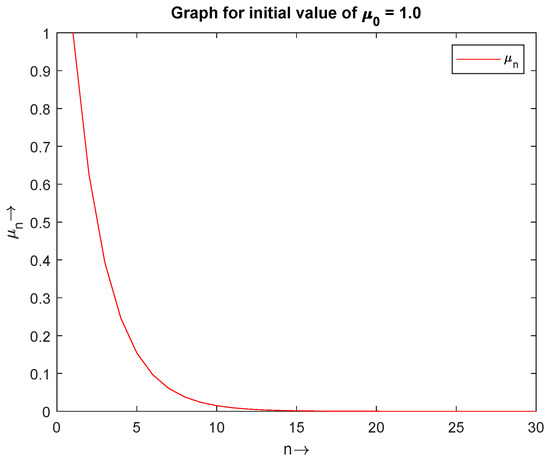
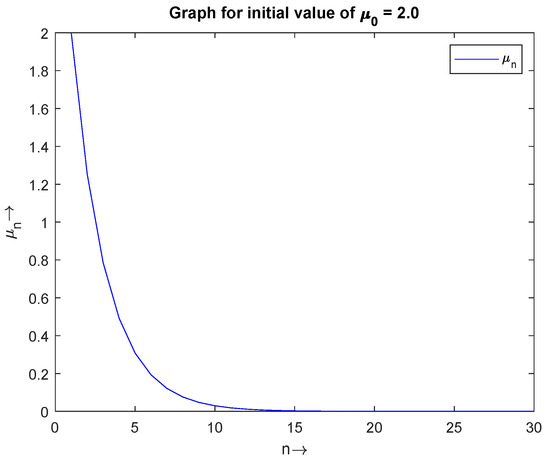
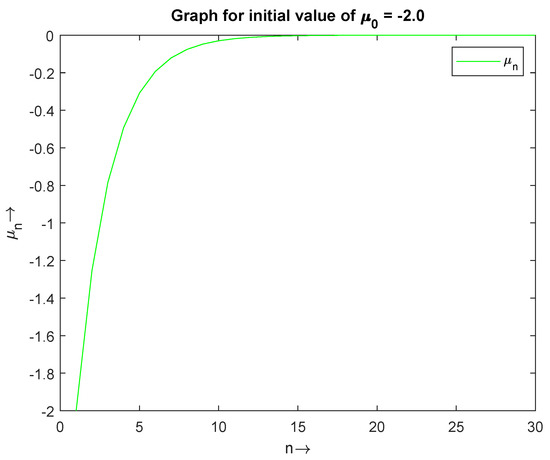
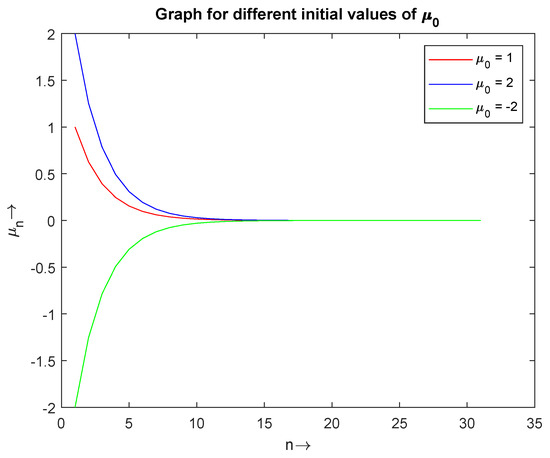
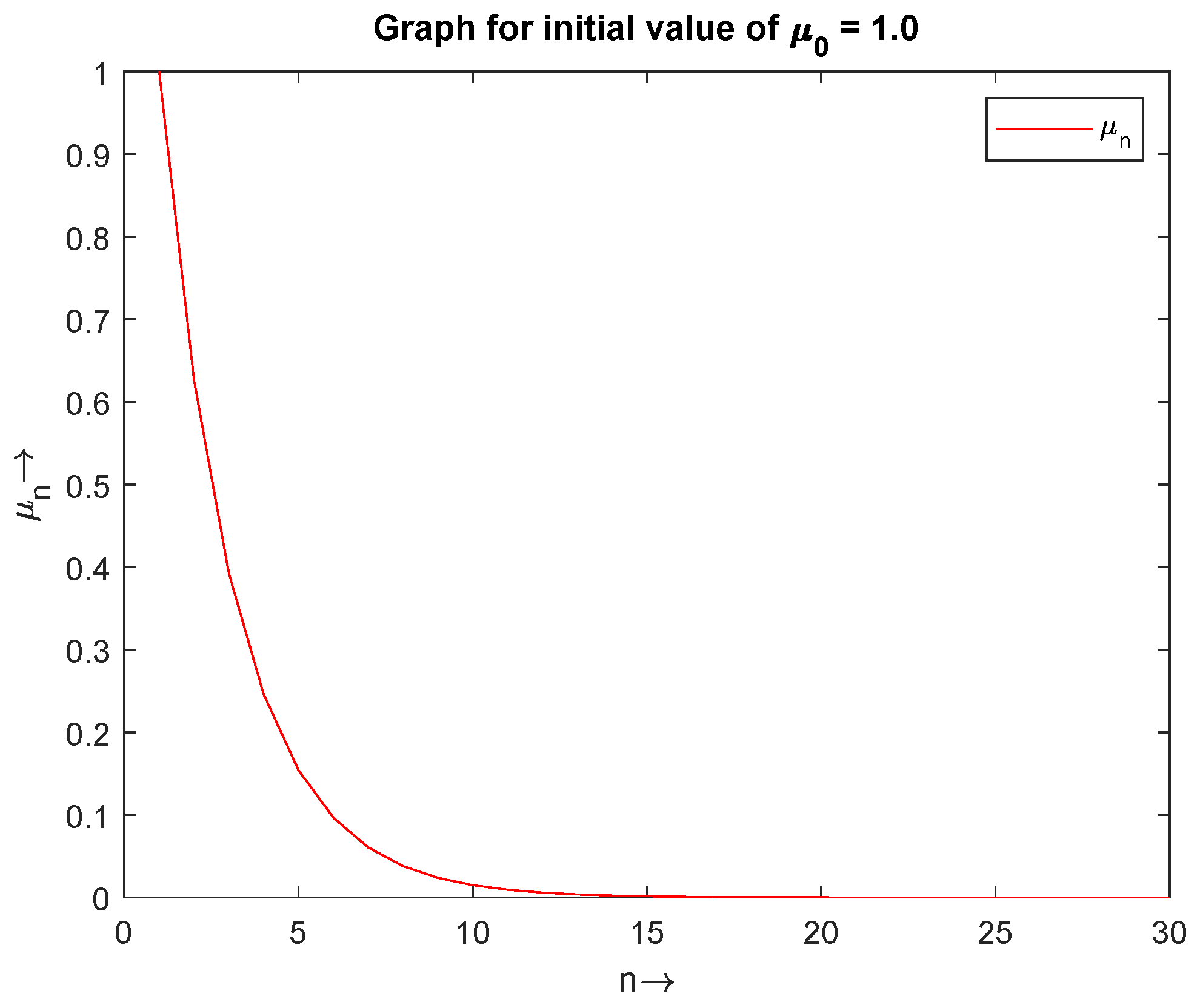
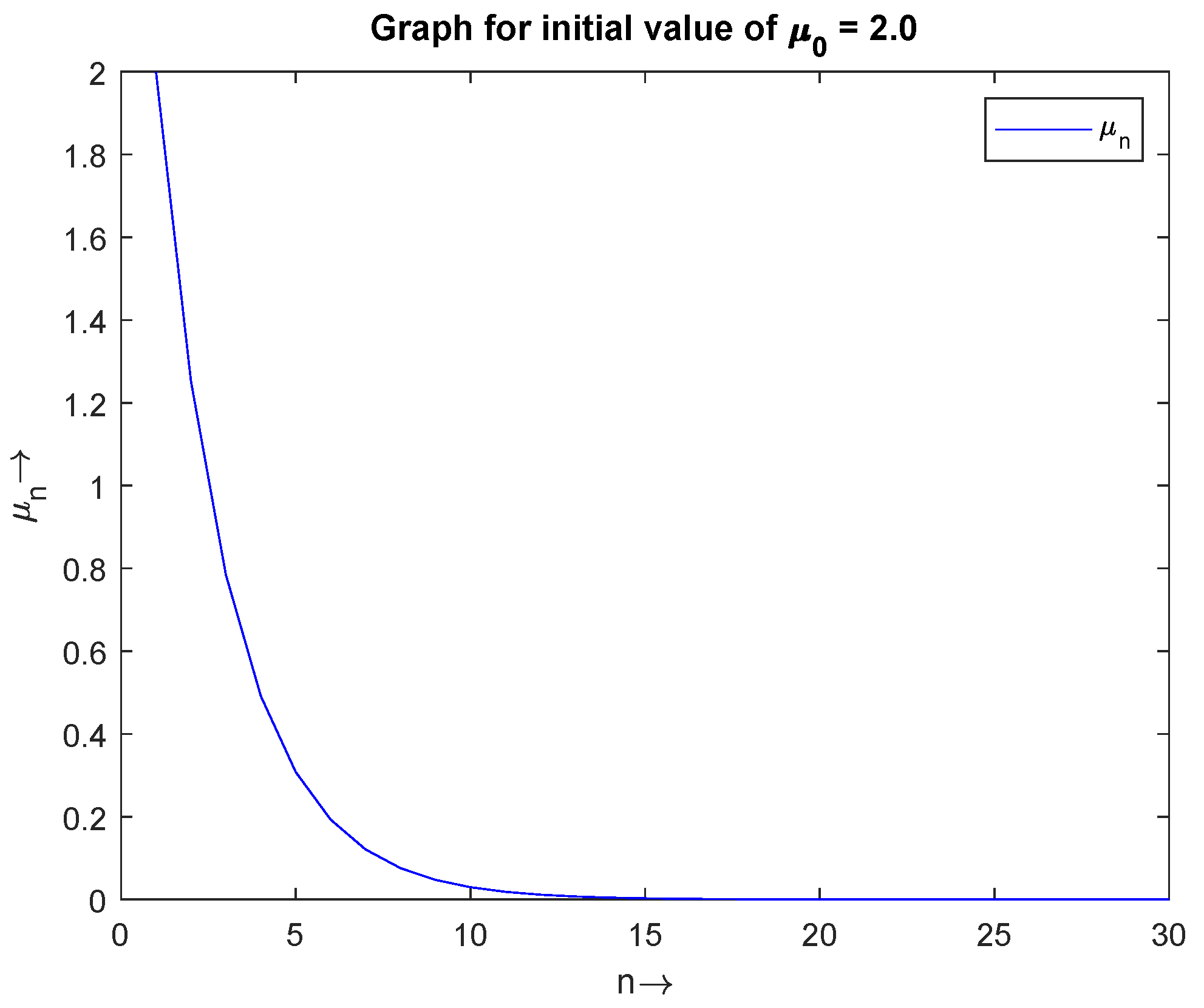
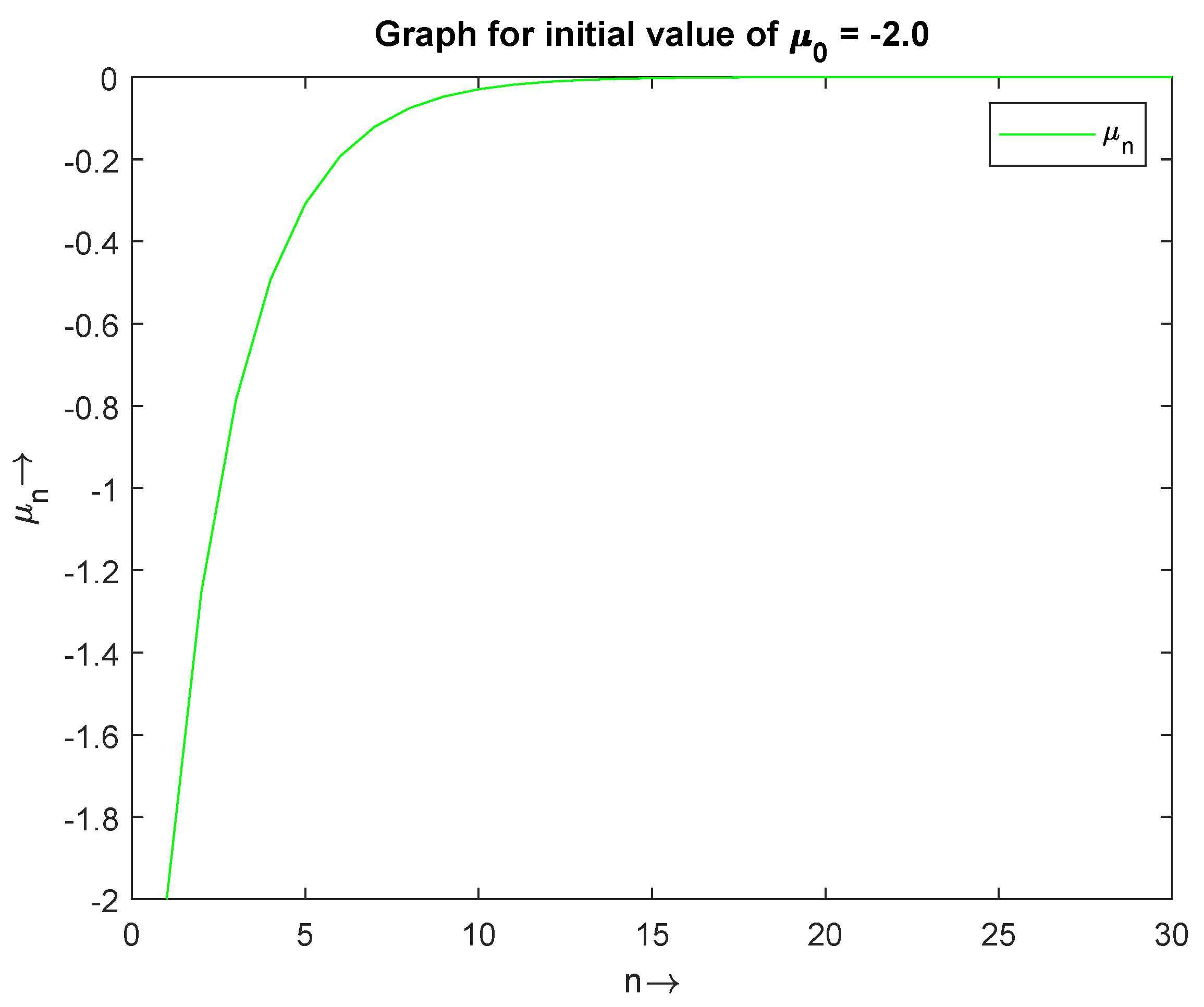
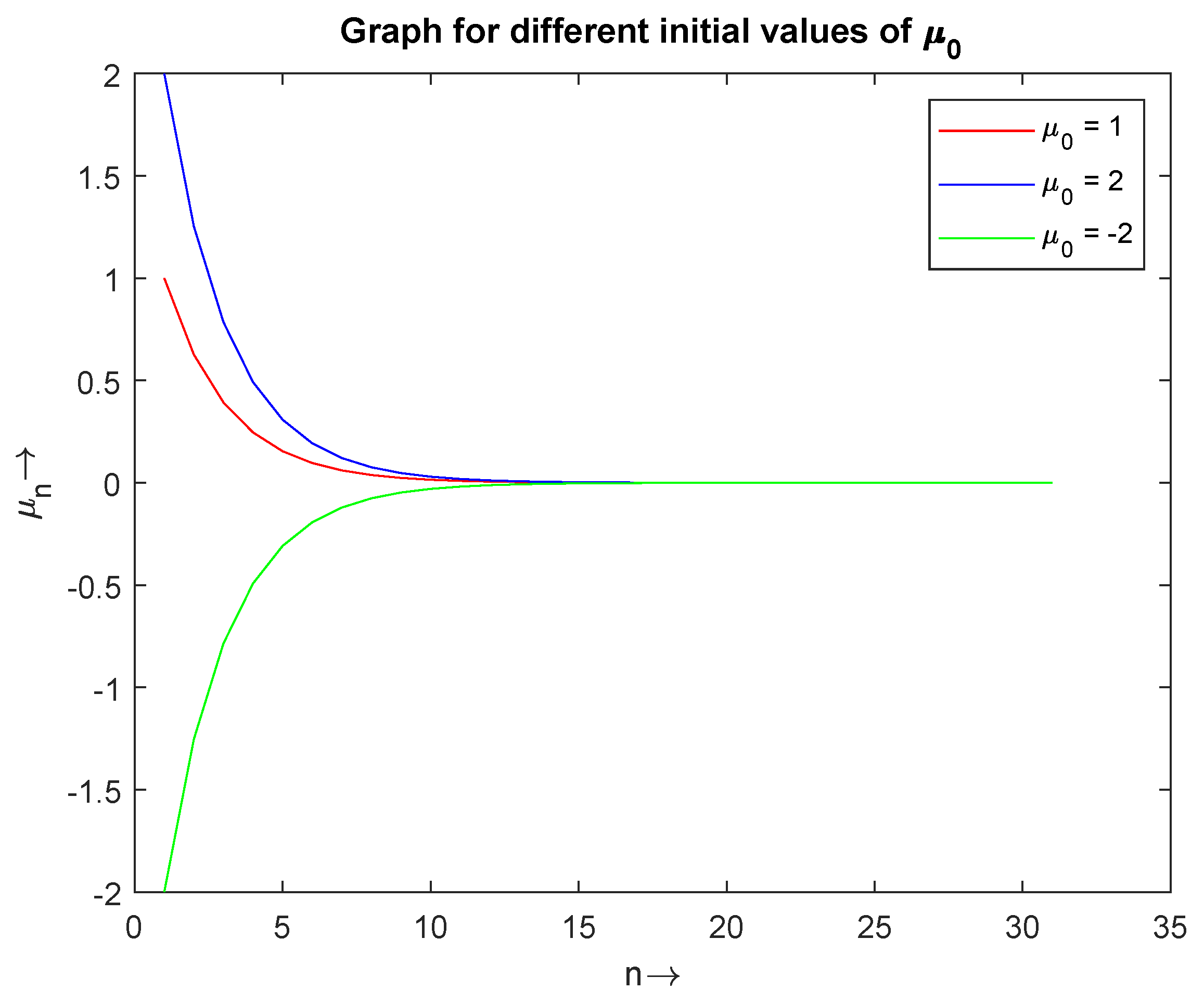
Figure 1, Figure 2 and Figure 3 (Table 1) show the convergence of for the initial values and , respectively. In Figure 4, we have drawn a combine graph of for the initial values , and it is shown that the sequence converges to 0.
Figure 1.
The convergence of with initial value .
Figure 2.
The convergence of with initial value .
Figure 3.
The convergence of with initial value .
Table 1.
Computational results for different initial values of .
Figure 4.
The convergence of with initial values and .
5. Conclusions
In order to establish the existence of the solution of (MVLIYAO), we find the equivalence between fixed point formulation and (MVLIYAO). Further, we proposed an iterative algorithm that is acquired from fixed point formulation to approximate the solution of (MVLIYAO). An existence and convergence result is obtained for (MVLIYAO) in Banach spaces. A numerical example is constructed to show the validity of our main result and the convergence graphs are presented using MATLAB programming. Furthermore, we mention that our results generalize the many existing results in the literature which can be extended to other spaces.
Author Contributions
Conceptualization, F.A.K.; Data curation, M.I. and H.I.A.M.; Formal analysis, T.R. and H.I.A.M.; Funding acquisition, F.A.K. and H.I.A.M.; Investigation, M.I.; Methodology, M.I., T.R. and H.I.A.M.; Project administration, F.A.K. and T.R.; Resources, M.I. and H.I.A.M.; Software, T.R. and H.I.A.M.; Supervision, F.A.K.; Validation, T.R.; Writing—original draft, M.I.; Writing—review and editing, F.A.K. All the authors contributed equally and significantly in writing this article. All authors have read and agreed to the published version of the manuscript.
Funding
This research received no external funding.
Institutional Review Board Statement
Not applicable.
Informed Consent Statement
Not applicable.
Data Availability Statement
Not applicable.
Acknowledgments
We are grateful for the comments and suggestions of the reviewers and editor, which improve the paper a lot.
Conflicts of Interest
The authors declare no conflict of interest.
References
- Baiocchi, C.; Capelo, A. Variational and Quasivariational Inequalities, Applications to Free Boundary Problems; Wiley: New York, NY, USA, 1984. [Google Scholar]
- Giannessi, F.; Maugeri, A. Variational Inequalities and Network Equilibrium Problems; Plenum Press: New York, NY, USA, 1995. [Google Scholar]
- Glowinski, R.; Lions, J.; Tremolieres, R. Numercial Analysis of Variational Inequalities; North-Holland: Amsterdam, The Netherlands, 1981. [Google Scholar]
- Harker, P.T.; Pang, J.S. Finite-dimensional variational inequality and nonlinear complementarity problems. Math. Program. 1990, 48, 161–220. [Google Scholar] [CrossRef]
- Kinderlehrer, D.; Stampacchia, G. An Introduction to Variational Inequalities and Their Applications; Academic Press: New York, NY, USA, 1980. [Google Scholar]
- Hassouni, A.; Moudafi, A. A perturbed algorithm for variational inclusions. J. Math. Anal. Appl. 1994, 185, 706–712. [Google Scholar] [CrossRef]
- Adly, S. Perturbed algorithms and sensitivity analysis for a general class of variational inclusions. J. Math. Anal. Appl. 1996, 201, 609–630. [Google Scholar] [CrossRef]
- Huang, N.J. Generalized nonlinear variational inclusions with noncompact valued mappings. Appl. Math. Lett. 1996, 9, 25–29. [Google Scholar] [CrossRef]
- Kazmi, K.R. Mann and Ishikawa perturbed iterative algorithms for generalized quasivariational inclusions. J. Math. Anal. Appl. 1997, 209, 572–584. [Google Scholar] [CrossRef]
- Ding, X.P. Perturbed proximal point algorithms for generalized quasivariational inclusions. J. Math. Anal. Appl. 1997, 210, 88–101. [Google Scholar] [CrossRef]
- Lescarret, C. Cas d‘addition des applications monotones maximales dans un espace de Hilbert. C. R. I‘Acadimic Sci. 1965, 261, 1160–1163. [Google Scholar]
- Browder, F.E. On the unification of the calculus of variations and the theory of monotone nonlinear operators in Banach spaces. Proc. Natl. Acad. Sci. USA 1966, 56, 419–425. [Google Scholar] [CrossRef]
- Konnov, I.V.; Volotskaya, E.O. Mixed variational inequalities and economic equilibrium problems. J. Appl. Math. 2002, 2, 289–314. [Google Scholar] [CrossRef]
- Zarantonello, E.H. Solving Functional Equations by Contractive Averaging; Tech. Report 160; Mathematics Research Center, United States Army, University of Wisconsin: Madison, WI, USA, 1960. [Google Scholar]
- Minty, G.J. Monotone (nonlinear) operators in Hilbert space. Duke Math. J. 1962, 29, 341–346. [Google Scholar] [CrossRef]
- Ram, T.; Iqbal, M. Generalized monotone mappings with an application to variational inclusions. Commun. Math. Appl. 2022, 13, 477–491. [Google Scholar] [CrossRef]
- Ahmad, R.; Ishtyak, M.; Rahaman, M.; Ahmad, I. Graph convergence and generalized Yosida approximation operator with an application. Math Sci. 2017, 11, 155–163. [Google Scholar] [CrossRef]
- Cao, H.W. Yosida approximation equations technique for system of generalized set-valued variational inclusions. J. Inequal. Appl. 2013, 2013, 455. [Google Scholar] [CrossRef][Green Version]
- Lan, H.Y. Generalized Yosida approximations based on relatively A-maximal m-relaxed monotonicity frameworks. Abstr. Appl. Anal. 2013, 157190. [Google Scholar]
- Qin, X.; Cho, S.Y.; Wang, L. A regularization method for treating zero points of the sum of two monotone operators. Fixed Point Theory Appl. 2014, 2014, 75. [Google Scholar] [CrossRef]
- Ceng, L.C.; Wen, C.F.; Yao, Y. Iteration approaches to hierarchical variational inequalities for infinite nonexpansive mappings and finding zero points of m-accretive operators. J. Nonlinear Var. Anal. 2017, 1, 213–235. [Google Scholar]
- Qin, X.; Petrusel, A.; Yao, J.C. CQ iterative algorithms for fixed points of nonexpansive mappings and split feasibility problems in Hilbert spaces. J. Nonlinar Convex Anal. 2018, 19, 251–264. [Google Scholar]
- Rajpoot, A.K.; Ahmad, R.; Ishtyak, M.; Wen, C.-F. Mixed variational inequality problem involving generalized Yosida approximation operator in q-uniformly smooth banach space. J. Math. 2022, 2022, 5668372. [Google Scholar] [CrossRef]
- Akram, M.; Chen, J.W.; Dilshad, M. Generalized Yosida approximation operator with an application to a system of Yosida inclusions. J. Nonlinear Funct. Anal. 2018, 2018, 17. [Google Scholar]
- Penot, J.-P.; Ratsimahalo, R. On the Yosida approximaton of operators. Proc. R. Soc. Edinb. Math. 2001, 131, 945–966. [Google Scholar] [CrossRef]
- Yu, Y. Convergence analysis of a Halpern type algorithm for accretive operators. Nonlinear Anal. 2012, 75, 5027–5031. [Google Scholar] [CrossRef]
- Zeng, L.C.; Guu, S.M.; Yao, J.C. Characterization of H-monotone operators with applications to variational inclusions. Comput. Math. Appl. 2005, 50, 329–337. [Google Scholar] [CrossRef]
- Ding, X.P.; Lou, C.L. Perturbed proximal point algorithms for general quasi-variational-like inclusions. J. Comput. Appl. Math. 2000, 113, 153–165. [Google Scholar] [CrossRef]
- Verma, R.U. On generalized variational inequalities involving relaxed Lipschitz and relaxed monotone operators. J. Math. Anal. Appl. 1997, 213, 387–392. [Google Scholar] [CrossRef]
- Lee, C.-H.; Ansari, Q.H.; Yao, J.-C. A perturbed algorithm for strongly nonlinear variational-like inclusions. Bull. Aust. Math. Soc. 2000, 62, 417–426. [Google Scholar] [CrossRef]
- Ahmad, R.; Siddiqi, A.H.; Khan, Z. Proximal point algorithm for generalized multivalued nonlinear quasi-variational-like inclusions in Banach spaces. Appl. Math. Comput. 2005, 163, 295–308. [Google Scholar] [CrossRef]
- Ahmad, R.; Siddiqi, A.H. Mixed variational-like inclusions and Jη-proximal operator equations in Banach spaces. J. Math. Anal. Appl. 2007, 327, 515–524. [Google Scholar] [CrossRef]
- Nadler, S.B., Jr. Multi-valued contraction mappings. Pac. J. Math. 1969, 30, 475–488. [Google Scholar] [CrossRef]
Publisher’s Note: MDPI stays neutral with regard to jurisdictional claims in published maps and institutional affiliations. |
© 2022 by the authors. Licensee MDPI, Basel, Switzerland. This article is an open access article distributed under the terms and conditions of the Creative Commons Attribution (CC BY) license (https://creativecommons.org/licenses/by/4.0/).