


Abstract
The construction of derivative-free iterative methods for approximating multiple roots of a nonlinear equation is a relatively new line of research. This paper presents a novel family of one-parameter second-order techniques. Our schemes are free from derivatives and have been designed to find multiple roots (). The new techniques involve the weight function approach. The convergence analysis for the new family is presented in the main theorem. In addition, some special cases of the new class are discussed. We also illustrate the applicability of our methods on van der Waals, Planck’s radiation, root clustering, and eigenvalue problems. We also contrast them with the known methods. Finally, the dynamical study of iterative schemes also provides a good overview of their stability.
MSC:
65G99; 65H05
1. Introduction
The modified Newton’s method is one of the basic schemes used to find multiple roots () of a nonlinear equation . Its iterative expression is
where f is an analytic function in a neighborhood of the zero . In addition to this, m is the multiplicity of . Sometimes, the derivative may be expensive to calculate or may indeed be unavailable. To overcome this problem, Traub–Steffensen replaced the derivative of the function in the modified Newton’s method by the divided difference
where . Therefore, the modified Newton’s method becomes
This expression is called the modified Traub–Steffensen method.
In the literature, there are many iterative methods for finding the multiple roots of , (see, for example [1,2,3,4,5]). Such methods require the evaluations of first or higher-order derivatives. The motivation for developing high order methods is closely related to the Kung–Traub conjecture [6]. It establishes an upper bound for the order of convergence , where is the order of convergence and d is the number of functional evaluations. Any iterative method without memory attaining the maximum bound of the Kung–Traub conjecture is called an optimal method.
Contrary to the methods that require derivative evaluation, the derivative-free techniques for multiple roots are exceptionally uncommon. The main issue with generating such techniques is the difficulty of finding their convergence order. Derivative-free procedures are significant when the derivative of function f is hard to evaluate, costly to compute, or does not exist. To deepen in this aspects, please refer to [7,8,9].
The main aim of this manuscript was to design a general class of derivative-free methods. The construction of our technique involved the based weight function procedure. We develop several new and existing methods when the specific weight functions are chosen according to the conditions of Theorem 1. The rest of the paper is as follows. In Section 2, the new family and its convergence order are considered. In Section 3, some test functions are proposed to check the performance of the new methods from two points of view: the basin of attraction (for observing the dependence on initial estimations) and the numerical results with high precision.
2. Construction of a Higher-Order Scheme
Here, we construct an optimal second-order family of the Steffensen-type method [10] for multiple zeros , which is defined by
where , , , , , and is the known multiplicity of the required zero. In addition, is a weight function of variable .
In Theorem 1, we illustrate that the constructed scheme (1) attains the maximum second-order of convergence for all ,
Theorem 1.
Let us assume (say) as multiple zero of multiplicity of the analytical function , being a neighborhood of . Then, scheme (1) has the second-order of convergence, when
and satisfies the following error equation
Proof.
Let us consider that and are the errors in pth iteration and asymptotic error constant numbers, respectively. Now, we generate Taylor series expansions of functions , and around assuming and ,
and
where
and
Expression (6) demonstrates that is of order one (). Then, we have
Hence, scheme (1) has the second-order convergence for . □
Particular Cases
In this section, we show that we can produce as many new derivative-free methods and numbers of weight functions that can be constructed. However, all of the weight functions should satisfy the conditions of Theorem 1. Some of the important cases are mentioned in Table 1.

Table 1.
Some special cases of our scheme (1).
3. Numerical Experimentation
Now, we check the effectiveness of our proposed iterative methods. We employ some members of our class: specifically case-4 , , and case-6 , and , denoted by , , , , and , respectively.We compare our methods with the following schemes:
A second order modified Traub–Steffensen method for multiple zeros, which is given by:
We denote this method by .
In addition, we compare the previous schemes with five methods, selected as best among the methods suggested in [11]. These were proposed by Kumar et al. in [11] for multiple zeros and are described in Table 2.
Table 2.
Different methods of Kumar et al. [11] scheme.
Finally, we also compare with a second order method proposed by Kansal et al. [12], which is given by
Expression (12), is respectively denoted by , and for , and . These values of parameter b are the best for the numerical results, as claimed by Kansal et al. in [12].
The nonlinear problems to be solved are mentioned in Examples 1–4. In Table 3, Table 4, Table 5 and Table 6, we display the values of absolute residual errors , number of iterations in order to attain the desired accuracy, and the absolute errors . All the values are calculated for . Further, we employ the ACOC, suggested by Cordero and Torregrosa in [13],
where and there is no need of exact zero.
Table 3.
Comparison of different iterative methods on Example 1.
Table 4.
Comparison of different iterative methods on Example 2.
Table 5.
Comparison of different iterative methods of Example 3.
Table 6.
Comparison of different iterative methods of Example 4.
During the current numerical experiments with Mathematica (Version-9), all computations were done with 1000 digits of mantissa, minimizing round-off errors. The denotes as . The configuration of the used computer is given below:
- Processor: Intel(R) Core(TM) i7-4790 CPU @ 3.60GHz;
- Made: HP;
- RAM: 8:00 GB;
- System type: 64-bit-operating system, x64-based processor.
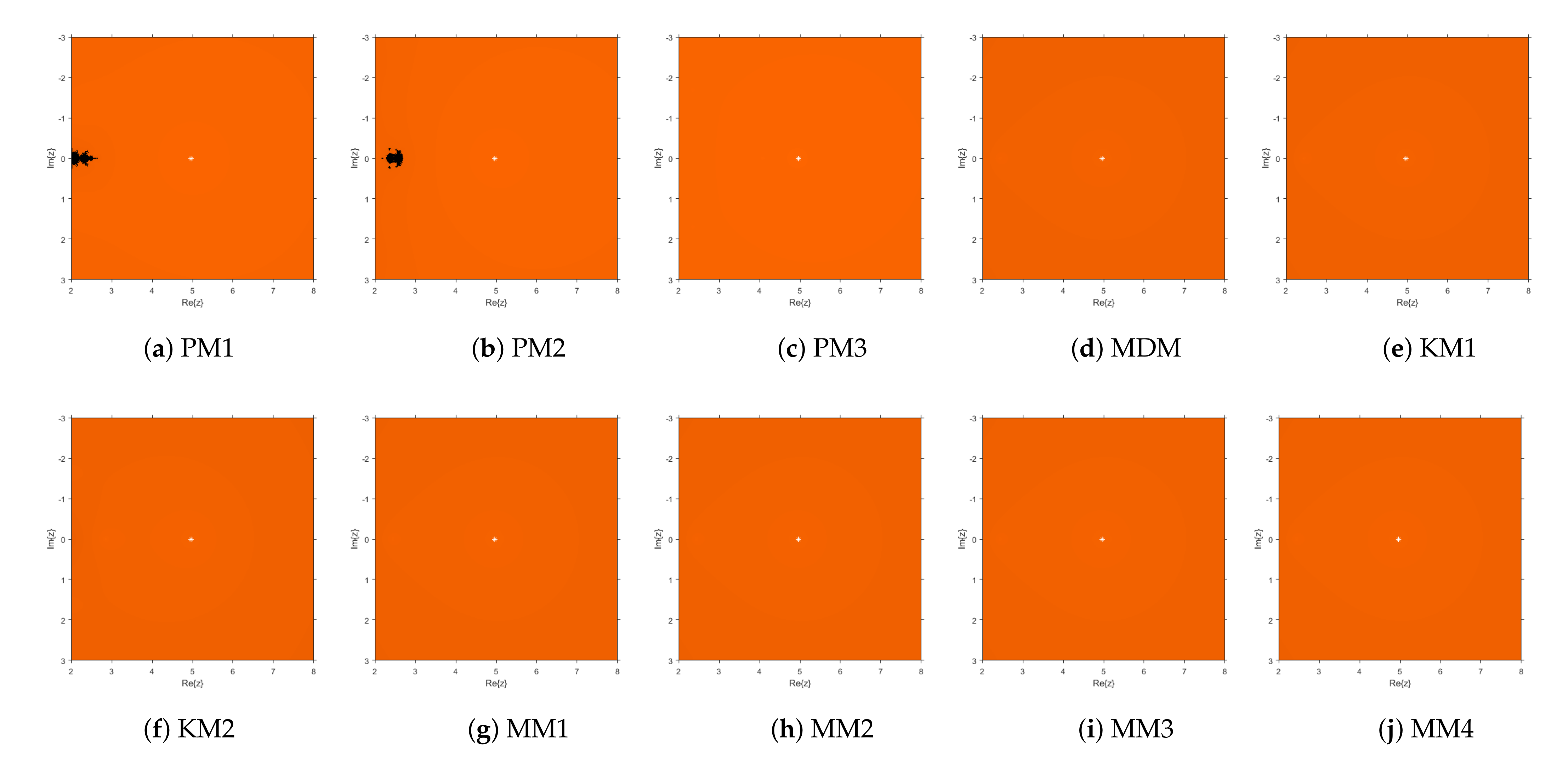
Moreover, for each example, the stability of new and existing methods was compared through the basin of attraction technique: new and known methods were used to solve each problem by using a mesh of points in a region of the complex plane, including the searched root (see, for example, [14]). Each point of this mesh was used as the starting point. If the method converges to one root of the nonlinear function in less than 80 iterations, the point appears in orange or green; in any other case, it appears in black. The tolerance used to set the convergence to the roots is in double-precision arithmetic. Using this technique, the set of starting points that converge to the root appears as a colored area in the complex plane. The wideness of these regions means that the method’s dependence on the starting guess is weak and, therefore, the method is considered stable.
Example 1.
It is known that, to find the eigenvalues of a large matrix whose order is greater than 4, we need to solve its characteristic equation. The determination of roots of such a higher order characteristic equation is a difficult task if we apply the linear algebra approach. So, one of the best ways is to use numerical techniques. Let us consider the following square matrix of order 9.
whose characteristic equation is defined by function
A real zero of is , with multiplicity .
Table 3 depicts the better performance of the proposed scheme in comparison to the existing techniques by taking the initial guess . Our proposed methods provide less residual and functional errors than existing ones.
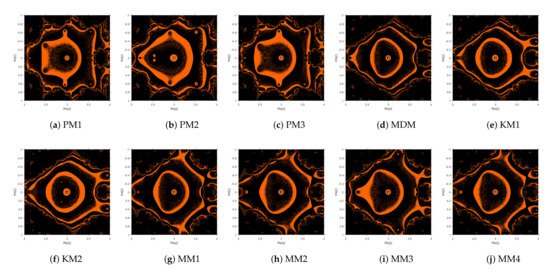
On the other hand, in Figure 1, the basins of attraction of new and known methods in this example are presented in the complex area (real and imaginary parts of the complex initial estimations). We observe that the convergence is assured very close to the root and surrounding coronas, also appearing in orange in each picture. Black areas are also wide and correspond to the need for higher digits of mantissa to avoid zero-division, as these plots have been calculated using double-precision arithmetic. Orange regions are stating guesses converging to the root and are wider or equal to those corresponding to known methods.
Figure 1.
Basins of attraction of new and existing methods for Example 1.
Example 2.
The van der Waals equation of state (see [15])
describes the nature of a real gas between two gases, namely, and when we introduce the ideal gas equations. For calculating the volume V of gases, we need the solution of the preceding expression in terms of the remaining constants
For choosing the particular values of gases, and , we can easily obtain the values for n, P, and T. Then, we yield
Function has three zeros, among them: is a multiple zero of multiplicity and is a simple zero.
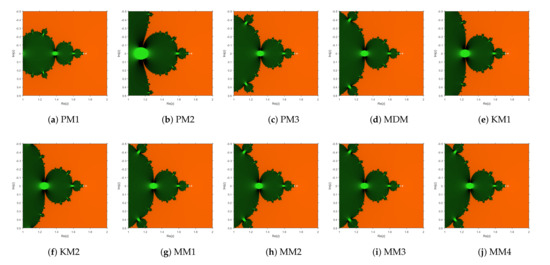
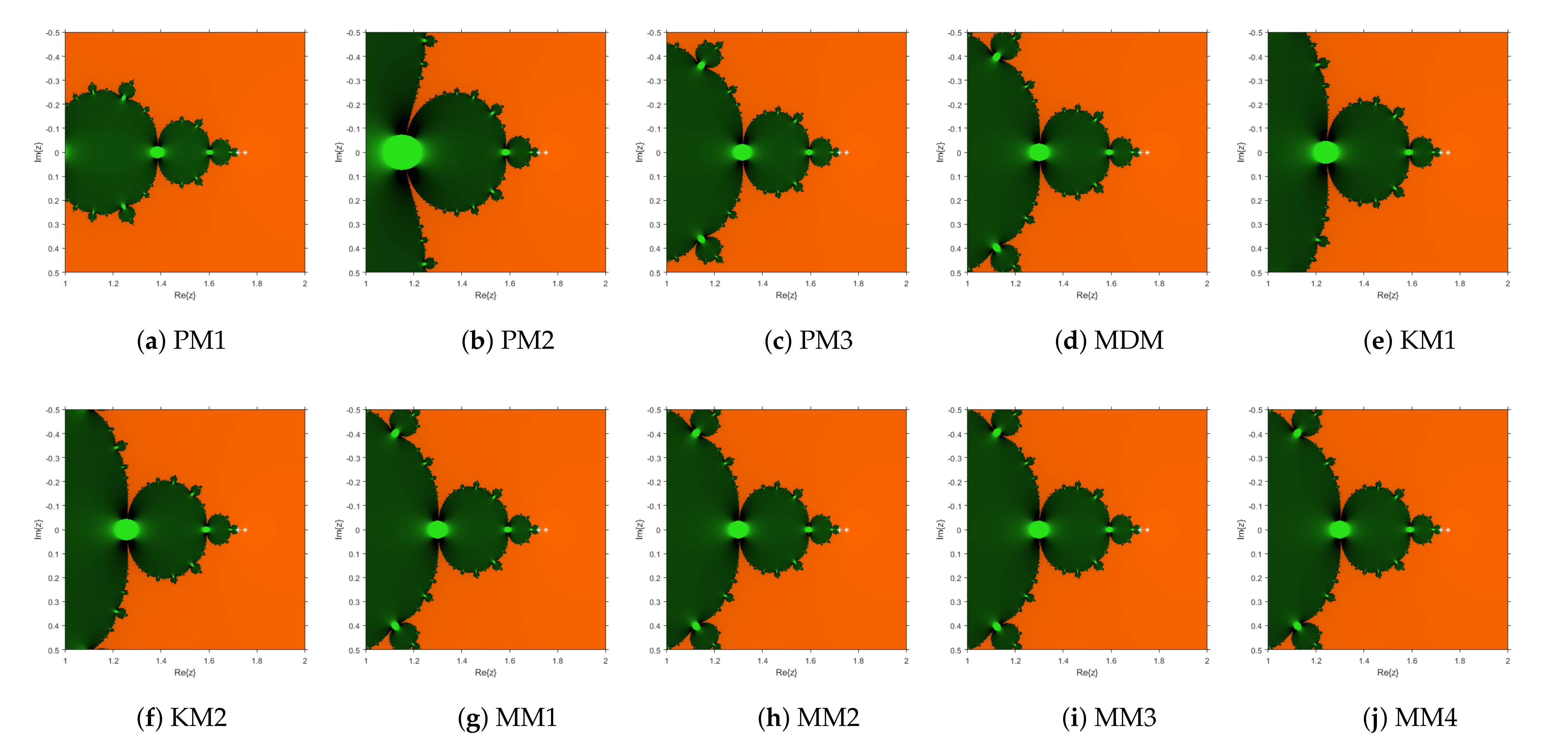
In this example, the basins of attraction are plotted in of the complex plane (see Figure 2). They show two different colors, corresponding to multiple root (orange) and simple root (green). The methods are able to converge to both roots, but with a lower order of convergence in the case of the simple one. This is observed in the darkness of the color; it is colored depending on the number of iterations needed to converge: the higher the number of iterations, the darker the color of this initial point in the basin of attraction.
Figure 2.
Basins of attraction of new and existing methods for Example 2.
We notice that the widest basin of attraction of the multiple root corresponds to the proposed PM1 method, with the green basin (simple root) being very small in this case compared with those of the other schemes.
The numerical results are mentioned in Table 4. The proposed schemes show better performance than known procedures, with low error and accurate result estimations.
Example 3.
Planck’s radiation problem.
Let us consider Planck’s radiation equation, which determines the spectral density of electromagnetic radiations released by a black body at a given temperature and thermal equilibrium [16] as
where T, y, k, h, and c denote the absolute temperature of the black body, wavelength of radiation, Boltzmann constant, Plank’s constant, and speed of light in the medium (vacuum), respectively. To evaluate the wavelength y, which results in the maximum energy density , set . We obtain the following equation
Further, the nonlinear equation is formulated by setting as follows:
The approximated zero is of multiplicity and with this solution, one can easily find the wave length y from the relation .
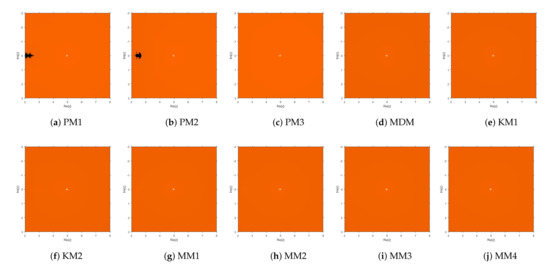
The basins of attraction for this example have been plotted in the complex area, whose real and imaginary parts are included in , see Figure 3. We notice that the basin of the multiple root fills all the regions of interest for PM3 and the known methods, but there are small black areas in the case of PM1 and PM2, far from the multiple root.
Figure 3.
Basins of attraction of new and existing methods for Example 3.
The computational results are presented in Table 5, where the proposed method presents the best residuals, showing the good performance.
Example 4.
Root clustering problem (see [17]).
Let us consider another standard nonlinear equation as follows
which has zeros , and 4 of multiplicity , and 55, respectively. Among these zeros, we chose the required zero as . In this case, the basins of attraction were not presented, as none of the analyzed methods were able to converge to the root by using double-precision arithmetic. Regarding the numerical results, they were obtained on the initial guess and are shown in Table 6. One can see that the precision in each scheme is extreme, with the lowest residual computed by PM1.
4. Concluding Remarks
In this manuscript, a new general class of derivative-free iterative procedures for multiple roots is suggested. The design of our scheme is based on the weight function procedure. A convergence study is presented in Theorem 1. In addition, we have shown several new particular cases in Table 1. Further, we illustrated the applicability of the proposed schemes on van der Waals, Planck’s radiation, root clustering, and eigenvalue problems, in comparison with the performance of the existing methods. In all of the examples, our schemes showed the best behaviors, in terms of stability and effectiveness.
Author Contributions
Conceptualization, R.B. and H.A.; methodology, S.A.; software, S.A.; validation, J.R.T. and A.C.; formal analysis, H.A.; investigation, R.B.; writing—original draft preparation, R.B. and H.A.; writing—review and editing, J.R.T. and A.C. All authors have read and agreed to the published version of the manuscript.
Funding
This research was partially supported by grant PGC2018-095896-B-C22, funded by MCIN/AEI/10.13039/5011000113033 by “ERDF A way of making Europe”, the European Union.
Institutional Review Board Statement
Not applicable.
Informed Consent Statement
Not applicable.
Data Availability Statement
Not applicable.
Acknowledgments
The authors would like to thank the anonymous reviewers for their comments and suggestions, which improved the final version of this manuscript.
Conflicts of Interest
The authors declare no conflict of interest.
References
- Geum, Y.H.; Kim, Y.I.; Neta, B. A class of two-point sixth-order multiple-zero finders of modified double-Newton type and their dynamics. Appl. Math. Comput. 2015, 70, 387–400. [Google Scholar] [CrossRef] [Green Version]
- Sharifi, M.; Babajee, D.K.R.; Soleymani, F. Finding the solution of nonlinear equations by a class of optimal methods. Comput. Math. Appl. 2012, 63, 764–774. [Google Scholar] [CrossRef] [Green Version]
- Sharma, J.R.; Sharma, R. Modified Jarratt method for computing multiple roots. Appl. Math. Comput. 2010, 217, 878–881. [Google Scholar] [CrossRef]
- Soleymani, F.; Babajee, D.K.R.; Lotfi, T. On a numerical technique for finding multiple zeros and its dynamics. J. Egypt. Math. Soc. 2013, 21, 346–353. [Google Scholar] [CrossRef]
- Kumar, D.; Sharma, J.R.; Argyros, I.K. Optimal One-Point Iterative Function Free from Derivatives for Multiple Roots. Mathematics 2020, 8, 709. [Google Scholar] [CrossRef]
- Kung, H.T.; Traub, J.F. Optimal order of one-point and multipoint iteration. J. Assoc. Comput. Mach. 1974, 21, 643–651. [Google Scholar] [CrossRef]
- Ortega, J.M.; Rheinboldt, W.C. Iterative Solution of Nonlinear Equations in Several Variables; Academic Press: New York, NY, USA, 1970. [Google Scholar]
- Ostrowski, A.M. Solutions of Equations and System of Equations; Academic Press: New York, NY, USA, 1964. [Google Scholar]
- Petković, M.S.; Neta, B.; Petković, B.L.D.; Džunić, J. Multipoint Methods for Solving Nonlinear Equations; Academic Press: New York, NY, USA, 2012. [Google Scholar]
- Traub, J.F. Iterative Methods for the Solution of Equations; Prentice- Hall Series in Automatic Computation; Prentice- Hall: Englewood Cliffs, NJ, USA, 1964. [Google Scholar]
- Zhou, X.; Chen, X.; Song, Y. Constructing higher-order methods for obtaining the multiple roots of nonlinear equations. J. Comput. Appl. Math. 2011, 235, 4199–4206. [Google Scholar] [CrossRef] [Green Version]
- Kansal, M.; Alshomrani, A.S.; Bhalla, S.; Behl, R.; Salimi, M. One Parameter Optimal Derivative-Free Family to Find the Multiple Roots of Algebraic Nonlinear Equations. Mathematics 2020, 8, 2223. [Google Scholar] [CrossRef]
- Cordero, A.; Torregrosa, J.R. Variants of Newton’s method using fifth-order quadrature formulas. Appl. Math. Comput. 2007, 190, 686–698. [Google Scholar]
- Ahlfors, L.V. Complex Analysis; McGraw-Hill Book, Inc.: New York, NY, USA, 1979. [Google Scholar]
- Constantinides, A.; Mostoufi, N. Numerical Methods for Chemical Engineers with MATLAB Applications; Prentice Hall PTR: Englewood Cliffs, NJ, USA, 1999. [Google Scholar]
- Bradie, B. A Friendly Introduction to Numerical Analysis; Pearson Education Inc.: New Delhi, India, 2006. [Google Scholar]
- Zeng, Z. Computing multiple roots of inexact polynomials. Math. Comput. 2004, 74, 869–903. [Google Scholar] [CrossRef] [Green Version]

Publisher’s Note: MDPI stays neutral with regard to jurisdictional claims in published maps and institutional affiliations. |
© 2022 by the authors. Licensee MDPI, Basel, Switzerland. This article is an open access article distributed under the terms and conditions of the Creative Commons Attribution (CC BY) license (https://creativecommons.org/licenses/by/4.0/).