


Abstract
The Theory of Complex Functions has been studied by many scientists and its application area has become a very wide subject. Harmonic functions play a crucial role in various fields of mathematics, physics, engineering, and other scientific disciplines. Of course, the main reason for maintaining this popularity is that it has an interdisciplinary field of application. This makes this subject important not only for those who work in pure mathematics, but also in fields with a deep-rooted history, such as engineering, physics, and software development. In this study, we will examine a subclass of Harmonic functions in the Theory of Geometric Functions. We will give some definitions necessary for this. Then, we will define a new subclass of complex-valued harmonic functions, and their coefficient relations, growth estimates, radius of univalency, radius of starlikeness and radius of convexity of this class are investigated. In addition, it is shown that this class is closed under convolution of its members.
MSC:
30C45; 30C80
1. Introduction
In this section, some definitions and necessary information that we will use in this paper will be given. After these definitions, we will give some important properties about harmonic functions and introduce the representations of a few subclasses.
When for , notation is called open unit disk. Here, is complex number set and and are analytic in . Let be the class of complex-valued harmonic functions in the open unit disk , normalized so that , . From this point of view, we can give the definition of for the class. Every function has the canonical representation of a harmonic function in the open unit disk as the sum of an analytic function and the conjugate of an analytic function . The power series expansions of and functions be defined as follows:
In this case, the functions in Relation (1) are analytic on the open unit disk. is locally univalent and sense-preserving in the open unit disk if and only if in . Denote by the subclass of that is univalent and sense-preserving in the open unit disk (see [1,2]). Note that, with the classical family of analytic univalent and normalized functions in the open unit disk is a subclass of just as the class of analytic and normalized functions in the open unit disk is a subclass of
Let and be the subclasses of mapping onto convex, starlike and close-to-convex domains, respectively, just as and are the subclasses of mapping the open unit disk to their respective domains.
The classes introduced above have been studied and developed by many researchers. One of these researchers, Ponussamy et al. [3], introduced the following class in 2013:
and they proved that functions in are close-to-convex. After this study, the following subclass definition has been made using this class and some important features such as coefficient bounds, growth estimates, etc., are examined by Ghosh and Vasudevarao [4]:
Nagpal and Ravichandran [5] studied a special version of subclass of functions which satisfy the inequality for which is a harmonic analogue of the class defined by Chichra [6] consisting of functions , satisfying the condition for .
In 1977, Chichra [6] studied the class for some where consists of analytic function such that
for
Recently, Liu and Yang [7] defined a class
where
Also, Rajbala and Prajapat [8] studied such properties of the class of functions satisfies the following inequality:
Apart from all these past studies, there are many ongoing studies today. For important studies that we can use as references in this article, References [5,9,10,11,12] can be consulted.
Denote by the class of functions , and satisfy the following inequality:
where When and are specially selected, previously studied [7] and [10] classes are obtained.
Let us define class as the class formed by the functions taken from class that satisfy the following inequality:
See References [6,13,14,15,16,17,18,19] for important major articles studied in this class.
Now, we will give some basic examples for .
Example 1.
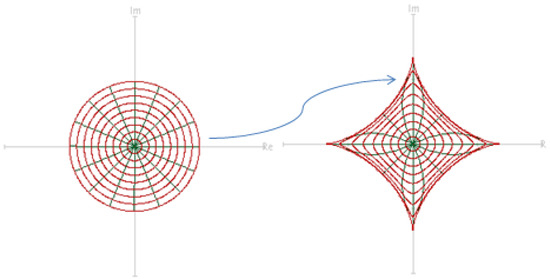
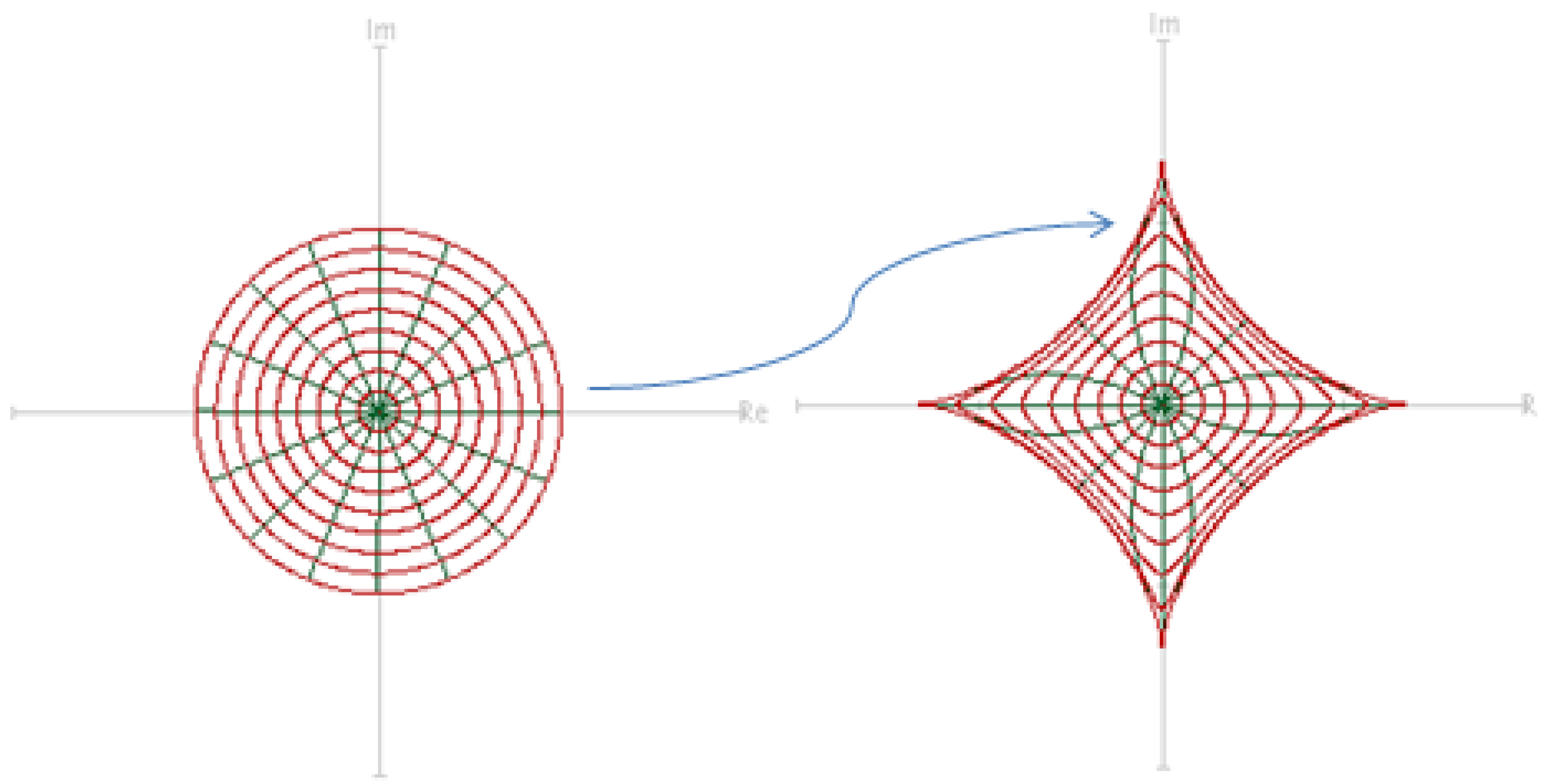
Let . And let , . Then, . Let us see where the function defined here will map the unit disk. See Figure 1.
Figure 1.
Image of the unit disk under the ⨍ function.
Example 2.
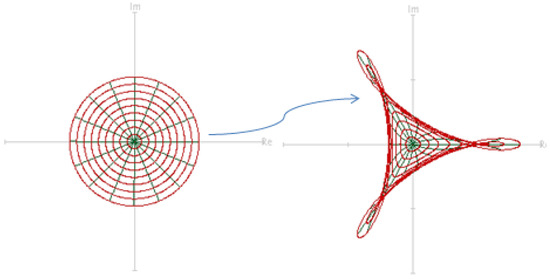
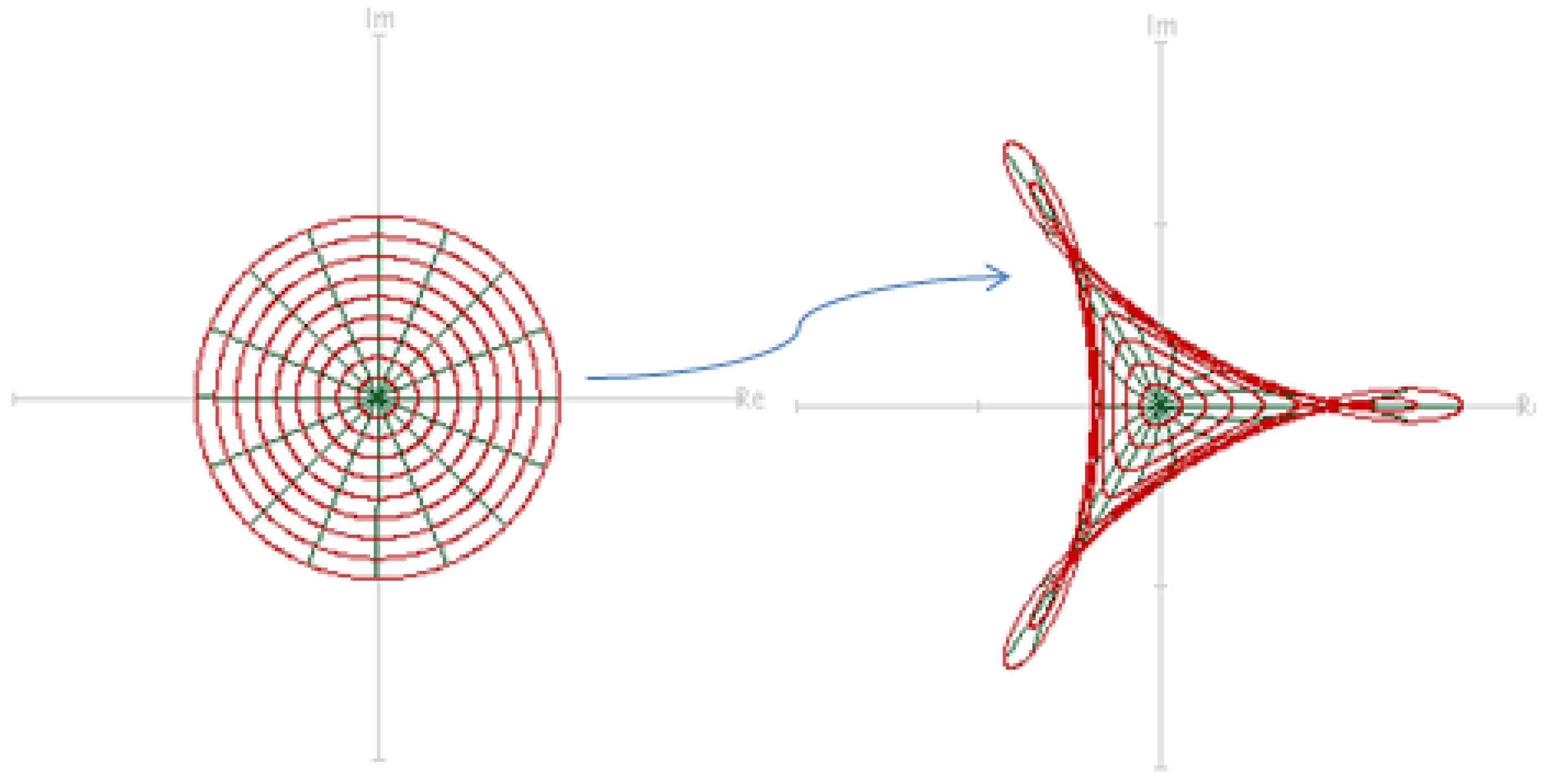
Let . And let and . Then, . Let us see where the function defined here will map the unit disk. See Figure 2.
Figure 2.
Image of the unit disk under the ⨍ function.
2. The Sharp Coefficient Estimates and Growth Theorems of
In this section, we will examine the class.
The first theorem is about the conditions under which a given function will belong to the class, and what properties a function in the class has.
Theorem 1.
The function defined in (1) is in class if and only if for each
Proof.
Suppose Then, by using (2) for , and also for each complex number with , we obtain
Thus, for each Conversely, let . This implies that
Setting , . Therefore, . For each fixed and arbitrarily chosen complex number with , i.e., , (3) becomes
This shows that □
Now, let us examine the coefficient relation of the co-analytical part of a function ⨍ of class .
Theorem 2.
Let ⨍ be a function of type in class. Then, for
The result is sharp and equality applies to the function
Proof.
Let us assume that the function ⨍ defined in type (1) belongs to class Using the series representation of and we derive
Allowing we prove the inequality (4). Moreover, the equality is achieved for . □
The following theorem, which allows us to understand the relationship between the coefficients of the function ⨍, also allows us to solve the problem of finding an upper bound for the coefficients of the functions in the class.
Theorem 3.
Let ⨍ be a function of type in class. Then, for we have
All boundaries are sharp here. Conditions of equality for all boundaries are satisfied if
Proof.
Let us assume that the function ⨍ defined in type (1) belongs to class . Then, from Theorem 1, for each Thus, for each we have
for From here, we see that there exists an analytical function of the type , whose real part is positive, which satisfies Equation (5) in the open unit disk such that
If we equate the coefficients in Equation (5), we obtain the following relation
According to Caratheodory (for detailed information, see [20]), since for and is arbitrary, the proof of the first inequality is thus completed. The proof can be completed by using the method used in the first proof in other parts of the theorem. In all cases, the state of equality is provided by the function . □
Theorem 4.
Let⨍be a function of type in class with
then
Proof.
Hence, □
The following theorem determines the lower and upper bounds for the modulus of the function ⨍.
Theorem 5.
Let ⨍ be a function of type in class for Then,
The result is sharp and equalities apply to the function
Proof.
Let ⨍ be a function of type in class . Then, using Theorem 1, , and for each , we have , where
If we then apply the method used by Rosihan et al. (Theorem 2.1 [16]), we get the following result
where u and v be two nonnegative real constants satisfying
Thus,
is written instead of and, after a few operations,
and
and
is obtained. We say that an analytic function f is subordinate to an analytic function g, and write , if there exists a complex valued function which maps into oneself with , such that Where ≺ shows subordination symbol, on the other hand, since , then [2]. Let and Using Equality (7), we obtain
Since
and
especially, we obtain
and
Then,
and
Since is arbitrary, we have
□
3. Geometric Properties of Harmonic Mappings in
In this section, we will examine the geometric properties of the functions in the class. We shall provide the radius of univalency, starlikeness and convexity for functions belonging to the class Let us consider and remember the three lemmas that will guide us in the theorems given in this section and shed light on the proofs.
Lemma 1
(Corollary 2.2 [21]). Let be a sense-preserving harmonic mapping in the open unit disk. If for all σ, the analytic functions are univalent in , then ⨍ is univalent in .
Lemma 2
([16]). Let with Then, F is univalent in where is the smallest positive root of the equation with
This result is sharp.
Lemma 3
([22,23]). Let be a harmonic mapping, where and have the form (1). If , then⨍is starlike in ; if then⨍is convex in .
Theorem 6.
Let be a sense-preserving harmonic mapping in then is univalent in where as given in (8), is the smallest positive root of the equation . This result is sharp.
Proof.
Let Then, using Theorem 1, for each Referring to Lemma 2, we derive that functions are univalent in for all Because of Lemma 1, we see that functions in are univalent in □
Theorem 7.
Let be a sense-preserving harmonic mapping in with and where and are the type in (1). Then, f is starlike in where is the smallest positive root in of the equation
where and
Proof.
Let and
so that
For convenience, we let
According to Lemma 3, it suffices to show that for Using Theorem 3(i), gives that
It is easily seen from the last two inequalities that if □
Theorem 8.
Let with and where and are the type in (1). Then, f is convex in where is the smallest positive root in of the equation
where and
Proof.
Let and
so that
For convenience, we let
According to Lemma 3, it suffices to show that for Using Theorem 3(i), gives that
It is easily seen from the last two inequalities that if □
4. Convex Combinations and Convolutions
In this section, we investigate that the class is convolutions and closed under convex combinations of its members.
Theorem 9.
The class is closed under convex combinations.
Proof.
Suppose for and The convex combination of functions may be written as
where
Then, both and are analytic in the open unit disk with and
showing that . □
A sequence of non-negative real numbers is said to be a convex null sequence, if as , and The following lemmas are needed to complete the proof.
Lemma 4
([24]). If is a convex null sequence, then function
is analytic and in
Lemma 5
([25]). Let the function be analytic in the open unit disk with and in the open unit disk Then, for any analytic function F in the function takes values in the convex hull of the image of under
Lemma 6.
Let then
Proof.
Suppose is given by then
This expression is equivalent to in where
Now, consider a sequence defined by
It can be easily seen that the sequence is a convex null sequence. Using Lemma 4, this implies that the function
is analytic and in Writing
and making use of Lemma 5 gives that for □
Lemma 7.
Let for Then, ∈
Proof.
Suppose and Then, the convolution of and is defined by
Since , we have
Since
and, using Lemma 6, in Now, applying Lemma 5 to (9) yields in Thus, ∈ □
Now, using Lemma 7, we give the following theorem.
Theorem 10.
Let for Then, ∈
Proof.
Suppose . Then, the convolution of and is defined as In order to prove that ∈ we need to prove that for each By Lemma 7, the class is closed under convolutions for each for Then, both and given by
belong to . Since is closed under convex combinations, then the function
belongs to . Hence, is closed under convolution. □
Let us remember the following Hadamard product explained by Goodloe [26]:
where is harmonic function and is an analytic function in
Theorem 11.
Let and be such that for then ∈
Proof.
Suppose that then for each By Theorem 1, to show that ∈ we need to show that ∈ for each Write as and
Since and in Lemma proves that . □
Corollary 1.
Let and then
Proof.
Suppose then for As a corollary of Theorem 11, ∈ □
5. Discussion
In this research, we examine some specific properties for harmonic functions defined by a second-order differential inequality. First, we gave the necessary definitions and preliminary information. Then, we define and prove the coefficient relations and growth theorems for the class. Then, we examined the geometric properties of the harmonic mappings belonging to the class. Finally, we proved the theorems about convex combinations and convolutions. Today, it is known that harmonic functions have a very wide field of study. Moreover, it is known that application areas are used by different disciplines. With this study, we aim to shed light on studies in other disciplines. We think that the results of this study, which will be used by many researchers in the future, will connect with different disciplines. In addition to all these, this study will act as a bridge between the articles written in the past and the articles to be written in the future.
Author Contributions
Conceptualization, D.B., A.D., S.Y., L.-I.C. and H.B.; methodology, D.B., A.D., S.Y., L.-I.C. and H.B.; software, D.B., A.D., S.Y., L.-I.C. and H.B.; validation, D.B., A.D., S.Y., L.-I.C. and H.B.; formal analysis, D.B., A.D., S.Y., L.-I.C. and H.B.; investigation, D.B., A.D., S.Y., L.-I.C. and H.B.; resources, D.B., A.D., S.Y., L.-I.C. and H.B.; data curation, D.B., A.D., S.Y., L.-I.C. and H.B.; writing—original draft preparation, S.Y. and H.B.; writing—review and editing, D.B., A.D., S.Y., L.-I.C. and H.B.; visualization, A.D., S.Y., L.-I.C. and H.B.; supervision, S.Y.; project administration, D.B. and L.-I.C.; funding acquisition, D.B. and L.-I.C. All authors have read and agreed to the published version of the manuscript.
Funding
This research received no external funding.
Conflicts of Interest
The authors declare no conflict of interest.
References
- Clunie, J.; Sheil-Small, T. Harmonic univalent functions. Ann. Acad. Sci. Fenn. Ser. A I 1984, 9, 3–25. [Google Scholar] [CrossRef]
- Duren, P. Harmonic Mappings in the Plane; Cambridge Tracts in Mathematics; Cambridge University Press: Cambridge, UK, 2004; Volume 156. [Google Scholar]
- Ponnusamy, S.; Yamamoto, H.; Yanagihara, H. Variability regions for certain families of harmonic univalent mappings. Complex Var. Elliptic Equ. 2013, 58, 23–34. [Google Scholar] [CrossRef]
- Ghosh, N.; Vasudevarao, A. On a subclass of harmonic close-to-convex mappings. Monatsh. Math. 2019, 188, 247–267. [Google Scholar] [CrossRef]
- Nagpal, S.; Ravichandran, V. Construction of subclasses of univalent harmonic mappings. J. Korean Math. Soc. 2014, 53, 567–592. [Google Scholar] [CrossRef]
- Chichra, P.N. New subclass of the class of close-to-convex function. Proc. Am. Math. Soc. 1977, 62, 37–43. [Google Scholar] [CrossRef]
- Liu, M.S.; Yang, L.M. Geometric properties and sections for certain subclasses of harmonic mappings. Monatsh. Math. 2019, 190, 353–387. [Google Scholar] [CrossRef]
- Rajbala, C.; Prajapat, J.K. On a subclass of close-to-convex harmonic mappings. Asian-Eur. J. Math. 2021, 14, 2150102. [Google Scholar] [CrossRef]
- Çakmak, S.; Yaşar, E.; Yalçın, S. Convolutions of planar harmonic convex mappings. Hacet. J. Math. Stat. 2022, 45, 263–271. [Google Scholar]
- Çakmak, S.; Yaşar, E.; Yalçın, S. Some basic geometric properties of a subclass of harmonic mappings. Bol. Soc. Mat. Mex. 2022, 28, 54. [Google Scholar] [CrossRef]
- Nagpal, S.; Ravichandran, V. A subclass of close-to-convex harmonic mappings. Complex Var. Elliptic Equ. 2014, 59, 204–216. [Google Scholar] [CrossRef][Green Version]
- Yaşar, E.; Yalçın, S. Close-to-convexity of a class of harmonic mappings defined by a third-order differential inequality. Turk. J. Math. 2021, 45, 678–694. [Google Scholar] [CrossRef]
- Brickman, L.; MacGregor, T.H.; Wilken, D.R. Convex hulls of some classical families of univalent functions. Trans. Am. Math. Soc. 1971, 156, 91–107. [Google Scholar] [CrossRef]
- Gao, C.-Y.; Zhou, S.-Q. Certain subclass of starlike functions. Appl. Math. Comput. 2007, 187, 176–182. [Google Scholar] [CrossRef]
- Hallenbeck, D.J. Convex hulls and extreme points of some families of univalent functions. Trans. Am. Math. Soc. 1974, 192, 285–292. [Google Scholar] [CrossRef]
- Rosihan, M.A.; Satwanti, D.; Swaminathan, A. Inclusion properties for a class of analytic functions defined by a second-order differential inequality. RACSAM 2018, 112, 117–133. [Google Scholar]
- Wang, Z.-G.; Gao, C.-Y.; Yuan, S.-M. On the univalency of certain analytic functions. J. Inequal. Pure Appl. Math. 2006, 7, 9. [Google Scholar]
- Oros, G.I.; Yalçın, S.; Bayram, H. Some Properties of Certain Multivalent Harmonic Functions. Mathematics 2023, 11, 2416. [Google Scholar] [CrossRef]
- Bayram, H. q-Analogue of a New Subclass of Harmonic Univalent Functions Associated with Subordination. Symmetry 2022, 14, 708. [Google Scholar] [CrossRef]
- Caratheodory, C. Uber den Variabilitatsbereich der Koeffzienten von Potenzreihen, die gegebene werte nicht annehmen. Math. Ann. 1907, 64, 95–115. [Google Scholar] [CrossRef]
- Hernandez, R.; Martin, M.J. Stable geometric properties of analytic and harmonic functions. Math. Proc. Camb. Philos. Soc. 2013, 155, 343–359. [Google Scholar] [CrossRef]
- Silverman, H. A class of bounded starlike functions. Int. J. Math. Math. Sci. 1994, 17, 249–252. [Google Scholar] [CrossRef]
- Silverman, H.; Silva, E.M. Subclasses of harmonic univalent functions. N. Z. J. Math. 1999, 28, 275–284. [Google Scholar]
- Fejér, L. Über die Positivität von Summen, die nach trigonometrischen oder Legendreschen Funktionen fortschreiten. Acta Litt. Ac Sei. Szeged 1925, 2, 75–86. [Google Scholar]
- Singh, R.; Singh, S. Convolution properties of a class of starlike functions. Proc. Am. Math. Soc. 1989, 106, 145–152. [Google Scholar] [CrossRef]
- Goodloe, M. Hadamard products of convex harmonic mappings. Complex Var. Theory Appl. 2002, 47, 81–92. [Google Scholar] [CrossRef]
Disclaimer/Publisher’s Note: The statements, opinions and data contained in all publications are solely those of the individual author(s) and contributor(s) and not of MDPI and/or the editor(s). MDPI and/or the editor(s) disclaim responsibility for any injury to people or property resulting from any ideas, methods, instructions or products referred to in the content. |
© 2023 by the authors. Licensee MDPI, Basel, Switzerland. This article is an open access article distributed under the terms and conditions of the Creative Commons Attribution (CC BY) license (https://creativecommons.org/licenses/by/4.0/).