


Abstract
There is a huge family of recurrent functions, which starts with equilibria and ends with Poisson stable functions. They are fundamental in theoretical and application senses, and they admit a famous history. Recently, we have added the unpredictable functions to the family. The research has been performed in several papers and books. Obviously, theoretical and application merits of functions increase if one provides rigorously approved efficient methods of construction of concrete examples, as well as their numerical simulations. In the present study, we met the challenges for unpredictability by considering functions of two variables on diagonals. Algorithms have been created, and they are both deterministic and random. Characteristics are introduced to evaluate contributions of periodic and unpredictable components to the dynamics, and they are clearly illustrated in graphs of the functions. Definitions of non-periodic compartmental functions are provided as suggestions for the research in the future.
Keywords:
unpredictable functions; compartmental unpredictable functions; degree of periodicity; functions determined deterministically and randomly; numerical simulations MSC:
26B40
1. Introduction
Oscillations and recurrence play a special role in the study of dynamics of processes occurring in nature and industry. In the literature, numerous results have been obtained for periodic, quasi-periodic, and almost periodic functions due to the established valuable mathematical methods and important applications [1,2,3,4,5]. On the other hand, recurrent and Poisson stable functions are also crucial for the theory of oscillations [6,7,8,9,10]. The theory of non-linear dynamics, [1,2,6,11,12], was focused mainly on periodic motions. Functions, which can be still be considered as “periodic” and are sufficiently convenient for strict mathematical analysis, are quasi-periodic functions introduced and investigated by P. Bohl [13,14] and E. Esclangon [15], independently. The fundamental papers of H. Bohr [16,17,18] are about basics of almost periodic functions. Different theories of almost-periodicity were constructed by N.N. Bogolyubov [19], A.S. Besicovitch [20], S. Bochner [21], and V.V. Stepanov [22]. Those functions are of great importance for the development of harmonic analysis of groups, including the Fourier series. The concepts of recurrent motions and Poisson stable points are central in the qualitative theory of dynamical systems. They were considered by H.Poincare [11] and G. Birkhoff [6] as the main ingredients of complexity in celestial dynamics.
Currently, chaos theory is being widely developed, and the classical functions are not any longer sufficient to describe the dynamics of complex systems. It requires not only new models and new solutions of models, but also new functions. This is why the unpredictable and compartmental Poisson stable have been introduced in our recent papers [23,24,25,26]. Accordingly, a new method of included intervals for the existence of unpredictable and Poisson stable solutions of discrete and differential equations was suggested. Since the unpredictability leads to chaos, the role of unpredictable functions is very important in applications. The new functions are especially important for studying the dynamics of neural networks. Due to the complexity and non-linearity of neural networks, their behaviour is not confined to regular functions. In our papers, unpredictable oscillations in Hopfield-type neural networks [27], as well as shunting inhibitory cellular neural networks [28,29], were investigated.
It is indisputable that, when considering functions in applications, one should enlarge the number of methods of construction and numerical presentations of them, starting with simple algebraic operations and finalizing with Fourier series and the theory of operators. In the present study, a new way of the unpredictable function construction is suggested, which is rooted at compartmental functions. It starts with functions of two variables, which are unpredictable in one of them, and in another are either periodic, quasi-periodic, or almost-periodic and even recurrent or Poisson stable. Then, domains of the functions are narrowed to the diagonals of the coordinate spaces, where the arguments are ranged. The method of diagonals is the routine one, known, for instance, for quasi-periodic functions or almost-periodic functions [5,20], but, in the study, the diagonalization is made for dynamics, which are on essentially different new level, since the dependence on the different variables is essentially different. Correspondingly, it is an interesting problem to find such conditions that the functions on diagonals admit the unpredictability. In the present research, the problem is provided with a particular solution for the case of periodicity. So-called compartmental periodic unpredictable functions are in the focus. Beside the general problem, elements of algebra for the unpredictable functions and unpredictability of compositions have been discussed.
Working on the new types of recurrence, we have learnt, surprisingly, that, despite numerous papers on almost periodic and Poisson stable functions, there are no any prints of numerical examples and simulations, neither for the functions nor solutions of differential equations, if they are not quasi-periodic. In the same time, the needs of industry and, exceptionally, neuroscience, artificial intelligence, and other modern areas, demand numerical presentation of motions, which already have been supported seriously in theories. Our research comprehensively meets the challenges, since we have constructed samples of Poisson stable and unpredictable functions utilizing solutions of the logistic equation, as well as determining them randomly through realizations of Bernoulli schemes and Markov chains. That is, deterministic, as well as stochastic routs for the functions, have been paved. One should emphasize that, even for Poisson stable functions, which are in the research for about a century, samples of the concrete functions appeared in our papers [24,25] for the first time. The numerical experiments are advantageous, since they are accompanied with newly developed strong instruments of the functions simulations. For instance, they are suitable for synchronization of chaos, namely, Delta synchronization, which works for gas discharge-semiconductor systems [30], where even the generalized synchronization [31] is not effective. A numerical test for the unpredictable dynamics has been suggested [32], which discovers strange attractors, when conservative methods do not work [33]. Moreover, we have developed algorithms, which allow us to observe contributions of periodicity and the unpredictability for the compartmental dynamics. The algorithms are based on the concept of the degree of periodicity. We have learnt that very similar time series can be seen in several industrial experiments [34,35,36,37,38], and this is a strong argument for the application of our results. One can believe, also, that the research of the compartmental functions can give more insights into the problem of the transition from quasi-periodicity to chaos [39,40].
In Preliminaries and Definitions, one can find basic information on functions, which are in the focus of the present research. The Section 3 contains conditions on the novel parameters, sufficient to guarantee the unpredictability of compartmental functions with a periodic component. The properties are utilized in the central theoretical part of the article, Section 4, where a new class of unpredictable functions is described. The reader is invited to consider Theorem 1 as the source of weakened conditions for the unpredictability. The Section 5 contains examples of concrete compartmental periodic unpredictable functions, which are constructed by applying irregular features of dynamics in the logistic equation. The results are rigorously approved by the method of included intervals. The degree of periodicity is considered in Section 6. Its role for the analysis is carefully illustrated through several numerical simulations. The rout for construction of unpredictable functions by Markov chains is discussed in Section 7. In the final part, Miscellanea, definitions of compartmental quasi-periodic, almost periodic, recurrent, and Poisson stable functions are presented to complete the presentation. Moreover, theorems are proved on the unpredictability of functions being subdued to simple algebraic operations. The section is closed with an example of a compartmental quasi-periodic unpredictable function, which confirms potentials of the research when a diagonalized function is not necessary unpredictable.
2. Preliminaries and Definitions
Throughout the paper, and , respectively, stand for the sets of natural numbers, integers, and real numbers. Moreover, for vectors, we use a Euclidean norm.
Definition 1.
A bounded function is said to be Poisson stable if there exists a sequence as such that the sequence of functions uniformly converges to on each bounded interval of the real axis.
Definition 2
([23]). A bounded function is unpredictable if there exist positive numbers and sequences , both of which diverge to infinity, such that as uniformly on compact subsets of and for each and .
A sequence in Definitions 1 and 2 is said to be the Poisson or convergence sequence of the function We call the uniform convergence on compact subsets of the convergence property, and the existence of the sequence and positive numbers is called the separation property.
Remark 1.
It follows, from the last two definitions, that we consider not only continuous, but also discontinuous unpredictable and Poisson functions. The convergence and separation properties are valid regardless to the continuity. Duo to this comment, we shall use examples with continuous and discontinuous functions. The definition of continuous Poisson stable functions can be found in [7].
Definition 3.
A bounded function is a domain, which is unpredictable in t, uniformly, with respect to if there exist positive numbers , δ and sequences , , both of which diverge to infinity, such that as uniformly on bounded intervals of t and and for and .
Definition 4.
A function is said to be a compartmental periodic unpredictable function if , where is a continuous bounded function, periodic in u uniformly with respect to and unpredictable in v uniformly with respect to , i.e., there exist positive numbers , δ and sequences , , both of which diverge to infinity, such that for all as uniformly on bounded intervals of and for and .
Definition 5.
A function is a domain, which is said to be compartmental periodic unpredictable in t uniformly for function, if where is a bounded function, periodic in u uniformly with respect to and unpredictable in v uniformly with respect to and
Remark 2.
What we use as functions on diagonals is the routine technique of multi-periodicity known for almost periodic functions [18]. If the number of periods is finite and they are incommensurate, the quasi-periodic functions as a subset of almost-periodic functions is shaped. In Definitions 3 and 4, functions differently depend on two variables since periodicity is not the unpredictability. That is, we consider a more sophisticated case of the technique this time. It is clear that the compartmental functions are already assumed to be irregular, but to clarify precisely the phenomenon as irregular, we provide conditions for the unpredictability of the functions on diagonals. The next section is devoted to the kappa property, which plays the role of the periods relation in almost-periodicity theory. The property guarantees that the unpredictability in a single variable is inherited by the function on the diagonal of the arguments space. This is why we say that the new results is a next step in application of the technique.
3. Kappa Property of Unbounded Sequences
Consider a sequence of positive real numbers as Below, the following two simple lemmas will be of use. They are rather general results adapted to the needs of the present paper.
Lemma 1.
For an arbitrary sequence of positive real numbers and a positive number ω, there exist a subsequence and a number such that as
Proof.
Consider the sequence , such that and for all The boundedness of the sequence implies that there exists a subsequence which converges to a number [41]. □
For fixed by the last lemma, there exist a subsequence and a number , such that as In what follows, considering applications for unpredictable and Poisson stable functions, we shall call the number as the Poisson shift with respect to the The set of all Poisson shifts is not empty. It can consist of several or even an infinite number of elements. The number is said to be Poisson number with respect to the number If then we say that the sequence satisfies kappa property with respect to the number The following assertion is useful in the next part of the paper.
Lemma 2
([24]).
Proof.
Assume on the contrary that is not in Then, there exists a strictly decreasing sequence in such that For each natural denote by a subsequence of , such that as
Fix a sequence of positive numbers which converges to the zero. One can find numbers such that It is clear that as □
Next, examples are provided to demonstrate how rich the set of sequences is with respect to the kappa property.
Example 1.
Let us take the unbounded sequence where are fixed numbers. If then and there exists a unique Poisson shift, If then for even numbers and if k is an odd number. There is no other Poisson shifts, therefore, Generally, one can find that the set of Poisson shifts is Thus, we procure, for any the sequence satisfies the kappa property with respect to
Example 2.
Now, consider the sequence where the sequence is determined as follows,
Thus, the sequence is obtained, and each element of the section is a Poisson shift. So, the example when is an uncountable set of numbers is considered, and the sequence satisfies the kappa property with respect to the number
4. Unpredictability of Compartmental Periodic Functions
This part is of main theoretical achievements of the paper. Theorem 1 discusses the most weak sufficient conditions for the unpredictability of compartmental functions with the periodic component, and it is more theoretical than results of the following Theorems 2–4, which are constructive to determine unpredictable functions in examples and experiments.
Theorem 1.
Assume that is an open and bounded set, which is a continuous function, and periodic in u uniformly with respect to v and Then, the function is unpredictable in uniformly with respect to if the following conditions are valid:
- (i)
- for each there exists a positive number η such that ifthere exist sequences both of which diverges to infinity as and positive numbers such that
- (ii)
- the sequence satisfies the kappa property with respect to the period
- (iii)
- on each bounded interval
- (iv)
Proof.
Let us fix a positive number and a bounded interval Since the sequence satisfies the kappa property, one can write, without loss of generality, that as Therefore, by conditions and the following inequalities are valid:
and
for sufficiently large
The following assertion is a corollary of the Theorem 1.
Theorem 2.
Assume that a continuous and bounded function is periodic in The function is unpredictable if the following conditions are valid,
- (i)
- for each there exists a positive number η such that ifthere exist sequences both of which diverges to infinity as and positive numbers , such that
- (ii)
- the sequence satisfies kappa property with respect to the period
- (iii)
- uniformly on each bounded interval of
- (iv)
Remark 3.
Conditions and in the Theorem 2 are satisfied if is unpredictable in the second argument by Definition 4.
Theorem 3.
Assume that a function is periodic in t and satisfies the inequalities where are positive constants, for all If is an unpredictable function, such that the convergence sequence admits the kappa property with respect to period ω, then is an unpredictable function.
Proof.
Consider the function We shall prove that is unpredictable in Let us fix positive number and a bounded interval Since of the kappa property, for a sufficiently large number k, we have for That is why,
for all and On the other hand, there exist a sequence and positive numbers such that for Therefore, we have:
for each Thus, one can conclude that the function is unpredictable. □
Theorem 4.
Assume that a function is a domain, it is unpredictable in t uniformly with respect to and it satisfies the inequality where L is positive constant. If is a Poisson stable function with the Poisson sequence common with that for and where is a separation constant for then the composition is an unpredictable function.
Proof.
Let us fix a positive number and a bounded interval Since is unpredictable in and is a Poisson stable function, there exists sufficiently large such that: and for That is,
for all Thus, uniformly on each bounded interval of the real axis. Under assumptions of the theorem, we have that there exists a sequence and positive numbers such that for We obtain:
for and the function is unpredictable. □
5. Unpredictable Functions Related to the Logistic Equation
In this part of the paper, examples of two unpredictable functions are presented. They have the unpredictability, and additional constructive properties, which significantly increase the use of the functions. Lemmas 3–6 make strong theoretical basis for future research in industrial and neuroscience problems. The approach covers both deterministic and stochastic potentials.
Let us consider the logistic map:
In [23], it was proved that, for each , the Equation (3) admits an unpredictable solution That is, there exist a positive number and the sequences of positive integers, both of which diverge to infinity, such that as for each i in a bounded interval of integers and for each
Lemma 3.
Assume that where h is a positive number, is a bounded function. Then, the function is Poisson stable in the sense of Definition 2.
Proof.
Let us fix an interval of real numbers and a number such that where s is a natural number. Then, for and , we have and
Denote For a fixed positive number and sufficiently large number k, it is true that Therefore, for where l is a fixed integer number from to one can obtain that
The last inequality is valid for all Consequently, if Thus, the function is Poisson stable. □
Lemma 4.
The function is unpredictable if the following condition is satisfied,
- (A)
- there exists a positive number such that for each
Proof.
By Lemma 3, the sequence of functions uniformly converges to on compact subsets of It remains to show that the function satisfies the separation property. Due to the unpredictability of the sequence there exist a positive number and the sequence as such that for each
For and we have that That is why for all So, by using condition (A), we obtain:
for all Thus, the function is unpredictable with with positive numbers and sequences □
Lemma 5.
The function is unpredictable if the following condition is valid,
- (B)
- there exist positive numbers and such that and for each
Proof.
The convergence property of the function is proved in Lemma 3. Let us show that the function satisfies the separation property. There exist a positive number and the sequence as such that for each
From and it follows that Therefore, Applying condition (B), we obtain:
for all So, one can conclude that the function is unpredictable with positive numbers and sequences □
Now, let us define a continuous function such that:
where is a positive real number, and is the unpredictable function, which satisfies one of the conditions (A) or (B). The function is bounded on the whole real axis, such that where By applying the unpredictability of the function with condition (B), we will prove the following lemma. One can see that the condition (B) implies the condition (A).
Lemma 6.
The function is unpredictable.
Proof.
Consider a fixed bounded and closed interval of the axis and a positive number . Now, applying the method of included intervals [24], we will show that the sequence uniformly converges to on Let us fix a positive number and a number which satisfy the following inequalities and Let k be a large enough number, such that on Then, for all , we obtain:
Thus, as uniformly on the interval
According Lemma 5, we have for Fix a natural number k and positive , such that Consider two alternative cases: (i) (ii)
It is easily seen that the following relation holds:
- (i)
- From the last relation, we obtain:
for
- (ii)
- Using the relation (7) we get that
6. Degree of Periodicity and Numerical Simulations
In this part of the paper, a quantitative characteristic, the degree of periodicity, is introduced for functions with the kappa property. Examples with graphs of compartmental unpredictable functions related to the logistic equation are presented. The dependence of their trajectories on the degree of periodicity is discussed.
To illustrate the dynamics of the compartmental unpredictable function, we will use the function which is defined by (6), with and the function where The function is bounded, such that and is the exponentially stable unpredictable solution of the differential equation This is why, for the numerical simulations of the function, we will use solutions of the equation.
The number h is said to be the length of step of the functions and For compartmental unpredictable functions, the ratio of the period and the length of step, is called the degree of periodicity.
Next, we shall construct the function, which is a compartmental one and unpredictable due to the kappa property.
Consider the following function, , which is periodic in uniformly with respect to The function satisfies Lipschitz conditions with and if This is why, according Theorems 6 and 7, the component-functions and are unpredictable.
Consider the function
where h—the length of step is a parameter.
We will show that the assumptions of Theorem 2 are valid for the function The uniform continuity of implies the condition (i) Since of one can consider the function with the convergence sequence and separation sequences such that condition (ii) is valid. Let us fix a bounded interval The sequence uniformly converges to on the interval. This is why,
and the sequence of functions converges to uniformly on That is, condition is satisfied.
According Lemma 6, for , we have That is,
The last inequality implies that condition is valid. Thus, all conditions of Theorem 2 are correct, and the function is unpredictable. Moreover, the arguments of Theorem 2 indicates that is a compartmental unpredictable function.
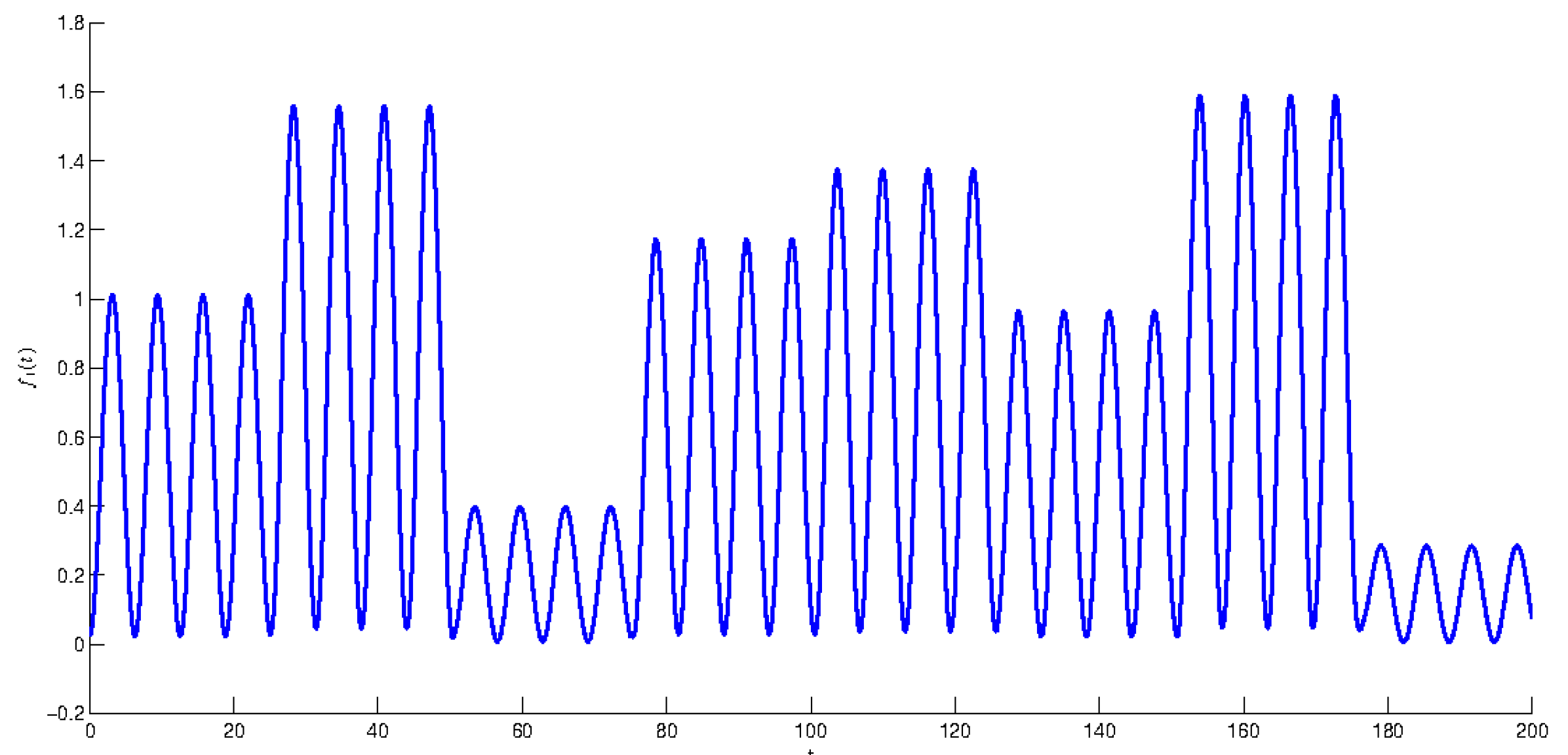
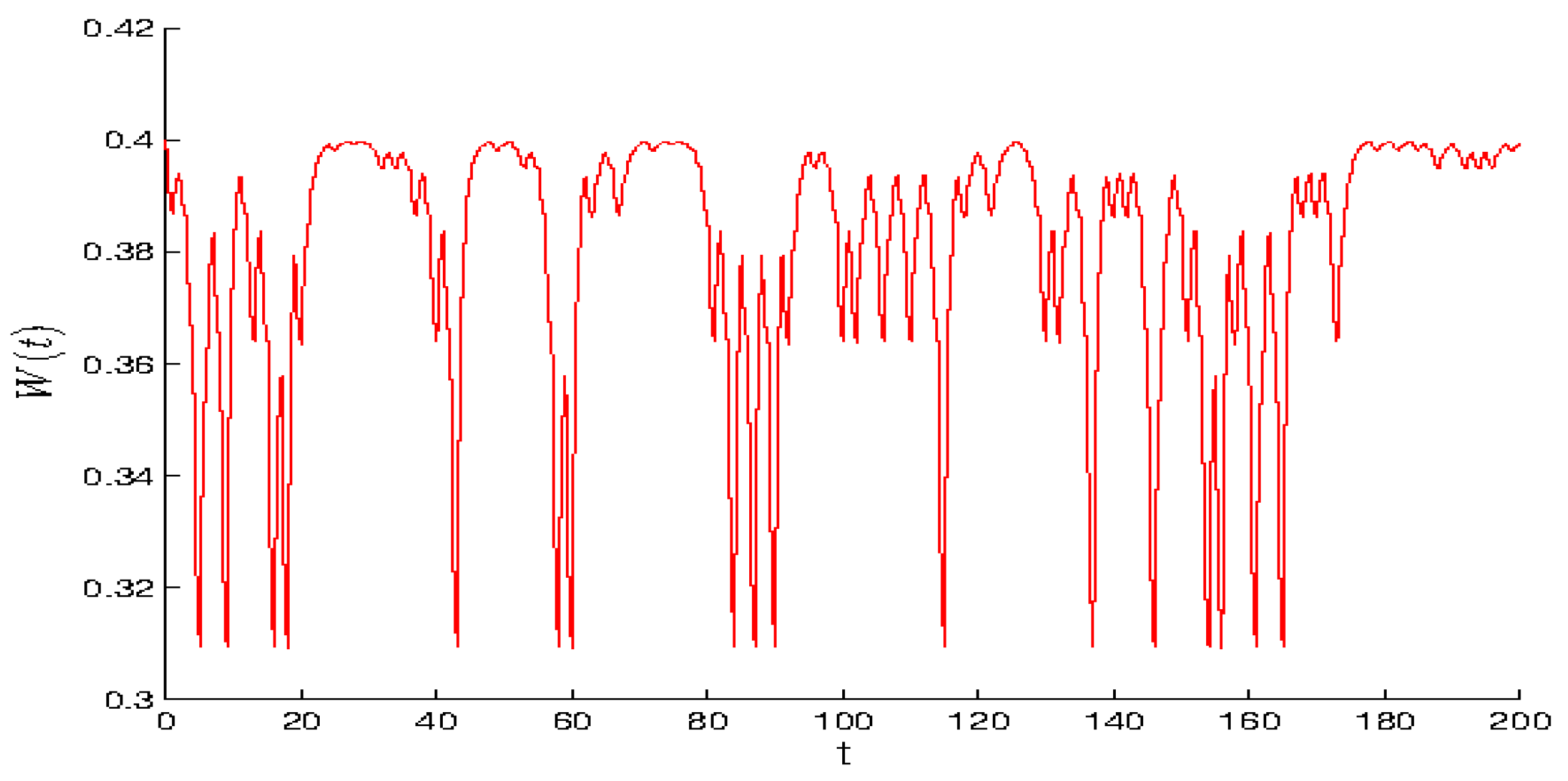
In Figure 1 the graph of function where the length of step and degree of periodicity , is shown.
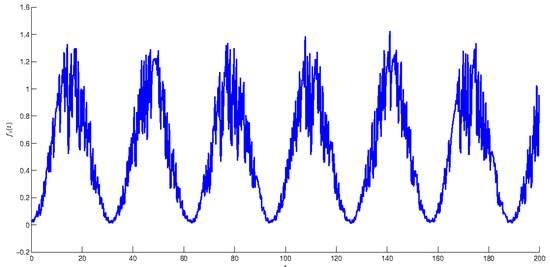
Figure 1.
The graph of compartmental periodic unpredictable function The length of step and degree of periodicity .
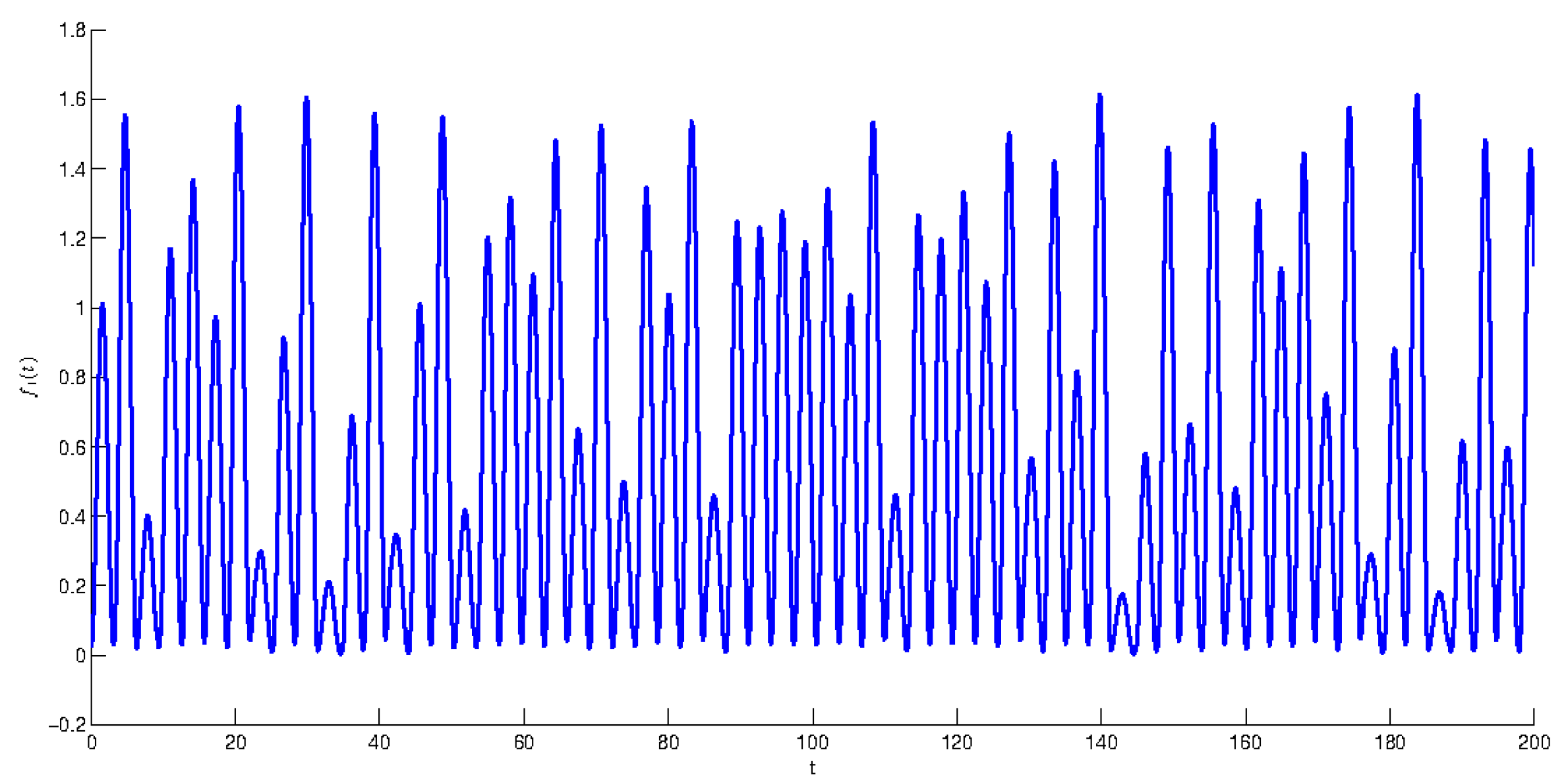
Similarly to the function it can be shown that the compartmental periodic unpredictable function, where and is unpredictable. The function is periodic in uniformly with respect to Figure 2 depicts the graph of function with length of step so that the degree of periodicity
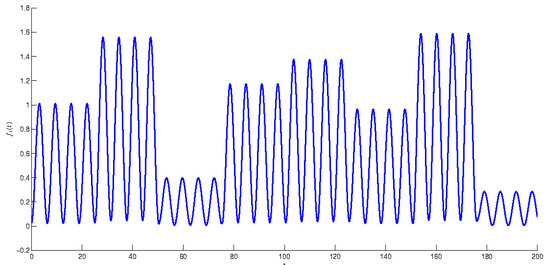
Figure 2.
The graph of function with the length of step and the degree of periodicity .
Compartmental periodic unpredictable function with the period and the length of step is presented in Figure 3. According Theorem 2, the function is unpredictable.
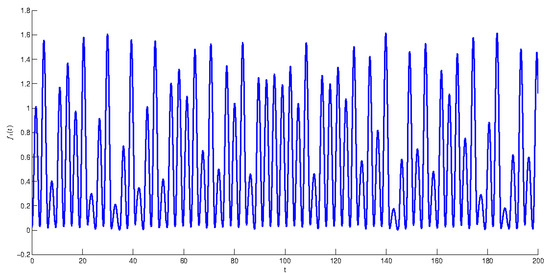
Figure 3.
The graph of compartmental periodic unpredictable function The degree of periodicity .
Issuing from the results of the last three simulations, let us make observations how the value of the degree of periodicity effects the shape of graphs of compartmental periodic unpredictable functions. Observing the graphs in Figure 1, when we see that the solution admits clear periodic shape, which is enveloped by the irregularity with small amplitude. Oppositely, if one can see in Figure 2 and Figure 3 that the periodicity lost its dominance and unpredictability prevails. More precisely, periodicity appears only locally on separated intervals, if That is, the periodicity envelopes the unpredictability this time. The periodicity is not seen at all for in Figure 3. So, the unit is the boundary value between dominance of regularity and irregularity, which are present with periodicity and the unpredictability respectively. The conclusions can be useful for analysis of experiments [34,35,36,37,38].
7. Randomly Determined Compartmental Unpredictable Functions
In this section, we demonstrate algorithms how to construct unpredictable functions by using Markov chains with finite state spaces. They will be used in the Miscellanea for compartmental quasi-periodic unpredictable functions.
A Markov chain is a stochastic model, which describes a sequence of possible events, such that the probability of each event depends only on the state attained in the previous one [42,43,44].
Since we expect for the unpredictable dynamics realizations to be bounded, the special Markov chain with boundaries is constructed below. Let the real-valued scalar dynamics be:
be given such that is a random variable. The probability distribution if and certain events if and if To satisfy the construction of the present research, we will make the following agreements. First of all, denote Consider the state space of the process and the value is the state of the process at time The Markov chain is a random process, which satisfies the property for all and Moreover, where is the transition probability that the chain jumps from state i to state It is clear that for all The unpredictability of infinite realizations of the dynamics is approved by Theorem 2.2 [45].
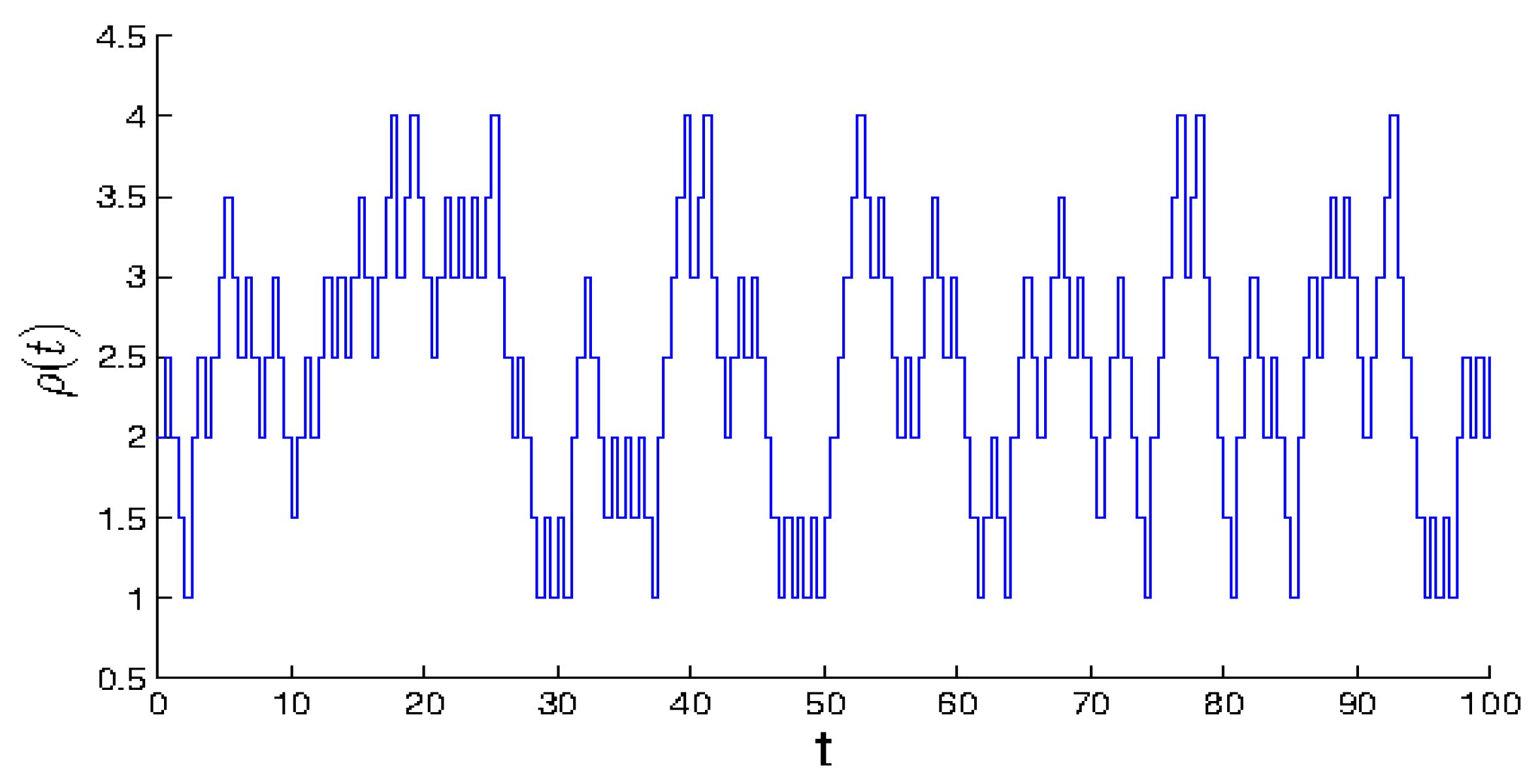
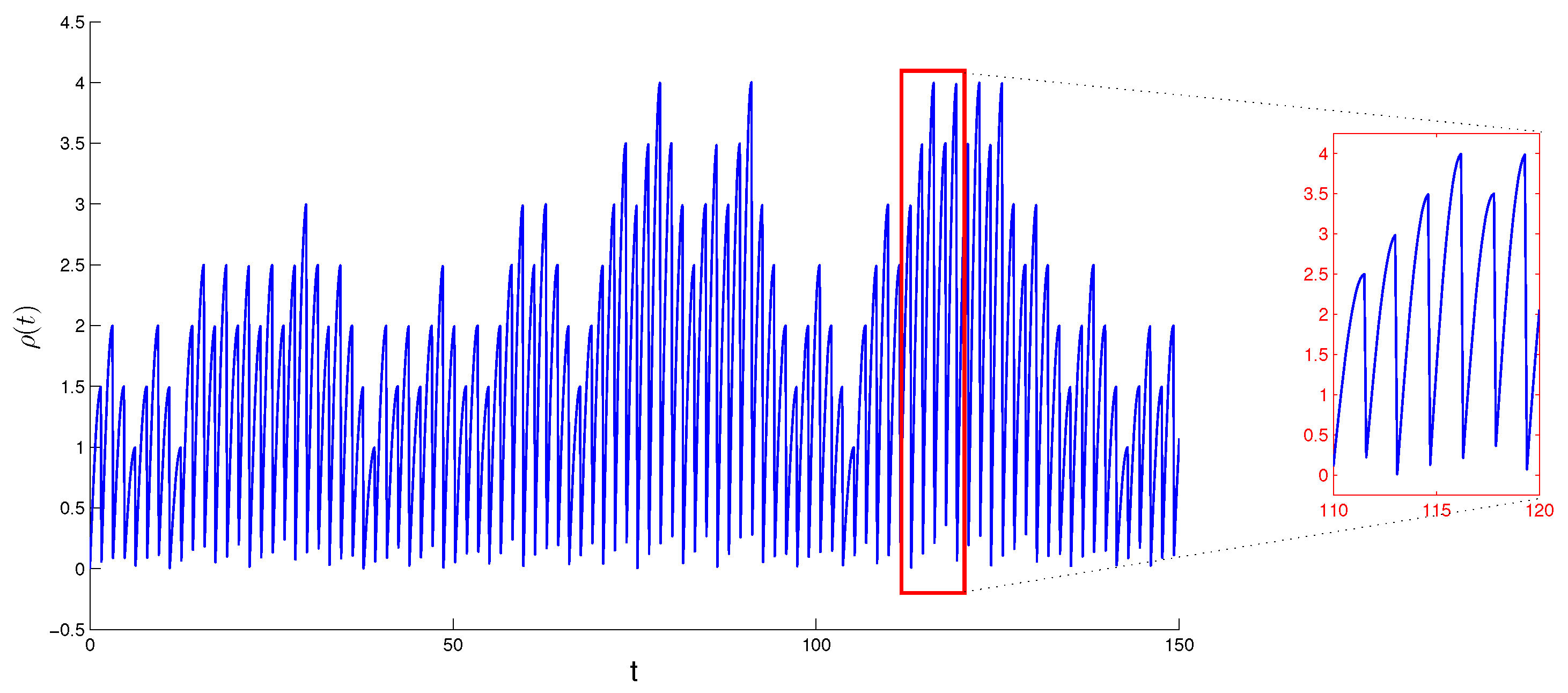
Next, we shall introduce randomly determined unpredictable function if where is a bounded function. In Figure 4 and Figure 5, the graph of the function with and respectively, for all is drawn.
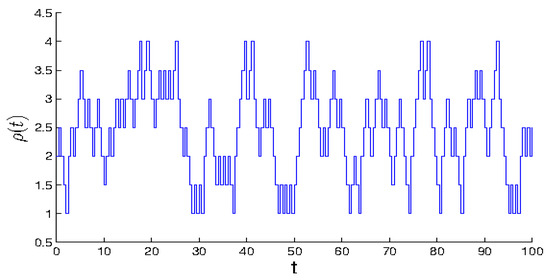
Figure 4.
The graph of the piecewise constant unpredictable function The vertical lines are drawn for better visibility.
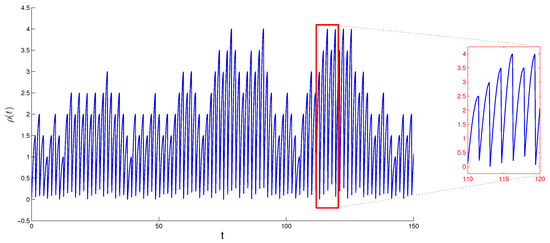
Figure 5.
The graph of the piecewise continuous unpredictable function - The vertical lines are drawn for better visibility.
Now, let us show construction of continuous unpredictable functions through the Markov process. Consider the ordinary differential equation:
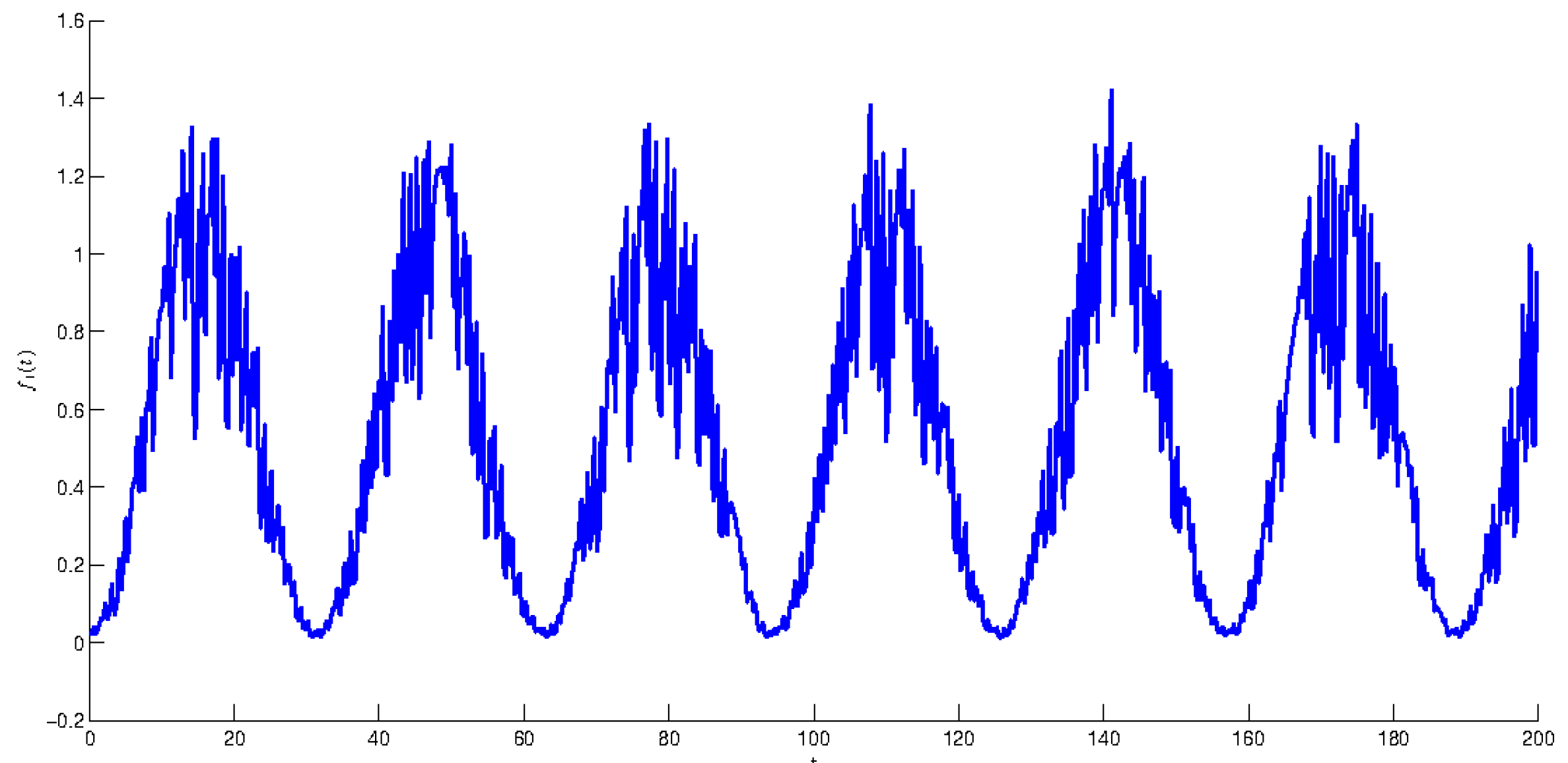
where is a negative number. The Equation (12) admits a unique exponentially stable unpredictable solution [45]. It is impossible to specify the initial value of the solution, but, by applying the property of exponential stability, one can consider any solution as arbitrarily close. In Figure 6, the graph of the solution, of Equation (12), where the parameter is equal to −2.5, and for is shown.
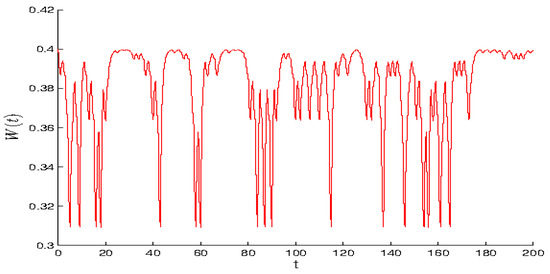
Figure 6.
The solution of Equation (12) with initial value exponentially approaches the unpredictable Markovian function.
8. Miscellanea
In the beginning of this part, two theorems are provided for construction of the unpredictable functions by using simple algebraic operations. The assertion of unpredictability of a composition is another result of the section. To provide information for next development of the study, several new definitions of compartmental unpredictable functions are presented. One can be invited to use the definitions to find conditions, which imply that the functions on diagonals are unpredictable in the sense of Definition 2. The irregular behaviour is demonstrated with numerical simulation in an example for a compartmental quasi-periodic unpredictable function.
Theorem 5.
If the function is unpredictable, then the sum , where C is a constant, is also unpredictable.
Proof.
Denote We have that this is why, as uniformly on compact subsets of and for each and . □
Theorem 6.
Assume that is an unpredictable function. Then, the function is unpredictable.
Proof.
There exists numbers and sequences , both of which diverge to infinity, such that converges to as uniformly on compact subsets of and for each and The proof of the Poisson stability of is not difficult, since it follows from uniformly continuity of on a compact set. Now, we will show that for some positive number and Fix a natural number Consider the function for By using the method of Lagrange multipliers, one can find that the minimum of occurs at the points with Therefore, for Thus, the function is unpredictable with sequences and positive numbers and □
Remark 4.
An unpredictable function to an even degree is not necessary unpredictable. This can be shown by considering the function Let us write the function in the form Despite the sum may be arbitrary small, and the separation property will not be satisfied.
Theorem 7.
Assume that bounded function satisfies the inequalities where are positive constants, for all Then, the function is unpredictable, provided that is an unpredictable function.
Proof.
Consider the function Let us fix positive number and a bounded interval One can find sufficiently large k it is true that for This is why,
for all Moreover, there exist a sequence and positive numbers , such that for Then, we obtain:
for all □
For further researches, it is important to consider the most general definitions of a Poisson stable and unpredictable functions, excluding their continuity.
Definition 6
([3]). A continuous function is called quasi-periodic with periods if for every positive ϵ there exists a positive number δ such that a number ρ satisfies the inequality provided that
Definition 7.
A function is said to be compartmental quasi-periodic unpredictable, if where is a continuous bounded function, quasi-periodic in u uniformly with respect to and unpredictable in v uniformly with respect to
Definition 8
([4]). A continuous function is said to be almost periodic if, for any positive ϵ, the set for all is relatively dense.
Definition 9.
A function is said to be compartmental almost periodic unpredictable, if where is a continuous bounded function, almost periodic in u uniformly with respect to and unpredictable in v uniformly with respect to
Definition 10
([46]). A continuous function is called recurrent if for any positive ϵ there can be found a positive number L, such that for each real number t and any interval I of length L there exists a number which satisfies
Definition 11.
A function is said to be compartmental recurrent unpredictable, if where is a function recurrent in u uniformly with respect to and unpredictable in v uniformly with respect to
Definition 12.
A function is said to be compartmental Poisson stable unpredictable, if where is a Poisson stable in u uniformly with respect to and unpredictable in v uniformly with respect to
Next, we formulate definitions of specific compartmental functions.
Definition 13.
A sum is said to be modulo periodic (quasi-periodic, almost-periodic, recurrent, Poisson stable) unpredictable function, if is a continuous periodic (quasi-periodic, almost-periodic, recurrent, Poisson stable) function and is an unpredictable function.
Definition 14.
A product is said to be factor periodic (quasi-periodic, almost-periodic, recurrent, Poisson stable) unpredictable function, if is a continuous periodic (quasi-periodic, almost-periodic, recurrent, Poisson stable) and is an unpredictable functions.
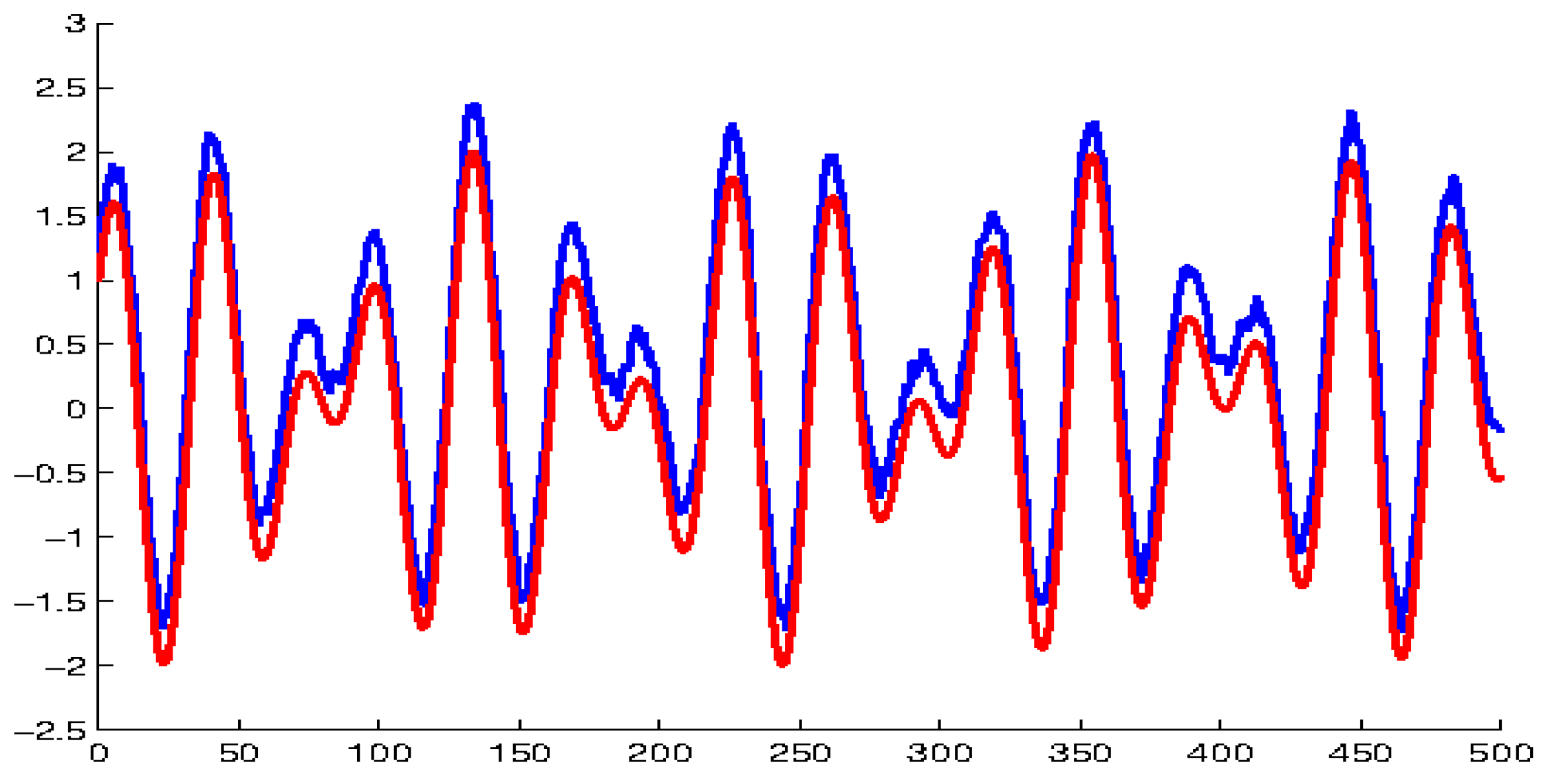
It is important to remark that the Definitions 7, 9, 11 and 12, are provided without any theoretical consequences within the present research. We consider them as a reason for open problems, such that conditions can be looked for the unpredictability of the functions, similar to the kappa property. Nevertheless, this time, we suggest the next simulation result to illustrate the irregularity as well possibility to see contribution of quasi-periodic and the unpredictable components to the composed dynamics. The graphs of quasi-periodic and compartmental quasi-periodic unpredictable function are shown in Figure 7. According to Theorem 7, the component is unpredictable with Lipschitz constants and since Thus, can be accepted as modulo quasi-periodic unpredictable function. One can see that the irregular graph of the unpredictable function envelopes the graph of the quasi-periodic function such that contribution of both quasi-periodicity and irregularity are clearly seen in the dynamics of compartmental function. Obviously, an analogue of the degree of periodicity can be looked for the quasi-periodicity, and the contributions of the components are discussed more deeply.
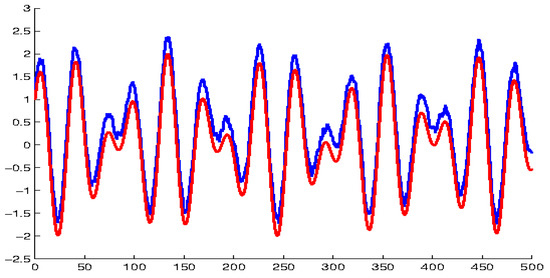
Figure 7.
The red curve is the graph of quasi−periodic function and the blue curve is the graph of the randomly determined compartmental quasi−periodic unpredictable function .
Author Contributions
M.A.: conceptualization; investigation; validation; writing—original draft. M.T.: investigation; writing—review and editing. A.Z.: investigation; software; writing—original draft. All authors have read and agreed to the published version of the manuscript.
Funding
M. Akhmet and A. Zhamanshin have been supported by 2247-A National Leading Researchers Program of TUBITAK, Turkey, N 120C138. M. Tleubergenova has been supported by the Science Committee of the Ministry of Education and Science of the Republic of Kazakhstan (grant No. AP14870835).
Institutional Review Board Statement
Not applicable.
Informed Consent Statement
Not applicable.
Data Availability Statement
Not applicable.
Acknowledgments
The authors wish to express their sincere gratitude to the referees for the helpful criticism and valuable suggestions, which helped to improve the paper significantly.
Conflicts of Interest
The authors declare no conflict of interest.
References
- Farkas, M. Periodic Motion; Springer: New York, NY, USA, 1994. [Google Scholar]
- Burton, T.A. Stability and Periodic Solutions of Ordinary and Functional Differential Equations; Elsevier Science: Amsterdam, The Netherlands, 1985. [Google Scholar]
- Levitan, B.; Zhikov, V. Almost Periodic Functions and Differential Equations; Cambridge University Press: Cambridge, UK, 1983. [Google Scholar]
- Fink, A. Almost Periodic Differential Equations; Springer: New York, NY, USA, 1974. [Google Scholar]
- Corduneanu, C. Almost Periodic Oscillations and Waves; Springer: New York, NY, USA, 2009. [Google Scholar]
- Birkhoff, G.D. Dynamical Systems; American Mathematical Society: Providence, RI, USA, 1927. [Google Scholar]
- Sell, G. Topological Dynamics and Ordinary Differential Equations; Van Nostrand Reinhold Company: London, UK, 1971. [Google Scholar]
- Hino, Y. Reccurent solutions for linear almost periodic systems. Funkc. Ekvacioj 1985, 28, 117–119. [Google Scholar]
- Kumar, A.; Bhagat, R.P. Poisson stability in product of dynamical systems. Int. J. Math. Math. Sci. 1987, 10, 613–614. [Google Scholar] [CrossRef]
- Knight, R.A. Recurrent and Poisson stable flows. Proc. Am. Math. Soc. 1981, 83, 49–53. [Google Scholar] [CrossRef]
- Poincare, H. New Methods of Celestial Mechanics; Dover Publications: Mineola, NY, USA, 1957. [Google Scholar]
- Lyapunov, A.M. Stability of Motion; Academic Press: New York, NY, USA, 1966. [Google Scholar]
- Bohl, P. Ueber Einige Differentialgleichungen Allgemeinen Charakters, Welche in der Mechanik Anwendbar Sind. Ph.D. Thesis, Bohl Publications, Dorpat, Estonia, 1900. [Google Scholar]
- Bohl, P. Über eine Differentialgleichung der Störungstheorie. Grelles J. 1906, 131, 268–321. [Google Scholar]
- Esclangon, E. Les Fonctions Quasi-Periodiques; Gauthier-Villars: Paris, France, 1904. [Google Scholar]
- Bohr, H. Zur Theorie der fastperiodischen Funktionen I. Acta Math. 1925, 8, 29–127. [Google Scholar] [CrossRef]
- Bohr, H. Zur Theorie der fastperiodischen Funktionen II. Acta Math. 1925, 45, 101–214. [Google Scholar] [CrossRef]
- Bohr, H. Almost Periodic Functions; American Mathematical Society: Providence, RI, USA, 1947. [Google Scholar]
- Bogolyubov, N.N. On Some Arithmetic Properties of Almost Periods; Akademiya Nauk Ukrainian SSR: Kiev, Ukraine, 1939. [Google Scholar]
- Besicovitch, A. Almost Periodic Functions; Dover: Cambridge, UK, 1954. [Google Scholar]
- Bohner, S. A new approach to almost periodicity. Proc. Natl. Acad. Sci. USA 1962, 45, 195–205. [Google Scholar]
- Stepanov, V.V. Sur quelques generalisations des fonctions presque periodiques. Comptes Rendus l’Acad. Sci. 1925, 181, 90–92. [Google Scholar]
- Akhmet, M.; Fen, M.O. Poincaré chaos and unpredictable functions. Commun. Nonlinear Sci. Nummer. Simulat. 2017, 48, 85–94. [Google Scholar] [CrossRef]
- Akhmet, M.; Tleubergenova, M.; Zhamanshin, A. Modulo periodic Poisson stable solutions of quasilinear differential equations. Entropy 2021, 23, 1535. [Google Scholar] [CrossRef]
- Akhmet, M.; Tleubergenova, M.; Zhamanshin, A. Compartmental Poisson Stability in Non-autonomous Differential Equations. In Nonlinear Dynamics and Complexity; Pinto, C.M., Ed.; Springer: Cham, Switzerland, 2022; pp. 1–23. [Google Scholar]
- Akhmet, M.; Tleubergenova, M.; Zhamanshin, A. Quasilinear differential equations with strongly unpredictable solutions. Carpathian J. Math. 2020, 36, 341–349. [Google Scholar] [CrossRef]
- Akhmet, M.; Tleubergenova, M.; Aruğaslan Çinçin, D.; Nugayeva, Z. Unpredictable oscillations for Hopfield-type neural networks with delayed and advanced arguments. Mathematics 2021, 9, 571. [Google Scholar] [CrossRef]
- Akhmet, M.; Seilova, R.; Tleubergenova, M.; Zhamanshin, A. Shunting inhibitory cellular neural networks with strongly unpredictable oscillations. Commun. Nonlinear Sci. Numer. Simul. 2020, 89, 105287. [Google Scholar] [CrossRef]
- Akhmet, M.; Tleubergenova, M.; Seilova, R.; Nugayeva, Z. Poisson Stability in Symmetrical Impulsive Shunting Inhibitory Cellular Neural Networks with Generalized Piecewise Constant Argument. Symmetry 2022, 14, 1754. [Google Scholar] [CrossRef]
- Akhmet, M.; Başkan, K.; Yeşil, C. Delta synchronization of Poincaré chaos in gas discharge-semiconductor systems. Chaos 2022, 32, 083137. [Google Scholar] [CrossRef]
- Rulkov, N.; Sushchik, M.; Tsimring, L.; Abarbanel, H. Generalized synchronization of chaos in directionally coupled chaotic systems. Phys. Rev. E 1995, 51, 980. [Google Scholar] [CrossRef]
- Akhmet, M.; Fen, M.; Tola, A. A Numerical Analysis of Poincaré Chaos. Discontin. Nonlinearity Complex. 2023, 12, 183–195. [Google Scholar] [CrossRef]
- Akhmet, M.; Fen, M.; Tola, A. Strange Non-Chaotic Attractors with Unpredictable Trajectories. J. Vib. Test. Syst. Dyn. 2022, 6, 317–327. [Google Scholar]
- Zhang, H.; Lu, H.; Nayak, A. Periodic time series data analysis by deep learning methodology. IEEE Access 2020, 8, 78–88. [Google Scholar] [CrossRef]
- Li, X.; Xu, F.; Zhang, J.; Wang, S. A multilayer feed forward small-world neural network controller and its application on electrohydraulic actuation system. J. Appl. Math. 2013, 1, 211–244. [Google Scholar] [CrossRef]
- Wei, Y.; Zhang, Q. Square wave analysis. In Common Waveform Analysis; Cai, K.Y., Ed.; Springer: Boston, MA, USA, 2000; pp. 13–40. [Google Scholar]
- Mohammad, U.; Yasin, M.; Yousuf, R.; Anwar, I. A novel square wave generator based on the translinear circuit scheme of second generation current controlled current conveyor–CCCII. SN Appl. Sci. 2019, 1, 587. [Google Scholar] [CrossRef]
- Wu, U.; Yasin, M.; Yousuf, R.; Anwar, I. Deep convolutional neural network for structural dynamic response estimation and system identification. J. Eng. Mech. Appl. Sci. 2019, 145, 4018125. [Google Scholar] [CrossRef]
- Landau, L. On the Nature of Turbulence. C.R. Dokl. Acad. Sci. USSR 1944, 44, 311314. [Google Scholar]
- Ruelle, D.; Takens, F. On the Nature of Turbulence. Commun. Math. Phys. 1971, 20, 167–192. [Google Scholar] [CrossRef]
- Haggarty, R. Fundamentals of Mathematical Analysis; Addison Wesley: Reading, MA, USA, 1993. [Google Scholar]
- Meyn, S.; Tweedie, R. Markov Chains and Stochastic Stability; Cambridge University Press: Cambridge, UK, 2009. [Google Scholar]
- Karlin, S.; Taylor, H. A First Course in Stochastic Processes; Academic Press: Cambridge, MA, USA, 2012. [Google Scholar]
- Hajek, R. Random Processes for Engineers; Cambridge University Press: Cambridge, UK, 2015. [Google Scholar]
- Akhmet, M. Unpredictability in Markov chains. Carpathian J. Math. 2022, 38, 13–19. [Google Scholar] [CrossRef]
- Zubov, V.I. Oscillations and Waves; Leningrad State University: Leningrad, Russia, 1989. (In Russian) [Google Scholar]
Disclaimer/Publisher’s Note: The statements, opinions and data contained in all publications are solely those of the individual author(s) and contributor(s) and not of MDPI and/or the editor(s). MDPI and/or the editor(s) disclaim responsibility for any injury to people or property resulting from any ideas, methods, instructions or products referred to in the content. |
© 2023 by the authors. Licensee MDPI, Basel, Switzerland. This article is an open access article distributed under the terms and conditions of the Creative Commons Attribution (CC BY) license (https://creativecommons.org/licenses/by/4.0/).