


Abstract
Association rule mining (ARM) is one of the most important tasks in data mining. In recent years, swarm intelligence algorithms have been effectively applied to ARM, and the main challenge has been to achieve a balance between search efficiency and the quality of the mined rules. As a novel swarm intelligence algorithm, the water wave optimization (WWO) algorithm has been widely used for combinatorial optimization problems, with the disadvantage that it tends to fall into local optimum solutions and converges slowly. In this paper, a novel hybrid ARM method based on WWO with Levy flight (LWWO) is proposed. The proposed method improves the solution of WWO by expanding the search space through Levy flight while effectively increasing the search speed. In addition, this paper employs the hybrid strategy to enhance the diversity of the population in order to obtain the global optimal solution. Moreover, the proposed ARM method does not generate frequent items, unlike traditional algorithms (e.g., Apriori), thus reducing the computational overhead and saving memory space, which increases its applicability in real-world business cases. Experiment results show that the performance of the proposed hybrid algorithms is significantly better than that of the WWO and LWWO in terms of quality and number of mined rules.
Keywords:
data mining; association rule mining; water wave optimization algorithm; hybrid algorithm; Levy flight MSC:
68T09
1. Introduction
Significant amounts of data are generated every day in all industries, and the field of data mining has expanded quickly in recent years. Data mining, also known as knowledge discovery, aims to find valuable implicit information in large amounts of data [1]. Association rule mining (ARM) is a powerful data mining technique that has been used in a variety of applications to uncover valuable patterns and relationships in large datasets [2]. ARM has long been in the spotlight as a fundamental strategy and is still used today in a variety of applications including market basket analysis, medical diagnostics, network intrusion detection, and other areas [3,4].
Frequent itemset mining (FIM), as a major phase in the traditional ARM algorithms, mines all possible association rules by first mining all the frequent item sets. However, the large number of possible association rules generated leads to expensive computational overhead. For example, in a network intrusion detection system based on association rules, extracting the features of network traffic and building a rule will be difficult if the network data grow quickly, as FIM might not be able to effectively mine the association relationship between features.
Traditional algorithms to resolve the problems of optimization need enormous computational efforts that are inclined to fail as the scale of the problem rises [5,6], which is time- and space-consuming [7,8]. To overcome this issue, some swarm-intelligence-based FIM methods, such as ant colony optimization (ACO) [9], bee swarm optimization (BSO) [10], bat algorithm (BA) [11,12], cuckoo search (CS) [13], penguin search optimization algorithm (PeSOA) [14], and particle swarm optimization (PSO) [15], have been utilized for ARM. From the perspective of runtime performance, these are far more effective, but the quality of the solutions still needs to be improved.
The water wave optimization (WWO) algorithm is a promising swarm intelligence algorithm that has gained attention from researchers because of its impressive performance in solving optimization problems. It has several advantages compared with other swarm intelligence algorithms, such as fewer parameters, high computational efficiency, and easy implementation. Zheng [16] first proposed the WWO algorithm based on shallow water wave models. As a novel algorithm, WWO has a broad development prospect in optimization problems and engineering applications [17], such as the traveling salesman problem and high-speed rail dispatching [18,19]. Zheng et al. [20] proposed a systematic approach to adapting WWO to specific heuristic algorithms for various combinatorial optimization problems. The proposed approach tested the flow-shop scheduling problem, and the results demonstrated that it is competitive. Yan et al. [21] proposed an enhanced WWO based on the elite opposition-based learning strategy and the simplex method (ESWWO), and the experimental results demonstrated that ESWWO is a practical and useful approach for path planning and function optimization problems. Given the effectiveness of WWO in engineering scheduling problems and path optimization problems, in this paper, it is employed to improve the performance of the primary ARM algorithm. However, WWO tends to get stuck in local optima and converge slowly when there are many transaction items in the datasets. To address this issue, an improved WWO with Levy flight (LWWO) is proposed to achieve better solutions in the global search process.
The wave in WWO makes probabilistic decisions based on the search length of the water wave in the current dimension when generating a feasible solution. The probability distribution used to select the next feasible solution is crucial when solving a locally optimal problem [22,23]. Moreover, the levy distribution has a heavy tail feature, which means that it has a thicker tail than other distributions [24,25,26]. Therefore, in the levy distribution, the tails have a higher probability of being selected, which gives a variety of solutions for LWWO. Additionally, expanding the variety of solutions increases the likelihood of discovering the optimal solution. Levy flight strategy has been shown to be successful in a variety of swarm intelligence algorithms, such as PSO [27,28,29], artificial bee colony (ABC) algorithm [30], CS algorithm [31,32], and so on.
To further improve the performance of swarm intelligence, scholars have conducted a lot of research on the hybrid strategy and achieved good results [33,34]. In addition, there are successful cases to prove that WWO has good performance when hybridizing with other algorithms. Rekha et al. [35] designed the water moth search algorithm (WMSA) for training a deep recurrent neural network to detect malicious network activities by combining WWO and moth search optimization (MSO). Zhang et al. [36] proposed an improved sine cosine WWO algorithm (SCWWO), which parallels the sine cosine algorithm (SCA) and WWO in the wave propagation and breaking phases. Experimental results demonstrate that SCWWO significantly improves convergence speed and computational accuracy. In this paper, a novel hybrid strategy on LWWO is proposed to obtain better performance. The basic idea of the hybrid strategy is to combine the characteristics of different algorithms. During the iterative update of the population, the algorithms with the appropriate characteristics are selected according to the different needs of the pre- and post-iteration periods. In this study, seeking appropriate algorithms to combine with LWWO is important to further improve the global search capability of water waves. In recent years, scholars have applied various forms of swarm intelligence to ARM and achieved good performance. Zhou et al. [37] applied ACO to solve the sequential rule mining problem, and interesting temporal association rules were extracted. Khan et al. [38] applied the ARM technique to protein classification, which combines the ARM and supervised classification mechanisms using ACO. According to experimental findings, the classifier performed well by identifying the most precise and brief rules. Heraguemi et al. [39,40] proposed an algorithm based on BA for ARM, and the proposed algorithm performed better than the FP-growth algorithm in terms of computation speed and memory usage. Afshari et al. [41] proposed an efficient approach that benefits from the CS algorithm for hiding sensitive association rules. Based on the effective application of the above algorithms on ARM, in this paper, LWWO is hybridized with the ACO, BA, and CS, respectively.
This paper proposes a novel LWWO-based ARM method with a hybrid strategy for discovering hidden relationships between items in datasets. The proposed method not only fuses the advantages of different algorithms but also facilitates a balance between the exploration and exploitation capabilities of WWO, which allows the algorithm to obtain the global optimal solution to the maximum extent and improve the quality of the mined association rules. The main contributions of this paper are summarized as follows:
- (1)
- Levy flight is used in the WWO algorithm’s location update process to improve the variety of solutions and prevent it from being stuck on the local optimal solution.
- (2)
- A hybrid strategy is proposed to help the algorithm balance exploration and exploitation. A hybrid algorithm with greater global search capability was obtained by hybridizing ACO, BA, and CS with LWWO, respectively.
- (3)
- The proposed hybrid LWWO–ARM method generates rules directly. Different from traditional ARM algorithms, the proposed method does not generate frequent item sets, reducing the computational overhead of the algorithm, which improves its applicability in practical cases.
The proposed hybrid LWWO–ARM method is tested on six datasets of different sizes and dimensions, which exhibits significantly better performance than primary WWO in terms of the number and quality of rules.
2. Theory Background
2.1. Association Rule Mining
ARM was first proposed by Agrawal as an important research task in data mining, and is also known as the market-basket problem: In a set of items and sales records, which include information about transactions related to the item, association rules are mined to obtain important relationships between the items. In summary, ARM aims to extract relationships between features of different elements [42]. Similar to functional dependency (FD), ARM expresses important relationships between database attributes. For example, with 100% confidence, an association rule is a constant conditional FD. Many studies have shown that ARM techniques can significantly accelerate the general FD discovery approaches [43,44].
Association rule analysis has been widely used in various industries. It can extract relevant information from complex and large amounts of data, which has been used in the financial industry to predict customer needs and provide more suitable product recommendations [45]. By mining the information data of the enterprise, it can predict the sales situation of the enterprise and provide a more specific development plan for the development of the enterprise. On online e-commerce platforms, intelligent recommendations can be made based on the correlation information of users’ browsing behavior, and the correlation between different products can be studied to improve the sales of products. Moreover, in the medical field, some researchers use ARM for the identification of cancer-related genes [46].
Association rules provide an expression () to present the correlation between features, indicating that if event A has occurred, then event B is also likely to occur [47]. In association rules, there are various indicators to evaluate their quality. The proposed hybrid algorithms based on LWWO consider two standards: support and confidence.
- (1)
- Support
Support is one of the criteria for assessing the quality of a rule; it is a measure of how often an item or a set of items appear in a dataset. The value of support can be calculated using Equation (1):
where is the number of transitions that contain both and and is the number of all transactions in the database.
- (2)
- Confidence
Confidence is also a criterion for the quality of association rules; it is a measure of how likely an item or a set of items are to appear together in a transaction. The value of confidence can be calculated using Equation (2):
where is the number of transactions that only contain .
2.2. Brief Introduction to WWO
WWO is a powerful algorithm that can be used to solve a variety of optimization problems. It is based on the principles of shallow water wave motion, which involves three operations: propagation, wave breaking, and refraction. WWO is computationally efficient and is capable of finding high-quality solutions.
- (1)
- Propagation.
The process of propagation can be seen as moving from deep water to shallow water, and the propagated solution is updated according to Equation (3):
where is a uniformly distributed random number with mean zero and standard deviation one, and is the length of the th dimension of the search space. If the updated location exceeds the search range, it is randomly reset to a location within the search range.
If , replaces in the population, and its height is reset to ; Otherwise, the height of is decreased by one and is retained.
After each generation update, the wavelength of each wave is calculated as in Equation (4):
where is the maximum fitness value and is the minimum fitness value in the current population, is the wavelength reduction factor, and is a very small constant to avoid division-by-zero.
- (2)
- Refraction.
When the water wave propagates many times without improvement, its wave height decreases to . Refraction is performed on it as Equation (5) to avoid search stagnation:
where denotes the current optimal solution and denotes the Gaussian random number with mean and variance .
Afterwards, the wave height of is reset to , and its wavelength is updated by Equation (6):
- (3)
- Breaking.
Once the WWO algorithm searches for a new optimal water wave , then the wave breaking operation is performed as Equation (7):
where is the wave breaking parameter. Additionally, is a function that generates a random number with a Gaussian distribution that has a mean of zero and a standard deviation of one. If the wave is better than , replaces in the population.
2.3. Brief View of Levy Flight
Levy flight refers to a random walk with a heavy-tailed probability distribution of step lengths, which means that there is a high probability of a large change in position during the random walk [48,49,50]. Abundant studies have shown that the individual behavior of many animals in nature is well-represented by the characteristics of Levy flight. The essence of Levy flight is a method to randomize the step length to simulate flight. Levy flight is a method to represent the levy distribution in random steps, as shown in Equation (8):
where is the step length of Levy flight, it can be calculated according to Equations (9) and (10):
where the parameters , , and are both normal distributions and is the standard gamma function.
3. Proposed Approach
3.1. Integrating Levy Flight with WWO
The primary WWO algorithm can deal with low-dimensional unimodal optimization problems with mathematical functions simply and efficiently. However, when the same method is applied to high-dimensional complex optimization problems, the solutions obtained by traditional WWO are not very satisfactory and the computation time is long. To improve the global search and local exploration capabilities of WWO, Levy flight is integrated into the location update process of the algorithm. Levy flight maximizes the diversity of the search space, which ensures that the algorithm updates the water wave positions efficiently, helping the WWO to achieve better search results. Therefore, the WWO position update formula is optimized and can be expressed by Equation (11):
In brief, the pseudo-code of the LWWO is described in Algorithm 1.
| Algorithm 1: Pseudo-Code of LWWO |
| Input: population () and maximum number of iterations (); Output: 1: Randomly Initialize a population of n waves and the parameters () 2: While stop criterion is not satisfied do 3: for each do 4: propagate to a new using Equation (3) 5: if then 6: if then 7: using Equation (11) 8: 9: Replace 10: else 11: 12: if then 13: Refract to a new using Equations (5) and (6) 14: Update the wavelengths using Equation (4) 15: Return |
3.2. The Hybrid Strategy for LWWO
To prevent the algorithm from falling into a local optimum to the greatest extent, it is necessary to apply a method that can explore the entire search space and exploit local regions. An effective mixture of different algorithms takes advantage of different search strategies to balance exploration and exploitation. A hybrid strategy is proposed to improve the global optimization capability of LWWO. ACO, BA, and CS were selected for hybridization with LWWO because they have a strong exploratory capability and have been proven to perform well on ARM in previous studies. Then, hybrid algorithms LWWO–ACO, LWWO–BA, and LWWO–CS were applied to ARM.
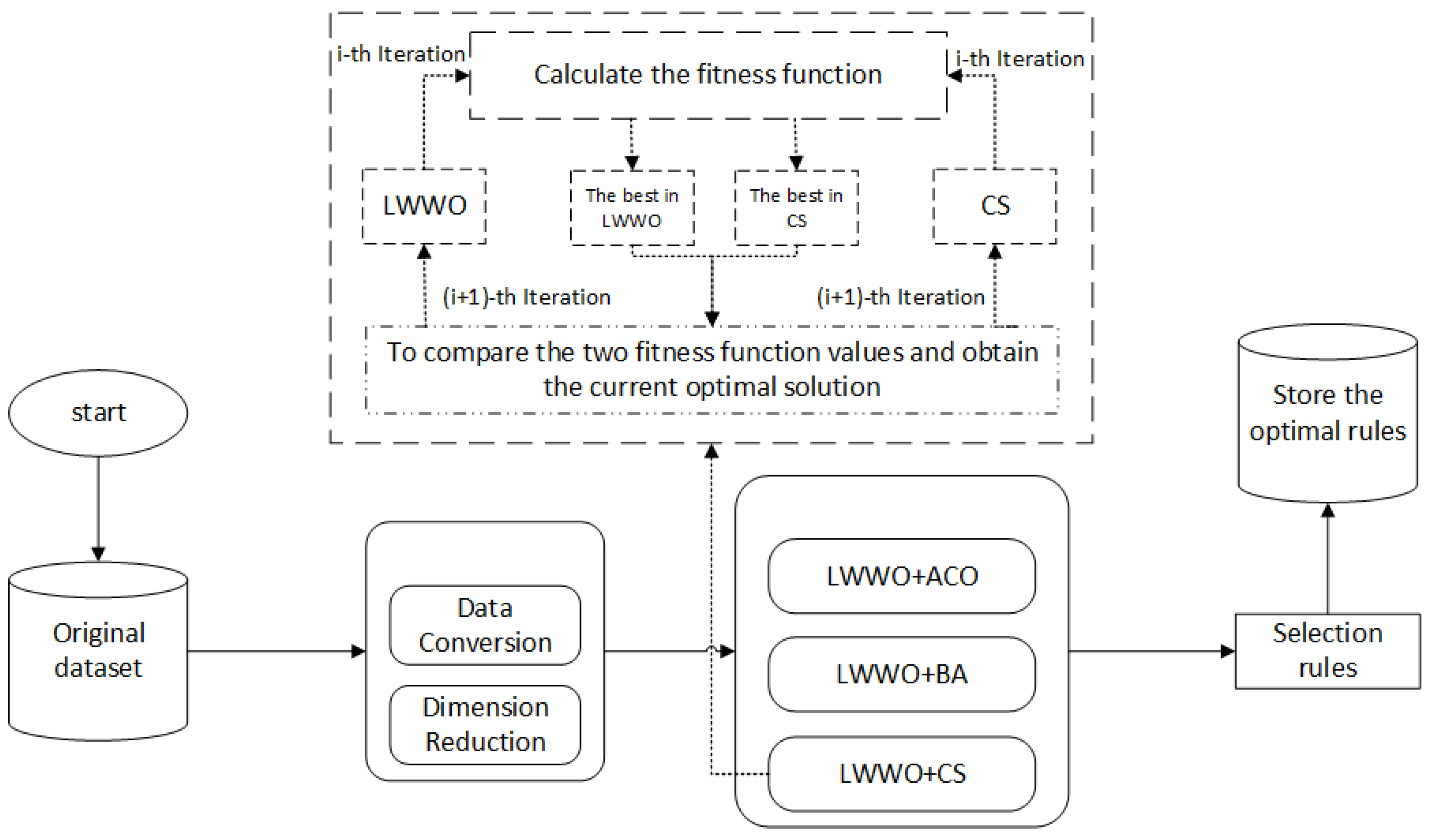
In this study, the proposed method comprises four stages: data pre-processing, hybrid algorithms for ARM, rule evaluation, and generation of association rule sets. The overall flow of the hybrid algorithm for ARM is shown in Figure 1. The process of selecting the optimal solution for the hybrid algorithm is illustrated in the dashed box, using LWWO–CS as an example. The proposed hybrid algorithm obtains the current optimal solution by comparing the values of the fitness functions of LWWO and CS.
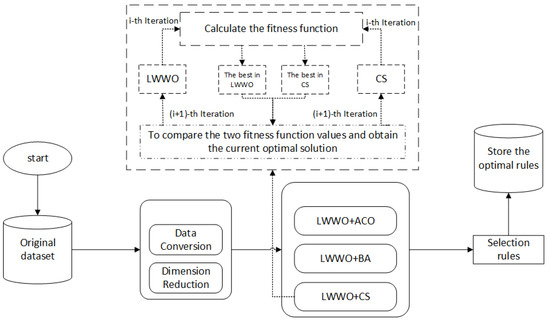
Figure 1.
The overall model of the hybrid algorithm for ARM.
In this paper, we combine the strengths of multiple algorithms to compensate for the shortcomings of the primary WWO, such as slow convergence speed and weak ability to jump out of the local optimum. In the whole process, the number of populations is the same for each algorithm, and the total number of iterations is the sum of the iterations of two algorithms. When the iterations of LWWO are complete, the current population is retained and used as the initial population for the next stage.
In general, swarm intelligence algorithms converge slowly during the population initialization phase. Therefore, at the beginning of the iteration, it is advisable to choose an algorithm with good convergence and strong search capabilities to approach the optimal solution. In the middle and late stages of the iteration, individuals of the population tend to cluster around local optimal solutions; thus, algorithms with greater exploratory power are needed.
As WWO is relatively slow to converge in the early stages, the ACO algorithm, which has a good convergence and search capabilities, is chosen to be mixed with it. In the later stage of the iteration, since WWO is weak in jumping out of the local optimum, it is suggested to combine with an algorithm with a stronger ability to jump out of the local optimum, such as the BA and the CS algorithms, which can further search the solution space to find other possible optimal solutions.
The data structure of the proposed algorithm is HashSet, which limits the storage of duplicate elements, making it well-suited for filtering duplicate association rules and storing the individuals in the population that meet the requirements. At the same time, the proposed method uses HashMap to store the rules, their corresponding support and confidence, which are stored in memory as key-value pairs. The proposed hybrid algorithm based on LWWO pseudo-code is provided in Algorithm 2.
| Algorithm 2: Pseudo-Code of the proposed hybrid algorithm based on LWWO |
| Input: population and maximum number of iterations, datasets; Output: rules stored in HashSet, the support and confidence stored in HashMap to an Excel table 1: Scan the datasets and count the number of attribute items 2: Convert the transactions in the datasets into a 0-1 matrix 3: Randomly Initialize the population and the parameters of algorithm A 4: Iterations = 5: While do 6: for each individual in the population do 7: Compute the fitness values for individuals in the population 8: Update the individuals in the population by location update formula of algorithm A 9: Binarize the updated individuals using sigmoid activation function using Equation (13) 10: Evaluate individuals in the population, deposit the individuals that meet the rules in HashSet, deposit the corresponding support and confidence in HashMap 11: end for 12: 13: end while 14: Use the population after algorithm A iterations as the initial population of algorithm B 15: Initialize the parameters for algorithm B; 16: while t < T2 do 17: for each individual in the population do 18: Compute the fitness values for individuals in the population 19: Update the individuals in the population by location update formula of algorithm B 20: Binarize the updated individuals using sigmoid activation function using Equation (13). 21: Evaluate individuals in the population, deposit the individuals that meet the rules in HashSet, deposit the corresponding support and confidence in HashMap 22: end for 23: 24: end while 25: Count the execution time of hybrid algorithm and the number of rules searched |
3.3. The Hybrid Algorithms for Association Rule Mining
The ARM process can be summarized as follows: First, a mapping needs to be created between the records in the dataset; in other words, for existing data records, relationships between attributes are revealed by association rules.
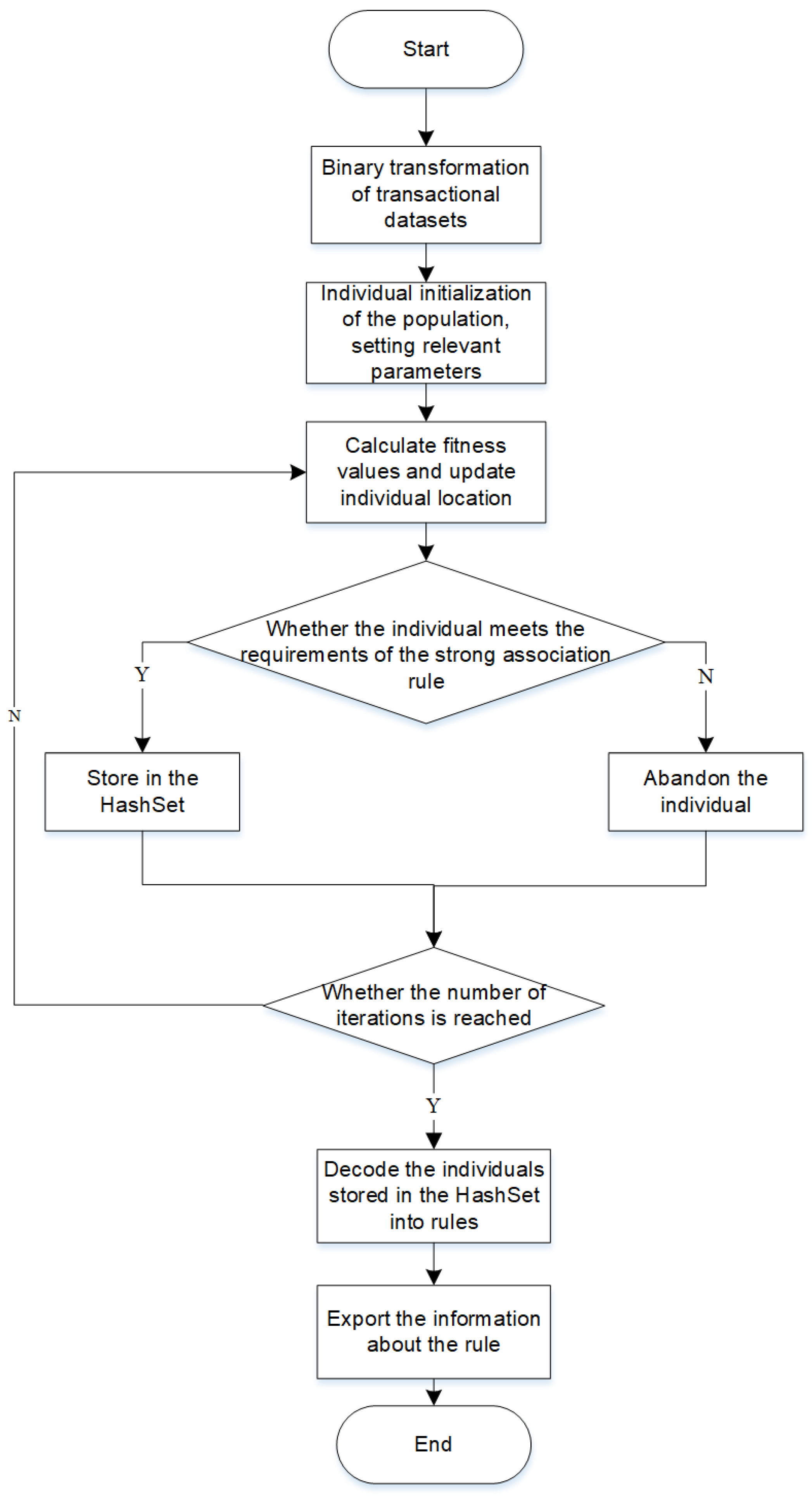
Figure 2 illustrates the entire operation of the hybrid algorithm based on the LWWO generation rules. In the process, the data are first converted into binary format, and then candidate solutions are encoded as individuals in the population. It is important to define a suitable fitness function to assess the quality of each individual. Then, a hybrid algorithm is used to mine the data for association rules and continues the search process until the iteration is complete. Finally, when the evolution of the individuals is complete, the hybrid algorithm outputs strong association rules.
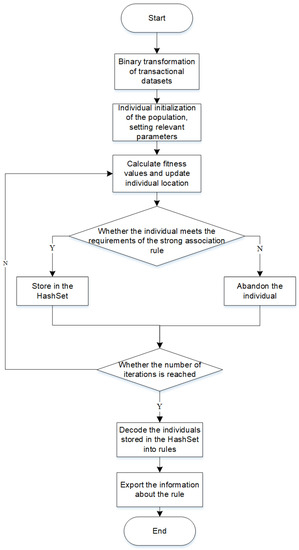
Figure 2.
Flowchart of the proposed hybrid algorithms for ARM.
3.4. Rule Encoding
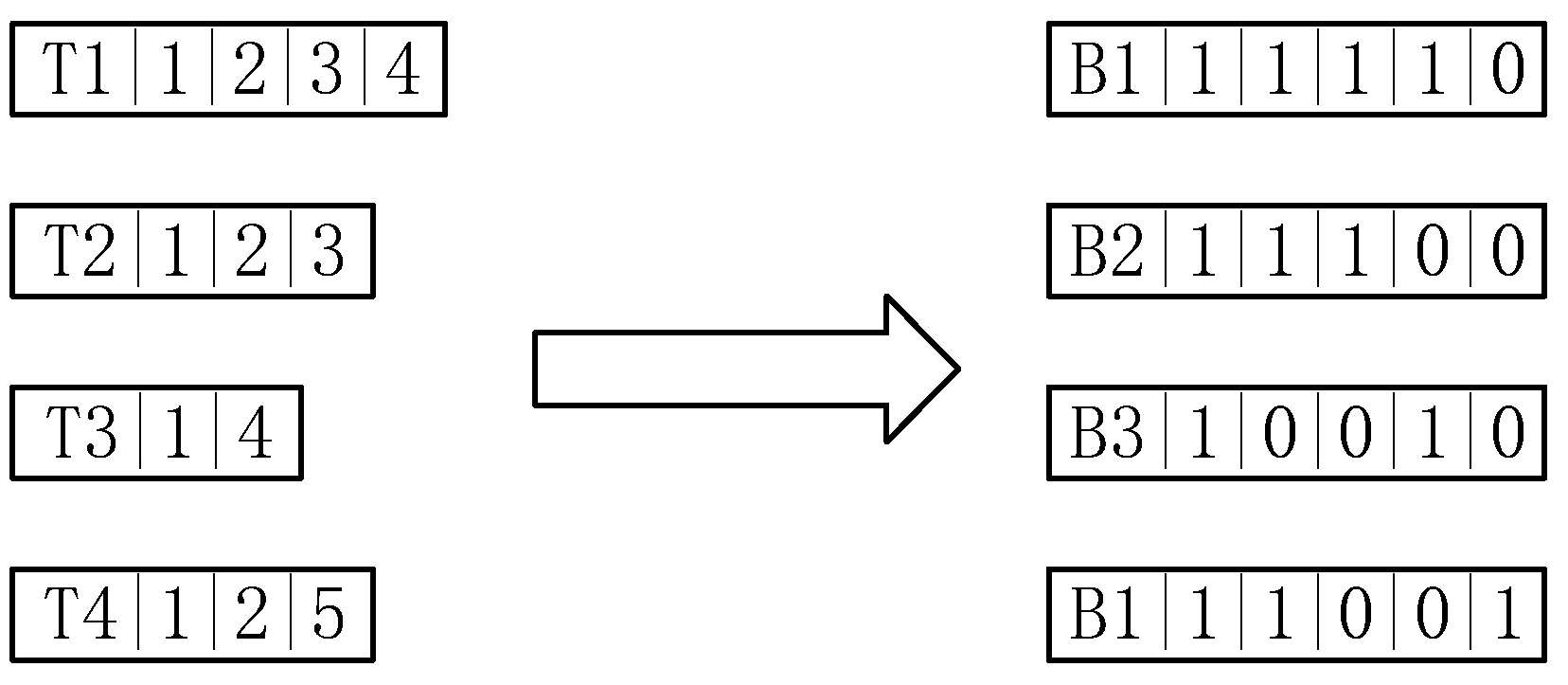
In swarm intelligence, each individual in the population represents a possible solution in the solution space. Aiming at the problem of ARM, each individual represents a possible rule. By encoding them, each solution is transformed into a rule. For the algorithms mentioned in this paper, binary encoding is used to encode the raw data. Binary encoding means that the records in a dataset are transformed into a zero–one matrix and all data records are stored in zero or one format, which makes it easy to read the data records and also increases the speed of calculation. The conversion method is shown in Figure 3. For an attribute item present in a transaction, the corresponding position is set to one. Otherwise, it is set to zero.
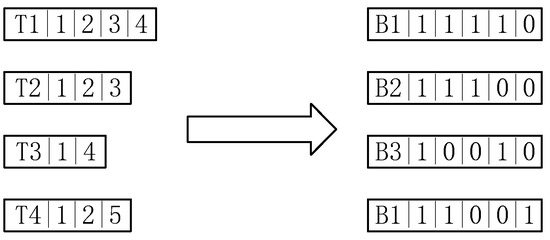
Figure 3.
Transaction data binary transformation.
There are two approaches to encoding association rules: in the Michigan approach, a rule represents a solution, while in the Pittsburgh approach, it uses a set of rules to represent a solution. Considering that each individual represents a rule, for the problem of how to distinguish the antecedent from the latter, the proposed algorithm uses the Michigan method, which consists of two attribute terms that jointly represent the transaction terms in a rule; each rule consists of a rule antecedent and a rule consequent.
As an example, the rules generated from the transaction in Figure 3 are encoded as shown in Table 1, where each attribute item consists of two digits, the first digit indicating whether the attribute is included in the rule, and the second digit indicating whether the attribute is the antecedent of the rule or the consequence of the rule. For example, if is coded as 1–1, it means that the generated rule has the attribute item , and is in the antecedent of the rule. Thus, this individual can be decoded as a rule .

Table 1.
Randomly generated Michigan-coded individuals.
After the positional update of population individuals, the code of population individuals is longer coded zero–one, so it is necessary to recode the updated individuals. The updated equation is as in Equation (12):
where is a random number in the range between zero and one, and is the sigmoid function, as shown in Equation (13):
3.5. The Fitness Function
Constructing a suitable fitness function is a key step in solving optimization problems and is used to evaluate the quality of the solution. Specifically applied to ARM, support and confidence are important criteria for evaluating whether a rule is valid or not.
Support indicates the probability that all data items in a rule will appear in the dataset at the same time and reflects the level of support for a rule. Confidence reflects the feasibility of a rule. They are used to determine the importance and validity of a rule. We consider combining support and confidence to define the required fitness function. The fitness function is formed as in Equation (14):
where is the support for randomly generated rules, is its confidence, and and determine the weight of support and confidence in the iterative process, respectively. and are all in the range (zero, one), and . If is set to zero, only the influence of confidence on the rules is considered, and rules with a weak association between the antecedent and the consequent may be mined. If is set to zero, only the influence of the support on the rules is considered, and rules with very low accuracy may be mined, ignoring rare rules. Considering appropriate weights can balance support and confidence, which has a good effect on mining strong association rules.
In addition, whether a rule is determined to be a strong association rule requires consideration of minimum support and minimum confidence. Finally, whether an individual can be retained as a strong association rule is calculated by Equation (15):
where and are the minimum support and the minimum confidence defined by the user, respectively. If , it means that the rule represented by the individual is not strongly associated and should be discarded. Otherwise, it can be retained as a strong association rule, and the rule will be written to the output file.
4. Experimental Results and Discussion
For the purpose of validating the performance of the proposed method, the corresponding computational experiments for hybrid algorithms, WWO, and LWWO implemented on ARM were conducted. Each algorithm was run 30 times on different datasets, and the average results were recorded. All algorithms were written in Java and executed on an Intel Core i7 machine with 16 GB of memory, running on Windows 10. The datasets and parameter settings are explained in detail in the following sections.
4.1. Datasets
The datasets were downloaded from the “LUCS-KDD Discretised/Normalised” database. To test the performance of the algorithms applied on ARM on datasets of different sizes and dimensions, six different datasets were selected for experiments to compare the performance of the five algorithms (WWO, LWWO, LWWO–ACO, LWWO–BA, LWWO–CS). The information of the datasets is shown in Table 2; these data were pre-processed by discretization and dimension reduction and then used in the experiments.
Table 2.
Dataset descriptions.
4.2. Parameters Settings
As for ARM, the quality of a rule is usually determined by its support and confidence. Through the analysis in Section 3.5, the proposed method uses Equation (14) as the fitness function of the proposed algorithm. The weight of support and confidence jointly determine the direction of population convergence and the search target. We tested the performance of different parameter combinations on a shopping basket dataset. As shown in Table 3, when the support weight () is 0.7 and the confidence weight () is 0.3, most algorithms perform a relatively large number of association rules and a good quality of the mined rules. Therefore, to ensure the fairness of the experiment, the experiment had the following settings:
Table 3.
Different weight of support and confidence tests.
- 500 for the total number of iterations (T);
- 60 for population size;
- 0.7 for support weight ();
- 0.3 for confidence weight ();
- 0.1 for the minimum support ();
- 0.5 for the minimum confidence ().
4.3. Evaluation Standard
It is insufficient to use only the number of rules mined as the evaluation standard. Consequently, the quality of the rules obtained should also be used as one of the criteria for determining the efficacy of the algorithms. This paper uses the average confidence and the average support of the rules mined as a supplementary evaluation criterion, to observe the quality of the rules mined by the algorithm. In summary, it was finally determined that the performance of the algorithm was evaluated from four aspects: average mining time (avg_time), average number of rules mined (rule_nums), average confidence (avg_conf), and average support (avg_sup).
4.4. Performance Comparison
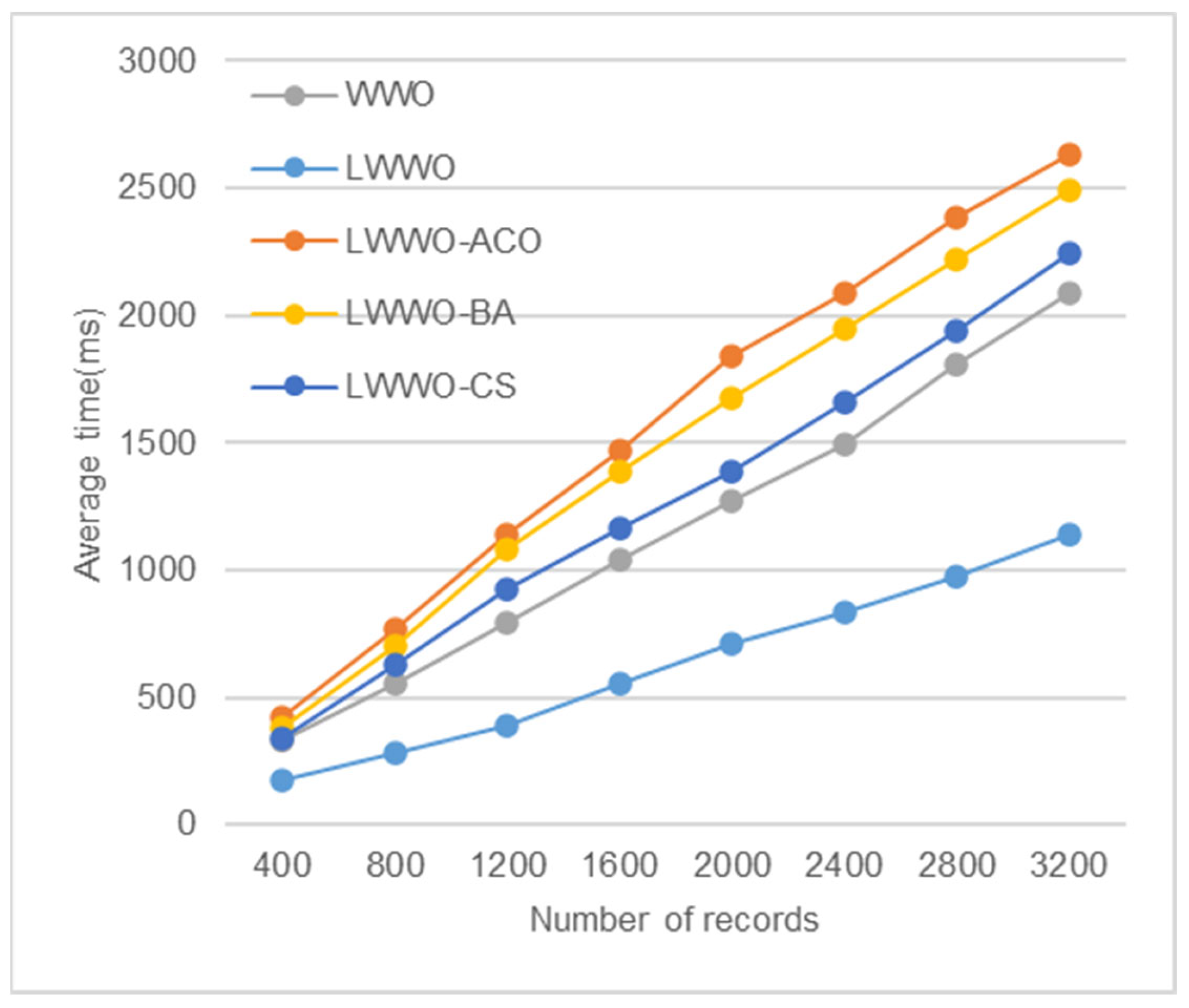
Since the Led7 dataset contains the largest number of records, it was used as a sample to count the execution time of each algorithm for different numbers of records, and the results are shown in Table 4 and Figure 4. Overall, LWWO had the shortest execution time, with a reduction of 44.06–51.08% over WWO. This indicates that the Levy flight strategy was effective in improving the search speed of WWO. The time taken by LWWO–CS was closest to that of WWO, while LWWO–BA and LWWO–ACO took more time than WWO. Compared with WWO, when the number of records was 1600, LWWO–ACO and LWWO–BA took 41.27% and 32.82% more time, respectively, and LWWO–CS took only 12.00% more time; when the number of records was 3200, LWWO–ACO and LWWO–BA took 26.33% and 19.66% more time, respectively, while LWWO–CS took only 7.58% more time. This indicates that LWWO–CS has an advantage over the other two hybrid algorithms in terms of execution time.
Table 4.
Running time of each algorithm with different data volume (ms).
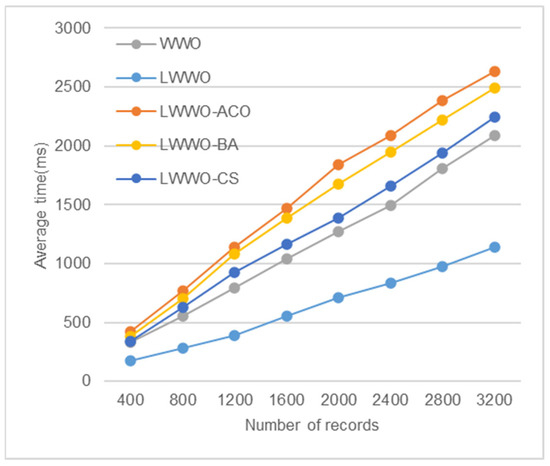
Figure 4.
Time consumption of each algorithm with different data volume.
4.5. Comprehensive Evaluation
In this section, the average execution time of each algorithm, the average number of rules mined, the average confidence, and the average support are tested on six benchmark datasets of varying dimensions and sizes, and the detailed statistics are shown in Table 5.
Table 5.
Detailed data of each algorithm on different datasets.
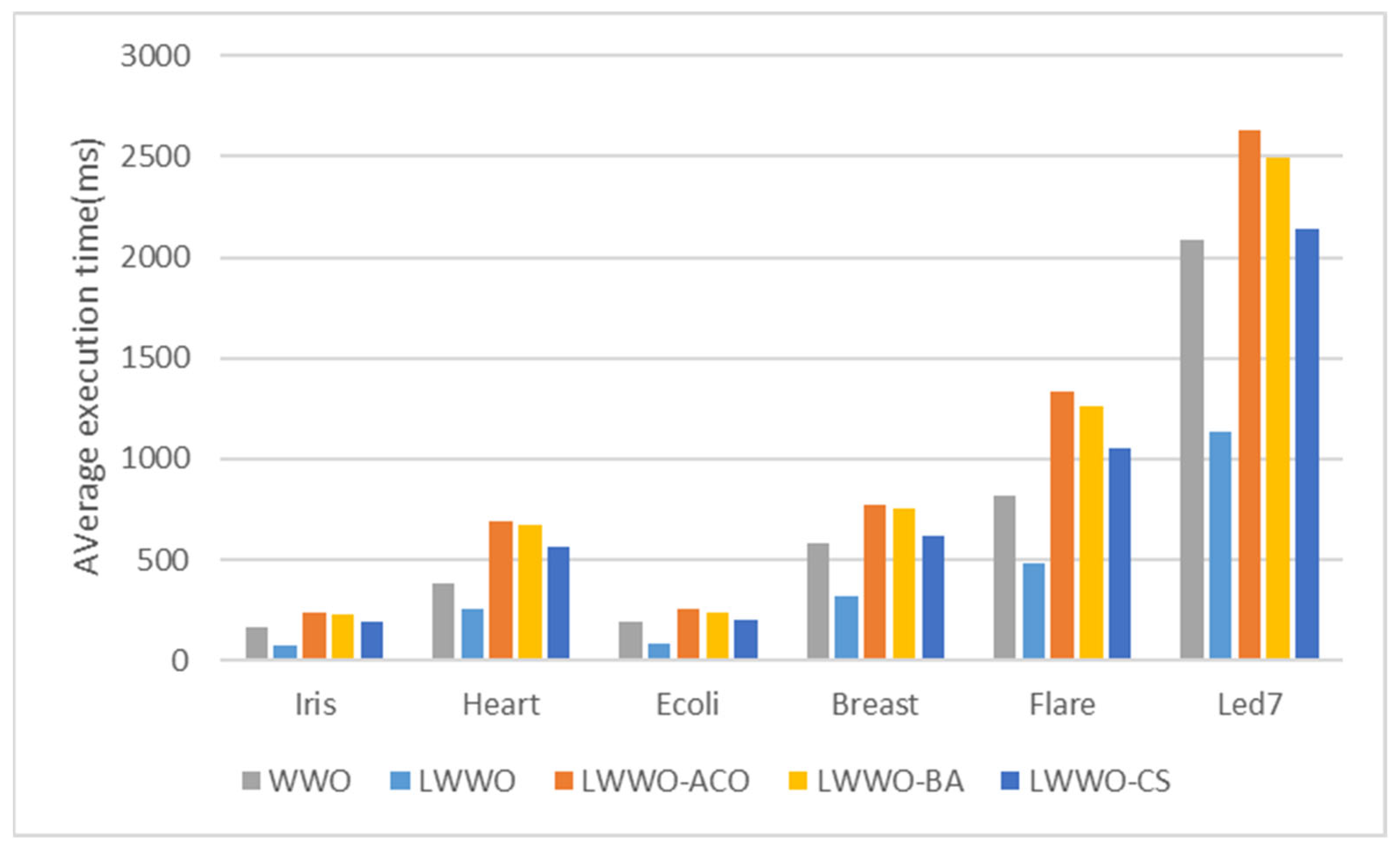
Figure 5 shows a comparison of the average execution times of the five algorithms on different datasets. It can be seen that the execution time of the algorithms increased on the dataset with a higher number of transactions. The Heart dataset had a similar number of transaction records as the Ecoli dataset, but it had a higher dimensionality; the algorithms had a longer average execution time on the Heart dataset. On all datasets, the execution time of the LWWO was 32.28–55.67% shorter than that of the primary WWO. All three hybrid algorithms showed a slight increase in execution time compared with primary WWO. LWWO–ACO took the longest time and LWWO–CS showed some advantages in terms of time consumption.
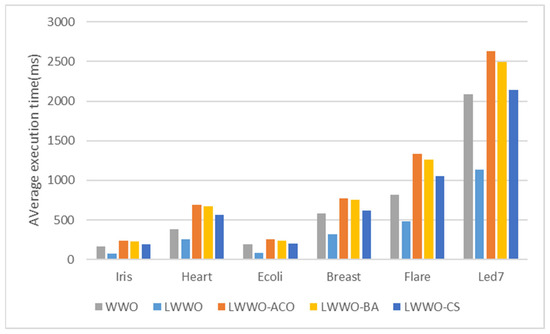
Figure 5.
Comparison of the execution time of each algorithm.
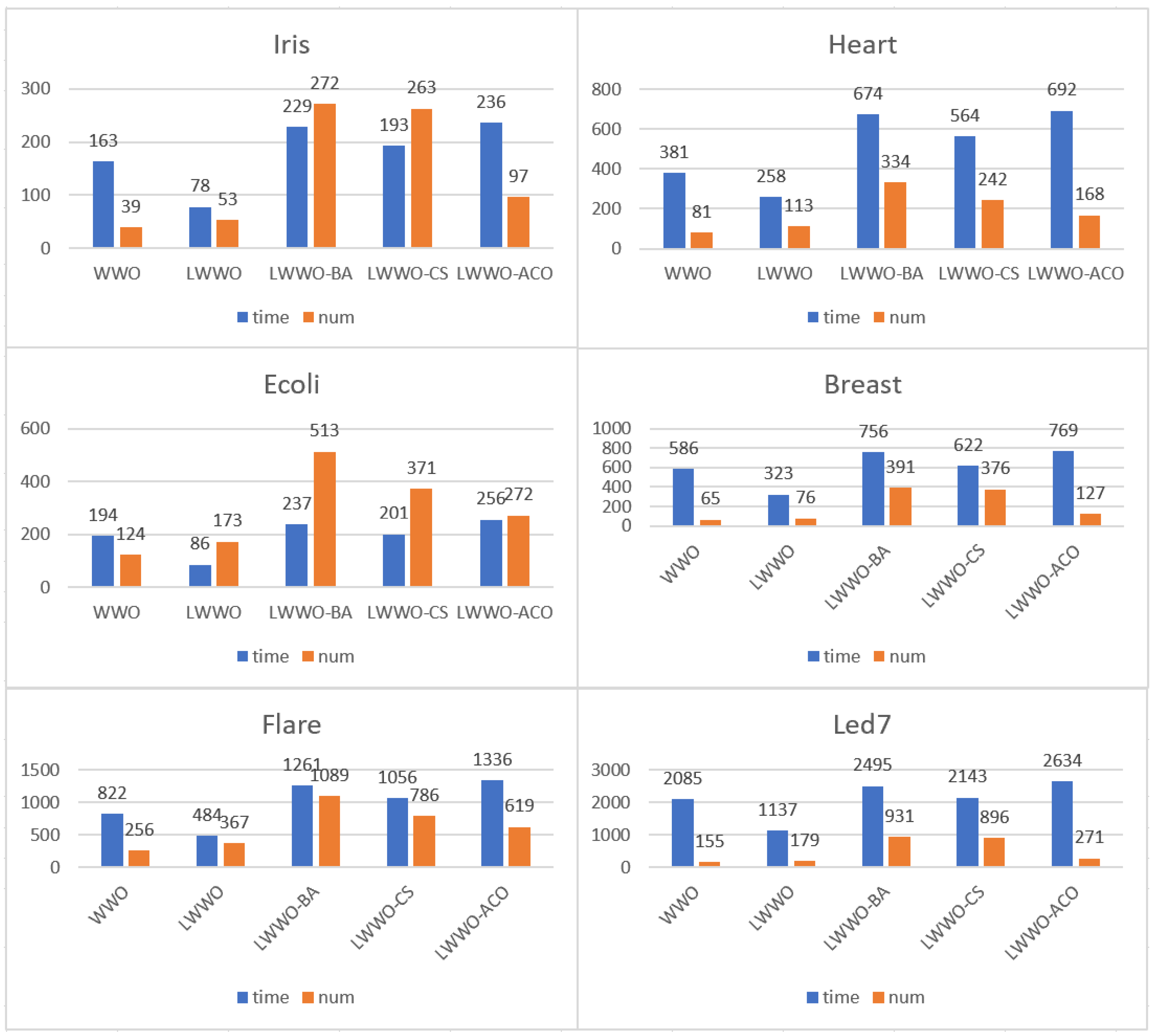
Figure 6 shows the comparison of time consumption and the number of rules required by each algorithm on different datasets. Across all datasets, the number of rules mined by LWWO was 15.48–44.44% more than that of WWO, which shows that Levy flight can effectively increase the diversity of solutions. The number of rules mined by LWWO–ACO was 1.75–2.48 times that of WWO, and the time-consumption increased by 26.33–81.63%. The number of rules mined by LWWO–BA was 4.12–6.97 times that of WWO, and the time-consumption increased by 19.66–76.90%. The number of rules mined by LWWO–CS was 2.99–6.74 times that of WWO, and the time-consuming increased by 2.78–48.03%. It shows that the proposed hybrid algorithms have a significant increase in the number of association rules mined compared with WWO, with LWWO–BA showing the largest improvement. This indicates that the proposed hybrid algorithms are able to effectively increase the diversity of solutions and have a strong global search capability. Furthermore, the time-consumption of the hybrid algorithms is increased by a reasonable degree.
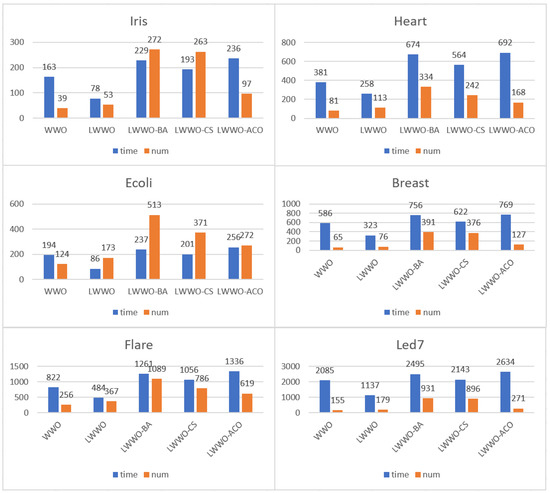
Figure 6.
Comparison of average execution time and the number of rules mined.
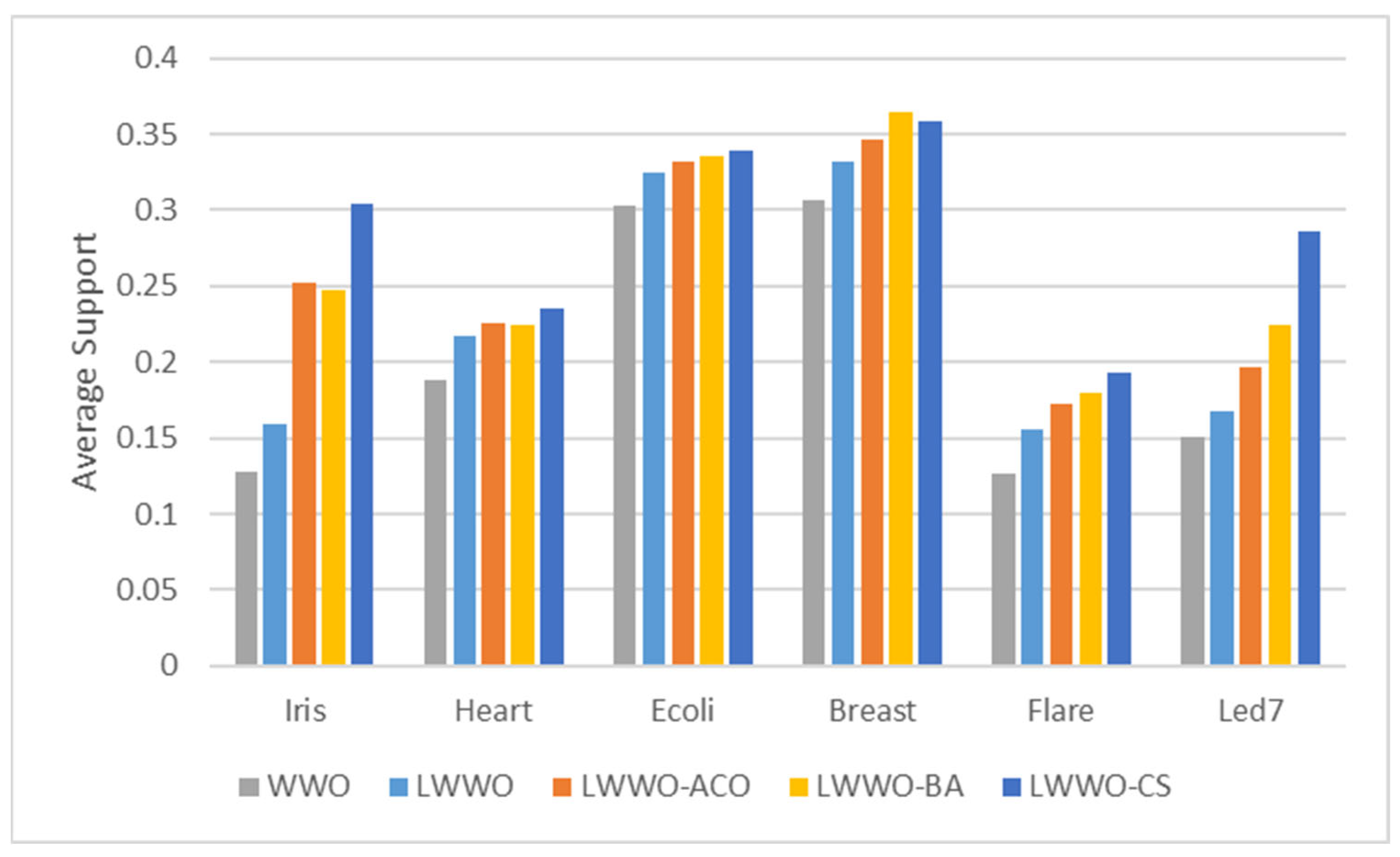
Figure 7 shows the comparison of the average support of the algorithms. On the six datasets, the improved algorithm had a significantly higher average support compared with WWO. Specifically, the support of LWWO–ACO ranged from 0.172 to 0.346, that of LWWO–BA from 0.180 to 0.365, that of LWWO–CS from 0.193 to 0.359, that of WWO from 0.127 to 0.307, and that of LWWO from 0.156 to 0.332. The average support of all the hybrid algorithms was higher than that of WWO and LWWO, with a more obvious advantage on the Iris and Led7 datasets.
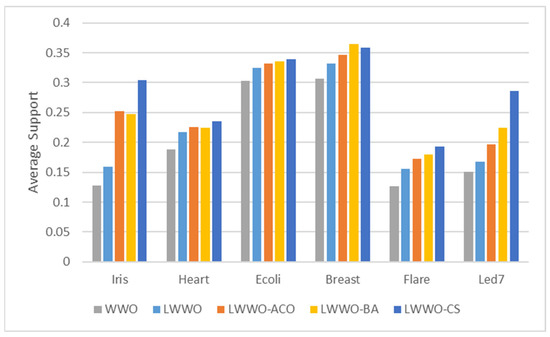
Figure 7.
Comparison of average support.
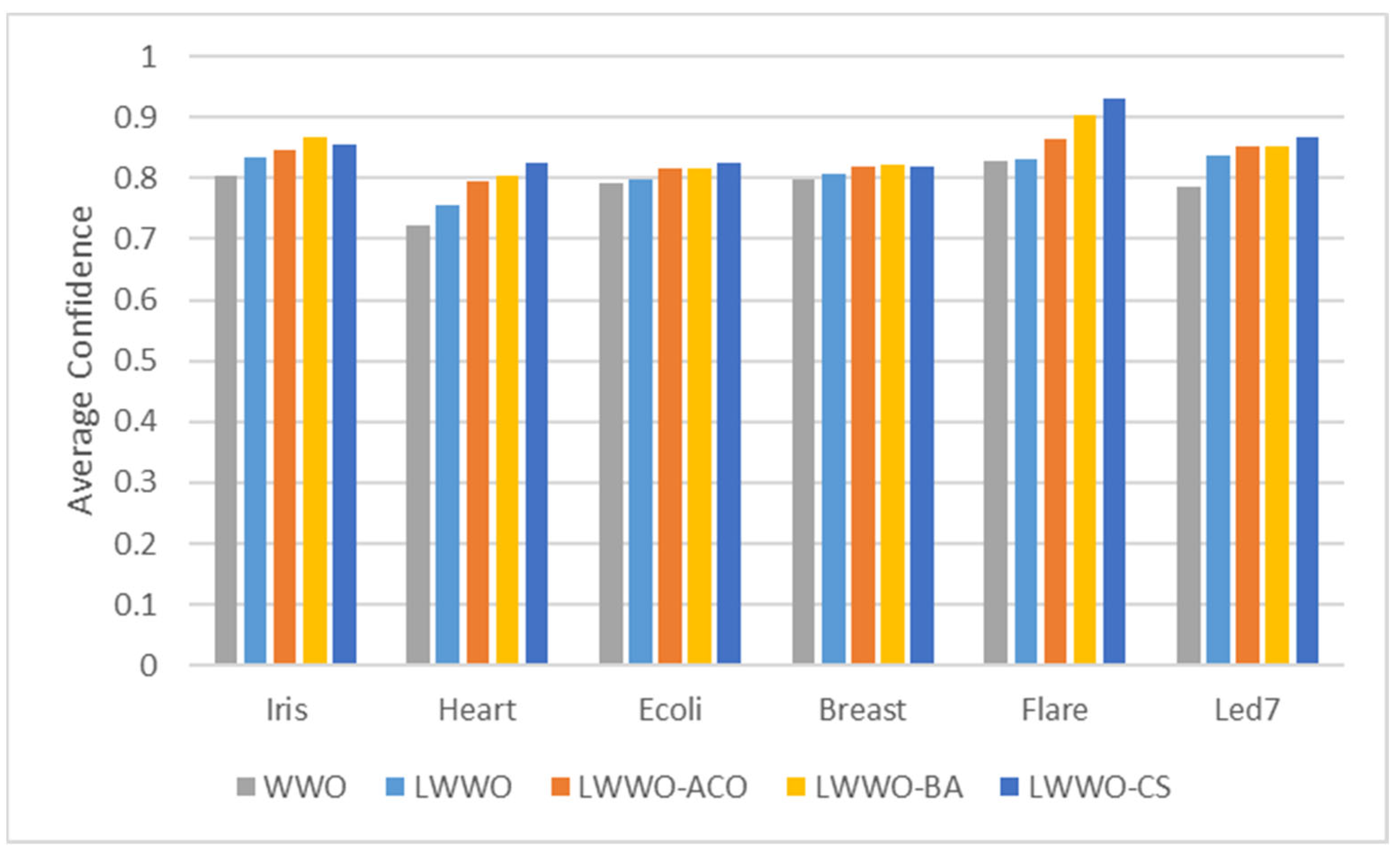
Figure 8 shows a comparison of the average confidence of the algorithms on the six datasets. It indicates that the hybrid algorithms slightly improved the confidence of the association rules mined. Compared with WWO, the average confidence of LWWO–PSO improved by 2.63–9.97%, the average confidence of LWWO–BA improved by 2.90–11.22%, and the average confidence of LWWO–CS improved by 2.76–14.13%. It indicates that the hybrid algorithms also had slightly improved confidence in the association rules, with LWWO–CS performing the best.
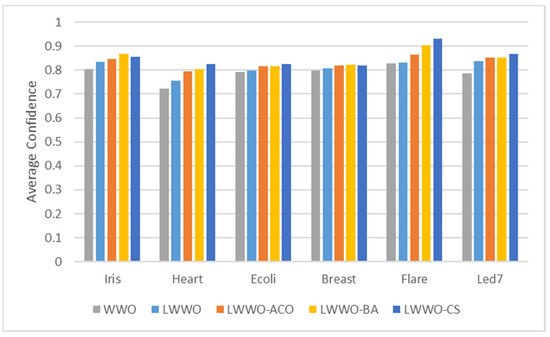
Figure 8.
Comparison of average confidence.
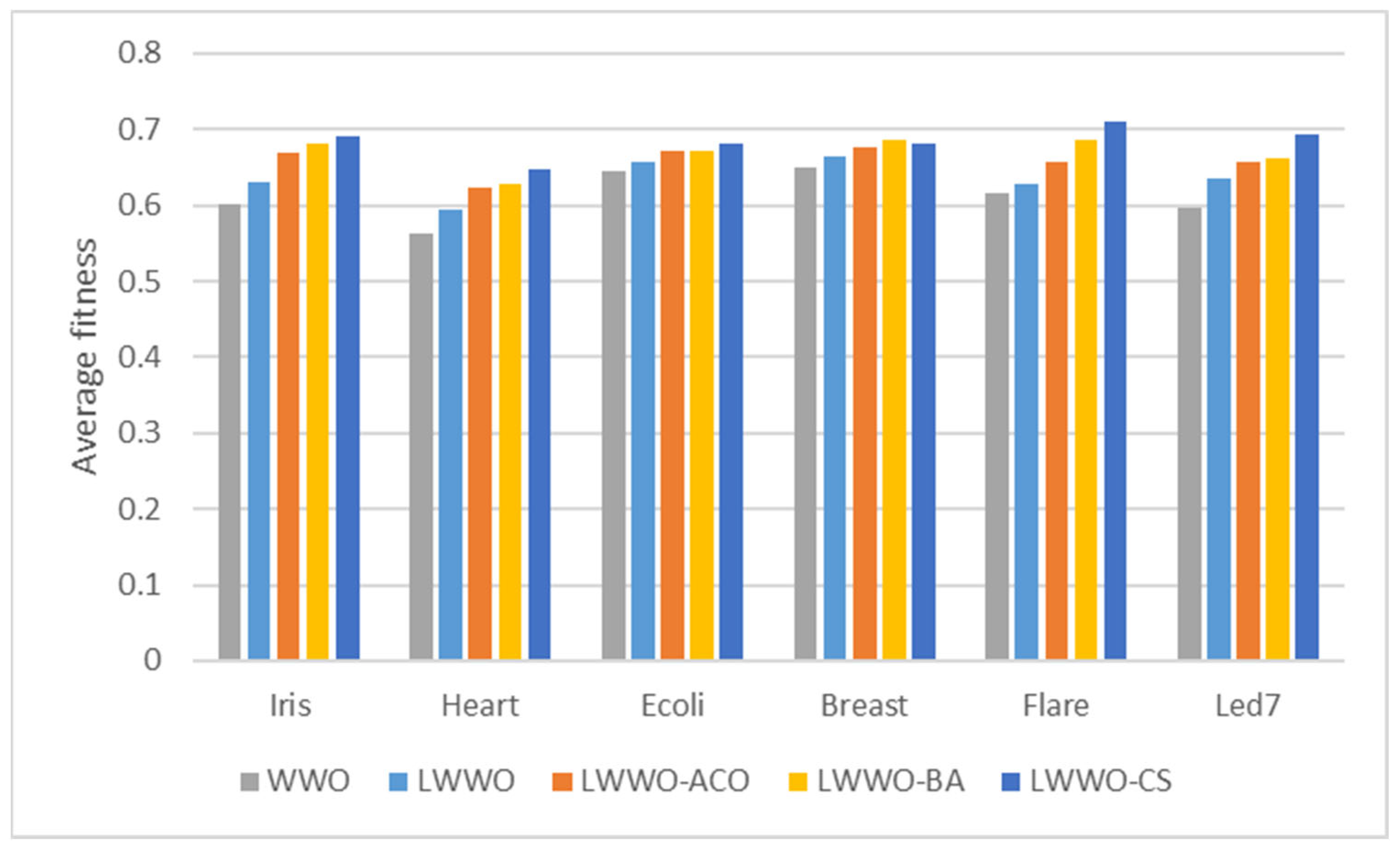
Figure 9 shows a comparison of the average fitness for the five algorithms. On all datasets, the average fitness of LWWO–ACO improved by 3.95–11.08%, that of LWWO–BA by 4.03–13.32%, and that of LWWO–CS by 4.77–16.44% compared with WWO. Compared with LWWO, the average fitness of LWWO–ACO improved by 1.81–5.86%, that of LWWO–BA by 2.13–9.22%, and that of LWWO–CS by 2.56–12.72%. It indicates that the quality of the association rules mined by the three hybrid algorithms improved, with a more significant advantage on the Flare dataset; LWWO–CS had the best performance.
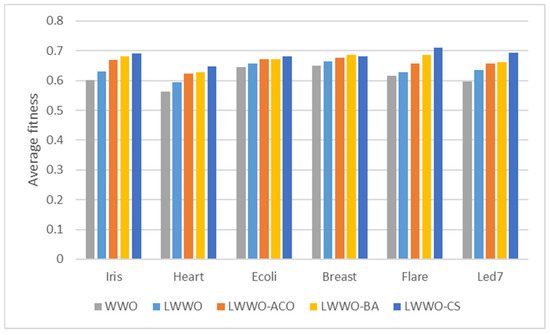
Figure 9.
Comparison of average fitness.
By comparing the performance of the algorithms on different datasets through the above graphs, it can be inferred that the proposed hybrid algorithm can obtain strong association rules with higher support and confidence. In addition, LWWO–BA obtained the highest number of rules on all datasets. The best performance on all datasets was LWWO–CS, which had the highest average fitness value and the shortest time consumption among the hybrid algorithms. Compared with WWO, the three hybrid algorithms significantly increased the number of association rules mined and improved the quality of the association rules mined with an acceptable increase in time consumption, indicating that the proposed hybrid algorithms are effective and robust for ARM.
5. Summary and Conclusions
ARM is an important technique for uncovering relationships between different items in large datasets. Therefore, in the era of big data, it is worthwhile to deeply study ARM algorithms. In this paper, three hybrid algorithms, called LWWO–ACO, LWWO–BA, and LWWO–CS, are proposed for ARM. These algorithms combine the search strategies of different algorithms to maximize the global optimal solution in the search process. Experiments on six datasets of various dimensions and sizes show that the proposed hybrid algorithms outperform WWO and LWWO in terms of the number and quality of rules mined. Moreover, LWWO–CS shows the best competitiveness, which indicates the effectiveness of the hybrid strategy on ARM. Furthermore, the proposed ARM approach does not require the generation of frequent item sets, thus improving mining efficiency and maintaining a good balance between rule quality and mining efficiency, making it suitable for practical applications.
So far, in our experiments, we have only focused on discovering association rules between items in the dataset; the specific relationships of the items in the obtained association rules will be further investigated in the future. Another possible direction for our future research is to focus on the similarity of the mined association rules and to filter the redundant rules in the rule sets more efficiently. In future work, it would be interesting to apply the proposed hybrid algorithms to different datasets and compare them with other ARM methods to see how well they work in real-world settings.
Author Contributions
Conceptualization, Q.H. and Z.Y.; methodology, J.T. and Y.C.; software, J.T. and Y.C.; validation, Q.H., M.W. and W.B.; writing, J.T. and Y.C.; review, Z.Y., M.W. and X.Z. All authors have read and agreed to the published version of the manuscript.
Funding
This research and publication of the paper were funded by the National Natural Science Foundation of China (No. 42201464) and the Wuhan Science and Technology Bureau 2022 Knowledge Innovation Dawning Plan Project (No. 2022010801020270).
Data Availability Statement
Not applicable.
Conflicts of Interest
The authors declare no conflict of interest.
Abbreviations
| ARM | association rule mining |
| WWO | water wave optimization algorithm |
| LWWO | water wave optimization algorithm with Levy flight |
| FIM | frequent item sets mining |
| ACO | ant colony optimization algorithm |
| BSO | bee swarm optimization algorithm |
| BA | bat algorithm |
| CS | cuckoo search algorithm |
| PeSOA | penguin search optimization algorithm |
| PSO | particle swarm optimization algorithm |
| ABC | artificial bee colony algorithm |
| WMSA | water moth search algorithm |
| SCWWO | sine cosine water wave optimization algorithm |
| SCA | sine cosine algorithm |
| FD | functional dependency |
| LWWO–ACO | water wave optimization algorithm with Levy flight hybrid with ant colony optimization algorithm |
| LWWO–BA | water wave optimization algorithm with Levy flight hybrid with bat algorithm |
| LWWO–CS | water wave optimization algorithm with Levy flight hybrid with cuckoo search algorithm |
References
- Dogan, A.; Birant, D. Machine learning and data mining in manufacturing. Expert Syst. Appl. 2021, 166, 114060. [Google Scholar] [CrossRef]
- Saxena, A.; Rajpoot, V.A. Comparative Analysis of Association Rule Mining Algorithms. In Proceedings of the 2016 International Conference on Inventive Computation Technologies (ICICT), Jaipur, India, 22–23 December 2020. [Google Scholar]
- Dhaenens, C.; Jourdan, L. Metaheuristics for data mining: Survey and opportunities for big data. Ann. Oper. Res. 2022, 314, 117–140. [Google Scholar] [CrossRef]
- Cheng, S.; Liu, B.; Ting, T.O.; Qin, Q.; Shi, Y.; Huang, K. Survey on data science with population-based algorithms. Big Data Anal. 2016, 1, 3. [Google Scholar] [CrossRef]
- Karthikeyan, T.; Ravikumar, N. A survey on association rule mining. Int. J. Adv. Res. Comput. Comm. Eng. 2014, 3, 2278-1021. [Google Scholar]
- Fournier-Viger, P.; Lin, J.C.; Vo, B.; Chi, T.T.; Zhang, J.; Le, H.B. A survey of itemset mining. WIREs Data Min. Knowl. Discov. 2017, 7, e1207. [Google Scholar] [CrossRef]
- Luna, J.M.; Fournier-Viger, P.; Ventura, S. Frequent itemset mining: A 25 years review. WIREs Data Min. Knowl. Discov. 2019, 9, e1329. [Google Scholar] [CrossRef]
- Logeswaran, K.; Andal, R.K.S.; Ezhilmathi, S.T.; Khan, A.H.; Suresh, P.; Kumar, K.R.P. A Survey on metaheuristic nature inspired computations used for Mining of Association Rule, Frequent Itemset and High Utility Itemset. IOP Conf. Series: Mater. Sci. Eng. 2021, 1055, 012103. [Google Scholar] [CrossRef]
- Patel, B.; Chaudhari, V.K.; Karan, R.K.; Rana, Y.K. Optimization of association rule mining apriori algorithm using ACO. Int. J. Soft Comput. Eng. 2011, 1, 24–26. [Google Scholar]
- Djenouri, Y.; Drias, H.; Habbas, Z. Bees swarm optimisation using multiple strategies for association rule mining. Int. J. Bio-Inspired Comput. 2014, 6, 239. [Google Scholar] [CrossRef]
- Song, A.; Song, J.; Ding, X.; Xu, G.; Chen, J. Utilizing Bat Algorithm to Optimize Membership Functions for Fuzzy Association Rules Mining. In Proceedings of the International Conference on Database and Expert Systems Applications, Lyon, France, 28–31 August 2017. [Google Scholar]
- Heraguemi, K.E.; Kamel, N.; Drias, H. Multi-swarm bat algorithm for association rule mining using multiple cooperative strategies. Appl. Intell. 2016, 45, 1021–1033. [Google Scholar] [CrossRef]
- Mlakar, U.; Zorman, M.; Fister, I., Jr.; Fister, I. Modified binary cuckoo search for association rule mining. J. Intell. Fuzzy Syst. 2017, 32, 4319–4330. [Google Scholar] [CrossRef]
- Gheraibia, Y.; Moussaoui, A.; Djenouri, Y.; Kabir, S.; Yin, P.Y. Penguins Search Optimisation Algorithm for Association Rules Mining. J. Comput. Inf. Technol. 2016, 24, 165–179. [Google Scholar] [CrossRef]
- Krishnamoorthy, S.; Sadasivam, G.S.; Rajalakshmi, M.; Kowsalyaa, K.; Dhivya, M. Privacy Preserving Fuzzy Association Rule Mining in Data Clusters Using Particle Swarm Optimization. Int. J. Intell. Inf. Technol. 2017, 13, 1–20. [Google Scholar] [CrossRef]
- Zheng, Y.-J. Water wave optimization: A new nature-inspired metaheuristic. Comput. Oper. Res. 2015, 55, 1–11. [Google Scholar] [CrossRef]
- Zheng, Y.; Xia, L.; Yu, Q. A method for identifying three-dimensional rock blocks formed by curved fractures. Comput. Geotech. 2015, 65, 1–11. [Google Scholar] [CrossRef]
- Zheng, Y.J.; Zhang, B. A simplified water wave optimization algorithm. In Proceedings of the 2015 IEEE Congress on Evolutionary Computation (CEC), Sendai, Japan, 25–28 May 2015. [Google Scholar]
- Wu, X.-B.; Liao, J.; Wang, Z.-C. Water Wave Optimization for the Traveling Salesman Problem. In Proceedings of the International Conference on Intelligent Computing, Fuzhou, China, 20–23 August 2015; pp. 137–146. [Google Scholar]
- Zheng, Y.-J.; Lu, X.-Q.; Du, Y.-C.; Xue, Y.; Sheng, W.-G. Water wave optimization for combinatorial optimization: Design strategies and applications. Appl. Soft Comput. 2019, 83, 105611. [Google Scholar] [CrossRef]
- Yan, Z.; Zhang, J.; Tang, J. Path planning for autonomous underwater vehicle based on an enhanced water wave optimization algorithm. Math Comput. Simul. 2021, 181, 192–241. [Google Scholar] [CrossRef]
- Yun, X.; Feng, X.; Lyu, X.; Wang, S.; Liu, B. A novel water wave optimization based memetic algorithm for flow-shop scheduling. In Proceedings of the 2016 IEEE Congress on Evolutionary Computation (CEC), Vancouver, BC, Canada, 24–29 July 2016. [Google Scholar]
- Zheng, Y.; Zhang, B.; Xue, J. Selection of key software components for formal development using water wave optimization. J. Softw. 2016, 27, 933–942. [Google Scholar]
- Tarkhaneh, O.; Isazadeh, A.; Khamnei, H.J. A new hybrid strategy for data clustering using cuckoo search based on Mantegna levy distribution, PSO and k-means. Int. J. Comput. Appl. Technol. 2018, 58, 137–149. [Google Scholar] [CrossRef]
- Yang, X.S.; Deb, S. Cuckoo search via Lévy flights. In Proceedings of the 2009 World Congress on Nature & Biologically Inspired Computing (NaBIC), Coimbatore, India, 9–11 December 2009. [Google Scholar]
- Dou, R.; Duan, H. Lévy flight based pigeon-inspired optimization for control parameters optimization in automatic carrier landing system. Aerosp. Sci. Technol. 2017, 61, 11–20. [Google Scholar] [CrossRef]
- Hariya, Y.; Kurihara, T.; Shindo, T.; Jin’no, K. Lévy flight PSO. In Proceedings of the 2015 IEEE congress on evolutionary computation (CEC), Sendai, Japan, 25–28 May 2015. [Google Scholar]
- Jensi, R.; Jiji, G.W. An enhanced particle swarm optimization with levy flight for global optimization. Appl. Soft Comput. 2016, 43, 248–261. [Google Scholar] [CrossRef]
- Yan, B.; Zhao, Z.; Zhou, Y.; Yuan, W.; Li, J.; Wu, J.; Cheng, D. A particle swarm optimization algorithm with random learning mechanism and Levy flight for optimization of atomic clusters. Comput. Phys. Commun. 2017, 219, 79–86. [Google Scholar] [CrossRef]
- Aydoğdu, I.; Akın, A.; Saka, M. Design optimization of real world steel space frames using artificial bee colony algorithm with Levy flight distribution. Adv. Eng. Softw. 2016, 92, 1–14. [Google Scholar] [CrossRef]
- Li, X.; Yin, M. A hybrid cuckoo search via Lévy flights for the permutation flow shop scheduling problem. Int. J. Prod. Res. 2013, 51, 4732–4754. [Google Scholar] [CrossRef]
- Yang, X.-S.; Deb, S. Cuckoo search: Recent advances and applications. Neural Comput. Appl. 2013, 24, 169–174. [Google Scholar] [CrossRef]
- Nenavath, H.; Jatoth, R.K. Hybridizing sine cosine algorithm with differential evolution for global optimization and object tracking. Appl. Soft Comput. 2018, 62, 1019–1043. [Google Scholar] [CrossRef]
- Khalilpourazari, S.; Khalilpourazary, S. An efficient hybrid algorithm based on Water Cycle and Moth-Flame Optimization algorithms for solving numerical and constrained engineering optimization problems. Soft Comput. 2017, 23, 1699–1722. [Google Scholar] [CrossRef]
- Rekha, P.M.; Shahapure, N.H.; Punitha, M.; Sudha, P.R. Water Moth Search Algorithm-based Deep Training for Intrusion Detection in IoT. J. Web Eng. 2021, 20, 1781–1812. [Google Scholar]
- Zhang, J.; Zhou, Y.; Luo, Q. An improved sine cosine water wave optimization algorithm for global optimization. J. Intell. Fuzzy Syst. 2018, 34, 2129–2141. [Google Scholar] [CrossRef]
- Zhou, H.; Hirasawa, K. Evolving temporal association rules in recommender system. Neural Comput. Appl. 2017, 31, 2605–2619. [Google Scholar] [CrossRef]
- Khan, M.A.; Shahzad, W.; Baig, A.R. Protein classification via an ant-inspired association rules-based classifier. Int. J. Bio-Inspired Comput. 2016, 8, 51. [Google Scholar] [CrossRef]
- Heraguemi, K.E.; Kamel, N.; Drias, H. Association Rule Mining Based on Bat Algorithm. J. Comput. Theor. Nanosci. 2015, 12, 1195–1200. [Google Scholar] [CrossRef]
- Heraguemi, K.E.; Kamel, N.; Drias, H. Multi-objective bat algorithm for mining numerical association rules. Int. J. Bio-Inspir. Com. 2018, 11, 239–248. [Google Scholar] [CrossRef]
- Afshari, M.H.; Dehkordi, M.N.; Akbari, M. Association rule hiding using cuckoo optimization algorithm. Expert Syst. Appl. 2016, 64, 340–351. [Google Scholar] [CrossRef]
- Agrawal, R.; Imieliński, T.; Swami, A. Mining association rules between sets of items in large databases. In Proceedings of the 1993 ACM SIGMOD International Conference on Management of Data, Washington, DC, USA, 25–28 May 1993. [Google Scholar]
- Fan, W.; Geerts, F.; Li, J.; Xiong, M. Discovering Conditional Functional Dependencies. IEEE Trans. Knowl. Data Eng. 2010, 23, 683–698. [Google Scholar] [CrossRef]
- Caruccio, L.; Deufemia, V.; Polese, G. On the discovery of relaxed functional dependencies. In Proceedings of the 20th International Database Engineering & Applications Symposium, Montreal, QC, Canada, 11–13 July 2016. [Google Scholar]
- Sato, Y.; Izui, K.; Yamada, T.; Nishiwaki, S. Data mining based on clustering and association rule analysis for knowledge discovery in multiobjective topology optimization. Expert Syst. Appl. 2018, 119, 247–261. [Google Scholar] [CrossRef]
- Gakii, C.; Rimiru, R. Identification of cancer related genes using feature selection and association rule mining. Informatics Med. Unlocked 2021, 24, 100595. [Google Scholar] [CrossRef]
- Dorigo, M.; Gambardella, L. Ant colony system: A cooperative learning approach to the traveling salesman problem. IEEE Trans. Evol. Comput. 1997, 1, 53–66. [Google Scholar] [CrossRef]
- Barthelemy, P.; Bertolotti, J.; Wiersma, D.S. A Lévy flight for light. Nature 2008, 453, 495–498. [Google Scholar] [CrossRef] [PubMed]
- Kamaruzaman, A.F.; Zain, A.M.; Yusuf, S.M.; Udin, A. Levy Flight Algorithm for Optimization Problems–A Literature Review. Appl. Mech. Mater. 2013, 421, 496–501. [Google Scholar] [CrossRef]
- Haklı, H.; Uğuz, H. A novel particle swarm optimization algorithm with Levy flight. Appl. Soft Comput. 2014, 23, 333–345. [Google Scholar] [CrossRef]
Disclaimer/Publisher’s Note: The statements, opinions and data contained in all publications are solely those of the individual author(s) and contributor(s) and not of MDPI and/or the editor(s). MDPI and/or the editor(s) disclaim responsibility for any injury to people or property resulting from any ideas, methods, instructions or products referred to in the content. |
© 2023 by the authors. Licensee MDPI, Basel, Switzerland. This article is an open access article distributed under the terms and conditions of the Creative Commons Attribution (CC BY) license (https://creativecommons.org/licenses/by/4.0/).