


Abstract
The formal concept of lattice plays a vital role in knowledge discovery. Reduction of the attribute has many applications in machine learning technology and data mining fields. In this paper, we introduce an object ranking concept to define a consistency set and the reduction of the attributes by structural features. An incomplete information system works on the three-way concepts using the SE-ISI Context. The granular was emphasized with join (meet) irreducible sets using the object ranking concepts. A dual operator is defined based on the object ranking concepts and its properties and conditions are verified. Hence, this elaborates on the four kinds of reduction of the attributes. The ordered pairs give the knowledge of the attributes that deal with the interval set of both the approximation of rough set theory concerning the objects. Therefore, the relationship between four kinds of reduction of the attribute was appropriate to access the consistency set using the object ranking concepts by some of the theorems and examples.
Keywords:
indiscernibility relation; granular lattice; object ranking; SE-ISI formal context; attribute reduction MSC:
06A06; 06B23; 06B75; 06D50; 06F15
1. Introduction
Pawlak [1,2] introduced the Rough set theory for defining two approximation sets and approached the rough set theory as an alternative to the fuzzy set theory. Jianjun [3] analyzed the connection between the three-way concept lattice and hence the structures were generalized for an algorithm. Ting [4] investigated the concept lattice with the isomorphic and anti-isomorphic conditions using the study of 1-dual and 2-dual interactable knowledge. Huilai [5] described a target set of positive and negative formal concepts to determine attribute characterization. Ruisi [6] examined the three-way concept lattice based on attribute reduction and also examined the results based on the reduction and analysis of a formal concept lattice. The attribute reduction for an object-oriented concept lattice was constructed by Jian [7] to define its relation based on attribute ranking. Wei [8] defined the strong and weak consistency for decision concept lattices. The similarity of objects was investigated for an indiscernibility relation by Yan [9]. Yiyu [10] constructed two heuristics reduced for the attribute measure.
The interval sets of three-way formal concepts that represented the intent and extent SE-ISI context were analyzed by Renu [11]. Zhen [12] proposed attribute reduction using the discernibility matrix. Furthermore, this relationship between consistency set and reduction of discernibility matrix or discernibility function is obtained by attribute reduction for an incomplete context. Zhang [13] defined an interval set with the degree and discussed a new method for an optimal approximation for an interval set. He analyzed a new binary relation with an approximation set by developing both intervals set model and granular theory.
Chen [14] represented a formal concept lattice that gives knowledge on graph theory and granular reduction and investigated the result for an optimization problem and numerical methods. Lei-Jun [15] proposed a simple discernibility matrix for the objects and attributes that construct a complex concept lattice and its properties. Jianqin [16] investigated the three types of formal concepts based on rectangular and covering theories. Furthermore, a new algorithm was explicitly used for the bits operators to demonstrate the effectiveness of attribute reduction. Srirekha [17] emphasized an ordered pair of distributive lattices to define the projection. A rough approximation space investigated the lattice homomorphism condition and equivalence relation.
Binghan [18] introduced a relation between the classical formal context and the incomplete fuzzy formal context. A double threshold operator was studied with the knowledge of order pairs consisting of objects and attributes. Qian [19] constructed a three-way concept lattice and transformed the formal context with the complementary context. He introduced Type I and II combinatorial contexts and studied the isomorphic to object and attribute induced respectively. Quintero [20] studied the application in chemistry for the formal concept with molecular structure and radionuclides. Dias [21] analyzed the reduction of concept lattice by three classes of reduction techniques and examined them with an experimental study. Xiao [22] combined a formal concept analysis with the weight attribute concept. The granularity was described using the dimension of weight through the threshold structure. Zhenquan [23] proposed rough set theory and granular theory to determine the weight of the attributes to define their effectiveness from the nonredundant aspect and redundant aspects. Li [24] experimented with the fundamental geographical data for formal concept analysis and hence obtained the feasible result of the complex geo ontological methods.
From the above literature survey, we concluded that the three way concept lattice gives a wide knowledge regarding information systems. Hence the granular has been discussed with various consistency sets to deduct the attribute reduction.
Hence, in this paper our contribution is as follows: In Section 2, the definition of rough set theory and formal concepts were given. In Section 3, we introduced the reduction of formal concept lattice with object ranking. In Section 4, we merged the object ranking concept with SE-ISI context. In Section 5, a real-time observation study was analyzed.
2. Preliminaries
In this section, the formal concept of the lattice with the notion of as a finite universal set as an object and as an attribute is discussed. Formal concept lattice has the attribute value and where there exists the relation such that if the object is related to the attribute, then the value is defined as and if the object is not related to the attributes, then the value is defined as .
2.1. Rough Set Theory
The information system introduced by Pawlak [1], consists of an object defined as finite non-empty set as , knowledge obtained as an attribute where is described as a combination of condition attributes and decision attributes , is a cartesian product of object and attributes and is defined as a function then . Hence, the information system is denoted as .
Let the discernibility relation obtained from the attribute as , then the approximation space is defined as a pair of where is an equivalence relation which partition the universal set . Consider be a subset of object , then the approximation for the corresponding notion can be defined as [1,2].
The set is said to be definable set if , else the set is said to be rough set.
2.2. Formal Concepts
The triplet is said to be a formal concept where represents a finite set of object and attribute respectively, and the binary relation represents a cartesian product of object and attribute such that The relation is denoted as [16].
3. Reduction of Formal Concept Lattice with Object Ranking
This section views the formal concept of lattice and the reduction of attributes using the object ranking concept. Further, a dual operator is considered to defined the consistency set and its properties.
Definition 1.
Let consider the triplet where object and attribute represents the finite universal set and knowledge about the object respectivelyt. The relation is the indiscernibility relation between the object and the attribute and it is denoted as . [4,6,15].
A pair of such that and then the operator can be defined as
If is the greatest collection of set of attributes that associate with all the objects in and is the greatest collection of set of an object that associates with all attributes in then
Throughout this paper, formal context has the covering of as and covering of as .
Definition 2.
Let a triple of then defined as a pair of dual approximation for a formal context as [7].
Similarly, as
Properties 1.
Consider and then the approximation operators satisfy.
- (i)
- and
- (ii)
- (iii)
- (iv)
A Pair of where and is called context if and , then are called extent and is called intent of . Then if and if is called concept.
Since is regular if and are formal concept denoted as .
Hence a binary relation is defined as .
Therefore, the hierarchy of partial relation is a formal concept lattice if is called child concept and is a parent concept of . [6,9]
Since a partially ordered relation defined in a finite ordered set as a lattice approximation with the operator meet and join as
Definition 3.
Let be a formal concept, the number of attributes possessing the object then the object ranking is defined as the cardinality of i.e., .
Hence, from the above definition and properties the object ranking concept can be examined with some lemma and theorems that emerged with the join irreducible concepts.
Lemma 1.
Let a formal context , consider then then there exist such that .
Proof.
Since then , Let and by Properties 1 and Definition 2, Therefore, . . □
Theorem 1.
Let us consider an ordered pair that belongs to the lattice and then is a join irreductable concept .
Proof.
By the above Lemma 1, Let , If there exist such that . By Definition 3, therefore, and , thus and that . Hence the result. □
Definition 4.
Let be a context and . If an attribute set then where , is said to be consistent set as . If then then is called reduct.
Definition 5.
Let and be the two formal context if then there exist such that . Hence it is denoted as .
Definition 6.
Let us consider a lattice with the element is called join irreducible if and or and dually the element can be defined as meet irreducible.
Example 1.

Table 1.
Information Table.
Object Rank: , Then .
- (i)
- The universal set and the attruites set can be represented as a set itself in concept of the set.
- (ii)
- We represent as .
- (iii)
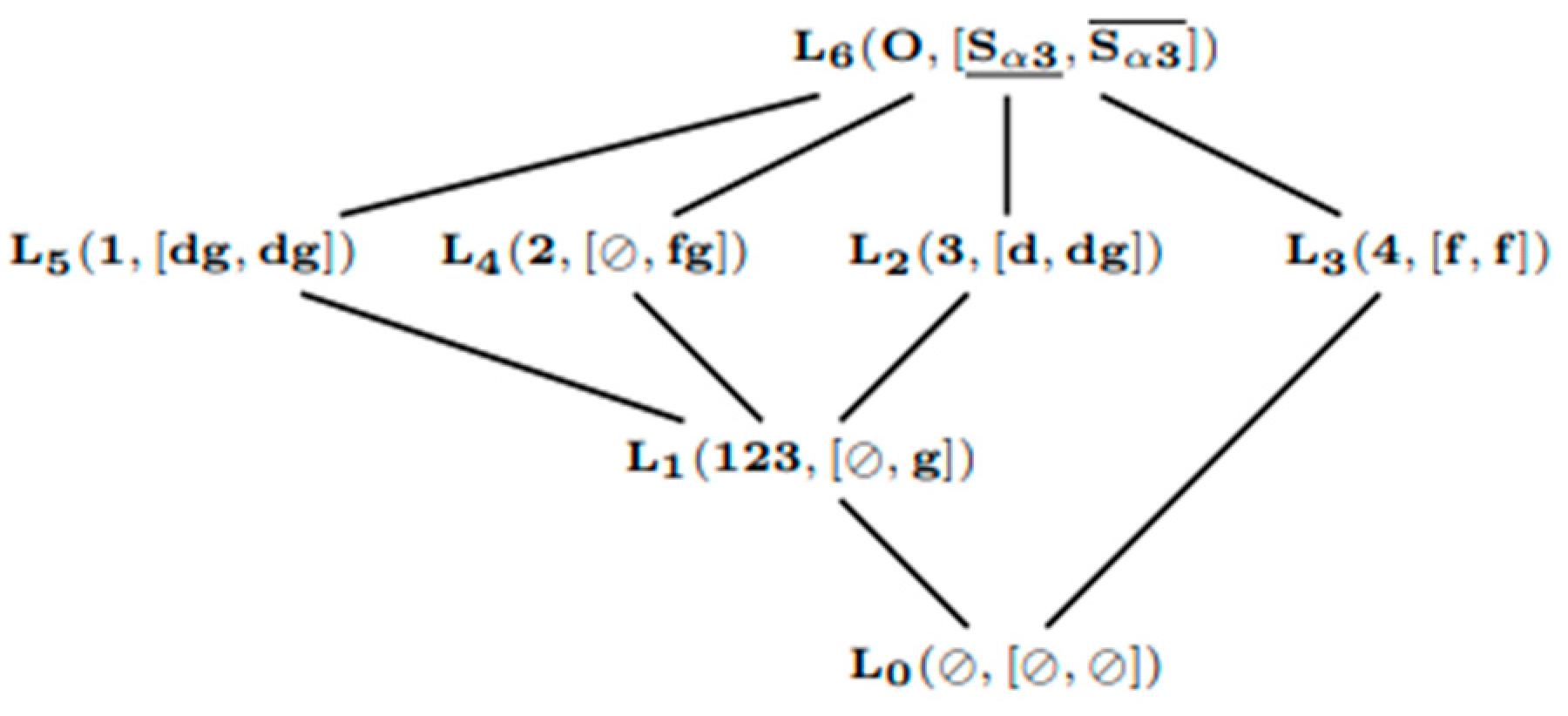
- From Figure 1, it is clearly defined are meet irreducible and join irreducible respectively.
Then .
Hence, this generates the set . Consider a reduct whose corresponding formal concept lattice is .
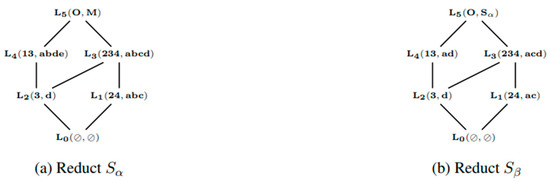
Figure 1.
Object Ranking Concepts with Reduction.
Figure 1.
Object Ranking Concepts with Reduction.
Theorem 2.
Let be a formal context then .
Proof.
Consider which implies and , for , hence thus, by the Properties 1 and , hence , therefore , by Definition 5, . □
4. The 3-Ways Formal Concept Using Object Ranking in SE-ISI Context
This section we discuss about the pair of objects and an interval set of attributes which is defined as SE-ISI [Set Extent-an Interval Set Intent] Context. This interval set gives the knowledge access from lower and upper approximation. The dual operator elaborates the features of lattice theory with the rough set theory, which induce to define the formal concept lattice for reduction of attributes.
Definition 7.
A finite set of an object is defined using an interval set such that where are LUB and GLB on interval set respectively.
Let be a set of all interval set. A partially order between , is defined as which implies and .
An interval set then and . then and .
Consider and then the intersection, union, and difference were defined as
Definition 8.
Let be a formal concept for the number of attribute value possessing the object , then the cardinality of is called object ranking of interval set of .
Definition 9.
Let be the incomplete information system, where is an object, is an attribute and are the 3 possible entries of the corresponding table. A relation and a mapping is defined as Hence the relation is defined as
- (i)
- this suggests the object ( that pairs with the attribute ( .
- (ii)
- this suggests the object ( that does not pair with the attribute .
- (iii)
- this suggests the object which is unknown or not in ( that pairs with the attribute .
For an incomplete information system , then and are defined on and by
Definition 10.
Consider an incomplete context with two dual operator are defined on the object ranking interval set is and , for an incomplete formal context then for any , then the following condition statisfies,
Definition 11.
Let be an incomplete context then the set is extended to an interval set which is defined as using the object ranking concept. Hence, the set is formally called SE-ISI formal concept with the condition
For any two SE-ISI concept and are ordered by .
Hence, it describes the and using SE-ISI formal concept lattice and it is defined as
Therefore, the SE-ISI context is a complete lattice. Additionally, in the SE-ISI context it is possible to define the parent and son context lattice as is said to be son concept of and is said to be parent concept of .
Definition 12.
Let be a SE-ISI formal context and consider a subset of attribute Reduct as then it is said to be a consistent set of if then . Thus for any is said to be object ranking lattice with reduct of .
Definition 13.
Let be a SE-ISI formal context, if the reduct (denoted as a set of attributes) then it is said to be a consistent set of Object Ranking Meet Irreducible (ORMI) . If is an ORMI consistent set of then there is no proper subset such that is an ORMI consistent set and is a reduct of ORMI consistent set of . Thus, the extent set of object ranking meets irreducible element is defined in .
Similarly, the consistent set of Object Ranking Join Irreducible (ORJI) and Object ranking Granular (ORG) element can defined in .
Example 2.
Table 2.
Information Table.
Object Rank: .
Then .
Hence, this generates the set
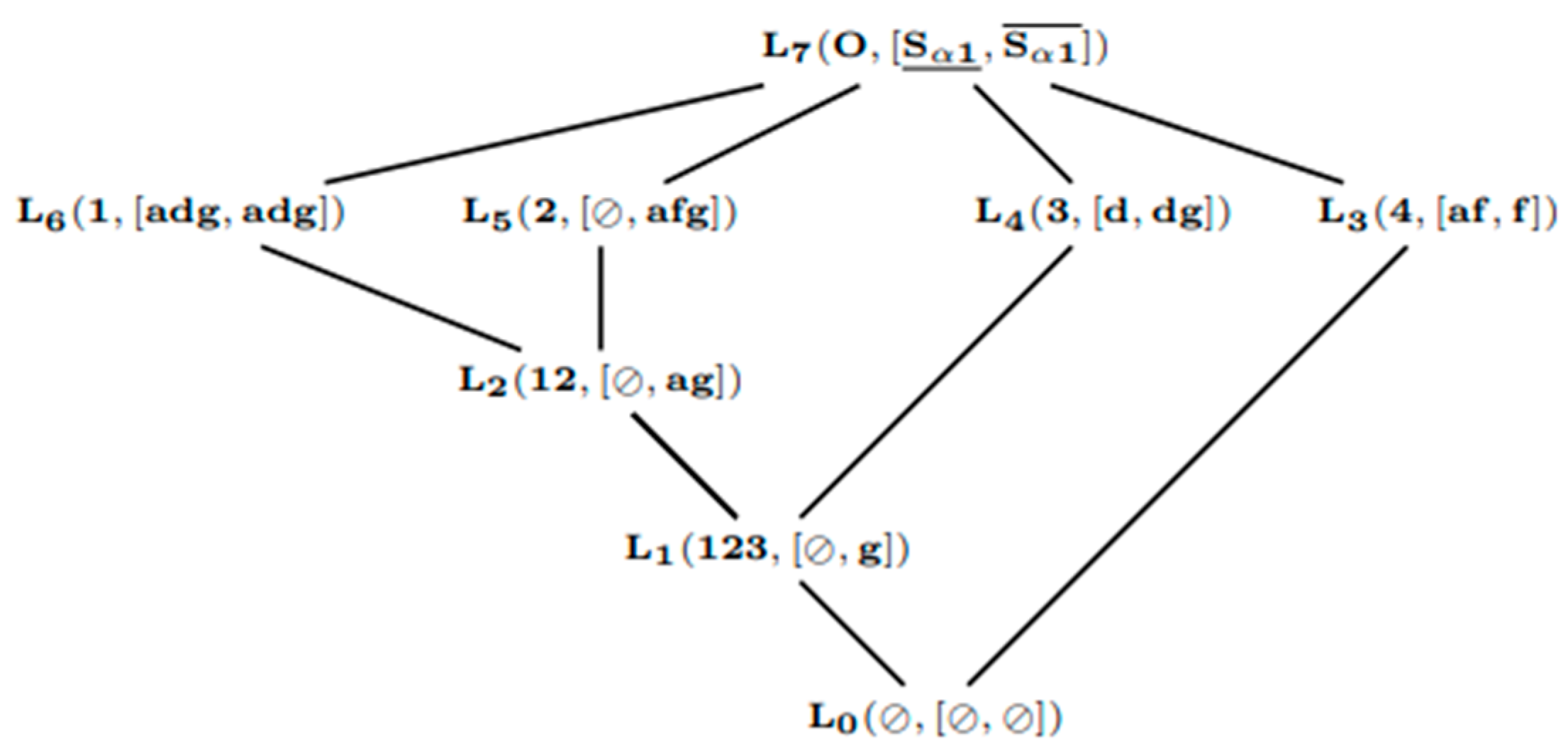
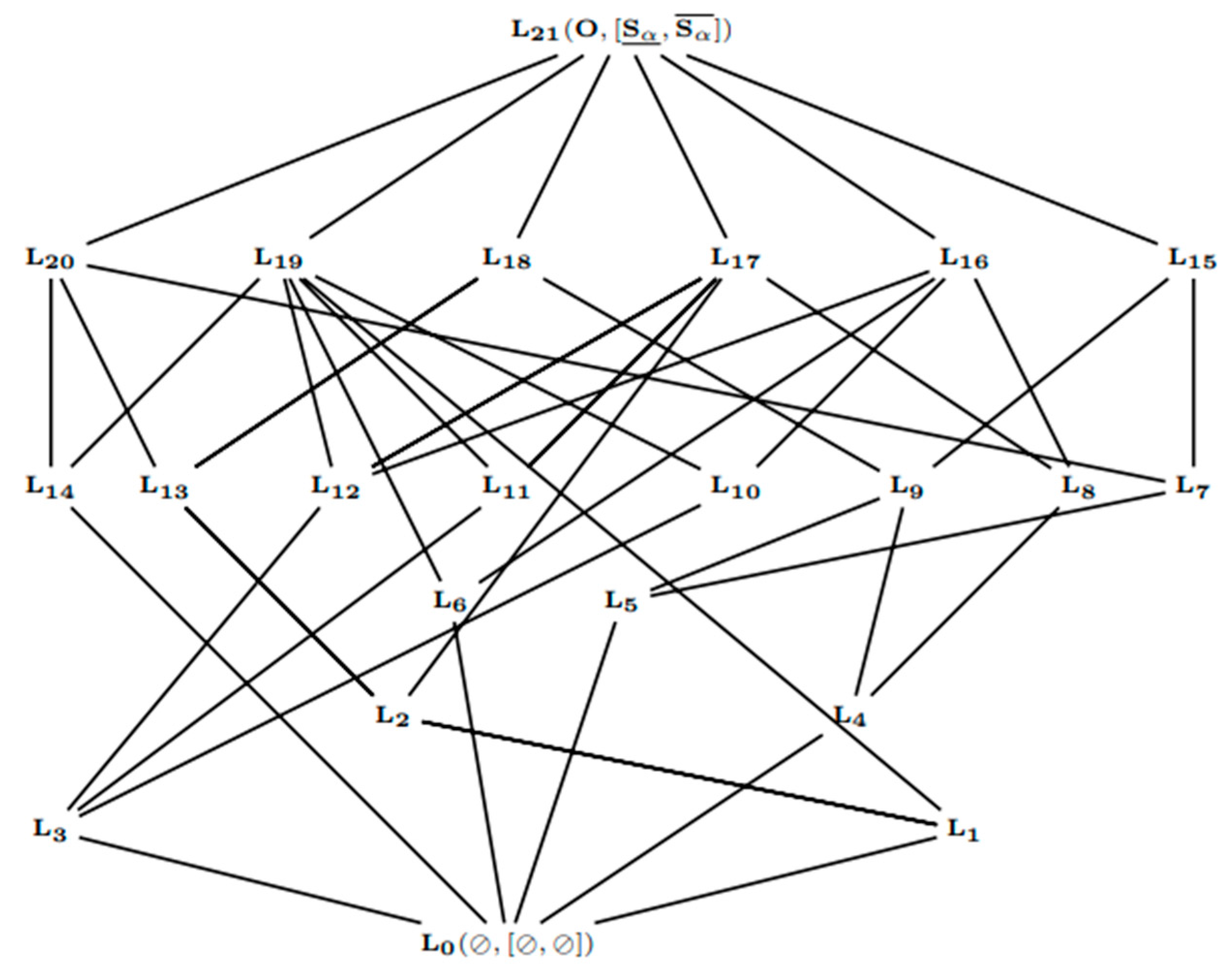
and Figure 2 illustrates the Hasse diagram.
Consider a reduct whose corresponding concept lattice are . Then .
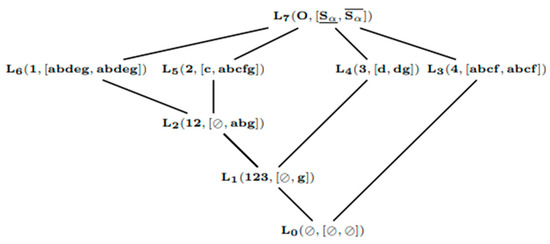
Figure 2.
Illustrates the Hasse diagram From Table 2.
Figure 2.
Illustrates the Hasse diagram From Table 2.
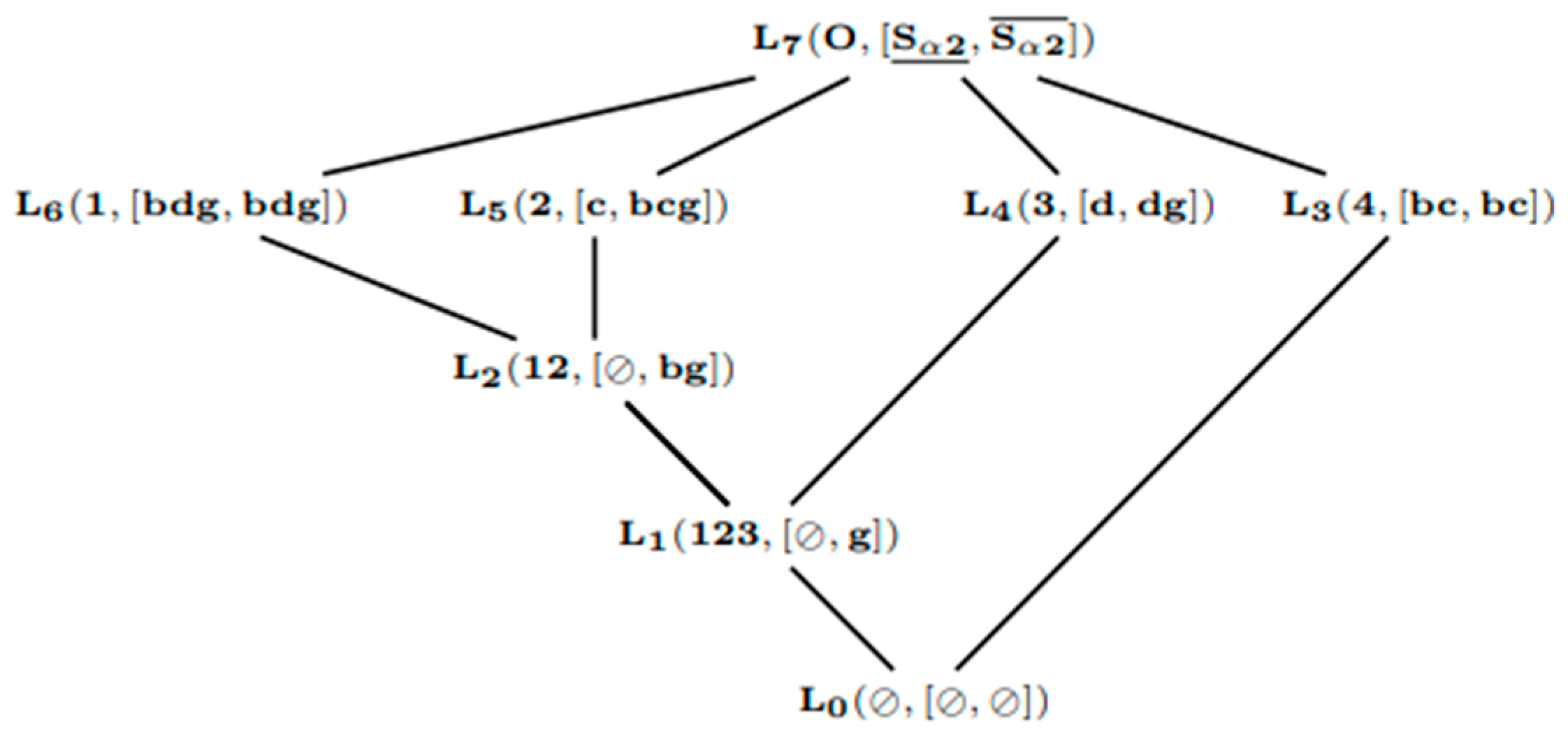
Hence this generates the set and Figure 3 expressions the hasse diagram.
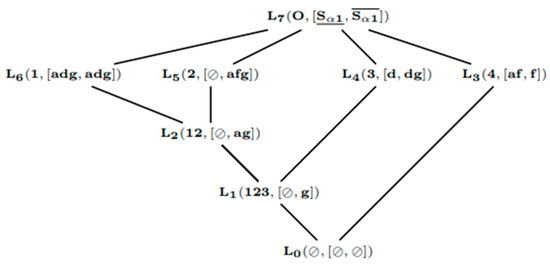
Figure 3.
Reduct .
Consider a reduct whose corresponding concept lattice is . Then .
Hence, this generates the set
and Figure 4 expressions the hasse diagram.
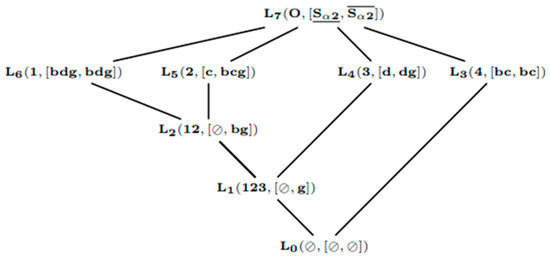
Figure 4.
Reduct .
Consider a reduct whose corresponding concept lattice is .
Hence, this generates the set
and Figure 5 expressions the hasse diagram.
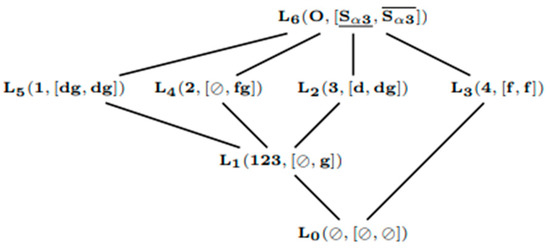
Figure 5.
Reduct .
From Table 2 and Figure 4, the reduction is an SE-ISI concept lattice which has satisfied the isomorphic to the concept lattice. Hence, from Figure 5 the reduction is a SE-ISI concept lattice has which maintains the extents of meet irreduciable lattice and from Figure 6 the reduction is an SE-ISI concept lattice which has conserved the extents of join irreducible and granular lattice.
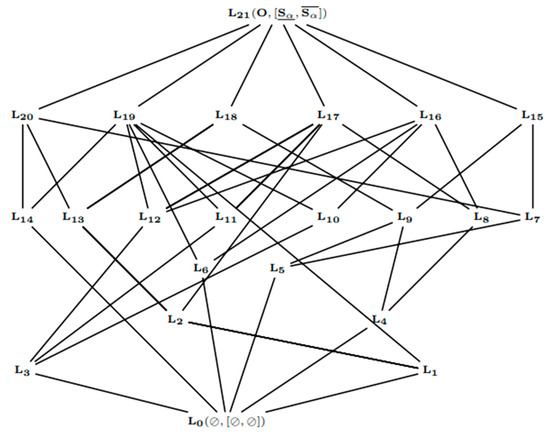
Figure 6.
From Table .
Hence, from the above study we can extend the theorems of a consistent set of object ranking lattice and its equivalent relation to meet (join) irreducible set.
Theorem 3.
Let be a SE-ISI formal context then the consistency set of object ranking lattice is equal to the consistency set of object ranking meet irreducible set.
Proof.
Let then by the Definition 12 , hence, for any , by Definition 13, , where and which implies and , since obtained that . Thus . Similarly, it can prove the remining reductions. Therefore, which implies . Thus .
Suppose , since then , For any then there exist such that . By Definition 7, Thus . Since then which implies . Hence . Therefore, . □
Corollary 1.
Let be a SE-ISI formal context then the consistency set of an object ranking lattice equal to the consistency set of object ranking join irreducible set.
Theorem 4.
Let be a SE-ISI formal context and then then is a join irreducible element which implies is a object ranking lattice .
Proof.
Let then .
By Properties 1 and Definition 2,
Here are the element of join irreducible in object ranking lattice. Hence, By the parent and child concept, it is easy to define the join irreducible element of .
Therefore, the joint irreducible element where extent to the set using the object ranking lattice. □
5. Observational Study
This section, we analyze the real-life application of attribute reduction with an example. The Table 3 represents the database consists of 6 patients in an ICU ward.
Table 3.
Information Table.
Work Rule for Object Ranking
Step 1: Consider incomplete information Table 3.
Step 2: Examine the indiscernibility relation.
Example 3.
The Table 4 represent, BP data as denoted as respectively. If the temperature is related to then the value refers as else the value of refer as . similarly, ECG data as as respectively, pulse data as as respectively, condition data as as respectively.
Step 3: Finding the rank of each object and also find the generating set. Eg: rank of object 1:4, object 2:4, object 3:4, object 4:4, object 5:6, object 6:4. Also find the set and .
Step 4: From the generating set construct the hasse diagram. Eg: .
Step 5: Determine the reduction set and construct the hasse diagram.
Step 6: From the construction, are analyzed.
In this example, we have analyzed on 6 objects using the formal concepts of SE-ISI context and its structure. Furthermore, a large number of objects can be investigated by using an algorithm. This process can be evaluated for ‘n’ number of object using the object ranking efficiencies toward the consistency set to determine with meet and join irreducible element.
Table 4.
Indiscernibility Table.
Table 4.
Indiscernibility Table.
| 1 | 0 | 1 | 1 | 0 | 0 | 1 | 0 | 0 | 0 | 1 |
| 2 | 1 | 0 | 1 | 0 | 1 | 0 | 0 | 0 | 1 | 0 |
| 3 | 0 | 1 | 1 | 0 | 1 | 0 | 0 | 0 | 1 | 0 |
| 4 | 0 | 1 | 0 | 1 | 0 | 1 | 0 | 0 | 1 | 0 |
| 5 | 1 | 0 | 1 | 0 | 1 | 0 | 0 | ? | ? | ? |
| 6 | 1 | 0 | 0 | 1 | 0 | 0 | 1 | 0 | 1 | 0 |
Example 4.
From the above Table 3 we generate Table 4 by an indiscernibility relation, using SE-ISI formal context. Also, we analyze an incomplete information context based on the reduction of attribute. From Table 5, the SE-ISI context was implement for defining the structure as Figure 6. Hence, we investigate using the structural features.
Table 5.
.
Table 5.
.
| Lattice | Concepts | Lattice | Concept |
|---|---|---|---|
Example 5.
Table 6.
.
Table 6.
.
| Lattice | Concepts | Lattice | Concept |
|---|---|---|---|
Hence, from the Figure 7 it concludes that the SE-ISI concept lattice is isomorphic and also classifies the patients by a defined structural form from the concepts of SE-ISI context lattice that was unchanged. Hence, we can come to the conclusion that the number of attributes is purely based on and .
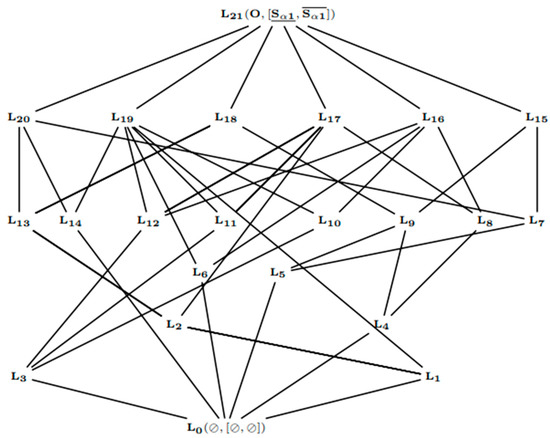
Figure 7.
From Table .
Figure 7.
From Table .
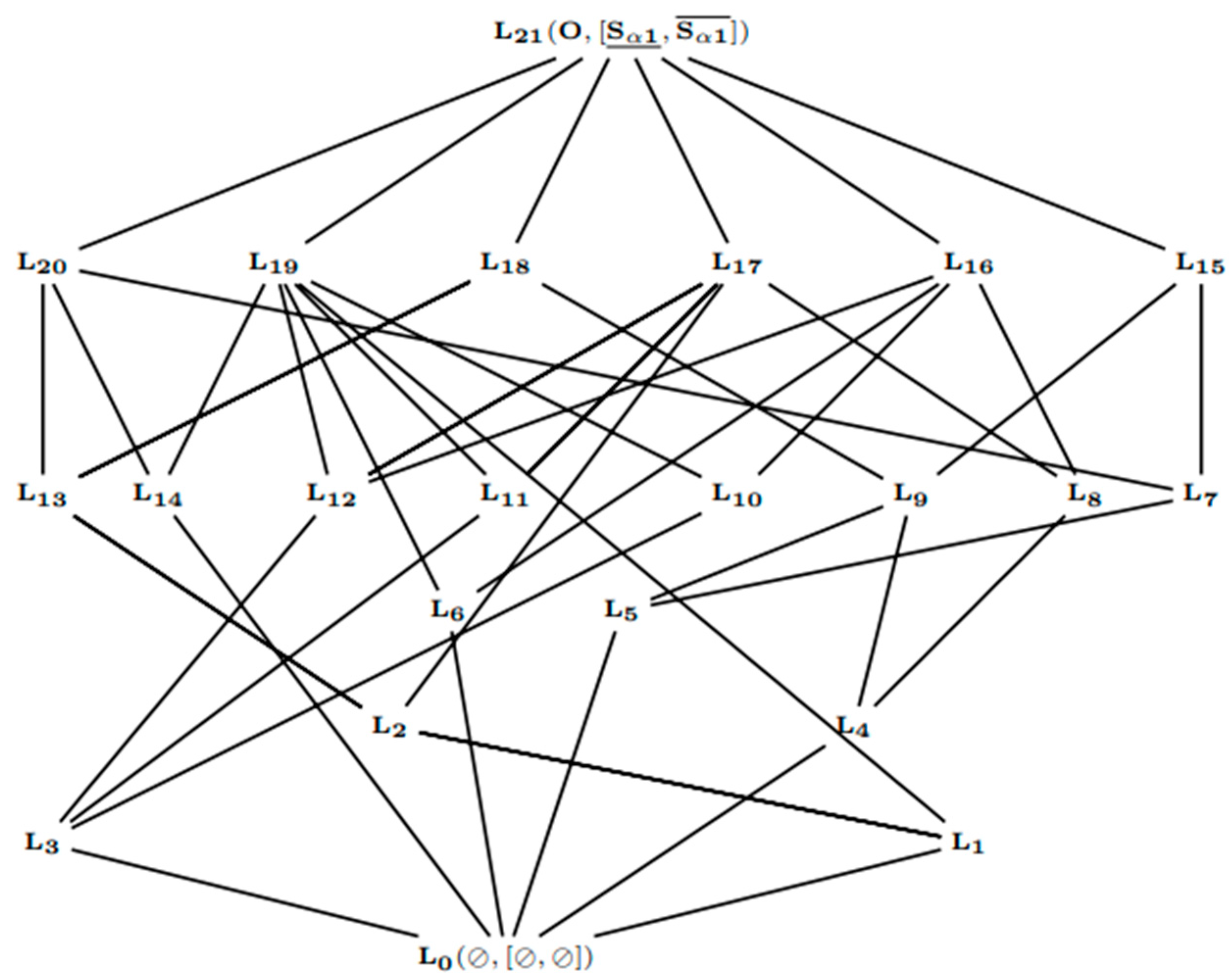
Table 7.
.
Table 7.
.
| Lattice | Concepts | Lattice | Concept |
|---|---|---|---|
Hence from Figure 8, ORJI reduction cannot have the defined structure form of concept of SE-ISI. Therefore, from Figure 8, has been eliminated after joining irreducible reduction. Thus, from the basic construction of the join irreducible elements, ORJI reduction is essential in SE-ISI lattice.
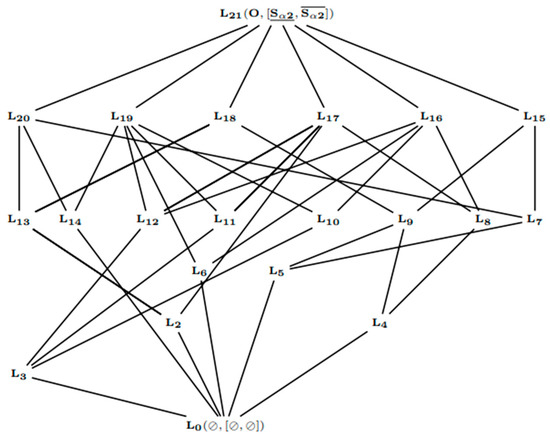
Figure 8.
From Table .
Figure 8.
From Table .
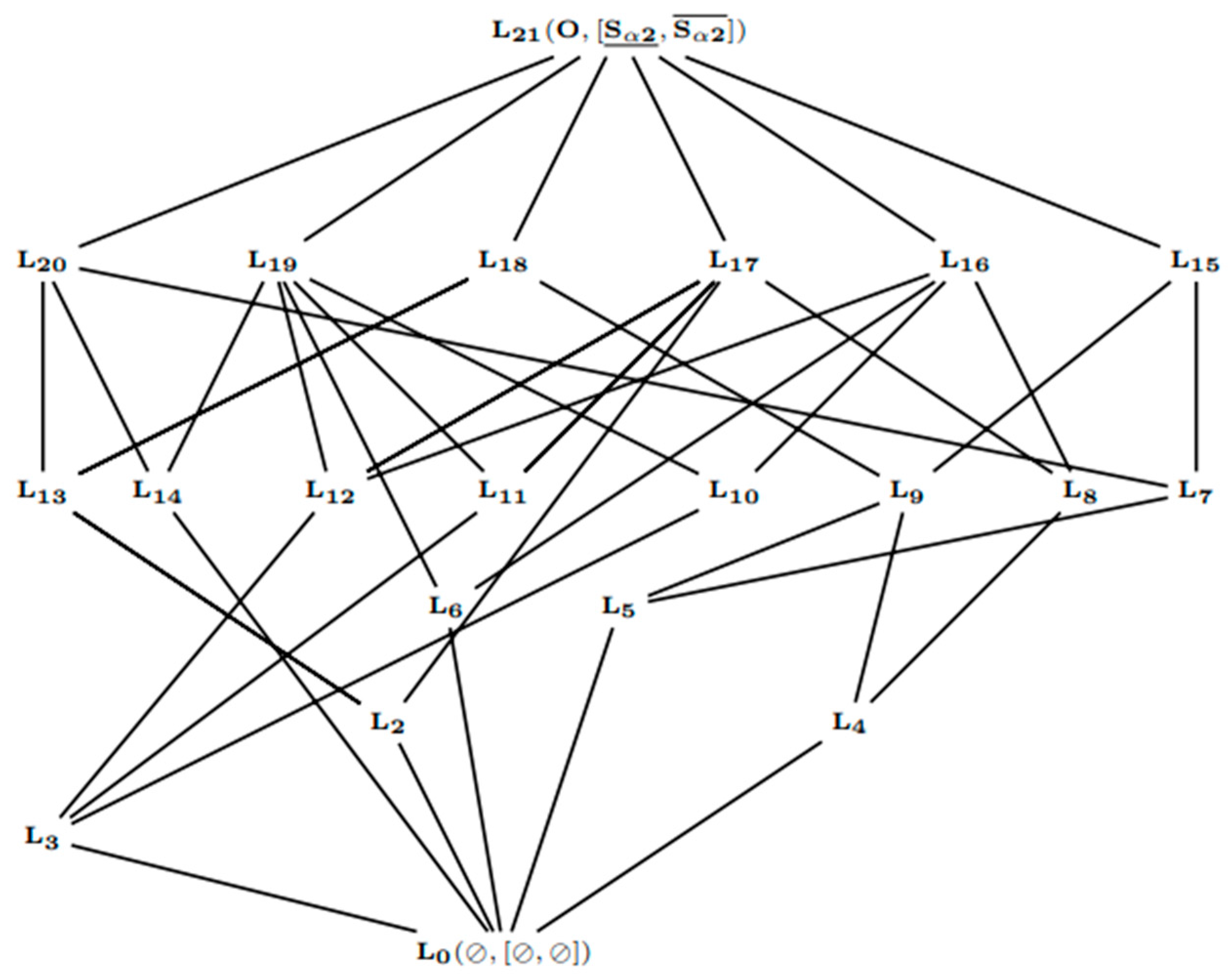
Table 8.
.
Table 8.
.
| Lattice | Concepts | Lattice | Concept |
|---|---|---|---|
From Figure 9 shows that ORG reduct cannot be constructed for the SE-ISI context. Thus, SE-ISI context was unchanged. Hence, we determined the ORG reduction lattice with the loss of the information context.
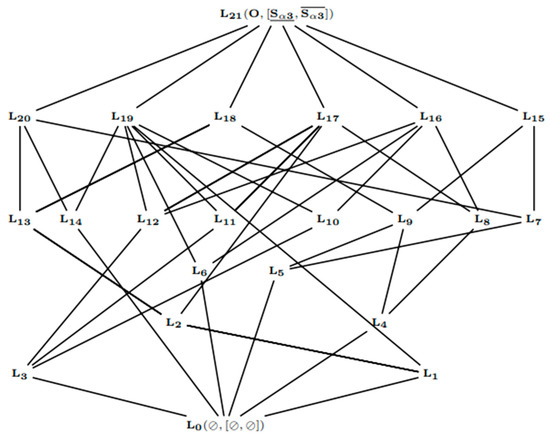
Figure 9.
From Table .
Figure 9.
From Table .
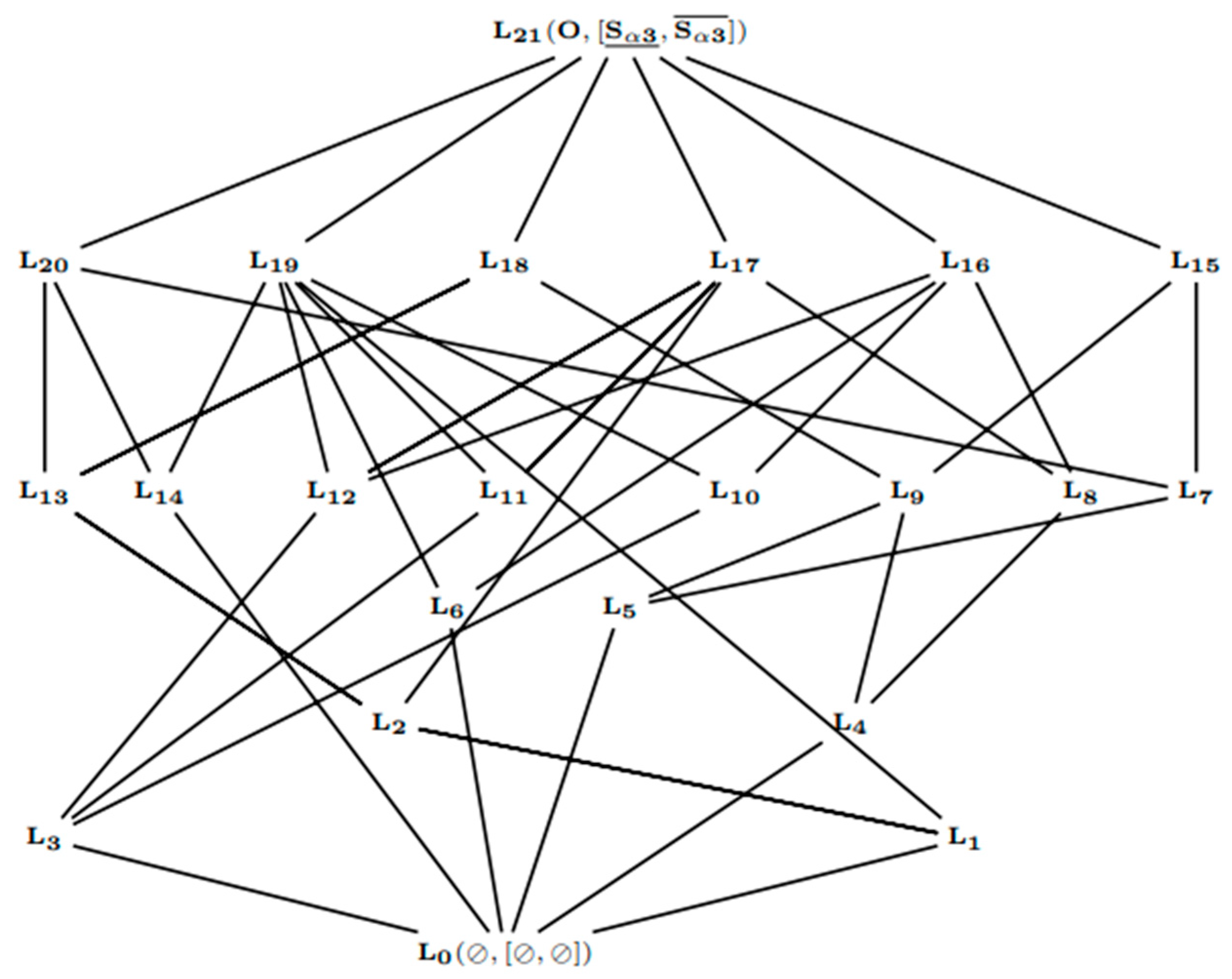
From the above real-time experimental study concludes that the various reduction of attributes with an incomplete information context have been analyzed without any loss of knowledge. The construction of the object ranking lattice has the same elements when compared with reduction. Hence, the attribute BP and ECG, which are essential for the diagonalization of the patient condition to shift to the general ward. In addition, it can be verified with pulse.
6. Conclusions
Formal concept analysis is a powerful tool for data mining and knowledge discovery. In this paper, the reduction of the attributes is investigated alongside the methodology of object ranking concept to determine from the SE-ISI concept. The four features of the reduction of attributes and their relationship were analyzed with the existence of a consistency set. The basic knowledge of the formal concept has been analyzed by defining the three-way concept with an enhancement of object ranking concepts. The existing attribute reduction is obtained from the incomplete context. The consistency set determined with join (meet) irreducible set towards the object ranking concepts. A real-time example is described in this paper for various reductions of attributes and a structural study on four features of the consistency set.
Author Contributions
Conceptualization, B.S., S.S., R.N.D., K.E. and R.C.; Data curation, B.S.; Formal analysis, S.S.; Investigation, S.S.; Methodology, S.S., M.M., R.C. and R.N.D.; Supervision, R.C. and M.M.; Visualization, S.S. and B.S.; Writing—original draft, B.S., K.E. and S.S.; Writing—review & editing, R.C. and M.M. All authors have read and agreed to the published version of the manuscript.
Funding
This research received no external funding.
Institutional Review Board Statement
Not applicable.
Informed Consent Statement
Not applicable.
Data Availability Statement
The data presented in this study are available through email upon request to the corresponding author.
Conflicts of Interest
The authors declare no conflict of interest.
References
- Pawlak, Z. Rough sets. Int. J. Inform. Comput. Sci. 1982, 11, 341–356. [Google Scholar] [CrossRef]
- Pawlak, Z. Rough sets and fuzzy sets. Fuzzy Sets Syst. 1985, 17, 99–102. [Google Scholar] [CrossRef]
- Qia, J.; Qianb, T.; Wei, L. The connections between three-way and classical concept lattices. Knowl.-Based Syst. 2015, 91, 0950–7051. [Google Scholar] [CrossRef]
- Qian, T.; Yang, Y.; He, X. The Feature Description of Formal Context Based on the Relationships among Concept Lattices. Entropy 2021, 23, 1397. [Google Scholar] [CrossRef] [PubMed]
- Zhi, H.; Chao, H. Three-Way Concept Analysis for Incomplete Formal Contexts. Hindawi Math. Probl. Eng. 2018, 2018, 9546846. [Google Scholar] [CrossRef]
- Ren, R.; Wei, L. The attribute reductions of three-way concept lattices. Knowl.-Based Syst. 2016, 99, 0950–7051. [Google Scholar] [CrossRef]
- Ma, J.-M.; Leung, Y.; Zhang, W.-X. Attribute reductions in object-oriented concept lattices. Int. J. Mach. Learn. Cyber. 2014, 5, 789–813. [Google Scholar] [CrossRef]
- Ling, W.; Qi, J.J.; WenXiu, Z. Attribute reduction theory of concept lattice based on decision formal contexts. Inf. Sci. 2008, 51, 910–923. [Google Scholar]
- Zhao, Y.; Yao, Y.; Luo, F. Data Analysis Based on Discernibility and Indiscernibility. Inf. Sci. 2007, 177, 4959–4976. [Google Scholar] [CrossRef]
- Yao, Y.; Zhao, Y. Discernibility Matrix Simplification for Constructing Attribute Reducts. Inf. Sci. 2009, 179, 867–882. [Google Scholar] [CrossRef]
- Ren, R.; Wei, L.; Yao, Y. An analysis of three types of patially known formal concepts. Int. J. Mach Learn. Cybern. 2018, 9, 1767–1783. [Google Scholar] [CrossRef]
- Wang, Z.; Wei, L.; Qi, J.; Qian, T. Attribute Reduction of SE-ISI Concept Lattices for Incomplete Contexts; Springer: Berlin/Heidelberg, Germany, 2020; Volume 24, pp. 15143–15158. [Google Scholar]
- Zhang, Q.; Wang, J.; Wang, G.; Hu, F. Approximation Set of the Interval Set in Pawlak’s Space. Hindawi Publ. Corp. Sci. World J. 2014, 2014, 317387. [Google Scholar] [CrossRef] [PubMed]
- Chen, J.K.; Mi, J.S.; Lin, Y.J. A graph approach for knowledge reduction in formal contexts. Knowl. Based Syst. 2018, 148, 177–188. [Google Scholar] [CrossRef]
- Li, L.-J.; Li, M.-Z.; Mia, J.-S.; Xie, B. A simple discernibility matrix for attribute reduction in formal concept analysis based on granular concepts. J. Intell. Fuzzy Syst. 2019, 37, 4325–4337. [Google Scholar] [CrossRef]
- Zhou, J.; Yang, S.; Wang, X.; Liu, W. Concept and Attribute Reduction Based on Rectangle Theory of Formal Concept. arXiv 2021, arXiv:2111.00005v1. [Google Scholar] [CrossRef]
- Srirekha, B.; Sathish, S.; Devaki, P. A New Methodology on Rough Lattice Using Granular Concepts. Math. Stat. 2023, 11, 65–70. [Google Scholar] [CrossRef]
- Long, B.; Xu, W.; Zhang, X. Double threshold construction method for attribute-induced three-way concept lattice in an incomplete fuzzy formal context. J. Eng. 2020, 2020, 549–554. [Google Scholar] [CrossRef]
- Qian, T.; Wei, L.; Qi, J.J. Constructing three-way concept lattices based on apposition and subposition of formal contexts. Knowl. Based Syst. 2017, 116, 39–48. [Google Scholar] [CrossRef]
- Quintero, N.Y.; Restrepo, G. Formal concept analysis applications in chemistry: From radionuclides and molecular structure to toxicity and diagnosis. In Partial Order Concepts in Applied Sciences; Fattore, M., Bruggemann, R., Eds.; Springer: Cham, Switzerland, 2017; pp. 207–217. [Google Scholar]
- Dias, S.M.; Vieira, N.J. A methodology for analysis of concept lattice reduction. Inf. Sci. 2017, 396, 202–217. [Google Scholar] [CrossRef]
- Xiao, J.; He, Z. A Concept Lattice for Semantic Integration of Geo-Ontologies Based on Weight of Inclusion Degree Importance and Information Entropy. Entropy 2016, 18, 399. [Google Scholar] [CrossRef]
- Shi, Z.; Chen, S. A New Knowledge Characteristics Weighting Method Based on Rough Set and Knowledge Granulation. Comput. Intell. Neurosci. 2018, 18, 1838639. [Google Scholar] [CrossRef] [PubMed]
- Li, J.L.; He, Z.Y.; Zhu, Q.L. An Entropy-based weighted concept lattice for merging multi-source geo-ontologies. Entropy 2013, 15, 2303–2318. [Google Scholar] [CrossRef]
Disclaimer/Publisher’s Note: The statements, opinions and data contained in all publications are solely those of the individual author(s) and contributor(s) and not of MDPI and/or the editor(s). MDPI and/or the editor(s) disclaim responsibility for any injury to people or property resulting from any ideas, methods, instructions or products referred to in the content. |
© 2023 by the authors. Licensee MDPI, Basel, Switzerland. This article is an open access article distributed under the terms and conditions of the Creative Commons Attribution (CC BY) license (https://creativecommons.org/licenses/by/4.0/).