


Abstract
The incidence of edges on vertices is a cornerstone of graph theory, with profound implications for various graph properties and applications. Understanding degree distributions and their implications is crucial for analyzing and modeling real-world networks. This study investigates the impact of vertex degree distribution on the energy landscape of graphs in network theory. By analyzing how vertex connectivity influences graph energy, the research enhances the understanding of network structure and dynamics. It establishes important properties and sharp bounds related to degree spectra and degree energy. Furthermore, the study determines the degree spectra and degree energy for several key families of graphs, providing valuable insights with potential applications across various fields.
MSC:
05C07; 05C50
1. Introduction
In recent decades, spectral graph theory has rapidly advanced, leading to the emergence of various new sub-fields within graph theory. The adjacency matrix of a graph allowed for the investigation of the degree of its vertices. This work opened up many new perspectives on the use of matrices in the study of graphs. A number of previously established graph theoretical concepts, including matching and chromatic number [1], were examined in relation to the spectral radius, the second largest eigenvalue, the least eigenvalue, and the absolute sum of these eigenvalues [2]. Because of its practical relevance, the energy and spectral radius also captured the interest of chemists and computer scientists [3]. Numerous graph polynomials have been defined on various graph matrices such as adjacency matrix, Laplacian matrix, degree sum matrix, distance matrix, skew-adjacency matrix, randic matrix, minimum covering matrix, and labelled matrix [4,5,6,7,8,9,10] in the literature.
The energy of the adjacency matrix of a graph has since received a lot of attention [11,12]. It is well-established that the -electron energy of a molecule can be approximately estimated using graph energy, linking theoretical chemistry closely with graph energy concepts [13,14,15]. In 1971, McClelland [16] provided both lower and upper bounds for -electron energy. Hosamani et al. [17] described the degree sum energy of graphs and established some lower bounds for this energy. Graph energy and its applications were covered by Gutman et al. [18], who included information on approximately 100 different types of graph energies and their uses in various fields. Further, Pirzada et al. [19] addressed the specific property that the energy of a graph cannot be the square root of an odd integer. Wilson et al. [20] offered a foundation for the fundamental concepts and principles of the field by discussing on various graph properties and their applications. Moreover, Zhang et al. [21] explored the spectral radii associated with the maximum and minimum degrees in operations by providing a detailed analysis and results related to the spectral properties of graphs. Xiaolong Shi et al. [22] expanded the energy concept on the picture fuzzy graph and sought to use the concept in solving problems on the neutrality state. For additional information and a general understanding of graph spectra and graph energy, one can refer to [23,24,25,26,27].
The objective of this study is to introduce and analyze the degree matrix of a graph, emphasizing the relationship between vertex degrees and adjacency. The study aims to uncover key properties of degree spectra and degree energy, and to derive analytical expressions for the degree energy of several significant families of graphs. This approach builds on previous research by expanding the understanding of how degree-related metrics influence graph energy and spectral properties.
For notational convenience and better understanding, we use the following notations in our study.
- Notations:
- ,
- is the total number of neighbouring vertex pairs with the same degree.
- ,
- is the total number of neighbouring vertex pairs with different degrees.
- ,
- is the total number of non-neighboring vertex pairs with identical degrees.
Let be a finite, undirected, simple graph with order k and size l. The number of edges incident to a vertex is its degree, . The matrix that represents the degree matrix of a graph G is defined by , where,
The set of eigenvalues with their algebraic multiplicities of is called a degree spectra of G, denoted by and represented as follows,
We consider the degree energy as the sum of absolute degree eigenvalues, i.e.,
Example 1.
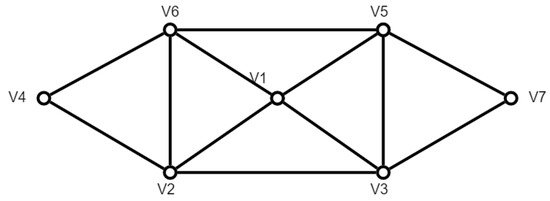
In Figure 1, vertices and have degree 4, while and have degree 2.
Figure 1.
Graph G with 7-vertices and 12-edged.
We obtain the degree matrix as shown below,
The characteristic equation for the above obtained matrix is . The vertex degree eigenvalues are , , , , , , . Therefore vertex degree energy is .
2. Main Results
2.1. Basic Properties on Degree Spectra and Degree Energy of a Graph
Let G be a degree graph with k vertices and l edges, represented by its degree matrix . The subsequent theorems establish the properties of the degree energy , including the sum of the squared eigenvalues, using the minimum eigenvalue, upper and lower bounds for , bounds for the maximum absolute degree eigenvalue, and the sum of the largest and smallest eigenvalues.
Theorem 1.
Let be the vertex degree eigenvalues of then,
Proof.
The trace of is equal to the sum of the squares of the eigenvalues of ,
□
Theorem 2.
Given a graph G, if then ,
Proof.
□
Theorem 3.
Let G represent a graph. Then,
Proof.
Through the Cauchy–Schwarz inequality,
Now, let us consider,
The geometric mean inequality and the arithmetic mean allow us to
□
Theorem 4.
(Bounds for maximum absolute degree eigenvalue) If the vertex degree eigenvalue of G is , then
Proof.
Consider that,
Now, let us consider,
□
Theorem 5.
Consider a graph G with vertices. Assessing the greatest and smallest eigenvalues of a graph is and , respectively, then,
Proof.
For of G, from the results of Theorem 1. Applying the Schwarz–Cauchy inequality,
□
2.2. Degree Spectra and Degree Energy of a Graph
This section and the following one focus on the energy associated with vertex degrees in graphs. We introduce the concept of the complement of a degree graph and subsequently calculate the degree energy for specific families of graphs and their corresponding complements.
Theorem 6.
The degree energy of a complete graph is .
Proof.
The degree matrix for a complete graph is
Then, the characteristic polynomial of degree matrix is as follows
The degree spectra of a complete graph is
Therefore, the degree energy of a complete graph is,
□
Theorem 7.
The degree energy of a star graph is
Proof.
The degree matrix of a star graph is
Then, the characteristic polynomial of the degree matrix is
And the degree spectra are
Hence, the degree energy of a star graph is,
□
Theorem 8.
The degree energy of a double star graph is
Proof.
Let be a double star graph and its degree matrix is
Then, the characteristic polynomial of the degree matrix of is,
And the degree spectra of is as follows
Thus, the degree energy of the double star graph can be expressed in the form,
□
Theorem 9.
The degree energy of a crown graph is .
Proof.
Let be a crown graph and its degree matrix is
Then, the characteristic equation of the degree matrix of can be obtained in the form,
Hence, the degree spectra of can be expressed as
Therefore, the degree energy of the crown graph can be computed as follows,
□
Theorem 10.
The degree energy of the Moore graph is .
Proof.
Let represent the Moore graph and its degree matrix can be expressed as follows
Then, the characteristic equation of can be considered as,
Therefore, the degree spectra of is
Hence, the degree energy of the Moore graph is
□
Theorem 11.
For any integer , the degree energy of a cocktail party graph is .
Proof.
Let be the cocktail party graph; then, its degree matrix can be expressed in the form
Then, the characteristic polynomial of is,
Thus, the degree spectra of can be represented as follows,
Therefore, the degree energy of the cocktail party graph can be computed as follows,
□
Theorem 12.
For any integer , the degree energy of is .
Proof.
Let be a complete bipartite graph and its degree matrix is as follows
Then, the characteristic equation of is,
Hence, the degree spectra of can be considered as,
Therefore, the degree energy of is,
□
Theorem 13.
For any integer , the degree energy of a friendship graph is .
Proof.
Let represent a friendship graph and its degree matrix is as follows
Then, the characteristic equation of is
Thus, the degree spectra of can be expressed in the form
Therefore, the degree energy of friendship graph is
□
2.3. Degree Spectra and Degree Energy of Complement of a Graph
Theorem 14.
The degree energy of the complement of a star graph is .
Proof.
Let be a complement of a star graph and its degree matrix is
Then, the characteristic equation of is
Thus, the degree spectra of is
Therefore, the degree energy of a complement of a star graph is,
□
Theorem 15.
The degree energy of complement of a double star graph is
Proof.
Let be a complement of a double star graph and its matrix is
Then, the characteristic equation of is as follows,
Hence, the degree spectra can be expressed as
Therefore, the degree energy of a complement of a double star graph is
□
Theorem 16.
The degree energy of a complement of a crown graph is is .
Proof.
Let be a complement of a crown graph and its degree matrix is
Then, the characteristic equation of the degree matrix is
Hence, the degree spectra of can be expressed as
Therefore, the degree energy of a complement of a crown graph is
□
Theorem 17.
The degree energy of a complete bipartite graph is .
Proof.
is a complement of a complete bipartite graph and its matrix is
The characteristic equation of is,
Hence, the spectra of is
Therefore, the energy of a complement of a complete bipartite graph is
□
Theorem 18.
For any integer , the degree energy of a complement of a cocktail party graph is .
Proof.
Let be a complement of a cocktail party graph and its degree matrix be
Now, the characteristic equation is as follows
Hence, the degree spectra of can be expressed as
Therefore, the degree energy of a complement of a cocktail party graph is
□
Theorem 19.
For any integer , the degree energy of a complement of a friendship graph is .
Proof.
Let be a complement of a friendship graph and its degree matrix be
Now, the characteristic equation is as follows
Thus, the degree spectra of can be expressed as
Therefore, the energy of the complement of Friendship graph is,
□
3. Conclusions
The degree distribution in a graph plays an important role in the analysis of the network. In this context, we tried to reveal some important properties that are purely related to the degree distribution using linear algebra. By utilizing the degree matrix, a degree-based representation of a simple graph G, we derived novel spectral results. This approach reduced the dimensionality of the matrices involved in eigenvalue calculations and, in many cases, enabled explicit eigenvalue determination. We introduced a new concept akin to graph energy, termed "degree energy", for which we established bounds and computed the exact energy for specific graph families.
Author Contributions
Conceptualization, A.R.N. and A.S.S.; methodology, A.R.N. and A.S.S.; investigation, A.R.N., A.S.S. and G.K.K.; original draft preparation, A.R.N. and K.S.S.; review and editing, A.R.N., A.S.S. and K.S.S. All authors have read and agreed to the published version of the manuscript.
Funding
This research received no external funding.
Data Availability Statement
The original contributions presented in the study are included in the article, further inquiries can be directed to the corresponding author.
Conflicts of Interest
The authors declare no conflict of interest.
References
- Fan, Y.Z.; Yu, G.D.; Wang, Y. The chromatic number and the least eigenvalue of a graph. Electron. J. Combin. 2012, 19, 39. [Google Scholar] [CrossRef] [PubMed]
- Yu, A.; Lu, M.; Tian, F. On the spectral radius of graphs. Linear Algebra Appl. 2004, 387, 41–49. [Google Scholar] [CrossRef]
- Li, X.; Shi, Y.; Gutman, I. Graph Energy; Springer Science & Business Media: New York, NY, USA, 2012. [Google Scholar]
- Adiga, C.; Bayad, A.; Gutman, I.; Shrikanth, A.S. The minimum covering energy of a graph. Kragujev. J. Sci. 2012, 34, 39–56. [Google Scholar]
- Adiga, C.; Sampathkumar, E.; Sriraj, M.A.; Shrikanth, A.S. Color energy of a graph. Proc. Jangjeon Math. Soc. 2013, 16, 335–351. [Google Scholar]
- Adiga, C.; Balakrishnan, R.; So, W. The Skew Energy of a Digraph. Linear Algebra Appl. 2010, 432, 1825–1835. [Google Scholar] [CrossRef]
- Aouchiche, M.; Hansen, P. Distance spectra of graphs: A survey. Linear Algebra Appl. 2014, 458, 301–386. [Google Scholar] [CrossRef]
- Bozkurt, S.B.; Gungor, A.D.; Gutman, I.; Cevik, A.S. Randic matrix and Randic energy. MATCH Commum. Math. Comput. Chem. 2010, 64, 239–250. [Google Scholar]
- Jog, S.R.; Hande, S.P.; Revankar, D.S. Degree sum polynomial of graph valued functions on regular graphs. Int. J. Graph Theory 2013, 1, 108–115. [Google Scholar]
- Mohar, B.; Alavi, Y.; Chartrand, G.; Oellermann, O. The laplacian spectrum of graphs. Graph Theory Comb. Appl. 1991, 12, 871–898. [Google Scholar]
- Akbari, S.; Ghorbani, E.; Oboudi, M.R. Edge addition, singular values, and energy of graphs and matrices. Linear Algebra Appl. 2009, 430, 2192–2199. [Google Scholar] [CrossRef]
- Alinaghipour, F.; Ahmadi, B. On the energy of complement of regular line graph. MATCH Commun. Math. Comput. Chem. 2008, 60, 427–434. [Google Scholar]
- Gutman, I. On graphs whose energy exceeds the number of vertices. Linear Algebra Appl. 2008, 429, 2670–2677. [Google Scholar] [CrossRef]
- Dehmer, M.; Emmert-Streib, F. Analysis of Complex Networks: From Biology to Linguistics; John Wiley & Sons: Hoboken, NJ, USA, 2009. [Google Scholar]
- Gutman, I.; Polansky, O.E. Mathematical Concepts in Organic Chemistry; Springer Science & Business Media: New York, NY, USA, 2012. [Google Scholar]
- McClelland, B.J. Properties of the latent roots of a matrix: The estimation of π-electron energies. J. Chem. Phys. 1971, 54, 640–643. [Google Scholar] [CrossRef]
- Hosamani, S.M.; Ramane, H.S. On degree sum energy of a graph. Eur. J. Pure Appl. Math. 2016, 9, 340–345. [Google Scholar]
- Gutman, I. The energy of a graph. Ber. Math. Statist. Sekt. Forchungsz. Graz 1978, 103, 1–22. [Google Scholar]
- Pirzada, S.; Gutman, I. Energy of a graph is never the square root of an odd integer. Appl. Anal. Discret. Math. 2008, 2, 118–121. [Google Scholar] [CrossRef]
- Wilson, R.J. Introduction to Graph Theory; Pearson Education India: New Delhi, India, 1979. [Google Scholar]
- Zhang, X.; Bilal, A.; Munir, M.M.; Rehman, H.M.U. Maximum degree and minimum degree spectral radii of some graph operations. Math. Biosci. Eng. 2022, 19, 10108–10121. [Google Scholar] [CrossRef] [PubMed]
- Shi, X.; Kosari, S.; Talebi, A.A.; Sadati, S.H.; Rashmanlou, H. Investigation of the Main Energies of Picture Fuzzy Graph and its Applications. Int. J. Comput. Intell. Syst. 2022, 15, 31. [Google Scholar] [CrossRef]
- Balakrishnan, R.; Ranganathan, K. A Textbook of Graph Theory; Springer Science & Business Media: New York, NY, USA, 2012. [Google Scholar]
- Bapat, R.; Pati, S. Energy of a graph is never an odd integer. Bull. Kerala Math. Assoc. 2004, 1, 129–132. [Google Scholar]
- Doob, M.; Sachs, H. Spectra of Graphs: Theory and Application; Deutscher Verlag der Wissenschaften: Berlin, Germany, 1980. [Google Scholar]
- Godsil, C.; Royle, G.F. Algebraic Graph Theory; Springer Science & Business Media: New York, NY, USA, 2001. [Google Scholar]
- Biggs, N. Algebraic Graph Theory; Cambridge University Press: Cambridge, UK, 1974. [Google Scholar]
Disclaimer/Publisher’s Note: The statements, opinions and data contained in all publications are solely those of the individual author(s) and contributor(s) and not of MDPI and/or the editor(s). MDPI and/or the editor(s) disclaim responsibility for any injury to people or property resulting from any ideas, methods, instructions or products referred to in the content. |
© 2024 by the authors. Licensee MDPI, Basel, Switzerland. This article is an open access article distributed under the terms and conditions of the Creative Commons Attribution (CC BY) license (https://creativecommons.org/licenses/by/4.0/).