


Abstract
Dung’s abstract argumentation framework is a popular formalism in formal argumentation. The present work develops paraconsistent labeling semantics for abstract argumentation such that the incomplete and inconsistent information can be expressed, and it introduces a Hilbert-style axiomatic system which is proven to be sound and complete. Additionally, we make a comparison between the logic developed in the present work and some relevant theories of abstract argumentation.
MSC:
03B45; 03B53
1. Introduction
Formal argumentation is an important research field in artificial intelligence (cf., e.g., [1,2,3,4]). Dung’s theory of abstract argumentation framework is useful for dealing with disputes between agents. This framework is simple but has powerful expressiveness (cf. [5]). An argumentation framework (AF) is a pair where is a set of arguments and R a binary attack relation on . For all , means that the argument a attacks b.
There are various kinds of semantics such as grounded, complete, preferred, stable and semi-stable semantics defined for AF in the literature (cf., e.g., [5,6]). For the purpose of representing different kinds of information, AF has been extended to many forms such as AF with uncertain information [4,7,8,9], bipolar AF [10,11,12], AF with preferences [13,14] and AF with constrains [15,16]. In particular, there are two ways to extend AF to represent uncertain information: one is incomplete AF (iAF) where arguments and attacks may be uncertain [7,8], and the other is probabilistic AF (PrAF) where arguments and attacks are associated with probabilities [4,9].
This paper uses AAF to deal with uncertain (incomplete) and paraconsistent information by introducing paraconsistent (four-valued) labeling semantics without utilizing probability. This differs from iAF in the following sense: the attack relation is certain, and the semantics is changed into a bilateral one such that an argument can accept (support) or reject a proposition. Thus, given an argument a and proposition , there are four possibilities: (C1) a accepts ; (C2) a rejects ; (C3) a both accepts and rejects ; and (C4) a neither accepts nor rejects . Here, (C1) means that is certainly true for a; (C2) means that is certainly not true for a; (C3) means that is a contradictory information for a; and (C4) means that is irrelevant with a.
The paraconsistent approach given in the present paper puts uncertainties on the satisfaction relation but not on the attack relation. Dung said, “an argument is an abstract entity whose role is solely determined by its relations to other arguments. No special attention is paid to the internal structure of the arguments” [5]. In our framework, an argument is an abstract entity whose role is determined both by its relations to other arguments and its relations to properties or propositions (supporting or rejecting). This is due to the fact that two arguments may attack the same arguments, but they are given based on different reasons. Belnap [17,18] and Dunn [19,20] proposed the four-valued semantics for modeling different states of information. In the present paper, the paraconsistent labeling semantics is used to deal with incomplete and paraconsistent information. After we present the bilateral semantics, we will introduce a sound and complete Hilbert-style axiomatic system. Finally, we will compare this kind of semantics with some relevant theories of abstract argumentation.
Some logicians (cf., e.g., [21,22]) have considered paraconsistency both at the level of propositional symbol and at the level of accessibility relation. The present paper has considered paraconsistency only at the level of the propositional symbol, but we generalize four-valued paraconsistent modal logic in a different direction: we generalize a single accessibility relation to bi-directional accessibility relations. Indeed, we use a four-valued paraconsistent tense logic with a global modality. Hence, the logic in the present paper can talk about the relations of both attacking and being attacked.
The structure of this paper is as follows. Section 2 introduces the formal language and paraconsistent labeling semantics. Section 3 gives a Hilbert-style axiomatic system and proves its soundness and completeness. Section 4 gives the comparison between our semantics and other theories. Section 5 gives some concluding remarks and directions of future work.
2. Paraconsistent Labeling Semantics
This section introduces the formal language and the paraconsistent labeling semantics. The modal logic of abstract argumentation under this kind of semantics is introduced.
Definition 1.
An abstract argumentation framework (AAF) is a pair where is a set of arguments, and R is a binary relation on which is called the attack relation. The inverse of R is defined as . For every argument , we define
Let be a denumerable set of propositional variables. We assume that is denumerable, and in practical scenarios, can be finite. Let be the powerset of . In the standard labeling in an AAF, a set of propositional variables is assigned to each argument. Here, we assign each argument a pair of sets of propositional variables, namely, each argument a takes an element in the product as its label. For each argument a, the label consists of a pair of sets where is the set of all propositional variables that a accepts, and is the set of all propositional variables that a rejects. The two sets of propositional variables have four cases in the following diagram:
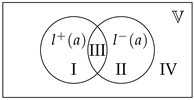
The region (I) consists of propositional variables which a accepts; (II) consists of propositional variables which a rejects; (III) consists of propositional variables which a accepts and rejects; and (IV) consists of propositional variables which a neither accepts nor rejects. Now, we give the formal definition of labeling and model as follows.
Definition 2.
Let be an AAF. A labeling in is the function . A model is where is an AAF, and l is a labeling in . For every model and , the pair is given the label of a. The label is consistent if ; is inconsistent if is not consistent; is complete if ; and is incomplete if it is not complete.
Example 1.
Consider the following AAF :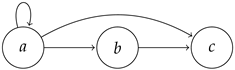
Clearly, and . Note that means a attacks itself, namely, a is contradictory. Moreover, for all . Let l be the labeling in such that and . Then, is both inconsistent and incomplete.
Properties of arguments are expressed by formulas built from propositional variables using logical operators. In the present paper, we shall consider the following logical operators: ¬ (classical negation), ∼ (paraconsistent negation), ∨ (disjunction), ⋄ (future possibility), ⧫ (past possibility) and (existential modality).
Definition 3.
The set of all formulas is defined inductively as follows:
where . The complexity of a formula φ, denoted by , is defined inductively as follows:
We use the following abbreviations:
For , let be the set of all propositional variables appearing in φ. For and , the formula is defined inductively by and . For , ⧫ or , the dual of ⊙ is the operator , ▪ or , respectively.
Let a be an argument a in a model and a formula. We give the acceptance relation and the rejection relation to show the paraconsistent labeling semantics.
Definition 4.
Let be a model, and . The acceptance relation and rejection relation are defined simultaneously by induction as follows:
- if and only if .
- if and only if .
- if and only if .
- if and only if .
- if and only if .
- if and only if .
- if and only if or .
- if and only if and .
- if and only if for some .
- if and only if for any .
- if and only if for some .
- if and only if for any .
- if and only if for some .
- if and only if for any .
For every , let and . Let be the meaning of φ in the model .
Lemma 1.
For every model and , the following hold:
- (1)
- and .
- (2)
- and .
- (3)
- if and only if and .
- (4)
- if and only if or .
- (5)
- if and only if or .
- (6)
- if and only if and .
- (7)
- if and only if for all .
- (8)
- if and only if for some .
- (9)
- if and only if for all .
- (10)
- if and only if for some .
- (11)
- if and only if for all .
- (12)
- if and only if for some .
- (13)
- if and only if .
- (14)
- if and only if .
- (15)
- if and only if .
- (16)
- if and only if .
- (17)
- if and only if .
- (18)
- if and only if .
Proof.
We only prove the following items, and the proof of others is omitted.
if and only if , if and only if , if and only if and , if and only if and .
if and only if , if and only if or , if and only if or .
if and only if , if and only if , if and only if for all , if and only if for all .
if and only if , if and only if , if and only if for some , if and only if for some .
if and only if for all by (7), if and only if for all , if and only if , if and only if .
if and only if for some by (8), if and only if for some , if and only if , if and only if . □
Definition 5.
Let be an AAF and . Let be a model on .
- φ is true at a in (notation: ) if and .
- φ is valid in (notation: ) if for every labeling l in and .
- φ is valid (notation: ) if for each AAF .
The paraconsistent modal logic for abstract argumentation . We write if for all ; and if for some . A formula φ is a semantical consequence of Γ (notation: ) if for every model and , (i) if , then ; and (ii) if , then .
Here, we have defined the paraconsistent modal logic which is the logic of argumentation under the paraconsistent labeling semantics. In the next section, we will give a Hilbert-style axiomatization of .
3. Hilbert-Style Axiomatic System
In this section, we shall present a Hilbert-style axiomatic system for the logic of abstract argumentation. We shall prove the soundness and completeness of . Let be the classical propositional logic in the language .
Definition 6.
The axiomatic system consists of the following axiom schemata and inference rules:
- (1)
- Axiom schemata:
- All instances of .
- where and is the dual of ⊙.
- where .
- (2)
- Inference rules:
A proof of a formula φ in a finite sequence of formulas such that and each is either an axiom or derived from previous formulas by an inference rule. A formula φ is provable (or a theorem) in (notation: ) if there exists a proof of φ in . A formula φ is derivable from a set of formulas Γ in (notation: ) if there exists a finite subset such that . Here, is the conjunction of all formulas in Δ. In particular, .
Lemma 2.
For all formulas φ, and , if , then where is obtained from φ by substituting for one or more occurrences of in φ.
Proof.
The proof proceeds by induction on the complexity . The case is trivial. Suppose that . By induction hypothesis, . By (A1) and (MP), . Suppose that . By induction hypothesis, . By (CP) and (A1), . Suppose that , or . These cases are similar, and we show only the first case. By induction hypothesis, . By (A1), . By , (MP) and (A6), . By (A1), . Then, by (A5) and (A1). Suppose that is . By induction hypothesis, and . By (A1) and (MP), . Hence, . □
Lemma 3.
The following hold in :
- where .
- and .
- if , then where .
- and .
- if and only if .
- if and only if .
Proof.
For (1), we only prove the case for □. By the definition of □, . By (A2) and Lemma 2, . By (A3), . By (A5), (A1) and Lemma 2, . By (A1), . For (2), we show only the case for ⋄. By (A10), . By (CP), . By (A2) and Lemma 2, . For (3), we show only the case for □. Assume that . By , . By (A6) and (MP), . For (4), by (A12) and (CP), . Then, . By (A2) and (MP), . Similarly, . For (5), assume that . By (3), . By (A13), (A1) and (MP), . Assume that . By (3), . By (4), (A1) and (MP), . The item (6) is shown similarly. □
Lemma 4.
The following hold in :
- ; and .
- and .
- and for .
- and for .
- ; and .
Proof.
(1) By (A1) and Lemma 2, . By (A5), (A1) and Lemma 2, . Similarly, we have and .
(2) For , it suffices to show by (A4). By (A1), and . Then by (CP), and . Hence, by (A1). For , clearly . By (A3), . By Lemma 2 and which we have just proven, . By (A3), . By (A1), . By (A1), .
(3) Clearly, and . By Lemma 3 (3), and . By (A1), . Clearly, . By , (A6) and (MP), . By (A6), . By (A1), . By (A1), . Again by (A1), . Again By (A1), . Hence, by (A5) and Lemma 2, . Similarly, and . Clearly, and . For , by Lemma 3 (3), and . Hence, .
(4) Clearly, and . For , by Lemma 3 (3), and . Then, . By (A5) and (A1), . By (A1) and Lemma 2, . By (3), . By (A1), . By (A5) and (A1), . By (A1), . Similarly, and .
(5) By (A5) and (A1), . By (A1), . By (A6) and (A1), . By (A5) and (A1), . By (A1) and Lemma 2, . Hence, by (A1). Similarly, and . □
Now, we prove the completeness of by the canonical model method. First, we define deductive filters and use them to define the canonical model.
Definition 7.
A nonempty set of formulas F is an -deductive filter if and imply . An -deductive filter F is proper if . The set of all -deductive filters is denoted by . A proper -deductive filter F is prime if implies or . The set of all prime -deductive filters is denoted by .
Lemma 5.
Let . For all formulas φ and ψ, the following hold:
- if and only if and .
- if and only if or .
- if and only if or .
- if and only if and .
- if and only if or .
- if and only if and .
Proof.
For (1), assume that . By and , we obtain and . Conversely, assume that and . By , we obtain . For (2), assume that . Since F is prime, we have or . Assume that or . By and , we have . The items (3) and (4) are shown similarly. By Lemma 4(2) and items (1) and (2), we obtain (5) and (6). □
For a nonempty set of formulas , let . Clearly, is an -deductive filter. If , we write for .
Lemma 6.
The following hold in :
- (1)
- If and , there exists such that and .
- (2)
- If , then there exists such that and .
Proof.
For (1), assume that and . Consider the set . Note that since . Then, is a partially ordered set. Let be any ⊆-chain in . It is easily shown that is a ⊆-upper bound of . By Zorn’s lemma, there exists a ⊆-maximal element G in . Clearly, and . It suffices to show that G is prime. For a contradiction, suppose that , and . Let and . Since G is ⊆-maximal, and . Then, and . Then, there exist such that and . By (A1), and . Again by (A1), . By Lemma 5 (1), . Then, which contradicts . For (2), let . Then, and . By (1), there exists such that and . □
Definition 8.
For a nonempty set of formulas Φ, let and for . The canonical AAF for is defined as the structure where
- .
- if and only if and .
- if and only if .
The canonical model for is defined as the model where is a labeling given by and for every .
The canonical AAF consists of two relations and , and so it is not an AAF in the sense of Definition 2. Thus, the proof of completeness is not standard. Using the following Lemma 7, we obtain a submodel generated by a point and so it will be a model in the sense of Definition 4.
Lemma 7.
and .
Proof.
Assume that . We show and . Suppose that . By (A10), . By , we have . Hence, . Suppose that . By , we have . By Lemma 3 (2), . Hence, . Hence, . Similarly, we have . □
Definition 9.
For the canonical model and , the generated submodel is defined as follows:
- (1)
- where and .
- (2)
- .
- (3)
- for every .
Lemma 8.
Let and . The following hold:
- (1)
- if and only if .
- (2)
- if and only if .
Proof.
We prove (1) and (2) simultaneously by induction on the the complexity of . The case or is trivial. Suppose that . For (1), assume . Then, for some . By induction hypothesis, . By induction hypothesis and Lemma 7, . Hence, . Conversely, assume that . Then, for some . By induction hypothesis, . By induction hypothesis and , we have . By and Lemma 7, . Similarly, we can prove (2). The case for or is shown similarly. □
Lemma 9
(Existence Lemma). For every , the following hold:
- (1)
- if and only if for some such that .
- (2)
- if and only if for some such that .
- (3)
- if and only if for some such that .
- (4)
- if and only if for all such that .
- (5)
- if and only if for all such that .
- (6)
- if and only if for all such that .
- (7)
- if and only if for all such that .
- (8)
- if and only if for all such that .
- (9)
- if and only if for all such that .
Proof.
(1) The right-to-left direction follows from the definition of . Assume that . Let . Consider .
Next, we show . Suppose that . Then, there exist and such that . By Lemma 3 (3), . By Lemma 4 (5), . By Lemma 4 (4), . For , by and (A12), . Hence, since and . Hence, . Furthermore, by Lemma 3 (2), and so . To show , suppose that . Then, since . By Lemma 3 (4), . Hence, . Thus, , i.e., .
Let be a ⊆-chain in . Let . Clearly, is a ⊆-upper bound of . By Zorn’s lemma, there exists a maximal ⊆-element G in . Suppose that . Then, by and Lemma 3(2). Clearly, . Then, which contradicts . Hence, . Clearly, , , and . It suffices to show that G is prime.
Assume that and and . For a contradiction, let and . Clearly, and . By the maximality of G, and . By , we have, for , or . We have the following cases:
(1.1) There exist and with and . By and , there exist such that and . Let . Clearly, . Then, and . Then, . Clearly, . Then, . Then, . By Lemma 4 (3), . Hence, or , which contradicts .
(1.2) There exist and such that and . By and , there exist such that and . Let . Clearly, . Then, and . Then, . Clearly, . Then, . Therefore, since . Hence, by Lemma 4 (3). Note that by Lemma 3 (4). Then, . Hence, or which contradicts .
(1.3) There exist and such that and . In the same way of case (1.1), we can show that or . The latter implies that by Lemma 3 (4). Hence, or which contradicts .
(1.4) There exist and such that and . This case can be shown in the same way of the case (1.3).
The proofs of (2) and (3) are similar to that of (1), and we omit the details.
(4) Assume that . Then, . By definition of the canonical model, for all such that . To show the other direction, assume that for all such that . For a contradiction, suppose that . Then, . Then, . By (1), for some such that . Then, which leads to a contradiction.
(5)–(6) are similar to case (4).
(7) Assume that . Then, by (A5). By definition of canonical model, for all such that . To show the other direction, assume that for all such that . For a contradiction, suppose that . Then, . By (1), for some such that . Then, which leads to a contradiction.
(8) and (9) are similar to (7). □
Lemma 10
(Truth Lemma). For all and formula φ, the following hold:
- (1)
- if and only if .
- (2)
- if and only if .
Proof.
We prove (1) and (2) simultaneously by induction on the complexity of . The case that is atomic is trivial. We have the following cases:
(i) . For (1), assume that . Then, for some such that . Thus, by Lemma 8(1). By induction hypothesis, . By Lemma 9 (1), . Conversely, assume that . By Lemma 9 (1), for some such that . By induction hypothesis, . By Lemma 7, . By Lemma 8 (1), . Hence, . For (2), assume that . For all such that , we have . By Lemma 8 (2), . By induction hypothesis, . Then, by Lemma 7, for all such that . By Lemma 9 (4), . The other direction is shown similarly.
(ii) or . This case is similar to the case (i).
(iii) . For (1), assume that . Then, . By induction hypothesis, . The other direction is shown similarly. For (2), assume that . Then, . By induction hypothesis, . By (A2), we have . The other direction is shown similarly.
(iv) . For (1), assume that . Then, . By induction hypothesis, . Then, since F is prime. Conversely, assume that . Then, since F is proper. By induction hypothesis, . Hence, . For (2), assume . Then, . By induction hypothesis, . Then, since F is prime. By (A3), . The other direction is shown similarly.
(v) . For (1), assume that . Then, or . By induction hypothesis, or . By Lemma 5 (2), . The other direction is shown similarly. For (2), assume . Then, and . By induction hypothesis, and . By Lemma 5 (1), . By (A4), . The other direction is shown similarly. □
Theorem 1
(Completeness). if and only if .
Proof.
The soundness can be checked as usual. Assume that . Then, . By Lemma 6(1), there exists such that and . By Lemma 10 (1), but . Hence, . □
4. Discussion
In an AAF, consider different arguments a and b which have the same relations to other arguments. The following Example 2 gives such a scenario. The problem is how a and b can be distinguished from each other. The semantics given by Dung [5] can not tell the difference between arguments a and b since an argument is completely determined by its relations to other arguments. However, using the semantics presented in this paper, we can achieve this. For an argument a, it has not only the attack relationship to other arguments, for example, the argument b attacks a and a attacks c, but also can accept or reject some properties. For example, a accepts the property p and rejects q. Thus, from this semantical perspective, an argument is an abstract entity whose role is determined both by its relations to other arguments and its semantical relations to propositions.
Example 2.
Marry and John both oppose presidential candidate A. However, they oppose him for different reasons. Marry opposes them because she thinks that he is not honest; and John opposes them because he thinks that his policies can not support economic growth.
The two arguments in Example 2 (Marry and John’s arguments) both attack the argument that presidential candidate A should be elected, but they are different arguments. Using the labeling semantics, a formula can be interpreted as a property of arguments or a set of all arguments accepting . The formula is interpreted as a set of all arguments rejecting . The formula is interpreted as a set of all arguments which attack some arguments supporting . The formula is interpreted as a set of all arguments which attack only arguments supporting . The formulas and are interpreted similarly. The formula is interpreted as that there is an argument accepting , and as that all arguments accept . By the labeling semantics, arguments are distinguished by properties.
Furthermore, many arguments are based on incomplete and inconsistent information. Dung [5] said that “all forms of reasoning with incomplete information rest on the simple intuitive idea that a defeasible statement can be believed only in the absence of any evidence to the contrary which is very much like the principle of argumentation.”. Since information is usually not only incomplete but also inconsistent based on multiple information sources, the labeling semantics given in the present paper works naturally since it introduces the acceptance and rejection semantical relations.
Grossi [23,24] introduced the doing argumentation theory to study abstract argumentation. In this framework, an argument a belonging to in a given model means that a has the property p or that p is true of a. Thus, either a has the property p or a does not have p, but not both. This approach is essentially bivalent. In our paraconsistent labeling semantics, we have the following four cases:
- (1)
- a accepts p (p is true of a).
- (2)
- a rejects p (p is false of a).
- (3)
- a both accepts and rejects p (p is both true and false of a).
- (4)
- a neither accepts nor rejects p (p is neither true nor false of a).
Grossi’s doing argumentation theory can not express the inconsistency or lacking information of arguments. For example, the arguments which attack an argument supporting and rejecting can be expressed by the formula under our labeling semantics.
Caminada [25] proposed an alternative labeling semantics for abstract argumentation. In their framework, every argument is labeled (or be valued) by in, out or undec, which means, respectively, the argument is accepted, rejected and illegally undec.
A Caminada Labeling is a function from the set of all arguments to the set of labels (or propositional variables), in, out and undec, satisfying the following conditions.
- (1)
- If (i.e., there is no argument attacking a), then .
- (2)
- If (i.e., the argument b attacking a) and , then .
- (3)
- If all , , then .
- (4)
- Otherwise, .
Caminada’s labeling demands consistency, i.e., an argument a is rejected if it is attacked by an accepted argument b. It also demands maximal acceptance, i.e., an argument a which is not attacked by no argument is necessarily accepted. However, in our paraconsistent approach, neither consistency nor maximal acceptance is assumed.
5. Concluding Remarks and Future Work
This paper develops a paraconsistent labeling semantics for abstract argumentation. Then, we introduces the paraconsistent modal logic and its Hilbert-style axiomatic system . The system is shown to be sound and complete with respect to the paraconsistent labeling semantics. Moreover, we have compared paraconsistent labeling semantics with other semantical approaches to the abstract argumentation.
The present paper leaves some interesting directions which are worth exploring in further work. One direction is that paraconsistency at the level of accessibility relation may be generalized in two different ways: one is the four-valued accessibility relation, and the other is the birelational frame semantics. In the latter way, we have the attack relation and support relation so that an argument can both attack and support the same arguments. Some logicians have given a sort of four-valued paraconsistent modal logic based on birelational frame semantics, but the resulting logic is not a temporal logic (cf., e.g., [26]).
Another approach is using the modal hybrid logic that can enrich the expressiveness of language on structures. We may add names of arguments to the language so that we can talk about properties of arguments in a direct way. Some logicians have considered this kind of modal hybrid logic (cf., e.g., [27]), but the used logic is not a temporal one.
The last approach is the study of measures of inconsistency in abstract argumentation (AAF) that can enable us to compare in a direct way two different AAFs with respect of the number of inconsistencies. For example, the arguments from a debate among the candidates consist of an argumentation; then, the less inconsistency there is in the argumentation, the clearer the candidate’s policy. Measures of inconsistency in the context of argumentation theory are worth exploring further; although, this kind of work has been done in other contexts (cf., e.g., [27,28,29]).
Funding
This research was funded by the Chinese National Funding of Social Sciences (Grant no. 18ZDA033).
Data Availability Statement
No new data were created or analyzed in this study. Data sharing is not applicable to this article.
Acknowledgments
Thanks are given to the reviewers and Minghui Ma for their insightful and helpful comments on the revision of this paper. In particular, some facts given in the introduction and the conclusion were pointed out by the second reviewer.
Conflicts of Interest
The author declares no conflicts of interest.
References
- Bench-Capon, T.; Dunne, P.E. Argumentation in Artificial Intelligence. Artif. Intell. 2007, 171, 619–641. [Google Scholar] [CrossRef]
- Simari, G.R.; Rahwan, I. Argumentation in Artificial Intelligence; Springer: New York, NY, USA, 2008. [Google Scholar]
- Atkinson, K.; Baroni, P.; Giacomin, M.; Hunter, A.; Prakken, H.; Reed, C.; Simari, G.; Thimm, M.; Villata, S. Toward Artificial Argumentation. Artif. Intell. Mag. 2017, 38, 25–36. [Google Scholar] [CrossRef]
- Fazzinga, B.; Mellema, R. Argumentation in AI. In Human-Centered Artificial Intelligence (ACAI 2021); Chetouani, M., Dignum, V., Lukowicz, P., Sierra, C., Eds.; Springer: Cham, Switzerland, 2023; pp. 347–362. [Google Scholar]
- Dung, P.M. On the acceptability of arguments and its fundamental role in nonmonotonic reasoning, logic programming and n-person games. Artif. Intell. 1995, 77, 321–357. [Google Scholar] [CrossRef]
- Caminada, M. Semi-Stable Semantics. In Proceedings of the 1st International Conference on Computational Models of Argument (COMMA), Liverpool, UK, 11–12 September 2006; pp. 121–130. [Google Scholar]
- Baumeister, D.; Neugebauer, D.; Rothe, J. Credulous and Skeptical Acceptance in Incomplete Argumentation Frameworks. In Proceedings of the 7th International Conference on Computational Models of Argument (COMMA), Warsaw, Poland, 12–14 September 2018; IOS Press: Amsterdam, The Netherlands, 2018; pp. 181–192. [Google Scholar]
- Baumeister, D.; Järvisalo, M.; Neugebauer, D.; Niskanen, A.; Rothe, J. Acceptance in incomplete argumentation frameworks. Artif. Intell. 2021, 295, 103–470. [Google Scholar] [CrossRef]
- Dung, P.M.; Thang, P.M. Towards (Probabilistic) Argumentation for Jury-based Dispute Resolution. In Proceedings of the 3rd International Conference on Computational Models of Argument (COMMA), Desenzano del Garda, Italy, 8–10 September 2010; IOS Press: Amsterdam, The Netherlands, 2010; pp. 171–182. [Google Scholar]
- Nouioua, F.; Risch, V. Argumentation Frame-works with Necessities. In Proceedings of the 5th International Conference on Scalable Uncertainty Management (SUM), Dayton, OH, USA, 10–13 October 2011; Springer: Berlin/Heidelberg, Germany, 2011; pp. 163–176. [Google Scholar]
- Nouioua, F. AFs with Necessities: Further Semantics and Labelling Characterization. In Proceedings of the 7th International Conference on Scalable Uncertainty Management (SUM), Washington, DC, USA, 16–18 September 2013; Springer: Berlin/Heidelberg, Germany, 2013; pp. 120–133. [Google Scholar]
- Villata, S.; Boella, G.; Gabbay, D.M.; van der Torre, L.W.N. Modelling defeasible and prioritized support in bipolar argumentation. Ann. Math. Artif. Intell. 2012, 66, 163–197. [Google Scholar] [CrossRef]
- Amgoud, L.; Cayrol, C. On the Acceptability of Arguments in Preference-based Argumentation. In Proceedings of the 4th Conference on Uncertainty in Artificial Intelligence (UAI), Madison, WI, USA, 24–26 July 1998; pp. 1–7. [Google Scholar]
- Modgil, S.; Prakken, H. A general account of argumentation with preferences. Artif. Intell. 2013, 195, 361–397. [Google Scholar] [CrossRef]
- Coste-Marquis, S.; Devred, C.; Marquis, P. Constrained Argumentation Frameworks. In Proceedings of the 10th International Conference on Principles of Knowledge Representation and Reasoning (KR), Lake District, UK, 2—5 June 2006; pp. 112–122. [Google Scholar]
- Alfano, G.; Greco, S. Incremental Skeptical Preferred Acceptance in Dynamic Argumentation Frameworks. IEEE Intell. Syst. 2021, 36, 6–12. [Google Scholar] [CrossRef]
- Belnap, N. A useful four-valued logic. In Modern Uses of Multiple-Valued Logic; Dunn, J.M., Epstein, G., Eds.; Springer: Dordrecht, Holland, 1977; pp. 5–37. [Google Scholar]
- Belnap, N. How a computer should think. In Contemporary Aspects of Philosophy; Ryle, G., Ed.; Oriel Press: Stocksfield, UK, 1977; pp. 30–55. [Google Scholar]
- Dunn, M. Intuitive semantics for first-degree entailments and coupled trees. Philos. Stud. 1976, 29, 149–168. [Google Scholar] [CrossRef]
- Dunn, M. Relevance logic and entaiment. In Handbook of Philosophical Logic Volume III: Alternatives in Classical Logic; Gabbay, D., Guenthner, F., Eds.; Springer: Dordrecht, Holland, 1986; pp. 117–224. [Google Scholar]
- Costa, D.; Martins, M.A. Non-dual modal operators as a basis for 4-valued accessibility relations in hybrid logic. J. Log. Algebr. Methods Program. 2021, 121, 100679. [Google Scholar] [CrossRef]
- Rivieccio, U.; Jung, A.; Jansana, R. Four-valued modal logic: Kripke semantics and duality. J. Log. Comput. 2017, 27, 155–199. [Google Scholar] [CrossRef]
- Grossi, D. On the logic of argumentation theory. In Proceedings of the 9th International Conference on Autonomous Agents and Multiagent Systems (AAMAS), Toronto, ON, Canada, 10–14 May 2010; Multiagent Systems: Richland, SC, USA, 2010; pp. 409–416. [Google Scholar]
- Grossi, D. Argumentation in the View of Modal Logic. In Argumentation in Multi-Agent Systems (ArgMAS); Lecture Notes in Computer Science; McBurney, P., Rahwan, I., Parsons, S., Eds.; Springer: Berlin/Heidelberg, Germany, 2011; pp. 190–208. [Google Scholar]
- Caminada, M.W.A.; Gabbay, D.M. A Logical Account of Formal Argumentation. Stud. Log. 2009, 93, 109–145. [Google Scholar] [CrossRef]
- Lin, Y.; Ma, M. Polarity Semantics for Negation as a Modal Operato. Stud. Log. 2020, 108, 877–902. [Google Scholar] [CrossRef]
- Costa, D.; Martins, M.A. Paraconsistency in hybrid logic. J. Log. Comput. 2017, 27, 1825–1852. [Google Scholar] [CrossRef]
- Besnard, P.; Grant, J. Relative inconsistency measures. Artif. Intell. 2020, 280, 103231. [Google Scholar] [CrossRef]
- Grant, J. Measuring inconsistency in generalized propositional logic. Log. Univers. 2020, 14, 331–356. [Google Scholar] [CrossRef]
Disclaimer/Publisher’s Note: The statements, opinions and data contained in all publications are solely those of the individual author(s) and contributor(s) and not of MDPI and/or the editor(s). MDPI and/or the editor(s) disclaim responsibility for any injury to people or property resulting from any ideas, methods, instructions or products referred to in the content. |
© 2024 by the author. Licensee MDPI, Basel, Switzerland. This article is an open access article distributed under the terms and conditions of the Creative Commons Attribution (CC BY) license (https://creativecommons.org/licenses/by/4.0/).