


Abstract
We describe the nonabelian exterior square of a pro-p-group G (with p arbitrary prime) in terms of quotients of free pro-p-groups, providing a new method of construction of and new structural results for . Then, we investigate a generalization of the probability that two randomly chosen elements of G commute: this notion is known as the “complete exterior degree” of a pro-p-group and we will use it to characterize procyclic groups. Among other things, we present a new formula, which simplifies the numerical aspects which are connected with the evaluation of the complete exterior degree.
MSC:
20P05; 20J05; 20E10; 20J06
1. Introduction and Formulation of the Main Results
In the present paper we deal only with topological Hausdorff groups. Topological groups with a discrete topology are called discrete groups or abstract groups. Topological groups with a compact topology are called compact groups. Of course, finite groups are examples of discrete compact groups but the additive group of the p-adic integers (p prime) is an example of an infinite nondiscrete compact group, see Example 1.28 (i) and Exercise E1.10 in [1]. The usual notion of an abelian tensor product of two abstract abelian groups, which is described by Propositions A1.44, A1.45 and A1.46 of [1], has been adapted to the context of profinite groups in §5.4 and §5.5 of [2], introducing the complete abelian tensor product of two profinite abelian groups. Usually, one formulates a universal property and then provides an explicit construction, as indicated in Lemma 5.5.1, Lemma 5.5.2 and Proposition 5.5.4 of [2]. Brown and Loday [3,4] introduced the nonabelian tensor product of two abstract groups, which are not necessarily abelian. Adapting the notion of Brown and Loday to topological groups, the presence of a topology should be compatible with the algebraic structure of the tensor product and some difficulties can appear even if we consider compact groups.
Let us focus on a special class of compact groups. First of all, we mention from §1.1 of [2] that a topological space X, which arises as projective limit on a given (directed) set of indices J, can be written as
and X is called profinite space. Secondly, we may look at finite groups and a projective limit
is called a -p-, as indicated by Definition 1.27 of [1]. These are special types of profinite groups, that is, totally disconnected compact groups, which are described by Theorem 1.34 of [1]. Several results of classification of compact groups involve maximal closed subgroups which are pro-p-groups; just to give an idea, Corollaries 8.5, 8.6 and 8.8 of [1] classify compact abelian groups via their pro-p-subgroups; in particular Corollary 8.8 of [1] shows that any compact abelian group is totally disconnected if and only if it is the direct product of pro-p-groups.
Following §3.3 of [2], if X is a profinite space, a pro-p-group and a continuous map such that , we say that the pair , or briefly , is a free pro-p-group on X, if the following universal property is satisfied
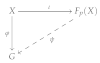 where is a continuous map into a pro-p-group G, topologically generatesG (i.e., ) and is a continuous homomorphism such that (3) commutes (i.e., ). Diagram (3) describes a universal property defining . The reader can look at Theorem A3.28 of [1] for a more general perspective on the definition of objects in a prescribed category by a universal property. Here, we assume that X is nonempty and in order to avoid trivial examples. We also note that is an embedding by Lemma 3.3.1 of [2] and that for every profinite space X there exists a unique free pro-p-group on X by Proposition 3.3.2 of [2].
We recall briefly the details of the construction of here. For instance, if X is a profinite space, F a free abstract group on X and (i.e., N is a normal subgroup of F), then one observes that
is a filter basis which allows us to form the projective limit
This is a concrete construction of the free pro-p-group on X and we may check that satisfies the universal property expressed by (3), as illustrated by Proposition 3.3.2 and Exercise 3.3.3 of [2]. Note also that possesses the topology induced by (4) and is compatible with the structure of the projective limit. The same logic applies to any filter basis and works in fact for free compact groups, but also for a free pro--group with an arbitrary class of finite groups closed under taking quotients and finite subdirect products (and containing groups of order two). The reader may refer to Chapter 11 of [1], to Chapter 3 of [2] and to [5] for more information on topological free groups.
We recall now that a Cantor cube is a topological space which is homeomorphic to a product space for some infinite cardinal ℵ, see Definition A4.30 in [1]. A dyadic space is a continuous image of a Cantor cube. Our first main result provides a new approach to the notion of a complete nonabelian tensor square of a pro-p-group G, originally studied in [6,7] for pro-p-groups, but introduced by Brown and Loday [3,4] for finite groups.
Theorem 1.
Let be a pro-p-group with finite p-groups for all .
Then, there exists a profinite space Y such that the complete nonabelian tensor square is the pro-p-group which is topologically isomorphic to the quotient group of the free pro-p-group on Y by the smallest closed normal subgroup K of containing the set
Moreover, ι embeds Y into and, if in addition is metrizable, then is a dyadic space.
We should mention that Theorem 1 has been recently proved for arbitrary compact groups in Theorem 1.4 of [8], involving the representation theory of compact groups. Here we do not use the representation theory and offer an argument, which involves only constructions via projective limits. The concrete description of Theorem 1 allows us to illustrate our second main result.
First of all, we consider , which turns out to be a closed normal subgroup of , called a diagonal subgroup of , and then we form the quotient
which is called a complete nonabelian exterior square of the pro-p-group G. We mention that the set
is a closed subgroup of G, called a complete exterior centralizer of x in G (see [7,9]), and the Haar measure on G, whose properties are illustraed by Theorem 2.8 and Exercise E2.3 in [1], allows us to introduce the complete exterior degree
of the pro-p-group G. In particular, if G is finite and we consider the counting measure on G, then we find in [10,11,12]. The complete exterior center
plays a relevant role in [7,9] and is always a subgroup of the usual center of G.
Secondly, we note that the notion of the - is well known (i.e., it is the set of elements with finite conjugacy classes) and investigated by Baer in 14.5.6 of [13] and by Neumann in 14.5.9 and 14.5.11 of [13]. In case of a pro-p-group G the complete exterior - is more recent:
This set turns out to be a closed normal subgroup of G by Lemma 3 of [9].
Thirdly, we recall that a pro-p-group P is , if it is topologically generated by a single element. As indicated by Proposition 2.7.1 of [2], a procyclic group P is either isomorphic to or to the cyclic group of p-power order (with ). Detecting procyclic groups among totally disconnected compact groups turns out to be relevant for several results of classification (for instance, they are involved in the theory of , whose structure is described by Theorems 6, 15, 26, 35 in Overview of [14]. In particular, some homological notions such as the notion of the Schur multiplier should be involved (see [2,14] and Definition 3 below). Our second main result is devoted to recognize procyclic groups through the complete exterior degree.
Theorem 2.
For a pro-p-group G, the following conditions are satisfied:
- (i).
- if and only if is not open in G;
- (ii).
- if and only if G is procyclic.
In particular, if G is a nonprocyclic pro-p-group with open in G, then there exists a finite p-group E with number of conjugacy classes such that
Note that Theorem 2 was inspired by a similar property, which was shown by Abdollahi and others [15] for the probability that two randomly picked elements commute in a pro-p-group G. In fact, our third main result connects with .
Theorem 3.
If G is a pro-p-group with a trivial Schur multiplier, then there exists a finite p-group H such that .
Section 2 proves Theorem 1 and gives a formal description of complete nonabelian tensor squares and complete nonabelian exterior squares in terms of quotients of free pro-p-groups. Section 3 recalls some facts of homological algebra and previous bounds on the exterior degree, setting the ground for the proofs of the remaining main theorems which are given in Section 4. Examples appear at the end, in order to support the main results. Notations and terminology are standard and follow [1,2,14,16].
2. The First Main Theorem and Its Proof
We say that a pro-p-group G acts compatibly and continuously on itself by conjugation, if the action is continuous and the compatibility relations and are satisfied for all .
Definition 1
(Continuous Crossed Pairings of Pro-p-Groups). Let A be a pro-p-group and G another pro-p-group acting compatibly and continuously on itself by conjugation. A map is called a continuous crossed pairing if for all we have
If G and A are profinite abelian groups, Definition 1 gives the notion of a bilinear continuous map, or middle linear continuous map, according to §5.5 of [2]. It is possible to introduce categorically the complete nonabelian tensor square via an appropriate universal property.
Definition 2
(Universal Property of Complete nonabelian Tensor Squares). Consider a pro-p-group A and pro-p-group G acting compatibly and continuously on itself by conjugation. The complete nonabelian tensor square of G is the pro-p-group together with a continuous crossed pairing such that for any continuous crossed pairing there is a unique homomorphism of pro-p-groups making commutative the following diagram (i.e., )
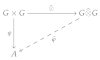
Note the universal property of complete abelian tensor products in §5.5 of [2]. It is also useful to compare Lemma 5.5.1, Lemma 5.5.2 and Proposition 5.4 of [2] with Theorems 2.1 and 3.1 of [6], in order to understand how we generalize the results on complete abelian tensor squares of profinite groups to complete nonabelian tensor squares of profinite groups. We now begin with the proof of our first main result.
Proof of Theorem 1.
First of all, we note that is a profinite space since we have
If is a continuous crossed pairing of pro-p-groups, then the universal property defining implies that there is a continuous homomorphism , which is unique in making commutative the following diagram:
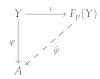 Here, is the embedding of Y into . Let K be the smallest closed normal subgroup of that is topologically generated by the elements
for all . Since is a crossed pairing,
We also have for the same reason
Therefore, and is a continuous homomorphism of pro-p-groups vanishing on the topological generators of K. Now, is the quotient homomorphism, hence a surjective continuous homomorphism of pro-p-groups, and we may consider the composition . In this situation, there is a continuous homomorphism of pro-p-groups , which is unique in making commutative the following diagram
Here, is the embedding of Y into . Let K be the smallest closed normal subgroup of that is topologically generated by the elements
for all . Since is a crossed pairing,
We also have for the same reason
Therefore, and is a continuous homomorphism of pro-p-groups vanishing on the topological generators of K. Now, is the quotient homomorphism, hence a surjective continuous homomorphism of pro-p-groups, and we may consider the composition . In this situation, there is a continuous homomorphism of pro-p-groups , which is unique in making commutative the following diagram
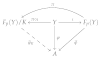
Setting and , Definition 2 is satisfied by the left portion of the diagram above. Of course, we may repeat the proof taking any pro-p-group which is topologically isomorphic to and we reach the same conclusions. The first part of Theorem 1 follows.
Concerning the remaining part of the theorem, we shall note that is a pro-p-group and by a result of Alexandroff in Lemma A4.31 of [1], so it is a dyadic space, whenever it is metrizable. □
From Theorem A4.16 of [1], it can be useful to mention that first countable pro-p-groups are always metrizable. This happens for instance when pro-p-groups are topologically finitely generated. Therefore, one could also note from the proof above that if G is topologically finitely generated, then so is and in this situation automatically is metrizable, hence a dyadic space.
3. Some Observations on the Schur Multipliers
In the present section we report some results on the exterior degree in [2,7,9] but also some results of homological algebra in [1,2,16]. Here, denotes the closure of the
While in general is a closed subgroup of a pro-p-group G, it can easily be seen that this is not the case for , and so we need to consider if we want to preserve both its algebraic and topological structure in a pro-p-group, see [1].
Definition 3
(See [6,16]). The Schur multiplier of a pro-p-group G is defined to be the second homology group with coefficients in the ring of the p-adic integers.
The above notion is largely used in [7,16,17,18] but it is useful to recall how Definition 3 should be interpreted in case of a finite p-group. For instance, we may consider a pro-p-group on a countable set of indices, that is, with each finite p-group. The situation does not change if and J is an arbitrary set of indices, but take J being countable as a temporary assumption.
From Proposition 6.5.7 of [2], there is a continuous homomorphism of pro-p-groups such that
where denotes the cyclic group of order as per Example 1.28 (i) of [1]. Let us carefully examine the construction of the above homology groups with coefficients in . Consider a free homogeneous Bar resolution (with each free profinite -modules on the profinite space ) according to §6.2 in [2]
where is the boundary map defined by
and is the augmentation map defined by
Both (23) and (24) are continuous homomorphisms of pro-p-groups. Now, G is a pro-p-group, is a commutative pro-p-ring and we may consider B which is a pro-p right -module, that is, a pro-p-module on the complete group algebra . See §5.1, §5.2 and §5.3 of [2] for definitions and details. In this situation, is the n-th left derived functor of the complete abelian tensor product, , as noted in [2] (§6.3), and so we have
Since , we may use the symbol in (23) also in (25), because it is induced by (23). In particular, can be regarded as a pro-p-module on and so we have
A careful examination of §6.8 of [2] suggests that we have a short exact sequence
where p denotes the multiplication by p in and q the limit map from to arising from the structure of the projective limit of , and so there is a long exact sequence of abelian pro-p-groups
where and are induced by p, and by q, and and are connecting continuous homomorphisms. Since is a monomorphism, we have
and so (28) becomes
On the other hand, Lemma 6.8.6 of [2] allows us to conclude that and ; hence, (23) becomes (up to isomorphisms of abelian pro-p-groups) the following long exact sequence of abelian pro-p-groups
We make two observations on the basis of the homological algebra, which was used.
Remark 1.
Assume we start with finite p-group, that is, in the projective limit describing G. Then, there is a presentation for with F a free abstract group and R a normal subgroup of F. Applying Theorem 9.5.10 of [16], we obtain the isomorphism of finite abelian p-groups
where denotes the subgroup of p-powers of F, the commutator subgroup of F and . In particular, the long exact sequence (31) becomes in this situation
so we may concretely visualize Definition 3 in the case of finite p-groups.
Note that (32) modifies the Hopf’s Formula for the Schur multiplier, which is available in Theorem 9.5.6 of [16] and usually formulated as
when is an arbitrary abstract group with presentation , so not necessarily a finite p-group. Now, we make our second observation as a further description of Definition 3.
Remark 2.
Comparing (34) with (32), we note that the terms and are significant in the case of finite p-groups and this justifies the construction of , which is designed for infinite pro-p-groups as large projective limits of finite p-groups. The temporary assumption of working with J countable facilitates the understanding of the functorial behavior in (21), where preserves the structure of projective limit. This relevant observation and general versions of Hopf’s Formula such as (32) allow us to consider as a projective limit of smaller homology groups when m tends to infinity. The reader can find in [19] details of a categorical nature on Hopf Formulas.
Now we remove the temporary assumption to have a countable J and consider a pro-p-group G which is a projective limit of with an arbitrary set J of indices. Note that Theorem 1 involves the nonabelian tensor square of an arbitrary pro-p-group G and one has the following maps
which are continuous surjective homomorphisms of pro-p-groups such that
We give a proof of the following result for convenience of the reader.
Lemma 1.
In a pro-p-group G, the maps and in (35) are continuous surjective homomorphisms of pro-p-groups and the following diagram has rows which are central extensions of pro-p-groups
Moreover, we have and there is a continuous isomorphism of pro-p-groups such that .
Proof.
From Definition 2, there are continuous crossed pairings and of pro-p-groups, inducing the map , which is a continuous crossed pairing such that and the upper part of the following diagram is commutative
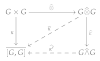 This shows that is a continuous homomorphism of pro-p-groups. Note that is surjective, because and is surjective by construction. Concerning , we look at the lower part of the same diagram, where is the natural projection of onto with . Then, is induced by modulo and is a continuous homomorphism of pro-p-groups such that . Of course, and, if , then for all we have
showing that . Note that more generally the same argument applies to any element , in fact
hence, . We may conclude that both the sequence
and the sequence
are short exact sequences, which describe central extensions of pro-p-groups. Considering the restriction of to we may conclude that
is a commutative diagram whose rows are central extensions of pro-p-groups. It remains to show that is isomorphic as a pro-p-group to . This is proved in [6] (Proposition 2.2), so we omit the details here. The result follows. □
This shows that is a continuous homomorphism of pro-p-groups. Note that is surjective, because and is surjective by construction. Concerning , we look at the lower part of the same diagram, where is the natural projection of onto with . Then, is induced by modulo and is a continuous homomorphism of pro-p-groups such that . Of course, and, if , then for all we have
showing that . Note that more generally the same argument applies to any element , in fact
hence, . We may conclude that both the sequence
and the sequence
are short exact sequences, which describe central extensions of pro-p-groups. Considering the restriction of to we may conclude that
is a commutative diagram whose rows are central extensions of pro-p-groups. It remains to show that is isomorphic as a pro-p-group to . This is proved in [6] (Proposition 2.2), so we omit the details here. The result follows. □
Even if in principle may be a proper subgroup of , the computations show that most of the time in case of finite groups (see [3,4]) and so (37) becomes most of the time
where embeds into and is induced by and by . Of course, if , then and , so we have inclusions and lose the exactness of the sequences, that is, the diagram (44) is no longer formed by central extensions as rows but it is still (44) a commutative diagram.
Remark 3.
In a finite p-group G, the quotient is isomorphic to a subgroup of the abelian group by the results in [7,10]. In particular, groups with have for all and as well.
We recall that the of a pro-p-group G is defined by the formula
where is the Haar measure on G. This notion has been studied extensively in [20,21,22,23] both in the finite case and in the infinite case. Of course, (45) represents for finite groups the probability that a randomly picked pair of elements of commutes, that is, satisfies the condition . Following the same notion at the level of elements for the operator of exterior degree, instead of commutator, we find the probability that the same randomly picked pair of elements of satisfies (instead of ). The two notions are related by the following result:
Lemma 2
(See [7], Theorem 1.1). A pro-p-group G satisfies the following inequality
Furthermore, if is finite, then
It is also useful to mention that the abelian pro-p-group can be embedded in the abelian pro-p-group , involving some numerical invariants such as the rank of a pro-p-group G
where is the minimal number of elements which topologically generate H. If G is a torsion-free pro-p-group, is called the torsion-free rank, see [17].
Lemma 3
(See [7], Theorem 1.2). Let G be a pro-p-group such that , and .
- (i).
- If is finite, then divides .
- (ii).
- If is infinite, then . In particular, if is torsion-free, then .
Now, we recall a characterization for the extremal cases of exterior degree equal to zero, or equal to one, via the notions of the complete exterior center and complete exterior centralizer.
Lemma 4
(See [7], Proposition 3.3). A pro-p-group G has if and only if .
We report a result similar to that of Abdollahi and others [15] for compact groups. This was at the origin of our investigations.
Lemma 5
(See [15], Theorem 1.1). In a pro-p-group G of there exists a finite p-group H such that is proportional to via a constant depending only on the -center of G. In particular,
We note explicitly that the formulation above is designed for our present context. It is also useful to collect some bounds, which can be obtained in terms of subgroups and quotients.
Lemma 6
(See [7], Proposition 3.6 and Corollary 5.3). Assume that G is a pro-p-group.
- (i).
- If N is a closed normal subgroup of G, then and the equality holds if ;
- (ii).
- If G is abelian nonprocyclic, thenand the equality holds if and only if is p-elementary abelian of rank two;
- (iii).
- If G is nonabelian and is a proper subgroup of , then
While the upper bounds on are useful to measure how far we are from the extremal case in , the lower bounds on may reveal the presence of quotients, which are small enough.
Remark 4.
From Lemma 2, a pro-p-group G always has , and, if is finite, is finite and , then is nontrivially bounded from below. Note that nontrivial lower bounds for imply that G is virtually abelian by [22].
4. Proofs of the Main Theorems
With the results of the previous section at hand, we show Theorem 2.
Proof of Theorem 2.
(i). The normalized Haar measure on the pro-p-group G is a left invariant Borel probability measure which respects the closed subgroups of G (see [22] for terminology); hence, for any closed subgroup M of G and , we have
Consider
We have from (47) that iff has p-power index in G, that is, iff has infinite index in G iff . Since is a nonnegative normalized Haar measure on G, we have
iff for all iff there are no elements in the interior , i.e., but we know that (any set so in particular) is open iff . This cannot happen since and . Therefore, happens iff iff is not open.
(ii). Assume that G is procyclic. If or , then is trivial. Hence, by Lemma 3 and so is abelian. The bounds of Lemma 2 imply . Conversely, assume that G is a pro-p-group with . From Lemma 4, if and only if . Hence, G is abelian. Therefore, we are assuming that G is an abelian pro-p-group of . Either G is procyclic or G is nonprocyclic. In the first case, the result follows. In the second case, Lemma 6 (ii) implies , which is a contradiction. Then, G must be necessarily procyclic.
(iii). Of course, . From (ii) above iff G is nonprocyclic. On the other hand, (i) above shows that iff . Since and is open in G, we have hence . This implies that . Therefore, a nonprocyclic pro-p-group G with open in G automatically has and we may proceed with the proof of the formula for the computation of the complete exterior degree. Consider Lemma 6 (i) and that is also closed in G by Proposition A4.25 (ii) of [1] (in fact any open subgroup is closed). It follows that is a finite p-group but also that
where the last equality is due to [10] (Lemma 2.2). □
Now, we proceed to prove another main result.
Proof of Theorem 3.
From Lemmas 2 and 3 we have and . Moreover, for all in this situation; hence, . From Lemma 5, we have a finite p-group H such that , that is, . □
As evidence of Theorem 2, we present the following construction.
Example 1.
The present example appears in [9], so we report the main information only and a few new computations. Consider the elementary abelian p-group
of countable rank, where is cyclic of order p and . Then, consider
elementary abelian p-subgroup of rank n of A. We have that
Note that the complete exterior degree of abelian pro-p-groups is also described by Lemma 6 (ii). In fact, Theorem 2 shows that computations such as those in Lemma 6 are in general tedious, so that formulas of reduction are very useful. In addition to Example 1, we mention below a pro-p-group, whose structure is described in [17].
Example 2.
Consider the infinite pro-2-group (with arbitrary)
which appears also in §1 of [18]. We have and so , but also and for all .
The following computations were carried out in Example 5.2 of [7] and are presented here for the convenience of the reader. First of all, we note that for we have but, for all , and for all i and instead .
If , then
Theorem 2 cannot be used here and is closed and open in G.
Author Contributions
Methodology, B.G.R. and F.G.R.; Investigation, B.G.R. and F.G.R. All authors have read and agreed to the published version of the manuscript.
Funding
This research received no external funding.
Data Availability Statement
No new data were created or analyzed in this study. Data sharing is not applicable to this article.
Conflicts of Interest
The authors declare no conflicts of interest.
References
- Hofmann, K.H.; Morris, S. The Structure of Compact Groups; de Gruyter: Berlin, Germany, 2006. [Google Scholar]
- Ribes, L.; Zalesski, P. Profinite Groups; Springer: Berlin, Germany, 2009. [Google Scholar]
- Brown, R.; Johnson, D.L.; Robertson, E.F. Some computations of non–abelian tensor products of groups. J. Algebra 1987, 111, 177–202. [Google Scholar] [CrossRef]
- Brown, R.; Loday, J.-L. Van Kampen theorems for diagrams of spaces. Topology 1987, 26, 311–335. [Google Scholar] [CrossRef]
- Sipacheva, O. The topology of free topological groups. J. Math. Sci. 2005, 131, 5765–5838. [Google Scholar] [CrossRef]
- Moravec, P. On the Schur multipliers of finite p-groups of given coclass. Israel J. Math. 2011, 185, 189–205. [Google Scholar] [CrossRef]
- Rezaei, R.; Russo, F.G. Commuting elements with respect to the operator ∧ in infinite groups. Bull. Korean Math. Soc. 2016, 53, 1353–1362. [Google Scholar] [CrossRef]
- Ramabulana, M.; Russo, F.G. Nonabelian tensor squares of compact groups via quotients of free compact groups. J. Lie Theory 2024, 34, 1–16. [Google Scholar]
- Erwin, D.; Russo, F.G. The influence of the complete nonexterior square graph on some infinite groups. Lith. Math. J. 2016, 56, 492–502. [Google Scholar] [CrossRef]
- Niroomand, P.; Rezaei, R. On the exterior degree of finite groups. Comm. Algebra 2011, 39, 335–343. [Google Scholar] [CrossRef]
- Niroomand, P.; Rezaei, R.; Russo, F.G. Commuting powers and exterior degree of finite groups. J. Korean Math. Soc. 2012, 49, 855–865. [Google Scholar] [CrossRef][Green Version]
- Rodrigues, B.G.; Russo, F.G. Numerical bounds for the exterior degree of finite simple groups. Comm. Algebra 2021, 49, 2707–2721. [Google Scholar] [CrossRef]
- Robinson, D.J. An Introduction to the Theory of Groups; Springer: Berlin, Germany, 1981. [Google Scholar]
- Herfort, W.; Hofmann, K.H.; Russo, F.G. Periodic Locally Compact Groups; de Gruyter: Berlin, Germany, 2018. [Google Scholar]
- Abdollahi, A.; Soleimani Malekan, M. Commuting probability of compact groups. Bull. Austral. Math. Soc. 2022, 105, 87–91. [Google Scholar] [CrossRef]
- Leedham-Green, C.R.; McKay, S. The Structure of Groups of Prime Power Order; Oxford University Press: Oxford, UK, 2002. [Google Scholar]
- Eick, B. Schur multiplicators of infinite pro-p-groups with finite coclass. Israel J. Math. 2008, 166, 147–156. [Google Scholar] [CrossRef]
- Eick, B. Schur multiplicators of finite p-groups with fixed coclass. Israel J. Math. 2008, 166, 157–166. [Google Scholar] [CrossRef]
- Everaert, T.; Gran, M.; van der Linden, T. Higher Hopf formulae for homology via Galois theory. Adv. Math. 2008, 217, 2231–2267. [Google Scholar] [CrossRef][Green Version]
- Erfanian, A.; Lescot, P.; Rezaei, R. On the relative commutativity degree of a subgroup of a finite group. Comm. Algebra 2007, 35, 4183–4197. [Google Scholar] [CrossRef]
- Guralnick, R.M.; Robinson, G.R. On the commuting probability in finite groups. J. Algebra 2006, 300, 509–528. [Google Scholar] [CrossRef]
- Hofmann, K.H.; Russo, F.G. The probability that x and y commute in a compact group. Math. Proc. Cambridge Phil. Soc. 2012, 153, 557–571. [Google Scholar] [CrossRef]
- Lescot, P. Isoclinism classes and commutativity degrees of finite groups. J. Algebra 1995, 177, 847–869. [Google Scholar] [CrossRef]
Disclaimer/Publisher’s Note: The statements, opinions and data contained in all publications are solely those of the individual author(s) and contributor(s) and not of MDPI and/or the editor(s). MDPI and/or the editor(s) disclaim responsibility for any injury to people or property resulting from any ideas, methods, instructions or products referred to in the content. |
© 2024 by the authors. Licensee MDPI, Basel, Switzerland. This article is an open access article distributed under the terms and conditions of the Creative Commons Attribution (CC BY) license (https://creativecommons.org/licenses/by/4.0/).