


Abstract
This study presents a comprehensive analysis of the semilocal convergence properties of a high-order iterative scheme designed to solve nonlinear equations in Banach spaces. The investigation is carried out under the assumption that the first derivative of the associated nonlinear operator adheres to a generalized Lipschitz-type condition, which broadens the applicability of the convergence analysis. Furthermore, the research demonstrates that, under an additional mild assumption, the proposed scheme achieves a remarkable ninth-order rate of convergence. This high-order convergence result significantly contributes to the theoretical understanding of iterative schemes in infinite-dimensional settings. Beyond the theoretical implications, the results also have practical relevance, particularly in the context of solving complex systems of equations and integral equations that frequently arise in applied mathematics, physics, and engineering disciplines. Overall, the findings provide valuable insights into the behavior and efficiency of advanced iterative schemes in Banach space frameworks. The comparative analysis with existing schemes also demonstrates that the ninth-order iterative scheme achieves faster convergence in most cases, particularly for smaller radii.
Keywords:
semilocal convergence; majorizing sequence; banach space; Fréchet derivative; bounded linear operator MSC:
65G99; 65H10; 65J15; 65Y20; 47J25
1. Introduction
Many systems and processes in applied mathematics, biological sciences, and engineering exhibit nonlinear behaviors, necessitating efficient numerical schemes that offer high accuracy and manageable computational cost as described in [1,2,3]. While existing numerical schemes address this need, there is still ample opportunity for advancements in numerical analysis. The importance of solving nonlinear equations extends beyond theoretical mathematics because discretizing many ordinary, partial, integral, and integro-differential equations results in nonlinear systems requiring numerical solutions [4,5,6,7,8]. Indeed, nonlinear models are prevalent not only in academic research and physical industries, but also in medical sciences and various real-world applications, including GPS triangulation, combustion, heat transfer, and fluid flow [9,10].
A nonlinear equation, or system of them, mathematically describes the relationship between variables in a problem, based on a specific model and its assumptions. This relationship is commonly represented as:
where represent a nonlinear mapping, where B and are Banach spaces and is a non-empty, open, convex subset of B. Obtaining exact, closed-form, or analytical solutions for these nonlinear systems is typically a challenge. However, iterative schemes based on fixed point theory offer approximate numerical solutions that achieve a specified accuracy level, as documented in [11,12]. As a result, a diverse range of iterative techniques have been established, and their convergence properties have been rigorously investigated within the Banach spaces. A common approach for estimating the convergence order of these schemes relies on Taylor series expansions, which require assumptions about the existence and boundedness of higher-order derivatives . One such three-step scheme has recently been proposed in [13], having ninth-order convergence:
where . Since many iterative schemes utilize only first-order derivatives, these higher-order assumptions can be restrictive and inapplicable in some cases.
The convergence of an iterative scheme hinges on the initial approximation, particularly how close it is to the true solution, regardless of the scheme’s theoretical order of convergence. Iterative schemes that exhibit local convergence require that the initial approximation be sufficiently near the solution; conversely, globally convergent schemes are largely independent of the initial guess. Much recent work has focused on local convergence, with analysts often using only first-order derivative assumptions to avoid Taylor expansions. Convergence analyzes based on the local and semi-local Banach space are valuable tools for investigating these schemes [14,15,16].
It is worth noting that the study of iterative methods is conducted mainly in two cases: First in the local convergence analysis where conditions about a neighborhood of the solution are found ensuring the convergence of the sequence generated by the method. Secondly, in the semilocal analysis of convergence, the conditions depend on the initial point.
In both cases a radius of convergence is found based on the initial information; uniqueness of the solution domains as well as error distances of the form and . This research paper is structured as follows: Section 2 discusses the main findings including local and semilocal analysis for the convergence of the chosen iterative scheme while Section 3 uses such analyses to solve some numerical problems. At the end, Section 4 briefly shows conclusion of the major contributions in the paper and suggests future research directions.
2. Convergence Without Taylor’s Approach
Local analysis leverages information in the vicinity of a solution to determine the bounds of the convergence region, estimate iteration errors, and establish conditions for the uniqueness of the solution within a specified area. In contrast, semi-local analysis centers on the convergence of an iterative scheme from a given starting point, using majorizing sequences to guarantee convergence of the iterates. The following points highlight:
- (i)
- Local analysis necessitates knowledge of the solution, while semilocal analysis requires knowledge of the starting point.
- (ii)
- To understand convergence behavior, establishing local convergence results is crucial, as they reveal the sensitivity in selecting initial guesses. Semilocal results demand a sufficiently accurate initial guess to ensure the iterative sequence converges to the correct solution.
Using the Taylor’s expansion in [13], the authors proved, via the following Theorem, the ninth-order convergence of their proposed iterative scheme given in (2).
Theorem 1.
Let be a simple root of the differentiable function , where D is an open interval. Then, the three-step iterative scheme defined in Equation (2) exhibits ninth-order convergence, with its asymptotic error term given by:
where shows the error at the nth iteration.
There are certain limitations (as given below) if the Taylor series is used to prove the convergence of the iterative scheme (2) or (4):
- The function must be at least four times differentiable (see Theorem 1).For example, suppose , and . Define on bywhere andNotice that , since , but is not continuous at .
- There are no a priori upper estimates on the norms Consequently, we do not know in advance about the number of iterations to be carried out to reach a predetermined error tolerance.
- There is no information about a neighborhood in that contains only one solution.
- The more challenging semilocal analysis of convergence for scheme (4) has not been studied before.
- Can this scheme be applied to more general domains than ?
We respond positively to the limitations –. In particular,
- The local analysis uses only conditions in the function that appear only in the scheme (2). Thus, the example in can be handled under this approach.
- The number of iterations to be performed to achieve a predecided error tolerance is known in advance, since upper error bounds on are developed under the present approach.
- Isolation results for the solution become available.
- The scheme is applicable on E, where or (the complex plane).
- A semilocal analysis of convergence for the scheme (4) is presented depending on majorizing sequences.
Note that both types of analysis are based on the concept of generalized continuity for . Based on the aforementioned comments, and to emphasize that we work in a more general setting, we consider the differentiable function and the equation.
Keeping these points in mind, we will investigate the local and semilocal convergence of the ninth-order iterative scheme proposed in [13].
The three-step scheme (2) is can be also written for and each by
2.1. (LAC) Local Analysis of Convergence
It is convenient to use some abbreviations such as:
- FNDC: A function which is nondecreasing and continuous.
- MPZF: The minimal positive zero of a function.
Let ,
Suppose:
- ()
- There exists FNDC such that has MPZF which is denoted by . Define the interval .
- ()
- There exist FNDC functions and .Define the functions for some byand
- ()
- The function has MPZF in , which is denoted by . Define the interval , where .
- ()
- The function has MPZF in the interval , which is denoted by , where ,
- ()
- The function has MPZF in the interval , which is denoted by . Define the interval . Define the functions and byandrespectively.
- ()
- The functions and have MPZF in the interval , which are denoted by and , respectively. DefineThe real number is a convergence radius for the scheme (8) (see Theorem 2). We will use the notation for some to denote an open ball. Moreover, is the notation for a closed ball.Next, we connect and to the operators on the scheme (4).
- ()
- There exist a solution of the equation and an invertible linear operator L such that for eachandDefine the region
- ()
- for eachandfor each .and
- ()
Let . Then, it follows by the conditions – that for each
and
Remark 1.
- (i)
- It is worth noting that the items – are standard sufficient convergence conditions for the study of iterative methods [15,17].In particular, the conditions – define the majorant functions , whose smallest positive zeros are always needed to define the radius of convergence of the method (see (4)). The radius of convergence defines a ball about the solution . Then, it is shown in Theorem 2 that as long as we select an initial point from that ball, the convergence of the method to is assured. Moreover, generalized continuity the conditions and needed to control the derivatives , connect and the majorizing functions ,κ and to these derivatives. Furthermore, a condition of the type is always present and defines a ball inside which the iterates lie. It is worth noting that the functions , κ and provide sharper error distances and and weaker sufficient convergence conditions than results from Lipschitz-Hölder conditions [16,18]. Finally, one can look at the first two numerical examples, where the major functions , κ and are calculated.
- (ii)
- Some choices for the operator L can be (the identity operator),or for some auxiliary point with or . The last choice for L implies that is a simple solution of the equation . But notice that no such hypothesis is made or implied by . Consequently, the new result can be applied to find solutions of multiplicity larger than one.Define the region
Next, the main LAC is presented for scheme (4).
Theorem 2.
Suppose that the conditions – hold. Then, if the starting point , all the iterates generated by the scheme (4) are well defined in , are contained in , and converge to . Moreover, the following items hold
and
Proof.
Items (15)–(17) are shown using induction. Pick . Then, by the condition , (8) and (11) one can have
In view of (18) and the Banach lemma on invertible operators [10], and
We need some estimates
where we used , , (13) and (19), so
Moreover, we have
Consequently, the iterate is well-defined due to the first substep of scheme (4) and can be expressed as:
Notice that
so by (), (),
By (18), (19), (14) (for ), and (25)–(27) estimate (22) gives
Thus, the iterate ,
the item (15) holds for and the iterates and exist by the last two substeps of the scheme (4).
Finally, for , we get from (33)
Therefore, we conclude that □
Next, a region is determined with the solution of equation
Proposition 1.
Suppose that the condition holds in for some and there exists such that
Define the region . Then, the only solution of the equation in the region is .
Proof.
Suppose that there exist such that and . Let us consider the linear operator In view of the condition and (35), we get
Therefore, . Finally, from the identity
we conclude that . □
Remark 2.
Under all the conditions –, we can take in the Proposition 1.
2.2. (SLAC) Semilocal Analysis of Convergence
The analysis is similar to LAC. But and are exchanged by and , respectively, as follows:
Suppose that:
- ()
- There exists FNDC such that the function has MPZF, which is denoted by . Define the interval .
- ()
- There exist FNDC and .Define for , some , the scale sequence by:andThe sequence denoted by will be demonstrated in Theorem (3) to be a majorizing sequence for the sequence that is generated by (4). But let us first develop a general condition for its convergence.
- ()
- There exists such that for each ,The limit point is the least upper bound of the sequence which is unique. As in the local analysis, the functions v and relate to the operators on the scheme (4).
- ()
- There exists and an invertible operator L such that for each ,andNotice that the conditions (), () (for ) and the second condition in () (for ) give as in the local caseSo, the linear operator is invertible and we can choose .
- ()
- andDefine the region and for each .
- ()
Remark 3.
As in the local case, one can choose or for some auxiliary point with or or some other choice as long as the conditions – hold.
Next, we provide the SAC for the scheme (4).
Theorem 3.
Assuming conditions through are satisfied, the iterative sequence generated by the scheme is well-defined within the ball , remains within for all , and converges to a solution of the nonlinear equation . Furthermore, the following error estimates are valid for all .
Proof.
Induction is employed to show the assertions
and
Assertion (48) holds if by (38) and the choice of , since
and the iterate .
By induction on the integer m and the first substep on the scheme (4), we can write in turn
We need the estimates
(by ()) and using the triangle inequality.
Then, by summing up (53)–(55), estimate (52) gives
Then, by the second substep of scheme (4), (54) (for ) and (56), we have
and
So, (49) holds for and the iterate .
We can write
So, the assertion (50) holds for and the iterate .
The iterate is well defined by (64) and we can write
and
By (57), (58), (63), (64), (67) and (68), the induction for assertions (48)–(50) is completed, and all iterates Notice that the sequence is Cauchy and convergent by the condition (). Thus, by(48)–(50) and
the sequence is also Cauchy in the Banach space B. Hence, there exists such that
Moreover, by letting in (66) and using the continuity of the operator , we deduce that .
If , estimate (69) and the triangle inequality give
Next, a region is specified containing only one solution of the equation .
Proposition 2.
Suppose that there exists a solution of the equation for some ; the condition holds in the ball and there exists such that
Set .
Then, the only solution of the equation in the region is .
Proof.
Suppose there exists such that and . Define the linear operator
Then, it follows by the condition and (72) that
So, the linear operator is invertible. Finally, from the identity
we conclude that . □
Remark 4.
- (i)
- The efficiency of an iterative method depends on the closeness of the starting point to the solution, i.e., on how small should be. In the condition we used this quantity to define the first nonzero number which helps generate the majorizing sequence for the sequence (see (38)). Then, in condition we determine the upper bound of this sequence by simply solving a scalar equation. Then, in the condition we provide sufficient convergence ensuring the majorizing sequence is nondecreasing. This fact together with the upper bound guarantee the convergence of the majorizing sequence and consequently that of .
- (ii)
- The limit point can be replaced in the condition by .
- (iii)
- Under all the conditions –, one can choose and in the Proposition 2.
3. Numerical Experiments
We present several numerical problems and their solutions using the iterative scheme discussed earlier. Each problem illustrates a different approach to solving nonlinear equations through the application of the proposed method. The calculations are based on different mathematical models, each demonstrating the practical application of the theory presented in the earlier sections. To compare the iterative scheme with other existing methods, we used three well-known numerical methods to solve nonlinear equations. The performance of each method was evaluated on the basis of comparison of the radii of the convergence balls. The three existing methods used for comparison are denoted by HM, PCNM, and DJNM and can be found in [10,19,20]; respectively. For the numerical experiments presented in this section, the effectiveness of the proposed ninth-order iterative scheme (4) has been evaluated by comparing its radii of convergence with existing methods for different non-linear problems.
Problem 1.
Let and . Define the mapping for as
It follows by this definition that the Jacobian is given by
Notice that by (77) and (78), solves the equation and . Moreover, the conditions hold if
and
Then, calculate the using equation (8) as
The radii of the proposed scheme (4) and the other three methods taken for comparison are given in Table 1.

Table 1.
Estimates of radii for Problem 1 using (4) and other three methods taken for comparison.
Table 1.
Estimates of radii for Problem 1 using (4) and other three methods taken for comparison.
| Radii | ||||
|---|---|---|---|---|
| Scheme (4) | 0.229452 | 0.264277 | 0.246246 | 0.21314 |
| HM [10] | 0.508853 | 0.591459 | 0.278050 | 0.278050 |
| PCNM [19] | 0.479901 | 0.479901 | 0.479869 | 0.479869 |
| DJNM [20] | 0.766228 | 0.766228 | 0.585308 | 0.585308 |
For Problem 1 (Table 1), the proposed iterative scheme (4) yielded radii values of , and , with a minimum radius of . Compared to the HM method (), and the PCNM and DJNM methods (around and , respectively), the scheme (4) demonstrated competitive performance, with smaller radii indicating potentially faster convergence.
Problem 2.
Let and . Let be a Hammerstein operator. We study the nonlinear integral equation of the first kind associated with , where is defined by
The calculation for the derivative gives
for . By this value of the operator , the conditions – are verified so that we choose
In Table 2, we present the radii of the iterative scheme (4) and the other three methods taken for comparison for Problem 2.
Table 2.
Estimates of radii for Problem 2 using (4) and the other three methods taken for comparison.
Table 2.
Estimates of radii for Problem 2 using (4) and the other three methods taken for comparison.
| Radii | ||||
|---|---|---|---|---|
| Scheme (4) | 0.999994 | 0.563769 | 0.578072 | 0.563769 |
| HM [10] | 0.333405 | 0.436717 | 0.939975 | 0.333405 |
| PCNM [19] | 0.999997 | 0.139438 | 0.381371 | 0.139438 |
| DJNM [20] | 0.001004 | 0.001004 | 0.180887 | 0.001004 |
In Problem 2 (Table 2), the radii for the proposed scheme were , and with a minimum radius of . In contrast, the HM method had a radius of , PCNM showed a smaller radius of , and DJNM provided a radius of , suggesting that the DJNM method might offer faster convergence for this specific problem.
Problem 3.
Let and . Define the mapping for as
It follows by this definition that the Jacobian is given by
Notice that by (84) and (85), solves the equation and . Moreover, the conditions hold.
and
Calculating the using equation (8), we obtain
The radii for the iterative scheme (4) and the other three methods taken for comparison are given in Table 3 as follows.
Table 3.
Estimates of radii for Problem 3 using (4) and the other three methods taken for comparison.
Table 3.
Estimates of radii for Problem 3 using (4) and the other three methods taken for comparison.
| Radii | ||||
|---|---|---|---|---|
| Scheme (4) | 0.001006 | 0.682127 | 0.683738 | 0.001006 |
| HM [10] | 0.001006 | 0.776006 | 0.824589 | 0.001006 |
| PCNM [19] | 0.666666 | 0.666668 | 0.605945 | 0.605945 |
| DJNM [20] | 0.001004 | 0.001005 | 0.780583 | 0.001004 |
For Problem 3 (Table 3), the radii for the iterative scheme (4) were , and , with a minimum radius of , indicating excellent performance and high efficiency in solving the nonlinear system in Problem 3. The HM method yielded , PCNM had , and DJNM was similar to HM with . Overall, the proposed iterative scheme (4) achieved smaller radii of convergence in Problems 1 and 3, suggesting its potential to outperform other methods when smaller radii are crucial. However, for certain cases such as Problem 2, the DJNM method appeared to provide faster convergence, highlighting that the optimal method may be context-dependent based on the specific characteristics of the problem.
Problem 4.
Consider the problem where , and let . We define a logarithmic operator as follows:
and consider the nonlinear system . Setting and using an initial guess of , the application of scheme (4) converges to the solution in three iterations.
Problem 5.
Let , where is a natural integer. Both X and Y are equipped with the norm , and for a matrix A, we define .
Consider the two-point boundary value problem:
on the interval , subject to the boundary conditions:
To discretize this equation, we divide the interval into m equal parts, each of length , and define the coordinates of the points as for . A second-order finite difference discretization of Equation (90) leads to the following system of nonlinear equations:
where . The Frechet derivative of this system is given by:
Let , , and . To solve the system (Steps 1, 2, and 3 in the iterative scheme), the MATLAB R2024b routine linsolve, which uses LU factorization with partial pivoting, is employed. Figure 1 plots the numerical solution.
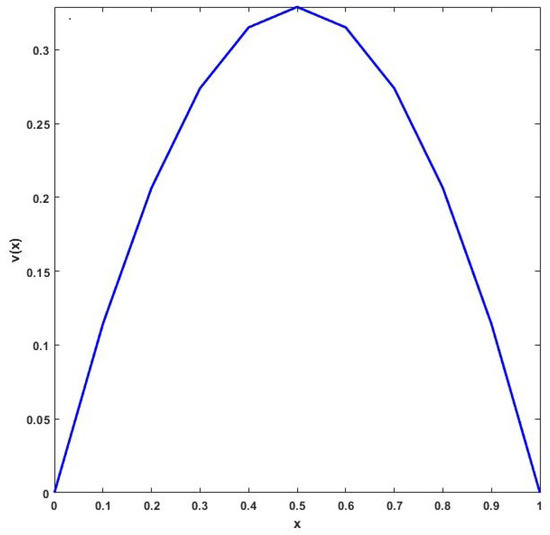
Figure 1.
Solution for the Bratu’s Problem 5.
4. Conclusions and Future Remarks
A comprehensive investigation of the abstract convergence analysis of a ninth-order iterative scheme is presented within the framework of Banach spaces. Unlike traditional approaches relying on Taylor series expansions, this study establishes generalized convergence criteria using only first-order derivatives. This operator-based analysis provides a novel perspective on the convergence behavior of iterative processes. By avoiding the use of higher-order derivatives, which may not exist or be readily available, this methodology overcomes limitations of previous research, thereby expanding the applicability of the scheme beyond conditions stipulated by earlier findings. The theoretical analysis is substantiated through numerical examples. Importantly, the analytical techniques employed can be adapted and applied to other iterative schemes, enhancing their versatility. Future research may extend the proposed ninth-order scheme to systems of nonlinear equations and explore its performance under weaker smoothness assumptions. Further research into its behavior in infinite-dimensional Banach spaces, as well as its resilience to noisy or inexact data, is needed to improve its practical application. Our technique shall be employed to extend other iterative schemes in future works [9,11,12,14,15,16,21,22].
Author Contributions
I.K.A.: Conceptualization, Formal Analysis, Writing—original draft; S.Q.: Writing—original draft, Investigation, Methodology, Software; A.S.: Formal analysis, Software, Validation, Visualization; M.A.: Writing—review & editing, Supervision and Funding acquisition. A.P.: Writing—review & editing, Supervision. M.I.A.: Methodology, Investigation, Supervision. All authors have read and agreed to the published version of the manuscript.
Funding
This work was supported by the Deanship of Scientific Research, Vice Presidency for Graduate Studies and Scientific Research, King Faisal University, Saudi Arabia [Grant No. KFU251813].
Institutional Review Board Statement
Not applicable.
Informed Consent Statement
Not applicable.
Data Availability Statement
Data are contained within the article.
Conflicts of Interest
The authors declare no conflict of interest. The funders had no role in the design of the study; in the collection, analyses, or interpretation of data; in the writing of the manuscript; or in the decision to publish the results.
References
- Ramos, H.; Monteiro, M.T.T. A new approach based on the Newton’s method to solve systems of nonlinear equations. J. Comput. Appl. Math. 2017, 318, 3–13. [Google Scholar] [CrossRef]
- Naseem, A.; Rehman, M.; Abdeljawad, T. A novel root-finding algorithm with engineering applications and its dynamics via computer technology. IEEE Access 2022, 10, 19677–19684. [Google Scholar] [CrossRef]
- Ramos, H.; Vigo-Aguiar, J. The application of Newton’s method in vector form for solving nonlinear scalar equations where the classical Newton method fails. J. Comput. Appl. Math. 2015, 275, 228–237. [Google Scholar] [CrossRef]
- Wang, X.; Sun, M. A new family of fourth-order Ostrowski-type iterative methods for solving nonlinear systems. AIMS Math. 2024, 9, 10255–10266. [Google Scholar] [CrossRef]
- Liu, T.; Xue, R. A convergent multi-step efficient iteration method to solve nonlinear equation systems. J. Appl. Math. Comput. 2024, 1–18. [Google Scholar] [CrossRef]
- Kansal, M.; Cordero, A.; Bhalla, S.; Torregrosa, J.R. New fourth-and sixth-order classes of iterative methods for solving systems of nonlinear equations and their stability analysis. Numer. Algorithms 2021, 87, 1017–1060. [Google Scholar] [CrossRef]
- Cordero, A.; Gómez, E.; Torregrosa, J.R. Efficient high-order iterative methods for solving nonlinear systems and their application on heat conduction problems. Complexity 2017, 2017, 6457532. [Google Scholar] [CrossRef]
- Sharma, J.R.; Sharma, R.; Kalra, N. A novel family of composite Newton–Traub methods for solving systems of nonlinear equations. Appl. Math. Comput. 2015, 269, 520–535. [Google Scholar] [CrossRef]
- Rouzbar, R.; Eyi, S. Reacting flow analysis of a cavity-based scramjet combustor using a Jacobian-free Newton–Krylov method. Aeronaut. J. 2018, 122, 1884–1915. [Google Scholar] [CrossRef]
- Argyros, I.K.; Gdawiec, K.; Qureshi, S.; Soomro, A.; Hincal, E.; Regmi, S. Local and semi-local convergence and dynamic analysis of a time-efficient nonlinear technique. Appl. Numer. Math. 2024, 201, 446–464. [Google Scholar] [CrossRef]
- Debnath, P.; Srivastava, H.; Kumam, P.; Hazarika, B. Fixed Point Theory and Fractional Calculus; Springer: Berlin/Heidelberg, Germany, 2022. [Google Scholar]
- Kirk, W.; Shahzad, N. Fixed Point Theory in Distance Spaces; Springer: Berlin/Heidelberg, Germany, 2014. [Google Scholar] [CrossRef]
- Qureshi, S.; Ramos, H.; Soomro, A.K. A New Nonlinear Ninth-Order Root-Finding Method with Error Analysis and Basins of Attraction. Mathematics 2021, 9, 1996. [Google Scholar] [CrossRef]
- Cordero, A.; Ezquerro, J.; Hernández-Verón, M.; Torregrosa, J. On the local convergence of a fifth-order iterative method in Banach spaces. Appl. Math. Comput. 2014, 251, 396–403. [Google Scholar] [CrossRef]
- Hernández-Verón, M.A.; Martínez, E.; Teruel, C. Semilocal convergence of a k-step iterative process and its application for solving a special kind of conservative problems. Numer. Algorithms 2016, 76, 309–331. [Google Scholar] [CrossRef]
- Liu, T.; Qin, X.; Wang, P. Local Convergence of a Family of Iterative Methods with Sixth and Seventh Order Convergence Under Weak Conditions. Int. J. Comput. Methods 2018, 16, 1850120. [Google Scholar] [CrossRef]
- Martínez, E.; Ledesma, A. Local Convergence Study for an Iterative Scheme with a High Order of Convergence. Algorithms 2024, 17, 481. [Google Scholar] [CrossRef]
- Yadav, S.; Singh, S.; Badoni, R.; Kumar, A.; Singh, M. Semilocal convergence of Chebyshev Kurchatov type methods for non-differentiable operators. Comput. Math. Appl. 2024, 170, 275–281. [Google Scholar] [CrossRef]
- Almutairi, D.K.; Argyros, I.K.; Gdawiec, K.; Qureshi, S.; Soomro, A.; Jamali, K.H.; Alquran, M.; Tassaddiq, A. Algorithms of predictor-corrector type with convergence and stability analysis for solving nonlinear systems. AIMS Math. 2024, 9, 32014–32044. [Google Scholar] [CrossRef]
- Qureshi, S.; Argyros, I.K.; Jafari, H.; Soomro, A.; Gdawiec, K. A highly accurate family of stable and convergent numerical solvers based on Daftardar–Gejji and Jafari decomposition technique for systems of nonlinear equations. MethodsX 2024, 13, 102865. [Google Scholar] [CrossRef] [PubMed]
- Ferreira, O.P.; Gonçalves, M.L.N.; Oliveira, P.R. Convergence of the Gauss–Newton Method for Convex Composite Optimization under a Majorant Condition. SIAM J. Optim. 2013, 23, 1757–1783. [Google Scholar] [CrossRef]
- Ferreira, O. A robust semi-local convergence analysis of Newton’s method for cone inclusion problems in Banach spaces under affine invariant majorant condition. J. Comput. Appl. Math. 2014, 279, 318–335. [Google Scholar] [CrossRef]
Disclaimer/Publisher’s Note: The statements, opinions and data contained in all publications are solely those of the individual author(s) and contributor(s) and not of MDPI and/or the editor(s). MDPI and/or the editor(s) disclaim responsibility for any injury to people or property resulting from any ideas, methods, instructions or products referred to in the content. |
© 2025 by the authors. Licensee MDPI, Basel, Switzerland. This article is an open access article distributed under the terms and conditions of the Creative Commons Attribution (CC BY) license (https://creativecommons.org/licenses/by/4.0/).