


Abstract
Let X be a partitioned matrix and let B its equitable quotient matrix. Consider a simple, undirected, connected graph G of order n. In this paper, we employ a technique based on quotient matrices derived from block-partitioned structures to establish new spectral results for the reciprocal distance signless Laplacian matrix. In particular, we identify a sequence of graphs whose eigenvalues are all integers. Furthermore, we introduce the concept of Harary incidence energy and extend known incidence energy results to the setting of the reciprocal distance signless Laplacian matrix. Finally, we characterize the Harary incidence energy of extremal graphs by examining vertex connectivity through the generalized graph join operation.
Keywords:
spectral radius; quotient matrix; Harary incidence energy; reciprocal distance signless Laplacian matrix MSC:
05C50; 15A18; 15A42
1. Introduction and Preliminaries
We begin by introducing the definition of an equitable quotient matrix and its associated spectral result, which will serve as a fundamental tool in the development of this work.
Definition 1
([1]). Let X be a complex matrix of order described in the following block form
where the blocks are matrices for any and . For , let denote the average row sum of , i.e., is the sum of all entries in divided by the number of rows. Then is called the quotient matrix of X. If for each pair , has a constant row sum, then is called the equitable quotient matrix of X.
Theorem 1.
([2]). Let be the equitable quotient matrix of X as defined in Definition 1. Then the spectrum of is contained in the spectrum of X.
This work is motivated by the study of the spectral properties of matrices that are naturally associated with graphs. By employing quotient matrix techniques applied to block-partitioned matrices, we derive novel spectral results for the reciprocal distance signless Laplacian matrix and investigate its associated energy.
Throughout this paper, will denote a simple, undirected, connected graph with vertex set V and edge set E. The order of the graph is defined as the cardinality of its vertex set (denoted by ), while the size of the graph refers to the cardinality of its edge set (denoted by ). The matrix denotes the adjacency matrix associated with the graph G of order n, whose eigenvalues are denoted by for all .
The distance between pairs of vertices and of G is defined as the length of the shortest path connecting and . The neighbors of a vertex , denoted by , are all the vertices in V whose distance to v is equal to 1.
The Harary matrix of a graph G of order n, also known as the reciprocal distance matrix, is a matrix of order n that was independently introduced in [3,4], and is defined as
Henceforward, we consider for .
The reciprocal distance degree of a vertex v, denoted by , is given by
We recall that a connected graph G is called a k-reciprocal distance degree regular graph if for all .
Let be the diagonal matrix whose diagonal entries are denoted by .
The Harary index of a graph G, denoted by , is defined in [3,4] as
Clearly,
In [5], the authors defined the reciprocal distance signless Laplacian matrix as
Bounds for the spectral radius of the reciprocal distance signless Laplacian matrix were established in [6,7]. Furthermore, in [8], the authors provided bounds for the reciprocal distance signless Laplacian energy and characterized the graphs that attain some of these bounds. We mention some recent works on spectral radius and energy on matrices related to the distance and reciprocal distance are as follows: in [9] the authors show that the class of the complete bipartite graphs maximize the reciprocal distance Laplacian spectral radius among all the bipartite graphs with n vertices, and they show that the star graph is the unique graph having the maximum reciprocal distance Laplacian spectral radius in the class of trees with n vertices; in [10] bounds are obtained for the spectral radius and for the energy of the degree distance matrix and in [11] the authors obtain upper bounds for the reciprocal distance Laplacian spectral radius; moreover, they characterize the extremal graphs attaining this bound.
Furthermore, is a real symmetric matrix, so we can write its eigenvalues in decreasing order
Since is a non-negative matrix, its largest eigenvalue, known as the Perron root, is denoted by . Furthermore, as is an irreducible matrix, so is a simple eigenvalue with a corresponding positive eigenvector.
Throughout this work, we adopt the following notations: indicates that is an eigenvalue with multiplicity t; is the i-th canonical vector; denotes the n-dimensional vector of ones; is the identity matrix of order n and denotes the matrix of ones. In particular, when , we simply write .
Lemma 1
([7]). A connected graph G has only two distinct reciprocal distance signless Laplacian eigenvalues if and only if G is a complete graph. In particular, the -spectrum is .
In [7], the authors established the following result.
Theorem 2.
([7]). Let G be a connected graph on n vertices and edges. Consider the connected graph obtained from G by the deletion of an edge. Let
and
be the reciprocal distance Laplacian spectra of G and , respectively. Then, for all
An immediate consequence of Theorem 2 is presented in the following result.
Corollary 1.
Let G be a connected graph on n vertices. Then
Theorem 3
([5]). Let G be a connected graph of order . Then
The equality holds if and only if G is a reciprocal distance degree regular graph.
Theorem 4
([7]). Let G be a simple connected graph, such that, for , is the reciprocal distance degree of vertex . Then
The equality holds if and only if G is a reciprocal distance degree regular graph.
2. Main Spectral Results
In this section, we present spectral results related to . Specifically, we characterize the spectrum of certain classes of graphs and investigate the spectral properties of the generalized join product of regular graphs. Using this construction, we explicitly determine the spectrum for specific graph families and, in particular, identify a sequence of graphs whose -eigenvalues are all integers.
In graph theory, a pair of vertices u and v in G are called twins if they share the same neighborhood, with identical edge weights in the case of a weighted graph. Given u and v twin vertices, if is an edge in G, they are called adjacent twins and if is not an edge in G, they are called nonadjacent twins. The concept of twins has proven to be highly valuable in the study of graph spectra.
Theorem 5.
Let G be a connected graph of order n and U be a subset of such that U is a set of nonadjacent twins, with . Then is constant for each and is an eigenvalue of with multiplicity at least .
Proof.
Without loss of generality, we can label the vertices of U as . Then for all and for all , in particular, for all . We note that for all . Let for all and let for . Then
Since are linearly independent, is an eigenvalue of with multiplicity at least . □
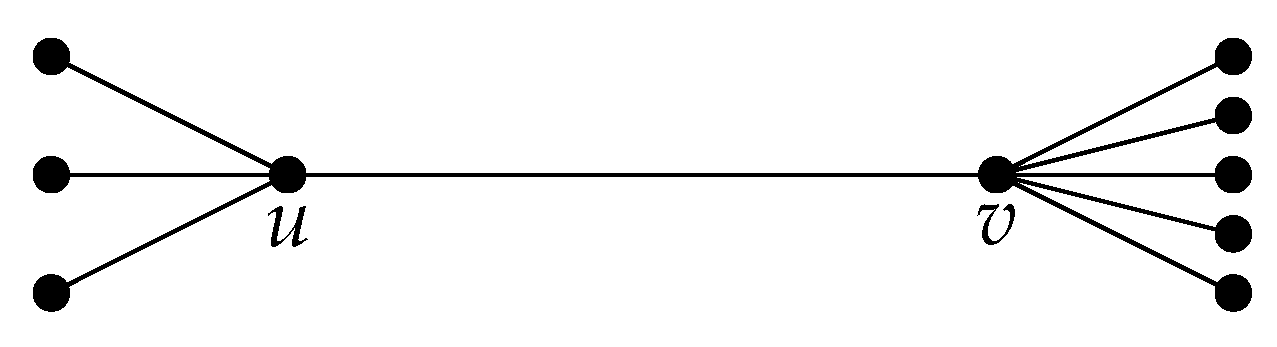
A double star graph, denoted as , is a graph formed by connecting the centers of the stars and with a single edge. We observe that all trees of diameter 3 are double star graphs (Figure 1).
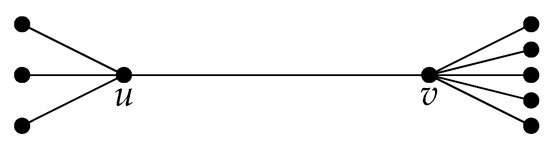
Figure 1.
The tree of diameter 3 and order .
Proposition 1.
Let be a tree of diameter 3 and order . Then the -eigenvalues are together with the eigenvalues of the matrix
Proof.
Consider the following partition of the graph
Clearly, and are independent sets to such that for any , and for any , .
We observe that for each vertex in we have that , analogously for each vertex in , . Then, using Theorem 5, we have that and are eigenvalues of with multiplicities at least and , respectively.
Let and . Then has the following block matrix form
We observe that in the above equation, each block of the matrix has a constant row sum. Then, if denoted the equitable quotient matrix of , we have
Applying Theorem 1, the eigenvalues of are eigenvalues of . Finally, replacing , , and , the matrix given in Theorem is obtained. □
A bipartite graph is defined as a graph whose vertex set can be partitioned into two disjoint and independent subsets, denoted by and , such that every edge joins a vertex of to a vertex of . A notable example of a bipartite graph is the complete bipartite graph, in which each vertex in is adjacent to every vertex in . A complete bipartite graph with and is denoted by .
The following proposition establishes the eigenvalues of a complete bipartite graph with respect to the reciprocal distance signless Laplacian matrix.
Proposition 2.
Let be a complete bipartite graph on vertices. Then the spectrum of is
Proof.
Since and are independent sets to such that for any , and for any , . Then for all we obtain that and for all vertices we have that . Now, using Theorem 5, we have that is an eigenvalue with multiplicity and is an eigenvalue with multiplicity .
Therefore, we have eigenvalues. We obtain the other two eigenvalues by applying the results of the quotient matrix given in Theorem 1. We will consider the following labeling of the vertices of : we start by labeling the a vertices of the first independent set and end with the b vertices of the second independent set. Therefore, has the following block form
Notice that the four blocks have a constant row sum. Therefore, we can obtain from the equitable quotient matrix of
Thus, the eigenvalues of this matrix are the remaining eigenvalues
□
Corollary 2.
Let be the star graph on vertices. Then the spectra of the reciprocal distance signless Laplacian matrix of is
Theorem 6.
Let G be a connected graph of order n and U be a subset of such that U is a set of adjacent twins with . Then is constant for each and is an eigenvalue of with multiplicity at least .
Proof.
Without loss of generality, we can label the vertices of U as . Then for all and for all , in particular, for all . Thus for all . Let for all and let for . Then
Since are linearly independent, is an eigenvalue of with multiplicity at least . □
A complete split graph, denoted by , is defined as a graph consisting of a clique on a vertices and an independent set on the remaining vertices, where each vertex in the clique is adjacent to every vertex in the independent set.
Proposition 3.
The eigenvalues of are
Proof.
Notice that the reciprocal degree distance of each vertex in the clique (of order a) is equal to . Applying Theorem 6, we obtain that is -eigenvalue of with multiplicity at least .
Analogously, for the independent set of order we have that Applying the Theorem 5 we obtain that is the -eigenvalue of with multiplicity at least .
Thus, we have eigenvalues of . We obtain the other two missing eigenvalues by applying the results of the quotient matrix given in Theorem 1. For this, we label the vertices of in the following order: first the a vertices that form a clique, and then the independent vertices. Therefore, has the following block form
We observe that the four blocks have a constant row sum. Therefore, the equitable quotient matrix of has the form
Thus, the eigenvalues of this matrix
are the remaining eigenvalues of . □
Finally, in this section, we extend the spectral results for the reciprocal distance signless Laplacian matrix by employing the generalized join operation of graphs.
Let and be a two-vertex disjoint graph. The join of and is the graph such that and . This join operation can be generalized as follows [12]: Let be a graph of order s. Let . Let be a set of pairwise vertex-disjoint graphs. For , the vertex is assigned to the graph . Let G be the graph obtained from the graphs and the edges connecting each vertex of with all the vertices of if and only if . That is, G is the graph with the vertex set and the edge set
This graph operation is denoted by
The labeling of the vertices of G begins with the vertices of , continuing with the vertices of and finally with the vertices of .
Let be a connected graph of order for , let be a -degree regular connected graph of order . Let be the distance between . Here, with the above-mentioned labeling, the reciprocal distance signless Laplacian matrix of the -join has the form
where
with
Notice that the matrices defined in (2) are not necessarily the reciprocal distance signless Laplacian matrices .
Thereby, using the results of the partitioned quotient matrix, we obtain the spectrum of the reciprocal distance signless Laplacian of the graph , where is a family of regular graphs.
Lemma 2.
Let be the diagonal blocks of the matrix defined in such that, for , is a -regular connected graph of order with adjacency eigenvalues . Then the spectrum of is
with .
Proof.
Since
is a non-negative matrix with constant row sum equal to , where , then
Thus, the Perron eigenvalue of is
Now, let be the orthogonal set of eigenvectors corresponding to the adjacency eigenvalues of the regular graph , , respectively. We observe that, for , and . Then
Therefore, for the spectrum of is
with . □
The following result is immediate.
Theorem 7.
Let be a connected graph of order s and where for each , is a regular graph. Then, the spectrum of is
where and is the matrix
Proof.
Let be a -regular graph such that is a set of eigenvectors corresponding to the adjacency eigenvalues . Then, using Lemma 2 we have that, for ,
Therefore, for and for ,
In the proof of Lemma 2, we mentioned that, for , the matrices have constant row sum. Thus, it is easy to see that all blocks of the matrix , given in the Equation (1), have a constant row sum. Therefore, the remaining eigenvalues of will be obtained from its quotient matrix, where the equitable quotient matrix of is
Then, applying Theorem 1, we obtain that
□
Example 1.
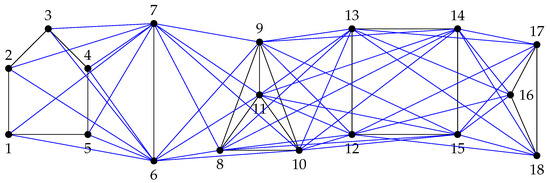
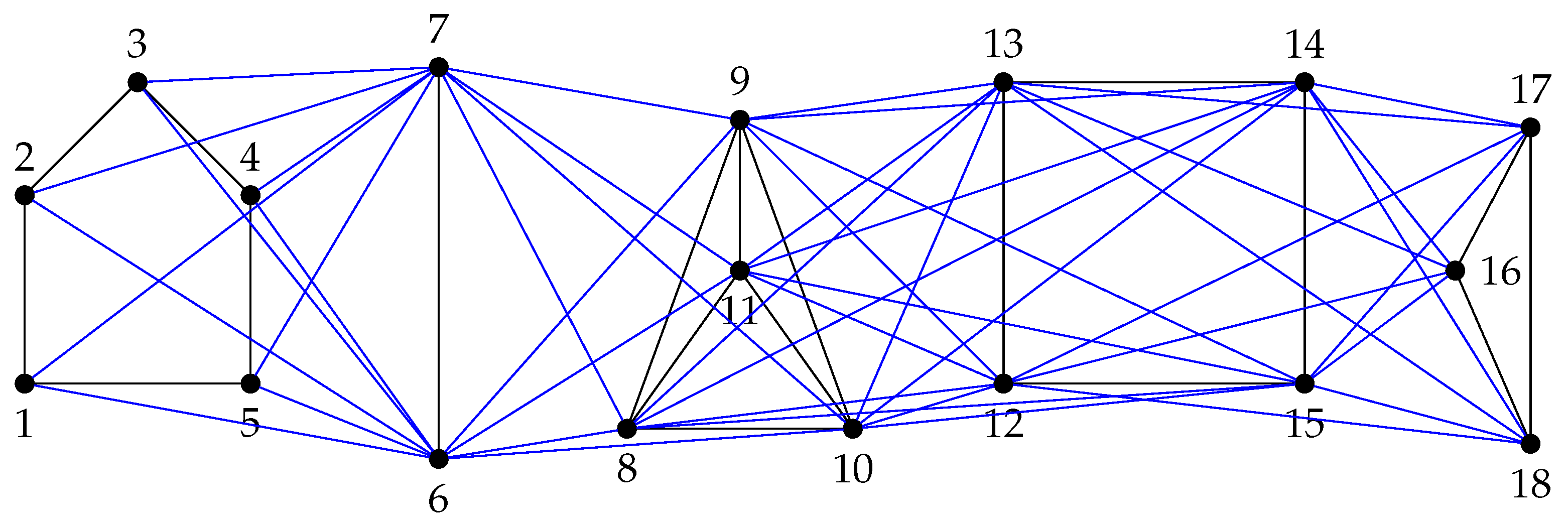
For , , , , and the graph is given in Figure 2.
Figure 2.
The graph . The edges of this graph are shown as the black edges of the graphs and the blue edges generated by on the graphs .
Thus, the matrices given in Theorem 7 are
Using three decimal places, we have
Therefore, applying Theorem 7, we conclude that
A wheel graph on vertices, denoted by , is a graph formed by connecting a single vertex to all vertices of a cycle of order . It can be observed that .
A generalized wheel graph on n vertices, denoted by , is a graph consisting of an independent set of order a and a cycle of the remaining vertices, such that each vertex in the cycle is adjacent to every vertex in the independent set. This graph can be expressed as the join product of two graphs or as a generalized join product:
where for the expression on the right, the central vertex of is assigned to and each pending vertex of is assigned to .
Since is not a connected graph, and our definition of the join product is for connected graphs, ensuring that the distance between components is not indeterminate, we use the notation:
Proposition 4.
Let be a generalized wheel graph on n vertices. Then the eigenvalues of are , together with the eigenvalues of the form for .
Proof.
The generalized join operation
we associate the cycle to the central vertex of the star and each vertex is associated with the pending vertices of the star. Considering the labeling in this same order, we have that the expressions given in (1) and (2), for the graph are
where
and
Now, expression (3) for becomes
Since the adjacency eigenvalues of the cycle of order p have the form , then, from Theorem 7, for , we have that are eigenvalues of .
Now, the matrix given in Theorem 7 has the form
We recall that denotes the i-th canonical vector. Then, for
Thus, is an eigenvalue of with multiplicity . From Theorem 7, we have that is an eigenvalue of with multiplicity .
We observe that the matrix given in (4) can be written in blocks as
where the four blocks have constant row sum. Thus, we can obtain the following equitable quotient matrix
which has as eigenvalues. From Theorems 1 and 7, we have that these eigenvalues are eigenvalues of . □
Corollary 3.
Let be a wheel graph on n vertices. Then, the eigenvalues of are 0, together with the eigenvalues of the form , for .
A friendship graph is a connected graph such that every pair of vertices has exactly one common neighbor. The triangle graph is the smallest order example of a friendship graph. The friendship graph of order vertices, denoted by , can be obtained from p copies of the cycle graph identifying a common vertex.
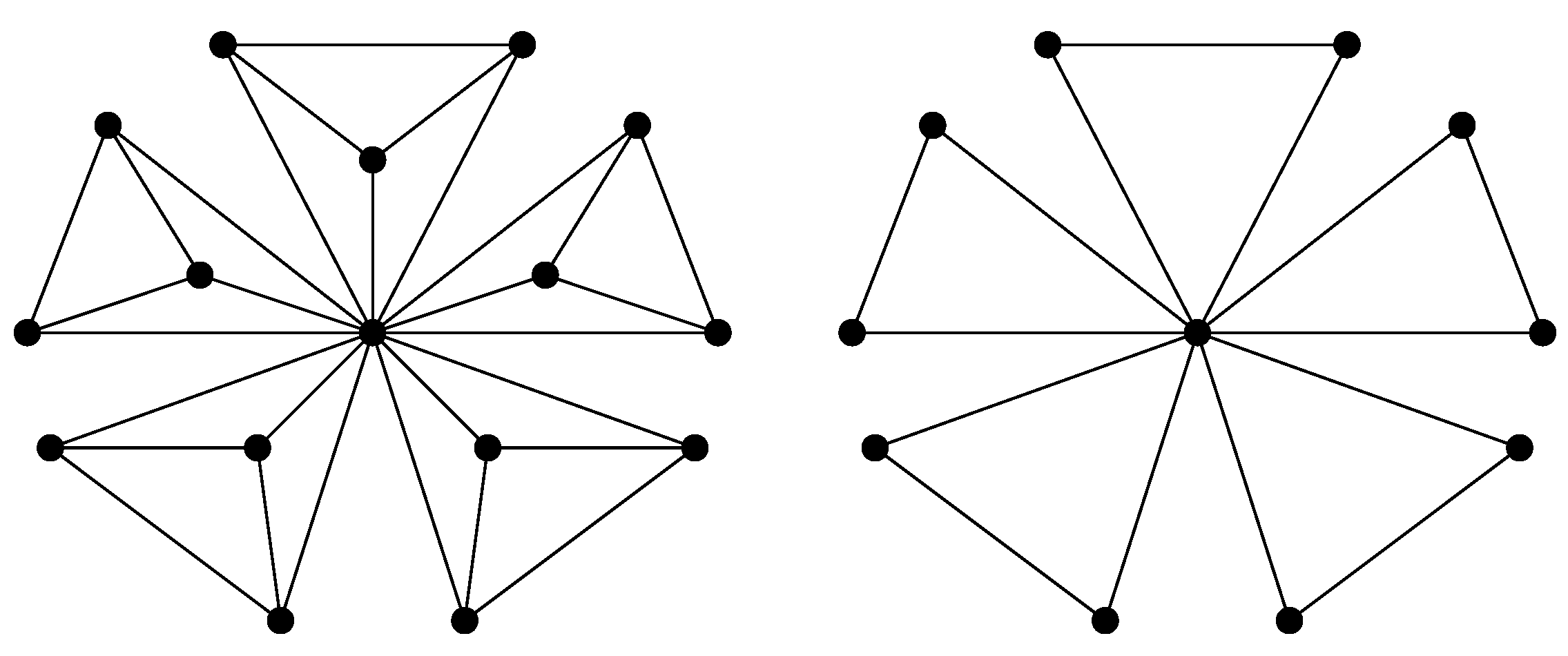
A windmill graph, denoted by , is a graph constructed for p copies of the complete graph identifying a common vertex. We observe that the friendship graph is isomorphic to . For examples of windmill graph and friendship graph, see Figure 3.
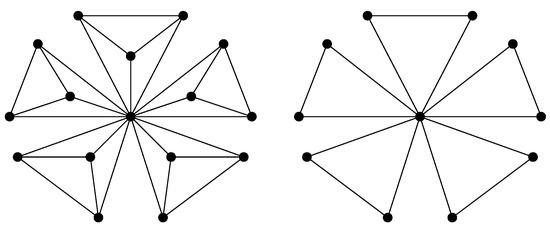
Figure 3.
The windmill graph and friendship graph .
Proposition 5.
Let be a windmill graph on vertices. Then the spectrum of is
Proof.
Let be the complete graph of order r. We observe that
where the central vertex of is assigned to and each pending vertex of is assigned to . Considering the labeling in this same order, we have that
where
and
For , the spectrum of is
Thus, from Theorem 7 we have that is an eigenvalue of with multiplicity , and the matrix can be written in blocks as
We observe that, for
Thus, is an eigenvalue of with multiplicity . From Theorem 7, we have that is an eigenvalue of with multiplicity .
Now, we observe that the four blocks of have a constant row sum, then we can obtain the following equitable quotient matrix
which has as eigenvalues. From Theorems 1 and 7, we have that these eigenvalues are eigenvalues of . □
Since the friendship graph is isomorphic to , the following result is immediate.
Corollary 4.
Let be a friendship graph on the vertices. Then the spectrum of is
We recall that a graph is an M-integral graph if the matrix M associated with the graph has only integer eigenvalues. From the above result, we can obtain the following Theorem.
Theorem 8.
Let G be a friendship graph of order n. The friendship graph is an -integral graph when n belongs to the sequence .
Proof.
Since if and only if , then is an odd number. Therefore, all the eigenvalues given in Corollary 4 are integers. □
3. Bounds for Harary Incidence Energy
In this section, we derive results concerning the reciprocal distance signless Laplacian energy by employing a technique based on the quotient matrix of a block-partitioned matrix. Additionally, we extend the notion of incidence energy to the reciprocal distance signless Laplacian matrix by introducing the concept of Harary incidence energy, denoted by , and defined as follows:
Finally, we characterize the Harary incidence energy of graphs with a given vertex connectivity using the generalized graph join operation.
The concept of graph energy originates in theoretical chemistry. In 1978, Ivan Gutman [13] introduced the energy of a graph in terms of the eigenvalues of its adjacency matrix, defined by
This invariant has been widely studied in mathematical chemistry as an approximation of the total -electron energy of a molecule [14,15,16]. Over time, it has become evident that the relevance of this graph parameter extends well beyond chemistry. For example, it has been investigated in the context of extremal problems with respect to minimum and maximum energy within specific graph families [17,18,19], as well as in the derivation of upper and lower bounds for graph energy [20,21,22,23], and in the bounding the energy of the Harary matrix and its Laplacian variants [7,24].
Furthermore, in [25], the authors provide an overview of numerous works published in 2019 related to graph energy and summarize their key contributions. Notably, they emphasize applications of graph energy beyond the realm of mathematics. For example, in [26], the authors apply this concept to topics related to climate change. They construct a graph where the vertices represent concepts such as soil, climate, hydrogeomorphic features, and biotic features, connected by directed or undirected edges. In this context, the energy of the graph reflects the overall strength of positive and negative feedback loops of the system.
In 2009, Jooyandeh et al. [27] introduced the concept of incidence energy, defined as the sum of the singular values of the vertex–edge incidence matrix . This matrix, of size , has entries equal to 1 if vertex is incident to the edge , and 0 otherwise.
The singular values of a matrix M are the non-negative square roots of the eigenvalues of . Since and share the same non-zero eigenvalues, the authors of [28,29] concluded that the incidence energy can be calculated as
where are the signless Laplacian eigenvalues of G.
The vertex connectivity of a graph G, denoted by , is the minimum number of vertices of G whose deletion disconnects G. It is conventional to define .
Remark 1.
If is the connected graph obtained from G by deleting an edge, then from the definition of the reciprocal distance signless Laplacian matrix, we obtain .
An immediate consequence of Theorem 2 is the following result.
Corollary 5.
If G and are connected graphs such that is obtained from G by the deletion of an edge, then
From Corollary 5 and Lemma 1, we obtain the following result.
Corollary 6.
Among all the connected graphs on the n vertices and on the edges, the complete graph has the largest Harary incidence energy. In particular
The equality holds if and only if G is the complete graph.
Theorem 9.
Let G be a graph on n vertices. Then
The equality holds if and only if G is the complete graph.
Proof.
Notice that . Using the Cauchy–Schwartz inequality, we obtain
with equality if and only if .
Thus
Let be the real function such that
We observe that is a strictly decreasing function in the interval and a strictly increasing function in the interval .
From Theorem 3, we have with equality if and only if G is a reciprocal distance degree regular graph. Since
we obtain
Furthermore, the above equalities hold if and only if and . Therefore, we have two cases:
- (i)
- If then . Thus, .
- (ii)
- If then G has only two distinct reciprocal distance signless Laplacian eigenvalues. From Lemma 1, we conclude that G is the complete graph of order n.
Conversely, if G is a complete graph, then the equality is immediate. □
Theorem 10.
Let G be a graph on n vertices. Then
The equality holds if and only if G is the complete graph.
Proof.
By Theorem 4 we obtain with equality if and only if G is a reciprocal distance degree regular graph. Note that, by (5), is a strictly decreasing function in the interval . Since
the result is similar to the proof of Theorem 9. □
Lemma 3
([30]). Let m and n be natural numbers such that . Let be positive real numbers. Then
Theorem 11.
Let G be a graph of order . Then
Proof.
Applying Lemma 3 to the definition of we obtain
Therefore,
□
Example 2.
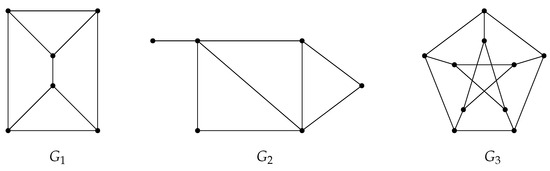
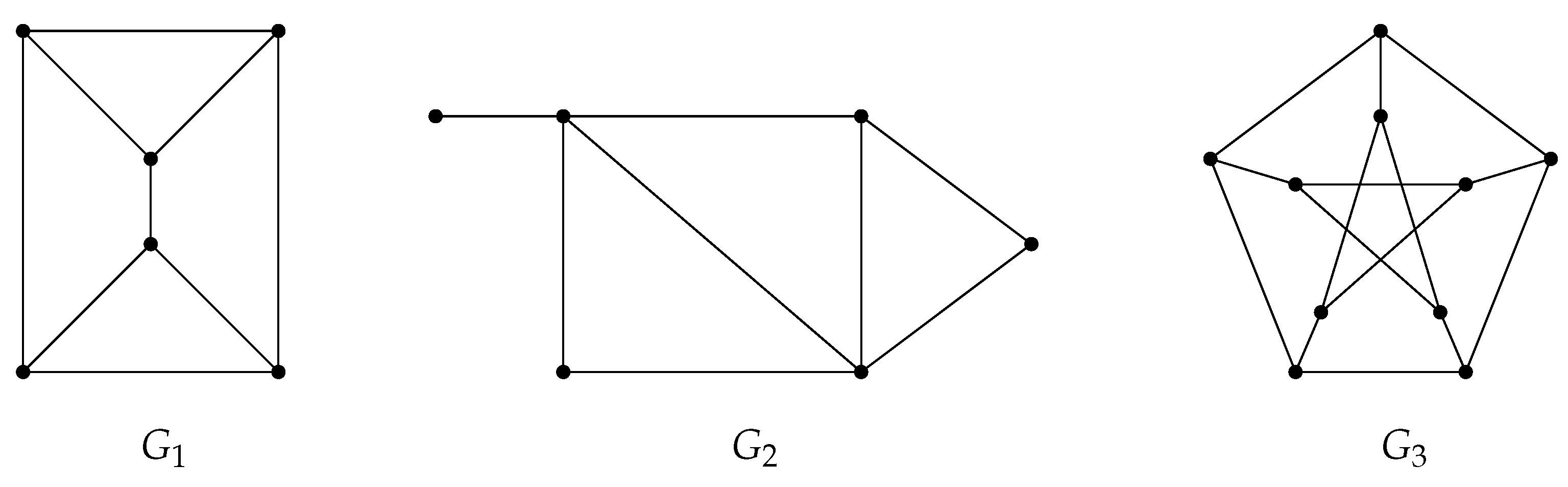
We consider the graphs and as depicted in Figure 4. Let be the Petersen graph, and , and be the star , the path and the cycle on seven vertices, respectively.
Figure 4.
Examples of connected simple undirected graphs.
Using four decimal places, we show upper and lower bounds for the Harary incidence energy.
| Upper bound | ||||||
| Theorem 9 | ||||||
| Theorem 10 |
| Lower bound | ||||||
| Theorem 11 |
Finally, in this section, we extend the upper bounds for the Harary incidence energy to all connected graphs of a given order, expressed in terms of vertex connectivity. Furthermore, we characterize the graphs for which these bounds are attained.
Let be the family of connected graphs G of order n such that .
For , let be a -regular graph of order . Then is a graph of order . Observe that
and
Labeling the vertices of starting with the vertices of , continuing with the vertices of and finishing with the vertices of , and using the results obtained in the previous subsection, the reciprocal distance signless Laplacian matrix is
where for ,
and
Clearly, the largest eigenvalues of , and , given as in (6), are
with eigenvectors , and , respectively.
Utilizing these observations, we obtain the following result as a direct application of Theorem 7.
Now, let n and k be positive integers, with and consider the graph
where without loss of generality, we assume . The following result is obtained by applying Proposition 6 to .
Proposition 7.
Let such that . Then
where and . In particular,
Proof.
Let
and let
If denotes the empty graph, i.e., the graph without edges, then we have the following results.
Lemma 4.
Let for . Then
Proof.
From Proposition 7 we have
We define the function
We observe that for and f is a strictly decreasing function in the interval . Thus, the result is obtained. □
Theorem 12.
Proof.
Let . We first consider . From Corollary 6, with equality if and only if . Moreover,
Then the result is true for . Consider and let then is a maximum.
Let such that is a disconnected graph and . We denote by the r connected components of . Clearly . Suppose that , then we can construct a new graph where e is an edge connecting a vertex in with a vertex in . We can see that . By Corollary 5, we have
it is a contradiction, because G is the graph with maximum . Therefore , that is .
By definition . Now, we claim that .
Suppose . Since , we may construct a graph where e is an edge joining a vertex with a vertex . We see that is a connected graph and the deletion of the vertex u disconnected it, then . By Corollary 5, , with is also a contradiction. Hence and . Let . Then . By repeated application of Corollary 5 we can conclude that
for some . We have proved for all . From Lemma 4 we have that . Since , for , the equalities hold if and only if . □
Example 3.
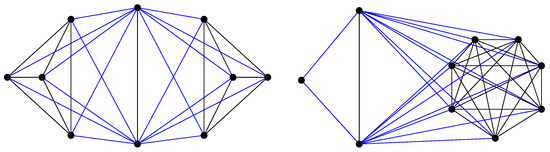
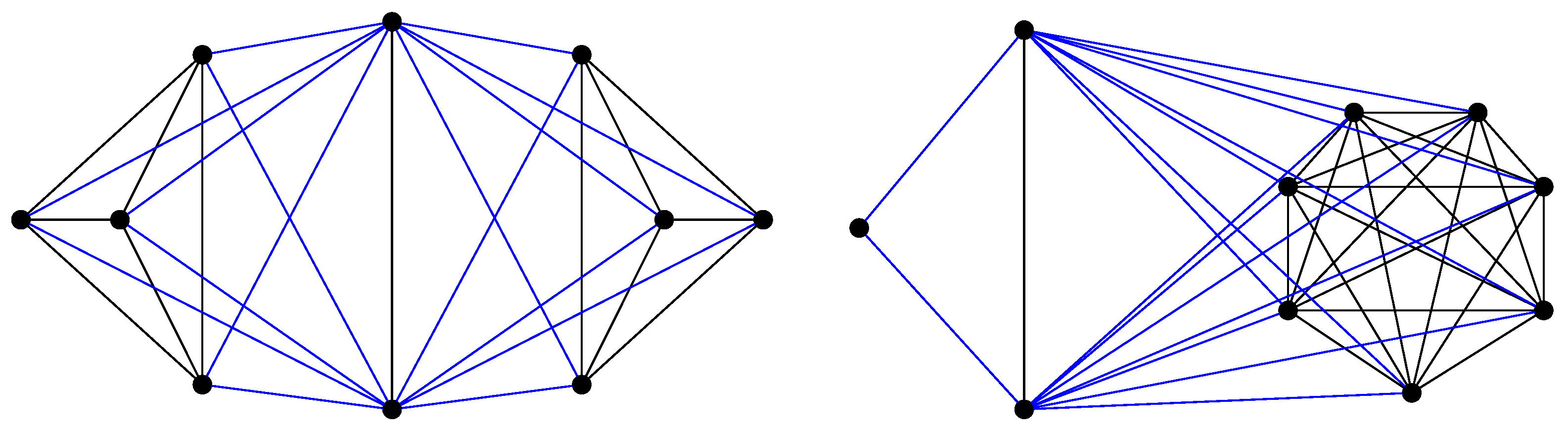
For and , the graphs with minimum and maximum Harary incidence energy are and , respectively (Figure 5). In fact, using four decimal places, we have
Figure 5.
The graphs and . The blue edges are generated by on the graphs and , for and , respectively.
Author Contributions
Conceptualization, L.M., J.R. and M.T.; methodology, L.M. and J.R.; software, M.T. and J.R.; validation, L.M., J.R. and M.T.; formal analysis, L.M.; investigation, L.M., J.R. and M.T.; resources, L.M. and J.R.; writing—original draft preparation, L.M. and M.T.; writing—review and editing, L.M. and J.R.; visualization, J.R. and M.T.; supervision, L.M. All authors have read and agreed to the published version of the manuscript.
Funding
All authors are supported by Programa Regional Math-AmSud under project GSA grant number 22-MATH-02 Chilean code AMSUD220015. L. Medina and J. Rodríguez are partially supported by Programa Semillero de Investigación—Universidad de Antofagasta, code Sem24-003. The article processing charge was funded by Universidad de Antofagasta.
Data Availability Statement
The original contributions presented in this study are included in the article. Further inquiries can be directed to the corresponding author.
Acknowledgments
All authors are grateful for the reviewers’ comments and recommendations. L. Medina thanks MINEDUC-UA, project code ANT22991. L. Medina and J. Rodriguez thank the hospitality of Departamento de Matemáticas from Universidad Nacional de San Luis.
Conflicts of Interest
The authors declare no conflicts of interest.
References
- Brouwer, A.E.; Haemers, W.H. Spectra of Graphs–Monograph; Springer: Berlin/Heidelberg, Germany, 2011. [Google Scholar]
- You, L.; Yang, M.; So, W.; Xi, W. On the spectrum of an equitable quotient matrix and its application. Linear Algebra Its Appl. 2019, 577, 21–40. [Google Scholar] [CrossRef]
- Ivanciuc, O.; Balaban, T.S.; Balaban, A.T. Reciprocal distance matrix, related local vertex invariants and topological indices. J. Math. Chem. 1993, 12, 309–318. [Google Scholar] [CrossRef]
- Plavsić, D.; Nikolixcx, S.; Trinajstixcx, N.; Mihalixcx, Z. On the Harary index for the characterization of chemical graphs. J. Math. Chem. 1993, 12, 235–250. [Google Scholar] [CrossRef]
- Alhevaz, A.; Baghipur, M.; Ramane, H.S. Computing the reciprocal distance signless Laplacian eigenvalues and energy of graphs. Le Mat. 2019, 74, 49–73. [Google Scholar]
- Medina, L. On the spectral radius of the reciprocal distance signless laplacian matrix. AIP Conf. Proc. 2023, 2872, 120030. [Google Scholar] [CrossRef]
- Medina, L.; Trigo, M. Upper bounds and lower bounds for the spectral radius of Reciprocal Distance, Reciprocal Distance Laplacian and Reciprocal Distance signless Laplacian matrices. Linear Algebra Its Appl. 2021, 609, 386–412. [Google Scholar] [CrossRef]
- Medina, L.; Trigo, M. Bounds on the Reciprocal distance energy and Reciprocal distance Laplacian energies of a graph. Linear Multilinear Algebra 2022, 70, 3097–3118. [Google Scholar] [CrossRef]
- Pirzada, S.; Khan, S. On the distribution of eigenvalues of the reciprocal distance Laplacian matrix of graphs. Filomat 2023, 37, 79737980. [Google Scholar] [CrossRef]
- Khan, Z.; Hameed, A. On the spectral radius and energy of the degree distance matrix of a connected graph. Open Math. 2025, 23, 20250139. [Google Scholar] [CrossRef]
- Mushtaq, U.; Pirzada, S. On the reciprocal distance Laplacian spectral radius of graphs. Commun. Comb. Optim. 2024; in press. [Google Scholar]
- Cardoso, D.M.; de Freitas, M.A.A.; Martins, E.; Robbiano, M. Spectra of graphs obtained by a generalization of the join graph operation. Discret. Math. 2013, 313, 733–741. [Google Scholar] [CrossRef]
- Gutman, I. The energy of a graph. Ber. Math. Statist. Sekt. Forschungsz. Graz. 1978, 103, 1–22. [Google Scholar]
- Gutman, I. The energy of a graph: Old and new results. In Algebraic Combinatorics and Applications; Betten, A., Kohnert, A., Laue, R., Wassermann, A., Eds.; Springer: Berlin/Heidelberg, Germany, 2001; pp. 196–211. [Google Scholar]
- Gutman, I.; Furtula, B. The total π-electron energy saga. Croat. Chem. Acta 2017, 90, 359–368. [Google Scholar] [CrossRef]
- Li, X.; Shi, Y.; Gutman, I. Graph Energy; Springer: New York, NY, USA, 2012. [Google Scholar]
- Aashtab, A.; Akbari, S.; Ghasemian, E.; Ghodrati, A.H.; Hosseinzadeh, M.A.; Koorepazan-Moftakhar, F. On the minimum energy of regular graphs. Linear Algebra Its Appl. 2019, 581, 51–71. [Google Scholar] [CrossRef]
- Das, K.C.; Mojallal, S.A.; Sun, S. On the sum of the k largest eigenvalues of graphs and maximal energy of bipartite graphs. Linear Algebra Its Appl. 2019, 569, 175–194. [Google Scholar] [CrossRef]
- Zhu, J.; Yang, J. Minimal energies of trees with three branched vertices. MATCH Commun. Math. Comput. Chem. 2018, 79, 263–274. [Google Scholar]
- Arrizaga-Zercovich, R.; Medina, L. Upper bound for the energy of the starlike trees. J. Phys. Conf. Ser. 2021, 2090, 012128. [Google Scholar] [CrossRef]
- Jahanbani, A. Upper bounds for the energy of graphs. MATCH Commun. Math. Comput. Chem. 2018, 79, 275–286. [Google Scholar]
- Jahanbani, A.; Rodriguez, J. Koolen-Moulton-Type Upper Bounds on the Energy of a Graph. MATCH Commun. Math. Comput. Chem. 2020, 83, 497–518. [Google Scholar]
- Oboudi, M.R. A new lower bound for the energy of graphs. Linear Algebra Its Appl. 2019, 590, 384–395. [Google Scholar] [CrossRef]
- Trigo, M. On Harary energy and Reciprocal distance Laplacian energies. J. Phys. Conf. Ser. 2021, 2090, 012102. [Google Scholar] [CrossRef]
- Gutman, I.; Ramane, H. Research on Graph Energies in 2019. MATCH Commun. Math. Comput. Chem. 2020, 84, 277–292. [Google Scholar]
- Phillips, J.D. State factor network analysis of ecosystem response to climate change. Ecol. Complex. 2019, 40, 100789. [Google Scholar] [CrossRef]
- Jooyandeh, M.R.; Kiani, D.; Mirzakhah, M. Incidence energy of a graph. MATCH Commun. Math. Comput. Chem. 2009, 62, 561–572. [Google Scholar]
- Gutman, I.; Kiani, D.; Mirzakhah, M. On incidence energy of graphs. MATCH Commun. Math. Comput. Chem. 2009, 62, 573–580. [Google Scholar]
- Gutman, I.; Kiani, D.; Mirzakhah, M.; Zhou, B. On incidence energy of a graph. Linear Algebra Its Appl. 2009, 431, 1223–1233. [Google Scholar] [CrossRef]
- Diaz, R.; Rojo, O. Sharp upper bounds on the distance energies of a graph. Linear Algebra Its Appl. 2018, 545, 55–75. [Google Scholar] [CrossRef]
Disclaimer/Publisher’s Note: The statements, opinions and data contained in all publications are solely those of the individual author(s) and contributor(s) and not of MDPI and/or the editor(s). MDPI and/or the editor(s) disclaim responsibility for any injury to people or property resulting from any ideas, methods, instructions or products referred to in the content. |
© 2025 by the authors. Licensee MDPI, Basel, Switzerland. This article is an open access article distributed under the terms and conditions of the Creative Commons Attribution (CC BY) license (https://creativecommons.org/licenses/by/4.0/).