


Abstract
This paper aims to introduce a novel idea of possibility multi-fuzzy soft ordered semigroups for ideals and interior ideals. Various results, formulated as theorems based on these concepts, are presented and further validated with suitable examples. This paper also explores the broad applicability of possibility multi-fuzzy soft ordered semigroups in solving modern decision-making problems. Furthermore, this paper explores various classes of ordered semigroups, such as simple, regular, and intra-regular, using this innovative method. Based on these concepts, some important conclusions are drawn with supporting examples. Moreover, it defines the possibility of multi-fuzzy soft ideals for semiprime ordered semigroups.
Keywords:
multi-fuzzy soft sets; possibility multi-fuzzy soft ordered semigroup; possibility multi-fuzzy soft interior ideals; possibility multi-fuzzy soft simple; semiprime possibility multi-fuzzy soft ideals MSC:
03E72; 06F05; 90C70
1. Introduction
Traditional mathematical tools of the classical approach are inadequate in handling the modern problems of applied sciences more precisely. Therefore, Zadeh initiated a novel approach called fuzzy mathematics [1]. This theory was further applied by scientists to solve numerous problems in artificial intelligence, control engineering, management sciences, robotics, and operational research.
Later, Moldstov initiated the soft set concept that extended fuzzy set theory by providing a parameterization tool [2,3]. Using Moldstov’s approach, Maji et al. solved various physical decision sciences problems [4,5]. Alkalzaleh et al. gave a new generalization to the soft sets approach, known as soft multisets [6]. Well ahead, Maji et al. broached the fuzzy soft set concept, providing a parametrization tool for fuzzy set theory, which improved its applications in decision sciences [7]. Different generalizations to fuzzy soft sets were made recently, like interval-valued fuzzy soft sets [8], intuitionistic fuzzy soft sets [9], multi-fuzzy soft sets [10], neutrosophic sets [11], vague soft expert sets [12], and many more [13,14,15,16,17,18,19,20,21,22,23,24]. Recently, S. Alkhazaleh and A.R. Salleh introduced the concept of soft expert sets and related their application to decision-making problems [25].
Possibility fuzzy soft set is also one of the generalized concepts used in solving decision-making problems and medical diagnoses introduced by Alkhalzaleh [26]. Recently, Zhang et al. proposed the possibility of multi-fuzzy soft sets and mentioned some of their applications [27]. The possibility multi-fuzzy soft sets theory precisely provides multi-membership values and possible membership values for all the elements in a universal set that leads the experts to choose the most appropriate results in decision sciences.
Algebraic structures are the main logistic tools for solving modern engineering problems and in various fields of applied sciences, which is why researchers are working on coupling these algebraic structures with modern methods of applied sciences. Initially, the concept of fuzzy sets in terms of semigroups was defined by Kuroki, who also related fuzzy ideals with semigroups [28,29,30]. Later, some properties of fuzzy sets in ordered groupoids were studied [31]. Kehayopulu and Tsingelis initiated the idea of fuzzy bi-ideals in ordered semigroups and also studied interior ideals for the same approach [32,33]. Khan et al. studied fuzzy interior ideals for ordered semigroups [34]. Jun et al. coupled the soft set theory with ordered semigroups [35]. Other researchers picked up the same concept and combined fuzzy soft sets with ordered semigroups [36,37]. Recently, Habib et al. initiated the idea of possibility fuzzy and multi-fuzzy soft ordered semigroups and possibility fuzzy soft ideals and related some of their applications via different operations [38,39,40]. Figure 1 illustrates a flow chart of fuzzy soft set theory, with the dotted section representing our proposed theory.
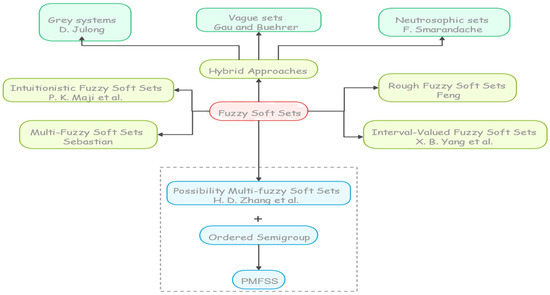
Figure 1.
Flow chart of fuzzy soft set [8,9,10,11,12,16,17,25].
The traditional fuzzy set theory has been widely used to model uncertainty by assigning a single membership value to each element in a set, reflecting its degree of belonging to that set. However, applying fuzzy sets to complex, real-world decision-making problems often requires modelling multiple criteria, alternatives, and uncertainty in a more flexible manner.
To address these limitations, this paper relates a novel concept, the possibility multi-fuzzy soft set, which combines the advantages of fuzzy sets and soft sets but with significant enhancements. Unlike traditional fuzzy sets, which assign a single membership value to each element, the possibility multi-fuzzy soft set assigns multiple membership values for each component, representing the degree of membership under different possibilities or criteria.
Furthermore, this paper explores the potential of multi-fuzzy soft sets by extending this concept to ordered semigroups and ideals, making it suitable for more complex mathematical applications. In particular, we show how these sets can be used to model decision-making problems in algebraic structures, such as ordered semigroups, in a simplified example.
The paper demonstrates that this extended flexibility in representing uncertainty and possibility provides a powerful tool for solving complex decision-making problems that involve multiple alternatives and criteria, which are often not fully captured by traditional fuzzy logic approaches.
The primary objectives of this research approach are outlined as follows:
- Introduce possibility multi-fuzzy soft sets: develop this concept in relation to ordered semigroups and clarify its applications in decision sciences.
- Define possibility multi-fuzzy soft ideals: establish definitions for left (and right) ideals and interior ideals, examining their interconnections through illustrative examples.
- Propose new concepts: introduce possibility multi-fuzzy soft ideals and interior ideals for various classes, including regular and intra-regular ordered semigroup relations.
- Characterize simple ordered semigroups: Present a novel method for characterizing these semigroups using possibility multi-fuzzy soft ideals and interior ideals.
- Explore possibility multi-fuzzy soft semiprime ideals: initiate this concept and assess its relevance within intra-regular and regular ordered semigroups.
This paper comprises the following sections. In Section 2, some important definitions are mentioned that will be further used to understand the new concepts. Section 3 introduces a novel concept of PMFSS, and some related theorems are included. In Section 4, the authors will explain the idea of possibility multi-fuzzy soft interior ideals in ordered semigroups. Later, the concept of possibility multi-fuzzy soft ideals and its relation with possibility multi-fuzzy soft interior ideals is generated. Further, union and intersection properties are defined in terms of these notions and are validated with suitable examples. Section 5 includes the concept of possibility multi-fuzzy soft simple for ordered semigroups. Lastly, in Section 6, the relation of semiprime possibility multi-fuzzy soft ideals is defined and supported by suitable lemma and theorems. The authors also build the relation for intra-regular and regular ordered semigroups for the PMFSS approach.
2. Preliminaries
In this section, the authors restate essential definitions and lemmas that form the foundational framework for developing new and fundamental concepts later in the paper. Additionally, two comparison tables are included to provide a comprehensive analysis of related concepts, highlighting distinctions and contextual relevance to the proposed methodology.
In this paper, we introduce and explore the concept of possibility multi-fuzzy soft sets, a generalization of fuzzy and soft set theories.
A possibility multi-fuzzy soft set is a generalized structure where each element of a universe has multiple membership values representing different degrees of possibility, thus allowing for greater flexibility and precision in modelling uncertainty. This is particularly useful in decision-making processes where various possibilities must be evaluated simultaneously.
Definition 1
([27]). Let be a universal set and be a set of parameters. Consider the mapping
( represents the set of all multi-fuzzy subsets of U with dimension p).
Then, is known as a possibility multi-fuzzy soft set and is denoted by . Possibility multi-fuzzy soft sets define both the multi-degree of membership value and its possible membership value for an element, denoted by and , respectively.
In its generalized form, a possibility multi-fuzzy soft set is expressed as
where .
Theorem 1
([27]). Let and be two possibility multi-fuzzy soft sets defined over U. If
- .
- .
then (is a subset of ).
Theorem 2
([27]). The union of two possibility multi-fuzzy soft sets and , defined over U, is represented as , where defined by , must satisfy the following conditions:
- .
- .
Theorem 3
([27]). Let and be two possibility multi-fuzzy soft sets defined over U. Then, their intersection is defined as , where , defined by , must satisfy the following conditions:
- .
Theorem 4
([27]).
Let and be two possibility multi-fuzzy soft sets defined over U. Then, the AND operation is defined as
where , is such that
We then extend this framework to ordered semigroups, algebraic structures equipped with a binary operation and a partial order.
An ordered semigroup is a semigroup in which an order relation is defined over its elements, and this order relation is compatible with the semigroup operation: for all , implies or [41]. If, then A is called a subsemigroup of Z for any non-empty subset A of .
In particular, we examine how these structures interact with ideals and interior ideals to provide more efficient solutions to decision-making problems under uncertainty.
Definition 2.
Let L be a non-empty subset of Z. Then, L is called a left (resp. right) ideal of Z if (resp.), and for all the next implication holds:. If L is both a left and right ideal of Z, then it is called an ideal of Z and is represented by . Left (respectively right) ideals are denoted by (resp.) [42].
Definition 3.
A non-empty subset A of an ordered semigroup Z is called an interior ideal of Z if
- .
- For all and,.
An ordered semigroup Z is called semiprime if, for all non-empty subsets L of Z, we have , for all [43].
Z is regular [41] if ; we have which means that for all , or equivalently,,.
If , there exists such that (resp.); then, Z is called left (resp right) regular. In other words, if , we have(resp. ), or equivalently if , we have (resp.). Z is known as completely regular if it is both left and right regular.
For every left (resp. right) ideal L of Z, Z is called left (resp. right) simple if and only if L = Z [44]. If an ordered semigroup Z is both right and left simple, then Z is simple.
Definition 4
([2]). Let U be a universal set, and let N denote a set of parameters. If M is a subset of N, then the pair is called a soft set, where f is a mapping from M to P(U), i.e., .
Definition 5
([36]). Let be a soft set over Z, where M is a set of parameters. Then, is called a soft ordered semigroup if is non-empty, and is a subsemigroup of Z.
Theorem 5
([35]). Let be a soft set over Z. Then, is a soft left (resp. right) ideal over Z if and only if is a fuzzy soft left (resp. right) ideal over Z.
Theorem 6

([35]). Let be a soft set over Z. Then, is a semiprime soft left (resp. right) ideal over Z if and only if is a semiprime ideal over Z,.
Also,,.
Possibility multi-fuzzy soft sets [25], bipolar fuzzy sets [14], and intuitionistic fuzzy sets [11] are advanced mathematical tools designed to address uncertainty and imprecision. Table 1 elaborates a detailed comparison based on their key characteristics, applications, and advantages.
Table 1.
Comparison Table.
A comparison table is presented below as Table 2 to elucidate the distinctions between general type 2 fuzzy logic systems (GT2 FLS) [45] and the proposed possibility multi-fuzzy soft sets in terms of membership value assignment. This table highlights their unique approaches to handling uncertainty and multi-criteria decision making, offering insights into their strengths and applications.
Table 2.
Key differences in membership value assignment.
3. Possibility Multi-Fuzzy Soft Ordered Semigroups
Definition 6
([41]). Let be a possibility multi-fuzzy soft set of Z, defined by , where denotes the multi-fuzzy subsets of Z and define the degree of membership value and possible membership value. Then, for any set of parameters , is called a possibility multi-fuzzy soft ordered semigroup of Z, if is non-empty and also Thus is a fuzzy subsemigroups of Z.
Unless otherwise specified, a possibility multi-fuzzy soft ordered semigroup is referred to as a PMFSS.
Example 1.
Table 3.
Multiplication table of Z.
For parameters, is defined as , where is a possibility multi-fuzzy soft set over Z.
Here, we obtain
Since is non-empty and also , it follows that is a fuzzy subsemigroup of Z. Hence, is a possibility multi-fuzzy soft ordered semigroup over Z, by Definition 6.
Definition 7.
Let be a PMFSS over Z for a set of parameters N. Then, the possibility multi-fuzzy soft level set of for all is defined by
Further, we stated the following theorems based on the notion of PMFSS.
Theorem 7.
Let and be a PMFSS over Z. Then, is also a PMFSS over Z.
Proof.
The AND operation in possibility multi-fuzzy soft sets is defined by , where and , . Since and are PMFSSs over Z, thereby the definition of PMFSSs and are multi-fuzzy subsemigroups of Z, and their intersection is also a fuzzy subsemigroup of Z. Hence, is also a fuzzy subsemigroup of Z. Thus, is also a PMFSS over Z. □
Example 2.
Let be a PMFSS over Z as defined in Example 1. Then, we define a mapping for all .
Then, and are fuzzy subsemigroups of Z. Hence, is a PMFSS over Z.
Then, we can define the corresponding AND operation by , where for all pairs of parameters can be concluded as follows.
In matrix form
as , is a multi-fuzzy subsemigroup of Z. Thus, is also possibility multi-fuzzy soft ordered semigroup over Z.
Theorem 8.
Let and be PMFSSs over Z. Then, for all , is also a PMFSS over Z.
Proof.
The proof of this theorem is straightforward and follows directly from the steps outlined in Theorem 7. □
4. Application of Possibility Multi-Fuzzy Soft Ordered Semigroup
Consider a set representing three football players. To evaluate their performance in the last five matches, we define a multiplication table (Table 4) and an ordered relation to compare their overall performance:
Table 4.
Multiplication table for players.
From this relation, it is clear that is the most suitable player due to its dominance in the hierarchy.
Let us define a possibility multi-fuzzy soft set by a mapping with index = 2 and the parameter, where represents skills (attacking and defense). Then, for all and where .
Hence, , satisfies the criteria for a fuzzy subsemigroup of Z. Hence, is a possibility multi-fuzzy soft ordered semigroup over Z as per Definition 6. Here, is defined on the basis of data provided by the first observer or the committee member.
Similarly, let us define a possibility multi-fuzzy soft set by a mapping , where is defined as the second committee member and
In addition, also satisfies the possibility multi-fuzzy soft ordered semigroup criteria. In order to evaluate the results on the basis of combined scoring AND operation of PMFSS, we consider , or simply we can write
This clearly indicates that both the multi-membership value and the possible multi-membership value for the third player are the highest. Therefore, the committee should select the third player as the star player.
5. Possibility Multi-Fuzzy Soft Interior Ideals
This section of the paper elaborates the concepts of possibility multi-fuzzy soft left (and right) ideals as well as possibility multi-fuzzy soft interior ideals. Furthermore, accompanied by appropriate examples for clarification, various classes of ordered semigroups, including simple, regular, and intra-regular relations, are defined.
Definition 8.
Let be a PMFSS over Z. Then, for any possibility multi-fuzzy soft set over Z, is called a possibility multi-fuzzy soft left ideal (resp. right ideal) of if and for every , and is a multi-fuzzy soft left ideal (resp. right ideal) of In this case, we write (resp. ()). Furthermore, is called a possibility multi-fuzzy soft ideal of if it is both a left and right ideal of , and this is denoted by .
Example 3.
Table 5.
Multiplication table of Z.
Let be a PMFSS over Z with parameters ; here, = 3.
Let L be a subset of N. Then, is also a possibility multi-fuzzy soft set defined by a mapping , where . Here, ; hence, is a possibility multi-fuzzy soft right ideal of .
Similarly, implies that is a possibility multi-fuzzy soft left ideal of . Thus, it is concluded that .
Theorem 9.
Let be a PMFSS over Z, and let and be the parameters contained in N, and also. Then, the following statements hold:
- If and then.
- Ifand then
Proof.
Let and be possibility multi-fuzzy soft sets of Z, and their intersections are defined as , where . Then, for any n of L, it follows that either n belongs to or to . If , then , and if , then . As , we can conclude that is a PMFSS over Z. Since , it follows that as .
Similarly, we can prove that □
Theorem 10.
Let and be two possibility multi-fuzzy soft sets over Z, where , and let be a PMFSS over Z. Then, the following statements hold:
- If and are a possibility multi-fuzzy soft left ideal of , then their union is also a possibility multi-fuzzy soft left ideal of , denoted by .
- If and are a possibility multi-fuzzy soft right ideal of then their unionis also a possibility multi-fuzzy soft right ideal of , denoted by .
Proof.
Let the union of two possibility multi-fuzzy soft sets and be equal to , denoted by where for all , .
Since either n belongs to M or to O. If n belongs to M, then , where is a multi-fuzzy soft left ideal of . Therefore, is also a multi-fuzzy soft left ideal of . Hence, . If n belongs to O, then , where is a multi-fuzzy soft left ideal of . So, is also a multi-fuzzy soft left ideal of . Therefore, . As a result, . □
Theorem 11.
Let be a PMFSS over Z. Then, is said to be a possibility multi-fuzzy soft interior ideal of Z if
- .
- .
Example 4.
Table 6.
Multiplication table of Z.
Let be a PMFSS over Z with parameters . The mapping is defined as , where
We have ; thus, it is a fuzzy subsemigroup of Z. Also, ,. Thus, Definition 8 is satisfied, so is a possibility multi-fuzzy soft interior ideal of Z.
Definition 9.
A possibility multi-fuzzy soft set is a possibility multi-fuzzy soft interior ideal over Z if and only if for every is a possibility multi-fuzzy soft interior ideal over Z.
Lemma 1.
Every possibility multi-fuzzy soft right and left ideal of Z is also a possibility multi-fuzzy soft interior ideal of Z.
Proof.
The proof of Lemma 1 is straightforward and can be readily understood by referring to Example 5 provided below. □
Example 5.
Let an ordered semigroup defined as in Example 4. Let be a possibility multi-fuzzy soft set over Z with parameters . Then, a mapping is defined by , where
We have and thus the definition of a multi-fuzzy soft right ideal is satisfied. Similarly, implies that also satisfies the condition of a multi-fuzzy soft left ideal of Z. We have ,. Thus, is also a possibility multi-fuzzy soft interior ideal of Z.
Clearly, every possibility multi-fuzzy soft ideal of Z is also a possibility multi-fuzzy soft interior ideal of Z. However, the converse does not hold universally, as illustrated in the following example.
Example 6.
Let an ordered semigroup be defined as described in Example 4. Let be a possibility multi-fuzzy soft set over Z with parameters and and be defined by , where
We have . Also,, . Thus, is a possibility multi-fuzzy soft interior ideal of Z. But does not satisfy the condition of a multi-fuzzy soft left ideal of Z since . Hence, is not a possibility multi-fuzzy soft ideal of Z.
Proposition 1.
Every possibility multi-fuzzy soft interior ideal is a possibility multi-fuzzy soft right and left ideal of Z if Z is regular.
Proof.
For a regular ordered semigroup Z, let be a possibility multi-fuzzy soft interior ideal, and then by the definition of regular, we can write , where and . Further, by using Lemma 1, the following inequality holds:
Similarly, .
Thus, , and also and In other words, is a possibility multi-fuzzy soft right and left ideal of Z. □
Corollary 1.
In regular ordered semigroups, both the concepts of possibility multi-fuzzy soft ordered semigroups for ideals and interior ideal must be satisfied over Z.
Theorem 12.
Let and be two possibility multi-fuzzy soft left (resp. right) ideals of Z, and is also a possibility multi-fuzzy soft left (resp. right) ideal of Z for all .
Proof.
By using Theorem 7, for any two PMFSSs and of Z, the And operation is defined by for all Then, is also a PMFSS of Z. Since and are both possibility multi-fuzzy soft left (resp. right) ideals of Z, then is also a possibility multi-fuzzy soft left (resp. right) ideal of Z for all and . Thus, is a possibility multi-fuzzy soft left (resp. right) ideal of Z. Accordingly, is a possibility multi-fuzzy soft left (resp. right) ideal of Z. □
Theorem 13.
Let and be two possibility multi-fuzzy soft left (resp. right) ideals of Z. Then, is also a possibility multi-fuzzy soft left (resp. right) ideal of Z for all .
Proof.
The proof follows directly from Theorem 8. □
6. Possibility Multi-Fuzzy Soft Simple Ordered Semigroup
Let be a possibility multi-fuzzy soft set over an ordered semigroup Z. For all and , define a mapping where is a PMFSS over Z, and it is defined by
Proposition 2.
Let be a possibility multi-fuzzy soft set over an ordered semigroup Z. Then, is a soft right ideal of Z.
Proof.
Let be a possibility multi-fuzzy soft right ideal over Z. If for every and and if , then we have and . Let Then, for any ,, it is implied that . Since and is a possibility multi-fuzzy soft right ideal over Z, it follows that for every , we have
as
Hence, .
Now, suppose that for every and Then, . Since is a possibility multi-fuzzy soft right ideal over Z, it follows that
So, .
Therefore, .
We have , and hence is a soft right ideal of Z.
Likewise, the proposition can be easily proven for left ideals using the same approach as in the above proof. □
Theorem 14.
Let be a possibility multi-fuzzy soft ideal over an ordered semigroup Z. Then, is a soft ideal of Z for all .
Definition 10.
Let be a PMFSS over an ordered semigroup Z. Then, Z is called possibility multi-fuzzy left (resp. right) simple if and only if is a possibility multi-fuzzy soft left (resp. right) simple ideal over Z, with , and.
An ordered semigroup Z is called possibility multi-fuzzy soft simple if it is both possibility multi-fuzzy soft left simple and possibility multi-fuzzy soft right simple.
Example 7.
Let be an ordered semigroup defined as in Table 7 and under the following ordered relation.
Table 7.
Multiplication table of Z.
Let be defined by a mapping with N parameters.
where
Here,
. ( is a multi-fuzzy subsemigroup of Z).
is a possibility multi-fuzzy soft right ideal of Z).
is a possibility multi-fuzzy soft left ideal of Z).
Also, , and .
Hence, is a possibility multi-fuzzy soft simple of Z.
Theorem 15.
An ordered semigroup Z is possibility multi-fuzzy soft simple if and only if Z is soft simple.
Proof.
Let be a PMFSS, which satisfies the conditions for left and right ideals over an ordered semigroup Z. By Theorem 14, is a soft ideal of Z for all . Since Z is soft simple, it follows that , and for all we have, Similarly, , and thus . Therefore, Z is a possibility multi-fuzzy soft simple.
Conversely, let be a soft ideal over Z such that . Since is a soft ideal over Z, it follows that is a soft ideal over Z. By Theorem 5, every soft ideal is also a fuzzy soft ideal; hence, is a fuzzy ideal of Z and is a multi-fuzzy ideal of Z implies that is a possibility multi-fuzzy ideal of Z. Since Z is fuzzy simple, must be a constant function, i.e., for all . Thus, for any we can write and therefore Thus, , which leads to a contradiction, so Z is a soft simple. □
Theorem 16.
For an ordered semigroup Z, Z is soft simple if and only if for every possibility multi-fuzzy soft interior ideal over Z, and .
Proof.
Let be a possibility multi-fuzzy soft interior ideal over Z, and assume that Z is soft simple. Then, Thus for any . Since is a possibility multi-fuzzy soft interior ideal over Z, we have
Similarly, following the same reasoning, we have
Therefore
Conversely, let be a possibility multi-fuzzy soft interior ideal over Z and suppose that . Then, is also a possibility multi-fuzzy soft ideal over Z. By Theorem 15, Z is a possibility multi-fuzzy soft simple with . Hence, an ordered semigroup Z is a soft simple. □
Theorem 17.
For an ordered semigroup Z, Z is intra-regular if for every possibility multi-fuzzy soft ideal over Z, , and .
Proof.
Suppose that is a possibility multi-fuzzy soft ideal. For an intra-regular ordered semigroup Z, for all , there exist such that . Since is a possibility multi-fuzzy soft ideal of Z, we have
Since is a possibility multi-fuzzy soft left ideal, we have
Since is also a possibility multi-fuzzy soft right ideal, we obtain
Thus, we conclude that
Since
it follows that
Hence, the result follows. □
7. Semiprime Possibility Multi-Fuzzy Soft Ideals
Definition 11.
Let be a possibility multi-fuzzy soft ideal of Z. Then, is a semiprime possibility multi-fuzzy soft ideal of Z if and only if for all and In other words, is a semiprime possibility multi-fuzzy ideal of Z.
Lemma 2.
Let be a soft set over Z. Then, is a semiprime soft ideal over Z if and only if is a semiprime possibility multi-fuzzy soft ideal over Z.
Proof.
Suppose that is a semiprime soft ideal over Z. By Theorem 6, is also a semiprime soft ideal over Z. If such that and for possible multi-membership value, we have ,. Since is a semiprime ideal and , it follows that
Suppose now that . Then
Thus, is a semiprime possibility multi-fuzzy soft ideal over Z, meaning that is a semiprime possibility multi-fuzzy soft ideal over Z.
Conversely, let be a semiprime possibility multi-fuzzy soft ideal over Z. This implies that for all , so
We have
We concluded that thus. Therefore, is a semiprime soft ideal over Z, implying that or is a semiprime soft ideal over Z. □
Theorem 18.
Every possibility multi-fuzzy soft left or right ideal over Z is semiprime if Z is left or right regular, respectively.
Proof.
Let be a possibility multi-fuzzy soft left ideal over Z, and suppose that Z is a left regular ordered semigroup. By definition, for every , there exist such that . Then
Since is a possibility multi-fuzzy soft left ideal, is also a possibility multi-fuzzy soft left ideal. Similarly, following the same reasoning, we can prove that for an ordered semigroup Z, Z is right regular if every possibility multi-fuzzy soft right ideal over Z is semiprime. □
Theorem 19.
An ordered semigroup Z is intra-regular if every possibility multi-fuzzy soft left (resp. right) ideal over Z is semiprime.
Proof.
The proof is straightforward and directly follows from Theorem 18. □
8. Conclusions
This research aims to broaden the scope of possibility multi-fuzzy soft sets by integrating them into the context of ordered semigroups, thus offering a more comprehensive framework. Since fuzzy soft sets play an important role in solving various applications in decision sciences, error correcting codes, etc., a novel subsystem of the fuzzy soft set approach named possibility multi-fuzzy soft ordered semigroups has been introduced to solve these problems more accurately and precisely. Further, the concept of the possibility multi-fuzzy ideals and interior ideals in ordered semigroups is broached. The authors characterize various classes of ordered semigroups in terms of this new approach, including regular and intra-regular ordered semigroups. The idea of a possibility multi-fuzzy soft simple ordered semigroup has been presented and validated with several theorems and examples. Different relations pertinent to simple, intra-regular, and regular ordered semigroups within the premises of PMFSSs are established. Lastly, semiprime ideals for PMFSSs have been introduced and supported with several theorems. This research is poised to provide a new platform for deriving diverse applications in decision making using PMFSS theory. Future research will include exploring concepts such as possibility multi-fuzzy soft bi-ideals, possibility multi-fuzzy soft generalized bi-ideals, possibility multi-fuzzy soft quasi-ideals, and so on. Overall, this research contributes to the advancement of decision-making methodologies by providing a theoretical framework that can be applied across various domains, with potential implications for practical problem-solving analyses.
Author Contributions
Conceptualization, S.H. and K.H.; methodology, S.H. and F.M.K.; validation, S.H., F.M.K. and V.L.-F.; formal analysis, S.H.; investigation, S.H. and K.H.; resources, S.H. and K.H.; data curation, S.H. and F.M.K.; writing—original draft preparation, S.H. and K.H.; writing—review and editing, S.H. and V.L.-F.; visualization, S.H.; supervision, S.H., F.M.K. and V.L.-F.; project administration, S.H. and F.M.K. All authors have read and agreed to the published version of the manuscript.
Funding
This research received no external funding.
Data Availability Statement
Data are contained within the article.
Conflicts of Interest
The authors declare no conflicts of interest.
References
- Zadeh, L.A. Fuzzy sets. Inf. Sci. Control 1965, 8, 338–353. [Google Scholar] [CrossRef]
- Molodtsov, D. Soft set theory first results. Comput. Math. Appl. 1999, 37, 19–31. [Google Scholar] [CrossRef]
- Molodtsov, D. The Theory of Soft Sets; URSS Publishers: Moscow, Russia, 2004. [Google Scholar]
- Maji, P.K.; Biswas, R.; Roy, A.R. Soft set theory. Comput. Math. Appl. 2003, 45, 555–562. [Google Scholar] [CrossRef]
- Maji, P.K.; Roy, A.R.; Biswas, R. An application of soft sets in decision making problems. Comput. Math. Appl. 2002, 44, 1077–1083. [Google Scholar] [CrossRef]
- Alkhazaleh, S.; Salleh, A.R.; Hassan, N. Soft multisets theory. Appl. Math. Sci. 2011, 72, 3561–3573. [Google Scholar]
- Maji, P.K.; Roy, A.R.; Biswas, R. Fuzzy soft sets. J. Fuzzy Math. 2001, 9, 589–602. [Google Scholar]
- Yang, X.B.; Lin, T.Y.; Yang, J.Y.; Li, Y.; Yu, D. Combination of interval-valued fuzzy set and soft set. Comput. Math. Appl. 2009, 58, 521–527. [Google Scholar] [CrossRef]
- Maji, P.K.; Biswas, R.; Roy, A. Intuitionistic fuzzy soft sets. J. Fuzzy Math. 2001, 9, 677–692. [Google Scholar]
- Sebastian, S.; Ramakrishnan, T.V. Multi-fuzzy set: An extension of fuzzy sets. J. Fuzzy Inform. Eng. 2011, 3, 35–43. [Google Scholar] [CrossRef]
- Smarandache, F. Neutrosophic set: A generalization of the intuitionistic fuzzy sets. Int. J. Pure Appl. Math. 2005, 24, 287–297. [Google Scholar]
- Gau, W.L.; Buehrer, D.J. Vague sets. IEEE Trans. Syst. Man Cybern. 1993, 23, 2. [Google Scholar] [CrossRef]
- Selvachandran, G.; Singh, P.K. Interval-valued complex fuzzy soft set and its application. Int. J. Uncertain. Quantif. 2018, 8, 101–117. [Google Scholar] [CrossRef]
- Zhang, W.R. (Yin)(Yang) bipolar fuzzy sets. In Proceedings of the 1998 IEEE International Conference on Fuzzy Systems (IEEE World Congress on Computational Intelligence), Anchorage, AK, USA, 4–9 May 1998; IEEE: Washington, DC, USA; Volume 1. [Google Scholar]
- Al-Quran, A.; Hassan, N. Neutrosophic vague soft expert set theory. J. Intell. Fuzzy Syst. 2016, 30, 3691–3702. [Google Scholar] [CrossRef]
- Julong, D. Control problems of Grey Systems. Syst. Control Lett. 1982, 5, 288–294. [Google Scholar] [CrossRef]
- Feng, F. Generalized Rough Fuzzy Sets Based on Soft Sets. In Proceedings of the International Workshop on Intelligent Systems and Applications, Wuhan, China, 23–24 May 2009; pp. 1–4. [Google Scholar] [CrossRef]
- Alhazaymeh, K.; Hassan, N. Generalized interval-valued vague soft set. Appl. Math. Sci. 2013, 7, 6983–6988. [Google Scholar] [CrossRef]
- Alhazaymeh, K.; Hassan, N. Possibility interval-valued vague soft set. Appl. Math. Sci. 2013, 7, 6989–6994. [Google Scholar] [CrossRef]
- Alkhazaleh, S.; Salleh, A.R.; Hassan, N. Fuzzy parameterized interval-valued fuzzy soft set. Appl. Math. Sci. 2011, 67, 3335–3346. [Google Scholar]
- Farman, S.; Khan, F.M.; Bibi, N. T-Spherical fuzzy soft rough aggregation operators and their applications in multi-criteria group decision-making. Granul. Comput. 2023, 9, 6. [Google Scholar] [CrossRef]
- Broumi, S.; Smarandache, F. Single valued neutrosophic soft expert sets and their application in decision making. J. New Theory 2015, 3, 67–88. [Google Scholar]
- Alkhazaleh, S.; Salleh, A.R. Soft expert sets. Adv. Decis. Sci. 2011, 2011, 757868. [Google Scholar] [CrossRef]
- Alkhazaleh, S.; Salleh, A.R.; Hassan, N. Possibility fuzzy soft set. Adv. Decis. Sci. 2011, 3. [Google Scholar] [CrossRef]
- Zhang, H.D.; Shu, L. Possibility multi-fuzzy soft set and its application in decision making. J. Intell. Fuzzy Syst. 2014, 27, 2115–2125. [Google Scholar] [CrossRef]
- Arshad, M.; Saeed, M.; Rahman, A.; Khalifa, H. Modeling uncertainties associated with multi-attribute decision-making based evaluation of cooling system using interval-valued complex intuitionistic fuzzy hypersoft settings. AIMS Math. 2024, 9, 11396–11422. [Google Scholar] [CrossRef]
- Zhu, S.; Liu, Z.; Rahman, A. Novel distance measures of picture fuzzy sets and their applications. Arab. J. Sci. Eng. 2024, 49, 12975–12988. [Google Scholar] [CrossRef]
- Kuroki, N. On fuzzy semigroups. Inf. Sci. 1991, 53, 203–236. [Google Scholar] [CrossRef]
- Kuroki, N. Fuzzy bi-ideals in semigroups. Comment. Math. Univ. St. Pauli 1979, 28, 17–21. [Google Scholar]
- Kuroki, N. On fuzzy ideals and fuzzy bi-ideals in semigroups. Fuzzy Sets Syst. 1981, 5, 203–215. [Google Scholar] [CrossRef]
- Kehayopulu, N.; Tsingelis, M. Fuzzy sets in ordered groupoids. Semigroup Forum 2002, 65, 128–132. [Google Scholar] [CrossRef]
- Kehayopulu, N.; Tsingelis, M. Fuzzy bi-ideals in ordered semigroups. Inf. Sci.—Inform. Comput. Sci. Intell. Syst. Appl. Int. J. 2005, 171, 13–28. [Google Scholar] [CrossRef]
- Kehayopulu, N.; Tsingelis, M. Fuzzy interior ideals in ordered semigroups. Lobachevskii J. Math. 2006, 21, 65–71. [Google Scholar]
- Khan, A.; Sarmin, N.H.; Khan, F.M.; Davvaz, B. A study of fuzzy soft interior ideals of ordered semigroups. Iran. J. Sci. Technol. 2013, 37, 237–249. [Google Scholar]
- Jun, Y.B.; Lee, K.J.; Khan, A. Soft ordered semigroups. J. Math. Logic Q. 2009, 56, 42–50. [Google Scholar] [CrossRef]
- Khan, F.M.; Leoreanu-Fotea, V.; Ullah, S.; Ullah, A. A benchmark generalization of fuzzy soft ideals in ordered semigroups. An. Stiint. Univ. Ovidius Constanta Ser. Mat. 2021, 29, 155–171. [Google Scholar] [CrossRef]
- Yin, Y.; Zhan, J. The characterization of ordered semigroups in terms of fuzzy soft ideals. Bull. Malays. Math. Soc. 2012, 4, 4–50. [Google Scholar]
- Habib, S.; Khan, F.M.; Yufeng, N. A new concept of possibility fuzzy soft ordered semigroup via its application. J. Intell. Fuzzy Syst. 2019, 36, 3685–3696. [Google Scholar] [CrossRef]
- Habib, S.; Garg, H.; Nie, Y.; Khan, F.M. An innovative approach towards possibility fuzzy soft ordered semigroups for ideals and its application. Mathematics 2019, 7, 1183. [Google Scholar] [CrossRef]
- Habib, S.; Khan, F.M.; Leoreanu-Fotea, V. A progressive outlook on possibility multi-fuzzy soft ordered semigroups: Theory and analysis. Axioms 2024, 13, 340. [Google Scholar] [CrossRef]
- Kehayopulu, N. Ideals and Green’s relations in ordered semigroups. Int. J. Math. 2006, 61286, 061286. [Google Scholar] [CrossRef]
- Kehayopulu, N. On weakly prime ideals of ordered semigroups. Jpn. J. Math. 1990, 35, 1051–1056. [Google Scholar] [CrossRef]
- Kehayopulu, N.; Tsingelis, M. Left regular and intra-regular ordered semigroups in terms of fuzzy subsets. Quasigroups Relat. Syst. 2006, 14, 169–178. [Google Scholar]
- Kehayopulu, N. On semilattices of simple poe-semigroups. Jpn. J. Math. 1993, 38, 305–318. [Google Scholar]
- Zhang, Z.; Zhang, S. Type-2 Fuzzy Soft Sets and Their Applications in Decision Making. J. Appl. Math. 2012, 2012, 608681. [Google Scholar] [CrossRef]
Disclaimer/Publisher’s Note: The statements, opinions and data contained in all publications are solely those of the individual author(s) and contributor(s) and not of MDPI and/or the editor(s). MDPI and/or the editor(s) disclaim responsibility for any injury to people or property resulting from any ideas, methods, instructions or products referred to in the content. |
© 2025 by the authors. Licensee MDPI, Basel, Switzerland. This article is an open access article distributed under the terms and conditions of the Creative Commons Attribution (CC BY) license (https://creativecommons.org/licenses/by/4.0/).