


Abstract
In this paper, we define the concepts of and -fuzzy filters of hoops, discuss some properties, and find some equivalent definitions of them. We define a congruence relation on hoops by an -fuzzy filter and show that the quotient structure of this relation is a hoop.
1. Introduction
The hoop, which was introduced by Bosbach in [1,2], is naturally-ordered commutative residuated integral monoids. Several properties of hoops are displayed in [3,4,5,6,7,8,9,10,11,12,13,14]. The idea of the quasi-coincidence of a fuzzy point with a fuzzy set, which was introduced in [15], has played a very important role in generating fuzzy subalgebras of -algebras, called -fuzzy subalgebras of -algebras, introduced by Jun [16]. Moreover, -fuzzy subalgebra is a useful generalization of a fuzzy subalgebra in -algebras. Many researcher applied the fuzzy structures on logical algebras [17,18,19,20,21,22]. Now, in this paper, we want to introduce these notions and investigate the existing fuzzy subsystems on hoops. Borzooei and Aaly Kologani in [8] defined the concepts of filters, (positive) implicative and fantastic filters of the hoop, and discussed their properties. Then, they defined a congruence relation on the hoop by a filter and proved that the quotient structure of this relation is a hoop. Finally, they investigated under what conditions that quotient structure will be the Brouwerian semilattice, Heyting algebra, and the Wajsberg hoop.
The aim of the paper is to define the concepts of -fuzzy filters and -fuzzy filters of hoops, discuss some properties and find equivalent definitions of them. By using an -fuzzy filter of hoops, we define a congruence relation on hoops, and we show that the quotient structure of this relation forms a hoop.
2. Preliminaries
By a hoop, we mean an algebraic structure in which is a commutative, monoid and for any , the following assertions are valid.
- (H1)
- .
- (H2)
- .
- (H3)
- (See [1,2]).
For any , we can define a relation ≤ on hoop H by if and only if . It is easy to see that is a poset. Therefore, in any hoop H, if for any , there exists an element such that , then H is called a bounded hoop. Let , for any . If H is a bounded hoop, then we define a negation “ ′ ” on H by , for all . By a sub-hoop of a hoop H, we mean a subset S of H that satisfies the condition:
Note that every non-empty sub-hoop contains the element 1.
Proposition 1.
[23] Let be a hoop. Then, the following conditions hold, for all :
- is a meet-semilattice such that .
- if and only if .
- and , for any .
- .
- and .
- .
- .
- implies , and .
Let F be a non-empty subset of a hoop H. Then, F is called a filter of H if, for any , and, for any and , if , then (see [23]).
Let X be a nonempty set, and . The fuzzy point with support x and value t is defined as:
and is denoted by
For a fuzzy point and a fuzzy set in a set X, Pu and Liu [15] defined the symbol where This means that, (resp. ) if (resp. ). Then, is said to belong to (resp. be quasi-coincident with) a fuzzy set Moreover, (resp. ) means that or (resp. and ).
From now one, we let H denote a hoop, unless otherwise specified.
3. -Fuzzy Filters for
In this section, we define -fuzzy filters of hoops for , and we investigate some of their properties. Furthermore, we define a congruence relation on hoops by these filters and prove that the corresponding quotients are a bounded hoop.
Definition 1.
Let . Let λ be a fuzzy set of H. Then, λ is called an -fuzzy filter of H if the following assertions are valid.
Example 1.
On the set , we define two operations ⊙ and → on H by:
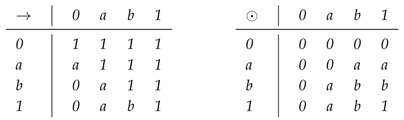 Then, (H, ⊙, →, 1) is a hoop. Define the fuzzy set λ in H by , , and . Then, λ is an -fuzzy filter of H, and it is clear that λ is an -fuzzy filter of H.
Theorem 1.
A fuzzy set λ in H is an -fuzzy filter of H if and only if the following conditions hold:
Proof.
Let be an -fuzzy filter of H and such that . Since is an -fuzzy filter of H, by Definition 1, . Therefore, . Now, let . If and , then and . Since is an -fuzzy filter of H, we have , so:
Conversely, suppose and . If , then . Since , we have , and so, . Furthermore, if and , then by assumption,
Hence, . Therefore, is an -fuzzy filter of H. □
Proposition 2.
If λ is an -fuzzy filter of H, then the following statement holds.
Proof.
Let such that . Therefore, it is clear that . Since is an -fuzzy filter of H, by Theorem 1, and , for any . Then:
Hence, . □
Theorem 2.
A fuzzy set λ in H is an -fuzzy sub-hoop of H such that, for any , . Then, for any , the following statements are equivalent:
- λ is an -fuzzy filter of H,
- if and , then ,
- if and , then .
Proof.
Let be an -fuzzy filter of H such that and . Then, and . By Proposition 1(vii), . Then, by Proposition 2,
Since , we have . Thus, by (i),
Hence, .
- It is enough to let .
- Let be an -fuzzy filter of H such that and . Then, by Proposition 1(vi), . Thus, . By Proposition 2, , so:Hence, .
- It is enough to let . □
Theorem 3.
Let λ be an -fuzzy filter of H, , and . Define:
Then, is a congruence relation on H.
Proof.
It is clear that is reflexive and symmetric. Now, we prove that is transitive. For this, suppose and . Then, there exists such that , and also, . By Proposition 1(vii), , and by Proposition 2, we have:
Hence, . In a similar way, we get that:
Hence, . Therefore, . Suppose that . We show that , for any . Since , for any , we have . Since , . By Proposition 1(viii), , and so, . Since is an -fuzzy filter of H, by Proposition 2, we have:
Hence, . In a similar way, since , we get . By Proposition 1(viii), , and so, . Since is an -fuzzy filter of H, by Proposition 2, we have:
Hence, . Therefore, . Finally, suppose that ; we show that , for any . Since , for any , we have . By Proposition 1(vii) and Proposition 2,
and:
Hence, . It is easy to see that . Therefore, is a congruence relation on H. □
Theorem 4.
Let , and operations ⊗ and ⇝ on are defined as follows:
Then, is a hoop.
Proof.
We have and if and only if and . Since is the congruence relation on H, then all above operations are well-defined. Thus, by routine calculation, we can see that is a hoop. □
Now, we define a relation on by:
It is easy to see that is a poset.
Note: According to the definition of the congruence relation, it is clear that:
Therefore, as we define a relation on quotient, if and only if , it is similar to writing if and only if .
Theorem 5.
If λ is a non-zero -fuzzy filter of H, then the set:
is a filter of H.
Proof.
Let . Since , we conclude that there exists such that . Moreover, from being an -fuzzy filter of H, by Definition 1, , then . Hence, , and so, . Now, suppose that . Then, there exist , such that and , and so, and . Thus, by Definition 1, , and so, . Hence, . Therefore, is a filter of H. □
Proposition 3.
If λ is a non-zero -fuzzy filter of H, then .
Proof.
Let . Since is an -fuzzy filter of H, by Theorem 1, for any , . Hence, for any , , and so, is a zero -fuzzy filter of H, which is a contradiction. Therefore, . □
Theorem 6.
For any filter F of H and , there exists an -fuzzy filter λ of H such that its ∈-level set is equal to F.
Proof.
Let and be defined by , for any , and , otherwise. By this definition, it is clear that . Therefore, it is enough to prove that is an -fuzzy filter of H. Let . Then, or . Since F is a filter of H and , we have , for any . Now, suppose that and . We consider the following cases:
- Case 1: If and , then . Since F is a filter of H, we have , and so, . Hence, . Therefore, is an -fuzzy filter of H.
- Case 2: If and , then it is clear that:Hence, . Therefore, is an -fuzzy filter of H.
- Case 3: If and , then it is clear that:Hence, . Therefore, is an -fuzzy filter of H.
Therefore, in all cases, is an -fuzzy filter of H and . □
For any fuzzy set in H and , we define three sets that are called the ∈-level set, q-set, and -set, respectively, as follows.
Theorem 7.
Given a fuzzy set λ in H, the following statements are equivalent.
- (i)
- The nonempty ∈-level set of λ is a filter of H, for all .
- (ii)
- λ satisfies the following assertions.
Proof.
Let and such that . Then, . Since is a filter of H, . Thus, . Moreover, since , we have . Hence, . Now, suppose and such that and . Then, . Since is a filter of H, we have . Thus, . From , we conclude that,
Hence,
Conversely, let . Then, . Since , by assumption:
Thus, , so . Now, suppose that , for any and . Then, and . By assumption,
Since , we have , so . Hence, is a filter of H. □
It is clear that every -fuzzy filter of H is an -fuzzy filter of H. However, the converse may not be true, in general.
Example 2.
On the set , we define two operations ⊙ and → as follows:
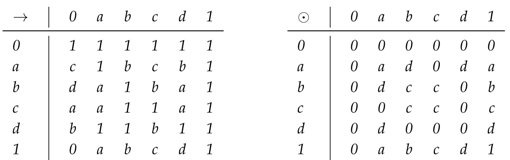 By routine calculations, it is clear that is a bounded hoop. Define a fuzzy set λ in H as follows:
It is easy to see that λ is an -fuzzy filter of hoop H, but it is not an -fuzzy filter of H; because:
However, it is not an -fuzzy filter of H.
By routine calculations, it is clear that is a bounded hoop. Define a fuzzy set λ in H as follows:
It is easy to see that λ is an -fuzzy filter of hoop H, but it is not an -fuzzy filter of H; because:
However, it is not an -fuzzy filter of H.
Now, we investigate under which conditions any -fuzzy filter is an -fuzzy filter.
Theorem 8.
If an -fuzzy filter λ of H satisfies the condition:
then λ is an -fuzzy filter of H.
Proof.
Let , for any and . Since is an -fuzzy filter of H, by Definition 1, or . If , then the proof is clear. If , then . Since , , then . Hence, . Now, suppose that and . From is an -fuzzy filter of H, by Definition 1, or . If , then the proof is complete. However, if , then , and so, . Since , we have , and so, . Then, . Therefore, is an -fuzzy filter of H. □
Theorem 9.
If λ is an -fuzzy filter of H, then the q-set is a filter of H, for all .
Proof.
Let , for any and . Then, , and so, . Since is an -fuzzy filter of H, by Definition 1, we have or . If , then it is clear that . Since , we have , and so, . If , then , and so, . Thus, in both cases, . Now, suppose that , for any and . Then, and , and so, and . Since is an -fuzzy filter of H, by Definition 1, we have or . If , then , and so, . If , then , and so, . Since , we have . Hence, in both cases, . Therefore, is a filter of H, for any . □
Theorem 10.
A fuzzy set λ in H is an -fuzzy filter of H if and only if the following assertion is valid.
Proof.
Let , for any and . Since is an -fuzzy filter of H, we have or . It means that or . Therefore, . In a similar way, if and , for any and , since is an -fuzzy filter of H, then we have or . This means that or . Therefore, . Conversely, let , for any and . Then, by assumption, we have . If , then , and so, . If , then , and so, ; thus, . Hence, . Now, suppose that and , for any and . Then, by assumption, we have . If , then:
Hence, . If , then:
Therefore, . Thus, . Hence, . Therefore, is an -fuzzy filter of H. □
Theorem 11.
A fuzzy set λ in H is an -fuzzy filter of H if and only if the non-empty ∈-level set of λ is a filter of H, for all .
Proof.
Let be an -fuzzy filter of H and , for any . Then, , and so, . Since is an -fuzzy filter of H, or . If , then it is clear that , and if , then . Since , , so . Thus, . Now, suppose that , then and , and so, and . Since is an -fuzzy filter of H, or . If , then it is clear that , and if , then . Since , , so . Thus, . Therefore, is a filter of H, for any .
Conversely, suppose is a filter of H and , for any and . Then, , so . Since is a filter of H, , so . Hence, , and so, . Now, let and , for any and . Then, and , and so, . Since is a filter of H, , and so, . Hence, . Therefore, . Therefore, is an -fuzzy filter of H, for any . □
Theorem 12.
A fuzzy set λ in H is an -fuzzy filter of H if and only if the following assertion is valid.
Proof.
Assume that is an -fuzzy filter of H and . Then, by Theorem 11, is a filter of H, for any . If and , then . Thus, . If , it is clear that . Now, suppose . If and , then . Since is a filter of H, . Thus, , for . If , then .
Conversely, let be a fuzzy set in H that satisfies the condition (12). Since for all , we have for all . Since for all , we get:
for all . It follows from Theorem 10 that is an -fuzzy filter of H. □
Theorem 13.
A fuzzy set λ in H is an -fuzzy filter of H if and only if is a filter of H, for all (we call an -level filter of λ).
Proof.
Let be an -fuzzy filter of H and , for any and . Then, or . This means that or . Since is an -fuzzy filter of H, we have, if , then or . Furthermore, if , then or ; this means that or . Hence, in both cases, , and so, . In a similar way, let , for and . Then, or or and . Therefore, we have the following cases:
- Case 1: if , then and . Since is an -fuzzy filter of H, or . Therefore, .
- Case 2: if , then and . Since is an -fuzzy filter of H, or . It is equivalent to or , respectively. Therefore, .
- Case 3: if and , then and . Since is an -fuzzy filter of H, , and so, it is equal to or . Thus, in both cases, .
Therefore, is a filter of H.
Conversely, let , for any and . Since is a filter of H, . Then, . Now, suppose that and , for any and . Then, it is clear that . Since is a filter of H, . Therefore, or . Hence, . Therefore, is an -fuzzy filter of H. □
Theorem 14.
Let be a homomorphism of hoops. If λ and μ are -fuzzy filters of H and K, respectively, then:
- (i)
- is an -fuzzy filter of H.
- (ii)
- If f is onto and λ satisfies the condition:then is an -fuzzy filter of K.
Proof.
Let , for any and . Then, . Since is an -fuzzy filter of H, we have . Thus, . Now, suppose and , for any and . Then, and . Since is an -fuzzy filter of H, we have . Hence, . Therefore, is an -fuzzy filter of H.
Let and be such that . Then, . By assumption, there exists such that . Then, . Since is an -fuzzy filter of H, we have . Now, , so , then or . Thus, . In a similar way, let and be such that and . Then, and . By assumption, there exist and such that and . Then, and . Since is an -fuzzy filter of H, we have . Now, , so , then or . Thus, . □
Theorem 15.
Let λ be an -fuzzy filter of H such that:
Then, there exist two -fuzzy filters μ and ν of H such that:
- (i)
- .
- (ii)
- and have at least two elements.
- (iii)
- μ and ν do not have the same family of -level filters.
Proof.
Let where and . Then, the chain of -level filters of is:
Define two fuzzy sets and in H by:
and:
respectively, where . Then, and are -fuzzy filters of H, and and . The chains of -level filters of and are given by:
respectively. It is clear that . This completes the proof.
□
4. Conclusions
Our aim was to define the concepts of -fuzzy filters and -fuzzy filters of hoops, and we discussed some properties and found some equivalent definitions of them. Then, we defined a congruence relation on the hoop by an -fuzzy filter of the hoop and proved that the quotient structure of this relation is a hoop. For future works, we will introduce -fuzzy (positive) implicative filters for of hoops, investigate some of their properties, and try to find some equivalent definitions of them. Furthermore, we study the relation between them. Moreover, we can investigate the corresponding quotients.
Author Contributions
The authors had the same contributions to complete the paper.
Funding
This research received no external funding.
Acknowledgments
The authors wish to thank the anonymous reviewers for their valuable suggestions.
Conflicts of Interest
The authors declare no conflicts of interest.
References
- Bosbach, B. Komplementäre Halbgruppen, Axiomatik und Arithmetik. Fundam. Math. 1969, 64, 257–287. [Google Scholar] [CrossRef]
- Bosbach, B. Komplementäre Halbgruppen, Kongruenzen and Quotienten. Fundam. Math. 1970, 69, 1–14. [Google Scholar] [CrossRef]
- Alavia, S.Z.; Borzooei, R.A.; Aaly Kologani, M. Fuzzy filters in pseudo hoops. J. Intell. Fuzzy Syst. 2017, 32, 1997–2007. [Google Scholar] [CrossRef]
- Alavia, S.Z.; Borzooei, R.A.; Aaly Kologani, M. Filter theory of pseudo hoop-algebras. Ital. J. Pure Appl. Math. 2017, 37, 619–632. [Google Scholar]
- Aaly Kologani, M.; Borzooei, R.A. On ideal theory of hoops. Mathematica Bohomica 2019. [Google Scholar] [CrossRef]
- Blok, W.J.; Ferreirim, I.M.A. On the structure of hoops. Algebra Universalis 2000, 43, 233–257. [Google Scholar] [CrossRef]
- Blok, W.J.; Ferreirim, I.M.A. Hoops and their implicational reducts. Log. Comput. Sci. 1993, 28, 219–230. [Google Scholar]
- Borzooei, R.A.; Aaly Kologani, M. Filter theory of hoop-algebras. J. Adv. Res. Pure Math. 2014, 6, 72–86. [Google Scholar] [CrossRef]
- Borzooei, R.A.; Varasteh, H.R.; Borna, K. Fundamental hoop-algebras. Ratio Math. 2015, 29, 25–40. [Google Scholar]
- Namdar, A.; Borzooei, R.A. Nodal filters in hoop algebras. Soft Comput. 2018, 22, 7119–7128. [Google Scholar] [CrossRef]
- Ghorbani, S. Localization of hoop-algebras. J. Adv. Res. Pure Math. 2013, 5, 1–13. [Google Scholar] [CrossRef]
- Luo, C.F.; Xin, X.L.; He, P. n-fold (positive) implicative filters of hoops. Ital. J. Pure Appl. Math. 2017, 38, 631–642. [Google Scholar]
- Khorami, R.T.; Saeid, A.B. Some unitary operators on hoop-algebras. Fuzzy Inf. Eng. 2017, 9, 205–223. [Google Scholar] [CrossRef]
- Zander, M.A. Decomposability of the finitely generated free hoop residuation algebra. Stud. Log. 2008, 88, 233–246. [Google Scholar] [CrossRef]
- Pu, P.M.; Liu, Y.M. Fuzzy topology I, Neighborhood structure of a fuzzy point and Moore-Smith convergence. J. Math. Anal. Appl. 1980, 76, 571–599. [Google Scholar]
- Jun, Y.B. On (α, β)-fuzzy subalgebras of BCK/BCI-algebras. Bull. Korean Math. Soc. 2005, 42, 703–711. [Google Scholar] [CrossRef]
- Allen, P.J.; Kim, H.S.; Neggers, J. Smarandache disjoint in BCK/d-algebras. Sci. Math. Jpn. 2005, 61, 447–449. [Google Scholar]
- Allen, P.J.; Kim, H.S.; Neggers, J. On companion d-algebras. Math. Slovaca 2007, 57, 93–106. [Google Scholar] [CrossRef]
- Allen, P.J.; Kim, H.S.; Neggers, J. Deformations of d/BCK-algebras. Bull. Korean Math. Soc. 2011, 48, 315–324. [Google Scholar] [CrossRef]
- Lee, Y.C.; Kim, H.S. On d-subalgebras of d-transitive d*-algebras. Math. Slovaca 1999, 49, 27–33. [Google Scholar]
- Neggers, J.; Kim, H.S. On d-Algebras. Math. Slovaca 1999, 49, 19–26. [Google Scholar]
- Neggers, J.; Jun, Y.B.; Kim, H.S. On d-ideals in d-algebras. Math. Slovaca 1999, 49, 243–251. [Google Scholar]
- Georgescu, G.; Leustean, L.; Preoteasa, V. Pseudo-hoops. J. Mult.-Valued Log. Soft Comput. 2005, 11, 153–184. [Google Scholar]
© 2019 by the authors. Licensee MDPI, Basel, Switzerland. This article is an open access article distributed under the terms and conditions of the Creative Commons Attribution (CC BY) license (http://creativecommons.org/licenses/by/4.0/).