


Abstract
In this paper, we study a nonisospectral semi-discrete Ablowitz–Kaup–Newell–Segur equation. Multisoliton solutions for this equation are given by Hirota’s method. Dynamics of some soliton solutions are analyzed and illustrated by asymptotic analysis. Multisoliton solutions and dynamics to a nonisospectral semi-discrete modified Korteweg-de Vries equation are also discussed.
1. Introduction
Nonisospectral integrable system [1,2,3] has attracted a great deal of interest and has been studied for many years from various view points, such as integrability and exact solutions. Compared with the isospectral integrable system, a nonisospectral integrable system is usually related to time-dependent spectral parameters and has time-varying solitary wave solutions. In general, depending on the linear problems, a nonisospectral integrable hierarchy can be derived from the Lax equation, zero curvature equation, or in the frame of Kac–Moody algebra, etc. [4,5,6]. The nonisospectral flows play the role of master symmetries and can be applied to generate time-dependent symmetries [7,8]. With regard to solutions for the nonisospectral integrable system, various of approaches have been developed, such as Inverse Scattering Transform, Bäcklund transformation, Darboux transformation, Hirota’s method, and the Wronskian technique [9,10,11,12,13].
In recent decades, the semi-discrete integrable system, i.e., the system given by an integrable partial differential-difference equation, has become an increasingly popular topic. Some prototypical examples include Toda lattice, Volterra lattice, semi-discrete nonlinear Schrödinger equation, semi-discrete modified Korteweg–de Vries (mKdV) equation, and so on. Such type of equations relate to many branches of mathematical theories and and play a central role in many fields. For instance, the semi-discrete nonlinear Schrödinger equation (also known as the self-trapping equation) has a number of applications in molecular physics, nonlinear optics, and in other fields [14,15]. The semi-discrete mKdV equation arises in a wide variety of fields, such as plasma physics, electromagnetic waves in ferromagnetic, antiferromagnetic, or dielectric systems.
Generally speaking, a continuous equation could have several discrete versions upon the discretisation procedure. Until now, many results for semi-discrete Ablowitz–Kaup–Newell–Segur (AKNS) type equations have been derived [16,17,18,19,20,21]. In [22] (see also [23]), Ablowitz and Ladik propose a semi-discrete spectral problem, called the Ablowitz–Ladik spectral problem,
with spectral parameter and potentials and . The spectral problem (1) can be viewed as a semi-discrete counterpart of the famous AKNS spectral problem [24]. By imposing time evolution,
then, by zero curve equation , the Ablowitz–Ladik lattice hierarchy can be derived. When , the corresponding hierarchy is called nonisospectral Ablowitz–Ladik lattice hierarchy [25]. The spectral problem (1), coupled with different time evolution parts, has provided Lax integrabilities for many nonisospectral semi-discrete integrable systems, such as a nonisospectral semi-discrete nonlinear Schrödinger equation, nonisospectral semi-discrete mKdV equation, and so forth. Recently, starting from nonisospectral flows of the Ablowitz–Ladik lattice hierarchy, by suitable linear combinations, Zhang et al. get nonisospectral AKNS flows, which go to the continuous nonisospectral AKNS flows under a continuous limit [26].
Up to now, several works have been done to search for exact solutions for nonisospectral semi-discrete integrable systems. In [27,28], Inverse Scattering Transform was used to construct multisoliton solutions of the nonisospectral Ablowitz–Ladik hierarchy. Recently, N-soliton solutions to a nonisospectral Ablowitz–Ladik type equation have been investigated by using the Hirota’s method and Casorati technique [29]. In addition, based on Hankel type determinants, Chen et al. present solutions for a nonisospectral Toda lattice [30] as well as the first and second members in the nonisospectral extended Volterra lattice hierarchy [31].
In this paper, we are interested in the multisoliton solutions for the following nonisospectral semi-discrete AKNS equation [26]:
where the dependent variables u and v are defined on the discrete-continuous coordinates and shift operator is defined by . The inverse of the difference operator is defined by . By performing with , Equation (3) reduces to the nonisospectral semi-discrete mKdV equation
When , (4) is viewed as a plus type equation, while, when , (4) is viewed as a minus type equation. These two equations are related with each other by transformation . In what follows, we call Equation (3) by an nsd-AKNS equation, respectively and Equation (4) with the nsd-mKdV equation for short. We plan to solve the nsd-AKNS Equation (3) by applying Hirota’s method [32], which is a direct and effective approach to construct multisoliton solutions for the integrable systems. The idea is to make a transformation into new variables, so that, in these new variables, multisoliton solutions appear in a particularly simple form.
The outline of this paper is as follows: in Section 2, Hirota’s method is used to derive multisoliton solutions for the nsd-AKNS Equation (3). In Section 3, dynamics of the some soliton solutions are analyzed and illustrated by asymptotic analysis. Section 4 is devoted to the multisoliton solutions and dynamics of the nsd-mKdV Equation (4). Section 5 presents conclusions.
2. Bilinear Form and Multisoliton Solutions for nsd-AKNS Equation (3)
In this section, we transform the nsd-AKNS Equation (3) into bilinear form and present the multisoliton solutions in e-exponential series form.
Through the dependent variable transformation
Equation (3) is bilinearized as
where is an auxiliary variable and D is the well-known Hirota’s bilinear operator [32] defined by
To obtain multisoliton solutions, we expand , , and as
Substituting the above expansions into bilinear Equation (6), we can list the coefficients of each ,
Multisoliton solutions can be derived by taking
where , , , and are undetermined functions with respect to t.
When , it is obvious that
In addition, Equations (7b)–(10b) admit . Thus, from transformation (5), we obtain 1-soliton solution
where we have taken .
When , Equation (11) yields
Moreover, one can get
and , where
In this case, the truncated series
provide a 2-soliton solutions for Equation (3) through transformation (5), where we have taken .
In general, the N-soliton solutions can be given by (5) with
where and
and and take over all possible combinations of and satisfy the following constraints, respectively,
3. Dynamics of 1-Soliton Solution and 2-Soliton Solutions
To proceed, we consider the expressions of functions , and . For the first equation in (22a), one can find that is a solution if is a solution. By solving the differential Equations (22a) and (22b), we immediately have
where and are real constants. Here, and play the role of phase shifts. One has to assume that in order to guarantee the real properties of , and . Under the condition , one knows that and . In addition, one can recognize that as and as . Similar results also hold for functions and .
We now consider the dynamical properties of 1-soliton solution (16) and 2-soliton solutions (20). Without loss of generality, we only focus on the dynamics of , since behaves similarly. We first pay attention to in (16). For the sake of brevity, we denote and , i.e.,
Then, we can rewrite (16) as
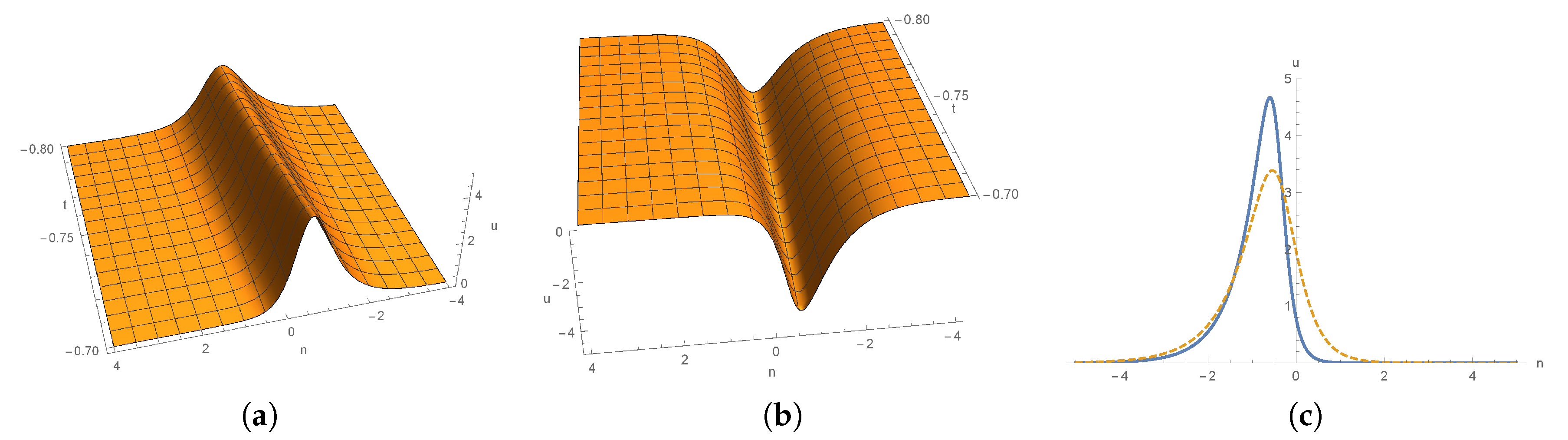
For , is nonsingular and provides a solitary wave because of the soliton part . Moreover, the part defines a time varying amplitude due to the nonisospectral effect. In terms of the sign of parameter , the amplitude of the wave can be positive or negative, which corresponds to soliton or anti-soliton. The top trace is given by the point trace
Furthermore,
implies the time-varying velocity of the wave. We illustrate this soliton in Figure 1.
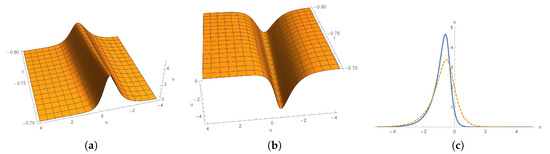
Figure 1.
Shape and motion of 1-soliton given by (26) for and . (a) soliton solution for and ; (b) anti-soliton solution for and ; (c) waves in blue (solid line) and yellow (dotted line) stand for plot (a) at and , respectively.
It is worth noting that this soliton is not in a symmetric shape when . This is because, for any fixed t,
This phenomenon is very similar to the solitons’ behavior of negative order AKNS equation [33].
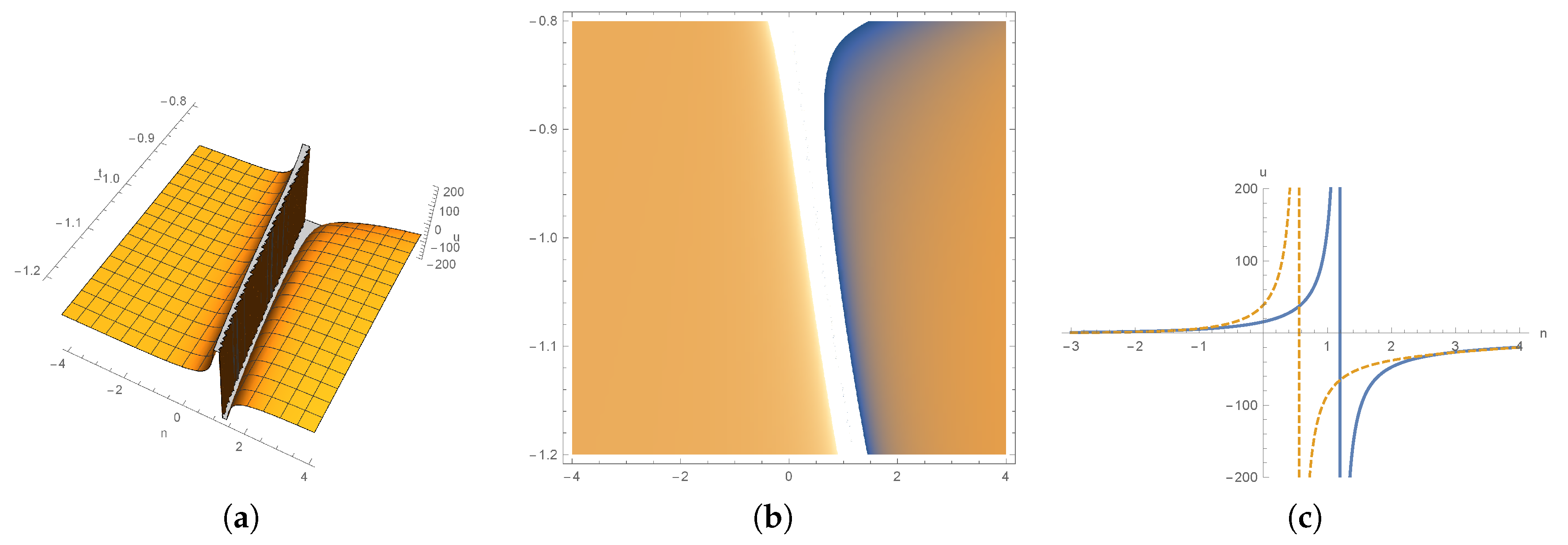
For , has singularity along the point trace (27) and the velocity is still expressed by (28). We depict this solution in Figure 2.
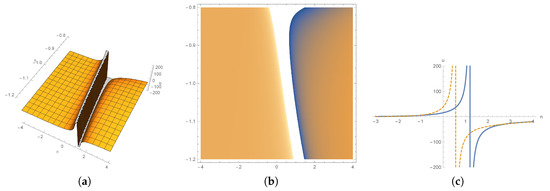
Figure 2.
given by (26) for and . (a) shape and motion; (b) a contour plot of (a) with range and ; (c) waves in blue (solid line) and yellow (dotted line) stand for plot (a) at and , respectively.
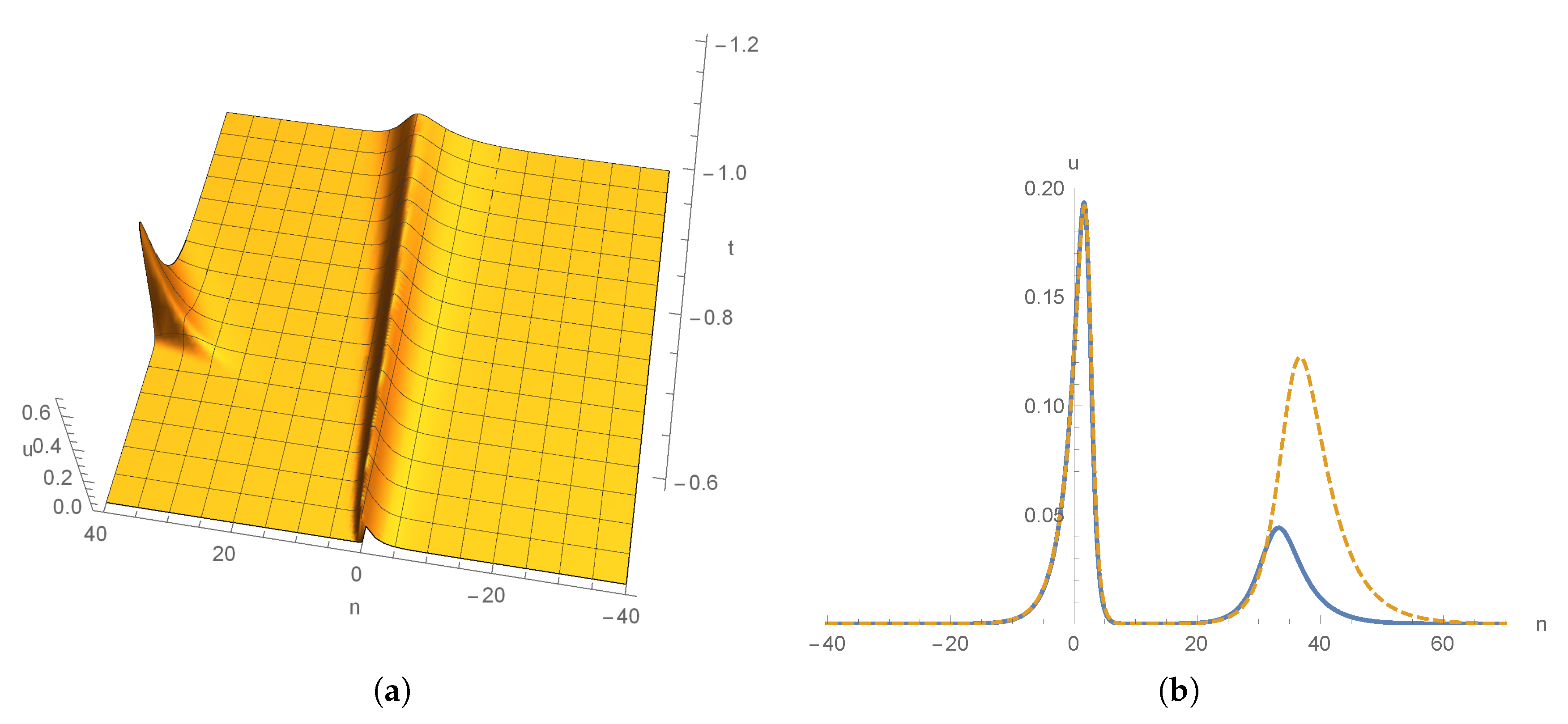
We next focus on given by (20). Since and are functions of t, it is intractable to make asymptotic analysis as usual [34]. Here, we only depict in Figure 3.
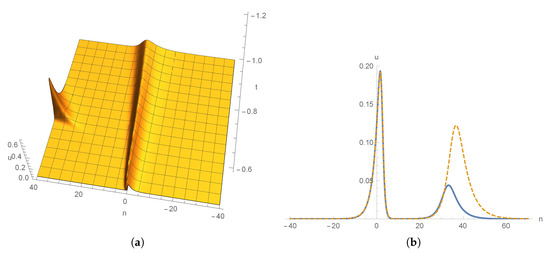
Figure 3.
2-soliton solutions for with and . (a) shape and motion; (b) waves in blue (solid line) and yellow (dotted line) stand for plot (a) at and , respectively.
4. Multisoliton Solutions for nsd-mKdV Equation (4) and Dynamics
The nsd-mKdV Equation (4) can be derived from the nsd-AKNS Equation (3) by imposing constraint , while it is difficult to derive its soliton solutions by imposing constraint since there is no linear relation between and . This can be demonstrated by the 1-soliton solution.
To derive the multisoliton solutions for the nsd-mKdV Equation (4), we take the dependent variable transformation
which yields the bilinear form for Equation (4)
Analogous to the previous analysis, one can successively derive 1-soliton, 2-soliton, and N-soliton solutions. The N-soliton solutions are given by
where and
and and are defined by (23).
Similarly, it is necessary to take . In terms of (25a), the 1-soliton solution can be expressed as
Obviously, solution (35) is nonsingular when and has singularity when . For , (35) provides a solitary wave with time varying amplitude . The top trace is given by the point trace
and the velocity is
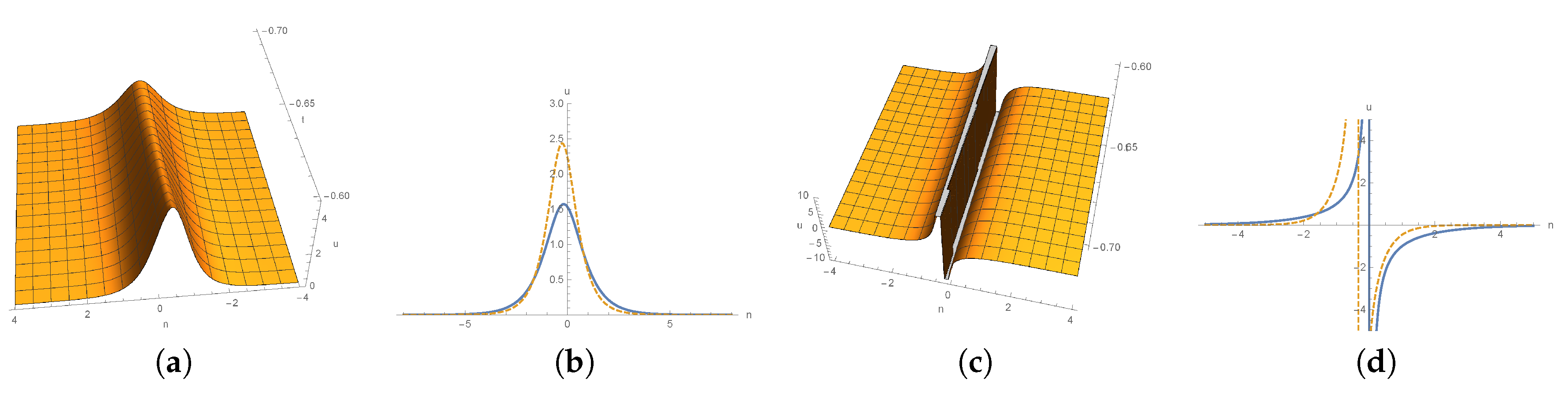
Figure 4a,c depict the solution (35) with and , respectively. Figure 4b shows the symmetric shape and the Gaussian-distributed structure with respect to n for a given t. Figure 4d exhibits the movement of the singularity point.
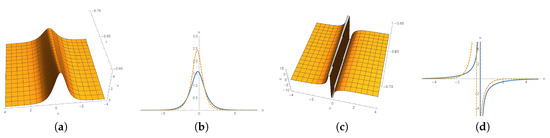
Figure 4.
given by (35) for and . (a) shape and motion with ; (b) waves in blue (solid line) and yellow (dotted line) stand for plot (a) at and , respectively; (c) shape and motion with ; (d) waves in blue (solid line) and yellow (dotted line) stand for plot (c) at and , respectively.
The 2-soliton solutions for nsd-mKdV Equation (4) read
in which
where , () and are given by (24a), (34) and (19c), respectively. In addition,
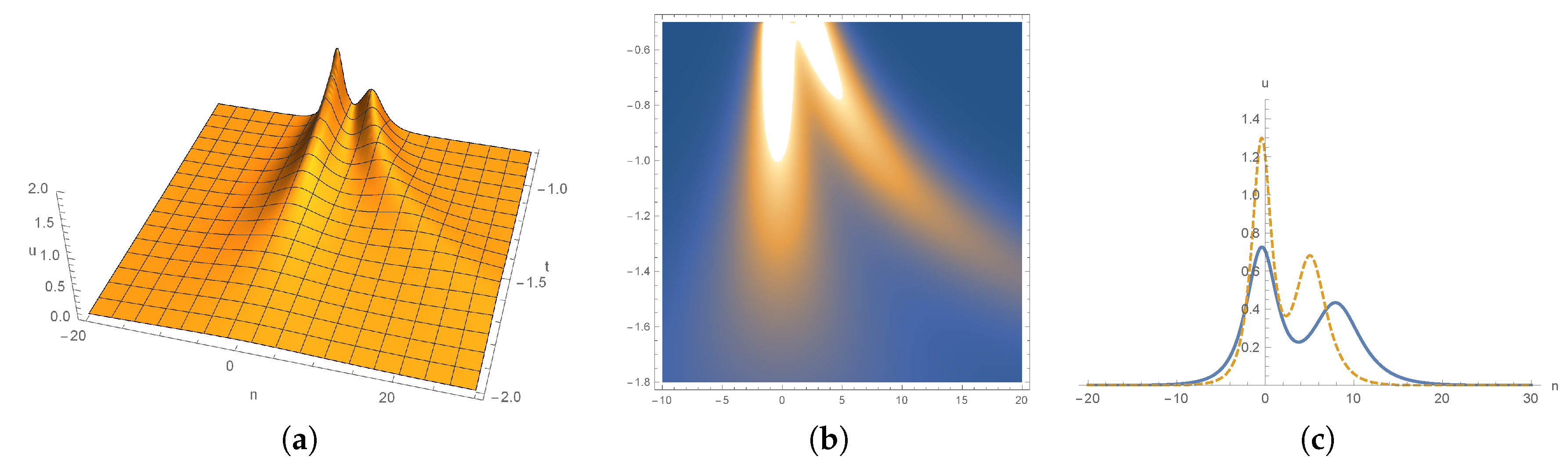
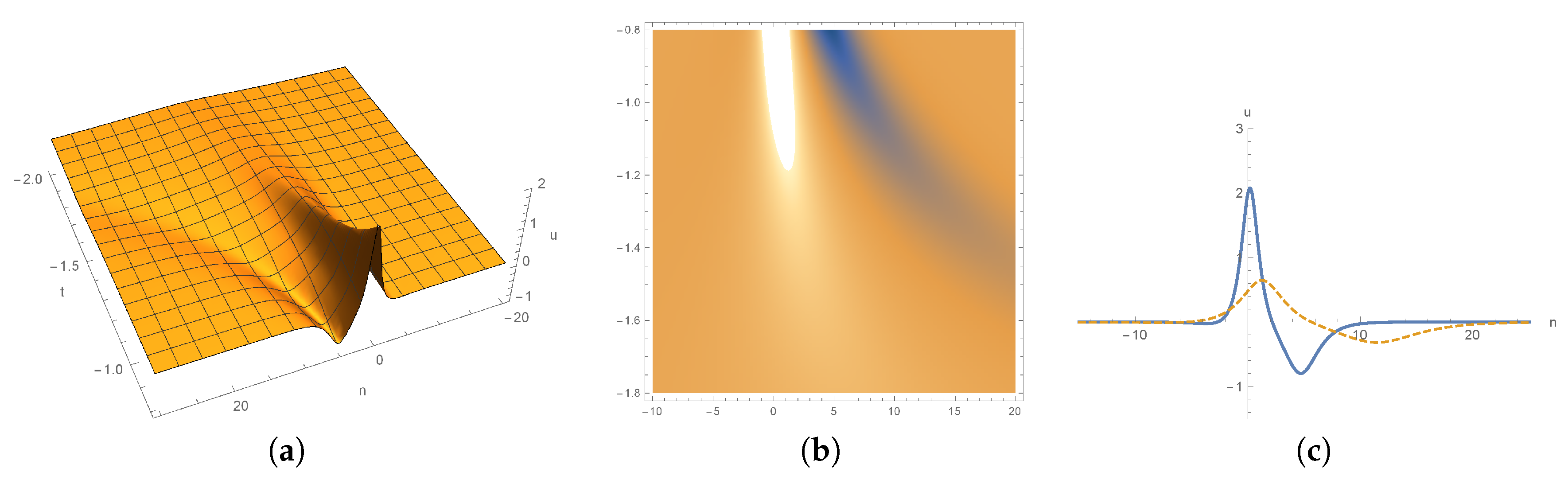
When , solution (38) is nonsingular. Figure 5 and Figure 6 depict soliton–soliton interaction, respectively, and soliton–anti-soliton interaction of the nsd-mKdV Equation (4) with .
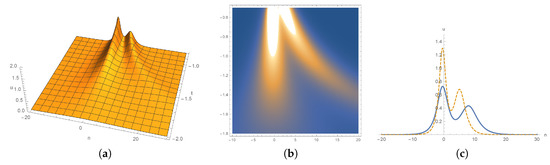
Figure 5.
given by (38) with for , and . (a) shape and motion; (b) a contour plot of (a) with range and ; (c) waves in blue (solid line) and yellow (dotted line) stand for plot (a) at and , respectively.
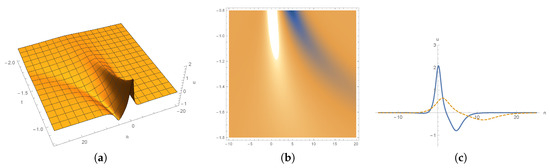
Figure 6.
given by (38) with for , , and . (a) shape and motion; (b) a contour plot of (a) with range and ; (c) waves in blue (solid line) and yellow (dotted line) stand for plot (a) at and , respectively.
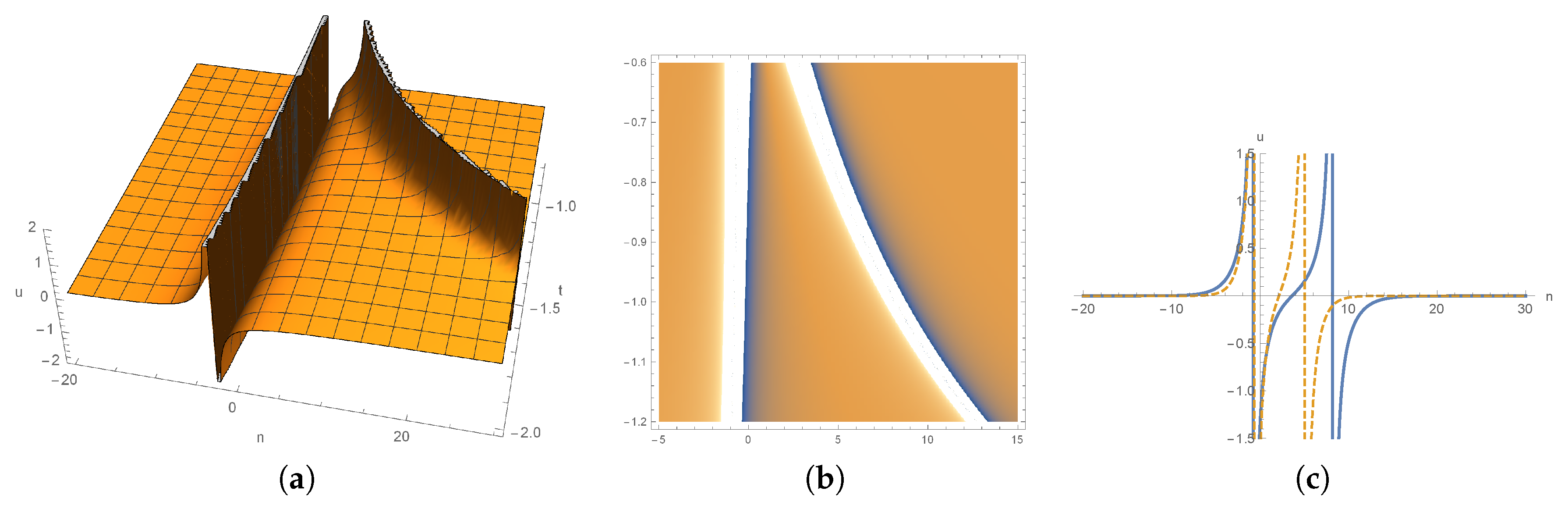
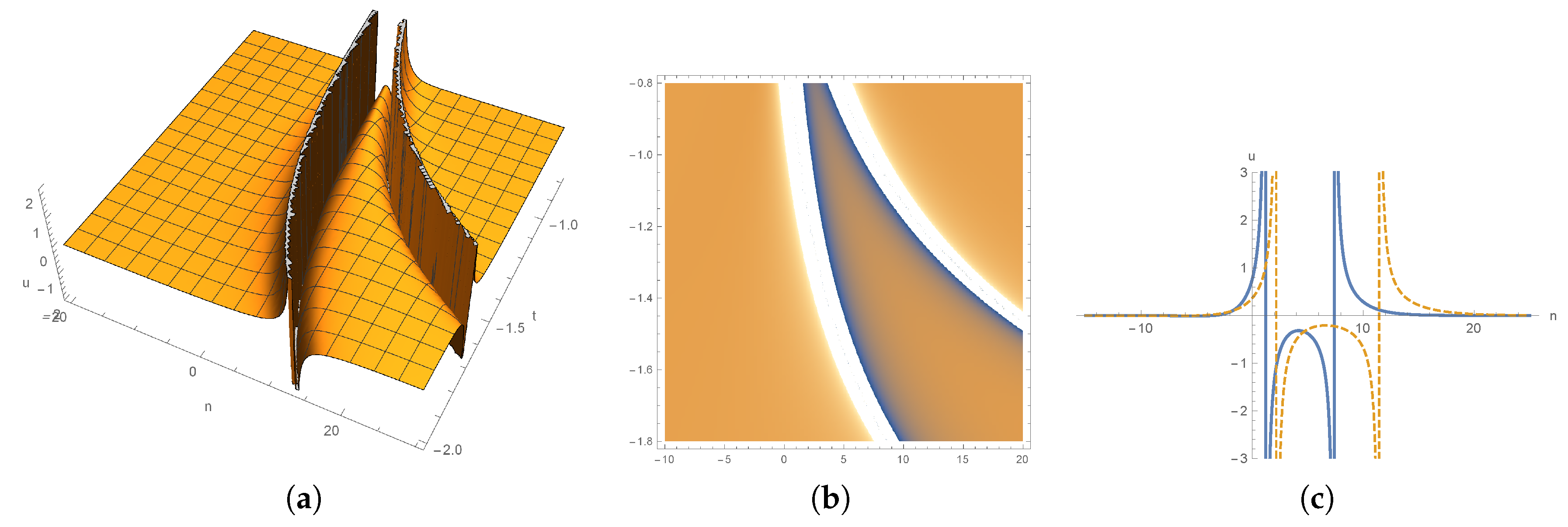
When , solution (38) has singularity, which appears at the point trace
Figure 7 and Figure 8 depict soliton–soliton interaction, respectively, soliton–anti-soliton interaction of the nsd-mKdV Equation (4) with .
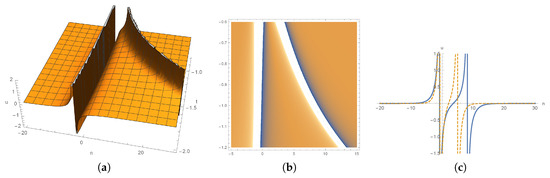
Figure 7.
given by (38) with for , and . (a) shape and motion; (b) a contour plot of (a) with range and ; (c) waves in blue (solid line) and yellow (dotted line) stand for plot (a) at and , respectively.
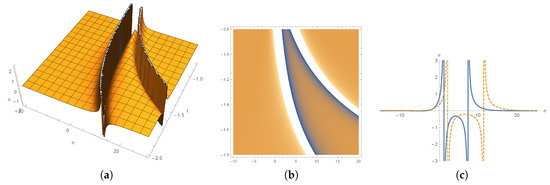
Figure 8.
given by (38) with for , , and . (a) shape and motion; (b) a contour plot of (a) with range and ; (c) waves in blue (solid line) and yellow (dotted line) stand for plot (a) at and , respectively.
5. Conclusions
In this paper, we have discussed the multisoliton solutions for nsd-AKNS Equation (3) by applying the Hirota’s method. Dynamical behaviors for some obtained soliton solutions are identified through asymptotic analysis. In terms of the sign of product , we present two kinds of 1-soliton solution for nsd-AKNS Equation (3). One is nonsingular and the other is singular. Nonisospectral effects on amplitude, top trace/singularity point trace, and velocity of these two 1-soliton solutions are analyzed emphatically. The nonsingular 1-soliton exhibits a nonsymmetric structure when . Since functions and depend on t, the asymptotic analysis on 2-soliton solutions to nsd-AKNS Equation (3) is not given in the present paper. With the help of Hirota’s method, we also present the multisoliton solutions to the nsd-mKdV Equation (4). For the plus type nsd-mKdV Equation (4) (), the resulting multisoliton solutions are nonsingular, while, for the minus type nsd-mKdV Equation (4) (), the resulting multisoliton solutions are singular. Although the multisoliton solutions to the nsd-mKdV Equation (4) have appeared in Refs. [27,28], there is little description on the dynamics of 1-soliton solutions. To understand the 2-soliton solutions better, we give some figures. The detailed discussion on the applications of the graphs will be given in the near future. We hope that the results given in this article might attract some attention in the areas of semi-discrete integrable system and nonisospectral integrable system. Particularly, this work will be beneficial to developing other approaches to study the multi-component nonisospectral semi-discrete integrable system.
Funding
This project is supported by the Natural Science Foundation of Zhejiang Province (Nos. LY18A010033, LY17A010024) and the National Natural Science Foundation of China (No. 11401529).
Acknowledgments
We are very grateful to the reviewers for the invaluable and expert comments.
Conflicts of Interest
The author declares no conflict of interest.
References
- Chen, H.; Liu, C.S. Solitons in nonuniform media. Phys. Rev. Lett. 1976, 37, 693–697. [Google Scholar] [CrossRef]
- Hirota, R.; Satsuma, J. N-soliton solution of the KdV equation with loss and nonuniformity terms. J. Phys. Soc. Jpn. 1976, 41, 2141–2142. [Google Scholar] [CrossRef]
- Calogero, F.; Degasperis, A. Conservation laws for classes of nonlinear evolution equations solvable by the spectral transform. Commun. Math. Phys. 1978, 63, 155–176. [Google Scholar] [CrossRef]
- Ma, W.X. An approach for constructing nonisospectral hierarchies of evolution equations. J. Phys. A Gen. Math. 1992, 25, L719–L726. [Google Scholar] [CrossRef]
- Ma, W.X. The algebraic structure of zero curvature representations and application to coupled KdV systems. J. Phys. A Gen. Math. 1993, 26, 2573–2582. [Google Scholar] [CrossRef]
- Ma, W.X. A simple scheme for generating nonisospectral flows from the zero curvature representation. Phys. Lett. A 1993, 179, 179–185. [Google Scholar] [CrossRef]
- Fuchssteiner, B. Master symmetries, higher order time-dependent symmetries and conserved densities of nonlinear evolution equations. Prog. Theor. Phys. 1983, 70, 1508–1522. [Google Scholar] [CrossRef]
- Ma, W.X.; Fuchssteiner, B. Algebraic structure of discrete zero curvature equations and master symmetries of discrete evolution equations. J. Math. Phys. 1999, 40, 2400–2418. [Google Scholar] [CrossRef]
- Gupta, M.R. Exact inverse scattering solution of a nonlinear evolution equation in a nonuniform media. Phys. Lett. A 1979, 72, 420–422. [Google Scholar] [CrossRef]
- Burtsev, S.P.; Zakharov, V.E.; Mikhailov, A.V. Inverse scattering method with variable spectral parameter. Theor. Math. Phys. 1987, 70, 227–240. [Google Scholar] [CrossRef]
- Zhang, D.J.; Chen, D.Y. Negatons, positons, rational-like solutions and conservation laws of the KdV equation with loss and nonuniformity terms. J. Phys. A Gen. Math. 2004, 37, 851–865. [Google Scholar] [CrossRef]
- Zhao, S.L.; Zhang, D.J.; Chen, D.Y. N-soliton solutions of non-isospectral derivative nonlinear Schrödinger equation. Chin. Phys. Lett. 2009, 26, 030202. [Google Scholar]
- Silem, A.; Zhang, C.; Zhang, D.J. Dynamics of three nonisospectral nonlinear Schrödinger equations. Chin. Phys. B 2019, 28, 020202. [Google Scholar] [CrossRef]
- Eilbeck, J.C.; Lomdah, P.S.; Scott, A.C. The discrete self-trapping equation. Physica D 1985, 16, 318–338. [Google Scholar] [CrossRef]
- Laedke, E.W.; Spatschek, K.H.; Turitsyn, S.K. Stability of discrete solitons and quasicollapse to intrinsically localized modes. Phys. Rev. Lett. 1994, 73, 1055–1059. [Google Scholar] [CrossRef]
- Cao, C.W.; Zhang, G.Y. Integrable symplectic maps associated with the ZS-AKNS spectral problem. J. Phys. A Math. Theor. 2012, 45, 265201. [Google Scholar] [CrossRef]
- Xue, L.L.; Liu, Q.P. A supersymmetric AKNS problem and its Darboux-Bäcklund transformations and discrete systems. Stud. Appl. Math. 2015, 135, 35–62. [Google Scholar] [CrossRef]
- Zhao, S.L. A discrete negative AKNS equation: Generalised Cauchy matrix approach. J. Nonlinear Math. Phys. 2016, 23, 544–562. [Google Scholar] [CrossRef]
- Chen, K.; Deng, X.; Zhang, D.J. Symmetry constraint of the differential-difference KP hierarchy and a second discretization of the ZS-AKNS system. J. Nonlinear Math. Phys. 2017, 24, 18–35. [Google Scholar] [CrossRef]
- Zhao, S.L.; Shi, Y. Discrete and semidiscrete models for AKNS equation. Z. Naturforsch. A 2017, 72, 281–290. [Google Scholar] [CrossRef]
- Zhao, S.L. Discrete potential Ablowitz–Kaup–Newell–Segur equation. J. Differ. Equ. Appl. 2019, 25, 1134–1148. [Google Scholar] [CrossRef]
- Ablowitz, M.J.; Ladik, J.F. Nonlinear differential-difference equations. J. Math. Phys. 1975, 16, 598–603. [Google Scholar] [CrossRef]
- Ablowitz, M.J.; Prinari, B.; Trubatch, A.D. Discrete and Continuous Nonlinear Schrödinger Systems; Cambridge University Press: Cambridge, UK, 2004. [Google Scholar]
- Ablowitz, M.J.; Kaup, D.J.; Newell, A.C.; Segur, H. Nonlinear-evolution equations of physical significance. Phys. Rev. Lett. 1973, 31, 125–127. [Google Scholar] [CrossRef]
- Zhang, D.J.; Ning, T.K.; Bi, J.B.; Chen, D.Y. New symmetries for the Ablowitz–Ladik hierarchies. Phys. Lett. A 2006, 359, 458–466. [Google Scholar] [CrossRef]
- Zhang, D.J.; Chen, S.T. Symmetries for the Ablowitz–Ladik hierarchy: II. Integrable discrete nonlinear Schrödinger equations anddiscrete AKNS hierarchy. Stud. Appl. Math. 2010, 125, 419–443. [Google Scholar] [CrossRef]
- Li, Q.; Chen, D.Y.; Zhang, J.B.; Chen, S.T. Solving the non-isospectral Ablowitz–Ladik hierarchy via the inverse scattering transform and reductions. Chaos Soliton Fractals 2012, 45, 1479–1485. [Google Scholar] [CrossRef]
- Li, Q.; Duan, Q.Y.; Zhang, J.B. Soliton solutions of the mixed discrete modified Korteweg Cde Vries hierarchy via the inverse scattering transform. Phys. Scr. 2012, 86, 065009. [Google Scholar] [CrossRef]
- Chen, S.T.; Chen, D.Y.; Li, Q.; Cheng, J.W. N-soliton-like and double Casoratian solutions of a nonisospectral Ablowitz–Ladik equation. Int. J. Mod. Phys. B 2016, 30, 1640008. [Google Scholar] [CrossRef]
- Chen, X.M.; Chang, X.K.; Su, J.Q.; Hu, X.B.; Yeh, Y.N. Three semi-discrete integrable systems related to orthogonal polynomials and their generalized determinant solutions. Nonlinearity 2015, 28, 2279–2306. [Google Scholar] [CrossRef]
- Chen, X.M.; Hu, X.B.; Hoissen, F.M. Non-isospectral extension of the Volterra lattice hierarchy, and Hankel determinants. Nonlinearity 2018, 31, 4393–4422. [Google Scholar] [CrossRef]
- Hirota, R. The Direct Method in Soliton Theory; Cambridge University Press: Cambridge, UK, 2004. [Google Scholar]
- Zhang, D.J.; Ji, J.; Zhao, S.L. Soliton scattering with amplitude changes of a negative order AKNS equation. Physica D 2009, 238, 2361–2367. [Google Scholar] [CrossRef]
- Hietarinta, J. Scattering of solitons and dromions. In Scattering: Scattering and Inverse Scattering in Pure and Applied Science; Pike, R., Sabatier, P., Eds.; Academic Press: London, UK, 2002; pp. 1773–1791. [Google Scholar]
Publisher’s Note: MDPI stays neutral with regard to jurisdictional claims in published maps and institutional affiliations. |
© 2020 by the author. Licensee MDPI, Basel, Switzerland. This article is an open access article distributed under the terms and conditions of the Creative Commons Attribution (CC BY) license (http://creativecommons.org/licenses/by/4.0/).