


Abstract
Trigonometric B-spline curves with shape parameters are equally important and useful for modeling in Computer-Aided Geometric Design (CAGD) like classical B-spline curves. This paper introduces the cubic polynomial and rational cubic B-spline curves using new cubic basis functions with shape parameter . All geometric characteristics of the proposed Trigonometric B-spline curves are similar to the classical B-spline, but the shape-adjustable is additional quality that the classical B-spline curves does not hold. The properties of these bases are similar to classical B-spline basis and have been delineated. Furthermore, uniform and non-uniform rational B-spline basis are also presented. and continuities for trigonometric B-spline basis and continuities for rational basis are derived. In order to legitimize our proposed scheme for both basis, floating and periodic curves are constructed. and models are also constructed using proposed curves.
1. Introduction
Splines are a kind of curve, initially evolved in the days prior to computer modeling. Geometric modeling refers to a set of techniques concerned mainly with developing efficient representations of geometric aspects of design. Therefore, geometric modeling is a fundamental part of all CAD (computer-aided design) tools. The basic geometric modeling approaches available to designers on the CAD system are: (1) Wireframe modeling, (2) curve modeling, (3) surface modeling, and (4) solid modeling.
In curve modeling, we deal with trigonometric Bézier-like [1,2,3,4,5], Q-Bézier [6], H-Bézier [7], Ball Bézier-like [8], S- Bézier-like [9], classical Bézier, B-spline, and NURBS curve, etc. Schoenberg introduced the trigonometric spline interpolation, spline interpolation of higher derivatives, interpolating spline as limit of polynomials, and Spline interpolation and best quadrature formulae in [10,11,12,13]. Lyche and Winther [14] proved a stable recurrence relation for trigonometric B-splines. Walz [15] constructed some identities for trigonometric B-splines with an application to curve design. The term B-spline (Basis spline) introduced is in [16,17,18]. The curves swarmed the area of Computer Aided Geometric Design (CAGD) in the middle of 1980s. In CAGD, trigonometric polynomials have also procured the great attention for and modeling, for example [19] proposed continuous trigonometric spline curves for data interpolation. The trigonometric Bézier-like curve with shape parameters based on new trigonometric basis function is proposed by [20]. Majeed and Faiza [21] proposed the curves and bases based on trigonometric B-spline for geometric modeling.
The quadratic trigonometric polynomial curve with continuity is introduced by [22]. It holds the basic properties of classical B-spline curves. Han [23] added cubic trigonometric B-spline curves on uniform and non-uniform knots with shape parameters to the literature. The application of the B-spline curve in Bio-modeling is given in [24]. Chouby and Ojha [25] introduced the quadratic spline curve with variable shape parameters. Pagani and Scott [26] proposed the sampling method for the reconstruction of curves and surfaces. Surface reconstruction by parallel curves is proposed by [27] with the application of fracture reconstruction.
Hu et al. [28] proposed a scheme based on -B-spline for the construction of rotational surface. Rational Bézier curves is proposed by [29] for the construction of frontal bone fracture. Yan and Liang [30] proposed algebraic-trigonometric blended spline curve (xyB curves). In the proposed curve, x and y are shape parameters to control the curve. Troll [31] proposed cubic trigonometric Bézier curves. A generation of convex polygon triangulation based on planted trivalent binary tree and ballot notation was proposed by [32]. SARACEVIC and SELİMİ [33] proposed the method for Catalan number decomposition in the expressions of the form . The authors in [34] have discussed the geometric effect of shape parameter introduced in [22,23]. The trigonometric cubic Bézier curve is proposed by [35] with shape parameters. Gang and Guo-Zhao [36] introduced interpolating -B-spline build on the new B-splines possessing global and local shape parameters.
This paper presents new trigonometric cubic B-spline basis functions acquiring shape parameter . The proposed basis and curves satisfy the basic properties and are continuous. Rational basis functions and curves are also derived at uniform and non-uniform knots. continuous rational curves are also derived in this paper. Validity and applicability of the proposed curves are checked by modeling the floating and periodic curves. In the end, the proposed curves are also used for and modeling. The objectives of the proposed research are:
- To derive new trigonometric B-spline basis functions with shape parameter ;
- To derive trigonometric rational B-spline and NURBS curves;
- To derive different continuities for basis and curve on uniform and non-uniform knots;
- To apply the derived curves for and modeling.
The rest of the paper is organized as follow. In Section 2, trigonometric B-spine bases have been constructed. Section 3, presents the modeling of cubic trigonometric B-spline curves with its application. Section 4 explains the construction of rational trigonometric B-spline and NURBS bases. The construction of rational trigonometric B-spline curves and geometric modeling with concluding remarks is explained in Section 5.
2. The Construction of Trigonometric B-Spline Basis
The proposed trigonometric cubic B-spline with as shape parameter on knot vector N is defined as:
The proposed cubic trigonometric B-spline functions possessing are defined as:
The basis functions can be defined on by replacing j by in Equation (1). The basis of the functions are:
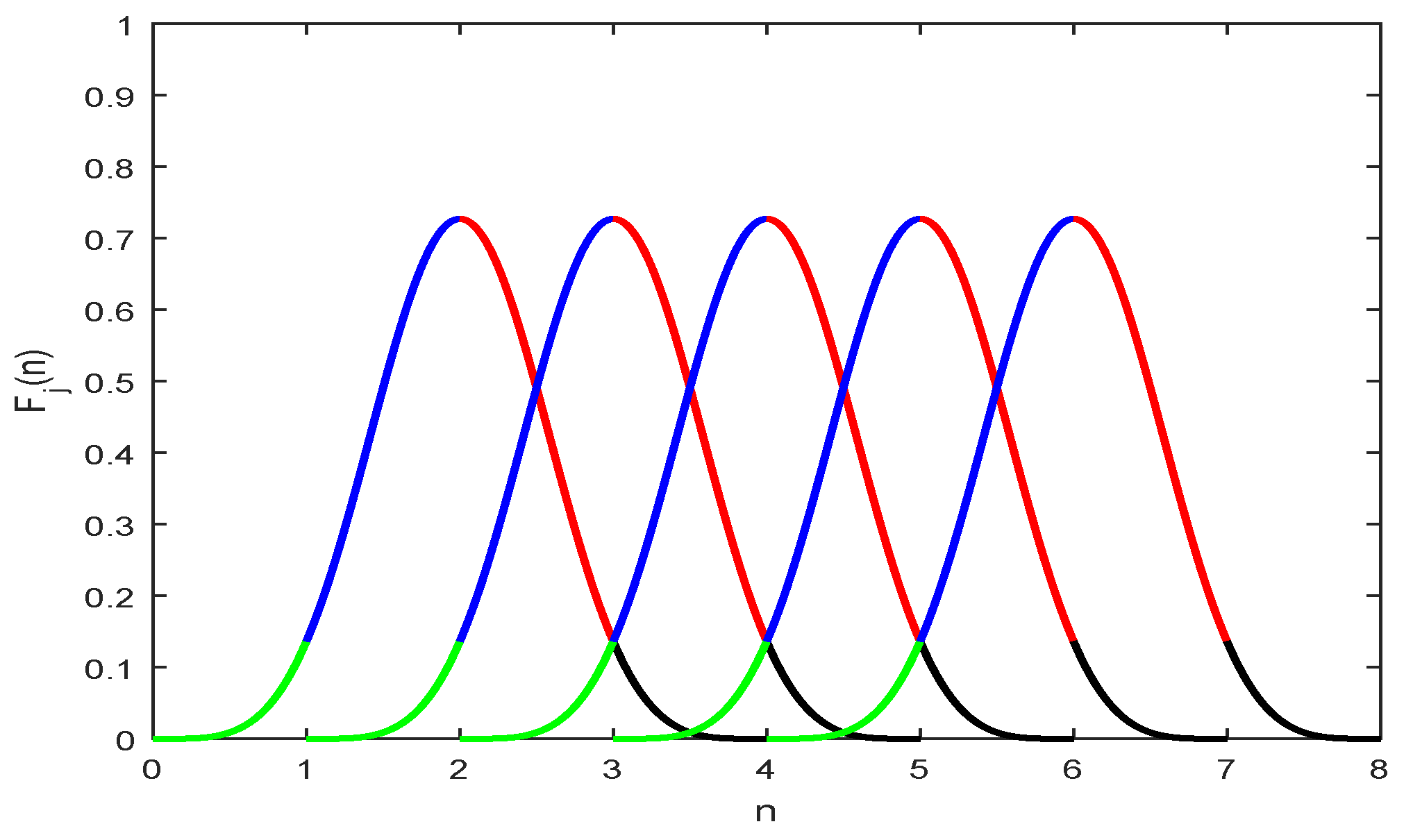
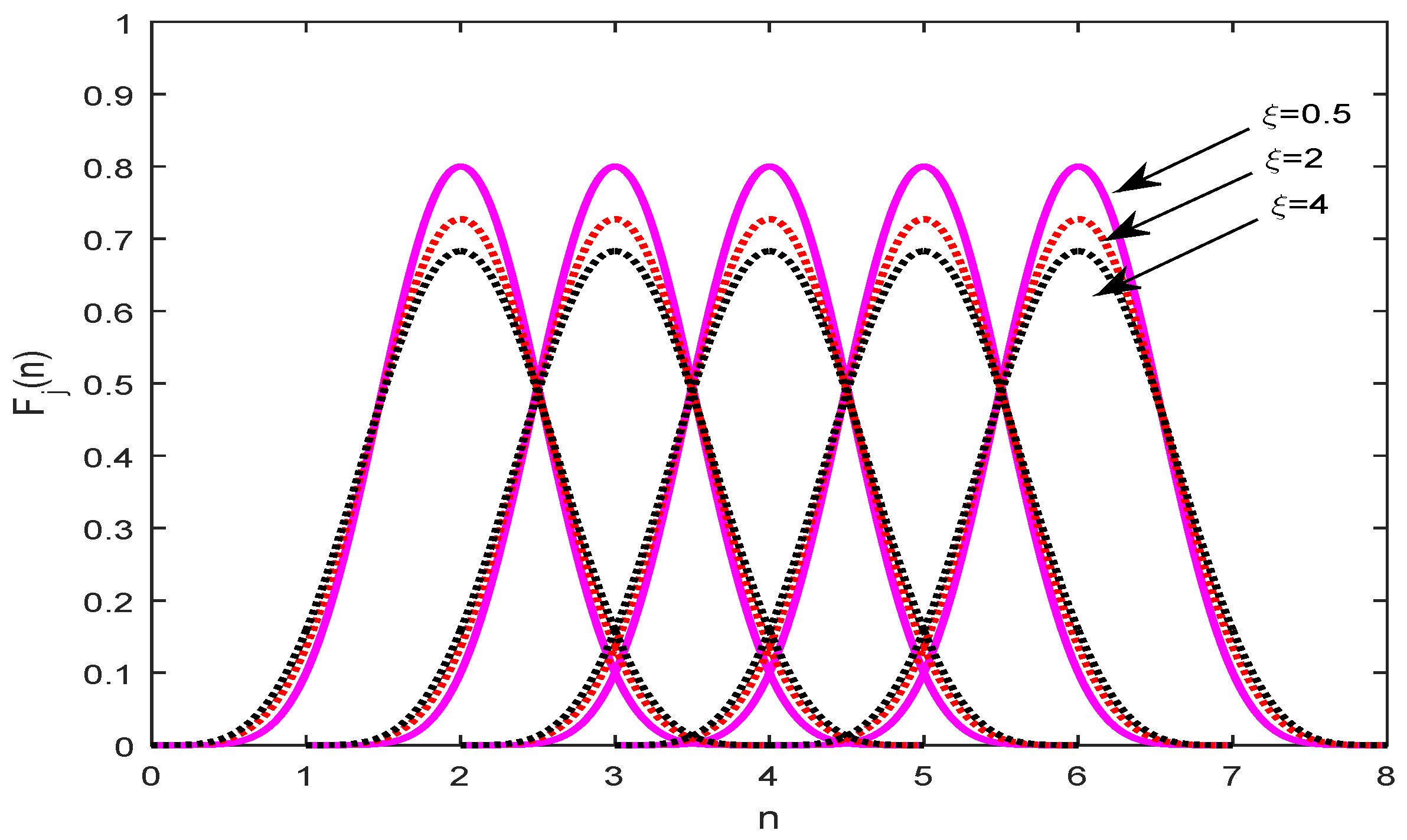
Figure 1 represents the graphical behavior of spline functions, where the effect of shape parameter is represented in Figure 2.
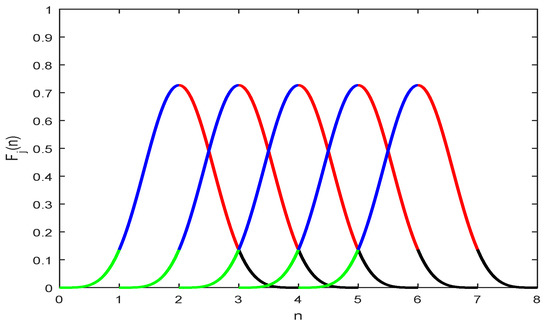
Figure 1.
Graphical behavior of the proposed trigonometric functions.
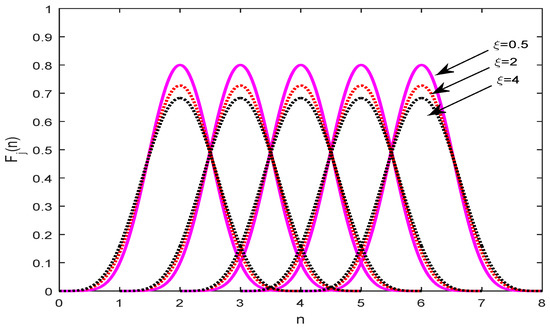
Figure 2.
The effect of shape parameter .
Properties of the Cubic Trigonometric Spline Functions
The following properties are satisfied by the proposed basis.
Theorem 1.
The proposed cubic trigonometric B-spline basis function satisfy the partition of unity property:
Proof of Theorem 1.
See Appendix A □
Theorem 2.
The cubic trigonometric B-spline basis holds non-negativity property i.e., .
Proof of Theorem 2.
See Appendix B □
Theorem 3.
The derived basis are and continuous for non-uniform knots.
Proof of Theorem 3.
See Appendix C □
3. Modeling of Cubic Trigonometric B-Spline Curves
Definition 1.
Let be the basis functions defined in Equation (5) above and for are control points in plane. The cubic trigonometric B-spline curve is defined as:
where,
and
3.1. Properties of Cubic Trigonometric B-Spline Curves
The following properties are obeyed by proposed curves.
3.1.1. Convex Hull Property
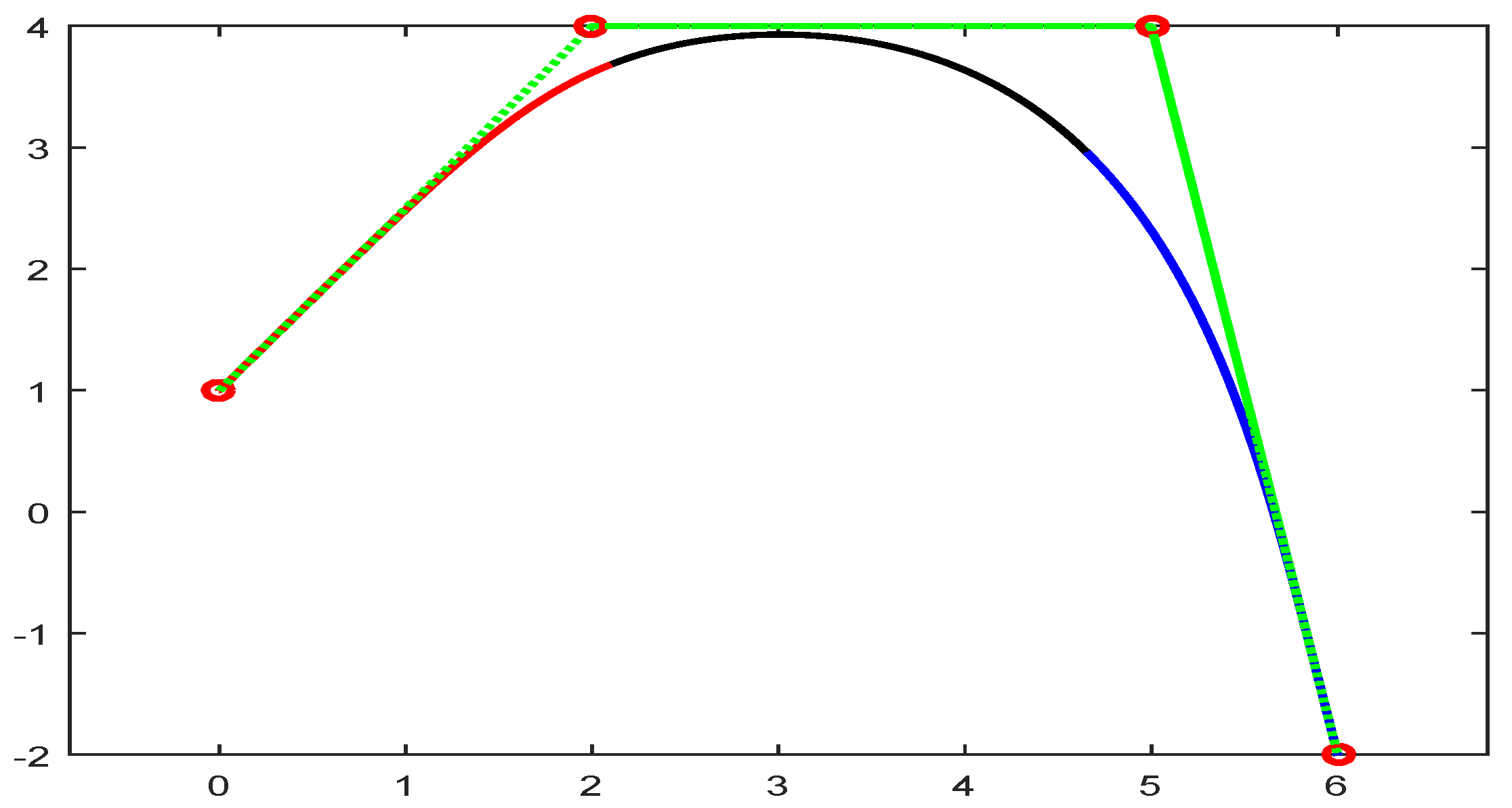
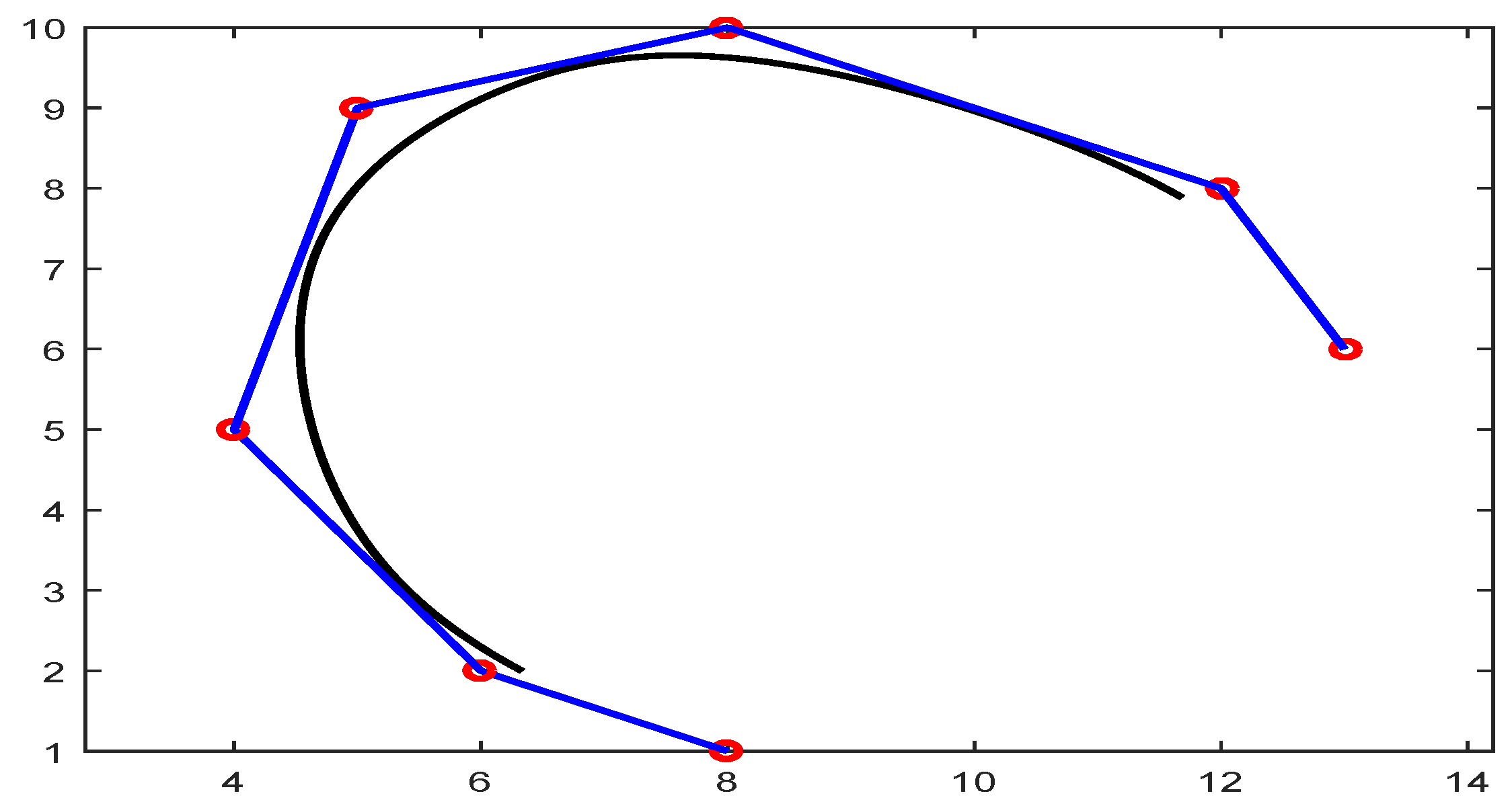
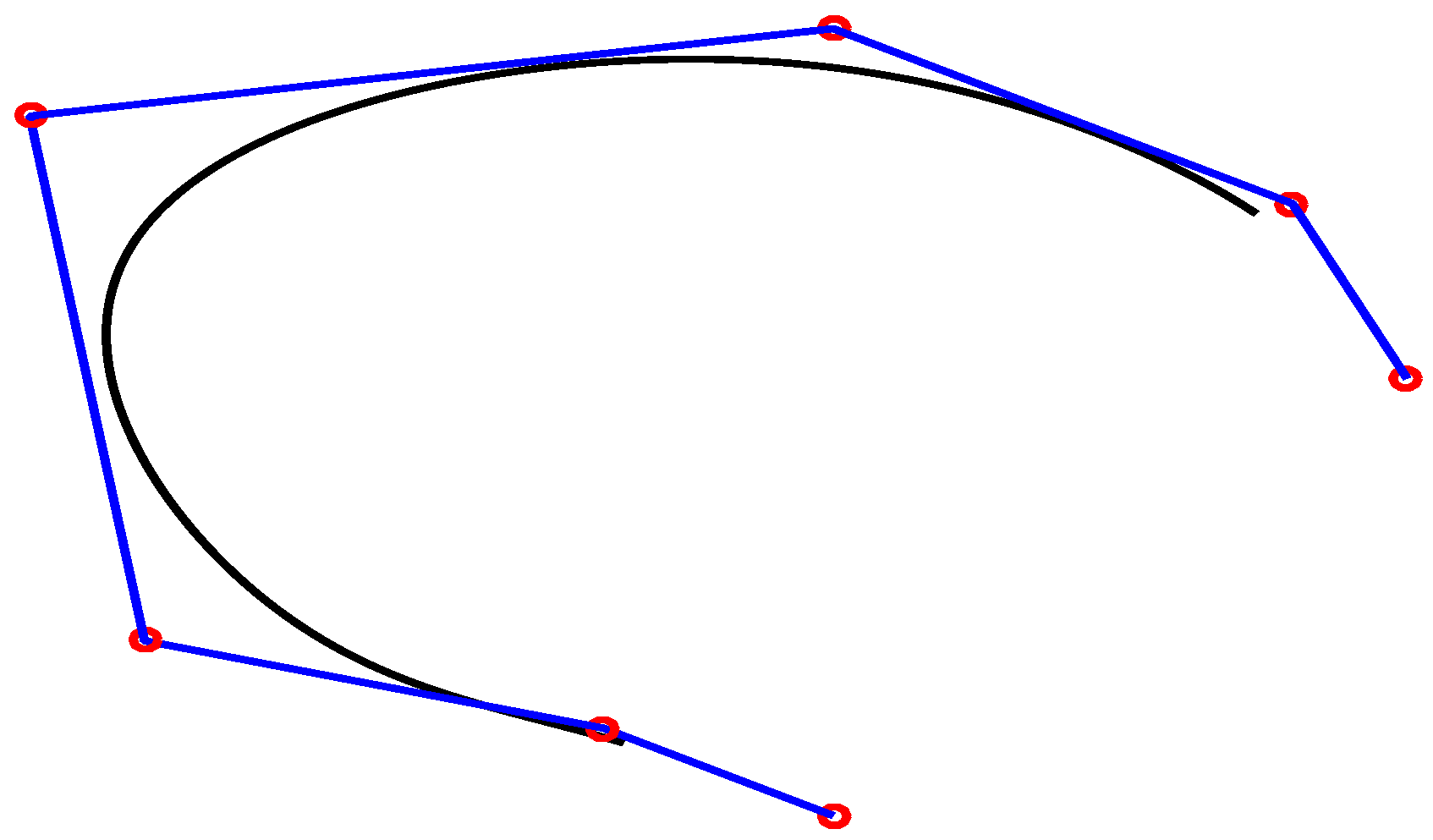
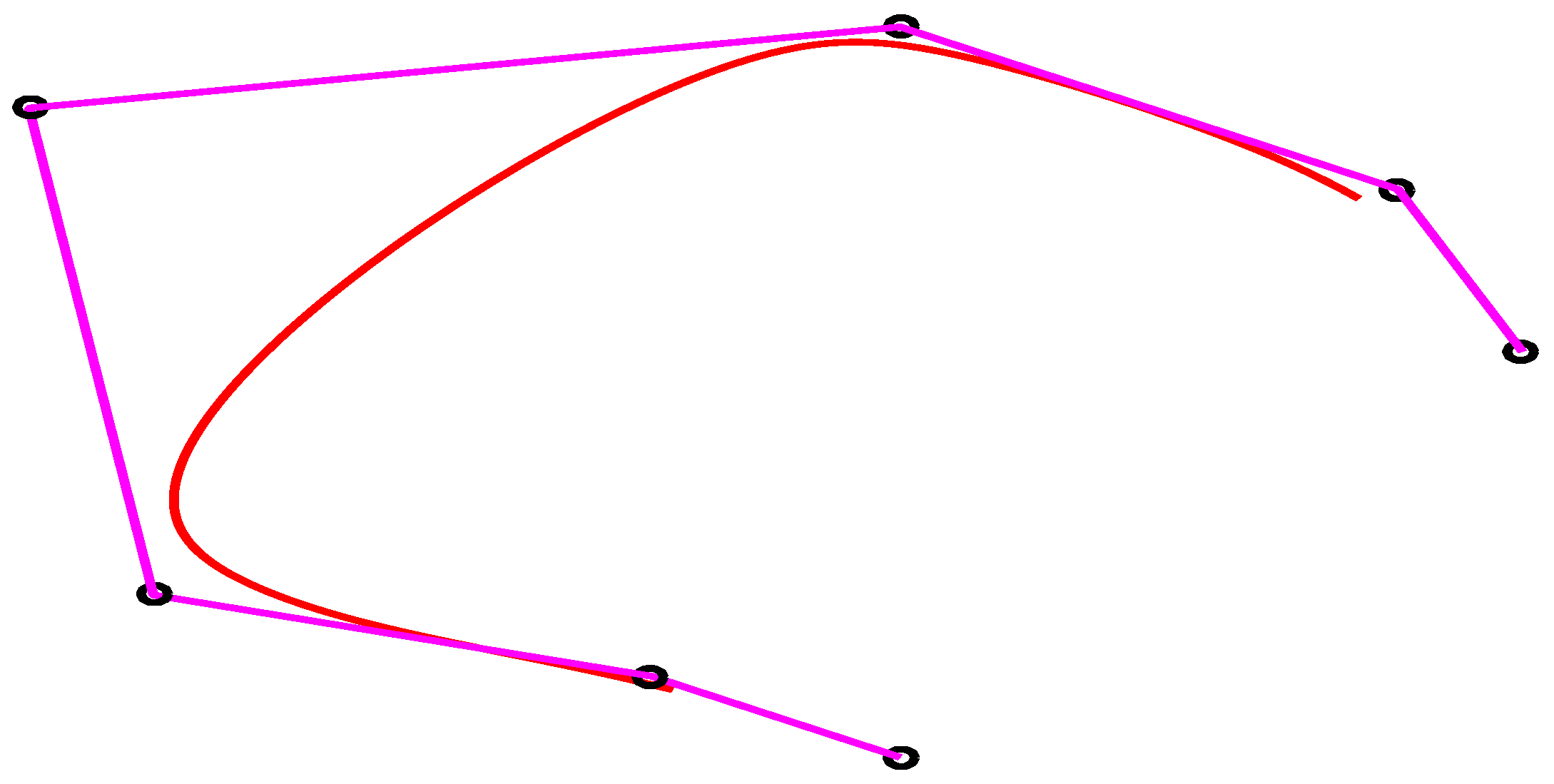
The constructed curves always lies within the convex hull of the control polygon as shown in Figure 3.
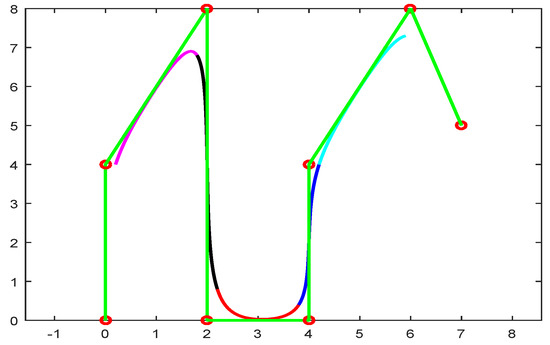
Figure 3.
Convex hull property.
3.1.2. Affine Transformation
The transformation may be of rotation, scaling, reflection, and translation. Let L be the transformation then:
Theorem 4.
The proposed curve possesses and continuity for . For multiple knots, the curve has continuity here .
Proof of Theorem 4.
See Appendix D □
3.2. Floating and Periodic Curves Using Proposed Trigonometric Basis Functions
3.2.1. Floating Cubic B-Spline Curve
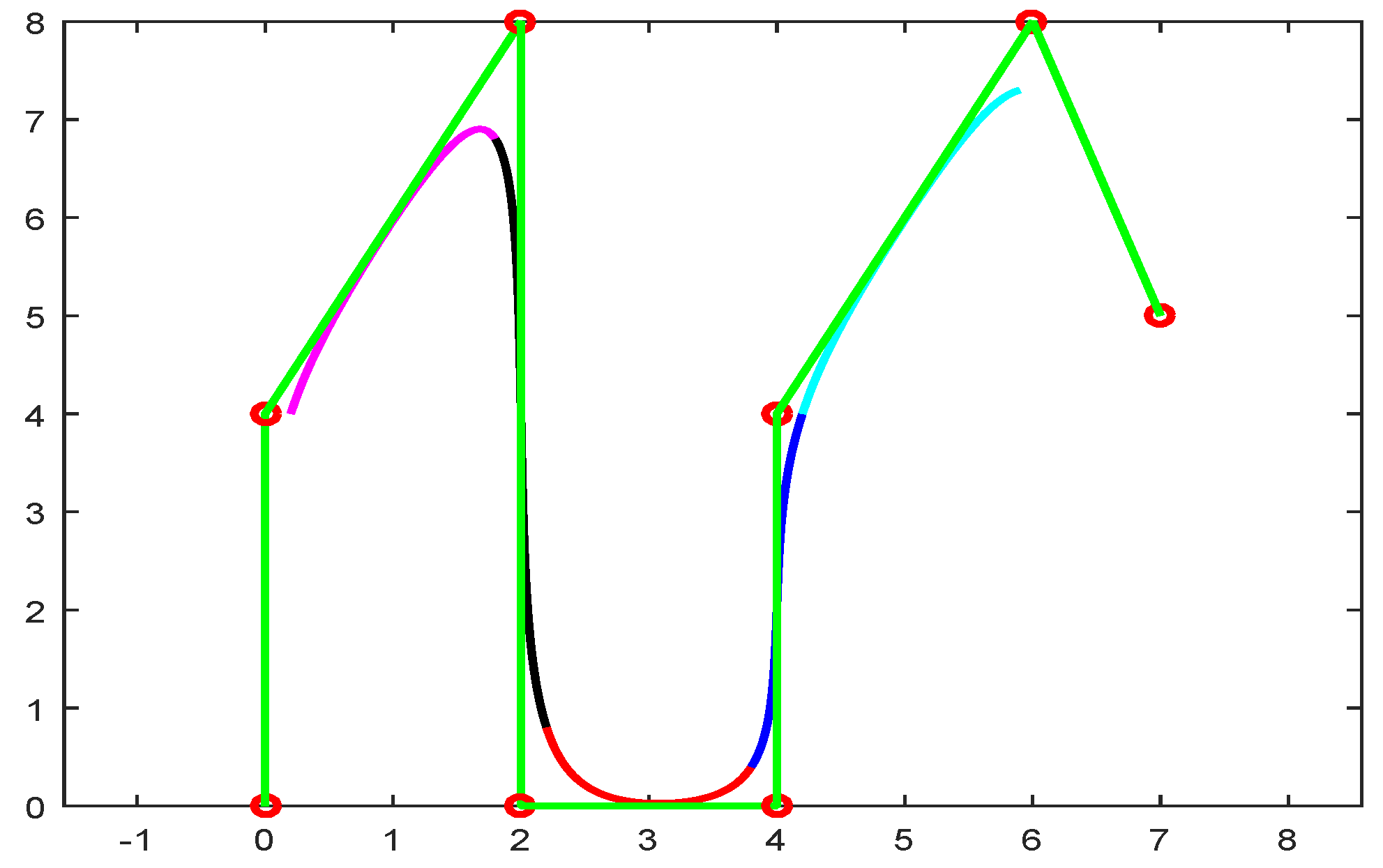
The cubic trigonometric basis are used to construct the floating curves with and 1 as shown in Figure 4.
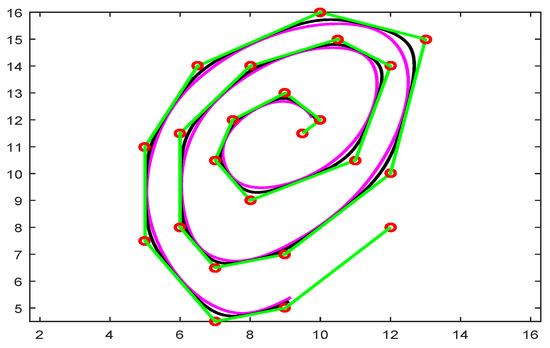
Figure 4.
Floating curve using (magenta) and (black) color curve.
3.2.2. Periodic Trigonometric B-Spline Curves
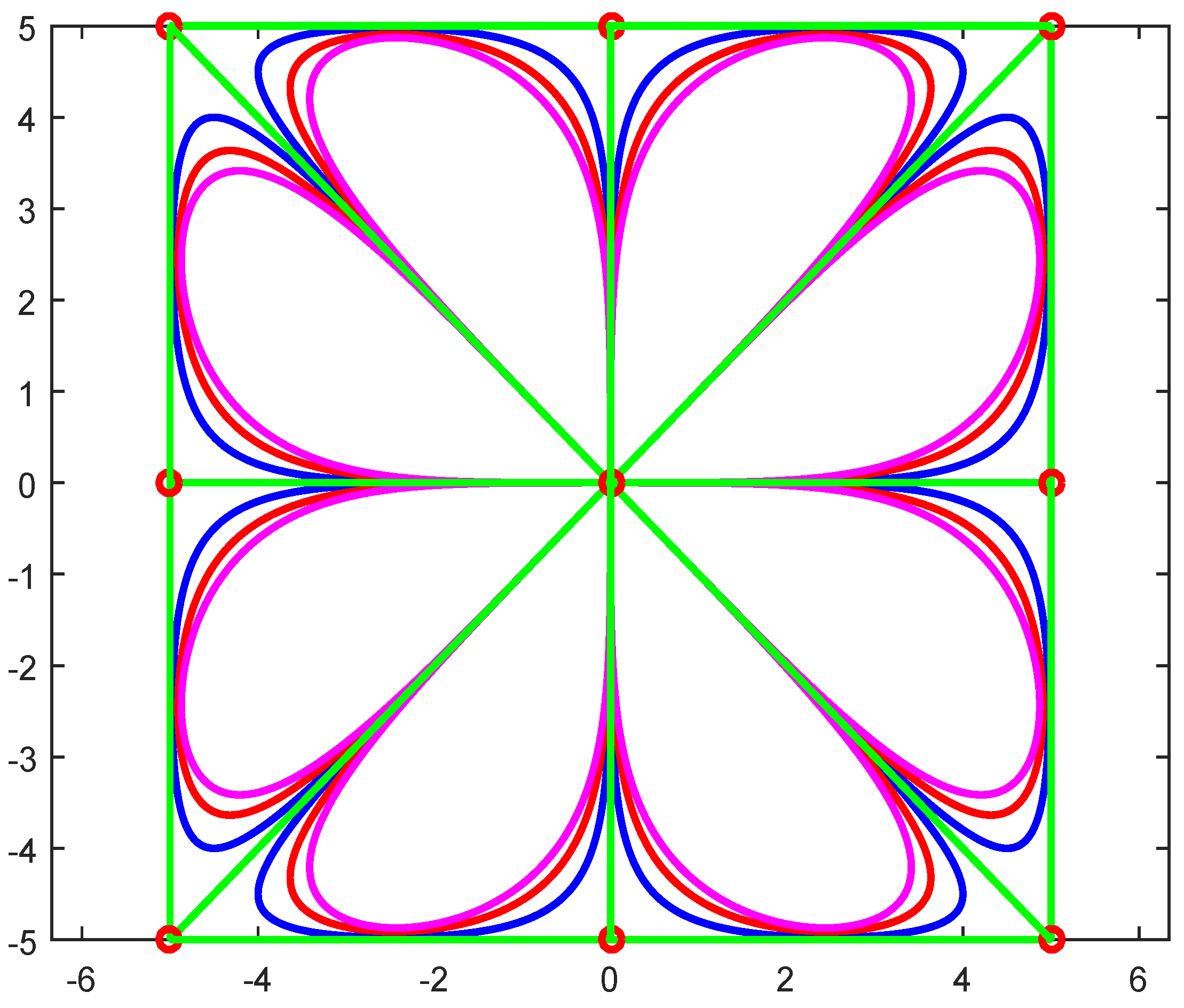
Periodic curve is drawn using cubic trigonometric B-spline basis functions as shown in Figure 5. Periodic curves can be drawn in blue, red, and magenta colors with , and 4 respectively these shape parameters provide more flexibility than classical B-spline curves.
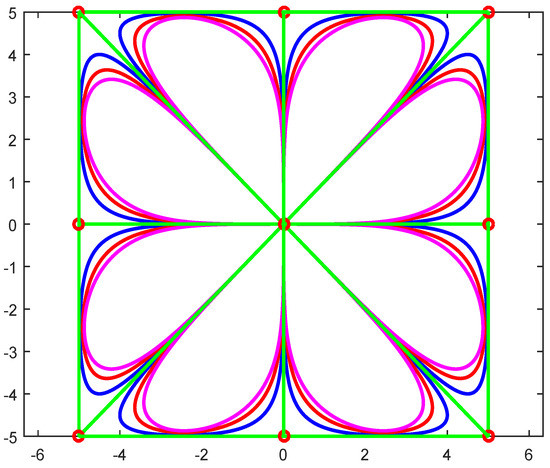
Figure 5.
Periodic curve with (Blue), (Red), and (Magenta).
4. Rational Trigonometric B-Spline and NURBS
Definition 2.
Rational trigonometric B-spline and NURBS are a generalization of B-spline basis. It enhances the flexibility of the curve. It is generally expressed as:
Here d is the degree of trigonometric B-spline basis. are positive weights. are the trigonometric B-spline basis. Simply, we can write it as:
where,
The expression for the rational trigonometric B-spline and NURBS becomes:
or
where
Remark 1.
In the above equations if B-spline basis are defined over uniform knots then the basis becomes Rational trigonometric B-spline otherwise NURBS.
Properties of the Rational Trigonometric B-Spline and NURBS
The proposed rational trigonometric B-spline and NURBS basis possess the following properties.
Theorem 5.
For all , then .
Proof of Theorem 5.
We prove this by taking:
Put, then above equation becomes:
Here are defined in Equation (5). Since, we have proved earlier that:
Thus, we get:
□
Theorem 6.
The rational cubic trigonometric B-spline basis function satisfies the partition of unity property i.e.
Proof of Theorem 6.
Since,
or simply:
Now,
Hence, partition of unity holds. □
5. Rational Trigonometric B-Spline and NURBS Curve
Definition 3.
Rational trigonometric B-spline and NURBS curve possessing shape parameter ξ is expressed generally as:
or
where are control points, are non-negative weights, and are trigonometric B-spline basis.
5.1. Properties of Rational Trigonometric B-Spline and NURBS Curve
5.1.1. Convex Hull Property
Rational trigonometric B-spline and NURBS curves always lie inside the convex hull of control polygon as shown in Figure 6 and Figure 7, respectively.
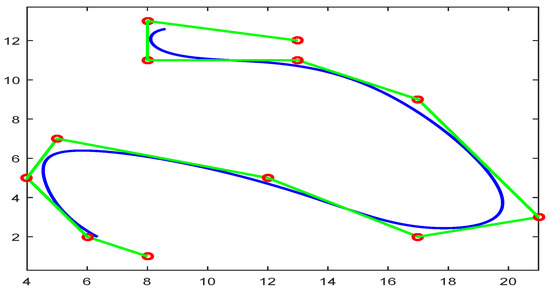
Figure 6.
Convex hull of rational trigonometric curve.
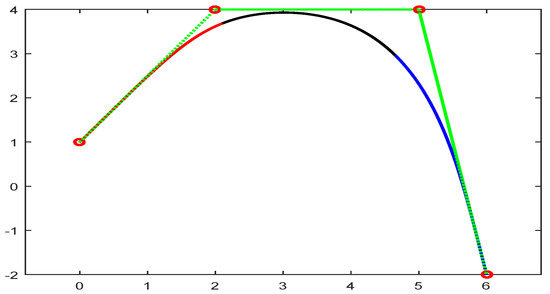
Figure 7.
Convex hull of NURBS curve.
5.1.2. Affine Transformation
Let T be an affine transformation, then:
5.1.3. Local Approximation
The shape of the curve can be distorted, either by changing the control points or weights. In Figure 8, the curve is without any change of control point and weight. Figure 9 explains that the change of control points affect the curve locally. Similarly, in Figure 10, a change of weight can be seen clearly.
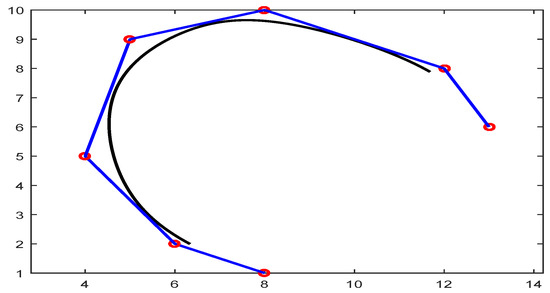
Figure 8.
Without changing the weight and control point.
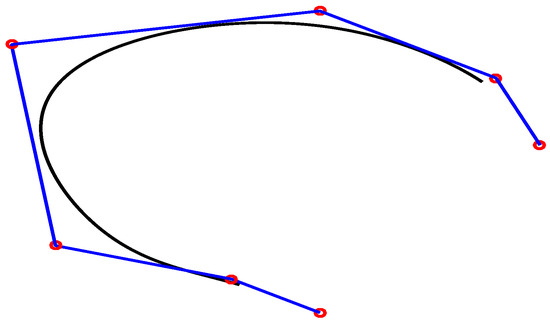
Figure 9.
The effect of changing the control point.
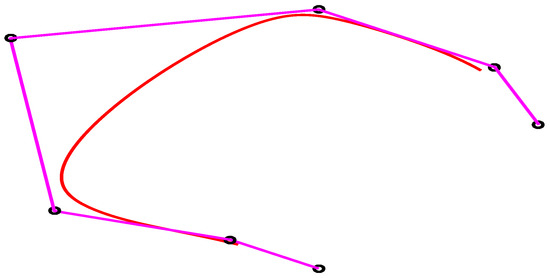
Figure 10.
The effect of changing the weight.
5.1.4. Continuity
Theorem 7.
The rational trigonometric B-spline and NURBS curve has continuity. These curve have continuity, . The curve becomes discontinuous at .
Proof of Theorem 7.
See Appendix E □
5.2. Floating and Periodic Rational Trigonometric B-Spline and NURBS Curve
5.2.1. Floating Rational and NURBS Curve
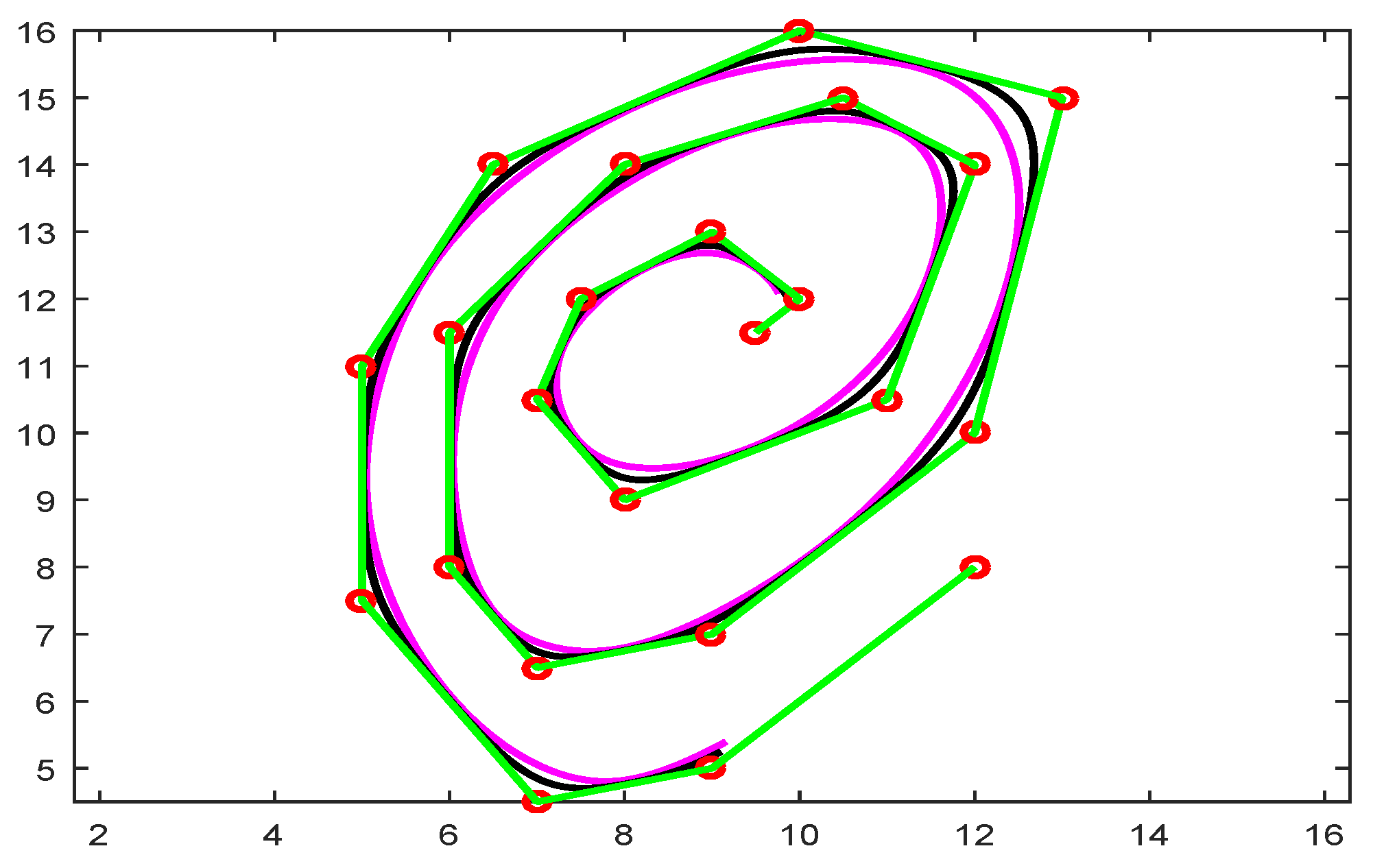
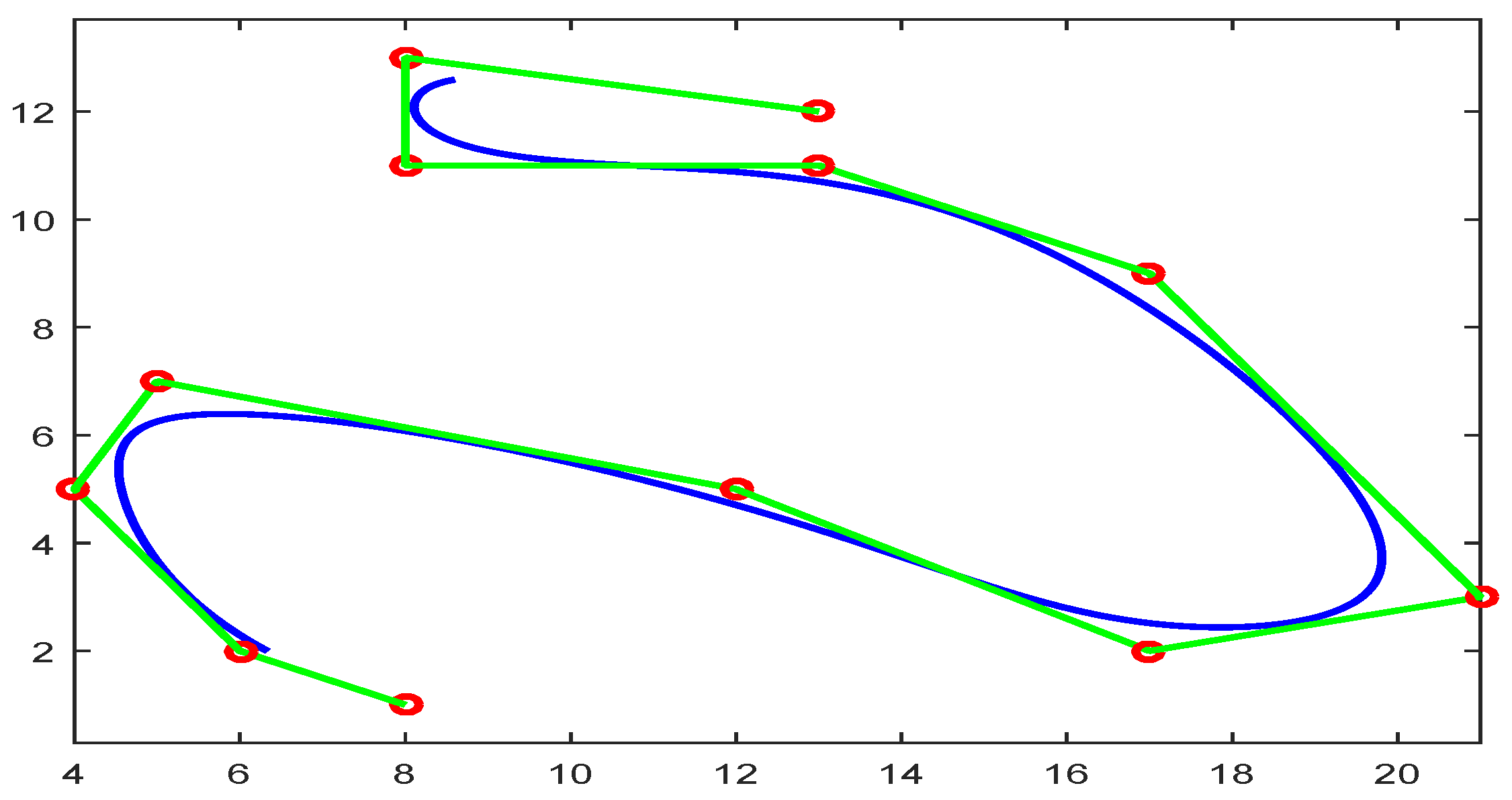
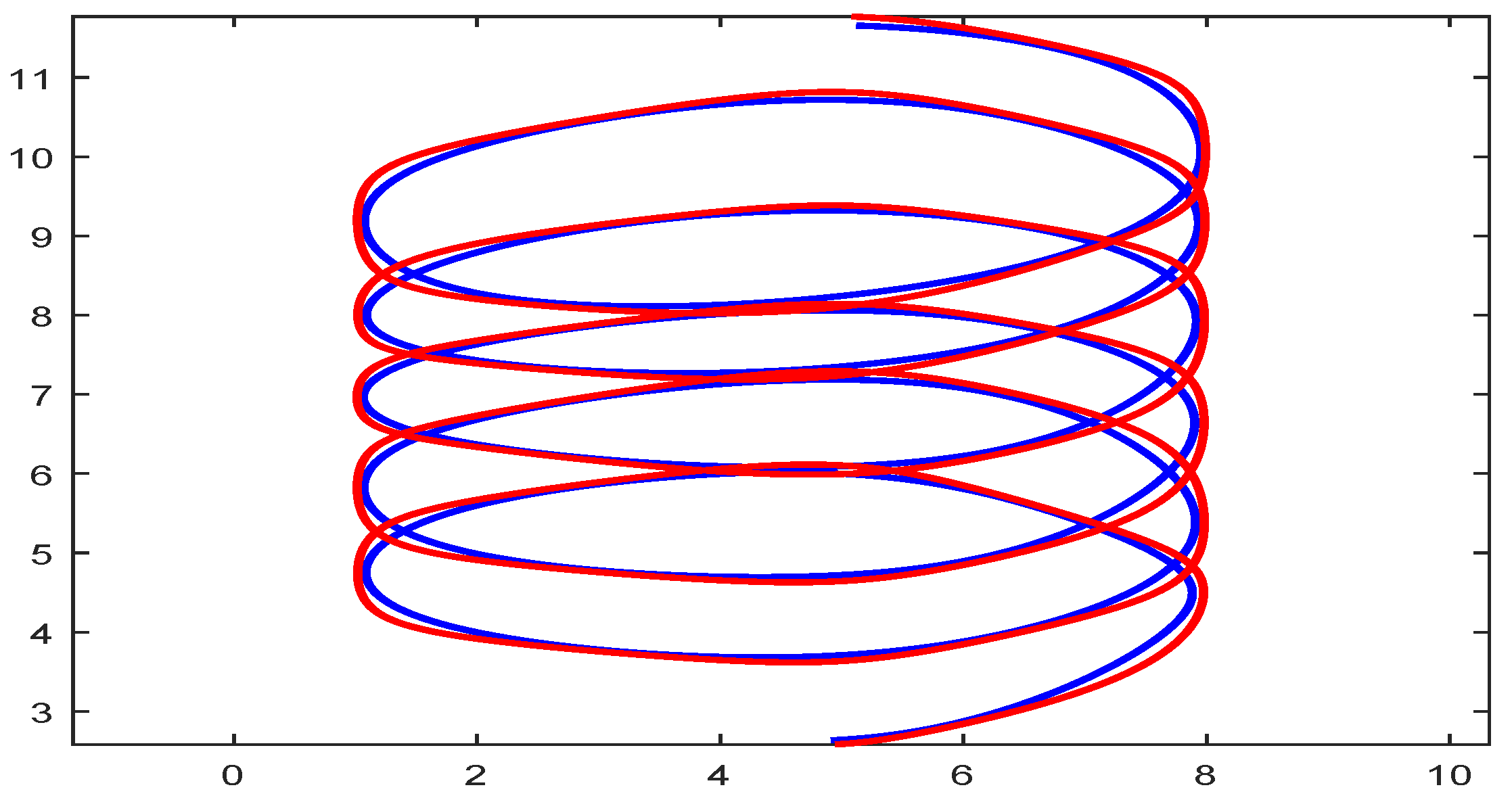
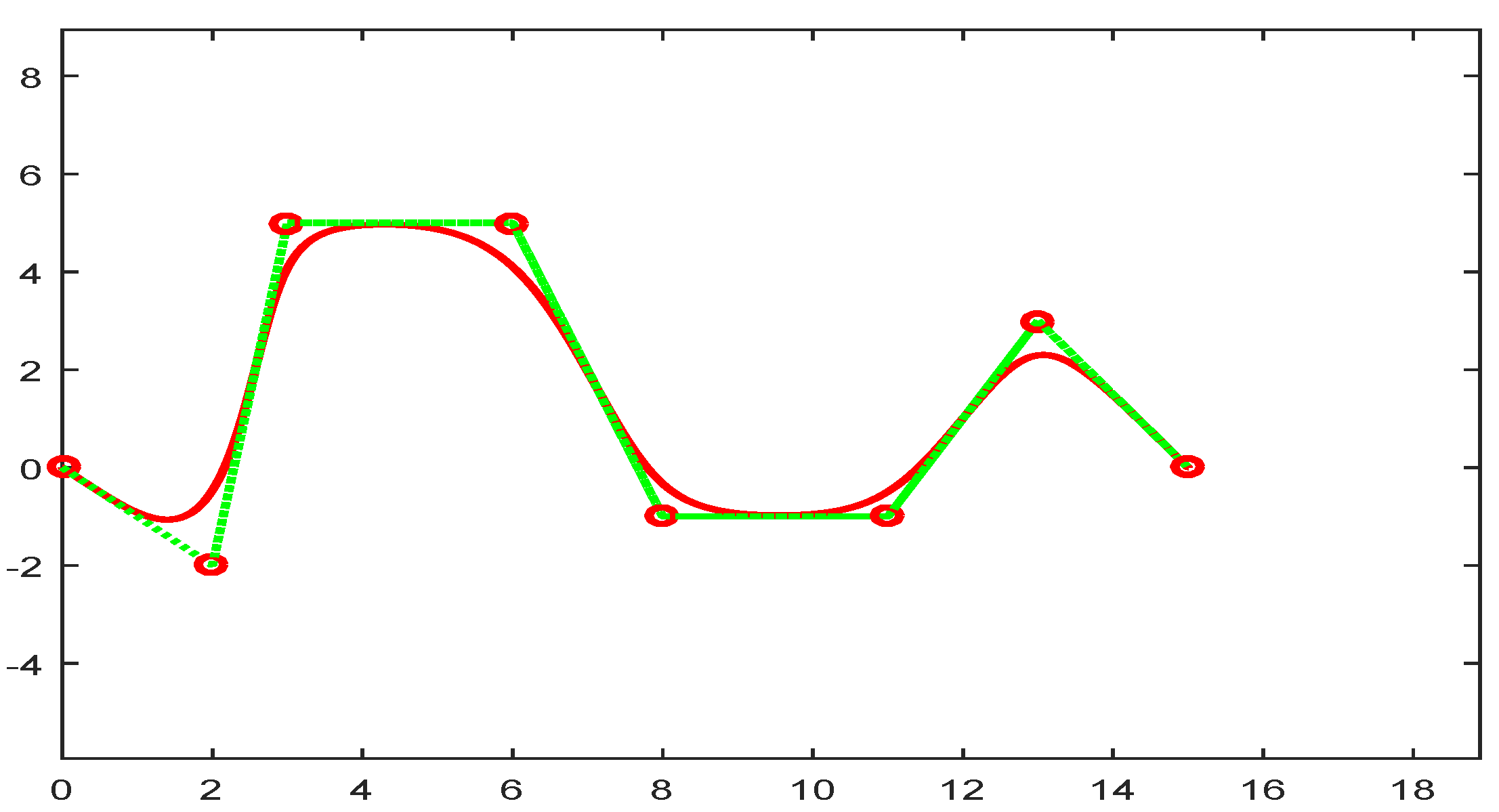
A floating curve is also known as an open curve, such curves whose first and last point does not meet. Figure 11 and Figure 12 show the floating rational trigonometric B-spline and NURBS curve, respectively. A total of 36 control points are used to construct rational trigonometric curve possessing for the blue and red color, respectively. The control polygon of NURBS is formed possessing see Figure 12.
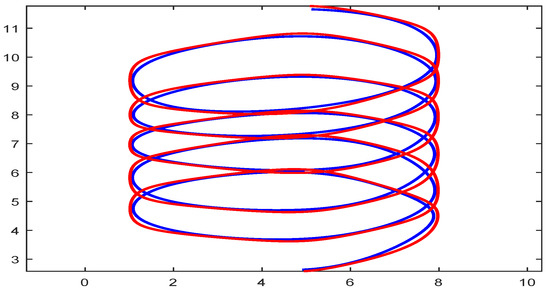
Figure 11.
Floating rational trigonometric curve with different .
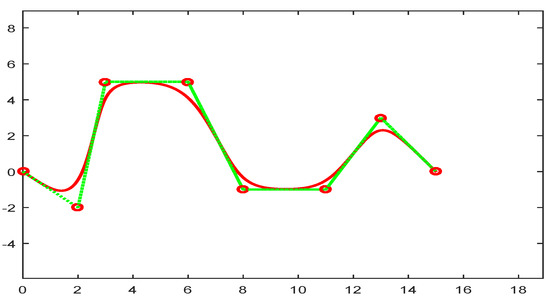
Figure 12.
Floating NURBS curve with .
5.2.2. Periodic Rational and NURBS Curve
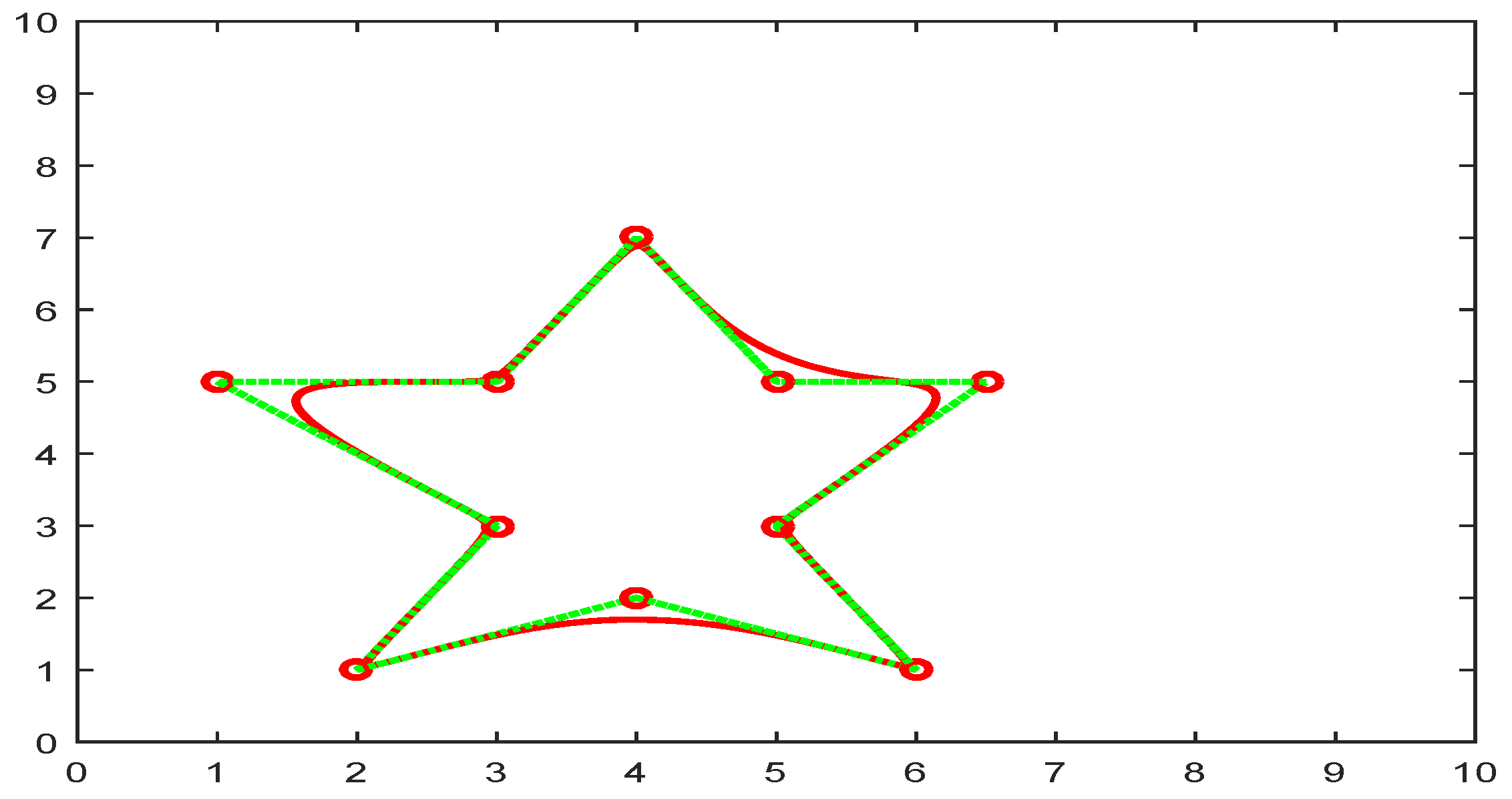
In Figure 13 and Figure 14 the periodic rational trigonometric B-spline and NURBS curve is constructed. The generated rational trigonometric curve consists of 12 control points.
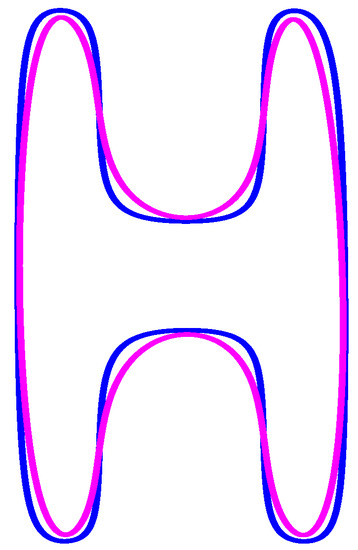
Figure 13.
Periodic rational curve with different .
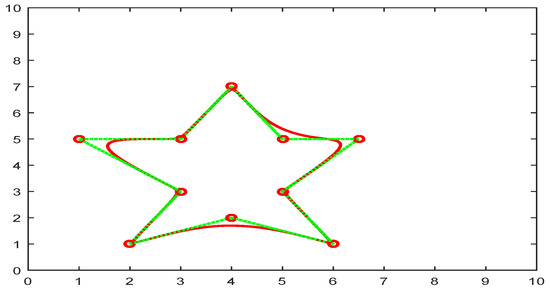
Figure 14.
Periodic NURBS curve with .
The shape parameter and weight make the designing of the Rational and NURBS curve more smooth and accurate.
5.3. Application of B-Spline and Uniform Rational Trigonometric B-Spline Curve
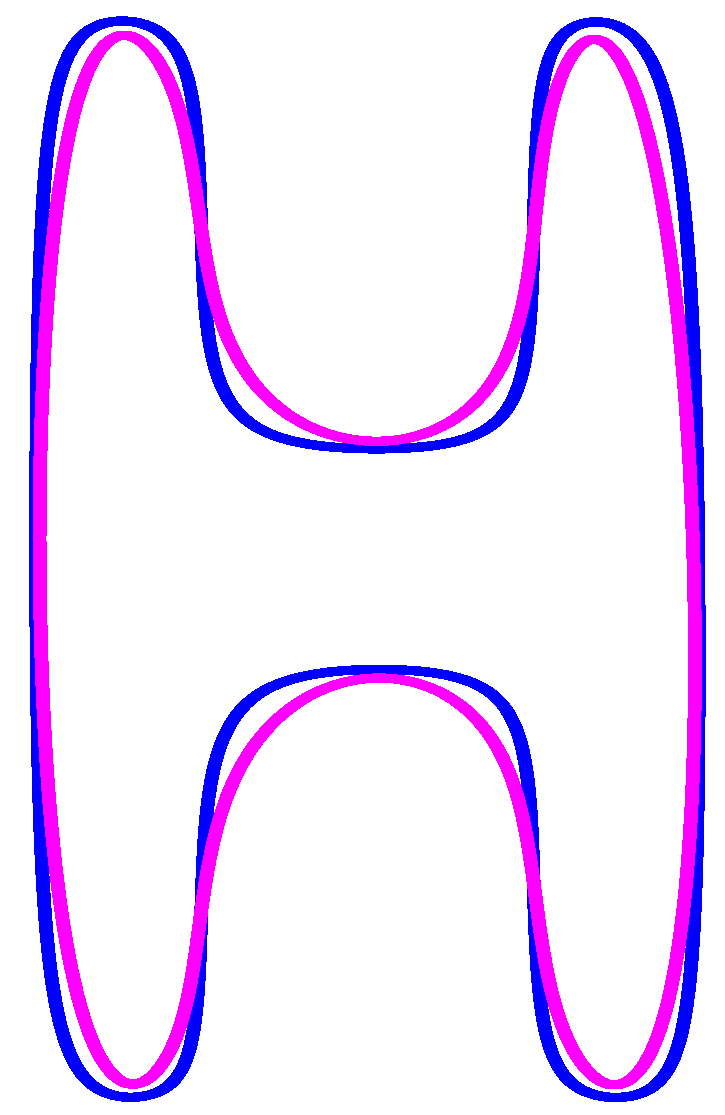
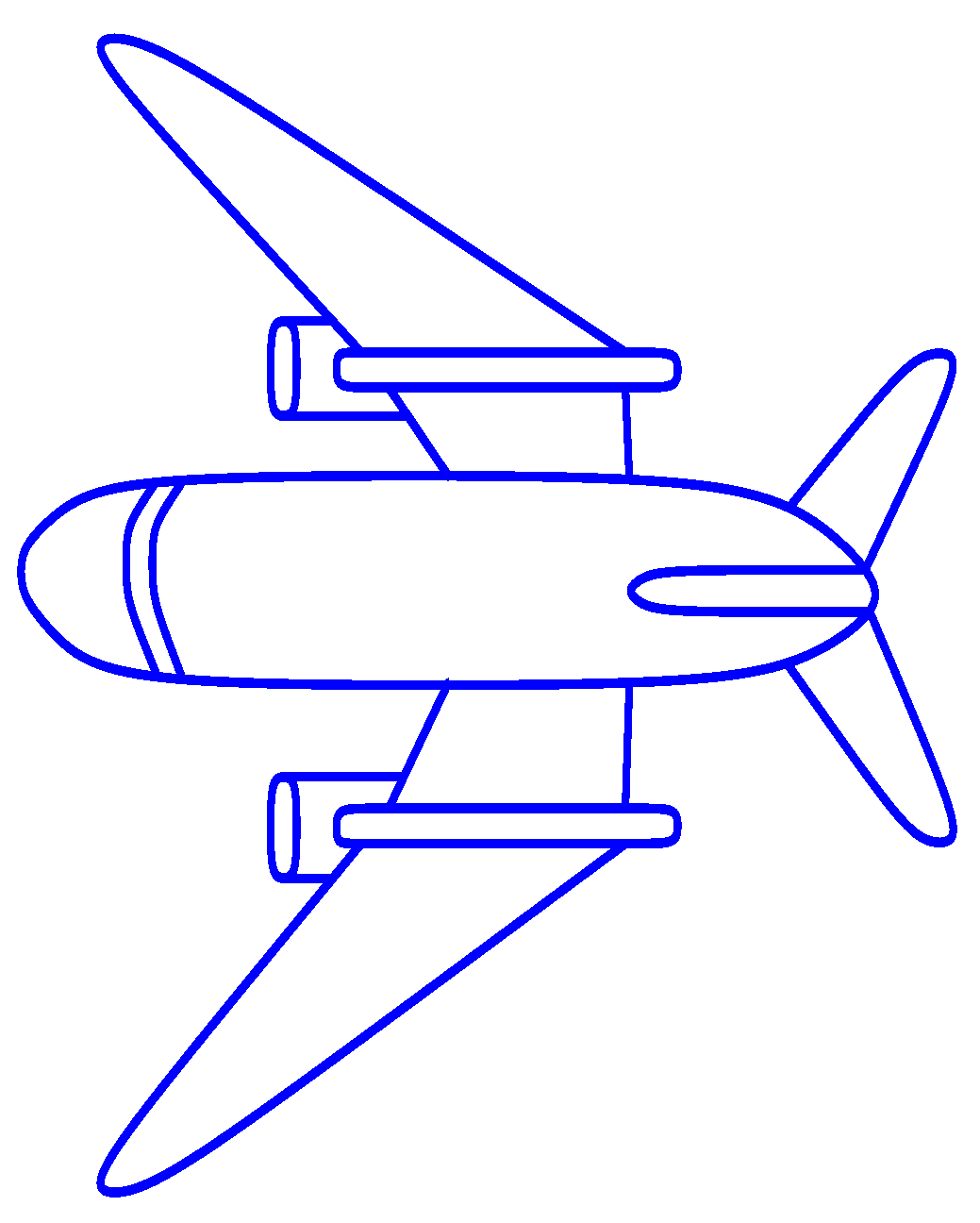
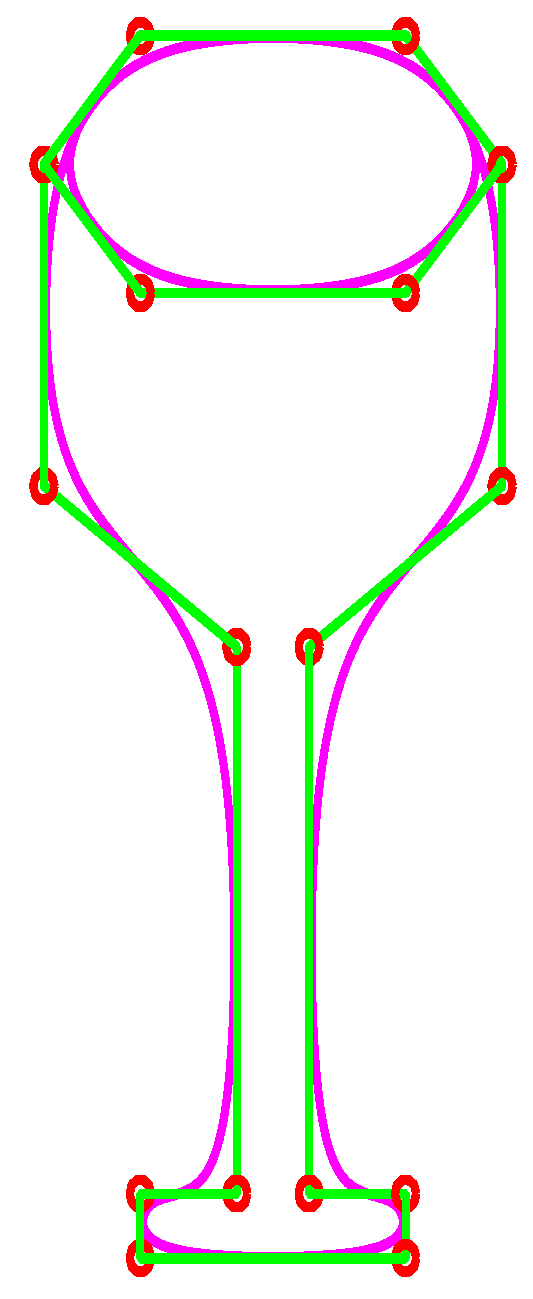
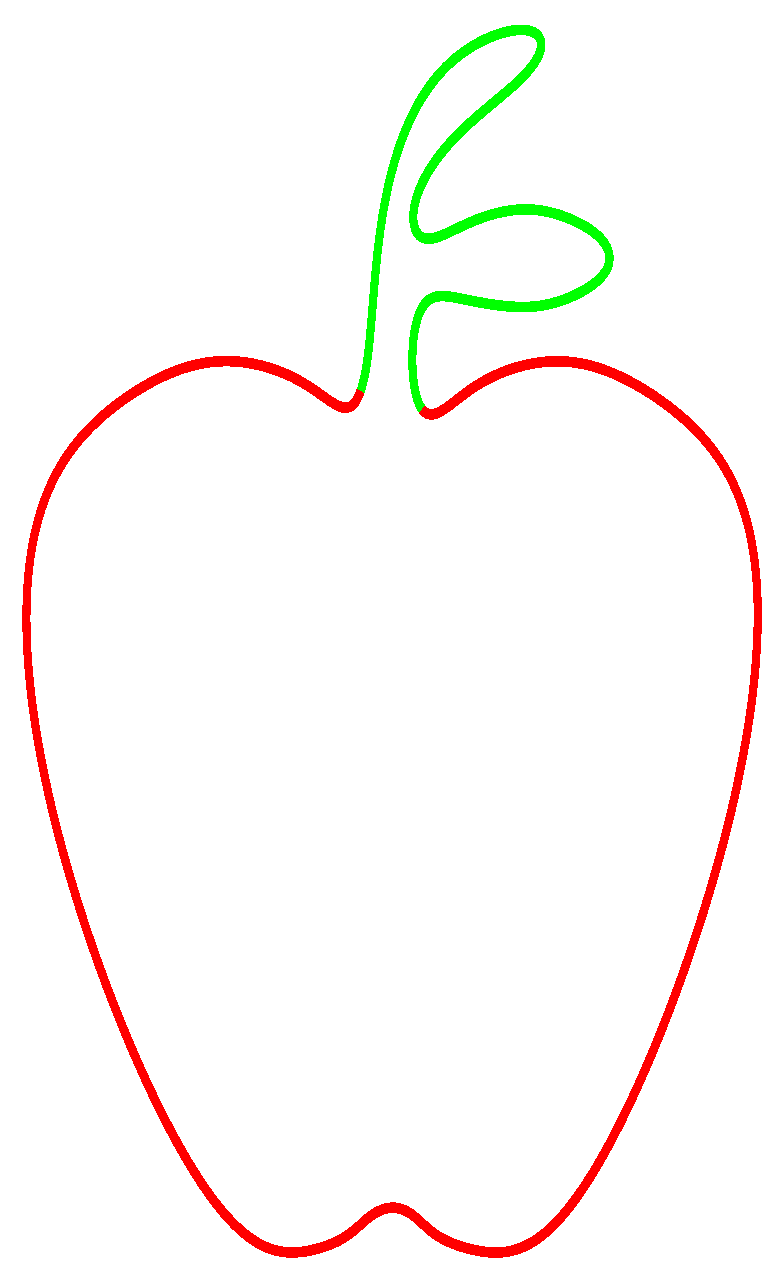
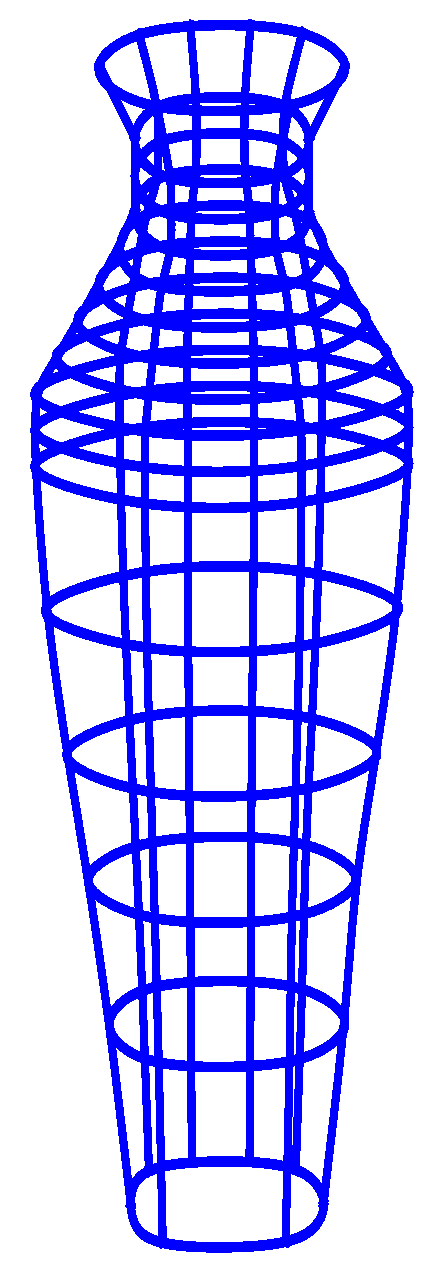
Proposed cubic trigonometric curves have been used for and modeling like in Figure 15, and we have designed an aeroplane with 107 control points with the shape parameter . The execution time for this model is 0.578 s. In Figure 16, glass has been designed using 25 control points and . The CPU time recorded for this model is 0.209 s. An apple has been designed in a form using the proposed method as shown in Figure 17. Different control points with is used for this model. Lastly, proposed curves have been used to design a vase in form as shown in Figure 18. The shape parameter is used in this model. The execution time for this model is 0.593 s.
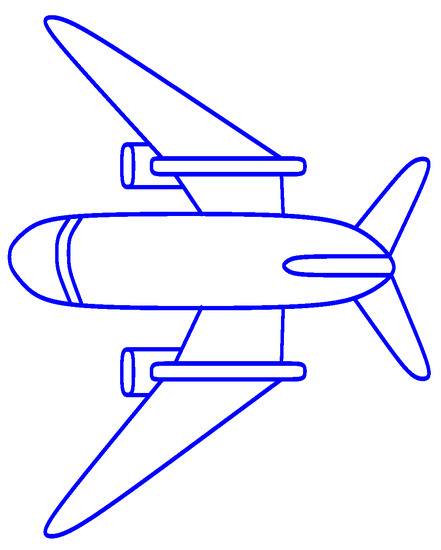
Figure 15.
Aeroplane design using cubic trigonometric B-spline curves.
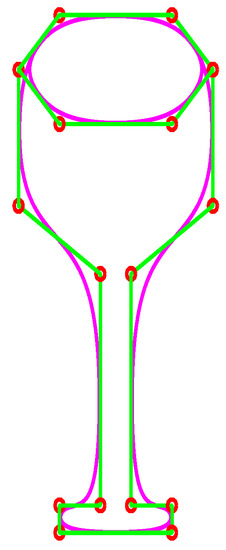
Figure 16.
Glass design using cubic trigonometric B-spline curve.
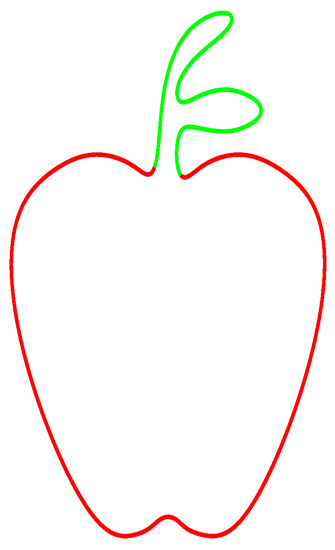
Figure 17.
Apple designing using rational B-spline curve.
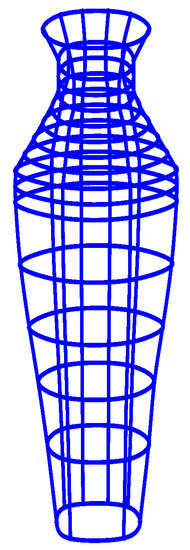
Figure 18.
vase mesh design using cubic trigonometric B-spline curves.
5.4. Conclusions
Cubic trigonometric and rational cubic trigonometric B-spline basis functions and curves with shape parameter were derived in this paper. The cubic trigonometric B-spline curves were and continuous at uniform and non-uniform knots and were derived. Rational cubic trigonometric B-spline curves were continuous for both uniform and non-uniform knots. Both cubic polynomial and cubic rational basis and curves obeyed the basic properties and were derived in this paper. The rendering of floating and periodic curves reflected the flexibility and applicability of the proposed method. Different and models were designed using the proposed curves successfully. This curve was more flexible, easy to use, and had a larger parametric range than the existing scheme. This work can be extended by adding shape parameter, using higher degree in functions, and by constructing the surface using proposed curves.
Author Contributions
Methodology, A.M., M.A. and F.Q.; software, A.M., M.A., F.Q., and T.N.; formal analysis, A.M., M.A., F.Q., K.T.M., M.Y.M. and T.N.; writing, original draft preparation, A.M., M.A. and F.Q.; Investigation, A.M., M.A., M.Y.M., and T.N.; writing, review and editing, A.M., M.A., F.Q., K.T.M., M.Y.M. and T.N.; visualization, A.M., M.A., F.Q., K.T.M., M.Y.M. and T.N.; resources, M.A. and K.T.M.; supervision, A.M., M.A. and K.T.M.; funding acquisition, M.A., and K.T.M. All authors have read and agreed to the published version of the manuscript.
Funding
This work was supported by Universiti Sains Malaysia under Short Term Grant 304/PMATHS/6315223.
Acknowledgments
The authors would like to thank the anonymous referees for their careful reading of this manuscript and also for their constructive suggestions which considerably improved the article.
Conflicts of Interest
The authors declare no conflict of interest.
Abbreviations
The following abbreviations are used in this manuscript:
| 2D | two dimensional |
| 3D | three dimensional |
| CAD | computer-aided design |
| NURBS | non-uniform rational B-spline |
| parametric continuity of degree three | |
| parametric continuity of degree five | |
| CPU | central processing unit |
Appendix A
Proof.
Appendix B
Proof.
The first and fourth term of equation (1) contains only a single term so . The third term involves summation, so we need to show it is either positive or not. For this let . Here .
Let .
After substituting , the equation above becomes
Comparing the coefficients of , , , , , z and constants, we get:
From the above equation, we get:
Here,
The theorem clearly follows for . □
Appendix C
Proof.
In the knot interval , the derivatives are taken at knot of Equation (1) as:
The above derivatives are at the same knot . It is clearly evaluated that all other derivative vanishes at this knot except the fourth derivative.
In the knot interval , the derivatives are taken at knot as:
Derivatives at knot are:
In the knot interval , the derivatives are taken at knot as:
Derivatives at knot are:
In the knot interval , the derivatives are taken at knot as:
□
Appendix D
Proof.
The derivatives at knot are evaluated as:
where .
The derivatives at knot are evaluated as:
□
Appendix E
Proof.
The continuity for knot interval is derived as:
- Continuity of NURBS curve
At knot
At knot
First derivative at knot
Let .
First derivative at knot
.
Second derivative at knot
where and
Second derivative at knot
Let and .
Third derivative at knot
Let , and .
Third derivative at knot
- 2.
- Continuity of Rational trigonometric B-spline curve
At knot.
At knot
First derivative at knot
First derivative at knot
Second derivative at knot
Second derivative at knot
In similar manner, third derivative for uniform knots is evaluated. □
References
- Bashir, U.; Abbas, M.; Awang, M.N.H.; Ali, J.M. A class of quasi-quintic trigonometric Bézier curve with two shape parameters. Sci. Asia 2013, 39S, 11–15. [Google Scholar] [CrossRef]
- Bashir, U.; Abbas, M.; Ali, J.M. The G2 and C2 rational quadratic trigonometric Bézier curve with two shape parameters with applications. J. Appl. Math. Comput. 2013, 219, 10183–10197. [Google Scholar] [CrossRef]
- BiBi, S.; Abbas, M.; Misro, M.Y.; Hu, G. A Novel Approach of Hybrid Trigonometric Bézier Curve to the Modeling of Symmetric Revolutionary Curves and Symmetric Rotation Surfaces. IEEE Access. 2019, 7, 165779–165792. [Google Scholar] [CrossRef]
- Maqsood, S.; Abbas, M.; Hu, G.; Ramli, A.L.A.; Miura, K.T. A Novel Generalization of Trigonometric Bézier Curve and Surface with Shape Parameters and Its Applications. Math. Probl. Eng. 2020, 2020, 4036434. [Google Scholar] [CrossRef]
- Usman, M.; Abbas, M.; Miura, K.T. Some engineering applications of new trigonometric cubic Bézier-like curves to free-form complex curve modeling. J. Adv. Mech. Des. Syst. Manuf. 2020, 14, 19-00420. [Google Scholar] [CrossRef]
- Hu, X.; Hu, G.; Abbas, M.; Misro, M.Y. Approximate multi-degree reduction of Q-Bézier curves via generalized Bernstein polynomial functions. Adv. Differ. Equ. 2020, 2020, 1–16. [Google Scholar] [CrossRef]
- Li, F.; Hu, G.; Abbas, M.; Miura, K.T. The Generalized H-Bézier Model: Geometric Continuity Conditions and Applications to Curve and Surface Modeling. Mathematics 2020, 8, 924. [Google Scholar] [CrossRef]
- Majeed, A.; Abbas, M.; Miura, K.T.; Kamran, M.; Nazir, T. Surface Modeling from 2D Contours with an Application to Craniofacial Fracture Construction. Mathematics 2020, 8, 1246. [Google Scholar] [CrossRef]
- Hu, G.; Li, H.; Abbas, M.; Miura, K.T.; Wei, G. Explicit Continuity Conditions for G1 Connection of S-λ Curves and Surfaces. Mathematics 2020, 8, 1359. [Google Scholar] [CrossRef]
- Schoenberg, I.J. On trigonometric spline interpolation. J. Math. Mech. 1964, 13, 795–825. [Google Scholar]
- Schoenberg, I.J. Spline interpolation and best quadrature formulae. Bull. Am. Math. Soc. 1964, 70, 143–148. [Google Scholar] [CrossRef]
- Schoenberg, I.J. Spline interpolation and the higher derivatives. Proc. Natl. Acad. Sci. USA 1964, 51, 24. [Google Scholar] [CrossRef]
- Schoenberg, I.J. Interpolating splines as limits of polynomials. Linear Algebra Appl. 1983, 52, 617–628. [Google Scholar] [CrossRef]
- Lyche, T.; Winther, R. A stable recurrence relation for trigonometric B-splines. J. Approx. Theory 1979, 25, 266–279. [Google Scholar] [CrossRef]
- Walz, G. Identities for trigonometric B-splines with an application to curve design. Bit Numer. Math. 1997, 37, 189–201. [Google Scholar] [CrossRef]
- Piegl, L.; Tiller, W. The NURBS Book; Springer Science & Business Media: Berlin/Heidelberg, Germany, 2012. [Google Scholar]
- Marsh, D. Applied Geometry for Computer Graphics and CAD; Springer: Berlin/Heidelberg, Germany, 2006. [Google Scholar]
- Salomon, D. Curves and Surfaces for Computer Graphics; Springer Science & Business Media: Berlin/Heidelberg, Germany, 2007. [Google Scholar]
- Juhász, I.; Róth, Á. A scheme for interpolation with trigonometric spline curves. J. Comput. Appl. Math. 2014, 263, 246–261. [Google Scholar] [CrossRef]
- Zhu, Y.P.; Han, X.L. New trigonometric basis possessing exponential shape parameters. J. Comput. Math. 2015, 33, 642–684. [Google Scholar]
- Majeed, A.; Qayyum, F. New rational cubic trigonometric B-spline curves with two shape parameters. Comput. Appl. Math. 2020, 39, 1–24. [Google Scholar] [CrossRef]
- Han, X. Quadratic trigonometric polynomial curves with a shape parameter. Comput. Aided Geom. Des. 2002, 19, 503–512. [Google Scholar] [CrossRef]
- Han, X. Cubic trigonometric polynomial curves with a shape parameter. Comput. Aided Geom. Des. 2004, 21, 535–548. [Google Scholar] [CrossRef]
- Majeed, A.; Yahya, Z.R.; Abdullah, J.Y.; Rafique, M. Construction of occipital bone fracture using B-spline curves. Comput. Appl. Math. 2018, 37, 2877–2896. [Google Scholar] [CrossRef]
- Choubey, N.; Ojha, A. Trigonometric splines with variable shape parameter. Rocky Mt. J. Math. 2008, 38, 91–105. [Google Scholar] [CrossRef]
- Pagani, L.; Scott, P.J. Curvature based sampling of curves and surfaces. Comput. Aided Geom. Des. 2018, 59, 32–48. [Google Scholar] [CrossRef]
- Majeed, A.; Mt Piah, A.R.; Yahya, Z.R. Surface reconstruction from parallel curves with application to parietal bone fracture reconstruction. PLoS ONE 2016, 11, e0149921. [Google Scholar] [CrossRef] [PubMed]
- Hu, G.; Qin, X.; Ji, X.; Wei, G.; Zhang, S. The construction of λμ-B-spline curves and its application to rotational surfaces. Appl. Math. Comput. 2015, 266, 194–211. [Google Scholar] [CrossRef]
- Majeed, A.; Gobithaasan, R.U.; Yahya, Z.R. Craniofacial reconstruction using rational cubic ball curves. PLoS ONE 2015, 10, e0122854. [Google Scholar] [CrossRef]
- Yan, L.; Liang, J. A class of algebraic–trigonometric blended splines. J. Comput. Appl. Math. 2011, 235, 1713–1729. [Google Scholar] [CrossRef]
- Troll, E. Constrained modification of the cubic trigonometric Bézier curve with two shape parameters. Ann. Math. Inform. 2014, 43, 145–156. [Google Scholar]
- Stanimirović, P.S.; Krtolica, P.V.; Saračević, M.H.; Mašović, S.H. Decomposition of Catalan numbers and convex polygon triangulations. Int. J. Comput. Math. 2014, 91, 1315–1328. [Google Scholar] [CrossRef]
- Saracevic, M.; SELİMİ, A. Convex polygon triangulation based on planted trivalent binary tree and ballot problem. Turk. J. Electr. Eng. Comput. Sci. 2019, 27, 346–361. [Google Scholar] [CrossRef]
- Troll, E.M.; Hoffmann, M. Geometric properties and constrained modification of trigonometric spline curves of Han. Ann. Math. Inform. 2010, 37, 165–175. [Google Scholar]
- Han, X.A.; Ma, Y.; Huang, X. The cubic trigonometric Bézier curve with two shape parameters. Appl. Math. Lett. 2009, 22, 226–231. [Google Scholar] [CrossRef]
- Xu, G.; Wang, G.Z. Extended cubic uniform B-spline and α-B-spline. Acta Autom. Sin. 2008, 34, 980–984. [Google Scholar] [CrossRef]
Publisher’s Note: MDPI stays neutral with regard to jurisdictional claims in published maps and institutional affiliations. |
© 2020 by the authors. Licensee MDPI, Basel, Switzerland. This article is an open access article distributed under the terms and conditions of the Creative Commons Attribution (CC BY) license (http://creativecommons.org/licenses/by/4.0/).