


Abstract
In this paper, we present the convergence rate analysis of the modified Landweber method under logarithmic source condition for nonlinear ill-posed problems. The regularization parameter is chosen according to the discrepancy principle. The reconstructions of the shape of an unknown domain for an inverse potential problem by using the modified Landweber method are exhibited.
1. Introduction
An inverse potential problem consists in determining the shape of an unknown domain D form measurements of the Neumann boundary values of u on , where the solution u of the homogeneous Dirichlet problem fulfills
where is the characteristic function of the domain . This inverse problem is a nonlinear severely ill-posed problem; see [1,2]. If a classical difference method is used for solving the inverse problem, the errors can grow exponentially fast as the mesh size goes to zero. Many regularizing methods are adopted to provide a stable solution of inverse potential problems, e.g., a second-degree method with frozen derivatives [3], level set regularization [4], the iteratively regularized Gauss–Newton method [5] and Levenberg–Marquardt method [1]. In this work, we consider a discrete version analoguous to the modified asymptotic regularization proposed by Pornsawad et al. [6] to recover the starlike shape of the unknown domain D.
In a general setting, an inverse potential problem can be formulated via a nonlinear operator equation
where y is the normal derivative of u on the boundary, , is the outer normal vector on , the operator is a nonlinear operator on domain , X and Y are Hilbert spaces, and the unknown x includes the information of the domain . For convenience in this article, the indices of inner products and norms are neglected but they can always be identified from the context in which they appear. Due to the nonlinearity of Equation (3), we assume all over that Equation (3) has a solution which needs not to be unique. We have the disturbed data with
where is a noise level. If one solves Equation (3) by traditional numerical method, high oscillating solutions may occur. Thus, one needs a regularization to minimize the approximation and data error.
One well-known continuous regularization is Showalter’s method or asymptotic regularization [7], where an approximate solution is obtained by solving an initial value problem. Later, a second-order asymptotic regularization for the linear problem was investigated in Zhang and Hofmann [8], where the optimal order is obtained under the Hölder type source condition and a conventional discrepancy principle as well as a total energy discrepancy principle. Recently, the study of modified asymptotic regularization is reported in Pornsawad et al. [6] where the term is included to the method proposed by Tautenhahn [7], i.e.,
A discrete version analogue to Equation (5) is successfully developed in Pornsawad and Böckmann [9], where the whole family of Runge–Kutta methods is applied and one obtaines an optimal convergence rate under Hölder-type sourcewise condition if the Fréchet derivative is properly scaled and locally Lipschitz continuous.
It is well known that, for many applications such as the inverse potential problem and the inverse scattering problem [5], the Hölder type source condition in general is not fulfilled even if a solution is very smooth. It is applicable only for mildly ill-posed problems [1,10,11]. Therefore, the convergence rate analysis of an explicit Euler method presented by
is considered in this article under the logarithmic source condition in Equation (7) and the properly scaled Fréchet derivative . The method in Equation (6) is a particular method of the iterative Runge–Kutta-type method [9], where is the relaxation parameter obtained by discretization of conventional asymptotic regularization [7]. We define
with and the usual sourcewise representation
where is sufficiently small. The method in Equation (6) is also known as the modified Landweber method [12] which has the rate under the Hölder-type source condition and general discrepancy principle. The convergence rate analysis under the logarithmic source condition in Equation (7) has been successfully studied by Hohage [5] for the iteratively regularized Gauss–Newton method and by Deuflhard et al. [13] for Landweber’s iteration. Current studies of source condition may be found, e.g., in Romanov et al. [11], Bakushinsky et al. [14], Schuster et al. [15] and Albani et al. [16].
The purpose of this work is to present the convergence rate analysis of the iterative scheme of Equation (6) under the logarithmic source condition in Equation (7) with and to recover the shape of an unknown domain D for an inverse potential problem (Equations (1) and (2)). Thus, in Section 2, a preliminary result is prepared. As usual, the Fréchet derivative of F needs to be scaled. Furthermore, we assume a nonlinearity condition of F in a ball , which is given in Assumption 1. It is well known that, without the additional assumption on the nonlinear operator, the convergence rate cannot be provided. The following assumption has been used in many works [5,17], i.e., there exists a bounded linear operator and such that
with nonnegative constants and . However a weaker condition will be used in this work. This will be shown in Assumption 1. In Section 3, the convergence rate of the modified Landweber method under the logarithmic source condition is presented. Application of the modified Landweber method to an inverse potential problem is provided in Section 4.
2. Preliminary Results
In this section, preliminary results are prepared to provide the convergence analysis of the modified Landweber method.
Lemma 1.
Let A be a linear operator with . For with with f given by Equation (7) and , there exist positive constants and such that
and
with
Proof.
Proposition 1.
Let A be a linear operator with . For with with f given by Equation (7) and , for some , there exist positive constants and such that
and
for and .
Proof.
We will prove by induction that, for some , the inequality
is true. Note that and provide
This means that Using Equation (7), we have
Thus, Equation (15) holds for . Next, we assume that Equation (15) holds for for some constant c. Applying Lemma 1, we obtain
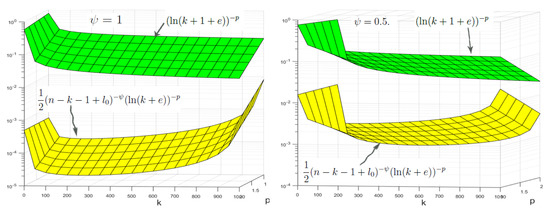
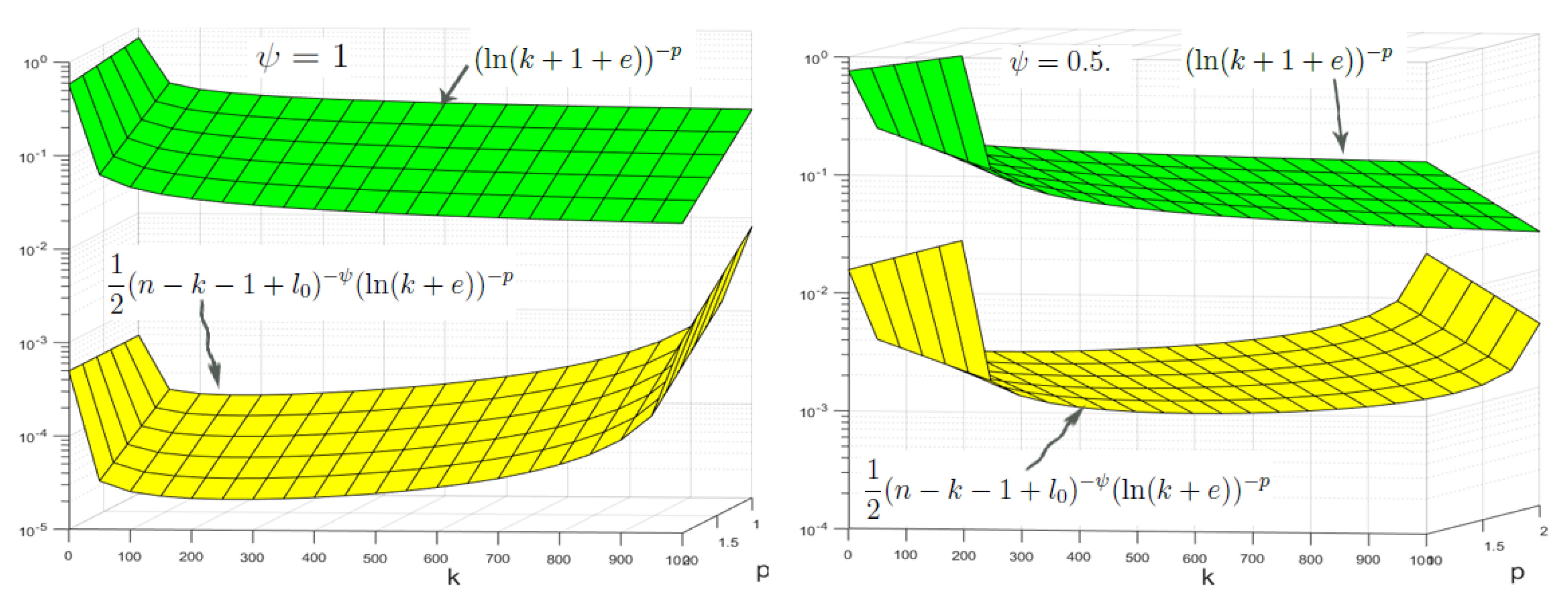
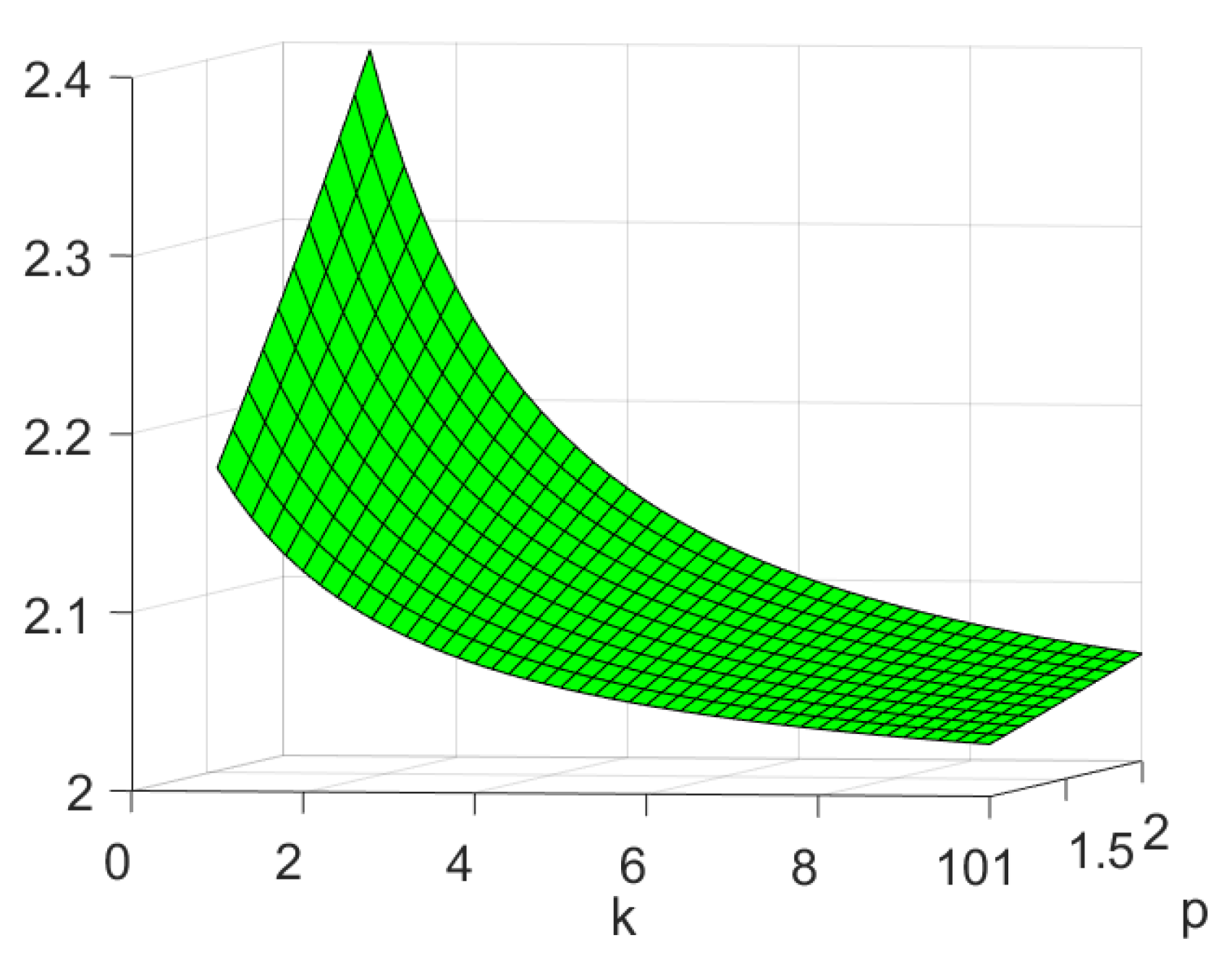
By Figure 1, we observe that
Figure 1.
Plot of and with , and (left) and (right) .
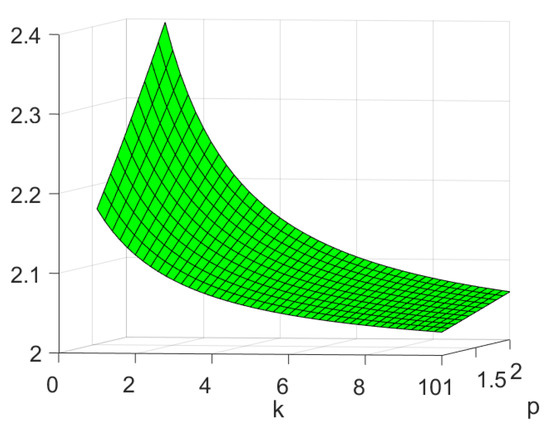
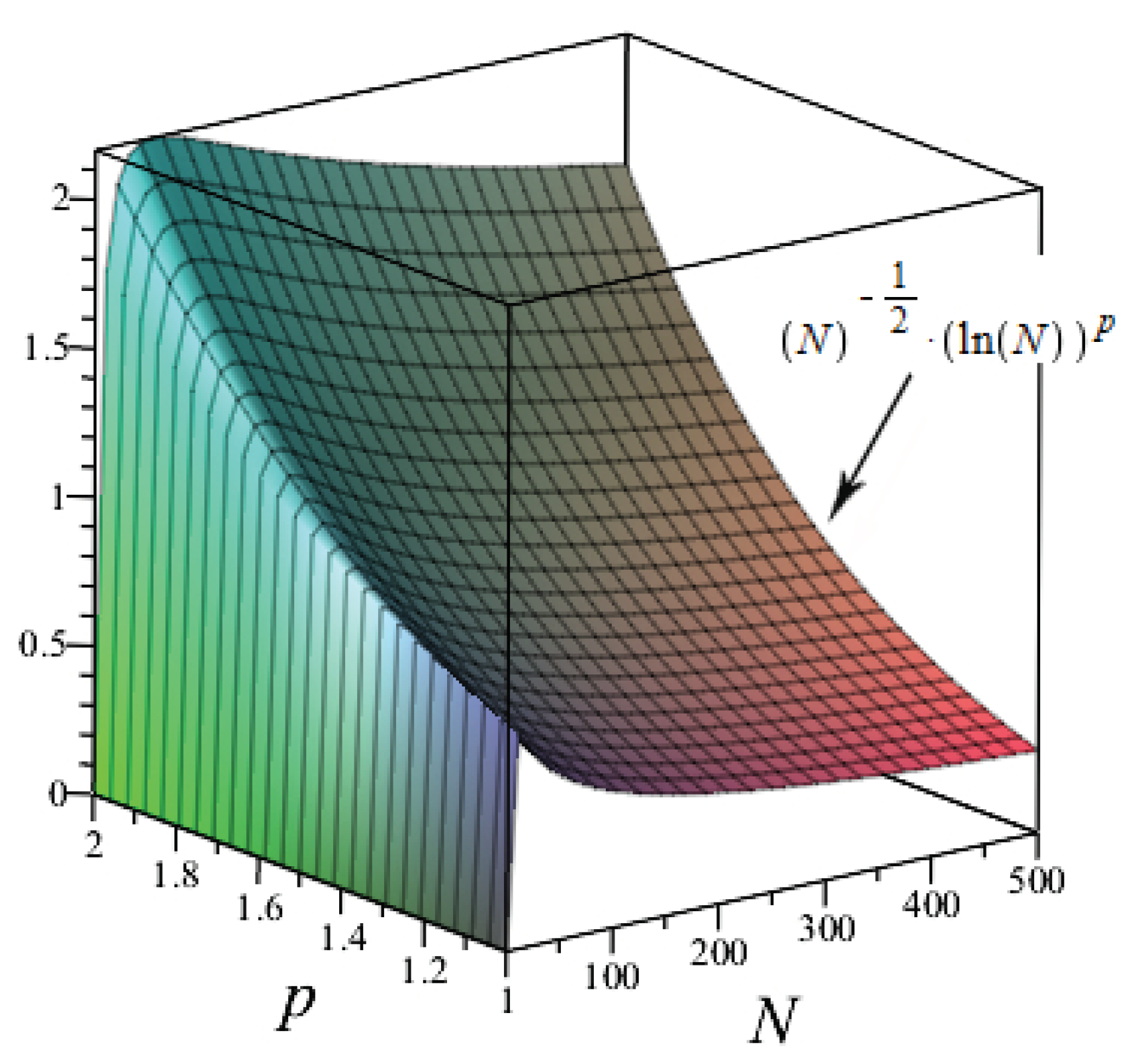
Moreover, in Figure 2, the graph of has a maximum at and and the maximum value is . Thus, Equation (16) becomes
for some constant Thus, the induction is complete.
Figure 2.
Plot of .
Assumption 1.
There exist positive constants , , and and linear bounded operator such that, for , the following condition holds
where is the exact solution of Equation (3).
Lemma 2.
Let the Assumption 1 be assumed. Then, we have
for some constant with .
Proof.
Proposition 2.
3. Convergence Analysis
To investigate the convergence rate of the modified Landweber method under the logarithmic source condition, we choose the regularization parameter n according to the generalized discrepancy principle, i.e., the iteration is stopped after N = N(,) steps with
where is a positive number. In addition to the discrepancy principle, F satisfies the local property in the open ball of radius around
with ∈. Utilizing the triangle inequality yields
to ensure at least local convergence to a solution of Equation (3) in .
Theorem 1.
Assume that the problem in Equation (3) has a solution in , fulfills Equation (4), and F satisfies Equations (17) and (18). Assume that the Fréchet derivative of F is scaled such that for . Furthermore, assume that the source condition in Equations (7) and (8) is fulfilled and that the modified Landweber method is stopped according to Equation (26). If is sufficiently small, then there exists a constant depending only on p and with
and
Proof.
We give the abbreviation := for the error of the nth iteration of Equation (6) and . We can rewrite Equation ( 6) into the form
Since := and , we present as
Rewritting Equation (30), we have
where
By recurrence and Equation (31), we obtain the closed expression for the error
Moreover, it holds
Next, for , using the discrepancy principle, triangle inequality, Equation (28), and , we get
Using Lemma 2, Proposition 2, and Equation (34), we obtain
where , and we use the fact that .
It holds that is decreasing independently of the source condition for ; see Proposition 2.2 in Scherzer [12].
Next, we show by induction that
and
hold for all with being a positive constant which does not depend on n. It is obvious for . Assuming that Equations (36) and (37) are true for all k with , we have to show that Equations (36) and (37) are true for all . We rewrite Equation (32) as follow
By assumption (see, e.g., Louis [18] or Vainikko and Veterennikov [19] cited in Hanke et al. [20]), we have
and
Consequently,
and
Using Lemma 1 for , Proposition 1, and Equations (39) and (40) to Equation (38), we obtain
Rewritting Equation (43), we have
The next idea is similar to the proof of Lemma A.5 in Deuflhard et al. [13]. Firstly, provides
For , the properties of the logarithm provide
with a generic constant which does not depend on .
Accordingly, Equation (44) can be estimated as follows:
The last summation is bounded since, with , the integral
is bounded from above by a positive constant independently of n. Substituting the above estimation into Equation (41) yields
with .
Similarly, Equation (33) can be rewritten as
By assumption (see, e.g., Louis [18] or Vainikko and Veterennikov [19] cited in Hanke et al. [20]), we have
and
Consequently,
and
Using Lemma 1 for and Proposition 1 and applying Equations (49) and (50) to Equation (48), we get
We may estimate the last term of Equation (51) by using Equations (35) and (45) and the fact that as follows:
The last summation is bounded because, with , the integral
with a positive constant independently of n. Substituting above information into (51) yields
with
Theorem 2.
Under the assumptions of Theorem 1 and , we have
and
with some constant c, .
Proof.
We recall Equation (32) and selected from a source condition in Equation (7). Therefore,
Then,
where
with
and .
Applying Equation (A4) with , we have
for some constant . Using Equation (A9) by setting , we have
From Equations (35), (36), (37), (63), and (64), we obtain
From Equation (62) we conclude that
From Equation (A8) in Lemma A2 and Equation (29) for some , we have
Thus,
We apply Equation (58); then,
or
for some positive . By the fact that
we have
By Lemma A4, we have
Applying Equation (68) to Equation (66), we get
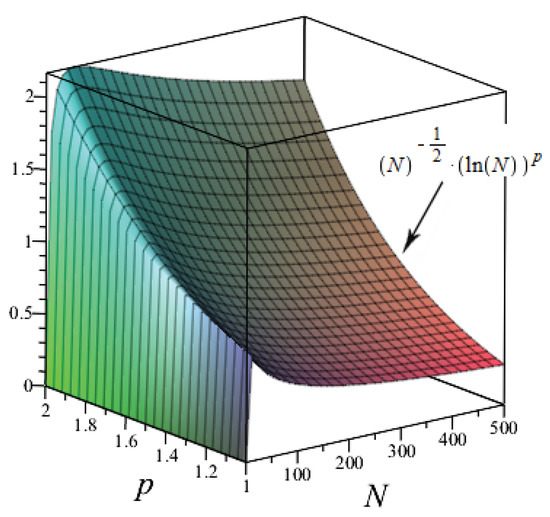
For , we know that for some ; see Figure 3.
Figure 3.
Graph of for .
Thus, the assertion can be obtained. □
4. Application to an Inverse Potential Problem
It is well known that an inverse potential problem is severely ill-posed. It is the problem of determining the shape of an unknown domain D from measurements of the Neumann boundary values of u on where the solution u fulfills Equations (1) and (2). In this work, Assumption 2.1 for the inverse potential problem cannot be presented. It fails even in the case of two concentric circles [2]. However, if we implement the method by representing the curve with a collocation basis, as will be seen in Proposition 3, the Fréchet derivative is reformulated. Without the verification of Assumption 1, we show a quite good performance of an approximated potential.
The nonlinear operator for an inverse potential problem is defined in the following form:
where . Moreover, the Fréchet derivative of the operator F is
See Reference [1] for more details. In the presented work, we use and . Since and , we discretized into m intervals with the grid points and . Note that and , where the sets and are orthogonal bases. The orthogonal bases are defined with respect to the step length by the piecewise continuous function with for , for , and with , otherwise. The result in the next proposition provides the formula for the calculation of .
Proposition 3.
Let The coefficient vector is given by
for , where
and
Proof.
The idea of the proof is analogous to Proposition 5 in Reference [21]. □
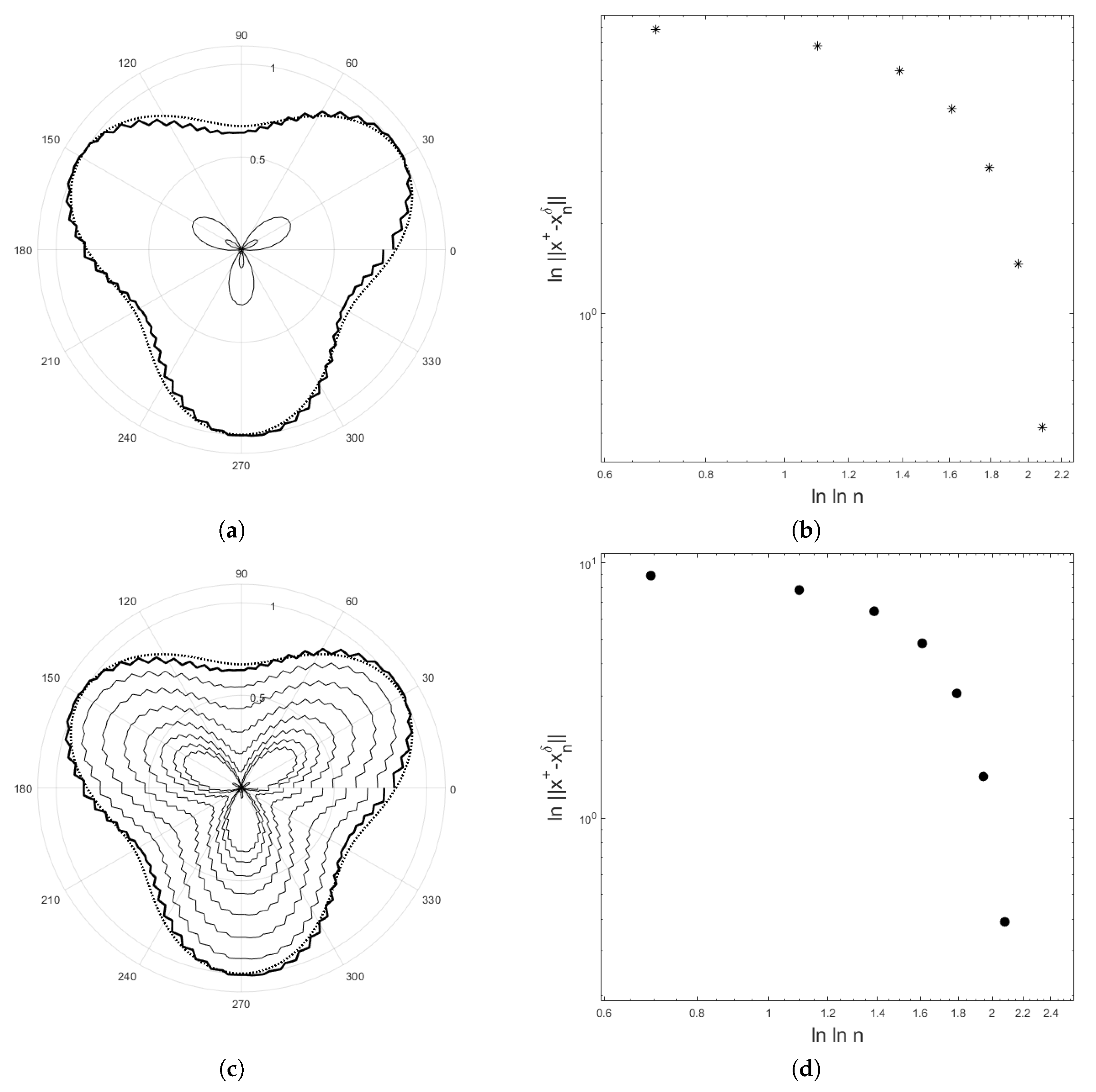
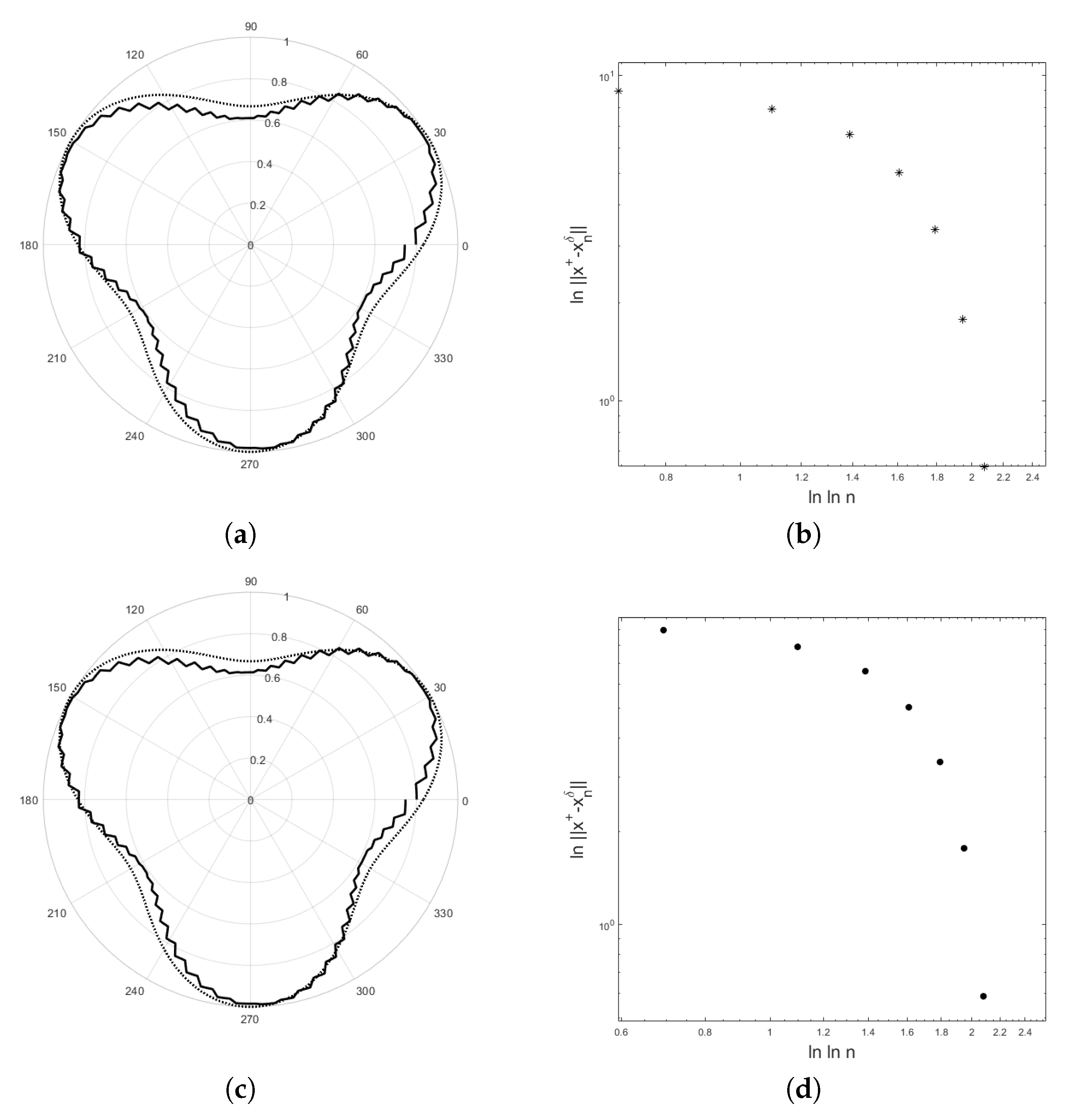
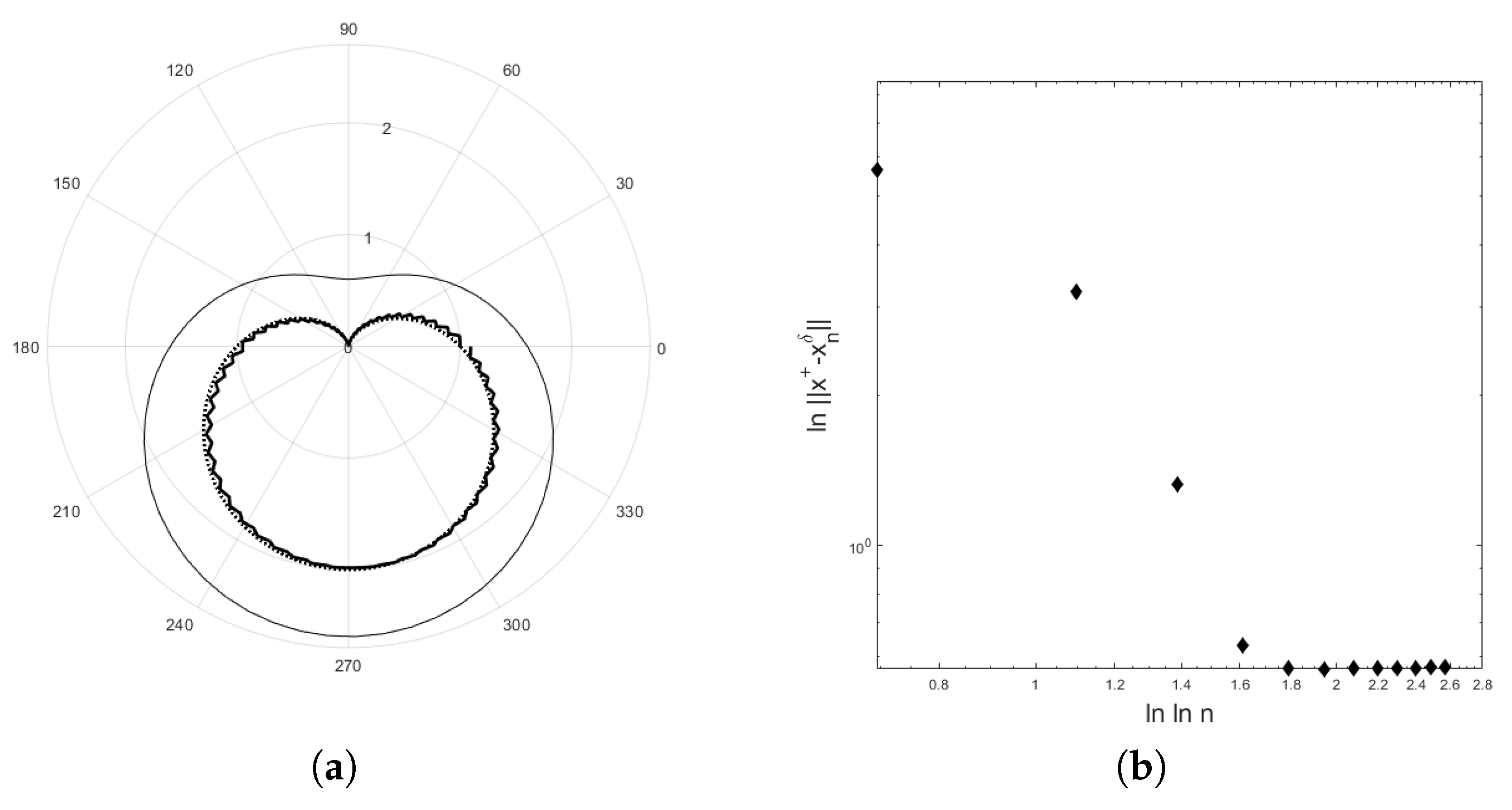
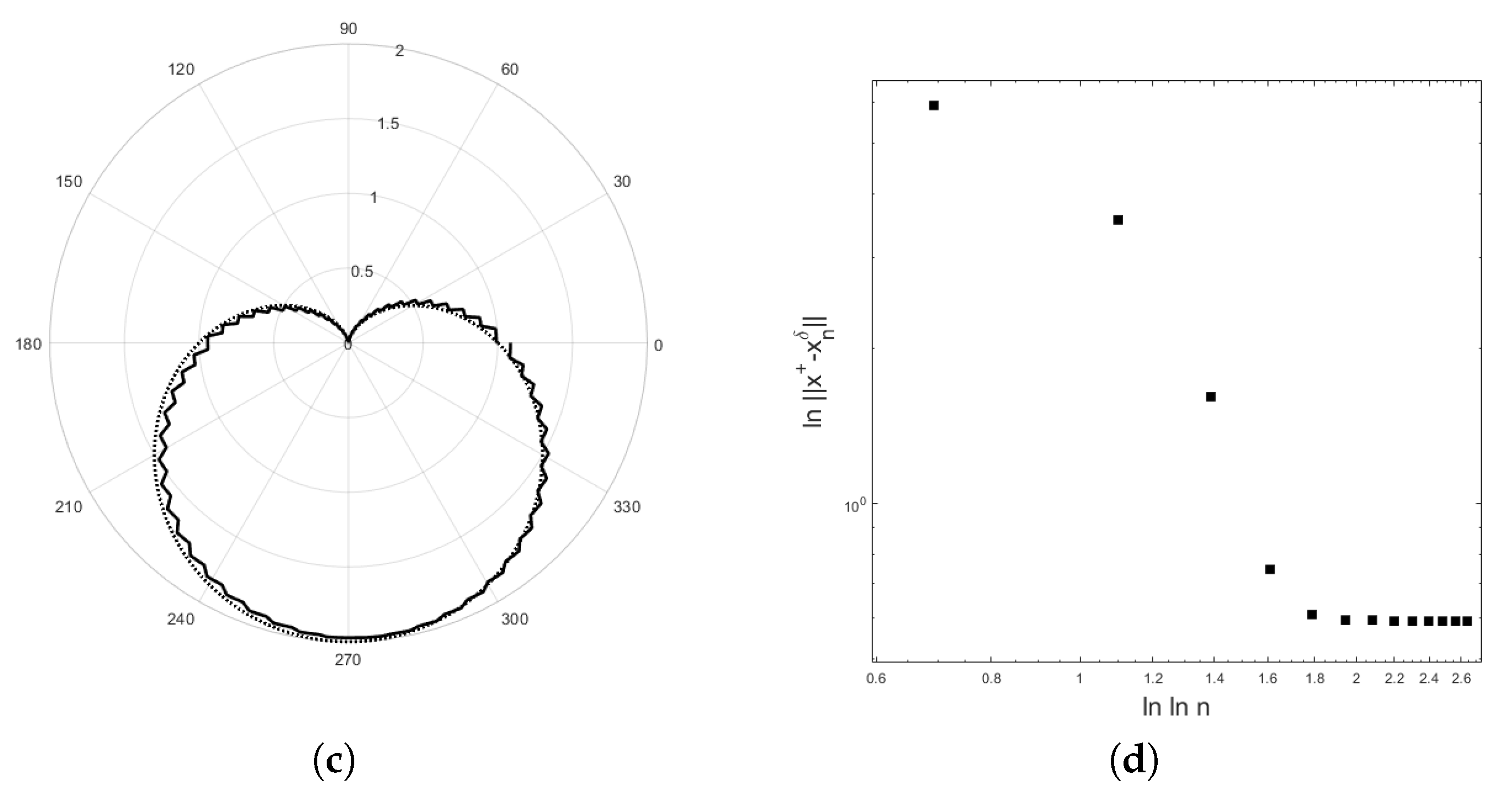
The numerical examples for recovering the potential are demonstrated in Figure 4, Figure 5 and Figure 6. We obtain data by solving the direct problem for the test curves. The program was written in MATLAB2018a. The results are demonstrated in Figure 4 and Figure 5 for the first test curve and in Figure 6 for the second test curve . For both examples, the number of basis functions is 65 and the number of equidistant grid points is 200. In Figure 4, , and provide the error with the residual norm after 8 iterations for and the error with the residual norm after 8 iterations for . In Figure 5, , and provide the error with the residual error after 8 iterations for and the error with the residual norm after 8 iterations for . For the second example, , and provide the error with the residual norm after 13 iterations and , and provide the error with the residual norm after 14 iterations. Figure 4, Figure 5b,d, and Figure 6b show that the curve of lies below a straight line with slope as suggested by Equation (29).
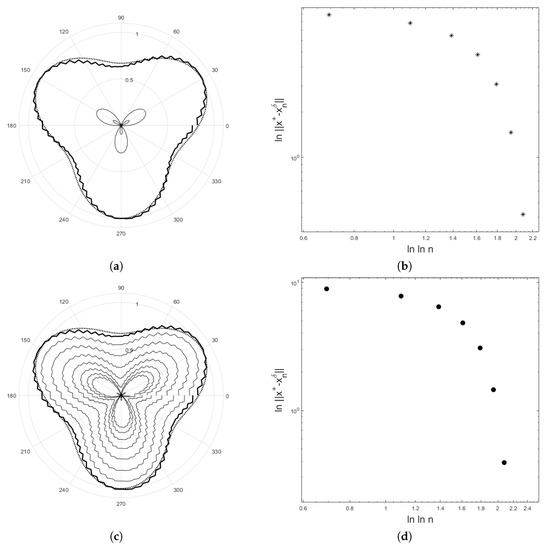
Figure 4.
The polar plot shows the exact solution (dot line) and the computed solution (solid line) for (a) and (c) with . In (a) the thin curve is an initial value. In (c) the thin curves are the curve of for . The error versus the logarithm of the number of iteration step using a double logarithm scale for (b) and (d) are shown. The initial value is = . The parameter in Equation (71) is .
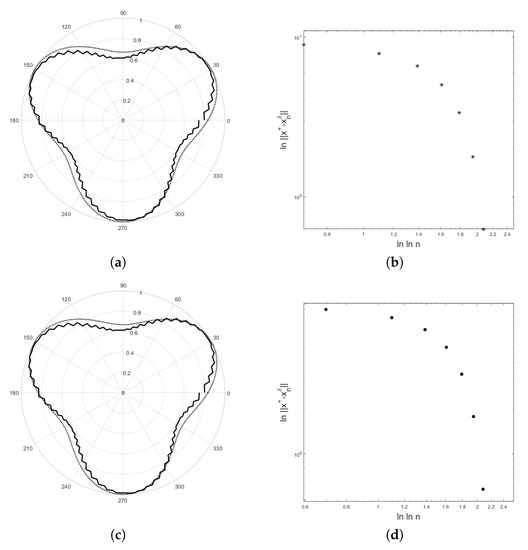
Figure 5.
The polar plot shows the exact solution (dot line) and the computed solution (solid line) for (a) and (c) with . The error versus the logarithm of the number of iteration step using a double logarithm scale for (b) and (d) are shown. The initial value is = . The parameter in Equation (71) is .
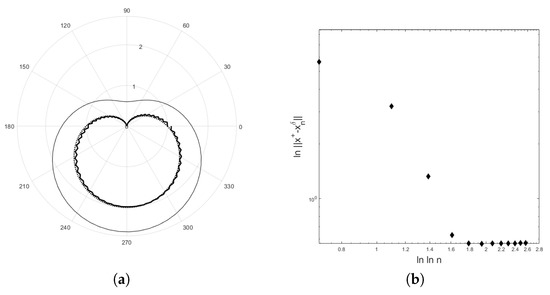
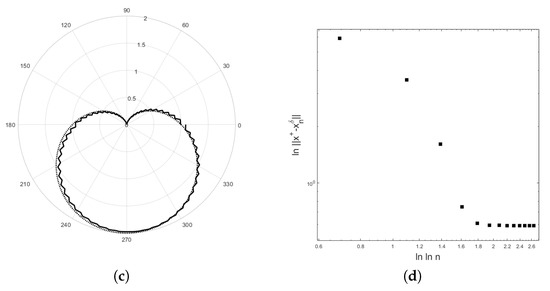
Figure 6.
(a) The polar plot shows the exact solution (dot line) and the computed solution (solid line) for example 2 with (a,b) and (c,d) . In (a), the thin curve is an initial value. The error versus the logarithm of the number of iteration step using a double logarithm scale is shown in (b) and (d). The initial value is = . The parameter in Equation (71) is .
5. Conclusions
In this article, we show that the rate of the modified Landweber method in Equation (6) under the logarithmic source condition in Equation (7) with is obtained. The regularization parameter was chosen according to the discrepancy principle. The linearity properties in Equations (17) and (18) of the nonlinear operator are needed although the verification for the inverse potential problem is not possible [2]. The test examples are used to illustrate the results in Theorem 1. For the modified Landweber regularization, the initial guess is an important information. With a good choice of initial guess, the shapes of the unknown domains D are quite good reconstructions. The curves in Figure 4, Figure 5b,d, and Figure 6b confirm the result in Theorem 1, where the curve of lies below a straight line with slope .
Author Contributions
The authors P.P., P.S., and C.B. carried out jointly this research work and drafted the manuscript together. All the authors validated the article and read the final version. All authors have read and agreed to the published version of the manuscript.
Funding
This work was supported by the Faculty of Science of Silpakorn University under the grant number 148 SRF-JRG-2561-07 and by Centre of Excellence in Mathematics of Mahidol University.
Acknowledgments
This work was supported by the Faculty of Science of Silpakorn University under the grant number SRF-JRG-2561-07 and by Centre of Excellence in Mathematics of Mahidol University. The authors would like to thank the reviewers for valuable hints and improvements.
Conflicts of Interest
The authors declare no conflict of interest
Appendix A
Lemma A1.
Similar to Deuflhard et al. [13]. Let and . The real-valued function
defined on satisfies
with C independent of k.
Moreover, for each , the real-valued function
defined on satisfies
with C independent of k.
Proof.
Following the proof of Deuflhard et al. [13] for , we have
for . Therefore, for any (independent of k), we have . Similarly, for , we have
Therefore, it follows that □
Lemma A2
([13]). Let and be sufficiently small such that. Let
Then,
with a generic constant C.
Lemma A3
([13]). Let . Then, there exists a constant D, which is independent of k, such that
Moreover, there exists a constant D (independent of k) such that
Lemma A4
([13]). Let be a solution of
Then, satisfies
References
- Böckmann, C.; Kammanee, A.; Braunß, A. Logarithmic convergence rate of Levenberg–Marquardt method with application to an inverse potential problem. J. Inv. Ill-Posed Probl. 2011, 19, 345–367. [Google Scholar] [CrossRef]
- Hettlich, F.; Rundell, W. Iterative methods for the reconstruction of an inverse potential problem. Inverse Probl. 1996, 12, 251–266. [Google Scholar] [CrossRef]
- Hettlich, F.; Rundell, W. A second degree method for nonlinear inverse problems. SIAM J. Numer. Anal. 1999, 37, 587–620. [Google Scholar] [CrossRef]
- Van den Doel, K.; Ascher, U. On level set regularization for highly ill-posed distributed parameter estimation problems. J. Comput. Phys. 2006, 216, 707–723. [Google Scholar] [CrossRef][Green Version]
- Hohage, T. Logarithmic convergence rates of the iteratively regularized Gauss—Newton method for an inverse potential and an inverse scattering problem. Inverse Probl. 1997, 13, 1279. [Google Scholar] [CrossRef]
- Pornsawad, P.; Sapsakul, N.; Böckmann, C. A modified asymptotical regularization of nonlinear ill-posed problems. Mathematics 2019, 7, 419. [Google Scholar] [CrossRef]
- Tautenhahn, U. On the asymptotical regularization of nonlinear ill-posed problems. Inverse Probl. 1994, 10, 1405–1418. [Google Scholar] [CrossRef]
- Zhang, Y.; Hofmann, B. On the second order asymptotical regularization of linear ill-posed inverse problems. Appl. Anal. 2018. [Google Scholar] [CrossRef]
- Pornsawad, P.; Böckmann, C. Modified iterative Runge-Kutta-type methods for nonlinear ill-posed problems. Numer. Funct. Anal. Optim. 2016, 37, 1562–1589. [Google Scholar] [CrossRef]
- Mahale, P.; Nair, M. Tikhonov regularization of nonlinear ill-posed equations under general source condition. J. Inv. Ill-Posed Probl. 2007, 15, 813–829. [Google Scholar] [CrossRef]
- Romanov, V.; Kabanikhin, S.; Anikonov, Y.; Bukhgeim, A. Ill-Posed and Inverse Problems: Dedicated to Academician Mikhail Mikhailovich Lavrentiev on the Occasion of his 70th Birthday; De Gruyter: Berlin, Germany, 2018. [Google Scholar]
- Scherzer, O. A modified Landweber iteration for solving parameter estimation problems. Appl. Math. Optim. 1998, 38, 45–68. [Google Scholar] [CrossRef]
- Deuflhard, P.; Engl, W.; Scherzer, O. A convergence analysis of iterative methods for the solution of nonlinear ill-posed problems under affinely invariant conditions. Inverse Probl. 1998, 14, 1081–1106. [Google Scholar] [CrossRef]
- Bakushinsky, A.; Kokurin, M.; Kokurin, M. Regularization Algorithms for Ill-Posed Problems; Inverse and Ill-Posed Problems Series; De Gruyter: Berlin, Germany, 2018. [Google Scholar]
- Schuster, T.; Kaltenbacher, B.; Hofmann, B.; Kazimierski, K. Regularization Methods in Banach Spaces; Radon Series on Computational and Applied Mathematics; De Gruyter: Berlin, Germany, 2012. [Google Scholar]
- Albani, V.; Elbau, P.; de Hoop, M.V.; Scherzer, O. Optimal convergence rates results for linear inverseproblems in Hilbert spaces. Numer. Funct. Anal. Optim. 2016, 37, 521–540. [Google Scholar] [CrossRef] [PubMed][Green Version]
- Kaltenbacher, B.; Neubauer, A.; Scherzer, O. Iterative Regularization Methods for Nonlinear Ill-Posed Problems; De Gruyter: Berlin, Germany; Boston, MA, USA, 2008. [Google Scholar]
- Louis, A.K. Inverse und Schlecht Gestellte Probleme; Teubner Studienbücher Mathematik, B. G. Teubner: Stuttgart, Germany, 1989. [Google Scholar]
- Vainikko, G.; Veterennikov, A.Y. Iteration Procedures in Ill-Posed Problems; Nauka: Moscow, Russia, 1986. [Google Scholar]
- Hanke, M.; Neubauer, A.; Scherzer, O. A convergence analysis of the Landweber iteration for nonlinear ill-posed problems. Numer. Math. 1995, 72, 21–37. [Google Scholar] [CrossRef]
- Böckmann, C.; Pornsawad, P. Iterative Runge-Kutta-type methods for nonlinear ill-posed problems. Inverse Probl. 2008, 24, 025002. [Google Scholar] [CrossRef][Green Version]
© 2020 by the authors. Licensee MDPI, Basel, Switzerland. This article is an open access article distributed under the terms and conditions of the Creative Commons Attribution (CC BY) license (http://creativecommons.org/licenses/by/4.0/).