


Abstract
This paper deals with the numerical solutions and convergence analysis for general singular Lane–Emden type models of fractional order, with appropriate constraint initial conditions. A modified reproducing kernel discretization technique is used for dealing with the fractional Atangana–Baleanu–Caputo operator. In this tendency, novel operational algorithms are built and discussed for covering such singular models in spite of the operator optimality used. Several numerical applications using the well-known fractional Lane–Emden type models are examined, to expound the feasibility and suitability of the approach. From a numerical viewpoint, the obtained results indicate that the method is intelligent and has several features stability for dealing with many fractional models emerging in physics and mathematics, using the new presented derivative.
1. Prolegomena and Presentation
Fractional calculus is dealing with investigations and applications of derivatives and integrations of arbitrary order that provide an attractive mechanism for explaining the memory and hereditary effort of complex systems [1,2,3,4,5]. Fractional calculus theory dates back to Leibniz in the sixteenth century, and after that, many forms of fractional operators have been introduced in the classical theory. Among them are the Riemann–Liouville, Caputo–Liouville, Atangana–Baleanu–Caputo, and Riesz operator approaches [6,7,8,9,10,11,12,13,14,15,16,17,18]. Fractional calculus attracted focus in current scientific research, due to its nonlocal nature and its ability to handle the effects of external forces of phenomena that cannot be modeled in a traditional way. Recently, a new definition of fractional derivative has proposed, the ABC fractional derivative [19,20,21,22,23,24,25,26,27,28,29,30,31].
At all events, it is not easy to find accurate numerical solutions to FLETM due to the complexity that occurs inside the Mittag–Leffler function in the fractional ABC derivatives. Thereafter, software computer programming is ordinarily used to obtain numerical solutions in acceptable accuracy. Over this treatise, we face to utilize the RKDM to gain approximate numerical outcomes of FLETM, utilizing the ABC fractional sense. More specifically, we consider the subsequent form [32,33].
subject to the CICs
We are standing for the following: ; ; with ; ; while ; ; . We are recording to sign the ABC fractional derivative of in over of order with
in which is a base point acquaint at and , whereas is the Sobolev functions’ space of order 2 on the domain except the boundary of erected as
The FLETM is categorized as a singular differential problem and supplied as an instrument in the formulation of the phenomena that emerge with various applications across mathematical physics and astrophysics. It characterizes the equilibrium thickness allocation in the self-gravitating sphere of polytrophic isothermal gas and, at the origin, contained singularity nodes. The FLETM has weight in the domain of modeling the clusters of galaxies, stellar structure, and radiative cooling. Interested reader can go through [32,33,34,35,36], to identify more details, properties, results, and applications on such singular models.
The standard RKDM main field topics are in the modelling and simulation of sundry-dimensional issues in applied computational physical, applied mathematics, and engineering [37,38,39], it has been used in creating numerical and approximate solutions for integral and differential models in the shape of infinite convergent series with floor extent of calculations, without any limited assumptions. This approach adjusted has been utilized as a solver technique to deal with complexes’ nonlinear and discontinues shapes of integral/differential problems arising in various applications area range from engineering to physics as utilized in [40,41,42,43,44,45,46,47,48,49,50,51,52,53,54,55,56,57,58,59].
2. Concrete Structure of the RKDM
This part is dedicated to describing some adaptive necessary rules and preliminaries for the RKDM, especially those concerning the kernel functions and independency. We take to denote the set of absolutely continuous functions on and we take to denote the set of square-integrable functions on .
Assume that is a reproducing kernel Hilbert space. From the Riesz representation theorem, it follows that for every , there exists only one , such that for every , we have
Definition 1.
[23] Letbe a Hilbert space with inner product and functional structures, as is given below:
Definition 2.
[23] Letbe a Hilbert space with inner product and functional structures, as is given below:
Theorem 1.
[23] The spaceis a complete reproducing kernel with rule
Theorem 2.
[23] The spaceis a complete reproducing kernel with rule
When applied the RKDM, one must firstly split the convex compact set into regular sections encoded with . This assumes that the acquired set will be dense in . We attempt to cover , as well as the numerical procedure ought to end in finite phases.
To examine the independency, suppose are not all zero, such that . Take , such that , , then
for . This shows that is linearly independent for all and, thus, is linearly independent in . Similarly, one can find that is linearly independent too.
3. Solutions Shape of FLETM
Multiplying (1) by , we get
in which , , and .
The replacement converts FLETM given by (11) and (2) into homogenous one. We are denoting the new equation by
subject to the CICs
The function appears from substituting instead of in (12). In fact, after simplification and transform the extra mathematical terms into the right hand side of (12), one can write .
Define the linear operator and its map as
Putting , then (14) and (13) are converted into the form
We arrange the system of orthogonal functions taking , , , such that is dense on . The Gram–Schmidt orthogonalization process is used to generate the system of orthonormal functions on , where
with the orthogonalization coefficients with the indexes , and are computed in the subsequent algorithm.
| Algorithm 1. Steps of the orthonormal Gram–Schmidt process: |
| Step 1: For and , do the following: Output: The orthogonalization coefficients . Step 2: For set Output: System of orthonormal functions . |
Remark 1.
In the third formula of (17), the calculations of ,are obtaining recursively as follows:
- Ifand, thenwhere
- Ifand, thenwherein whichcomes from (19). Similarly,where
- Ifand, 3 thenwherein whichcomes from (19) andcomes from (21). Similarly,wherein whichcomes from (23). Finally,where
Analogue for the remaining indexesand.
Lemma 1.
The systemis complete on
Proof.
assures that . For each , if , , then
From (5) we get . By the density of in , we have . The existence of yields . Subsequently, is complete on . □
Definition 3.
[60] Ifis a continuous function andan orthonormal functions system, then, are called Fourier functions ofwith respect to the systemandis called its Fourier expansion.
Theorem 3.
The subsequent are achieved:
- Wheneverthe analytic solution of (15) fulfills:
- The-term numerical solution of Equation (15) fulfills:
Proof.
Assume that are orthogonalization coefficients for the orthonormal functions systems . Then
For the numerical computations, we truncate the series in (32) using the -term numerical solution of . □
The attached steps focusing on the computational steps require using an appropriate software package for solving (15) using RKDM, and in order to evaluate the numerical approximation of in .
| Algorithm 2. Steps of RKDM for numerical approximations model of FLETM in ABC derivative: |
| Step I: Fix in and do Phases 1 and 2: Phase 1: Set in the index . Phase 2: Set in the index . Output: the orthogonal function system . Step II: For the indices and do Algorithm 1. Output: the orthogonalization coefficients . Step III: Set in the indices . Output: the orthonormal function system . Step IV: Set and with the indices do Phases 1, 2, and 3: Phase 1: Set . Phase 2: Set . Phase 3: Set . Output: The -term numerical approximation of . |
4. Convergence Analysis
In this part, the convergence of numerical solution and error behavior are presented. Using convergent series representation, the following two theorems explain that FLETM described in Equation (15) is conditionally formulated and consistent.
To achieve our goal, we assume is bounded whenever and is dense on . Then the error is decreasing for sufficiently large , since we have
The convergence of yields whenever as long as and are extracted from (32) and (33).
Lemma 2.
For, it holds,, and.
Proof.
The proof is straightforward from , Holder’s inequality, and (6). □
If and whenever then . This can be seen directly from Lemma 2 and the fact that . We denote . This allows us to rewrite as
Theorem 4.
From (36), it holds thatwhenever.
Proof.
Clearly, . From the orthogonality of , we get
This implies and there exists in such that , which means that . In order to have
it is sufficient to have for that
whereas, . As one has . By the completeness, such that as . □
Theorem 5.
One haswheneverin (36).
Proof.
Taking the on both sides of (36), one get . Thus
and
If , then and if , then . Generally, we have . By the density condition, ; such that whenever or . Letting one can get . Since , then satisfies (15). □
5. Model Experiments and Computational Results
In this important portion; in order to solve FLETM in (1) and (2) numerically using the RKDM, three models are presented in certain specific form. In the examples, we demonstrate the performance and efficiency of the proposed approach in term of tables and figures, with some scientific explanations’ comments.
5.1. Certain Examples
In the subsequent FLETM, the readers should note that and are known and may not be homogeneous. The forcing term can be obtain by substituting through the given model.
Example 1.
Consider the following FLETM in ABC sense:
subject to the CICs
where the analytic solution is given by
Example 2.
Consider the following FLETM in ABC sense:
subject to the CICs
where the analytic solution is given by
Example 3.
Consider the following FLETM in ABC sense:
subject to the CICs
where the analytic solution is given by
Recall that ; ; ; and , while denotes the ABC fractional derivative of in over of order .
5.2. Results and Discussions
Take into consideration Algorithms 1 and 2, following the RKDM, using , the numerical validations for different values of grid points will be exhibited. For this purpose, Table 1, Table 2 and Table 3 tabulates the evolution of the absolute errors as
for Examples 1, 2, and 3, simultaneously.

Table 1.
Numerical results of Example 1 using RKDM.
Table 2.
Numerical results of Example 2 using RKDM.
Table 3.
Numerical results of Example 3 using RKDM.
From the tables, we observe that the RKDM numerical outcomes are unanimous with analytic solutions during in the area of interest. Additional iterations will lead to more refined solutions along the memory and heritage characteristics of . The ABC fractional derivative orders have powerful belongings on the model shapes, which head for lead to remarkable behaviors in the incident of a considerable departure from the value of .
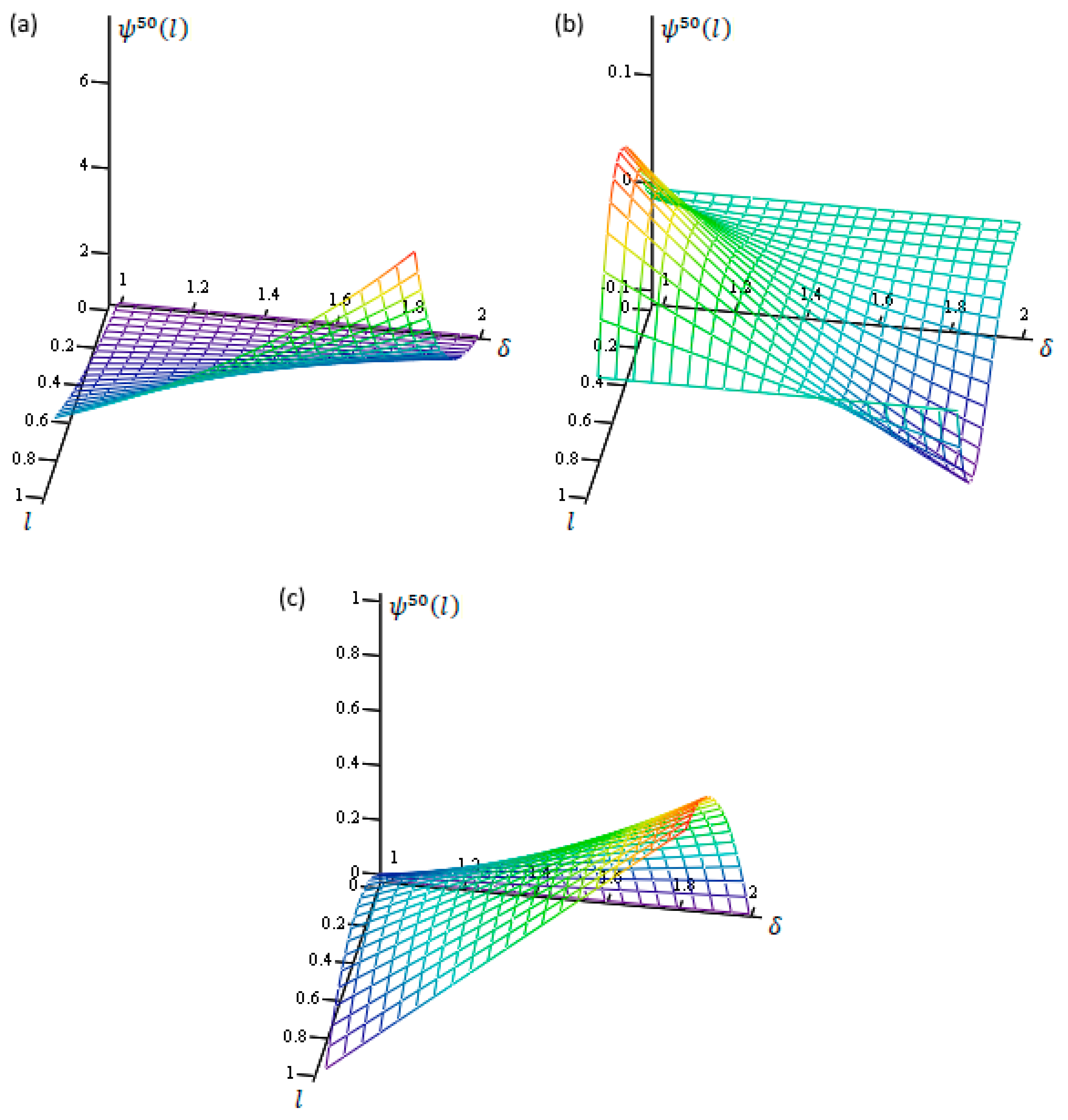
The surfaces plot of the RKDM numerical solutions for Examples 1, 2, and 3 are drawn in Figure 1a–c simultaneously, for different values of grid points when . It appears that all figures almost look identical in their behaviors, and in good agreement with each other, particularly when comparing the case of . Moreover, the RKDM numerical solutions are very close at the CICs.
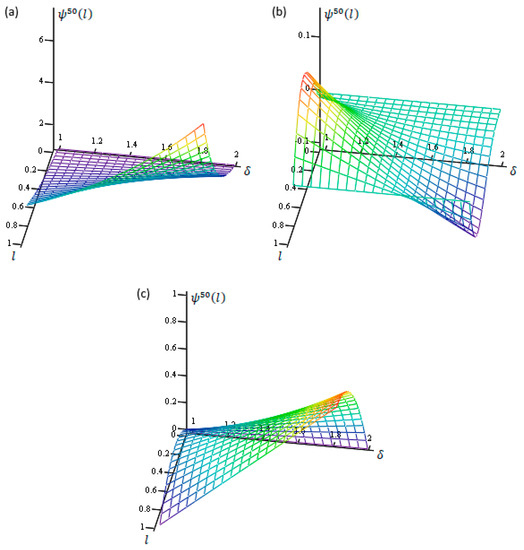
Figure 1.
The computational values of the RKDM when and : (a) Example 1; (b) Example 2; and (c) Example 3.
6. Conclusions and Outline
The attractive RKDM has been successfully employed to construct and predict the numerical/analytic solutions for FLETM under the ABC fractional sense. Convergence and consistency were discussed, which turns out that the proposed scheme has decreasing absolute error in the space. Three FLETM models have been given to test applicability and straightforwardness of the presented approach. The gained numerical data reveal that the numerical solutions are conformable with each other at the selected parameters and nods. Finally, one can see that the RKDM is a methodical and convenient scheme to address various fractional differential/integral problems across applied sciences and engineering area.
In the near future, we intend to conduct more research as a continuation of this work. One of these research studies is related to the applications of the RKDM to solve numerically the Lane–Emden type models that contain functions with singularities or weak regularity, subject to CICs or constraint boundary conditions.
Author Contributions
Conceptualization, O.A.A. and S.M.; methodology O.A.A.; software, A.-H.A.-A.; validation, M.S.O. and A.-B.A.M.; formal analysis, O.A.A.; investigation, O.A.A.; resources, M.S.O.; data curation, A.-H.A.-A.; writing—original draft preparation, M.S.O.; writing—review and editing, O.A.A.; visualization, O.A.A.; supervision, S.M.; project administration, A.-B.A.M.; funding acquisition, A.-B.A.M. All authors have read and agreed to the published version of the manuscript.
Funding
This project was supported by the Deanship of Scientific Research at Prince Sattam Bin Abdulaziz University under the research project No.2020/01/11801.
Acknowledgments
This research was supported by the Ajman University grant: 2019–20.
Conflicts of Interest
The authors declare no conflict of interest.
Abbreviations
| FLETM | fractional Lane–Emden type model |
| ABC | Atangana–Baleanu–Caputo |
| RKDM | reproducing kernel discretization method |
| CIC | constraint initial condition |
References
- Herrmann, R. Fractional Calculus: An Introduction for Physicists; World Scientific: Singapore, 2014. [Google Scholar]
- Tarasov, V.E. Fractional Dynamics: Applications of Fractional Calculus to Dynamics of Particles, Fields and Media; Springer: Heidelberg, Germany, 2011. [Google Scholar]
- West, B.J. Fractional Calculus View of Complexity: Tomorrow’s Science; Taylor & Francis: Oxfordshire, UK, 2015. [Google Scholar]
- Kilbas, A.; Srivastava, H.; Trujillo, J. Theory and Applications of Fractional Differential Equations; Elsevier: Amsterdam, The Netherlands, 2006. [Google Scholar]
- West, B.J. Natures Patterns and the Fractional Calculus; De Gruyter: Berlin, Germany, 2017. [Google Scholar]
- Abu Arqub, O.; El-Ajou, A.; Momani, S. Constructing and predicting solitary pattern solutions for nonlinear time-fractional dispersive partial differential equations. J. Comput. Phys. 2015, 293, 385–399. [Google Scholar] [CrossRef]
- El-Ajou, A.; Abu Arqub, O.; Momani, S. Approximate analytical solution of the nonlinear fractional KdV-Burgers equation: A new iterative algorithm. J. Comput. Phys. 2015, 293, 81–95. [Google Scholar] [CrossRef]
- El-Ajou, A.; Abu Arqub, O.; Momani, S.; Baleanu, D.; Alsaedi, A. A novel expansion iterative method for solving linear partial differential equations of fractional order. Appl. Math. Comput. 2015, 257, 119–133. [Google Scholar] [CrossRef]
- Ray, S.S. New exact solutions of nonlinear fractional acoustic wave equations in ultrasound. Comput. Math. Appl. 2016, 71, 859–868. [Google Scholar]
- Ray, S.S.; Sahoo, S. Analytical approximate solutions of Riesz fractional diffusion equation and Riesz fractional advection-dispersion equation involving nonlocal space fractional derivatives. Math. Method. Appl. Sci. 2015, 38, 2840–2849. [Google Scholar] [CrossRef]
- Ghanbari, B.; Osman, M.S.; Baleanu, D. Generalized exponential rational function method for extended Zakharov–Kuzetsov equation with conformable derivative. Mod. Phys. Lett. A 2019, 34, 1950155. [Google Scholar] [CrossRef]
- Zhuang, P.; Liu, F.; Anh, V.; Turner, I. Numerical methods for the variable-order fractional advection-diffusion equation with a nonlinear source term. SIAM J. Numer. Anal. 2009, 47, 1760–1781. [Google Scholar] [CrossRef]
- Osman, M.S. New analytical study of water waves described by coupled fractional variant Boussinesq equation in fluid dynamics. Pramana 2019, 93, 26. [Google Scholar] [CrossRef]
- Liu, J.G.; Osman, M.S.; Zhu, W.H.; Zhou, L.; Ai, G.P. Different complex wave structures described by the Hirota equation with variable coefficients in inhomogeneous optical fibers. Appl. Phys. B 2019, 125, 175. [Google Scholar] [CrossRef]
- Osman, M.S.; Wazwaz, A.M. A general bilinear form to generate different wave structures of solitons for a (3+ 1) -dimensional Boiti-Leon-Manna-Pempinelli equation. Math. Method Appl. Sci. 2019, 42, 6277–6283. [Google Scholar] [CrossRef]
- Osman, M.S.; Lu, D.; Khater, M.M.A.; Attia, R.A.M. Complex wave structures for abundant solutions related to the complex Ginzburg–Landau model. Optik 2019, 192, 162927. [Google Scholar] [CrossRef]
- Ding, Y.; Osman, M.S.; Wazwaz, A.M. Abundant complex wave solutions for the nonautonomous Fokas–Lenells equation in presence of perturbation terms. Optik 2019, 181, 503–513. [Google Scholar] [CrossRef]
- Lu, D.; Tariq, K.U.; Osman, M.S.; Baleanu, D.; Younis, M.; Khatera, M.M.A. New analytical wave structures for the (3 + 1)-dimensional Kadomtsev-Petviashvili and the generalized Boussinesq models and their applications. Results Phys. 2019, 14, 102491. [Google Scholar] [CrossRef]
- Atangana, A.; Baleanu, D. New fractional derivatives with non-local and non-singular kernel: Theory and application to heat transfer model. Therm. Sci. 2016, 20, 763–769. [Google Scholar] [CrossRef]
- Atangana, A.; Nieto, J.J. Numerical solution for the model of RLC circuit via the fractional derivative without singular kernel. Adv. Mech. Eng. 2015, 7, 1–7. [Google Scholar] [CrossRef]
- Maayah, B.; Yousef, F.; Abu Arqub, O.; Momani, S.; Alsaedi, A. Computing bifurcations behavior of mixed type singular time-fractional partial integrodifferential equations of Dirichlet functions types in Hilbert space with error analysis. Filomat 2019, 33, 3845–3853. [Google Scholar] [CrossRef]
- Atangana, A.; Gómez-Aguilar, J.F. Decolonisation of fractional calculus rules: Breaking commutativity and associativity to capture more natural phenomena. Eur. Phys. J. Plus 2018, 133, 1–22. [Google Scholar] [CrossRef]
- Abu Arqub, O.; Al-Smadi, M. Atangana-Baleanu fractional approach to the solutions of Bagley-Torvik and Painlevé equations in Hilbert space. Chaos Solitons Fractals 2018, 117, 161–167. [Google Scholar] [CrossRef]
- Abu Arqub, O.; Maayah, B. Modulation of reproducing kernel Hilbert space method for numerical solutions of Riccati and Bernoulli equations in the Atangana-Baleanu fractional sense. Chaos Solitons Fractals 2019, 125, 163–170. [Google Scholar] [CrossRef]
- Abu Arqub, O.; Maayah, B. Numerical solutions of integrodifferential equations of Fredholm operator type in the sense of the Atangana-Baleanu fractional operator. Chaos Solitons Fractals 2018, 117, 117–124. [Google Scholar] [CrossRef]
- Abu Arqub, O.; Maayah, B. Fitted fractional reproducing kernel algorithm for the numerical solutions of ABC-Fractional Volterra integro-differential equations. Chaos Solitons Fractals 2019, 126, 394–402. [Google Scholar] [CrossRef]
- Djida, J.D.; Atangana, A.; Area, I. Numerical computation of a fractional derivative with non-local and non-singular kernel. Math. Model. Nat. Phenom. 2017, 12, 4–13. [Google Scholar] [CrossRef]
- Atangana, A.; Gómez-Aguilar, J.F. Fractional derivatives with no-index law property: Application to chaos and statistic. Chaos Solitons Fractals 2018, 114, 516–535. [Google Scholar] [CrossRef]
- Atangana, A. On the new fractional derivative and application to nonlinear Fisher’s reaction-diffusion equation. Appl. Math. Comput. 2016, 273, 948–956. [Google Scholar] [CrossRef]
- Atangana, A.; Koca, I. On the new fractional derivative and application to Nonlinear Baggs and Freedman model. J. Nonlinear Sci. Appl. 2016, 9, 2467–2480. [Google Scholar] [CrossRef]
- Algahtani, O. Comparing the Atangana-Baleanu and Caputo-Fabrizio derivative with fractional order: Allen Cahn model. Chaos Solitons Fractals 2016, 89, 552–559. [Google Scholar] [CrossRef]
- Akgül, A.; Inc, M.; Karatas, E.; Baleanu, D. Numerical solutions of fractional differential equations of Lane-Emden type by an accurate technique. Adv. Differ. Equ. 2015, 2015, 220. [Google Scholar] [CrossRef]
- Singh, O.P.; Pandey, R.K.; Singh, V.K. An analytic algorithm of Lane–Emden type equations arising in astrophysics using modified Homotopy analysis method. Comput. Phys. Commun. 2009, 180, 1116–1124. [Google Scholar] [CrossRef]
- Kıymaz, O.; Mirasyedioğlu, Ş. A new symbolic computational approach to singular initial value problems in the second-order ordinary differential equation. Appl. Math. Comput. 2005, 171, 1218–1225. [Google Scholar]
- Iqbal, S.; Javed, A. Application of optimal homotopy asymptotic method for the analytic solution of singular Lane–Emden type equation. Appl. Math. Comput. 2011, 217, 7753–7761. [Google Scholar] [CrossRef]
- Pandey, R.K.; Kumar, N. Solution of Lane–Emden type equations using Bernstein operational matrix of differentiation. New Astron. 2012, 17, 303–308. [Google Scholar] [CrossRef]
- Cui, M.; Lin, Y. Nonlinear Numerical Analysis in the Reproducing Kernel Space; Nova Science: Hauppauge, NY, USA, 2009. [Google Scholar]
- Berlinet, A.; Agnan, C.T. Reproducing Kernel Hilbert Space in Probability and Statistic; Kluwer Academic Publishers: New York, NY, USA, 2004. [Google Scholar]
- Daniel, A. Reproducing Kernel Spaces and Applications; Springer: Basel, Switzerland, 2003. [Google Scholar]
- Abu Arqub, O.; Al-Smadi, M.; Momani, S.; Hayat, T. Numerical solutions of fuzzy differential equations using reproducing kernel Hilbert space method. Soft Comput. 2016, 20, 3283–3302. [Google Scholar] [CrossRef]
- Abu Arqub, O.; Al-Smadi, M.; Momani, S.; Hayat, T. Application of reproducing kernel algorithm for solving second-order, two-point fuzzy boundary value problems. Soft Comput. 2017, 21, 7191–7206. [Google Scholar] [CrossRef]
- Abu Arqub, O. Adaptation of reproducing kernel algorithm for solving fuzzy Fredholm-Volterra integrodifferential equations. Neural Comput. Appl. 2017, 28, 1591–1610. [Google Scholar] [CrossRef]
- Abu Arqub, O. Fitted reproducing kernel Hilbert space method for the solutions of some certain classes of time-fractional partial differential equations subject to initial and Neumann boundary conditions. Comput. Math. Appl. 2017, 73, 1243–1261. [Google Scholar] [CrossRef]
- Abu Arqub, O. Numerical solutions for the Robin time-fractional partial differential equations of heat and fluid flows based on the reproducing kernel algorithm. Int. J. Numer. Meth. Heat 2018, 28, 828–856. [Google Scholar] [CrossRef]
- Abu Arqub, O. The reproducing kernel algorithm for handling differential algebraic systems of ordinary differential equations. Math. Meth. Appl. Sci. 2016, 39, 4549–4562. [Google Scholar] [CrossRef]
- Abu Arqub, O.; Al-Smadi, M.; Shawagfeh, N. Solving Fredholm integro-differential equations using reproducing kernel Hilbert space method. Appl. Math. Comput. 2013, 219, 8938–8948. [Google Scholar] [CrossRef]
- Abu Arqub, O.; Al-Smadi, M. Numerical algorithm for solving two-point, second-order periodic boundary value problems for mixed integro-differential equations. Appl. Math. Comput. 2014, 243, 911–922. [Google Scholar] [CrossRef]
- Abu Arqub, O. Approximate solutions of DASs with nonclassical boundary conditions using novel reproducing kernel algorithm. Fundam. Inform. 2016, 146, 231–254. [Google Scholar] [CrossRef]
- Abu Arqub, O.; Al-Smadi, M. Numerical algorithm for solving time-fractional partial integrodifferential equations subject to initial and Dirichlet boundary conditions. Numer. Meth. Part. Differ. Equ. 2018, 34, 1577–1597. [Google Scholar] [CrossRef]
- Abu Arqub, O. Solutions of time-fractional Tricomi and Keldysh equations of Dirichlet functions types in Hilbert space. Numer. Meth. Part. Differ. Equ. 2018, 34, 1759–1780. [Google Scholar] [CrossRef]
- Abu Arqub, O. Numerical solutions of systems of first-order, two-point BVPs based on the reproducing kernel algorithm. Calcolo 2018, 55, 1–28. [Google Scholar] [CrossRef]
- Abu Arqub, O.; Odibat, Z.; Al-Smadi, M. Numerical solutions of time-fractional partial integrodifferential equations of Robin functions types in Hilbert space with error bounds and error estimates. Nonlinear Dyn. 2018, 94, 1819–1834. [Google Scholar] [CrossRef]
- Abu Arqub, O.; Al-Smadi, M. An adaptive numerical approach for the solutions of fractional advection–diffusion and dispersion equations in singular case under Riesz’s derivative operator. Physica A 2020, 540, 123257. [Google Scholar] [CrossRef]
- Abu Arqub, O. Numerical algorithm for the solutions of fractional order systems of Dirichlet function types with comparative analysis. Fundam. Inform. 2019, 166, 111–137. [Google Scholar] [CrossRef]
- Al-Smadi, M.; Abu Arqub, O. Computational algorithm for solving fredholm time-fractional partial integrodifferential equations of dirichlet functions type with error estimates. Appl. Math. Comput. 2019, 342, 280–294. [Google Scholar] [CrossRef]
- Abu Arqub, O.; Shawagfeh, N. Application of reproducing kernel algorithm for solving Dirichlet time-fractional diffusion-Gordon types equations in porous media. J. Porous Media 2019, 22, 411–434. [Google Scholar] [CrossRef]
- Jiang, W.; Chen, Z. A collocation method based on reproducing kernel for a modified anomalous sub-diffusion equation. Numer. Meth. Part. Differ. Equ. 2014, 30, 289–300. [Google Scholar] [CrossRef]
- Geng, F.Z.; Qian, S.P.; Li, S. A numerical method for singularly perturbed turning point problems with an interior layer. J. Comput. Appl. Math. 2014, 255, 97–105. [Google Scholar] [CrossRef]
- Lin, Y.; Cui, M.; Yang, L. Representation of the exact solution for a kind of nonlinear partial differential equations. Appl. Math. Lett. 2006, 19, 808–813. [Google Scholar] [CrossRef]
- Parashar, B.P. Differential and Integral Equations, 2nd ed.; CBS Publishers: Delhi, India, 2008. [Google Scholar]
© 2020 by the authors. Licensee MDPI, Basel, Switzerland. This article is an open access article distributed under the terms and conditions of the Creative Commons Attribution (CC BY) license (http://creativecommons.org/licenses/by/4.0/).