


Abstract
A paired-dominating set of a graph G without isolated vertices is a dominating set of vertices whose induced subgraph has perfect matching. The minimum cardinality of a paired-dominating set of G is called the paired-domination number γpr(G) of G. The paired-domination subdivision number sdγpr(G) of G is the minimum number of edges that must be subdivided (each edge in G can be subdivided at most once) in order to increase the paired-domination number. Here, we show that, for each tree T ≠ P5 of order n ≥ 3 and each edge e ∉ E(T), sdγpr(T) + sdγpr(T + e) ≤ n + 2.
1. Introduction
Let be a simple connected graph with vertex set and edge set and let . For any vertex , the open neighborhood of u is the set , and the closed neighborhood of u is the set . The degree of a vertex u is . A vertex of degree one is called a leaf and its neighbor is called a stem. A stem is said to be strong if it is adjacent to at least two leaves.
Throughout this paper, when an edge is subdivided, denotes the subdivision vertex for e. For a set , denotes the graph obtained from G by subdividing every edge in F (note that we have for any with ). The length of a shortest -path in a graph G is the distance between u and v, and is written or simply if G is clear from context. The maximum distance among all pairs of vertices in G is called the diameter of G, written . A diametral path of G is a path of G with the length .
A subset S of V is a dominating set of G if every vertex in is adjacent to a vertex in A paired-dominating set (PD-set) of G is a subset S of V if S is a dominating set and the subgraph induced by S contains a perfect matching. The minimum cardinality of a PD-set of G is the paired-domination number. If S is a PD-set with a perfect matching M and , then u and v are said to be partners (or paired) in S. We call a PD-set of minimum cardinality a -set. Since the end vertices of any maximal matching in G form a PD-set, every graph G without isolated vertices has a PD-set. Haynes and Slater [1] introduced the Paired-domination, which has been studied, for example, in [2,3,4,5,6]. For more details on paired-domination, we refer the reader to [7].
As good models of many practical problems, graphs sometimes have to be changed to adapt the changes in reality. Thus, we must pay attention to the change of the graph parameters under graph modifications, such as the deletion of vertices, deletion or addition of edges, and subdivision of edges. Velammal [8] was the first to study the domination subdivision number of a graph G defined to be the minimum number of edges that must be subdivided (each edge in G is subdivided at most once) to increase the domination number. Since then, subdivision parameters have been studied by several authors (see [9,10,11,12,13,14,15]).
In this paper, we study the paired-domination subdivision number of trees, which was introduced by Favaron et al. in [16] and has been further studied in [17,18,19,20,21]. The paired-domination subdivision number of a graph G is the minimum number of edges that must be subdivided (where each edge in G can be subdivided at most once) in order to increase the paired-domination number of G.
If G is a connected graph of order at least 3, Favaron et al. [16] asked whether it is true that for any edge . Egawa et al. [18] gave a negative answer to this question. However, they proved the question in the affirmative if the following additional condition is added: for every Recently, Hao et al. [19] showed that for any graph G without isolated vertices and different from , and for any edge , .
Our aim in this paper is to further study paired-domination subdivision number and show that for each tree of order and each edge , .
We close this section by recalling some useful results.
Proposition 1
([16]). Let G be a connected graph of order and let be obtained from G by subdividing the edge . Then, .
Proposition 2
([20]). For every connected graph G of order , .
Proposition 3
([18]). For any graph G with no isolated vertex and any , or .
Proposition 4
([18]). For any connected graph G of order at least 3 and with , .
Proposition 5
([16]). If G contains either adjacent stems or a strong stem, then .
Proposition 6
([16]). For any connected graph G containing a path such that , .
Proposition 7
([16]). For ,
Proposition 8
([18]). If a tree T contains a path in which and for , then .
Proposition 9
([19]). For any isolated-free graph G different from and any satisfying that u or v is a stem,
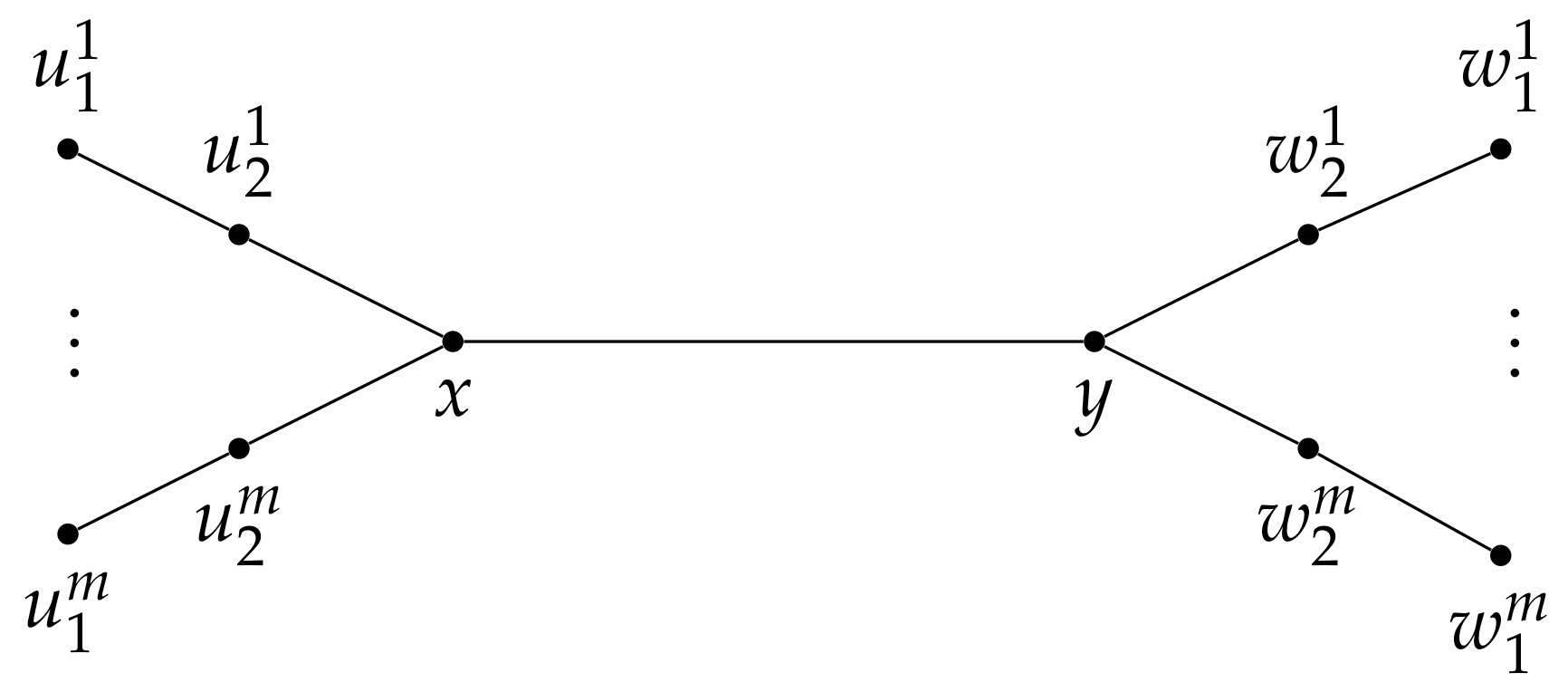
For any positive integer , let be the healthy spider obtained from the complete bipartite graph by subdividing every edge. Therefore and (see Figure 1). The vertex x is called the center of . Let be the tree obtained from the disjoint union of two copies of the healthy spider centered at , by joining x and y (see Figure 2). Observe that , and .
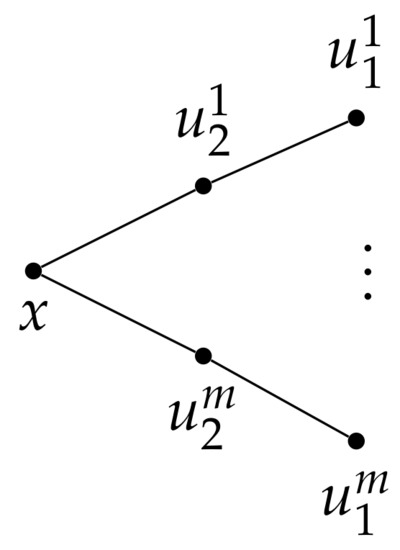
Figure 1.
A healthy spider .
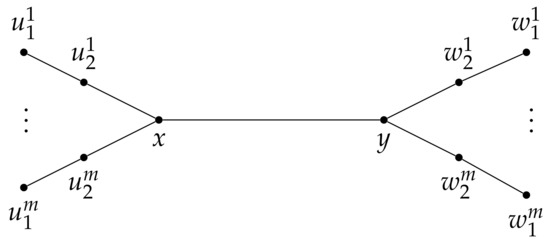
Figure 2.
A tree with .
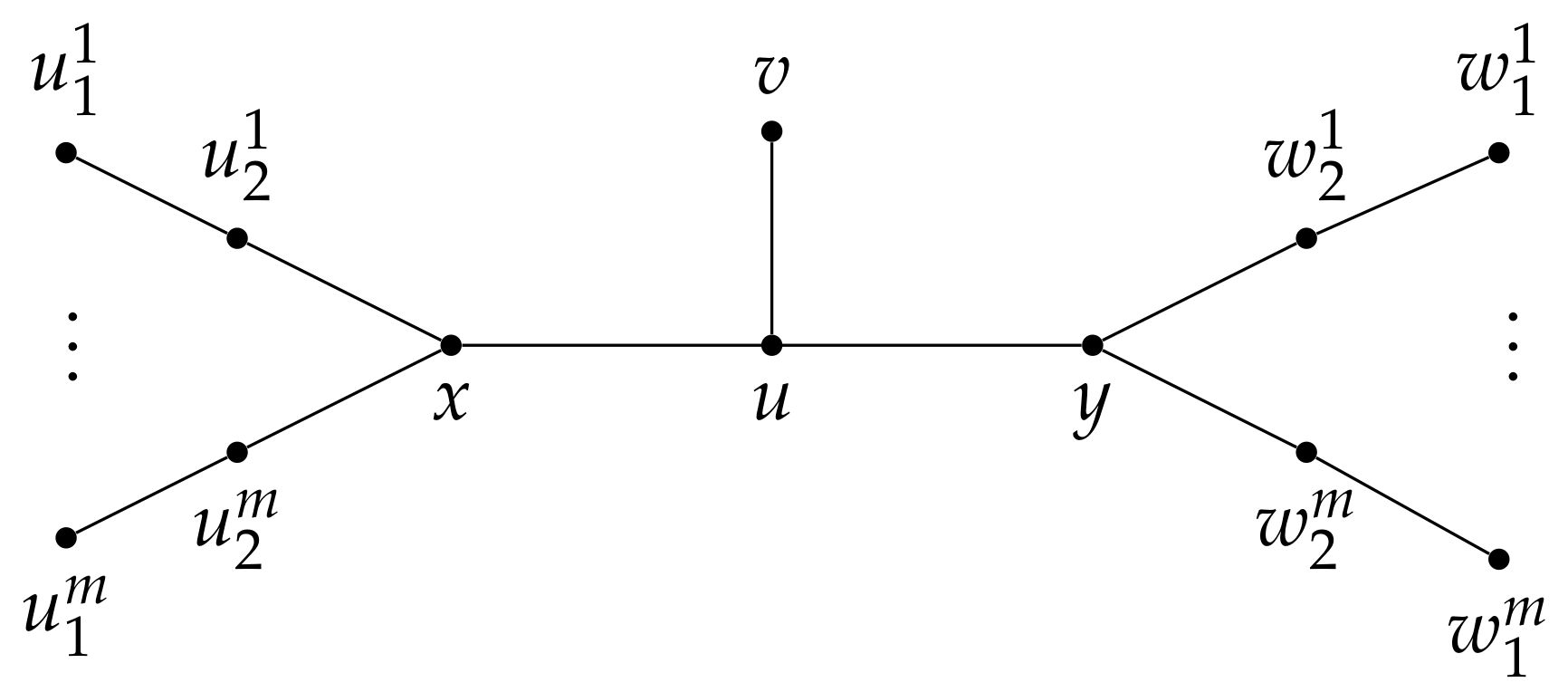
Let be the tree obtained from by subdividing the edge with a subdivision vertex u and adding a new vertex v and a new edge (Figure 3). Observe that , , and .
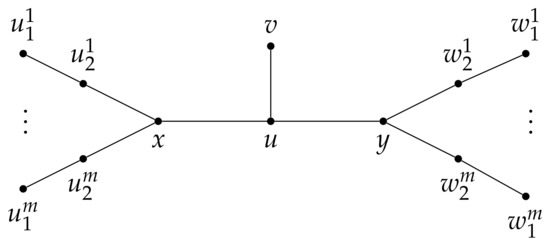
Figure 3.
A tree with .
Now let .
Proposition 10
([18]). For any tree T of order , if and only if .
Proposition 11
([20]). For any tree T of order different from a healthy spider,
Combining Propositions 10 and 11, we have the following corollary.
Corollary 1.
Let T be a tree of order different from a healthy spider. Then, with equality if and only if .
2. Main Result
Our aim in this section is to prove that, for each tree with vertices and any edge , First, we consider trees with diameter four and five.
Lemma 1.
Let T be a tree of order with and let . Then,
Proof.
If T has a strong stem or adjacent stems, then by Propositions 2 and 5 we have Suppose next that T has no adjacent stems and no strong stem. Then, T is a healthy spider. Let and let . Since , we have . We consider the four cases.
- Case 1.
- Both x and y are leaves.
Without a loss of generality, assume that and . Observe that . Let be obtained from by subdividing the edges with the vertices , and , respectively. We show that . Let D be a -set. If , then we must have for each and , which leads to . Assume now that . If v is paired with or , then we must have for each and implying that . Assume next that v is not paired with or . Without a loss of generality, assume that v is paired with . Thus, for each and yielding . Thus, and, by Proposition 2, we obtain
- Case 2.
- x is a leaf and y is a stem.
Without a loss of generality, assume that and . Then, it is clear that . Let be obtained from by subdividing the edges and e with the vertices and , respectively. As in Case 1, we can see that . Hence, and, by Proposition 2, we have
- Case 3.
- x is a leaf and .
Without a loss of generality, assume that . Clearly . Let be obtained from by subdividing the edges with . We show that . Let D be a -set. To paired-dominate , we must have and to paired-dominate we must have . Since is even, we obtain . Hence, and, by Proposition 2, we have
- Case 4.
- Both x and y are stems.
In this case, has adjacent stems, and we deduce from Propositions 2 and 5 that □
Lemma 2.
Let T be a tree of order n withand let. Then,
Proof.
As in the proof of Lemma 1, we may assume that T has no strong stem and no adjacent stems. Let be a diametral path in T. By the assumption, the components of are or a healthy spider. It is easy to see that . Let and be the components of containing and , respectively. If , then we deduce from Propositions 2 and 7 that Assume that . Suppose that . If , then it is easy to see that subdividing the edges increases the paired-domination number of T and so and the result follows by Proposition 2. Hence, we assume that . Let , , and let . We consider the four cases.
- Case 1.
- Both x and y are leaves.
If x and y are the leaves of (resp., ), then, clearly, and by Propositions 4 and 11, we have If x is a leaf of and y is a leaf of , then, we deduce from Propositions 6 and 11 that
- Case 2.
- x is a leaf and y is a stem.
Assume first that are the vertices of . We may assume that and . Then, the set is a paired-dominating set of of size and so . If x and y are the vertices of , then similarly we have . Assume second that and . Without a loss of generality, we can suppose that and . Then, the set is a paired-dominating set of with cardinality , and thus . Applying Propositions 4 and 11 we obtain
- Case 3.
- x is a leaf and .
Without loss of generality, we may assume that . If , then the set is a paired-dominating set of of size and so . If , then the set is a paired-dominating set of of size , and thus . Using Propositions 4 and 11, we obtain
- Case 4.
- Both x and y are stems.
In this case, has adjacent stems, and we deduce from Propositions 2 and 5 that □
Theorem 1.
Let T be a tree different from of order and let . Then,
Proof.
If T has a strong stem or adjacent stems, then, by Propositions 2 and 5, we have Hence, we assume that T has no strong stem and no adjacent stems. It follows that . According to Lemmas 1 and 2, we may assume that . If x or y is a stem, then by Propositions 9 and 11, we have Hence, we assume that neither x nor y is a stem. If x (resp., y) is a leaf with support vertex (resp., ) of degree 2, respectively, then for , is a path in T with , and therefore by Propositions 6 and 11, we have Thus, we may assume that, if both x and y are leaves, then the stem of x or y is of at least degree 3.
Let be a diametral path such that is minimized. By assumption, the trees and (the components of containing and , respectively) are or a healthy spider. Let and let be the leaf adjacent to for each i. Root T is at . We consider three cases.
- Case 1.
- .
We distinguish the following subcases.
Subcase 1.1. is a stem.
By our assumption, T has no strong stem. Let w be a unique leaf adjacent to . First, let . Let be obtained from by subdividing the edges and with vertices and , respectively for each i and the edges and with vertices r and s, respectively. We show that . Let P be a -set. To paired-dominate , we may assume that for each i. On the other hand, to paired-dominate w and , we must have .
If or and is paired with r or s, then the set
is a PD-set of with cardinality of less than P. Assume that and is paired with a vertex not in . Then, we have , and clearly the set is a PD-set of with cardinality of less than P. Since the number of subdivided edges is at most , we deduce from Proposition 11 that .
Now, let . Let . Note that each component of has at least two vertices. Let be obtained from by subdividing and with vertices and , respectively for each i, the edge with vertex for each j, and the edge e with vertex q. By our assumptions, it is not difficult to verify that the number of subdivided edges is at most . We next show that . Let P be a -set, and let F be the set of all edges in whose subdivision vertices are in P. To paired-dominate , we may assume that for each i.
On the other hand, to paired-dominate , we must have . If or and is not paired with , then and the set is a PD-set of obtained from by subdividing all edges in F with cardinality of less than P. If and is paired with , then the set is a PD-set of obtained from by subdividing the edges in F with cardinality of less than P. By Proposition 1, we have for each . Therefore, in either case, we have . It follows from Proposition 11 that .
Subcase 1.2. is not a stem and there is a path in T such that and .
If e is incident to , then it follows from Propositions 9 and 11 that . Hence, we assume that . First, let . Let be obtained from by subdividing the edges and with the vertices and , respectively, for each i and the edges and with the vertices r and s, respectively. By our assumptions, it is not difficult to verify that the number of subdivided edges is at most . As above, we can see that , and thus . We deduce from Proposition 11 that .
Now, let . We distinguish the following situations.
- (1.2.1)
- .Let . Note that each component of has order at least two. Let be obtained from by subdividing the edges and with the vertices and , respectively, for each i, the edge with vertex for each j, and the edges and e with the vertices and , respectively. By our assumptions, it is not difficult to verify that the number of subdivided edges is at most . We show that . Let P be a -set, and let F be the set of all edges in whose subdivision vertices are in P. To paired-dominate , we may assume that for each i. On the other hand, to paired-dominate , we must have .If or and is not paired with , then , and the set is a PD-set of obtained from by subdividing the edges F with cardinality of less than P. If and is paired with , then the set is a PD-set of obtained from by subdividing the edges in F with cardinality of less than P. By Proposition 1, we have for each . Therefore, in either case, we have . It follows from Proposition 11 that .
- (1.2.2)
- .Then, . Let , and let be obtained from by subdividing the edges and with the vertices and , respectively, for each i, the edge with vertex for each j, and the edges and e. By our assumptions, it is not difficult to verify that the number of subdivided edges is at most . Using an argument similar to that described in (1.2.1), we can see that .
Subcase 1.3. All children of except have depth 3.
Considering the above cases and subcases and the choice of diametral path, we may assume that each component of has at least three vertices. Let }, and let be obtained from by subdividing the edges and with the vertices and , respectively, for each i and the edges with vertex for each j. By our assumptions, it is not difficult to verify that the number of subdivided edges is at most . We show that . Let P be a -set. To paired-dominate , we may assume that for each i. On the other hand, to paired-dominate , we must have .
Let F be the set of subdivided edges incident to whose subdivision vertices belong to P. If or and its partner is in , then we have , and the set is a PD-set of obtained from by subdividing the edges of F with cardinality of less than P.
If , and its partner is , then the set is a PD-set of obtained from by subdividing the edges of F with cardinality of less than P. By Proposition 1, we have for each . Therefore, in either case, we have . It follows from Proposition 11 that .
- Case 2.
- .
By our earlier assumptions, T has no strong stem, neither x nor y is a stem, and if both x and y are leaves, then the stem of x or y is of at least degree 3. Therefore, we may assume without a loss of generality that and . Let be obtained from by subdividing the edges , and e by the subdivision vertices , and , respectively. We show that . Let P be a -set. If , then we must have , and clearly is a PD-set of with cardinality of less than P.
If and its partner is not or , then , and hence is a PD-set of with cardinality of less than P. If and its partner is or , then , and hence is a PD-set of with cardinality of less than P. Therefore, we have . It follows from Proposition 11 that .
- Case 3.
- One of x and y belongs to , and the other does not belong to .
Assume, without a loss of generality, that and . By our earlier assumption, x is not a stem. We distinguish two subcases.
Subcase 3.1.x is a leaf of .
Assume without a loss of generality that . If or y is a leaf, then it follows from Proposition 6 that , and the result follows from Proposition 11. Let , and y is not a leaf. By our earlier assumption, y is not a stem, and hence each component of has at least two vertices. Note that the component of containing has at least five vertices and, thus, . Let be obtained from by subdividing the edges and by the subdivision vertices and , respectively, and all edges incident to y in T. We show that . Let P be a -set, be the set of subdivided edges incident to y whose subdivision vertices are in P and let be obtained from by subdividing the edges in .
First, we assume that and y is paired with . Then, clearly . We may assume that , otherwise , and hence we may consider as a -set. If is paired with a vertex other than , then is a PD-set of with cardinality of less than P. If is paired with , then and is also a PD-set of with cardinality of less than P.
Second, assume that and y is paired with a subdivision vertex other than . Then, . As above, we may assume that . If is paired with a vertex other than , then is a PD-set of with cardinality of less than P. If is paired with , then and hence is a PD-set of obtained from T by subdividing the edges in , with cardinality of less than P.
Finally, we assume that . Then, y must be dominated by a subdivision vertex. As above, we may assume that . We consider the following.
- (3.1.1)
- .Then, and are partners and to paired-dominate , we must have . If is paired with , then , and hence is a PD-set of with cardinality of less than P. If is paired with a vertex other than , then , and hence is a PD-set of with cardinality of less than P.
- (3.1.2)
- .Then, we must have . Let be a subdivision vertex that dominates y, and let be obtained from by subdividing the edges . If is paired with , then , and hence is a PD-set of with cardinality of less than P. If is paired with a vertex other than , then is also a PD-set of with cardinality of less than P.
In all cases, it follows from Proposition 1 that for each . Therefore, we have . It follows from Proposition 11 that .
Subcase 3.2..
By assumption, y is not a support vertex. We consider the following situations.
- (3.2.1)
- .Let be the stem of y and be the parent of . Let be obtained from by subdividing the edges and with the vertices , respectively, and the edge with vertex for each i. Let F be the set of all subdivided edges. Note that by the choice of the diametral path , it is not difficult to check that . We show that . Let P be a -set. To paired-dominate , we must have .If and is the partner of , then is a PD-set of obtained from by subdividing the edges in with cardinality of less than P. If and is the partner of , then is a PD-set of obtained from by subdividing the edge in with cardinality of less than P.In the following, we may assume that . To paired-dominate , we may assume that , and, to paired-dominate , we must have . First, we assume that y and are partners. If , then is a PD-set of obtained from by subdividing the edges in with cardinality of less than P.If , then is a PD-set of obtained from by subdividing the edges in with cardinality of less than P. Second, we assume that y and are partners. If , then and , is a PD-set of obtained from by subdividing the edges in with cardinality of less than P. If , then is also a PD-set of with cardinality of less than P.In all cases, it follows from Proposition 1 that for each . Therefore, we have . It follows from Proposition 11 that .
- (3.2.2)
- There is a path in T satisfying that and .Let be obtained from by subdividing the edge with vertex for each i, the edges and with the vertices and , respectively, and the other edges incident to y. Let F be the set of all subdivided edges. We note that . Let P be a -set. To paired-dominate and , we must have and . To dominate , we must have or .First, assume that . If y is paired with , then and is a PD-set of obtained from by subdividing the edges with cardinality of less than P. If y is paired with , then is a PD-set of obtained from by subdividing the edges with cardinality of less than P. If y is partner with a subdivision vertex , then is a PD-set of obtained from by subdividing the edges with cardinality of less than P.Second, assume that . If is paired with a subdivision vertex , then is a PD-set of obtained from by subdividing the edges with cardinality of less than P. If is paired with , then is a PD-set of obtained from by subdividing the edges with cardinality of less than P.In all cases, it follows from Proposition 1 that for each . Therefore, we have . It follows from Proposition 11 that .
- (3.2.3)
- There is no path in T with and .Let be the shortest -path in T such that is a leaf of T and . By our assumption, T has no strong stem. Thus, we have . Let be the component of containing . Note that . Now, using the argument applied in Case 1, we can see thatThis completes the proof.
□
3. Conclusions
The main objective of this paper was to study the paired-domination subdivision number of a graph G defined to be the minimum number of edges that must be subdivided (where each edge in G can be subdivided at most once) in order to increase the paired-domination number of G. We focused on trees and proved that, for any tree of order and any edge , . As a consequence of this study, we pose the following conjecture.
Conjecture 1.
Let G be a connected graph of order . Then, .
Author Contributions
G.H. and S.M.S. contributed to the supervision, methodology, validation, project administration, and formal analysis. S.W., R.K., and H.K. contribute to the investigation, resources, some computations, and wrote the initial draft of the paper, which was investigated and approved by G.H., S.W., and S.M.S. who wrote the final draft. All authors have read and agreed to the published version of the manuscript.
Funding
This study was supported by the National Natural Science Foundation of China (Nos. 12061007, 11861011), the Natural Science Found of Fujian Province (No. 2020J01844), and the Open Project Program of Research Center of Data Science, Technology, and Applications, Minjiang University, China.
Institutional Review Board Statement
Not applicable.
Informed Consent Statement
Not applicable.
Data Availability Statement
Not applicable.
Conflicts of Interest
The authors declare no conflict of interest.
References
- Haynes, T.W.; Slater, P.J. Paired-domination in graphs. Networks 1998, 32, 199–206. [Google Scholar] [CrossRef]
- Chellali, M.; Haynes, T.W. Total and paired-domination in trees. AKCE Int. J. Graphs. Combin. 2004, 1, 69–75. [Google Scholar]
- Favaron, O.; Karami, H.; Sheikholeslami, S.M. Paired-domination number of a graph and its complement. Discrete Math. 2008, 308, 6601–6605. [Google Scholar] [CrossRef]
- Haynes, T.W.; Henning, M.A. Paired-domination game played in graphs. Commun. Comb. Optim. 2019, 5, 79–94. [Google Scholar]
- Kang, L.; Sohn, M.Y.; Cheng, T.C.E. Paired-domination in inflated graphs. Theoret. Comput. Sci. 2004, 320, 485–494. [Google Scholar] [CrossRef][Green Version]
- Proffitt, K.E.; Haynes, T.W.; Slater, P.J. Paired-domination in grid graphs. Congr. Numer. 2001, 150, 161–172. [Google Scholar]
- Desormeaux, W.J.; Haynes, T.W.; Henning, M.A. Paired-domination in graphs. In Topics in Domination in Graphs; Haynes, T.W., Hedetniemi, S.T., Henning, M.A., Eds.; Springer International Publishing: Berlin, Germany, 2020. [Google Scholar]
- Velammal, S. Studies in Graph Theory: Covering, Independence, Domination and Related Topics. Ph.D. Thesis, Manonmaniam Sundaranar University, Tirunelveli, India, 1997. [Google Scholar]
- Amjadi, J. Total Roman domination subdivision number in graphs. Commun. Comb. Optim. 2020, 5, 157–168. [Google Scholar]
- Avella-Alaminos, D.; Dettlaff, M.; Lemańska, M.; Zuazua, R. Total domination multisubdivision number of a graph. Discuss. Math. Graph Theory 2015, 35, 315–327. [Google Scholar] [CrossRef]
- Dettlaff, M.; Kosari, S.; Lemańska, M.; Sheikholeslami, S.M. The convex domination subdivision number of a graph. Commun. Comb. Optim. 2016, 1, 43–56. [Google Scholar] [CrossRef]
- Dettlaff, M.; Raczek, J.; Topp, J. Domination subdivision and domination multisubdivision numbers of graphs. Discuss. Math. Graph Theory 2019, 39, 829–839. [Google Scholar] [CrossRef]
- Favaron, O.; Karami, H.; Sheikholeslami, S.M. Connected domination subdivision numbers of graphs. Util. Math. 2008, 77, 101–111. [Google Scholar]
- Fvaron, O.; Karami, H.; Sheikholeslami, S.M. Disprove of a conjecture the domination subdivision number of a graph. Graphs Combin 2008, 24, 309–312. [Google Scholar] [CrossRef]
- Meddah, N.; Blidia, M.; Chellali, M. On the 2-independence subdivision number of graphs. Commun. Comb. Optim. 2021, in press. [Google Scholar]
- Favaron, O.; Karami, H.; Sheikholeslami, S.M. Paired-domination subdivision numbers of graphs. Graphs Combin. 2009, 25, 503–512. [Google Scholar] [CrossRef]
- Amjadi, J.; Chellali, M. Complexity of the paired domination subdivision problem. 2020; submitted. [Google Scholar]
- Egawa, Y.; Furuya, M.; Takatou, M. Upper bounds on the paired domination subdivision number of a graph. Graphs Combin. 2013, 29, 843–856. [Google Scholar] [CrossRef]
- Hao, G.; Sheikholeslami, S.M.; Chellali, M.; Khoeilar, R.; Karami, H. On the paired-domination subdivision number of a graph. Mathematics 2021, 9, 439. [Google Scholar] [CrossRef]
- Shao, Z.; Sheikholeslami, S.M.; Chellali, M.; Khoeilar, R.; Karami, H. A proof of a conjecture on the paired-domination subdivision number. submitted.
- Qiang, X.; Kosari, S.; Shao, Z.; Sheikholeslami, S.M.; Chellali, M.; Karami, H. A note on the paired-domination subdivision number of trees. Mathematics 2021, 9, 181. [Google Scholar] [CrossRef]
Publisher’s Note: MDPI stays neutral with regard to jurisdictional claims in published maps and institutional affiliations. |
© 2021 by the authors. Licensee MDPI, Basel, Switzerland. This article is an open access article distributed under the terms and conditions of the Creative Commons Attribution (CC BY) license (https://creativecommons.org/licenses/by/4.0/).