


Abstract
For a graph G with no isolated vertex, let and denote the paired-domination and paired-domination subdivision numbers, respectively. In this note, we show that if T is a tree of order different from a healthy spider (subdivided star), then improving the -upper bound that was recently proven.
1. Introduction
Throughout the paper, is a simple connected graph with vertex set of order and edge set . For every vertex , the open neighborhood of v is the set and the closed neighborhood of v is the set . The degree of a vertex v is . When no confusion arises, we will delete the subscript G in and A vertex of degree one is called a leaf and its neighbor is called a stem. A stem is said to be strong if it is adjacent to at least two leaves. A healthy spider for is obtained from a star by subdividing each edge by exactly one vertex. The center vertex of a healthy spider will be called a head. Let and be the path and cycle of order n. The diameter of G, denoted by , is the maximum value among minimum distances between all pairs of distinct vertices of G. A matching in a graph G is a set of pairwise non-intersecting edges, while a perfect matching in G is a matching that covers each vertex.
A dominating set of G is a subset S of V such that every vertex in has at least one neighbor in A subset S of V is a paired-dominating set of abbreviated PD-set, if S is a dominating set and the subgraph induced by the vertices of S contains a perfect matching. The paired-domination number is the minimum cardinality of a PD-set of G. If S is a PD-set with a perfect matching M, then two vertices u and v are said to be partners (or paired) in S if the edge . We call a PD-set of minimum cardinality a -set. Note that every graph G without isolated vertices has a PD-set since the endvertices of any maximal matching in G form such a set. Paired-domination was introduced by Haynes and Slater [1] and is studied, for example, in [2,3,4,5,6,7]. For more details on paired-domination, we refer the reader to the recent book chapter [8].
As an application, in the design of networks for example, it is essential to study the effect that some modifications on the graph that have on the graph parameters. These modifications can be deletion or addition of vertices, deletion or addition of edges. We refer the reader to chapter 7 of [9] when the graph parameter is the domination number. Fink et al. [10], were the first to study the bondage number of G defined to be the minimum number of edges whose removal increases the domination number of G, while Kok and Mynhardt [11] were the first to study the reinforcement number of G defined to be the minimum number of edges which must be added to G in order to decrease the domination number of G. In [12], Velammal studied another kind of modification where the goal is find the minimum number of edges to be subdivided (each edge in G is subdivided at most once) in order to increase the domination number. For more details, see [13,14,15,16,17].
Our main purpose in this paper is to study of the paired-domination subdivision number of trees. This parameter was introduced by Favaron et al. in [18] and defined as follows. The paired-domination subdivision number of a graph G is the minimum number of edges that must be subdivided (where each edge in G can be subdivided at most once) in order to increase the paired-domination number of G. Observe that since the paired-domination subdivision number of the complete graph remains unchanged when its only edge is subdivided, we will assume that the graph G has order at least 3. It is worth noting that it has recently been shown by Amjadi and Chellali [19] that the problem of computing the paired-domination subdivision number is NP-hard for bipartite graphs. The paired-domination subdivision number has been further studied by several authors (see [20,21,22]).
In [18], Favaron et al. have given some conditions for a graph (including trees) to have a small paired-domination subdivision number that we summarize by the following results.
Proposition 1
([18]). For every graph G of order , if , then .
Proposition 2
([18]). If G contains either a strong stem or adjacent stems, then .
Proposition 3
([18]). If a connected graph G contains a path in which for , then .
It should also be noted that Favaron et al. [18] conjectured that for all connected graphs of order In connection with this conjecture, Egawa et al. [20] proved that for every connected graph G of order Moreover, if further G has an edge such that u and v are not partners in any -set, then The conjecture has recently been settled in the affirmative in [22]. Restricted to the class of trees, we observe that for healthy spiders with or paths
In this note, we improve the -upper bound on the paired-domination subdivision number for all trees T of order different from a healthy spider by providing an upper bound on it in terms of the paired-domination number. More precisely, we will mainly show the following.
Theorem 1.
Let T be a tree of order different from a healthy spider. Then .
In addition, we will also show that if T is a tree of order different from a healthy spider, then its paired-domination subdivision number is at most Before giving the proof of our results, it is necessary to recall the following two useful results.
Proposition 4
([18]). Let G be a connected graph of order and . If is obtained from G by subdividing the edge e, then .
Proposition 5
([18]). For ,
We close this section by mentioning that the paired-domination number of a path of order is (see [8]).
2. Proof of Theorem 1
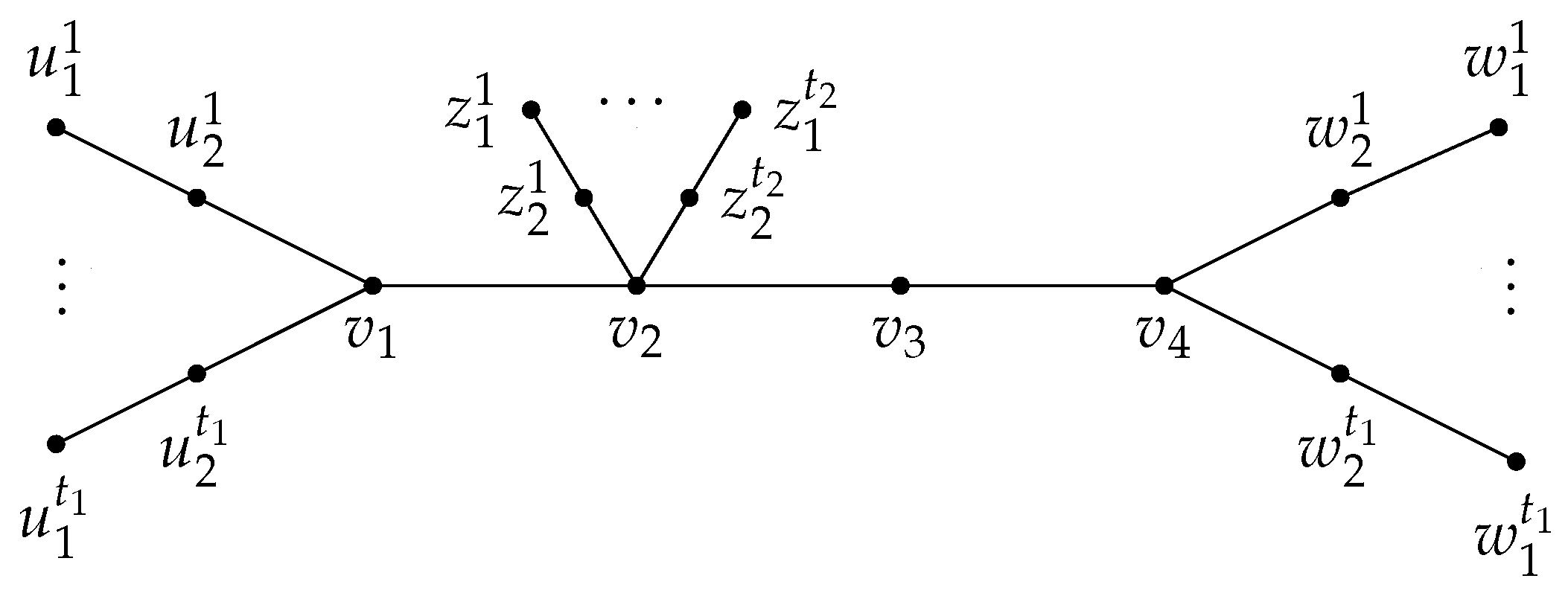
For non-negative integers where , let be the tree obtained from a path by adding pendant paths , pendant paths , and pendant paths (see Figure 1). Let be the family of all trees . The set is a PD-set of and so One the other hand, if D is a -set, then to paired-dominate the leaves of , we must have , and implying that Thus
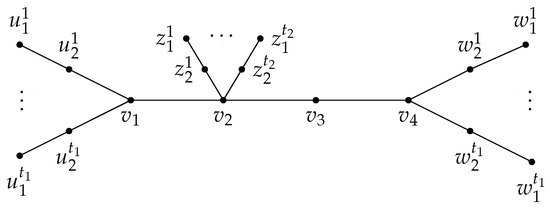
Figure 1.
The graph .
Lemma 1.
If , then .
Proof.
Let , and let be the tree obtained from T by subdividing the edge with new vertex x, the edges with new vertices respectively, for each i, and the edge with new vertex for each j, if . Clearly the number of subdivided edges is . Let be a -set. To paired-dominate each leaf , we must have for each ; to paired-dominate each leaf we must have for each ; and to paired-dominate the leaves we may assume that . Moreover, to paired-dominate the vertex , we must have . Therefore . Hence . □
Now we are ready to start the proof of Theorem 1.
Proof of Theorem 1.
If , then clearly and by Proposition 2 we have . Hence, let . Note that If T has a strong stem or adjacent stems, then the result follows from Proposition 2. Hence, we can assume that T has no strong stem or adjacent stems. If and is a diametral path in T, then since T is not a subdivided star, we must have and is a stem, which is a contradiction. Hence, we can assume that . Let be a diametral path in T such that is as small as possible. We consider two cases.
Case 1.. Root T at , and consider the following subcases.
Subcase 1.1. is not a stem and .
By the choice of the diametral path, we deduce that for each child w of , the maximal subtree rooted at w is a either path or a healthy spider (if ). Let H be the forest of where each of its components is a healthy spider. Since , note that H is empty if Now, let be the (pendant) paths in T such that and for each , and let be the paths in T (if any) such that and for each . Assume, without loss of generality, that . Let be the tree obtained from T by subdividing the edges with new vertices , respectively, the edge with a new vertex for each and the edge with a new vertex for each . Let D be a -set. To paired-dominate each leaf in , we must have that for each , to paired-dominate we must have , and to paired-dominate each leaf in we must have for each Also, to paired-dominate vertex x, we may assume that and x are partners in . It follows that . A similar argument shows that . Moreover, the equality in the last inequality is attained since each PD-set of H can be extended to a PD-set of T by adding the set . Thus , and therefore . It follows that , and hence .
Subcase 1.2. is not a stem and .
By assumption, for each child w of , the maximal subtree rooted at w is either a healthy spider or a path . Let be the children of such that is a healthy spider with head , and let be the children of and let be the leaf neighbor of for each . Also, let be the paths in T (if any) such that and for each Without loss of generality, let . Let be the tree obtained from T by subdividing the edge with vertex x, the edges with vertices , respectively, and the edge with vertex for each j. Let D be a -set. To paired-dominate each leaf in , we must have for each ; to paired dominate each leaf we must have for each and to paired dominate vertex x we may assume that and x are partners in Hence . A similar argument as above shows that Moreover, the equality in the last inequality is attained since is a PD-set of Thus , and therefore . It follows that and hence .
Subcase 1.3. is a stem.
Let w be a leaf neighbor of . By assumption, w is the unique leaf adjacent to and is not adjacent to any stem. Hence, T has diameter 6. First let there be a path in T such that and . Without loss of generality, we may assume that Let be the tree obtained from T by subdividing the edges with new vertices respectively, and let be a PD-set of . It is easy to see that . If or and its partner belongs to , then is a PD-set of T smaller than . If and its partner does not belong to , then is a PD-set of T smaller than . Hence, and thus . Now let D be a -set. To paired-dominate and , we must have and , respectively. Moreover, to paired-dominate w, we have . Since is even, we have . Consequently, as desired. Therefore, we can assume that T has no such a path in T such that and . Thus for any child of , the maximal subtree is a healthy spider. Since , we deduce that has at least two children whose maximal subtrees are healthy spiders. Let be the children of such that is a healthy spider with head . Suppose that are the children of and is the leaf adjacent to . Let be the tree obtained from T by subdividing the edges with new vertices , respectively, the edges with new vertices and , respectively for each . Clearly the number of subdivided edges is . Let be a -set. To paired-dominate , we may assume that . Also to paired-dominate the vertices , we must have . Now, if or and its partner belongs to , then is a PD-set of T smaller than . If and its partner does not belong to , then is a PD-set of T smaller than . In either case, we deduce that Now let D be a -set and let be the components of containing and , respectively. To paired-dominate the leaves of and we must have and . Also to paired-dominate w we must have . Since is even, we deduce that . This implies that .
Case 2.. We consider two subcases.
Subcase 2.1.
If T is a path, then the result follows from Proposition 5 and the exact value of the paired-domination number of a path given at the end of Section 1. Hence, we assume that T is not a path, and thus . If , then is a path in T such that and the result follows from Proposition 3. Hence, assume that . If is a stem, then using an argument similar to that described in Subcase 1.3, we can see that . Thus, we assume that is not a stem. Hence, each component of is of order at least 2. Moreover, since , one component of different from the one containing , must have order at least four and diameter at least three. Root T at and let be the children of with depth at least three, be the children of with depth two, and be the children of with depth one, if any. We can assume, without loss of generality, that and Let be the tree obtained from T by subdividing the edges with new vertices respectively, the edge with new vertex for each , the edge with new vertex for each and each edge with new vertex for all . We note that all edges incident to are subdivided and the number of subdivided edges is . Let be a PD-set of and F the set of all edges in whose subdivision vertices belong to . Let be the tree obtained from T by subdividing only the edges in Clearly, to paired-dominate vertices in , we must have . Now, if or and its partner is not x, then is a PD-set of smaller than and thus . If and its partner is x, then is a PD-set of smaller than and thus . We deduce that Now let D be a -set. To paired-dominate the leaves in each we must have and for each , and . Assume that . Then to paired-dominate , we must have . Hence, . But since is even, it follows that . Therefore, . Hence, we can assume in the sequel that Now, consider the following situations.
- (2.1.1)
- has a child with depth 2 and degree at least three.Then we must have implying that , and the desired result is obtained as above.
- (2.1.2)
- .Let w be a neighbor of such that . To paired-dominate w, we must have , and thus Since is even, we have , and the result follows as above.
- (2.1.3)
- . Then we have implying that , and the result follows as above.
- (2.1.4)
- .If and w is a neighbor of such that , then the result follows as in item 2. Hence, assume that . By above item we can assume that . Since T is not a path, we must have . By item (2.1.3), we may assume that . In this case, one can see that and (Proposition 3), and thus the desired result is obtained.
- (2.1.5)
- .By items 2 and 3, we may assume that and the result follows as item (2.1.4).
Subcase 2.2..
By the choice of diametral path in which is as small as possible, there is no path in T such that and . Thus the component of containing is a healthy spider with head . Similarly we may assume that the component of containing is a healthy spider with head . By the choice of the diametral path, is as small as possible and we have . Let and let be the leaf neighbor of for each i. Suppose first that is a stem and let w be the leaf neighbor of . Let be the tree obtained from T by subdividing the edges with new vertices , respectively, and the edges with new vertices , respectively, for each . Clearly the number of subdivided edges is . Let be a PD-set of . Without loss of generality, we can assume that , where each is paired with . Moreover, to paired-dominate the vertices , we must have . Let S be the set of all subdivision vertices. If or and the partner of is in , then is a PD-set of T smaller than . If and the partner of is not in , then is a PD-set of T smaller than . In either case, we obtain Now let D be a -set and let and be the components of containing and , respectively. To paired-dominate the leaves of and we must have and . Also to paired-dominate w we must have . Since is even, we have . Therefore, as desired.
Suppose now that is not a stem. Then each component of is of order at least two. If , then the result follows from Lemma 1. Hence, we assume that . Since and , we deduce that . On the other hand, since , either one of the components of that does not contain neither nor has order at least three or . Let . Let be the tree obtained from T by subdividing the edges with vertices for , the edges with vertices , respectively, for each . Note that the number of subdivided edges is . Let be a PD-set of and let F be the set of all edges incident with whose subdivision vertices belong to . Let be the tree obtained from T by subdividing only the edges in Without loss of generality, assume that , where each is paired with . Also, to paired-dominate vertex , we must have . Let . If or and its partner is , then is a PD-set of smaller than and so . If and its partner is not , then is a PD-set of smaller than and again . Consequently, . Now let D be a -set. As seen above, we can see that for each child of with depth two we have In particular, Similarly, . Moreover, if are the children of with depth one (if any), then to paired-dominate the leaf neighbors of we must have .
Assume that . Then to paired-dominate , we must have . Hence . But since is even, it follows that . Therefore, . Hence, we can assume in the sequel that Now, consider the following situations.
- (2.2.1)
- has a child with depth 2 and degree at least three.Then we must have implying that , and the desired result is obtained as above.
- (2.2.2)
- .Let w be a neighbor of such that . To paired-dominate w, we must have , and thus Since is even, we have , and the result follows as above.
- (2.2.3)
- . Then we have implying that , and the result follows as above.
- (2.2.4)
- .If and w is a neighbor of such that , then the result follows as in item 2. Hence, assume that . By above item we can assume that . If , then the result follows from Proposition 3. Thus, let . Note that since is not a stem and according to the first item and the choice of diametral path, every subtree rooted at a child of different from and is a path . Moreover, by the third item we may assume that . In this case, one can see that and (for instance we can subdivide edges and one edge incident with different from and ). Therefore, the desired result is obtained.
- (2.2.5)
- .Since , we must have or . In either case, the result follows by above items.
This completes the proof. □
The following upper bound on the paired domination number of a tree has been presented by Chellali and Haynes in [2].
Theorem 2
([2]). If T is a tree of order with s stems, then
According to Theorems 1 and 2, we obtain the following upper bound on the paired-domination subdivision number of a tree.
Corollary 1.
If T is a tree of order with s stems different from a healthy spider, then .
Applying Theorem 1 and Corollary 1, we get the following result.
Corollary 2
([20]). If T is a tree of order different from a healthy spider, then
Proof.
We first observe that if T has a strong stem, then by Proposition 2, Hence we assume that T has no strong stem. Let s be the number of stems in T and let t be the number of vertices that are neither leaves nor stems. Note that since T is different from a healthy spider. Now, if then and thus T has adjacent stems. By Proposition 2, Hence we can assume that Clearly, If then and by Corollary 1, we obtain Therefore, let . Thus and is even. Let x and y be the two vertices of T that are neither leaves nor stems. Then in which each stem is paired with its unique leaf neighbor, is a PD-set of D and so . It follows from Theorem 1 that and the proof is complete. □
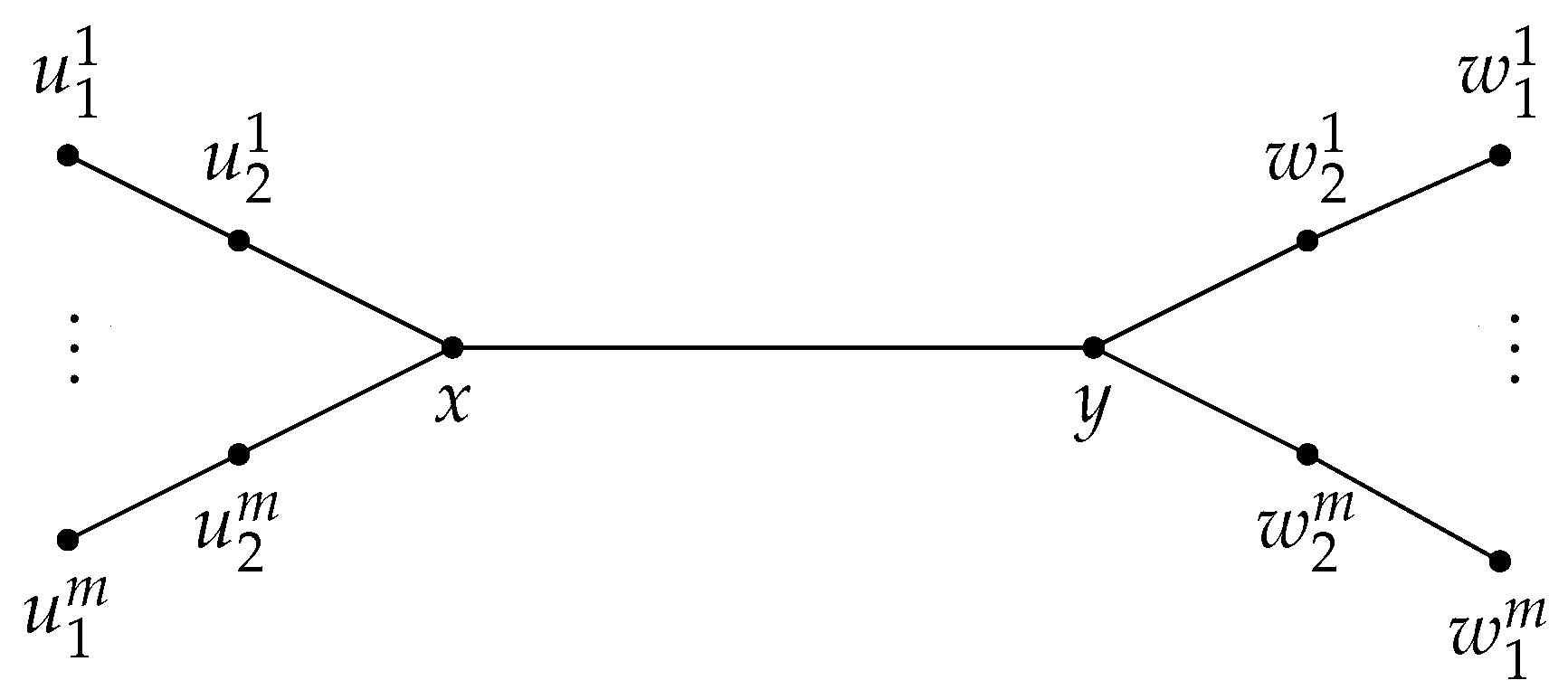
Let and be two healthy spiders with feet each and centers x and y, respectively. Let be the tree obtained from and by adding the edge (see Figure 2). It is not hard to see that , and . Therefore the bounds of Theorem 1 and Proposition 2 are sharp.
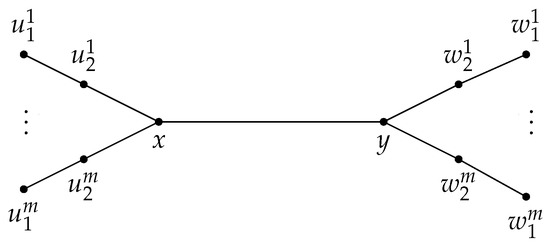
Figure 2.
A tree with .
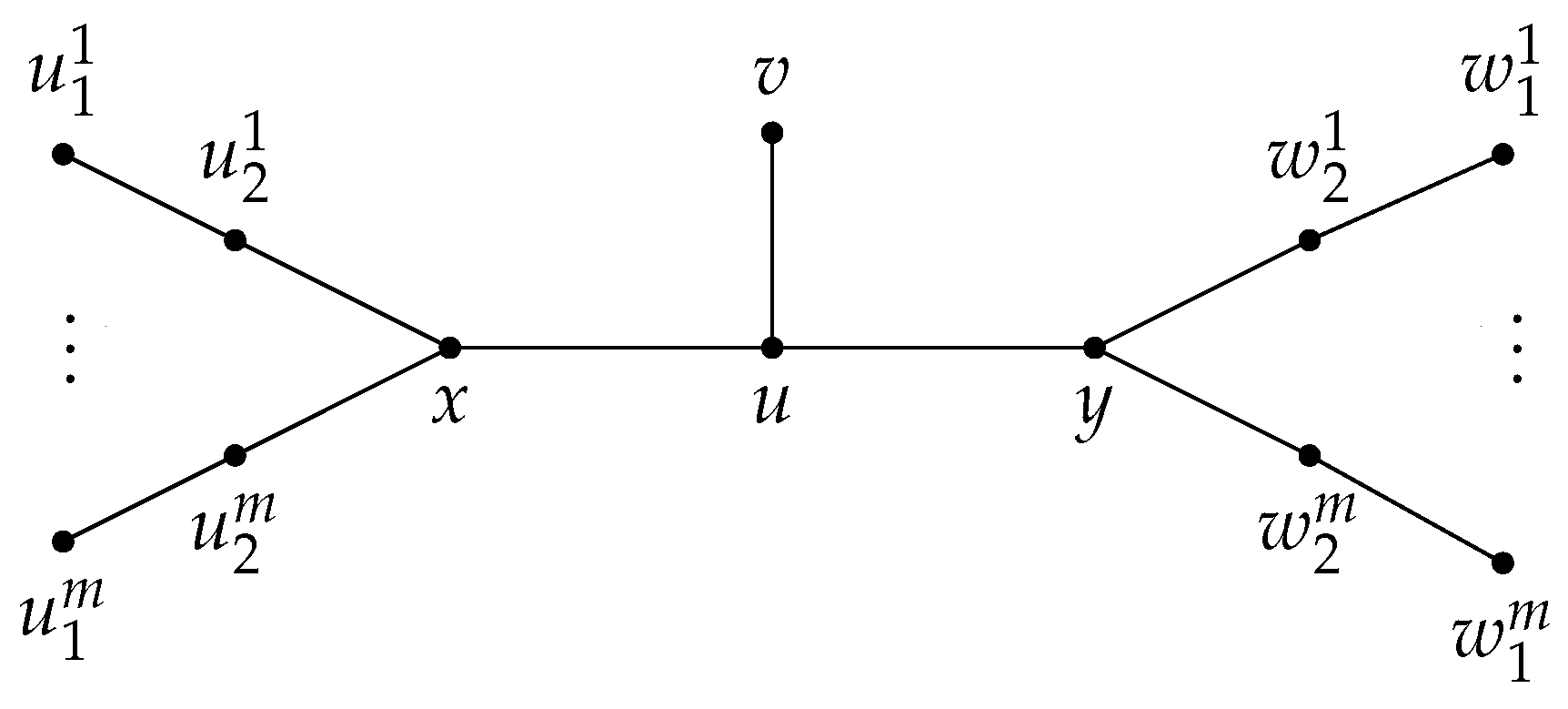
Let be the tree obtained from by subdividing the edge with a subdivision vertex u and adding a new vertex v and a new edge (see Figure 3). It is not hard to see that , and . Therefore the bounds of Theorem 1 and Proposition 2 are sharp for any tree in the family .
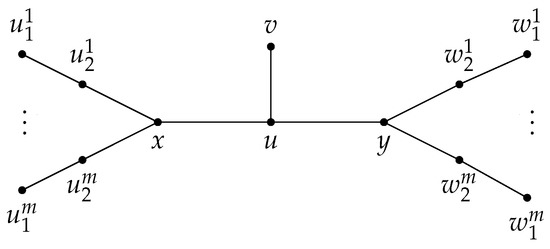
Figure 3.
A tree with .
We conclude this paper with two conjectures.
Conjecture 1.
For any connected graph G of order different from a healthy spider, .
Conjecture 2.
For any connected graph G of order different from a healthy spider, .
If G is the graph obtained from by adding a pendant edge at one vertex, then we have . Therefore, the condition is necessary to establish the second conjecture.
Author Contributions
X.Q., Z.S. and S.M.S. contribute for supervision, methodology, validation, project administration and formal analyzing. S.K., M.C., H.K. contribute for investigation, resources, some computations and wrote the initial draft of the paper, which was investigated and approved by Z.S., S.M.S. and M.C. who wrote the final draft. All authors have read and agreed to the published version of the manuscript.
Funding
This work was supported by the National Natural Science Foundation of China (61632002) and by the National Key R&D Program of China (No. 2018YFB1005100).
Institutional Review Board Statement
Not applicable.
Informed Consent Statement
Not applicable.
Data Availability Statement
Not applicable.
Conflicts of Interest
The authors declare no conflict of interest.
References
- Haynes, T.W.; Slater, P.J. Paired-domination in graphs. Networks 1998, 32, 199–206. [Google Scholar] [CrossRef]
- Chellali, M.; Haynes, T.W. Total and paired-domination in trees. AKCE J. Graphs Comb. 2004, 1, 69–75. [Google Scholar]
- Chellali, M.; Haynes, T.W. On paired and double domination in graphs. Util. Math. 2005, 67, 161–171. [Google Scholar]
- Favaron, O.; Karami, H.; Sheikholeslami, S.M. Paired-domination number of a graph and its complement. Discret. Math. 2008, 308, 6601–6605. [Google Scholar] [CrossRef]
- Haynes, T.W.; Henning, M.A. Paired-domination game played in graphs. Commun. Comb. Optim. 2019, 5, 79–94. [Google Scholar]
- Kang, L.; Sohn, M.Y.; Cheng, T.C.E. Paired-domination in inflated graphs. Theor. Comput. Sci. 2004, 320, 485–494. [Google Scholar] [CrossRef][Green Version]
- Proffitt, K.E.; Haynes, T.W.; Slater, P.J. Paired-domination in grid graphs. Congr. Numer. 2001, 150, 161–172. [Google Scholar]
- Desormeaux, W.J.; Haynes, T.W.; Henning, M.A. Paired-domination in graphs. In Topics in Domination in Graphs; Haynes, T.W., Hedetniemi, S.T., Henning, M.A., Eds.; Springer International Publishing: Berlin/Heidelberg, Germany, 2020. [Google Scholar]
- Haynes, T.W.; Hedetniemi, S.T.; Slater, P.J. Fundamentals of Domination in Graphs; Marcel Dekker, Inc.: New York, NY, USA, 1998. [Google Scholar]
- Fink, J.F.; Jacobson, M.S.; Kinch, L.F.; Roberts, J. The bondage number of a graph. Discret. Math. 1990, 86, 47–57. [Google Scholar] [CrossRef]
- Kok, J.; Mynhardt, C.M. Reinforcement in graphs. Congr. Numer. 1990, 79, 225–231. [Google Scholar]
- Velammal, S. Studies in Graph Theory: Covering, Independence, Domination and Related Topics. Ph.D. Thesis, Manonmaniam Sundaranar University, Tirunelveli, India, 1997. [Google Scholar]
- Dettlaff, M.; Kosari, S.; Lemańska, M.; Sheikholeslami, S.M. The convex domination subdivision number of a graph. Commun. Comb. Optim. 2016, 1, 43–56. [Google Scholar] [CrossRef]
- Fvaron, O.; Karami, H.; Sheikholeslami, S.M. Disprove of a conjecture the domination subdivision number of a graph. Graphs Comb. 2008, 24, 309–312. [Google Scholar] [CrossRef]
- Haynes, T.W.; Hedetniemi, S.M.; Hedetniemi, S.T.; Jacobs, D.P.; Knisely, J.; Merwe, L.C.V. Domination subdivision numbers. Discuss. Math. Graph Theory 2001, 21, 239–253. [Google Scholar] [CrossRef][Green Version]
- Favaron, O.; Karami, H.; Sheikholeslami, S.M. Connected domination subdivision numbers of graphs. Util. Math. 2008, 27, 101–111. [Google Scholar]
- Haynes, T.W.; Henning, M.A.; Hopkins, L.S. Total domination subdivision numbers of graphs. Discuss. Math. Graph Theory 2004, 24, 457–467. [Google Scholar] [CrossRef]
- Favaron, O.; Karami, H.; Sheikholeslami, S.M. Paired-domination subdivision numbers of graphs. Graphs Comb. 2009, 25, 503–512. [Google Scholar] [CrossRef]
- Amjadi, J.; Chellali, M. Complexity of the paired domination subdivision problem. 2020; Submitted. [Google Scholar]
- Egawa, Y.; Furuya, M.; Takatou, M. Upper bounds on the paired domination subdivision number of a graph. Graphs Comb. 2013, 29, 843–856. [Google Scholar] [CrossRef]
- Kosari, S.; Shao, Z.; Sheikholeslami, S.M.; Chellali, M.; Khoeilar, R.; Karami, H. On the paired-domination subdivision number of a graph. 2020; Submitted. [Google Scholar]
- Shao, Z.; Sheikholeslami, S.M.; Chellali, M.; Khoeilar, R.; Karami, H. A proof of a conjecture on the paired-domination subdivision number. 2020; Submitted. [Google Scholar]
Publisher’s Note: MDPI stays neutral with regard to jurisdictional claims in published maps and institutional affiliations. |
© 2021 by the authors. Licensee MDPI, Basel, Switzerland. This article is an open access article distributed under the terms and conditions of the Creative Commons Attribution (CC BY) license (http://creativecommons.org/licenses/by/4.0/).