


Abstract
We prove a theorem that describes all possible tensor-valued natural operations in the presence of a linear connection and an orientation in terms of certain linear representations of the special linear group. As an application of this result, we prove a characterization of the torsion and curvature operators as the only natural operators that satisfy the Bianchi identities.
PACS:
53A55; 58A32
1. Introduction
Since the very early days of differential geometry, the idea of natural operation played a mayor role in the development the theory. As an example, let us point out the applications of this notion of naturalness in the inception of general relativity (cf. [1]). In the course of the years, there also appeared some striking mathematical results, such as Gilkey’s characterization of Pontryagin forms on Riemannian manifolds [2,3] or his proof of the uniqueness of the Chern–Gauss–Bonnet formula [4]. By the end of the last century, the modern development of this theory was summarized in the monograph by Kolář-Michor-Slovák [5]. That book contained all of the main results and techniques that were known so far, and thus became the standard reference in the subject since then.
On the other hand, the notion of covariance or naturalness is, in some sense, ubiquitous in physics and mathematics. For that reason, the renewed interest in this theory of natural operations that has been raised in recent years is not surprising, with the appearance of new results and applications in contact geometry [6], homotopy theory [7,8], Riemannian and Kähler geometry [9,10,11,12], general relativity [13], or quantum field theory [14,15].
In this paper, we focus our attention on the vector space of tensor-valued natural operations that can be performed in the presence of a linear connection and an orientation. Our main result, Theorem 8, establishes that such a vector space is isomorphic to the space of invariant maps between certain linear representations of the special linear group. Thus, the description of these spaces can, in certain cases, be completely achieved using classical invariant theory. As an example of this philosophy, in the final section, we characterize the torsion and the curvature as the only natural tensors satisfying the Bianchi identities (Corollary 13 and Theorem 15).
These results generalize analogous statements that were recently proven in [16], where we studied natural tensors associated with a linear connection. This was also the situation considered in a landmark paper by Slovák [17], whose results were included—and expanded—in [5]. Nevertheless, the non-specialist may find it difficult to understand the precise meaning of some statements of this book due to the functorial language and the generality of its setting.
For this reason, we outlined in [16] the foundations of an alternative approach, which we hope will be accessible to a wider audience. The present paper lays out complete proofs of the main results of this approach, whose novelties are a systematic use of the language of sheaves, ringed spaces, and a more elementary—yet equivalent (cf. [18])—notion of the natural bundle. In our opinion, the heart of the matter in this theory is the existence of an analogue of a Galois theorem (cf. [18], Thm. 1.6), which allows the use of group theory to infer theorems in many areas of differential geometry, in many of which (such as Fedosov, contact, or Finsler geometry) this idea is still to be exploited.
2. The Category of Ringed Spaces
In this section, we firstly introduce the category of ringed spaces, which is a framework adequate for our purposes: It will allow us to treat certain “infinite dimensional” spaces—such as the ∞-jet space or a countable product of vector spaces—and quotients of smooth manifolds by the actions of groups on equal footing as usual smooth, finite-dimensional manifolds.
Secondly, we state Theorem 4, which is an important characterization of differential operators as the morphisms of sheaves that transform smooth families of sections into smooth families of sections.
Definition 1.
A ringed space is a pair , where X is a topological space and is a sub-algebra of the sheaf of real-valued continuous functions on X.
A morphism of ringed spaces is a continuous map such that composition with φ induces a morphism of sheaves , that is, for any open set and any function , the composition lies in .
Any smooth manifold X is a ringed space, where is the sheaf of smooth real-valued functions. If X and Y are smooth manifolds, a morphism of ringed spaces is just a smooth map.
By analogy with this example, on any ringed space , the sheaf will be called the sheaf of smooth functions, and morphisms of ringed spaces will be often referred to as smooth morphisms.
2.1. Limits of Ringed Spaces
This category possesses limits; nevertheless, in what follows, only the following particular case appear.
Definition 2.
The inverse limit of a sequence of smooth manifolds and smooth maps between them
is the ringed space , which is defined as follows:
- -
- The underlying topological space is the inverse limit of the topological spaces , i.e., the setis endowed with the minimum topology for which the canonical projections are continuous.
- -
- Its sheaf of smooth functions is the direct limit .
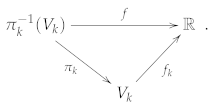
That is to say, for any open set , a continuous map lies in if and only if, for any point , there exist , an open neighborhood , and a smooth map such that the following triangle commutes:
Later, we will need the following two properties regarding the smooth structure of this inverse limit:
Universal property of the inverse limit:For any smooth manifold , the projections induce a bijection that is functorial on Y,
where denotes the set of morphisms of ringed spaces.
Proof.
The projections are smooth maps, so one inclusion is trivial. As for the other, let be a continuous map such that is smooth for any .
Let be a smooth function and let . On a neighborhood V of , there exists an smooth map such that , and therefore:
which is smooth because is a smooth map. □
Proposition 1.
Let Z be a smooth manifold. A continuous map is smooth if and only if it locally factors through a smooth map defined on some .
Proof.
Let be a smooth map; let be a point and let be a coordinate chart around in Z. Each of the functions locally factors through some ; as they are a finite number, there exists and an open neighborhood V of x such that all of them, when restricted to V, factor through . Hence, , where .
The converse is obvious because the composition of morphisms of ringed spaces is a morphism of ringed spaces. □
As examples, the space of -jets of sections of a fiber bundle is defined as the inverse limit of the sequence of k-jets fiber bundles:
In addition, if is a countable family of finite-dimensional -vector spaces, the vector space is, by definition, the inverse limit of the projections:
2.2. Quotients by the Action of Groups
Let be a group acting on a ringed space . Let us denote by the quotient topological space and by the quotient map.
Definition 3.
The quotient ringed space is the ringed space whose underlying topological space is the quotient topological space and whose sheaf of smooth functions is defined, on any open set as:
where stands for the set of maps such that for any and .
It is then routine to check that the quotient map is a morphism of ringed spaces that satisfies the following property:
Universal property of the quotient:For any ringed space , the quotient map induces a functorial bijection:
Corollary 2
(Orbit reduction). Let G be a group acting on a ringed space X, and let be a surjective morphism of ringed spaces that, locally on Y, admits smooth sections passing through any point of X.
If the orbits of G coincide with the fibers of f, then the corresponding map is an isomorphism of ringed spaces.
Proof.
The hypothesis on the fibers assures that the induced morphism is bijective. The inverse map is also a morphism of ringed spaces because it locally coincides with the projection into the quotient of any smooth section of f. □
There is also the following corollary, whose proof is routine:
Corollary 3.
Let be a group acting on two ringed spaces X and Y, and let be a subgroup that acts trivially on Y.
Then, the universal property of the quotient restricts to a bijection:
2.3. Differential Operators
Let and be fiber bundles over a smooth manifold .
Definition 4. 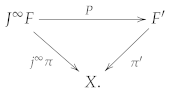
A differential operator is a morphism of ringed spaces such that the following triangle commutes:
Let us denote by and the sheaves of smooth sections of F and , respectively.
Definition 5.
A family of sections is smooth if T is a smooth manifold and the following conditions are satisfied:
- 1.
- is an open set of .
- 2.
- The map , defined as , is smooth.
A morphism of sheaves is regular if, for any smooth family of sections , the family is also smooth.
Any differential operator defines a morphism of sheaves
and the chain rule proves that it is a regular morphism of sheaves.
The following statement is a particular case of a deep result due to J. Slovák (see [5], Sect. 19.7, or [19] for a proof of the specific statement below):
Theorem 4
(Peetre-Slovák). If and are fiber bundles over a smooth manifold X, then the assignment explained above establishes a bijection:
3. Natural Operations in the Presence of an Orientation
The purpose of this section is twofold: On the one hand, we present the notion of natural operation (Definition 7); our definition strongly differs from the standard one (cf. [5]), although it is equivalent to it ([18]). On the other hand, we prove a general result—Theorem 6—that relates these natural operations with certain smooth equivariant morphisms.
3.1. Natural Bundles
Let denote the set of diffeomorphisms between open sets of a smooth manifold .
If is a bundle over , a lifting of diffeomorphisms is a map:
such that if is a diffeomorphism between open sets in , then is a diffeomorphism covering ; that is to say, making the following square commutative
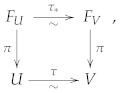
where and .
Definition 6. 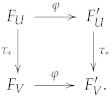
A natural bundle over a smooth manifold X is a bundle together with a lifting of diffeomorphisms satisfying the following properties:
- 1.
- Functorial character: and .
- 2.
- Local character: For any diffeomorphism and any open subset ,
- 3.
- Regularity: If is a smooth family of diffeomorphisms between open sets on X, then the family is also smooth.
A sub-bundle E of a natural bundle F is said to be natural if it is a natural bundle and its lifting of diffeomorphisms is the restriction of the lifting of diffeomorphisms of F.
A morphism of natural bundles is a morphism of bundles that commutes with the lifting of diffeomorphisms; that is, such that for any diffeomorphism , the following square commutes:
The tangent and cotangent bundles, or, more generally, the bundles of -tensors , are examples of natural bundles. The sub-bundle of k-forms is a natural sub-bundle of the bundle of k-covariant tensors .
If is a natural bundle, its k-jet prolongation is also a natural bundle for all . Thus, if is a diffeomorphism, its liftings to these jet spaces allow the definition of a lifting to the ∞-jet space—in other words, a morphism of ringed spaces
covering the diffeomorphism .
Let and be natural bundles over X, and let and be their sheaves of smooth sections, respectively.
Definition 7. 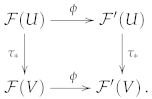
A differential operator is natural if it is a morphism of ringed spaces that commutes with the lifting of diffeomorphisms.
A morphism of sheaves is natural if it is a regular morphism of sheaves that commutes with the action of diffeomorphisms on sections; that is to say, if for any diffeomorphism between open sets of X, the following square commutes:
where is defined as for any .
Theorem 5.
The choice of a point allows the definition of a bijection:
where stands for the group of germs of diffeomorphisms τ between open sets of X such that .
Proof.
In this context, where both F and are natural bundles, the bijection of Theorem 4 specializes to a bijection:
Then, a standard argument—using that the pseudogroup acts transitively on X—allows one to prove that restriction to the fiber of the point p establishes a bijection:
To be precise, if is a -equivariant map, the corresponding differential operator is defined, over the fiber of any other point , as the composition , where is any diffeomorphism such that . The choice of a different produces the same P due to the -equivariance of , whereas the smoothness of P is a consequence of the smoothness assumptions on the liftings on F and . □
3.2. Natural Operations in the Presence of an Orientation
Let us now explain how to generalize Theorem 5 to the case of natural operations that depend on an orientation.
First of all, we observe that the orientation bundle is a natural bundle: The lifting of a diffeomorphism at a point p is the identity in the case that is positive, and the other map otherwise.
On the other hand, let us also observe that the direct product of natural bundles is also a natural bundle with the obvious lifting of diffeomorphisms.
Theorem 6.
Let F and be natural bundles over X, and let and be their sheaves of smooth sections, respectively.
The choice of a point and an orientation at p produces a bijection:
where denotes the sheaf of orientations on X, and stands for the group of germs at p of diffeomorphisms τ such that and .
Proof.
Due to Theorem 5, the choice of a point p allows the definition of a bijection:
As the action of the group on the ringed space is transitive, a general statement about ringed spaces—Proposition 7 below—permits us to conclude. □
Proposition 7.
Let G be a group acting on three ringed spaces X, Y, and Z.
If the action on Y is transitive, then the choice of a point allows the definition of a bijection:
where denotes the isotropy group of .
Proof.
For any smooth map , the restriction to the subspace defines a smooth -equivariant map .
Conversely, any smooth -equivariant map can be extended to a smooth -equivariant map as follows:
where is any element such that .
Finally, it is not difficult to check that this extension is well defined, as well as that both assignments are mutually inverse. □
4. Invariants of Linear Connections and an Orientation
This section is devoted to proving Theorem 8, which is a description of the space of natural tensors associated to a linear connection and an orientation.
Let be the germ of a linear connection at a point , and let be the germ of the flat connection at corresponding, via the exponential map, to the flat connection of .
Let be the -tensor:
Definition 8.
For any integer , the m-th normal tensor of ∇ at p is .
In a system of normal coordinates for ∇ at p:
Definition 9.
The space of normal tensors of order m at p is the vector subspace of -tensors T at p satisfying the following symmetries:
- 1.
- They are symmetric in the last m covariant indices:
- 2.
- The symmetrization of the covariant indices is zero:
Normal tensors lie in [20] (Prop. 3.4). Thus, it makes sense to consider the following maps for any :
where denotes the bundle of linear connections on X (not necessarily symmetric).
These maps are compatible in the sense that the following diagrams commute:
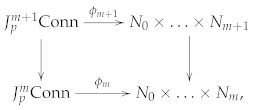
and hence, they define a morphism of ringed spaces between the corresponding inverse limits:
For any , let us consider the Lie groups as well as their subgroups .
Their inverse limits define groups
that can be related via a short, exact sequence of groups:
where .
Reduction Theorem.
The equivariant morphism of ringed spaces
is surjective, its fibers are the orbits of , and it admits smooth sections passing through any point of .
As a consequence, induces a -equivariant isomorphism of ringed spaces:
Proof.
By [20] (Thm. 3.6), the -equivariant maps
are surjective, regular projections whose fibers are the orbits of for any .
Let us explain how these facts imply the statement above that deals with formal developments of connections. Firstly, as is -equivariant and surjective for all m, it follows that is -equivariant and surjective.
Next, let us check that the fibers of are the orbits of . On the one hand, if for some , the condition of being -equivariant implies
Conversely, if , then for all m. Therefore, there exists such that . The sequence defines an element that verifies
so that both formal developments are in the same orbit of .
As for the existence of smooth sections, let us choose a local coordinate system centered at p. For any given formal development , the proof of [20] (Thm. 3.6) shows how these coordinates define a global section of that passes through . These sections are easily checked to be compatible with the projections and for all m, so that they, in turn, define a morphism of ringed spaces that is a section of and passes through .
Finally, the last assertion of the statement is a consequence of Corollary 2. □
Theorem 8.
Let X be a smooth manifold and let and denote the sheaves of connections and orientations on X, respectively.
Let F be a natural sub-bundle of the bundle of -tensors and let be its sheaf of smooth sections.
If we fix a point and an orientation at p, there exists an -linear isomorphism
where run over the non-negative integer solutions of the equation
and where and .
Proof.
Theorem 6 yields the isomorphism:
Observe that the action of over and coincides with that of , so that, in the formula above, we may consider -equivariant maps instead.
In addition, notice that the following sequence of groups is exact:
The subgroup acts by the identity over so that Corollary 3, in conjunction with the exact sequence above, assures the existence of an isomorphism:
Now, the Reduction Theorem above allows us to replace this quotient ringed space with an infinite product of vector spaces via the isomorphism:
Finally, in the last step, we make use of the equivariance by homotheties of ratio . As , the equivariance of these maps t implies
for all , .
In view of this property of the smooth maps t, the Homogeneous Function Theorem stated below (to be precise, Formula (7)) allows us to conclude with the isomorphism:
where are non-negative integers running over the solutions of the equation
□
Homogeneous Function Theorem.Let be finite-dimensional vector spaces.
Let be a smooth function such that there exist positive real numbers and satisfying:
for any positive real number and any .
Then, f depends on a finite number of variables , and it is a sum of monomials of degree in satisfying the relation
If there are no natural numbers satisfying this equation, then f is the zero map.
Proof.
Firstly, if f is not the zero map, then we observe because, otherwise, (4) is contradictory when .
As f is smooth, there exists a neighbourhood of the origin and a smooth map such that .
As the are positive, there exist a neighborhood of zeros, , and a neighborhood of the origin such that, for any and any that are positive, the vector lies in V.
On that neighborhood V, the function satisfies the homogeneity condition:
for any positive real number .
Differentiating this equation, we obtain analogous conditions for the partial derivatives of ; v.gr.:
If the order of derivation is big enough, the corresponding partial derivative is homogeneously of negative weight and, hence, zero. This implies that is a polynomial; the homogeneity condition (6) is then satisfied for any positive if and only if its monomials satisfy (5).
Finally, given any , we take such that the vector lies in U. Then:
and f only depends on the first k variables. □
This statement readily generalizes to say that, for any finite-dimensional vector space W, there exists an -linear isomorphism:
where run over the non-negative integer solutions of (5).
5. An Application
Finally, as an application of Theorem 8, in this section, we compute some spaces of vector-valued and endomorphism-valued natural forms associated to linear connections and orientations, thus obtaining characterizations of the torsion and curvature operators (Corollary 13 and Theorem 15).
5.1. Invariant Theory of the Special Linear Group
Let be an oriented -vector space of finite dimension , and let be the real Lie group of its orientation-preserving -linear automorphisms.
Our aim is to describe the vector space of -invariant linear maps:
For any permutation , there exist the so-called total contraction maps, which are defined as follows:
Moreover, let be a representative of the orientation, and let be the dual n-vector; that is to say, the only element in such that . For any permutation , the following linear maps are also -invariant:
Classical invariant theory proves that these maps suffice to generate the vector space under consideration.
Theorem 9.
The real vector space of invariant linear forms on is spanned by
where k is a non-negative integer such that .
In particular, for , the vector space of -invariant linear maps coincides with the vector space of -invariant linear maps.
In the applications, we will also require the following facts:
Proposition 10.
Let and be (algebraic) linear representations of .
- There exists a linear isomorphism .
- If is a sub-representation, then any equivariant linear map is the restriction of an equivariant linear map .
5.2. Uniqueness of the Torsion and Curvature Operators
Definition 10.
Let be a natural vector bundle. An E-valued natural k-form (associated to linear connections and orientations) is a regular and natural morphism of sheaves
where denotes the sheaf of differential k-forms on X and stands for the sheaf of smooth sections of E.
Theorem 8 implies, in particular, that the space of E-valued natural forms associated to linear connections and orientations is a finite-dimensional real vector space. Moreover, as the exterior differential commutes with diffeomorphisms, it induces -linear maps:
where it should be understood that, if is an E-valued natural k-form, the differential is defined, on each section , with respect to the linear connection on E induced by ∇.
Definition 11.
A closed E-valued natural k-form (associated to linear connections and orientations) is an element in the kernel of the map above.
5.3. Vector-Valued Natural Forms
The torsion tensor of a linear connection can be understood as a vector-valued natural 2-form; that is to say, as a regular and natural morphism of sheaves
where stands for the sheaf of vector fields on X.
To be precise, the value of that tensor on a linear connection ∇ and an orientation on an open set is
so that, in particular, it is independent of the orientation.
On the other hand, if denotes the identity map and stands for the trace of the first covariant and contravariant indices, the tensor defines another vector-valued natural 2-form:
Lemma 11.
If , then and are a basis of the -vector space of vector-valued natural 2-forms.
Proof.
Looking at Theorem 8, we first compute the non-negative integer solutions of
There is only one solution, namely , , for , so Theorem 8 assures that the vector space under consideration is isomorphic to the space of -equivariant linear maps:
Thus, the problem is reduced to a question of invariants for the special linear group, and we can invoke Theorem 9 and Proposition 10 to obtain generators for this vector space.
According to those results, if , then the space of -equivariant linear maps that we are considering coincides with the space of -equivariant linear maps, which, in turn, are proved in [16] (Lemma 3.5) to be spanned by H and .
If , there may exist another generator; namely, the map , which, in coordinates around p, reads:
where and is its dual 3-vector.
If denote the Christoffel symbols, then a trivial computation allows us to express
as well as the linear relation . □
Theorem 12.
If , then the exterior differential is an injective -linear map:
Proof.
It is a consequence of both Lemma 11 and the fact that and are -linearly independent [16] (Theorem 3.6). □
The so-called first Bianchi identity for the torsion tensor describes its differential in terms of the curvature, R, and the identity map, I: It is the following equality of vector-valued natural 3-forms:
Therefore, an immediate corollary of Theorem 12 is:
Corollary 13.
The torsion tensor is characterized as the only vector-valued natural 2-form ω that satisfies the first Bianchi identity, i.e., such that .
5.4. Endomorphism-Valued Natural Forms
In this section, we restrict our attention to symmetric linear connections.
As in the case of the torsion tensor, the curvature tensor can also be thought of as an endomorphism-valued natural 2-form; that is to say, as a (regular and natural) morphism of sheaves
whose value on a symmetric linear connection and an orientation defined on an open set are the following endomorphism-valued 2-form on :
Definition 12.
An endomorphism-valued natural 2-form ω satisfies the first Bianchi identity if, for any symmetric linear connection , any orientation and any vector fields :
The curvature tensor satisfies the first Bianchi identity. Moreover, if and denote the symmetric and skew-symmetric parts of the Ricci tensor , then the following tensors also satisfy the first Bianchi identity:
Lemma 14.
If , then the tensors , and R are a basis of the -vector space of endomorphism-valued natural 2-forms that satisfy the first Bianchi identity.
If , then that vector space has dimension four.
Proof.
Let be the vector space of endomorphism-valued 2-forms at a point that satisfies the first Bianchi identity. Theorem 8 describes the space of the natural 2-forms under consideration as the vector space:
where are non-negative integers verifying the equation:
The only solution to this equation is , , so that the vector space to analyze is the space of -equivariant linear maps:
First of all, recall that the maps induced by the tensors R, , and are a basis of the space of -equivariant linear maps ; see [16] (Lemma 3.11).
A systematic application of Theorem 9 now allows us to find generators for the space of -equivariant maps.
If , then the vector space of -equivariant maps coincides with the space of -equivariant maps and, hence, is generated by these three elements.
In case , there is another possible generator: the map defined as
However, as any tensor in is symmetric in the first two indices, it readily follows that this map is identically zero.
If , let us first describe the -equivariant endomorphisms .
To this end, let and be coordinates centered at p such that is positively oriented, and let be its dual 3-vector.
Using and , we can construct 16 generators, and they can all be expressed as a permutation of the factors of followed by one of these four maps:
- (a)
- ,
- (b)
- ,
- (c)
- ,
- (d)
- .
As the first two covariant indices of are symmetric, the following maps are identically zero: (a), (b), and raising the first two indices at (c) and (d).
That leaves eight non-zero generators. However, this symmetry also makes raising indices 1, 3 and 2, 3 indistinguishable, hence reducing to just four generators.
The last step is to check which of these maps take values in . Out of these four generators, only the following two produce tensors that are skew-symmetric in the first two covariant indices:
and the skew-symmetrization of the remaining two is a linear combination of these.
None of these two tensors satisfy the first Bianchi identity, but the linear combination does.
Finally, all that is left to prove is that is -linearly independent of , and . In order to do that, it is enough to find a symmetric linear connection and an orientation on a 3-manifold X such that the aforementioned tensors on X are -linearly independent.
The following example works: Let be the linear connection on whose only non-zero Christoffel symbols in cartesian coordinates are
Assume that is positively oriented, and denote .
Direct computation gives the following linearly independent tensors, thus finishing the proof:
□
Definition 13.
An endomorphism-valued natural 2-form ω is said to satisfy the second Bianchi identity if it is closed in the sense of Definition 11.
Theorem 15.
The constant multiples of the curvature are the only endomorphism-valued natural 2-forms that satisfy both the first and second Bianchi identities.
Proof.
The curvature tensor R is always a closed natural 2-form, so, by the previous Lemma, it is enough to analyze the -linear span of the differentials of , , and, in dimension 3, of .
If , then and are linearly independent by [16] (Thm. 3.13), and the statement follows.
If , a direct computation, using the same example as in the previous Lemma, proves that , , and are -linearly independent tensors:
□
Author Contributions
All authors contributed equally to this work. All authors have read and agreed to the published version of the manuscript.
Funding
The authors were partially supported by Junta de Extremadura and FEDER funds with project IB18087, as well as with project GR18001 in the case of the second and third authors. The second author was additionally supported by the grant “Plan Propio de Iniciación a la Investigación, Desarrollo Tecnológico e Innovación” of Universidad de Extremadura.
Conflicts of Interest
The authors declare no conflict of interest.
References
- Mehra, J. Einstein, Hilbert, and the Theory of Gravitation. Historical Origins of General Relativity Theory; Reidel: Dordrecht, The Netherlands, 1974. [Google Scholar]
- Atiyah, M.; Bott, R.; Patodi, V.K. On the heat equation and the index theorem. Invent. Math. 1973, 19, 279–330. [Google Scholar] [CrossRef]
- Gilkey, P.B. Curvature and the eigenvalues of the Dolbeault complex for Kaehler manifolds. Adv. Math. 1973, 11, 311–325. [Google Scholar] [CrossRef]
- Gilkey, P. Local invariants of an embedded Riemannian manifold. Ann. Math. 1975, 102, 187–203. [Google Scholar] [CrossRef]
- Kolář, I.; Michor, P.W.; Slovák, J. Natural Operations in Differential Geometry; Springer: Berlin/Heidelberg, Germany, 1993. [Google Scholar]
- Bernig, A. Natural operations on differential forms on contact manifolds. Differ. Geom. Appl. 2017, 50, 34–51. [Google Scholar] [CrossRef][Green Version]
- Freed, D.S.; Hopkins, M.J. Chern-Weil forms and abstract homotopy theory. Bull. Am. Math. Soc. 2013, 50, 431–468. [Google Scholar] [CrossRef]
- Navarro, J.; Sancho, J.B. Natural operations on differential forms. Differ. Geom. Appl. 2015, 38, 159–174. [Google Scholar] [CrossRef]
- Gilkey, P.; Park, J.H.; Sekigawa, K. Universal curvature identities. Differ. Geom. Appl. 2011, 62, 814–825. [Google Scholar] [CrossRef]
- Gilkey, P.; Park, J.H.; Sekigawa, K. Universal curvature identities and Euler Lagrange Formulas for Kaehler manifolds. J. Math. Soc. Jpn. 2016, 68, 459–487. [Google Scholar] [CrossRef]
- Navarro, A.; Navarro, J. Uniqueness of the Gauss-Bonnet-Chern formula (after Gilkey-Park-Sekigawa). J. Geom. Phys. 2016, 101, 65–70. [Google Scholar] [CrossRef]
- Timashev, D.A. On differential characteristic classes of metrics and connections. J. Math. Sci. 2017, 223, 763–774. [Google Scholar] [CrossRef]
- Navarro, J. On second-order, divergence-free tensors. J. Math. Phys. 2014, 55, 062501. [Google Scholar] [CrossRef]
- Khavkine, I.; Moretti, V. Analytic Dependence is an Unnecessary Requirement in Renormalization of Locally Covariant QFT. Commun. Math. Phys. 2016, 344, 581–620. [Google Scholar] [CrossRef][Green Version]
- Khavkine, I.; Melati, A.; Moretti, V. On Wick Polynomials of Boson Fields in Locally Covariant Algebraic QFT. Ann. Henri Poincaré 2019, 20, 929–1002. [Google Scholar] [CrossRef]
- Gordillo-Merino, A.; Martínez-Bohórquez, R.; Navarro, J. On the uniqueness of the torsion and curvature operators. Revista de la Real Academia de Ciencias Exactas Físicas y Naturales Serie A Matemáticas 2020, 114, 1–13. [Google Scholar] [CrossRef]
- Slovák, J. On invariant operations on a manifold with connection or metric. J. Differ. Geom. 1992, 36, 633–650. [Google Scholar] [CrossRef]
- Navarro, A.; Navarro, J.; Tejero-Prieto, C. Natural operations on holomorphic forms. Arch. Math. (Brno) 2018, 54, 239–254. [Google Scholar] [CrossRef]
- Navarro, J.; Sancho, J.B. Peetre-Slovák theorem revisited. arXiv 2014, arXiv:1411.7499. [Google Scholar]
- Gordillo, A.; Navarro, J. On moduli spaces for finite-order jets of linear connections. Filomat 2017, 31, 2035–2044. [Google Scholar] [CrossRef]
Publisher’s Note: MDPI stays neutral with regard to jurisdictional claims in published maps and institutional affiliations. |
© 2021 by the authors. Licensee MDPI, Basel, Switzerland. This article is an open access article distributed under the terms and conditions of the Creative Commons Attribution (CC BY) license (https://creativecommons.org/licenses/by/4.0/).